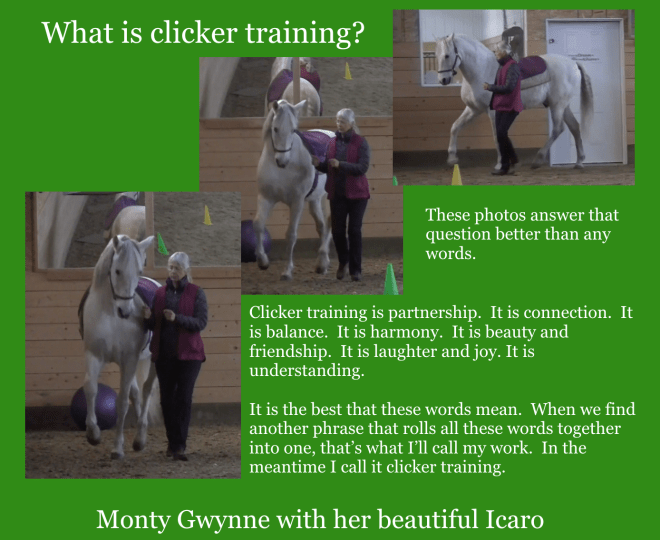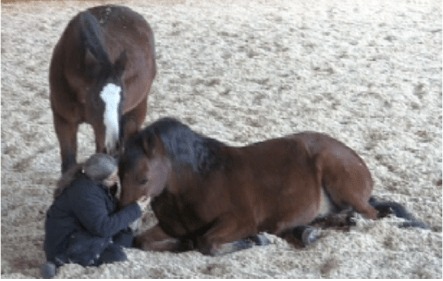
What Is Clicker Training?

JOY FULL Horses: Ten Things You Should Know About Cues: Number 9.) You Can’t Not Cue: Part 3 of 12

Labels
In the previous section I introduced you to Poco, an extremely ear-shy horse.  I ended that section by saying: “Poco wasn’t going to be helped by following old recipes, but by coming up with solutions that were tailored to his needs.  To do that we had to look more broadly at all that clicker training means.”

I put my first JOYFULL horses post up on January 2, 2016.  This far into the book may seem like an odd time to be asking such a basic question: what is clicker training?  But this question refers to so much more than just the surface definition of clicker training.

The term clicker training was coined by Karen Pryor.  In it’s simplest form it refers to applied operant condition in which a marker signal is paired with positive reinforcement.  In other words, if you like what your animal is doing, you click and reinforce him.

For years at clinics I’ve had people say to me you really need to call your work something other than clicker training.  What you do is so much more than clicker training.

I always throw this right back to them.  What would you call it?

I get lots of suggestions but nothing so far has stuck.  So many of the words that describe my work have been used, abused, and over-used.  Or they are too specific to a narrow area of horse training.

Harmony, balance, partnership have all been used so many times by so many different approaches to training they have lost any meaning.  You can have two diametrically opposed training systems both talking about partnership.  They’ll end up with very different looking horses and each group will be convinced they have “true partnership” and the others don’t.  Sigh.  Labels can leave behind a huge and very controversial mine field to navigate.

When I first came across clicker training, it had no associations attached to it.  It was just a label, a way of referencing a particular approach to training.  I had not seen other clicker-trained horses because there weren’t any around.  I hadn’t yet experimented with it, so I brought no strong biases to the term – good or bad.  It was simply a label, a convenient way to reference a system of training in which a marker signal was paired with positive reinforcement.

For me the term “clicker training” is still a convenient way to refer to a system of training that uses a marker signal, but it has grown to have many more associations for me and for others.  If someone has seen clicker training applied badly, just the mention of the name may send them over the edge into a long diatribe against it.

I’ve seen plenty of clumsy, not well-thought-out clicker training sessions over the years, but that doesn’t make me want to run from the label.  It makes me want to find better ways to teach the work.

What Clicker Training Means To Me
I’ve experienced so much joy both in my own horses and in sharing the work with others that I don’t want to walk away from the label.  Instead I want to make it clearer what clicker training can be.  I don’t know what clicker training has come to mean to others, but to me, when I think of clicker-trained horses, I see happy, well mannered, beautifully balanced horses who are a joy to be around.
icky-what-is-clicker-training-3
My clicker-trained horses make me smile.  I hope how I handle them gives my horses the equine equivalent of those happy feelings.  That’s what I want to share with others.

In 1993 when I started experimenting with clicker training, I didn’t head out to the barn thinking – “I’m going to write a book about this.”  I just wanted to find a way to keep Peregrine entertained while he was on stall rest.

There weren’t other people clicker training horses who I could turn to as role models or who could provide how-to instructions.  That meant I got to invent my own version of clicker training.

Defining Clicker Training
If you were to ask me to define clicker training, I would begin with Karen Pryor’s definition: clicker training is applied operant conditioning in which a marker signal is paired with positive reinforcement.

That gives us an operational definition, but clicker training is so much more than that.  I see it as a huge umbrella under which I can fit many different approaches to horse training.  For example, I studied for a time with Linda Tellington-Jones, the founder of TTEAM, so I fit her training under the umbrella.  I also put the work I learned from John Lyons under this same umbrella even though Lyons himself is not a clicker trainer.  These two training methods represent fundamentally different philosophies of horse training, but I was able to draw good things from both and adapt what I learned to fit under my clicker umbrella.

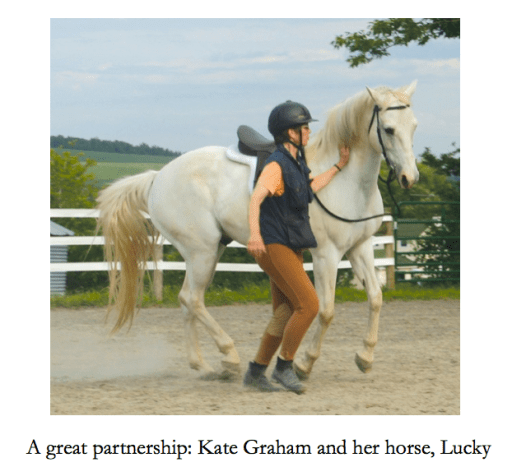
When I think of clicker training, I see a complete and very structured approach to training that results in well-mannered, happy horses.  I think of beautifully-balanced horses who are both having fun and are fun to be around.

Lucky with caption

That’s what I see.  But if all you’ve seen of clicker training is someone using it to teach simple tricks, you may see the fun – but not the balance.  Or maybe you’ve just seen someone who was fumbling around the edges of clicker training.  Your picture of clicker training may be a frustrated horse who is acting aggressively towards the handler.

Creating Stepping Stones
The more people who encounter clicker training the more different images of what it is there will be.  Clicker training will evolve and morph into something else.  That’s the nature of all creative work.  It is never static.  Clicker training, which seemed so revolutionary, so very much on the leading edge of training when I first encountered it, will become mainstream.  It will be the stepping stone to the next leading-edge idea.

We can’t yet know what that idea will be, not until it has had time to evolve.

This is the nature of the creative process.  Humans thrive on creativity.  This is part of play.  You are exploring two separate ideas and suddenly you see how you can put them together to create a completely original combination.  Both ideas by themselves were great.  Combined they are transforming.

So let’s look underneath the clicker training umbrella and see what’s really there.  Let’s also ask the question: are you a clicker trainer, or are you someone who just uses a clicker?  And what is the difference that that question is seeking to answer?

(And yes, I will get back to Poco and his ear-shy problem.)

Coming next: Are You A Clicker Trainer or a User of Clicker Training?

Remember, if you are new to the JOY Full Horse blog, click on the JOY Full Horses tab at the top of this page to find the full table of contents and links to each of the articles I have published so far.

I hope you will want to share these articles by sending links to this blog to your friends.  But please remember this is copyrighted material.  All rights are reserved. Please do not copy any of the “JOY Full Horses” articles without first getting written permission from Alexandra  Kurland, via theclickercenter.com

Also note: these articles are not intended as an instruction guide for introducing your horse to clicker training.  If you are new to clicker training and you are looking for how-to instructions, you will find what you need at my web sites:

theclickercenter.com                    theclickercentercourse.com

JOYFull Horses: Cue Communication Continued: Part 6 – Just Tell me How You Feel

Listen to Your Horse
I’ve been describing a lesson I call “Capture the Saddle”.  It’s used to teach horses to line themselves up next to a mounting block.  In the previous section I talked about how you can turn this ordinary, everyday behavior into extraordinary “Grand Prix” level excellence.

Even before you have built the behavior to this point, you can use the mounting block as a measure of how your horse is feeling.  If your horse normally lines up well, but today he is swinging out or he’s walking off before you can get on, don’t assume that he’s “testing” you.  Instead ask him what’s wrong?  He knows standing at the mounting block leads to riding.  Why doesn’t he want to be ridden today?

Our horses work so hard to communicate with us.  We need to learn to be better listeners.  When we train them with play in our hearts, they will want to work with us.  If today they are saying “No” to riding, there’s a good reason.  It may not always be obvious, but we need to become good detectives and find the answer.

Detective Work
Ask most horse owners about the ancestral background of the horse, and they can tell you that horses are a prey species that evolved in open grasslands.  What they may not be as clear about are some of the consequences of that background.

Horses are herd animals because there is safety in numbers.  The flip side of this is there is danger in appearing to be vulnerable.  A lame or sick horse draws attention to itself and to the herd as a whole.  Show weakness, and you’ll be drawing in predators, so horses are very good at hiding their injuries.  They are protecting not just themselves, but their whole family.  It takes something acutely painful such as an abscess or a torn tendon to bring a horse hobbling to a stand still.  If they can hide an injury, they will.

So we have to be good detectives.  It may not be immediately obvious what is wrong, but if you keep looking, if you keep collecting data, you may be able to piece together enough clues to discover that the reason your horse fidgets at the mounting block has nothing to do with training and everything to do with the poorly fitting saddle that is hurting his back.

“Just Tell Me How You Feel”
Normally an angry or frightened horse gives lots of warning signals that he is about to explode.  If you punish those early warning signals in an attempt to stop a horse from biting, you can create that most dangerous of animals – a horse that gives no warning signals and goes straight to attacking when he has been pushed over threshold.

Just as horses can learn to withhold these signs of stress, they can learn the opposite.  Instead of punishing them for fidgeting and refusing to step up to the mounting block, if you show them instead that you will listen to them, they will become more comfortable about expressing how they feel.

Just as we can actively teach a process that leads to intelligent disobedience, we can teach our horses to express more openly how they are feeling.  When we listen to them in a context such as the mounting block, they begin to generalize the concept and offer us a truer picture of how they feel both physically and emotionally.

Peregrine for years bounced from one health crisis to another.  The  aftermath of a bout of Potomac Horse fever sent him on a downward health spiral that took several years to sort out.  During that time I was grateful for his grumpy faces.  I needed to know from one day to the next how he was feeling.

He was never punished for making faces.  The rule was he could make faces.  He just couldn’t act out on them.  Because I was listening, he never needed to.

Saying “No”
Sometimes the reason a horse says “No” to us, is not because there is something wrong with him, but because there is something that isn’t right with us.

This was driven home to me by a horse I met in a clinic many years ago.  The horse was on loan to one of the course participants.  She was a very clicker-experienced horse who was used to being handled by a skilled and very tactful owner.

Some horses are incredibly generous teachers.   They seem to enjoy working with beginners.  They are truly worth their weight in gold as they make up the heart of a good lesson string.  Round-bellied ponies who take care of their young riders are treasures.  Solid citizen campaigners who will take you over your first jump no matter how out of balance or how scared you are are the salt of the earth.

This mare was none of those things.  She was a finely-trained artist who expected a high level of expertise and delicate feel from all her human partners.  Unfortunately the woman who was working with her wasn’t able to live up to this mare’s exacting standards.

They started out well enough.  I had them walking around a “why would you leave me” circle of cones.  The mare started out by offering what she knew – beautifully balanced steps of shoulder-in on the circle.  The handler clicked, gave her a treat and then slid down the lead.  The mare wasn’t happy.  Something was wrong, but it wasn’t clear yet what it was.

They went through a couple more cycles.  The handler slid up the rope, and the mare walked off in shoulder-in, click and treat. Only now she was beginning to grab the lead before the handler could get more than a few inches down the rope.

“That’s as far as you’re going, little miss,” she was effectively saying.

We stopped, put the mare away and worked with the handler.  We had her slide down the lead while someone else held the snap end.  She felt soft enough to us.  There was nothing especially harsh or abrupt in the way she handled the lead.  We made a few adjustments to the details we did notice, and then we brought the mare back out.  Things were not much better.  Hmm.  We put her away again and went back to rope handling basics.

Our handler told us she had the same sort of issues with her own horse.  Clearly both horses were trying to tell her something.  This was a puzzle we needed to solve.

We brought the mare back out, but now we let her be the teacher.  The instructions were to wait until she showed her handler that she was ready to begin a new cycle.  Not until her horse cued her was she to slide down the lead.

They stood side by side.  The handler had her hands folded together about waist height.  That’s the cue for a behavior which I call “the grown-ups are talking, please don’t interrupt”. It is one of the very first lessons which I teach a horse.  The horse is clicked and reinforced when he keeps his nose pointing forward, away from the handler’s treat pouch.  Over time it evolves and branches off into many different behaviors.


Robin Runway return to mat grups 2016-06-18 at 6.21.41 PM

Robin shows us a beautiful baseline for “the grown-ups are talking, please don’t interrupt” behavior.

The grown-ups are talking:

  • is the formation of ground tying which means, among others things, you can groom a horse while he stands at ease.
  •  transforms from a simple at-ease posture into the pilates pose.  This is a “grand prix” behavior.  The horse engages the same muscles he uses under saddle to collect himself for advanced performance. Only instead of doing this in motion, he is collecting at the halt.  It is wonderfully good for a horse’s overall muscle tone and can help maintain a horse’s back strength for riding.

The Conversation
This mare had a beautiful pilates pose which she normally was perfectly happy to offer.  Now she just stood next to this handler in a flat, at-ease stance.

The handler was waiting in grown-ups for she wasn’t sure what.  She let out her breath, and the mare posed.

“Slide down the lead,” I quietly instructed her.  The handler did as she was told.  There was no biting at her hand. Instead the mare flowed into a beautifully balanced shoulder-in.  Click and treat.

The handler waited again.  Again, she let out her breath, and again the horse posed.  “She’s telling you she’s ready for you to go on,” I told her handler.  “Let the pose be the cue to you that she’s ready for you to slide down the lead.”

The mare had been trying her best to tell us what was wrong.  When this handler slid down the rope, she held her breath.  That made her feel tighter, heavier.  It made her feel as though she was shouting at this very light horse.

Either we humans weren’t as sensitive as this mare, or the handler hadn’t been holding her breath when she practiced the rope handling with us.  But at least with this horse she was definitely holding her breath. Without meaning to she was applying too much pressure.  This horse didn’t like it and neither, apparently, did her own horse.  When we gave the mare a way to signal to us when things were more to her liking, we could not only see what was going on, we could solve the problem.

Fixing the “Fixers”
As I watched this handler more closely throughout the weekend, I saw lots of little ways in which she was keeping the pressure on.  It was so subtle, it was easy to miss.  The pressure wasn’t coming from her hand on the lead, it was coming from her expectations and to be blunt – her neediness.  She was a rescuer.  She wanted to “fix” this mare. But this mare didn’t see herself as broken.

When we gave the mare permission to lead the dance, she was able to show us all that she wasn’t broken.  Her handler needed to breath, smile and set aside the “poor horse” energy that was clogging up the relationship she brought to all the horses she worked with.  She saw horses as sad little infants in need of rescuing and fixing.

If you don’t see yourself as either a baby or broken, you don’t want someone mother henning you and trying to “fix” you.  There are definitely times when my horses aren’t feeling well, and they want to be cuddled.  And there are horses who have fallen on hard times and really do need to be rescued.  But that’s not forever.  At some point that event sits in their distant past, and they are no longer “broken”.  When we surround them with “fix it” energy, some of these horses can begin to feel restricted and annoyed.

It’s very much like a toddler who squirms out of his mother’s protective arms.  “I can do it myself!”  He’s beginning to exert his own independence.  “I can tie my own shoes!”  At some point you have to let him try.

At some point we have to stop treating our horses like infants in need of our constant care and supervision.  They are our partners in the best and truest sense of that word, and sometimes our partners get to take the lead.

This handler needed to play more.  She wanted to be a nurturer, and for some horses that is exactly what is needed.  But every good mother knows there is a place for play, as well.

When my horses wrap themselves around me in beautiful lateral work, they make me smile.  I laugh with them.  We are dancing together, and for both horses and humans there is no better of expression of Joy than that.


This article ends this section on “Cue Communication”. 

Coming Next in our list of “Ten Things You Should Know About Cues” is: Number 5: Cues Evolve. 

The way in which cues evolve as we teach new skills leads us straight to play.  That makes this a very important concept to explore.  

Remember, if you are new to the JOY Full Horse blog, click on the JOY Full Horses tab at the top of this page to find the full table of contents and links to each of the articles I have published so far.

I hope you will want to share these articles by sending links to this blog to your friends.  But please remember this is copyrighted material.  All rights are reserved. Please do not copy any of the “JOY Full Horses” articles without first getting written permission from Alexandra  Kurland, via theclickercenter.com

Also note: these articles are not intended as an instruction guide for introducing your horse to clicker training.  If you are new to clicker training and you are looking for how-to instructions, you will find what you need at my web sites:

theclickercenter.com                    theclickercentercourse.com

JOYFULL Horses: Cue Communication Continued – Part 3: The Mounting Block Lesson

In the previous section I described how I taught Peregrine to line himself up to a mounting block.  He was already an experienced riding horse who was familiar with mounting blocks so this was an easy lesson.  I used two targets to bring him into position.  The first brought him to the mounting block and the second took him forward a couple of steps so he ended up positioned exactly where I needed him to be in order to get on.

Capture the Saddle
I teach the mounting block lesson very differently these days.  The lesson is called: “Capture the Saddle”.  (Refer to Lesson 11 in The Click That Teaches DVD Series: “Capture the Saddle”.)  It begins with rope handling and directed learning and ends with targeting.  I teach it in this way because I regard the mounting block lesson as a final safety check before a rider gets on.  The lesson shows how well connected you and your horse are to one another.  BEFORE you get on and need to rely on them for your safety, it confirms that you BOTH know how to communication via the reins and are comfortable with their use.

A horse that has been well prepared with good ground work will breeze through this lesson.  The prerequisite is a lesson that I have named: The “Why Would You Leave Me?” game.  I will refer you to the DVD of that name for the details on how to teach this lesson.  (This is Lesson 5 in The Click That Teaches DVD Lesson Series)

The “Why Would You Leave Me?” Game
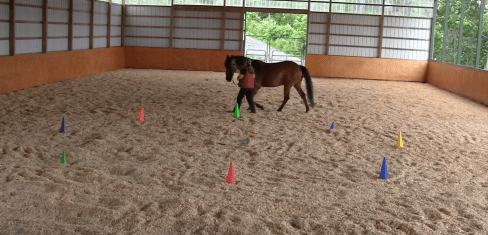
The overall description is this: the handler sets out a circle of cones and then leads her horse around the circle.  The basic question is: can the handler let go of the lead/rein and have her horse stay with her like a dog heeling at her side?  Or when she let’s go, does her horse wander off the circle, lag behind, rush ahead, or push into her to cut across her path?  Where is his attention – with her or elsewhere outside of the circle?

Robin wwylm far end collecting 1 at 11.59.50 AM

Robin has his attention on me as we walk around the “Why Would You Leave Me?” circle.

It doesn’t matter if the horse can do this perfectly at liberty, wearing nothing on his head.  Lots of things change when a horse is “dressed” for riding.  The horse that walks beautifully by your side when he’s wearing nothing, may become an anxious freight train when he’s wearing a bridle.

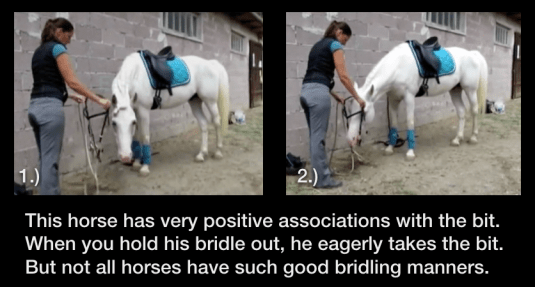
Bridling 2

Some people may jump to the conclusion that a horse who becomes anxious when he’s wearing a bridle dislikes having a bit in his mouth, but that may be a red herring.  If we went back to that horse’s first encounter with a bit, we might discover that he was one of those youngsters who always seemed to have something in his mouth.  His handlers were forever taking lead ropes, brushes, halters out of his reach.  If you left anything close enough to grab, he would have it in his mouth. So when he was offered a bit, there was nothing unpleasant about it.  It was something he could put in his mouth, and finally his people didn’t snatch it away from him!

But then the reality of riding set in.  Riders bounced uncomfortably on his back.  His saddle pinched his shoulders, and worst of all, when he guessed wrong or headed off in his own direction, his riders jerked on the rein so the bit hurt his mouth.  It wasn’t long before someone approaching him with a bridle became a predictor of unpleasant things to come.

Of course, this isn’t the only outcome for riding.  The sight of the bridle can mean a fun clicker game is about to begin.  But for a horse who has been ridden with corrections, the bridle often triggers unpleasant associations.

You could decide to work exclusively at liberty, or you could help this horse out by explaining away his anxiety about halters, leads, bridles, and saddles.  Every time you explain away a fear, you remove a potential source of stress for your horse.  That’s a process that’s worth doing.

Expectations
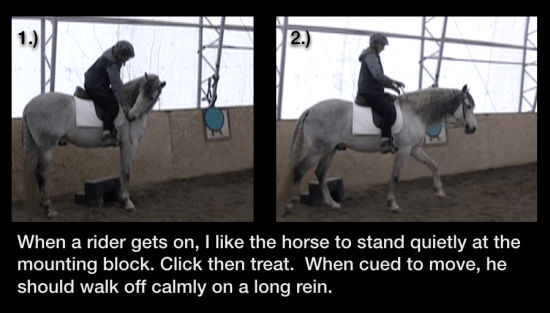
When I first get on a horse, I like to walk off from the mounting block on a loose rein. (And yes I do use mounting blocks.  I feel very strongly that they are a courtesy to the horse.  They save strain to his back.  You save strain to yours, and you protect your saddle from becoming twisted.)

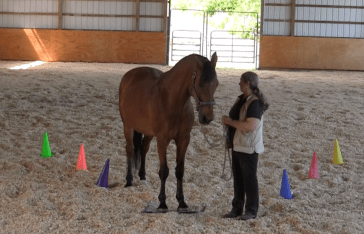
Icky at mouting block 2 photos at 11.18.23 AM

I want the horse to stand patiently at the mounting block until I signal to him that I am ready for him to walk off.  I’ve watched too many horses who barely let the rider settle into the saddle before they take off.  The rider is snatching up the reins and blocking the horse before they’ve even gone two steps.  The horse protects himself by throwing his head up and tightening his jaw which then hollows his back.  The ride has barely begun, and already they are in a training hole.  It’s a long way from play for either horse or rider.

When I get on, I expect my horse to wait patiently while I get myself organized and settled into the saddle.  I appreciate these good manners, so I always click and treat the horse for standing well.  I’m sure there will be some who feel that the horse should not need to be be reinforced for behavior that he knows well, but I like to say “thank you” by marking good responses with a click and a treat.  It costs so little to maintain this ritual.  I ride with clicker treats at the ready.  Offering one as a thank you takes no real effort, and it means that my horses can be trusted to stand quietly at the mounting block.

When we are ready, I cue the horse to walk off.  I want him to walk off on a loose rein.  On a green horse, this may not be possible.  Two steps on from the mounting block I may be picking up the rein and sliding down asking for the hip, but the goal is to have a horse who leaves the mounting block in an energetic, but relaxed walk.  The reins are long.  I don’t want to be shortening them up and restricting the walk in any way.

This is important.  It gives me time to evaluate how my horse is feeling on that day.  Where is his back?  Does everything feel as it should, or is there a stiffness or an uneven feeling that I need to be aware of?  What is his energy level? How does everything compare to previous rides?  Can I feel the effect of the previous lesson in the start-up?  What is available to me?  What do I need to work on?  As Mia Segal (June 9, 2016 post)  would say, if you know the questions, you have the lesson.

Walking Off Casually and the “Why Would You Leave Me?” Game
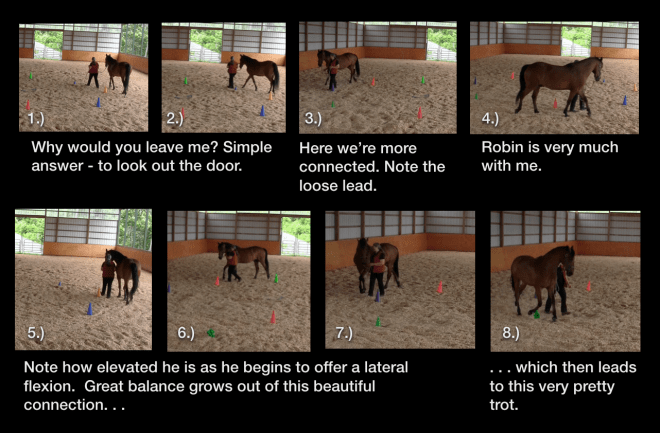
Walking off casually gives us time to come together as a riding pair.  It gives me time to evaluate where my horse is on that particular day, both physically and emotionally.  But walking off casually is not a given.  It is something I have actively taught to my horses.  It begins on the ground with the very first leading lesson and is further expanded upon in the “Why Would You Leave Me?” game.

This lesson is best taught on a circle.  Every time the horse takes his focus away from the handler and begins to leave the circle, the handler slides down the lead and brings the horse back onto the circle.  The handler is essentially asking the question: why would you leave me?

This is such an important question to ask.  Are you leaving because the environment is too distracting? In that case perhaps the best option is to move to a less distracting location.  And note the distractions could be from things the horse is afraid of and wants to get away from, such as a tarp that’s come loose over the shavings pile.  Or it could be things the horse wants to go towards, such as grass or his pasture buddies.

Are you leaving because you are so full of energy that you can’t walk at my pace?  Are you leaving because you aren’t balanced enough to stay on a circle?  Are you leaving because you’re afraid of me?

wwylm collage

Robin begins by being momentarily distracted by something out the back door, and ends with some lateral work and a beautifully balanced, connected trot.

These are all questions I want to ask and have answered before I put my bones up on the horse.  That’s the purpose of the “Why Would You Leave Me” game.  The end result will be a horse who walks with you without needing to be held there with a lead.

We begin on a circle so the loop keeps repeating itself.  If your horse tends to crowd into you as you pass by the gate, and you missed noticing until he was already pushing you off the circle, don’t worry.  You’ll come around to that point again, and you will be better prepared to ask for what you WANT him to do.  Eventually,  you’ll be able to leave the set pattern of the circle and walk complex patterns.

https://www.youtube.com/watch?v=jzYqEbcIRug

In this video Panda shows off her “heeling” skills.  She’s working with Sue Bennett, one of the coaches for my on-line course.  Sue and Panda have just met, but that doesn’t matter to Panda.   She’s happy to stay connected.  Why would you leave me? For no reason at all.

My thanks to my coaches: Michaela Hempen and Asfaloth for the bridling pictures; Monty Gwynne and Icaro for the mounting block; Sue Bennett and Panda for the heeling video (and Ann Edie for letting Sue play with her guide horse); and Robin for the “Why Would You Leave Me?” photos.

Also please note: I am not attempting to provide complete instructions for any of the lessons I have described in this post.  Nor have I detailed how to ride in a way that is clicker compatible.  That’s not the function of these posts.  You will find very thorough instructions in my books, DVDS, and on-line course.  Visit: theclickercenter.com    theclickercentercourse.com

Coming Next: Cue Communication Part 4: Capture the Saddle – A Targeting Game

Remember, if you are new to the JOY Full Horse blog, click on the JOY Full Horses tab at the top of this page to find the full table of contents and links to each of the articles I have published so far.

I hope you will want to share these articles by sending links to this blog to your friends.  But please remember this is copyrighted material.  All rights are reserved. Please do not copy any of the “JOY Full Horses” articles without first getting written permission from Alexandra  Kurland, via theclickercenter.com

Also note: these articles are not intended as an instruction guide for introducing your horse to clicker training.  If you are new to clicker training and you are looking for how-to instructions, you will find what you need at my web sites:

theclickercenter.com                    theclickercentercourse.com

JOYFull Horses: Cue Communication continued

Behaviors Become Cues
In the previous section I wrote about Panda and the guide work she performs.  Just as guide work made the perfect example for understanding environmental cues, it also shows so clearly how this back and forth cue communication works.


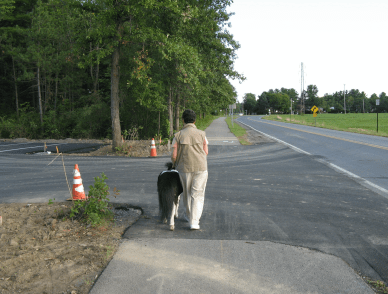
Panda environmental cues

This is a particularly challenging form of curb for a guide because there is no clear difference between the end of the sidewalk and the start of the driveway, but Panda was always consistent at stopping where she should.  Even when the surface was repaved, changing many of the familiar environmental cues, she was rock solid in her guide work.  The driveway is the entrance to the parking lot for the district school buses so there was always a lot of traffic in and out.  Stopping accurately at this crossing was essential.


When Panda gets to a curb, she stops.  If it’s the up curb on the far side of a street crossing, she’ll put one foot up on the curb.  This tells Ann not only that there is some sort of obstacle in front of them, but where to look for it.

Ann finds the obstacle by searching for it with her foot.  She then cues Panda to go forward.  Panda walks on.  Ann may then tell her to trot on with a “hup, hup” verbal cue.  Panda will increase her speed by breaking into a brisk trot.  But she may then stop and pull to the side.  Perhaps a pedestrian is coming in the opposite direction pushing a baby carriage and walking a dog.  There isn’t room to pass, so Panda alerts Ann that there is “a situation” ahead by stopping and moving them over to the edge.

Traffic checks are another great example of cue communication.  It’s up to Panda to alert Ann and either to refuse to go forward, or to back them up out of harm’s way.

In all of these examples Panda is using the behaviors we have taught her in their appropriate context to provide Ann with the information she needs.

https://www.youtube.com/watch?v=IUgZvAjD2Gc

Mounting Blocks as Cue Communication
Cue communication can take other more subtle forms.  One of the early behaviors I taught to Peregrine via the clicker was to line himself up to the mounting block.  He was already very good about walking with me to the mounting block and standing quietly while I got on, but I wanted to add a bit of clicker flourish to the behavior.  So I used two targets.  The first brought him to the mounting block and the second took him forward a couple of steps so he ended up positioned exactly where I needed him to be in order to get on.

The targets quickly faded to hand signals. I was able to leave him in the center of the arena, walk the ten to twenty feet over to the mounting block, and call him to me. He would come and line himself up without my having to make any adjustments via the reins.

It became a favorite behavior.  In fact, if I forgot and started to lead him to the mounting block, he would hang back.  How silly of me!  I’d let go of the reins and head by myself to the mounting block.  He’d wait until I signaled to him, and then he’d come directly over and line himself up.

This behavior could always be counted on night after night even in a busy arena.  Peregrine would wait in the middle of the arena while all the other horses went past.  When the coast was clear, I’d cue him to come.  He never wandered off to visit with the other horses or to look for the scraps of hay which could always be found in the arena.  Coming when cued was a consistent, sure-fire behavior – except . . . every now and then he would stall out in the center of the arena.  I’d cue him to come, and he’d just hang back.

I never forced him over to the mounting block.  Instead I checked his feet, I listened for gut sounds, I took his temperature.  Hanging back from the mounting block was his way of telling me that something was wrong.  It was my early warning sign that he wasn’t feeling well.

Trust Your Horse, Trust the Process
I can just hear the harrumphers now.  What nonsense!  All you’re doing is teaching your horse that he doesn’t have to listen to you.  You’re letting him get away with not coming.  You’re rewarding him for hanging back.  You’re just going to get a horse who never goes to the mounting block.

Except that’s not what happened.  I trusted Peregrine, and I trusted the work we were doing together.  I truly believed that riding was fun for him.  He wanted to be ridden.

He showed me this in so many ways.  We’d be working on shoulder-in, adding our clicker bells and whistles to the basic movement.  He’d give me an extra lift through his shoulders, and I’d click and pull a peppermint – his favorite treat – out of my pocket.

He could hear the crinkle of the wrapper as I was undoing it.  Through the saddle I could feel his excitement.  If the paper was very stuck to the peppermint so he had to wait a bit longer than usual, he’d give a soft nicker of anticipation.  Finally!  I’d reach down, and he’d take the treat gently from my fingers.  I’d hear the quick crunch of the candy, and then he’d be ready to move on.  I’d touch the reins and without missing a beat he would pick up into another stride of even more glorious shoulder-in.  How could I not click that!

Of course he loved to ride!  Riding was the ticket to laughter, to lots of praise, to scritches on the neck, and best of all to peppermints!

So on the nights when he hung back, I knew he wasn’t feeling well, and I always listened.  He’d had a long series of serious health issues following a bout of Potomac Horse fever.  I needed this early warning system to be up and functioning so I could monitor his health.

Capture the Saddle
I teach the mounting block lesson very differently these days.  The lesson is called “Capture the Saddle”.  It begins with rope handling and directed learning and ends with targeting.  I teach it in this way because I regard the mounting block lesson as a final safety check before I give the okay for a rider to get on.

A horse that has been well prepared with good ground work, will breeze through this lesson.  The prerequisite is a lesson that I refer to as the “Why Would You Leave Me?” game.  In the next section I’ll describe both these lessons and the reasons for them.

Coming Next: Unit 4: Cue Communication continued: The Mounting Block Lesson

Remember, if you are new to the JOY Full Horse blog, click on the JOY Full Horses tab at the top of this page to find the full table of contents and links to each of the articles I have published so far.

I hope you will want to share these articles by sending links to this blog to your friends.  But please remember this is copyrighted material.  All rights are reserved. Please do not copy any of the “JOY Full Horses” articles without first getting written permission from Alexandra  Kurland, via theclickercenter.com

Also note: these articles are not intended as an instruction guide for introducing your horse to clicker training.  If you are new to clicker training and you are looking for how-to instructions, you will find what you need at my web sites:

theclickercenter.com                    theclickercentercourse.com


JOY Full Horses: Part 2: Ten Things You Should Know About Cues

This is a continuation of Part 2 of my new book, “JOY Full Horses”.  If you are new to this series, go to the contents for links to the previous articles.

In the previous installment I talked about patience and persistence.  I ended with: “One of the many things that you learn from horse training is the longer you stay with an exercise, the more good things it will give you.  Focus on some little, achievable piece of the training, something you and your horse can accomplish together, and all kinds of other good and often unexpected results will emerge out of it.”

Now in this section I’ll share more lessons my horses have taught me.

“They Don’t Feel Pain the Way We Do”
Shortly before she became mine, Peregrine’s mother was injured in a handling incident.  One of the teenagers at the barn had been given the assignment of pulling her mane.  In case you aren’t familiar with this technique, it is literally what the name implies.  The mane is shortened and tidied up by pulling out the longer strands.

The horses I grew up with never had their manes pulled.  The first time I watched this being done it was to a young racehorse, a two year old who was literally climbing the walls trying to get away.  The trainer stood outside the stall door watching as a groom struggled to control her.

I couldn’t help but ask what they were doing.  It looked to me like some horrific form of torture.  The trainer dismissed my concerns.  “They don’t feel pain the way we do,” he said.  In his view, the mare was climbing the walls not because of pain, but because she was being disobedient.  That’s a great example of the stories we tell ourselves – and come to believe – to make things okay.

Peregrine’s mother wasn’t in a stall the first time someone tried to pull her mane.  Shortly before she officially became my horse, it was decided she should have her mane tidied up.  For her introduction to this procedure she was tied tight to a post supporting a four foot high fence.  To get away from the pain she presumably didn’t feel, she jumped the fence.  You could say it showed how athletic she was that she was able to jump the fence with her head snubbed up tight to the post.  Really, it just says how desperately she needed to get away.

I only learned about it because I saw scrapes on her hind legs and asked about them. It wasn’t until much later that I discovered the full scope of the injuries she sustained.  Her spine was damaged in what was a very avoidable accident.  My beautiful, athletic, perfect horse had become a wobbler.  That is exactly what the name suggests.  She sustained neurological damage as a result of that incident.  She could no longer tell where her hind legs were so she wobbled about trying to stay on her feet.

The Evolution of Belief
I learned over time just how severely compromised she was. What began as a slight dragging of her hind toes eventually deteriorated into such a profound loss of balance that it became hard for her to walk without falling.  All the dreams I had had for her were shattered.   All that was left was helping her relearn the most basic of motor skills. It was my early training experiences with her that taught me about small wins, and about finding ways around the many brick walls in her life. Long before I ever heard about clickers and positive reinforcement, she taught me how to break things down into the smallest of small steps.  The power of those lessons formed the core of what clicker training means to me.

If belief is a major part of changing habits, she taught me to believe in the power of change.  You cannot NOT change.  How’s that for a sentence!  But it’s true.  We are constantly changing.  The question is: are you changing towards something new, or are you simply boomeranging back to familiar patterns?

If you don’t believe that change is possible, you will always be reverting back to the same reality you are currently in.  Eventually you may find yourself so bogged down in that state that change truly does seem beyond your reach.

I didn’t know what change, if any, was possible for her.  The vets at the time painted a very bleak future for us.  They told me they could do nothing to help her, and eventually she would deteriorate to the point where she would be unable to stand.  It was a grim future to consider.

Since I couldn’t ride her, the vets recommended that I put her down.  That I couldn’t do.  Whether I could ride her or not, her life still had value to her.  Together we would deal with the challenges each day presented.  When things got too hard for her, that’s when I would make that decision, but until then we would keep going as best we could.

Stepping over the sill of her stall door was hard for her. But it was something she needed to be able to do, so we worked on stepping over ground poles. Those were terrifying for her, so I put a rope on the ground instead.  Even that was too hard, so I drew a line in the dirt.  That she could manage so that’s where we began.

She was showing me that no matter how small a step may seem, there is always, ALWAYS a smaller step you can find.

That is truly at the heart of all good training.  It is certainly at the heart of how I think about clicker training.

Eventually she was able to walk over those ground poles, and the sill of her stall was no longer a problem.  She could even manage a small cross rail.  We didn’t know what was possible.  We just kept working on the little things that challenged her.  Over time the little things grew into wonderful things.  She became my riding partner and introduced me to the world of classical dressage. She was the first horse I ever taught to piaffe.

Balance – The Core of Everything
She is why at the core of everything I teach there is balance.  For me balance is everything.  It gave her life.  When some people talk about dressage, they see competition rings and rosettes.  I see balance.  That’s what dressage means to me.  The end result may indeed take you to the show ring, but first it takes you to a feel that is heaven itself.  Balance is everything.  It is life giving, life sustaining.  It is beauty, grace, power.  It is love.

Some wonderful things have grown out of that terrible training accident, but I am never very far removed from the consequences.  It reached past her life and changed Peregrine’s.   During his foaling, she got down against a stall wall and couldn’t get up.  He was boxed in by the corner of the stall, trapped in her pelvis.  If I had not been camped out beside her stall, ready to help, I would certainly have lost him and possibly both of them.

Peregrine’s spine was damaged by the foaling.  That in turn led to his locking stifles which led to a challenging first few years of training which led – through a series of twists and turns – to clicker training.  So again, good things came out of a hard beginning.

My “Soap Box”
It has also given me the right to stand on the soap box that actively promotes positive training methods.  When I first started introducing clicker training to the horse world, I was very careful what I said about other training methods.  Clicker training was the new kid on the block.  If I came in like gang busters denouncing what everyone else was doing and saying my way is the best, I’d have been pounced on and crushed – and rightly so.  If you push against someone, of course, they are going to push back.

So I chose not to comment on what was occurring in the rest of the equine training community.  At times this was incredibly difficult.  There have been so many emerging trends over the last thirty years.  Many, very horse-friendly advances have been made.  Acupuncture, chiropractic work, physical therapies of many varieties are now common.  But why do we need so many interventions?  It is because we also have so many “methods” that are so very hard on horses. Strip away the rhetoric, and you will see revealed some horrific things being done in the name of training.

The words often sound great.  Everyone talks about partnership, harmony, etc..  But when you turn the sound down on the videos and watch what is actually being done to horses, it is often times nothing more than abuse.

I remember watching one video where the trainer’s solution to a needle-shy horse was to run him to exhaustion in a round pen.  The trainer was riding a stocky quarter horse, controlling from the saddle a rope that was lassoed around the horse’s hind leg. At the other end a strong twenty-something handler anchored down a lead attached to the horse’s head.  Between them he was well and truly trapped.

Every few minutes the trainer would tighten his rope, and the horse would go bucking and pitching around the pen.  Then they would back off and give the horse a short break.  The horse’s sides were heaving as he tried to catch his breath.  The trainer, meanwhile, was telling stories about how much he was helping this horse to get along with people.  He was like a skilled magician distracting the audience away from the things he didn’t want them to see.

After about forty minutes of this, his assistant did indeed manage to wrestle the horse into a head lock and give him a pretend shot. As the horse’s owner walked him out of the round pen, the trainer told her he might be a bit stiff for a few days, and he’d need some ointment for the rope burns on his hock.

I was horrified.  Whatever happened to safety always comes first!?  Whatever happened to common sense and humane handling!?

The trainer never asked about the physical history on this horse.  Did he have any hock or hind end issues that might be made worse by this kind of handling?  Suspending a horse as they did between the two ropes could easily have resulted in an injury to his pelvis, his spine, his hind legs.  He could have ended up with the same kind of neurological damage that had so crippled Peregrine’s mother.  Was it worth it?  All this just to give a shot!  When you see the videos from the zoos and aquariums showing wild animals – whales, dolphins, cheetahs, giraffes, rhinos, baboons etc. – voluntarily presenting themselves for shots and blood draws, you have to question these methods.

This is a soap box I have earned the right to stand on because for over thirty years I have lived with the consequences of this sort of training approach.  We do get to stand up for our horses and say find a different way, find a better way. Find a humane way.

And always, always – safety does come first.

Coming Next: Standing Up For Our Horses

Remember, if you are new to the JOY Full Horse blog, click on the JOY Full Horses tab at the top of this page to find the full table of contents and links to each of the articles I have published so far.

I hope you will want to share these articles by sending links to this blog to your friends.  But please remember this is copyrighted material.  All rights are reserved. Please do not copy any of the “Joyful Horses” articles without first getting written permission from Alexandra  Kurland, via theclickercenter.com

Also note: these articles are not intended as an instruction guide for introducing your horse to clicker training.  If you are new to clicker training and you are looking for how-to instructions, you will find what you need at my web sites:

theclickercenter.com                    theclickercentercourse.com

JOY Full Horses: Part 2: Ten Things You Should Know About Cues

This is a continuation of Part 2 of my new book, “JOY Full Horses”.  If you are new to this series, go to the contents for links to the previous articles.

In the previous post I introduced the metaphor of a brick wall that you are asking your horse to go over.  I wrote: “There will be a few horses who are athletic enough and riders who are skilled enough to go directly over the wall.  If they’re successful, that will tempt those riders to take the next horse straight over, and the next.  And it will also tempt them to make the wall ever higher.  Eventually they will either make the wall so high no horse can jump it, or they will try and force a horse over the wall who truly can’t make it.  Either way, eventually they will crash.

Lower that wall and some who couldn’t jump it before will now be successful.  Turn it into a cross rail and even more will manage it.”

Creating these alternatives builds the habit of confidence and saying “yes” instead of “no” to simple requests.  In this section I’ll explore what it means to dismantle these “brick walls”.

Dismantling The Brick Walls
When I’m confronted by a “brick wall” of a behavioral problem, I prefer either to find a way around it, or to dismantle it so I only have to ask my horse to go over a few small bricks.  If you pull enough layers off the brick wall, you will eventually get to the point where every horse and every handler can be successful.

Peregrine’s mother taught me this.  She was bred to be a racehorse.  The trainer who had her kept a small string of racehorses in addition to his jumpers.  If I hadn’t stepped into her life, she would have ended up at the track – at least that was the goal.  Given the injuries she sustained in the name of training, she never would have made it that far.

Racehorses take baths, so as a weanling it was expected that she would take baths.  The assignment of teaching her about hoses was turned over to a teenager who took her straight out and tried to give her a bath. The result was predictable.  She reared up and struck out at his head.

He never managed to give her a bath, but he did make everyone believe this five month old filly was a “witch”, a nasty horse you didn’t want to get close to.  Interesting how it is the horse who takes the blame for our bad training.

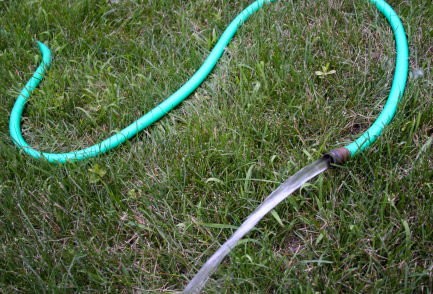
garden hose

He also created in her a lasting fear of hoses. When I started working with her a few months later, I could not take her down the barn aisle and out into the arena because it meant walking over the hose that was used to fill water buckets.  When I wanted to go into the arena, I had to take her out through the back which meant climbing over the shavings pile so we could get in by the back gate.

I’m sure the trainer would have had a different solution.  He would have “made” her comply.  There would have been a fight, and in the end she would have walked over the hose.  She would still have been afraid of it, but she would have learned that she had no choice.

Patience and Persistence
I was a very green handler.  I knew I didn’t have the skills to get into this fight, so I used a different approach.  I have always said I did some of my best training when I knew the very least.  All I had was patience and persistence, and I put those to good use.

Every night I would take her out of her stall and tie her to the aisle rail so I could groom her.  Tying was something she had already learned how to do so it was safe to use.  I began about twenty feet away from the hose.  When we were done, I would turn her away from the hose and walk the long way around into the arena.  Each night I tied her a little closer to the hose, but always we turned and walked away from it.  I never confronted her with it.

We finally got to the point where she could be tied right beside the hose, and she would stand quietly throughout her grooming session without seeming to worry about it.  One night instead of turning away, I asked her to follow me over it.  She did so without hesitation.  And after that, she always followed me wherever I asked her to go.

At the time I wouldn’t have referred to this as a “small win”, but that’s what it was.  I didn’t try to plow over the brick wall.  I found a way to dismantle it brick by brick until she was ready to go over it.

She discovered she could walk over hoses without fear.  More than that, she now understood that she could trust me to take care of her.

I wasn’t expecting this larger result.  I simply wanted to find a non-confrontational way to help her understand that hoses were harmless.  In the process I showed her how I could be trusted to behave.  I could be counted on to be consistent and to be on her side.  I wasn’t going to be petting her one moment and beating her the next.

One of the many things that you learn from horse training is the longer you stay with an exercise, the more good things it will give you.  Focus on some little, achievable piece of the training, something you and your horse can accomplish together, and all kinds of other good and often unexpected results will emerge out of it.

Coming Next:

They Don’t Feel Pain The Way We Do and The Evolution of Belief

Remember, if you are new to the JOY Full Horse blog, click on the JOY Full Horses tab at the top of this page to find the full table of contents and links to each of the articles I have published so far.

I hope you will want to share these articles by sending links to this blog to your friends.  But please remember this is copyrighted material.  All rights are reserved. Please do not copy any of the “Joyful Horses” articles without first getting written permission from Alexandra  Kurland, via theclickercenter.com

Also note: these articles are not intended as an instruction guide for introducing your horse to clicker training.  If you are new to clicker training and you are looking for how-to instructions, you will find what you need at my web sites:

theclickercenter.com                    theclickercentercourse.com

JOY Full Horses: Part 2: Ten Things You Should Know About Cues

This is a continuation of Part 2 of my new book, “JOY Full Horses”.  If you are new to this series, go to the contents for links to the previous articles.

When you want to change a habit, community is important.  In the preceding section I wrote: “Communities make change believable.  For habits to change permanently people must believe that change is possible. . . . Every time someone shares a clicker success story they are helping someone else cross that bridge into belief.  The success story says change is possible.”

If our lives are made up of a series of habits, which ones do we work on to create widespread change?  In other words, is there a habit that you can create or change that would spark a chain reaction generating even more changes?  Such a habit is referred to as a “keystone habit.” That’s what I’ll be exploring in this section.

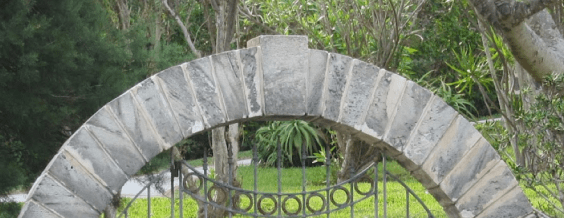
keystone round arch 2

Keystone Habits
Keystone habits provide what are referred to as “small wins”.  These are small successes that help other habits take hold and flourish.  Small wins have “enormous power, an influence disproportionate to the accomplishments of the victories themselves.”

Duhigg cited a reference from a Cornell study which concluded that:
“Small wins are a steady application of a small advantage.  Once a small win has been accomplished, forces are set in motion that favor another small win.  Small wins fuel transformative changes by leveraging tiny advantages into patterns that convince people that bigger achievements are within reach.”

(I can’t help but add here that this description could easily be applied to the shaping process we use in clicker training.)

Small Wins or Big Fights – You Choose
“Small wins” are at the heart and center of my training.  Early on in my horse training experience I was able to spend time with some very skilled horsemen.  They didn’t mess around with small wins.  They went straight to the big stuff.  Most of the time they were successful because they had the skills to get into a fight with a horse and win.  But occasionally things would turn into a train wreck.

I remember one such occasion where a trainer was trying to “sort out” a mustang.  This was a powerfully built draft type horse.  He’d already come to grief with several other trainers, and now this man was trying out his skills.  The mustang came within a hair’s breath of kicking his head in.

I was watching this as a very young and very inexperienced horse owner.  My takeaway message was I didn’t want to get into a fight with a horse.  Apart from the fact that it was just too dangerous, even then I knew it didn’t create the kind of relationship that I wanted.

I also knew that I didn’t have the skills or the strength to guarantee that I would win.  If you can’t guarantee a victory in the big battle – don’t start it in the first place.

I concentrated instead on the little victories.  I was boarding at the time in a hunter jumper barn.  I saw horses who had never been jumped before being sent over enormous fences.  Most of the time they were athletic enough to make it over, but sometimes they would simply crash through the fence or refuse to jump altogether.  The horses that stopped or tried to run out past the jump were all treated in the same way.  They were punished.  They learned fast that no matter how scared they were about jumping, the only safe route for them was straight over the fence.

Again, I thought of my small victories.  My own, beloved horse – Peregrine’s mother – had neurological damage.  She couldn’t jump.  In fact she couldn’t even go over a ground pole without panicking, but she could go over a line drawn in the dirt.  So that’s where we began.  Stepping over that line was a major small win that snowballed into many others.

Brick Walls
The image I have is of a huge brick wall.  There will be a few horses who are athletic enough and riders who are skilled enough to go directly over the wall.  If they’re successful, that will tempt them to take the next horse straight over, and the next.  And it will also tempt them to make the wall ever higher.  Eventually they will either make the wall so high no horse can jump it, or they will try and force a horse over the wall who truly can’t make it.  Either way, eventually they will crash.

If you lower that fence, more horses and more riders will be able to jump it successfully, but there will still be some who can’t.  They either lack the physical ability, the skills or the confidence to jump it.

Lower it a bit more and some who couldn’t jump it before will now be successful.  Turn it into a cross rail and even more will manage it, but even there, you will have some individuals who can’t manage even a small jump.  You may have to turn it into a ground pole, or draw a line in the dirt – or you may need to find a way to go around the jump altogether rather than over it.

Finding these alternatives are the “small wins”.  They build the habit of confidence and saying “yes” instead of “no” to simple requests.

Coming Next:

Dismantling The Brick Walls
When I’m confronted by a “brick wall” of a behavioral problem, I prefer either to find a way around it, or to dismantle it so I only have to ask my horse to go over a few small bricks.  If you pull enough layers off the brick wall, you will eventually get to the point where every horse and every handler can be successful. In the next section I’ll explore further what that means.

Remember, if you are new to the JOY Full Horse blog, click on the JOY Full Horses tab at the top of this page to find the full table of contents and links to each of the articles I have published so far.

I hope you will want to share these articles by sending links to this blog to your friends.  But please remember this is copyrighted material.  All rights are reserved. Please do not copy any of the “Joyful Horses” articles without first getting written permission from Alexandra  Kurland, via theclickercenter.com

Also note: these articles are not intended as an instruction guide for introducing your horse to clicker training.  If you are new to clicker training and you are looking for how-to instructions, you will find what you need at my web sites:

theclickercenter.com                    theclickercentercourse.com

JOY Full Horses Pt 1. Ch 7: Training Playfully Mixed with a Little Science

When I think about playing with my horses, I don’t mean trick training.  I’m not asking them to bow or to lie down.  I’m not dressing them in clown costumes and having them retrieve my hat – or maybe I am (at least the hat retrieving part).  The behaviors I’m asking for are not as important as how I train them.  Ideally whenever I am with my horses, I want to be in a PLAY FULL state.

That’s easier said than done.  If you’re used to training in a very formal, structured way, being PLAY FULL may feel very foreign.  The good news is clicker training provides us with a clear road map for discovering PLAY.  It begins appropriately enough with the ABC’s.  In this case ABC stands for:

ABC of training
Behavior is obvious.  That’s what you want your horse to do.

Often people think it is the Antecedent that makes a behavior happen.  That’s how it looks.  You call your dog, and your dog comes.  A came before B so it appears to be the cause of the behavior.  But what really determines whether or not the dog comes is all the learning history associated with that behavior. When he responded in the past to the cue, what happened?

The reason that behavior is likely to occur again – or not – is because of the consequences. Good consequences make the behavior more likely to happen again.  If you put a heating pad on your back after you’ve strained it lifting too many hay bales into your loft and your back begins to feel better, you’re likely to use the heating pad the next time you over do the barn chores. Good consequences make the behavior more likely to occur again.  They are a predictor of future behavior.

Unpleasant consequences mean the behavior will be less likely.  Instead of loading all the hay into the loft yourself, you may decide you’ve learned your lesson.  Next time you’ll hire some strong teenagers and spare the strain to your back.

Antecedents obviously occur before the behavior.  When you give your horse a cue, you’re telling your horse which behavior is most likely to earn reinforcement.

So the ABC’s can be written as:
ABC of training with arrows
If you’re familiar with clicker training, you’ve no doubt seen this phrase written out many times before.

In clicker training we focus a lot of attention on the consequences.  It’s click and reinforce.  One of the many questions good trainers ask is: how can we expand the ways in which we reinforce our learners?

Reinforcement Variety
Trainers of other species inform us that we want to use reinforcement variety to maximize performance.  For a dog it’s easy to come up with a long list of different reinforcers.  Think of all the goodies dogs will happily (and safely) wolf down.  And then there are the chase, kill and dismember games that make this lifelong vegetarian appreciate her horses all the more.

While it may make me cringe as you play tug with a squeaky toy that mimics the screams of a dying rabbit, the underlying concept is a good one.  We want reinforcement variety.  For our horses food is a primary reinforcer in more ways than one.  It is primary in the technical sense in that it is needed for survival.

And it is primary in that it is of first order usefulness.  Food is both something that horses want, and it is easy to use in a training session.  In fact it is such a powerful motivator that many people have shied away from using it because they have not known how to manage their horse’s heightened emotional response to food.

Clicker training changes that by introducing an organized process for teaching horses emotional self-regulation around food.  The process transforms food treats from a distraction into a useful training tool.

Food is not our only reinforcer, but it is the most convenient to use, especially in a training environment.  My horses may love to roll in a sand pit – but not with my good saddle on their backs, thank you very much.

Antecedents
Peregrine Robin sleeping in arenaI’m writing this section about the ABCs of training sitting on the inner deck of my barn.  From my vantage point I can see Peregrine and Robin lying down in the arena enjoying a morning nap.
They’ve had a busy morning “helping” me with the chores, and now it is time to rest.  Again, this is clearly something they enjoy.  It is part of their daily ritual.  Today is especially pleasant.  It’s late May.  The temperature could not be more perfect, and as yet the flies are not out.  The horses can indulge in a long nap.  Peregrine is stretched out on his side, clearly dreaming.  His hind legs are cantering and every now and then he gives a deep throated nicker.

Robin sleeping cin in sawdustRobin is resting more upright, his nose buried in the shavings as he falls into a deep sleep.

I don’t know why watching horses sleep is so very reinforcing.   I treasure these quiet times we have together.  While I watch over them, I can work on the computer.  It is family time we all enjoy, but this is not something that I can use in a practical way during a training session.  That’s true of most of my horse’s favorite activities.  So if I want to vary their reinforcers, I need to shift my focus from the consequences and look more at antecedents.  I need to learn about cues and how they glue behaviors together.

Understanding cues unlocks a lot of “doors to the kingdom”.  In particular this key component opens the door to PLAY.  That’s what we’ll be exploring in the next section.

Peregrine Robin family time

Family Time

Coming next: Part 1: Chapter 8: Cues and Their Connection to Play

I hope you will want to share these articles by sending links to this blog to your friends.  But please remember this is copyrighted material.  All rights are reserved. Please do not copy any of the “Joyful Horses” articles without first getting written permission from Alexandra  Kurland, via theclickercenter.com  (kurlanda@verizon.net)

Also note: these articles are not intended as an instruction guide for introducing your horse to clicker training.  If you are new to clicker training and you are looking for how-to instructions, you will find what you need at my web sites:

theclickercenter.com                    theclickercentercourse.com

JOY Full Horses: Part 1 Ch. 4: Inside The Trainer’s Brain

Recognizing Play

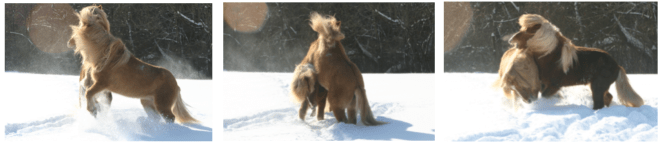
sindri fengur playing 3 photos

When they’re turned out together, our two Icelandics engage in mock battles. How do I know they are playing and not fighting for real?  Their drama is intense.  Both rear up and crash into one another.  One will come down over the neck of the other seemingly trying to bite the other horse through his thick mane.   They’ll spin apart and kick out, then race off at a gallop shouldering one another for an advantage in the turn.

To a causal observer it looks both very dramatic and very real, but these Iceys are good actors.  Their battles are all make believe.  They leave the “battle field” without a mark on them.  The kicks are all pulled punches and the bites nothing but pretend.  One moment they are body slamming into one another, the next they are standing side by side in their other favorite activity – social grooming.

After a good play session they come into the barn relaxed, refreshed, and always ready for more.  At twenty they play with the same vigor and intensity that they did when they were four.

When you watch your dogs or your cats wrestling together, you have no trouble recognizing this behavior as play.  You see the bites that aren’t bites, and the claws that don’t draw blood.  You see them taking turns.  First, one is on top pinning the other down, and then they’ll flip roles.  The stronger animal has learned that if he dominates the play, the other animal will quit.  I don’t know which of the Icelandics is the faster horse.  They always run together.  If Fengur has his nose out in front, it is only because Sindri, our stallion has let him, not because Sindri has fallen behind.

When Peregrine, my senior horse, was a two year old, he was chased by another horse through a fence.  I’ve seen what it looks like when these clashes are not play. It is terrifying to watch.  There is no mistaking the real thing for play.  When I see my cats confronting the neighborhood stray, it does not look in any way like the play they engage in together.  But that play between friends has prepared them well for the negotiations they are about to have.  All of us – cats, horses, people – know when the play has stopped, and we are now engaged in the real thing – a struggle for survival.

Part 1: Chapter 5: What is Play?

Defining Play
So we can recognize play.  But what is it?  Stuart Brown wrestled with this question in his book. He opened by saying he resisted giving play a definition for a number of reasons.  Play is so varied.  As he points out, an activity such as writing this chapter might seem like play to me, but it might be work to somebody else.  So we cannot define play simply through the activities we engage in.

For Brown play may be hard to pin down with a rigid definition, but at least in people, it does have very recognizable properties.  He would say:

* Play is done for it’s own sake.  Play has no direct survival value.
* It is voluntary.  You don’t “have to” play.
* Play is inherently reinforcing.  Play is fun so you want to play more.
* Play provides freedom from time.

This is the characteristic that most resonates with me.  I am constantly losing track of time.  I’ll be working with the horses, or working on this book, and suddenly realize that several hours have passed and I’m about to be late for an appointment.  I have been so absorbed in what I was doing, so in “the zone” in a PLAY state, that I have completely lost track of time.

At clinics I am constantly surprised that the hands on my watch have moved forward by several hours. “How can it be four o’clock?”, I’ll exclaim.  “It was just 12:30 the last time I looked.”  It is as though I’m surprised by the notion that time passes.  I know the hands on my watch will be progressing around the clock face, but in my PLAY state it truly does seem as though no time has passed.

* Play produces a diminished consciousness of self.

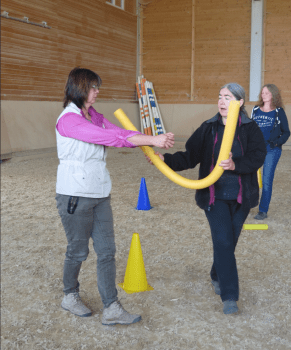
pool noodle GermanyWe stop worrying so much about how we look to others.  In imaginative play we may even become a different “self”.  When you’re trying to learn to ride and you have an instructor barking commands at you treating your lesson more like military boot camp than something you’ve chosen to do for fun, you’ll be a long way from a PLAY state.  Barked commands create FEAR and make the learner more self-conscious – not less.  To promote the best mental state for learning and retaining information, we want to be PLAY full.

When people are first learning clicker-compatible rope handling skills, I start them out without their horses.  At first, people may be thinking how silly they look practicing their technique with a rope tied to a door handle.  They’ll be terribly self-conscious.  Once I get them in a PLAY state, this kind of thinking disappears. They forget what it might look like to an outsider as they become fully engaged in the process.

* Play has improvisational potential.

When you play, you aren’t locked into a set way of doing things.  You can experiment and invent.  Many of the details that we now know make a huge difference to the horses were discovered during play sessions without any horses being involved.

People took turns being the handler and the “human horse”. They stepped outside of themselves and left behind their usual, I’m-an-adult-and-I don’t-play-silly-make-believe-games.  They let go of their self-conscious rigidity and let the act of playing take over.  The result was they saw things in a different way and with fresh insights.

Canine clicker trainer, Kay Laurence, often refers to a quote from Proust:

A journey of discovery comes not from a voyage into new landscapes but seeing familiar landscapes with fresh eyes.

Over and over again, our animals show us the truth of this expression.  As each new layer of training is explored, we see our animals and all their brilliance with fresh eyes.

* Play provides a continuation desire.  You want to keep doing it.  Once the play stops, you want to do it again.  As Brown puts it: “Play is its own reward, its own reason for being.”++

++ The Properties of Play are from: “Play: How it Sharpens the Brain, Opens the Imagination, and Invigorates the Soul”    Stuart Brown M.D. and Christopher Vaughan, The Penguin Group, NY New York 2009.

Coming next: Part 1: Chapter 6:  Being PLAY FULL

I hope you will want to share these articles by sending links to this blog to your friends.  But please remember this is copyrighted material.  All rights are reserved. Please do not copy any of the “Joyful Horses” articles without first getting written permission from Alexandra  Kurland, via theclickercenter.com

Also note: these articles are not intended as an instruction guide for introducing your horse to clicker training.  If you are new to clicker training and you are looking for how-to instructions, you will find what you need at my web sites:

theclickercenter.com                    theclickercentercourse.com

JOY Full Horses

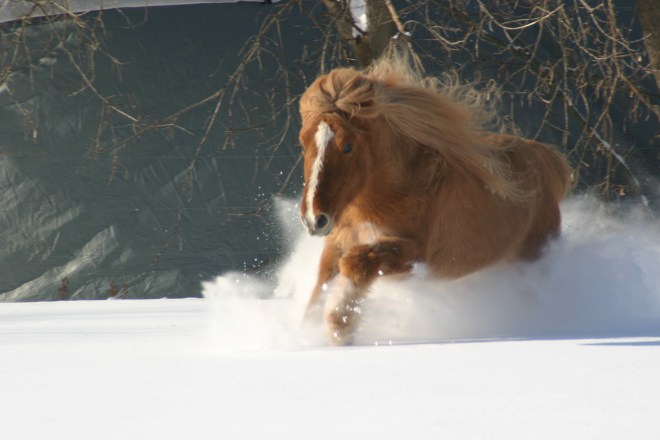
IMG_0218 Fengur snow great

In 2014 I surprised myself by writing a book.  This is by no means the first book I have written, so perhaps some of you will be surprised that I was surprised, but I had just finished the monster-sized project of writing and launching my new on-line course.  I wasn’t expecting to take on another big project quite so soon on the heels of that endeavor.

But books are funny things.  You don’t so much write them as they write themselves. When a book wants to pop out, if I am anywhere near a computer or a pad of paper with a pen in my hand, that’s what is going to happen.

Once the book was written, there remained the question of what to do with it. The normal answer is you publish it as a hold-in-your-hand actual book, but somehow that didn’t seem the right answer for this particular project. I sat with it for a year while I considered what I wanted to do.  In the end I have decided that what I wanted was to share it here.

I’m going to publish my book in this blog, section by section.  I hope you enjoy it.  It was written first and foremost for my horses, perhaps you could even say by my horses.  It is a gift from them to you.

Happy New Year 2016

Alexandra Kurland
Robin in box purple JOY FULL


Before I begin the book, let me share with you why it was written.

2014 was a dreadful year for me.  It’s astounding how fast your world can be turned upside down and inside out.  I arrived at the barn on Feb 10, 2014, as usual.  Robin and Peregrine greeted me at the paddock gate, as usual.  Robin bowed, stretching both front feet out in front of him and crossing one leg over the other – again as usual.
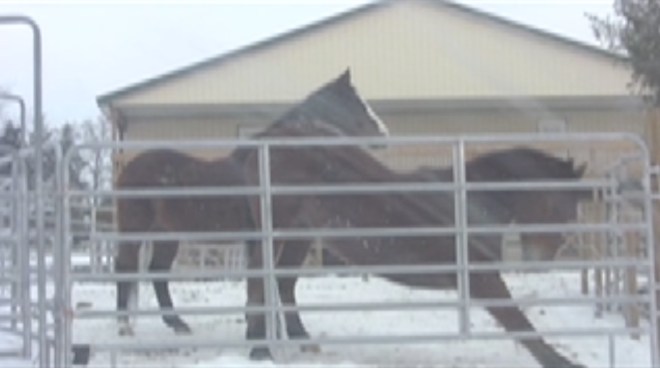
robin stretch bow copy

The bow is part of a favorite morning game. It’s his cue to me to open my car door.  I always feel like a jack-in-the-box popping out of my car on his signal.   I opened my car door, as usual, and gave both Peregrine and Robin good-morning-greeting treats from my pocket.

I got my backpack out of the car and headed up to the barn. Fengur and Sindri, our two Icelandics, were there to greet me as I reached their section of the barnyard.  Robin and Peregrine were already inside the barn, waiting for me in the aisle.

I went through my morning routine.  I fixed Peregrine’s mash, passed out hay for everyone, put Robin into his stall, closed the back gate to his “sun room” so he couldn’t help himself to Peregrine’s breakfast, gave Peregrine his mash and had just started on Sindri’s stall when I heard Robin banging against his stall wall.  I love the open design of the stalls in the new barn.  I could look down the line of stalls and see all the horses.  Robin looked as though he was trying to stretch out in a bow but there wasn’t quite enough room.
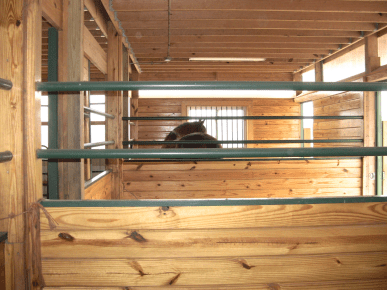
Robin in stall long view

“That’s interesting,” I thought.  “He’s transferring the bow up to the barn.”  I wanted to capture the moment, but I was too far away.  I continued on with Sindri’s stall, but I was listening now, on the alert for a repeat performance.  Sure enough Robin bowed again.  This time I was prepared.  I rushed over, but not in time to capture the bow.  Robin had gone outside into the small run directly outside his stall.  A quick glance told me something was wrong.

It took no more than an instant to switch from the playfulness of clicker training to the dread of a colic alert.  This wasn’t his normal bow inviting me to come play.  The stretch that I was seeing was something entirely different.  In the space of no time at all Robin’s gut had seized up into full colic pain.

Thank goodness for cell phones.  I never thought I would hear myself say that, but it meant I didn’t have to leave Robin to call the vet.  I got him out of the stall and into the arena.  Less than an hour later the vet was there, not my usual vet, but one of the younger members of the practice.

Robin blew through all the pain meds she gave him.  Suddenly we were talking about surgery.  “If you think it’s an option, you should ship him now.”

I couldn’t believe I was hearing those words, not for Robin.  He was my healthy horse.  He was never sick.  He’d never even had a lameness exam.  He’d certainly never coliced, and he had none of the common risk factors for colic.  He wasn’t confined to a stall.  Yes, the pastures were closed for the winter, but he and Peregrine had free run through the barn, the indoor arena, and their outside paddock area.  He drank a lot.  His weight was good.  He had none of the signs of metabolic disease that has become so common in older horses.  Given all the horses I know, Robin would be the last one I would expect to colic – and yet here we were talking about surgery.

I knew from clients who had gone through this experience that colic surgery was survivable, but you needed to ship early.  The longer you waited, the lower the chances were for a good outcome.

But surgery.  For Robin.

He was my healthy horse.  I didn’t want him to become an invalid.  That wasn’t the kind of life he would enjoy.

And then there was his shadow, Peregrine.  Peregrine is my elderly thoroughbred.  In the last couple of years he had become completely dependent upon Robin for security.  I’m not sure Robin appreciated having a constant shadow, but Peregrine didn’t really give him any choice.  In 2011 when I moved the horses to their new home, Peregrine coped with the change by attaching himself completely to Robin.  Fierce Robin, who had never really buddied up with anyone,  slowly discovered that he liked having someone to hang out with and take naps with.  They had become a pair, sharing everything including training time with me.

But now Robin was in the arena, filled with drugs that didn’t even dull his distress.  Peregrine was hovering nearby.  He clearly knew something was terribly wrong.    What was I to do?  If I kept Robin here, I was going to lose him.  And then what would Peregrine do?  The unthinkable was happening.  It was never supposed to be this way.  Robin was so much younger than Peregrine and he had ALWAYS been so healthy.  How could he be colicing?

If you’re going to ship them, ship them sooner rather than later.

I knew this truth.  I knew I had to make a decision, but how was I going to trailer Robin anywhere?  This was February.  The only available trailer on the property was snowed in.  And how could I leave Peregrine?  I wouldn’t be able to go with Robin.

I started making phone calls.  It took another hour to get everything organized, to get a driver for the trailer, to get the trailer dug out, the truck hitched up.

If you’re going to ship them, ship them sooner rather than later.  The day had begun so normally.  And now just a few hours later, I was leading Robin out to the trailer and shipping him off without me.

Bob Viviano, one of my long term clients and good friends, drove Robin for me.  We are lucky in this area to have an excellent hospital within an hour’s drive.  We gave Peregrine a sedative which bought me the time I needed to get Robin on the trailer.  He loaded without hesitation and I sent Bob off.  It was then a little after noon.

Half way to the hospital the snow started. Bob drove through white out conditions from a storm that was moving in from the coast.  If I had known there was snow to our south, I would never have risked his safety to drive Robin. Instead of an hour’s drive, it took him closer to two to reach the hospital.

I was waiting in the barn for news. At two thirty I heard that Robin had arrived safely and was being examined by the vets. Bob was heading back.

Peregrine had woken up by this time and had begun to pace.  I closed the outer stall doors to try to keep things a little warmer for him.  There was nothing I could do to ease his distress except to give him back Robin.  I had to hope that was going to be possible.

The news from the clinic didn’t sound good.  They were recommending surgery.  Was that an option?

I talked to the surgeon about what I wanted for Robin.  If it meant he would be left in chronic pain with a disabled life, then no, I didn’t want to operate.

She thought there was still a good chance for him.  How can you say no?  I said yes to the surgery.

I waited.  The hours passed.  There was another horse in surgery ahead of Robin. As soon as that horse was in recovery, Robin’s operation would begin.

At six I got another call.  Robin was being prepped for surgery.

Peregrine continued to pace.  He walked through the night, unable to settle.  I stayed with him, but it was Robin he needed.

At midnight I got the call, the call we all dread.  I had another decision to make.  They had found a twist. A full twist with dead small intestine.

I had learned from my clients that if you are going to ship them, ship them sooner rather than later.  I had also learned that cutting out intestine was the deal breaker.  That’s where you stopped.

So he’s a dead horse.  That’s what I thought as I heard the news.

But the surgeon thought there was still a chance.  The twist put him into the category of worst case scenario, but given that, he was in better shape than many horses who had twists.  He still had a good chance.  My world had flipped and flipped again.  What was she saying?  What decision should I make?  How could I say no? How could I stop now?

I told her again what I wanted for Robin.  I wanted him to live, but not if it meant he would be left in a state of chronic pain.  I told her it was okay to continue, and it was also okay to stop.

I wish I could have been there.  I don’t know what decision I would have made if I had seen the pain Robin was in.  But in the barn with Peregrine continuing to pace, I gave permission to continue.

At 2:30 in the morning the call came.  Robin was in recovery.

Peregrine continued to pace.  At dawn I opened up the outside stall door and let him out into the barnyard.  Peregrine liked to sunbath.  I hoped the warmth from the early morning sun would help him to settle.  He went out into the snow and rolled.  All very normal, and then he got cast.

I never knew it was possible for a horse to get cast in snow, but the conditions were just right for this calamity.  The weight of his body packed the snow into ice.  It formed a perfect cast along his backside.  The ridge line of ice kept him from rolling back onto his side.  He was trapped on his back, his feet waving helplessly in the air.  After a night of constant walking, he didn’t have the strength left to get up.  I could see in his eyes that he was giving up.

I couldn’t get him up by myself.  I made frantic phone calls.  I put in a call to the vets.  They were only ten minutes away.  Someone would be there at this hour who could get here fast.

While I waited, I dug away at the frozen snow.  I cleared enough to tip Peregrine more onto his side.  He struggled, found a bit of purchase, and was on his feet just as the vet arrived.

Disaster averted, but I couldn’t help but think how close I had come to losing both my horses in the space of twenty-four hours.

I stayed with Peregrine throughout the day.  I wanted to see Robin, but I knew he was getting the full care he needed.  Peregrine needed me more.

By evening he was settled enough that I could leave him in the care of others.   I drove down to see Robin.

Robin greeted me with a nicker.  I don’t know what I had expected, but not this.  He looked so healthy, so very bright.  He posed for me.  “Oh don’t do that, Robin, you’ll hurt your stitches.”

The surgeon and intern stopped by and stayed for a long time answering questions and just visiting.

I stayed with Robin.  His surgery was rapidly emptying my bank balance and putting me deep in debt, but that evening, when he rested his head against me, I knew I had made the right decisions.

I finally had to leave.  I slipped out of his stall, but before I could leave, Robin posed – his sure cue to me for attention.  The pose was a behavior he had learned when he was two. It had been the cornerstone of his training – helping him to develop the most glorious gaits and also giving him a sure-fire way of engaging me in clicker games.

So soon after surgery he wasn’t allowed anything to eat.  I couldn’t give him any treats, but that’s not what he wanted.  He wanted me to stay with him.  I opened his stall door and went back inside to hug his face – another favorite behavior.

I tried to leave again, again he posed.  I laughed.  He was turning my leaving into a game.  I went in and out a few more times for him, and then I slipped away.

The following afternoon I went down again.  The brightness was gone.  Robin was crashing.  He was in terrible pain.  The vets did an ultrasound looking for gut motility, looking for signs of more damage, or worse, more dead intestine or another twist.  What they could see encouraged them.  There were no obvious signs of further damage.
Robin in hospital

Over the next couple of days Robin’s temperature shot up.  What little manure he passed came out as liquid diarrhea.  He was put into an isolation stall.  When I visited him, I had to don protective gear – gown, gloves and boots before going into his stall.

My days took on a pattern.  I slept at the barn, so I could keep an eye on Peregrine.  I made a bed for myself in the tack room by stacking bags of shavings together.  In the morning I would wake up early and do the morning chores.  Then I would wait for the call that would tell me if Robin had made it through the night.

While I waited, I wrote.  I worked on a book.  It was originally supposed to be a series of articles for my on-line course, but day by day as I waited for news of Robin, it grew into a book.

Robin continued to fail.  To protect his feet from laminitis they kept him wrapped up round the clock in ice boots. He hated the boots.  He was in constant colic pain in spite of the pain killers he was on.  Every afternoon, all afternoon I stayed with him in his stall.  Some days all I could do was lean against the wall and watch as his muscles quivered in spasms with the pain and the fever. Other days he would lie down and sleep with his head resting in my lap.  I sat in the deep shavings and kept a vigil, monitoring every little change.
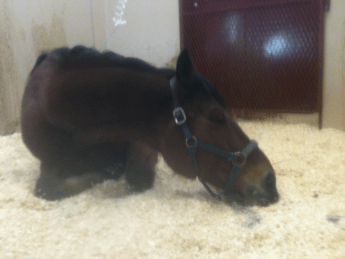
Robin 2 sleeping in hospital

The days passed.  The money poured out.  While I worried how I was going to afford all of this, I wrote a book about Play.  Odd how things evolve.

I knew always Robin might not come home.  He was so very sick.  The vets suggested that we give him platelets, but they wanted to check with me first.  The platelets were $500 a bag.  Ah well, I thought, so much for getting the new computer I so very much needed.

A week went by, then another.  I watched some horses go home.  Others came in, most for colic surgery, most were thoroughbred mares with newborn foals at their side.

I watched the staff give all the horses superb care.  Never was there any concern about leaving Robin with them.  There was no rough handling, no yelling, no treating any of the horses like livestock.  It was careful, caring, gentle handling.

During the second week Robin began to show more interest in eating.  At first, he was offered only small handfuls of hay several hours apart.  Then he was given a bowl of hay and finally a hay net.  At first all this did was make the diarrhea and the pain worse, but then on his second Saturday in hospital he started to look brighter.  His temperature finally dropped, and he began to eat more normally.  When I arrived in the afternoon, I was greeted by the welcome sight of a full hay net hanging in his stall.  The following day he continued to do well, so on the Monday, two weeks to the day of his arrival, he was cleared to go home.

I continued to live in the barn through the winter, huddled near a space heater in the tack room so I could keep an eye on Robin.  He was confined to his stall for a couple of weeks, then he was allowed out into his small outside run.

Peregrine helped me watch over him at night.  I always knew when Robin was lying down.  Peregrine would begin to pace.  The tack room is directly opposite Robin’s stall so Peregrine’s pacing would wake me in the middle of the night.  I’d slip out to check on Robin.  Always he looked comfortable, just resting, but I often had to get him up or Peregrine would continue to fret.  After about two weeks, Peregrine relaxed and let Robin – and me – sleep as needed.

Two months on from the surgery, Robin was allowed the freedom of the barn plus the arena, and then another month on from that he was allowed normal turnout.

As he got better, my writing time disappeared, and the book project went on hold.  Now that spring was here, there were more pressing outside jobs to do, plus my travel schedule was back in full swing.

In June the nightmare repeated itself – this time with Sindri, Ann Edie’s Icelandic stallion. He went off his feed, and he had a low grade temperature.  We had the vet out right away.  The diagnosis – anaplasmosis, one of the tick-borne fevers.  Apparently, this was hitting our area hard this year, and they were being run ragged getting to all the horses who were showing similar symptoms.

Sindri had had Potomac Horse fever eight years previously.  He’d had a bad reaction to the tetracycline, the antibiotic that is used to treat it.  His kidneys shut down, and we came very close to losing him.  Tetracycline is the drug of choice for anaplasmosis, but given his previous reaction, the vet chose an antibiotic from a different family of drugs.

This was on Saturday.  Sindri’s temperature dropped back to normal, and by Sunday he was back to eating and drinking normally.

Monday morning as I was turning him out, I saw a slight misstep as he came out of his stall.  Alarm bells started ringing.  The vet was out doing a recheck on Robin.

As we were finishing up with Robin, I mentioned that Sindri hadn’t looked right that morning.  He’d been a little off, and I was worried about laminitis.  We walked out to look at him.  Sindri walked up to us.  He looked fine.  There was no obvious lameness, no heat or pulses in his feet.

The vet left.  I busied myself about the barn where I could keep an eye on the horses.  When I checked Sindri again a short time later, he could no longer walk. The tinge that I had seen had grown into full blown laminitis.

I called the vet out again.  This time there was no mistaking what was happening.  The anaplasmosis had tipped him into laminitis.  My vet wanted us to keep his feet wrapped in ice boots and to stand him on sand to try to support his feet.  There was no way could get a load of sand delivered on such short notice, so Ann’s husband went off instead to Lowes to bring back bags of builders sand.

He brought us bags of ice and fifteen bags of sand.  That didn’t even begin to give us the coverage we needed.  Three trips later we had enough sand to get Sindri through the night.

The following day, Sindri looked so much better.  I thought with relief that we had dodged that bullet.  He was going to be all right. But the following day he crashed again.  Laminitis is like that.  You think you’re making head way, and then cruelly it flares up again with crippling pain.  The only good news was the x-rays showed no rotation of the coffin bone.

Sindri was on painkillers and other medications to try to control the inflammation.  He seemed to stabilize, but he was still sore.  And we had to keep his feet in ice boots round the clock.  Every two hours I repacked his boots with ice.  I could feel my brain turning to mush as the sleep deprivation set in.

Sindri seemed to stabilize.  He was allowed five minutes in the arena.  Turning he was very sore, but on a straight away he walked out in big reaching strides.  I turned him loose in the arena so he could choose what he wanted to do.  What he wanted was to trot up to me as I cleaned manure piles out of the arena.  That was an encouraging sign.  We were still hopeful he might recover with only minimal long-term damage to his feet.

Two weeks in we stopped icing his feet.  Hurray!  I still had to get up a couple of times during the night to give him his next round of meds, but at least I didn’t have to wrestle with the repacking of the ice boots.  We tried to reduce the level of painkillers.  The result: he could barely walk.  We changed meds and got him stabilized back to where he had been, but he continued to be a mystery.  The x-rays simply weren’t that bad.  Why was he continuing to show this degree of pain?

After two months he was no better, but he was also no worse.  I was scheduled to be out of the country for a week. I left on a Wednesday.  Friday I got an email from Ann.  She had tried to reach me by phone, but the contact number wasn’t working.  Sindri was colicing.

More nightmare.

I borrowed a cell phone and made the overseas call.  It was the middle of the night for Ann, but I knew she would be up.  She told me they weren’t sure what was going on, and she didn’t know what to do.

I heard myself saying if you think surgery is an option, ship him sooner rather than later.  Already, by waiting it might be too late.

I also heard myself telling her in more detail about Robin, about the cost of the surgery and the aftercare, about the risk to the feet in any horse, and the increased risk in a horse who already had laminitis.

I heard myself saying she should call Bob and get the trailer hooked up.  I knew it was the middle of the night, but he wouldn’t mind.  If she thought she wanted to go forward with treatment, the sooner they got to a hospital the better.  She should ship him while he was still able to go.

We talked for a few more minutes.  We both wanted the same thing for Sindri.  We wanted to give him a chance, but not if it meant condemning him to a lifetime of chronic pain.

I hung up, and pretended that everything was normal while I taught the morning sessions.  When it was eight o’clock back home, I called again.  The vets had recommended that Ann send him to our local clinic.  It looked as though the colic would resolve medically, but they wanted to be able to support him with fluids and monitor him more closely.  They had trailered Sindri over mid-morning to the clinic.  I kept checking my emails waiting for word of what was going on.

Sometime overnight things changed dramatically.  He began to reflux, a sign that there was a blockage somewhere.  Then the reflux slowed, but he became very painful, bucking and spinning in his stall.

His condition had shifted from a medical colic to an emergency surgery, but he was still an hour from the hospital.  Ann and I talked on the phone.  We both decided to send him for surgery.  It was so hard being so far away.  I knew the risks far better than Ann.  I had seen foundered horses.  What were we doing?  But we had to give him a chance.

Sindri made it to the hospital, but like Robin, he had to wait for another horse to come out of surgery.  He seemed to stabilize, and it was looking as though he might resolve medically, but then the reflux started again, and the decision had to be made.  Ann got the call and gave her permission to go ahead.

On the other side of the ocean I waited for news.

Sindri’s surgery was shorter than Robin’s and had a better outcome.  His intestine was inflamed.  They found signs of what might have been constrictions, but if there had been a blockage, it had resolved.

I flew home on Monday.  I was anxious to get in and get down to see Sindri.  I was hoping he would still be alive, that I wasn’t flying home to a dead horse.  United Airlines let me down.  The last leg of my trip was cancelled, and I had to spend the night in Newark.  I didn’t get home until mid-day on Tuesday.

Sindri waited for me.

He was in the same stall that Robin had started out in.  I almost didn’t recognize him as I walked up to his stall.  Unlike Robin, he looked like the very sick horse that he was.  His thick mane and forelock were braided to keep them out of the way of the catheter and fluid lines.  It was like looking at someone who you’ve only known with a beard.  Oh, that’s what you look like!
Sindri head shot in hospital

All four feet were in ice boots.  He was clearly in a lot of pain, both from the surgery and his feet.  The surgeon stopped by to update me on what they had found.  He sounded hopeful that Sindri would recover well from the surgery.  I looked at the way he was standing and wondered.

Over the next few days Sindri took us on a downward spiral.  He wasn’t eating.  Fresh x-rays showed us that we were now dealing with a rotation of his coffin bone, and his blood work was pointing us in the direction of liver damage.
Sindri lying down in hospital

I had stopped working on my book when Robin had gotten better.  Now I brought it out again.  Every morning I worked on it, and every afternoon Ann and I drove down to visit with Sindri.  The vets started him on IV nutrition to try to reverse the liver damage.  Slowly he began to eat a little on his own.  Now instead of rejecting the handfuls of hay that he was offered, he was asking for more.

Mid-week a mini donkey moved in to the stall directly across from Sindri.  While Sindri’s condition slowly improved, the donkey’s declined.  He was clearly much loved.  His family came often to see him.  His liver was failing, but he wasn’t as lucky as Sindri.  The vets weren’t able to stop the progression of his disease.  I heard the vets discussing  the possibilities with his owners.  Epm had been ruled out, along with West Nile.  They weren’t sure what they were dealing with, or what more they could do.

It was hard to celebrate Sindri’s growing appetite knowing that across the hall there were only tears.

The vets began to talk about Sindri going home.  If he meets this milestone, maybe by Wednesday.  Then it was Thursday, then Friday.  Finally the call came early Saturday morning.  Sindri had been cleared, we could take him home.

When we arrived the mini donkey was on his side resting on a thick mat.  He was having a seizure.

Across the hall Sindri was looking bright and very much ready to go home.  We were using a borrowed stock trailer that didn’t have a ramp.  I was concerned that Sindri might be reluctant to step up into the trailer.  I needn’t have worried.  Sindri was ready to go home.  One of the interns took him out before I realized he was even out of his stall.  He was already on the trailer by the time I got outside.  Good Sindri!

He got off just as easily and walked surprisingly well up to the barn.  But over the next couple of days that changed.  Walking was reduced to a slow hobble.

I’ve been trimming my horses feet for the last couple of years.  That means when something like this happens, you don’t have a farrier available to help you.  My vet called in a favor and arranged for one of the best farriers in the area to come help us.  Together they decided that the best option for Sindri were wooden clogs.  The clogs are built up of layers of wood laminated together.  They let the horse’s foot roll over in any direction that is comfortable, and apparently they can provide almost instant relief to some laminitic horses.

The farrier and my vet came out together to put the clogs on. They took x-rays first.  The x-rays showed clearly why Sindri’s feet had become so much more painful.  The last set of x-rays taken at the hospital had indicated that he still had good depth of sole.  On the new x-rays the coffin bone on both front feet had rotated even more and was now pressing down on the sole.  We had run out of foot.

I’m glad it was an experienced farrier who trimmed Sindri’s  foot that day and not me.  The sole was separating at the toe leaving a long line of exposed soft tissue.  There was no possibility of putting the clogs on.  The farrier made some temporary pads to protect his feet.  Sindri was so good to stand for the trimming and for all the fussing with his feet.

We had been keeping him on a sand stall, but with his feet so open, the sand had to go.  We put Sindri temporarily in one of the other stalls, while I dug out load after load of sand.  Sand is amazing how it gets into all the cracks and crevasses and refuses to come out.  I swept until sweeping was doing no good.  Then I got out my vacuum – yes the barn has a vacuum.  I bought it originally for my house, but somehow it ended up at the barn instead.  When the vacuum wasn’t getting anything more, I washed the mats.  I had just spent two weeks in a vet hospital.  They had set the bar high for cleaning a stall!

Finally it was ready for shavings – four bags to create a wonderfully deep, soft bed.  Sindri was going into a luxury apartment!  Once he had hobbled from Fengur’s stall to his own, he lay flat out on this new thick mattress and fell into an exhausted sleep.

We ordered boots for Sindri.  They came by overnight express the following day, and we transferred him from the styrofoam pads he had been in to the protective and much more supportive boot.  Every day Ann helped me change his wraps and reapply a sugar and betadine mix to the soles of his feet.

A week later Sindri’s feet were less painful.  The soles were beginning to grow in and cover up the exposed soft tissue, but I knew we still had a long road ahead of us.  The goal was to make him comfortable.  He was still bright eyed, and engaged with us.  He was telling us it was okay to keep going.  As long as his eyes were bright, we would keep going on.  Ann couldn’t say no to the surgery, anymore than I could say no to Robin’s.  So here we were in a place we never wanted to be with any of our beloved horses.

I always wanted to live in a barn with my horses.  I never expected I would be doing so under such circumstances.  Once again, I turned the tack room into my full time office and living quarters.  While I worked on the computer, I could keep an eye on Sindri.  Each afternoon Peregrine and Robin would have a nap standing side by side in the aisle next to Sindri’s stall.  Fengur, our other Icelandic, was generally outside having a sunbath in the barn yard.  And I was in my “stall”, keeping watch.

Sindri’s coffin bones stabilized.  With good care, a good farrier, and a lot of luck, his feet began to heal.  I kept writing throughout all of this.

Some people take up drinking when times are rough.  Other people go shopping or remodel their homes.  I, apparently, write books.  The first draft of the book was begun during Robin’s stay in hospital.  And it was finished during Sindri’s.

The book has been finished for a long time, but I have been undecided what I want to do with it.  Robin is still doing well, but we lost Sindri the day after Christmas 2014.  He coliced again, and this time it was clear it was the end.  When I led him for the last time out of the barn, he walked sound.  We had beaten the founder, but we couldn’t beat the colics. Perhaps six months of pain killers and other medications had just been too much for him.

I set the book aside. It’s been sitting in my computer, waiting.  I wasn’t sure for what.  I really haven’t wanted to publish it as a book, but if not that, what?  The book I have written was given to me by my horses.  It has grown out of lessons Peregrine and the others have been teaching me.   I wanted to share it, but I wasn’t sure how.

My decision has been to do something very old fashioned with it, but with a modern twist.  I’m borrowing an idea from the nineteenth century.  Charles Dickens published his books in serial form. Before they were turned into books that could be read cover to cover, they came out in weekly installments in inexpensive periodicals.  That meant his stories could be more widely read, but imagine having to wait a whole week to find out what twist the next chapter would bring.

I’m going to do something similar, but instead of using a printed magazine, I’m going to publish my book here on this blog, section by section.  I know we all live busy lives so I’ll space the publishing of these articles out so they don’t become overwhelming.

So what is this book about?  The simplest answer is play.

I have always played with training.  I have always told people to go “play” with an exercise.  I send them home to “play with ideas”, not to “work on a lesson.”  Play has been central to my life, but work can overcome that.  It has taken a lot of work to bring clicker training into the horse community.  My horses were always there reminding me that play is more powerful.

So it was right that a book about play would emerge at a time when I was most focused on my horses. It was written first and foremost for my horses, perhaps you could even say by my horses.  It is a gift from them to you.  I hope you enjoy it.

Alexandra Kurland
January 2 2016

Before I begin, I want to extend my great thanks to Dr. Naile and all the vets and staff at Oakencroft Veterinary clinic, and to the surgeons and staff at Rhinebeck Equine Hospital for the good care they gave to Robin and Sindri.

Also, a very great thanks to Mary Arena, who helped us enormously in caring for the horses, especially when I was away.  I would not have been able to travel if Mary had not been willing to step in and help.  Her contribution has always been greatly appreciated and always will be.  You never say thank you enough to people, but, Mary, I get to say thank you here.

Note:  What this book is, and what it is not.  In clicker training we learn to shift our focus from the unwanted behavior.  We want to focus on what we want the learner TO DO.  So it seems odd to be saying what this book is not.  It is not a “how-to” guide to clicker training.  I’ve written those books, produced those DVDS, written that on-line course.  If you are new to clicker training and need the nuts and bolts of how to get started, I will direct you to those resources.  You can find them all via my web site: theclickercenter.com.

So what is this book?  And who is it for?  The second question is easy to answer.  It’s for you – especially if you have animals in your life, and you’re interested in training.

Over the past twenty plus years I’ve been pushing the boundaries of what can be done with clicker training.  How do we use it?  How do we think about it?  What is our current understanding of cues, chains, reinforcement schedules, etc., and how has that changed over the years?

This book explores some of the areas that exploration has taken me.  We’ll be going well beyond the basics of clicker training.  I want to share with you the differences that make a difference – that transform you from a follower of recipes into a creative, inventive trainer.  Play is the transformer.  In the articles that follow you’ll discover what I mean by that.

I won’t be posting every day.  That would be overwhelming to you and to me.  Tomorrow is a travel day, so I’m not sure when I’ll be posting the next blog.  It will depend in part upon my internet access.  I will be putting you instead on an intermittent reinforcement schedule.  If you want to be notified when new posts are published, please sign up to follow this blog.

Coming soon: Part 1: Why Play?

Copyright  2016 All Rights Reserved.  I know on the internet how easy it is to pass posts around.  I certainly wrote this to share, and I hope you will share the link to these posts with others, but please respect the copyright restrictions on these articles.  If you wish to reprint them, please contact me for permission. (kurlanda@crisny.org)