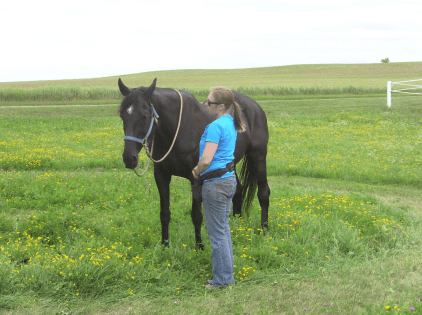
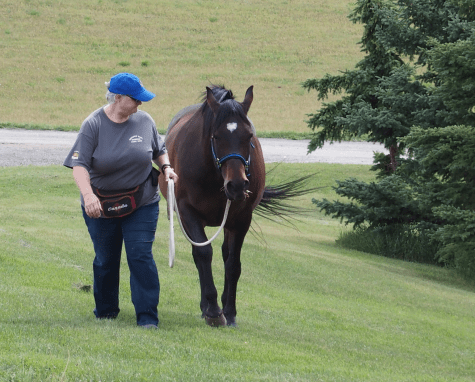
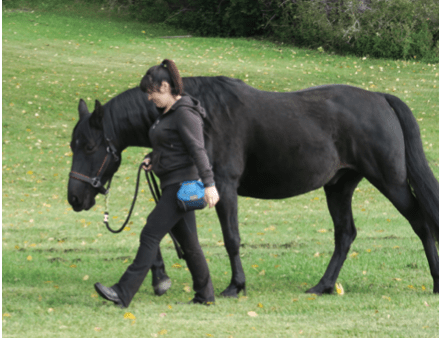
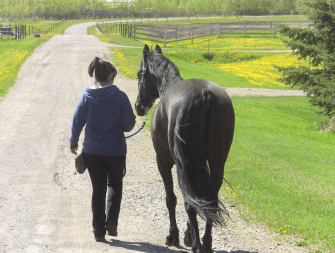
Thank YOU!

I’m taking a brief detour from the Goat Diaries.  2018 is the 20th Anniversary of the publication of my book, “Clicker Training for your Horse”.  To celebrate every month this year I will be writing an article about one of the many people who have helped me bring positive reinforcement training into the horse world.

Last month I told you about Bob Viviano and Crackers.  Bob was there literally at the beginning of my exploration of clicker training.  Ann Edie joined us a short time later when she started taking lessons from me at the barn where I boarded my horses.  This month I want to turn the spotlight in her direction to thank her for the enormous contribution she has made to the development of clicker training and for 25 years of friendship.

Most of you know Ann through her guide horse, Panda.  Ann has big horses as well.  We seem to share our equine family – at least that’s how it feels.  Ann’s first horse, Magnat, is our one in ten thousand horse.  That’s how I think of him.  He was originally my school horse, but he was such a great match for Ann, in 1996 I gave him to her.  In 1999 he was joined by our two Icelandics, Sindri and Fengur.  Panda joined the “herd” in 2001.

I’ve written so much about Panda, I’m going to shine the spotlight instead on Magnat.  He played such an important role in the early development of clicker training it is right that he should get the attention as I celebrate twenty years of “Clicker Training for your Horse“.   There is so much I could write.  I’ll just share a couple of favorite Magnat stories.

Remembering Magnat

Magnat is an Arabian.  He came to me through clients of mine who wanted a weekend trail horse for their guests.  Several months and several disastrous rides after they got him, they discovered that he had a severe heart murmur.  My clients were in a dilemma.  They didn’t want to keep him as a pasture ornament, but they couldn’t ethically sell a horse with such a severe heart condition.  Who would want such a horse?  The answer was I would.

So Magnat became mine.  One of my favorite training mantras is:

The walk is the mother of all gaits.

I didn’t need to ride fast to enjoy a horse.  Magnat and I were a perfect fit.  I would love to have reserved him just for myself, but he was such a great school horse.  I began to use him to give lessons at the barn where I boarded.  I could not have asked for a better co-teacher.  This was in 1994.  I had just begun the year before to explore clicker training with Peregrine.  I was having such good success with it, I had started to share it with all my clients.

Pretty soon the only horse who wasn’t clicker trained was my own school horse.  I was reluctant to introduce it to him.  I had all the questions that everybody else has when you first start introducing food into your training.  What if he got mouthy?  He was so polite now.  I didn’t want to risk messing up my one and only school horse by teaching him clicker training!

When someone is hesitant to give clicker training a try, I get it.  I had the same questions and concerns that most people have when they first encounter this work.  But I really couldn’t go on encouraging all my clients to give it a try and not follow my own advice with Magnat.

I needn’t have worried.  For Magnat it barely caused a blip on the landscape.  He was polite before I introduced food, and he remained so even when my pockets were bulging with treats.  He was never muggy.

There are lots of horses who go through a very rocky transition stage.  The food does get them excited.  They frustrate easily and often older behaviors that have been suppressed through punishment resurface to create problems.  Magnat showed none of this.  That isn’t to say there weren’t changes.  My solid, reliable lesson horse truly began to shine.  If he had been good before, now he was outstanding.

Throughout that first winter he helped me teach people the basics of single-rein riding.  There’s a great expression:

The longer you stay with an exercise, the more good things you’ll see that it gives you.

One of the good things the basics of single-rein riding produced for Magnat was collection.  The beginnings of two favorite behaviors popped out: piaffe and canter in-hand.  This later is a gorgeous behavior to have in repertoire.  Magnat became so balanced and collected, he could canter while I walked beside him.

It was around this time that Ann came to the barn wanting to take lessons.  Ann was not a beginner.  She had ridden as a teenager, but then like so many others she gave up riding when she went off to college and never got back to it once she started raising a family.  The challenge for me was Ann is blind.  I had never worked with a blind rider before.  This was a new frontier for me.  But I assumed my job was teaching her to ride.  Ann would take care of the rest.  If I taught her the way I taught everyone else, we’d come out okay.  It turned out I was right.

I started Ann the way I start all riders who come to me.   It doesn’t matter how many years you have ridden or how experienced a trainer you are, if you are going to ride one of my horses, you start with a pony ride.  I guide the horse from the ground.  All you have to do is sit and enjoy.

As the rider becomes familiar with the horse’s communication system, and understands how to cue the horse, I gradually turn over more and more of the control.  So at first I have the reins, and I’m working the horse in-hand with a rider up.  Then I hand the reins over to the rider, but I stay close so my body language continues to support the rider’s cues.  Then I gradually fade out and the rider takes over completely from me.

This worked perfectly for Ann.  Having Magnat as my co-teacher made all the difference, especially since he could canter in-hand.  For teaching that made him worth his weight in gold.  I wish I had learned how to ride on a horse like Magnat.  Ann has such a relaxed canter seat because she learned the rhythm of the canter from him.  Starting out she never rode a bad canter.  All she had to do was relax and enjoy.  There was no struggle trying to get him into the canter, no trotting faster, faster, faster like a plane taking off.  There was no leaning sideways through unbalanced turns.
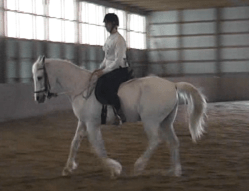
Magnat canter

Instead there was just the relaxed rhythm of a collected, glorious canter.  And then there was the piaffe and the passage.  It was Ann who was riding the first time Magnat succeeded in mobilizing into piaffe.  I was working him from the ground while she helped manage his weight shifts.

We were figuring out how to teach riding with the clicker.  I gave Ann the lesson, and she taught Magnat.  They were such a good match, I decided after their first winter together to give him to her.  It gave me so much more pleasure watching them develop as a team than I ever would have had riding him for myself.  And I had Peregrine.  He and Magnat became riding partners.  For the next sixteen years while we kept the horses at the boarding barn, Ann and I shared our evening rides together.

They were an unlikely pair, my thoroughbred, her Arab.  But it turned out that each horse gave their best to the other.  Magnat gave Peregrine the confidence to move forward again after a long, hard recovery from the aftershocks of Potomac horse fever.  And Peregrine taught Magnat about collection.

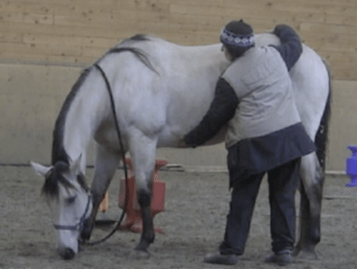
Magnat lived in a small paddock with two other horses.  I’m sure you can picture what he looked like during mud season.  Every night Ann would spend an hour or so grooming him and by the time he was ready to go into the arena, he was snowy white.  I don’t know how she did it!  When I brush my horses, the dirt moves from one spot to another.  When Ann grooms, the dirt leaves!  And a horse isn’t clean until her fingers tell her he’s clean.

Early on we taught Magnat to retrieve.  There’s a picture of him with a wooden dumbbell in his mouth on the cover of the first edition of “Clicker Training for your Horse”.  When Ann brought him into the arena, he would ask to be turned loose.  She’d let go of his reins, and he’d go out in the arena and bring back to her all the things the previous riders had dropped.

We boarded in a barn where there was a very active after school lesson program so there were always dropped riding crops, gloves, hats, kleenex.  Ann never knew what she was going to be handed.  Magnat was very diligent in making sure that he had found anything and everything that might get in their way.  In so many ways he was Ann’s first guide horse.

When the arena was clean, he would walk with her to the mounting block and line himself up.  Now the real glory of Magnat shone through.

Ann understood that clicker training means so much more than just using a marker signal and treats.  Clicker training for us is synonymous with good balance.  It was a joy to explore with her what that meant for our horses.

When Ann first started riding Magnat, she couldn’t manage his trot at all.  He bounced her out of the saddle.  It was the most jarring, bone rattling, uncomfortable trot imaginable.  That was because for her Magnat wasn’t yet balanced.  She didn’t yet understand how to use lateral flexions.  When she asked for the trot, she got the hollow-back, high-headed, stiff-legged trot that is all too often associated with Arabs.

As she learned how to use lateral flexions, Magnat relaxed and lifted himself up into a magic carpet ride.  The transformation was so black and white.  Ride him without asking for the lift that comes through the lateral work, and he would jar you right out of the saddle.  Ask for collection, and you were in heaven.

I taught Magnat lateral flexions before I began to explore clicker training.  He understood what I wanted and was a willing student.  Often people seek out clicker training because they are struggling with a horse.  That wasn’t the case with Magnat.  He could have gone through his whole life without ever needing to be clicker trained.

Before clicker training he was a good, solid-citizen riding horse, but that’s all he was.  Without clicker training he would have remained a nice, but ordinary horse.  With clicker training he shone.  I used to say he was a one in a million horse, but as the years went by and he just became more and more wonderful, not just to ride but to be around, I changed this to a one in ten million horse.

But I really shouldn’t be the one to describe what it was like to ride Magnat.  He was Ann’s horse.  Here is how Ann described him in a piece she wrote for my riding book:

“It’s always a dilemma to describe the experience of riding a truly extraordinary horse who has had the benefit of several years of clicker training.  Although many technical components go into the production of a really memorable ride, the irrepressible smile, the feeling of wonder, and expression of “WOW!!” that arises so regularly these days when I ride Magnat simply cannot be described in anything but poetic terms.

Yes, athletic talent and neuromuscular conditioning are part of what makes the ride so special; and yes, many hours of repetition over many months have gone into it; and yes, there is extraordinary lightness and balance.  But this is still far from the sum total of the experience.

Musicians have described a great melody as “ a journey which has many familiar passages, and which also contains some wonderful surprises which cause you to look at the world in a completely fresh way and gives new meaning to life.”  This is the best description I can find of what it is like to ride Magnat.

Magnat comes out into the arena every night feeling relaxed and eager to work.  He knows he will be appreciated and reinforced for his performance.  He knows that he is a respected dance partner and member of the team, not a mere subject of training.  This awareness and active participation on the part of the horse is one of the benefits bestowed by clicker training.

Our rides begin with warm-up exercises.  In the course of executing figures or doing simple softening and balancing work, I will pick up on the reins and suddenly feel the most indescribable lightness!!!

We may be in a super-buoyant, floating trot, a deliberate, balanced, ballet-like piaffe, or a heavenly rocking-horse canter.  Whatever it is, it will feel as though I am floating on a magic carpet.  He is so responsive in these moments.  It’s as if there are clear filaments of two-way communication from my finger tips to each of Magnat’s feet.  The slightest breath of a touch on one of those lines will be answered by an immediate floating response.

The musicians described music as a journey which “contains some wonderful surprises.”  That’s how I feel about riding Magnat.  Each ride contains surprises and special pleasures we have not experienced before.  It is like coming around a bend in the road and seeing a spectacular sunset, or a grove of awe-inspiring redwood trees, or the grandeur of an ancient castle, or the peace and cool of a Buddhist temple.  It truly takes the breath away!  It creates the deepest joy and aliveness in my heart!

These moments have totally changed the way I think about riding.  I feel such awe for Magnat and for what we create together.  In this moment I know, without the slightest doubt, exactly what I ride for – it is just this amazing feeling of total balance, effortlessness, lightness, and energy.  Magnat seems to feel the same excitement and joy, for he literally beams with pride, and recently he has begun uttering deep chortles in his throat at these moments.

I let the magic moment go on for as long as I dare, wanting it to continue forever, but knowing I must capture it with a click, before it disappears like a soap bubble or a delicious dream.

The click creates a pause in the music.  Magnat comes to a halt; I throw my arms around his neck in a huge hug, shower him with lavish praise, and empty my pockets of the most desirable treats!

The “WOW” feeling is definitely addictive.  The glow of the experience lingers and stays with me long after the ride.  Our whole horse-human relationship is one of appreciation, respect, and awe.

This is, for me, the great gift of clicker training.  When taken to the high-performance level, it creates transcendent moments of great joy”

Ann Edie – written in 2005 for “The Click That Teaches: Riding with the Clicker

Ann’s words express so perfectly why we have both worked to bring clicker training into the horse world.  If clicker training had just been about teaching tricks, and finding kinder way to get horses onto trailers or to stand for grooming, I would have moved on years ago.  Instead clicker training takes us on a journey to Joy.  It connects us deeply to our horses.

This is what Ann and I wanted to share when we wrote about our horses.  It is what I am celebrating in this twentieth year of “Clicker Training for your Horse”.  It is what we hope others will find as they explore clicker training: the great love and wisdom of horses.

Sadly we lost Magnat in 2011 not long after we moved to our new barn.  He had reached the grand age of 33, but it wasn’t enough.  We were both hoping he would be one of those Arabs who live to be forty.  Sadly he had cancer, and we had to say good-bye.

Ann has shared so generously her horses.  Magnat and the Icelandics have served as my school horses.  I’ve written about them, and they have appeared in the books and DVDs.  Sindri, our Icelandic stallion, was my riding horses.  Thank you Ann for that great pleasure and honor.

And then of course there is Panda, Ann’s guide horse.  Ann is a very private person, but she has shared Panda literally with the world.  We’ve had journalists from as far away as Japan and Australia come and do stories on her.  Ann has always been a good sport, and so has Panda!

What many people don’t know is Ann is one of the partners in The Clicker Center Barn. Without her help, the barn would never have been built.  Thank you Ann for this.  And thank you also for teaching me how to play scrabble and for occasionally letting me win.
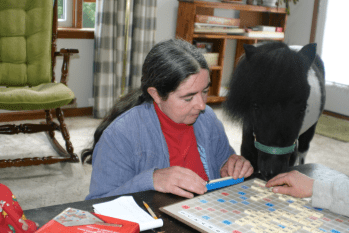
Alex Panda scrabble 0038

Goat Diaries Day 10: Expectations

What is the Click?

What does the click mean?

I’ve told you many times throughout these diaries that I clicked and reinforced a particular action.  Those are good words, but we have to question – is that what really happened?

Absolutely, I did click.  But what, if any, effect did it have on the goats’ behavior?  Did they even notice it?

In July I could make a good case for the click being just meaningless noise for the goats.  At this stage in their training were they stopping and orienting back to me because they heard the click? Or were they stopping because I stopped?

There was one very consistent cue that they were responding to.  When I reached into my pocket, they surged forward for the treat.  It’s this behavior that I wanted to change.  There are many strategies for doing this.  The one I chose for these sessions was to turn the movement of my hand into a cue for backing.

Once they had this part of the sequence down, I expected that they would notice more what came before the movement of my hand – the click.  Hear that sound, and you know treats are coming – get ready.  I know some people drop the click out and let the movement of their hand become the marker signal.  I prefer to keep the click in the sequence.

We all have biases in what we use for our marker signals.  My strong preference is for tongue clicks so I don’t have to carry a clicker around with me.  That leaves my hands free for other things.

We also have biases in how we use marker signals.  Do we keep them in?  Do we change them over time to verbal signals?  Do we sometimes feed without using a marker signal?  Do we click but not feed?  (When you want your click to function as a cue, that’s a peculiar one.  What are you cueing?  It becomes like an unfinished sentence.  Think how annoying and not very useful that is when people make a habit of never finishing their . . . .

There are lots of variations on the theme.  I developed my approach to using the marker signal through working with horses.  I decided early on I wanted the click to be a gate keeper.  That means about the only time I give my horses treats is after I have clicked.  I want the message to be: “If you didn’t hear a click, don’t bother looking for food.”  The exceptions involve rituals I have created around greeting and leaving.  I give treats as I enter the barn and say hello to my horses, and again as I am saying good-bye, but the context is consistent and creates its own control of expectations.

At all other times, if I am giving a treat, it is for something I have clicked.  This creates very consistent rules around the food.  In the absence of the click, I can reach into my pocket to get my gloves or a tissue.  My horses won’t be expecting food because I didn’t click.

If you sometimes feed a “just because” treat, you can create a lot of frustration.  Your horse is left wondering what he just did that got you to reach into your pocket.  “Just because” treats usually aren’t very consistent.  That lack of consistency can throw a learner into an extinction process complete with all the “shaking of the vending machine” that goes along with it.

You’re wanting to be kind, and instead the carrots you’re feeding are just turning your horse into a scary monster.  The click helps to manage this.  Now he knows there’s no food unless and until he hears the click.

If you are new to clicker training, this may sound very restricting.  You want to feed treats.  Don’t worry.  Once you start clicker training, you will have lots of opportunities to click and give your horse a treat.

Initially, the click is barely noticed by the horse.  He sees you reaching into your pocket.  That’s what he focuses on.  You can get the same kind of mugging behavior that the goats were showing.  The only difference is all that eagerness for the treats comes in a much larger package.

Over time you will see your horse respond to the click.  It has begun to function as a reliable cue.  When he hears that sound, he will stop to get his treat.

How do I know this?  I do a lot of liberty work.  Often the horse is at a considerable distance from me.  In fact, I may be completely out of his sight.  When I click, he stops.  He heard that sound, and he knows what he needs to do to get his treat.  Usually that means waiting quietly while I walk (not run) to him with the treat.

When cues are linked with positive reinforcement, they become predictors of good things to come.  The sound of the click leads to good things, so my learner will want to figure out what he can do to get me to click again.

Pushing forward into my space, nudging my hands, pawing at me, if none of these things lead to a click, but backing up does, I’ll begin to see my learner actively backing away from me and these other less useful behaviors (from his perspective) will drop away.  My learner will be using the backing behavior to cue me to make that funny sound that predictably, reliably leads to treats.

Over time he will learn that there are many behaviors that can get me to click.  So now the noticing of cues moves back another step.  He begins to pay attention to the thing that comes before the thing that comes before the thing that . . . .  In other words he begins to notice the cues I am giving that signal to him what is the hot behavior that will most reliably lead to a click and a treat.

In all of this click serves as a gatekeeper.  On one side are the behaviors that I want.  On the other are the treats that my learner wants.  It’s a win-win situation for both of us.

That understanding of the click’s function isn’t there at the beginning.  Horses can be just as eager for their treats as the goats.  They can crowd every bit as much into your space.  But at liberty, I can show you that the click is a cue an educated horse is definitely responding to.

Why do I want this?  I know many dog trainers have a much looser system with the click.  They will often toss treats without first marking a specific behavior.  Instead I want to give my horses so much practice responding to the click that it becomes automatic.  They don’t even think about it.  They hear the click, and instantly they are stopping.

Again, why do I want this?  Simple answer – because I ride.  Under saddle when I click, my horses all stop.  I don’t have to actively stop them in order to get a treat to them.  They stop on their own, and they wait patiently while I fish around in my pocket to get their treat.  There’s no fussing or fidgeting.  They have learned how to be patient.  That’s a wonderful safety net to have when you are sitting on the back of your learner.

These goats were a long way from that standard.  Riding was obviously not where we were heading. Instead they were going to be around small children.  When someone clicks, backing up away from the treat pocket is a great response for a goat to have.  That’s what I was working on in this session.

E’s leading session

In the previous post I described P’s leading session and my focus on the treat delivery. Now it was E’s turn.  I brought him out into the arena on a lead.  He was also excellent.  He’s so very gentle.  He’s much easier to lead than P.  That actually made this lesson a little harder for him.  Because P can be very pushy, he’s had a lot more experience moving back from the treat.  It was easier for him to make the connection and to understand that backing up is what got me to hand him a goody.

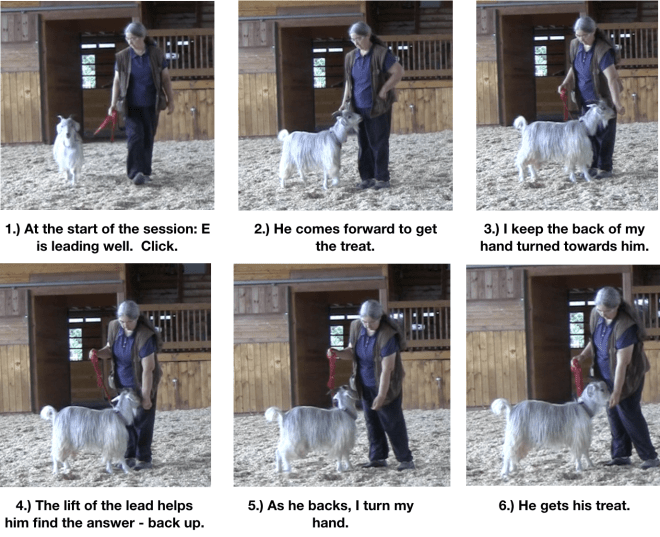
E was slower to catch on.  When I clicked, I extended my closed hand out towards him.  Instead of finding my open palm with the treats there for the taking, I had the back of my hand turned towards him.  At first, he was confused.  What was he supposed to do?  I didn’t want this to turn into teasing, so I helped a little by lifting the lead up so it exerted a slight backwards pressure.  It was a suggestion only.  I was careful not to pull him back. The lead was there only to remind him about backing, to bring it further up in the “files” so he would give it a try.

In previous sessions I had introduced him to this collar cue.  He had learned that backing led to a release of the pressure AND a click and a treat.  I’d given the lift of the lead meaning.  Now it was time to put it to use.  The lead was acting as a prompt.  He got it right away.  I only had to use it three times, and then he was moving away from my closed hand on his own.

Goat diaries Day 10 food manners 1.png

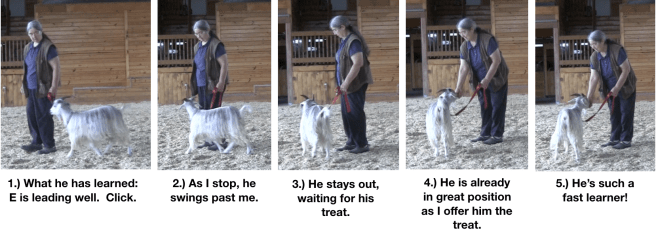
So now it was click, and he backed up to get his treat.  When I extended my hand out where the perfect goat would be, he was exactly where he should be to get a treat.

Goat diaries Day 10 food manners 2.png

You’ll need a password to watch this video.  It’s:  GoatDiariiesDay10E

I started to take E back, and then decided to let him have another go at the mounting block.  E was a little uncertain at first but then he went across the mounting block all the way to the end.  I had some foam mats at the far end.  E jumped up on them.  Contact points!  Then he leapt high into the air for a twisting dismount.  What fun!

We went back to the beginning, and he ran across the mounting block again.  I loved the rat a tat tat sound of his hooves on the wood.  At the far end he did another wild leap off the mounting block.

The two runs seemed to satisfy him.  He followed me into the aisle and back to his stall.  Getting him to go back in was easy.  Dropping treats seems to be the incentive they need to turn going into the stall into a good thing.  They could so easily become sticky at going back.  They like to go exploring.  And they definitely like the treats, the social attention, and the game.  Planning ahead so returning to the stall is a good thing was paying off.

As always, I balanced the excitement of our training sessions with the quiet of cuddle time.  P was particularly eager for attention.  They are showing more and more enjoyment.  Now when I scratch, they lean into my fingers.  I can see their lips wiggling.  None of this was there at the beginning.  Now when I scratch them, I get a whole body response.  Talk about reinforcing me!

The Goat Palace – Catching Up With Current Training

All this good prep has created more opportunities to give the goats adventures.  Because they will now lead reliably, we can take the three youngsters into the indoor arena for playtime.  I can lead Pellias and Elyan together without being dragged in opposite directions or pulled off my feet.  On the rare days when the temperature is reasonable I’ve also been taking them out individually for walks.

Last summer Pellias was the bold one, but this winter oddly enough it is Elyan who has been up for longer adventures.  We started out just walking a large circle immediately outside the lean-to.  I would ask Elyan to go just a couple of steps – click and treat.  When I walked off, I was always mindful of his response.

If he hesitated or stopped to look at his surroundings, I would wait for him.  The slack was out of the lead, but I didn’t add any pull.  When he oriented back to me, click, I gave him a treat.

If he rushed ahead of me, I would say “Wait” and stop my feet.  As soon as he glanced back towards me, click, I gave him a treat.  “Wait” became a reliable cue within one session.

I discovered this the next day when we took the three youngsters into the arena for a playtime.  We turned then loose and let them do aerials off the mounting block.  After a bit I headed towards the far end of the arena.  Elyan was staying close to me.  Pellias was a little further off.  When they spotted a set of platforms, they started to run towards them.   I said “Wait”, and Elyan immediately turned back to me.  Click and treat.  What fast learners these goats are!  I hadn’t yet given Pellias the “Wait” lesson, but when he heard the click, he immediately turned away from the platform and came running back to me.

Walking out with them individually has confirmed even more for me that the click has taken on meaning.  Pellias and Elyan have both become very good at staying by my side and keeping slack in the line.  As we walk along, I’ll click, and they will immediately orient to me.  This is happening now before I stop my feet or reach into my pocket.  What began as just noise in the background has become a reliable and very clear signal – come get your treat!

I should mention that Thanzi has also gained walking out privileges.  The first time I put a lead on her, she dragged me the length of the hallway to get back to the security of her pen.  Now she stays glued to my side, and we can venture out for walks.  That’s enormous progress.  She was chosen to come here because she was such a strong puller.  She’s so powerful, and now she is also so wonderfully light on a lead.

Trixie is another matter.  The lead for her is definitely a cue – just not a positive one.  If I am holding a lead in my hand, she shuts down completely.  Never mind trying to put it on her.  Just holding it creates this response.  She is a work in slow progress.  But I have written enough for today without going into the unwinding of her poisoned cues.  That will have to wait for another day.

Coming Next: Day 10 Continued: Distractions!

Please Note: if you are new to the Goat Diaries, these are a series of articles that are best read in order.  The first installment was posted on Oct. 2nd.  I suggest you begin there: https://theclickercenterblog.com/2017/10/02/   Two of the goats I write about originally came for a twelve day stay in July.  The July Goat Diaries track their training during this period.  In November these two goats, plus three others returned.  They will be with me through the winter.  The “Goat Palace” reports track their current training.  I wish to thank Sister Mary Elizabeth from the Community of St. Mary in upstate NY for the generous loan of her beautiful cashmere goats.


The Goat Diaries – Day 6: Staying Positive with Constructional Training

Constructional Training

I’m a clicker trainer. The work I do sits under the umbrella of The Click That Teaches. Those are both labels I’m very comfortable with, but for years people have said I need to give my work a different name.

“It’s so much more than just clicker training,” they say to me. They are referring to my emphasis on balance.  When we do a summing up at the end of clinics, someone will always say there is so much more to clicker training than they had ever imagined.  So perhaps it isn’t that I need a different name for my work. Perhaps I just need to help people see the depth and breadth of what clicker training can do.

In any case I have tried on many names over the years. One of my favorites is “Constructional Training”.  That comes via Dr. Jesús Rosales-Ruiz from the field of Behavior Analysis.  My translation of this term is this: Complex behaviors are created from smaller components.  When I teach these smaller components first, it becomes easy to ask for the larger, goal behavior.  So I construct complex behaviors from smaller building blocks.

I also want to construct behaviors before I use them.  If I haven’t taught the goats how to soften and yield to the contact of the lead, or how to follow a target, or how to stay by my side, then it isn’t fair game to ask them to walk beside me on a lead.  If they charge ahead of me, and I use the lead to stop them, I’m being a negatively-focused trainer.  I’m using the lead to try to stop a behavior I don’t like.

But if I’ve taught them the components, then I can ask them to back up and come forward in response to cues.  Leading becomes a dance – and in great dancing both partners respond to one another.  They listen to one another.  Both partners direct the flow.  If my partner misses a cue and rushes ahead of me, I can redirect him into another direction.  I’m asking for a known behavior which my partner has learned leads to positive reinforcement.  Constructional training takes me to the dance.  And the dance helps me be a more positive partner for my animal learner.

All of this sounds very grand.  But really it is very simple.  With the goats I was building the components I would need for us to be successful venturing out into the larger spaces of the barn aisle, the arena, and eventually the great outdoors.  Leading was high on the priority list.  These goats would be going home in just a few days, back to the children who were leasing them.  They would be going to the county fair, and hopefully they would know how to lead and not be one of the goats who was dragging his child across the show ring (or being dragged by the child).

We’ve reached Day 6 of their stay with me.  In this report I’ll be illustrating what it means to be a constructional trainer.  In the previous posts I described how I introduced both goats to platforms and to the beginning of leading.  At the start of Day 6 I continued with Pellias’ platform training.

The July Goat Diaries Day 6 7/9/17 Sunday

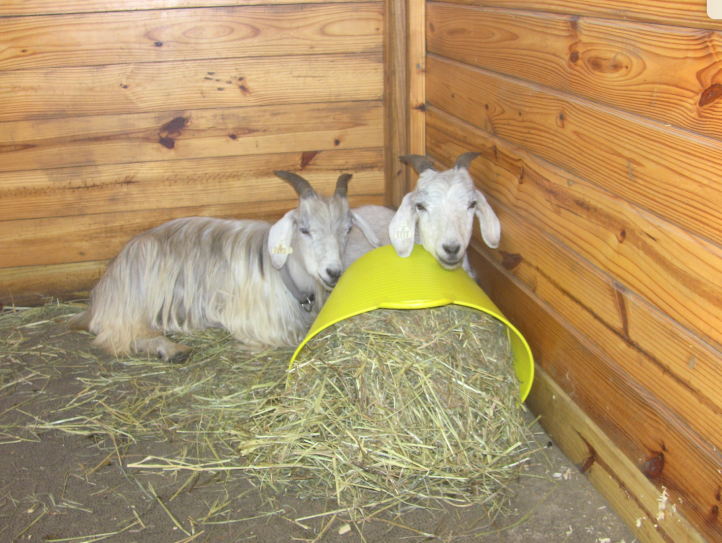
9 am session:  I was learning from previous experience.  I made sure to give the goats plenty of time for their breakfast before asking them to concentrate on training.  By the time I was ready to play, they were lying down side by side having a nap. I scattered some hay stretcher pellets on the floor as a distraction while I went outside to set up the platforms.

Goats lying down by bucket.png

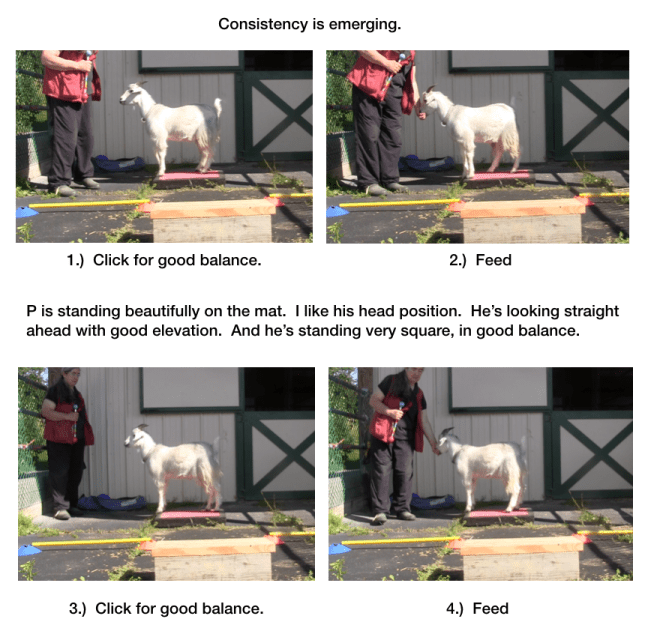
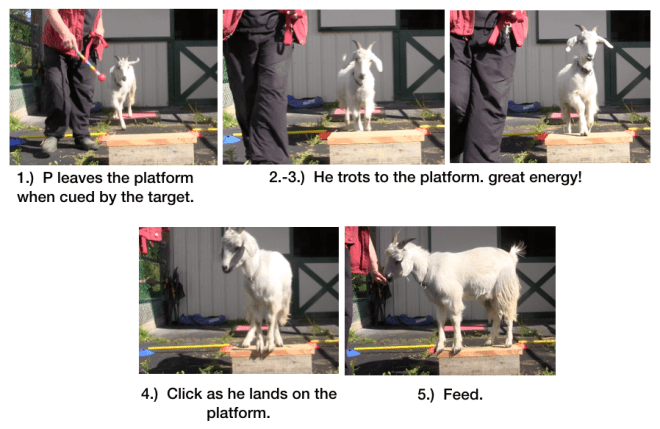
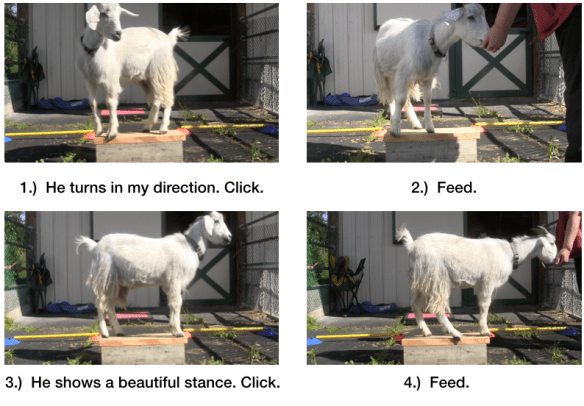
For P I set out both platforms and the ground poles as before, but the platforms were closer together so I could film. P was ready to play, and he did great.  I could move several steps away, and he stayed put.  I loved the consistency P was beginning to show.  Instead of stretching out to try to get to my treats, he was standing in great balance.

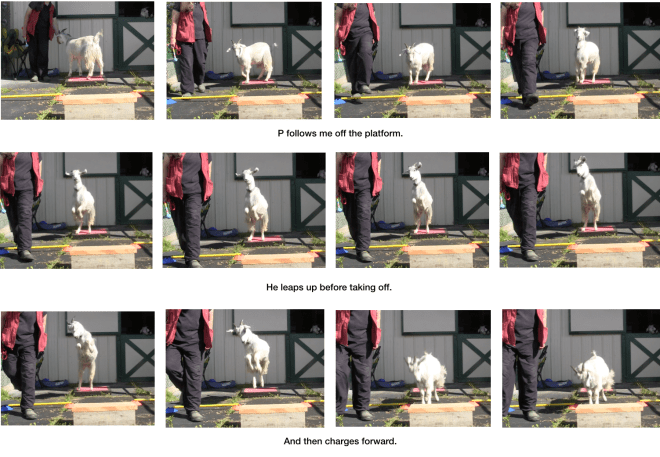
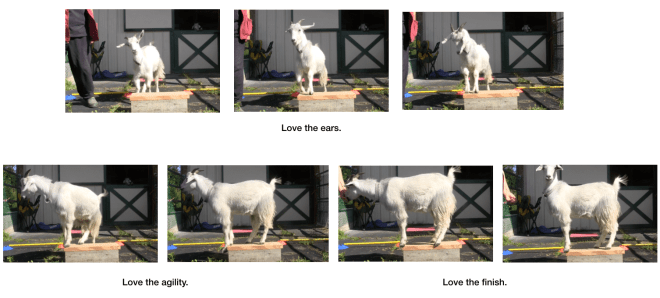
Diaries Day 6 Platform Progress with P -panel 1

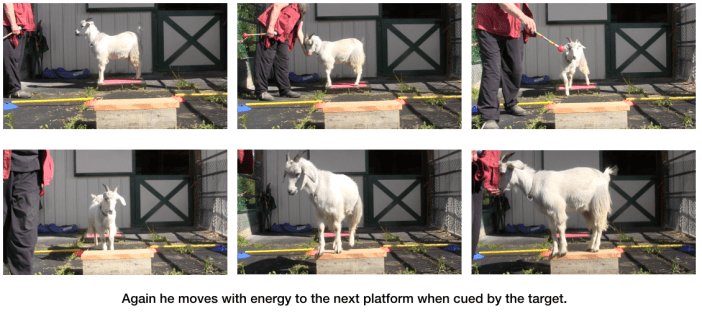
When I rattled the target, he changed platforms readily.  He had lots of energy which he was learning to control. I liked seeing him move at speed to the next platform, and even more I liked seeing him transform that energy into an ability to stand still on the mat.

Diaries Day 6 Platform Progress with P -panel 2.png

Back and forth between the platforms, I was seeing lots of energy.

Diaries Day 6 Platform Progress with P -panel 4.png

Diaries Day 6 Platform Progress with P -panel 5.png

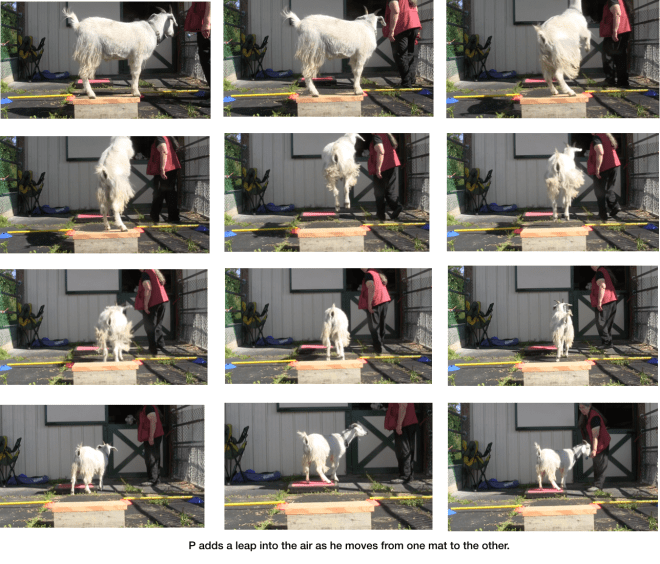
He was such fun to watch as he leapt into the air to bounce from one mat to another.

Diaries Day 6 Platform Progress with P -panel 6.png

Diaries Day 6 Platform Progress with P -panel 7.png

Diaries Day 6 Platform Progress with P -panel 8.png

A couple of times he missed or came off the platform. I waited, and he turned away from me and landed on the platform – excellent. It seems as though he is really getting the game.

The Goat Palace Journal Dec 23

That initial introduction to the platform has evolved into what I am working on now.  I am using Michele Pouliot’s platform training as my model.  I introduced Michele in a previous post.  In her position of the Director of Research and Development at Guide Dogs for the Blind, she transformed their training program.  Now all the dogs at that school learn their guide work via clicker training.  In her free time Michele’s training hobby is canine musical freestyle.

Michele is a creative, inventive trainer.  Lots of us use mats and platforms in our training.  Michele took the idea of using platforms and developed it into a fabulous process for teaching the body orientation and cued positions she wants for freestyle.  With the horses I make extensive use of multiple mats, but I have used them in a very different way from Michele’s work.  With the goats I wanted to explore more directly Michele’s use of platforms.

For step by step instructions for platform training for dogs I’ll direct you to her DVD on platform training which you can find on her web site: MichelePouliot.com

One of the key ingredients of her approach is you want an animal that is magnitized to the platform.  If your dog, goat or guinea pig sees a platform, he’s on it.  Forget trying to pick up a platform to move it.  Your animal will already be on it.  I definitely had that!  In fact I had it with all four goats.  The lessons I’ve described in previous posts had created super magnitized mats and super eager-to-play goats.

So in July you could say I began the initial construction of platform behavior.  Now I was continuing that process.  Those early lessons let me construct this current layer.  What I’m building now will become the components for the next project, and on it goes.

So what am I doing?  Here’s my set up for Pellias and Elyan: at the near end of the hallway I set out two the narrow platforms side by side.  In the middle I have the a single platform next to which I hang a stationary target.  Actually this target is not all that stationary since it is hung from the rafters so it swings after they touch it.  Pellias’ hanging target is a giant kong toy.  Elyan’s is another dog toy, a dumbell with tennis balls at either end.  The storage box is at the far end of the hallway, so I have three stations set up.

I’ve been working them individually in this lesson.  Normally it is Pellias who goes first.  He goes immediately to one of the narrow platforms with a very expectant air of I’m here!  Let’s play.  And that’s exactly what we do.  We play.

I have four positions that we’re working on:

“Front” – I stand directly in front of Pellias as he stands all four feet on the platform.

“Side” – I stand by his left side.

“Off” – This one will only make sense to horse people.  I stand on by his right side.  In the horse world that’s referred to as the off side.  Left and right would confuse me, but my brain can keep track of the off side so that’s what I’m using.

“Behind” – I stand in front of Pellias but with my back turned to him.

I also want “Ahead”, but I will probably need to use a target to get this one.

I generally begin with “Front”.  I say “front” as I stand in the position.  Click, treat. Repeat.  Then I shift to the other mat.  “Front” – Pellias shifts with me.  Click, treat.  From here I can shift into other positions.  I can step to either side of him.  As I do, I identify the position.  Or I might step to the opposite end of one of the mats so Pellias has to spin 180 degrees around to face me.

He’s gotten very good at following me and shifting position as needed and also staying put and letting me change position around him.  The idea is I will eventually be able to fade out the mats, and he will move into the cued orientations.  Time will tell what dots he connects.  For now it is keeping us both well entertained.

When we have done a good unit on these two platforms, I move to the middle platform and Pellias follows.  I don’t want to get him stuck and only able to work on the two platforms so it’s important to have these multiple stations.  On the middle platform he gets reinforced for touching the hanging target.

From the middle platform we head to the box.  On the box I reinforce him for body contact.  Then it’s back to the middle platform, and then on to the two narrow platforms.

With Elyan I am doing a similar lesson.  The difference between the two is Elyan is much wigglier in a younger brother sort of way.  I have no idea which one is the younger twin, but the difference in actual age is measured in minutes.  The difference in emotional age is much greater.  Elyan is the little brother bouncing up and down excited that Santa is coming.  Pellias is the older, wiser brother who pretends he’s not excited that Christmas is here.  I find them both charming.

So I am busy constructing behavior.  With horses I have built component behaviors that are similar to the ones I am teaching the goats, but not in this way.  I am very much looking forward to seeing how this unfolds.  It is fun working with an animal that not only is the size of a dog, but in so many ways moves like a dog.  That means I can more directly explore some of these techniques that canine clicker trainers have developed.  It is great fun to take someone’s good work and then to see what your own learners do with it.  And then it will be interesting what I take back to the horses.

Happy New Year Everyone!  May you construct great things from the gifts your animal friends give you.

Coming Next: Train Where You Can

Please Note: if you are new to the Goat Diaries, these are a series of articles that are best read in order.  The first installment was posted on Oct. 2nd.  I suggest you begin there: https://theclickercenterblog.com/2017/10/02/   Two of the goats I write about originally came for a twelve day stay in July.  The July Goat Diaries track their training during this period.  In November these two goats, plus three others returned.  They will be with me through the winter.  The “Goat Palace” reports track their training.  I wish to thank Sister Mary Elizabeth from the Community of St. Mary in upstate NY for the generous loan of her beautiful cashmere goats.

Deer Fencing – A Great Example of Everything is Connected


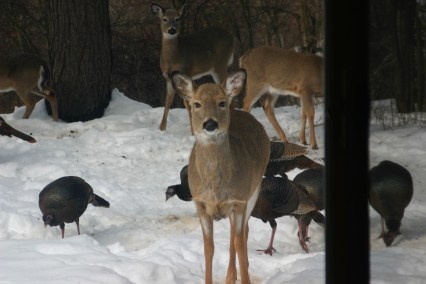
IMG_8839.JPG

The view in winter out my window

I recently took the deer fencing down.  That may not sound like a horse training topic, but it turned out to be a perfect example of one of my favorite training mantras: everything is connected to everything else.

The deer fencing protects a sprawling, low-growing evergreen.  I let the deer eat most of my garden, but this tree I protect.  Every fall the fencing goes up.  And in the spring it comes down.  That means taking down the plastic fencing I use and then pulling the metal fence stakes out of the ground.  After I had rolled up and put away the fencing, I tackled the fence posts.  I took a firm hold of the first stake, expecting it to come easily out of the soft spring ground.  It didn’t move.  I changed my grip, and it slipped out of the ground.  The image of a warm knife cutting through butter came to mind.  What was the difference?  Simple answer – bone rotations.

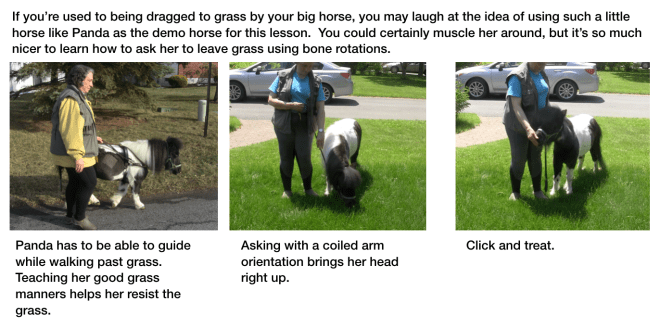
As I pulled up the rest of the stakes, it occurred to me that this would be a great way to let people practice the rope handling technique that you use to get a horse to lift his head up from grass. ‘Tis the season when the grass is calling with a Siren’s song to our horses.  In traditional training we are taught to fight the grass.  The horse MUST NOT drag us to grass. This sometimes keeps clicker trainers from seeing grass for what it is  – a wonderfully convenient source of reinforcement.  Instead we struggle to keep our horses from plunging their heads down to graze.

No one enjoys being dragged to grass. So how do you change this picture? One answer is to change how you view the grass. Your horse wants it. Great! That means you can use it to reinforce behavior YOU want. Instead of trying to stop him from diving for the grass, you’ll be looking for opportunities to let him graze.

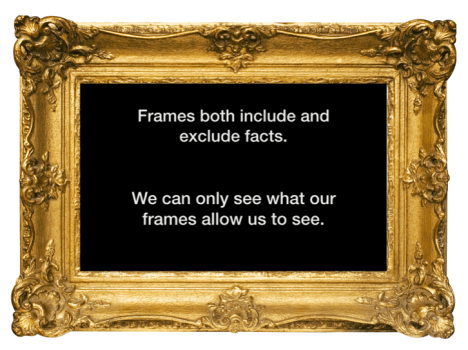
This lesson is connected to something else I’ve been thinking about a lot recently and that’s frames.  Here I’m not talking about picture frames, though that’s a good metaphor for them.  I’m referring to the mental constructs that George Lakoff describes in his books, “Your Brain’s Politics” and “Don’t Think of an Elephant”.

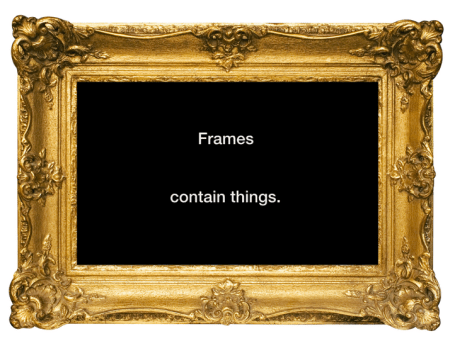
Frames contain things

Whether frames are the kind we hang on a wall or the kind we form around ideas, frames contain things.  According to Lakoff, we organize facts within a frame of reference.  Facts that fit within a given frame are easily processed.  Others bounce off these frames as though they don’t even exist.  Either that or we push back against them because they don’t fit comfortably within the frame.  There’s no structure, no way to relate to them so the new idea might just as well not exist.

Frames both include and exclude facts

If you’ve always resisted letting your horse have grass during training, the following lesson is a great opportunity to practice expanding your frame to let some new ideas in. The first step is to decide that you’re going to give this approach a try.  That’s a lot more inviting than facing another summer-long battle with your horse over access to grass.

You can’t just suddenly declare that the grass is a reinforcer and expect smooth sailing.  You need to go through a teaching process for your horse to understand how to behave on grass.  I’m going to assume a general understanding of clicker training.  If you haven’t yet introduced your horse to the basics of clicker training, you’ll want to do that first.  I’ll refer you to my web sites for details (theclickercenter.com and theclickercentercourse.com)

Many of us have to hand-graze our horses to acclimate them to spring grass.  This is the perfect opportunity for this lesson. (If you need an easier starting point, you can begin in a paddock and use small piles of hay.) The idea is that you are going to teach your horse to leave food in order to get food.

For this lesson on transforming grass into a useful reinforcer here are the steps:

Begin by taking your horse out to graze. Don’t try to keep him from the grass. (If you are using hay piles scattered around your training space, let him take you to the hay. Don’t resist.) Let him eat for a couple of minutes. As he begins to settle and relax, you can start the lesson.

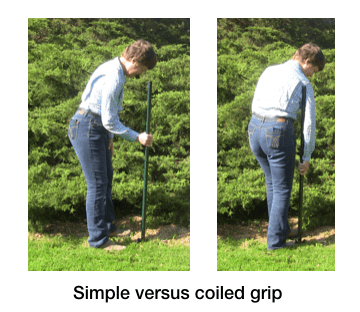
1.) Use your lead to ask your horse to lift his head up. He may ignore you at first, but do the best you can. This is where the image of pulling fence posts out of the ground becomes handy.  If you pull straight up on the lead, you’ll feel as though you are playing tug of war against a team of football players.  Your horse’s head won’t budge. Remember when I tried to pull the fence post up with a simple grip, it stayed planted in the ground.  But when I coiled my arm around the post like a vine coiling itself around a stake, it came out easily.

So before you head out with your horse, go practice pulling some metal fence posts out of the ground. Test the effect.  Take a simple grip and see what happens.  If the stake is buried deep into the ground, you won’t be able to pull it out.

Simple versus coiled grip.png

Now coil your arm around the stake.  You’ll feel it lift out with very little effort.  This is the technique you’re going to use on the lead.  You’re going to stand directly over the snap so the lead is perpendicular to the ground.  As you slide your hand down the lead, let your arm coil around it.  You’re now in a position that matches the way you coiled your arm around the metal stake.  Think about how you pulled the stake out of the ground.  You’ll use the same action with your horse.

In the past you may have had to yank, tug, and plead to get your horse to “come up for air”. Now suddenly his head is popping up.  It can’t be this easy!

Even if your horse feels as though he’s one of those stakes that is well and truly cemented into the ground, you’ll still be able to pry his head up with considerably less effort than you would have had to use in the past.  As his head begins to lift, be ready for the next step in this lesson.

Screen Shot 2017-05-18 at 10.51.08 PM

2.) As soon as he starts to lift his head, click and offer him a treat.

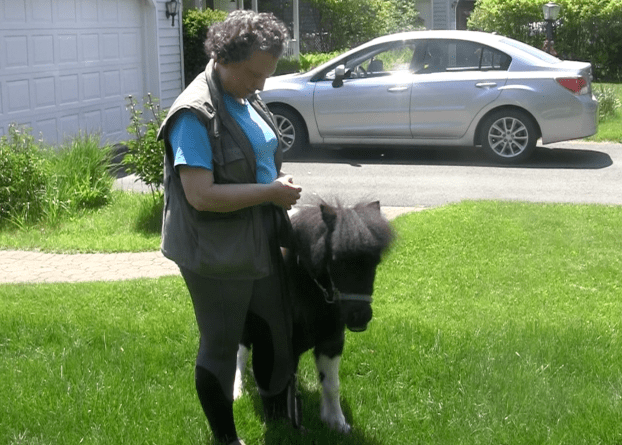
3.) Keeping the lead fairly short, fold your hands together at your waist. This base position is part of a lesson I call  “the grown-ups are talking, please don’t interrupt”.  With both hands folded together, if your horse tries to pull down to get to the grass, you’ll be able to anchor the lead to your body.   It’s surprising how solid you can be in this position.  From your horse’s point of view, it’s as though he’s tied to a well anchored post.

This only works if you have a fairly short lead so he can’t get too far down to the grass.  If your lead is too long, you’ll lose your leverage advantage.

Your horse is going to try and drop his head back down to the grass. With your hands anchoring the lead, you are essentially holding him as if he was tied to a post. As soon as he stops trying to pull down (even for an instant), click. Offer him a treat, and then anchor your hands again to your waist.

Panda in grown-ups not grazing.png

Panda would love to keep eating.  The short lead tells her to go into “grown-ups” instead.

Repeat this several times and then, click, give him his treat and let him drop his head down to eat grass.

Let him graze a little, then again, standing directly over the snap, coil your arm around the lead.  When you’re in position, rotate your arm so the “stake pops out of the ground”. As your horse lifts his head up, click and treat, then anchor your lead by standing in “grown-ups”.  Remember that means you’ll have both hands held together at your waist, and the lead will be short.

As soon as he stops pulling down, again you’ll click and treat.  Repeat this part of the pattern several times.  Release him to the grass when you see a noticeable improvement in his behavior. The behavior you’re heading towards is his side of the “grown-ups” picture.  That means he’s standing beside you with slack in the lead.  His head is about level with his chest and he’s looking straight ahead.  In other words he looks like a settled, well-mannered horse standing politely beside you.  If a friend were with you, the “grown-ups” could talk, and your horse would be waiting patiently beside you.

Screen Shot 2017-02-18 at 11.43.45 AM

A lovely result: this horse can stand on her own over grass without needing any reminders from the lead. She’ll get a click and a treat for this desirable behavior.

Instead of fighting the grass, you are now using it to reinforce the behavior you want. When you ask him to lift his head, your horse will begin to come up faster.  Instead of trying to dive back down to eat grass, he’ll shift on his own into “grown-ups”.  He knows he’s going to get reinforced for standing beside you with his head up.  And he also knows you’re going to let him eat more grass.  Instead of being anxious about getting to the grass, now he can relax and stand beside you keeping slack in the lead.

Paddy leading on grass 2

Lots of temptation under foot, but note how relaxed this horse is leading over the grass.

Once he’s coming up readily, you can ask him to walk a few steps to get to another patch of grass. At first, just go a couple of steps, then stop. People tend to want to keep going once they have a horse in motion, but this can undo the good work you’ve been establishing.  Go too far and the Siren’s call of the grass may overwhelm your horse.  So go just a couple of steps, stop and ask for grown-ups. As soon as he settles, which means he’s able to keep slack in the line because he’s not trying to go down for the grass, click, and let him graze.

On the search for good grass

On the search for good grass. Note the slack in the lead. This horse isn’t anxious about getting to the grass because he knows he’ll be given the opportunity to graze.

You can turn this into a game in which you are helping him find the best grass. From his point of view, you’ll probably be an incompetent grass hunter.  We humans seem to be drawn to the grass that our horses don’t want to eat.  We pick the long, extra green grass.  They want the stubby weeds.  But even if we take them to less than ideal spots, they do seem to understand that we’re on their side.  We’re trying to find them good grass.  It’s a great way to build a deep connection with your equine partner.

As you expand this basic lesson, you’ll be able train on grass without it becoming a distraction. In fact, when your horse does something you especially like, you’ll be able to thank him by letting him graze. What was once a major distraction will be instead a handy reinforcer. Leaving the grass will no longer be a problem.  Your horse knows he’s going to be able to graze again.  When you’re ready to move on, he’ll come away from the grass without a fuss. Your horse will be relaxed and ready for more work, and you’ll have a great new way to say  you for a job well done!

You’ve learned how to do this because everything is connected to everything else. Pulling up garden stakes has taught you the skill needed for asking a horse to come away from grass.  You’ve also learned that you can change long-held habits of thought. Instead of pushing against the grass and fighting your horse over every mouthful he snatches, you’ve found a way to transform it into a reinforcer.  That’s a great way to begin transforming other habits of thought that get in the way of creating a positive connection with your horse.

Happy grazing everyone!

Whisper walking away

I Don’t Understand You. You Don’t Understand Me. Thank You Donald Trump For Helping Me To Understand Why.

New Years Greetings!

I always like to prepare a New Year’s gift for everyone, a thank you for all the support people have shown for clicker training.  This year’s gift comes in the form of a new blog post.

As we count down the days towards the Presidential Inauguration, this seems like an appropriate article to post.  There were so many times when I was puzzled and even deeply disturbed by the 2016 election campaign.  To help decipher the puzzle that is American politics, I’ve been reading some of George Lakoff’s books.  What really hooked me were the very obvious parallels with horse training.  This post is a result of my reading.

I thought about breaking this article up into a series of shorter posts so it wouldn’t monopolize your reading time, but it is better read in larger chunks.  So make yourself a cup of tea and enjoy.

Alexandra Kurland – January 2017


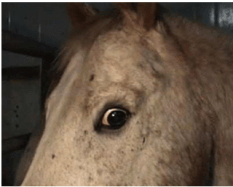
frightened-horse-close-upI can still hear the filly screaming.  She was only three months old, and she was being weaned.  Her mother had been abruptly taken away earlier in the day.  She was left on her own for the first time in her life, trapped in a dark stall.  She was rearing and spinning, screaming for her mother.  The older gelding in the stall next to her was aware of her distress and in the quiet way of horses provided her with comfort.  She had latched onto him for security.  As long as she could hear him next door, she was okay, but now that he had been taken out to be ridden, she was screaming her distress.
The barn owner wasn’t having it.  He moved the gelding to another part of the barn and put a different horse next to her.

I was watching this drama play out from the other end of the barn where my own horse was stabled.  The filly’s anguish wrenched at my heart.  I wanted to help her, but she wasn’t mine to comfort.  I couldn’t do anything but listen to her scream.

The barn owner didn’t share my concern.  He explained he was doing this for her own good.  She was destined for the race track.  She needed to learn how to be on her own. Her life would be a lot better if she learned early on not to attach herself to other horses.

After the third move, and the third loss of her equine comforter, the filly did settle.  She stopped forming attachments with the horses that were nearby.  She stopped screaming for them whenever they were taken away.

Over the years I’ve seen the terrible stress some adult horses go through when they are separated from their friends.  I think of that filly when I see their anxiety.  Through his actions the barn owner may well have been saving her from a lifetime of stress, but every time I think of her I still want to give her the comfort she was so desperately crying out for.

If I told this story to the cognitive linguist, George Lakoff, he would immediately know who I voted for in the 2016 presidential election. – I’m guessing that’s not where you thought this story was heading.

 To save myself some time I have uploaded the full article as a pdf file. Click on the link below to continue reading.

you-dont-understand-me-1-8-17

The Fluid Nature of Language

JOY Full Horses: Ten Things You Should Know About Cues: Number 10: Playing with Chains – Part 5 of 5

The Fluid Nature of Language
We began this discussion of negative reinforcement by eavesdropping on a late night gathering of the Clicker Expo faculty.  It is now twelve o’clock and the conversation in the faculty lounge is still going strong.  We have shed Kay and several of the others.  I had promised myself that I would leave at 11:30, and yet here I am.  Another ten minutes and then I really will leave.  That’s what I say to myself, but I have been saying it all evening.

Eva has asked another question.  I am loving the twists and turns the conversation is taking, but really I do have presentations to give.  I find an opening in the conversation and stand up, bringing the discussion to a natural close.  The others all stand up, as well.  Good.  I won’t miss anything.  But as I am leaving, I hear Susan Friedman asking Ken Ramirez a question.  I want to stay, but I know if I do, I will be good for nothing tomorrow.  I leave, but the following day, I hear from Ken that he and Susan remained locked in a discussion over terminology until 1:30 in the morning.

Language is not fixed.  We add words.  We change words.  We think we understand the intended meaning when we hear words used in context, but do we?  We are so accustomed to the fluid nature of language we don’t even notice how the language has evolved until we run into someone who uses the same words but in a different way.

In behavior analysis precision matters, and the use of language is very structured and controlled. It is like that puppy in yesterday’s post who stays in the base position of lying down while he learns to move just his paw.  Lying down keeps the number of things that are moving to a minimum.  Change too many variables at once, and it becomes harder to notice the one thing that you’re doing.  Scientists attempt to constrain the language to make themselves clearer.  Terms such as positive punishment and negative reinforcement have very precise meanings.  Unfortunately, when you bring that language back into the realm of common usage, confusion is often the result.

As I thought about our wonderful late night conversation, I found myself straddling both sides of the fence.  I agree that we need to understand the technical definitions of the terms we use.  But along with that understanding is the consideration of how the terms have been used, interpreted, and misinterpreted over the years.  Are the definitions are still valid in light of additional research and development?  Do we need to modernize/change the definitions to bring them more in line with modern usage?  Is it time to develop new language that reflects more accurately our current understanding of the systems we’re studying.  Archaic language can keep us stuck in archaic belief systems.

How Words Are Used
Are there some terms that we need to snatch back from the scientists?  Are there some that are simply so useful and so easily understood that we need to say to the scientists you can’t have this one?  I think chains may well fall into this category.

A chain of behaviors is such a descriptive term.  It doesn’t take a lot of explaining for a novice to understand that you are asking for a series of behaviors, each one linked to the next.  It’s a good term, one that suggests it’s meaning almost without the need for a formal definition – except . . . the scientists have given this term a very specific meaning that excludes much of what many animal trainers mean when they refer to chains.

The scientists have their technical chains: you give one cue that starts the process.  The next behavior is triggered by an internal cue.  It’s like dominoes.  You push over the first block and all the rest follow.

A sequence is something very different.  It’s a series of behaviors in which you cue one after the other after the other.

Hmm.  But are they really all that different.  Why does it matter if the cue comes from the green cone the horse sees after the jump or from a handler calling out “green”.  Both are cues.  And both link behaviors together.

The kind of chain that you wear around your neck is made up of links.  You can open up one of the links to take a section of the chain out or to add in more links. That’s why it is such a good image.  It provides such a clear visual image of one behavior connected to another.  You begin with one link.  You make that consistent, then you add the next link in the chain.  Link by link you can imagine growing your chain into longer and longer sections.  You can also imagine how links can be opened and a section of a longer chain taken out to be worked on separately or used in a different context.

It’s such a great image, I’m reluctant to give it over to the scientists.  We can certainly refer to technical chains, but I am also going to use the term chain to mean any series of behaviors which are deliberately linked together by cues.

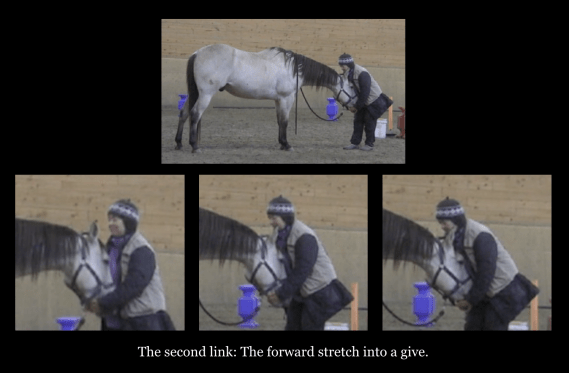
poco-hug-3


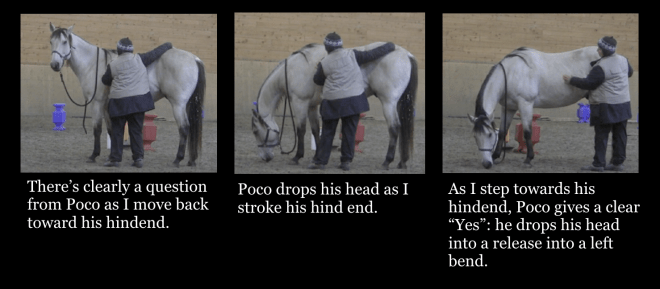
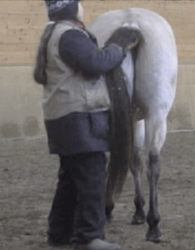
With Poco I was using these links to build a two way conversation.  Touch could be highly aversive for him.  I wanted to show him that it didn’t need to be.  He could let down his guard and let me in.


The Power of Play
Play brought us step by step to this point.  It kept me laughing.  It kept me from treating him like something broken that needed to be fixed.  It kept me from becoming so fixated on his ears that I simply convinced him all the more to keep me at arm’s length.  Remaining PLAY FULL opened up creative possibilities.  It brought back old training memories, memories of Linda-Tellington-Jones in the mid 1980’s working with a fearful llama by doing TTEAM circles with her forehead, not her hands.  It let me take familiar lessons and combine them in novel ways.  It kept me listening to Poco and letting him lead me through the process.  It kept the training fun.

If you had walked into the arena in the middle of this session, you might not have said – “oh they’re playing.”

You would certainly recognize as play the rough and tumble of two young horses rearing up together in a field, or two dogs playing keep away with a stick.  You would see play when a handler clicks and throws a tennis ball to her dog or engages with him in a game of tug.  But this subtle exchange with Poco probably would not look like anything you would call play behavior.

With dogs you can use natural play behaviors very effectively to build bonds between you.  That’s not so much the case with horses.  Given their size, a horse’s natural play behavior means you are “playing” with dynamite.  So Poco and I developed our own form of play.  It evolved out of my approach to the session more than the specific behaviors I used.  If I am full of play, the horses respond by doing what Poco did – letting down their guard and inviting me in.

*  *  *  *

With this tenth characteristic of cues well in place we’ve moved from the realm of macro-responses to micro-shaping.  You’ve had a taste of what this means in the descriptions of Pocos sessions.  We’ll be covering it in even more detail in Part Three of JOY FULL Horses.

Coming Next: Part 3: Going Micro

Remember, if you are new to the JOY Full Horse blog, click on the JOY Full Horses tab at the top of this page to find the full table of contents and links to each of the articles I have published so far.

I hope you will want to share these articles by sending links to this blog to your friends.  But please remember this is copyrighted material.  All rights are reserved. Please do not copy any of the “JOY Full Horses” articles without first getting written permission from Alexandra  Kurland, via theclickercenter.com

Also note: these articles are not intended as an instruction guide for introducing your horse to clicker training.  If you are new to clicker training and you are looking for how-to instructions, you will find what you need at my web sites:

theclickercenter.com                    theclickercentercourse.com

Hidden Motivators

JOY Full Horses: Ten Things You Should Know About Cues: Number 10: Playing with Chains – Part 4 of 5

Hidden Motivators
Yesterday’s discussion of negative reinforcement considered the impact that each individual’s learning history has on the emotional response to a particular procedure.  Something you regard as fun might make someone else run for the hills.  When we’re choosing which teaching strategy we’re going to use with our horses or dogs, their past experience matters.

We often think of negative reinforcement in terms of the overt actions someone is taking.  We can see the slack being taken out of a lead and understand that pressure is being applied.  The release of that pressure is intended to reinforce a desired response.  But there’s another form of pressure that’s not as easy to see that plays an important role in horse training.  I’ll use an example you can experience yourself.  Suppose I’m working with you showing you some of the rope handling techniques that I teach.

I’ll begin by having you stand in balance over your feet. I’ll slide down the lead very softly.  You’re relaxed, and I want you to stay that way.  If I slide down with a lot of “make it happen” muscle, I’d be picking a fight, and you’ll stiffen into resistance.

I want you to stay soft and relaxed, so I take care how I come down the rope.  I slide into a neutral position that doesn’t effect your balance.  This is the “get ready” stage of my cue.

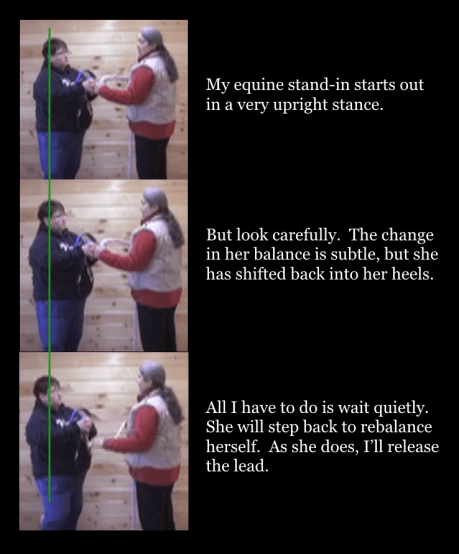
Now I shift my own balance.  I let my overall balance shift forward onto my toes.  This subtle shift rocks you back on your heels.  The shift is so subtle, you may at first not even notice.  I wait.  I’ve taken the slack out of the lead, but I am not pushing on you in any way.  I have simply set up a shift in your balance.

After a bit, you’ll begin to feel uncomfortable.  You can’t maintain this slightly-out-of-balance position forever. You’re having to use muscle to sustain your position, and it’s creating uneven pressure on your joints. So you take a step back.  My hand releases, click and treat.

sue-3-photos-tai-chi-wall-2

At clinics people get to feel how subtle this is.  All I have to do is rock my balance slightly forward and the other person will shift back into her heels.  She won’t feel threatened by the action. In fact she often isn’t even aware that I have created this shift in her balance.  Her focus has been on my hands, not the subtle shift in her own balance.

It’s like a magician’s trick.  You’re so busy watching where the magician is directing your attention, that you don’t notice when he slips your watch off your wrist.  It isn’t the pressure from my hand on the lead that creates the change or causes that slight discomfort.  The lead gives me the framework through which to create the shift.  It’s the mild discomfort that the balance shift creates that triggers the step back.

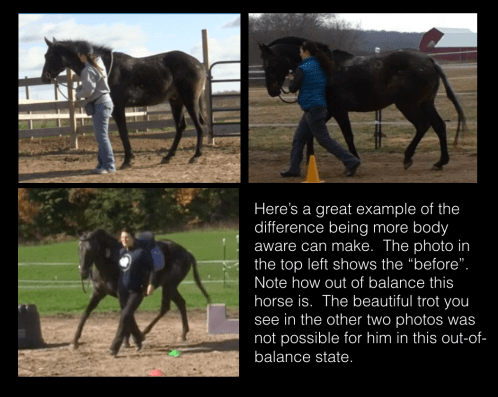
This shift out of what feels normal to you draws your attention inside.  I want you to become aware of your balance, to learn to pay attention to these subtle shifts and to make adjustments that bring you closer to an optimal state of comfort.  I want to help you shift from what feels normal but may actually be a state of imbalance to what feels good because you are now in functional balance. That’s also what I want for the horses.  Body aware horses stay sounder longer.  And body aware horses not only look very beautiful, they are more athletic than their out-of-balance counterparts.

harrison-3-photos-before-after

This set of three photos show Natalie Zielinski and her horse Harrison.  In the top left photo he’s standing all higgeldy-piggledy.  Whenever he stopped, he was always out of balance.  He tended to fall over his left shoulder, so when she led him, he was always crowding into her.  The beautiful trot you see in the other two photos evolved out of work that helped him become much more body aware.

What Triggers Change?
Here’s another example of hidden negative reinforcement.  This one is a dog example.  I’ve watched Kay Laurence teach a puppy to put his paw on a target.  It looks like a wonderfully elegant example of shaping with positive reinforcement.  But is that all that’s going on there?

If you want a puppy to put his paw on a target, most people would start with the target.  Kay doesn’t. Instead she sets the puppy up to offer a consistent motor pattern.  She gets the puppy moving his paw, and then she puts the target in the path of where the paw is going to land.  Simple and elegant.

She begins by having the puppy lie down.  This is the base position she uses to teach the behavior.  Lying down limits the behavior which the puppy can offer.  Instead of offering responses from the entire range of things a puppy can do with his body, now he’s restricted to those things he can do while lying down.  This makes it much easier to get only the desired behavior and to get it without a lot of unwanted add-ons.

Kay jump-starts the process by placing a treat off to the side away from the direction she is eventually going to want the puppy to move his paw.  He has to shift his balance and move his paw to the side in order to reach the treat.

He’s left out of balance.  If he were to stay in this position, he’d quickly become uncomfortable, so he rights himself.  He moves back to center.  Kay clicks as he moves his paw back towards a more balanced position, but she doesn’t feed him there.

Instead she again feeds him so he has to move his paw to reach for the treat. He gets his treat and returns to center.  Click!

Why does the puppy not just stay out there in this position where all the treats are delivered?  Why does he right himself?

Over time the answer becomes because he is being positively reinforced for moving back to center.  The function of the click is to identify for the puppy the right-answer behavior that leads to a treat being given.  But initially he rights himself because he’s out of balance and that feels odd. So even here there is a negative reinforcement component in what appears on the surface to be the most elegant of positive reinforcement training.

Trying to decide what to call a particular procedure can make your head spin.  If you are trying to stay on the positive side of training, of course, you want to avoid the harsh use of aversives, but, as we’ve just seen, not all discomfort creates a negative emotional reaction.  Rather than fight against the terminology, I prefer to use it.  I think it is useful to understand that that slight feeling of muscle fatigue will cause you to take a step back.  I don’t have to push you back or do anything else to get the behavior.  I can simply wait and let you figure out the puzzle.  The same thing holds true for my horse.

My horse’s emotional reaction will tell me if I am on the side of the angels or sliding fast down the slippery slope that appears when soft words don’t match hard actions. I use the terms to remember the history of the harsh methods modern horse training has evolved out of.  At some point we may be able to let go of that trail, but for now I think it is wiser to keep remembering.

Coming Next: Part 5: The Fluid Nature of Langauge

Remember, if you are new to the JOY Full Horse blog, click on the JOY Full Horses tab at the top of this page to find the full table of contents and links to each of the articles I have published so far.

I hope you will want to share these articles by sending links to this blog to your friends.  But please remember this is copyrighted material.  All rights are reserved. Please do not copy any of the “JOY Full Horses” articles without first getting written permission from Alexandra  Kurland, via theclickercenter.com

Also note: these articles are not intended as an instruction guide for introducing your horse to clicker training.  If you are new to clicker training and you are looking for how-to instructions, you will find what you need at my web sites:

theclickercenter.com                    theclickercentercourse.com

JOY FULL Horses: Unit 10 – Part 2 of 5: What We Say

JOYFULL Horses: Ten Things You Should Know About Cues: Number 10: Playing With Chains – Cues Evolve into Chains

What We Say
It’s ten p.m., an hour at which I should be heading off to bed, but I can’t leave yet.  I’m sitting in the faculty lounge at the Clicker Expo.  We’ve just come from dinner and a presentation by this year’s guest speaker.  After a full day of presentations you would think we would all be ready to call it a night, but instead we’re just getting warmed up.

Around the table with me are Dr. Susan Friedman, Ken Ramirez,  Eva Bertilsson, Kay Laurence, Dr. Jesús Rosales-Ruiz, and Laura Monico Torelli.

We are discussing terminology.  Eva got the ball rolling with a question about chains. We are wrestling with the different definitions of chains that are in use.

chain-2

Dr. Friedman is defining a chain from the perspective of a behavior analyst.  A chain has a very narrow and very specific meaning.  For a true chain, you give one cue that starts the process.  The next behavior is triggered by an internal cue.  It’s like dominoes.  You push over the first block and all the rest follow.

This type of chain can be very elegant to watch.  Imagine a series of agility obstacles set out in your arena.  You give your horse a cue that sends him out to the first obstacle, a small jump.  Just beyond the jump is a cone.  Your horse spots the cone as he clears the jump.  The cone itself serves as the cue for him to trot over to it, and pick it up.  Nearby is a large bucket.  He walks over to the bucket, drops the cone into the bucket.  A few feet past the bucket is a large platform.  Your horse now walks over to the platform, steps up onto it with all four feet, and lifts one foot high into the air while you click and run over with his treat.

That’s a technical chain.

Now imagine a different scenario.  You send your horse out over the first jump.  Just beyond the jump are two cones, a green one and a red one.  As your horse jumps, you shout “green”.  You’ve added a cue to tell your horse which cone he’s to pick up.  He heads straight over to the green cone, but now there are more choices.  Instead of one bucket, there are two identical ones, except one has a symbol of a circle painted on it, and the other a triangle.  As he picks up the green cone, you shout “circle”.  He walks over to the correct bucket and drops the cone in.

After this he again has more choices.  There are two platforms, one to the right and one to the left of the buckets.

You shout “Left”, and he walks over to the platform that’s off his left shoulder and steps up on it.

If you are using scientific terminology, this very sophisticated series of behaviors is not a chain because you are cueing each one.  It would be considered a sequence.

Our discussion rolled on around these two terms.  We all understood the distinctions.  The question was how fluid and flexible should we be with the language we use.

The Meaning of Words
In the field of learning theory scientists took for their own use many terms which already had a common-usage meaning.  Punishment is a great example.  When someone says we need to punish a child, a criminal, a terrorist, another country, the meaning is clear.  There is a moral element to it.  You don’t simply want to stop the behavior.  You want to impose a penalty.  You want the person to suffer in some way, to “pay” for his offense.  You are punishing the individual, not the behavior.

When a behavioral analyst uses the term, the meaning is very different.  There are no moral overtones of retribution.  If you smack a horse for biting, and the behavior decreases, you can say that the smack punished the biting behavior.  If the biting continues, the smack did not punish the behavior.  It may have annoyed or even frightened the horse, but if the behavior of biting didn’t decrease, the smack wasn’t a punisher.

When scientists take words that are already in common usage and redefine them, we can get a muddled result.  We also have confusion when scientists use words that we’re sort of familiar with, but not really.

A great example is operant conditioning.

That’s the big umbrella under which clicker training sits.  Operant sounds like operator.  And conditioning we understand from fitness programs.  But what do those two words put together really mean?

Look at what else happens when scientists start combining words we thought we understood.

Consider the four quadrants of operant conditioning: there’s positive and negative reinforcement, positive and negative punishment.

Positive punishment!?  Really.

Okay, the scientists explain.  The positive means simply that something has been added.  You’re adding something the horse doesn’t want and that stops the behavior, at least for the moment.  You add the smack of your hand when your horse bites you.

That’s clear enough, except it’s hard not to feel the harsh “take that” edge when you even just think about smacking your horse.  We can say we understand the plus and minus of the terms, but we still experience emotions we’ve come to associate with the words: positive equals good, negative equals bad.  Of course people get confused by these terms!  They understand them intellectually, but they experience them emotionally.  The only term that matches up and creates no conflict in meaning is “positive reinforcement”.  The rest get us into a real “knickers in a twist” state of confusion.

Negative Reinforcement
I was listening to the conversation, but I was also keeping an eye on my watch.  Eleven o’clock.  I had presentations to give the following day.  I should be calling it a night.  I decided to stay just a few more minutes.

Eva was asking more questions.  Now we were talking about negative reinforcement, a subject that always gets my attention given it’s connection to horse training.

When horses are handled with conventional training methods, rope handling is a very clear example of negative reinforcement.  The horse can avoid/escape the threat of escalating pressure by moving in the direction the handler wants.  As the horse learns to obey, the pressure diminishes to a subtle command.  The work looks soft, but the threat of escalation remains.  The soft command tells the horse how to avoid the escalating pressure.

Often people watch the finished result and think the trainer is very soft and kind.  This is very much a case of don’t judge a book by it’s cover.  The handler can look gentle because the horse understands the threat of escalating pressure that’s hidden inside every soft request.

That’s very straight forward.  If the handler is skilled, many horses thrive in this kind of system.  They know what they need to do to stay out of trouble. There’s no guess work. The commands are clear, the consequences are swiftly applied. Respond well, the pressure goes away. Fail to respond, and it escalates.  If you can figure out what is wanted – and if you can physically do it – you can stay out of trouble.

It’s easy to understand this kind of handling.  It’s textbook negative reinforcement.  And it’s also standard-issue horse training.

So what do we call it when the pressure doesn’t increase? When there is no threat of escalation, what is it?

I’ve always kept the use of the term negative reinforcement when I write about clicker-compatible rope handling.  I do this in part because I want to remember our history.  I want to remember where so many of the techniques that we use evolved from.  I want to remember so I won’t ever be tempted to go back there.

I have always combined pressure and release of pressure with the clicker.  You could say that I am simply piggy backing the clicker onto existing training systems, and that’s not really clicker training.

Perhaps, but it is a bridge.  If I am working with a rider who has spent years perfecting her horse-handling skills, I don’t want to say: “Throw all that away.  You won’t be using leads, or reins, or anything else you’re familiar with.”  That’s a great way to lose someone before they’re even out of the starting gate.

But if I say the communication system you know still works, we’re just going to teach it very differently, that makes more sense.  There’s still a huge learning curve, but I’m not going to begin by “throwing the baby out with the bath water.”

By the way do you know the derivation of that expression?  Before the modern era of indoor plumbing, baths were a rarity.  You brought water in and heated it for one bath.  The patriarch of the household took his bath first, followed in rank by everyone else.  The children would be the last ones to bathe.  By the time it was the turn of the youngest babies, the water would be murky brown.  You literally had to be careful not to throw the baby out with the bath water!

This derivation comes courtesy of the historian, Lucy Worsley and her wonderful book, “If Walls Could Talk, An Intimate History of the Home”.

Just as we still take baths – but my how they’ve changed – we still use lead ropes and other pressure cues in clicker training. But again – how things change when you take the threat away and make them clicker compatible!

Coming Next: Procedure versus The Emotional Effect

Remember, if you are new to the JOY Full Horse blog, click on the JOY Full Horses tab at the top of this page to find the full table of contents and links to each of the articles I have published so far.

I hope you will want to share these articles by sending links to this blog to your friends.  But please remember this is copyrighted material.  All rights are reserved. Please do not copy any of the “JOY Full Horses” articles without first getting written permission from Alexandra  Kurland, via theclickercenter.com

Also note: these articles are not intended as an instruction guide for introducing your horse to clicker training.  If you are new to clicker training and you are looking for how-to instructions, you will find what you need at my web sites:

theclickercenter.com                    theclickercentercourse.com

JOY FULL Horses: Unit 10 – Part 1 of 5: Creating Change Through Chains

JOYFULL Horses: Ten Things You Should Know About Cues: Number 10: Playing With Chains – Cues Evolve into Chains

The List of Ten
We’re coming to the final element in our list of ten things you should know about cues.  What began as a basic introduction has taken us to some complex concepts and sophisticated uses for cues.

We began with the fundamentals:

1.) Cues and commands are not the same.
2.) Not all cues are verbal.
3.) Cues can come from inanimate objects.  You can have environmental cues.
4.) Our animals can cue us.
5.) Cues evolve out of the shaping process.
6.) Having a cue attached to a behavior isn’t enough.  We need stimulus control – a fancy term for saying you get the behavior you want when you want it and only when you want it.
7.) We can use cues to counter balance one another to create stimulus control.
8.) Cues change and evolve. You can use this to create the degree of lightness you want.  You can also create new cues for existing behaviors.
9) You can’t not cue.  You saw this applied to the “play” session with Poco, the ear-shy horse.

This naturally brings us to:

10.) What’s more fun than playing with cues? Playing with Chains.

Creating Change Through Chains
In the previous unit I introduced you to Poco, an ear-shy horse.  I described a series of sessions in which I combined clicker training with body work.   Poco wasn’t just ear shy.  He was tight throughout his whole body.  Backing was hard.  Turning was hard. Yielding his hips was hard.

It may be that all that worry over his ears made him generally tight, or the ears were the red flag telling us that there was much more going on that we couldn’t see.

The Story for Poco
Remember we want to tell stories that help our horses.  So here’s the story I told about Poco.  Horses who are ear shy often get wrestled with.  They get jerked on and pulled around and told to STAND STILL OR ELSE!  At best they simply become wary and defensive.  At worst they can sustain serious injuries, especially if they are pulled off their feet in their struggles.

The story I told for Poco is that he was one of the horses who was wrestled with and who may have sustained some injuries.  We needed to ask him some questions to find out if we were dealing with simple tension or something more serious.  I suspected that part of the reason the ear shyness remained a persistent problem was because it hurt every time he threw his head up to avoid being touched.  That predictable spike of pain convinced that being handled around his ears was a bad deal.

I wanted to get to his ears, and I also wanted to get to his tail.  Most of us have seen frightened dogs with their tails tucked between their legs.  When they’re afraid, animals from many species clamp their tails tight to their bodies.  The best explanation I’ve heard for this behavior is it blocks the release of pheromones into the air.  When an animal is afraid, it may not want to broadcast that fear to everyone in the neighborhood, so it clamps down on its tail to cover the anal glands.

Whatever the reason, horses certainly do carry a great deal of tension in their tails.  Working the tail can help release that tension and free up the hind end.

Poco’s Learning Loop
Under saddle you learn to free up a horse’s hindquarters by working from the front end first.  And to soften the front end, you begin with the hind end.  So what do you do when you need to gain access to both ends and both have “do not trespass” signs posted?  The answer with Poco was I set up a predictable pattern.  Poco always knew what I was going to do next.  Because he knew what to expect, he could let me know when he was ready for me to move on. Until I got a sign from him that he was comfortable with what I was doing, I did not move deeper into the cycle of behaviors.

Step one began with a hug.  Standing at his side, I used the components I had built earlier to ask Poco to rest his nose in my hands.  I could then press my head against the side of his face.  A casual spectator would have seen me hugging Poco.  What a lovely picture!  But look more closely, and you would see that I was also asking for a lateral give at his poll.

https://www.youtube.com/watch?v=-roGR2qw37k

I was placing my head on his forehead.  It gave him a reference place around which to soften into a bend.  The give was tiny.  Gives are.  But I could feel him release through the poll – a release that traveled down his spine towards his withers.

That was my cue to step in front of him and ask for the next link in the chain: the forward stretch that asked for another give at the poll.  I was inviting him to lengthen forward, down and out.  I could feel the release so clearly as he melted into my hands.

poco-forward-give-2nd-link-caption

The third link in this sequence was long strokes across his back and down his hindquarters asking him to drop his head.

poco-head-lowering-3-photos

His response told me how ready or not he was for me to go on.  As he took down his “no trespassing” signs, I was able to slip in behind him.  I was being given tentative permission to proceed.

poco-tail-lift-2

I used TTEAM body work techniques to lift his tail.

I slid my hand gently under his tail and lifted up.  The muscles of his hindquarters spasmed, and he stepped quickly away swinging his tail away from me.

Clearly my “story” had some merit to it.  He was showing me places where there were huge questions.


https://www.youtube.com/watch?v=92u12leIclc

He was facing me again.  I reached up as though nothing had happened and asked for another hug. The chain began again.

Link 1 was the hug asking for a lateral bend.

Link 2 was the forward stretch and release through the poll.

Link 3 was the stroking across his back looking for head lowering.

His response gave me permission to move onto his tail.

Link 4 was working his tail looking for a release through his whole spine.

The result: Poco felt soft as butter.  Instead of a wary, tense horse keeping himself well removed from me, he was seeking out my company, melting into my hands.  We were having a conversation.  These gives were asked for, not demanded. I was asking the questions.  He was finding the changes.  He was coming up with the answers. That changes everything – not just in his body but in the relationship.

https://www.youtube.com/watch?v=DUB_5ayUcgY

Coming Next: What we Say

Remember, if you are new to the JOY Full Horse blog, click on the JOY Full Horses tab at the top of this page to find the full table of contents and links to each of the articles I have published so far.

I hope you will want to share these articles by sending links to this blog to your friends.  But please remember this is copyrighted material.  All rights are reserved. Please do not copy any of the “JOY Full Horses” articles without first getting written permission from Alexandra  Kurland, via theclickercenter.com

Also note: these articles are not intended as an instruction guide for introducing your horse to clicker training.  If you are new to clicker training and you are looking for how-to instructions, you will find what you need at my web sites:

theclickercenter.com                    theclickercentercourse.com

Tactile Communication

JOY FULL Horses: Ten Things You Should Know About Cues: Number 9.) You Can’t Not Cue: Part 12 of 12

Adding the Click
In an earlier section I said we expand a field not from within, but from without.   Innovations come from bringing ideas together from different areas of study.  Poco gives us a wonderful illustration of this.  I was combining two things I knew worked well: body work and clicker training.  The click turned over responsibility for the process to Poco.  I was not simply a body worker doing something TO him.  Poco and I were involved in a conversation.  I was asking questions, but I didn’t have the answers.  Poco had to provide those.

I was asking him to release through the poll.  What could you find, what could you release that would let you melt into my waiting hands?  I felt the answers through my hands, and I acknowledged them with a click and a treat.

Tactile Communication
The release through the poll was just one area I wanted to explore with Poco.  I not only wanted to get to Poco’s ears.  I also wanted to get to his hindquarters, but he had huge “DO NOT ENTER” signs posted everywhere.

I don’t know the horses I meet at clinics well enough to know which are the ones who really do mean KEEP OUT and which ones are all bluff.  If you ignore the “warning signs” of the ones who mean it, you can get seriously hurt, so I respect the “signs” all the horses post.  I try not to bludgeon my way in.  I much prefer to have them take down the warning signs themselves and invite me into their personal space.

Cues Evolve
I wanted to reach Poco’s hips.  I began my approach with long arm strokes across his back.

Poco dropped his head marginally.  Click and treat.

You can’t not cue.

Cues evolve out of the shaping process.

I was on the look out for associations which could turn into cues.  I stroked his back, and Poco dropped his head.  Again, I clicked and treated.

Poco was a tuned-in clicker horse.  He caught on right away.  I was cueing head lowering.  Very neat.

I always chuckle when this sort of thing pops out.  It’s so easy to miss that first little head drop.  It’s so easy to think that all you’re doing is stroking your horse’s back.  But if you are on the lookout, you will spot that first little drop of the head.  Once you’ve captured it with a click and a treat, you can grow it into a more definite, predictable response.

Cue Communication
Poco now had a way to tell me when it was okay for me to move on.  I could stroke a little further back along his barrel.  If his head dropped right away, I knew he was at ease, and next time I would be able to ask for a bit more.

But if he hesitated, I knew I was asking for too much.  I needed to move back towards his withers and ask for less.  Poco very quickly realized he had control.  I wouldn’t go any further, any faster than he was ready for.

I built a small, predictable loop.  First, I stood in front of him and invited him to release forward and down into my hands.

Click and treat.

Then I moved to his side and stroked along his back.  He dropped his head.  Click and treat.

That sent me back to the start of the cycle, asking for a release of his poll.  As I invited him into my hands, I leaned directly over the plane of his face.  My chin at times rested against his ears. I could feel his worry melting away.  At least in this context, he was trusting me to keep my word. I was not going to hurt him.

Adding in Lateral Flexions

poco-stroke-back

I asked for a series of these lengthening through the spine.  Then I moved to his side, but now I was looking for the next level of criterion in the head lowering.  It was no longer enough that he was dropping his head.  Now I wanted him to drop his head AND give to the side I was on.  In other words I was looking for the same lateral give that I would have been looking for if I had had a rein in my hand.

At this point I could stroke along his top line and down the backside of his hindquarters.  He dropped his head, but I didn’t click.  He brought his head up.  I re-cued head lowering by stroking my arm over his hindquarters.  He dropped his head and gave slightly to the side – a lucky discovery in his part.

Immediately I clicked and treated.

I stroked again, and he dropped his head and gave into the left bend.  Click and treat.  What a smart horse!  Our communication was expanding.  Each criterion we added gave us another bit of “syntax” to weave into the conversation we were having.

Do Not Enter Signs
It was time to ask him if he was ready to take down another of his KEEP OUT – NO TRESPASSING ALLOWED signs.

This one was on his belly.  As I also stroked along his back with one hand, I tried stroking along his sternum with the other.  He hunched up away from my hand.  This reaction revealed the kind of tension that can turn into a buck under saddle.

I eased my hand back.  He could tell me when he was ready.  When he dropped his head, click and treat, I returned to the stretch forward.  I was telling him once again that I wouldn’t proceed without his permission.

Permission granted. He took down the first of his signs.  I could stroke his belly.  He signaled his content by dropping his head and giving into the bend.  Click, treat, and walk off casually to give him some break time for processing all the new information.

Microrhythms
Cues evolve in many ways.  When you open yourself up to listen to your horse, you will quickly discover what it means when I say you can’t not cue.

When you are in conversation with someone, there are always subtle cues that are being exchanged.  We nod our head, we smile, we add in a quick word.  These simple gestures become cues that keep the conversation going. We notice them when they are absent.  When you talk on the phone and the other person doesn’t say anything in the pauses you provide, you start looking at your phone to see if the call has been dropped.

Poco and I were creating our own subtle micro rhythms.  We were understanding that our actions had influence.  I could cue him, and he could respond by cueing me.  He was showing me so clearly not only that cues evolve out of the shaping process but also that you can’t not cue.  The exchange of cues goes on even when we are not consciously aware of it.  When I turned our session into play time, I simply made these cues easier to spot.

Review
We’ve covered a lot of ground in this unit.  These videos will give you a quick review of the work I did with Poco.  The first clip was taken during the second session I did with him.  I am asking him to target his nose, then his chin, and finally I can rest my head against his forehead – click and treat.  (refer back to Part 10 of 12: Stepping Stones https://theclickercenterblog.com/2016/09/18/)


https://www.youtube.com/watch?v=kTrbilF5JrQ

Next came adding in duration by clicking on the exhale of his breath.  (refer back to Part 10 of 12: Stepping Stones https://theclickercenterblog.com/2016/09/18/)

https://www.youtube.com/watch?v=M-hR4oH6o-o

The next video shows the release of the poll and the building of head lowering. (refer to Part 11 of 12: Moving On https://theclickercenterblog.com/2016/09/19/ and this current post.)

https://www.youtube.com/watch?v=TqiVGcBPb50

This final video in this series shows the taking down the “Do Not Enter”signs.  I’m coupling the stroking along his back and belly with head lowering.

https://www.youtube.com/watch?v=vDDhdEznZXg

This ends this section: Number 9: You Can’t Not Cue.

Coming Next: Ten Things You Should Know About Cues: Number 10: Playing with Chains 

Remember, if you are new to the JOY Full Horse blog, click on the JOY Full Horses tab at the top of this page to find the full table of contents and links to each of the articles I have published so far.

I hope you will want to share these articles by sending links to this blog to your friends.  But please remember this is copyrighted material.  All rights are reserved. Please do not copy any of the “JOY Full Horses” articles without first getting written permission from Alexandra  Kurland, via theclickercenter.com

Also note: these articles are not intended as an instruction guide for introducing your horse to clicker training.  If you are new to clicker training and you are looking for how-to instructions, you will find what you need at my web sites:

theclickercenter.com                    theclickercentercourse.com