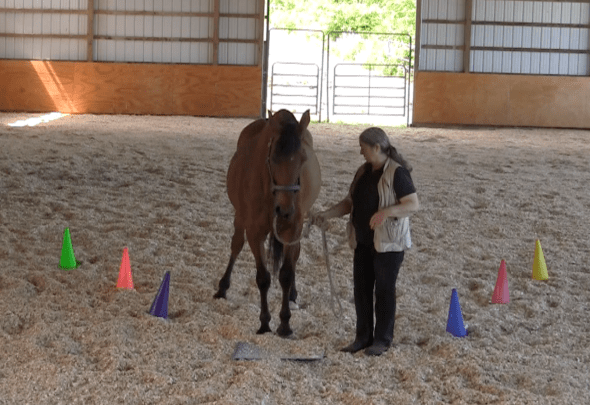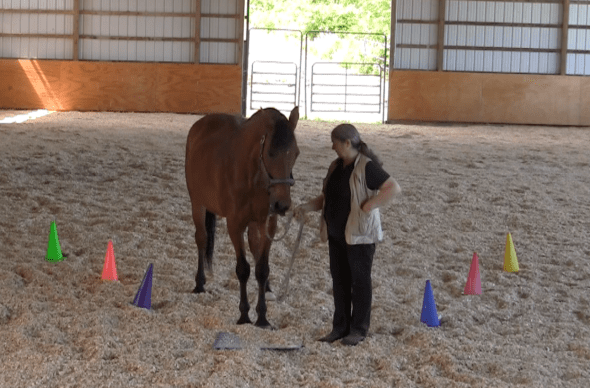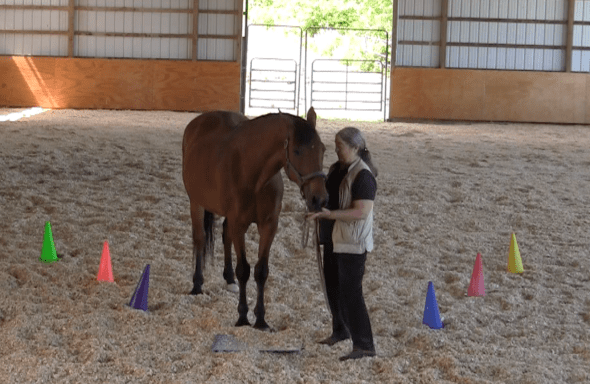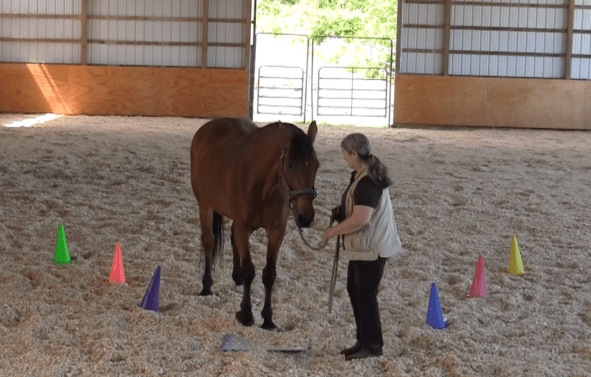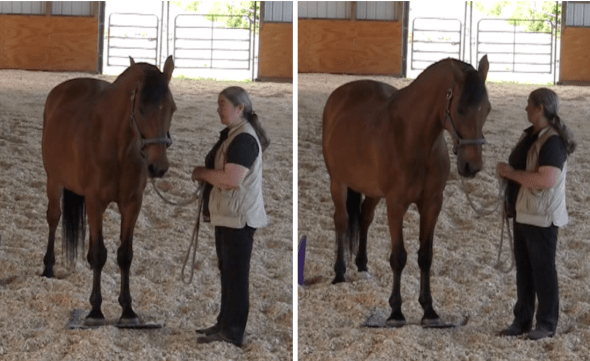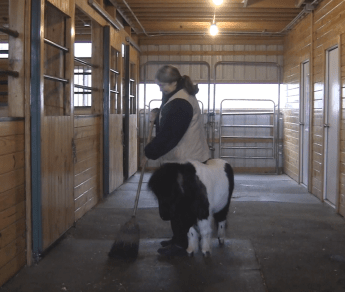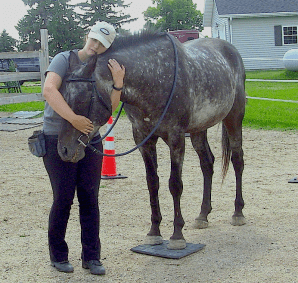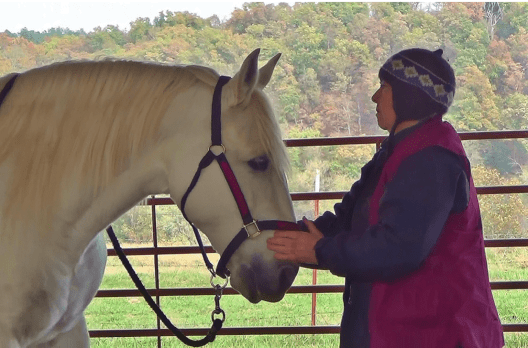
JOYFULL Horses: Unit 4: Cue Communication

Everything  You Need to Know About Cues
At the end of Part 1 I asked: What are ten things you would want a beginner to know about cues?  That seemed like a simple enough question, but look where it has taken us – to neuroscience and the affective emotional systems, to habits and what maintains them, to TAGteaching and the focus funnel, to guide training for horses, to Feldenkrais work and asking questions, to the Premack principle and the creative use of imagery in training.

All that and we still have only three things on our list:

1.) Cues and commands are not synonyms.
2.) Cues are not just verbal signals.  They can include weight shifts, hand gestures and other body language signals.  
3.) Cues can come from the environment.

And now here’s number 4.) Cue Communication

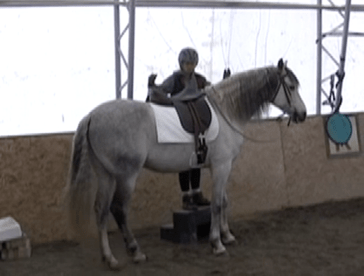
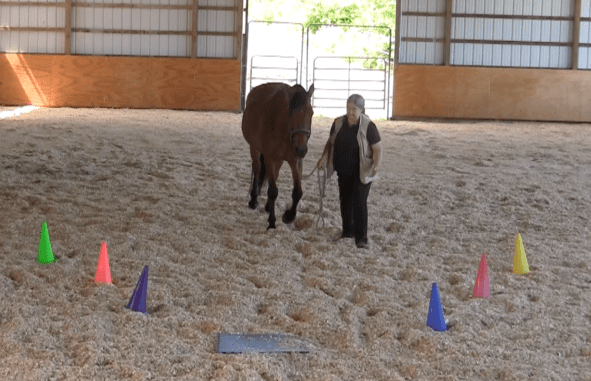
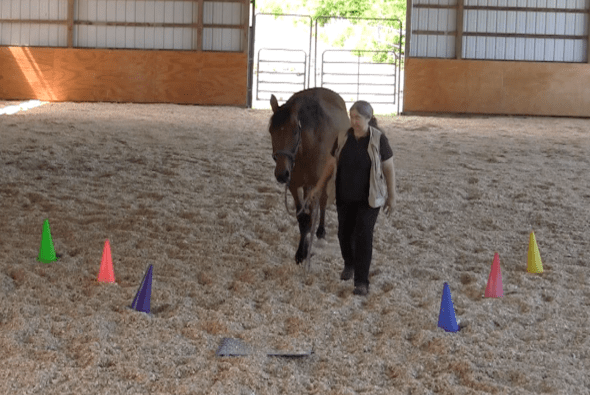
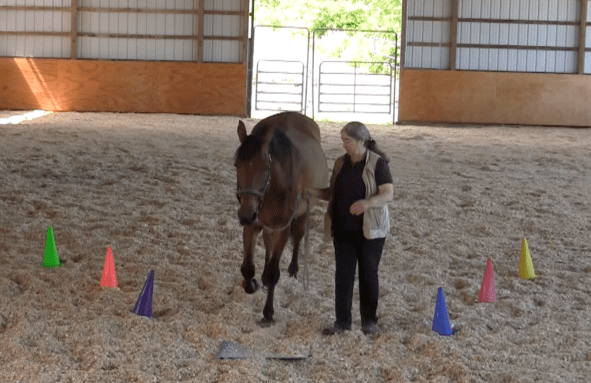
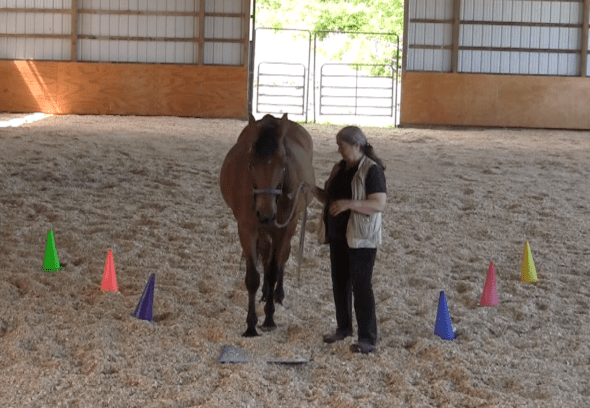
Icky mounting block - hands up

Cue Communication
We tend to think of cues as coming from us, but cues can also be given by our animals.  The behaviors we teach them can be turned around and used by them to communicate back to us.

When we recognize that cues are a two way street, we become much more aware of what are animals are trying to communicate to us.

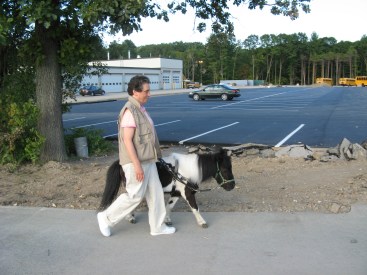
Panda was the poster child for environmental cues.  She can serve the same function for cue communication.  Guide work is dependent upon the back and forth exchange of cues.  I described earlier Panda’s traffic checks.  That’s a great example both of environmental cues and cue communication.  The moving car is the signal for Panda to stop and back up.  Her actions cue Ann.  Ann must interpret Panda’s sudden change of behavior correctly and allow her to move her out of harm’s way.


https://youtu.be/8UXGwFMYQbM

Everyday Conversations
Good training is about cue communication.  It’s a two way street.

When novice trainers first encounter cues, they often think that they are something only they give.  Most of us have spent time around dogs, either our own or a friend’s.  We’re used to telling dogs to sit, to lie down, to come, to leave it!  These are all cues (or possibly commands – depending upon how they were taught) that we’re giving to the dog.

But what about that sad-eyed look the dog is giving you that gets you to stop working on the computer, get up, walk to the coat closet, put on your jacket and your outside shoes, take the leash off the hook where it’s hanging, attach it to your dog’s collar, open the back door and take him out for a walk.  That was quite the complex chain the dog set in motion just by raising his eyebrows and giving you “that look”.

He probably further cued the internal components of the chain by jumping up, wagging his tail, running to the back door, sitting quietly while you put on shoes and jacket and attached the lead.

Back and forth throughout this sequence there was a dance of cues.  Some were given by you, some by the dog.  It is so like talking on the phone.  You have a long story to tell.  What maintains the conversation?  The little interjections your listener gives you that tell you she’s still on the line, still listening to you.  The call hasn’t been dropped by your cell phone network, nor has she gone off to feed her horses.  Without those little sounds cueing you that the connection is still active, and she’s still on the other end of the line, your story would stutter to a stop.

“Are you still there?” You may find yourself asking this as you talk on the cell phone.

“Are you still walking to the door?”  Your dog wags  his tail, or goes into a play bow.  Yes!  That just redirected the human from the kitchen back on track to the door.

We tend to think of cues as coming from us, but cues can also be given by our animals. When you live with animals, you become as much cued by their behavior as they are cued by you.  We know the look our cats give us when they want to be picked up for a cuddle, when they want to be set down again, or let out, or fed.  We become well-trained humans.

Animal Trainers – The Ones to Really Learn From!
I have always known how much my behavior is being cued by my animals.  I know those “looks”.  I have learned to interpret them and respond appropriately to them.  It’s no good picking your cat up for a cuddle when what she wants is to go out.  She’ll simply squirm out of your arms to repeat – louder – her cue.  She knows what many people who travel in foreign countries also believe.  If the foreigner doesn’t understand your language, repeat what you just said, only louder.  In the cat’s case, this often works!

Cats are superb trainers.  They are experts at arranging their households to their liking.  If you want to learn about training – watch your cats.  You don’t need to go any further to find a master trainer!

A Well-Trained Human
Cats are very good at taking the behaviors we have taught them, and turning them around to cue us.  I became very aware of this when one of my cats was a small kitten.  She wanted to see what I was having for breakfast and perhaps share it with me.  I didn’t want to encourage this behavior, so I took advantage of her interest to teach her to sit.  I followed the same procedure I had seen dog trainers use.  I held a small tidbit over her head.  As she looked up to see what was in my fingers, her hindquarters sank towards the floor.  Click!  I gave her a tiny bit of the buttered toast she was so interested in.

Two or three reps were usually enough to satisfy her curiosity. She would go off and leave me alone to enjoy my breakfast without the constant interruption of a too inquisitive paw pushing its way onto my plate.

Over the course of several days the sit began to evolve.  Now we had a proper down on your rump sit.  Click and treat.

One morning she added a slight paw lift.  I grew that from a slight lift of her front foot into a “high five” wave.   It was very cute.

And that’s when she turned the tables on me.  I was in the kitchen not far from the refrigerator.  She very deliberately sat down, lifted her paw and gave me my cue.  It was so like the dog handlers who cue “sit” and “down” with a hand signal, only in my case the cue set in motion a much more complex chain.  I walked to the refrigerator, opened the door, reached in, lifted out the tub of margarine, took off the lid, put a small dollop on the tip of my finger, reached down and let her lick it off my finger.

I had to laugh.  I knew exactly what had just happened.  She had turned everything around, and she was cueing me!

I also understood more clearly than I ever had before that the behaviors we teach our animals can be used by them to cue us.

JOYFULL HORSES: TRANSFORMING HORSE TRAINING INTO PLAY

In the previous sections I used the image of a runway to teach a horse to step on a mat.  The point of using this image is to get you thinking creatively, with imagination.  That’s what takes you far, far away from the mind set of do-it-or-else training.

Transforming Horse Training Into Play
We’ve all watched skilled trainers, whether in person or on video.  I’m sure you’ve taken in a variety of images of how things are done.  Now suppose you’re handed a horse who is pushy, or won’t stand still for saddling.  You’ve seen how professional horse trainers deal with this in what often seems like no time at all.

It’s so easy to put on their “hat” and fall into the same-old, same-old of traditional horse training solutions.  But remember – when you are watching one of those skilled trainers, you aren’t just watching fifteen minutes of training.  You are watching fifteen minutes plus fifteen years.  That’s a lot of experience – and a lot of mistakes made and lessons learned – to get to the point where things look easy.

Easy isn’t the only criterion we’re looking for.  I remember watching a video of a trainer who was working with what was described as a “lazy” horse.  The owner wanted to be able to lunge the horse, but her horse stayed in close to her and wouldn’t move out.  There are all kinds of reasons why a horse would lock in close to a handler.  One might be that the horse has learned that staying in close is the safest place to be.  If that was the case for this horse, the trainer took his safety away.  He charged into the horse with his lunge whip, sending the horse leaping away to the side.

The trainer was using negative reinforcement.  His timing was excellent.  As soon as the horse was in motion, he stopped cracking the whip.  But the instant the horse slowed down, he was on the attack again.  It took just a couple of turns around the circle to convince that horse that he needed to keep moving.  Easy.  The battle was over in just a few minutes.

The trainer stood in the middle of the lunge circle touting the virtues of his technique.  The horse continued to trot around him the whole time he was talking to the audience.  He no longer even needed to lift his whip.  It was an impressive result.

But I was thinking about the lesson from the horse’s perspective.  If one of us were trapped in a round pen with someone peppering bullets at our feet, wouldn’t we run?  And we’d keep on running until we dropped from exhaustion.  If we slowed down, the person in the middle would just need to gesture with the gun to get us running again.

It is the same thing.  So easy isn’t enough.  I can look at the behavior that emerges – a horse moving at a steady pace around me at liberty and think that’s a fun result.  The question becomes: how can I get to that behavior but in a more learner-friendly way?  How can I take this, or any other lesson, and turn it into true play for both myself and my horse?

One of the principles that is common to ALL good training methods is this:

There is ALWAYS more than one way to teach every behavior.

If you really believe that and know how to put this principle into practice then this leads you to the answer.

You’re going to break the task down into smaller components so your horse understands what is wanted in each step.  You want him to be more than just comfortable with what is being asked.  You want him to be eager to play.

Using Props
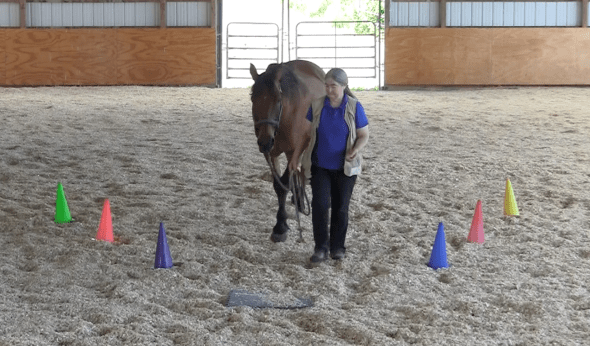
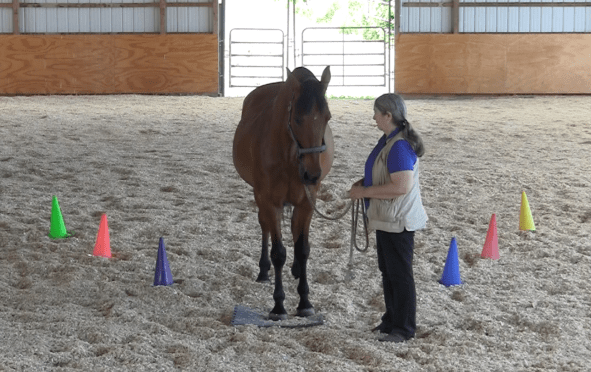
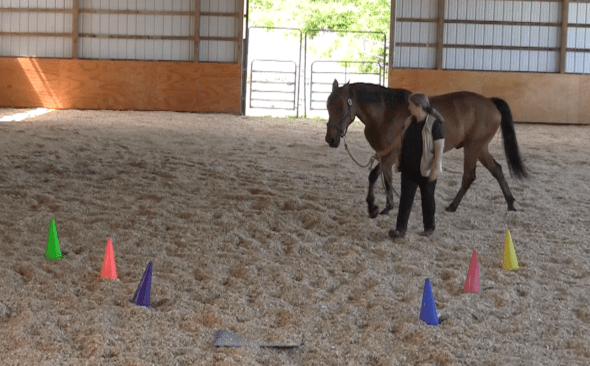
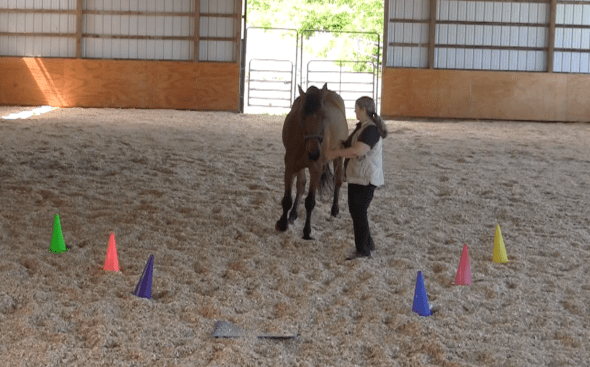
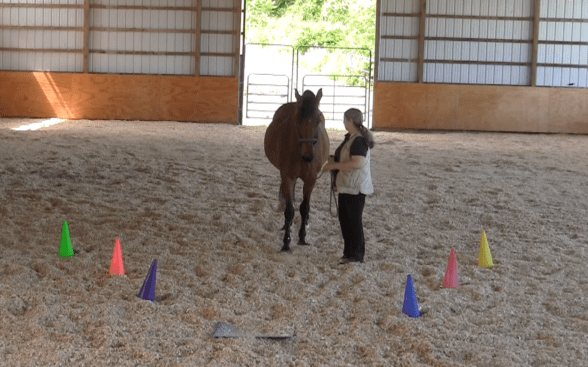
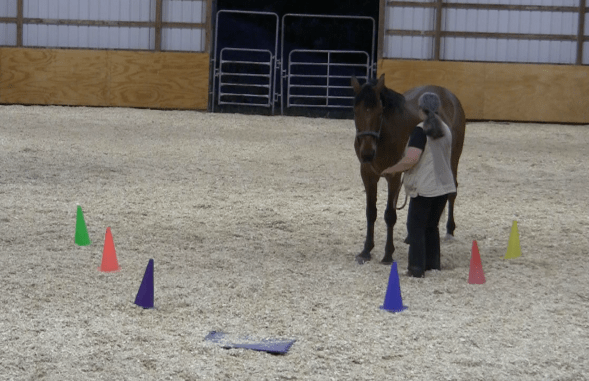
To teach horses to step on mats, I set out the V runway pattern.   The cones help handlers line their horses up with the mat so they have room to come to it on a straight line.  When I first taught mats, I didn’t put the cones out.  But then I saw that handlers would leave the mat and cut back around on such a tight turn that the horse had no chance to line himself up again straight to it.

They did the same thing at mounting blocks.  If the horse shifted away from the mounting block, they would walk off on a tight circle that gave the horse little opportunity to come in straight.  The missing step was the handler’s ability to visualize the path she needed to take to give her horse the most success.

So I set out the V shaped line of cones.  The length of the “runway” obliged the handler to go out far enough so that she had room to line her horse up to the mat.

I could have set the mats out in a parallel lines.  Then I would have had a different kind of runway, and I would have used different images to describe it.  It might have become the catwalk for a fashion show.  The horse would be a model sashaying her way down the runway – stopping periodically to show off her costume.

Instead I set them out in a V so the handler would have a wide funnel entrance and a better chance of getting the horse into the top of the runway.  It’s only experienced pilots and co-pilots who can successfully enter into the top of a narrow runway.  Novice teams need the wider opening.

Playing with Images
Playing with images takes you away from relying solely on the standard-issue horse training approaches you may already know.  It puts you into a creative place where you can come up with your own patterns, images, and techniques that work for your horse.

People often feel that they have to follow exactly the instructions given by a clinician or riding instructor.  I offer the runway as a starting point.  I suggest that you begin with my image.  Understand how this process works; learn the basics of good rope handling; see what it gives you when you have a horse who welcomes the information the lead provides; and then become creative.  Invent your own images to help teach the skills your horse needs to meet your personal training goals.

Creativity
For me, there’s no better indicator of success than hearing from someone that they have found a new way of teaching a familiar lesson.  They don’t go about it exactly the same way I do.  Their horse has shown them a different way, just as my horses often show me new ways to teach old things.

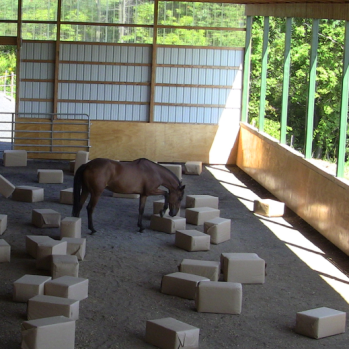
Creativity is at the core of our being.  When a handler clutters up her work space with cones, empty supplement containers, bags of shavings, and who knows what else, and sees in that clutter a better way to teach a lesson, I know she has understood the greater game.  She is becoming creative and inventive.  She is creating new games.  For both horse and handler it has become true play.

Robin with shavings 2016-06-22 at 5.54.53 PM

You might not want to put quite so many shavings bags into your “play ground”, but clutter can definitely contribute to creative ideas.

Coming Next: Unit 4: Cue Communication

Remember, if you are new to the JOY Full Horse blog, click on the JOY Full Horses tab at the top of this page to find the full table of contents and links to each of the articles I have published so far.

I hope you will want to share these articles by sending links to this blog to your friends.  But please remember this is copyrighted material.  All rights are reserved. Please do not copy any of the “Joyful Horses” articles without first getting written permission from Alexandra  Kurland, via theclickercenter.com

Also note: these articles are not intended as an instruction guide for introducing your horse to clicker training.  If you are new to clicker training and you are looking for how-to instructions, you will find what you need at my web sites:

theclickercenter.com                    theclickercentercourse.com

JOYFULL Horses: Mat Manners

In the previous installment I introduced you to constructional training.  I used the runway lesson to teach your horse to step on a mat.  Instead of going directly to the mat, you first taught your horse the skills he’d need to make this an easy lesson.

So now you have a horse who is eager to get to his mat.  He isn’t just gingerly stepping a toe onto the edge of the mat, he’s rushing ahead to get to it.  Hurray!  You’re part way through this lesson.

For every exercise you teach there is an opposite exercise you must teach to keep things in balance. 

The mat lesson helps you understand the importance of this statement.  You’ve got a horse who is eager to get to the mat.  Now you need to explain that you’d like him to walk with you to the mat.

Robin runway walk casually to it 2016-06-22 at 2.34.16 PM

Robin shows his great mat manners, walking with me to the mat.

Robin halt on mat 2016-06-22 at 2.34.39 PM

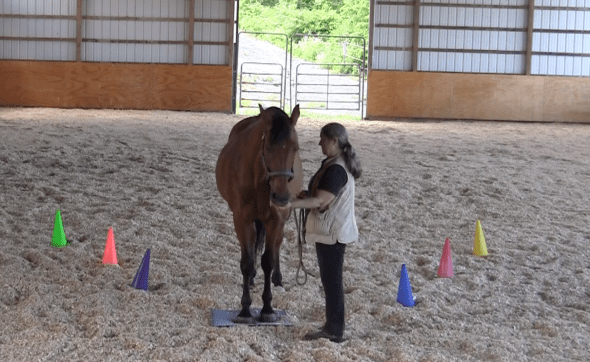
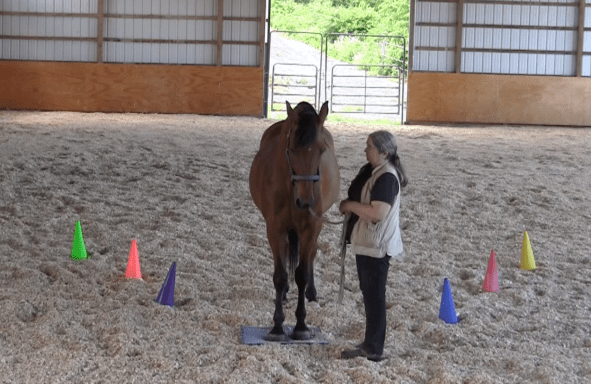
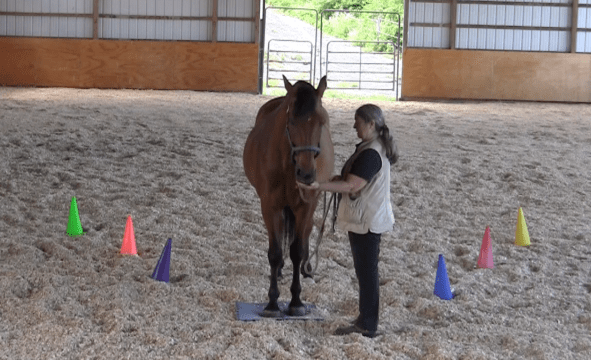
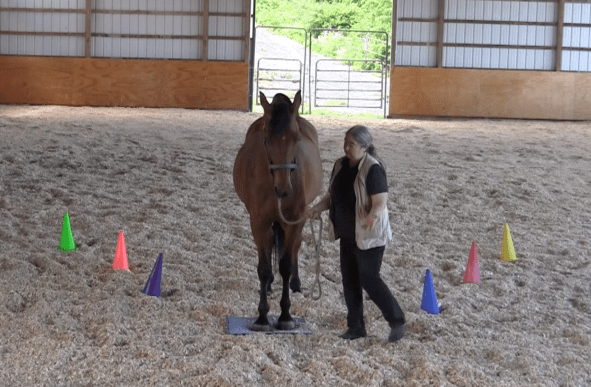
He lands on the mat in beautiful balance.  He’s going to continue to be our equine teacher for this lesson.  In the following photos you’ll see how to build great mat manners.

Mat Manners
You’re now ready for the next level in this “runway” game.

You want a horse who is eager to get to the mat, who regards it as a fun place to be, a place where lots of good things happen, but you also want a horse who walks with you to the mat.  You don’t want your co-pilot taking over complete control.  You still want to make some of the decisions.   So now if he starts to grab the throttle stick from you, you can use your “needle point” skills to ask him to stop and back up.

I know that’s mixing a lot of metaphors.  Let’s see how this works.

Robin mat back one step 2 2016-06-22 at 4.16.26 PM

Robin and I are practicing our “needlepoint”.  I’m asking for a single step back. (Refer to the previous post: https://theclickercenterblog.com/2016/06/21)

Rushing doesn’t lead to the mat.  It leads to needle point.  But needle point is not a bad thing.  Your co-pilot understands what is wanted.  I tend not to click for course corrections.  So that first backing step won’t be rewarded with a click and a treat.  But when we’re back on pattern, and I ask for the next step, perhaps asking now for one green stitch forward – that I’ll click and treat.

Robin walk one step to mat 2016-06-22 at 4.18.01 PM

In the “needlepoint” part of the runway lesson I’m asking Robin for one step forward.

Robin walk off to mat 2016-06-22 at 4.18.14 PM

After a click and a treat, I release him to the mat.

We’re back in sync with one another, still a few steps away from our landing pad.  I’ll release the controls to my co-pilot, and we’ll walk together with slack in the lead.  I won’t need to help him get to the mat.  He knows how to land our little craft.  He stops, perhaps not perfectly square yet, but with both feet on the mat.  Click and treat!

Robin on mat grups 2016-06-22 at 2.56.18 PM

Again, he lands beautifully on the mat.

And now the game changes yet again.  I want the mat to be a versatile tool.  I want my horse to remain on the mat while I move around him, or even away from him.  The mat provides the foundation for what is referred to in the horse world as ground tying – the horse stays on the spot where you left him as though he was tied.

Robin on mat grups at distance 2016-06-22 at 2.56.57 PM

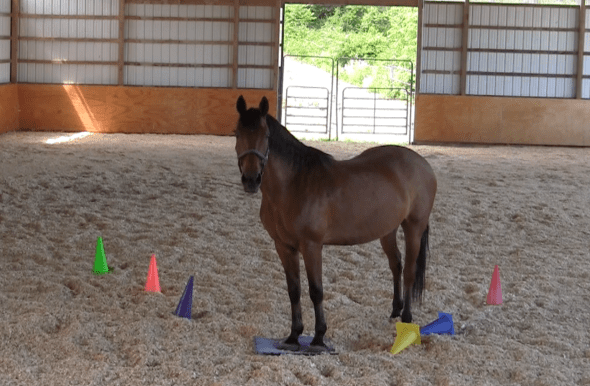
The mat is a great tool for teaching ground tying.

101 Things
So the new game becomes “101 things a handler can do while a horse stays on a mat.”

This is a variation on the theme of a game which many canine clicker trainers play with their dogs.  It’s called “101 Things a Dog Can Do With A Box”. The handler presents a dog with a box.  Each novel behavior the dog offers gets clicked.  So if the dog sniffs the box, he gets clicked.   If he sniffs it again, he doesn’t get reinforced.  But if he paws the box with his right front foot, he does.  Now if he sniffs the box or paws it with his right front – nothing.  But if he changes and paws with his left front, click and treat.

This was a popular game early on amongst canine clicker trainers, but for a lot of reasons I never played an equine version of it.  One of the more fuddy-duddy reasons was I really didn’t want my horses learning all the creative things they can do either with their bodies or with things.  I didn’t want them thinking they can do fancy leaps into the air with me on their backs or open their stall door latches whenever it pleased them.  If they discovered these talents on their own, so be it, but I didn’t need to be an accomplice in this kind of cleverness. (That’s especially true when it comes to stall latches!)

So 101 things was out for my horses, but it is very much in for the handlers.  I need them to be creative.  So the game becomes – every time your horse lands back on the mat, you have to come up with a new behavior a handler can do while a horse stands on a mat.

At first this is easy.  Your horse lands on the mat, and you might ask him questions about handling his mane.  Will he continue to stand on the mat while you run your fingers through his mane?  Yes.  Click and treat.  Repeat this several times and then walk off casually back around to the top of the runway.

Robin toss rope 2016-06-22 at 2.38.14 PM

I begin by “parking” Robin by tossing the lead over his neck.  Draping the lead over his neck quickly becomes a cue to stand.

Robin on mat play with mane 2016-06-22 at 2.57.44 PM

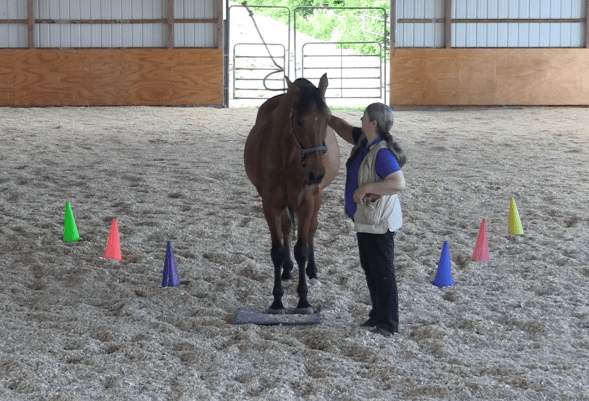
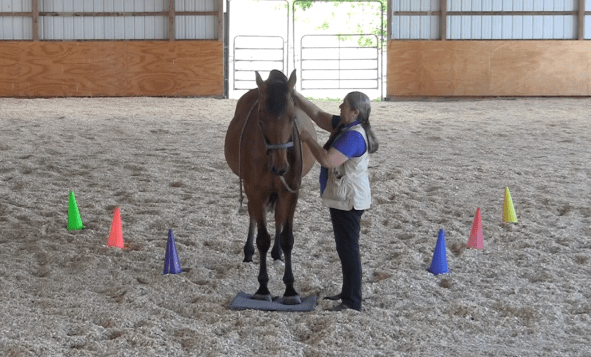
With Robin “parked” on the mat, I can begin the “101 things a handler can do while a horse stands on a mat” lesson. In this round of the game I am stroking his mane.  The lead rests over his neck in the “parked” position.  I’m not holding on to it, but I can easily pick it up should he walk off.

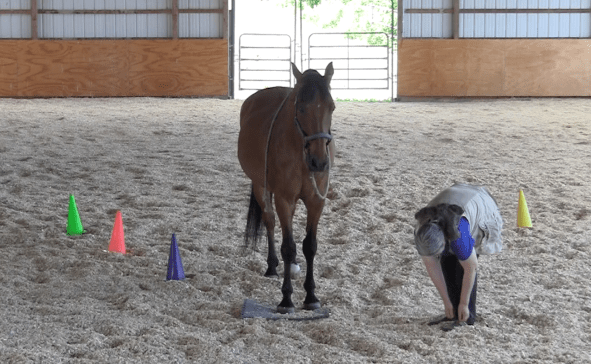
Next time you get back to the mat, you have to think of something else to do.  It could be you simply expand running your fingers through his mane to stroking down his neck and along his shoulder.  Or you could decide to play the game more like “101 things you can do with a box”.  You stroked his mane in the last round, so now you’re going to think up a completely different sort of behavior.  “Will you stand on the mat while I bend down to tie my shoe?  Oh, I don’t have shoe laces!  Never mind my shoe still needs to be checked.”

Robin on mat tie shoes 2016-06-22 at 3.00.36 PM

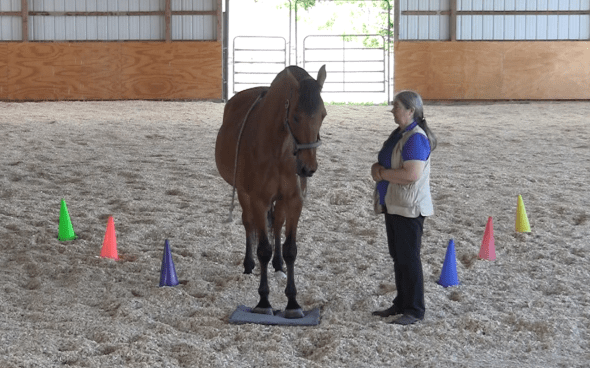
“Will you stand still while I tie my shoe?”  Yes, click then feed.

Most people can easily play a couple rounds of this game but then they begin to get stuck for ideas.  They are too much in their “horse-training” head.   They’ve already stroked their horse from head to tail and picked up all four feet. What else can they do?  They are running out of ideas.

The Opposite of Flooding
Time to channel their inner child or their inner kindergarten teacher.  You can ask your horse for horsey things like dropping his head, or putting his ears forward, or letting you walk behind him and groom his tail.

Robin on mat ask for foot 2 2016-06-22 at 2.39.13 PM

While Robin stands on a mat, I can ask for horsey things. In this case I am touching him at his elbow as a cue for him to lift his foot.

Robin on mat knee target 2016-06-22 at 2.39.27 PM

As Robin lifts his foot, I have him target his knee to my hand.

Robin on mat take foot 2016-06-22 at 2.41.41 PM

From here it is easy to ask him to target his foot to my hand.  (This is an easy way to teach a horse to pick up his feet.)

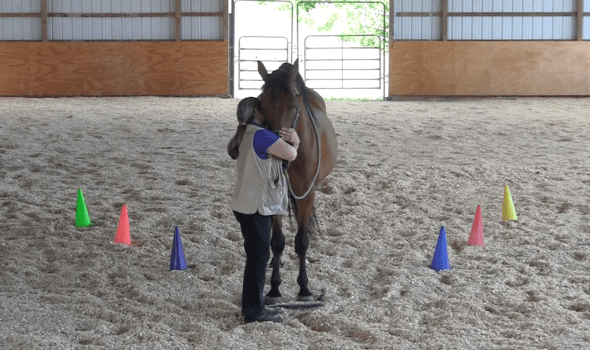
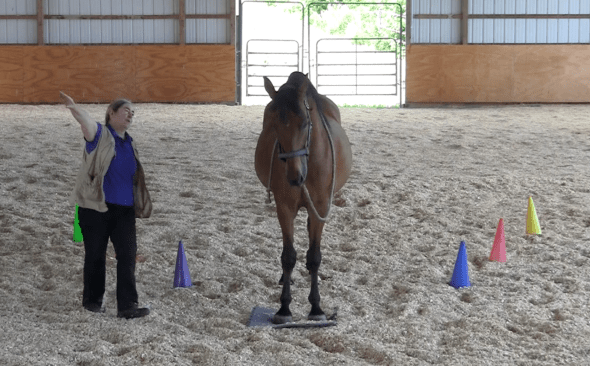
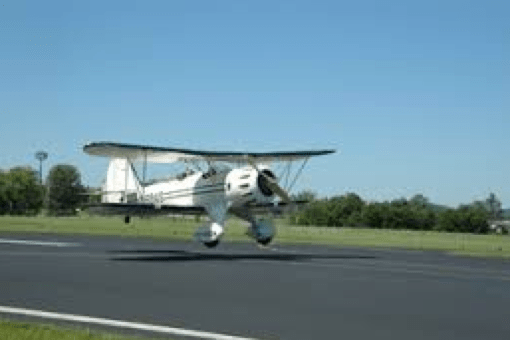
You can play silly games with your horse.  Can he stand still while you run around pretending to be an airplane?  Bzzzz, Bzzz – coming in for a crash landing into the mountain (horse).  Click and treat.

Robin on mat airplane 1 2016-06-22 at 3.03.26 PM

When you run out of “horse training” games, you can play silly ones.  In this case I’m pretending to be an airplane.  I even include the sound effects of a buzzing  engine.

Robin on mat hug 1 2016-06-22 at 3.04.16 PM

My favorite kind of “crash landing”.

I love watching the horses watch the people.  This is the best entertainment they’ve had in years!  What will their human do next!?

Robin on mat airplane rgt side 2016-06-22 at 3.03.56 PM

Robin isn’t sure what to make of my behavior.  What a very strange human!


This type of training is done routinely when you are prepping a youngster for riding.  The handler waves things around and jumps up and down.  The goal is to desensitize the horse so he doesn’t spook at unexpected movement.  But instead of creating an entertaining game for the horse, it is often done with flooding.

Here’s an example of how flooding works.  Suppose a horse is afraid of flapping saddle blankets.  He scoots away.  The blanket pursues him, matching him move for move until finally he gives up and stands still.  Next comes another scare, this time it might be an umbrella opening and closing in his face.  The horse learns he can’t escape.  The best he can do is stop.  That makes the umbrella go away  – for the moment, but it is back again in the next instant.  He learns finally that no matter what happens, no matter how afraid he is, he can’t get away.  He gives up and stands still while the handler flaps tarps around his body, and up over his head, covering his eyes so he cannot see to run even if he wanted to.  He’s given up flight because he has given up.

The handler isn’t playing, except maybe at being a “horse trainer”.  And this most certainly is not a game for the horse.

I want to create something very different for the horses I interact with.  It needs to be play for both of us.  I want my horse to know that he does have a choice.  His voice most certainly counts.

Teaching the skills you need before you use them; building success and confidence through patterned exercises; and – most important – really listening to your horse helps transform these lessons into true play for both of you.

Playing with Language
I’ve written about mats many times.  I’ve described in detail the rope handling techniques that are used.  I’ve referred to the runway image.  (I definitely spend too much time in airports.  I can rarely teach a weekend clinic without making some reference to airplane travel.)  I’ve also referenced the needle point image because to me this section of the lesson always makes me think of the fine, detailed work that needle point represents.

What I haven’t done before is used quite so much of this type of imagery in describing the lesson.  My point is not to force you into a mold where you have to be thinking – okay what colour thread am I supposed to be picking up and why?  If you’ve never done needle point or other fine detailed handiwork, this image will feel foreign and forced.  If you haven’t traveled on as many airplanes as I have over the last few years, the runway image may not jump out at you as you set your cones out in a V.

My point is not to get you using these images.  My point is to get you thinking creatively, with imagination.  That’s what takes you far, far away from the mind set of do-it-or-else training.

airplane landing.png

Coming Next: Transforming Horse Training Into Play

Remember, if you are new to the JOY Full Horse blog, click on the JOY Full Horses tab at the top of this page to find the full table of contents and links to each of the articles I have published so far.

I hope you will want to share these articles by sending links to this blog to your friends.  But please remember this is copyrighted material.  All rights are reserved. Please do not copy any of the “Joyful Horses” articles without first getting written permission from Alexandra  Kurland, via theclickercenter.com

Also note: these articles are not intended as an instruction guide for introducing your horse to clicker training.  If you are new to clicker training and you are looking for how-to instructions, you will find what you need at my web sites:

theclickercenter.com                    theclickercentercourse.com

JOYFULL Horses: The Runway Lesson

I ended the previous section by saying the lead tells a story.  I want my lead rope to be a welcome tool, one my clicker-trained horse is completely comfortable with.  That’s the goal, but it’s often not where we begin.  Often when I first attach a lead to a horse, what I encounter is resistance and concern.  Lead ropes have been used for correction and punishment – so the horse is defensive.  He’s telling me about is history, and I need to listen.  I also need to respond in a way that doesn’t prove to him that he was right to be guarded.

I want to show him that the defenses he’s thrown up aren’t necessary.  The castle walls, the moat with the sharks, the draw bridge, the boiling oil, the iron portcullis, and all the armored men lined up behind can all vanish, whisked away not through force, but through play. Mats are going to be the training tool I use.

To introduce a horse and handler to clicker training I focus on six foundation lessons.  Teaching a horse to stand on a mat is one of those lessons. The mat is what the word implies.  Think door mat, and you’ll have the right sort of size.  You can use plywood, carpet squares, rubber mats.  They all work as long as they contrast well with the surface they are on.

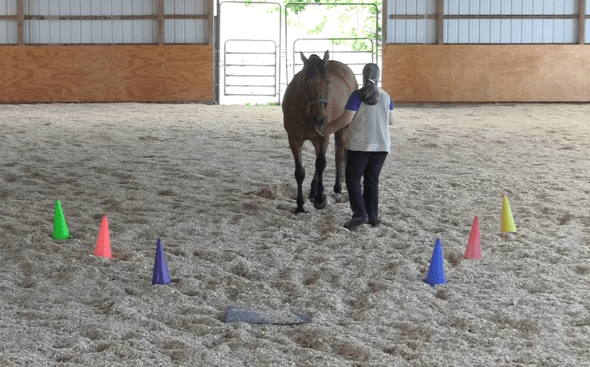
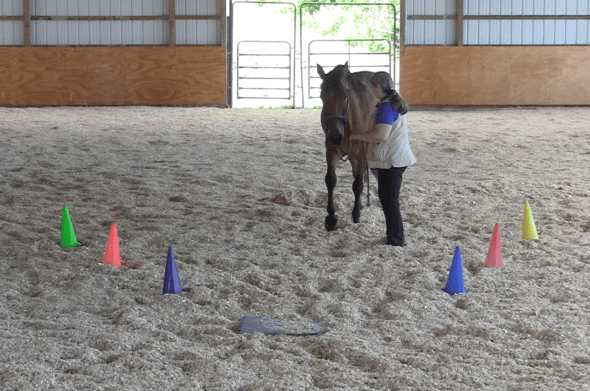
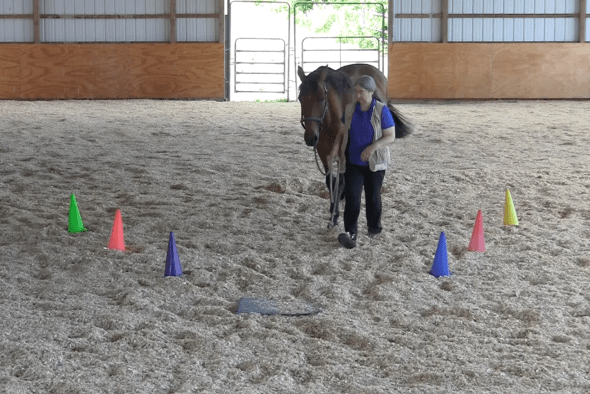
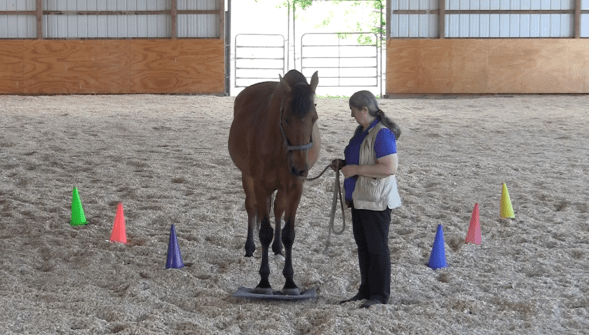
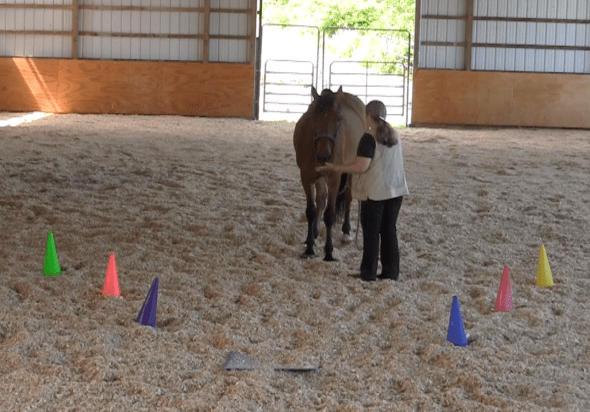
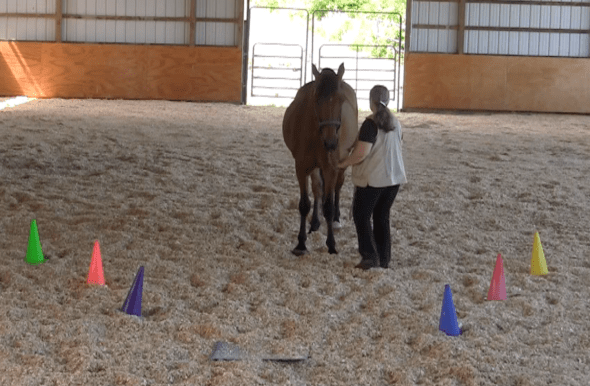
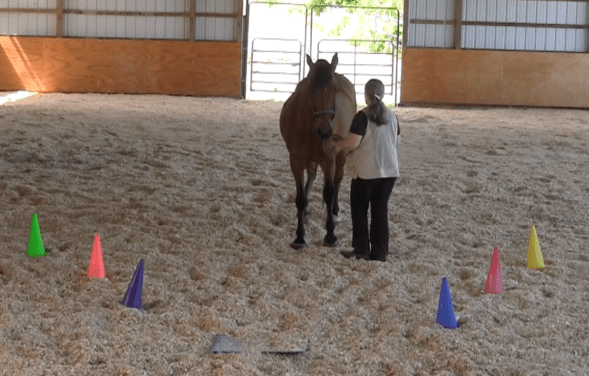
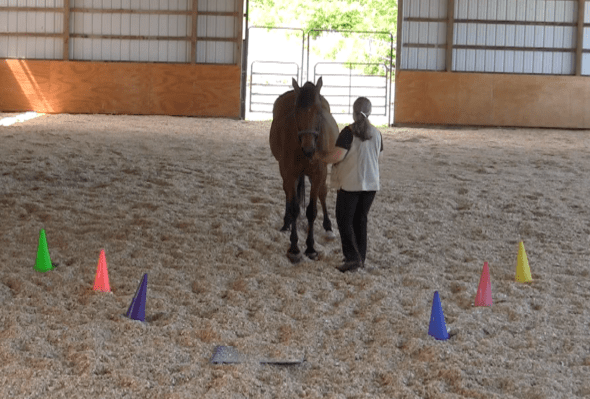
They are lots of different ways that you can teach a horse to step on a mat.  Over the years I have used a variety of approaches, tailoring the choice to the needs of the team.  But my favorite way, and the way I generally choose first is to imagine that the mat sits at the end of a runway of cones.   I am trying to line up straight to my runway so I can bring my horse to a safe landing on the mat in the same way a plane would line up to a real runway. Here’s the lesson:

The Runway
Instead of castle walls with the mat as a drawbridge, I imagine an airplane runway.  The sides of the runway are lined with cones that form an open V, funneling us down towards the mat at the end.

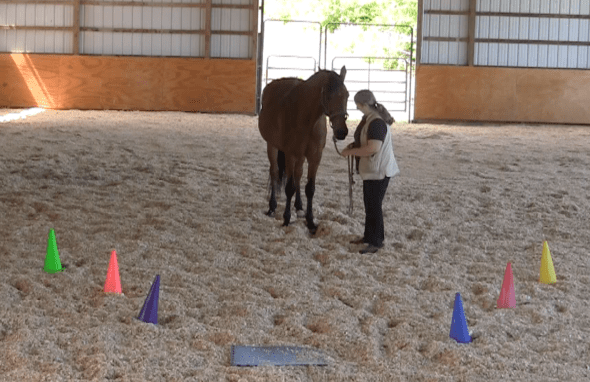
Robin waiting for me in runway 2016-06-18 at 6.05.54 PM

My horse, Robin is going to be our equine teacher for this lesson.  He’s going to show you what the lesson looks like with an experienced “copilot”.  I’ll also be describing what the lesson is like when you’re working with an inexperienced horse.  I’ll be taking you from the first wobbly “flights” down the runway to the finessed balance that evolves over time. For now Robin is waiting expectantly for the game to begin.

If Robin is one of our equine teachers, let’s suppose the other is a pushy, somewhat nervous horse who has gotten into the habit over several years of dragging his person pretty much wherever he wants to go. In this lesson the pilot (me) is approaching in her single engine little plane (the horse).  I’m being buffeted by strong winds.  The plane (my horse) is rocking from side to side, trying to drag me off course.  Can I even make the top of the runway?  No!  I abort to try again.  I circle around, and this time I manage to get the nose of the plane, i.e. this horse, pointing into the open V of the runway.  Click and treat.  The wide end of the funnel helps me to be successful.  I want to find ways to say ‘yes” to this horse, so I make the lesson as easy as possible by making the opening of the funnel extra wide.  I’m setting up the environment to help ensure success.  A narrow funnel would be much harder to get to with my determinedly pushy horse.

I had originally wanted to show a video of an inexperienced horse using the runway lesson, but computers being computers my editing program isn’t cooperating with that intent.  So instead I enlisted Robin’s help.  He’s my “dance partner”, or to stick with my metaphor of the runway, my copilot.  I filmed him going through the pattern, and I’ve pulled still photos from the video to describe some of the key elements of this lesson.

It’s been a very long time since I have worked Robin through this foundation lesson.  As always, I found it was worth revisiting the basics with him.  No matter how skilled a horse becomes, the basics always reveal details that need polishing.  So whether you and your horse are a novice team or one that is very experienced, the runway is a great lesson to explore.

Please note: This is not a stand alone lesson, nor is this JOYFULL Horses book intended as a clicker training how-to instruction manual.  The prerequisites and a description of the handling skills needed for this lesson are presented in my DVD lesson series and in the on-line course. I am describing this lesson in detail here not not so much to teach you how to use it, but to illustrate some important concepts that are relevant to all good clicker lessons.

I’ll start with a short video which will give you a quick overview of the lesson.


There are a lot of important details in this 3 minute clip.  I’m going to take the lesson apart literally frame by frame.  I’ll be using stills pulled from the video to point out the key elements of this lesson.  Enjoy!

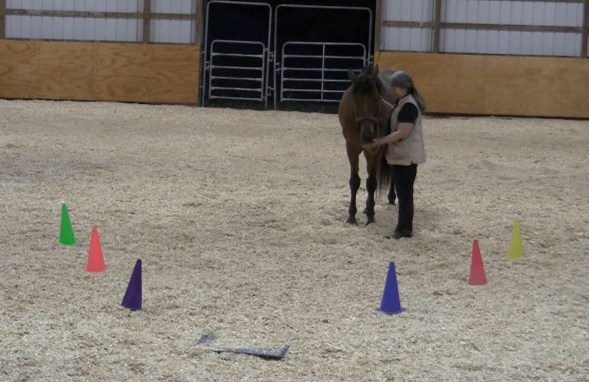
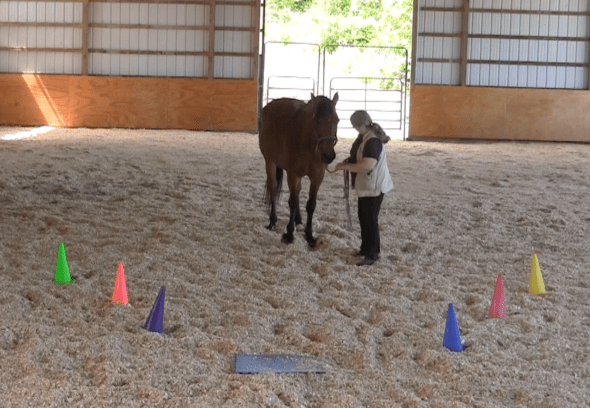
Robin Runway reenter runway 2016-06-18 at 6.11.50 PM

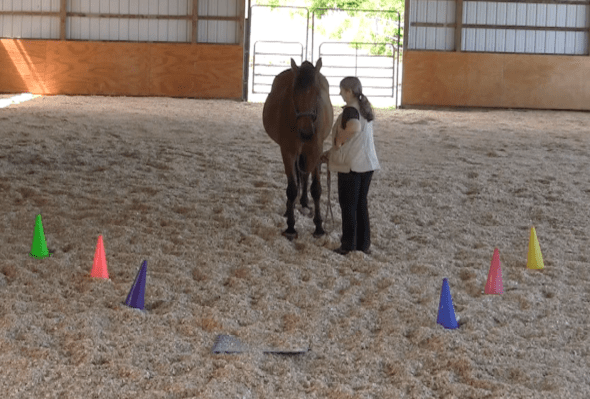
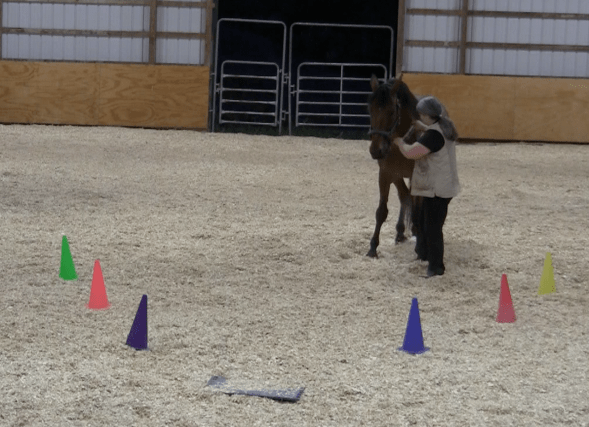
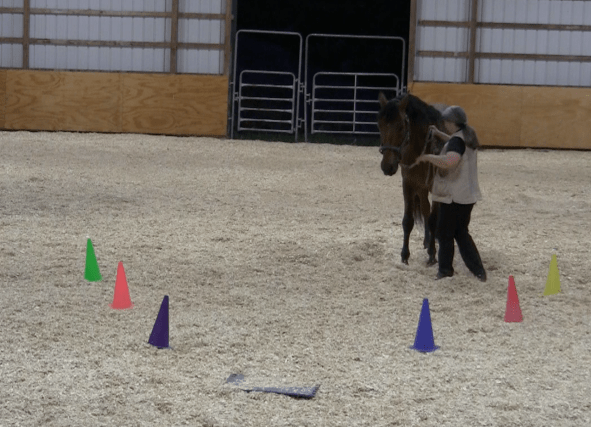
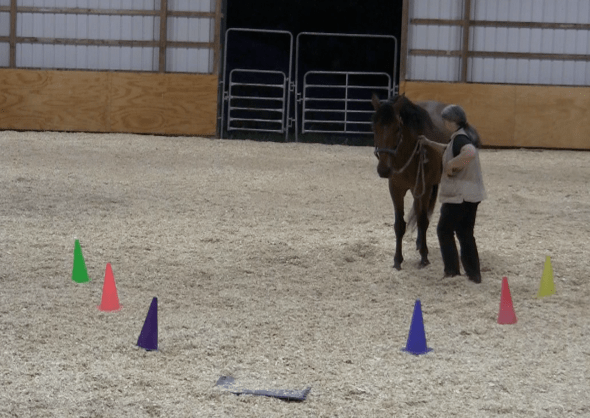
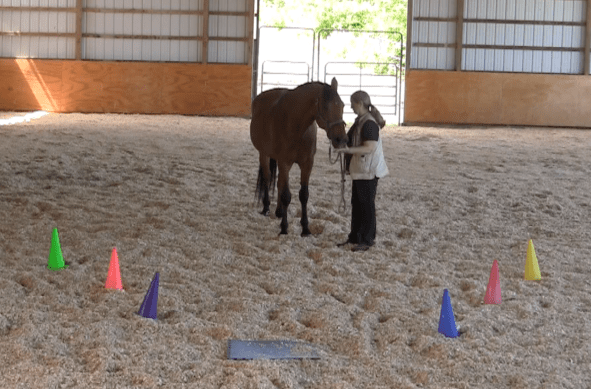
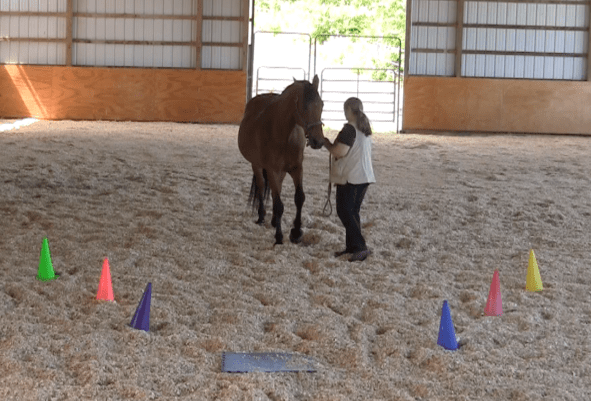
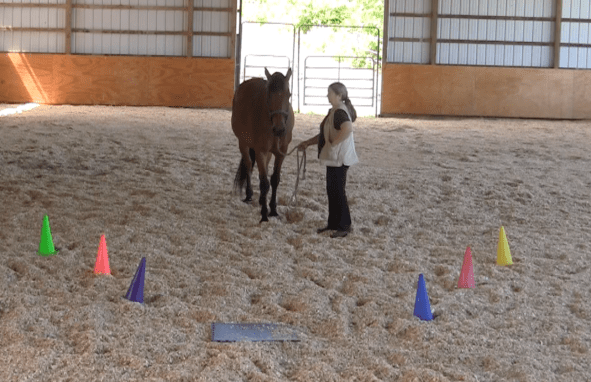
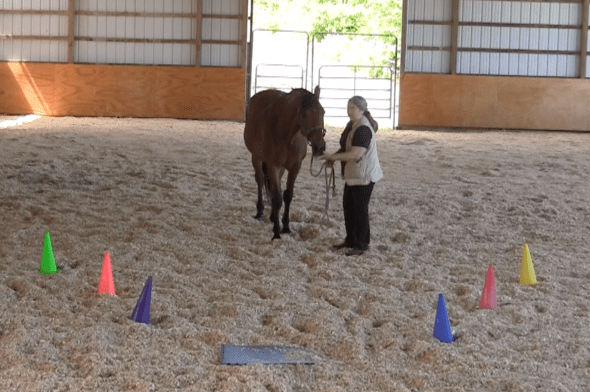
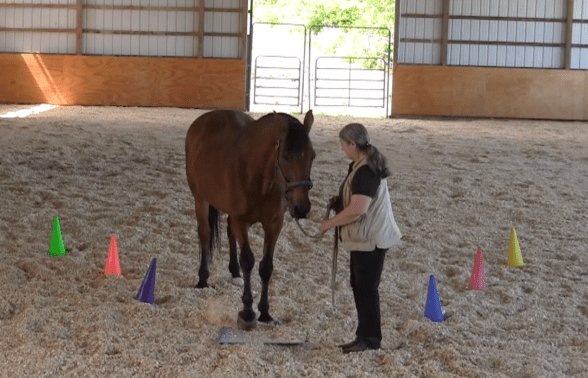
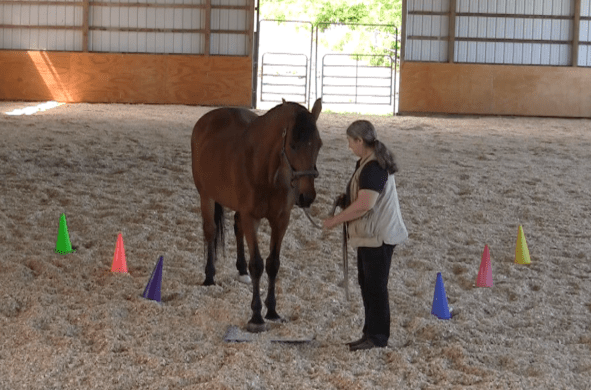
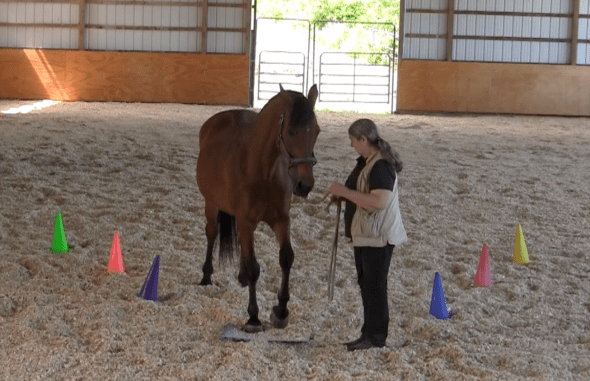
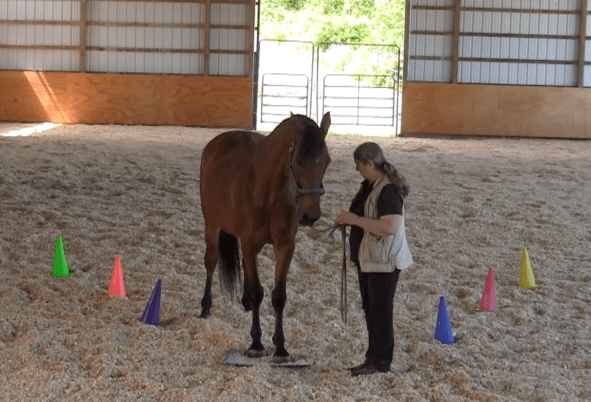
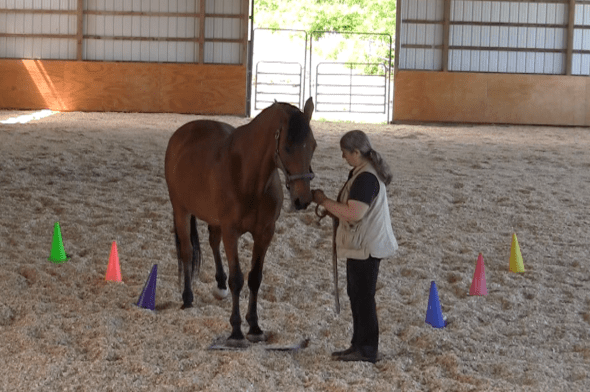
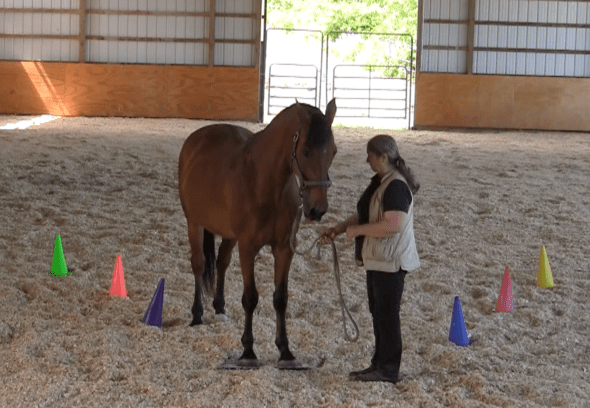
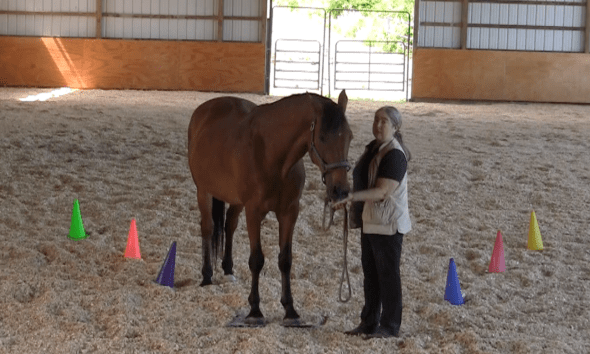
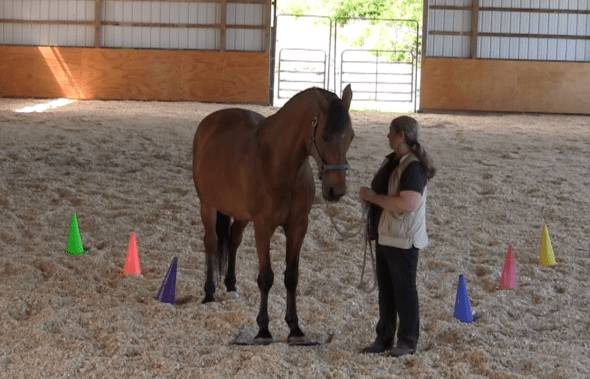
The runway is part of a larger loop.  There’s no beginning, middle, and end.  A horse that is familiar with mats might begin, as Robin did, on the mat.  The pushy horse I am starting with has never stepped on a mat and is worried by them. I would begin with that horse where we are picking up the pattern here, with Robin turning with me into the top of the runway.  Note the slack in the lead.  I probably would not be giving this much freedom to my pushy horse.  he wouldn’t yet know how to read and respond to the subtle signals from my lead and body language.  I would need to slide up the lead to signal my intent to turn.  I would click and reinforce the horse as he responded to my request.  This would bring him to a halt, ready for the next phase of the lesson.

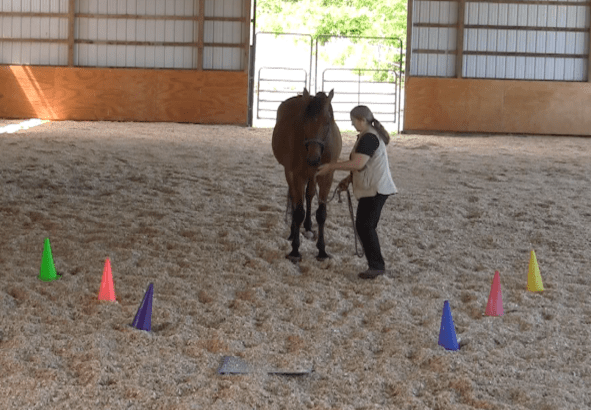
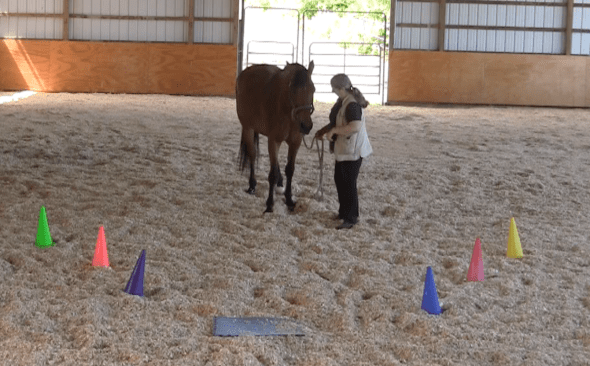
Robin Runway turn to a stop 2016-06-18 at 6.12.10 PM

Note how I have brought Robin into the runway.  I’ve been mindful of the placement of the V. I’ve given us enough room to turn so Robin ends up in line with the mat.  This exercise is about straightness.  It is a wonderful lesson for helping crooked, pushy, unbalanced, nervous, or just plain wiggly horses.

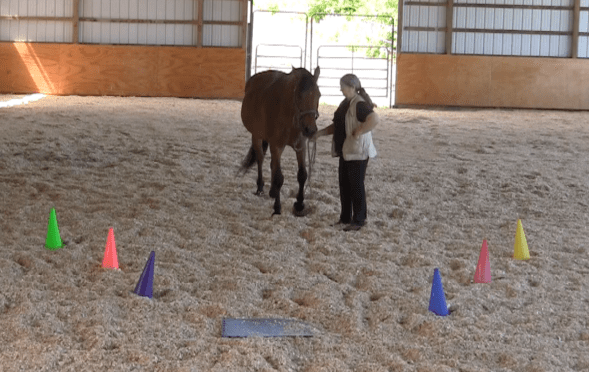
Robin Runway lined up for approach 2016-06-18 at 6.12.22 PM

Here Robin is beautifully lined up to the mat as he completes his turn into the runway.


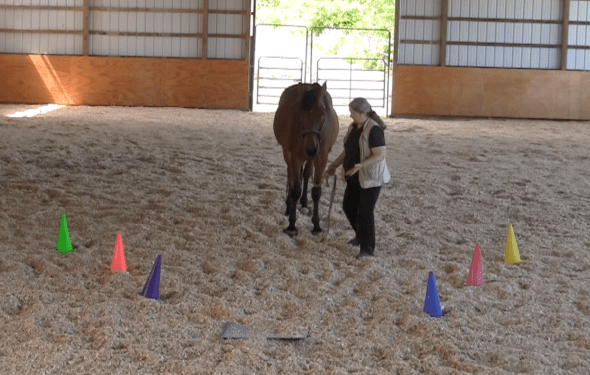
Robin runway off sides 2016-06-19 at 9.36.47 AM

In contrast here I’ve made my turn too early so there isn’t time to line Robin up straight to the runway.  I originally taught the mat lesson without any cones for markers.  People would walk their horses off from the mat and then come back around in too tight of a turn.   There was no way their horses could line up to the mat and approach it on a straight path.  These handlers were setting their horses up for a wiggly, crooked approach.  The mat is about lining up straight to a mounting block, approaching the center of a jump on a straight path, crossing streams and other obstacles, stopping square at X in a dressage test, and performing any other task where precision and accuracy in the approach are needed.  A novice horse needs the extra help that a long runway approach gives him.  I set the cones out as guides for the handlers.  They have to take their horses back to the mat by walking all the way out and around the line of cones.  Targets aren’t just for our horses.  Sometimes they are for us, as well.


You’re in the runway.  Now what? This lesson is like a dream where you drift from one scene to another – never questioning the odd juxtaposition of images.  In this part of the lesson I am doing “needlepoint” with this horse.  That’s the image.

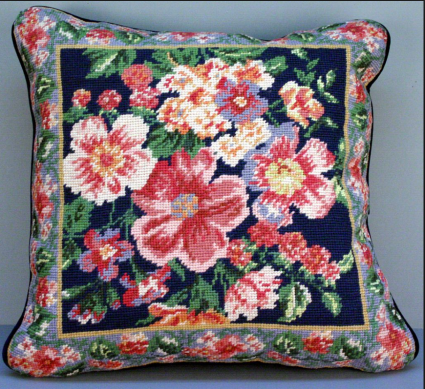
needle point pillow

Needlepoint may not seem relevant to horse training, but the individual balance shifts we teach in the runway always make me think of the intricate stitches in a needlepoint tapestry.

Each stitch is an individual action.  Each stitch must be carefully thought through before beginning the next. I may have to change colour often.  I may only want one or two stitches of green before I switch to red. That’s how this part of the lesson feels to me.  I will be asking for tiny shifts of weight.  Each balance shift forms one stitch in this larger tapestry.

When I ask my horse for one tiny step forward, that’s one green stitch.  If I’m working with a poorly balanced or pushy horse, I don’t want to take a step and then follow it with many more.  Instead, just as this horse begins to lift his leg, I’m going to click.  The click interrupts one thought – move forward – and replaces it with another – get your reinforcer.  Before he has even really begun to move, he’s at a standstill again waiting for his treat  He was thinking of barging past me, but that would have crashed our little “plane”.  Instead disaster has been averted.  He has taken a half step forward, and now he’s shifted his weight back slightly to get his treat.

He’s beautifully set up for the next stitch in our tapestry.  I ask for another forward step.  Click!  Again, the power of the click interrupts him before he can charge forward.  He is learning patience.  He is learning self-control.  He is learning to control his movements.  He began with a throttle that was either at full power or completely turned off.  Now we are gaining some adjustability.  I can ask for a tiny amount of energy, and he can give me a soft, half step forward.  Click and treat.

He is doing so well, it is time to land “the plane”.  I put aside one image – the needle point – and we walk casually forward down the rest of the runway.  As we approach the mat, I realize my co-pilot isn’t ready to stop.  I walk over the mat myself and keep going, letting my co-pilot walk beside me.

We circle around back to the top of the runway.  My co-pilot learns fast.  The little plane is steadier now as we bank around the turn and face into the top of the V.  Click and treat.  This time I put red thread into my needle. I ask for backing.  Again, I click on that single stitch.  The plane wobbles a bit and goes off course.  We are no longer pointing straight down the runway.  It doesn’t matter.  The pattern allows for many stitches of red.

Click by click we lay down a line of red stitches.  The backing is smoother now, less hesitant, less wobbly.  We have backed ourselves in a squarish turn that takes us out of the top part of the runway.  I am using skills learned in previous lessons.  My “copilot” may not be able to back straight yet, but I can still keep us in the vicinity of the runway by having him back in a square pattern.  Straight will emerge as he learns how to handle these larger course corrections.

When you put enough of these fine needlepoint stitches together, you get a picture that looks like the one Robin is illustrating for us in this series of photos:

Robin Runway backing in runway 2 2016-06-18 at 6.12.54 PM

Robin’s adjustability and good balance has allowed him to come in straight to the mat.  I’ve turned toward him to ask for one step back with his right front foot.

Robin Runway backing con't  2016-06-18 at 6.13.17 PM

Robin has initiated a step back. As he does, I click and prepare to release the lead.

Robin Runway backing done 2016-06-18 at 6.13.29 PM

Robin has completed the single step back.  You can’t see it, but my hand is opening on the lead even before his foot lands.  What goes up must come down.  It’s important to let go as I click and not to wait for the foot to land.  If I stay on the line, I would be holding on way too long, giving my horse something annoying that he would need to push against.  The timing needed to release a horse into the action you want takes deep practice focus.  If you aren’t sure what I mean by deep practice, read my blog on this subject. (https://theclickercenterblog.com/2014/11/16/)

Robin Runway feed after backing 2016-06-18 at 6.13.44 PM

I’ve already clicked.  Now it’s time to reinforce Robin with some hay stretcher pellets.

Robin Runway 2nd back 2016-06-18 at 6.14.13 PM

My “needlepoint tapestry” is made up of many stitches.  I’ll ask Robin for another, single step back.

Robin Runway 2nd back con't 2 2016-06-18 at 6.14.22 PM

It may not look as though anything has changed, but Robin has unweighted his right front in preparation for backing.  That’s my cue to be ready to click.

Robin Runway backing step good 2016-06-18 at 6.15.31 PM

Robin has begun to take a step back – Click! Remember it’s important to click as he initiates movement.  I’m not waiting to see the outcome of the weight shift (meaning the completed step back.)  If I click as he initiates a movement, I am saying “yes” to that movement.  This lesson is not about blocking or shutting down energy.  I want energy.  I want behavior.  I want to say “yes” to moving even if the moving is being done by a pushy, inexperienced horse.  When I click as he begins to take a step, I am saying “yes” to movement that in the past someone else may have punished.  An inexperienced horse is expecting a “no”.  Part of his pushiness comes from trying to rush past the obstacles he’s expecting me to throw in his path.  Instead he hears a click!  Surprise, surprise!  He brings himself to a stop to get his treat.  Self control and good balance will emerge out of saying “yes” when what his history tells him to expect is a “no”.    

Robin Runway feed after back 3 2016-06-18 at 6.15.47 PM

I’ve clicked Robin as he began to take a step back.  The click is a cue to me to begin my reinforcement cycle.  I’m reaching into my pocket to get a treat.  But note also what my right hand is doing.  I have moved it forward so the snap hangs straight down.  I am giving Robin the full freedom of the lead.  This is an important part of this lesson and one many people struggle with so I’ll be pointing it out again in other photos.  The snap on my lead is going to become a tactile target for my horse to orient to.  Moving my right hand towards Robin as I get the treat with my left is part of the teaching process that helps Robin tune in to the significance of the snap and it’s orientation.


Robin runway tai chi wall 1 2016-06-18 at 9.37.29 PM

Here’s the contrast.  As I ask Robin to take a step, I’m using my right hand more actively on the lead.  If he were a more inexperienced horse, I might need my hand here to help him maintain his balance as he takes a step forward.  Otherwise, he might be falling into me with his left shoulder. (Note: if I were on Robin’s right side, things would be reversed.  I would be feeding with my right hand and releasing the lead fully with my left.)

Robin runway tai chi wall 2 2016-06-18 at 9.37.39 PM

Here’s a common mistake.  I’ve released with my left hand, but I’ve kept my right hand in place on his neck.

Robin runway tai chi wall 3 2016-06-18 at 9.37.48 PM

Even while I am reaching for the food, I am keeping my right hand in place.  I refer to this as driving down a motorway with your emergency brake on.  When a horse is unbalanced and pushing through you, it can feel as though you can’t let go completely.  It takes focus to remember to release the lead completely with your right as well as your left hand.  This is where you learn to truly let go. This is the beginning of floating on a point of contact – a heavenly feel for both horse and handler.

Robin runway tai chi wall feed 2016-06-19 at 11.48.13 AM

After all, you’ve got treats in your hand.  Where is your horse going to go?  This is the perfect time to experience letting go of him.

Robin Runway prepared for next step 2016-06-18 at 6.16.03 PM

The runway lesson teaches the handler to be an agile thinker.  Depending upon what happens with my horse’s balance, I may need to change in an instant the direction I want him to go.  So while I am giving him his treat, I am already thinking about what I am going to do next.  I don’t wait for him to fill in the “dance card” through my indecision.  My body language is signaling the next clear intent.  Can you tell what I’m going to ask him to do next? Answer: walk forward with me to the mat.

Robin Runway release to mat 2016-06-18 at 6.16.14 PM

Robin has done a nice unit of “needlepoint stitches”. Now it’s time to let him move.  I am releasing him to the mat.

In the photos it was time to release Robin to the mat.  It is time to do the same for my less experienced horse.  Once again, I’ll set the needle work image aside.  I have asked this horse to stay focused with me through several steps.  We have put down enough concentrated stitches.  Now it’s time to move.  We’ll walk casually towards the tip of the V and the mat.  This time instead of walking over the mat, I may choose to stop on it.  My co-pilot misses the stop and over swings past me.  No problem.  It’s a sloppy landing, but it won’t bring out the fire brigade, at least not this time.  I am standing on the mat, clicking and treating my horse for standing quietly beside me.  He can see that the mat did not swallow me up. Instead standing next to it produces lots of clicks and treats.

In contrast to a green horse Robin shows us a beautifully on-the-spot landing on the mat.

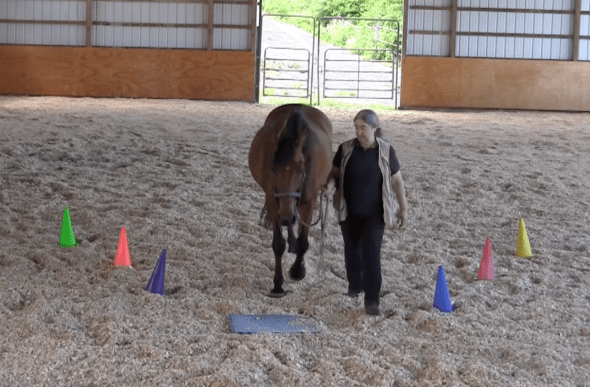
Robin Runway walk to mat 1 2016-06-18 at 6.07.24 PM

Robin is showing perfect mat manners.  Even though he is eager to get to the mat because it represents an opportunity for reinforcement, he is walking with me on a slack lead.  Mats are a great tool for teaching horses the emotional control they need to walk politely out to turnout and other exciting places.  If your horse pulls or dances around you when you lead him, working with mats is a great lesson to teach.

Robin Runway one foot landing on mat 2016-06-18 at 6.07.43 PM

Robin knows how to land on a mat.  First, one foot . . .

Robin Runway 2nd foot landing on mat 2016-06-18 at 6.07.53 PM

Then a second foot . . .

Robin Runway both feet on mat 2016-06-18 at 6.08.11 PM

Both front feet on the mat.  Click! and . . .


Robin Runway release hand as feed 2016-06-18 at 6.08.21 PM

. . . and initiate the reinforcement process.  Note how I release the lead fully to Robin WHILE I reach into my pocket with my left hand to get the treat.  Coordinating these two actions takes deep practice concentration. (https://theclickercenterblog.com/2014/11/16)

Robin Runway feed 1 2016-06-18 at 6.06.59 PM

. . .  Feed. Note how balanced we both are.  I am encouraging good balance in Robin, AND I am also building a feel for good riding balance for myself.  The mantra is: feed where the perfect horse would be.  In this case that means Robin’s head is in line with his shoulders – not pulled off to the side towards me.  I feed at a height that encourages him to lift up from the base of his neck.  I want to feel him lifting up, supporting his own weight as I feed him.  As he takes his treat, if I feel him leaning down onto my hand, that should signal to me that I need to change what I’m doing to encourage better balance in both of us.

Robin runway on mat grown ups 2016-06-18 at 6.08.50 PM

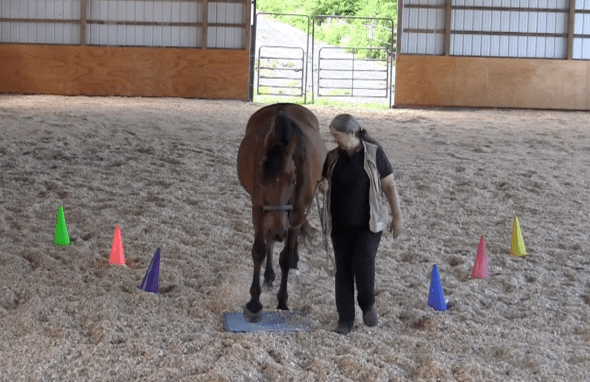
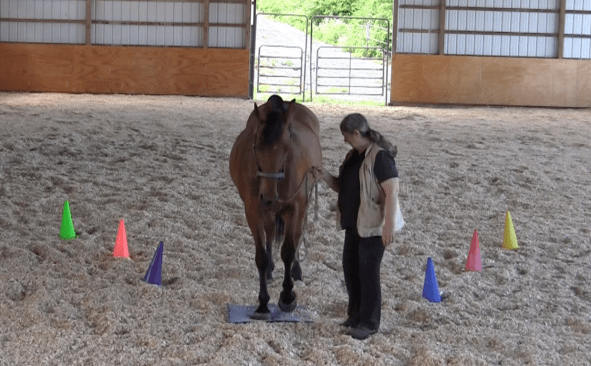
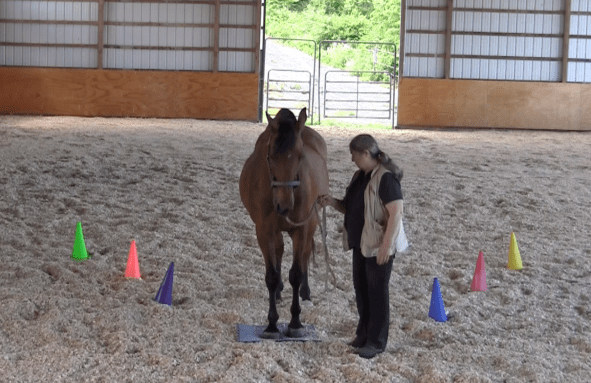
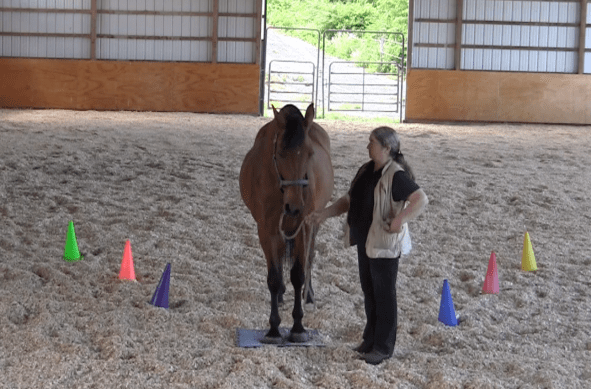
I want to turn the mat into a conditioned reinforcer.  If it becomes a predictor of good things, my horse will want to go to the mat.  He’ll enjoy being on the mat.  That means I’ll be able to reinforce other activities with an opportunity to return to the mat.  So before we head back to the top of the runway, I cue Robin to give me a very familiar behavior, one I call: “the grown-ups are talking, please don’t interrupt”.  Than means Robin is standing in his own space.  My pockets are full of treats, but I am not being mugged.  Robin adds the extra flourish of his beautifully calm focus and good balance to this important base behavior.


Robin Runway feed 2016-06-18 at 6.08.37 PM

It’s click then feed for beautiful grown-ups, and then . . .

Robin Runway invite walk off 2016-06-18 at 6.09.44 PM

I invite Robin to leave the mat and walk off casually with me back to the top of the runway.

My green horse has also been standing beside me practicing good grown-ups.  It’s time to walk off again and head back to the top of the runway.  This time our entry into the V comes out perfectly.  Click!  That brings him to a halt so he can get his treat.  I don’t have to actively stop him, cues he may not yet understand.  That’s what the runway is going to teach him – whoa and go.   As I give him his treat, I am deciding which colour thread to pick up, meaning should I ask him to go forward or back?  I may decide to ask for a couple of green stitches, and then I’ll switch to red.  It all depends upon the response I get from my “co-pilot” and where we are in the runway.

As my co-pilot becomes steadier and better balanced, we can work on an intricate pattern – one stitch forward, one stitch back, each one separated by a click and a treat.  We are building control – not the force-based control of do-it-or-else, but the self-control of good balance.  He is gaining the ability to change his balance – forward or back within a single stride.  He doesn’t have to barge past me any more because he can regulate both his emotions and his balance.


Screen Shot 2016-06-18 at 6.57.51 PM

So far I’ve asked Robin for a lot of backing.  I need to balance that with requests to go forward – but remember, in the “needlepoint” phase of this pattern I am asking for only one step at a time.


Screen Shot 2016-06-18 at 6.58.15 PM

As soon as he begins to initiate a step, it’s click . . .


Screen Shot 2016-06-18 at 6.58.31 PM

. . . release the lead and begin the reinforcement process.

Screen Shot 2016-06-18 at 6.58.41 PM

Again note how my right hand moves towards Robin releasing the lead fully to him.  I have pointed this out before because it is a detail many find very difficult to coordinate.  Their focus is on getting the food.  It takes focused practice to coordinate the separate tasks both hands are doing. (https://theclickercenterblog.com/2014/11/16)


Screen Shot 2016-06-18 at 6.58.59 PM

Many people push against the use of food during training, but clicker trainers have such an advantage because we feed treats.  In this photo series you’ve seen how I can use the food delivery to help my horse become better balanced.  Here I’ve drawn Robin slightly forward with my food delivery.  This sets me up well to be able to turn into him to ask for my next request – backing.


Screen Shot 2016-06-18 at 6.59.18 PM

As he begins to lift his left front foot, I am ready to click and release the lead.

Screen Shot 2016-06-18 at 6.59.44 PM

Again, my right hand moves towards Robin to release the lead AS my left hand gets the food.

Screen Shot 2016-06-18 at 6.59.58 PM

Even as he is taking the food from my hand, I am setting up my next request.  Can you tell which direction we’ll be heading?  Forward or back?

Screen Shot 2016-06-18 at 7.00.19 PM

As soon as I’ve given him his treat, I release him to the mat.  Note: this release to the mat is an important element.  I don’t ask him to keep doing “needlepoint” all the way to the mat.  I want to reinforce the concentrated work with an opportunity to move forward freely.  The mat gives us a destination that offers even more reinforcement opportunities.

Give Them What They Want
For the horse who prefers nothing better than to nap under a tree, all this slow, step by step work is easy-peasy.  It’s all that walking forward stuff to get to the top of the runway that this horse finds wearisome.  So what this game sets up is a bargain.  I’ll let him get all these easy clicks and treats for walking one step at a time provided he will walk with me when I ask him to head back to the top of the runway.

Remember the Premack principle from the previous article? (https://theclickercenterblog/2016/06/09) I’m reinforcing a lower valued behavior – marching on around the outside of my pattern – with a higher valued behavior – getting loads of clicks and treats for taking one small, low energy step after another followed by a chance to stand still at the mat.  What could be better!

For the high-energy, foot moving, impatient horse Premack also works.  I’m saying to this horse: if you will indulge me by giving me a couple of needlepoint stitches, I will not only make it worth your while by clicking and treating each one (thereby upping their value), I will also let you march forward down the rest of the runway.  And if you will further indulge me by standing still on the mat where again I pay really well, I will let you march on, uninterrupted back to the top of the mat.

In both cases the Premack principle is at work.  And in both cases I am turning all the segments of the loop into activities that gain value.  Pretty soon, my slow-moving horse will be looking forward to the march back to the top of the runway, and my impatient horse will be showing me how softly and with such delicate control he can creep down the runway.

Stopping on Mats
For my inexperienced horse it’s time for the game to change again.  I’m going to start using the skills he’s been learning in the runway.
When we get to the mat, instead of stopping so my feet are on the mat, now I’ll change course slightly in the runway so the mat is in line with my horse.  If he steps over it the first time or two so his feet never touch it, that’s all right.  We aren’t yet ready to land.  But eventually, on one of the passes, I’ll do a test run.  As we approach the mat, I’ll rotate slightly towards him as I slide up the lead.  I’m indicating that we will be stopping.  Our needle point has taught him how to listen to these signals.  He’ll stop with his front feet just shy of the mat.  Click and treat.

Here is Robin again showing us how much control and refinement the runway can help us build into leading:


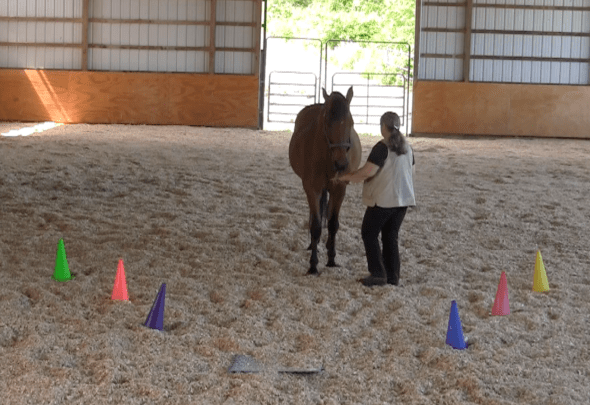
Robin Runway walk to runway 2016-06-18 at 6.16.26 PM

I’ve released Robin to the mat.  Note the slack in the lead.  There’s no pulling to the mat, no forging ahead of me.  We are walking together towards the mat.  Exactly right.

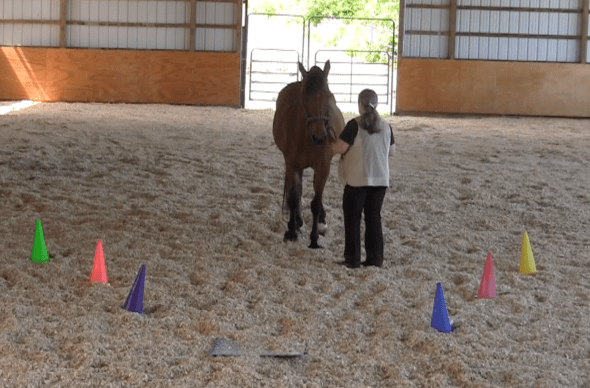
Robin Runway stop before mat 2016-06-18 at 6.16.40 PM

I’ve brought Robin up to the mat, but I am deliberately asking him to stop just shy of it.

Robin Runway stop before mat 2 2016-06-18 at 6.16.50 PM

Frame 1: His front end stops beautifully, but . . .

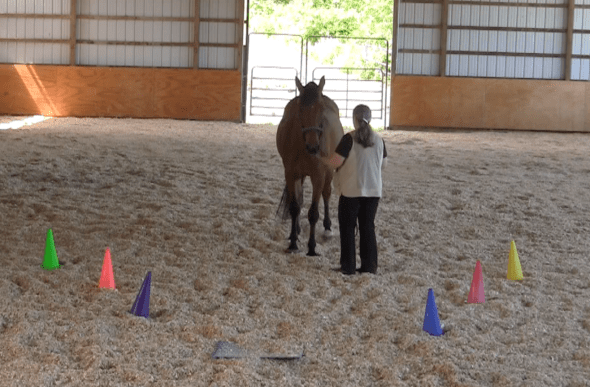
Robin Runway stop before mat hind leg out2016-06-18 at 6.17.20 PM

Frame 2: Robin wasn’t expecting to stop before the mat.  His front end stopped in response to my request, but his hind end took an extra moment to catch up to the change in the pattern.  It’s a bit like a rear end collision at a traffic light.  The first car stopped, but the second one didn’t.  The result: Robin has stepped out to the side with his right hind.  He could have plowed past me to continue on to the mat, but instead he has managed to stop his front end in response to my request.  It’s only his back end that couldn’t quite stop in time.

Robin Runway stop before mat click2016-06-18 at 6.17.32 PM

He may have landed slightly out of balance, but he still responded perfectly to my request to stop his right front and then his left front foot, so he gets clicked.  That’s my cue to begin the reinforcement process. I surprised him with a sudden change in pattern.  That resulted in less than perfect balance in the stop, but he still gets reinforced for a correct response to my cues.

Robin Runway stop before mat feed 2016-06-18 at 6.17.47 PM

Feed so his head stays lined up with the rest of his body.

Robin runway ask to step on mat 1 2016-06-18 at 6.18.09 PM

Now I’ll use his “needlepoint” skills to bring him the rest of the way onto the mat. That was the point of my abrupt halt.  I wanted  to create an opportunity to show you how these skills work.

Robin Runway ask to step on mat 2 2016-06-18 at 6.18.26 PM

Robin responds to very light cues on the lead.  A very small change in my hand position is  all that is needed to request a single, forward step with the right front.

Robin Runway ask to step on mat 3 2016-06-18 at 6.18.33 PM

Job done with the right front.

Robin Runway ask to step on mat 4 2016-06-18 at 6.18.43 PM

Now I ask for one step forward with the left front.

Robin Runway ask to step on mat 52016-06-18 at 6.18.54 PM

Job done again. With a very inexperienced horse I would have clicked and reinforced each footfall.  With Robin I can connect these requests together via cues.  Cues act as both prompts and reinforcers.  I am only clicking after he has both feet on the mat, but I am still giving him plenty of “yes” information via the cues from the lead.  Those cues contain an additional “yes” every time I release the lead. 

Robin Runway ask to step on mat feed 2016-06-18 at 6.19.10 PM

I’ve clicked so now it’s time to feed.


Robin Runway ask to step on mat grups 2016-06-18 at 6.19.26 PM

I’ll further reinforce his good efforts to get on the mat by asking for “grown-ups”, a well known and highly reinforced behavior.  Note how beautifully he maintains his balance, and his very calm, focused demeanor even though he is just inches away from the treats in my pockets.

Robin Runway back off mat 1 2016-06-18 at 6.20.14 PM

I continue to use his “needlepoint skills” to ask him to take one step back off the mat.

Robin Runway back off mat 2  2016-06-18 at 6.20.29 PM

Once he’s stepped back off the mat, I can ask him to come forward again. An inexperienced horse might become frustrated by all this toing and froing.  He might be wanting me to make up my mind and decide which way I want him to go.  But the “needlepoint” lesson in the runway has familiarized Robin with this type of request.  They are just a series of changing dance steps.  They were never taught as corrections.  I want him to see them as a path towards reinforcement – never as a way to avoid punishment.

Robin Runway return to mat 1 mat  2016-06-18 at 6.20.53 PM

His front feet are back on the mat.  Now I’m asking him to step up with his left hind. Click as the leg begins to lift.

Robin Runway return to mat release hand 2016-06-18 at 6.21.09 PM

Again the reminder to release with right hand as well as the left.

Robin Runway return to mat feed 2016-06-18 at 6.21.26 PM

Feed for a job well done.

Robin Runway return to mat grups 2016-06-18 at 6.21.41 PM

Ask for grown-ups to create added value for landing on the mat.  Why go through all of this? Compare this photo with the one taken just moments before I asked Robin to step off the mat. 

Robin grups comaprison 2016-06-19 at 3.26.11 PM

In both photos Robin is in grown-ups.  He’s showing the calm focus and good balance that has been consistent throughout this session.  But in the photo on the right Robin shows slightly more lift from the base of his neck.  The difference is subtle, but it is there.  It was created out of the rebalancing steps he took to back off and then, weight shift by weight shift, return to the mat.  The control he has over his footfalls leads to the consistency we see throughout this lesson in his balance.

These photos were all pulled from a video.  Now that we’ve gone through the details of this lesson, let’s have you watch the video again.  How many of the photos you’ve been studying can you spot?  They are just still frames taken from the video.  How much more detail are you seeing now than you did when you  watched this video the first time through at the beginning of the article?  How many of the points that I covered are you spotting?  I’ll bet you’re seeing the very deliberate release of my right hand and the use of the food delivery to help build good balance.  What else pops out at you now that I’ve been pointing out the details of this lesson?

Constructional Training
For the inexperienced horse, as well as for Robin, the work in the runway builds the skills that are needed for the mat.  That’s the strength of this approach.  I haven’t started with the mat where a horse’s concern over stepping on an unknown surface might create problems.  The focus of this lesson is to teach the horse to step on the mat, but that isn’t my end goal.  The mat is a tool. Stepping on the mat is a way to get that energetic walk and those “needle point” skills that I’ll be using elsewhere in his training.  And once my horse is comfortable with the mat, I can use it throughout his training as a reinforcer.

When I first introduced my horse to the overall game which we call clicker training, I had to deal with the food.  It started out as a distraction.  I held a target up for my horse to touch –  which he did, eagerly enough.  His curiosity served me well.  Click and treat.  Treat!  You have food in your pockets.  Never mind the target, I’ll have more of those!

The initial stages of clicker training are really a teaching process that transforms the food from a distraction into a useful tool.  Once my horse understands that he gets the treats by taking his focus off my pockets and offering instead other behaviors that I like, then the game can really expand.  It truly does become a game, a treasure hunt where solving the puzzle becomes even more reinforcing than the treat itself.

The mat works in a similar way.  At first it is something to be avoided – stepped over or around, but never actually on.  Then it becomes something to put a tentative, testing toe on.  Clicks and treats!  This isn’t so bad.  What was all the fuss about!

Pretty soon you’ll have a horse who isn’t just stepping gingerly onto the mat, he’s rushing down the runway to get to it.  Hurray!

Coming Next: Mat Manners. For every exercise you teach there is an opposite exercise you must teach to keep things in balance.  The mat lesson helps you understand the importance of this statement.  The runway lesson has helped create a horse who is eager to get to the mat.  Now you need to explain that you’d like him to walk with you to the mat.


Remember, if you are new to the JOY Full Horse blog, click on the JOY Full Horses tab at the top of this page to find the full table of contents and links to each of the articles I have published so far.

I hope you will want to share these articles by sending links to this blog to your friends.  But please remember this is copyrighted material.  All rights are reserved. Please do not copy any of the “Joyful Horses” articles without first getting written permission from Alexandra  Kurland, via theclickercenter.com

Also note: these articles are not intended as an instruction guide for introducing your horse to clicker training.  If you are new to clicker training and you are looking for how-to instructions, you will find what you need at my web sites:

theclickercenter.com                    theclickercentercourse.com


JOYFull Horses: Chapter 3: The Time Has Come . . .

The Time Has Come the Walrus Said To Talk of Many Things

“The time has come,” the walrus said,
“To talk of many things:
Of shoes and ships and sealing-wax
Of cabbages and kings
And why the sea is boiling hot
And whether pigs have wings.”
Lewis Carroll – Through the Looking Glass

In Chapter One of this section I shared some examples of how the environment can cue behavior.  Panda, the mini I trained to be a guide, provided us with many examples of environmental cues.  In the previous Chapter I showed how a combination of mats and strategic food delivery can be used to teach basic leading.

We’ll be building on that lesson is this next unit. Which means the time has come to talk about Premack, Feldenkrais work, asking questions, mats, airplane runways, needlepoint, and creativity.  If you’re not sure what some of these mean or what the link is between them, read on.  And yes, we will be getting back to play and our list of ten things a beginner needs to know about cues, but first let’s set the stage with a discussion of the Premack Principle.

Behaviors as Reinforcers
One of the things that quickly becomes apparent when you start turning training into play is how quickly the behaviors you teach your horse can be turned around and used as reinforcers for other things.

This is not a new understanding. In the late 1950s primatologist, David Premack developed his relativity theory of reinforcement which is better know as the Premack Principle.  Simply put this means that a higher valued, more probable behavior can be used to reinforce a lesser valued, less probable behavior.

If you hate to sweep your barn aisle, but love to ride, don’t put sweeping after riding.  Let riding serve as a reinforcer for sweeping up.  When you finish grooming and reach for the broom before you reach for your hard hat, that puts you on a habit path that’s going to culminate not just in a great ride, but also in a love for barn chores. Clicks for you!

That’s something I discovered when I changed the sequence in which I did my barn chores.  I’ve always disliked sweeping.  When I was boarding my horses, it never made any sense to me that we were sweeping the barn aisle last thing at night.  The only person who was going to see our beautifully swept aisle was the morning stall cleaner, and she was going to begin the day by making a mess.

It would have been much better to sweep up when we first arrived so we could enjoy the clean aisle all evening, but that wasn’t how things were done.  In my own barn I sweep the aisle first and then follow that with cleaning the stalls and paddocks – something I enjoy.  After the barn chores are done, I get to play with the horses.  The result?  I now look forward to sweeping the aisle. It’s a great way to begin my day.

Panda helping me sweep 3

Panda is “helping” me sweep my barn aisle during a visit to the barn.

The same kind of sequencing becomes important when you train your horse.  Think about the order in which you ask for things.  If you’ve taught a behavior well, it can serve as a reinforcer for a newer behavior you’re working on.  Ideally every behavior you add into your training loops should function as a reinforcer for all the other behaviors.  The result: every behavior you ask for will become something your horse enjoys doing.

That’s ideally.  How can you make that a reality for the behaviors you teach your horses?

Turning Mats Into Tractor Beams
For a horse who likes to be actively doing something, what could be more tedious than standing on a mat?  And yet, that’s definitely not how our eager clicker horses view mats.

Mats become like tractor beams drawing the horse in.  They are where good things happen.  You get treats on a mat.  You get lots of attention.  And when you leave one mat, you get to head off to another.  More treats!  Yeah!!

Harrison on mat hug cropped

Mats are where good things happen.

If I teach mats well, they are a source of play not tedium. When I am first teaching mats, I keep the Premack principle very much in mind.  Most horses initially view a mat as something to avoid.  They will step over it, around it, slam on the brakes in front of it, anything but actually step on it.

I’ve taught mats in lots of different ways.  You can freeshape stepping on a mat, but I prefer to put the horse on a lead and turn this into a more directed-learning process.  The reason I do this is because it’s a great opportunity for the horse and handler to become more familiar with good rope handling techniques.

In the horse world the lead is often used as an enforcement tool.  “Do what I say – or else!” If a horse pushes past the handler, the lead is there to give him a quick reprimand.  The handler jerks the lead so the horse feels a sharp bump from the halter.

If a horse doesn’t back fast enough, he knows the lead will be there again swinging threateningly in his face.

That kind of expectation is not clicker compatible.  We need to take the “do it or else” threat out of the lead.  The lead is there to ask questions – not to tell or demand.

What does this mean – the lead is there to ask questions?  One of the best ways to describe this came from a youtube video clip of Mia Segal.  Segal is a Feldenkrais practitioner.  Developed by Moshe Feldenkrais in the mid-1900s Feldenkrais work eases pain or restrictions to movement by increasing an individual’s awareness of small movements.

Feldenkrais Work
Unlike a massage and other manipulative therapies, Feldenkrais work is experienced through self-observation.  You learn how to move with attention.  You become aware of how you move; what parts of your body you mobilize to create an intended movement; how far the movement flows through your body; where it stops; where it is blocked; and what can be released to extend the movement.  It is an exploration of movement in which an individual is guided via questions towards greater self-awareness and well being.

The expression “Where there is no fear or pain, learning can take place in a single lesson.” lies at the core of this training.  Like many in the horse world I was first introduced to Feldenkrais work via Linda Tellington-Jones.  Her TTEAM training evolved out of this work.  Later I was fortunate to have a client who was an Alexander Practitioner and who had also studied the Feldenkrais work.  We did trades, sharing back and forth the new things we were exploring. Through her I learned even more about the art of asking questions.

Asking Questions
Recently a friend sent me a link to a youtube clip of Mia Segal teaching a workshop  (https://www.youtube.com/watch?v=prGxrhXDEgQ).  My friend said it reminded her a lot of my work.  As I watched it, I thought, she’s right.  Mia Segal might have been talking about working with people, but she was describing perfectly my approach to horse training.  Segal was sitting on the floor with one of the workshop participants.  She was clearly in the middle of a session.  Her student was lying on her back, knees up in the air, with Segal comfortably supporting her head in her hands.

Segal was talking about the first time she saw Moshe Feldenkrais working.  It was 1957.  After the session he asked her if she had any questions.  She had so many, but she knew there were other people waiting.  How could he have time for all of her questions?

Feldenkrais answered her – “If you know the question – it will take but a minute.”

The art of training is knowing the questions to ask.  That is as true for our horses as it is for people.

Segal went on to say:

Someone recently asked the question: ‘What is the difference between this work and pilates, yoga, and other physical therapies. Isn’t it all the same?  So you have another method.’  And I thought the biggest difference is this is a method of questions. I don’t have answers, and I don’t want answers.

You ask a person to move in a certain way.  Bend your knees to the right and you ask – ‘How is she doing it?  Is it anything to do with what I feel under my hands?’

How do I feel it in my hands?  How is she coming back?  Does this change anything under my hands?  And do it to the other side – How is she doing it, and does this feel different?

So rather than thinking – Here it stops.  Here it goes.  Instead I just keep putting a little question mark at the end.  HOW does it go?  HOW does it stop?  WHERE does it stop?  WHEN does it stop?  Is it the same on both sides?  And then I have the whole lesson.”

The Translation to Horses
When I slide down a lead to a point of contact, I am listening through my hands.  And I am asking questions.

Merenaro with alex

This horse and I are deep in conversation.  I am asking many questions through my hands.

When I meet horses for the first time, most aren’t used to being asked anything.  They expect to be ordered about.  Some horses are very compliant.  They have learned that the best way to stay out of trouble is to do what they’re told.  They will follow the feel of a rope.  They will be responsive, and light in your hands. They may even seem happy or at least content.

Light we can measure in terms of how much pressure we need to apply to get a response; how quickly the horse responds; how much weight we feel in the rope as he moves.  Does he move with us, or does he hang back leaving pressure on the lead?  These are all measurable.

But happy.  Who knows. How do I know if you or anyone else is happy?

The “Black Box” of Emotions
How do I know if another person is happy?  I may see behaviors that I associate with times when I have felt happy, but I don’t really know how anyone else feels.  When you say you love your horse, I believe you.  But what does that really mean?  If you tell me you love your horse, but then you sell him so you can buy another horse who jumps higher, I have to believe that that word means something very different to you than it does to me.

So I can say that a horse is responsive – that’s measurable.  I can describe other behaviors that I like to see – his ears are relaxed so they flop back and forth in time with his walk.   Or I might see the opposite.  He has his ears pinned flat, he’s grinding his teeth, and the muscles around his eyes are tight.  These behaviors tell a different story.  I wouldn’t say that’s a horse who is happy.

The Lead Tells A Story
Often when I first attach a lead to a horse, what I encounter is resistance and concern.  Leads have been used for corrections – so the horse is defensive.  He may throw his head up as I slide down the lead, or punch my hand with his mouth.  He might even bite at the lead or at me.  He’s telling me about his history, and I need to listen.  I also need to respond in a way that doesn’t prove to him that he was right to be guarded.

The mats are going to help me.  I was about to add the phrase: get past his defenses, but that’s not exactly right.  That would imply that the castle walls are still there, and all I’ve done is found a way to scale them.

castle walls 1.png

Instead, I want to show him that the castle walls, the moat with the sharks, the draw bridge, the boiling oil, the iron portcullis, and all the armored men lined up behind it aren’t necessary.  They can all vanish, whisked away not through force, but through play.  In the next installment I’ll describe a lesson that replaces castle walls with airplane runways, and you’ll see how the Premack Principle can be applied to training loops.

Coming next: The Runway

Remember, if you are new to the JOY Full Horse blog, click on the JOY Full Horses tab at the top of this page to find the full table of contents and links to each of the articles I have published so far.

I hope you will want to share these articles by sending links to this blog to your friends.  But please remember this is copyrighted material.  All rights are reserved. Please do not copy any of the “Joyful Horses” articles without first getting written permission from Alexandra  Kurland, via theclickercenter.com

Also note: these articles are not intended as an instruction guide for introducing your horse to clicker training.  If you are new to clicker training and you are looking for how-to instructions, you will find what you need at my web sites:

theclickercenter.com                    theclickercentercourse.com


JOYFull Horses: Using Environmental Cues

Using Environmental Cues

Spring is clinic season which means a lot of traveling for me.  I haven’t been able to post anything since the beginning of April which also means some of you may have lost track of where we are in the book.  At the end of Part One I asked the question: what are ten things you would want a novice trainer to know about cues?  In Part Two I began to answer that question.  So far my list includes:

1.) Cues are not Commands.

2.) Cues can be non-verbal.

3.) The environment can be a cue. 

In the first chapter of this section on environmental cues I shared some stories about Panda, the miniature horse I trained to be a guide.  Her work illustrates well the many ways in which the environment can cue behavior.  

IMG_1994_1 Panda Ann great walk

Now in this post I’ll be looking at ways we can all use environmental cues in our training.

Every Day Environmental Cues
Panda’s training shows how much inanimate objects can cue behavior.  You may never ask your horse for the kind of work that is expected of a guide, but you can still make effective use of environmental cues.  They can help turn a frustrating or even dangerous situation into play.

Here are a few examples:

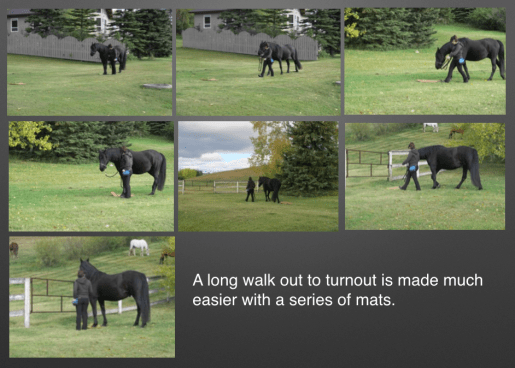
For a horse who rushes out to turnout – even to the point of rearing if you try to slow him down – teach him to stand on a mat.  Then put out a series of mats on his way out to turnout.  Now instead of trying to keep things calm over the long stretch to turnout, all he has to do is walk a couple steps to the next mat – click and treat!  Turn each mat into a station where he can engage in some favorite game.  That takes the focus off the turnout.  In fact when you do finally get to the paddock, you may find your horse doesn’t want you to leave.

“Must I go eat grass?  This is so much more fun!”

Shannon mat series

For the barn-sour, herd-bound horse who doesn’t want to leave the comfort zone of his friends, hang targets at strategic points around the barnyard and along the driveway.  Click and reinforce him for walking to the target.

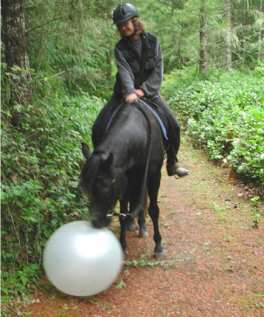
For the horse who worries out on trails, take his toys out with him so he can play familiar games.

Magic with ball
Combine mats with a circle of cones to teach a horse how to trot around a circle.  Lay out a small circle made up of cones and one mat.  Your horse will begin on the mat and end up back at the mat – click and treat.  As you gradually expand the circle, he’ll understand that his job is to stay out around the the outside of the cones.

https://youtu.be/6xHIieQ7gxY


For the horse who fidgets and fusses to be groomed, hang a stationary target or give him a mat to stand on.

https://youtu.be/1noFMolXmzc

Mounting blocks become wonderful environmental cues.  Teach your horse to bring himself over to your mounting block and line himself up so it is easy to get on.  It’s not only a fun behavior to “show off”, it’s also a great way to measure how ready – or not – he is to ride.

https://youtu.be/L4ITL96J9Os

(Note: This video features Michaela Hempen, one of my coaches for the on-line course.  I almost didn’t use this video because she wasn’t wearing a hard hat. When I mentioned it to her, she said she normally wears a hard hat.  She just couldn’t resist getting on.  I decided to use the clip after all because it is a great example of the joy this training brings to both horses and handlers.  And it also gives me an opportunity to say safety always comes first.  Certainly good preparation contributes to safety, but hard hats are still important.)

These are just a few training suggestions.   The more creative you are, the more playful you can be with your horse.

When you have a training challenge, instead of tackling it head on with your normal “horse training” solutions, think instead about how you might use props.  If your horse has trouble turning to move out of your space, how could you use mats to help with this?

Maybe you have large cones or temporary fence posts that can be used like gates on a slalom course.  How could you use them to explain the patterns you want to your horse?

If forward is an issue, teach him to retrieve, and then toss a cone out in front of his path.

If stopping is the problem, set out lots of mats.  Give him a positive reason to stop.  That’s a lot better than the “horse training” solutions of harsher bits and running horses into fences.

If you want your horse to get more exercise, but for some reason you can’t ride, use targets to teach your horse to go from person to person.  This can easily be turned into a game Panda would say she invented and which we named after her: “Panda catch”.  She “taught” us this game when she was a yearling.  At thirteen she plays it with every bit as much gusto as she did then.

https://youtu.be/hbrKliBt72U


As you can see from this article, teaching your horse to stand quietly on a mat has many uses.  What I haven’t included here are the how-to instructions for introducing your horse to mats.  You can find detailed instructions for teaching this lesson in my books and DVDs and in my on-line course.  Visit my web sites to learn more:

 theclickercenter.com                    theclickercentercourse.com

Remember, if you are new to the JOY Full Horse blog, click on the JOY Full Horses tab at the top of this page to find the full table of contents and links to each of the articles I have published so far.

I hope you will want to share these articles by sending links to this blog to your friends.  But please remember this is copyrighted material.  All rights are reserved. Please do not copy any of the “Joyful Horses” articles without first getting written permission from Alexandra  Kurland, via theclickercenter.com

Also note: these articles are not intended as an instruction guide for introducing your horse to clicker training.  If you are new to clicker training and you are looking for how-to instructions, you will find what you need at my web sites:

 theclickercenter.com                    theclickercentercourse.com

JOY Full Horses: Pt. 1 Ch. 6: Being PLAY Full

Play Full
The dictionary would tell me that I should write this as playful.  But just as Panksepp wants to emphasize that when he writes PLAY in capitals he is speaking of one of the seven fundamental affective systems, I want to remind you that playful means we are full of play.

The six properties of PLAY which I wrote about in the previous section remind us why being PLAY FULL with our horses is important.  Being full of play helps us find creative solutions to training problems.  It keeps us in a relaxed mental state that makes it easy to reach for the positive solutions instead fear-based corrections.  Play creates a safety net for our horses.  Especially when you are working with difficult or potentially dangerous situations, being in a play state helps you find horse-friendly solutions.

Playing with Horses
But how do you play with a horse?  After all safety always comes first. I can’t play with the Icelandics in the same way that they play with one another.

sindri Fengur rough play

Horses at play

At a recent clinic I was sitting in the host’s living room. Her three dogs were having a rough and tumble play session.  It looked for all the world like a miniature version of the Iceys.  There were the same mock bites, the same leaps up into the air.

My host walked boldly through this maelstrom bringing me a cup of tea!  If they had miscalculated and bumped her leg, the worst that would have happened was the tea would have been spilled on her carpet.

Cindy with her dogs

Dogs at play

If the Iceys miscalculate, I could end up in a full-body cast. So what is the answer? How can I safely play with my horses?

Playing with Behavior
Without a great deal of skill and experience, I may not be able to engage with my horses via their natural play behaviors, but I can play via the behaviors that I teach them.  That’s the beauty of clicker training.  If I am in a state of play as I teach new behaviors to my horses, they will turn those behaviors around and use them as a way to play with me.

Even seemingly hard behaviors can function in this way.  Playing a Beethoven concerto can seem like either an onerous task imposed by your teachers or the greatest joy in your life.

How a behavior is perceived is more important than what it is. Our senior horse Magnat loved to piaffe.  Give him the least hint that piaffe might be on the table, and he would be offering it with gusto.  He also loved to retrieve.  At the start of a training session in the arena, he would insist on being turned loose so he could retrieve any dropped objects that might have been left in the arena by others.

Magnat belonged to Ann Edie.  Ann is blind.  Many know her through her other horse, Panda, the mini she uses as her guide.

Panda great walk

It may look like a casual walk, but Panda is guiding her blind handler.

For years Ann and I boarded our horse together in a large lesson barn.  The Iceys and Magnat belong to her.

Playing with Play
Because Ann is blind, it was very useful to her to let Magnat clean up the arena at the start of every session.  She was handed gloves, riding crops, Kleenex, cones.  If there was nothing else to retrieve, he even brought her larger than normal pieces of the shavings that made up the arena footing.

Piaffe and retrieving are two very different kinds of behaviors.  Retrieving was taught in an afternoon.  Piaffe took many months of structured work, but for Magnat they were clearly both regarded as play.  They were taught with laughter and they brought laughter.

CTFYH cover with caption1

Coming next: Part 1: Chapter 7: Training Playfully Mixed with a Little Science

I hope you will want to share these articles by sending links to this blog to your friends.  But please remember this is copyrighted material.  All rights are reserved. Please do not copy any of the “Joyful Horses” articles without first getting written permission from Alexandra  Kurland, via theclickercenter.com

Also note: these articles are not intended as an instruction guide for introducing your horse to clicker training.  If you are new to clicker training and you are looking for how-to instructions, you will find what you need at my web sites:

theclickercenter.com                    theclickercentercourse.com

JOY Full Horses: Part 1: Why Play?

Joy Full Horses title page coverI’ve teased you with an introduction to this book, and with the Table of Contents.  Now finally here is Part 1: Why Play!

This is a short section – just to get your feet wet.  Enjoy!


blue bar

Part One: Why Play?

Panda scrabble - leaning against me

When science and art come together,
they become indistinguishable from play.

blue bar

Chapter 1: Mammals Play

Fengur Sindri rearing 5:19:13


Airplane Reading
When you travel by plane as often as I do, you begin to know all the major airports in the country.  I can tell you which ones have free internet access and electrical outlets at your seat, and which ones force you to sit on the floor to recharge your computer.  I can tell you which airports have decent food and which ones assume that the entire traveling public wants to eat junk food.  I can also tell you where all the good bookstores are.  I enjoy browsing through airport bookstores.  Instead of feeling overwhelmed by an overabundance of choice in the mega bookstores, the airport bookstores are confined to cubbyhole spaces.  They give you just a small sampling of what is current and popular.

What I want for traveling is what I call airplane reading – nothing too heavy.  I mean that both physically – I may have a long walk between gates and my backpack is already weighed down with my computer and camera equipment.  And I also want something that’s light enough reading to let me dip in and out as I nap on the plane.

I often check out the business and science sections where I’ll find titles that might not otherwise have crossed my radar.  That’s how I spotted a book on play, called appropriately enough “Play”.  For a long time, whenever I referred to this book, I could never remember the author’s name.  I finally tracked down my copy for the express purpose of being able to reference the author in a talk I was preparing.  It was written by Stuart Brown.

Stuart Brown. How was I going to remember that?

Stuart is easy.  Stuart is Stuart Little from E.B. White’s charming children’s book.  And if we are thinking about children’s books, then, of course, we have Paddington Bear, and that gives you the author’s name. Not sure of the connection?  Paddington Bear lived with the Browns.  Hence Stuart Brown.

That’s a playful way to remember the author of a book on Play.

Stuart Brown book covers

Why Do Animals Play?
Stuart Brown is an M.D. who has studied play.  In his book he posed an interesting question.  Play carries with it enormous metabolic costs and genetic risks.  Two horses playing mock stallion battles are not only expending a great deal of energy, they are exposing themselves to possible injury.  In the wild if they miscalculate and one of them is injured, that horse could very quickly be out of the gene pool.  So given this, why is play so prevalent?  It’s not just people and puppies who play.  You’ll find play behavior across all species of mammals.

aa Iceys play in snow 3 pictures caption

It’s not my intention here to give a detailed review of Brown’s book.  The main point he was making is that regardless of the evolutionary forces that led to the prevalence of play, what we are left with is this conclusion: play is important for the development of healthy brains.

When you compare brain scans of individuals who have been play deprived with those who are living in enriched environments with many opportunities for play, you see a marked difference.  Should you wish to, I’ll leave it to you to explore this in more detail.  You can begin with the lighter read of Brown’s book and then move on to the work of neuroscientist and play specialist, Jaak Panksepp.  And if you want even more, their books will give you plenty of additional references to explore.

The launching point for what I’ll be covering is this basic premise: play is important for healthy brains.  That means it is important for our horses, and, equally, it is important for us.  As I explore what play means in the context of training, I will be focusing my attention on both ends of the lead rope. I’ll be looking at what it means for both the horse and the handler to be engaging in play.

aa crackers basketball

blue bar

Part 1: Chapter 2:  Animal Emotions

aa crackers hit ball

Bob Viviano and Crackers – Great partners who knew how to play and to share their connection with others.

Is Your Training Fun?
When we think about clicker training, we often think about play.  After all, we’re often using clicker training to teach some very playful behaviors.  But just because you are having your horse kick a beach ball, doesn’t necessarily mean either one of you is having fun.  If you’re so caught up in the science behind the training, if you’re thinking about what the discriminative stimulus is for kicking the ball and whether you should be using a least reinforcing stimulus after that last miss, your brain may be processing the interaction in a way that’s a long way away from play.

If you’re concentrating on your handling skills, if you’re thinking about the timing of your click, and whether your hand is staying out of the treat pouch between clicks, again you may be a long way away from play.  It’s easy to get so caught up in “getting things right” that play drops out of the equation.  The function of these articles is to remind you that we need to keep bringing play back to the forefront of our training.

I mentioned Jaak Panksepp earlier.  His work is getting a great deal of attention at the moment within the clicker community.  Karen Pryor gets the credit for this.  Karen Pryor is one of the very early pioneers in clicker training.  Her book, “Don’t Shoot the Dog” has introduced thousands of people to this modern form of animal training.  Karen wanted to know what the neuroscientists could tell us about how the click is processed in the brain. In her book, “Reaching the Animal Mind” she talked about the SEEKER system, one of the seven primary emotional states Panksepp has identified.  It is the SEEKER system that Pryor attributes to the enthusiasm and – dare I say it – joy we see in our clicker-trained animals.

Animal Wise
Panksepp has been studying what was once a forbidden area in science – emotions in animals.  Here’s another “airplane” book I’ll recommend, Animal Wise by Virginia Morell.  Morrell begins her book with the following:

“Animals have minds.  They have brains, and use them, as we do: for experiencing the world, for thinking and feeling, and for solving the problems of life every creature faces.  Like us, they have personalities, moods, and emotions; they laugh and they play.  Some show grief and empathy and are self-aware and very likely conscious of their actions and intents.

Not so long ago, I would have hedged these statement, because the prevailing notion held that animals are more like robotic machines, capable of responding with only simple, reflexive behaviors.  And indeed there are still researchers who insist that animals are moving through life like the half dead, but those researchers are so 1950s. They’ve been left behind as a flood of new research from biologists, animal behaviorists, evolutionary and ecological biologists, comparative psychologists, cognitive ethologists, and neuroscientists sweeps away old ideas that block the exploration of animal minds.  The question is now not “Do animals think?”  It’s “How and what do they think?”

Hurray!  Finally people are coming around to my view of animals as intelligent, very aware beings with rich emotional lives.  I know this goes against strong cultural biases.  But where did this notion that animals do not think come from?  Why do scientists have such a horror of being accused of being anthropomorphic (attributing human mental abilities to an animal)? How can we deny the evidence we see in every interaction we have with our horses, with our cats and dogs?

Outdated Belief Systems
Morrell points out in her introduction that this idea that animals do not think or have emotions as we know them is an old one. Aristotle did not believe that animals could think rationally, but he did at least grant that they experienced physical sensations such as hunger and pain, and they could be angry.

It turns out that Aristotle represented an “enlightened” view of animals – even with all of it’s limitations.   Later philosophers denied that “animals had any thoughts, emotions, or sensations and therefore we did not need to extend any moral consideration to them.” (Morrell)

Belief systems are a curious thing.  There’s that wonderful line that crops up during political discussions: you wouldn’t want a little thing like facts to get in the way of a good argument.  It applies here, as well. Belief systems become self supporting.  We tend to attract experiences that support our belief systems.  I find it beyond comprehension that anyone could deny the emotionally rich life that animals have.  You have only to sit on a panicked horse who has been separated from his herd to know very directly the emotions he’s feeling!

But I suppose there will be those who would say I’m just delusional.  I’m the one attracting evidence to support a faulty belief system.  Perhaps.  But I am no longer alone.  If you want a good read, add Animal Wise to your list.  Morrell has been visiting with scientists from all over the world who are doing pioneering work in the field of animal cognition.  That includes the neuroscientist Jaak Panksepp.

Coming next: Part 1: Chapter 2: Animal Emotions: Affective Neuroscience

I hope you will want to share these articles by sending links to this blog to your friends.  But please remember this is copyrighted material.  All rights are reserved. Please do not copy any of the “Joyful Horses” articles without first getting written permission from Alexandra  Kurland, via theclickercenter.com

Also note: these articles are not intended as an instruction guide for introducing your horse to clicker training.  If you are new to clicker training and you are looking for how-to instructions, you will find what you need at my web sites:

theclickercenter.com                    theclickercentercourse.com


Joyful Horses: Table of Contents

In my previous post I explained how my book, JOY Full Horses, came to be written.  Then I left you hanging while I went off for a week to a conference.  So here, finally, is the first installment of the book.  I’m beginning, as books do, with the Table of Contents.

As you scroll down through the Table of Contents, I hope the chapter titles excite your interest.  I don’t want you to feel overwhelmed by a sudden flood of articles into this blog, so my plan is to publish a block of material once or twice a week.

Before I begin, let me share with you what this book overall is about, and what it is not.  In clicker training we learn not to focus on the unwanted behavior.  We want to focus on what we want the learner TO DO.  So it seems odd to be saying what this book is not.  It is not a “how-to” guide to clicker training.  I’ve written those books, produced those DVDs, written that on-line course.  If you are new to clicker training and need the nuts and bolts of how to get started, I will direct you to those resources.  You can find them all via my web site: theclickercenter.com.

So what is this book?  And who is it for?  The second question is easy to answer.  It is for you – especially if you have animals in your life, and you’re interested in training.  Over the past twenty plus years I’ve been pushing the boundaries of what can be done with clicker training.  How do we use it?  How do we think about it?  What is our current understanding of cues, chains, reinforcement schedules, etc., and how has that changed over the years? In these articles we’ll be going well beyond the basics of clicker training.  I want to share with you the differences that make a difference – that transform you from a follower of recipes into a creative, inventive trainer.  Play is the transformer.  In the articles that I have collected together to form this book, you’ll discover what I mean by that.

Alexandra Kurland   January 12, 2016

Joy Full Horses title page cover

Here’s a look at what’s coming:

Contents:

PART ONE: WHY PLAY?

Chapter 1: Mammals Play
Airplane Reading
Why Do Animals Play?

Chapter 2  Animal Emotions
Is Your Training Fun?
Animal Wise
Outdated Belief Systems
Affective Neuroscience
The Seven Affective Emotional Systems
The SEEKER System
A Courageous Mouse
The Cat Dilemma
RAGE
FEAR
LUST, CARE, and PANIC

Chapter 3: What Neuroscience Teaches Us About Play
The Archeological Dig Through The Brain
Clicker Training and the Seven Affective Systems

Chapter 4:  Inside the Trainer’s Brain
The Neuroscience of Training
Recognizing Play?

Chapter 5: What is Play?
Defining Play

Chapter 6: Being PLAY FULL
Play Full
Playing with Horses
Playing with Behavior
Playing with Play

Chapter 7:  Training Playfully Mixed with a Little Science
The ABC’s of Training
Reinforcement Variety
Antecedents

Chapter 8: Cues and Their Connection to Play
What are Cues?
Explaining Cues to a Beginner – Your List
Explaining Cues to a Beginner – My List

PART 2: PLAYING WITH CUES:
Ten Things You Should Know About Cues

Number 1: Cues are not Commands
Chapter 1: Asking Versus Telling
Commands
Cues
Paradigm Shifts
Playing with Cues

Number 2: Non Verbal Cues
Chapter 1:  Shh. Don’t Talk.  I’m Listening To Your Body
Clever Hans
Unintended Cues

Chapter 2: Turning being PLAY FULL into a Habit
The Power of Habits
The Effect of Cues
Unexpected Habits
Emotional Habits
Traveling Outside Your Habits
Microhabits
The Structure of Habits
Changing Habits
Bad Habits
Forming Habits – Good or Bad
Focus
Cravings
Changing Your Habits
Do You Believe?
The Power of Community
Keystone Habits
Small Wins or Big Fights – You Choose
Brick Walls
Dismantling The Brick Walls
Patience and Persistence
“They Don’t Feel Pain the Way We Do”
The Evolution of Belief
Balance – The Core of Everything
My “Salt Box”
Learned Helplessness
Standing Up For Our Horses
Force-Based Training
What Good Trainers Have In Common
Speaking Out For Our Horses

Chapter 3: TagTeaching – You Can’t Train My Child Like a Dog!
TagTeaching
Tag Points
WOOF Criteria
The Focus Funnel
The Focus Funnel Applied to Horse Training
Constructive Feedback
Tag Teaching and Keystone Habits
Journals
Forming The Record Keeping Habit
Forming a Journaling Community
KeyStone Habits for Life

Number 3: The Environment is a Cue

Chapter 1:  Emotions and Environmental Triggers
Environmental Cues
Guide Horses
Goose Neck Trailers
A Trainer’s Play Ground
The Herd Horse Advantage
My Cue Trumps Your Cue
Intelligent Disobedience
Horses as Guides
Evidence in Support of Intelligent Disobedience
Trusting Intelligent Disobedience
Teaching Traffic Checks
Testing the Training – How Strong are your Habits?
Guide Work: Yes She Can!
But, But, You MUST Need to Correct Her

Chapter 2: Using Environmental Cues
Every Day Environmental Cues

Chapter 3: The Time Has Come the Walrus Said to Talk of Many Things: Premack, Asking Questions, Mats, Airplane Runways and Creativity
The Time Has Come
Behaviors as Reinforcers
Turning Mats Into Tractor Beams
Feldenkrais Work
Asking Questions
The Translation to Horses
The Lead Tells A Story
The Runway
Give Them What They Want
Stopping on Mats
Constructional Training
Mat Manners
101 Things
The Opposite of Flooding
Playing with Language
Transforming Horse Training Into Play
Using Props
Playing with Images
Creativity

Number 4: Cue Communication

Chapter 1: Dr. DooLittle Knew How To Listen
Everything You Need to Know About Cues
Cue Communication
Everyday Conversations
Animal Trainers – The Ones to Really Learn From!
A Well-Trained Human
Behaviors Become Cues
Mounting Blocks as Cue Communication
Trust Your Horse, Trust the Process
Capture the Saddle
The Why Would You Leave Me? Game
Expectations
Walking Off Casually and the Why Would You Leave Me? Game
Capture the Saddle – A Target Game
Pre-Ride Safety Check List
“Grand Prix” Mounting Block Behavior
Listen To Your Horse
Detective Work
“Just Tell Me How You Feel”

Chapter 2: Finding “Yes”
Saying “No”
The Horse As Teacher
The Conversation
Fixing the “Fixers”

Number 5: Cues Evolve

Chapter 1: Cues Evolve Out Of The Shaping Process
Review
Head Lowering
Keeping Things in Balance
There’s Always More Than One Way To Teach A Behavior
Not A Forward-Moving Exercise
Moving the Hips
Backing in a Square
“Walking and Chewing Gum”
Dynamic Food Delivery
Mapping Out The Dance
Reading Your Dance Partner
Cues Evolve – Adding the Lead
Cues Evolve: How Light Can Light Be?
Who’s Not Showing Respect?
Starter Button and Constant On Cues
The Horse’s Perspective
Soap Box Time
Backing with Starter Button Cues
A Change in the Game
More “Being the Horse”
Heating Up a Behavior
Priming The Head Lowering Pump
Head Lowering from Backing in a Square
Calm Down NOW!
Heading Toward Lighter Than Light Cues
Playing with Cues
“How’d you do that?”

Number 6: Getting What You Want When You Want It: Stimulus Control

Chapter 1: Getting What You Want
More About Cues
Cues and Our Eager Clicker Horses
Stimulus Control Version 1.0
The Four Criteria of Stimulus Control
Speed Bump: Teaching with Extinction
Through “the Wardrobe”

Number 7: Stimulus Control and Play

Chapter 1: Even Play Has Rules
Reminders
Balancing Cues
Building a Repertoire of Behaviors
Base Behaviors
An Equine Ostrich
Clicker “Drill Sergeants”
Laughing with our Horses
Playing Safe
Remember To Laugh

Number 8: Cues Can Change and Be Changed

Chapter 1: Cues Evolve
Change Happens
What Comes Before What Comes Before
How Light is Too Light?
Wait

Chapter 2: The Cue Transfer Process
Changing Cues
Basic Manners
Tap Root Behaviors
Saying Please and Thank You
Good Manners are a Good Habit
The Grown-ups Really Are Talking
Great Service
Consistency
Over-eager Students

Chapter 3: New Cue – Old Cue
Creating New Cues
Sleight of Hand Magic Tricks
Understanding Pressure
Play and the Transferred Cue
The Transfer Continues
Sleight of Hand Magic – The Trick Revealed

Number 9: You Can’t Not Cue

Chapter 1: Using The Cues Your Horse Discovers
Collecting Gems
Clever Hans
Working WITH Your Own Clever Hans
Canine Teachers
Selecting from the Menu
Use Your Cues
An Accident Waiting To Happen
All Work and No Play . . .

Chapter 2: What is Clicker Training?
Labels
What Clicker Training Means To Me
Defining Clicker Training
Creating Stepping Stones

Chapter 3: Are You A Clicker Trainer or a User of Clicker Training?
Are You a Clicker Trainer?
Why Clicker Train? The Science Foundation
Three Blind Men and the Elephant
Modern Animal Training
Relationship
Using Clicker Training
The Clicker Super Glue
Science
Relationship
Repertoire
Persistence
Using Clicker Training
The Clicker Umbrella
Just Because You Can . . .
More Questions
Levels of Analysis
Adding a Question Mark – Feldenkrais Work
Asking Not Telling
The Questions

Chapter 4: What is the lesson? – Playing with Cues
The Teachers We Get Are The Teachers We Need
Stories
One Day At A Time
TTEAM
Innovations Come From the Outside In
Following Antennae
The Joy of Discovery
Ready To Teach
Change Makers
Change Our Beliefs, Change the World
Detective Work

Chapter 5: Stepping Stones
More To Learn
Remembering Play
Getting “Yes” Answers
Training Choices
Building Clean Loops
Scritching
Sequence Matters
You Never Know What You’ve Taught.  You Only Know What You’ve Presented
Using Your Head
Breath
Celebration!
Moving On
What Could You Find? What Could You Release?
Posing the Questions
Adding the Click
Tactile Communication
Cues Evolve
Cue Communication
Adding in Lateral Flexions
Do Not Enter Signs
Microrhythms

Number 10: Playing with Chains

Chapter 1: Cues Evolve into Chains
The List of Ten
Creating Change Through Chains
The Story for Poco
Poco’s Learning Loop
What We Say
The Meaning of Words
Negative Reinforcement
Procedure versus The Emotional Effect
History Matters
The Emotional Spectrum
It’s Not Your Fault
Changing Expectations
Hidden Motivators
What Triggers Change?
The Fluid Nature of Language
How Words Are Used
The Power of Play

PART 3: GOING MICRO

Chapter 1: The Many Forms of Micro
Why Micro
MicroShaping
Outcome Versus Reaction Pattern
Base Behaviors
Tossing Treats
Precision
Dynamic Food Delivery
Precision and Play Go Together
Patterns
What Does the Click Do

Chapter 2: How Clicker Trainers Play
Five Go To Sea
“Riding” the Ocean
The Conference
Reaction Patterns
Extinction

Chapter 2: Regression
Reverting to Past Behaviors
Extinction Reveals Your Horse’s Past
Well Behaved or Shut Down?
Leaving History Behind
Data Collecting
Tuning Up the Handler’s Skills
Building Your Repertoire
The Animal Emotions
The Emotions of Extinction
Extinctions Emotional Pattern
Grief

Chapter 3: To Love a Horse
Extinction and Shaping
Regression and Resurgence
Extinction History
The Catalyst, Not the Cause
Extinction Reveals the Past
The Equine Version
Accidental Extinction
Mini versus Maxi Extinctions
Training Game Mishaps
Micro Extinctions
The Measure of Success
Using “Hot” Behaviors
Click For What You Already Have
Cues and Extinction
Teaching “Chill”
The Training Game
Genabacab
PORTL
PORTL Games
Mastering Extinction
Experiment One: Resurgence
Experiment Two: Regression
Mind Games
Using resurgence – Insight
What is Creativity?
Persistence
Degrees of Freedom
Expanding Repertoires
Being Emotional Is Being Alive
Building Unlikely Behaviors with Resurgence
Resurgence and Dog “Yoga”
Generalization and Creativity
The “Pose”
Seeing Familiar Landscapes with Fresh Eyes
The Creative Process
Mastering Micro
Micro Masters

AFTERWORD
I Can’t Do What You Want
Finding Joy

JOY Full Horses

IMG_0218 Fengur snow great

In 2014 I surprised myself by writing a book.  This is by no means the first book I have written, so perhaps some of you will be surprised that I was surprised, but I had just finished the monster-sized project of writing and launching my new on-line course.  I wasn’t expecting to take on another big project quite so soon on the heels of that endeavor.

But books are funny things.  You don’t so much write them as they write themselves. When a book wants to pop out, if I am anywhere near a computer or a pad of paper with a pen in my hand, that’s what is going to happen.

Once the book was written, there remained the question of what to do with it. The normal answer is you publish it as a hold-in-your-hand actual book, but somehow that didn’t seem the right answer for this particular project. I sat with it for a year while I considered what I wanted to do.  In the end I have decided that what I wanted was to share it here.

I’m going to publish my book in this blog, section by section.  I hope you enjoy it.  It was written first and foremost for my horses, perhaps you could even say by my horses.  It is a gift from them to you.

Happy New Year 2016

Alexandra Kurland
Robin in box purple JOY FULL


Before I begin the book, let me share with you why it was written.

2014 was a dreadful year for me.  It’s astounding how fast your world can be turned upside down and inside out.  I arrived at the barn on Feb 10, 2014, as usual.  Robin and Peregrine greeted me at the paddock gate, as usual.  Robin bowed, stretching both front feet out in front of him and crossing one leg over the other – again as usual.
robin stretch bow copy

The bow is part of a favorite morning game. It’s his cue to me to open my car door.  I always feel like a jack-in-the-box popping out of my car on his signal.   I opened my car door, as usual, and gave both Peregrine and Robin good-morning-greeting treats from my pocket.

I got my backpack out of the car and headed up to the barn. Fengur and Sindri, our two Icelandics, were there to greet me as I reached their section of the barnyard.  Robin and Peregrine were already inside the barn, waiting for me in the aisle.

I went through my morning routine.  I fixed Peregrine’s mash, passed out hay for everyone, put Robin into his stall, closed the back gate to his “sun room” so he couldn’t help himself to Peregrine’s breakfast, gave Peregrine his mash and had just started on Sindri’s stall when I heard Robin banging against his stall wall.  I love the open design of the stalls in the new barn.  I could look down the line of stalls and see all the horses.  Robin looked as though he was trying to stretch out in a bow but there wasn’t quite enough room.
Robin in stall long view

“That’s interesting,” I thought.  “He’s transferring the bow up to the barn.”  I wanted to capture the moment, but I was too far away.  I continued on with Sindri’s stall, but I was listening now, on the alert for a repeat performance.  Sure enough Robin bowed again.  This time I was prepared.  I rushed over, but not in time to capture the bow.  Robin had gone outside into the small run directly outside his stall.  A quick glance told me something was wrong.

It took no more than an instant to switch from the playfulness of clicker training to the dread of a colic alert.  This wasn’t his normal bow inviting me to come play.  The stretch that I was seeing was something entirely different.  In the space of no time at all Robin’s gut had seized up into full colic pain.

Thank goodness for cell phones.  I never thought I would hear myself say that, but it meant I didn’t have to leave Robin to call the vet.  I got him out of the stall and into the arena.  Less than an hour later the vet was there, not my usual vet, but one of the younger members of the practice.

Robin blew through all the pain meds she gave him.  Suddenly we were talking about surgery.  “If you think it’s an option, you should ship him now.”

I couldn’t believe I was hearing those words, not for Robin.  He was my healthy horse.  He was never sick.  He’d never even had a lameness exam.  He’d certainly never coliced, and he had none of the common risk factors for colic.  He wasn’t confined to a stall.  Yes, the pastures were closed for the winter, but he and Peregrine had free run through the barn, the indoor arena, and their outside paddock area.  He drank a lot.  His weight was good.  He had none of the signs of metabolic disease that has become so common in older horses.  Given all the horses I know, Robin would be the last one I would expect to colic – and yet here we were talking about surgery.

I knew from clients who had gone through this experience that colic surgery was survivable, but you needed to ship early.  The longer you waited, the lower the chances were for a good outcome.

But surgery.  For Robin.

He was my healthy horse.  I didn’t want him to become an invalid.  That wasn’t the kind of life he would enjoy.

And then there was his shadow, Peregrine.  Peregrine is my elderly thoroughbred.  In the last couple of years he had become completely dependent upon Robin for security.  I’m not sure Robin appreciated having a constant shadow, but Peregrine didn’t really give him any choice.  In 2011 when I moved the horses to their new home, Peregrine coped with the change by attaching himself completely to Robin.  Fierce Robin, who had never really buddied up with anyone,  slowly discovered that he liked having someone to hang out with and take naps with.  They had become a pair, sharing everything including training time with me.

But now Robin was in the arena, filled with drugs that didn’t even dull his distress.  Peregrine was hovering nearby.  He clearly knew something was terribly wrong.    What was I to do?  If I kept Robin here, I was going to lose him.  And then what would Peregrine do?  The unthinkable was happening.  It was never supposed to be this way.  Robin was so much younger than Peregrine and he had ALWAYS been so healthy.  How could he be colicing?

If you’re going to ship them, ship them sooner rather than later.

I knew this truth.  I knew I had to make a decision, but how was I going to trailer Robin anywhere?  This was February.  The only available trailer on the property was snowed in.  And how could I leave Peregrine?  I wouldn’t be able to go with Robin.

I started making phone calls.  It took another hour to get everything organized, to get a driver for the trailer, to get the trailer dug out, the truck hitched up.

If you’re going to ship them, ship them sooner rather than later.  The day had begun so normally.  And now just a few hours later, I was leading Robin out to the trailer and shipping him off without me.

Bob Viviano, one of my long term clients and good friends, drove Robin for me.  We are lucky in this area to have an excellent hospital within an hour’s drive.  We gave Peregrine a sedative which bought me the time I needed to get Robin on the trailer.  He loaded without hesitation and I sent Bob off.  It was then a little after noon.

Half way to the hospital the snow started. Bob drove through white out conditions from a storm that was moving in from the coast.  If I had known there was snow to our south, I would never have risked his safety to drive Robin. Instead of an hour’s drive, it took him closer to two to reach the hospital.

I was waiting in the barn for news. At two thirty I heard that Robin had arrived safely and was being examined by the vets. Bob was heading back.

Peregrine had woken up by this time and had begun to pace.  I closed the outer stall doors to try to keep things a little warmer for him.  There was nothing I could do to ease his distress except to give him back Robin.  I had to hope that was going to be possible.

The news from the clinic didn’t sound good.  They were recommending surgery.  Was that an option?

I talked to the surgeon about what I wanted for Robin.  If it meant he would be left in chronic pain with a disabled life, then no, I didn’t want to operate.

She thought there was still a good chance for him.  How can you say no?  I said yes to the surgery.

I waited.  The hours passed.  There was another horse in surgery ahead of Robin. As soon as that horse was in recovery, Robin’s operation would begin.

At six I got another call.  Robin was being prepped for surgery.

Peregrine continued to pace.  He walked through the night, unable to settle.  I stayed with him, but it was Robin he needed.

At midnight I got the call, the call we all dread.  I had another decision to make.  They had found a twist. A full twist with dead small intestine.

I had learned from my clients that if you are going to ship them, ship them sooner rather than later.  I had also learned that cutting out intestine was the deal breaker.  That’s where you stopped.

So he’s a dead horse.  That’s what I thought as I heard the news.

But the surgeon thought there was still a chance.  The twist put him into the category of worst case scenario, but given that, he was in better shape than many horses who had twists.  He still had a good chance.  My world had flipped and flipped again.  What was she saying?  What decision should I make?  How could I say no? How could I stop now?

I told her again what I wanted for Robin.  I wanted him to live, but not if it meant he would be left in a state of chronic pain.  I told her it was okay to continue, and it was also okay to stop.

I wish I could have been there.  I don’t know what decision I would have made if I had seen the pain Robin was in.  But in the barn with Peregrine continuing to pace, I gave permission to continue.

At 2:30 in the morning the call came.  Robin was in recovery.

Peregrine continued to pace.  At dawn I opened up the outside stall door and let him out into the barnyard.  Peregrine liked to sunbath.  I hoped the warmth from the early morning sun would help him to settle.  He went out into the snow and rolled.  All very normal, and then he got cast.

I never knew it was possible for a horse to get cast in snow, but the conditions were just right for this calamity.  The weight of his body packed the snow into ice.  It formed a perfect cast along his backside.  The ridge line of ice kept him from rolling back onto his side.  He was trapped on his back, his feet waving helplessly in the air.  After a night of constant walking, he didn’t have the strength left to get up.  I could see in his eyes that he was giving up.

I couldn’t get him up by myself.  I made frantic phone calls.  I put in a call to the vets.  They were only ten minutes away.  Someone would be there at this hour who could get here fast.

While I waited, I dug away at the frozen snow.  I cleared enough to tip Peregrine more onto his side.  He struggled, found a bit of purchase, and was on his feet just as the vet arrived.

Disaster averted, but I couldn’t help but think how close I had come to losing both my horses in the space of twenty-four hours.

I stayed with Peregrine throughout the day.  I wanted to see Robin, but I knew he was getting the full care he needed.  Peregrine needed me more.

By evening he was settled enough that I could leave him in the care of others.   I drove down to see Robin.

Robin greeted me with a nicker.  I don’t know what I had expected, but not this.  He looked so healthy, so very bright.  He posed for me.  “Oh don’t do that, Robin, you’ll hurt your stitches.”

The surgeon and intern stopped by and stayed for a long time answering questions and just visiting.

I stayed with Robin.  His surgery was rapidly emptying my bank balance and putting me deep in debt, but that evening, when he rested his head against me, I knew I had made the right decisions.

I finally had to leave.  I slipped out of his stall, but before I could leave, Robin posed – his sure cue to me for attention.  The pose was a behavior he had learned when he was two. It had been the cornerstone of his training – helping him to develop the most glorious gaits and also giving him a sure-fire way of engaging me in clicker games.

So soon after surgery he wasn’t allowed anything to eat.  I couldn’t give him any treats, but that’s not what he wanted.  He wanted me to stay with him.  I opened his stall door and went back inside to hug his face – another favorite behavior.

I tried to leave again, again he posed.  I laughed.  He was turning my leaving into a game.  I went in and out a few more times for him, and then I slipped away.

The following afternoon I went down again.  The brightness was gone.  Robin was crashing.  He was in terrible pain.  The vets did an ultrasound looking for gut motility, looking for signs of more damage, or worse, more dead intestine or another twist.  What they could see encouraged them.  There were no obvious signs of further damage.
Robin in hospital

Over the next couple of days Robin’s temperature shot up.  What little manure he passed came out as liquid diarrhea.  He was put into an isolation stall.  When I visited him, I had to don protective gear – gown, gloves and boots before going into his stall.

My days took on a pattern.  I slept at the barn, so I could keep an eye on Peregrine.  I made a bed for myself in the tack room by stacking bags of shavings together.  In the morning I would wake up early and do the morning chores.  Then I would wait for the call that would tell me if Robin had made it through the night.

While I waited, I wrote.  I worked on a book.  It was originally supposed to be a series of articles for my on-line course, but day by day as I waited for news of Robin, it grew into a book.

Robin continued to fail.  To protect his feet from laminitis they kept him wrapped up round the clock in ice boots. He hated the boots.  He was in constant colic pain in spite of the pain killers he was on.  Every afternoon, all afternoon I stayed with him in his stall.  Some days all I could do was lean against the wall and watch as his muscles quivered in spasms with the pain and the fever. Other days he would lie down and sleep with his head resting in my lap.  I sat in the deep shavings and kept a vigil, monitoring every little change.
Robin 2 sleeping in hospital

The days passed.  The money poured out.  While I worried how I was going to afford all of this, I wrote a book about Play.  Odd how things evolve.

I knew always Robin might not come home.  He was so very sick.  The vets suggested that we give him platelets, but they wanted to check with me first.  The platelets were $500 a bag.  Ah well, I thought, so much for getting the new computer I so very much needed.

A week went by, then another.  I watched some horses go home.  Others came in, most for colic surgery, most were thoroughbred mares with newborn foals at their side.

I watched the staff give all the horses superb care.  Never was there any concern about leaving Robin with them.  There was no rough handling, no yelling, no treating any of the horses like livestock.  It was careful, caring, gentle handling.

During the second week Robin began to show more interest in eating.  At first, he was offered only small handfuls of hay several hours apart.  Then he was given a bowl of hay and finally a hay net.  At first all this did was make the diarrhea and the pain worse, but then on his second Saturday in hospital he started to look brighter.  His temperature finally dropped, and he began to eat more normally.  When I arrived in the afternoon, I was greeted by the welcome sight of a full hay net hanging in his stall.  The following day he continued to do well, so on the Monday, two weeks to the day of his arrival, he was cleared to go home.

I continued to live in the barn through the winter, huddled near a space heater in the tack room so I could keep an eye on Robin.  He was confined to his stall for a couple of weeks, then he was allowed out into his small outside run.

Peregrine helped me watch over him at night.  I always knew when Robin was lying down.  Peregrine would begin to pace.  The tack room is directly opposite Robin’s stall so Peregrine’s pacing would wake me in the middle of the night.  I’d slip out to check on Robin.  Always he looked comfortable, just resting, but I often had to get him up or Peregrine would continue to fret.  After about two weeks, Peregrine relaxed and let Robin – and me – sleep as needed.

Two months on from the surgery, Robin was allowed the freedom of the barn plus the arena, and then another month on from that he was allowed normal turnout.

As he got better, my writing time disappeared, and the book project went on hold.  Now that spring was here, there were more pressing outside jobs to do, plus my travel schedule was back in full swing.

In June the nightmare repeated itself – this time with Sindri, Ann Edie’s Icelandic stallion. He went off his feed, and he had a low grade temperature.  We had the vet out right away.  The diagnosis – anaplasmosis, one of the tick-borne fevers.  Apparently, this was hitting our area hard this year, and they were being run ragged getting to all the horses who were showing similar symptoms.

Sindri had had Potomac Horse fever eight years previously.  He’d had a bad reaction to the tetracycline, the antibiotic that is used to treat it.  His kidneys shut down, and we came very close to losing him.  Tetracycline is the drug of choice for anaplasmosis, but given his previous reaction, the vet chose an antibiotic from a different family of drugs.

This was on Saturday.  Sindri’s temperature dropped back to normal, and by Sunday he was back to eating and drinking normally.

Monday morning as I was turning him out, I saw a slight misstep as he came out of his stall.  Alarm bells started ringing.  The vet was out doing a recheck on Robin.

As we were finishing up with Robin, I mentioned that Sindri hadn’t looked right that morning.  He’d been a little off, and I was worried about laminitis.  We walked out to look at him.  Sindri walked up to us.  He looked fine.  There was no obvious lameness, no heat or pulses in his feet.

The vet left.  I busied myself about the barn where I could keep an eye on the horses.  When I checked Sindri again a short time later, he could no longer walk. The tinge that I had seen had grown into full blown laminitis.

I called the vet out again.  This time there was no mistaking what was happening.  The anaplasmosis had tipped him into laminitis.  My vet wanted us to keep his feet wrapped in ice boots and to stand him on sand to try to support his feet.  There was no way could get a load of sand delivered on such short notice, so Ann’s husband went off instead to Lowes to bring back bags of builders sand.

He brought us bags of ice and fifteen bags of sand.  That didn’t even begin to give us the coverage we needed.  Three trips later we had enough sand to get Sindri through the night.

The following day, Sindri looked so much better.  I thought with relief that we had dodged that bullet.  He was going to be all right. But the following day he crashed again.  Laminitis is like that.  You think you’re making head way, and then cruelly it flares up again with crippling pain.  The only good news was the x-rays showed no rotation of the coffin bone.

Sindri was on painkillers and other medications to try to control the inflammation.  He seemed to stabilize, but he was still sore.  And we had to keep his feet in ice boots round the clock.  Every two hours I repacked his boots with ice.  I could feel my brain turning to mush as the sleep deprivation set in.

Sindri seemed to stabilize.  He was allowed five minutes in the arena.  Turning he was very sore, but on a straight away he walked out in big reaching strides.  I turned him loose in the arena so he could choose what he wanted to do.  What he wanted was to trot up to me as I cleaned manure piles out of the arena.  That was an encouraging sign.  We were still hopeful he might recover with only minimal long-term damage to his feet.

Two weeks in we stopped icing his feet.  Hurray!  I still had to get up a couple of times during the night to give him his next round of meds, but at least I didn’t have to wrestle with the repacking of the ice boots.  We tried to reduce the level of painkillers.  The result: he could barely walk.  We changed meds and got him stabilized back to where he had been, but he continued to be a mystery.  The x-rays simply weren’t that bad.  Why was he continuing to show this degree of pain?

After two months he was no better, but he was also no worse.  I was scheduled to be out of the country for a week. I left on a Wednesday.  Friday I got an email from Ann.  She had tried to reach me by phone, but the contact number wasn’t working.  Sindri was colicing.

More nightmare.

I borrowed a cell phone and made the overseas call.  It was the middle of the night for Ann, but I knew she would be up.  She told me they weren’t sure what was going on, and she didn’t know what to do.

I heard myself saying if you think surgery is an option, ship him sooner rather than later.  Already, by waiting it might be too late.

I also heard myself telling her in more detail about Robin, about the cost of the surgery and the aftercare, about the risk to the feet in any horse, and the increased risk in a horse who already had laminitis.

I heard myself saying she should call Bob and get the trailer hooked up.  I knew it was the middle of the night, but he wouldn’t mind.  If she thought she wanted to go forward with treatment, the sooner they got to a hospital the better.  She should ship him while he was still able to go.

We talked for a few more minutes.  We both wanted the same thing for Sindri.  We wanted to give him a chance, but not if it meant condemning him to a lifetime of chronic pain.

I hung up, and pretended that everything was normal while I taught the morning sessions.  When it was eight o’clock back home, I called again.  The vets had recommended that Ann send him to our local clinic.  It looked as though the colic would resolve medically, but they wanted to be able to support him with fluids and monitor him more closely.  They had trailered Sindri over mid-morning to the clinic.  I kept checking my emails waiting for word of what was going on.

Sometime overnight things changed dramatically.  He began to reflux, a sign that there was a blockage somewhere.  Then the reflux slowed, but he became very painful, bucking and spinning in his stall.

His condition had shifted from a medical colic to an emergency surgery, but he was still an hour from the hospital.  Ann and I talked on the phone.  We both decided to send him for surgery.  It was so hard being so far away.  I knew the risks far better than Ann.  I had seen foundered horses.  What were we doing?  But we had to give him a chance.

Sindri made it to the hospital, but like Robin, he had to wait for another horse to come out of surgery.  He seemed to stabilize, and it was looking as though he might resolve medically, but then the reflux started again, and the decision had to be made.  Ann got the call and gave her permission to go ahead.

On the other side of the ocean I waited for news.

Sindri’s surgery was shorter than Robin’s and had a better outcome.  His intestine was inflamed.  They found signs of what might have been constrictions, but if there had been a blockage, it had resolved.

I flew home on Monday.  I was anxious to get in and get down to see Sindri.  I was hoping he would still be alive, that I wasn’t flying home to a dead horse.  United Airlines let me down.  The last leg of my trip was cancelled, and I had to spend the night in Newark.  I didn’t get home until mid-day on Tuesday.

Sindri waited for me.

He was in the same stall that Robin had started out in.  I almost didn’t recognize him as I walked up to his stall.  Unlike Robin, he looked like the very sick horse that he was.  His thick mane and forelock were braided to keep them out of the way of the catheter and fluid lines.  It was like looking at someone who you’ve only known with a beard.  Oh, that’s what you look like!
Sindri head shot in hospital

All four feet were in ice boots.  He was clearly in a lot of pain, both from the surgery and his feet.  The surgeon stopped by to update me on what they had found.  He sounded hopeful that Sindri would recover well from the surgery.  I looked at the way he was standing and wondered.

Over the next few days Sindri took us on a downward spiral.  He wasn’t eating.  Fresh x-rays showed us that we were now dealing with a rotation of his coffin bone, and his blood work was pointing us in the direction of liver damage.
Sindri lying down in hospital

I had stopped working on my book when Robin had gotten better.  Now I brought it out again.  Every morning I worked on it, and every afternoon Ann and I drove down to visit with Sindri.  The vets started him on IV nutrition to try to reverse the liver damage.  Slowly he began to eat a little on his own.  Now instead of rejecting the handfuls of hay that he was offered, he was asking for more.

Mid-week a mini donkey moved in to the stall directly across from Sindri.  While Sindri’s condition slowly improved, the donkey’s declined.  He was clearly much loved.  His family came often to see him.  His liver was failing, but he wasn’t as lucky as Sindri.  The vets weren’t able to stop the progression of his disease.  I heard the vets discussing  the possibilities with his owners.  Epm had been ruled out, along with West Nile.  They weren’t sure what they were dealing with, or what more they could do.

It was hard to celebrate Sindri’s growing appetite knowing that across the hall there were only tears.

The vets began to talk about Sindri going home.  If he meets this milestone, maybe by Wednesday.  Then it was Thursday, then Friday.  Finally the call came early Saturday morning.  Sindri had been cleared, we could take him home.

When we arrived the mini donkey was on his side resting on a thick mat.  He was having a seizure.

Across the hall Sindri was looking bright and very much ready to go home.  We were using a borrowed stock trailer that didn’t have a ramp.  I was concerned that Sindri might be reluctant to step up into the trailer.  I needn’t have worried.  Sindri was ready to go home.  One of the interns took him out before I realized he was even out of his stall.  He was already on the trailer by the time I got outside.  Good Sindri!

He got off just as easily and walked surprisingly well up to the barn.  But over the next couple of days that changed.  Walking was reduced to a slow hobble.

I’ve been trimming my horses feet for the last couple of years.  That means when something like this happens, you don’t have a farrier available to help you.  My vet called in a favor and arranged for one of the best farriers in the area to come help us.  Together they decided that the best option for Sindri were wooden clogs.  The clogs are built up of layers of wood laminated together.  They let the horse’s foot roll over in any direction that is comfortable, and apparently they can provide almost instant relief to some laminitic horses.

The farrier and my vet came out together to put the clogs on. They took x-rays first.  The x-rays showed clearly why Sindri’s feet had become so much more painful.  The last set of x-rays taken at the hospital had indicated that he still had good depth of sole.  On the new x-rays the coffin bone on both front feet had rotated even more and was now pressing down on the sole.  We had run out of foot.

I’m glad it was an experienced farrier who trimmed Sindri’s  foot that day and not me.  The sole was separating at the toe leaving a long line of exposed soft tissue.  There was no possibility of putting the clogs on.  The farrier made some temporary pads to protect his feet.  Sindri was so good to stand for the trimming and for all the fussing with his feet.

We had been keeping him on a sand stall, but with his feet so open, the sand had to go.  We put Sindri temporarily in one of the other stalls, while I dug out load after load of sand.  Sand is amazing how it gets into all the cracks and crevasses and refuses to come out.  I swept until sweeping was doing no good.  Then I got out my vacuum – yes the barn has a vacuum.  I bought it originally for my house, but somehow it ended up at the barn instead.  When the vacuum wasn’t getting anything more, I washed the mats.  I had just spent two weeks in a vet hospital.  They had set the bar high for cleaning a stall!

Finally it was ready for shavings – four bags to create a wonderfully deep, soft bed.  Sindri was going into a luxury apartment!  Once he had hobbled from Fengur’s stall to his own, he lay flat out on this new thick mattress and fell into an exhausted sleep.

We ordered boots for Sindri.  They came by overnight express the following day, and we transferred him from the styrofoam pads he had been in to the protective and much more supportive boot.  Every day Ann helped me change his wraps and reapply a sugar and betadine mix to the soles of his feet.

A week later Sindri’s feet were less painful.  The soles were beginning to grow in and cover up the exposed soft tissue, but I knew we still had a long road ahead of us.  The goal was to make him comfortable.  He was still bright eyed, and engaged with us.  He was telling us it was okay to keep going.  As long as his eyes were bright, we would keep going on.  Ann couldn’t say no to the surgery, anymore than I could say no to Robin’s.  So here we were in a place we never wanted to be with any of our beloved horses.

I always wanted to live in a barn with my horses.  I never expected I would be doing so under such circumstances.  Once again, I turned the tack room into my full time office and living quarters.  While I worked on the computer, I could keep an eye on Sindri.  Each afternoon Peregrine and Robin would have a nap standing side by side in the aisle next to Sindri’s stall.  Fengur, our other Icelandic, was generally outside having a sunbath in the barn yard.  And I was in my “stall”, keeping watch.

Sindri’s coffin bones stabilized.  With good care, a good farrier, and a lot of luck, his feet began to heal.  I kept writing throughout all of this.

Some people take up drinking when times are rough.  Other people go shopping or remodel their homes.  I, apparently, write books.  The first draft of the book was begun during Robin’s stay in hospital.  And it was finished during Sindri’s.

The book has been finished for a long time, but I have been undecided what I want to do with it.  Robin is still doing well, but we lost Sindri the day after Christmas 2014.  He coliced again, and this time it was clear it was the end.  When I led him for the last time out of the barn, he walked sound.  We had beaten the founder, but we couldn’t beat the colics. Perhaps six months of pain killers and other medications had just been too much for him.

I set the book aside. It’s been sitting in my computer, waiting.  I wasn’t sure for what.  I really haven’t wanted to publish it as a book, but if not that, what?  The book I have written was given to me by my horses.  It has grown out of lessons Peregrine and the others have been teaching me.   I wanted to share it, but I wasn’t sure how.

My decision has been to do something very old fashioned with it, but with a modern twist.  I’m borrowing an idea from the nineteenth century.  Charles Dickens published his books in serial form. Before they were turned into books that could be read cover to cover, they came out in weekly installments in inexpensive periodicals.  That meant his stories could be more widely read, but imagine having to wait a whole week to find out what twist the next chapter would bring.

I’m going to do something similar, but instead of using a printed magazine, I’m going to publish my book here on this blog, section by section.  I know we all live busy lives so I’ll space the publishing of these articles out so they don’t become overwhelming.

So what is this book about?  The simplest answer is play.

I have always played with training.  I have always told people to go “play” with an exercise.  I send them home to “play with ideas”, not to “work on a lesson.”  Play has been central to my life, but work can overcome that.  It has taken a lot of work to bring clicker training into the horse community.  My horses were always there reminding me that play is more powerful.

So it was right that a book about play would emerge at a time when I was most focused on my horses. It was written first and foremost for my horses, perhaps you could even say by my horses.  It is a gift from them to you.  I hope you enjoy it.

Alexandra Kurland
January 2 2016

Before I begin, I want to extend my great thanks to Dr. Naile and all the vets and staff at Oakencroft Veterinary clinic, and to the surgeons and staff at Rhinebeck Equine Hospital for the good care they gave to Robin and Sindri.

Also, a very great thanks to Mary Arena, who helped us enormously in caring for the horses, especially when I was away.  I would not have been able to travel if Mary had not been willing to step in and help.  Her contribution has always been greatly appreciated and always will be.  You never say thank you enough to people, but, Mary, I get to say thank you here.

Note:  What this book is, and what it is not.  In clicker training we learn to shift our focus from the unwanted behavior.  We want to focus on what we want the learner TO DO.  So it seems odd to be saying what this book is not.  It is not a “how-to” guide to clicker training.  I’ve written those books, produced those DVDS, written that on-line course.  If you are new to clicker training and need the nuts and bolts of how to get started, I will direct you to those resources.  You can find them all via my web site: theclickercenter.com.

So what is this book?  And who is it for?  The second question is easy to answer.  It’s for you – especially if you have animals in your life, and you’re interested in training.

Over the past twenty plus years I’ve been pushing the boundaries of what can be done with clicker training.  How do we use it?  How do we think about it?  What is our current understanding of cues, chains, reinforcement schedules, etc., and how has that changed over the years?

This book explores some of the areas that exploration has taken me.  We’ll be going well beyond the basics of clicker training.  I want to share with you the differences that make a difference – that transform you from a follower of recipes into a creative, inventive trainer.  Play is the transformer.  In the articles that follow you’ll discover what I mean by that.

I won’t be posting every day.  That would be overwhelming to you and to me.  Tomorrow is a travel day, so I’m not sure when I’ll be posting the next blog.  It will depend in part upon my internet access.  I will be putting you instead on an intermittent reinforcement schedule.  If you want to be notified when new posts are published, please sign up to follow this blog.

Coming soon: Part 1: Why Play?

Copyright  2016 All Rights Reserved.  I know on the internet how easy it is to pass posts around.  I certainly wrote this to share, and I hope you will share the link to these posts with others, but please respect the copyright restrictions on these articles.  If you wish to reprint them, please contact me for permission. (kurlanda@crisny.org)