JOYFULL Horses: The Runway Lesson

I ended the previous section by saying the lead tells a story.  I want my lead rope to be a welcome tool, one my clicker-trained horse is completely comfortable with.  That’s the goal, but it’s often not where we begin.  Often when I first attach a lead to a horse, what I encounter is resistance and concern.  Lead ropes have been used for correction and punishment – so the horse is defensive.  He’s telling me about is history, and I need to listen.  I also need to respond in a way that doesn’t prove to him that he was right to be guarded.

I want to show him that the defenses he’s thrown up aren’t necessary.  The castle walls, the moat with the sharks, the draw bridge, the boiling oil, the iron portcullis, and all the armored men lined up behind can all vanish, whisked away not through force, but through play. Mats are going to be the training tool I use.

To introduce a horse and handler to clicker training I focus on six foundation lessons.  Teaching a horse to stand on a mat is one of those lessons. The mat is what the word implies.  Think door mat, and you’ll have the right sort of size.  You can use plywood, carpet squares, rubber mats.  They all work as long as they contrast well with the surface they are on.

They are lots of different ways that you can teach a horse to step on a mat.  Over the years I have used a variety of approaches, tailoring the choice to the needs of the team.  But my favorite way, and the way I generally choose first is to imagine that the mat sits at the end of a runway of cones.   I am trying to line up straight to my runway so I can bring my horse to a safe landing on the mat in the same way a plane would line up to a real runway. Here’s the lesson:

The Runway
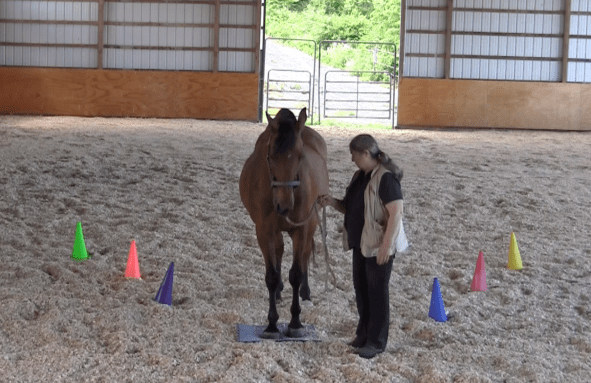
Instead of castle walls with the mat as a drawbridge, I imagine an airplane runway.  The sides of the runway are lined with cones that form an open V, funneling us down towards the mat at the end.
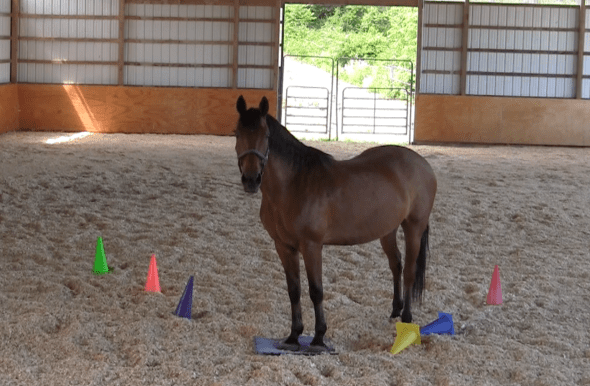
Robin waiting for me in runway 2016-06-18 at 6.05.54 PM

My horse, Robin is going to be our equine teacher for this lesson.  He’s going to show you what the lesson looks like with an experienced “copilot”.  I’ll also be describing what the lesson is like when you’re working with an inexperienced horse.  I’ll be taking you from the first wobbly “flights” down the runway to the finessed balance that evolves over time. For now Robin is waiting expectantly for the game to begin.

If Robin is one of our equine teachers, let’s suppose the other is a pushy, somewhat nervous horse who has gotten into the habit over several years of dragging his person pretty much wherever he wants to go. In this lesson the pilot (me) is approaching in her single engine little plane (the horse).  I’m being buffeted by strong winds.  The plane (my horse) is rocking from side to side, trying to drag me off course.  Can I even make the top of the runway?  No!  I abort to try again.  I circle around, and this time I manage to get the nose of the plane, i.e. this horse, pointing into the open V of the runway.  Click and treat.  The wide end of the funnel helps me to be successful.  I want to find ways to say ‘yes” to this horse, so I make the lesson as easy as possible by making the opening of the funnel extra wide.  I’m setting up the environment to help ensure success.  A narrow funnel would be much harder to get to with my determinedly pushy horse.

I had originally wanted to show a video of an inexperienced horse using the runway lesson, but computers being computers my editing program isn’t cooperating with that intent.  So instead I enlisted Robin’s help.  He’s my “dance partner”, or to stick with my metaphor of the runway, my copilot.  I filmed him going through the pattern, and I’ve pulled still photos from the video to describe some of the key elements of this lesson.

It’s been a very long time since I have worked Robin through this foundation lesson.  As always, I found it was worth revisiting the basics with him.  No matter how skilled a horse becomes, the basics always reveal details that need polishing.  So whether you and your horse are a novice team or one that is very experienced, the runway is a great lesson to explore.

Please note: This is not a stand alone lesson, nor is this JOYFULL Horses book intended as a clicker training how-to instruction manual.  The prerequisites and a description of the handling skills needed for this lesson are presented in my DVD lesson series and in the on-line course. I am describing this lesson in detail here not not so much to teach you how to use it, but to illustrate some important concepts that are relevant to all good clicker lessons.

I’ll start with a short video which will give you a quick overview of the lesson.


There are a lot of important details in this 3 minute clip.  I’m going to take the lesson apart literally frame by frame.  I’ll be using stills pulled from the video to point out the key elements of this lesson.  Enjoy!
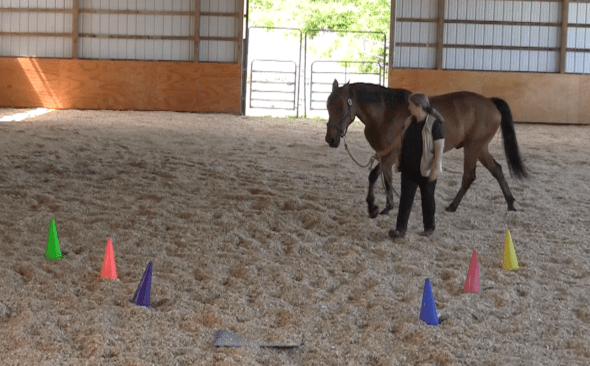
Robin Runway reenter runway 2016-06-18 at 6.11.50 PM

The runway is part of a larger loop.  There’s no beginning, middle, and end.  A horse that is familiar with mats might begin, as Robin did, on the mat.  The pushy horse I am starting with has never stepped on a mat and is worried by them. I would begin with that horse where we are picking up the pattern here, with Robin turning with me into the top of the runway.  Note the slack in the lead.  I probably would not be giving this much freedom to my pushy horse.  he wouldn’t yet know how to read and respond to the subtle signals from my lead and body language.  I would need to slide up the lead to signal my intent to turn.  I would click and reinforce the horse as he responded to my request.  This would bring him to a halt, ready for the next phase of the lesson.
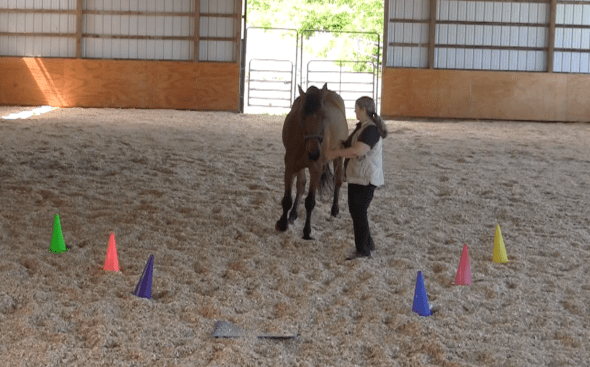
Robin Runway turn to a stop 2016-06-18 at 6.12.10 PM

Note how I have brought Robin into the runway.  I’ve been mindful of the placement of the V. I’ve given us enough room to turn so Robin ends up in line with the mat.  This exercise is about straightness.  It is a wonderful lesson for helping crooked, pushy, unbalanced, nervous, or just plain wiggly horses.
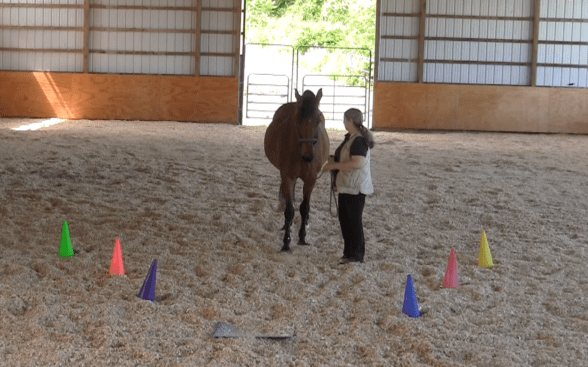
Robin Runway lined up for approach 2016-06-18 at 6.12.22 PM

Here Robin is beautifully lined up to the mat as he completes his turn into the runway.
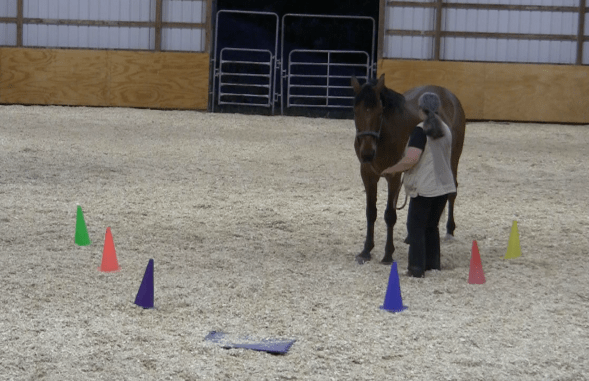
 

Robin runway off sides 2016-06-19 at 9.36.47 AM

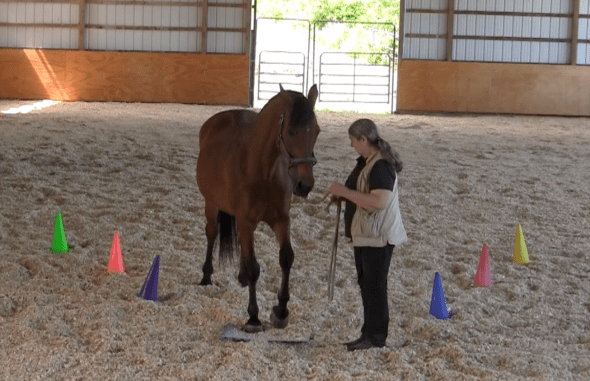
In contrast here I’ve made my turn too early so there isn’t time to line Robin up straight to the runway.  I originally taught the mat lesson without any cones for markers.  People would walk their horses off from the mat and then come back around in too tight of a turn.   There was no way their horses could line up to the mat and approach it on a straight path.  These handlers were setting their horses up for a wiggly, crooked approach.  The mat is about lining up straight to a mounting block, approaching the center of a jump on a straight path, crossing streams and other obstacles, stopping square at X in a dressage test, and performing any other task where precision and accuracy in the approach are needed.  A novice horse needs the extra help that a long runway approach gives him.  I set the cones out as guides for the handlers.  They have to take their horses back to the mat by walking all the way out and around the line of cones.  Targets aren’t just for our horses.  Sometimes they are for us, as well.


You’re in the runway.  Now what? This lesson is like a dream where you drift from one scene to another – never questioning the odd juxtaposition of images.  In this part of the lesson I am doing “needlepoint” with this horse.  That’s the image.
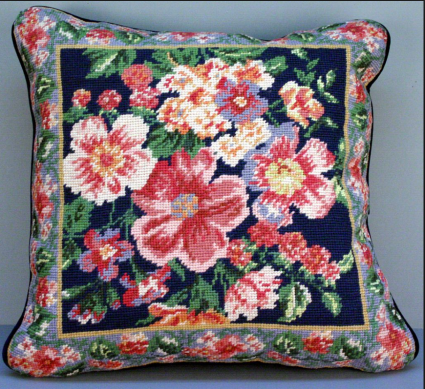
needle point pillow

Needlepoint may not seem relevant to horse training, but the individual balance shifts we teach in the runway always make me think of the intricate stitches in a needlepoint tapestry.

Each stitch is an individual action.  Each stitch must be carefully thought through before beginning the next. I may have to change colour often.  I may only want one or two stitches of green before I switch to red. That’s how this part of the lesson feels to me.  I will be asking for tiny shifts of weight.  Each balance shift forms one stitch in this larger tapestry.

When I ask my horse for one tiny step forward, that’s one green stitch.  If I’m working with a poorly balanced or pushy horse, I don’t want to take a step and then follow it with many more.  Instead, just as this horse begins to lift his leg, I’m going to click.  The click interrupts one thought – move forward – and replaces it with another – get your reinforcer.  Before he has even really begun to move, he’s at a standstill again waiting for his treat  He was thinking of barging past me, but that would have crashed our little “plane”.  Instead disaster has been averted.  He has taken a half step forward, and now he’s shifted his weight back slightly to get his treat.

He’s beautifully set up for the next stitch in our tapestry.  I ask for another forward step.  Click!  Again, the power of the click interrupts him before he can charge forward.  He is learning patience.  He is learning self-control.  He is learning to control his movements.  He began with a throttle that was either at full power or completely turned off.  Now we are gaining some adjustability.  I can ask for a tiny amount of energy, and he can give me a soft, half step forward.  Click and treat.

He is doing so well, it is time to land “the plane”.  I put aside one image – the needle point – and we walk casually forward down the rest of the runway.  As we approach the mat, I realize my co-pilot isn’t ready to stop.  I walk over the mat myself and keep going, letting my co-pilot walk beside me.

We circle around back to the top of the runway.  My co-pilot learns fast.  The little plane is steadier now as we bank around the turn and face into the top of the V.  Click and treat.  This time I put red thread into my needle. I ask for backing.  Again, I click on that single stitch.  The plane wobbles a bit and goes off course.  We are no longer pointing straight down the runway.  It doesn’t matter.  The pattern allows for many stitches of red.

Click by click we lay down a line of red stitches.  The backing is smoother now, less hesitant, less wobbly.  We have backed ourselves in a squarish turn that takes us out of the top part of the runway.  I am using skills learned in previous lessons.  My “copilot” may not be able to back straight yet, but I can still keep us in the vicinity of the runway by having him back in a square pattern.  Straight will emerge as he learns how to handle these larger course corrections.

When you put enough of these fine needlepoint stitches together, you get a picture that looks like the one Robin is illustrating for us in this series of photos:
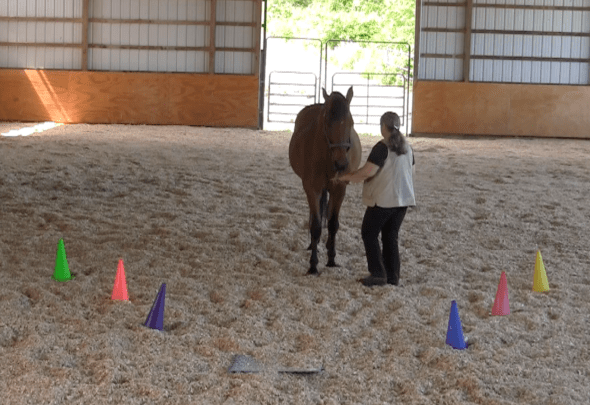
Robin Runway backing in runway 2 2016-06-18 at 6.12.54 PM

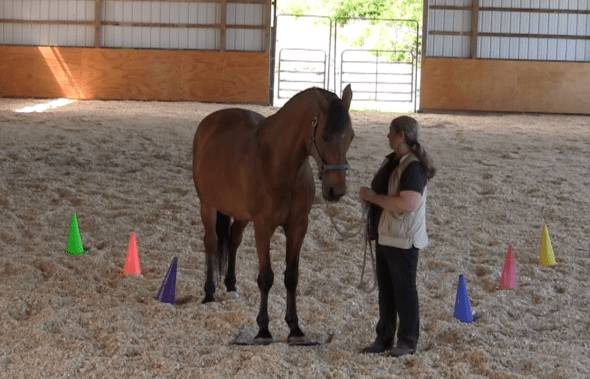
Robin’s adjustability and good balance has allowed him to come in straight to the mat.  I’ve turned toward him to ask for one step back with his right front foot.
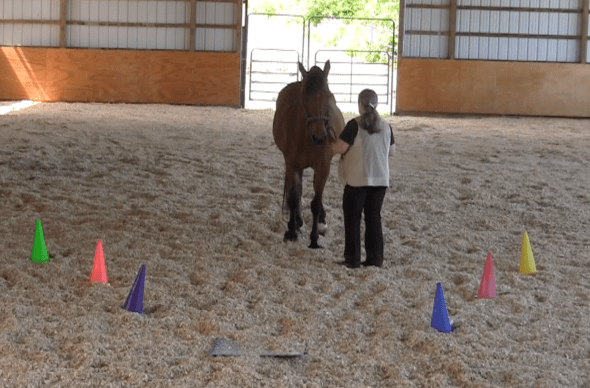
Robin Runway backing con't  2016-06-18 at 6.13.17 PM

Robin has initiated a step back. As he does, I click and prepare to release the lead.
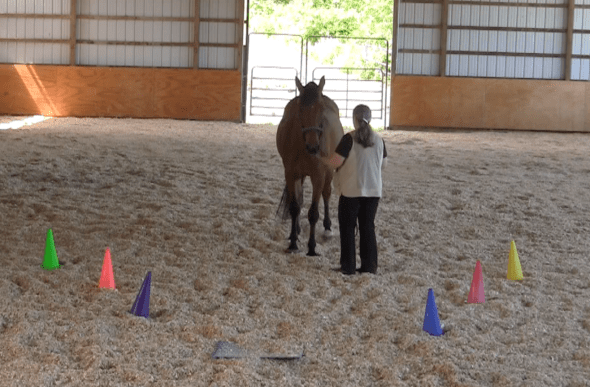
Robin Runway backing done 2016-06-18 at 6.13.29 PM

Robin has completed the single step back.  You can’t see it, but my hand is opening on the lead even before his foot lands.  What goes up must come down.  It’s important to let go as I click and not to wait for the foot to land.  If I stay on the line, I would be holding on way too long, giving my horse something annoying that he would need to push against.  The timing needed to release a horse into the action you want takes deep practice focus.  If you aren’t sure what I mean by deep practice, read my blog on this subject. (https://theclickercenterblog.com/2014/11/16/)
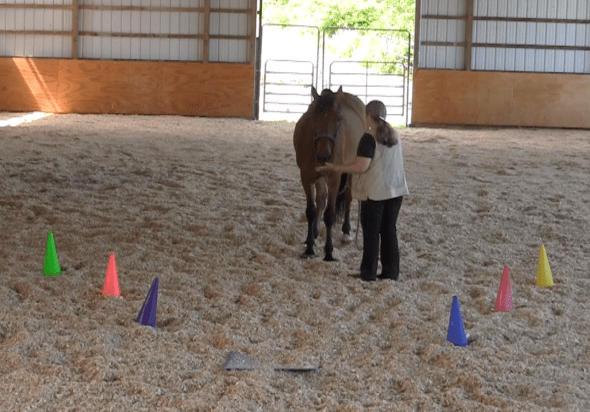
Robin Runway feed after backing 2016-06-18 at 6.13.44 PM

I’ve already clicked.  Now it’s time to reinforce Robin with some hay stretcher pellets.
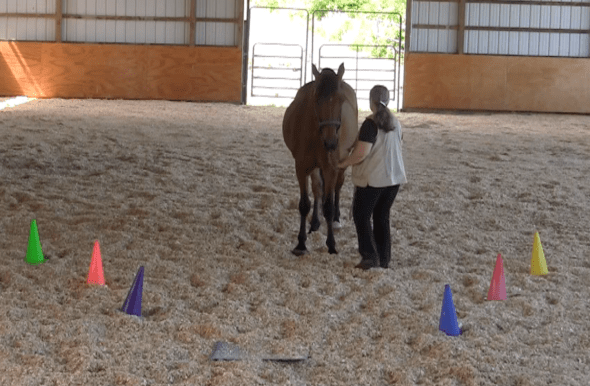
Robin Runway 2nd back 2016-06-18 at 6.14.13 PM

My “needlepoint tapestry” is made up of many stitches.  I’ll ask Robin for another, single step back.
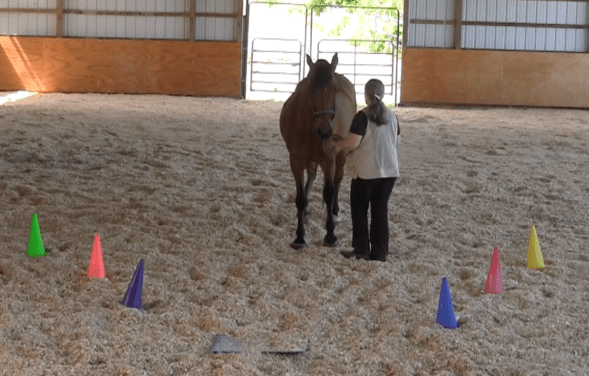
Robin Runway 2nd back con't 2 2016-06-18 at 6.14.22 PM

It may not look as though anything has changed, but Robin has unweighted his right front in preparation for backing.  That’s my cue to be ready to click.
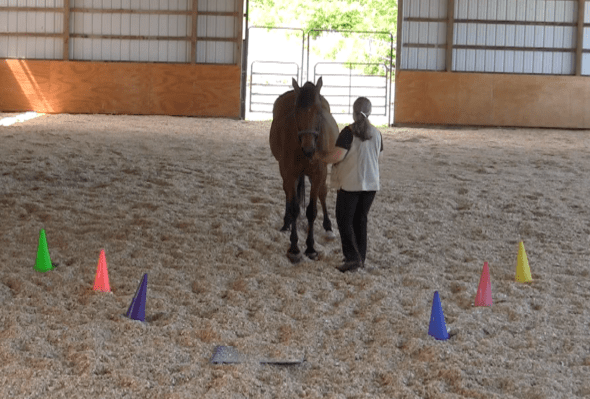
Robin Runway backing step good 2016-06-18 at 6.15.31 PM

Robin has begun to take a step back – Click! Remember it’s important to click as he initiates movement.  I’m not waiting to see the outcome of the weight shift (meaning the completed step back.)  If I click as he initiates a movement, I am saying “yes” to that movement.  This lesson is not about blocking or shutting down energy.  I want energy.  I want behavior.  I want to say “yes” to moving even if the moving is being done by a pushy, inexperienced horse.  When I click as he begins to take a step, I am saying “yes” to movement that in the past someone else may have punished.  An inexperienced horse is expecting a “no”.  Part of his pushiness comes from trying to rush past the obstacles he’s expecting me to throw in his path.  Instead he hears a click!  Surprise, surprise!  He brings himself to a stop to get his treat.  Self control and good balance will emerge out of saying “yes” when what his history tells him to expect is a “no”.    
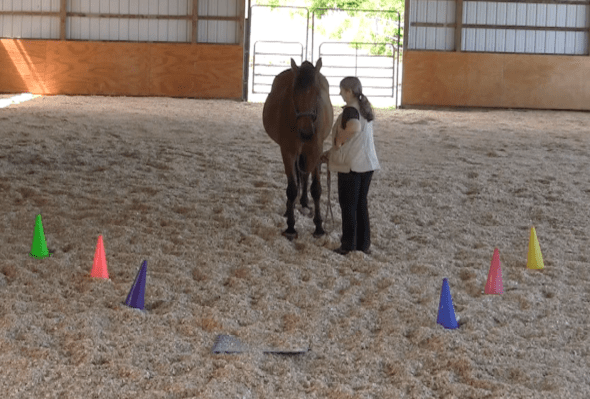
Robin Runway feed after back 3 2016-06-18 at 6.15.47 PM

I’ve clicked Robin as he began to take a step back.  The click is a cue to me to begin my reinforcement cycle.  I’m reaching into my pocket to get a treat.  But note also what my right hand is doing.  I have moved it forward so the snap hangs straight down.  I am giving Robin the full freedom of the lead.  This is an important part of this lesson and one many people struggle with so I’ll be pointing it out again in other photos.  The snap on my lead is going to become a tactile target for my horse to orient to.  Moving my right hand towards Robin as I get the treat with my left is part of the teaching process that helps Robin tune in to the significance of the snap and it’s orientation.
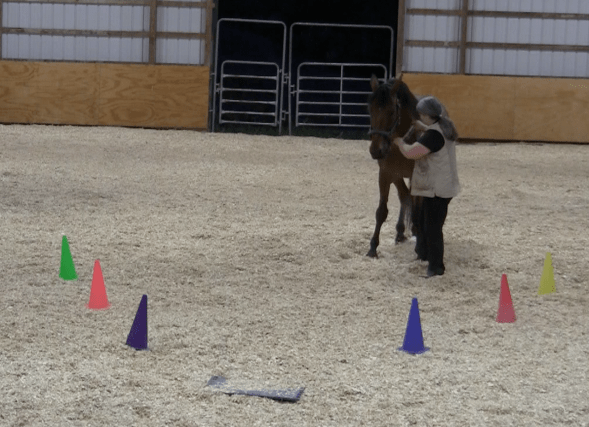
 

Robin runway tai chi wall 1 2016-06-18 at 9.37.29 PM

Here’s the contrast.  As I ask Robin to take a step, I’m using my right hand more actively on the lead.  If he were a more inexperienced horse, I might need my hand here to help him maintain his balance as he takes a step forward.  Otherwise, he might be falling into me with his left shoulder. (Note: if I were on Robin’s right side, things would be reversed.  I would be feeding with my right hand and releasing the lead fully with my left.)
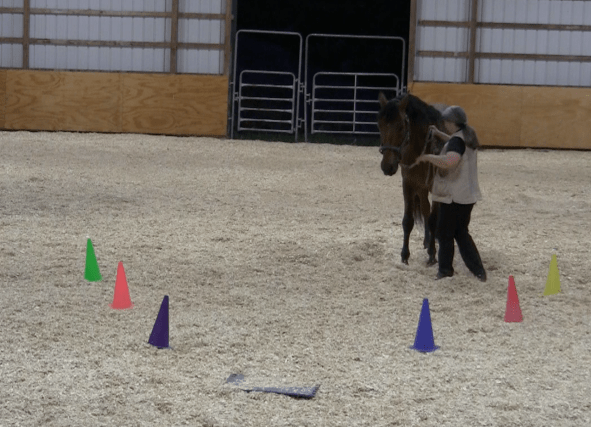
Robin runway tai chi wall 2 2016-06-18 at 9.37.39 PM

Here’s a common mistake.  I’ve released with my left hand, but I’ve kept my right hand in place on his neck.
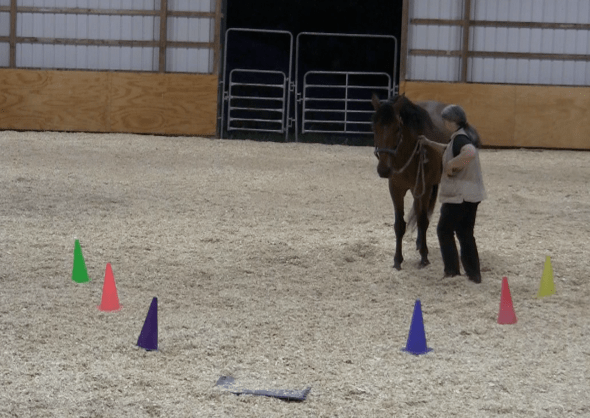
Robin runway tai chi wall 3 2016-06-18 at 9.37.48 PM

Even while I am reaching for the food, I am keeping my right hand in place.  I refer to this as driving down a motorway with your emergency brake on.  When a horse is unbalanced and pushing through you, it can feel as though you can’t let go completely.  It takes focus to remember to release the lead completely with your right as well as your left hand.  This is where you learn to truly let go. This is the beginning of floating on a point of contact – a heavenly feel for both horse and handler.
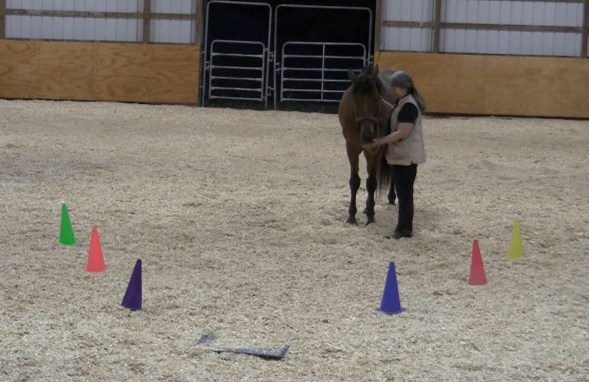
Robin runway tai chi wall feed 2016-06-19 at 11.48.13 AM

After all, you’ve got treats in your hand.  Where is your horse going to go?  This is the perfect time to experience letting go of him.
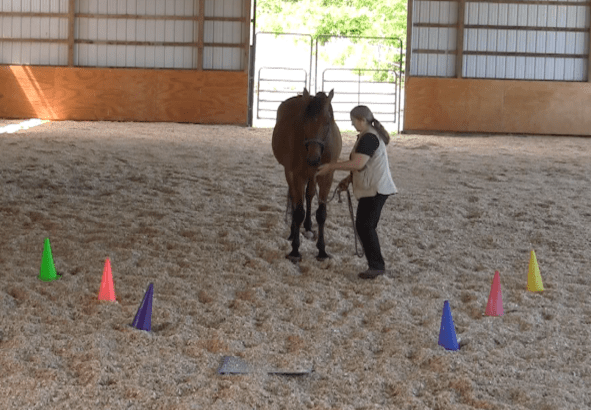
Robin Runway prepared for next step 2016-06-18 at 6.16.03 PM

The runway lesson teaches the handler to be an agile thinker.  Depending upon what happens with my horse’s balance, I may need to change in an instant the direction I want him to go.  So while I am giving him his treat, I am already thinking about what I am going to do next.  I don’t wait for him to fill in the “dance card” through my indecision.  My body language is signaling the next clear intent.  Can you tell what I’m going to ask him to do next? Answer: walk forward with me to the mat.
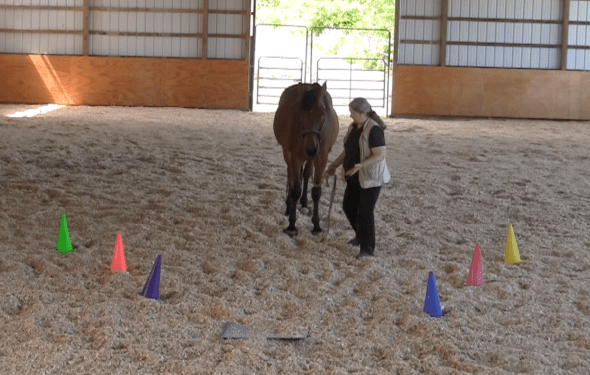
Robin Runway release to mat 2016-06-18 at 6.16.14 PM

Robin has done a nice unit of “needlepoint stitches”. Now it’s time to let him move.  I am releasing him to the mat.

In the photos it was time to release Robin to the mat.  It is time to do the same for my less experienced horse.  Once again, I’ll set the needle work image aside.  I have asked this horse to stay focused with me through several steps.  We have put down enough concentrated stitches.  Now it’s time to move.  We’ll walk casually towards the tip of the V and the mat.  This time instead of walking over the mat, I may choose to stop on it.  My co-pilot misses the stop and over swings past me.  No problem.  It’s a sloppy landing, but it won’t bring out the fire brigade, at least not this time.  I am standing on the mat, clicking and treating my horse for standing quietly beside me.  He can see that the mat did not swallow me up. Instead standing next to it produces lots of clicks and treats.

In contrast to a green horse Robin shows us a beautifully on-the-spot landing on the mat.
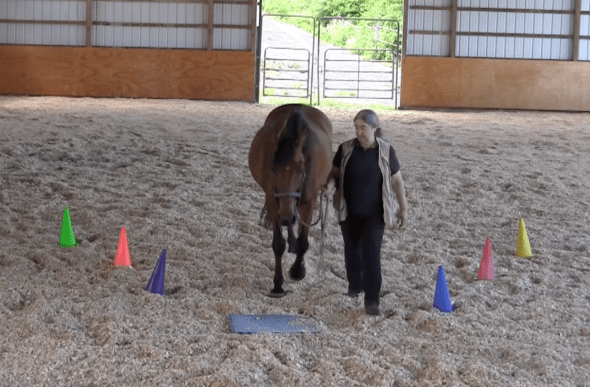
Robin Runway walk to mat 1 2016-06-18 at 6.07.24 PM

Robin is showing perfect mat manners.  Even though he is eager to get to the mat because it represents an opportunity for reinforcement, he is walking with me on a slack lead.  Mats are a great tool for teaching horses the emotional control they need to walk politely out to turnout and other exciting places.  If your horse pulls or dances around you when you lead him, working with mats is a great lesson to teach.
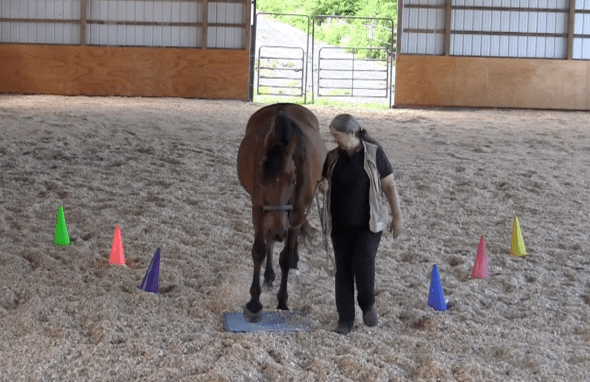
Robin Runway one foot landing on mat 2016-06-18 at 6.07.43 PM

Robin knows how to land on a mat.  First, one foot . . .
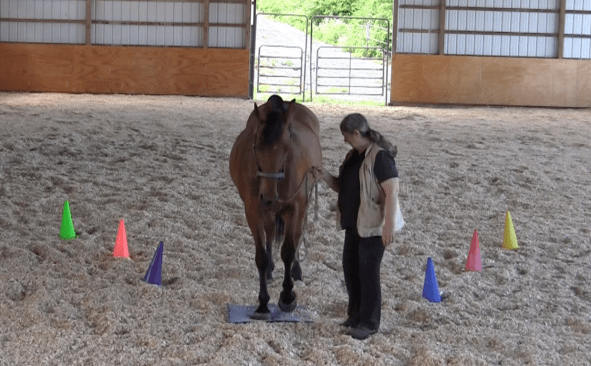
Robin Runway 2nd foot landing on mat 2016-06-18 at 6.07.53 PM

Then a second foot . . .

Robin Runway both feet on mat 2016-06-18 at 6.08.11 PM

Both front feet on the mat.  Click! and . . .
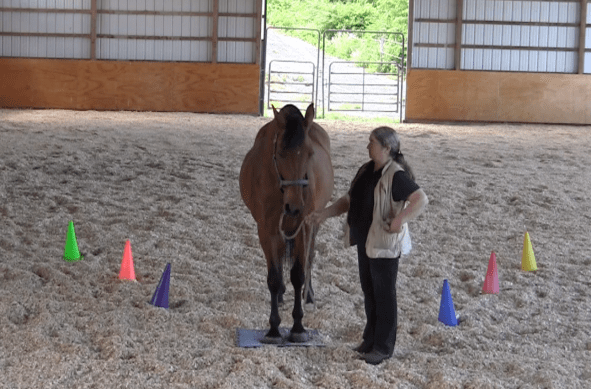
 

Robin Runway release hand as feed 2016-06-18 at 6.08.21 PM

. . . and initiate the reinforcement process.  Note how I release the lead fully to Robin WHILE I reach into my pocket with my left hand to get the treat.  Coordinating these two actions takes deep practice concentration. (https://theclickercenterblog.com/2014/11/16)
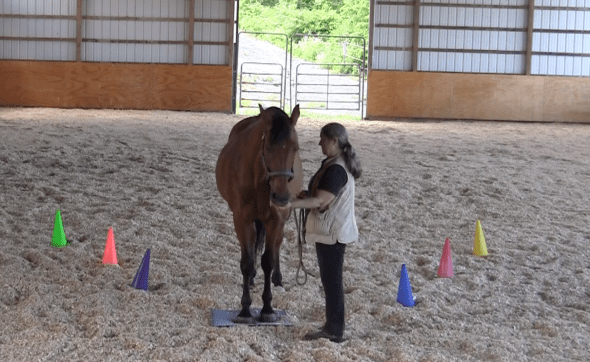
Robin Runway feed 1 2016-06-18 at 6.06.59 PM

. . .  Feed. Note how balanced we both are.  I am encouraging good balance in Robin, AND I am also building a feel for good riding balance for myself.  The mantra is: feed where the perfect horse would be.  In this case that means Robin’s head is in line with his shoulders – not pulled off to the side towards me.  I feed at a height that encourages him to lift up from the base of his neck.  I want to feel him lifting up, supporting his own weight as I feed him.  As he takes his treat, if I feel him leaning down onto my hand, that should signal to me that I need to change what I’m doing to encourage better balance in both of us.
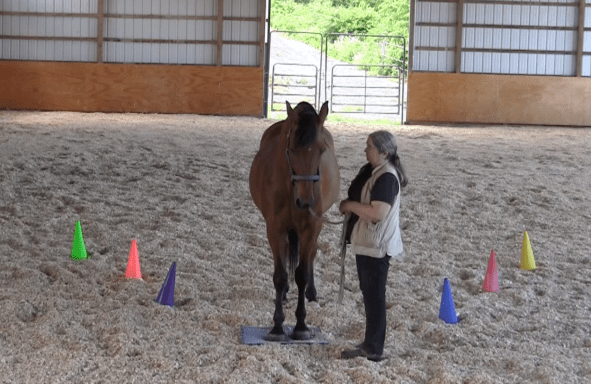
Robin runway on mat grown ups 2016-06-18 at 6.08.50 PM

I want to turn the mat into a conditioned reinforcer.  If it becomes a predictor of good things, my horse will want to go to the mat.  He’ll enjoy being on the mat.  That means I’ll be able to reinforce other activities with an opportunity to return to the mat.  So before we head back to the top of the runway, I cue Robin to give me a very familiar behavior, one I call: “the grown-ups are talking, please don’t interrupt”.  Than means Robin is standing in his own space.  My pockets are full of treats, but I am not being mugged.  Robin adds the extra flourish of his beautifully calm focus and good balance to this important base behavior.
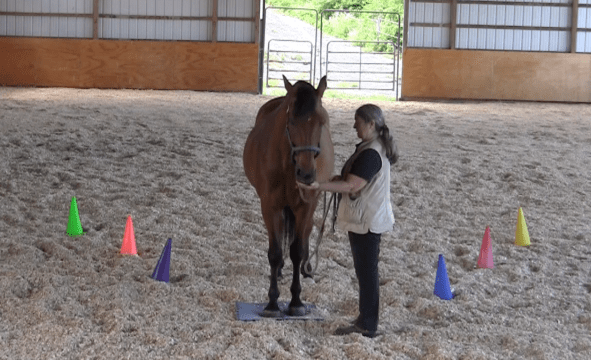
 

Robin Runway feed 2016-06-18 at 6.08.37 PM

It’s click then feed for beautiful grown-ups, and then . . .
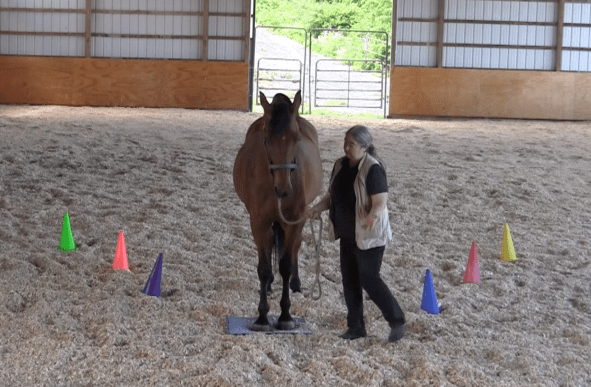
Robin Runway invite walk off 2016-06-18 at 6.09.44 PM

I invite Robin to leave the mat and walk off casually with me back to the top of the runway.

My green horse has also been standing beside me practicing good grown-ups.  It’s time to walk off again and head back to the top of the runway.  This time our entry into the V comes out perfectly.  Click!  That brings him to a halt so he can get his treat.  I don’t have to actively stop him, cues he may not yet understand.  That’s what the runway is going to teach him – whoa and go.   As I give him his treat, I am deciding which colour thread to pick up, meaning should I ask him to go forward or back?  I may decide to ask for a couple of green stitches, and then I’ll switch to red.  It all depends upon the response I get from my “co-pilot” and where we are in the runway.

As my co-pilot becomes steadier and better balanced, we can work on an intricate pattern – one stitch forward, one stitch back, each one separated by a click and a treat.  We are building control – not the force-based control of do-it-or-else, but the self-control of good balance.  He is gaining the ability to change his balance – forward or back within a single stride.  He doesn’t have to barge past me any more because he can regulate both his emotions and his balance.
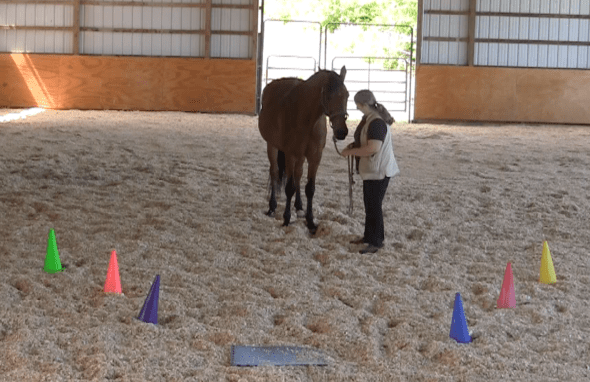
 

Screen Shot 2016-06-18 at 6.57.51 PM

So far I’ve asked Robin for a lot of backing.  I need to balance that with requests to go forward – but remember, in the “needlepoint” phase of this pattern I am asking for only one step at a time.
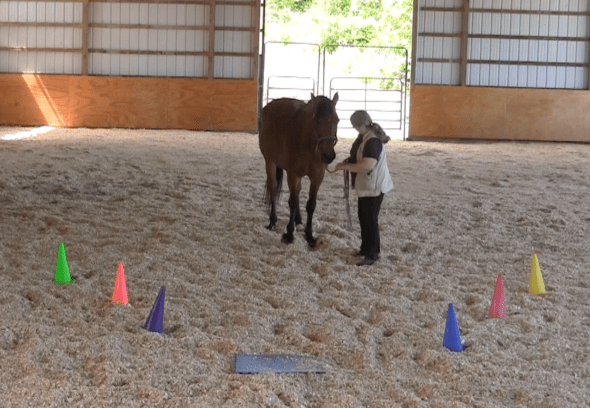
 

Screen Shot 2016-06-18 at 6.58.15 PM

As soon as he begins to initiate a step, it’s click . . .
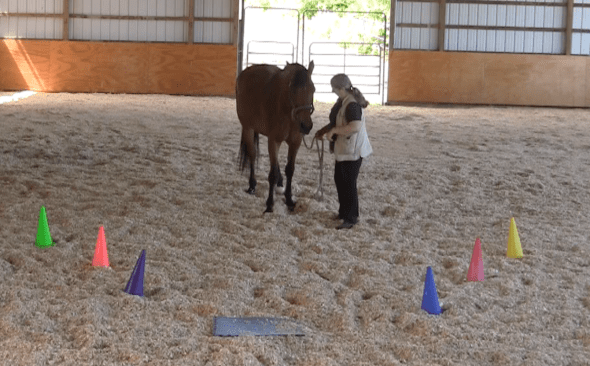
 

Screen Shot 2016-06-18 at 6.58.31 PM

. . . release the lead and begin the reinforcement process.
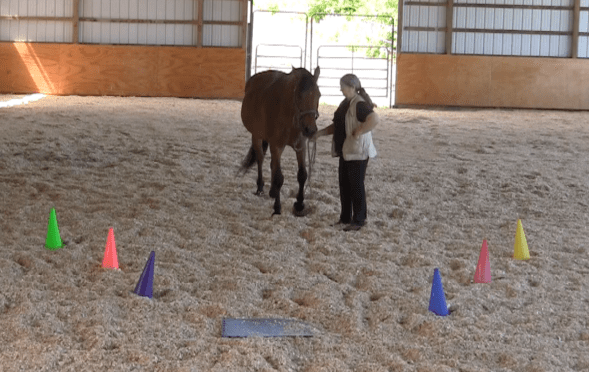
Screen Shot 2016-06-18 at 6.58.41 PM

Again note how my right hand moves towards Robin releasing the lead fully to him.  I have pointed this out before because it is a detail many find very difficult to coordinate.  Their focus is on getting the food.  It takes focused practice to coordinate the separate tasks both hands are doing. (https://theclickercenterblog.com/2014/11/16)
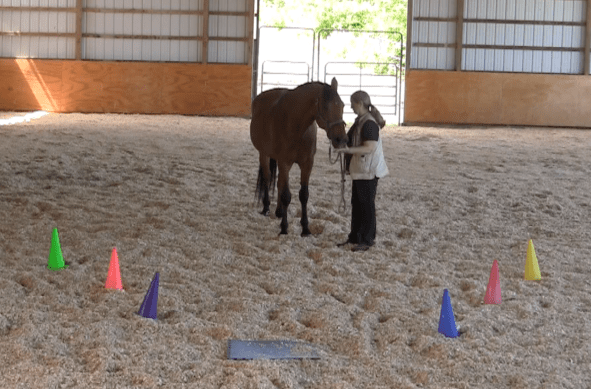
 

Screen Shot 2016-06-18 at 6.58.59 PM

Many people push against the use of food during training, but clicker trainers have such an advantage because we feed treats.  In this photo series you’ve seen how I can use the food delivery to help my horse become better balanced.  Here I’ve drawn Robin slightly forward with my food delivery.  This sets me up well to be able to turn into him to ask for my next request – backing.
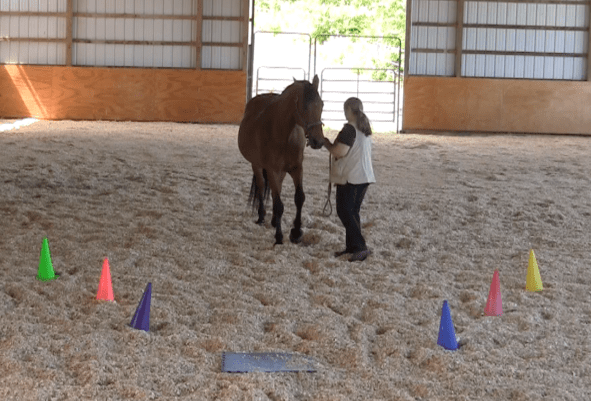
 

Screen Shot 2016-06-18 at 6.59.18 PM

As he begins to lift his left front foot, I am ready to click and release the lead.
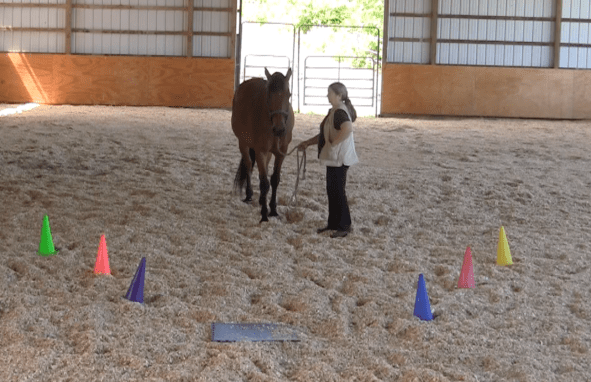
Screen Shot 2016-06-18 at 6.59.44 PM

Again, my right hand moves towards Robin to release the lead AS my left hand gets the food.
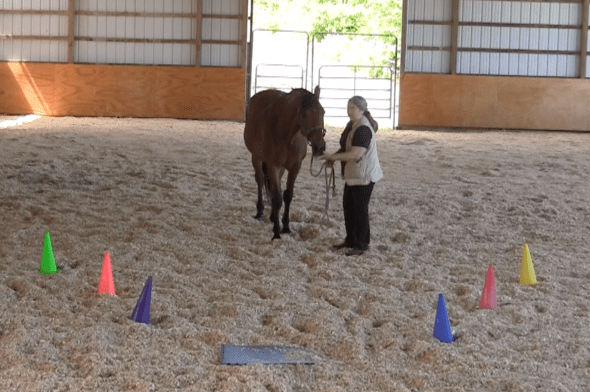
Screen Shot 2016-06-18 at 6.59.58 PM

Even as he is taking the food from my hand, I am setting up my next request.  Can you tell which direction we’ll be heading?  Forward or back?
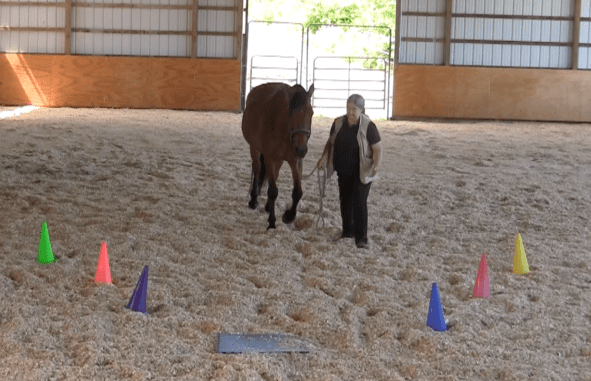
Screen Shot 2016-06-18 at 7.00.19 PM

As soon as I’ve given him his treat, I release him to the mat.  Note: this release to the mat is an important element.  I don’t ask him to keep doing “needlepoint” all the way to the mat.  I want to reinforce the concentrated work with an opportunity to move forward freely.  The mat gives us a destination that offers even more reinforcement opportunities.

Give Them What They Want
For the horse who prefers nothing better than to nap under a tree, all this slow, step by step work is easy-peasy.  It’s all that walking forward stuff to get to the top of the runway that this horse finds wearisome.  So what this game sets up is a bargain.  I’ll let him get all these easy clicks and treats for walking one step at a time provided he will walk with me when I ask him to head back to the top of the runway.

Remember the Premack principle from the previous article? (https://theclickercenterblog/2016/06/09) I’m reinforcing a lower valued behavior – marching on around the outside of my pattern – with a higher valued behavior – getting loads of clicks and treats for taking one small, low energy step after another followed by a chance to stand still at the mat.  What could be better!

For the high-energy, foot moving, impatient horse Premack also works.  I’m saying to this horse: if you will indulge me by giving me a couple of needlepoint stitches, I will not only make it worth your while by clicking and treating each one (thereby upping their value), I will also let you march forward down the rest of the runway.  And if you will further indulge me by standing still on the mat where again I pay really well, I will let you march on, uninterrupted back to the top of the mat.

In both cases the Premack principle is at work.  And in both cases I am turning all the segments of the loop into activities that gain value.  Pretty soon, my slow-moving horse will be looking forward to the march back to the top of the runway, and my impatient horse will be showing me how softly and with such delicate control he can creep down the runway.

Stopping on Mats
For my inexperienced horse it’s time for the game to change again.  I’m going to start using the skills he’s been learning in the runway.
When we get to the mat, instead of stopping so my feet are on the mat, now I’ll change course slightly in the runway so the mat is in line with my horse.  If he steps over it the first time or two so his feet never touch it, that’s all right.  We aren’t yet ready to land.  But eventually, on one of the passes, I’ll do a test run.  As we approach the mat, I’ll rotate slightly towards him as I slide up the lead.  I’m indicating that we will be stopping.  Our needle point has taught him how to listen to these signals.  He’ll stop with his front feet just shy of the mat.  Click and treat.

Here is Robin again showing us how much control and refinement the runway can help us build into leading:
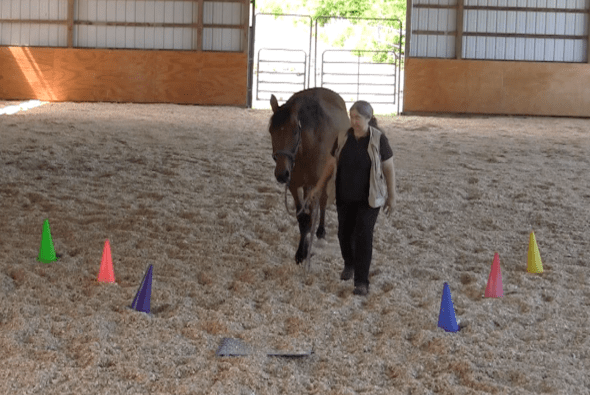
 

Robin Runway walk to runway 2016-06-18 at 6.16.26 PM

I’ve released Robin to the mat.  Note the slack in the lead.  There’s no pulling to the mat, no forging ahead of me.  We are walking together towards the mat.  Exactly right.
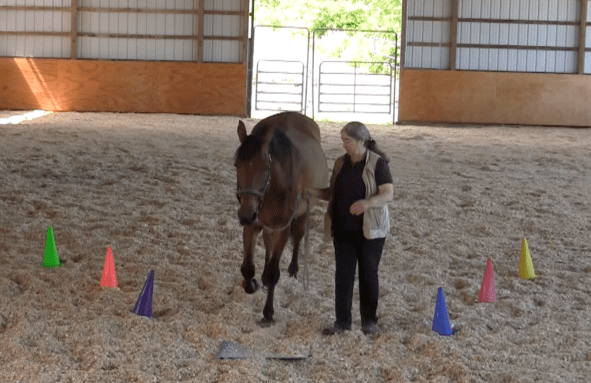
Robin Runway stop before mat 2016-06-18 at 6.16.40 PM

I’ve brought Robin up to the mat, but I am deliberately asking him to stop just shy of it.
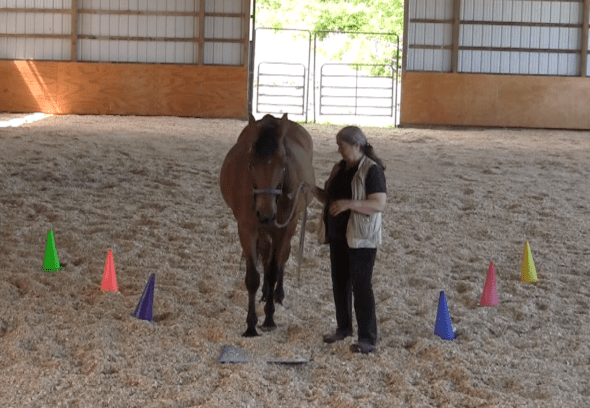
Robin Runway stop before mat 2 2016-06-18 at 6.16.50 PM

Frame 1: His front end stops beautifully, but . . .
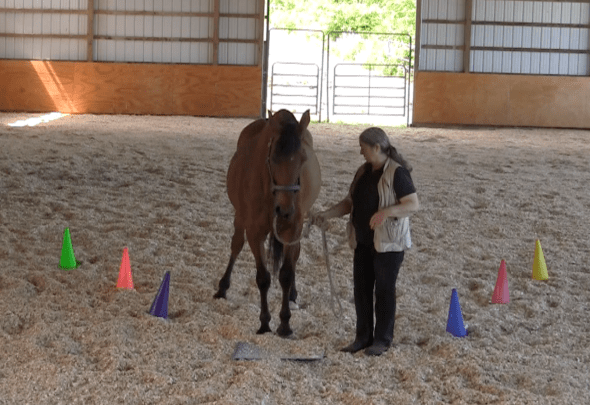
Robin Runway stop before mat hind leg out2016-06-18 at 6.17.20 PM

Frame 2: Robin wasn’t expecting to stop before the mat.  His front end stopped in response to my request, but his hind end took an extra moment to catch up to the change in the pattern.  It’s a bit like a rear end collision at a traffic light.  The first car stopped, but the second one didn’t.  The result: Robin has stepped out to the side with his right hind.  He could have plowed past me to continue on to the mat, but instead he has managed to stop his front end in response to my request.  It’s only his back end that couldn’t quite stop in time.
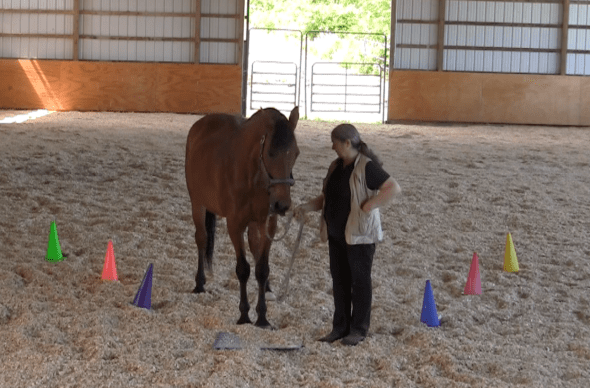
Robin Runway stop before mat click2016-06-18 at 6.17.32 PM

He may have landed slightly out of balance, but he still responded perfectly to my request to stop his right front and then his left front foot, so he gets clicked.  That’s my cue to begin the reinforcement process. I surprised him with a sudden change in pattern.  That resulted in less than perfect balance in the stop, but he still gets reinforced for a correct response to my cues.
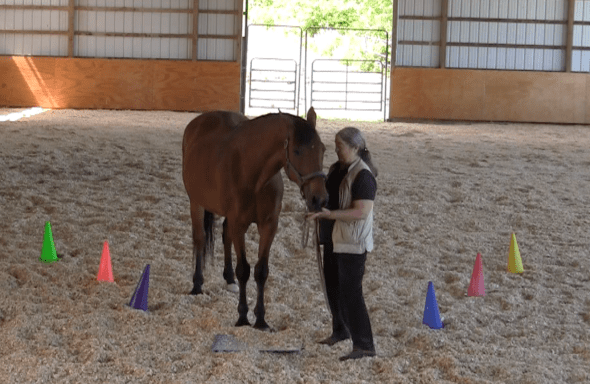
Robin Runway stop before mat feed 2016-06-18 at 6.17.47 PM

Feed so his head stays lined up with the rest of his body.
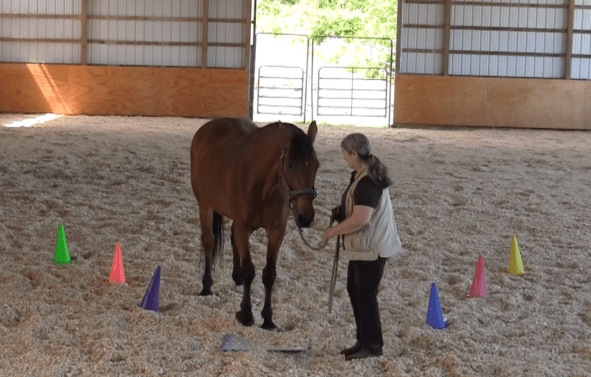
Robin runway ask to step on mat 1 2016-06-18 at 6.18.09 PM

Now I’ll use his “needlepoint” skills to bring him the rest of the way onto the mat. That was the point of my abrupt halt.  I wanted  to create an opportunity to show you how these skills work.
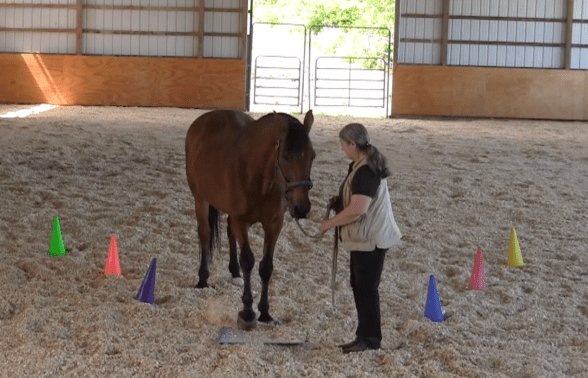
Robin Runway ask to step on mat 2 2016-06-18 at 6.18.26 PM

Robin responds to very light cues on the lead.  A very small change in my hand position is  all that is needed to request a single, forward step with the right front.
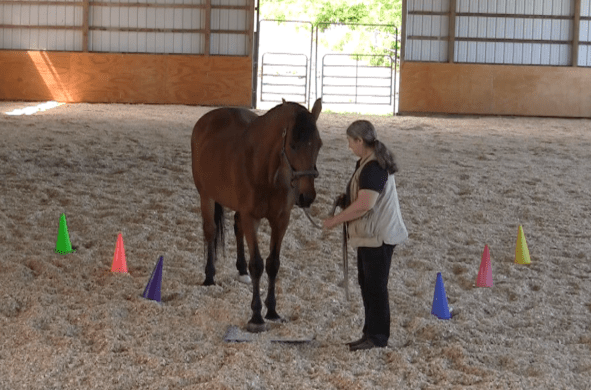
Robin Runway ask to step on mat 3 2016-06-18 at 6.18.33 PM

Job done with the right front.

Robin Runway ask to step on mat 4 2016-06-18 at 6.18.43 PM

Now I ask for one step forward with the left front.
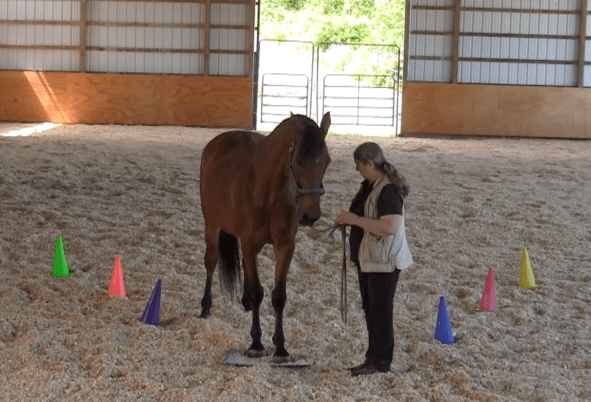
Robin Runway ask to step on mat 52016-06-18 at 6.18.54 PM

Job done again. With a very inexperienced horse I would have clicked and reinforced each footfall.  With Robin I can connect these requests together via cues.  Cues act as both prompts and reinforcers.  I am only clicking after he has both feet on the mat, but I am still giving him plenty of “yes” information via the cues from the lead.  Those cues contain an additional “yes” every time I release the lead. 
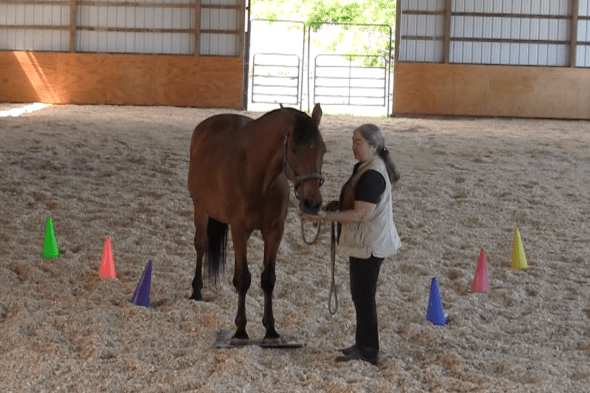
Robin Runway ask to step on mat feed 2016-06-18 at 6.19.10 PM

I’ve clicked so now it’s time to feed.
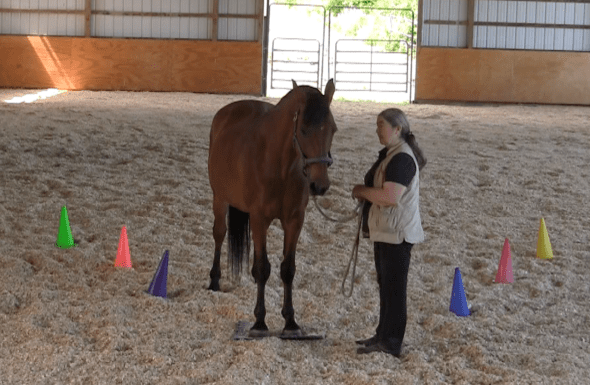
 

Robin Runway ask to step on mat grups 2016-06-18 at 6.19.26 PM

I’ll further reinforce his good efforts to get on the mat by asking for “grown-ups”, a well known and highly reinforced behavior.  Note how beautifully he maintains his balance, and his very calm, focused demeanor even though he is just inches away from the treats in my pockets.
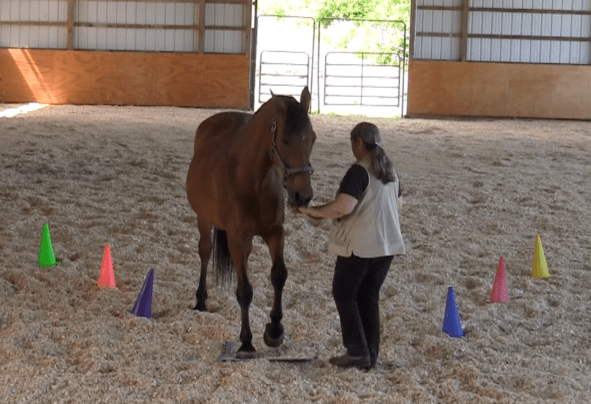
Robin Runway back off mat 1 2016-06-18 at 6.20.14 PM

I continue to use his “needlepoint skills” to ask him to take one step back off the mat.
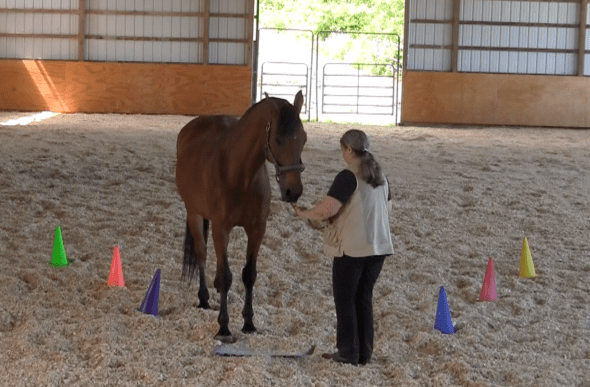
Robin Runway back off mat 2  2016-06-18 at 6.20.29 PM

Once he’s stepped back off the mat, I can ask him to come forward again. An inexperienced horse might become frustrated by all this toing and froing.  He might be wanting me to make up my mind and decide which way I want him to go.  But the “needlepoint” lesson in the runway has familiarized Robin with this type of request.  They are just a series of changing dance steps.  They were never taught as corrections.  I want him to see them as a path towards reinforcement – never as a way to avoid punishment.
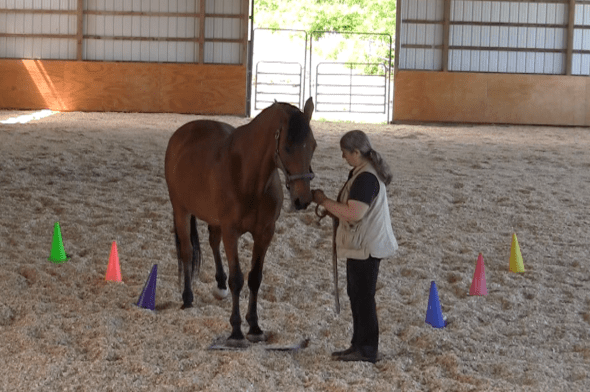
Robin Runway return to mat 1 mat  2016-06-18 at 6.20.53 PM

His front feet are back on the mat.  Now I’m asking him to step up with his left hind. Click as the leg begins to lift.
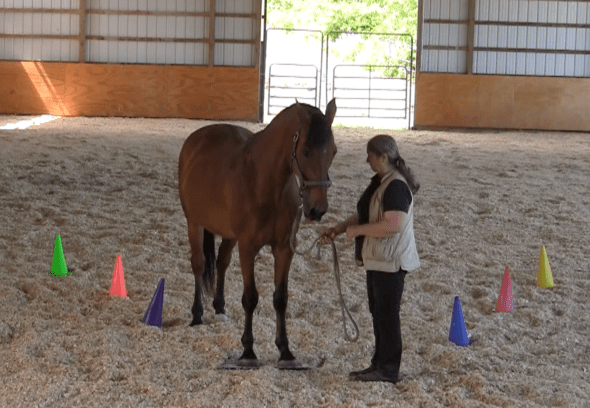
Robin Runway return to mat release hand 2016-06-18 at 6.21.09 PM

Again the reminder to release with right hand as well as the left.
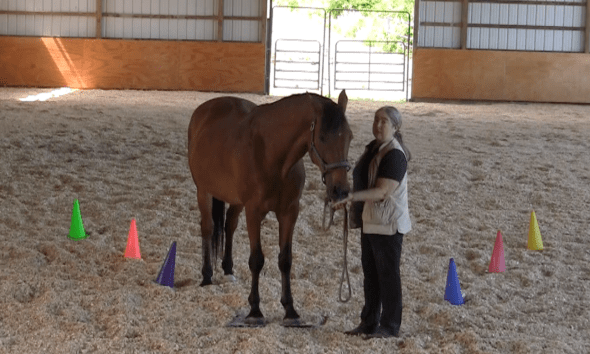
Robin Runway return to mat feed 2016-06-18 at 6.21.26 PM

Feed for a job well done.

Robin Runway return to mat grups 2016-06-18 at 6.21.41 PM

Ask for grown-ups to create added value for landing on the mat.  Why go through all of this? Compare this photo with the one taken just moments before I asked Robin to step off the mat. 
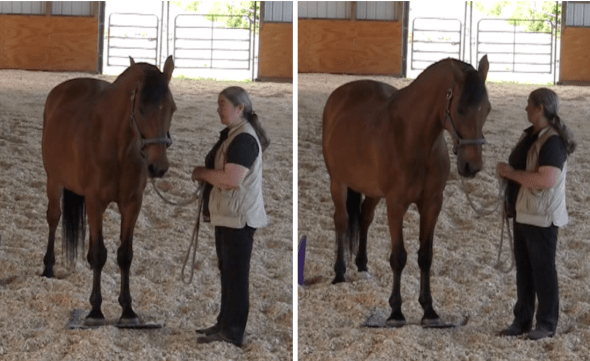
Robin grups comaprison 2016-06-19 at 3.26.11 PM

In both photos Robin is in grown-ups.  He’s showing the calm focus and good balance that has been consistent throughout this session.  But in the photo on the right Robin shows slightly more lift from the base of his neck.  The difference is subtle, but it is there.  It was created out of the rebalancing steps he took to back off and then, weight shift by weight shift, return to the mat.  The control he has over his footfalls leads to the consistency we see throughout this lesson in his balance.

These photos were all pulled from a video.  Now that we’ve gone through the details of this lesson, let’s have you watch the video again.  How many of the photos you’ve been studying can you spot?  They are just still frames taken from the video.  How much more detail are you seeing now than you did when you  watched this video the first time through at the beginning of the article?  How many of the points that I covered are you spotting?  I’ll bet you’re seeing the very deliberate release of my right hand and the use of the food delivery to help build good balance.  What else pops out at you now that I’ve been pointing out the details of this lesson?

Constructional Training
For the inexperienced horse, as well as for Robin, the work in the runway builds the skills that are needed for the mat.  That’s the strength of this approach.  I haven’t started with the mat where a horse’s concern over stepping on an unknown surface might create problems.  The focus of this lesson is to teach the horse to step on the mat, but that isn’t my end goal.  The mat is a tool. Stepping on the mat is a way to get that energetic walk and those “needle point” skills that I’ll be using elsewhere in his training.  And once my horse is comfortable with the mat, I can use it throughout his training as a reinforcer.

When I first introduced my horse to the overall game which we call clicker training, I had to deal with the food.  It started out as a distraction.  I held a target up for my horse to touch –  which he did, eagerly enough.  His curiosity served me well.  Click and treat.  Treat!  You have food in your pockets.  Never mind the target, I’ll have more of those!

The initial stages of clicker training are really a teaching process that transforms the food from a distraction into a useful tool.  Once my horse understands that he gets the treats by taking his focus off my pockets and offering instead other behaviors that I like, then the game can really expand.  It truly does become a game, a treasure hunt where solving the puzzle becomes even more reinforcing than the treat itself.

The mat works in a similar way.  At first it is something to be avoided – stepped over or around, but never actually on.  Then it becomes something to put a tentative, testing toe on.  Clicks and treats!  This isn’t so bad.  What was all the fuss about!

Pretty soon you’ll have a horse who isn’t just stepping gingerly onto the mat, he’s rushing down the runway to get to it.  Hurray!

Coming Next: Mat Manners. For every exercise you teach there is an opposite exercise you must teach to keep things in balance.  The mat lesson helps you understand the importance of this statement.  The runway lesson has helped create a horse who is eager to get to the mat.  Now you need to explain that you’d like him to walk with you to the mat.


Remember, if you are new to the JOY Full Horse blog, click on the JOY Full Horses tab at the top of this page to find the full table of contents and links to each of the articles I have published so far.

I hope you will want to share these articles by sending links to this blog to your friends.  But please remember this is copyrighted material.  All rights are reserved. Please do not copy any of the “Joyful Horses” articles without first getting written permission from Alexandra  Kurland, via theclickercenter.com

Also note: these articles are not intended as an instruction guide for introducing your horse to clicker training.  If you are new to clicker training and you are looking for how-to instructions, you will find what you need at my web sites:

theclickercenter.com                    theclickercentercourse.com
 

JOYFull Horses: Chapter 3: The Time Has Come . . .

The Time Has Come the Walrus Said To Talk of Many Things

“The time has come,” the walrus said,
“To talk of many things:
Of shoes and ships and sealing-wax
Of cabbages and kings
And why the sea is boiling hot
And whether pigs have wings.”
Lewis Carroll – Through the Looking Glass

In Chapter One of this section I shared some examples of how the environment can cue behavior.  Panda, the mini I trained to be a guide, provided us with many examples of environmental cues.  In the previous Chapter I showed how a combination of mats and strategic food delivery can be used to teach basic leading.

We’ll be building on that lesson is this next unit. Which means the time has come to talk about Premack, Feldenkrais work, asking questions, mats, airplane runways, needlepoint, and creativity.  If you’re not sure what some of these mean or what the link is between them, read on.  And yes, we will be getting back to play and our list of ten things a beginner needs to know about cues, but first let’s set the stage with a discussion of the Premack Principle.

Behaviors as Reinforcers
One of the things that quickly becomes apparent when you start turning training into play is how quickly the behaviors you teach your horse can be turned around and used as reinforcers for other things.

This is not a new understanding. In the late 1950s primatologist, David Premack developed his relativity theory of reinforcement which is better know as the Premack Principle.  Simply put this means that a higher valued, more probable behavior can be used to reinforce a lesser valued, less probable behavior.

If you hate to sweep your barn aisle, but love to ride, don’t put sweeping after riding.  Let riding serve as a reinforcer for sweeping up.  When you finish grooming and reach for the broom before you reach for your hard hat, that puts you on a habit path that’s going to culminate not just in a great ride, but also in a love for barn chores. Clicks for you!

That’s something I discovered when I changed the sequence in which I did my barn chores.  I’ve always disliked sweeping.  When I was boarding my horses, it never made any sense to me that we were sweeping the barn aisle last thing at night.  The only person who was going to see our beautifully swept aisle was the morning stall cleaner, and she was going to begin the day by making a mess.

It would have been much better to sweep up when we first arrived so we could enjoy the clean aisle all evening, but that wasn’t how things were done.  In my own barn I sweep the aisle first and then follow that with cleaning the stalls and paddocks – something I enjoy.  After the barn chores are done, I get to play with the horses.  The result?  I now look forward to sweeping the aisle. It’s a great way to begin my day.

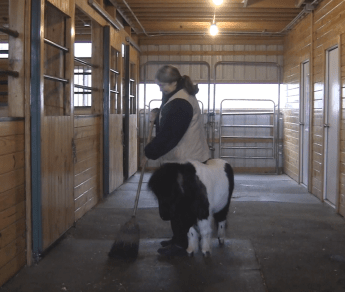
Panda helping me sweep 3

Panda is “helping” me sweep my barn aisle during a visit to the barn.

The same kind of sequencing becomes important when you train your horse.  Think about the order in which you ask for things.  If you’ve taught a behavior well, it can serve as a reinforcer for a newer behavior you’re working on.  Ideally every behavior you add into your training loops should function as a reinforcer for all the other behaviors.  The result: every behavior you ask for will become something your horse enjoys doing.

That’s ideally.  How can you make that a reality for the behaviors you teach your horses?

Turning Mats Into Tractor Beams
For a horse who likes to be actively doing something, what could be more tedious than standing on a mat?  And yet, that’s definitely not how our eager clicker horses view mats.

Mats become like tractor beams drawing the horse in.  They are where good things happen.  You get treats on a mat.  You get lots of attention.  And when you leave one mat, you get to head off to another.  More treats!  Yeah!!

Harrison on mat hug cropped

Mats are where good things happen.

If I teach mats well, they are a source of play not tedium. When I am first teaching mats, I keep the Premack principle very much in mind.  Most horses initially view a mat as something to avoid.  They will step over it, around it, slam on the brakes in front of it, anything but actually step on it.

I’ve taught mats in lots of different ways.  You can freeshape stepping on a mat, but I prefer to put the horse on a lead and turn this into a more directed-learning process.  The reason I do this is because it’s a great opportunity for the horse and handler to become more familiar with good rope handling techniques.

In the horse world the lead is often used as an enforcement tool.  “Do what I say – or else!” If a horse pushes past the handler, the lead is there to give him a quick reprimand.  The handler jerks the lead so the horse feels a sharp bump from the halter.

If a horse doesn’t back fast enough, he knows the lead will be there again swinging threateningly in his face.

That kind of expectation is not clicker compatible.  We need to take the “do it or else” threat out of the lead.  The lead is there to ask questions – not to tell or demand.

What does this mean – the lead is there to ask questions?  One of the best ways to describe this came from a youtube video clip of Mia Segal.  Segal is a Feldenkrais practitioner.  Developed by Moshe Feldenkrais in the mid-1900s Feldenkrais work eases pain or restrictions to movement by increasing an individual’s awareness of small movements.

Feldenkrais Work
Unlike a massage and other manipulative therapies, Feldenkrais work is experienced through self-observation.  You learn how to move with attention.  You become aware of how you move; what parts of your body you mobilize to create an intended movement; how far the movement flows through your body; where it stops; where it is blocked; and what can be released to extend the movement.  It is an exploration of movement in which an individual is guided via questions towards greater self-awareness and well being.

The expression “Where there is no fear or pain, learning can take place in a single lesson.” lies at the core of this training.  Like many in the horse world I was first introduced to Feldenkrais work via Linda Tellington-Jones.  Her TTEAM training evolved out of this work.  Later I was fortunate to have a client who was an Alexander Practitioner and who had also studied the Feldenkrais work.  We did trades, sharing back and forth the new things we were exploring. Through her I learned even more about the art of asking questions.

Asking Questions
Recently a friend sent me a link to a youtube clip of Mia Segal teaching a workshop  (https://www.youtube.com/watch?v=prGxrhXDEgQ).  My friend said it reminded her a lot of my work.  As I watched it, I thought, she’s right.  Mia Segal might have been talking about working with people, but she was describing perfectly my approach to horse training.  Segal was sitting on the floor with one of the workshop participants.  She was clearly in the middle of a session.  Her student was lying on her back, knees up in the air, with Segal comfortably supporting her head in her hands.

Segal was talking about the first time she saw Moshe Feldenkrais working.  It was 1957.  After the session he asked her if she had any questions.  She had so many, but she knew there were other people waiting.  How could he have time for all of her questions?

Feldenkrais answered her – “If you know the question – it will take but a minute.”

The art of training is knowing the questions to ask.  That is as true for our horses as it is for people.

Segal went on to say:

Someone recently asked the question: ‘What is the difference between this work and pilates, yoga, and other physical therapies. Isn’t it all the same?  So you have another method.’  And I thought the biggest difference is this is a method of questions. I don’t have answers, and I don’t want answers.

You ask a person to move in a certain way.  Bend your knees to the right and you ask – ‘How is she doing it?  Is it anything to do with what I feel under my hands?’

How do I feel it in my hands?  How is she coming back?  Does this change anything under my hands?  And do it to the other side – How is she doing it, and does this feel different?

So rather than thinking – Here it stops.  Here it goes.  Instead I just keep putting a little question mark at the end.  HOW does it go?  HOW does it stop?  WHERE does it stop?  WHEN does it stop?  Is it the same on both sides?  And then I have the whole lesson.”

The Translation to Horses
When I slide down a lead to a point of contact, I am listening through my hands.  And I am asking questions.

Merenaro with alex

This horse and I are deep in conversation.  I am asking many questions through my hands.

When I meet horses for the first time, most aren’t used to being asked anything.  They expect to be ordered about.  Some horses are very compliant.  They have learned that the best way to stay out of trouble is to do what they’re told.  They will follow the feel of a rope.  They will be responsive, and light in your hands. They may even seem happy or at least content.

Light we can measure in terms of how much pressure we need to apply to get a response; how quickly the horse responds; how much weight we feel in the rope as he moves.  Does he move with us, or does he hang back leaving pressure on the lead?  These are all measurable.

But happy.  Who knows. How do I know if you or anyone else is happy?

The “Black Box” of Emotions
How do I know if another person is happy?  I may see behaviors that I associate with times when I have felt happy, but I don’t really know how anyone else feels.  When you say you love your horse, I believe you.  But what does that really mean?  If you tell me you love your horse, but then you sell him so you can buy another horse who jumps higher, I have to believe that that word means something very different to you than it does to me.

So I can say that a horse is responsive – that’s measurable.  I can describe other behaviors that I like to see – his ears are relaxed so they flop back and forth in time with his walk.   Or I might see the opposite.  He has his ears pinned flat, he’s grinding his teeth, and the muscles around his eyes are tight.  These behaviors tell a different story.  I wouldn’t say that’s a horse who is happy.

The Lead Tells A Story
Often when I first attach a lead to a horse, what I encounter is resistance and concern.  Leads have been used for corrections – so the horse is defensive.  He may throw his head up as I slide down the lead, or punch my hand with his mouth.  He might even bite at the lead or at me.  He’s telling me about his history, and I need to listen.  I also need to respond in a way that doesn’t prove to him that he was right to be guarded.

The mats are going to help me.  I was about to add the phrase: get past his defenses, but that’s not exactly right.  That would imply that the castle walls are still there, and all I’ve done is found a way to scale them.

castle walls 1.png

Instead, I want to show him that the castle walls, the moat with the sharks, the draw bridge, the boiling oil, the iron portcullis, and all the armored men lined up behind it aren’t necessary.  They can all vanish, whisked away not through force, but through play.  In the next installment I’ll describe a lesson that replaces castle walls with airplane runways, and you’ll see how the Premack Principle can be applied to training loops.

Coming next: The Runway

Remember, if you are new to the JOY Full Horse blog, click on the JOY Full Horses tab at the top of this page to find the full table of contents and links to each of the articles I have published so far.

I hope you will want to share these articles by sending links to this blog to your friends.  But please remember this is copyrighted material.  All rights are reserved. Please do not copy any of the “Joyful Horses” articles without first getting written permission from Alexandra  Kurland, via theclickercenter.com

Also note: these articles are not intended as an instruction guide for introducing your horse to clicker training.  If you are new to clicker training and you are looking for how-to instructions, you will find what you need at my web sites:

theclickercenter.com                    theclickercentercourse.com
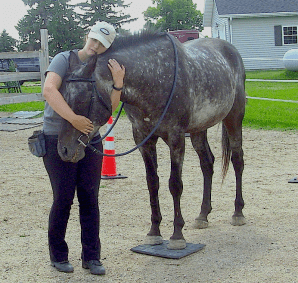
 

JOYFull Horses: Using Environmental Cues

In the previous post I shared many examples of using environmental cues.  For one example I wrote:

“When you have a training challenge, instead of tackling it head on with your normal “horse training” solutions, think instead about how you might use props.  If your horse has trouble turning to move out of your space, how could you use mats to help with this?”

One of the reasons I wanted to share the JOYFull Horses book on line was I knew I wanted to include video along with the text.  That’s what I’ll be doing in today’s post.  To illustrate just how useful environmental cues can be in training, I’m going to explain more fully how you can use mats to teach basic balance and leading skills.  I’ll be combining the draw of  the mats with the set up for a turn that can be created out of food delivery.

These videos were taken during the spring 2015 Arkansas clinic at Cindy Martin’s farm.  Cindy is one of the coaches for my on-line course.  The video features her beautiful draft cross mare, Scout.  Scout is a fairly new arrival in Cindy’s family.  When she first started riding her, Cindy discovered two things.  First, Scout’s idea of steering meant going where she wanted to go regardless of the rider’s wishes.  And second, if you asked for forward, you were just as likely to trigger rearing as any forward impulsion.  These riding issues meant it was time to go back to ground work and teach Scout the basics of leading.

By the time these videos were taken, Scout was well versed in the foundation skills of clicker training.  She had become a mannerly, very pleasant horse to be around, but her tank-like qualities were still in evidence.  This was in part due to a lack of balance.  During the spring 2015 clinic, I introduced Cindy to a simple lesson in which food delivery was combined with the use of multiple mats to teach better leading skills.

These videos take you step by step through the process.

Part 1 establishes a baseline.  Cindy is asking for Scout to turn away out of her space.  In this short video you’ll see Scout push forward through Cindy’s request.  In many traditional forms of horse training we would have dealt with this push-through by getting after Scout.  We would have punished the forward push, but punishment brings with it many unwanted consequences.  Obviously, we used a very different approach, one that used positive reinforcement to teach Scout what was wanted.

In Part 2 you’ll see how Cindy begins to use food delivery to set up the balance shifts she wants.  If you aren’t familiar with clicker training, this can look as though Cindy is simply feeding Scout out to the side.  That’s only part of what is happening.

In the video you’ll hear me refer many times to “grown-ups”.  This is a short hand expression for a lesson which I call: “The grown-ups are talking, please don’t interrupt”. This is one of the foundation lessons of clicker training, one of the very first things we teach the horses when we introduce them to clicker training.  It’s a long name for a simple lesson.  What it means is the handler is able to stand next to her horse with her pockets full of treats, and her horse will stand quietly beside her.  I gave it this very long name because I wanted to emphasize that at the core of clicker training sits good manners.

Having a horse who is mugging you for treats takes the fun out clicker training.  I don’t want the mugging behavior.  And I also don’t want the horses to be anxious about the treats, so early on we teach them this foundation behavior.  Moving away from the treat pouch is what earns clicks and treats.

So many people avoid using food in training because they see it as a distraction.  They want the horse working for them, not any goodies in their pockets.  I ask a lot of my horses, and I want to reinforce their good behavior generously with something they really enjoy.  Being able to offer something they will actively work for adds enormously to my training. Plus, I find it reinforcing for myself to be able to say thank you for a job well done.

How do you know what your horse will actively work for?  Ask yourself what will he mug you to get.  At the top of the list for most horses is food.  I’m going to take that information and transform food from a distraction into a powerful teaching aid.  I do this by teaching the “grown-ups are talking” lesson.  Once a horse understands that treats come when he shows me good emotional self-control, I can use food as a reinforcer to help teach other things.  That’s what you’re seeing in this series of videos.

In Part 2 Cindy is using grown-ups.  First, she asks Scout to look straight ahead so her head is out of Cindy’s space. Click.  Normally, Cindy would feed Scout so her head continues to be centered between her shoulders.  But to teach her how to turn so she doesn’t crowd forward into Cindy’s space, Cindy is instead stepping into her and extending her arm out so Scout has to look to the right to get her treat.

Once she does, Cindy again asks for grown-ups.  Scout’s head is still bent to the side.  To earn a click and a treat, she needs to keep her head away from Cindy.  When she does – click! – she earns another treat.  Again, Cindy extends her arm out to the side so Scout has to bend her head even more.  As she does, she discovers that she can move her feet.  That simple realization lets her straighten out into a more comfortable position.

So, while it might look as though Cindy is simply feeding Scout treats, and that’s how she is getting her to turn, the treats are in fact reinforcers that come after Scout has been clicked for keeping her head away from Cindy in the “grown-ups are talking” lesson.

When she does, she not only gets clicked and given a treat, she also gets to walk forward to a mat.  In previous lessons Scout has been introduced to mats.  She’s not only comfortable standing on them, the mats have become conditioned reinforcers.

This means that there is such a deep history of reinforcement that’s been built up around the mats, Scout regards them as a great place to be.  They are a predictor of good things – easy requests and lost of treats.  So Scout likes going to mats.  We can use them to reinforce previous behavior. We’re going combine the strategic use of the food delivery with her eagerness to go to mats to help her find her own balance through these leading turns.

Part 3 continues to develop Scout’s balance.  Not only will this teach great leading manners, but it also opens the door to lateral work.  So many good things come out of lessons that are taught with positive reinforcement.

Part 4 begins to introduce the lead back into the equation.  We don’t want to have to rely forevermore on food delivery to get turns.  Now that Scout understands the pattern we want, Cindy can begin to ask for the turns from the lead.  She may encounter some old history when she slides down the lead.  Scout’s old pattern was to push through pressure, so Cindy goes back and forth between the food delivery and the lead to set up the turns and and change Scout’s expectations.

You’ll see some beautiful rope handling in these videos.  Cindy is very light and tactful on the lead.   She is familiar with the rope handling techniques which I teach in my books, DVDs and on-line course.  If you aren’t familiar with this type of rope handling, refer to my web sites: theclickercenter.com and theclickercentercourse.com.

The lessons I am presenting here are built around this style of rope handling.  The lead is taught as a clicker-compatible tool.  The horses trust the information it gives them.  It is not used as a correction tool.  I don’t want my horses to be afraid of the lead or to be worrying about what might happen if they make a mistake.  That would poison the cues the lead is giving.  If you are using a style of rope handling in which escalating pressure is at times used to enforce behavior, you will undermine the intent and the power of this lesson.

Part 5 takes us into the second day of the clinic and shows us steady progress in this lesson.  You might want to refer back to Part 1 as a reminder of the starting point.

Up to this point Cindy has just asked Scout to turn away from her.  In this lesson I have her ask her to turn in her direction, as well.  We’re following a basic principle of training: For every exercise you teach, there is an opposite exercise you must teach to keep things in balance.  These two turns are part of creating beautiful leading balance.

Part 6 continues the process of adding in the lead.  Again, I’ll refer you to my books, DVDs, clinics and on-line course for details on this rope handling technique.

Cindy and Scout are learning how to dance together.  Each small step is part of a larger flow that will let them move in balance one with the other.  This is the final video of this particular lesson.  Scout had been doing wonderfully well, but she was beginning to get a little slower in her responses.  That’s a good indicator that she might be getting tired.  So rather than push beyond what she could do, we noted this early sign of fatigue and brought the day’s lesson to a close.  Both Scout and Cindy had learned a lot.

This is a glimpse into the future.  This clip was taken during the fall 2015 clinic.  Scout and Cindy have made great progress in their dance together.  Lateral work is one of the many good results that comes out of teaching good balance.

The fun of teaching in this way is you always get so many good things popping out of simple lessons!

Have Fun!

Coming Next: Chapter 3: The Time Has Come the Walrus Said To Talk of Many Things: Premack, Asking Questions, Mats, Airplane Runways and Creativity

Remember, if you are new to the JOY Full Horse blog, click on the JOY Full Horses tab at the top of this page to find the full table of contents and links to each of the articles I have published so far.

I hope you will want to share these articles by sending links to this blog to your friends.  But please remember this is copyrighted material.  All rights are reserved. Please do not copy any of the “Joyful Horses” articles without first getting written permission from Alexandra  Kurland, via kurlanda@crisny.org

Also note: these articles are not intended as an instruction guide for introducing your horse to clicker training.  If you are new to clicker training and you are looking for how-to instructions, you will find what you need at my web sites:

 theclickercenter.com                    theclickercentercourse.com
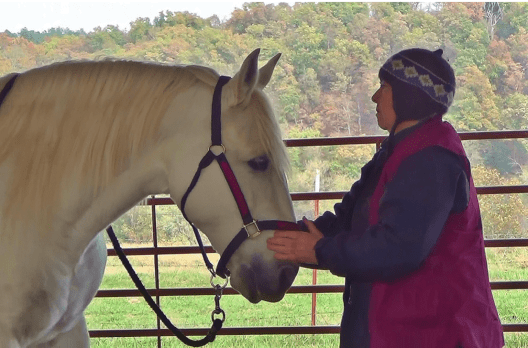


JOYFull Horses: Using Environmental Cues

Using Environmental Cues

Spring is clinic season which means a lot of traveling for me.  I haven’t been able to post anything since the beginning of April which also means some of you may have lost track of where we are in the book.  At the end of Part One I asked the question: what are ten things you would want a novice trainer to know about cues?  In Part Two I began to answer that question.  So far my list includes:

1.) Cues are not Commands.

2.) Cues can be non-verbal.

3.) The environment can be a cue. 

In the first chapter of this section on environmental cues I shared some stories about Panda, the miniature horse I trained to be a guide.  Her work illustrates well the many ways in which the environment can cue behavior.  

IMG_1994_1 Panda Ann great walk

Now in this post I’ll be looking at ways we can all use environmental cues in our training.

Every Day Environmental Cues
Panda’s training shows how much inanimate objects can cue behavior.  You may never ask your horse for the kind of work that is expected of a guide, but you can still make effective use of environmental cues.  They can help turn a frustrating or even dangerous situation into play.

Here are a few examples:

For a horse who rushes out to turnout – even to the point of rearing if you try to slow him down – teach him to stand on a mat.  Then put out a series of mats on his way out to turnout.  Now instead of trying to keep things calm over the long stretch to turnout, all he has to do is walk a couple steps to the next mat – click and treat!  Turn each mat into a station where he can engage in some favorite game.  That takes the focus off the turnout.  In fact when you do finally get to the paddock, you may find your horse doesn’t want you to leave.

“Must I go eat grass?  This is so much more fun!”

Shannon mat series

For the barn-sour, herd-bound horse who doesn’t want to leave the comfort zone of his friends, hang targets at strategic points around the barnyard and along the driveway.  Click and reinforce him for walking to the target.

For the horse who worries out on trails, take his toys out with him so he can play familiar games.

Magic with ball
Combine mats with a circle of cones to teach a horse how to trot around a circle.  Lay out a small circle made up of cones and one mat.  Your horse will begin on the mat and end up back at the mat – click and treat.  As you gradually expand the circle, he’ll understand that his job is to stay out around the the outside of the cones.


For the horse who fidgets and fusses to be groomed, hang a stationary target or give him a mat to stand on.

Mounting blocks become wonderful environmental cues.  Teach your horse to bring himself over to your mounting block and line himself up so it is easy to get on.  It’s not only a fun behavior to “show off”, it’s also a great way to measure how ready – or not – he is to ride.

(Note: This video features Michaela Hempen, one of my coaches for the on-line course.  I almost didn’t use this video because she wasn’t wearing a hard hat. When I mentioned it to her, she said she normally wears a hard hat.  She just couldn’t resist getting on.  I decided to use the clip after all because it is a great example of the joy this training brings to both horses and handlers.  And it also gives me an opportunity to say safety always comes first.  Certainly good preparation contributes to safety, but hard hats are still important.)

These are just a few training suggestions.   The more creative you are, the more playful you can be with your horse.

When you have a training challenge, instead of tackling it head on with your normal “horse training” solutions, think instead about how you might use props.  If your horse has trouble turning to move out of your space, how could you use mats to help with this?

Maybe you have large cones or temporary fence posts that can be used like gates on a slalom course.  How could you use them to explain the patterns you want to your horse?

If forward is an issue, teach him to retrieve, and then toss a cone out in front of his path.

If stopping is the problem, set out lots of mats.  Give him a positive reason to stop.  That’s a lot better than the “horse training” solutions of harsher bits and running horses into fences.

If you want your horse to get more exercise, but for some reason you can’t ride, use targets to teach your horse to go from person to person.  This can easily be turned into a game Panda would say she invented and which we named after her: “Panda catch”.  She “taught” us this game when she was a yearling.  At thirteen she plays it with every bit as much gusto as she did then.


As you can see from this article, teaching your horse to stand quietly on a mat has many uses.  What I haven’t included here are the how-to instructions for introducing your horse to mats.  You can find detailed instructions for teaching this lesson in my books and DVDs and in my on-line course.  Visit my web sites to learn more:

 theclickercenter.com                    theclickercentercourse.com

Remember, if you are new to the JOY Full Horse blog, click on the JOY Full Horses tab at the top of this page to find the full table of contents and links to each of the articles I have published so far.

I hope you will want to share these articles by sending links to this blog to your friends.  But please remember this is copyrighted material.  All rights are reserved. Please do not copy any of the “Joyful Horses” articles without first getting written permission from Alexandra  Kurland, via theclickercenter.com

Also note: these articles are not intended as an instruction guide for introducing your horse to clicker training.  If you are new to clicker training and you are looking for how-to instructions, you will find what you need at my web sites:

 theclickercenter.com                    theclickercentercourse.com
JOYFULL Horses: Guide Work: Yes, She Can!

Saying “No”
I ended the previous post by saying that intelligent disobedience shouldn’t just be limited to guide horses.  My wish would be that our big horses could have the same freedom to say “no” that Panda does.

If I have taught well, my horse will understand what I want.  If I have taught well, my horse will want to do what I ask.  If he says “no”, I need to trust that he is aware of something I have missed.  Instead of forcing him to comply, I need to find out what that is.  If I believe that horses are intelligent animals, it makes sense to acknowledge that intelligence and let it be expressed through the training.  Choice is part of clicker training.  Real choice only comes when our horses know that it is safe to say “no”.

Saying “no” to cues that are well understood is part of the job description of a guide.  A guide says “no” to the cue to go forward when it would take the team into the path of an on-coming car.  Wouldn’t it be equally useful to have a riding horse say “no” to going forward down a trail his senses are telling him is unsafe?  Wouldn’t it be empowering – not to mention so much safer – to have a horse stop well before a jump he isn’t sure he can clear?

Instead of forcing a horse to go forward into something he perceives to be dangerous, we could become better at preparing him for the tasks we set. When our horses say “no”, there is a reason.  Taking the time to ask what that reason is would transform horse training.

The importance of Panda is not that horses can serve as guides, but that we can teach them an appropriate way to say “no”.

Guide Work: Yes, She Can!

IMG_1994_1 Panda Ann great walk

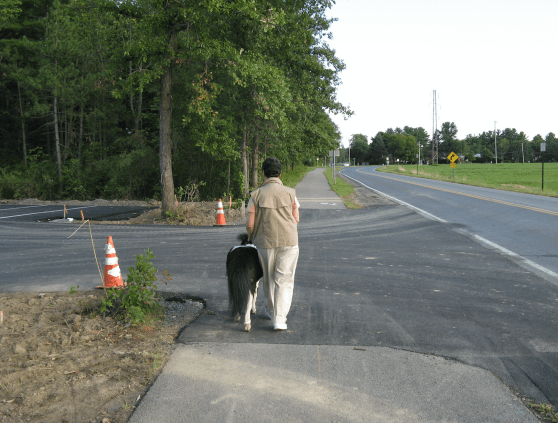
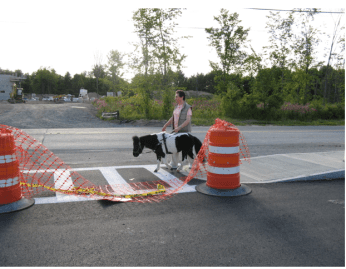
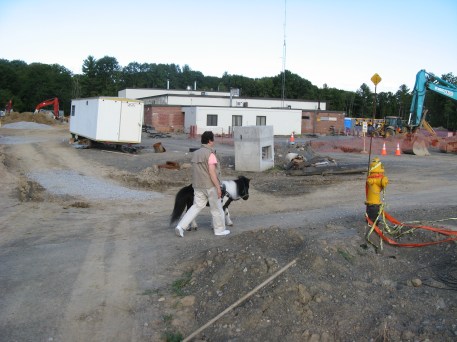
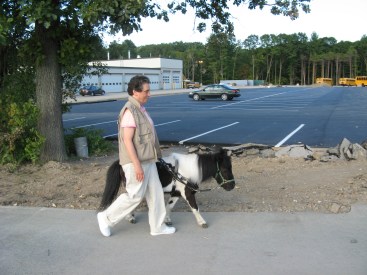
This is one of my favorite photos of Ann and Panda.  Look at how relaxed they both are.  They have just passed through a construction zone, and they are back on an undisturbed section of sidewalk.  Panda is trained just like our riding horses.  We want connection not pull.  Panda is guiding Ann, providing her with all the information that is needed, but there is no strain in either of them.  They are both able to walk in balance, passing information back and forth through harness and lead as needed.  It looks like what it is: a relaxed, enjoyable outing.

Panda shows how much the environment cues behavior.  Ann can’t see when there’s a curb coming up. She can’t see the trash can that’s fallen across the sidewalk, or the overhead branch that’s been weighed down after a summer’s rain.  Panda’s training has taught her to respond to these environmental cues.

As I write this, Panda is fifteen.  She has been in work with Ann for thirteen years.  Well before this age most guide dogs would be retired, but Panda is still a relatively young horse.  She has a job, but to watch her guide, it would be hard to describe it as work.  Panda was trained exclusively through clicker training.  She was never punished for mistakes.

During her training with me, if she missed an obstacle – meaning I got bumped or I tripped over a tree root pushing up through the sidewalk, we would stop and rework the obstacle.  Normally that’s all she needed.  Once she saw the consequence to me, she would make the necessary adjustments and take me safely around not just this obstacle, but all others that resembled it.  She was wonderfully clever at being able to generalize from one example out to a whole class of similar obstacles.

But, But, You MUST Need to Correct Her
When Ann was first transitioning from her guide dogs who were traditionally trained with corrections to Panda who was clicker trained, she told me about a conversation that was occurring on one of the guide dog users on-line discussion groups.  Ann had been describing some of Panda’s training.  The question people had was how do you correct her?  Ann responded that she never needed to correct Panda.  She would then describe, yet again, how Panda was being trained.

“Yes, yes,” they answered back.  “We understand that’s how you taught her, but what happens when you’re out in the real world, and she makes a mistake?  How do you correct her?”

They were truly insistent.  They needed to know how Ann dealt with these transgressions.

Ann wrote back that Panda didn’t make mistakes.  That sounds very smug, but it happened to be true. That was right around the time the three of us went to the Equine Affaire, the big horse Expo that’s held every year in Springfield Massachusetts.  All day Panda guided Ann through the chaos of the trade show.  She navigated her through aisles crowded with people, and from building to building.  There were plenty of distractions, plenty of opportunities to bump Ann into a pole or miss a curb crossing, but Panda’s focus was on her job, not the other horses in the back parking lot, or the kids reaching out to pet her as she walked by.

She did all that plus she served as my demo horse in the presentations I was giving on clicker training.  In the evening we decided she had done enough.  We left her happily munching hay in her stall while we went out for dinner.  There were several us in the group, and at various points in the evening Ann used us to go sighted guide.  That means she took our elbow, and we served as her guide. Every one of us during the course of the evening either tripped her up at a curb or bumped her into a pole.

As Ann wrote later, she didn’t think punishing us for the mistakes would have helped us to be better guides.  Nor would it help Panda.  If a mistake is made, Panda is not reprimanded for it.  She is simply given another opportunity to try again.  As needed, we break the overall task down into smaller segments and teach her any missing skills.  Once she understands how to navigate through a particular type of obstacle, Panda doesn’t make the same mistake twice.

Horses can live a very long time.  Hopefully, Panda and Ann will be partnered together for thirty years and more.  As our cities and towns become even more congested, the challenges a guide faces will grow increasingly complex.  Keeping it fun, keeping it more like play than work is an important part of maintaining this life-long partnership.

Panda Ann Scrabble

Panda gets plenty of opportunities to play as this video shows.  It was taken on New Year’s Day, 2016 during a holiday visit to the barn.

Coming Next: Chapter 2: Using Environmental Cues

You can read about Panda’s early training on my web site: theclickercenter.com. Visit: http://www.theclickercenter.com/ThePandaProject.html

Also, there is an excellent children’s book that was written about Panda:  Panda: A Guide for Ann written by Rosanna Hansen with photographs by Neil Soderstrom, published by Boyd Mills Press 2005.

Remember, if you are new to the JOY Full Horse blog, click on the JOY Full Horses tab at the top of this page to find the full table of contents and links to each of the articles I have published so far.

I hope you will want to share these articles by sending links to this blog to your friends.  But please remember this is copyrighted material.  All rights are reserved. Please do not copy any of the “Joyful Horses” articles without first getting written permission from Alexandra  Kurland, via theclickercenter.com

Also note: these articles are not intended as an instruction guide for introducing your horse to clicker training.  If you are new to clicker training and you are looking for how-to instructions, you will find what you need at my web sites:

theclickercenter.com                    theclickercentercourse.com
JOY Full Horses: Intelligent Disobedience

Number 3: The Environment can be a Cue
Chapter 1:  Emotions and Environmental Triggers

My Cue Trumps Your Cue
In the previous section Panda, the miniature horse I trained to be a guide, provided us with many examples of environmental cues.  Among them were curbs marking a street crossing.  Moving cars are one of the many dangerous obstacles a guide has to deal with.  People who aren’t familiar with guides often ask how the animal knows when a light has turned green and it’s okay to cross.

The answer is that’s not the guide’s job.  The guide finds the curb and stops the handler before they get to the edge.  Then the handler listens to the traffic patterns.  When the handler thinks it is safe to cross, she will tell the guide to go forward.  But these days with cars turning on red, and so many people riding bikes, and the new, very quiet electric cars, there are many opportunities for mistakes.

Moving cars trump go forward cues.  If Ann tells Panda to go forward, but Panda sees something coming that will cut across their path, she will stand her ground and refuse to move until the vehicle has passed.  If they are already crossing and a car suddenly comes towards them, she will stop quickly and back up, taking Ann out of the path of the on-coming car.


Intelligent Disobedience
When Ann asks Panda to go forward off a curb, Panda knows perfectly well what she is supposed to do.  When she refuses to move, she isn’t being bad.  She’s doing her job.  There’s a name for this kind of response: intelligent disobedience.

When I took on the project of training Panda, this was one of the areas I was most interested in   There were so many myths floating around about intelligent disobedience.  Ann told me that many people believed guide dogs were especially intelligent and could do a job that ordinary dogs just wouldn’t be able to handle.

There were certainly people in the horse community who huffed and puffed when they heard about Panda.  “If I were blind,” they declared, “I would never trust a horse to guide me.”

I always thought – how sad.  Is that really what they think about the horses that they get on and ride?  How little do they understand the amazing abilities of the horses they say they love.  I would much rather think that I am entrusting my safety to an intelligent animal than one I regard as stupid.

Horses as Guides
As a herd animal, guiding made perfect sense to Panda.  It was easy to teach her the basic elements.  A dog might want to explore the hedgerow.  That’s where the rabbits live.  To a horse it makes sense to go around.  By extension going around other obstacles also makes sense.  And because horses do live in herds, they understand that they need to make room for the person walking next to them.

A dog is nimble and can easily handle rough footing.  So can a horse, but they are very aware of where they put their feet.  Looking out for rough ground makes sense to them.  A broken leg from a fall is a death sentence for a horse.

Dogs are distracted by squirrels, other dogs, pigeons and lots of other things that can run or fly away.  Panda has never chased a squirrel in her life.  She can be distracted by grass, but as Ann has said, the grass isn’t likely to run away.  It’s a much easier distraction to deal with.

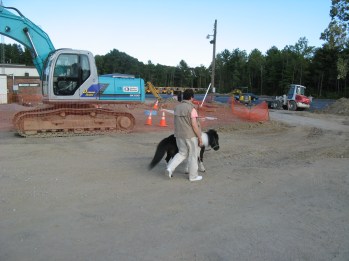
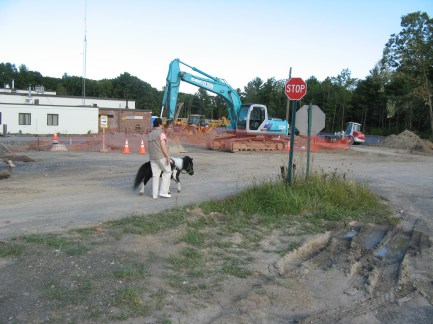
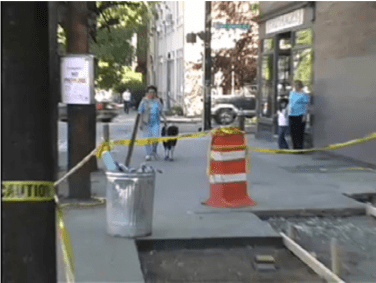
Some horses are very spooky and nervous in unfamiliar settings.  Panda seems to thrive on the puzzles they present.  I live not far from Albany, the Capital of New York State. During the time Panda and Ann were first learning to work together, there were a lot of street repairs going on in Albany.  We used to take field trips into the downtown sections where we knew the sidewalks were under construction.  Every visit presented monster-sized challenges.  Sometimes the entire sidewalk would be torn up, and Panda and Ann would have to work together to find a safe way through the construction zone.  I never saw Panda even hesitate.  She would size up the task in front of them and proceed forward. (You can see an example of one of these sidewalk hazards in the video at the top of this page.)

IMG_1991 Panda Ann construction

Panda guiding Ann safely through a construction zone.

Ambulances blasting their sirens just a few feet away, people on bicycles, busy traffic, nothing seemed to surprise or frighten her.  Whatever was in front of her was just another puzzle, another opportunity to earn clicker treats, another part of the game.

Teaching Panda to guide a handler over and around obstacles was easy.  It was really just a matter of supporting the good decisions she was already making.  The outstanding question was would she be able to understand intelligent disobedience?  Could a horse understand this concept?

Evidence in Support of Intelligent Disobedience
Before I ever started training Panda, I already had the answer to this question.  Anyone who rides out has experienced some form of intelligent disobedience.  There are so many stories of horses who have refused to go forward on a trail.  The horse stops, feet firmly planted, his whole body clearly saying “No!”. The rider gets after him, kicking him, maybe even hitting him with a crop or the long end of the reins.  The horse just plants himself even more.  And then a friend’s horse catches up to them and passes them on the trail, only to find itself mired up to its belly in deep mud.  Horse and rider are lucky to escape uninjured.

Of course, the first rider always feels about two inches tall.  Her horse was trying to tell her the trail wasn’t safe.  This is a horse who grew up free to roam over large tracks of land.  He understood the signs that were in front of him.  The second horse may have grown up in a small field and had never seen this kind of boggy ground before.  But the first horse was trying in every way he knew how to say that it wasn’t safe to go forward, and his rider didn’t know enough to listen.

Trusting Intelligent Disobedience
Intelligent disobedience is a wonderful response to build into our horses.  Panda’s training shows us we can do so deliberately.  If I know that I have taught a behavior well and my horse doesn’t respond to my cues, I need to look for a reason.

Suppose I have taught my horse to come to me from the middle of the arena over to a mounting block. If he comes every time, and then suddenly one day, he hangs back, I need to look for a reason.  It may be that he isn’t feeling well, and his reluctance to ride is his way of telling me. It may be that I’m in a grump of a mood, and again, he is letting me know that riding isn’t the best choice for the day.  Whatever the reason, I need to listen and not simply assume that my horse is “testing me” with his disobedience.  That “disobedience” could one day save my life.

Teaching Traffic Checks
Let me describe briefly how Panda’s traffic checks were taught.  The lesson that I followed was given to me by Michele Pouliot.  Michele has thirty plus years of experience working with guide dogs.  She is currently the Director of Research and Development at Guide Dogs for the Blind where she has played a primary role in transitioning the training of their dogs to clicker training.

I don’t know if this is still how she teaches traffic checks, but these are the instructions she gave me in 2002 when I was teaching Panda this lesson.

Step 1: We began with a parked car.  We walked directly toward the car.  When Panda stopped in front of it, I clicked and reinforced her.

Step 2: I enlisted the help of one of my experienced clicker friends.  As we approached the car, she began to drive it very, very slowly forward towards us.  Panda stopped on her own, and I cued her to back up.  Click and treat.

Step 3: Panda stopped and backed up without needing to be cued by me when the car went into motion.  Click and treat.

Step 4: We now moved to simulated traffic checks.  Still using my experienced driver, we had her wait for us in a neighbor’s driveway.  (You do wonder what people looking out their windows must have thought!)  I walked Panda along her familiar route.  As we began to cross the driveway, my driver would pull out slowly across our path. Panda backed us up out of harm’s way.

We were essentially teaching Panda that moving cars trumped the go forward cue.  If I asked her to go forward, and there were no cars or bicycles coming, she was to take me across the intersection.  But if there was a vehicle in motion, she was to stop.  She wouldn’t be punished for refusing to respond to a known cue.   Keeping us out of the path of a car produced clicker treats.

Step 5: The traffic checks continued.  We used different cars and different locations.  They became increasingly more like real world situations.

Step 6: Once Panda was paired up with Ann, we went through the whole process again, making sure that the behavior was solid now that the possibility of real traffic checks existed.

Testing the Training – How Strong are your Habits?
Panda was so good at these checks I wanted to get them on film.  Our usual driver wasn’t available so we enlisted the help of Ann’s husband.  We gave him the instructions.  He was to wait for us in a neighbor’s driveway and, as Ann approached with Panda, he was to pull out in front of them.

That was fine.  He knew how traffic checks worked.   The one part of the instructions we forgot to tell him was we only needed one or two traffic checks.  After that he could go home, and we’d keep walking.  Since we left that part out, at every driveway and parking lot intersection along our route – there he was.

Later when we watched the video, we thought we should have the sound track from Jaws playing in the background.  There was the gold van stalking Ann and Panda yet again!  Ann was taking her usual route heading for the barn.  It’s a long walk, and that day we all learned just how many driveways there are between her house and the barn!  (You can see one of the many of these traffic checks in the video at the top of this page.)

All of these traffic checks served them well.  Prior to pairing up with Panda, Ann had had two guide dogs who both failed to stay in work.  They were both very distracted by other dogs, squirrels, really anything that moved.

Crossing streets was always a white-knuckled affair.  Ann would get to the barn with horror stories about missed curbs and missed traffic checks.  Neither of these dogs should ever have been passed by the school that trained them, but they were hoping that an experienced handler like Ann would be able to manage them.  In both cases they had to be returned to the school and re-homed into other careers.   I think both went on to be police dogs, work they were much more temperamentally suited to.

Ann’s experience with Panda was completely different.  Dogs were something you ignored.  And traffic checks – for Panda they were like playing a video game where you’ve reached master level.  Ann would get to the barn laughing, telling me about that day’s adventures.  For well over a year the high school she walked past on her way to the barn had been under construction.  Every day there was some new challenge for them.  One day there would be a sidewalk for them to navigate along.  The next day it would be gone.  All that was left would be a gaping hole and piles of rubble.

IMG_1990 Panda Ann construction

This once familiar landscape has been transformed by construction, but Panda still manages to find a safe route.

Traffic checks didn’t just mean avoiding cars, school buses and the high school track team out for the day’s run.  It now included encounters with heavy construction vehicles and bulldozers. Panda had to watch out for traffic and figure out how to find a route across a parking lot that was completely transformed.  This was nothing like the tidy sidewalks and suburban side streets she had trained over.  All those trips into Albany paid off here.

Saying “No”
I’m writing about intelligent disobedience because this is something we need to be more aware of in our training.  I wish our big horses could have the same freedom to say no that Panda does.  If we’re going to ride a horse, he should be able to say no, not today.  If we’re going to jump a horse, or ride him over uncertain ground, we need to trust those times when he slams on the brakes and says not there. You may not see the slick ground or smell the grizzly bear, but I can.

If I have taught well, my horse will understand what I want.  If I have taught well, my horse will want to do what I ask.  If he says no, I need to trust that he is aware of something I have missed.  Instead of forcing him to comply, I need to find out what that is.  If I believe that horses are intelligent animals, it makes sense to acknowledge that intelligence and let it be expressed through the training.  It makes sense to use their senses to help keep us both safe.

The importance of Panda is not that horses can serve as guides, but that it is okay for a horse to say no.

Coming next: What About Mistakes?  When is it okay for us to say no?  Panda has some things to teach us about that, as well.

You can read about Panda’s early training on my web site: theclickercenter.com. Visit: http://www.theclickercenter.com/ThePandaProject.html

Also, there is an excellent children’s book that was written about Panda:  Panda: A Guide for Ann by Rosanna Hansen with photographs by Neil Soderstrom, published by Boyd Mills Press 2005.

Remember, if you are new to the JOY Full Horse blog, click on the JOY Full Horses tab at the top of this page to find the full table of contents and links to each of the articles I have published so far.

I hope you will want to share these articles by sending links to this blog to your friends.  But please remember this is copyrighted material.  All rights are reserved. Please do not copy any of the “Joyful Horses” articles without first getting written permission from Alexandra  Kurland, via theclickercenter.com

Also note: these articles are not intended as an instruction guide for introducing your horse to clicker training.  If you are new to clicker training and you are looking for how-to instructions, you will find what you need at my web sites:

theclickercenter.com                    theclickercentercourse.com
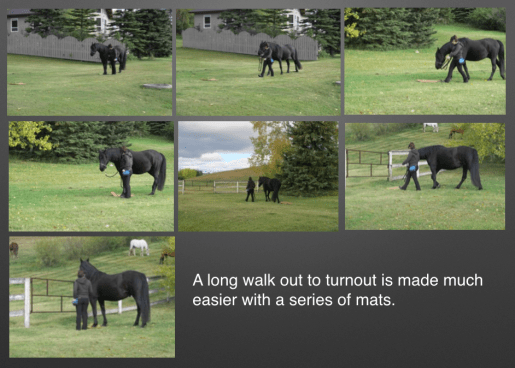


JOY Full Horses: Ten Things You Should Know About Cues

Number 3: The Environment can be a Cue
Chapter 1:  Emotions and Environmental Triggers

The previous section began a discussion of environmental cues.

Panda environmental cues

Panda, the miniature horse I trained to be a guide, provides us with lots of examples of environmental cues.  In this photo there’s no real curb to mark where the sidewalk ends and the driveway begins,  but Panda has stopped exactly where she should.  This section of their daily walk had been under construction for months.  Every day the landscape was different.  In this photo the pavement has been newly patched.  The appearance of the intersection has changed dramatically from it’s previous state, but Panda still knows what to do at this intersection.

Looking ahead to the opposite side of the driveway we see another place where the environment will cue a stop.  Stopping at the far side of the driveway helps her blind handler stay oriented.  The stop on the up-curb side of the driveway lets her know when they have come to the beginning of the next section of sidewalk.

The sidewalk itself is another environmental cue, one which overrides the pull of the grass to the side.  Panda will guide her handler straight along the sidewalk to the next curb crossing.  There are lots of cues being exchanged between Panda and her handler, but it is Panda’s responsibility to respond correctly to the environmental cues which her handler cannot see, and to alert her to any changes or obstacles in their path.

I ended the previous installment by promising you some more Panda stories and here they are:

Goose Neck Trailers
I can’t resist telling one of my favorite Panda stories.  When Panda was first being paired up with Ann, we spent a day at the Equine Affaire, a giant horse expo and trade show that is held every year in western Massachusetts.  It’s a wonderful place to take a guide-in-training.  The concentration of challenging obstacles is a trainer’s delight.  We had loading ramps that could substitute for railway platforms, and garage doors that gave us lots of practice with overhead obstacles, not to mention the crowds of people in the trade show to navigate through.

Panda handled it all with ease.  Late in the day as we were walking through the back parking lot area, we passed a goose neck trailer that was parked alongside the sidewalk.  I decided to put Panda through one more challenge.  I instructed Ann to stop at this point and cross the street.  This would take them directly under the front of the trailer.

gooseneck trailer

The goose neck portion was right at forehead-hitting height, but I had no worries.  Of course, Panda would stop.  Except she didn’t.  I was about to cry out an alarm.  It looked as though Panda was going to crash Ann straight into trailer. But before I could get the words out to say STOP! Panda slammed on the brakes, looked up at the trailer hitch and hastily backed Ann away.

The double take she did was priceless. It was as if she was saying: “Where did that come from! How could I have missed that?!”

It reminded me of those times when I’m driving, and I’ve been so focused on the road ahead that I have completely failed to see a car coming up alongside me.  “How could I have missed that!?” I’ll exclaim as the car comes into view.  I could sympathize with Panda’s surprised reaction to the goose neck.

Now for Panda the goose neck trailer was not a hazard.  She could easily fit under the hitch, but Ann would most certainly have hit her head.  When Panda looked up, it was clear to me that she had seen the overhead obstacle and was backing up to avoid it.

Every class of obstacle requires a different type of response.  Find an empty chair means Panda scans the available seats and takes Ann to an empty one.  She alerts her to the presence of the chair by putting her nose on it.

For doors Panda finds the door and then orients her body sideways towards it so it is easy for Ann to reach out and find the handle.

A Trainer’s Play Ground

Panda descending museum stairs
Stairs present a special hazard.  It’s important that the handler understands that the guide is stopping at a flight of stairs and not at a single curb.  Towards the end of Panda’s training we spent a fun day practicing stairs during a visit to Albany, the capital of New York State.

concourse

A photo of the Empire State Plaza taken from the steps of the State Museum. The State Capital is straight ahead. To the right is The Egg, the Center for Performing Arts.

We turned the state plaza into our personal playground.  We were in a huge concourse that serves as a public park.  Underneath the plaza is a maze of offices and shops.  At one end is the state library and museum.  At the other end the State Capital.

state museum

The State Museum with its imposing flight of steps leading up to the entrance.

state capital building

The State Capital Building at stands at the opposite end of the Concourse

These are beautiful buildings, but we were not there for the sight seeing.  The plaza provided us with a wonderful array of training obstacles.  There were stairs everywhere – stairs going up, stairs going down, stairs in all sorts of unexpected places.

Ann wasn’t familiar with the area, so she never knew for certain what was coming up next. I was having a grand time directing her towards every unexpected obstacle I could find, the more challenging, the better.  If you’re given a playground, you should play in it!

Stairs cue a distinct set of responses from Panda.  When she comes to a set of stairs, she will stop before the first step.  At this point Ann will not know what is in front of them.  She will tell Panda to go forward.  In response Panda will put one foot on the first step – either up or down – and again stop.  She will not go forward until Ann has also placed her foot on the step and given her the verbal cue to go. Panda is not to proceed until both of these things have happened.  It’s important that Ann not only knows there’s a set of stairs in front of her, but that she also has time to prepare herself for them.  Panda is not to go forward until Ann tells her she’s ready.

I think we found every set of stairs in the concourse that day, including the long flight that takes you up to the State Library.  I especially liked pointing Ann and Panda towards the stairs that led down into the underground concourse.  Up stairs are more expected.  It’s the ones that took them down below the Plaza that really tested them as a team.

The Herd Horse Advantage
Pedestrians, bikes in motion, dogs being walked, baby carriages, parked cars are all obstacles that cue specific responses.  One of the things that I most enjoy is watching Panda maneuver Ann through a crowd of people.  I will sometimes position myself far enough ahead so that I can see Panda and Ann approaching.

Panda will be scanning what is in front of her.  You can see her eyes moving, taking in all the activity that’s coming up.  She’ll make little course adjustments so there is never a collision.  As a herd animal, she is superb at being able to judge where she is going to be relative to people who are moving towards her from the opposite direction.  The course corrections are seamless.  The only ones swerving abruptly are the people doing double takes when they realize what has just passed them!

Coming Next: Intelligent Disobedience   This is the name given for those times when a guide does not respond to a cue the handler has given, but instead responds to environmental cues.  It might be ignoring the cue to go forward and instead backing up out of the path of an approaching car.  Intelligent disobedience is an important part of every guide’s training.  It is also something we would do well to be aware of in the training of our full-sized horses.

Remember, if you are new to the JOY Full Horse blog, click on the JOY Full Horses tab at the top of this page to find the full table of contents and links to each of the articles I have published so far.

You can read about Panda’s early training on my web site: theclickercenter.com. Visit: http://www.theclickercenter.com/ThePandaProject.html

I hope you will want to share these articles by sending links to this blog to your friends.  But please remember this is copyrighted material.  All rights are reserved. Please do not copy any of the “Joyful Horses” articles without first getting written permission from Alexandra  Kurland, via theclickercenter.com

Also note: these articles are not intended as an instruction guide for introducing your horse to clicker training.  If you are new to clicker training and you are looking for how-to instructions, you will find what you need at my web sites:

theclickercenter.com                    theclickercentercourse.com
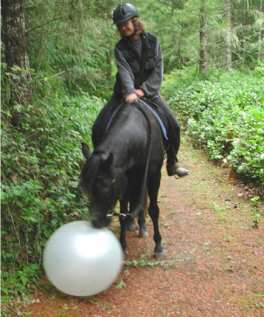


JOY Full Horses: Ten Things You Should Know About Cues

Today’s installment begins a new unit.  So far in my list of ten things you should know about cues I have: 1.) Cues are not commands. 2.) Cues can be non-verbal

This brings us to:

Number 3: The Environment is a Cue

Panda zebra crossing

This mini is a guide horse for the blind.  She’s just done a beautiful stop at the curb, and now she’s guiding her handler across the entrance to a busy parking lot.  Just to add to the complexity of the task, the parking lot is under construction.


Chapter 1:  Emotions and Environmental Triggers

Environmental Cues
We seem to have wandered a long way from the ten things I would want a beginner to know about cues.  So let me pull us back to that list for a moment.

Beginners tend to think of cues as something they present to the animal, but cues can also come from inanimate objects.  In fact much more than we may be aware of these environmental cues move us through our day from one habit pattern to the next.

Many of us have experienced this with our horses.  If you work in an arena, you may have found that there is one corner where your horse’s balance makes it easiest to ask for a canter.  Maybe you’re starting a youngster, so setting up the canter out of the short side makes sense.  He pops up nicely into the canter which is reinforcing for both of you.  It gets easier and easier to ask for the canter out of that corner, except now, even when you aren’t wanting to canter, that’s what he’s offering.  That corner has become the cue, not your riding aids.

We often experience the same thing riding out.  The stretch of trail where the path widens out into a gently rising slope over good footing just invites a canter.  Both you and your horse enjoy a good run up the hill.  You don’t even notice that the trail has taken over control of your horse – until you are riding out with a friend who is on a young horse that she doesn’t yet want to canter.  You get to the bottom of that hill, and your horse is off and running – following instructions that you helped to write.

Here’s the mantra to remember:

“Never make your horse wrong for something you have taught him.”

Punishing the canter isn’t the solution.  That may squash the behavior for the moment, but it will have fallout.  For one thing punishment takes you a long way from play.  You may stop the canter in that moment, but the damage you do to your relationship is a price you may not want to pay.

In a later section I’ll describe how you can manage these environmental cues by teaching cues in pairs.  But before I get to the solution to the problem, let’s first dig down a little deeper to see how environmental cues work.

Guide Horses

Panda sidewalk construction

The “Equine Poster Child” for environmental cues is Panda, the miniature horse I trained to be a guide for her blind owner, Ann Edie.

Guide work is dependent upon environmental cues.  It’s the job of the guide to spot changes in elevation, overhead obstacles, moving cars, other pedestrians; to find the door, the stairs, an empty chair; and to point out designated landmarks that the blind handler uses to navigate, such as driveways and street crossings.

The different triggers elicit different responses.  When Panda spots a section of sidewalk that’s been pushed up by a tree root and that might trip her person, she stops and waits for her handler to find it.

As Panda approaches a street crossing where there is no raised curb, she will pull her handler to the left hand edge of the sidewalk.

At the opposite side of the street if she encounters a raised  curb, Panda will stop and tap the curb with her hoof.

Out in the country where there is no sidewalk to follow, Panda will follow the curve of the road past a street crossing and then stop.  She will not go directly across or stop as she might at a driveway.  Following the curve of the corner lets her handler know that they have come to an intersection.

At street corners with traffic lights, her handler will direct Panda to “find the button”, and Panda will take her to the pole with the pedestrian crossing signals.

If they encounter an overhead obstacle such as a tree branch weighed down with snow that her handler won’t fit under, Panda will stop and look up.  The movement tells her handler what sort of obstacle is in front of them.


Coming next: More Panda stories.

IMG_1989 Panda Ann construction

Even when the familiar environmental cues are obscured by construction, Panda still finds the way from curb to curb.


You can read about Panda’s early training on my web site: theclickercenter.com. Visit: http://www.theclickercenter.com/ThePandaProject.html

Also, there is an excellent children’s book that was written about Panda:  Panda: A Guide for Ann written by Rosanna Hansen with photographs by Neil Soderstrom, published by Boyd Mills Press 2005.

Remember, if you are new to the JOY Full Horse blog, click on the JOY Full Horses tab at the top of this page to find the full table of contents and links to each of the articles I have published so far.

I hope you will want to share these articles by sending links to this blog to your friends.  But please remember this is copyrighted material.  All rights are reserved. Please do not copy any of the “Joyful Horses” articles without first getting written permission from Alexandra  Kurland, via theclickercenter.com

Also note: these articles are not intended as an instruction guide for introducing your horse to clicker training.  If you are new to clicker training and you are looking for how-to instructions, you will find what you need at my web sites:

theclickercenter.com                    theclickercentercourse.com
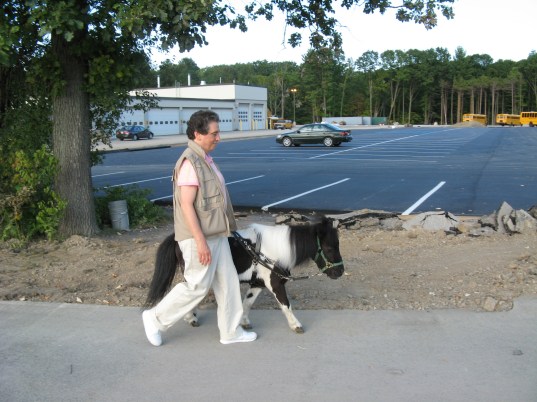


Joy Full Horses: Tag Teaching and Keystone Habits

This is a continuation of Part 2 of my new book, “JOY Full Horses”.  If you are new to this series, go to the contents for links to the previous articles.

The previous section highlighted the importance of separating feedback from instruction.  We’re all teachers whether we give ourselves that label or not.  We give feedback and instruction all the time – and often we fall into the trap of combining them together:  “That was great, but . . .”  It’s easy to find yourself doing this since that’s what most of us have had modeled for us by our own teachers.

So suppose you notice that this is indeed your pattern.  You’re one of the legions of people who negate all the “that was great” with that irresistible “but . . . “.  You want to change.  In this section we’ll look at several key elements that help transform that good intention into a well-formed habit.

Tag Teaching and Keystone Habits
As you’ve seen, thinking about TAGpoints helps keep your training positive.  You don’t have to limit yourself to tagging other people. You can build great habits by tagging yourself.

Pick something you want to work on, and identify achievable, measurable, realistic goals for yourself.  Now be your own best coach.  When you meet your criterion, acknowledge it, then observe your own self-talk.  You want to move from: “Okay, you did it, but . . .” to “That was great! I just met that goal.  Now in this next round I’m going to monitor this criterion and tag myself for . . .”  That’s the good coaching habit you want to build.

Remember you are looking for the keystone habits and those small wins that begin to accumulate into transformative changes. One of the great values of TAGteaching is it focuses the spotlight on what you want.  As you go through the focus-funnel process looking for a way to say what you want in five words or less, you’ll find yourself discarding all the “yeah, buts” and “don’t wants”.  Instead your attention will be drawn to that one key behavior you can consistently change.

Suppose you are feeling guilty because work has been so crazy recently that you haven’t had much time for your horse.  Instead of beating yourself up because you feel that you are neglecting him, what could you tag yourself for?  Maybe instead of checking your personal emails over lunch, you decide to write a training plan for five minutes of clicker play later that day.  Tag for you!

When you spend those few minutes during the day thinking about your horse, you may find that you return to work feeling refreshed and ready for the rest of the day.  There’s the reward that is going to support this new habit!

When you concentrate on these tiny moments of success, they become mental triggers.  Instead of beating yourself up because you aren’t able to spend as much time with your horses as you’d like, you’re preparing yourself well for the time you do have.

With that training plan in mind, you’ll be more productive.  You and your horse will have a great time together.  You’ll leave the barn on a euphoric high feeling as though you have accomplished something. That provides you with more rewards for a routine that’s becoming filled with good habits.  Eventually these habits will take over, and you will discover that you are not only enjoying work more, you’re creating more and more barn time, as well.

Journals
Keeping a journal is a great way to track these changes – and to build even more good habits.  Journaling seems to be one of those world divides sorts of activities.  Either you are a record keeper, have stacks of diaries sitting in your bookshelf, or you have one notebook with half a page filled out and the rest is a blank testament to good intentions gone astray.

It’s probably no surprise that I’m a record keeper.  I have stacks of training journals.  They make dull as dishwater reading, but then they aren’t intended to be read.  They are there for record keeping only.

When I was first starting out with Peregrine’s mother, I kept a daily log of every one of our sessions.  I knew in the evening I would be recording whatever training choices I made.  If I got mad and whacked her with a whip, I knew I would have to write about it that night.  More than that I would have to explain my actions. Saying I got mad and vented my frustration on my horse wasn’t anything I ever wanted to be writing in my journal.  So just the knowledge that I was keeping this journal, kept me from reaching for those “knee-jerk solutions”.  It helped mold the pattern of thought that became a pattern of habit that turned into the foundation of clicker training.

It turns out there is plenty of evidence to support the value of journaling.  In “The Power of Habits”, Charles Duhigg cites a study in which 1600 people kept food journals.  At least one day per week they recorded everything that they ate during that day.

When they did this, they became much more aware of their patterns, and they were able to lose significantly more weight than people who used other methods.

“It was hard at first.  The subjects forgot to carry their food journals, or would snack and not note it. Slowly, however, people started recording their meals once a week – and sometimes more often. . . . Eventually, it became a habit. Then something unexpected happened.  The participants started looking at their entries and finding patterns they didn’t know existed.  Some noticed they always seemed to snack at about 10:00 am so they began keeping an apple or a banana on their desk for mid-morning munchies.

The researchers hadn’t suggested any of these behaviors. They had simply asked everyone to write down what they ate once a week.  But this keystone habit – food journaling – created a structure that helped other habits to flourish. Six months into the study, people who kept daily food records had lost twice as much weight as everyone else.”

Forming The Record Keeping Habit
If you don’t already keep a journal, the next question would be how do you form that good habit?

What cue can you establish for yourself that will trigger journal writing?  It might be putting your training log on your bedside table so you write in it every evening before going to sleep.

white board for record keepingIt might be a white board that you keep in your barn aisle with a check list of things accomplished during the day.

Maybe you are less of a dinosaur than I am and you have an app on your computer that cues you first thing in the morning to open your journal.  Or maybe it is that first cup of coffee in the morning that you have associated with sitting down and writing.

When you pick up your journal and begin writing, remember to give yourself a mental “yes, I did it!” TAG.

You pick the cue that starts the behavior.  You also get to pick the reward.  It might be as simple as checking off boxes on your white board and seeing the board fill up.  It might be the pleasure you gain reliving the day’s successes.  Or you might give yourself a more concrete reward. Maybe you fill out your journal in the evening while you have a relaxing cup of tea.

Forming a Journaling Community
Earlier I wrote about the importance of community.  The dieters wrote a log of their food habits one day per week. Perhaps you might decide that one day a week you will write a summary of the week’s training and email it to a friend. What have you been working on? What discoveries did you make? What connections between the lessons did you see?  What successes did you have?  What questions arose out of all this?

Your friend can be enlisted as a training partner.  She doesn’t necessarily have to be another horse person, just someone you enjoy sharing with.  She might have a project of her own that she’d like to keep track of.  Together you can help each other build the good habit of journaling. Writing a quick email at the end of the day to a friend describing the day’s training can be a wonderful way to keep a record.  This is different from blogging. This is private.  It doesn’t need to be long or insightful.  You can keep it simple because it is just a quick note between friends.

Key Stone Habits for Life
Establishing the journal habit is a good way to learn how to deliberately build a good habit. Building that first habit prepares you to move on to other keystone habits.  You’ll begin to see how all these small wins contribute to good changes in your life.

The next time you’re feeling frustrated with your horse, your kids, your co-workers, your significant other – instead of reaching for the old knee-jerk reaction, you’ll catch yourself.  You’ll be asking: what do I want to be writing in my journal tonight? Do I want to say I lost my temper and yelled at my co-worker for misfiling a document?  Or do I want to be describing the TAG points I came up with to help her become more organized?

We’ll let Charles Duhigg have the last word in this chapter:

“Keystone habits transform us by creating cultures that make clear the values that, in the heat of a difficult decision or moment of uncertainty, we might otherwise forget”

Isn’t this exactly what we want for our horses?  Oops.  I got the last word in.  I couldn’t help myself, so I’ll add a couple more!  As I’ve said before, the advantage of presenting this book in small installments is it creates pauses. So in this pause, I hope you’ll consider your journaling habit.

If you’re already a record keeper, how could you use it to help create other good training habits?  And if you aren’t yet a record keeper, what routine could you begin today to get that habit loop going?  One thing good trainers have in common is they value record keeping.  So give journaling a try.  You may be surprised by all the good things that come from this one keystone habit.

This ends the section on Non-verbal Cues.  Up next is the third in my list of ten things you should know about cues.


Remember, if you are new to the JOY Full Horse blog, click on the JOY Full Horses tab at the top of this page to find the full table of contents and links to each of the articles I have published so far.

I hope you will want to share these articles by sending links to this blog to your friends.  But please remember this is copyrighted material.  All rights are reserved. Please do not copy any of the “Joyful Horses” articles without first getting written permission from Alexandra  Kurland, via theclickercenter.com

Also note: these articles are not intended as an instruction guide for introducing your horse to clicker training.  If you are new to clicker training and you are looking for how-to instructions, you will find what you need at my web sites:

theclickercenter.com                    theclickercentercourse.com
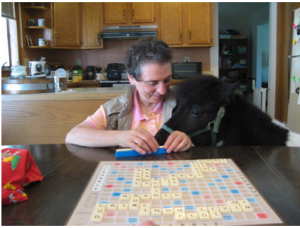
JOY Full Horses: Tagteaching – The Focus Funnel

This is a continuation of Part 2 of my new book, “JOY Full Horses”.  If you are new to this series, go to the contents for links to the previous articles.

In the previous post I introduced you to TagTeaching which stands for teaching with acoustical guidance.  Tagteaching takes the excess words out of coaching and shifts the focus from what a student is doing wrong and needs to correct to what is wanted.  Instruction can be pared down to the four WOOF criteria:

What we want
One thing at a time
Observable
Five words or less.

I described what each of those meant in the previous installment.  Now in this section, I’ll introduce you to another tagteaching tool: the focus funnel.

The Focus Funnel
The founder of Tagteaching,  Theresa Mckeon, developed the concept of the focus funnel for TAG instruction.

A funnel is wide at the top and narrows down at the bottom.

So at the top of the focus funnel is a broad description of the lesson.  This is the part most of us find easy.  We like our words!

Next the coach reduces this general description of the task down to clear instructions about what is wanted.  Lastly she reduces this even further down to a point of focus which can be described in five words or less.

The Focus Funnel Applied to Horse Training
Suppose you are introducing a friend to clicker training.  You’re going to show her how to ask her horse to touch a target.  You’ve probably already given her a general overview of targeting and explained why it’s important, why it makes a great introduction to clicker training.

You’ve gone through the basic prep.  You’ve practiced the lesson letting her rehearse with you how she’s going to hold the clicker and the target, how she’s going to feed her horse.

You’ve found a good area to work with her horse.  He’s loose in a small paddock so he’s free to move about and interact with her, but there is a fence separating her from him just in case he gets pushy or overly excited about the food.  The barrier means she can step back out of his reach instead of correcting him.  That keeps the lesson focused on the behavior she wants – touching the target.

So now she’s ready for the lesson description.

“You’re going to ask your horse to touch the target.  When he does, click and treat.  Repeat this several times, then drop some treats in his food bucket and step away from his paddock.

Your tag point is: Click as nose touches target.”

Constructive Feedback
Tagteaching, like its cousin clicker training, keeps us focused on the positive.  How do we say things so they are clear, to the point and non critical?

One of the tripping up points in coaching is what happens after the handler completes this first round of training.  As you watch her work, suppose you noticed that she was reaching into her treat pouch a second or two before she clicked.

Horses miss nothing. Her horse is going to see that movement, and he’s very quickly going to connect the dots.  Whatever he was doing just as her hand started to move is what he’s going to repeat.  If that was touching the target, that’s the behavior she’ll get more of.  The click will be extraneous information that gets filtered out.  She’ll be clicking the clicker, but it will have less and less meaning as her horse begins to rely on the movement of her hand.  For him that’s the true marker signal.

Now you could say – what’s wrong with that?   Isn’t that easier than all this clicking nonsense?

You could absolutely decide that the movement of your hand is going to be your marker.  There is nothing in clicker training that says you have to use a clicker, or even an auditory marker.  If you were working with a deaf horse, you’d have to come up with some other way to mark behavior.

The problem isn’t that a different marker is being used.  It’s that the handler isn’t aware that’s what is going on.  She isn’t being deliberate in her use of that signal so it will become inconsistent.  If she watched a video of herself, she might notice her hand movement and decide to make that her marker signal, but it’s one I would advise against.  There are so many times in horse training where your hands are going to be busy doing other things.  If your hand is your marker signal, you’re going to run into major timing problems.

You’re seeing these potential pitfalls ahead for your friend so you decide to say something about it.  Here’s how this normally plays out:

“That was good.  You timed the click well, but I noticed that your hand was creeping into your treat pouch.”

Oops.  You’ve just fallen through the trap door that catches so many of us out.  You’ve mixed reinforcement with instruction, and the result is that “but” just negated all the good things you said about her performance.  She isn’t going to hear that she did a good job.  What will stick is she got something wrong.

So what do you do instead?  You put a pause between the assessment and the next set of instruction.

“That was great. You timed the click perfectly each time he touched the target.”

Pause

Lesson description: “Now in the next round of targeting we’re going to focus on a different element.  It’s important that you wait until after the click to reach into your treat pocket.  This keeps the meaning of the click really clear.”

Directions:  “You’re going to repeat the targeting.  Your feeding hand will stay at your side until you click.”

Tag Point: “What would be a good tag point for you?  “Food delivery after the click.” Or perhaps “Hand on hip” might work better.  You tell me which one works best for you.”

Having the learner identify her own tag point makes it even stronger.  This is something that means something to her, that she can relate to.  So involve your learner in creating her own tag points.  It’s a great way to check that she really does understand what you want her to do, and because she helped create the tag point, she is more likely to remember it.

Try It Out
One of the reasons for publishing this book in small installments is it gives you time to think about each section and to try things out for yourself.  How many times during the coming day will you find yourself commenting on someone’s performance?

Your answer may be: “but I’m not a teacher.”

Hah!  We’re all teaching – all the time.  It may be with your children, or a co-worker – or yourself, but we all offer instruction and give feedback.  Do you fall into the trap of mixing feedback with instruction?  Are you letting: “that was great, but . . .” slip in and disrupt  what you intended as praise?

For today take the time to notice what you are currently doing.  What is your existing habit pattern?  Once you’ve observed what you do, you can take action to change any patterns you aren’t liking.  Use what you’ve been learning about habits from the previous chapters to help you create a plan for developing the good habit of separating feedback from instruction.  What new habit loop are you going to create for yourself?

Keeping track of the changes you see is a good way to build new habits that last.  That’s what we’ll be exploring in the next installment.

(P.S. If you are new to clicker training horses and would like to see what these first targeting lessons that I referred to in this post look like, in November of 2015 I posted a four part series on introducing a horse to clicker training.) https://theclickercenterblog.com/2015/11/20/2015-clinic-season-an-introduction-to-clicker-training-day-1/

Coming soon: Tagteaching and Keystone Habits

Remember, if you are new to the JOY Full Horse blog, click on the JOY Full Horses tab at the top of this page to find the full table of contents and links to each of the articles I have published so far.

I hope you will want to share these articles by sending links to this blog to your friends.  But please remember this is copyrighted material.  All rights are reserved. Please do not copy any of the “Joyful Horses” articles without first getting written permission from Alexandra  Kurland, via theclickercenter.com

Also note: these articles are not intended as an instruction guide for introducing your horse to clicker training.  If you are new to clicker training and you are looking for how-to instructions, you will find what you need at my web sites:

theclickercenter.com                    theclickercentercourse.com