Modern Horse Training Leads To Creative Training Solutions

(This series of posts were originally posted on instagram in June 2023. Find me at: #alexandra.kurland.5)

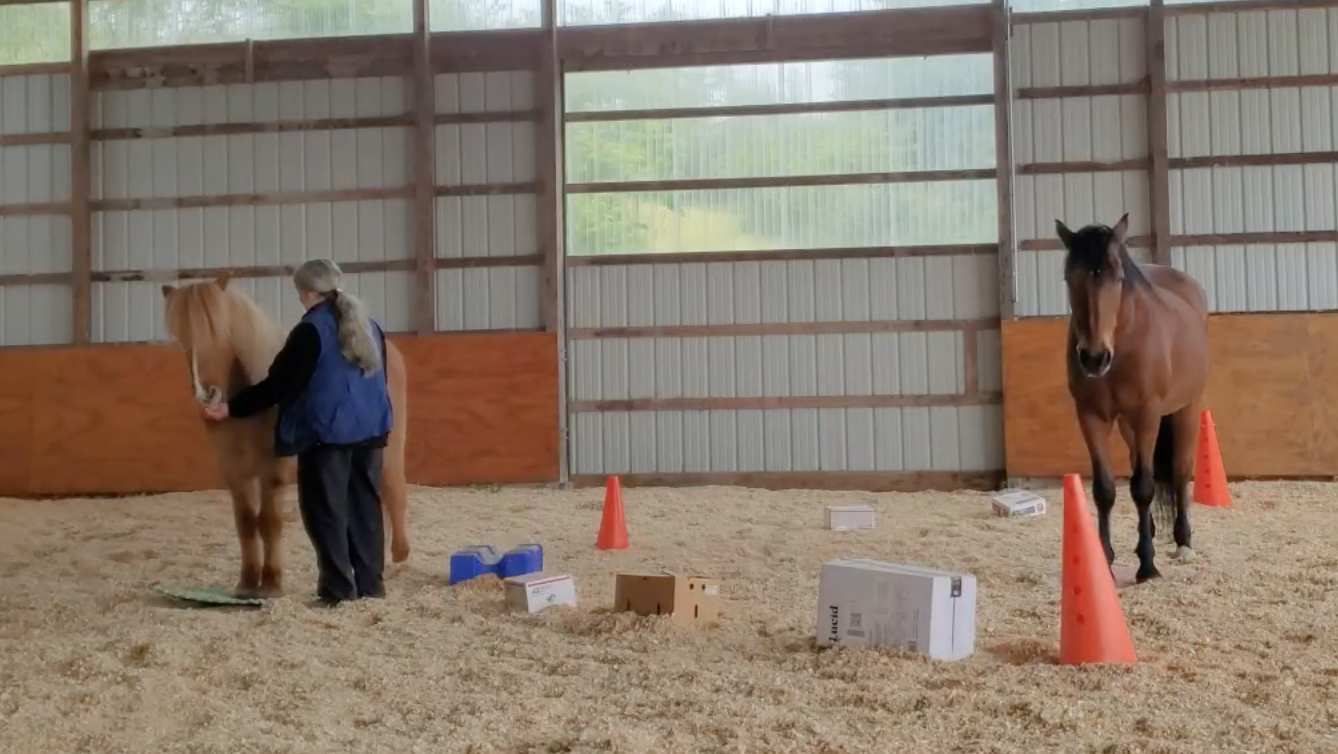
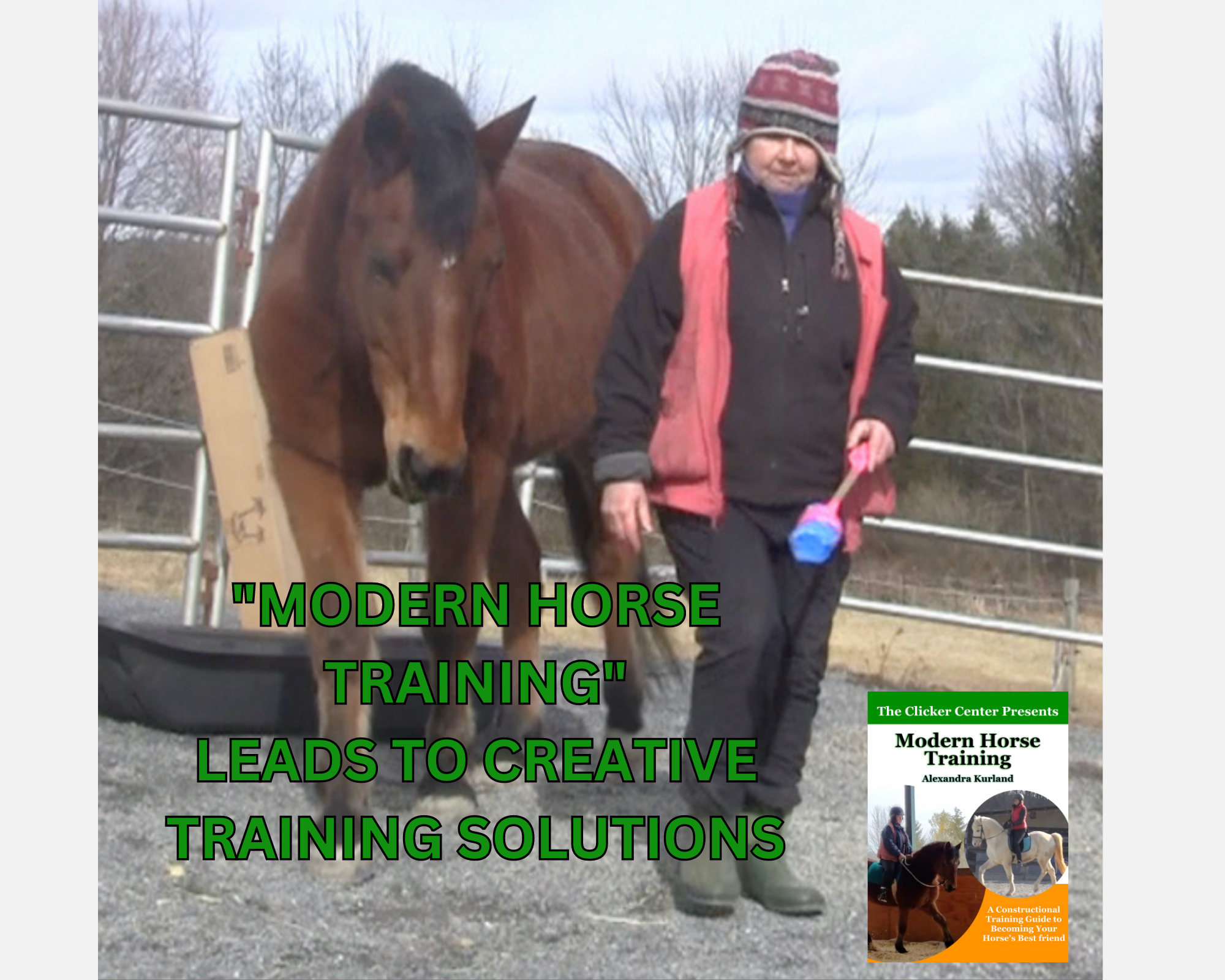
Robin is helping me demo the “touch the goblin” game. This is a targeting lesson that helps horses gain a lot of confidence interacting with novel objects.

As always, I am using a constructional approach, meaning this lesson uses skills that I have taught previously. I wouldn’t begin by asking an anxious horse to follow a target up to something that worries him.

That would be like having you touch a tarantula in exchange for a hundred dollars. You might do it. A hundred dollars can buy a lot of hay for your horse. You’ll touch the tarantula – really fast and maybe you’ll be flinching while you do it. You’re still afraid of the tarantula, but you touched the goblin and got your hundred dollars.

That’s not what we want for our horses, so the game begins by having them orient first to lots of objects that they are already familiar with and don’t worry them. You’ll also begin in environments where your horse feels comfortable.

I’ve added a toboggan and some cardboard boxes to the barnyard. Robin is reminding us that turning your back on a goblin and walking calmly away is just as important as approaching a goblin. I remember years ago watching a very bold rider force her nervous horse to stand facing a scary mailbox. As soon as the horse had his back turned to it, he shot off like a rocket. She was lucky she didn’t fall off. Horses show us how important it is to listen to them and to adjust our training to meet their needs.

Things I like about this photo: Robin is working at liberty which means he has the option to leave at any time. Choice is an important part of Modern Horse Training.

I love how relaxed he looks as he walks away from the goblins. He’s following both the target and my body orientation. He may be at liberty, but this is also very much a lesson on leading.

Everything is connected to everything else.

Modern Horse Training – Be Creative!

Good training doesn’t mean you need to spend a lot of money on training equipment.

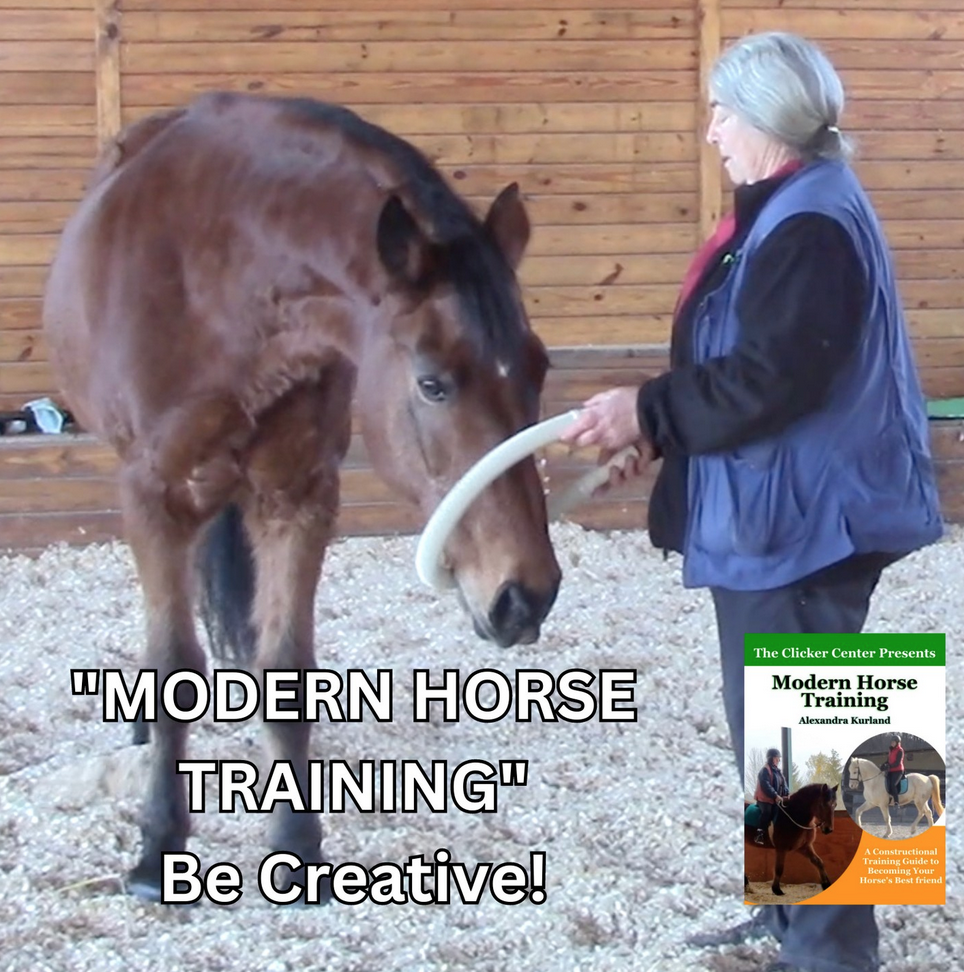
I’m teaching Robin to put his nose into a loop formed from a vacuum cleaner hose. The hose can be swapped out for cardboard boxes of different sizes and depths, pool noodles held in a loop, and many other objects.

How does this help you? Think about all the “clothes” we ask our horses to wear. This turns into haltering, bridling, putting on an over-the-head blanket, accepting a grazing muzzle, etc.

The fun of constructional training is you are teaching component skills that can then be used for many different behaviors. It’s a very fun and efficient way to teach.

Modern Horse Training: Be Creative!

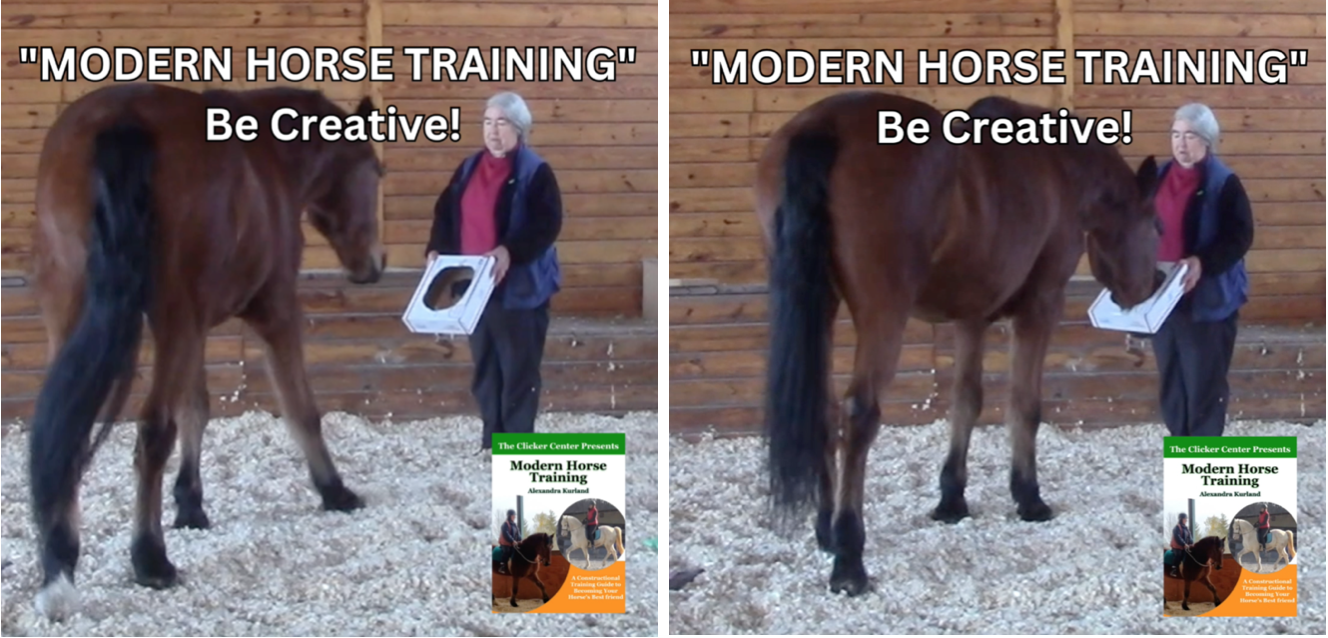
Robin has learned to put his nose down into many different objects, including cardboard boxes.

Now I’m using backchaining to teach him to come to me from a distance to put his nose into a cardboard box. Backchaining means I begin by standing very close to him so it is easy for him to put his nose into the box. Then I gradually move further away from him so he has to take several steps to get to the box.

Right now this is a cardboard box. Later it could be a halter I hold out to him. Think about how you can use this lesson to help a horse who is anxious about being haltered. You’re using objects that don’t have the previous associations that a halter has for that horse to teach him the basic skills that will help him to be comfortable with halters.

The cardboard box will be swapped out for other objects such as pool noodles held in a loop until eventually the horse is ready for halters. You’ll now have a horse who sees you holding a halter in your hand. Instead of turning away, he will come from a distance to put his nose into the halter.

You’ve been framed!”

Modern Horse Training leads to creative solutions and lots of fun games!

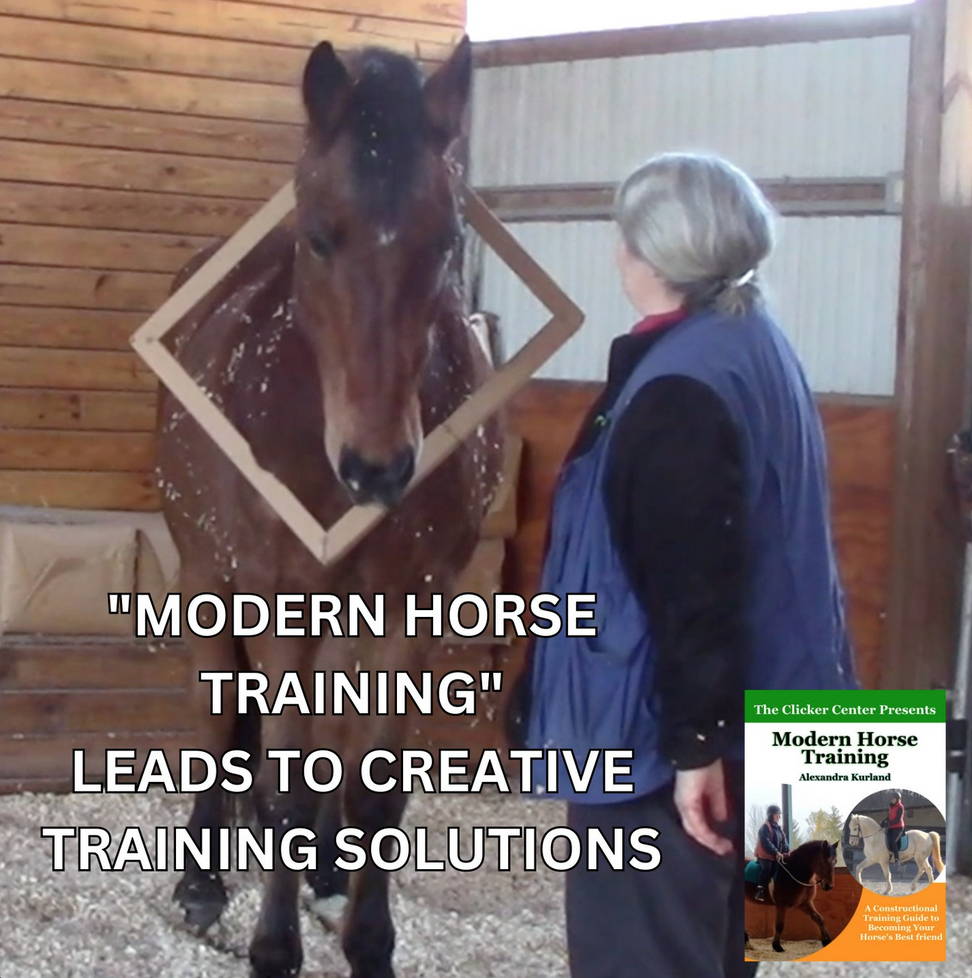
Robin is putting his whole head and neck into this cardboard frame.

Think about all the ways this simple game can be transformed into useful skills. It’s a great prep for putting a blanket over your horse’s head. Is your horse worried about a halter or bridle going up over his ears? Games like this are a great prep. Maybe you’d like to ride in a neck ring. Again this is great prep.

Games like this are fun for both the horse and the handler. And they smooth the way for many other handling requests we make of our horses.

Want to learn more? My new book, Modern Horse Training, is available through my web site: theclickercenter.com and from Amazon and other booksellers.

Modern Horse Training Connects Ground Work to Riding

One of my favorite expressions is: “Ground work is riding where you get to stand up and riding is ground work where you get to sit down.”

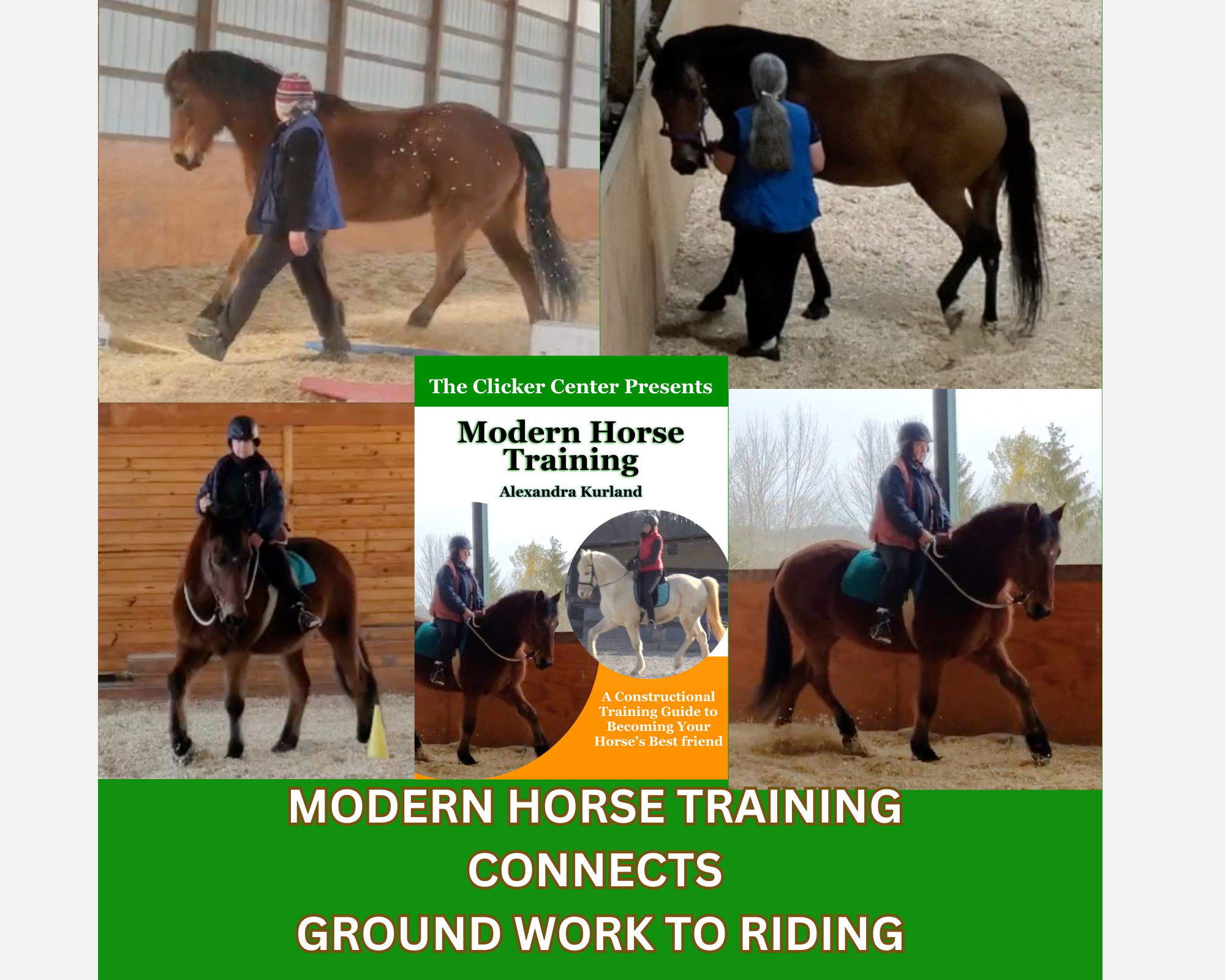
Everything is connected. The beautiful balance that Robin shows as he trots beside me at liberty is the same balance that I want to ride. The cues that I use on the ground carry over and become cues he understands when I ride.

The use of the lead as a communication tool works in the same way as the reins. When I teach Robin how to respond to tactile cues beginning on the ground, that understanding carries over to riding. Leads and reins work in the same way. Body language cues taught first on the ground carry over into riding.

This means the training is wonderfully efficient. I don’t have to teach one set of cues and behaviors for ground work and an entirely new set for riding. The components that I use to work with Robin at liberty are the same components that I’ll use for work in-hand and for riding. Modern Horse Training makes a deliberate, thoughtful connection between everything you teach. Lessons are not separate and random. The more your horse knows, the faster he will learn because many of the components you’ll need for a new lesson will already be in place.

Modern Horse Training Focuses on Balance

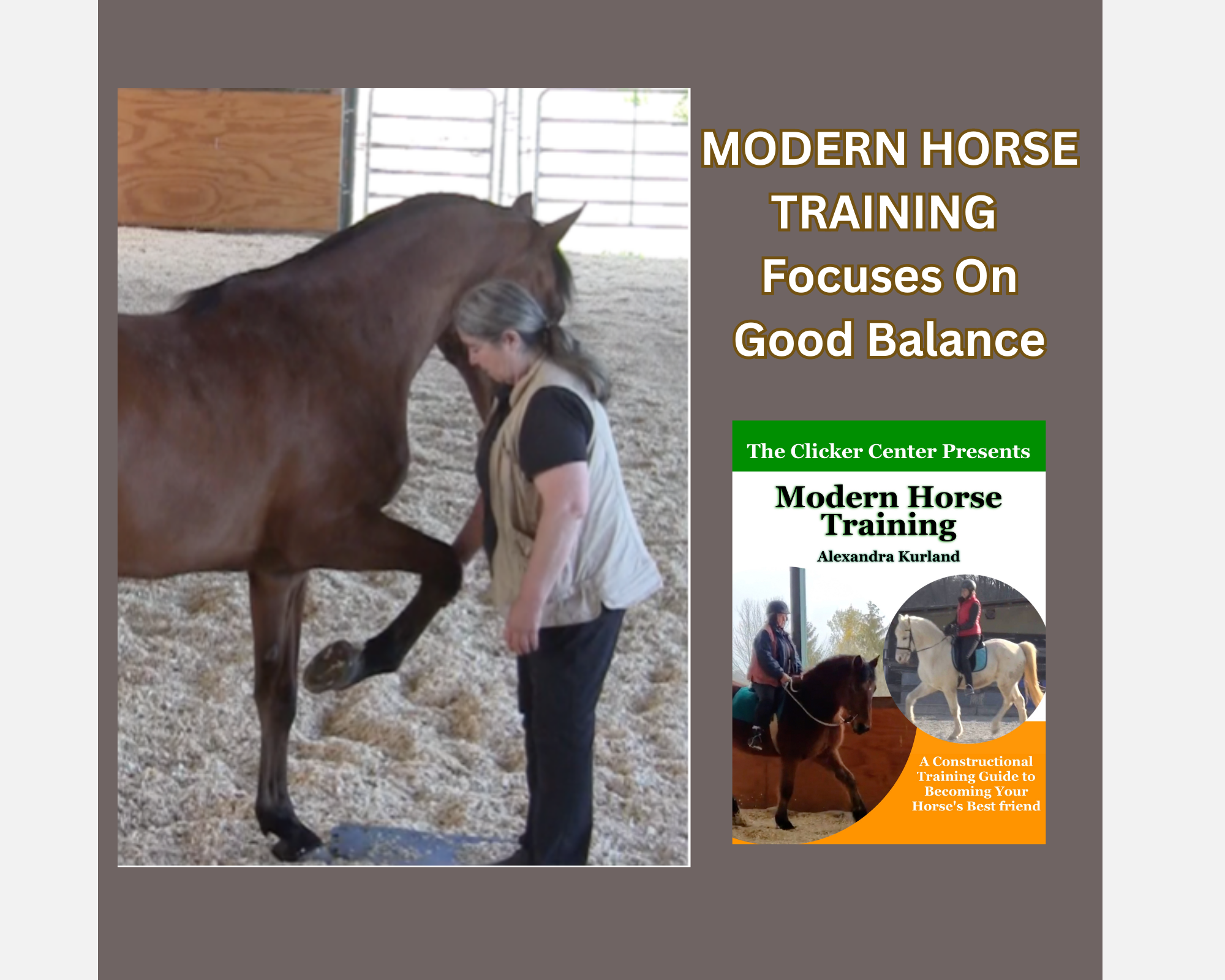
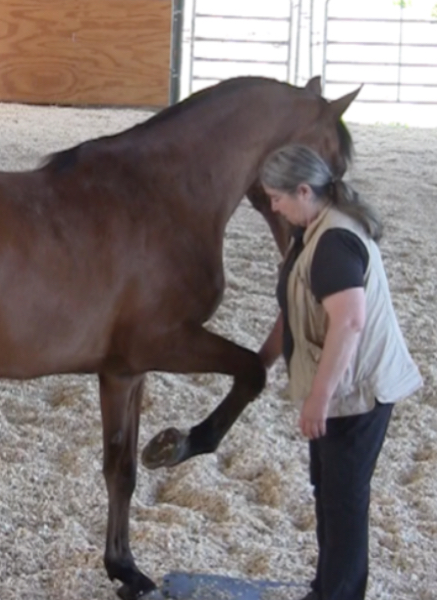
This has long been a favorite photo. I am asking Robin to lift his knee into my waiting hand. I love the quiet elegance that is expressed in this gesture. Note the solid support we see in his left front as he lifts his right leg.

I could easily turn this into foot cleaning, or I could expand the gesture so he extends his leg forward in preparation for Spanish Walk.

Or I could use it, as I am here, as a gymnastic exercise that prepares Robin for the day’s ride.

Once again we see the foundation lessons in action. Robin is standing on a mat. The mat provides a context for the leg lifts and helps to keep them from becoming a nuisance behavior. His beautiful balance has evolved out of the foundation lessons.

Modern Horse Training reminds us that everything is connected.

To learn more visit my web site: theclickercenter.com
Instagram: alexandra.kurland.5
Podcast: equiosity.com

Modern Horse Training Takes Your Horse Into His Senior Years

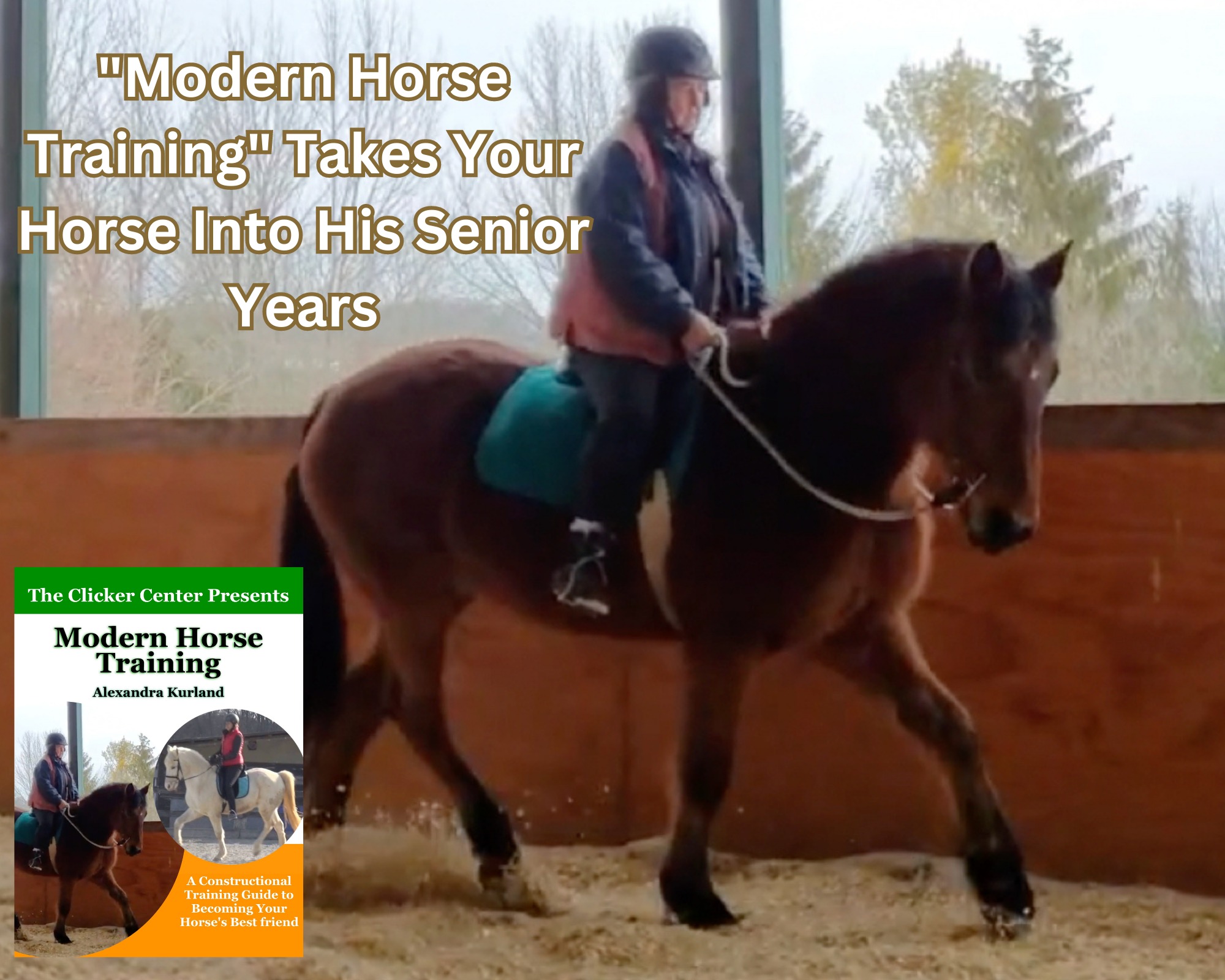
I chose this photo for the cover of my new book for many reasons. First, it’s simply a beautiful image. I love the overall balance, the roundness of Robin’s topline, the softness of the reins, the energy and suspension, the settled attention. But I also chose this photo because of the statement it makes. Robin was twenty-seven when this photo was taken. He’s still in work. He’s still moving beautifully.

Balance is the central pillar around which I build all my training. Balance matters to me because I love my horses. I want them to be in my life for as long as possible, and I want them to have a good quality of life. Physical balance and emotional well being are woven together. Balance has always been a key ingredient, beginning with the very first lessons I taught Robin when he came to me as a yearling. Clicker training has been with us every step of the way. Modern Horse Training has been there throughout his whole life.

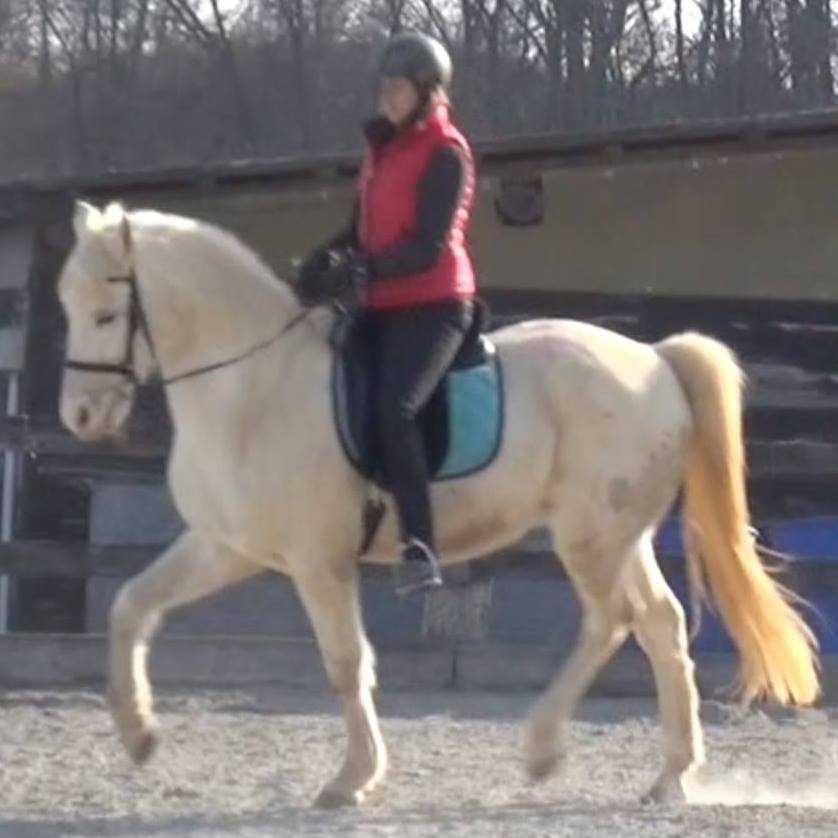
The other horse featured on the cover is Michaela Hempen’s Asfaloth. He’s also now in his twenties and still loving to play.

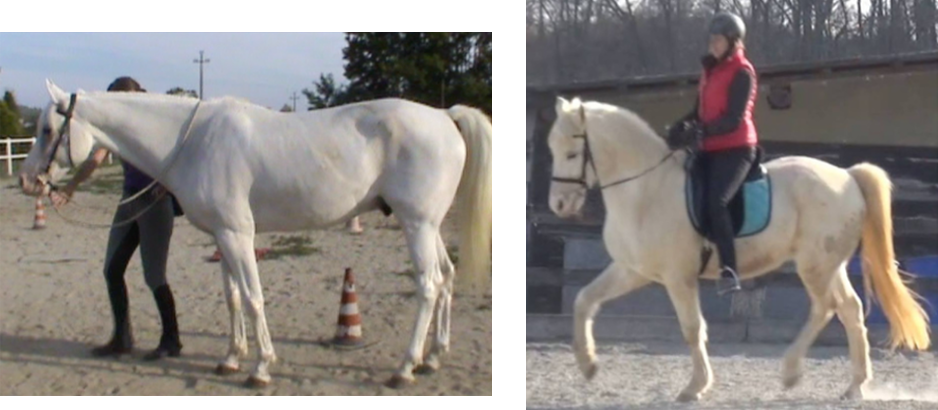
Asfaloth shows us how important balance is.

When you look at these two photos it is hard to believe it’s the same horse. The photo at the left shows Asfaloth in his early teens when Michaela was just beginning to work with him.

A lot of horses stand like this so at first all you may see is a grey Arab. No big deal. But compare him to the photo at the right and you’ll begin to some of the early balance issues. Look at his front legs. They’re angled back. If you were building a bridge, you wouldn’t want the support columns to be angled back like this. He’s long like a sausage. He’s falling forward onto his forehand. In this balance, he wouldn’t be able to produce the beautiful suspension you see in the second image.

A bridge or a house which is built on such crooked underpinnings isn’t going to last as long as one that is built well. Our horses show us that good balance carries them forward into their senior years.

Michaela’s excellent training is featured throughout my on-line clinics.

You can read about her work at her website: https://clickertrainingpferde.com/

Modern Horse Training Is . . . (continued)

I’m practicing the skill of writing short posts. Here’s the second post I put up on Instagram. You can find me there at: @alexandra.kurland.5

But note – I couldn’t resist adding a bit more to the original instagram posts.

I love this photo. Robin is waiting for the lesson to begin.

Here’s the story behind this photo. I was getting set up to video the runway lesson. That’s a lesson that I use to introduce horses to standing on mats. Instructions for the lesson are included in the new book, “Modern Horse Training”.

Obviously, mats don’t worry Robin. He loves his mats. He had been standing off to the side of the arena watching me set out the cones and the mat.

The camera was up on the deck that overlooks the arena. Once the cones were in place, I left the arena to turn the camera on. I went out of sight into the barn and then up a flight of stairs to the loft. Robin let me know that he was eager for the session to begin by going over to stand on the mat.

His behavior tells me that he not only understands the runway lesson, he enjoys it. He wanted the lesson to begin!

I love this about our clicker-trained horses. They let us know in so many ways that this is training they truly enjoy.

How do your horses tell you they enjoy their training time?

Robin and Fengur join me in the morning while I clean up the arena. When the chores are done, we have a game of “musical chairs” around a circle of cones and mats. Robin is waiting patiently on a center mat while Fengur has a turn. (Note: I try to reduce my use of plastic, so when I needed more cones, instead of buying new ones, I reused cardboard shipping boxes. They work great in my cone circle.)

Modern Horse Training: What is Constructional Training?

I’m counting down the days to the publication of my new book: “Modern Horse Training A Constructional Guide to Becoming Your Horse’s Best Friend”.

Everything is set to go (I hope). The publication date is April 26. While we are waiting, I’ve been sharing with you, not excerpts from the book, but some stories that explain the genesis of my training choices. Here’s today’s installment:

Yesterday I wrote about the link between ground work and riding. That sits at the core of the constructional approach to training that my horses have been teaching me. Here’s an example to help you understand how this works.

Suppose you are working with a youngster who hasn’t had much handling. You want this horse to pick up his feet for cleaning. That’s one of the universals we all need to teach our horses. It doesn’t matter if you want to ride English or western, or you don’t ride at all, horses need regular foot care.

But before you can pick up your horse’s feet, you need him to stand still and to be comfortable being handled. So there are some component skills that are handy to teach before you start trying to handle his feet.

You’ll be starting with the foundation lessons. You’ll be teaching him to stand still, to back up and come forward, to orient to targets, to stand on a mat. You’ll be starting in simple environments that make these lessons easier to teach. The new book covers this in detail so I won’t say more here. Let’s assume that you have taught your horse to stand on a mat, and you are now teaching him front leg flexions. As you develop this lesson, you are able to point at his shoulder and your horse will lift his foot up well off the ground into your waiting hand.

Robin shows a good example of a leg flexion. He’s targeting his knee to my hand. The balance these leg flexions teach make routine foot care very easy, and they also contribute to the good balance I look for under saddle.

Teaching leg flexions to your young horse will mean foot cleaning is easy. He’s lifting his foot up for you, and he’s become so well balanced he’s not leaning on you for support.

Foot care may not seem to be connected to riding, but it very much is. Those leg flexions are a wonderful prep for riding. They help your horse find the good balance that makes riding easier for both of you.

When you clean your horse’s feet, you could skip all this training. You could pry his feet up off the ground and accept having him shifting around and leaning on you for support. Cleaning his feet would be a chore, but you’d get it done.

You could skip all the “niceties” of the preliminary groundwork and get straight on, but your job will be much harder. You’ll be getting on an unbalanced horse who is much more of a challenge to ride.

I prefer to stack the deck more in favor of both my horse and myself. So another important lesson my horses have taught me is: If a lesson is becoming difficult for either the horse or the handler, it’s time to break the lesson down into smaller steps.

Remember I want to avoid “brick-wall” training. The sooner I recognize that a lesson is presenting puzzles my horse and I aren’t ready to solve, the easier it becomes to avoid crashing into metaphorical brick walls. I want to fine tune my detectors so long before a puzzle begins to generate frustration, anxiety, fear, or any other emotion that could get us into trouble, I’m already looking for the smaller, easier-to-teach underlying steps.

My horses have taught me to keep looking for smaller steps. If I break a lesson down into what I think is a small step, if it is still too hard, I will keep looking for the even smaller step that it can be divided into. Sometimes finding the smaller step means asking for less. It means asking for just a weight shift instead of a full step. It can also mean looking for the missing component part that is needed to make the lesson easier to understand. What do I need to teach first? If I haven’t introduced my horse to basic targeting, asking him to target his knee to my hand could easily become a frustrating lesson for both of us.

Looking for the smaller step has evolved into this “loopy training” guideline: To find a starting place for your training, you will keep dividing a lesson into smaller and smaller component parts, until you find something your learner CAN consistently do, even if that step seems very small and very far away from your goal behavior.

What am I describing?

Constructional training. This term comes from the work of Dr. Goldiamond, a behavior analyst and clinical psychologist. In a nutshell Goldiamond didn’t want to “fix” behavior. He wanted to build new repertoires of behavior – hence the name constructional training.

This fits perfectly with clicker training. Instead of focusing on what you aren’t liking, and setting goals that are centered around eliminating unwanted behavior, you reframe everything. You focus on what you want your horse TO DO, and you teach that. A constructional training approach matches the approach to training that for me began to evolve over 40 years ago.

Something else I learned a long time ago is good ideas are good ideas. They aren’t unique to any one person or any one source. When you find a convergence like this coming from two very different sources – clinical patients in Goldiamond’s case, and horses in mine, that’s a good indicator that you are on the right track.

The new book, “Modern Horse Training” is designed to help you become a skilled constructional trainer. It explains in detail how the concept of constructional training provides a wonderful framework for positive reinforcement training. Everything is connected to everything else makes perfect sense when you see your training from this perspective.

“Modern Horse Training” will be available as a hardcover, a paperback, and as an ebook. The publication date is April 26. You’ll be able to order it through my web site, theclickercenter.com and also through Amazon and other booksellers.

Modern Horse Training: Why Another Book?

A new book is coming: Modern Horse Training: A Constructional Guide to Becoming Your Horse’s Best Friend

I’ll be telling you soon how you can pre-order it. This isn’t a marketing ploy. I am still getting the book set up so you can order it on line. As soon as that’s done, I’ll let you know. The publication date is April 26, the anniversary of Peregrine’s Birthday.

The book is coming out on Peregrine’s birthday, but it is really celebrating Robin. I think of this as his book. So let me show you why I want to share this work with you.

I’ve said over and over that balance matters. I fuss handling details in the food delivery. In clinics we focus in on the minutia of balance and here’s why.

Look at the changes in the way these horses are standing. In the before images we see the higgledy-piggledy stance of horses that are tense in their backs and unaware of their balance. They can’t stand square and be comfortable. And then we see the changes that occur, often within just a couple of sessions. We aren’t compelling these horses to stand square. They are finding this balance on their own. We teach them the underlying components and what emerges is a horse who can stand in beautiful balance.

You may be thinking: “Okay. That’s nice. It’s pretty. But so what?”

Why does this matter? Why should you care about these changes? Why should you join me in my obsession about balance?

Here’s why:

This is one of the images I have chosen for the cover of “Modern Horse Training”. This is Robin. The photo was taken last year. For years when people have asked me how old Robin is I have always said he’s four going on five. In the last year or two I finally decided it was time to update his age. In this photo you are looking at a 27 year old horse – (who still thinks he’s four going on five!)

Balance matters.

Here’s what I write about this image towards the end of the book:

“Robin joined my family as a yearling. He is not only my training partner, he is my much loved best friend. I treasure every every ride, every day we have together.

Good balance is woven into every lesson I have shared with you. My goal throughout this book has been to help you build your own great equine partnership with the horses in your life. Here’s to many great rides on your beautiful horses!”

If there’s an elevator speech way to describe the new book, that’s is it. Balance matters. For all of us who love our horses, these horses show us why.

Coming next: Constructional Training: What that means to me.

Goat Diaries Day 10: Distractions!

Distractions

I’ve been distracted by several projects this week so I am a bit behind getting these Goat Diary reports posted.  That seems very appropriate somehow because today’s post is about distractions!

In one of his Clicker Expo presentations Ken Ramirez talks about the importance of introducing distractions into the environment.  When he was the Director of Training at the Shedd Aquarium, he instructed his trainers to make changes every day to the training environment.  He wanted the dolphins and belugas that were used in the public demos to be so comfortable with change that if a tornado ripped the roof off the Aquarium, they would just think – “Oh look what our trainers have done for us today”.

I have always loved that image.  It creates a high standard of creativity and  consistent good training that is worth aspiring to.  With the goats at this point in their training it was easy to introduce change – essentially everything I did with them was new.  I wasn’t yet thinking about adding distractions as an active strategy.  I was starting with fearful animals so I knew I had a long way to go before they would be comfortable in a changing environment.  In their evening session I was about to discover just how easily something that I didn’t consider a distraction at all could completely derail their eagerness for training.

Lions and Tigers and Bears, Oh My! – And People, Too!  The July Goat Diaries: 7/14/17 7 pm session

In a previous post I shared with you what a happy goat looks like (https://theclickercenterblog.com/2018/01/26/).  I had taken E and P into the arena and watched with delight as they turned the mounting block into a playground.  I wanted to share the fun with Ann.  She can’t see their antics, but she can certainly hear the laughter in their feet as they run across the mounting block.

Ann came in the evening to visit with Fengur.  While she was playing with him, I sat with the goats.  When the arena was free, I set up the camera and brought them in.  Ann stationed herself beside the camera well away from them.  After my big build up about how much fun they had running over the mounting block, they were total fuddy-duddies.  There was no energy, no joy, no laughter, no interest in the mounting block at all – just a cautious inspection from a distance of Ann.  What was she doing out in the middle of the arena?  Having a new person in the arena was clearly a concern.

After a few minutes of non-performance, I decided to put them back.  They followed me into the barn aisle and went eagerly into their stall, knowing that I would be dropping treats on the floor.  It turns out that I neglected to turn on my camera, so none of their non-interest was recorded.

I let the goats settle back into the comfortable familiarity of their stall, then I took them out again individually for another leading session.  The main focus of the session was on treat delivery and their behavior around food.  I was continuing with the work I described in the previous two goat diary posts. (https://theclickercenterblog.com/2018/01/29/  and https://theclickercenterblog.com/2018/02/02/

A Panda Story

This focus on treat delivery and the time it takes to establish good manners was reminding me of Panda’s early training.  Cold winter days are a good time for stories, so I’m going to indulge in a couple, beginning with a favorite Panda story.  Panda is the miniature horse I trained to be Ann’s guide.  I remember when I first started working with Panda, she was as eager as the goats were to get into my pockets.

A week into her training – at about the stage I was now with the goats – I took Panda with me to a clinic I was giving at a barn that was about an hour away.  Ann rode in the front seat with her new guide dog curled between her feet.  Another of my clients was driving.  I was in the backseat with Panda essentially in my lap.  I was definitely a captive audience.  Doing a short session and then putting her back in her stall to process was an impossibility.  I had an hour’s drive with a horse in my lap!  What’s more I had a horse who knew I had treats in my pocket.

For the duration of the drive I clicked and treated anytime Panda’s nose moved even fractionally away from my pocket.  The idea was to keep her on such a high rate of reinforcement that she didn’t have a chance to mug me.  Over and over again, through the food placement I was saying to her – this is where the treats are delivered.  Going to my pocket gains you nothing.  Out here away from me, this is where you will find treats.  You might as well keep your nose here and not waste your energy going to my pockets.

Ann was in the front seat listening to the constant barrage of clicks.  I know they were making her anxious.  She had only recently taken on a new guide dog.  Everything about this dog was a struggle.  He should never have been placed.  The school was hoping that because Ann was such an experienced guide dog user, she would be able to make him work.

“Make the dog work” was truly the philosophy behind this dog’s training.  The result was a dog who showed extreme avoidance behavior.  Ann had one problem animal.  She didn’t want another.  How could she have a guide who needed to be clicked and treated every couple of seconds?  Ann knows how training works.  She knows that we would be building duration, but in that stage where the mugging is still such a strong reaction, the future good manners can seem impossibly far away.

Good manners emerge over time.  They are the result of consistent handling and a growing confidence in the learner.  By the time I handed Panda over to Ann, the guide dog had gone back to the school to be re-trained for a different job.  He went into search and rescue work, a job that suited his temperament much better.  And Panda became Ann’s full time guide much sooner than we had originally planned.

We celebrated the transfer by going out to dinner.  Panda kept her nose to herself and stayed quietly by Ann’s side throughout the evening.  Even when the salad course arrived, all she did was have a curious sniff before ducking her head back under the table to continue her nap. That’s great duration in a behavior that had begun with barely seconds between clicks.

Good manners emerged for Panda, and I was confident that they would also become the norm for the goats.  Time and consistency would create the behavior I wanted.
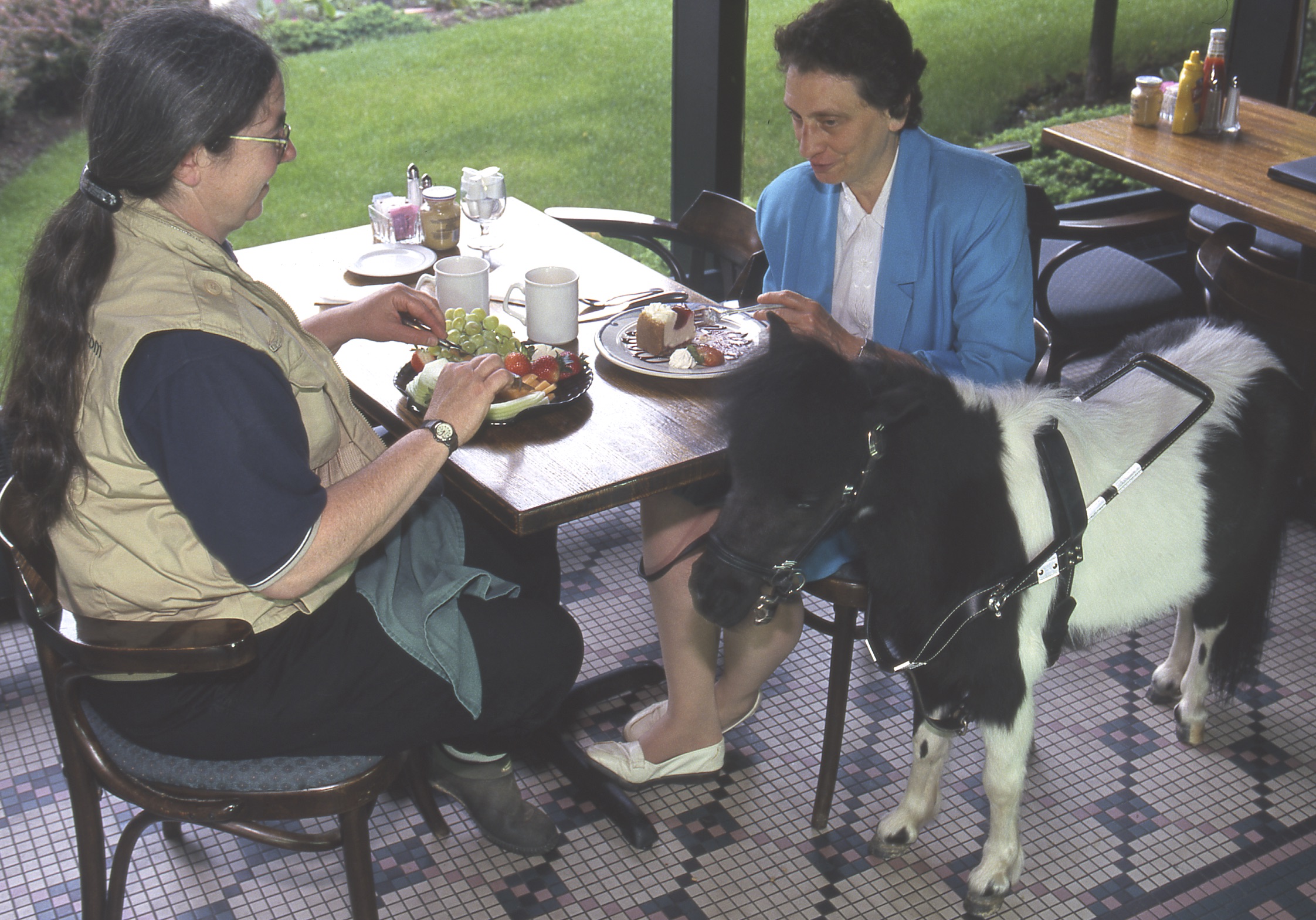
p46_PandaInRestaurantWithTrainerAlexandraKurlandOwnerAnnEdieNeilSoderstrom 343

Dining out with Panda

(If you want to learn more about Panda and her training, read the Panda Reports on my web site: theclickercenter.com.  Some of her early training is also featured in my DVDs: An Introduction to Clicker Training and Lesson 4: Stimulus Control.

Treats: Whatever Is Logical Do The Opposite

At some point in the distant future, it might be fun to travel with the goats in my car.  But at this point the thought of spending an hour trapped in the backseat of a car with an eager, greedy goat sounded exhausting.  We had a long way to go before they would be as settled about treats as Panda.

You meet your learner where he is not where you want him to be.  When I took P back into the arena, the session was very much focused around food delivery.  The children in the 4-H program may have giggled and let him snatch pretzels from their mouths.  With me P was learning that we played a very different game.

I brought P back out on a lead.  He continued to show good progress. He backed away from my closed hand.  He did a bit of head flinging which means he was feeling frustrated by having to back up.  I’m sure it did conflict with how he thought things should be done.  He wanted to push forward to get to the treats.  That’s what he had always done, but now he had to remember to back up instead.

Whatever is logical, do the opposite.  I could sympathize with his frustration.  From his point of view it made no sense that backing should work.  Going forward was how you get children to spill treats all over the ground.  Why should backing work?!!  We have all been given directions that make no sense.  Why should turning left instead of right get us to our destination?

And how many of us turn right because we’re convinced that should be the correct answer.  Even when we do turn left, it feels wrong.  Surely we’re heading in the wrong direction.  This can’t be right.  We’ll never get there.  Oh look, there’s our destination just ahead. How did that happen!?

It can take a while to relax and trust the directions.  That’s the stage I was in with P.  With a little more reinforcement history behind us, he would relax into the confidence that treats were coming.  There was no need to rush to get them.

The Goat Palace written Dec. 27 – Our Animals Always Tell Us

Meeting your learner where he is, not where you want him to be makes me want to share this story.  It was prompted by the goat’s current training.  If E and P’s treat taking manners were reminding me of Panda, a session I did with Trixie and Thanzi at the end of December made me think of Robin.  There are several of training mantras that apply to this session:

Our animals will always tell us what they need to work on next.

You get what you reinforce. 

My favorite, though, is this one:

If you don’t notice a little resistance, don’t worry about it.  It will get bigger.  And eventually, it will get big enough that you will do something about it.

Before I describe the goat’s training, here is Robin’s story:

Over the winter when Robin was still very new to clicker training, he started to snatch his treat from my hand.  I’d click, he’d grab, and then he’d eagerly be offering me the next clickable behavior.  I ignored the snatching.  He was eager.  It was cold.  He was offering lots of great work.

The snatching increased.  You get what you reinforce.  I didn’t like the snatching, but if it was getting worse, something in our interactions was reinforcing it.

I ignored it.  Robin was eager.  It was cold.  We were having fun – until I wasn’t.  The snatching was becoming more than annoying.  I was starting to count fingers after I gave him a treat.  It was time to do something about the way he took treats.

If you don’t notice a little resistance, don’t worry about it.  It will get bigger.  And eventually, it will get big enough that you will do something about it.

I’ve told the story many times about the way I solved this particular problem.  It’s detailed in both my Riding book and The Step-By-Step Guide in Pictures.  I went back to basics.  I put Robin in his stall with a stall guard across the door.  I stood across the aisle from him and held out the biggest carrot from a bag of big carrots.  Robin stretched his neck out to try and reach it.

I immediately turned my back, removing the carrot from sight and counted to three.  Then I turned back and held the carrot out again.  Robin stretched out his nose.  I turned my back and counted to three.

I again offered the carrot.  This time Robin hesitated ever so slightly.  I clicked, reached into my pocket and handed him a piece of carrot. I was using negative punishment.  I was taking away something Robin wanted – the carrot – to decrease a behavior I didn’t like – the reaching out towards me to get a treat.

(When an activity decreases – it is being punished, either by adding something unpleasant or by taking away something the individual enjoys (positive punishment and negative punishment – it’s just math adding or subtracting).  When an activity increases, it is being reinforced, either by adding something the individual wants or taking away something he doesn’t like. So again there is positive and negative reinforcement.  When the behavior increases it is being strengthened, i.e. reinforced.  When it decreases, it is being punished.  In both – the positive and negative refer to adding or subtracting, not value judgements.)

I offered the carrot again.  Robin hesitated.  Click, I handed him a piece of carrot from my pocket.  Robin is a super fast learner.  He had the dots connected.  If he drew back away from my hand, he got treats.  I could hold the carrot directly under his nose and instead of snatching it off my hand, he arched his neck and drew up away from it.  Click and treat.

I was enchanted.  He looked like a beautiful dressage horse.  Robin being Robin, he quickly made the connection.  If he arched his neck, click, I would give him a treat.  He wasn’t snatching anymore.  Instead he scooped the carrot slice gently off my hand with his enormous soft lips.

He started to offer what I have since called “the pose”.  When I walked by his stall, Robin would draw himself up and arch his neck.  Click.  I’d pause in my barn chores and give him a piece of carrot.  Through the winter I reinforced him a lot for this behavior.  I might have begun with negative punishment as I tried to stop an unwanted behavior – snatching treats off my hand.  Now I was actively reinforcing him for something I wanted – “the pose”.

I should add that this is not the way I teach the pose today.  It popped out when I was working on something else.  Now that I know this behavior is worth going after, I shape it more directly, most often with the aid of targeting.  And in general, when I find myself reaching towards a negative punishment strategy to solve a problem, I go have a cup of tea instead. I think about what I want and look for reinforcement-based teaching strategies instead.

The “pose” is not the best name that I could have come up with for this behavior.  For many people, a pose is a fixed, rigid, stilted posture.  It’s that awful grimace so many of us have when we’re forced to have our picture taken.

Instead, for me, the pose is a very dynamic behavior.  For Robin it has become a default behavior.  I was the cue.  In the absence of any active cue from me, if Robin posed, I would click and reinforce him.  It meant that if he wanted attention from me, he could get me to engage with him using a behavior I actively liked.

Horses are always doing something.  A horse in a stall has a long laundry list of behaviors to choose from.  Some are behaviors that I like, some are behaviors that I can ignore, and some are behaviors that I never want to see.  The laundry list includes taking a nap, eating hay, having a drink, watching the activities in the barn aisle – all perfectly acceptable and easy to ignore.

A horse could also be fighting with his neighbor, kicking the stall door to get attention, cribbing, raking his teeth up and down the wall, pacing, weaving.  These are behaviors I definitely do not want.  But if I fuss at a horse when I see him engaging in them, I could easily be reinforcing them through my attention.  Think of the small child who bangs the kitchen pots and pans while mother is on the phone.   Even negative attention is attention, and that can be better than no attention at all.

Robin doesn’t have to kick the wall to get me to notice him.  All he has to do is pose.  Click and treat.  I love having behaviors which my horses can use to ask for my attention. They know I will always acknowledge their request for connection.

Think of all the ways people interact with one another:  “Good morning.”  “How are you?” “Never better.”  These quick exchanges connect us.  Think how chilling and unpleasant an environment becomes when these social pleasantries are absent.  We need them to tell us things are okay between us.

Robin says good morning by posing.  I respond with a click and a treat.  All is well between us.  Our social bond is strong and getting stronger with each click and treat.

I reinforced Robin for the pose because he looked pretty.  I wasn’t heading for anything in particular beyond that.  This is what makes training so much fun.  Sometimes the next unexpected piece just pops out.

Here’s what happened to the pose.  One evening I had Robin in the arena.  I was asking him to trot around me on a circle.  He was giving me a nothing of a trot.  He looked like an old plow horse.  There was no energy, no pizzazz, nothing I wanted to reinforce.

Robin was expecting me to click.  He went once around the circle.  Nothing.  The way I tell the story was you could all but see the cartoon bubble appearing above his head.  “I’m not being reinforced.”

He went around again.

“What can I do to get reinforced?”

On the third time around he had the answer: “I know! I’ll try the pose!”

The way Dr. Jesus Rosales-Ruiz tells this story is this: by withholding the click I was putting Robin into an extinction process.  He began to regress back through behaviors that had been successful in the past.  The pose had been highly reinforced, so it was the first thing that he tried.

Whichever version of the story you prefer, Robin had to add energy to the trot in order to get into the pose.  Suddenly, his trot looked as though it belonged on a magazine cover.  He was gorgeous!  I clicked and gave him a treat, all the while gushing over how pretty he was.  I sent him back out around me.  It took him a few strides to find his balance, but he once again added the pose to the trot.  It was just one stride that I was clicking – but wow! What a gorgeous stride it was!  The rest is history.  Robin led the way.  He showed us that we could shape the beautiful, suspended balance of a classical dressage horse just through well timed clicks and treats.

Why am I telling this story? Because this morning’s session with Thanzi and Trixie made me think of Robin and the pose.  It reminded me of the expression:

If you don’t notice a little resistance, don’t worry about it.  It will get bigger.  And eventually, it will get big enough that you will do something about it.

In December I had been trying to work them individually.  We had snow Christmas eve and then the temperatures dropped and the wind rose.  Trixie was nervous about being out in the hallway by herself, so I let Thanzi join her.  Suddenly with two goats I had lots of crowding.  Hmm.  You get what you reinforce.  I knew at night when I was tucking them in, I was in a hurry.  It was cold.  It was late.  I just wanted to get done with the final chores and get back inside where it’s warm.  Had I been letting them crowd me and hurry the treat deliver?  Apparently the answer was yes.

I needed to sort out the crowding so in this session I set two mats out face too face.  Trixie hopped on one, Thanzi on the other.  I stood in the middle with both goats crowding into me begging for treats.  I waited.

“Oh right.  Crowding doesn’t get treats.”  They took their noses away from me.  Click. I reached into my pockets.

They were right back, pushing against my hands.  I got the treats out of my pockets and then drew my hands together.  I stood as though in calm meditation, waiting.  First one then the other took her nose away.  I waited until they were both good, then held out the treats to them.

They got their treats, and then they were right back crowding me, pushing against me with their muzzles.  I waited.  They took their noses away.  Click.  Get the treat.  Wait again with hands held together in quiet meditation.  They both drew away from me.  I held out my hands and let them take the treat.

It only took a couple of repetitions. They were both working so hard to stay away from my pockets.  Click, pause, feed.  They were both so good.

I left them in the hallway while I filled their hay feeders.  I was just finishing up when I looked out into the aisle.  They were standing each on her own platform waiting for me.  How can you resist?  I went out and did another round of paying attention to their good manners.

Your animals always tell you what they need to work on.  I don’t know where this will lead me, but I know it is what they need.  If it makes me think of Robin’s pose, I must be on the right track.

Staying Consistent

It’s easy to be focused and consistent through one training session.  It’s much harder to maintain that consistency over time.  When we transferred Panda full time to Ann, it was actually a relief to hand her over.  I missed her constant presence by my side, but maintaining the level of consistency that is needed for a guide was demanding.  When you can see, you don’t need a guide to tell you that you’ve come to a curb. If I started cutting corners in Panda’s training because I didn’t need all the things I had taught her to do, it would undermine her performance as a guide.  Ann would never be able to enjoy the luxury of seeing the curb that’s in front of her.  She would be relying on Panda to point this out to her.  A horse doesn’t know when it doesn’t count so it always has to count.  I followed that mantra throughout Panda’s training.

The same thing applies to the goats.  The same thing applies to the goats.  If sometimes I let them push into me to get treats, I will never get to the consistent good behavior that I want.  But it’s been cold!  It is so easy to get in a hurry and let standards drop.  So their training has been a bit like a yo yo.  I let things slip in my hurry to get chores done and my gloves back on.  They begin to crowd me, but now I am catching it sooner.  The manners pendulum keeps swinging back and forth.  Over time the cumulative effect shows me that the balance is tipping towards good manners.

Just for Fun!

I told you the story of Robin’s pose.  Here’s one of my favorite videos of Robin.  He was only three when this was filmed.  He had not yet been started under saddle.  So he’d never had a rider on his back, and I had never lunged him in side reins or any other type of mechanical device.  This beautiful balance and cadence had been shaped entirely with the clicker.  You’ll see I am holding two dressage whips.  You can call them anything you want, but they are functioning as targets.  They give him points of reference to balance between.  I know the lighting is not good in this video, but this was a long time ago, and this was the best the video camera could do.  Enjoy!


Coming Next: The Goat Diaries Day 10: You Can Never Do One Thing

Please Note: if you are new to the Goat Diaries, these are a series of articles that are best read in order.  The first installment was posted on Oct. 2nd.  I suggest you begin there: https://theclickercenterblog.com/2017/10/02/   Two of the goats I write about originally came for a twelve day stay in July.  The July Goat Diaries track their training during this period.  In November these two goats, plus three others returned.  They will be with me through the winter.  The “Goat Palace” reports track their current training.  I wish to thank Sister Mary Elizabeth from the Community of St. Mary in upstate NY for the generous loan of her beautiful cashmere goats.



Goat Diaries: Arrival Day

Arrivals

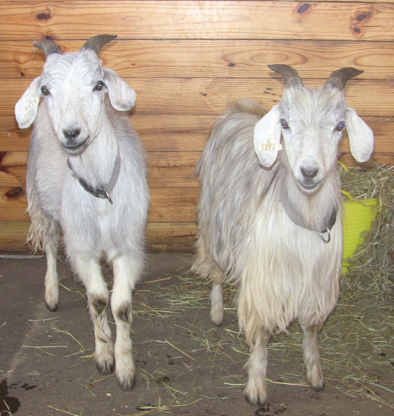
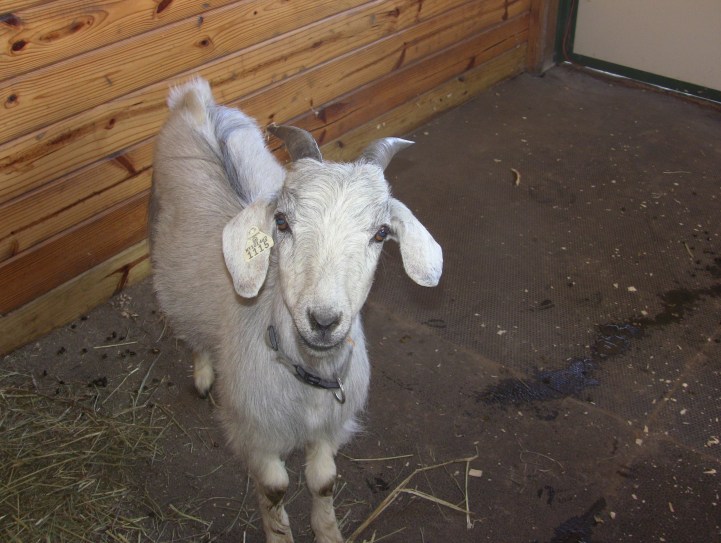
They are small like dogs, eat hay like horses and behave like goats – which is exactly what they are.

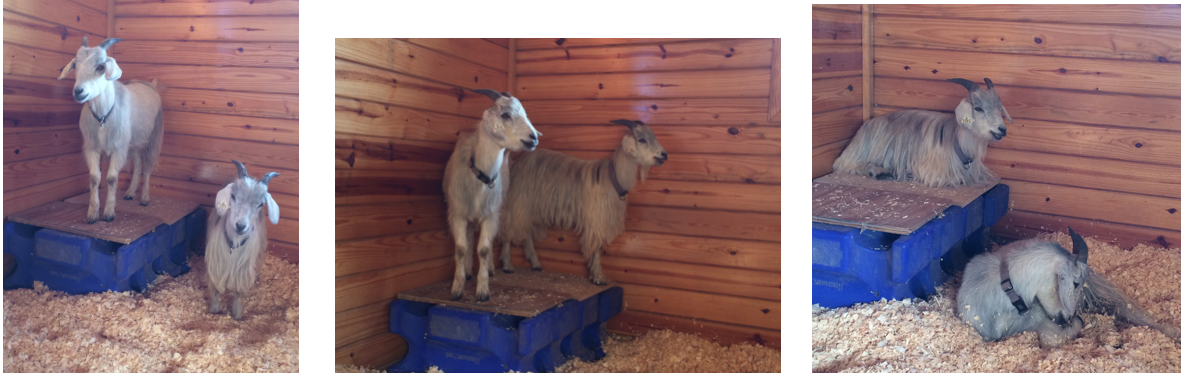
goats in stall Day 1

But these weren’t just any goats. They were Cashmere goats, producers of that most luxurious of fibers. They belonged to St. Mary’s Convent. Long story short the Sister in charge of the herd had offered to let me have the pair for a couple of weeks. How could I say no? It was going to be fun to train something other than horses.

So here they were in the back of a covered pickup truck, two yearlings huddled together in a bed of hay, trying to stay as far away from us as they could get. The Sister crawled into the back of the truck and pulled out the smaller of the two.  She sat on the tailgate holding him in her lap.  These goats were used in a 4H program. They had been cradled in children’s laps since the time they were born.

This goat, Sir Elyan, was incredibly cute. The first cashmere goat I saw was a beautiful silver doe with long, flowing guard hairs. This little one was going to have a coat like hers. How perfect!

He was tiny for his age. He weighed only about thirty pounds. The Sister could easily lift him down from the back of the van. The other goat was his full brother, but they looked nothing alike. He was much bigger and had short guard hairs instead of the long coat of his brother. Good, I thought. I won’t have any trouble telling the two of them apart.

The Sister handed me Elyan’s lead and climbed back into the van for his brother. He was too big to easily lift out. The Sister managed to pull him to the back of the truck. He stood on the tailgate of the van surveying his new surroundings.

“Now what do we do?  How do you get a goat down?” I wondered, but I didn’t say anything out loud.

Not to worry. He took care of that for us. He jumped nimbly down from the truck and joined his brother. We pointed them in the direction of the barn, and off they went!

“Great!” I thought, “they pull like sled dogs!” Leading was definitely going to be high on my training priority list.

sled dog 4.png

We got them headed into the stall I had prepared for them and turned them loose to explore. I had lots of questions to ask. What could they eat? What mustn’t they eat? Apparently they were picky eaters, but they did like peanuts and pretzels. That’s what the children had taught them. I had neither at the barn. Oh well. Surely they would like hay stretcher pellets.

No, the goats told me after giving these treats the briefest of sniffs. That is not something goats eat. Nor will we take the grass you are offering us, or the hay. We will eat the hay, but only if you go away.

I brought a chair into the stall and sat down. I was not unfamiliar with goats. I’ve had clients who had goats, and there were goats at the barn where I boarded my horses. I’ve been around goats enough to know that they are perfect candidates for clicker training. They are agile, greedy, and very smart.

These goats were also very afraid. They did NOT want to be touched. They may have curled up in the laps of the small children they knew, but they were making it very clear that they wanted nothing to do with me.

I was still enchanted. Talk about cute! I spent the evening sitting with them, observing their behavior and letting them observe me. In my on-line course this is how I have people begin with their horses. Before you start introducing the clicker and making it contingent on behavior, spend time just getting to know the animal you’ll be training.

(It is worth noting that I am writing this sitting in a chair next to Robin.  I enjoy spending time with the animals I train.  He is having a snooze. His chin is resting on the top of my head. It is perhaps the most charming way in which to work. The only thing that would make it better would be the absence of flies.)

Spending time with our animals is a luxury. That’s especially true of our horses. We groom them, we ride them, but do we spend time just being with them, sharing quiet moments like this together?  For many of us the answer is no.  There are too many pulls on our time, and often barns are not set up for quiet visiting.  Certainly many of the boarding barns I visit aren’t.  You groom, you ride, you go away.  That’s the expectation.  If you want to spend time just hanging out with your horse, that’s something you have to create on your own.

I knew with the goats food would get me a long way forward, but fear could also pull me back even further. I wanted them to want to be with me, just as Robin wants to stand here by my side. We are all social animals. Once you remove the fear, the pull to be together is a strong one.

So I sat and watched, enchanted. Sometimes good training is as simple as sitting in a chair.  At least that’s how it begins.

The goats settle in:

IMG_1563 goats who are you.jpg

Do I know you?

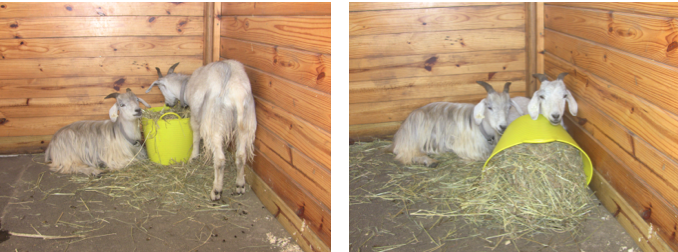
goats with hay bucket

Happiness is a bucket filled with hay.

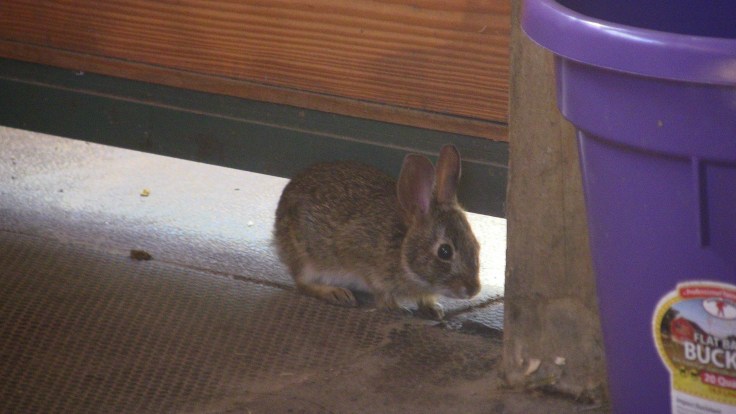
IMG_1582 goats rabbit in stall.jpg

All the neighbors came to check out the new arrivals.

goats on platform 3 photos

Inspecting the “hotel room”.  It looks as though they found everything to their liking.

Coming Next: Goat Diaries – Training Day 1

Summer Pleasures – Watermelon Parties and The Two Sides of Freedom

Watermelon Parties

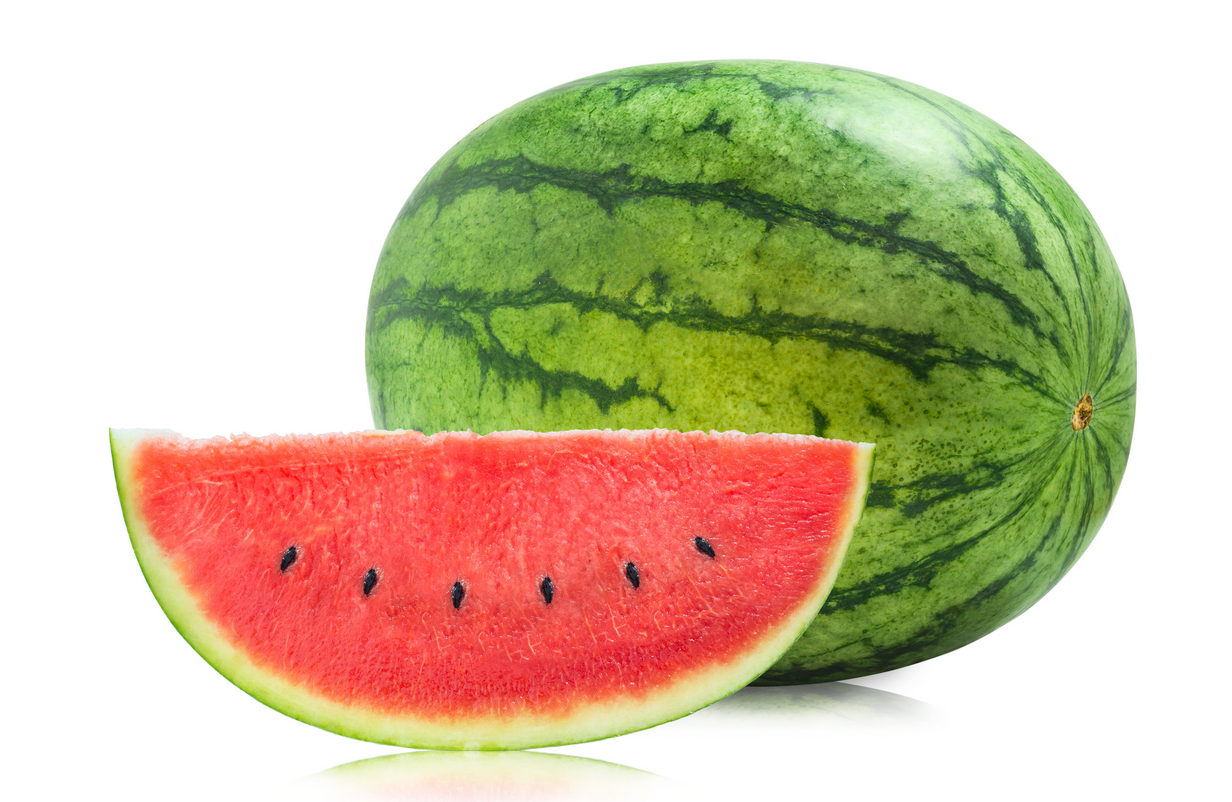
watermelon

Summer means watermelon parties for the horses.  They are always a surprise.  As I walk through the barn, bowl in hand, I’ll announce: “It’s party time!”

Watermelon parties are held outside. That was quick learning on my part. It’s astounding the amount of happy drool even a few pieces of watermelon can produce.

Robin and Fengur follow me outside.  While I pass out chunks of watermelon, they stand waiting, one on either side of me.  There’s no pushing, no trying to jump the queue, no grumbling at the other horse. We have a happy time together. The horses get to enjoy one of their favorite treats, and I get to enjoy their obvious pleasure.

Summer also means sharing an afternoon nap with Robin. I’ve just come in from mowing the lower pasture. It’s time for a cool down. I’m sitting in a chair in the barn aisle, cold drink by my side, computer on my lap, and Robin dozing beside me. Fengur has wandered off to the hay box to snack. He’ll join us in a little while.

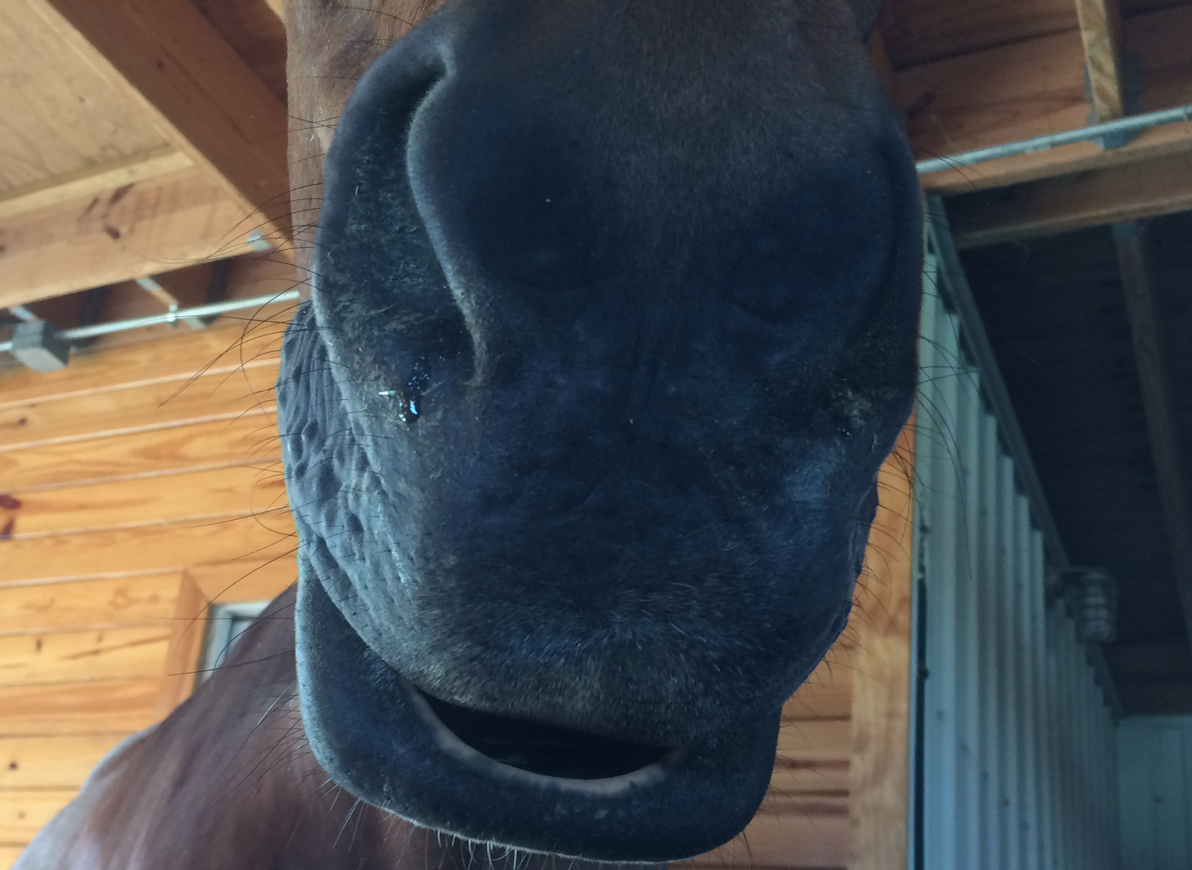
Robin asleep lip drooping

The view from my chair – Robin’s lower lip droops while he naps beside me.

Why am I writing about these simple summer pleasures? My horses live in a world of yes. I’ve been thinking a lot lately about what this means. Living in a world of yes gives me the freedom to enjoy these simple pleasures. But the freedom isn’t one-sided. Living in a world of yes gives my horses just as much freedom.

We often think of training in terms of what we need from our animals. When I walk down the barn aisle, I need you, horse, to move out of my space. When the door bell rings, I need you, dog, to go sit on your mat. I’ll teach these things using clicks and treats, but the behaviors are for my benefit more than my animal companions. The freedom to ask is all on my side.

That’s not how things are in my barn. It’s set up to maximize choice for the horses. Doors are left open so they are free to go where they want. Right now what Robin wants is to nap in the barn aisle. I couldn’t give Robin this luxury of choice if I hadn’t also given him behaviors that let us share space amiably.

When I walk down the barn aisle, Robin will often pose. It’s a simple gesture, a slight arch of the neck is all that’s needed. If he thinks I’m not paying attention, he’ll give a low rumble of a nicker. I’ll click, and give him a treat. Often I’ll get a hug in return.  That’s good reinforcement for me.

The pose is a guaranteed way to get attention from me. If Robin wants to interact, he knows how to cue me. And I am under excellent stimulus control! That’s how cues should work. They create a give and take, a back and forth dialog. They erase hierarchy and create instead the three C’s of clicker training. Those three C’s lead in turn to the freedom my horses and I enjoy sharing the barn together.

Before I can tell you what the three C’s are, we have to go back a few steps to commands.  It’s not just in horse training that commands rule. They control most of our interactions from early childhood on.  Commands have a “do it or else” threat backing them up. Parents tell children what to do.  In school it is obey your teachers or face the penalties. In our communities it’s stop at red lights or get a ticket. Pay your taxes or go to jail. We all know the underlying threat is there. Stay within the rules and stay safe. Stray too far over the line and you risk punishment.

This is how we govern ourselves, so it is little wonder that it is also how we interact with our animals. With both horses and dogs – commands have been the norm. We tell our dogs to “sit”. When it is a true command, it is expected that the dog will obey – or else! The command is hierarchical which means it is also unidirectional. A sergeant gives a command to a private. The private does what he’s told.  He doesn’t turn things around give a command back to the sergeant.

We give commands to our horses, to our dogs – never the reverse. We expect our commands to be obeyed. We say “sit”, and the dog sits. I tell. You obey. Because they are hierarchical, commands exclude dialog. The conversation is all one-sided. Commands put us in a frame that keeps us from seeing deep into the intelligence and personality of the individual we’re directing.

Cues are different. Cues are taught with positive reinforcement. At first, this sounds like a huge difference, but for many handlers it represents a change in procedure, but not yet of mind set. The handler may be using treats as reinforcement, but the cues are still taught with an element of coercion.  How can this be? It’s not until you scratch below the surface, that you’ll begin to understand the ever widening gulf that the use of cues versus commands creates.

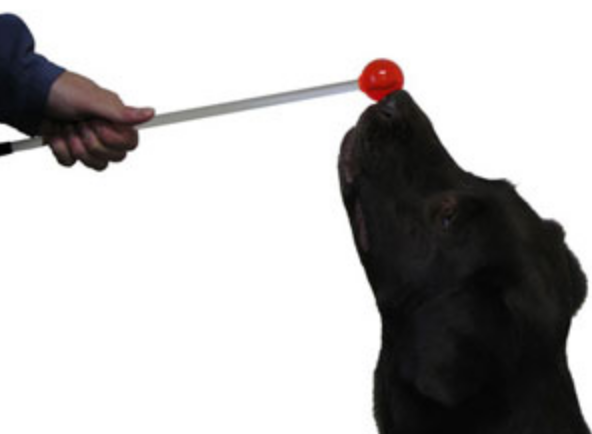
dog touching a targetTo help you see the coercive element, let’s look at how twenty plus years ago we were originally instructed how to teach cues.  You used your shaping skills to get a behavior to happen. It might be something as simple as touching a target. Cues evolve out of the shaping process. The appearance of the target quickly becomes the cue to orient to it.  But this cue is often not fully recognized by a novice handler.  We’re such a verbal species, this handler wants her animal to wait until she says “touch”.  As she understand it, that’s the cue.  So what does she do? She begins by saying “touch” and clicking and reinforcing her learner for orienting to the target.

This part is easy. Whether she had said anything or not, her learner was going to touch the target. She’s ready to make a discrimination. Now she presents the target, but she says nothing. What does her learner do? He orients to the target, just as he’s been doing in all the previous trials. He expects to hear the click and be given a treat, but nothing happens. His person just changed the rules which has plunged him into a frustrating puzzle.

He’s in an extinction process. He’s no longer being reinforced for a behavior that has worked for him in the past. He’ll go through the normal trajectory of an extinction process. That means he’ll try harder. He’ll try behaviors that worked in the past, and he’ll become frustrated, anxious, even angry, before he’ll give up for a moment. In that moment of giving up, his person will say “touch” and present the target again.

She wants him to learn the distinction. In the presence of the cue perform the behavior – click and treat. In the absence do nothing.

The problem with this approach is she never taught her learner what “do nothing” looks like. She stepped from the world of commands into what she thinks of as a kinder world of cues, but she didn’t entirely shed the mantle of “do it or else”. With cues the threat of punishment may not be there, but extinction is still an unpleasant and frustrating experience. Why isn’t this key on my computer which was just working now locked up and frozen?!! Until you can find your way out of the puzzle, you can feel very trapped and helpless. A good trainer doesn’t leave her learner there very long. She’s looking for any hesitation that let’s her explain to her learner the on-off nature of cues.

There’s another way to teach this that doesn’t put the learner into this extinction bind.  This other way recognizes that cues create a dialog, a back and forth conversation.  I want my learner to wait for a specific signal before moving towards the target.  Let’s begin by creating a base behavior, a starting point.  For my horses this is the behavior I refer to as: “the grown-ups are talking please don’t interrupt”.  I will reinforce my horse for standing beside me with his head looking forward.  He’ll earn lots of clicks and treats for this behavior.  And he’ll begin to associate a very specific stance that I’m in with this behavior.  When I am standing with my hands folded in front of me, it’s a good bet to try looking straight ahead – click and treat.

Ruth Scilla grown ups.png

“Grown-ups”

In separate sessions he’ll also be reinforced for orienting to a target.  When both behaviors are well established, I’ll combine them.  Now I’ll look for grown-ups.  I’ll fold my hands in front of me, knowing I’ll get the response I’m looking for.  Only now, instead of clicking and reinforcing him, I’ll hold out the target to touch.  Click the quick response and treat.

The message is so much more interesting than the one created by using an extinction procedure to introduce cues.  Cues have just become reinforcers which means they have become part of a conversation.  If you want to interact with the target, here’s an easy way to get me to produce it – just shift into grown-ups.  That will cue me to lift the target up.  A conversation has begun.  We’re at the very elementary stage of “See spot run”.  I’m teaching my horses the behaviors they can use to communicate with me, and I am showing them how the process works.  You can be heard.  You WILL be heard.  Let’s talk!

The conversation that emerges over time comes from looking more deeply at what cues really are. We can think of them as a softer form of commands, but that doesn’t oblige us to step out of our hierarchical mindset. It is still I give a signal. You – my animal companion – respond. Click and treat. Diagram this out. The arrows all point in one direction.

Signal from human leads to response from animal

Peel another layer of understanding about how cues work and you come to this:

It isn’t just that cues are taught with positive reinforcement. Cues can be given by anyone or anything. A curtain going up cues an actor to begin speaking his lines. We would never say the curtain commanded the actor.

If cues can be given by anyone or anything, that means they are not hierarchical. We cue our animals, and they cue us. Cues create a back and forth exchange. They lead to conversation – to a real listening to our animals. We adjust our behavior based on their response. Cues lead to the three C’s of clicker training which I can now say are: communication, choice, and connection. And in my barn that in turn creates opportunities for more freedom. It means doors can be left open. It means I can have watermelon parties and sit with my horses while we both enjoy the afternoon breeze through the barn aisle.

Let’s parse this some more.

The mindset that commands create is very much centered around stopping behavior. Other training options won’t make sense. They won’t work.

Cue-based training makes it easier for you to see your horse’s behavior as communication, as a bid for attention. That makes it easier for you to look for solutions that satisfy his needs.

Let’s see how these differences play out in a typical boarding barn scenario. Your horse is hungry. His initial whicker has been ignored. In frustration he’s escalated into banging on his stall door. His human caretakers see this as “demanding” hay. In a command-based frame demanding hay equal rebellious behavior which can’t be tolerated. The behavior must be stopped.

Within this frame the only training options you can think of are those centered around stopping the unwanted behavior. Other options don’t make sense and won’t work. The command-based frame narrows your field of view. It’s as though you have a tight beam focused on the problem behavior. Everything within that beam is crystal clear, but everything outside the beam might as well not exist. You can’t even begin to think about other solutions. You are targeted on the unwanted behavior.  Banging on the stall door must be addressed and addressed directly.

Now let’s look at the contrast that a cue-based frame creates. Your horse is hungry. His initial whicker to you is noticed and responded to. You appreciate his alerting you to the lack of hay. You have read how important gut fill is in preventing ulcers. You attend to your horse’s needs. Within this frame many options become available including hanging a slow feeder in his stall so he doesn’t have to become anxious about his hay.

Which training options make sense will depend upon which frame you are in. If you are a teacher and you want your instructions to be effective, you need to help your students open a frame that matches what you are trying to teach.

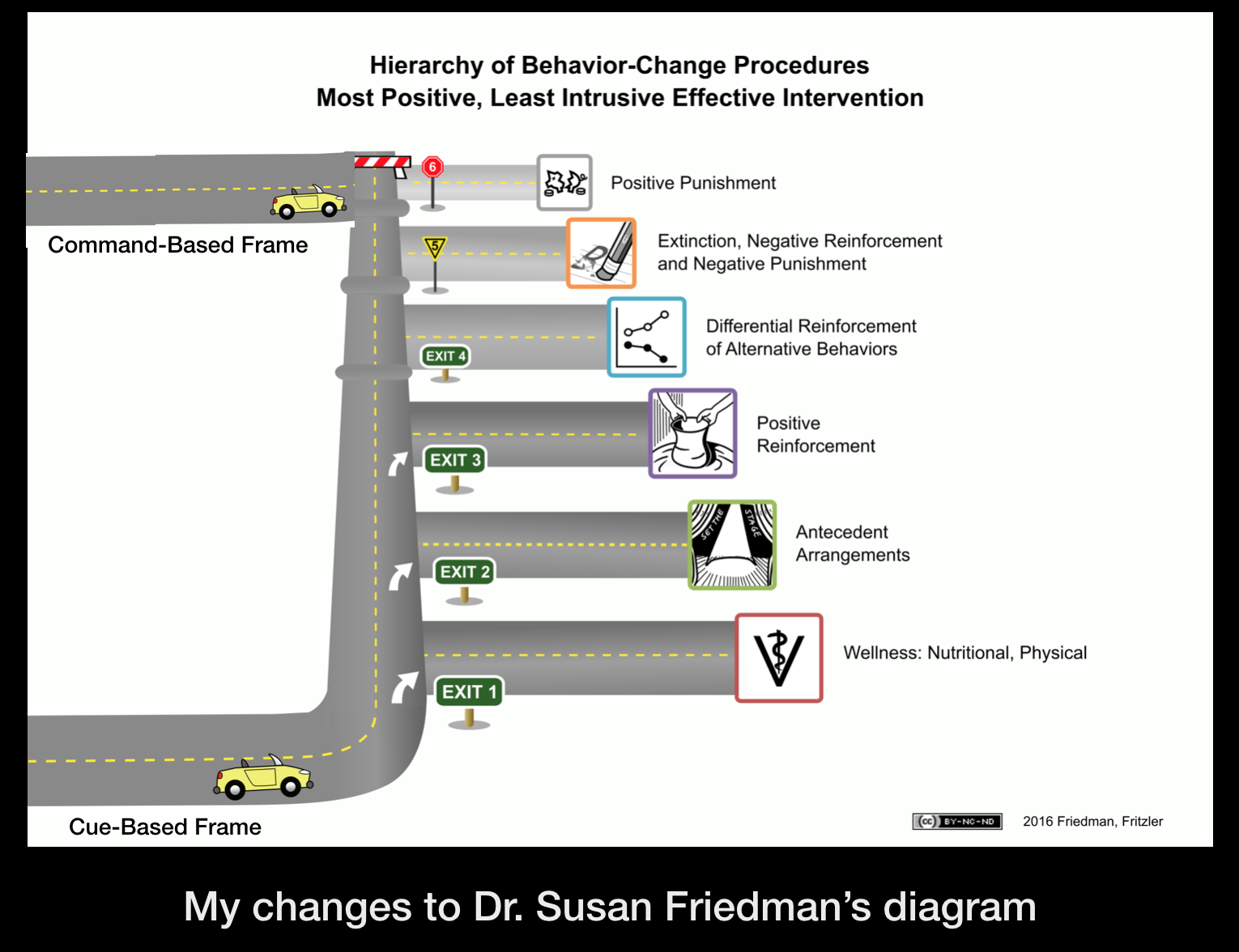
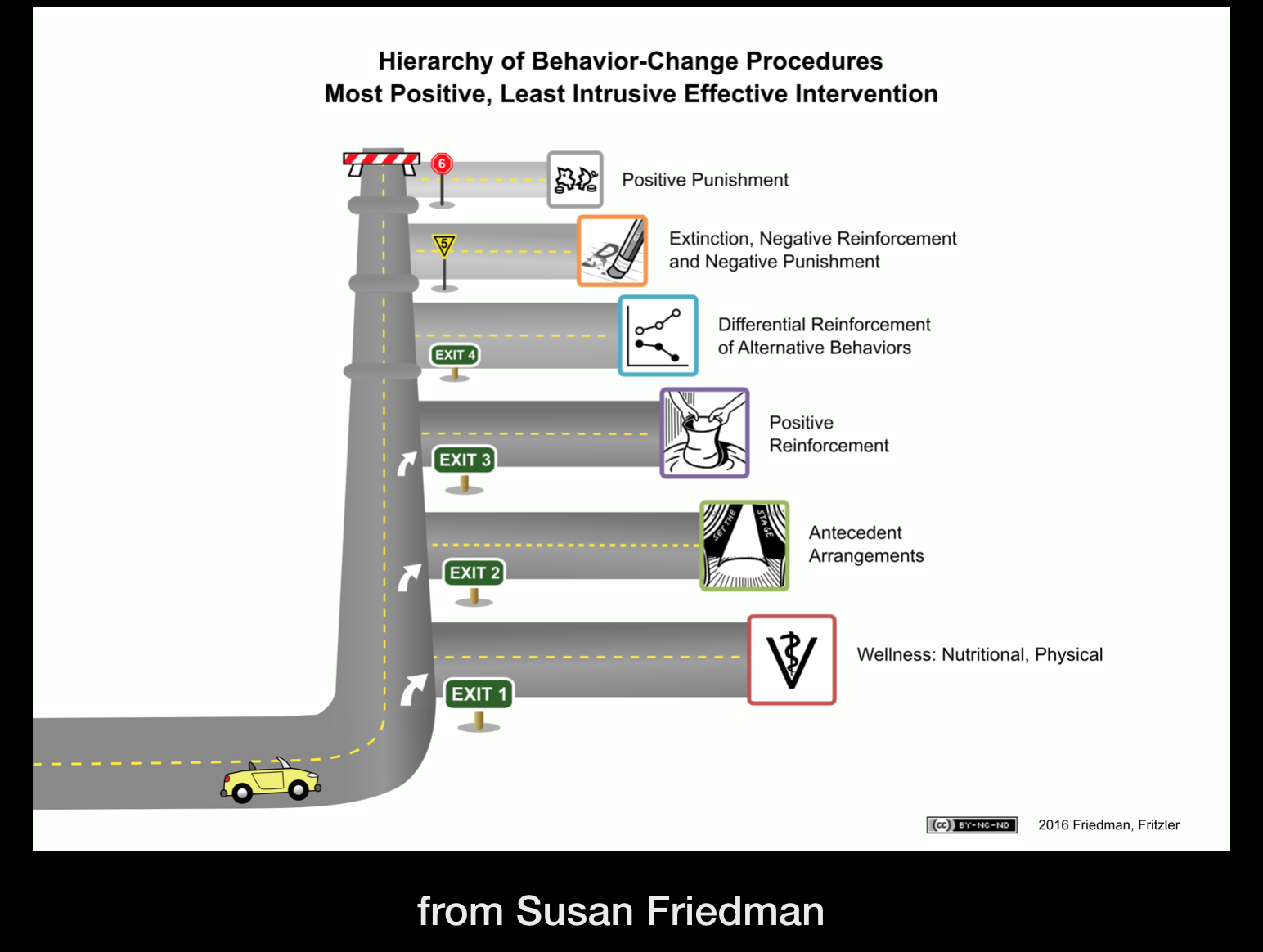
In her presentations Dr. Susan Friedman uses a graphic showing a hierarchy of behavior change procedures beginning with the most positive, least intrusive procedures.

Dr. Susan Friedman's Hierarchy of interventions

You begin by looking at health and nutritional considerations and then move to antecedent arrangements. Hanging a hay net for our hungry horse would fit in here. Her graphic pictures a car moving along a highway. As you begin to approach more invasive procedures, there are speed bumps blocking the way. They are there to slow you down, to make you think about other approaches before you bring in the heavy guns of positive punishment. The hierarchy doesn’t exclude positive punishment as a possible solution, but it does say you would use this only when everything else has first been tried.

This hierarchy makes sense when you are looking at behavior from a cue-based perspective. From a command-based frame, the car enters not at the bottom of the roadway, but at the top.

My Changes To Procedural Changes slide

The first intervention is positive punishment. The barriers are still there, but now they act to keep you from seeing other options. It is only when punishment fails, that you are dragged, kicking and screaming, to consider other ways of changing behavior.  I’ve heard these stories so many times from people who are attending their first clicker training clinic. They’ve been brought there by “that horse” – the one who challenges everything they thought they knew about training. Nothing else worked, but then they tried, as a last resort, a bit of clicker training and everything changed! So here they are, ready to learn more.

They don’t yet know what an exciting world they are entering. Everything they have thought about training is about to be turned truly upside down and inside out. That’s all right. They have the fun of watermelon parties ahead of them.

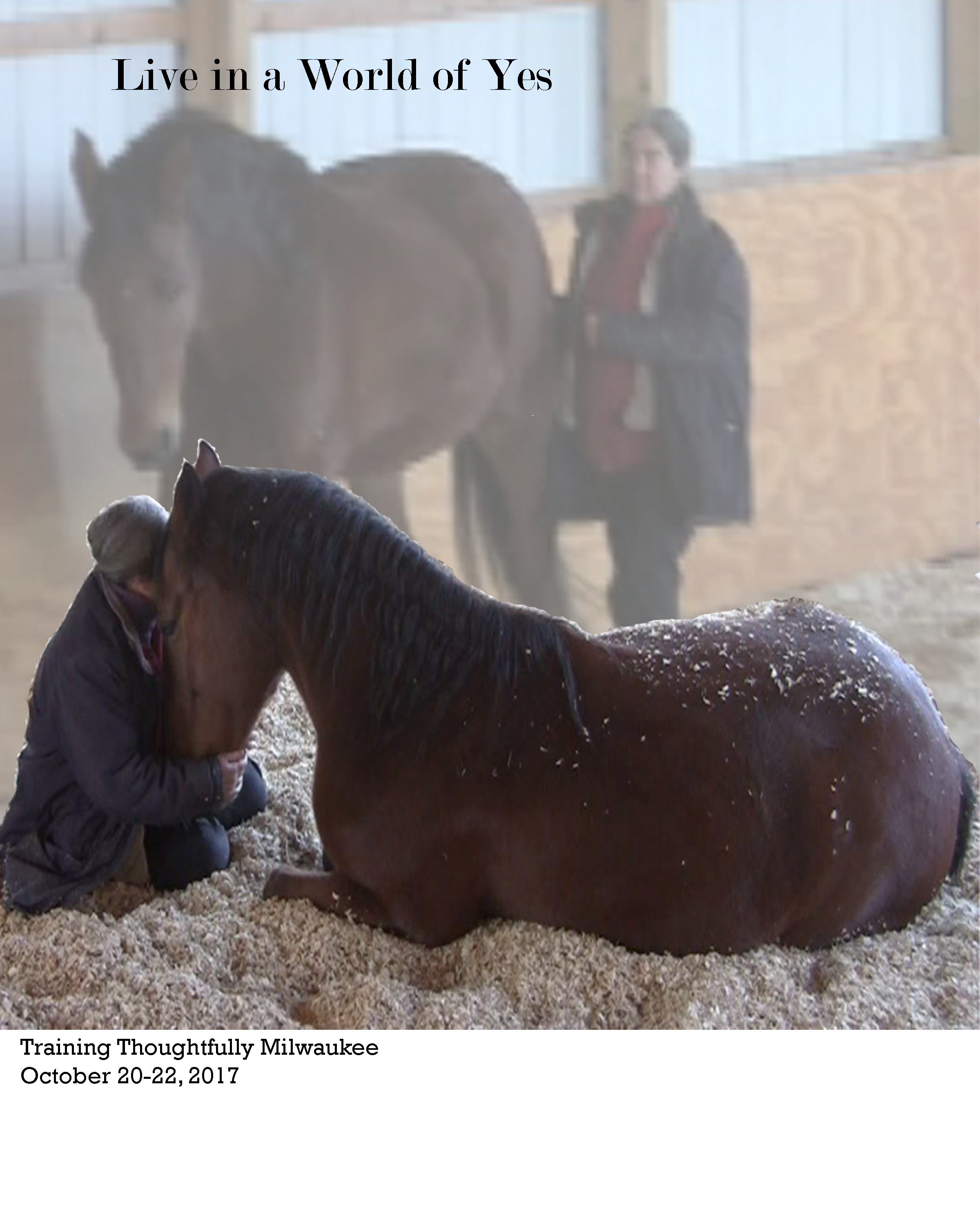
Live in a World of Yes.png

If you want to learn more about living in a world of yes and the freedom that creates for both you and your animal companions, come join us in Milwaukee for the Training Thoughtfully conference.  https://www.trainingthoughtfullymilwaukee.com/

JOY FULL Horses: Understanding Extinction: Part 14

Our Creative Horses
Yesterday I shared with you the story of Robin’s “pose”.  The use of resurgence has helped us develop a much more systematic way of creating unlikely behaviors.  Because we understand the process better, we can be more deliberate in it’s use.  I ended the post by saying: “The end result may look like magic, but there is good science behind it.”

When we open up our training in this way and turn our learners into more active participants, we often find that they are even more creative than we are.  Once again Robin provided me with a great example of this.

When Robin was three I took him to the Equine Affaire to be my demo horse.  I wanted to show people what freeshaping via clicker training looks like.  I didn’t want them just to see the end product of freeshaping.  I wanted them to see me teach Robin a completely novel behavior.  The problem was he already had a pretty extensive repertoire. I was stumped for ideas, but I thought the easiest solution would be to use a prop.  One of my clients had been teaching his horse to flip a hula hoop up over his head.  I thought I could make a start on that with Robin.

Robin had been our first equine retriever.  Picking things up was solidly in repertoire.  I figured if I put the hula hoop on the ground, he would try to pick it up.  I’d be able to reinforce that and build it into Robin holding it longer which might over three days of demos lead to him flipping it over his head.  Such was my level of creativity, that’s all I could think of to work on with a hula hoop.

So during our demo, I brought out the hula hoop and tossed it out on the ground.  I was still explaining freeshaping to the audience so I wasn’t focusing yet on Robin.  While I was talking, he walked over to the hoop and stood with his front feet planted in the middle of it just as he would have stood on a mat.  Before I could respond to him, he reached down, picked up one side of the hoop and began walking himself forward foot by foot with the hoop!  That was his level of creativity!

The Creative Process
Here are the steps the horses have been teaching us:

First, you build a strong history of reinforcement for the component behaviors.

You change the situation somewhat so mild extinction comes into play.

You get a resurgence of these previously reinforced behaviors and new combinations emerge.  That’s creativity.  The most fun for me is seeing what the horses invent. As we have seen, they are often so much more creative than their human partners!

Familiar Landscapes
Kay Laurence might say we were seeing familiar landscapes with fresh eyes.

Dr. Jesús Rosales-Ruiz would say you have to understand the process of extinction before you can master it.  If you understand it, you’ll avoid situations that create macro extinction processes and all the frustration that goes along with them.  Instead you’ll use micro extinctions to build complex behaviors.

I would say that monitoring the level of extinction your learner is experiencing is a keys-to-the-kingdom part of good training.

I’ve just spent a couple of days working with a group of horses I have come to know well. One of them is a retired performance horse. Without going into a lot of details, I would describe him as an emotionally fragile horse. He’s easily worried.  If he thinks he has the right answer, he’s a superstar, but I always have to be careful how far I stretch him into new behaviors.  If he thinks he might get something wrong, he worries.  He’s come out of a training environment in which he had to perform correctly or his rider could get seriously hurt. I suspect he was punished for mistakes which accounts for his worry.

Mastering Micro
His back was looking prematurely aged so I wanted to teach him Robin’s “pilates pose”.  I had already shown him that he could get reinforced for lifting his back up and releasing at the poll.  In this particular session I was holding out for slightly better versions. As I withheld my click, I saw him experimenting.  Was it higher with his poll? Was it more lift of his back? What did I want?

The shifts he was giving me represented micro changes.  They were all within a clickable range.  Clicking him for any of these variations would have been fine, but I was waiting fractionally to see what else would pop out.

I was using micro extinctions to create the next step.  And because I was thinking about this in terms of extinction, I was monitoring closely his emotional responses.  I did not want him to become macro worried.  We were always just a second or two from a click so I could let him experiment without risking the emotional fallout of a larger extinction process.

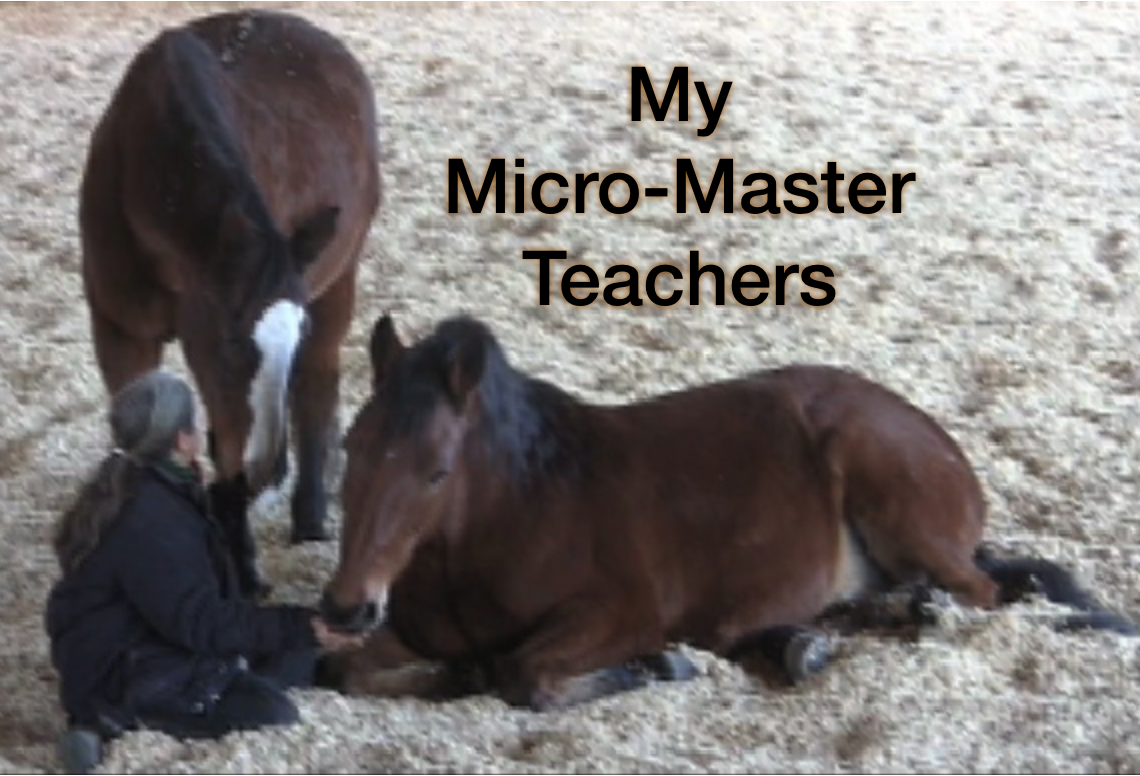
Micro Masters
Micro is so very much the key.

Macro extinctions are frustrating.  Micro extinctions are part of good teaching.

Macro shaping can be confusing.  Micro shaping is elegant.

Macro negative reinforcement is literally painful. Micro negative reinforcement is clear communication. It is a conversation with cues exchanged in both directions.

When you go micro, your learner is always just a second or two away from a reinforceable moment.  You can cue another behavior, or you can simply click and treat. Either way, you are saying: “Yes! Great idea!” Micro Mastery is what we should be striving for in our training.  When you say someone is a great trainer, you are really saying that individual is a Micro Master.  In training that’s the “black belt” we should be aiming for.

robin-pg-lying-down-micro-masters

With this last section we come to the end of my JOY FULL Horses book – almost.  What remains is one final chapter and that’s what’s coming next.

Coming Next: Doorways

Remember, if you are new to the JOY Full Horse blog, click on the JOY Full Horses tab at the top of this page to find the full table of contents and links to each of the articles I have published so far.

I hope you will want to share these articles by sending links to this blog to your friends.  But please remember this is copyrighted material.  All rights are reserved. Please do not copy any of the “JOY Full Horses” articles without first getting written permission from Alexandra  Kurland, via theclickercenter.com

Also note: these articles are not intended as an instruction guide for introducing your horse to clicker training.  If you are new to clicker training and you are looking for how-to instructions, you will find what you need at my web sites:

theclickercenter.com                    theclickercentercourse.com