JOYFull Horses: Chapter 3: The Time Has Come . . .

The Time Has Come the Walrus Said To Talk of Many Things

“The time has come,” the walrus said,
“To talk of many things:
Of shoes and ships and sealing-wax
Of cabbages and kings
And why the sea is boiling hot
And whether pigs have wings.”
Lewis Carroll – Through the Looking Glass

In Chapter One of this section I shared some examples of how the environment can cue behavior.  Panda, the mini I trained to be a guide, provided us with many examples of environmental cues.  In the previous Chapter I showed how a combination of mats and strategic food delivery can be used to teach basic leading.

We’ll be building on that lesson is this next unit. Which means the time has come to talk about Premack, Feldenkrais work, asking questions, mats, airplane runways, needlepoint, and creativity.  If you’re not sure what some of these mean or what the link is between them, read on.  And yes, we will be getting back to play and our list of ten things a beginner needs to know about cues, but first let’s set the stage with a discussion of the Premack Principle.

Behaviors as Reinforcers
One of the things that quickly becomes apparent when you start turning training into play is how quickly the behaviors you teach your horse can be turned around and used as reinforcers for other things.

This is not a new understanding. In the late 1950s primatologist, David Premack developed his relativity theory of reinforcement which is better know as the Premack Principle.  Simply put this means that a higher valued, more probable behavior can be used to reinforce a lesser valued, less probable behavior.

If you hate to sweep your barn aisle, but love to ride, don’t put sweeping after riding.  Let riding serve as a reinforcer for sweeping up.  When you finish grooming and reach for the broom before you reach for your hard hat, that puts you on a habit path that’s going to culminate not just in a great ride, but also in a love for barn chores. Clicks for you!

That’s something I discovered when I changed the sequence in which I did my barn chores.  I’ve always disliked sweeping.  When I was boarding my horses, it never made any sense to me that we were sweeping the barn aisle last thing at night.  The only person who was going to see our beautifully swept aisle was the morning stall cleaner, and she was going to begin the day by making a mess.

It would have been much better to sweep up when we first arrived so we could enjoy the clean aisle all evening, but that wasn’t how things were done.  In my own barn I sweep the aisle first and then follow that with cleaning the stalls and paddocks – something I enjoy.  After the barn chores are done, I get to play with the horses.  The result?  I now look forward to sweeping the aisle. It’s a great way to begin my day.
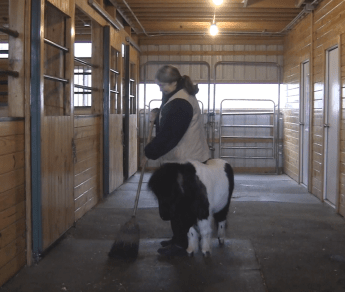
Panda helping me sweep 3

Panda is “helping” me sweep my barn aisle during a visit to the barn.

The same kind of sequencing becomes important when you train your horse.  Think about the order in which you ask for things.  If you’ve taught a behavior well, it can serve as a reinforcer for a newer behavior you’re working on.  Ideally every behavior you add into your training loops should function as a reinforcer for all the other behaviors.  The result: every behavior you ask for will become something your horse enjoys doing.

That’s ideally.  How can you make that a reality for the behaviors you teach your horses?

Turning Mats Into Tractor Beams
For a horse who likes to be actively doing something, what could be more tedious than standing on a mat?  And yet, that’s definitely not how our eager clicker horses view mats.

Mats become like tractor beams drawing the horse in.  They are where good things happen.  You get treats on a mat.  You get lots of attention.  And when you leave one mat, you get to head off to another.  More treats!  Yeah!!
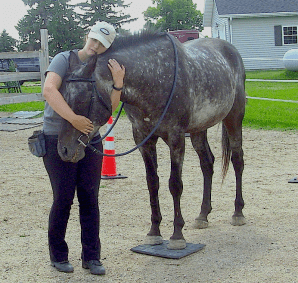
Harrison on mat hug cropped

Mats are where good things happen.

If I teach mats well, they are a source of play not tedium. When I am first teaching mats, I keep the Premack principle very much in mind.  Most horses initially view a mat as something to avoid.  They will step over it, around it, slam on the brakes in front of it, anything but actually step on it.

I’ve taught mats in lots of different ways.  You can freeshape stepping on a mat, but I prefer to put the horse on a lead and turn this into a more directed-learning process.  The reason I do this is because it’s a great opportunity for the horse and handler to become more familiar with good rope handling techniques.

In the horse world the lead is often used as an enforcement tool.  “Do what I say – or else!” If a horse pushes past the handler, the lead is there to give him a quick reprimand.  The handler jerks the lead so the horse feels a sharp bump from the halter.

If a horse doesn’t back fast enough, he knows the lead will be there again swinging threateningly in his face.

That kind of expectation is not clicker compatible.  We need to take the “do it or else” threat out of the lead.  The lead is there to ask questions – not to tell or demand.

What does this mean – the lead is there to ask questions?  One of the best ways to describe this came from a youtube video clip of Mia Segal.  Segal is a Feldenkrais practitioner.  Developed by Moshe Feldenkrais in the mid-1900s Feldenkrais work eases pain or restrictions to movement by increasing an individual’s awareness of small movements.

Feldenkrais Work
Unlike a massage and other manipulative therapies, Feldenkrais work is experienced through self-observation.  You learn how to move with attention.  You become aware of how you move; what parts of your body you mobilize to create an intended movement; how far the movement flows through your body; where it stops; where it is blocked; and what can be released to extend the movement.  It is an exploration of movement in which an individual is guided via questions towards greater self-awareness and well being.

The expression “Where there is no fear or pain, learning can take place in a single lesson.” lies at the core of this training.  Like many in the horse world I was first introduced to Feldenkrais work via Linda Tellington-Jones.  Her TTEAM training evolved out of this work.  Later I was fortunate to have a client who was an Alexander Practitioner and who had also studied the Feldenkrais work.  We did trades, sharing back and forth the new things we were exploring. Through her I learned even more about the art of asking questions.

Asking Questions
Recently a friend sent me a link to a youtube clip of Mia Segal teaching a workshop  (https://www.youtube.com/watch?v=prGxrhXDEgQ).  My friend said it reminded her a lot of my work.  As I watched it, I thought, she’s right.  Mia Segal might have been talking about working with people, but she was describing perfectly my approach to horse training.  Segal was sitting on the floor with one of the workshop participants.  She was clearly in the middle of a session.  Her student was lying on her back, knees up in the air, with Segal comfortably supporting her head in her hands.

Segal was talking about the first time she saw Moshe Feldenkrais working.  It was 1957.  After the session he asked her if she had any questions.  She had so many, but she knew there were other people waiting.  How could he have time for all of her questions?

Feldenkrais answered her – “If you know the question – it will take but a minute.”

The art of training is knowing the questions to ask.  That is as true for our horses as it is for people.

Segal went on to say:

Someone recently asked the question: ‘What is the difference between this work and pilates, yoga, and other physical therapies. Isn’t it all the same?  So you have another method.’  And I thought the biggest difference is this is a method of questions. I don’t have answers, and I don’t want answers.

You ask a person to move in a certain way.  Bend your knees to the right and you ask – ‘How is she doing it?  Is it anything to do with what I feel under my hands?’

How do I feel it in my hands?  How is she coming back?  Does this change anything under my hands?  And do it to the other side – How is she doing it, and does this feel different?

So rather than thinking – Here it stops.  Here it goes.  Instead I just keep putting a little question mark at the end.  HOW does it go?  HOW does it stop?  WHERE does it stop?  WHEN does it stop?  Is it the same on both sides?  And then I have the whole lesson.”

The Translation to Horses
When I slide down a lead to a point of contact, I am listening through my hands.  And I am asking questions.
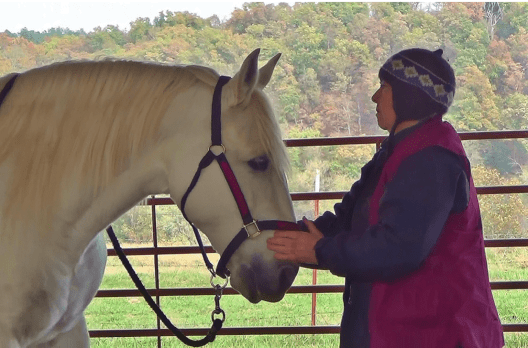
Merenaro with alex

This horse and I are deep in conversation.  I am asking many questions through my hands.

When I meet horses for the first time, most aren’t used to being asked anything.  They expect to be ordered about.  Some horses are very compliant.  They have learned that the best way to stay out of trouble is to do what they’re told.  They will follow the feel of a rope.  They will be responsive, and light in your hands. They may even seem happy or at least content.

Light we can measure in terms of how much pressure we need to apply to get a response; how quickly the horse responds; how much weight we feel in the rope as he moves.  Does he move with us, or does he hang back leaving pressure on the lead?  These are all measurable.

But happy.  Who knows. How do I know if you or anyone else is happy?

The “Black Box” of Emotions
How do I know if another person is happy?  I may see behaviors that I associate with times when I have felt happy, but I don’t really know how anyone else feels.  When you say you love your horse, I believe you.  But what does that really mean?  If you tell me you love your horse, but then you sell him so you can buy another horse who jumps higher, I have to believe that that word means something very different to you than it does to me.

So I can say that a horse is responsive – that’s measurable.  I can describe other behaviors that I like to see – his ears are relaxed so they flop back and forth in time with his walk.   Or I might see the opposite.  He has his ears pinned flat, he’s grinding his teeth, and the muscles around his eyes are tight.  These behaviors tell a different story.  I wouldn’t say that’s a horse who is happy.

The Lead Tells A Story
Often when I first attach a lead to a horse, what I encounter is resistance and concern.  Leads have been used for corrections – so the horse is defensive.  He may throw his head up as I slide down the lead, or punch my hand with his mouth.  He might even bite at the lead or at me.  He’s telling me about his history, and I need to listen.  I also need to respond in a way that doesn’t prove to him that he was right to be guarded.

The mats are going to help me.  I was about to add the phrase: get past his defenses, but that’s not exactly right.  That would imply that the castle walls are still there, and all I’ve done is found a way to scale them.

castle walls 1.png

Instead, I want to show him that the castle walls, the moat with the sharks, the draw bridge, the boiling oil, the iron portcullis, and all the armored men lined up behind it aren’t necessary.  They can all vanish, whisked away not through force, but through play.  In the next installment I’ll describe a lesson that replaces castle walls with airplane runways, and you’ll see how the Premack Principle can be applied to training loops.

Coming next: The Runway

Remember, if you are new to the JOY Full Horse blog, click on the JOY Full Horses tab at the top of this page to find the full table of contents and links to each of the articles I have published so far.

I hope you will want to share these articles by sending links to this blog to your friends.  But please remember this is copyrighted material.  All rights are reserved. Please do not copy any of the “Joyful Horses” articles without first getting written permission from Alexandra  Kurland, via theclickercenter.com

Also note: these articles are not intended as an instruction guide for introducing your horse to clicker training.  If you are new to clicker training and you are looking for how-to instructions, you will find what you need at my web sites:

theclickercenter.com                    theclickercentercourse.com
 

JOYFull Horses: Using Environmental Cues

In the previous post I shared many examples of using environmental cues.  For one example I wrote:

“When you have a training challenge, instead of tackling it head on with your normal “horse training” solutions, think instead about how you might use props.  If your horse has trouble turning to move out of your space, how could you use mats to help with this?”

One of the reasons I wanted to share the JOYFull Horses book on line was I knew I wanted to include video along with the text.  That’s what I’ll be doing in today’s post.  To illustrate just how useful environmental cues can be in training, I’m going to explain more fully how you can use mats to teach basic balance and leading skills.  I’ll be combining the draw of  the mats with the set up for a turn that can be created out of food delivery.

These videos were taken during the spring 2015 Arkansas clinic at Cindy Martin’s farm.  Cindy is one of the coaches for my on-line course.  The video features her beautiful draft cross mare, Scout.  Scout is a fairly new arrival in Cindy’s family.  When she first started riding her, Cindy discovered two things.  First, Scout’s idea of steering meant going where she wanted to go regardless of the rider’s wishes.  And second, if you asked for forward, you were just as likely to trigger rearing as any forward impulsion.  These riding issues meant it was time to go back to ground work and teach Scout the basics of leading.

By the time these videos were taken, Scout was well versed in the foundation skills of clicker training.  She had become a mannerly, very pleasant horse to be around, but her tank-like qualities were still in evidence.  This was in part due to a lack of balance.  During the spring 2015 clinic, I introduced Cindy to a simple lesson in which food delivery was combined with the use of multiple mats to teach better leading skills.

These videos take you step by step through the process.

Part 1 establishes a baseline.  Cindy is asking for Scout to turn away out of her space.  In this short video you’ll see Scout push forward through Cindy’s request.  In many traditional forms of horse training we would have dealt with this push-through by getting after Scout.  We would have punished the forward push, but punishment brings with it many unwanted consequences.  Obviously, we used a very different approach, one that used positive reinforcement to teach Scout what was wanted.

In Part 2 you’ll see how Cindy begins to use food delivery to set up the balance shifts she wants.  If you aren’t familiar with clicker training, this can look as though Cindy is simply feeding Scout out to the side.  That’s only part of what is happening.

In the video you’ll hear me refer many times to “grown-ups”.  This is a short hand expression for a lesson which I call: “The grown-ups are talking, please don’t interrupt”. This is one of the foundation lessons of clicker training, one of the very first things we teach the horses when we introduce them to clicker training.  It’s a long name for a simple lesson.  What it means is the handler is able to stand next to her horse with her pockets full of treats, and her horse will stand quietly beside her.  I gave it this very long name because I wanted to emphasize that at the core of clicker training sits good manners.

Having a horse who is mugging you for treats takes the fun out clicker training.  I don’t want the mugging behavior.  And I also don’t want the horses to be anxious about the treats, so early on we teach them this foundation behavior.  Moving away from the treat pouch is what earns clicks and treats.

So many people avoid using food in training because they see it as a distraction.  They want the horse working for them, not any goodies in their pockets.  I ask a lot of my horses, and I want to reinforce their good behavior generously with something they really enjoy.  Being able to offer something they will actively work for adds enormously to my training. Plus, I find it reinforcing for myself to be able to say thank you for a job well done.

How do you know what your horse will actively work for?  Ask yourself what will he mug you to get.  At the top of the list for most horses is food.  I’m going to take that information and transform food from a distraction into a powerful teaching aid.  I do this by teaching the “grown-ups are talking” lesson.  Once a horse understands that treats come when he shows me good emotional self-control, I can use food as a reinforcer to help teach other things.  That’s what you’re seeing in this series of videos.

In Part 2 Cindy is using grown-ups.  First, she asks Scout to look straight ahead so her head is out of Cindy’s space. Click.  Normally, Cindy would feed Scout so her head continues to be centered between her shoulders.  But to teach her how to turn so she doesn’t crowd forward into Cindy’s space, Cindy is instead stepping into her and extending her arm out so Scout has to look to the right to get her treat.

Once she does, Cindy again asks for grown-ups.  Scout’s head is still bent to the side.  To earn a click and a treat, she needs to keep her head away from Cindy.  When she does – click! – she earns another treat.  Again, Cindy extends her arm out to the side so Scout has to bend her head even more.  As she does, she discovers that she can move her feet.  That simple realization lets her straighten out into a more comfortable position.

So, while it might look as though Cindy is simply feeding Scout treats, and that’s how she is getting her to turn, the treats are in fact reinforcers that come after Scout has been clicked for keeping her head away from Cindy in the “grown-ups are talking” lesson.

When she does, she not only gets clicked and given a treat, she also gets to walk forward to a mat.  In previous lessons Scout has been introduced to mats.  She’s not only comfortable standing on them, the mats have become conditioned reinforcers.

This means that there is such a deep history of reinforcement that’s been built up around the mats, Scout regards them as a great place to be.  They are a predictor of good things – easy requests and lost of treats.  So Scout likes going to mats.  We can use them to reinforce previous behavior. We’re going combine the strategic use of the food delivery with her eagerness to go to mats to help her find her own balance through these leading turns.

Part 3 continues to develop Scout’s balance.  Not only will this teach great leading manners, but it also opens the door to lateral work.  So many good things come out of lessons that are taught with positive reinforcement.

Part 4 begins to introduce the lead back into the equation.  We don’t want to have to rely forevermore on food delivery to get turns.  Now that Scout understands the pattern we want, Cindy can begin to ask for the turns from the lead.  She may encounter some old history when she slides down the lead.  Scout’s old pattern was to push through pressure, so Cindy goes back and forth between the food delivery and the lead to set up the turns and and change Scout’s expectations.

You’ll see some beautiful rope handling in these videos.  Cindy is very light and tactful on the lead.   She is familiar with the rope handling techniques which I teach in my books, DVDs and on-line course.  If you aren’t familiar with this type of rope handling, refer to my web sites: theclickercenter.com and theclickercentercourse.com.

The lessons I am presenting here are built around this style of rope handling.  The lead is taught as a clicker-compatible tool.  The horses trust the information it gives them.  It is not used as a correction tool.  I don’t want my horses to be afraid of the lead or to be worrying about what might happen if they make a mistake.  That would poison the cues the lead is giving.  If you are using a style of rope handling in which escalating pressure is at times used to enforce behavior, you will undermine the intent and the power of this lesson.

Part 5 takes us into the second day of the clinic and shows us steady progress in this lesson.  You might want to refer back to Part 1 as a reminder of the starting point.

Up to this point Cindy has just asked Scout to turn away from her.  In this lesson I have her ask her to turn in her direction, as well.  We’re following a basic principle of training: For every exercise you teach, there is an opposite exercise you must teach to keep things in balance.  These two turns are part of creating beautiful leading balance.

Part 6 continues the process of adding in the lead.  Again, I’ll refer you to my books, DVDs, clinics and on-line course for details on this rope handling technique.

Cindy and Scout are learning how to dance together.  Each small step is part of a larger flow that will let them move in balance one with the other.  This is the final video of this particular lesson.  Scout had been doing wonderfully well, but she was beginning to get a little slower in her responses.  That’s a good indicator that she might be getting tired.  So rather than push beyond what she could do, we noted this early sign of fatigue and brought the day’s lesson to a close.  Both Scout and Cindy had learned a lot.

This is a glimpse into the future.  This clip was taken during the fall 2015 clinic.  Scout and Cindy have made great progress in their dance together.  Lateral work is one of the many good results that comes out of teaching good balance.

The fun of teaching in this way is you always get so many good things popping out of simple lessons!

Have Fun!

Coming Next: Chapter 3: The Time Has Come the Walrus Said To Talk of Many Things: Premack, Asking Questions, Mats, Airplane Runways and Creativity

Remember, if you are new to the JOY Full Horse blog, click on the JOY Full Horses tab at the top of this page to find the full table of contents and links to each of the articles I have published so far.

I hope you will want to share these articles by sending links to this blog to your friends.  But please remember this is copyrighted material.  All rights are reserved. Please do not copy any of the “Joyful Horses” articles without first getting written permission from Alexandra  Kurland, via kurlanda@crisny.org

Also note: these articles are not intended as an instruction guide for introducing your horse to clicker training.  If you are new to clicker training and you are looking for how-to instructions, you will find what you need at my web sites:

 theclickercenter.com                    theclickercentercourse.com


JOYFull Horses: Using Environmental Cues

Using Environmental Cues

Spring is clinic season which means a lot of traveling for me.  I haven’t been able to post anything since the beginning of April which also means some of you may have lost track of where we are in the book.  At the end of Part One I asked the question: what are ten things you would want a novice trainer to know about cues?  In Part Two I began to answer that question.  So far my list includes:

1.) Cues are not Commands.

2.) Cues can be non-verbal.

3.) The environment can be a cue. 

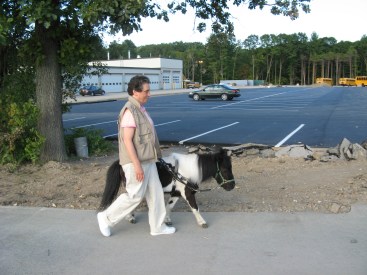
In the first chapter of this section on environmental cues I shared some stories about Panda, the miniature horse I trained to be a guide.  Her work illustrates well the many ways in which the environment can cue behavior.  

IMG_1994_1 Panda Ann great walk

Now in this post I’ll be looking at ways we can all use environmental cues in our training.

Every Day Environmental Cues
Panda’s training shows how much inanimate objects can cue behavior.  You may never ask your horse for the kind of work that is expected of a guide, but you can still make effective use of environmental cues.  They can help turn a frustrating or even dangerous situation into play.

Here are a few examples:

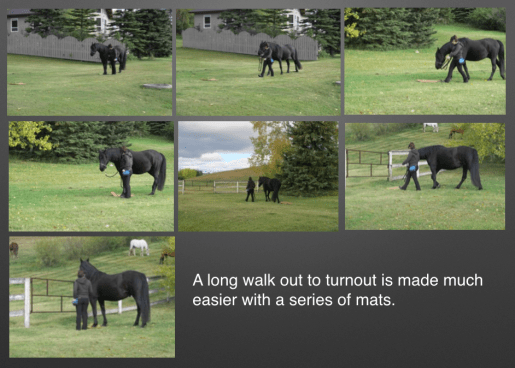
For a horse who rushes out to turnout – even to the point of rearing if you try to slow him down – teach him to stand on a mat.  Then put out a series of mats on his way out to turnout.  Now instead of trying to keep things calm over the long stretch to turnout, all he has to do is walk a couple steps to the next mat – click and treat!  Turn each mat into a station where he can engage in some favorite game.  That takes the focus off the turnout.  In fact when you do finally get to the paddock, you may find your horse doesn’t want you to leave.

“Must I go eat grass?  This is so much more fun!”

Shannon mat series

For the barn-sour, herd-bound horse who doesn’t want to leave the comfort zone of his friends, hang targets at strategic points around the barnyard and along the driveway.  Click and reinforce him for walking to the target.

For the horse who worries out on trails, take his toys out with him so he can play familiar games.

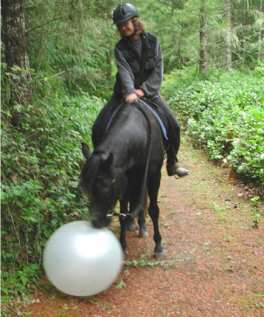
Magic with ball
Combine mats with a circle of cones to teach a horse how to trot around a circle.  Lay out a small circle made up of cones and one mat.  Your horse will begin on the mat and end up back at the mat – click and treat.  As you gradually expand the circle, he’ll understand that his job is to stay out around the the outside of the cones.


For the horse who fidgets and fusses to be groomed, hang a stationary target or give him a mat to stand on.

Mounting blocks become wonderful environmental cues.  Teach your horse to bring himself over to your mounting block and line himself up so it is easy to get on.  It’s not only a fun behavior to “show off”, it’s also a great way to measure how ready – or not – he is to ride.

(Note: This video features Michaela Hempen, one of my coaches for the on-line course.  I almost didn’t use this video because she wasn’t wearing a hard hat. When I mentioned it to her, she said she normally wears a hard hat.  She just couldn’t resist getting on.  I decided to use the clip after all because it is a great example of the joy this training brings to both horses and handlers.  And it also gives me an opportunity to say safety always comes first.  Certainly good preparation contributes to safety, but hard hats are still important.)

These are just a few training suggestions.   The more creative you are, the more playful you can be with your horse.

When you have a training challenge, instead of tackling it head on with your normal “horse training” solutions, think instead about how you might use props.  If your horse has trouble turning to move out of your space, how could you use mats to help with this?

Maybe you have large cones or temporary fence posts that can be used like gates on a slalom course.  How could you use them to explain the patterns you want to your horse?

If forward is an issue, teach him to retrieve, and then toss a cone out in front of his path.

If stopping is the problem, set out lots of mats.  Give him a positive reason to stop.  That’s a lot better than the “horse training” solutions of harsher bits and running horses into fences.

If you want your horse to get more exercise, but for some reason you can’t ride, use targets to teach your horse to go from person to person.  This can easily be turned into a game Panda would say she invented and which we named after her: “Panda catch”.  She “taught” us this game when she was a yearling.  At thirteen she plays it with every bit as much gusto as she did then.


As you can see from this article, teaching your horse to stand quietly on a mat has many uses.  What I haven’t included here are the how-to instructions for introducing your horse to mats.  You can find detailed instructions for teaching this lesson in my books and DVDs and in my on-line course.  Visit my web sites to learn more:

 theclickercenter.com                    theclickercentercourse.com

Remember, if you are new to the JOY Full Horse blog, click on the JOY Full Horses tab at the top of this page to find the full table of contents and links to each of the articles I have published so far.

I hope you will want to share these articles by sending links to this blog to your friends.  But please remember this is copyrighted material.  All rights are reserved. Please do not copy any of the “Joyful Horses” articles without first getting written permission from Alexandra  Kurland, via theclickercenter.com

Also note: these articles are not intended as an instruction guide for introducing your horse to clicker training.  If you are new to clicker training and you are looking for how-to instructions, you will find what you need at my web sites:

 theclickercenter.com                    theclickercentercourse.com
JOY Full Horses: Tagteaching – You Can’t Train My Child Like A Dog!

This is a continuation of Part 2 of my new book, “JOY Full Horses”.  If you are new to this series, go to the contents for links to the previous articles.

Chapter 2 of this section on Non-Verbal Cues was about habits.  What began as a simple question – how do you turn being PLAY FULL into a habit – took us down many paths.  We looked at habit loops, cravings, changing your habits, the power of community, small wins and keystone habits.  That led us back to horse training.  I shared with you some of the most important lessons my own horses have taught me.  That highlighted the contrast between clicker training and the force-based training many of us started with.  These were heavy topics to consider. Now in Chapter 3, I’m turning the spotlight entirely on what we do want: which is effective ways to teach our learners – horses and humans alike.

Chapter 3
Tagteaching – You can’t train my child like a dog!

TagTeaching
Tagteaching stands for teaching with acoustical guidance.  It is often described as clicker training for people, but really Tagteaching is it’s own self.  It evolved out of clicker training, so it is a relative, but not a clone.

Tagteaching was developed by Theresa Mckeon.  Theresa was a gymnastic coach.  We’ve all watched the Olympics and seen the intensity of the coaching.  This goes on at all levels, and in all sports.  Under the intense pressure of competition, students are hammered with all the things they are doing wrong, and all the things they need to do to correct them – everything – all at once.

At one point or another you may have been in a riding lesson that was like this.  The instructor was giving you a barrage of instructions – all at full volume.  Put your hands forward, no back, shoulders UP! Sit BACK! Why are you leaning to the side!? No! Don’t pull back.  Kick him HARDER!

I’ve certainly seen plenty of these lessons, and even taken a few.

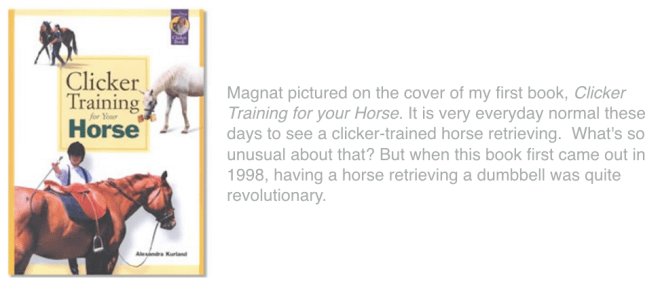
Theresa was also familiar with this sort of lesson.  She has a horse, so I’m sure she’s seen this kind of instruction. She was certainly seeing it in the gymnastics coaching.  When my first book, “Clicker Training for your Horse”, came out in 1998, Theresa read it with interest.  She was familiar with clicker training in dogs, and now here it was for horses.  Why couldn’t she do something like this for her gymnastics students?

Excited to try the experiment, she introduced the concept to her students.

“Oh, yuck, you can’t treat us like dogs!” was the reaction.

Theresa was surprised and disappointed. She was sure adding a marker signal would help the training.  She went home that night and started thinking of other ways she could get the kids to buy into the idea.  Maybe if she didn’t tell them it was clicker training, she’d be all right.  What else could she call it?

The way Theresa tells the story, she says she always liked words beginning with T.  Ts made a sharp, clear sound.  So she started thinking up T words and came up with the acronym TAG – Teaching with Acoustical Guidance.

In clicker training we work non-verbally.  We can’t say to our horses we want you to walk over there and pick up that plastic cone and bring it back to me.  We have to shape that behavior through a series of small approximations.

Tag Points
In TAG Teaching we have the advantage of words.  We can tell our human students exactly what we want them to do.  But that description can turn into a verbal barrage.  So part of the brilliance of TAGteaching is the coach learns to pare down the instruction to just the core key phrases that the student most needs to focus on next.

Whether the student is a young gymnast attempting her first somersault, a golfer perfecting his swing, or a child with disabilities learning to walk, the coach is looking for one specific skill that the student will concentrate on for this next turn.  This skill is referred to as the TAG point.  When the learner is successful, that will be indicated with a TAG – an agreed upon marker signal that indicates success.

WOOF Criteria
A good TAG point meets the four WOOF criteria.

1.) Ask for what you Want.  Just as in clicker training, the focus is on what you want your learner To Do.  You don’t focus on what is wrong, what you don’t want to see.  Instead you define in clear, precise ways what you WANT your learner to do in the next round. Your instruction needs to strip away all the clutter that comes from describing all the ways things can go wrong.

2.)  Ask for One thing at a time.  You will be identifying one key element that the learner should focus on in this next trial.  Think about this in terms of the keystone habits and small wins that were covered in the previous section. Can you identify an element that will have a ripple effect and help to create many of the other good habits you would like to see developing?

3.) The behavior you choose needs to be Observable and Measurable.  This allows you to mark the exact moment when your learner is successful.  Saying “lift your arms up” is too vague.  The learner doesn’t know how far or in what direction?  Instead you might put a target on a wall and say: “finger tips to target.”  Which brings us to the fourth and often the most challenging criterion.

4.) Five words or less.  You may be prepping your instruction by giving a detailed description of what is wanted.  You may be modeling what you want your students to do and then describing it for them, but once you’ve done this, you want to pare down your instruction to five words or less.  That’s what your learner will remember.

Five words or less also obliges you to focus on what is really important and to come up with a clear and simple way of describing it.  It promotes creativity.

In the previous example: “lift your arms up” really is too vague.  But how are you going to say what you want in five words or less?

“Lift your arms up straight out to your side so you end up with your arm parallel to the ground” doesn’t cut it.  But putting a target on the wall and saying: “finger tips to target” is not only short and simple, it’s an elegant way to get exactly what you want and for your learner to know instantly when she has been successful.

These four criteria become the WOOF points.

What we want
One thing at a time
Observable
Five words or less.

Tag!  You got it.

Coming Next: The Focus Funnel

To learn more about Tagteaching visit: Tagteach.com

Remember, if you are new to the JOY Full Horse blog, click on the JOY Full Horses tab at the top of this page to find the full table of contents and links to each of the articles I have published so far.

I hope you will want to share these articles by sending links to this blog to your friends.  But please remember this is copyrighted material.  All rights are reserved. Please do not copy any of the “Joyful Horses” articles without first getting written permission from Alexandra  Kurland, via theclickercenter.com

Also note: these articles are not intended as an instruction guide for introducing your horse to clicker training.  If you are new to clicker training and you are looking for how-to instructions, you will find what you need at my web sites:

theclickercenter.com                    theclickercentercourse.com

JOY Full Horses: Pt 1: Ch. 8: Cues and Their Connection to Play

What are Cues?
To begin the conversation about cues I’m going to ask a simple question.  If you were explaining cues to a beginner, what are some of the fundamental things you would want that person to know?  (If you are that beginner, you won’t yet be able to answer this question, but the answers others give will be of interest.  They will help you wrap your mind around cues and all that they do. So ask your dog-owning friends, ask your fellow horse owners this question:  what are some of the fundamental things you should know about cues and how they work?  What are the answers they come up with?)

I have a list of 10 key things I would want to share about cues. Before we get to my list, I want you to write down your own ten things.  Today’s post is a short one to give you time to think about this.

Once we’ve reached the end of the next section, you can look back and compare our two lists.  What did we both include?  What was on your list that wasn’t on mine?  And what did I include that you left off?

At a clinic this would be the launching point for the kind of discussion that often goes on for several PLAY FULL hours and leads to great discoveries.  Hopefully it will do the same for you.

Explaining Cues to a Beginner – Your List

1.) _____________________________________

2.) _____________________________________

3.) _____________________________________

4.) _____________________________________

5.) _____________________________________

6.) _____________________________________

7.) _____________________________________

8.) _____________________________________

9.) _____________________________________

10.) _____________________________________

Explaining Cues to a Beginner – My List

I could write out my list of ten key concepts here, but instead I am going to treat them more like Christmas presents under the tree.  I’m going to give them to you one at a time. That way you can “unwrap” them slowly and take the time to explore each one before adding the next.  You’ll find my list in Part 2: Playing with Cues: Ten Things You Should Know About Cues.

JOY Full Horses Pt 1. Ch 7: Training Playfully Mixed with a Little Science

When I think about playing with my horses, I don’t mean trick training.  I’m not asking them to bow or to lie down.  I’m not dressing them in clown costumes and having them retrieve my hat – or maybe I am (at least the hat retrieving part).  The behaviors I’m asking for are not as important as how I train them.  Ideally whenever I am with my horses, I want to be in a PLAY FULL state.

That’s easier said than done.  If you’re used to training in a very formal, structured way, being PLAY FULL may feel very foreign.  The good news is clicker training provides us with a clear road map for discovering PLAY.  It begins appropriately enough with the ABC’s.  In this case ABC stands for:

ABC of training
Behavior is obvious.  That’s what you want your horse to do.

Often people think it is the Antecedent that makes a behavior happen.  That’s how it looks.  You call your dog, and your dog comes.  A came before B so it appears to be the cause of the behavior.  But what really determines whether or not the dog comes is all the learning history associated with that behavior. When he responded in the past to the cue, what happened?

The reason that behavior is likely to occur again – or not – is because of the consequences. Good consequences make the behavior more likely to happen again.  If you put a heating pad on your back after you’ve strained it lifting too many hay bales into your loft and your back begins to feel better, you’re likely to use the heating pad the next time you over do the barn chores. Good consequences make the behavior more likely to occur again.  They are a predictor of future behavior.

Unpleasant consequences mean the behavior will be less likely.  Instead of loading all the hay into the loft yourself, you may decide you’ve learned your lesson.  Next time you’ll hire some strong teenagers and spare the strain to your back.

Antecedents obviously occur before the behavior.  When you give your horse a cue, you’re telling your horse which behavior is most likely to earn reinforcement.

So the ABC’s can be written as:
ABC of training with arrows
If you’re familiar with clicker training, you’ve no doubt seen this phrase written out many times before.

In clicker training we focus a lot of attention on the consequences.  It’s click and reinforce.  One of the many questions good trainers ask is: how can we expand the ways in which we reinforce our learners?

Reinforcement Variety
Trainers of other species inform us that we want to use reinforcement variety to maximize performance.  For a dog it’s easy to come up with a long list of different reinforcers.  Think of all the goodies dogs will happily (and safely) wolf down.  And then there are the chase, kill and dismember games that make this lifelong vegetarian appreciate her horses all the more.

While it may make me cringe as you play tug with a squeaky toy that mimics the screams of a dying rabbit, the underlying concept is a good one.  We want reinforcement variety.  For our horses food is a primary reinforcer in more ways than one.  It is primary in the technical sense in that it is needed for survival.

And it is primary in that it is of first order usefulness.  Food is both something that horses want, and it is easy to use in a training session.  In fact it is such a powerful motivator that many people have shied away from using it because they have not known how to manage their horse’s heightened emotional response to food.

Clicker training changes that by introducing an organized process for teaching horses emotional self-regulation around food.  The process transforms food treats from a distraction into a useful training tool.

Food is not our only reinforcer, but it is the most convenient to use, especially in a training environment.  My horses may love to roll in a sand pit – but not with my good saddle on their backs, thank you very much.

Antecedents
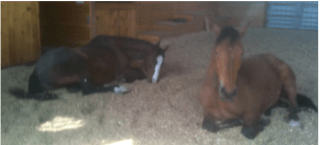
Peregrine Robin sleeping in arenaI’m writing this section about the ABCs of training sitting on the inner deck of my barn.  From my vantage point I can see Peregrine and Robin lying down in the arena enjoying a morning nap.
They’ve had a busy morning “helping” me with the chores, and now it is time to rest.  Again, this is clearly something they enjoy.  It is part of their daily ritual.  Today is especially pleasant.  It’s late May.  The temperature could not be more perfect, and as yet the flies are not out.  The horses can indulge in a long nap.  Peregrine is stretched out on his side, clearly dreaming.  His hind legs are cantering and every now and then he gives a deep throated nicker.

Robin sleeping cin in sawdustRobin is resting more upright, his nose buried in the shavings as he falls into a deep sleep.

I don’t know why watching horses sleep is so very reinforcing.   I treasure these quiet times we have together.  While I watch over them, I can work on the computer.  It is family time we all enjoy, but this is not something that I can use in a practical way during a training session.  That’s true of most of my horse’s favorite activities.  So if I want to vary their reinforcers, I need to shift my focus from the consequences and look more at antecedents.  I need to learn about cues and how they glue behaviors together.

Understanding cues unlocks a lot of “doors to the kingdom”.  In particular this key component opens the door to PLAY.  That’s what we’ll be exploring in the next section.

Peregrine Robin family time

Family Time

Coming next: Part 1: Chapter 8: Cues and Their Connection to Play

I hope you will want to share these articles by sending links to this blog to your friends.  But please remember this is copyrighted material.  All rights are reserved. Please do not copy any of the “Joyful Horses” articles without first getting written permission from Alexandra  Kurland, via theclickercenter.com  (kurlanda@verizon.net)

Also note: these articles are not intended as an instruction guide for introducing your horse to clicker training.  If you are new to clicker training and you are looking for how-to instructions, you will find what you need at my web sites:

theclickercenter.com                    theclickercentercourse.com

JOY Full Horses: Pt. 1 Ch. 6: Being PLAY Full

Play Full
The dictionary would tell me that I should write this as playful.  But just as Panksepp wants to emphasize that when he writes PLAY in capitals he is speaking of one of the seven fundamental affective systems, I want to remind you that playful means we are full of play.

The six properties of PLAY which I wrote about in the previous section remind us why being PLAY FULL with our horses is important.  Being full of play helps us find creative solutions to training problems.  It keeps us in a relaxed mental state that makes it easy to reach for the positive solutions instead fear-based corrections.  Play creates a safety net for our horses.  Especially when you are working with difficult or potentially dangerous situations, being in a play state helps you find horse-friendly solutions.

Playing with Horses
But how do you play with a horse?  After all safety always comes first. I can’t play with the Icelandics in the same way that they play with one another.

sindri Fengur rough play

Horses at play

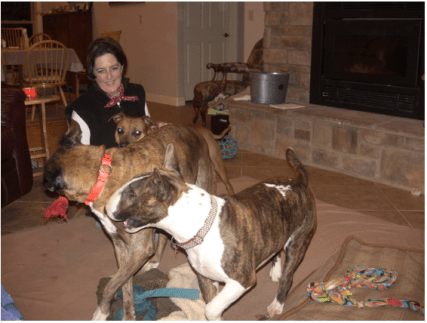
At a recent clinic I was sitting in the host’s living room. Her three dogs were having a rough and tumble play session.  It looked for all the world like a miniature version of the Iceys.  There were the same mock bites, the same leaps up into the air.

My host walked boldly through this maelstrom bringing me a cup of tea!  If they had miscalculated and bumped her leg, the worst that would have happened was the tea would have been spilled on her carpet.

Cindy with her dogs

Dogs at play

If the Iceys miscalculate, I could end up in a full-body cast. So what is the answer? How can I safely play with my horses?

Playing with Behavior
Without a great deal of skill and experience, I may not be able to engage with my horses via their natural play behaviors, but I can play via the behaviors that I teach them.  That’s the beauty of clicker training.  If I am in a state of play as I teach new behaviors to my horses, they will turn those behaviors around and use them as a way to play with me.

Even seemingly hard behaviors can function in this way.  Playing a Beethoven concerto can seem like either an onerous task imposed by your teachers or the greatest joy in your life.

How a behavior is perceived is more important than what it is. Our senior horse Magnat loved to piaffe.  Give him the least hint that piaffe might be on the table, and he would be offering it with gusto.  He also loved to retrieve.  At the start of a training session in the arena, he would insist on being turned loose so he could retrieve any dropped objects that might have been left in the arena by others.

Magnat belonged to Ann Edie.  Ann is blind.  Many know her through her other horse, Panda, the mini she uses as her guide.

Panda great walk

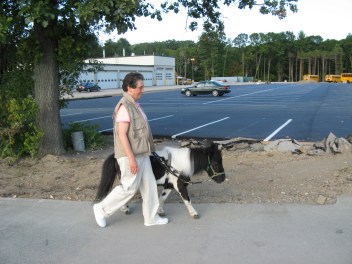
It may look like a casual walk, but Panda is guiding her blind handler.

For years Ann and I boarded our horse together in a large lesson barn.  The Iceys and Magnat belong to her.

Playing with Play
Because Ann is blind, it was very useful to her to let Magnat clean up the arena at the start of every session.  She was handed gloves, riding crops, Kleenex, cones.  If there was nothing else to retrieve, he even brought her larger than normal pieces of the shavings that made up the arena footing.

Piaffe and retrieving are two very different kinds of behaviors.  Retrieving was taught in an afternoon.  Piaffe took many months of structured work, but for Magnat they were clearly both regarded as play.  They were taught with laughter and they brought laughter.

CTFYH cover with caption1

Coming next: Part 1: Chapter 7: Training Playfully Mixed with a Little Science

I hope you will want to share these articles by sending links to this blog to your friends.  But please remember this is copyrighted material.  All rights are reserved. Please do not copy any of the “Joyful Horses” articles without first getting written permission from Alexandra  Kurland, via theclickercenter.com

Also note: these articles are not intended as an instruction guide for introducing your horse to clicker training.  If you are new to clicker training and you are looking for how-to instructions, you will find what you need at my web sites:

theclickercenter.com                    theclickercentercourse.com
JOY Full Horses: Part 1 Ch. 4: Inside The Trainer’s Brain

Recognizing Play

sindri fengur playing 3 photos

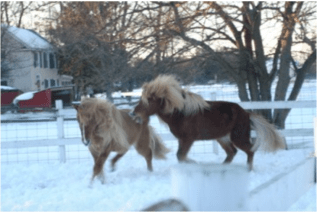
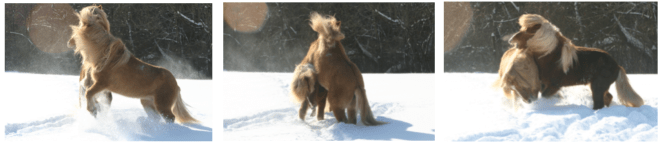
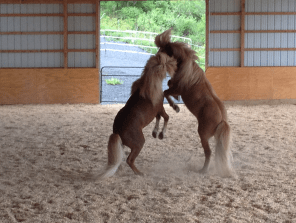
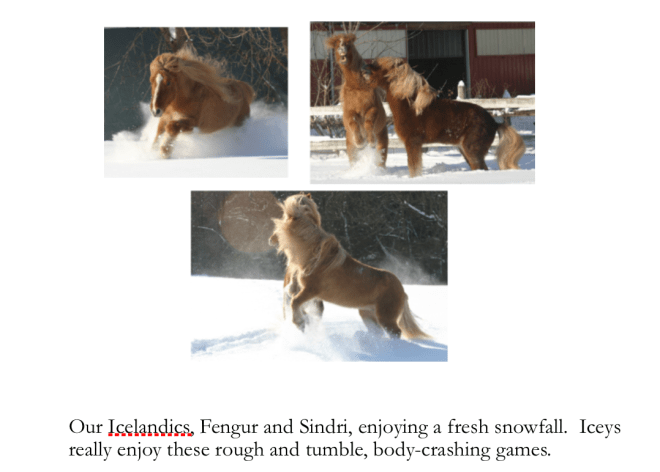
When they’re turned out together, our two Icelandics engage in mock battles. How do I know they are playing and not fighting for real?  Their drama is intense.  Both rear up and crash into one another.  One will come down over the neck of the other seemingly trying to bite the other horse through his thick mane.   They’ll spin apart and kick out, then race off at a gallop shouldering one another for an advantage in the turn.

To a causal observer it looks both very dramatic and very real, but these Iceys are good actors.  Their battles are all make believe.  They leave the “battle field” without a mark on them.  The kicks are all pulled punches and the bites nothing but pretend.  One moment they are body slamming into one another, the next they are standing side by side in their other favorite activity – social grooming.

After a good play session they come into the barn relaxed, refreshed, and always ready for more.  At twenty they play with the same vigor and intensity that they did when they were four.

When you watch your dogs or your cats wrestling together, you have no trouble recognizing this behavior as play.  You see the bites that aren’t bites, and the claws that don’t draw blood.  You see them taking turns.  First, one is on top pinning the other down, and then they’ll flip roles.  The stronger animal has learned that if he dominates the play, the other animal will quit.  I don’t know which of the Icelandics is the faster horse.  They always run together.  If Fengur has his nose out in front, it is only because Sindri, our stallion has let him, not because Sindri has fallen behind.

When Peregrine, my senior horse, was a two year old, he was chased by another horse through a fence.  I’ve seen what it looks like when these clashes are not play. It is terrifying to watch.  There is no mistaking the real thing for play.  When I see my cats confronting the neighborhood stray, it does not look in any way like the play they engage in together.  But that play between friends has prepared them well for the negotiations they are about to have.  All of us – cats, horses, people – know when the play has stopped, and we are now engaged in the real thing – a struggle for survival.

Part 1: Chapter 5: What is Play?

Defining Play
So we can recognize play.  But what is it?  Stuart Brown wrestled with this question in his book. He opened by saying he resisted giving play a definition for a number of reasons.  Play is so varied.  As he points out, an activity such as writing this chapter might seem like play to me, but it might be work to somebody else.  So we cannot define play simply through the activities we engage in.

For Brown play may be hard to pin down with a rigid definition, but at least in people, it does have very recognizable properties.  He would say:

* Play is done for it’s own sake.  Play has no direct survival value.
* It is voluntary.  You don’t “have to” play.
* Play is inherently reinforcing.  Play is fun so you want to play more.
* Play provides freedom from time.

This is the characteristic that most resonates with me.  I am constantly losing track of time.  I’ll be working with the horses, or working on this book, and suddenly realize that several hours have passed and I’m about to be late for an appointment.  I have been so absorbed in what I was doing, so in “the zone” in a PLAY state, that I have completely lost track of time.

At clinics I am constantly surprised that the hands on my watch have moved forward by several hours. “How can it be four o’clock?”, I’ll exclaim.  “It was just 12:30 the last time I looked.”  It is as though I’m surprised by the notion that time passes.  I know the hands on my watch will be progressing around the clock face, but in my PLAY state it truly does seem as though no time has passed.

* Play produces a diminished consciousness of self.

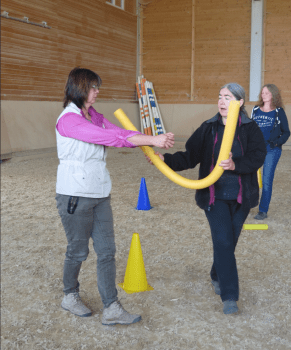
pool noodle GermanyWe stop worrying so much about how we look to others.  In imaginative play we may even become a different “self”.  When you’re trying to learn to ride and you have an instructor barking commands at you treating your lesson more like military boot camp than something you’ve chosen to do for fun, you’ll be a long way from a PLAY state.  Barked commands create FEAR and make the learner more self-conscious – not less.  To promote the best mental state for learning and retaining information, we want to be PLAY full.

When people are first learning clicker-compatible rope handling skills, I start them out without their horses.  At first, people may be thinking how silly they look practicing their technique with a rope tied to a door handle.  They’ll be terribly self-conscious.  Once I get them in a PLAY state, this kind of thinking disappears. They forget what it might look like to an outsider as they become fully engaged in the process.

* Play has improvisational potential.

When you play, you aren’t locked into a set way of doing things.  You can experiment and invent.  Many of the details that we now know make a huge difference to the horses were discovered during play sessions without any horses being involved.

People took turns being the handler and the “human horse”. They stepped outside of themselves and left behind their usual, I’m-an-adult-and-I don’t-play-silly-make-believe-games.  They let go of their self-conscious rigidity and let the act of playing take over.  The result was they saw things in a different way and with fresh insights.

Canine clicker trainer, Kay Laurence, often refers to a quote from Proust:

A journey of discovery comes not from a voyage into new landscapes but seeing familiar landscapes with fresh eyes.

Over and over again, our animals show us the truth of this expression.  As each new layer of training is explored, we see our animals and all their brilliance with fresh eyes.

* Play provides a continuation desire.  You want to keep doing it.  Once the play stops, you want to do it again.  As Brown puts it: “Play is its own reward, its own reason for being.”++

++ The Properties of Play are from: “Play: How it Sharpens the Brain, Opens the Imagination, and Invigorates the Soul”    Stuart Brown M.D. and Christopher Vaughan, The Penguin Group, NY New York 2009.

Coming next: Part 1: Chapter 6:  Being PLAY FULL

I hope you will want to share these articles by sending links to this blog to your friends.  But please remember this is copyrighted material.  All rights are reserved. Please do not copy any of the “Joyful Horses” articles without first getting written permission from Alexandra  Kurland, via theclickercenter.com

Also note: these articles are not intended as an instruction guide for introducing your horse to clicker training.  If you are new to clicker training and you are looking for how-to instructions, you will find what you need at my web sites:

theclickercenter.com                    theclickercentercourse.com

JOY Full Horses: Part 1 Chapter 3: What Neuroscience Teaches Us About Play

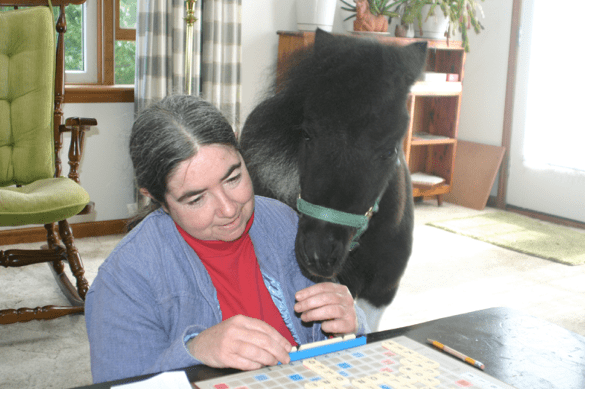
aa Panda scrabble

The Archeological Dig Through The Brain
So far I’ve discussed:

SEEKING.  This is the “granddaddy” of all the systems. You have to find the resources needed for survival. This is why so many people love to shop.  The SEEKER circuit is being activated even if you are just window shopping. This system is also activated in conjunction with the other emotional systems so it is too simplistic to say the SEEKER circuit alone was activated.

RAGE: Someone wants to take your resources so you have RAGE.

FEAR: Other organisms want to eat you, so there’s FEAR.

LUST: You need to reproduce.  This leads to the evolution of the next system: CARE.

CARE: You need to care for offspring.

PANIC: The loss of your caregiver and protector triggers this system.

This leaves just one more system to talk about and that’s PLAY.  After I first heard Panksepp speak, I was trying to remember the seven systems so I could share his work with others.  I got six of them without any trouble.  What was the seventh?  I had a hard time remembering PLAY.  Somehow PLAY just seemed too frivolous and inconsequential to belong on this list, but then I started learning more about play and the key role it “plays” in brain development.

So here is the last of the seven systems:

PLAY: Animals need social engagement which is manifested in play. PLAY is the last system Panksepp lists, and he gives it special significance. It is through play that the neocortex becomes integrated.

Clicker Training and the Seven Affective Systems
For a clicker trainer, this list of the seven Affective Systems is of particular interest.  Consider what it means to use a marker signal and to pair it with things an animal wants.  The click becomes my “yes answer” signal.  For the horse it’s a predictor of good things.  My horse wants to get me to click so he can engage in activities he enjoys.  That means he’s going to be more likely to perform whatever behavior was occurring just as I clicked.  It’s a wonderfully reinforcing loop.  We’re both happy.  I’m getting more of the behavior I like, and my horse thinks he’s got me all figured out!  He knows how to make that magic click happen.

Clicker training is a fun, effective, horse-friendly way to train.  When I look at Panksepp’s list, I understand even more clearly why my horses and I enjoy it so very much.  Clicker training activates both the SEEKER and the PLAY systems.  I’m not relying on FEAR to move a horse out of my space.  In fact I actively work to avoid triggering FEAR, RAGE, or PANIC.

As a clicker trainer, I’ve learned how to trigger the SEEKER circuit and to turn training into play for both myself and my horses.  At any point where the training begins to feel like a chore, it’s time to rethink what I’m doing.  I want to come up with training solutions that don’t just manage my horse’s fear and anxiety.  I want to turn the trailer, the farrier, the scary end of the arena into a source of play and social engagement for my horse.  I want him actively seeking out opportunities to engage with me and the environment.

Part 1: Chapter 4:  Inside the Trainer’s Brain

The Neuroscience of Training
When I think about Panksepp’s list, I wonder what happens in the brain when different training methods are used. Two trainers could be working towards the same end goal behavior. On the outside you’d see the behavior emerging. But inside the brain – what is happening?

Clicker trainers talk about their horses being different. Panksepp’s work seems to support this. When we use clicker training, we’re very much activating the SEEKER circuit. We’re engaging our animals in PLAY, and we’re avoiding FEAR and PANIC.

You can train a horse with a whip and spurs followed by a pet on the neck.  Alternatively, you can take the threat away and train with a clicker and treats.  Panksepp’s work would suggest that very different systems are activated within the brain. And so, yes, when we say our clicker-trained horses are different – at the basic level of brain mechanisms, it turns out that they truly are.  So, if play is critical for integrating the neocortex, what is this saying about our animals? And what is the effect on us as we participate in the process? Anyone who clicker trains can easily answer that last question.

Coming next: Part 1: Chapter 4:  Recognizing PLAY

I hope you will want to share these articles by sending links to this blog to your friends.  But please remember this is copyrighted material.  All rights are reserved. Please do not copy any of the “Joyful Horses” articles without first getting written permission from Alexandra  Kurland, via theclickercenter.com

Also note: these articles are not intended as an instruction guide for introducing your horse to clicker training.  If you are new to clicker training and you are looking for how-to instructions, you will find what you need at my web sites:

theclickercenter.com                    theclickercentercourse.com

JOY Full Horses: Part 1: Why Play?

Joy Full Horses title page coverI’ve teased you with an introduction to this book, and with the Table of Contents.  Now finally here is Part 1: Why Play!

This is a short section – just to get your feet wet.  Enjoy!


blue bar

Part One: Why Play?

Panda scrabble - leaning against me

When science and art come together,
they become indistinguishable from play.

blue bar

Chapter 1: Mammals Play

Fengur Sindri rearing 5:19:13


Airplane Reading
When you travel by plane as often as I do, you begin to know all the major airports in the country.  I can tell you which ones have free internet access and electrical outlets at your seat, and which ones force you to sit on the floor to recharge your computer.  I can tell you which airports have decent food and which ones assume that the entire traveling public wants to eat junk food.  I can also tell you where all the good bookstores are.  I enjoy browsing through airport bookstores.  Instead of feeling overwhelmed by an overabundance of choice in the mega bookstores, the airport bookstores are confined to cubbyhole spaces.  They give you just a small sampling of what is current and popular.

What I want for traveling is what I call airplane reading – nothing too heavy.  I mean that both physically – I may have a long walk between gates and my backpack is already weighed down with my computer and camera equipment.  And I also want something that’s light enough reading to let me dip in and out as I nap on the plane.

I often check out the business and science sections where I’ll find titles that might not otherwise have crossed my radar.  That’s how I spotted a book on play, called appropriately enough “Play”.  For a long time, whenever I referred to this book, I could never remember the author’s name.  I finally tracked down my copy for the express purpose of being able to reference the author in a talk I was preparing.  It was written by Stuart Brown.

Stuart Brown. How was I going to remember that?

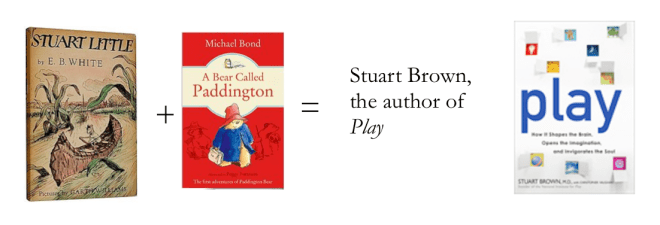
Stuart is easy.  Stuart is Stuart Little from E.B. White’s charming children’s book.  And if we are thinking about children’s books, then, of course, we have Paddington Bear, and that gives you the author’s name. Not sure of the connection?  Paddington Bear lived with the Browns.  Hence Stuart Brown.

That’s a playful way to remember the author of a book on Play.

Stuart Brown book covers

Why Do Animals Play?
Stuart Brown is an M.D. who has studied play.  In his book he posed an interesting question.  Play carries with it enormous metabolic costs and genetic risks.  Two horses playing mock stallion battles are not only expending a great deal of energy, they are exposing themselves to possible injury.  In the wild if they miscalculate and one of them is injured, that horse could very quickly be out of the gene pool.  So given this, why is play so prevalent?  It’s not just people and puppies who play.  You’ll find play behavior across all species of mammals.

aa Iceys play in snow 3 pictures caption

It’s not my intention here to give a detailed review of Brown’s book.  The main point he was making is that regardless of the evolutionary forces that led to the prevalence of play, what we are left with is this conclusion: play is important for the development of healthy brains.

When you compare brain scans of individuals who have been play deprived with those who are living in enriched environments with many opportunities for play, you see a marked difference.  Should you wish to, I’ll leave it to you to explore this in more detail.  You can begin with the lighter read of Brown’s book and then move on to the work of neuroscientist and play specialist, Jaak Panksepp.  And if you want even more, their books will give you plenty of additional references to explore.

The launching point for what I’ll be covering is this basic premise: play is important for healthy brains.  That means it is important for our horses, and, equally, it is important for us.  As I explore what play means in the context of training, I will be focusing my attention on both ends of the lead rope. I’ll be looking at what it means for both the horse and the handler to be engaging in play.

aa crackers basketball

blue bar

Part 1: Chapter 2:  Animal Emotions

aa crackers hit ball

Bob Viviano and Crackers – Great partners who knew how to play and to share their connection with others.

Is Your Training Fun?
When we think about clicker training, we often think about play.  After all, we’re often using clicker training to teach some very playful behaviors.  But just because you are having your horse kick a beach ball, doesn’t necessarily mean either one of you is having fun.  If you’re so caught up in the science behind the training, if you’re thinking about what the discriminative stimulus is for kicking the ball and whether you should be using a least reinforcing stimulus after that last miss, your brain may be processing the interaction in a way that’s a long way away from play.

If you’re concentrating on your handling skills, if you’re thinking about the timing of your click, and whether your hand is staying out of the treat pouch between clicks, again you may be a long way away from play.  It’s easy to get so caught up in “getting things right” that play drops out of the equation.  The function of these articles is to remind you that we need to keep bringing play back to the forefront of our training.

I mentioned Jaak Panksepp earlier.  His work is getting a great deal of attention at the moment within the clicker community.  Karen Pryor gets the credit for this.  Karen Pryor is one of the very early pioneers in clicker training.  Her book, “Don’t Shoot the Dog” has introduced thousands of people to this modern form of animal training.  Karen wanted to know what the neuroscientists could tell us about how the click is processed in the brain. In her book, “Reaching the Animal Mind” she talked about the SEEKER system, one of the seven primary emotional states Panksepp has identified.  It is the SEEKER system that Pryor attributes to the enthusiasm and – dare I say it – joy we see in our clicker-trained animals.

Animal Wise
Panksepp has been studying what was once a forbidden area in science – emotions in animals.  Here’s another “airplane” book I’ll recommend, Animal Wise by Virginia Morell.  Morrell begins her book with the following:

“Animals have minds.  They have brains, and use them, as we do: for experiencing the world, for thinking and feeling, and for solving the problems of life every creature faces.  Like us, they have personalities, moods, and emotions; they laugh and they play.  Some show grief and empathy and are self-aware and very likely conscious of their actions and intents.

Not so long ago, I would have hedged these statement, because the prevailing notion held that animals are more like robotic machines, capable of responding with only simple, reflexive behaviors.  And indeed there are still researchers who insist that animals are moving through life like the half dead, but those researchers are so 1950s. They’ve been left behind as a flood of new research from biologists, animal behaviorists, evolutionary and ecological biologists, comparative psychologists, cognitive ethologists, and neuroscientists sweeps away old ideas that block the exploration of animal minds.  The question is now not “Do animals think?”  It’s “How and what do they think?”

Hurray!  Finally people are coming around to my view of animals as intelligent, very aware beings with rich emotional lives.  I know this goes against strong cultural biases.  But where did this notion that animals do not think come from?  Why do scientists have such a horror of being accused of being anthropomorphic (attributing human mental abilities to an animal)? How can we deny the evidence we see in every interaction we have with our horses, with our cats and dogs?

Outdated Belief Systems
Morrell points out in her introduction that this idea that animals do not think or have emotions as we know them is an old one. Aristotle did not believe that animals could think rationally, but he did at least grant that they experienced physical sensations such as hunger and pain, and they could be angry.

It turns out that Aristotle represented an “enlightened” view of animals – even with all of it’s limitations.   Later philosophers denied that “animals had any thoughts, emotions, or sensations and therefore we did not need to extend any moral consideration to them.” (Morrell)

Belief systems are a curious thing.  There’s that wonderful line that crops up during political discussions: you wouldn’t want a little thing like facts to get in the way of a good argument.  It applies here, as well. Belief systems become self supporting.  We tend to attract experiences that support our belief systems.  I find it beyond comprehension that anyone could deny the emotionally rich life that animals have.  You have only to sit on a panicked horse who has been separated from his herd to know very directly the emotions he’s feeling!

But I suppose there will be those who would say I’m just delusional.  I’m the one attracting evidence to support a faulty belief system.  Perhaps.  But I am no longer alone.  If you want a good read, add Animal Wise to your list.  Morrell has been visiting with scientists from all over the world who are doing pioneering work in the field of animal cognition.  That includes the neuroscientist Jaak Panksepp.

Coming next: Part 1: Chapter 2: Animal Emotions: Affective Neuroscience

I hope you will want to share these articles by sending links to this blog to your friends.  But please remember this is copyrighted material.  All rights are reserved. Please do not copy any of the “Joyful Horses” articles without first getting written permission from Alexandra  Kurland, via theclickercenter.com

Also note: these articles are not intended as an instruction guide for introducing your horse to clicker training.  If you are new to clicker training and you are looking for how-to instructions, you will find what you need at my web sites:

theclickercenter.com                    theclickercentercourse.com