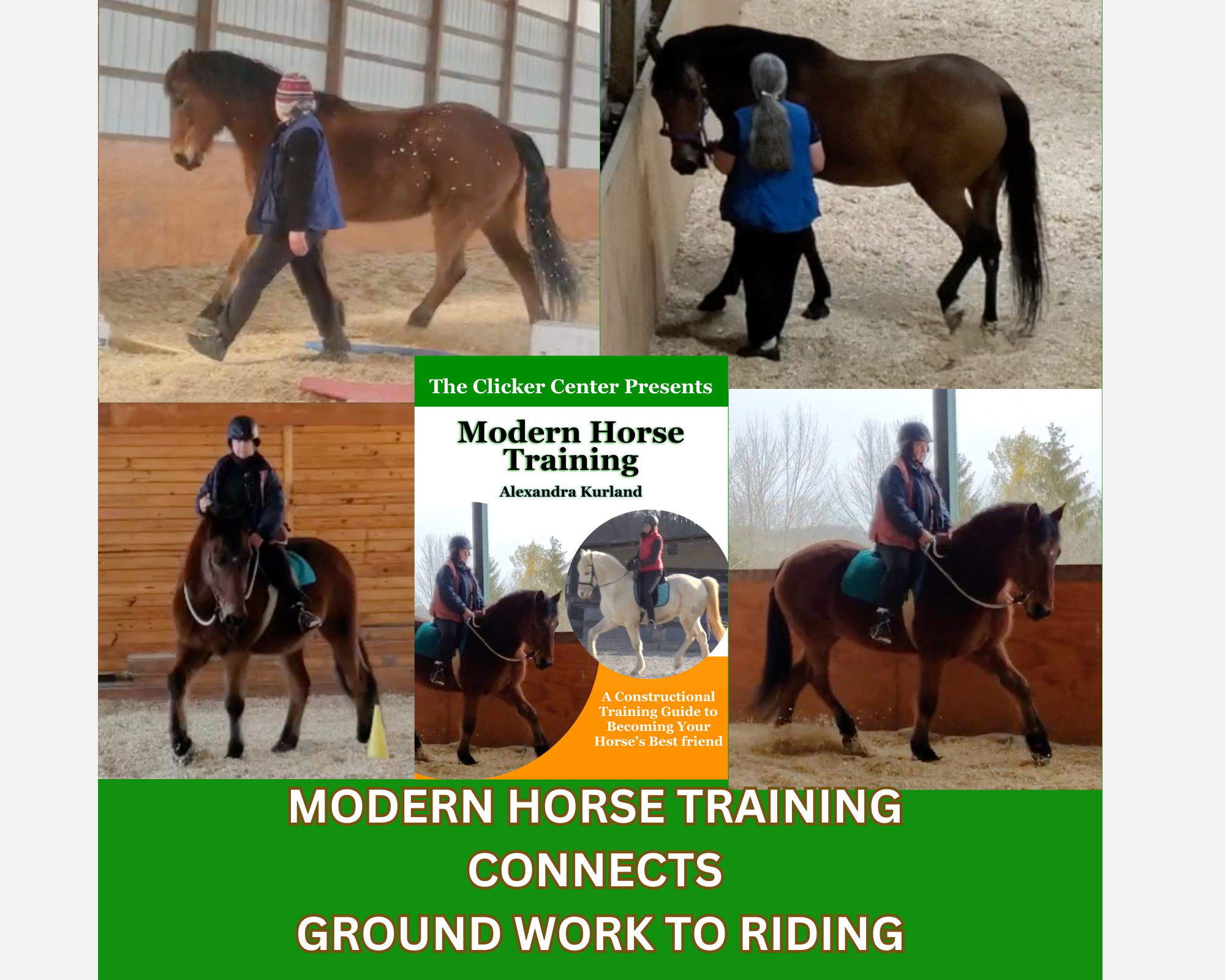
Modern Horse Training Connects Ground Work to Riding

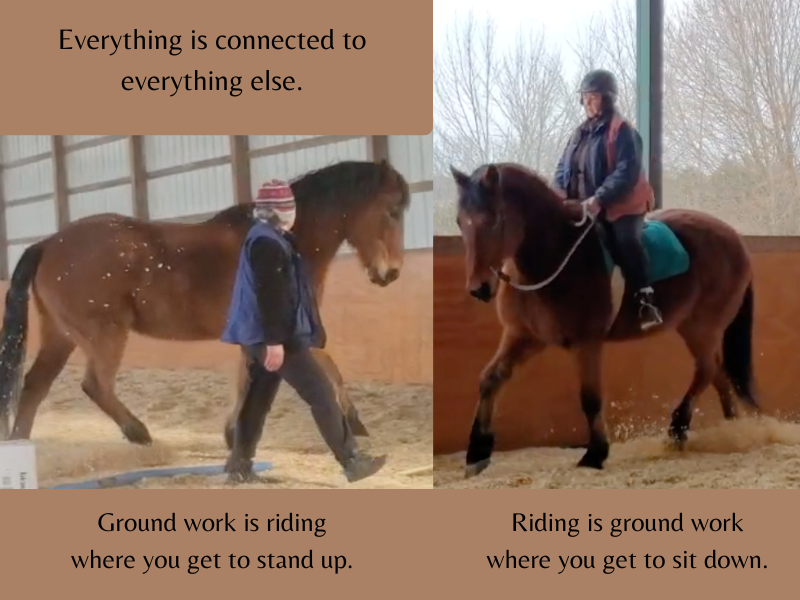
One of my favorite expressions is: “Ground work is riding where you get to stand up and riding is ground work where you get to sit down.”

Everything is connected. The beautiful balance that Robin shows as he trots beside me at liberty is the same balance that I want to ride. The cues that I use on the ground carry over and become cues he understands when I ride.

The use of the lead as a communication tool works in the same way as the reins. When I teach Robin how to respond to tactile cues beginning on the ground, that understanding carries over to riding. Leads and reins work in the same way. Body language cues taught first on the ground carry over into riding.

This means the training is wonderfully efficient. I don’t have to teach one set of cues and behaviors for ground work and an entirely new set for riding. The components that I use to work with Robin at liberty are the same components that I’ll use for work in-hand and for riding. Modern Horse Training makes a deliberate, thoughtful connection between everything you teach. Lessons are not separate and random. The more your horse knows, the faster he will learn because many of the components you’ll need for a new lesson will already be in place.

Modern Horse Training Focuses on Balance

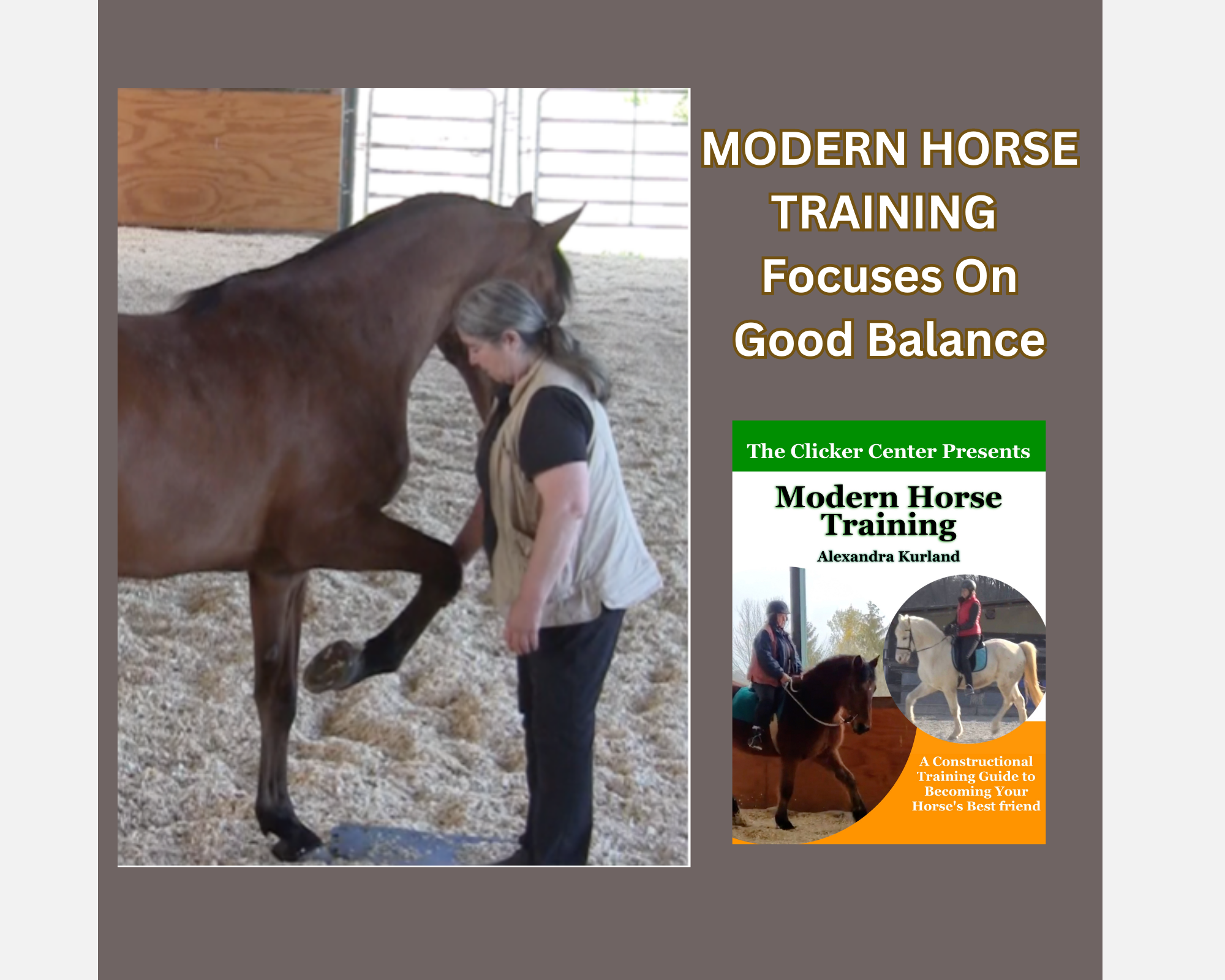
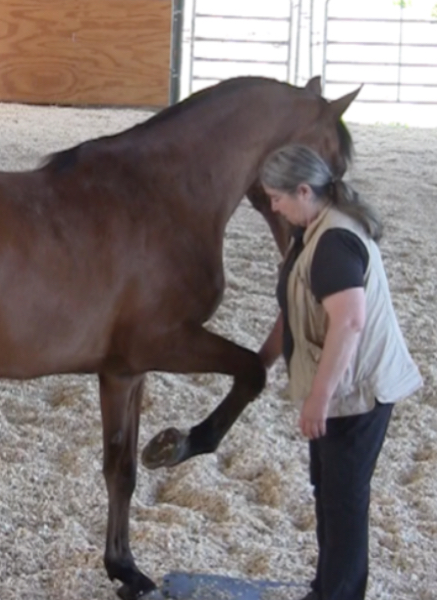
This has long been a favorite photo. I am asking Robin to lift his knee into my waiting hand. I love the quiet elegance that is expressed in this gesture. Note the solid support we see in his left front as he lifts his right leg.

I could easily turn this into foot cleaning, or I could expand the gesture so he extends his leg forward in preparation for Spanish Walk.

Or I could use it, as I am here, as a gymnastic exercise that prepares Robin for the day’s ride.

Once again we see the foundation lessons in action. Robin is standing on a mat. The mat provides a context for the leg lifts and helps to keep them from becoming a nuisance behavior. His beautiful balance has evolved out of the foundation lessons.

Modern Horse Training reminds us that everything is connected.

To learn more visit my web site: theclickercenter.com
Instagram: alexandra.kurland.5
Podcast: equiosity.com

Modern Horse Training Builds Great Relationships

I love giving clinics. I love sharing clicker training with others, and I am always honored when someone lets me have a play with their horse. Over time I have come to know many of the clinic horses well, and I consider them to be part of my extended equine family. I always get a chuckle when a horse I haven’t seen for months gets excited when I turn up at the barn. “You’re here! We’re going to play!”

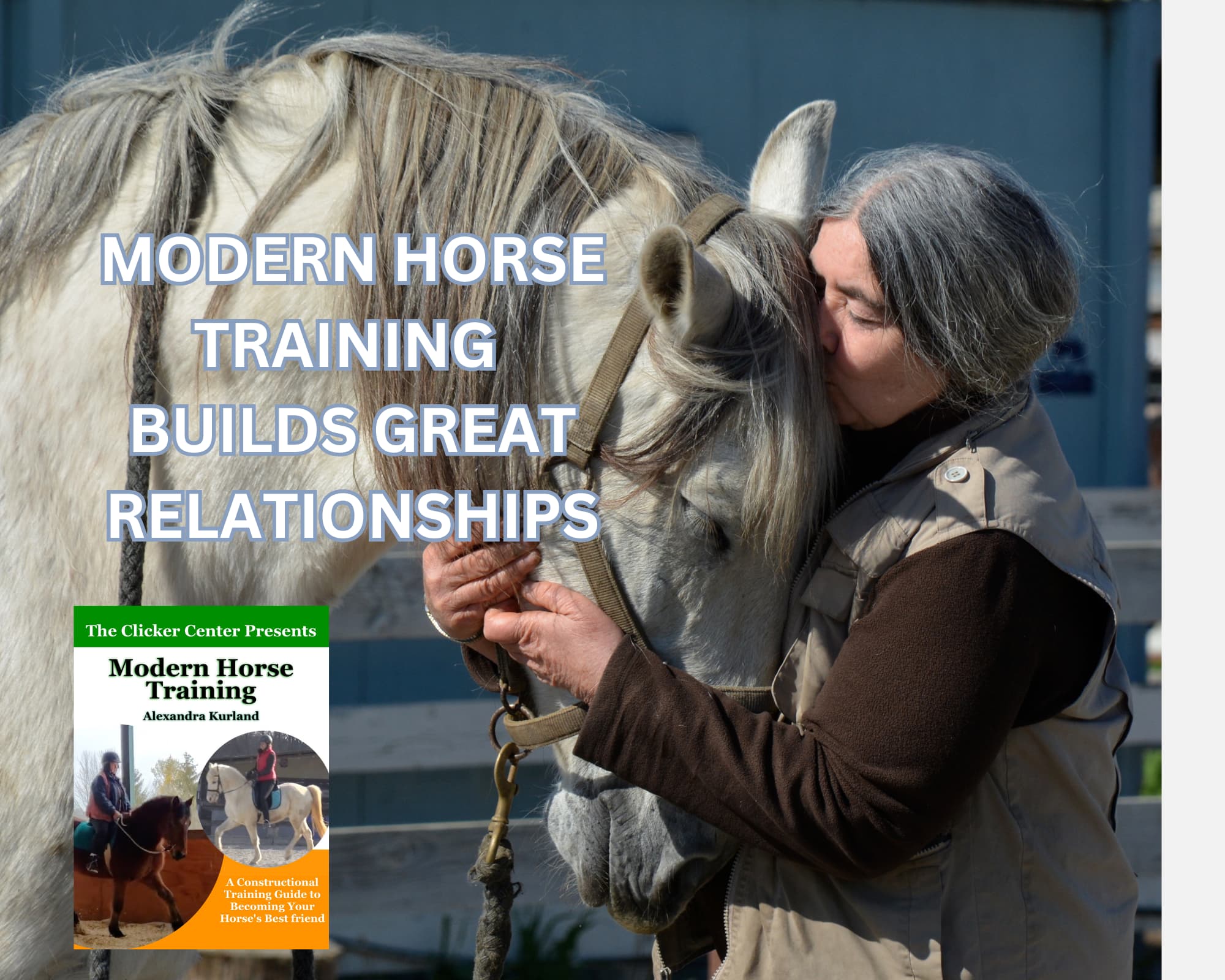
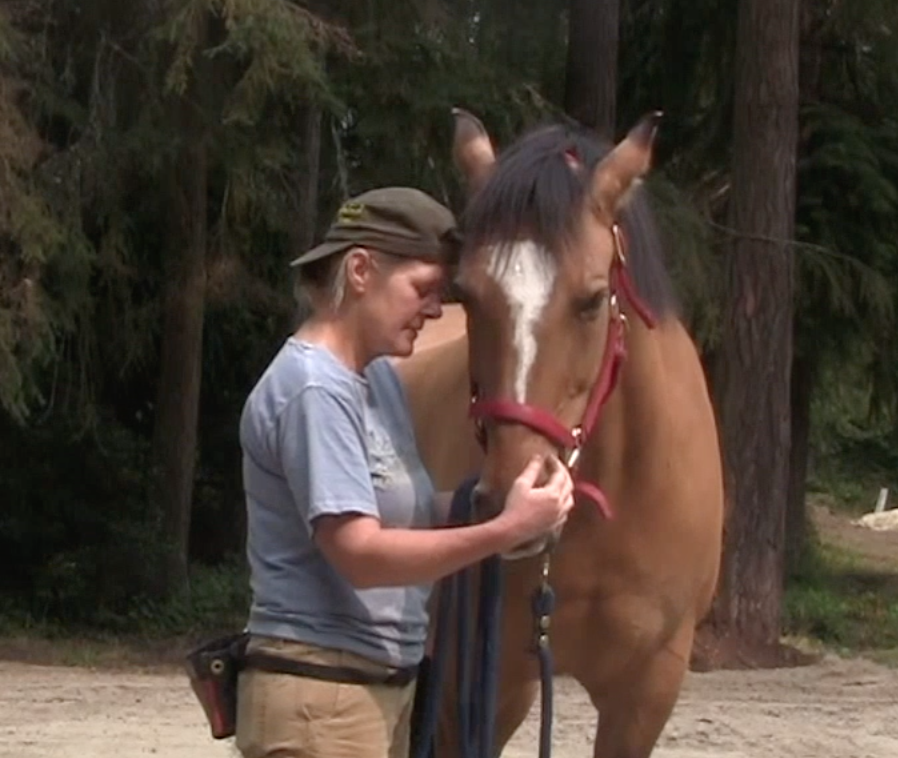
I love this photo because this horse began by actively warning me to stay out of his space. His body was covered with “No Trespassing” signs. Teaching him to give hugs changed all that.

The hug begins as simple body part targeting. The horse learns to bring his nose to your hand. With your palm over his nostril you can feel the horse breathing in, breathing out. Click as he exhales and pretty soon you are clicking as the horse relaxes and melts into your waiting hand.

Adding in your second hand gives him two target points to orient around. This can become an exercise in body awareness and balance. Or you can turn it into a social hug.

It’s hard to tell who enjoys the hug more – horse or human. I suspect the best answer is we both do.

This is very much a case of we both enjoy a good bear hug.


Modern Horse Training is wonderfully sneaky. Simple behaviors such as basic targeting transform into so much more.

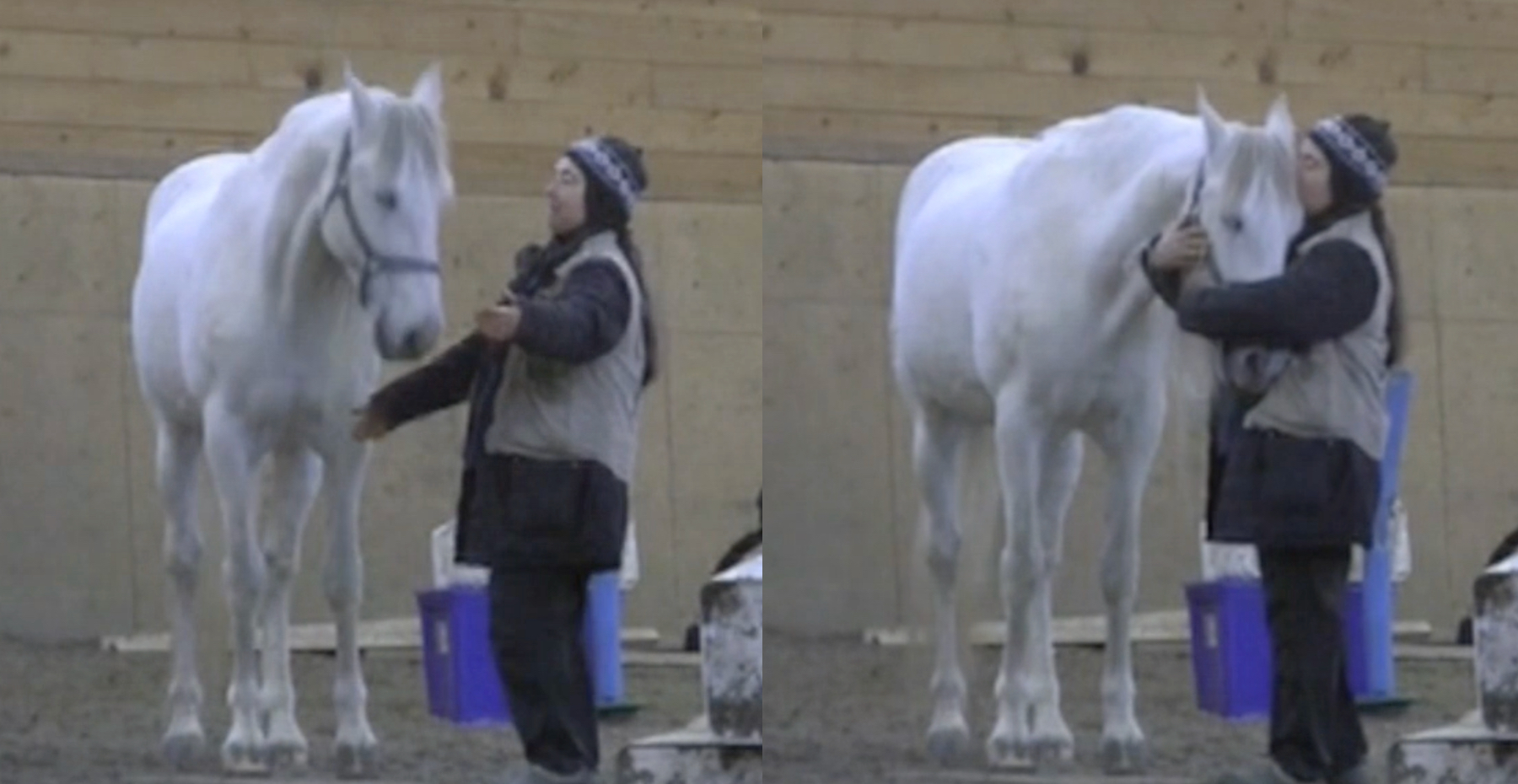
This image shows the beginning steps of teaching the Awareness Hug.

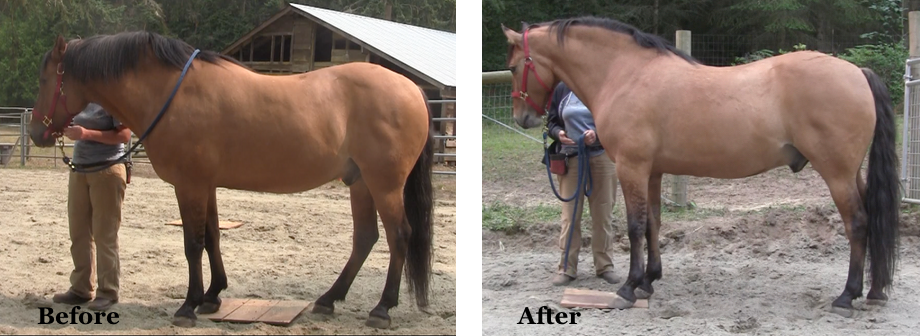
This is one of my favorite before and after comparisons. The changes in the way this horse is holding himself occurred after three sessions held over a day and a half. The Awareness Hug very much contributed to the changes you’re seeing.

“Before” he’s in a higgledy-piggledy stance with his balance pitching forward. He looks stuck. Under saddle you could imagine it might be a chore to get him to go forward with enthusiasm.

“After” he’s lifting up. He’s standing much more over the support columns of his legs. He looks so much more athletic, as though it would be easy to go forward.

The Awareness Hug is taught in detail through my on-line clinics. I’m tempted to say it is part of Clinic #6: Connecting the Dots since I have a unit that is specifically on The Hug in that clinic. But everything is connected to everything else. To truly understand the details that helped change this horse’s balance you need to connect the dots through all the clinics.

To learn more about my on-line clinics visit my web site: theclickercenter.com

Modern Horse Training Takes Your Horse Into His Senior Years

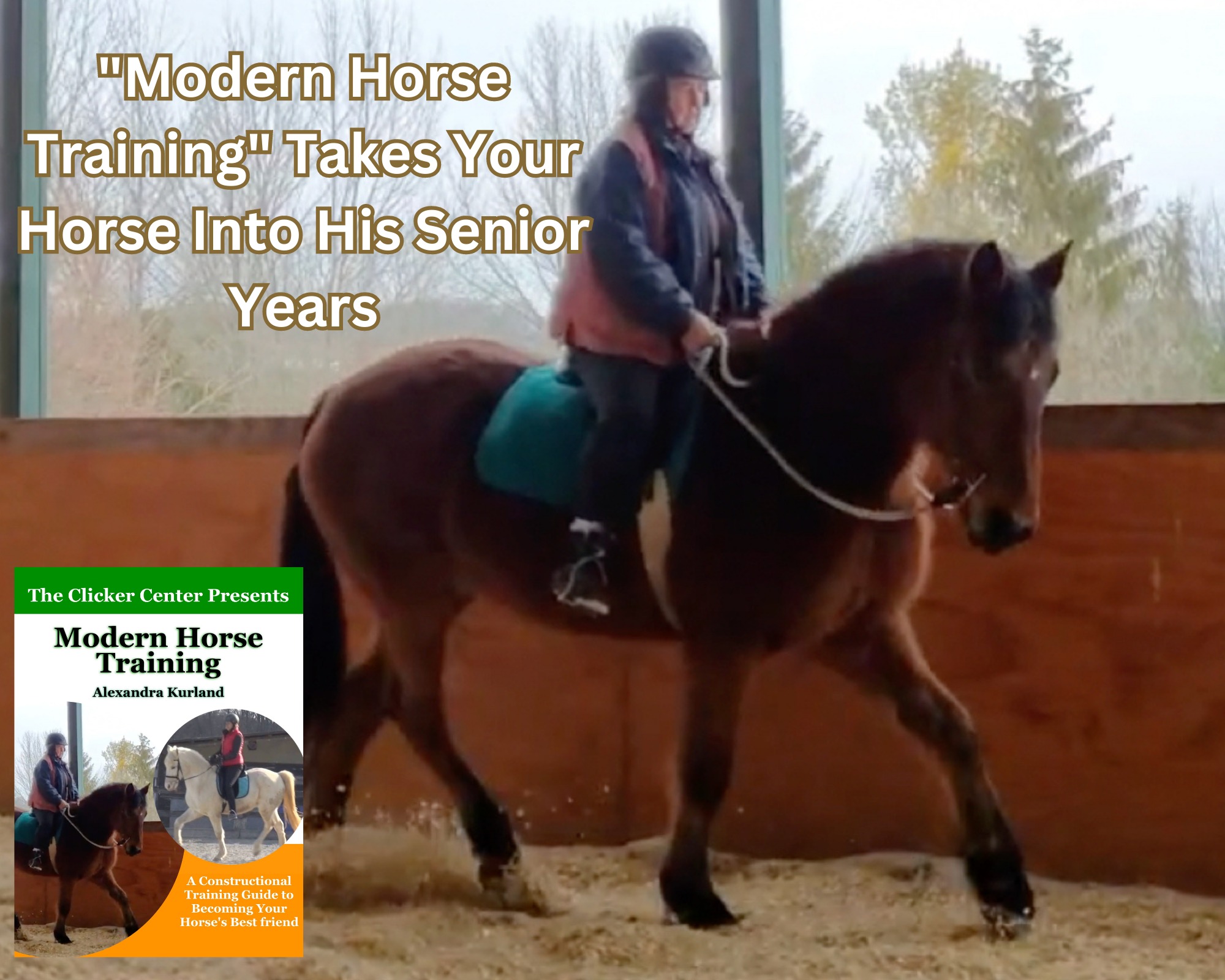
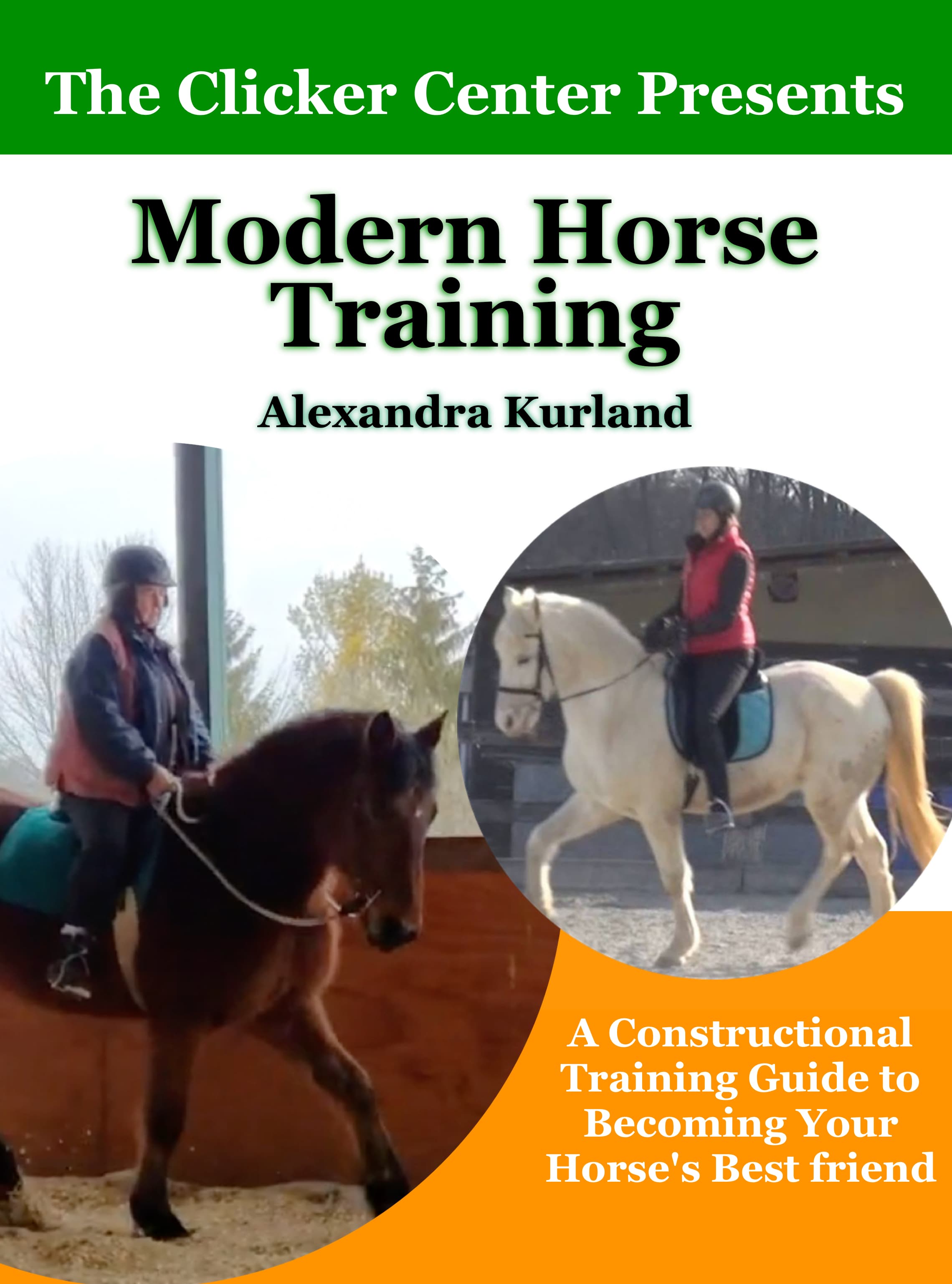
I chose this photo for the cover of my new book for many reasons. First, it’s simply a beautiful image. I love the overall balance, the roundness of Robin’s topline, the softness of the reins, the energy and suspension, the settled attention. But I also chose this photo because of the statement it makes. Robin was twenty-seven when this photo was taken. He’s still in work. He’s still moving beautifully.

Balance is the central pillar around which I build all my training. Balance matters to me because I love my horses. I want them to be in my life for as long as possible, and I want them to have a good quality of life. Physical balance and emotional well being are woven together. Balance has always been a key ingredient, beginning with the very first lessons I taught Robin when he came to me as a yearling. Clicker training has been with us every step of the way. Modern Horse Training has been there throughout his whole life.

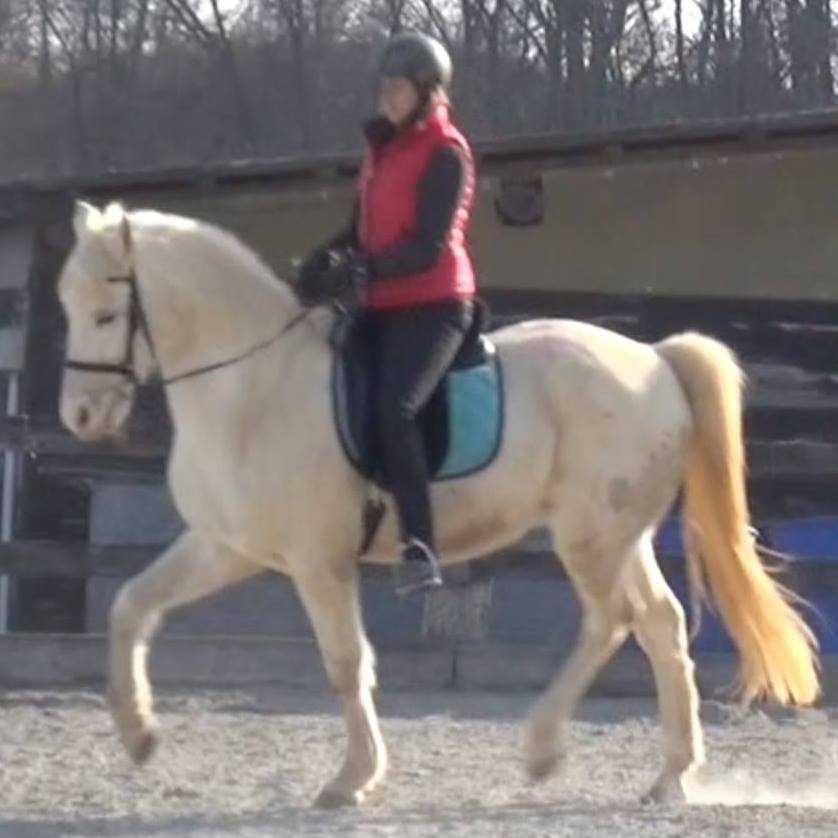
The other horse featured on the cover is Michaela Hempen’s Asfaloth. He’s also now in his twenties and still loving to play.

Asfaloth shows us how important balance is.

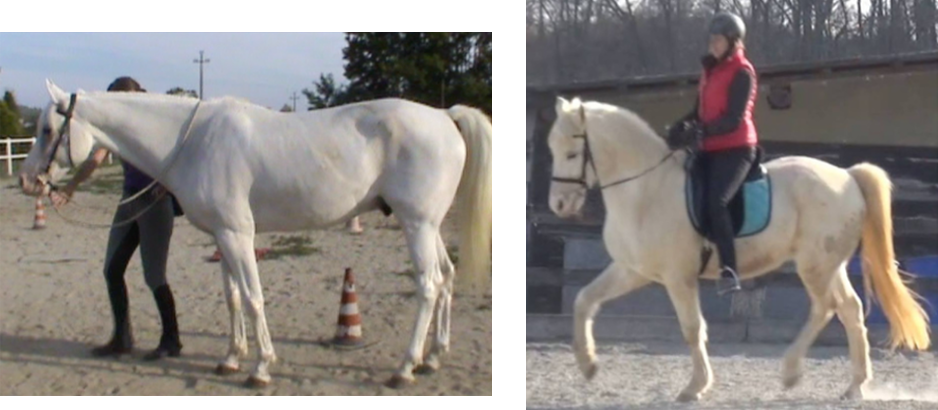
When you look at these two photos it is hard to believe it’s the same horse. The photo at the left shows Asfaloth in his early teens when Michaela was just beginning to work with him.

A lot of horses stand like this so at first all you may see is a grey Arab. No big deal. But compare him to the photo at the right and you’ll begin to some of the early balance issues. Look at his front legs. They’re angled back. If you were building a bridge, you wouldn’t want the support columns to be angled back like this. He’s long like a sausage. He’s falling forward onto his forehand. In this balance, he wouldn’t be able to produce the beautiful suspension you see in the second image.

A bridge or a house which is built on such crooked underpinnings isn’t going to last as long as one that is built well. Our horses show us that good balance carries them forward into their senior years.

Michaela’s excellent training is featured throughout my on-line clinics.

You can read about her work at her website: https://clickertrainingpferde.com/

Modern Horse Training: What is Constructional Training?

I’m counting down the days to the publication of my new book: “Modern Horse Training A Constructional Guide to Becoming Your Horse’s Best Friend”.

Everything is set to go (I hope). The publication date is April 26. While we are waiting, I’ve been sharing with you, not excerpts from the book, but some stories that explain the genesis of my training choices. Here’s today’s installment:

Yesterday I wrote about the link between ground work and riding. That sits at the core of the constructional approach to training that my horses have been teaching me. Here’s an example to help you understand how this works.

Suppose you are working with a youngster who hasn’t had much handling. You want this horse to pick up his feet for cleaning. That’s one of the universals we all need to teach our horses. It doesn’t matter if you want to ride English or western, or you don’t ride at all, horses need regular foot care.

But before you can pick up your horse’s feet, you need him to stand still and to be comfortable being handled. So there are some component skills that are handy to teach before you start trying to handle his feet.

You’ll be starting with the foundation lessons. You’ll be teaching him to stand still, to back up and come forward, to orient to targets, to stand on a mat. You’ll be starting in simple environments that make these lessons easier to teach. The new book covers this in detail so I won’t say more here. Let’s assume that you have taught your horse to stand on a mat, and you are now teaching him front leg flexions. As you develop this lesson, you are able to point at his shoulder and your horse will lift his foot up well off the ground into your waiting hand.

Robin shows a good example of a leg flexion. He’s targeting his knee to my hand. The balance these leg flexions teach make routine foot care very easy, and they also contribute to the good balance I look for under saddle.

Teaching leg flexions to your young horse will mean foot cleaning is easy. He’s lifting his foot up for you, and he’s become so well balanced he’s not leaning on you for support.

Foot care may not seem to be connected to riding, but it very much is. Those leg flexions are a wonderful prep for riding. They help your horse find the good balance that makes riding easier for both of you.

When you clean your horse’s feet, you could skip all this training. You could pry his feet up off the ground and accept having him shifting around and leaning on you for support. Cleaning his feet would be a chore, but you’d get it done.

You could skip all the “niceties” of the preliminary groundwork and get straight on, but your job will be much harder. You’ll be getting on an unbalanced horse who is much more of a challenge to ride.

I prefer to stack the deck more in favor of both my horse and myself. So another important lesson my horses have taught me is: If a lesson is becoming difficult for either the horse or the handler, it’s time to break the lesson down into smaller steps.

Remember I want to avoid “brick-wall” training. The sooner I recognize that a lesson is presenting puzzles my horse and I aren’t ready to solve, the easier it becomes to avoid crashing into metaphorical brick walls. I want to fine tune my detectors so long before a puzzle begins to generate frustration, anxiety, fear, or any other emotion that could get us into trouble, I’m already looking for the smaller, easier-to-teach underlying steps.

My horses have taught me to keep looking for smaller steps. If I break a lesson down into what I think is a small step, if it is still too hard, I will keep looking for the even smaller step that it can be divided into. Sometimes finding the smaller step means asking for less. It means asking for just a weight shift instead of a full step. It can also mean looking for the missing component part that is needed to make the lesson easier to understand. What do I need to teach first? If I haven’t introduced my horse to basic targeting, asking him to target his knee to my hand could easily become a frustrating lesson for both of us.

Looking for the smaller step has evolved into this “loopy training” guideline: To find a starting place for your training, you will keep dividing a lesson into smaller and smaller component parts, until you find something your learner CAN consistently do, even if that step seems very small and very far away from your goal behavior.

What am I describing?

Constructional training. This term comes from the work of Dr. Goldiamond, a behavior analyst and clinical psychologist. In a nutshell Goldiamond didn’t want to “fix” behavior. He wanted to build new repertoires of behavior – hence the name constructional training.

This fits perfectly with clicker training. Instead of focusing on what you aren’t liking, and setting goals that are centered around eliminating unwanted behavior, you reframe everything. You focus on what you want your horse TO DO, and you teach that. A constructional training approach matches the approach to training that for me began to evolve over 40 years ago.

Something else I learned a long time ago is good ideas are good ideas. They aren’t unique to any one person or any one source. When you find a convergence like this coming from two very different sources – clinical patients in Goldiamond’s case, and horses in mine, that’s a good indicator that you are on the right track.

The new book, “Modern Horse Training” is designed to help you become a skilled constructional trainer. It explains in detail how the concept of constructional training provides a wonderful framework for positive reinforcement training. Everything is connected to everything else makes perfect sense when you see your training from this perspective.

“Modern Horse Training” will be available as a hardcover, a paperback, and as an ebook. The publication date is April 26. You’ll be able to order it through my web site, theclickercenter.com and also through Amazon and other booksellers.

Modern Horse Training: Core Principles of Good Training

I have a new book coming out on April 26, 2023: “Modern Horse Training: A Constructional Guide to Becoming Your Horse’s Best Friend”

The new book – coming April 26, 2023

I am no good at writing quick elevator pitches to let you know what the book is about. Instead while we are waiting for the publication date, I have been sharing a series of short posts that describe the overall development of my training.

I ended yesterday’s post by asking what were some of the component skills that helped me transform clicker training from an interesting concept into a workable training program for horses?

For starters my horses had helped me to formulate some guiding principles. These pre-dated my exploration of clicker training. I learned these principles directly from my horses. I also saw trainers I admired using them. So these principles are not specific to clicker training. I would say they are part of good training in general. These concepts take you to horse-friendly, learner-centric training choices regardless of the actual procedures used.

So what are they?

They begin with:

Safety always comes first – for both you and your horse.

That sounds as though it should be a given, but it’s not. I’ve watched far too many horse people ignore this basic principle. Trailer loading is a prime example. Look at all the fights you see around trailers. A given trainer may have gotten away with forcing frightened horses onto trailers. But load enough horses, and you’ll will meet that one individual who fights back with more power, more speed, more fear than you can handle. Someone will get hurt and those are odds I’m just not willing to take on.

Here’s a way safety always comes first plays out for me. Peregrine’s mother taught me the value of ground work. Her neurological condition gave me this one simple rule. I never asked her for something under saddle which she had not shown me she could do on her own. If she couldn’t walk beside me around my work space without spooking at the goblins, she wasn’t ready to be ridden. If she couldn’t trot in balance without a rider, I wasn’t going to get on and expect her to know how to trot.

This rule kept us safe. It’s a good rule that I have extended to all the horses I work with. It means that ground work is an essential part of good riding. That’s also not a given. In 1993 when I first started exploring clicker training, ground work for most people meant lunging. That was pretty much it. You lunged your horse before you rode him to “get the bucks out”. Often that meant sending an unbalanced horse at speed around you on a circle. It wasn’t much fun for either the horse or the handler.

For me ground work meant so much more than this. I got Peregrine’s mother as a yearling and later I bred her to get Peregrine. Because I raised both my horses, ground work meant all the handling of young horses – teaching them to accept grooming, haltering, basic leading, foot care, blanketing, basic medical care, etc. When you have only been around older riding horses, it’s easy to take these universals for granted. You forget that horses have to learn how to accept all these different intrusions into their personal space. When an older horse is hard to groom or doesn’t stand well for the farrier, he’s labelled as a “problem horse”. Clicker training helps us to reframe how we see these horses.

Ground work also meant teaching my horses the basic skills that let me go for walks with them. It meant the T.E.A.M. ground work skills that began to move me away from the conventional handling that I saw around me in the local riding stables. It also meant the classical work in-hand that I was learning from Bettina Drummond, Nuno Oliviero’s principle student. And it meant round pen training that I first figured out based on a magazine article and later expanded upon after watching John Lyons. So I brought to clicker training an extensive and varied repertoire of ground work.

I also understood the connection between ground work and riding. The first time I watched John Lyons at one of his symposiums, he said “I solve ground problems on the ground and riding problems under saddle.” I could see that wasn’t what he was doing, but he really believed what he was saying. Yes, he was using his version of round pen training to prepare a young horse for riding. That connection was there. But after that in his mind there was a separation.

A couple of years later he stopped making that distinction. His stallion Zip had shown him how connected ground work and riding really were. I never heard him talk about this directly, but you could see the difference. The first time I saw Zip, I loved his topline. He was round, he was soft, he was well balanced – all things I enjoyed looking at. But Zip had short, little pony gaits.

Lyons had not yet resolved this major training puzzle: horses will naturally change leg speed before they soften at the poll. In the new book I describe in detail what this means so I won’t go into it here. When you don’t solve this puzzle, the gaits are effected. Horses no longer have the big, beautiful, clean gaits that you would have seen in them as youngsters. Their gaits become compromised. It is so normal, we often don’t even see anymore how unbalanced and lame horses are becoming because of the way in which they are being ridden.

In his symposiums Lyons would use Zip to demonstrate a ground exercise Lyons referred to as the east, west, north, south lesson. It is a form of hazing. The horse wants to dodge to the left to escape from you, you drive him to the right. He ducks out to the right, you drive him back to the left. He tries to back up, you send him forward. He barges over the top of you, you drive him straight back. No matter which way the horse tries to duck out the escape route is blocked. After a while, the horse stands still in front of you. And when you tell him to move to the left or right, forward or back, he does.

This can be a brutal lesson if you take the brick-wall approach to it. (See https://theclickercenterblog.com/2023/04/13/) It can be an elegant lesson if you break it down into small steps and teach it with positive reinforcement.

I watched Lyons over a number of years, and I saw a lot of changes both in his horses and in the way he talked about his training. With Zip he demonstrated another core training principle: the longer you stay with an exercise the more good things you see that it gives you.

Every week Lyons would use Zip to demo the east, west, north, south lesson and every week Zip would get better at it. Lyons kept seeing more of what staying with a lesson gives you. In Zip’s case it resolved the leg speed puzzle. Zip gave at the poll before he changed leg speed. Solving the puzzle transformed his gaits. He became a beautiful mover. His gaits matched the promise of his topline. When he was in his twenties and completely blind, he moved better than he had in his early teens.

My horses had also shown me the clear connection between ground work and riding. So one of my favorite expressions is:

Ground work is just riding where you get to stand up and riding is ground work where you get to sit down.

Everything is connected to everything else.

This connection between lessons and especially between ground work and riding is key to the approach I have taken in “Modern Horse Training: A Constructional Guide to Becoming Your Horse’s Best Friend”. The fun of this way of structuring your training is it is very sneaky. You are never working on just one thing. Every lesson truly is connected to all other lessons. And because I am breaking complex lessons down into small components and I am using positive reinforcement procedures, safety always does come first – and fun is the result.

The new book, “Modern Horse Training” will be published April 26, 2023. It will be available as a hardcover, a paperback, and as an ebook. You’ll be able to order it through my web site, theclickercenter.com and also through Amazon and other booksellers.

Coming next- What is Constructional Training?

Constructional Training – What That Term Means to Me.

I have a new book coming out on April 26: Modern Horse Training

The subtitle of the book is: A Constructional Guide to Becoming Your Horse’s Best Friend.

In the clicker training community we’ve been talking a lot recently about constructional training. Dr Jesús Rosales Ruiz has brought to our attention the work of Israel Goldiamond. Dr Goldiamond was a clinical psychologist. Instead of trying to “fix” problem behavior, he constructed new repertoires. The analogy would be instead of trying to fix a falling down, hundred year old barn with a leaky roof, cracked foundations and ceilings that are too low for horses, you build a new barn that’s purpose-built for what you need. It has none of the problems of the falling-down barn. The old barn may still be on your property, but you don’t have to use it for your horses. The old, unwanted behavior may still exist. Nothing is ever erased or unlearned, but there is a clean, new behavior in repertoire that you can call on instead.

The term constructional training appeals to me. I like building things. The idea that we can teach complex behaviors by first breaking them down into smaller component parts is not new to me. My horses showed me this decades ago.

Nor is this a new idea in the horse world. It is how good trainers train. But that doesn’t make it the norm. Far from it. What we see around us are people who confront problems head on. The horse world is full of instructors who tell their students to send their frightened horses forward, to make them obey, to show them who is boss. Sometimes this works and sometimes it puts the rider in the hospital and the horse on a trailer to the auction yards.

My Path to a Constructional Mindset
I have always been horse crazy. Like so many others I grew up in a family that just didn’t share my obsession over horses. My parents did at least provide me with the opportunity to ride. Over time I developed a decent seat. I could ride, maybe not that well, but riding out over rough terrain, riding at speed, riding bareback were all well within my capabilities. As a teenager, I thought I knew how to ride. As a young adult, I decided I was wrong. Yes, I could ride, but I didn’t really know how to ride. There’s a difference. And I certainly didn’t know how to train. I wanted to learn, so I started to take lessons at a local hunter jumper stable. To choose the stable I opened the phone book – yes, this was a time before computers when there were actual phone books with yellow pages directories. When I chose the stable that was closest to my house, I had no idea what I was getting myself into.

The owner had been around horses all of his life. He had grown up poor with very little formal schooling. I’m pretty sure he would not have been able to read the words I’m writing here, but my goodness he could read horses. He was a superb horse person. Talk about horse whisperers – he was definitely one of them.

He was running a hunter jumper barn because that’s where the money was in the northeast, but that wasn’t where he started out. At one point he had been top ten in the country – in bull riding.

That’s certainly not a typical background for a trainer at a jumper barn, at least not in this region. It made for “exciting” lessons. He had no physical fear. And he didn’t understand fear in others, not in people and certainly not in horses. His approach to fences was to go straight at them, the higher the better.

In New York where I live the thoroughbred racing industry is strong. That means if you are looking for a riding horse, you will encounter a lot of thoroughbreds. The horses in the school line were all thoroughbreds with only one exception, and they were all literally off the track. On Sunday the horses would be racing. On Monday they would be on a dealer’s van heading for the riding stable. The dealers knew Pick was looking for cheap horses, horses that weren’t fast enough, or sound enough for the trainers to hang onto, but who might do as riding horses.

These were horses who had never jumped a fence in their lives – at least not with a rider on board. Pick would set up a line of fences. He’d have one of the teenage boys who rode for him get on and they’d send the horse over the jumps. If a horse balked, they would build a chute. Two men would stand on either side of the chute with lunge whips while the rider drove the horse forward with a crop.

When the horse cleared the fence, the rails went up. They wanted to see what the horse could do.

The horses that took the fences down, or that came up lame afterwards were put back on the trailer and were sent back to the dealer’s yard. The others stayed and were put into the school line. I rode some amazingly athletic horses. I also rode some very frightened, unbalanced, and untrained horses. And I learned a lot about brick-wall training.

Brick-wall Training
Brick-wall training refers to an approach to problem solving where you go head-on into the problem. It was the reality I saw at this stable, and it’s a metaphor for much of what we encounter in the rest of society. If there’s a brick wall in front of you, you head over it, no matter how tall or how wide it is. You either make it over, or you crash. Oh well.

Brick-wall problem solving is fine if you are athletic enough, strong enough, sound enough, brave enough to make it over the fence. Many of those thoroughbreds were. But many of the riders weren’t. Pick lost a lot of potentially good riders to broken bones and just plain old fear.

I very quickly decided to opt out of the group lessons. I watched as many as I could, but I chose to take private lessons instead. I wanted to control what I was being taught. I wasn’t interested so much in going over the fences. That was a fun outcome, but only if the fence was jumped well. I wanted to know how to ride a correct corner that would bring me into a balanced approach to the fence. In other words, I was looking for the components that made for a successful ride. Because I had ridden before, I knew what I wanted to learn.

I baffled Pick. He thought riders just wanted to jump. In my lessons I would stop and ask questions. It turned out he knew a lot about balance. If you asked the right questions you could learn a lot from him. I asked a lot of questions, and I did indeed learn a lot about good riding. By watching the group lessons I also learned what I didn’t want.

I couldn’t go straight at brick walls, not with my horse. This was Peregrine’s mother. I bought her from Pick just before she turned a year old. He had bred her to be a racehorse, but he was just as glad to sell her early. She passed a pre-purchase vet check. Now that I’ve seen more pre-purchase exams, I know the vet was pretty superficial with this one. He wasn’t expecting to see any problems in such a young horse so he didn’t look for any. Not long after that exam, I began to see the first small signs that there was something terribly wrong.

At first, I saw her dragging her hind feet. When I asked Pick about it, he said she was just being lazy. How many times since then have I heard people say that about a horse?

When I saw her fall for the first time, I called the vet back in. This time he looked more closely, and he diagnosed her as a wobbler. She had spinal cord damage. When I started asking questions and doing some digging it was clear that the cause was a handling incident that had gone wrong. She was tied tight to a post while a teenager pulled her mane for the first time. She protested. He persisted. She fought back. She was against the four foot kick board of the arena. Her only escape was over the rail so she jumped it with her head tied tight. I’ll leave it to you to imagine the rest of that scene.

The incident occurred shortly before I bought her. I wouldn’t have known anything about it except one of the visible signs of the event was a swollen hind leg. If I hadn’t seen the swelling during one of my visits to the barn, no one would have said anything about it.

The swelling went away, but the damage to her spinal cord remained. The injury left her with limited awareness of her hindquarters. Wobbler syndrome is descriptive even if it doesn’t tell you very much about what has happened internally. It can be caused by injury, and there is also equine protozoal myeloencephalitis (EPM) which at that time was just beginning to be understood. In either case, even the vets at Cornell had no treatment to offer me. My local vet told me I would never be able to ride her, and he advised me to put her down.

I couldn’t do that. I couldn’t end her life simply because I wouldn’t be able to ride her. That wasn’t right. Nor could I afford to retire her to a pasture somewhere while I got a second horse to ride.

The vet told me that her condition would deteriorate over time, and I would eventually be forced to put her down for safety reasons. That was the future I had in front of us, but in the meantime I needed to deal with what she was struggling with on a day by day basis.

For starters she had trouble going in and out of her stall because there was a sill over the threshold that was intended to keep the bedding from spilling out into aisle. I thought if I taught her to go over ground poles, she would have more confidence stepping over the sill. So I set out a round jump pole. That terrified her. She refused to go anywhere near it. I could have forced her over it. That’s the “show them who’s boss” approach to training I had seen modeled all around me at the riding stable. I didn’t want to fight with her, so I took a different approach.

A ground pole was too hard. That was too big a “jump”. I swapped it out for a flat board that wouldn’t roll if she stepped on it. She was still afraid. She couldn’t manage it.

I tried a lead rope. That was still too hard. So then I drew a line in the sand. That she could walk over. From the line in the sand, I reintroduced the lead rope, then the flat board, and the round ground pole. She was eventually able to jump a small cross rail.

I didn’t approach the problem head on. She taught me how to break complex tasks down into smaller and smaller steps until I found something she could do.

Over time she learned to compensate for the nerve damage. My vet warned me never to ride her. He told me it was just too risky. She might lose her balance and fall on top of me. I listened to him. I had seen her fall often enough to know he was right, but when she was ready, I rode her. She was the horse who introduced me to classical dressage. She was the first horse I taught to piaffe. It was because of her that I became balanced obsessed. That’s what kept her from falling. That’s what kept us both safe, and that’s what formed the core of everything I teach today.

Here is the simplicity of what she showed me:

Break complex tasks down into smaller, simpler components.

Find something – no matter how small, no matter how far away from your goal behavior it may seem to be – where you can get a “yes answer” response and begin there.

Build in small steps.

Build in repeating patterns.

At that time I didn’t know anything about clicker training. I didn’t have the clarity of the marker signal. I wasn’t talking about movement cycles or loopy training. I didn’t call any of what I was doing constructional training, but the elements were all there. I was primed to be a clicker trainer. And I was primed to be drawn to the language of constructional training that Goldiamond has given us.

The new book, “Modern Horse Training“, has grown out of those powerful lessons learned over forty years ago. What we have now are the words to describe what the horses have been showing us. Horses are truly our best teachers. We just need to listen to them and they will open their hearts and their wisdom to us.

The publication date for “Modern Horse Training” is April 26, 2023. I’ll share more about where it can be ordered as we get closer to the date.

Coming next: Contrast Teaches

Do It Differently

It was bound to happen.  At the start of this year I said every month this year I was going to use this blog to write a thank you to some of the many people who helped bring clicker training into the horse community.  This is my way of marking the twentieth anniversary of the publication of “Clicker Training for Your Horse”.  Sometimes it was just by a whisker, but I managed to get this done every month – except August.  I will blame the extreme heat that slowed me down to a snail’s pace.

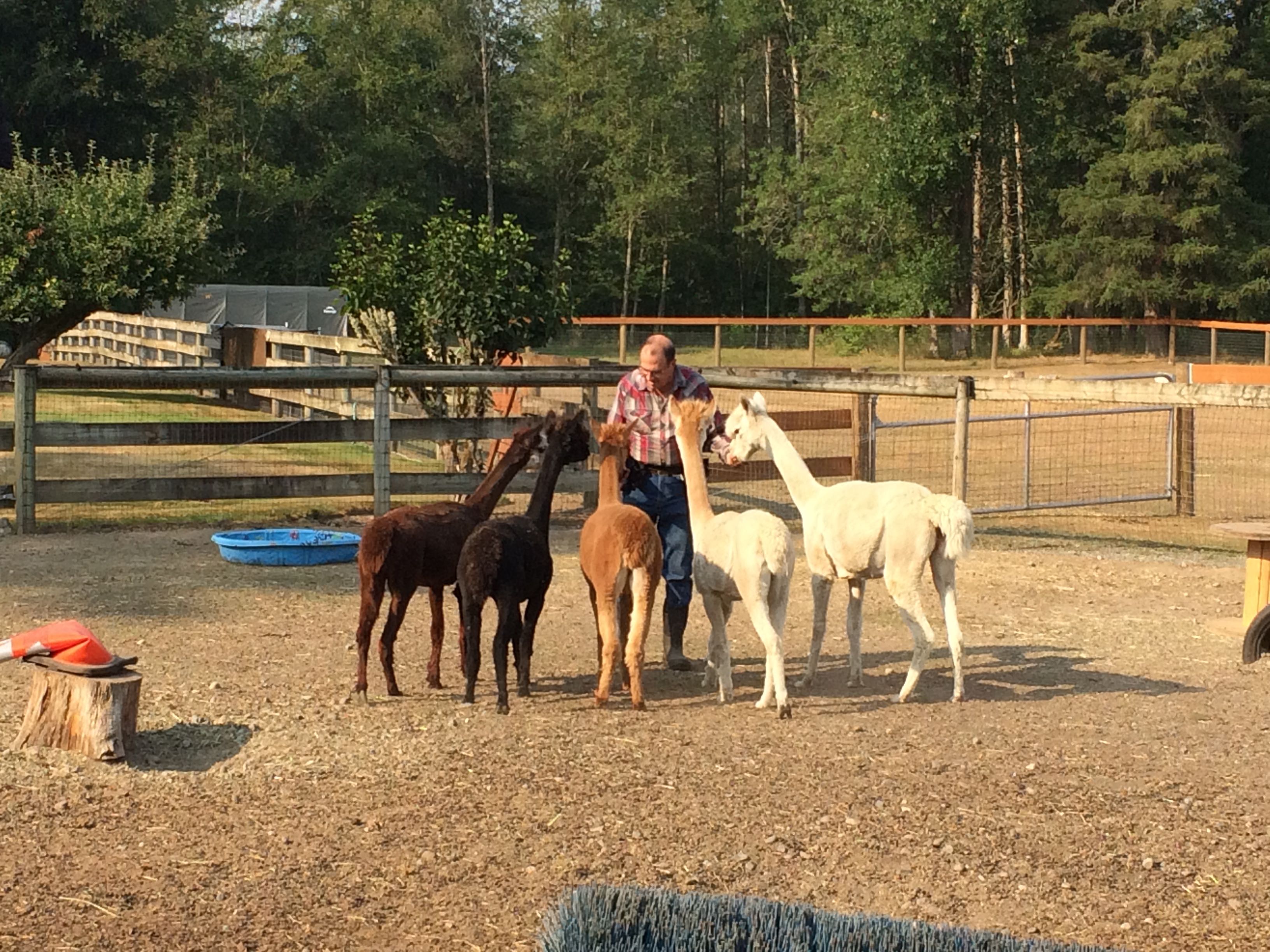
I can’t blame my travel schedule because I travel every month.  August was no exception.  I was out in Washington State at Ken Ramirez’s Ranch for his “Animal Training for Professionals” course.  For twenty years he taught this as a semester long course at the University of Illinois.  He also taught a concentrated week-long version of the course at the Shedd Aquarium.  Most of the time is spent in the classroom but twice a day students get to have some animal time.  For the week-long course at the Shedd attendees got to watch the trainers working with animals.  At the Ranch attendees get hands-on experience working with goats, miniature donkeys and alpacas.

IMG_5425 Ken Ramirez with alpacas

Ken Ramirez with his alpacas

For this course I got to be Ken’s assistant which was a great fun, especially since most of the training sessions involved his herd of dairy goats.  I enjoyed very much seeing what Ken was teaching his herd of clicker-trained goats – what was a match up with what I was teaching my goats and what were some good ideas to take back to them?  It was also very interesting to see how Ken structured the course.  What did he put in his foundation?  What stair steps did he use to take people into the more advanced aspects of training?

Ken Ramirez teaching husbandry behaviorsOn the third day Ken focused on husbandry, especially as it relates to medical care.  He is uniquely qualified to speak on this subject.  Both at the Shedd and through his consulting work, he has overseen the teaching of cooperative husbandry procedures not just to more animals than most of us will ever handle in a lifetime, but to more species as well.

Ken’s basic strategy can be summed up in a very simple phrase: do it differently.  Every day in your training you should be practicing some form of husbandry skills, but the key to success is don’t try to mimic a procedure someone else is going to be doing.  Your touch is going to be different, so even if you try to make everything the same as the real thing – you won’t succeed.  And besides, you don’t know what you are preparing your animal for.  Is it to stand quietly while you doctor a wire cut on your horse’s leg, or to put eye drops into an infected eye?  We don’t have crystal balls that can tell us what medical procedures our horses will need to tolerate.  X-rays might be standard, and certainly shots, but beyond that what are you preparing your animal for?

So Ken says do it differently.  Get your animal accustomed not just to being touched all over his body, but to being touched in different ways.

Do it differently also applies to getting an animal comfortable with changes in the environment.  Every day introduce some change, something different.  You aren’t trying to scare your horse.  You just want him to get used to the idea that change happens and it’s nothing to worry about.

Do it differently is a great life metaphor.  Sometimes we need to follow the rules, to do things the way “they have always been done” because the way they have always been done works.  The motto here would be “if it ain’t broke, don’t fix it.”

But even if it “ain’t broke”, can it be better?  Are we stuck in a rut just mindlessly copying what has been done before?  Horses have been trained for thousands of years.  On the surface the training that I learned from experienced horse trainers didn’t appear to be broken.  They could get on and ride their horses.  They could make them jump and cross scary streams.  They could make them go where they wanted.

“Make” was the operant word.  The end result could be very appealing, but if you scratched too far below the surface, you discovered a very broken system.  It was littered with discarded horses and far too many frightened would-be riders.  Something needed to change.

I was very lucky to be learning about horse training at a time when two very important change makers were shaking up the horse world.  One was Sally Swift who brought the Alexander technique into the horse world and changed the way riding was taught in the United States. Sally came regularly into my area so I was very fortunate to have been able to attend many of her workshops.

The other change maker was Linda Tellington-Jones, the founder of T.E.A.M. training (Tellington-Jones Equine Awareness Method).  Through Linda the horse world was introduced to the Feldenkrais work.  Early on I encountered T.E.A.M. training through a magazine article.  In it Linda described the body work she had developed, including the T.E.A.M. circles.

Peregrine’s mother was a wobbler.  She had a spinal cord injury that impaired her balance and made her very body defensive.  When she was a yearling, if I tried to touch her anywhere, I was met with gnashing teeth and pinned ears.  Her whole body couldn’t hurt, but I couldn’t figure out what was wrong because she wouldn’t let me in to ask questions.

I was reading everything and anything related to horses, and I was eager to learn.  These funny T.E.A.M. circles Linda was describing sounded intriguing.  I tried them on my mare and her world changed.  In minutes her eyes had grown soft.  Her head was drooping.  She was letting me in all over her body – except in one area around her right shoulder.  That was where the pain was.  For the first time she could relax enough to let me know what was wrong.

Within a few weeks I was on an airplane headed to the mid-west to attend a workshop Linda was giving.  I had to learn more!

That was the first of my many travels for horses.  At first I was traveling to learn, and then I was traveling to teach (which really means to learn even more!)

At one of the T.E.A.M. workshops Linda was letting us experience for ourselves the T.E.A.M. body work.  She let me feel one version of the T.E.A.M. circles, and then she did it another way.  She had her hand on my back so I couldn’t see what she was doing, but, oh my goodness!  It felt so very different!

I turned to face her.  “What did you do!?”

Her answer meant nothing to me.  “I breathed up through my feet.”

Now I’ve been trained in the biological sciences.  I’ve studied anatomy and physiology.  I’ve done dissections.  I know we breathe through our lungs, not our feet.  And beside, I had hay fever when I was little.  I was constantly congested.  Even breathing through my lungs felt like a foreign notion.  My breath got clogged somewhere at the top of my chest.

But I knew that breathing up from her feet meant something to Linda, so I went in search of the translation to that phrase.  One of the teachers I found lived in my area. She had a horse with a hard-to-diagnose lameness.  She contacted me to see if I could help her with him.  It turns out that the lateral work I was learning helped enormously.  When he carried himself in good balance, there was no sign of the lameness.

His owner, Marge Cartwright, was an Alexander practitioner, and she had also studied the Feldenkrais work.  So we ended up doing trades.  I worked with her horse to help him to be sounder, and she worked with me. Overtime I learned not only what it means to breath up through my feet, but to breathe up from the ground.  Learning that changed how horses relate to me.  It isn’t magic.  It isn’t some mystical gift of a horse whisperer.  It is simply the systematic unblocking of tension.  One metaphor that I love is the shining of a light on the dark places.  These are the places where movement become stuck, and we hide from ourselves the reasons for the stiffness.  This image comes via Anita Schnee, a Feldenkrais practitioner and regular attendee at the clinics I give at Cindy Martin’s farm near Fayetteville Arkansas.

The work Marge shared with me stands as one of the central pillars of what I teach today.  It is woven into every lesson both the ones that I give directly to horses and the lessons that I teach to their handlers.  Unless you live in my area and had the good fortune to learn from Marge, you won’t know her name.  But I owe her a huge thank you for enriching my life beyond measure.  Her work is woven into what I mean by equine clicker training.  If you have participated in a body awareness lesson at one of my clinics, you have been the direct beneficiary of her work. If you have thought about your own balance as you feed your horse a treat, that’s Marge’s influence again.  If you are learning about school figures – circles, lateral work, diagonals, etc. – by walking them without your horse, Marge has a hand in that, as well.

An awareness of balance, no much more than that – an appreciation for balance, an understanding that balance and soundness go hand-in-hand is something that I explored with Marge.

Clicker training for horses might have been little more than the teaching of tricks if it weren’t for this fascination and appreciation for balance.  Instead clicker training is a complex, wonderfully rich and diverse training system that can meet all needs. It includes the fun of tricks, but it doesn’t stop there.  The central core, the pillar that supports everything else is balance.

So thank you Marge for sharing your work so generously.  When you suggested we trade services, I’m sure you had no idea the ripple you were about to set into motion.  You helped make clicker training so much more than simply the pairing of a marker signal with treats.  What we teach and how we teach have become woven together to create a magnificent whole new way of doing things.  We dared to to it differently and look what grew out of it!

Thank you!

Learning Fast!

Learning!  That’s what we’re born ready to do.  That’s what the baby goats are showing me.

Thanzi’s twins were born on Wednesday, March 21.  On Friday, March 23 I was on a plane heading to the Art and Science of Animal Training conference so I barely got to say more than hello to them.

At the conference I presented a new program on a very familiar topic – balance.  I had some great before and after photos showing how much a horse’s balance can be transformed just using the foundation lessons.  I also had some new videos showing how those changes were made.  You don’t need advanced skills and complex lessons.  You just need to direct your attention to your horse’s balance to make a huge difference for him.

By the time I got home, Thanzi’s twins had met Trixie’s triplets.  The two family groups were living and playing together in the front pen.  And it was still cold.  In fact it has continued to be cold even into April.  This morning when I looked out there was fresh snow on the ground!  Not much, but still it snowed overnight – and it’s April.  The cold limits how adventurous I want to be getting them out.  But it doesn’t limit their need for enrichment.  So every morning I have been building a new play ground for them to explore.

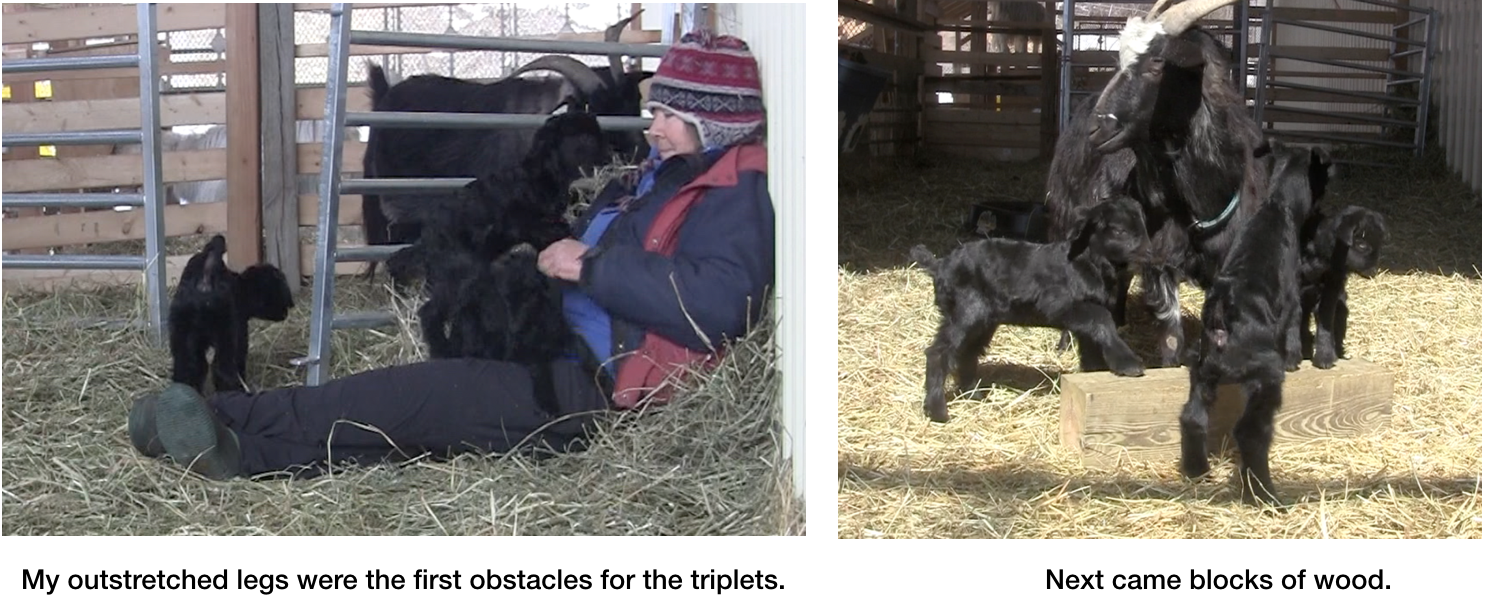
For Trixie’s triplets, their very first obstacles had been my outstretched legs as I sat with them in the hay.  They were determined to master climbing up and over.  And they delighted in trying to climb up onto my shoulder.  Patience, in particular, was determined to get to the top of the “mountain”, even if it meant stepping on Felicity who preferred to curl up in my lap.

Goats First Obstacles

Their next obstacles were blocks of wood, and then plastic jump blocks. Every day I gave them something new to explore, so for them novelty is something you play with, not run from.

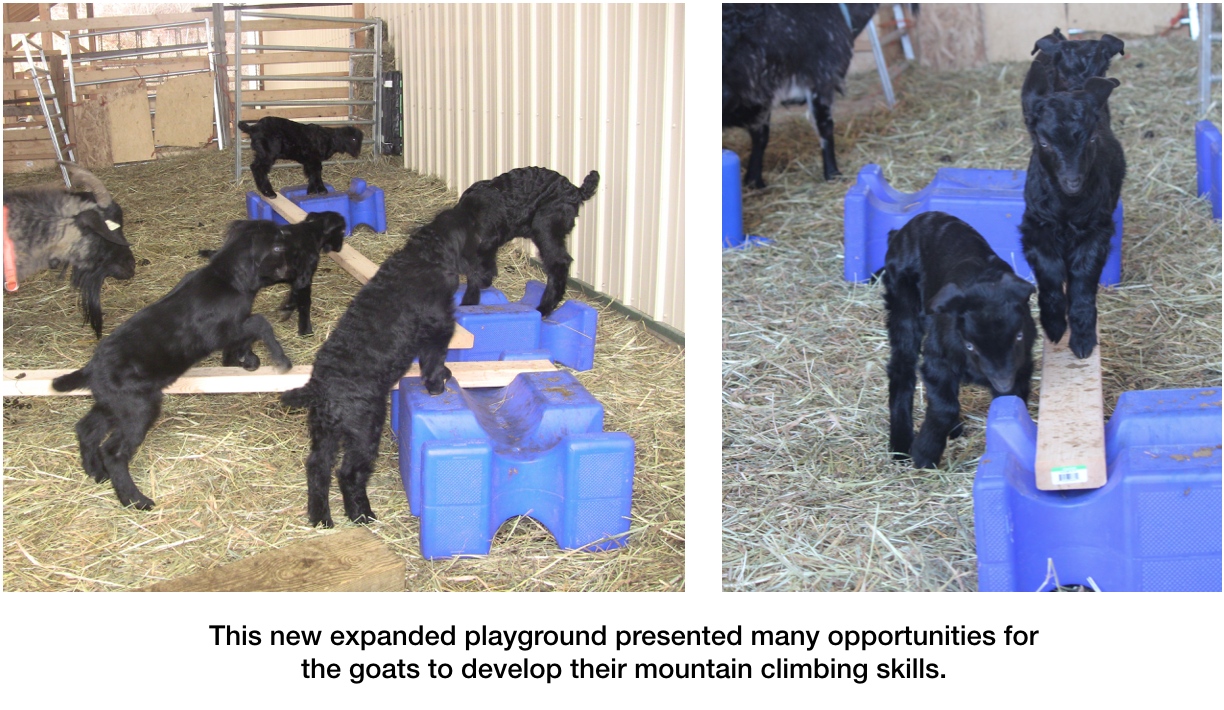
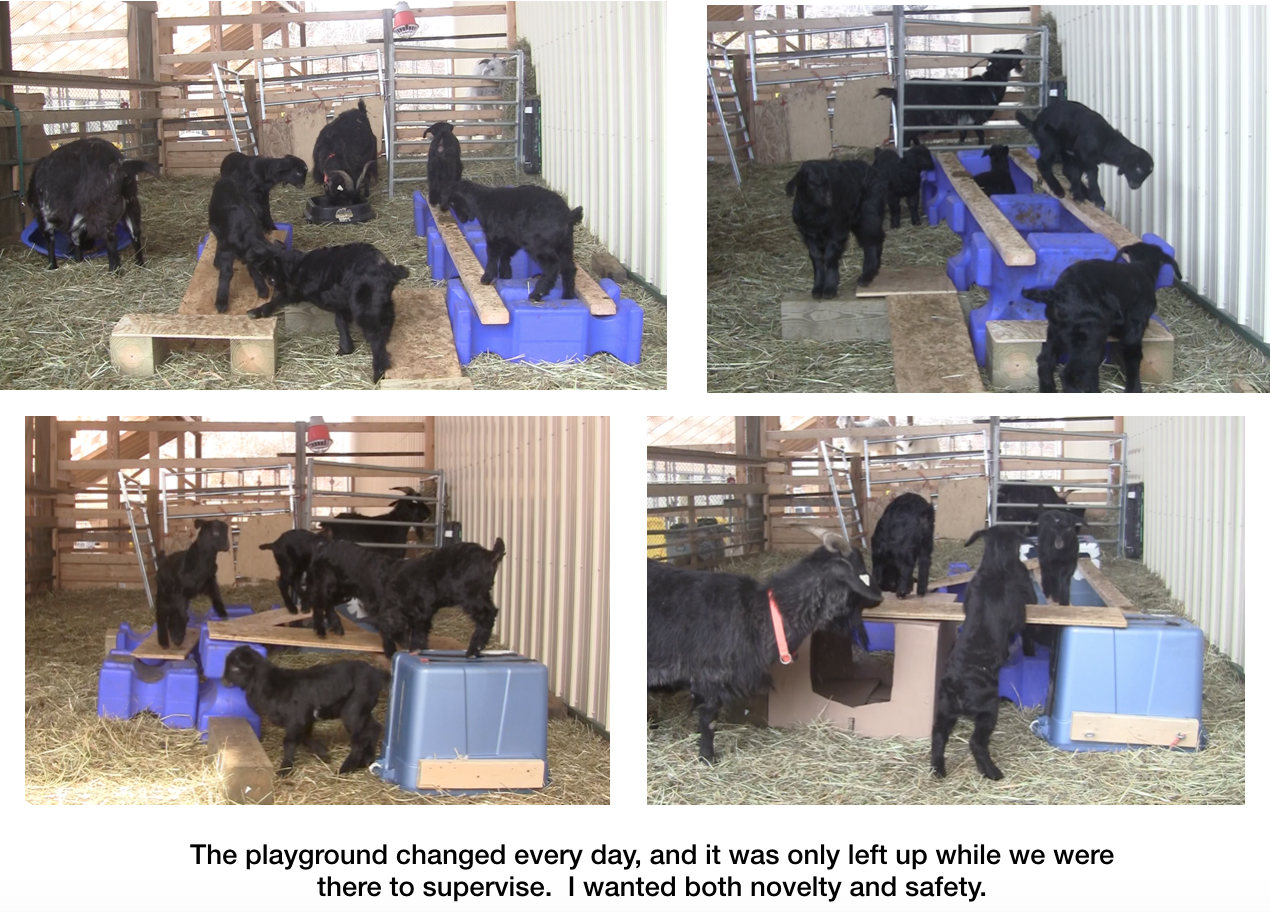
When I got back from the Art and Science conference, both sets of babies were clearly ready for even greater challenges so their playground expanded.  My raw materials were a couple of two by fours, six plastic jump blocks, some odds and ends of wood, and three pieces of plywood.  It is amazing how many different ways you can set up these elements to create a fresh challenge every day.

I began with the two by fours elevated just a little way off the ground.  The goats were immediately testing out their balance.  They wobbled a couple steps along the boards, fell off, got back on again, got bumped off by another goat, fell off, got back on again.  A day later they weren’t wobbling any more.  They could very nimbly walk the plank.

Goats learning to walk the plank

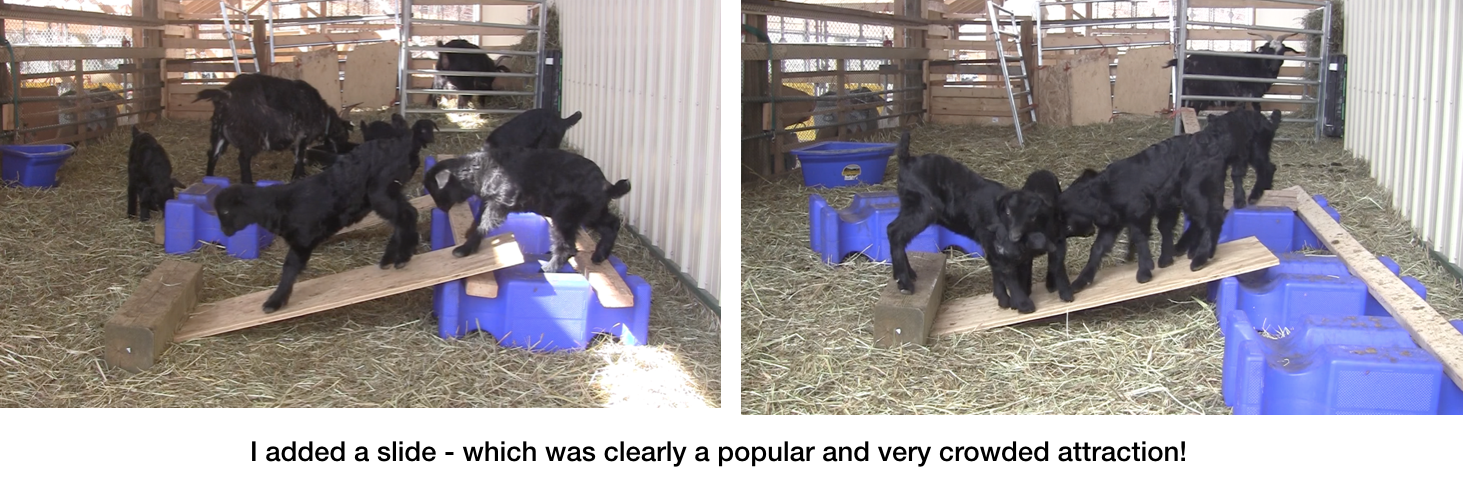
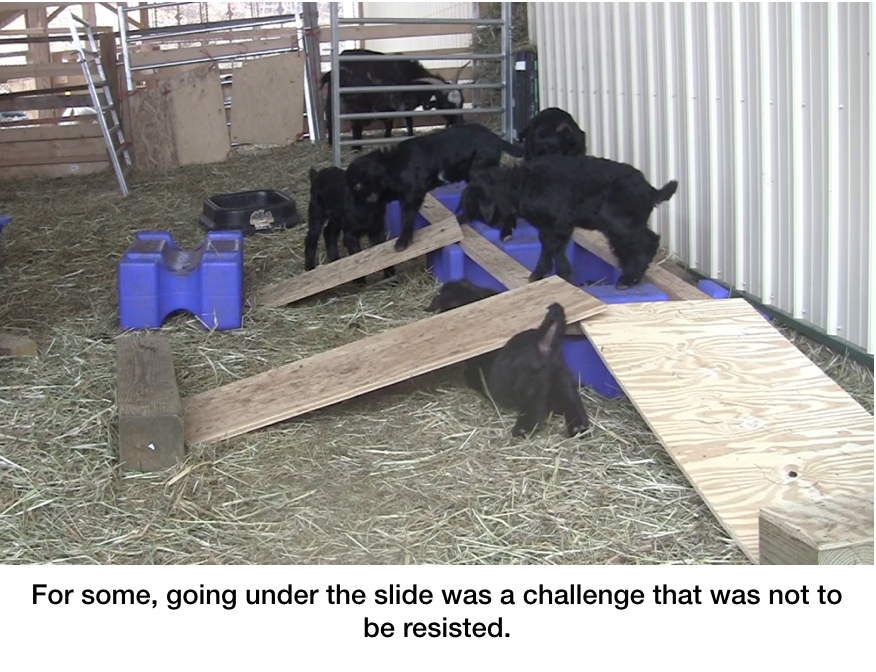
The next morning I added the plywood, but I set it so it sloped from the two by fours to the ground.  The goats slipped and slid down the plywood.  The two by fours were yesterday’s game.  This new challenge had them crowding onto the plywood.  One would be trying to go up the down escalator.  Her feet would be scrambling as she slid inexorably back down the plywood.  Another would be sliding towards her.  They’d collide mid-way, fall off and be right back for another turn.  What resilient, eager learners!

Goats Adding a slide to the playground

Goats every day something newAs their skills increased, I raised the two by fours, and added a couple more props.  One day I made a loop so they could run along the two by fours, slide down to a lower level, bounce from there across a plywood plank to another jump block and from there scramble up another slide back to the two by fours.  They made lap after lap, always with the obstacle of another goat wanting to go in the opposite direction.  Head butting on the slide was the best.  The mornings routinely begin with laughter as we watch the goats play.

Goats the playground changes every day

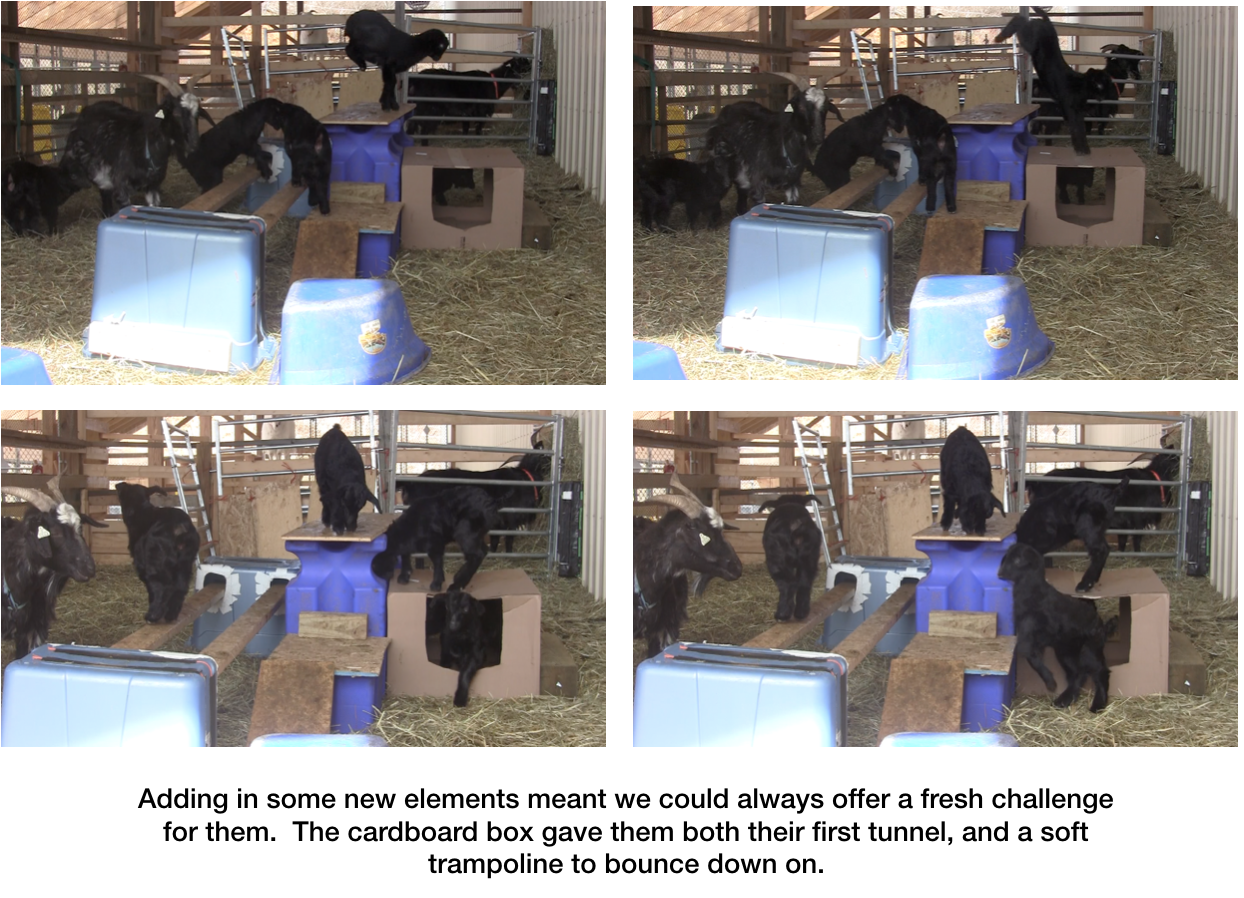
Goats carboard boxes make great playgroundsLast weekend I shared the laughter with Caeli Collins, the organizer of the up-coming clinic in Half Moon Bay, California.  What a treat it was having Caeli visiting.  She attended the Art and Science conference then flew out last Wednesday to spend a few days enjoying goats and horses.

Caeli is an experienced clicker trainer.  When you are meeting a new group of animals, it is never clear what you’re going to work on.  Will they settle right in and show you the leading edge of what they know, or will they ask for some other lesson?  With the baby goats the goal was laughter.  That was easily provided.

With the older Clicker Center residents there were other important lessons to be explored.  Caeli was learning how to transfer her clicker training skills to animals (and species) she didn’t know.  And I was learning how to introduce the goats to someone new.

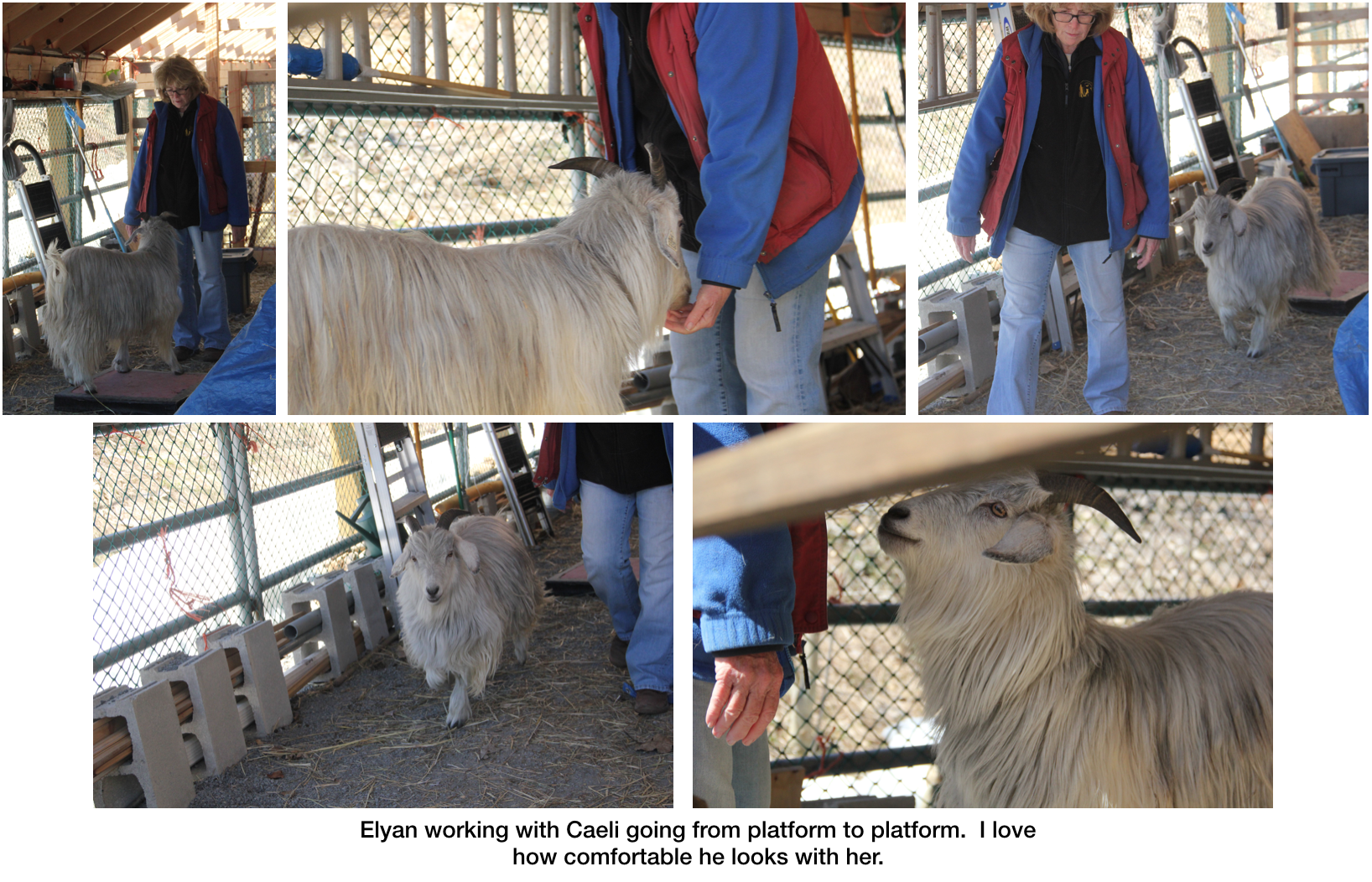
On the first day I opened the back gate into the boy’s section to let them out into the hallway while I fed.  They all poured out and raced to their stations.  That was before they realized there was someone new in the hallway.  I filled the hay feeders and then gave Caeli some hay stretcher pellets.  Pellias was willing to take a treat from Caeli, but not Elyan.  When I called the goats back into their enclosure, he scooted past her as fast as he could.  That was our baseline.

Day one was spent quietly letting the goats get to know Caeli.  She interacted with Elyan through the fence.  “Hmm.  This person knows how to play the clicker game.  Maybe she isn’t quite so scary after all!”

On day two they could both engage with her a little, and by day three I could step outside their pen and let Caeli train the goats on her own.  She worked with each one on targeting and platform training.  Pellias surprised her by deciding that after he got his treat from her, he should back up to the platform that was behind him.  And Elyan wanted to offer her his foot, something I had been working on a lot with both goats.

Goats Elyan working with Caeli

In addition to training time in the hallway, we took them into the arena so they could run around and play on the mounting block. And we went out for walks with them. We took advantage of one sunny, almost warm day to venture out on their longest walk yet, out into the back field.

And then there were the babies.  Every morning we set up a new playground for them.  As soon as we started moving pieces into place, they would be climbing all over them.  There was no worry, no concern over some new element we’d introduced.  These are confident, eager puzzle solvers, exactly what I want.  So our mornings started always with laughter.  Mixed into that was amazement over how fast they were learning.

Caeli also got to play with horses.  Robin and Fengur thought she was an entertaining guest, but mostly Caeli worked with the newest equine resident in the barn.  His name is Tonnerre.  He’s an eighteen year old, very pretty paint.  In his previous life he worked hard, and he has the stiffnesses and on-again-off-again lameness to show for it.

Through the winter the lameness has been more off than on, so I am hopeful that the microshaping gymnastics will help keep him comfortable.  That’s my main interest in having him at the barn.  I want to document the change in his body over time as he works more consistently with these lessons.

Last fall when he arrived, he really struggled to settle in.  For the first month or more the sessions were all about helping him not to panic when Marla took her mare into the arena.  For the first couple of weeks Marla had to spend most of her training time keeping Maggie in the barn aisle or just going into the arena briefly and then coming right back out again.  Thank goodness Marla was willing to play this game and had the skill to know how far and how fast to take Maggie out of sight.  Both horses were latching on to each other.  If we hadn’t spent the time to build their confidence that the other could go out of sight, we would today have two horses joined at the hip instead of two independent workers.

During those sessions Tonnerre was always loose.  He had his stall, outside run and part of the barnyard to move around in.  I had just pulled his shoes, and I didn’t want him doing a lot of frantic running back and forth.  So I stayed with him whenever Maggie was out and offered him the opportunity to target, to drop his head, and to back up, three very familiar behaviors.  He was able to stay with me, playing the clicker training game and only occasionally would he feel the need to break away and check on where she was.

Gradually, I was able to move away, engage with him less, and Marla was able to work her horse more normally.  It was very time intensive in the beginning, but definitely worth it to have both horses comfortable being out of sight of the other and able to work independently in the arena.

Tonnerre is proving to be an excellent student.  He’s always eager for his training sessions, but he’s not so sure about the goats.  He hasn’t quite come to terms with the strange sounds that come from that side of the arena.  When they are playing, goats make a lot of noise!

The first time he was in the arena with Caeli, they were just making the occasional banging sounds, but the wind was blowing hard. And of all things a squirrel decided to jump into the arena and run up a post into the rafters.

Tonnerre didn’t know Caeli, but he did know this was a scary day.  He wanted back into the barn away from all these strange noises and alarming creatures.  He was at liberty.  The door back to the barn aisle was open, so that’s where he went.  We had our baseline.  Relationship matters.

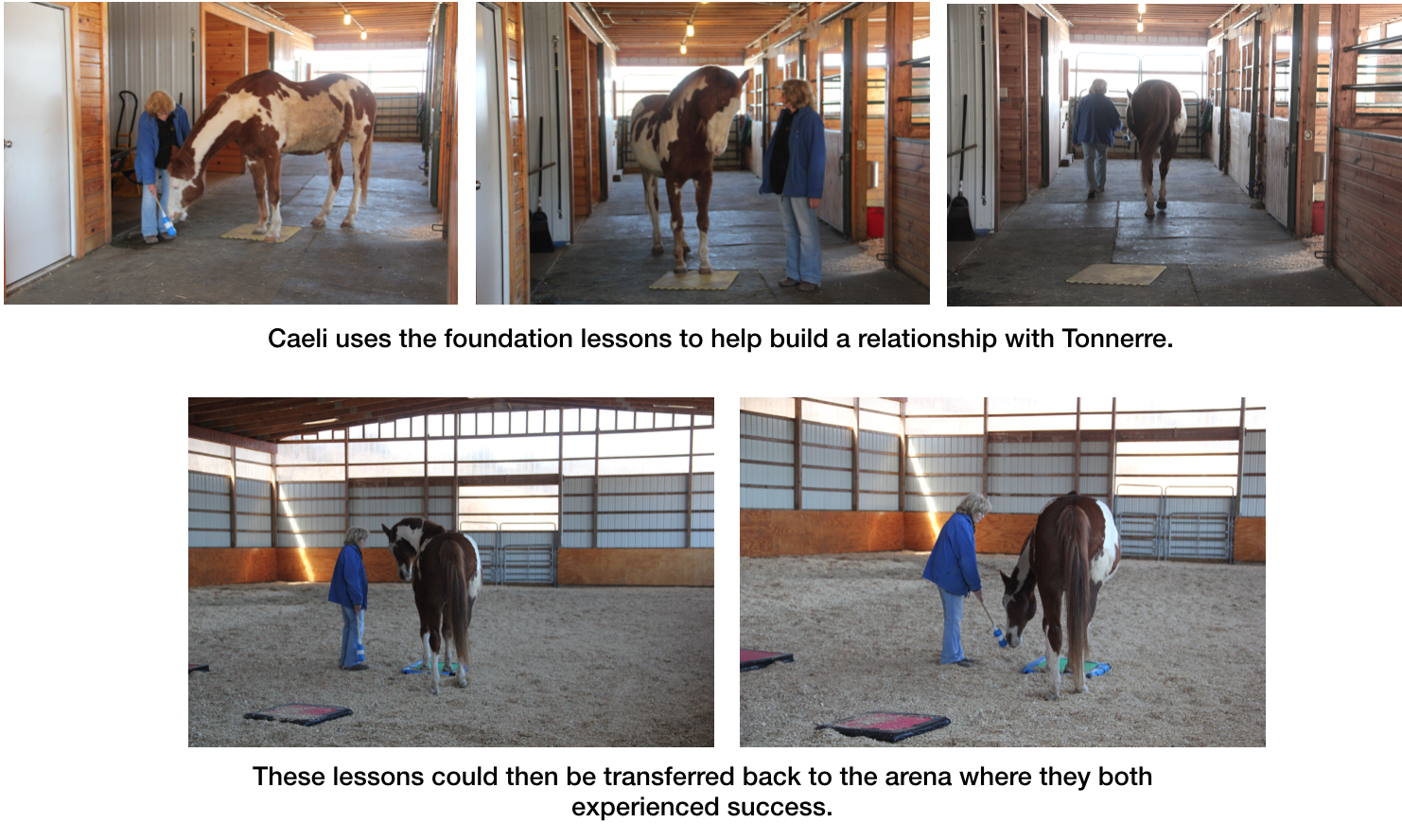
So we back tracked through his training, letting Caeli and Tonnerre get to know one another through the structure of the foundation lessons and in an environment where he was more comfortable.  It is always: “Train where you can, not where you can’t.”

And it is: “Go to a place in the training where you can get a consistent yes answer and proceed from there.”

Caeli could get a consistent yes answer in the barn aisle which then became a consistent and much more relaxed yes answer when she returned to the arena. Often the most important lessons come not from the fancy “stuff” a horse can show you, but from the simple things applied well.

Caeli and Tonnerre

At the Art and Science conference I talked about balance.  The baby goats are learning fast about physical balance.  When I turned the older goats and Tonnerre over to Caeli, the focus was very much on emotional balance.   Both are part of a complete picture.

I’d like Tonnerre and the goats to be good teachers even for novice clicker trainers.  Caeli was helping them make that leap to being comfortable with people they don’t know.  Her visit showed me that they will all be great co-teachers for anyone who wants to sharpen their clicker training skills – and enjoy some laughter along with it.

I made a short video of our daily play ground for the youngsters.  Enjoy!


Caeli wrote a wonderful post about her visit which I am including here.  It is fun to read about the same event from two different perspectives.  And Caeli added in her visit to Ann and Panda – always a treat.

A visit to Alex’s (long) – written by Caeli Collins and posted in The Click That Teaches facebook group April 7, 2018.

I spent four wonderful days with Alexandra Kurland at her barn in Albany just about a week ago. The goat babies were better than a movie, providing endless entertainment as they bounced around. Alex and Marla Foreman built new puzzles for them on a daily basis and they just kept bouncing to the challenge – walking a 2×4, turning a slanted board into a sliding contest, and chewing any clothing we didn’t quickly redirect. We decided a YouTube channel streaming baby goat antics would be a huge stress buster. Trixie and Thanzi are good moms and have amazing patience with them.

That was the several-times-a-day funfest. I also got to meet Ann and Panda, and go for a walk with them. Ann and Panda walk out! They walk faster than Sebastian and I doing in-hand trot work. But what I was really, really blown away by was Panda’s decision-making abilities. She watches for unevenness in the road, driveways, changes in slope, finds the crosswalk buttons, moves over for cars and more. It’s one thing to read about it, it’s another thing to see it in person. They are an amazing pair.

All of this was wonderful, but I was really there to expand my training knowledge and practice, which was so much fun. The boy goats (Pellias, Galahad and Elyan) and a horse named Tonnerre contributed to my education. Tonnerre is new to Alex’s barn since the fall, and is in long-term training with her to be a clicker training school horse (he’s the very good looking paint in the pictures). Alex has been working with him for some time.

My breadth of training is not wide – I work with my horse, Sebastian, and my dogs, but I’ve been a practicing and committed clicker trainer for about seven or eight years. I’m not a novice, but I’m also not a professional. For those of you who don’t know me, I organize and host Alex’s clinic in Half Moon Bay, CA, which is coming in three short weeks.

I learned so much. More than I ever hoped for. For me, it wasn’t about how do I teach shoulder-in or half-pass, it was how can I take what I know and use it with other animals as well as do better with my own. How do I make good decisions about what to work on with a different horse, or a different species. And with the help of Alex and the kindly animals at the barn, I have started on the building blocks to do this.

Here are some of the things I learned:

• Training begins with a relationship. If you are working with an animal you don’t know, you have to get to know each other. It’s that first date feeling, where everything feels a little (or a lot) awkward. And the less experience you have with the species the longer that might take
• Species appropriate foundation lessons are so important. The ones we use with the horses help them establish self-control and give them a measure of control over their learning. All animals deserve that
• Goats are really, really fast. Their heads can go in circles, and it’s very distracting. If I focused on what I was working on, and ignored the bits that don’t contribute I could get past this, but it was sooooo easy to get drawn in. I can see where this is true for my dog and my horse as well.
• Unexpected things happen. Really, they do! Can I be flexible enough to make the learner right? Pellias hit me with one – we were doing a bit of off leash practice and I was feeding where I wanted him to be (by my side) and he turned that into backing to the mat! It was funny and clickable and oh so not what I was thinking, but worth every bit of the click. And that became our routine in that spot, and I learned to take what was offered
• Food delivery is so, so important. The poor goats. Until I got consistent at putting the food where the perfect goat would be, the heads were twisting sideways to get it. But very much like the horses, the right food delivery moved them out of my space and set up the next cue, and calmed some of the frenetic activity down. The food delivery was predictable. It was very cool, and helped establish rhythm and stability

Tonnerre really helped me understand the importance of relationships. He was part of all that I learned, but deserves a few words of his own. Tonnerre can be safely handled, but he was pretty indifferent to anyone but Alex when we started. Alex suggested just grooming him while we got to know each other. There was no ear pinning or any overt aggression but he did grind his teeth. That became my cue that whatever we were currently doing was too much for him. So move to something else, or stop. Mats in the aisle, targets, the pose, walking from mat to mat, targeting while working in protective contact, mats and cones in the arena were all available. Working in the arena was too much, too early, and between a squirrel and noise from the goats he left – back to his stall. But the good news is that he had the choice to leave. Isn’t that cool? How often are our learners given the ability to say “sessions over, I’m done?”

Tonnerre reminds me of Sebastian, only kinder. He responded to short sessions of things he knew and we could expand on those. Alex could coach me on how to work with him, and we both could learn to work with someone new. Since Sebastian started out similar to Tonnere in his opinion of people, only more overt in expressing it, it wasn’t unfamiliar territory to either of us. And now I have better skills to deal with it (however did Sebastian and I survive those early days of clicker training?) and I had Alex there every day to help. And nothing but admiration for how Alex deals with the strange horses she’s presented with at every clinic.

And there you have it. Sorry for the length but it was an amazing, wonderful experience. This write-up was very worthwhile for me – it helped imprint the four days. And there is one other great thing – sitting there with Alex dissecting things over tea, while we took a break.

If you are interested in exploring this for yourself, Alex is doing private/small group sessions at the barn, so please contact her directly. It is amazing, and I highly, highly recommend it. And I can’t thank Alex enough for the opportunity. If I can figure out a way, I will be back.

Caeli Collins

Thank YOU!

I’m taking a brief detour from the Goat Diaries.  2018 is the 20th Anniversary of the publication of my book, “Clicker Training for your Horse”.  To celebrate every month this year I will be writing an article about one of the many people who have helped me bring positive reinforcement training into the horse world.

Last month I told you about Bob Viviano and Crackers.  Bob was there literally at the beginning of my exploration of clicker training.  Ann Edie joined us a short time later when she started taking lessons from me at the barn where I boarded my horses.  This month I want to turn the spotlight in her direction to thank her for the enormous contribution she has made to the development of clicker training and for 25 years of friendship.

Most of you know Ann through her guide horse, Panda.  Ann has big horses as well.  We seem to share our equine family – at least that’s how it feels.  Ann’s first horse, Magnat, is our one in ten thousand horse.  That’s how I think of him.  He was originally my school horse, but he was such a great match for Ann, in 1996 I gave him to her.  In 1999 he was joined by our two Icelandics, Sindri and Fengur.  Panda joined the “herd” in 2001.

I’ve written so much about Panda, I’m going to shine the spotlight instead on Magnat.  He played such an important role in the early development of clicker training it is right that he should get the attention as I celebrate twenty years of “Clicker Training for your Horse“.   There is so much I could write.  I’ll just share a couple of favorite Magnat stories.

Remembering Magnat

Magnat is an Arabian.  He came to me through clients of mine who wanted a weekend trail horse for their guests.  Several months and several disastrous rides after they got him, they discovered that he had a severe heart murmur.  My clients were in a dilemma.  They didn’t want to keep him as a pasture ornament, but they couldn’t ethically sell a horse with such a severe heart condition.  Who would want such a horse?  The answer was I would.

So Magnat became mine.  One of my favorite training mantras is:

The walk is the mother of all gaits.

I didn’t need to ride fast to enjoy a horse.  Magnat and I were a perfect fit.  I would love to have reserved him just for myself, but he was such a great school horse.  I began to use him to give lessons at the barn where I boarded.  I could not have asked for a better co-teacher.  This was in 1994.  I had just begun the year before to explore clicker training with Peregrine.  I was having such good success with it, I had started to share it with all my clients.

Pretty soon the only horse who wasn’t clicker trained was my own school horse.  I was reluctant to introduce it to him.  I had all the questions that everybody else has when you first start introducing food into your training.  What if he got mouthy?  He was so polite now.  I didn’t want to risk messing up my one and only school horse by teaching him clicker training!

When someone is hesitant to give clicker training a try, I get it.  I had the same questions and concerns that most people have when they first encounter this work.  But I really couldn’t go on encouraging all my clients to give it a try and not follow my own advice with Magnat.

I needn’t have worried.  For Magnat it barely caused a blip on the landscape.  He was polite before I introduced food, and he remained so even when my pockets were bulging with treats.  He was never muggy.

There are lots of horses who go through a very rocky transition stage.  The food does get them excited.  They frustrate easily and often older behaviors that have been suppressed through punishment resurface to create problems.  Magnat showed none of this.  That isn’t to say there weren’t changes.  My solid, reliable lesson horse truly began to shine.  If he had been good before, now he was outstanding.

Throughout that first winter he helped me teach people the basics of single-rein riding.  There’s a great expression:

The longer you stay with an exercise, the more good things you’ll see that it gives you.

One of the good things the basics of single-rein riding produced for Magnat was collection.  The beginnings of two favorite behaviors popped out: piaffe and canter in-hand.  This later is a gorgeous behavior to have in repertoire.  Magnat became so balanced and collected, he could canter while I walked beside him.

It was around this time that Ann came to the barn wanting to take lessons.  Ann was not a beginner.  She had ridden as a teenager, but then like so many others she gave up riding when she went off to college and never got back to it once she started raising a family.  The challenge for me was Ann is blind.  I had never worked with a blind rider before.  This was a new frontier for me.  But I assumed my job was teaching her to ride.  Ann would take care of the rest.  If I taught her the way I taught everyone else, we’d come out okay.  It turned out I was right.

I started Ann the way I start all riders who come to me.   It doesn’t matter how many years you have ridden or how experienced a trainer you are, if you are going to ride one of my horses, you start with a pony ride.  I guide the horse from the ground.  All you have to do is sit and enjoy.

As the rider becomes familiar with the horse’s communication system, and understands how to cue the horse, I gradually turn over more and more of the control.  So at first I have the reins, and I’m working the horse in-hand with a rider up.  Then I hand the reins over to the rider, but I stay close so my body language continues to support the rider’s cues.  Then I gradually fade out and the rider takes over completely from me.

This worked perfectly for Ann.  Having Magnat as my co-teacher made all the difference, especially since he could canter in-hand.  For teaching that made him worth his weight in gold.  I wish I had learned how to ride on a horse like Magnat.  Ann has such a relaxed canter seat because she learned the rhythm of the canter from him.  Starting out she never rode a bad canter.  All she had to do was relax and enjoy.  There was no struggle trying to get him into the canter, no trotting faster, faster, faster like a plane taking off.  There was no leaning sideways through unbalanced turns.
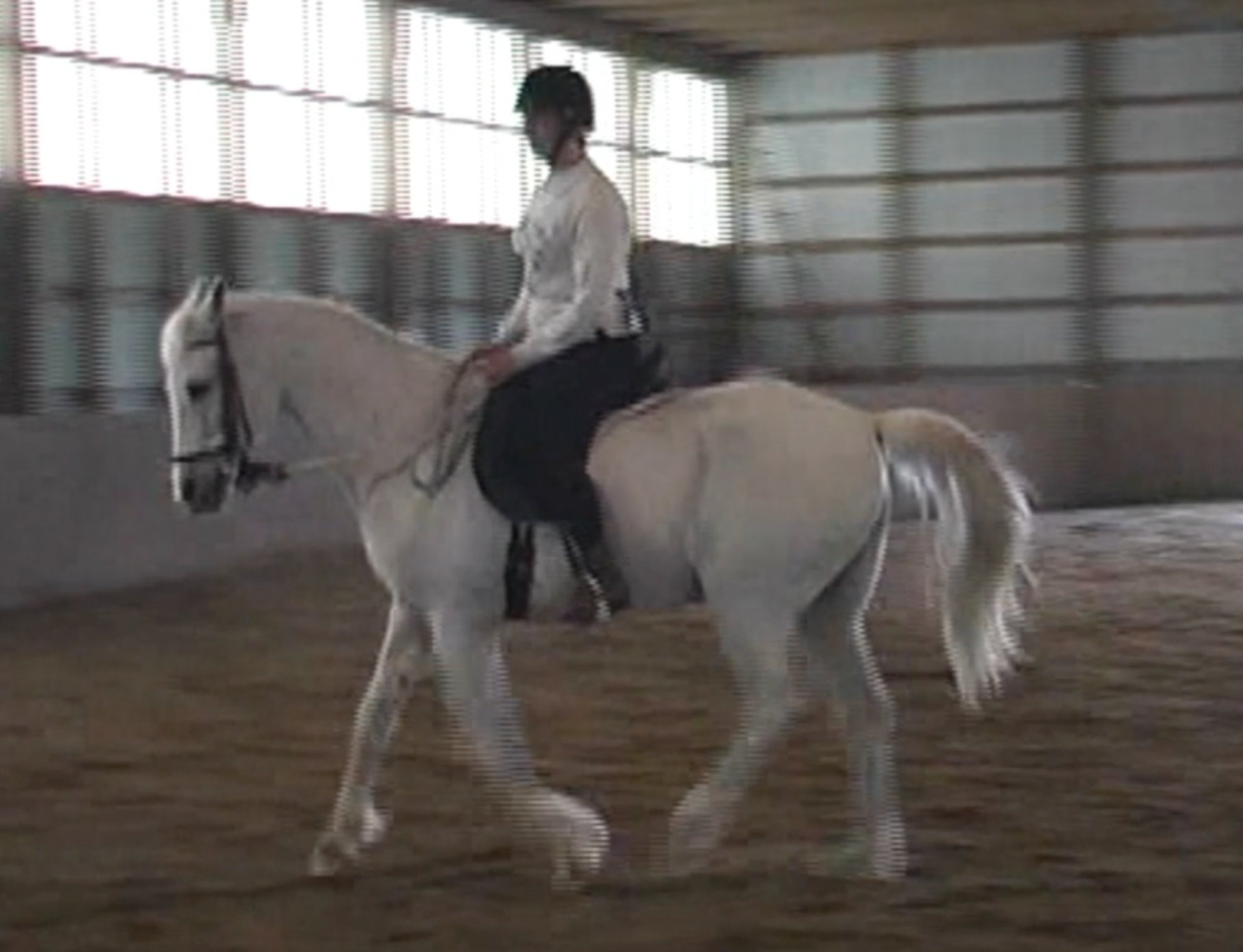
Magnat canter

Instead there was just the relaxed rhythm of a collected, glorious canter.  And then there was the piaffe and the passage.  It was Ann who was riding the first time Magnat succeeded in mobilizing into piaffe.  I was working him from the ground while she helped manage his weight shifts.

We were figuring out how to teach riding with the clicker.  I gave Ann the lesson, and she taught Magnat.  They were such a good match, I decided after their first winter together to give him to her.  It gave me so much more pleasure watching them develop as a team than I ever would have had riding him for myself.  And I had Peregrine.  He and Magnat became riding partners.  For the next sixteen years while we kept the horses at the boarding barn, Ann and I shared our evening rides together.

They were an unlikely pair, my thoroughbred, her Arab.  But it turned out that each horse gave their best to the other.  Magnat gave Peregrine the confidence to move forward again after a long, hard recovery from the aftershocks of Potomac horse fever.  And Peregrine taught Magnat about collection.

Magnat lived in a small paddock with two other horses.  I’m sure you can picture what he looked like during mud season.  Every night Ann would spend an hour or so grooming him and by the time he was ready to go into the arena, he was snowy white.  I don’t know how she did it!  When I brush my horses, the dirt moves from one spot to another.  When Ann grooms, the dirt leaves!  And a horse isn’t clean until her fingers tell her he’s clean.

Early on we taught Magnat to retrieve.  There’s a picture of him with a wooden dumbbell in his mouth on the cover of the first edition of “Clicker Training for your Horse”.  When Ann brought him into the arena, he would ask to be turned loose.  She’d let go of his reins, and he’d go out in the arena and bring back to her all the things the previous riders had dropped.

We boarded in a barn where there was a very active after school lesson program so there were always dropped riding crops, gloves, hats, kleenex.  Ann never knew what she was going to be handed.  Magnat was very diligent in making sure that he had found anything and everything that might get in their way.  In so many ways he was Ann’s first guide horse.

When the arena was clean, he would walk with her to the mounting block and line himself up.  Now the real glory of Magnat shone through.

Ann understood that clicker training means so much more than just using a marker signal and treats.  Clicker training for us is synonymous with good balance.  It was a joy to explore with her what that meant for our horses.

When Ann first started riding Magnat, she couldn’t manage his trot at all.  He bounced her out of the saddle.  It was the most jarring, bone rattling, uncomfortable trot imaginable.  That was because for her Magnat wasn’t yet balanced.  She didn’t yet understand how to use lateral flexions.  When she asked for the trot, she got the hollow-back, high-headed, stiff-legged trot that is all too often associated with Arabs.

As she learned how to use lateral flexions, Magnat relaxed and lifted himself up into a magic carpet ride.  The transformation was so black and white.  Ride him without asking for the lift that comes through the lateral work, and he would jar you right out of the saddle.  Ask for collection, and you were in heaven.

I taught Magnat lateral flexions before I began to explore clicker training.  He understood what I wanted and was a willing student.  Often people seek out clicker training because they are struggling with a horse.  That wasn’t the case with Magnat.  He could have gone through his whole life without ever needing to be clicker trained.

Before clicker training he was a good, solid-citizen riding horse, but that’s all he was.  Without clicker training he would have remained a nice, but ordinary horse.  With clicker training he shone.  I used to say he was a one in a million horse, but as the years went by and he just became more and more wonderful, not just to ride but to be around, I changed this to a one in ten million horse.

But I really shouldn’t be the one to describe what it was like to ride Magnat.  He was Ann’s horse.  Here is how Ann described him in a piece she wrote for my riding book:

“It’s always a dilemma to describe the experience of riding a truly extraordinary horse who has had the benefit of several years of clicker training.  Although many technical components go into the production of a really memorable ride, the irrepressible smile, the feeling of wonder, and expression of “WOW!!” that arises so regularly these days when I ride Magnat simply cannot be described in anything but poetic terms.

Yes, athletic talent and neuromuscular conditioning are part of what makes the ride so special; and yes, many hours of repetition over many months have gone into it; and yes, there is extraordinary lightness and balance.  But this is still far from the sum total of the experience.

Musicians have described a great melody as “ a journey which has many familiar passages, and which also contains some wonderful surprises which cause you to look at the world in a completely fresh way and gives new meaning to life.”  This is the best description I can find of what it is like to ride Magnat.

Magnat comes out into the arena every night feeling relaxed and eager to work.  He knows he will be appreciated and reinforced for his performance.  He knows that he is a respected dance partner and member of the team, not a mere subject of training.  This awareness and active participation on the part of the horse is one of the benefits bestowed by clicker training.

Our rides begin with warm-up exercises.  In the course of executing figures or doing simple softening and balancing work, I will pick up on the reins and suddenly feel the most indescribable lightness!!!

We may be in a super-buoyant, floating trot, a deliberate, balanced, ballet-like piaffe, or a heavenly rocking-horse canter.  Whatever it is, it will feel as though I am floating on a magic carpet.  He is so responsive in these moments.  It’s as if there are clear filaments of two-way communication from my finger tips to each of Magnat’s feet.  The slightest breath of a touch on one of those lines will be answered by an immediate floating response.

The musicians described music as a journey which “contains some wonderful surprises.”  That’s how I feel about riding Magnat.  Each ride contains surprises and special pleasures we have not experienced before.  It is like coming around a bend in the road and seeing a spectacular sunset, or a grove of awe-inspiring redwood trees, or the grandeur of an ancient castle, or the peace and cool of a Buddhist temple.  It truly takes the breath away!  It creates the deepest joy and aliveness in my heart!

These moments have totally changed the way I think about riding.  I feel such awe for Magnat and for what we create together.  In this moment I know, without the slightest doubt, exactly what I ride for – it is just this amazing feeling of total balance, effortlessness, lightness, and energy.  Magnat seems to feel the same excitement and joy, for he literally beams with pride, and recently he has begun uttering deep chortles in his throat at these moments.

I let the magic moment go on for as long as I dare, wanting it to continue forever, but knowing I must capture it with a click, before it disappears like a soap bubble or a delicious dream.

The click creates a pause in the music.  Magnat comes to a halt; I throw my arms around his neck in a huge hug, shower him with lavish praise, and empty my pockets of the most desirable treats!

The “WOW” feeling is definitely addictive.  The glow of the experience lingers and stays with me long after the ride.  Our whole horse-human relationship is one of appreciation, respect, and awe.

This is, for me, the great gift of clicker training.  When taken to the high-performance level, it creates transcendent moments of great joy”

Ann Edie – written in 2005 for “The Click That Teaches: Riding with the Clicker

Ann’s words express so perfectly why we have both worked to bring clicker training into the horse world.  If clicker training had just been about teaching tricks, and finding kinder way to get horses onto trailers or to stand for grooming, I would have moved on years ago.  Instead clicker training takes us on a journey to Joy.  It connects us deeply to our horses.

This is what Ann and I wanted to share when we wrote about our horses.  It is what I am celebrating in this twentieth year of “Clicker Training for your Horse”.  It is what we hope others will find as they explore clicker training: the great love and wisdom of horses.

Sadly we lost Magnat in 2011 not long after we moved to our new barn.  He had reached the grand age of 33, but it wasn’t enough.  We were both hoping he would be one of those Arabs who live to be forty.  Sadly he had cancer, and we had to say good-bye.

Ann has shared so generously her horses.  Magnat and the Icelandics have served as my school horses.  I’ve written about them, and they have appeared in the books and DVDs.  Sindri, our Icelandic stallion, was my riding horses.  Thank you Ann for that great pleasure and honor.

And then of course there is Panda, Ann’s guide horse.  Ann is a very private person, but she has shared Panda literally with the world.  We’ve had journalists from as far away as Japan and Australia come and do stories on her.  Ann has always been a good sport, and so has Panda!

What many people don’t know is Ann is one of the partners in The Clicker Center Barn. Without her help, the barn would never have been built.  Thank you Ann for this.  And thank you also for teaching me how to play scrabble and for occasionally letting me win.
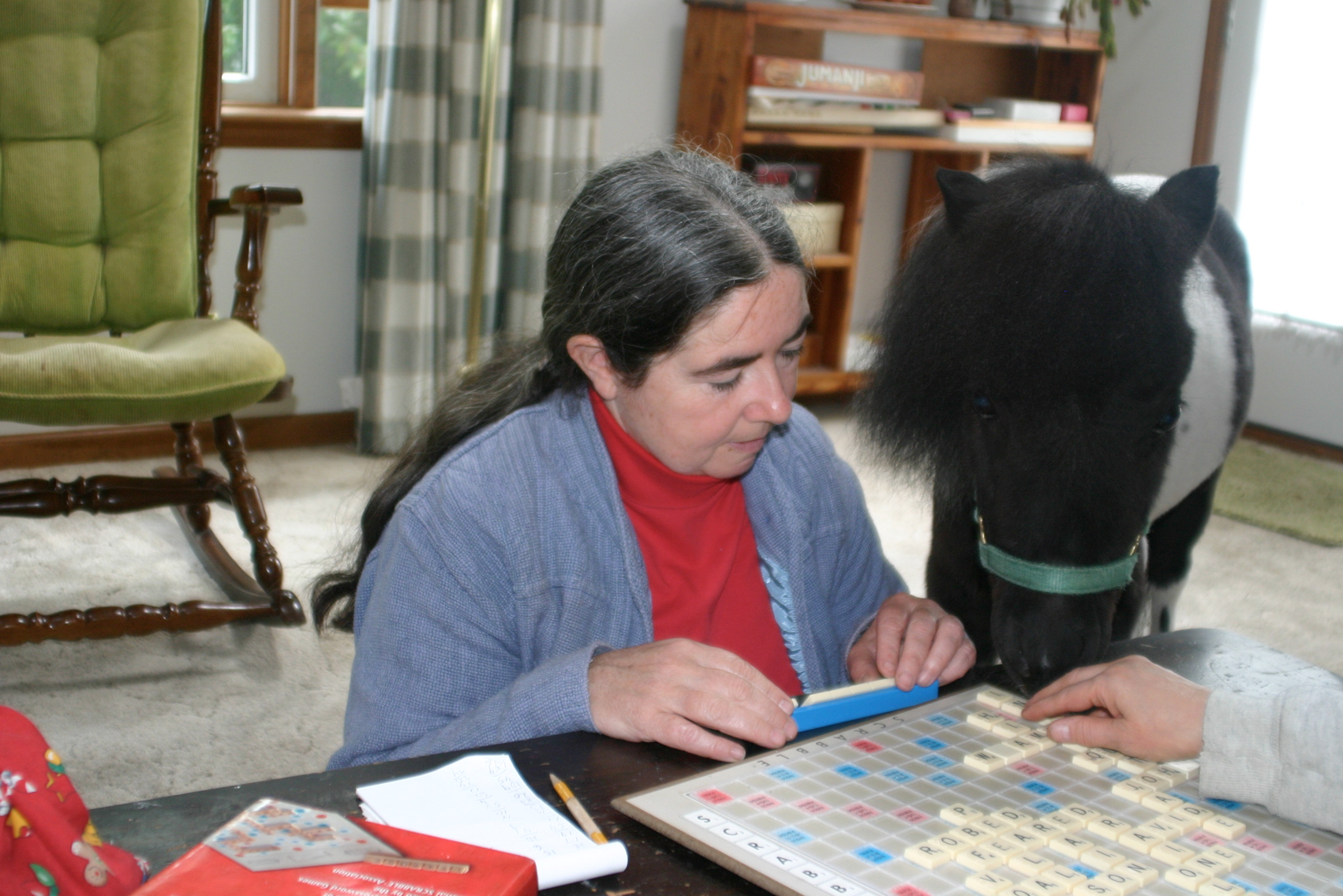
Alex Panda scrabble 0038

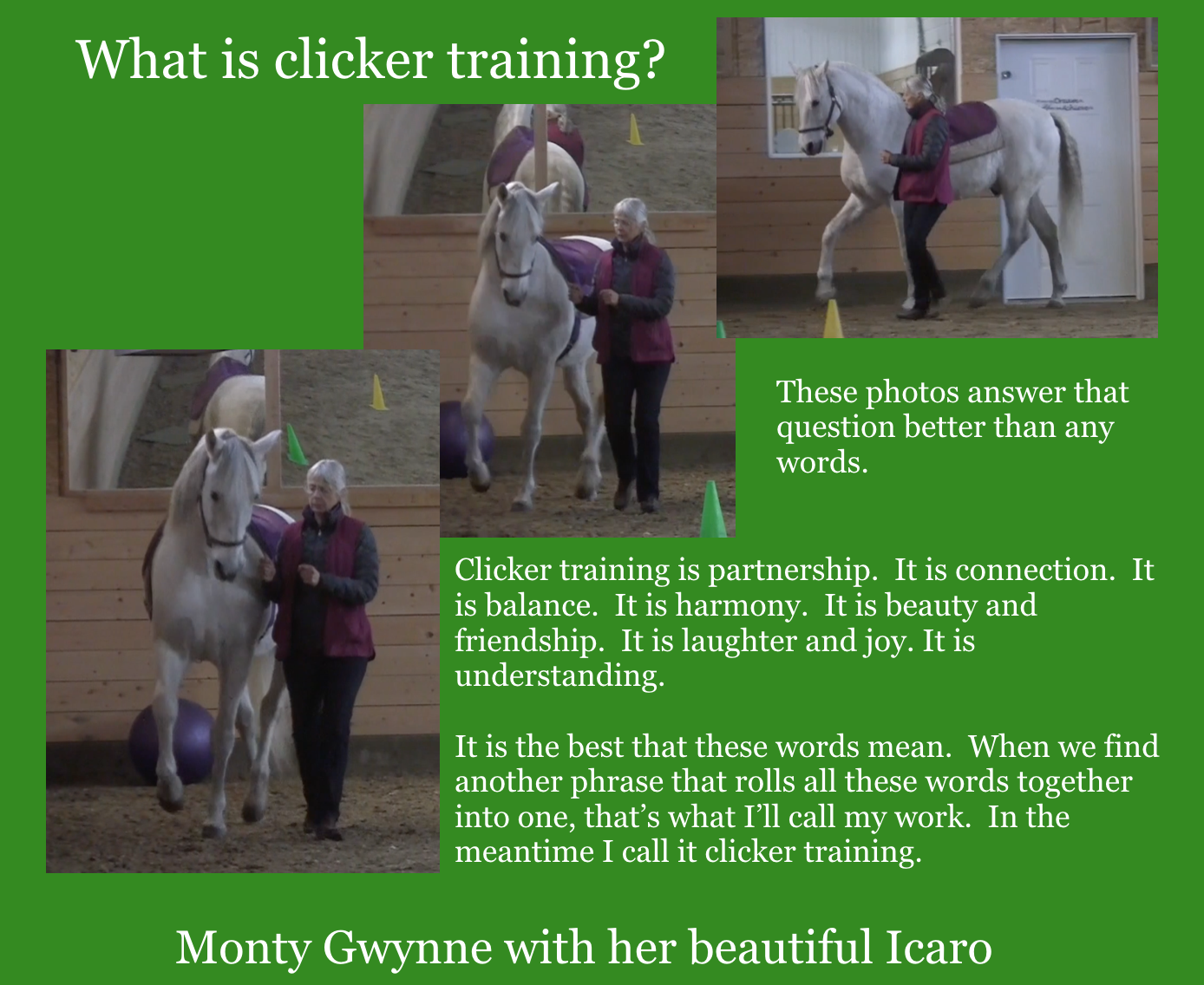
What Is Clicker Training?

JOY FULL Horses: Ten Things You Should Know About Cues: Number 9.) You Can’t Not Cue: Part 3 of 12

Labels
In the previous section I introduced you to Poco, an extremely ear-shy horse.  I ended that section by saying: “Poco wasn’t going to be helped by following old recipes, but by coming up with solutions that were tailored to his needs.  To do that we had to look more broadly at all that clicker training means.”

I put my first JOYFULL horses post up on January 2, 2016.  This far into the book may seem like an odd time to be asking such a basic question: what is clicker training?  But this question refers to so much more than just the surface definition of clicker training.

The term clicker training was coined by Karen Pryor.  In it’s simplest form it refers to applied operant condition in which a marker signal is paired with positive reinforcement.  In other words, if you like what your animal is doing, you click and reinforce him.

For years at clinics I’ve had people say to me you really need to call your work something other than clicker training.  What you do is so much more than clicker training.

I always throw this right back to them.  What would you call it?

I get lots of suggestions but nothing so far has stuck.  So many of the words that describe my work have been used, abused, and over-used.  Or they are too specific to a narrow area of horse training.

Harmony, balance, partnership have all been used so many times by so many different approaches to training they have lost any meaning.  You can have two diametrically opposed training systems both talking about partnership.  They’ll end up with very different looking horses and each group will be convinced they have “true partnership” and the others don’t.  Sigh.  Labels can leave behind a huge and very controversial mine field to navigate.

When I first came across clicker training, it had no associations attached to it.  It was just a label, a way of referencing a particular approach to training.  I had not seen other clicker-trained horses because there weren’t any around.  I hadn’t yet experimented with it, so I brought no strong biases to the term – good or bad.  It was simply a label, a convenient way to reference a system of training in which a marker signal was paired with positive reinforcement.

For me the term “clicker training” is still a convenient way to refer to a system of training that uses a marker signal, but it has grown to have many more associations for me and for others.  If someone has seen clicker training applied badly, just the mention of the name may send them over the edge into a long diatribe against it.

I’ve seen plenty of clumsy, not well-thought-out clicker training sessions over the years, but that doesn’t make me want to run from the label.  It makes me want to find better ways to teach the work.

What Clicker Training Means To Me
I’ve experienced so much joy both in my own horses and in sharing the work with others that I don’t want to walk away from the label.  Instead I want to make it clearer what clicker training can be.  I don’t know what clicker training has come to mean to others, but to me, when I think of clicker-trained horses, I see happy, well mannered, beautifully balanced horses who are a joy to be around.
icky-what-is-clicker-training-3
My clicker-trained horses make me smile.  I hope how I handle them gives my horses the equine equivalent of those happy feelings.  That’s what I want to share with others.

In 1993 when I started experimenting with clicker training, I didn’t head out to the barn thinking – “I’m going to write a book about this.”  I just wanted to find a way to keep Peregrine entertained while he was on stall rest.

There weren’t other people clicker training horses who I could turn to as role models or who could provide how-to instructions.  That meant I got to invent my own version of clicker training.

Defining Clicker Training
If you were to ask me to define clicker training, I would begin with Karen Pryor’s definition: clicker training is applied operant conditioning in which a marker signal is paired with positive reinforcement.

That gives us an operational definition, but clicker training is so much more than that.  I see it as a huge umbrella under which I can fit many different approaches to horse training.  For example, I studied for a time with Linda Tellington-Jones, the founder of TTEAM, so I fit her training under the umbrella.  I also put the work I learned from John Lyons under this same umbrella even though Lyons himself is not a clicker trainer.  These two training methods represent fundamentally different philosophies of horse training, but I was able to draw good things from both and adapt what I learned to fit under my clicker umbrella.

When I think of clicker training, I see a complete and very structured approach to training that results in well-mannered, happy horses.  I think of beautifully-balanced horses who are both having fun and are fun to be around.

Lucky with caption

That’s what I see.  But if all you’ve seen of clicker training is someone using it to teach simple tricks, you may see the fun – but not the balance.  Or maybe you’ve just seen someone who was fumbling around the edges of clicker training.  Your picture of clicker training may be a frustrated horse who is acting aggressively towards the handler.

Creating Stepping Stones
The more people who encounter clicker training the more different images of what it is there will be.  Clicker training will evolve and morph into something else.  That’s the nature of all creative work.  It is never static.  Clicker training, which seemed so revolutionary, so very much on the leading edge of training when I first encountered it, will become mainstream.  It will be the stepping stone to the next leading-edge idea.

We can’t yet know what that idea will be, not until it has had time to evolve.

This is the nature of the creative process.  Humans thrive on creativity.  This is part of play.  You are exploring two separate ideas and suddenly you see how you can put them together to create a completely original combination.  Both ideas by themselves were great.  Combined they are transforming.

So let’s look underneath the clicker training umbrella and see what’s really there.  Let’s also ask the question: are you a clicker trainer, or are you someone who just uses a clicker?  And what is the difference that that question is seeking to answer?

(And yes, I will get back to Poco and his ear-shy problem.)

Coming next: Are You A Clicker Trainer or a User of Clicker Training?

Remember, if you are new to the JOY Full Horse blog, click on the JOY Full Horses tab at the top of this page to find the full table of contents and links to each of the articles I have published so far.

I hope you will want to share these articles by sending links to this blog to your friends.  But please remember this is copyrighted material.  All rights are reserved. Please do not copy any of the “JOY Full Horses” articles without first getting written permission from Alexandra  Kurland, via theclickercenter.com

Also note: these articles are not intended as an instruction guide for introducing your horse to clicker training.  If you are new to clicker training and you are looking for how-to instructions, you will find what you need at my web sites:

theclickercenter.com                    theclickercentercourse.com