JOY Full Horses: Tagteaching – You Can’t Train My Child Like A Dog!

This is a continuation of Part 2 of my new book, “JOY Full Horses”.  If you are new to this series, go to the contents for links to the previous articles.

Chapter 2 of this section on Non-Verbal Cues was about habits.  What began as a simple question – how do you turn being PLAY FULL into a habit – took us down many paths.  We looked at habit loops, cravings, changing your habits, the power of community, small wins and keystone habits.  That led us back to horse training.  I shared with you some of the most important lessons my own horses have taught me.  That highlighted the contrast between clicker training and the force-based training many of us started with.  These were heavy topics to consider. Now in Chapter 3, I’m turning the spotlight entirely on what we do want: which is effective ways to teach our learners – horses and humans alike.

Chapter 3
Tagteaching – You can’t train my child like a dog!

TagTeaching
Tagteaching stands for teaching with acoustical guidance.  It is often described as clicker training for people, but really Tagteaching is it’s own self.  It evolved out of clicker training, so it is a relative, but not a clone.

Tagteaching was developed by Theresa Mckeon.  Theresa was a gymnastic coach.  We’ve all watched the Olympics and seen the intensity of the coaching.  This goes on at all levels, and in all sports.  Under the intense pressure of competition, students are hammered with all the things they are doing wrong, and all the things they need to do to correct them – everything – all at once.

At one point or another you may have been in a riding lesson that was like this.  The instructor was giving you a barrage of instructions – all at full volume.  Put your hands forward, no back, shoulders UP! Sit BACK! Why are you leaning to the side!? No! Don’t pull back.  Kick him HARDER!

I’ve certainly seen plenty of these lessons, and even taken a few.

Theresa was also familiar with this sort of lesson.  She has a horse, so I’m sure she’s seen this kind of instruction. She was certainly seeing it in the gymnastics coaching.  When my first book, “Clicker Training for your Horse”, came out in 1998, Theresa read it with interest.  She was familiar with clicker training in dogs, and now here it was for horses.  Why couldn’t she do something like this for her gymnastics students?

Excited to try the experiment, she introduced the concept to her students.

“Oh, yuck, you can’t treat us like dogs!” was the reaction.

Theresa was surprised and disappointed. She was sure adding a marker signal would help the training.  She went home that night and started thinking of other ways she could get the kids to buy into the idea.  Maybe if she didn’t tell them it was clicker training, she’d be all right.  What else could she call it?

The way Theresa tells the story, she says she always liked words beginning with T.  Ts made a sharp, clear sound.  So she started thinking up T words and came up with the acronym TAG – Teaching with Acoustical Guidance.

In clicker training we work non-verbally.  We can’t say to our horses we want you to walk over there and pick up that plastic cone and bring it back to me.  We have to shape that behavior through a series of small approximations.

Tag Points
In TAG Teaching we have the advantage of words.  We can tell our human students exactly what we want them to do.  But that description can turn into a verbal barrage.  So part of the brilliance of TAGteaching is the coach learns to pare down the instruction to just the core key phrases that the student most needs to focus on next.

Whether the student is a young gymnast attempting her first somersault, a golfer perfecting his swing, or a child with disabilities learning to walk, the coach is looking for one specific skill that the student will concentrate on for this next turn.  This skill is referred to as the TAG point.  When the learner is successful, that will be indicated with a TAG – an agreed upon marker signal that indicates success.

WOOF Criteria
A good TAG point meets the four WOOF criteria.

1.) Ask for what you Want.  Just as in clicker training, the focus is on what you want your learner To Do.  You don’t focus on what is wrong, what you don’t want to see.  Instead you define in clear, precise ways what you WANT your learner to do in the next round. Your instruction needs to strip away all the clutter that comes from describing all the ways things can go wrong.

2.)  Ask for One thing at a time.  You will be identifying one key element that the learner should focus on in this next trial.  Think about this in terms of the keystone habits and small wins that were covered in the previous section. Can you identify an element that will have a ripple effect and help to create many of the other good habits you would like to see developing?

3.) The behavior you choose needs to be Observable and Measurable.  This allows you to mark the exact moment when your learner is successful.  Saying “lift your arms up” is too vague.  The learner doesn’t know how far or in what direction?  Instead you might put a target on a wall and say: “finger tips to target.”  Which brings us to the fourth and often the most challenging criterion.

4.) Five words or less.  You may be prepping your instruction by giving a detailed description of what is wanted.  You may be modeling what you want your students to do and then describing it for them, but once you’ve done this, you want to pare down your instruction to five words or less.  That’s what your learner will remember.

Five words or less also obliges you to focus on what is really important and to come up with a clear and simple way of describing it.  It promotes creativity.

In the previous example: “lift your arms up” really is too vague.  But how are you going to say what you want in five words or less?

“Lift your arms up straight out to your side so you end up with your arm parallel to the ground” doesn’t cut it.  But putting a target on the wall and saying: “finger tips to target” is not only short and simple, it’s an elegant way to get exactly what you want and for your learner to know instantly when she has been successful.

These four criteria become the WOOF points.

What we want
One thing at a time
Observable
Five words or less.

Tag!  You got it.

Coming Next: The Focus Funnel

To learn more about Tagteaching visit: Tagteach.com

Remember, if you are new to the JOY Full Horse blog, click on the JOY Full Horses tab at the top of this page to find the full table of contents and links to each of the articles I have published so far.

I hope you will want to share these articles by sending links to this blog to your friends.  But please remember this is copyrighted material.  All rights are reserved. Please do not copy any of the “Joyful Horses” articles without first getting written permission from Alexandra  Kurland, via theclickercenter.com

Also note: these articles are not intended as an instruction guide for introducing your horse to clicker training.  If you are new to clicker training and you are looking for how-to instructions, you will find what you need at my web sites:
theclickercenter.com                    theclickercentercourse.com

This is a continuation of Part 2 of my new book, “JOY Full Horses”.  If you are new to this series, go to the contents for links to the previous articles.

Learned Helplessness
At their best Horse Expos should be events that expand in positive ways our understanding of horse training.  Sadly that isn’t always what is presented.  At one Expo I found myself standing outside a demo ring where a trainer was cracking a bull whip over a horse’s head.  She first warned the audience to cover their ears because the crack was going to be loud.

The horse couldn’t cover his ears, and he couldn’t get away.  Over and over again she cracked the whip around his body.  Each time you could see his belly tighten.  You know the expression “tied up in knots”.  That’s how this horse was clearly feeling. No matter what he did he couldn’t get away from that fearful crack.

This isn’t training.  This is learned helplessness.

We know about learned helplessness from some terrible laboratory experiments that were done with dogs in the 1960s.  The dogs were restrained in harnesses and given electric shocks through electrodes attached to their foot pads.

For the experiment two dogs were yoked together.  The first dog could stop the shocks by pressing a lever which also stopped the shocks the second dog was receiving.  The second dog could not stop the shocks through it’s own actions.

In the second half of the experiment the dogs were placed in a room with a barrier down the center.  The floor they were on had electric wires running through it. Again the dogs were shocked. The dogs that had learned that they could control the shocks jumped over the divider and escaped.  The dogs that had not been able to control the shocks made no attempt to jump out.   Nothing was restraining them.  They could have jumped across the partition to the safety of the other side, but instead they just curled up in a ball and took the shocks.  Learned helplessness.  They didn’t believe any more that they could escape from the pain.*

Is this what we want for our horses? Do we want them to give up and simply endure whatever we do to them in the name of training?  It’s important to remember that this trainer with the bull whip had a benign intent.  This horse was pushy and tended to spook.  The trainer wanted to be sure the horse was safe for the owner to be around.

Safety does always come first – but that has to mean for BOTH the horse and the handler.  The trainer continued to crack the bull whip around this horse.  I don’t know how long it continued.  I left to find the show management to lodge a complaint.

* Failure to Escape Traumatic Shock, Martin Seligman, Steven Maier  Journal of Experimental Psychology Vol. 74, No. 1  May 1967

Standing Up For Our Horses
I know if I push against you, you will push back against me.  And I know that we will not all make the same training choices.  There are many in the clicker training community who want to avoid all use of pressure, including any use of leads.  But pressure and release of pressure is our riding language, so I’ve made it part of clicker training.  I want the horses to learn in a positive, constructive way how to use the information that pressure provides.  I want it to mean not “do it or else”, but “follow the hints the pressure is offering, and you’ll get to your reinforcer faster.”  How we teach these lessons changes how pressure is perceived.

We all make different choices.  We all draw our lines at different points.  People who are exploring force-based training methods want good things for their horses.  They see that the end results can look very light.  They see that horses can be responsive.  They are afraid of the dangerous behaviors they are dealing with, and they are looking for solutions that work.

I don’t want to push against these good intentions, or the exploration that each of us goes through as we sort out how we want to train.  But at some point we all need to remember that it is more than okay, it is our responsibility to stand up for our horses.  We are their voice.  When we see methods that cross the lines of safe training, we need to be able to move past the words the trainers are using and see what is really going on.

Force-Based Training
I have watched and learned good things from force-based trainers. How am I defining force-based training?  This is training that is backed up with a do-it-or-else threat of escalating pressure.  The trainer applies light pressure.  If the horse complies, the pressure is released, and all is well.  If the horse fails to respond, the pressure increases until the horse gives a correct response.  The more the horse resists, the greater the pressure becomes.

A skilled trainer using these methods can look unbelievably light. Raise an eyebrow and the horse backs up twenty feet.  The final result is very impressive and compelling.  How magical.  Of course we want that.  But it is like a magician’s illusion, all built out of slight of hand. We need to remember that the reason the horse backs up for that raised eyebrow is because he knows that if he doesn’t, the subtle directive will turn into the sharp crack of a whip.  The threat is always there even if the audience fails to see it.

What Good Trainers Have In Common
I make this sound unbelievably harsh, but good force-based trainers can create good results and end up with eager, happy horses.  Good trainers no matter what methods they use share many of the same characteristics.

Good trainers are splitters.  They break their lessons down into many small steps.  If you are a force-based trainer and you are heading straight for the towering brick wall, you will end up in a fight.  But if you tear that wall down and build it up brick by brick, layer by layer – in other words if you are a good teacher – then the amount of do-it-or-else pressure you will be adding at any one step will be small.  You will be building confidence in your learner that he can succeed.  You’ll create a learning environment in which he knows he’ll be able to figure out the answer.  And just as important, he’ll be confident in his physical ability to perform.

If your small steps are accompanied by good timing, your requests will be clear and fair.  You will truly be working for the good of the horse.  Safety will be built into your training, and you will be a trainer I can watch and learn from.

It is important to make these distinctions and not put all the eggs into the same basket.  It’s only the rotten eggs that need to be left out.

Speaking Out For Our Horses
When we see training that violates safety, we need to speak out.  It can be hard.  Punishers are good at punishing. And they will all tell you it is for the good of the horse.

But good trainers know there is always another way to train everything.  If I am working with someone who isn’t comfortable with one of the choices I’m making for their horse, I’ll change the lesson plan.  There is ALWAYS another way to teach what we are after.

If you are working with a trainer who tells you that lassoing the horse’s hind leg to get him over his fear of shots is the way to go, it’s okay for you to say you aren’t comfortable with that method.  It isn’t safe for your horse and to please find a different way.  A good trainer won’t belittle you or make you feel bad.  A good trainer will listen to your concerns for your horse’s welfare.  A good trainer will respect you more for standing up for your horse.  And a good trainer will find another way.  There is ALWAYS another way.

That wasn’t what I expected to write when I began the section on small wins.  Let me bring it back around to a wonderfully positive note and that’s to the brilliant use of keystone behaviors and small wins that you see in tagteaching.  That’s the subject of the next chapter.

Coming Next: We’re still in the section on Non-verbal Cues. Up next is: TagTeaching – You Can’t Train My Child Like a Dog!

Remember, if you are new to the JOY Full Horse blog, click on the JOY Full Horses tab at the top of this page to find the full table of contents and links to each of the articles I have published so far.

I hope you will want to share these articles by sending links to this blog to your friends.  But please remember this is copyrighted material.  All rights are reserved. Please do not copy any of the “Joyful Horses” articles without first getting written permission from Alexandra  Kurland, via theclickercenter.com

Also note: these articles are not intended as an instruction guide for introducing your horse to clicker training.  If you are new to clicker training and you are looking for how-to instructions, you will find what you need at my web sites:
theclickercenter.com                    theclickercentercourse.com


JOY Full Horses: Part 2: Ten Things You Should Know About Cues

This is a continuation of Part 2 of my new book, “JOY Full Horses”.  If you are new to this series, go to the contents for links to the previous articles.

In the previous installment I talked about patience and persistence.  I ended with: “One of the many things that you learn from horse training is the longer you stay with an exercise, the more good things it will give you.  Focus on some little, achievable piece of the training, something you and your horse can accomplish together, and all kinds of other good and often unexpected results will emerge out of it.”

Now in this section I’ll share more lessons my horses have taught me.

“They Don’t Feel Pain the Way We Do”
Shortly before she became mine, Peregrine’s mother was injured in a handling incident.  One of the teenagers at the barn had been given the assignment of pulling her mane.  In case you aren’t familiar with this technique, it is literally what the name implies.  The mane is shortened and tidied up by pulling out the longer strands.

The horses I grew up with never had their manes pulled.  The first time I watched this being done it was to a young racehorse, a two year old who was literally climbing the walls trying to get away.  The trainer stood outside the stall door watching as a groom struggled to control her.

I couldn’t help but ask what they were doing.  It looked to me like some horrific form of torture.  The trainer dismissed my concerns.  “They don’t feel pain the way we do,” he said.  In his view, the mare was climbing the walls not because of pain, but because she was being disobedient.  That’s a great example of the stories we tell ourselves – and come to believe – to make things okay.

Peregrine’s mother wasn’t in a stall the first time someone tried to pull her mane.  Shortly before she officially became my horse, it was decided she should have her mane tidied up.  For her introduction to this procedure she was tied tight to a post supporting a four foot high fence.  To get away from the pain she presumably didn’t feel, she jumped the fence.  You could say it showed how athletic she was that she was able to jump the fence with her head snubbed up tight to the post.  Really, it just says how desperately she needed to get away.

I only learned about it because I saw scrapes on her hind legs and asked about them. It wasn’t until much later that I discovered the full scope of the injuries she sustained.  Her spine was damaged in what was a very avoidable accident.  My beautiful, athletic, perfect horse had become a wobbler.  That is exactly what the name suggests.  She sustained neurological damage as a result of that incident.  She could no longer tell where her hind legs were so she wobbled about trying to stay on her feet.

The Evolution of Belief
I learned over time just how severely compromised she was. What began as a slight dragging of her hind toes eventually deteriorated into such a profound loss of balance that it became hard for her to walk without falling.  All the dreams I had had for her were shattered.   All that was left was helping her relearn the most basic of motor skills. It was my early training experiences with her that taught me about small wins, and about finding ways around the many brick walls in her life. Long before I ever heard about clickers and positive reinforcement, she taught me how to break things down into the smallest of small steps.  The power of those lessons formed the core of what clicker training means to me.

If belief is a major part of changing habits, she taught me to believe in the power of change.  You cannot NOT change.  How’s that for a sentence!  But it’s true.  We are constantly changing.  The question is: are you changing towards something new, or are you simply boomeranging back to familiar patterns?

If you don’t believe that change is possible, you will always be reverting back to the same reality you are currently in.  Eventually you may find yourself so bogged down in that state that change truly does seem beyond your reach.

I didn’t know what change, if any, was possible for her.  The vets at the time painted a very bleak future for us.  They told me they could do nothing to help her, and eventually she would deteriorate to the point where she would be unable to stand.  It was a grim future to consider.

Since I couldn’t ride her, the vets recommended that I put her down.  That I couldn’t do.  Whether I could ride her or not, her life still had value to her.  Together we would deal with the challenges each day presented.  When things got too hard for her, that’s when I would make that decision, but until then we would keep going as best we could.

Stepping over the sill of her stall door was hard for her. But it was something she needed to be able to do, so we worked on stepping over ground poles. Those were terrifying for her, so I put a rope on the ground instead.  Even that was too hard, so I drew a line in the dirt.  That she could manage so that’s where we began.

She was showing me that no matter how small a step may seem, there is always, ALWAYS a smaller step you can find.

That is truly at the heart of all good training.  It is certainly at the heart of how I think about clicker training.

Eventually she was able to walk over those ground poles, and the sill of her stall was no longer a problem.  She could even manage a small cross rail.  We didn’t know what was possible.  We just kept working on the little things that challenged her.  Over time the little things grew into wonderful things.  She became my riding partner and introduced me to the world of classical dressage. She was the first horse I ever taught to piaffe.

Balance – The Core of Everything
She is why at the core of everything I teach there is balance.  For me balance is everything.  It gave her life.  When some people talk about dressage, they see competition rings and rosettes.  I see balance.  That’s what dressage means to me.  The end result may indeed take you to the show ring, but first it takes you to a feel that is heaven itself.  Balance is everything.  It is life giving, life sustaining.  It is beauty, grace, power.  It is love.

Some wonderful things have grown out of that terrible training accident, but I am never very far removed from the consequences.  It reached past her life and changed Peregrine’s.   During his foaling, she got down against a stall wall and couldn’t get up.  He was boxed in by the corner of the stall, trapped in her pelvis.  If I had not been camped out beside her stall, ready to help, I would certainly have lost him and possibly both of them.

Peregrine’s spine was damaged by the foaling.  That in turn led to his locking stifles which led to a challenging first few years of training which led – through a series of twists and turns – to clicker training.  So again, good things came out of a hard beginning.

My “Soap Box”
It has also given me the right to stand on the soap box that actively promotes positive training methods.  When I first started introducing clicker training to the horse world, I was very careful what I said about other training methods.  Clicker training was the new kid on the block.  If I came in like gang busters denouncing what everyone else was doing and saying my way is the best, I’d have been pounced on and crushed – and rightly so.  If you push against someone, of course, they are going to push back.

So I chose not to comment on what was occurring in the rest of the equine training community.  At times this was incredibly difficult.  There have been so many emerging trends over the last thirty years.  Many, very horse-friendly advances have been made.  Acupuncture, chiropractic work, physical therapies of many varieties are now common.  But why do we need so many interventions?  It is because we also have so many “methods” that are so very hard on horses. Strip away the rhetoric, and you will see revealed some horrific things being done in the name of training.

The words often sound great.  Everyone talks about partnership, harmony, etc..  But when you turn the sound down on the videos and watch what is actually being done to horses, it is often times nothing more than abuse.

I remember watching one video where the trainer’s solution to a needle-shy horse was to run him to exhaustion in a round pen.  The trainer was riding a stocky quarter horse, controlling from the saddle a rope that was lassoed around the horse’s hind leg. At the other end a strong twenty-something handler anchored down a lead attached to the horse’s head.  Between them he was well and truly trapped.

Every few minutes the trainer would tighten his rope, and the horse would go bucking and pitching around the pen.  Then they would back off and give the horse a short break.  The horse’s sides were heaving as he tried to catch his breath.  The trainer, meanwhile, was telling stories about how much he was helping this horse to get along with people.  He was like a skilled magician distracting the audience away from the things he didn’t want them to see.

After about forty minutes of this, his assistant did indeed manage to wrestle the horse into a head lock and give him a pretend shot. As the horse’s owner walked him out of the round pen, the trainer told her he might be a bit stiff for a few days, and he’d need some ointment for the rope burns on his hock.

I was horrified.  Whatever happened to safety always comes first!?  Whatever happened to common sense and humane handling!?

The trainer never asked about the physical history on this horse.  Did he have any hock or hind end issues that might be made worse by this kind of handling?  Suspending a horse as they did between the two ropes could easily have resulted in an injury to his pelvis, his spine, his hind legs.  He could have ended up with the same kind of neurological damage that had so crippled Peregrine’s mother.  Was it worth it?  All this just to give a shot!  When you see the videos from the zoos and aquariums showing wild animals – whales, dolphins, cheetahs, giraffes, rhinos, baboons etc. – voluntarily presenting themselves for shots and blood draws, you have to question these methods.

This is a soap box I have earned the right to stand on because for over thirty years I have lived with the consequences of this sort of training approach.  We do get to stand up for our horses and say find a different way, find a better way. Find a humane way.

And always, always – safety does come first.

Coming Next: Standing Up For Our Horses

Remember, if you are new to the JOY Full Horse blog, click on the JOY Full Horses tab at the top of this page to find the full table of contents and links to each of the articles I have published so far.

I hope you will want to share these articles by sending links to this blog to your friends.  But please remember this is copyrighted material.  All rights are reserved. Please do not copy any of the “Joyful Horses” articles without first getting written permission from Alexandra  Kurland, via theclickercenter.com

Also note: these articles are not intended as an instruction guide for introducing your horse to clicker training.  If you are new to clicker training and you are looking for how-to instructions, you will find what you need at my web sites:

theclickercenter.com                    theclickercentercourse.com

JOY Full Horses: Part 2: Ten Things You Should Know About Cues

This is a continuation of Part 2 of my new book, “JOY Full Horses”.  If you are new to this series, go to the contents for links to the previous articles.

In the previous post I introduced the metaphor of a brick wall that you are asking your horse to go over.  I wrote: “There will be a few horses who are athletic enough and riders who are skilled enough to go directly over the wall.  If they’re successful, that will tempt those riders to take the next horse straight over, and the next.  And it will also tempt them to make the wall ever higher.  Eventually they will either make the wall so high no horse can jump it, or they will try and force a horse over the wall who truly can’t make it.  Either way, eventually they will crash.

Lower that wall and some who couldn’t jump it before will now be successful.  Turn it into a cross rail and even more will manage it.”

Creating these alternatives builds the habit of confidence and saying “yes” instead of “no” to simple requests.  In this section I’ll explore what it means to dismantle these “brick walls”.

Dismantling The Brick Walls
When I’m confronted by a “brick wall” of a behavioral problem, I prefer either to find a way around it, or to dismantle it so I only have to ask my horse to go over a few small bricks.  If you pull enough layers off the brick wall, you will eventually get to the point where every horse and every handler can be successful.

Peregrine’s mother taught me this.  She was bred to be a racehorse.  The trainer who had her kept a small string of racehorses in addition to his jumpers.  If I hadn’t stepped into her life, she would have ended up at the track – at least that was the goal.  Given the injuries she sustained in the name of training, she never would have made it that far.

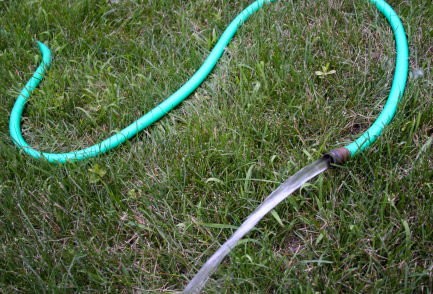
Racehorses take baths, so as a weanling it was expected that she would take baths.  The assignment of teaching her about hoses was turned over to a teenager who took her straight out and tried to give her a bath. The result was predictable.  She reared up and struck out at his head.

He never managed to give her a bath, but he did make everyone believe this five month old filly was a “witch”, a nasty horse you didn’t want to get close to.  Interesting how it is the horse who takes the blame for our bad training.

garden hose

He also created in her a lasting fear of hoses. When I started working with her a few months later, I could not take her down the barn aisle and out into the arena because it meant walking over the hose that was used to fill water buckets.  When I wanted to go into the arena, I had to take her out through the back which meant climbing over the shavings pile so we could get in by the back gate.

I’m sure the trainer would have had a different solution.  He would have “made” her comply.  There would have been a fight, and in the end she would have walked over the hose.  She would still have been afraid of it, but she would have learned that she had no choice.

Patience and Persistence
I was a very green handler.  I knew I didn’t have the skills to get into this fight, so I used a different approach.  I have always said I did some of my best training when I knew the very least.  All I had was patience and persistence, and I put those to good use.

Every night I would take her out of her stall and tie her to the aisle rail so I could groom her.  Tying was something she had already learned how to do so it was safe to use.  I began about twenty feet away from the hose.  When we were done, I would turn her away from the hose and walk the long way around into the arena.  Each night I tied her a little closer to the hose, but always we turned and walked away from it.  I never confronted her with it.

We finally got to the point where she could be tied right beside the hose, and she would stand quietly throughout her grooming session without seeming to worry about it.  One night instead of turning away, I asked her to follow me over it.  She did so without hesitation.  And after that, she always followed me wherever I asked her to go.

At the time I wouldn’t have referred to this as a “small win”, but that’s what it was.  I didn’t try to plow over the brick wall.  I found a way to dismantle it brick by brick until she was ready to go over it.

She discovered she could walk over hoses without fear.  More than that, she now understood that she could trust me to take care of her.

I wasn’t expecting this larger result.  I simply wanted to find a non-confrontational way to help her understand that hoses were harmless.  In the process I showed her how I could be trusted to behave.  I could be counted on to be consistent and to be on her side.  I wasn’t going to be petting her one moment and beating her the next.

One of the many things that you learn from horse training is the longer you stay with an exercise, the more good things it will give you.  Focus on some little, achievable piece of the training, something you and your horse can accomplish together, and all kinds of other good and often unexpected results will emerge out of it.

Coming Next:

They Don’t Feel Pain The Way We Do and The Evolution of Belief

Remember, if you are new to the JOY Full Horse blog, click on the JOY Full Horses tab at the top of this page to find the full table of contents and links to each of the articles I have published so far.

I hope you will want to share these articles by sending links to this blog to your friends.  But please remember this is copyrighted material.  All rights are reserved. Please do not copy any of the “Joyful Horses” articles without first getting written permission from Alexandra  Kurland, via theclickercenter.com

Also note: these articles are not intended as an instruction guide for introducing your horse to clicker training.  If you are new to clicker training and you are looking for how-to instructions, you will find what you need at my web sites:
theclickercenter.com                    theclickercentercourse.com

JOY Full Horses: Part 2: Ten Things You Should Know About Cues

This is a continuation of Part 2 of my new book, “JOY Full Horses”.  If you are new to this series, go to the contents for links to the previous articles.

When you want to change a habit, community is important.  In the preceding section I wrote: “Communities make change believable.  For habits to change permanently people must believe that change is possible. . . . Every time someone shares a clicker success story they are helping someone else cross that bridge into belief.  The success story says change is possible.”

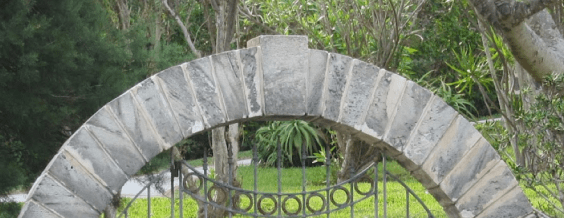
If our lives are made up of a series of habits, which ones do we work on to create widespread change?  In other words, is there a habit that you can create or change that would spark a chain reaction generating even more changes?  Such a habit is referred to as a “keystone habit.” That’s what I’ll be exploring in this section.

keystone round arch 2

Keystone Habits
Keystone habits provide what are referred to as “small wins”.  These are small successes that help other habits take hold and flourish.  Small wins have “enormous power, an influence disproportionate to the accomplishments of the victories themselves.”

Duhigg cited a reference from a Cornell study which concluded that:
“Small wins are a steady application of a small advantage.  Once a small win has been accomplished, forces are set in motion that favor another small win.  Small wins fuel transformative changes by leveraging tiny advantages into patterns that convince people that bigger achievements are within reach.”

(I can’t help but add here that this description could easily be applied to the shaping process we use in clicker training.)

Small Wins or Big Fights – You Choose
“Small wins” are at the heart and center of my training.  Early on in my horse training experience I was able to spend time with some very skilled horsemen.  They didn’t mess around with small wins.  They went straight to the big stuff.  Most of the time they were successful because they had the skills to get into a fight with a horse and win.  But occasionally things would turn into a train wreck.

I remember one such occasion where a trainer was trying to “sort out” a mustang.  This was a powerfully built draft type horse.  He’d already come to grief with several other trainers, and now this man was trying out his skills.  The mustang came within a hair’s breath of kicking his head in.

I was watching this as a very young and very inexperienced horse owner.  My takeaway message was I didn’t want to get into a fight with a horse.  Apart from the fact that it was just too dangerous, even then I knew it didn’t create the kind of relationship that I wanted.

I also knew that I didn’t have the skills or the strength to guarantee that I would win.  If you can’t guarantee a victory in the big battle – don’t start it in the first place.

I concentrated instead on the little victories.  I was boarding at the time in a hunter jumper barn.  I saw horses who had never been jumped before being sent over enormous fences.  Most of the time they were athletic enough to make it over, but sometimes they would simply crash through the fence or refuse to jump altogether.  The horses that stopped or tried to run out past the jump were all treated in the same way.  They were punished.  They learned fast that no matter how scared they were about jumping, the only safe route for them was straight over the fence.

Again, I thought of my small victories.  My own, beloved horse – Peregrine’s mother – had neurological damage.  She couldn’t jump.  In fact she couldn’t even go over a ground pole without panicking, but she could go over a line drawn in the dirt.  So that’s where we began.  Stepping over that line was a major small win that snowballed into many others.

Brick Walls
The image I have is of a huge brick wall.  There will be a few horses who are athletic enough and riders who are skilled enough to go directly over the wall.  If they’re successful, that will tempt them to take the next horse straight over, and the next.  And it will also tempt them to make the wall ever higher.  Eventually they will either make the wall so high no horse can jump it, or they will try and force a horse over the wall who truly can’t make it.  Either way, eventually they will crash.

If you lower that fence, more horses and more riders will be able to jump it successfully, but there will still be some who can’t.  They either lack the physical ability, the skills or the confidence to jump it.

Lower it a bit more and some who couldn’t jump it before will now be successful.  Turn it into a cross rail and even more will manage it, but even there, you will have some individuals who can’t manage even a small jump.  You may have to turn it into a ground pole, or draw a line in the dirt – or you may need to find a way to go around the jump altogether rather than over it.

Finding these alternatives are the “small wins”.  They build the habit of confidence and saying “yes” instead of “no” to simple requests.

Coming Next:

Dismantling The Brick Walls
When I’m confronted by a “brick wall” of a behavioral problem, I prefer either to find a way around it, or to dismantle it so I only have to ask my horse to go over a few small bricks.  If you pull enough layers off the brick wall, you will eventually get to the point where every horse and every handler can be successful. In the next section I’ll explore further what that means.

Remember, if you are new to the JOY Full Horse blog, click on the JOY Full Horses tab at the top of this page to find the full table of contents and links to each of the articles I have published so far.

I hope you will want to share these articles by sending links to this blog to your friends.  But please remember this is copyrighted material.  All rights are reserved. Please do not copy any of the “Joyful Horses” articles without first getting written permission from Alexandra  Kurland, via theclickercenter.com

Also note: these articles are not intended as an instruction guide for introducing your horse to clicker training.  If you are new to clicker training and you are looking for how-to instructions, you will find what you need at my web sites:
theclickercenter.com                    theclickercentercourse.com

JOY Full Horses: Part 2: Ten Things You Should Know About Cues

This is a continuation of Part 2 of my new book, “JOY Full Horses”.  If you are new to this series, go to the contents for links to the previous articles.

In the preceding section I asked: “What happens if you don’t like the habit you’ve formed?  How do you change a habit?”  That’s what I’ll be exploring in this next post.

Changing Habits
What happens if you want to change a habit?  If you understand the habit loop (cue leads to routine leads to reward), you can begin to see different strategies that will work. Many fit into what we are already doing via clicker training.  Thinking about the habit loop gives us a different perspective on why some of the teaching strategies we employ work so well.  One way to alter behavior is to keep the old cue and deliver the same reward, but insert a new routine.

You’re doing this all the time with clicker training.  Your horse presents you with an old cue – crowding into your space.  The habit you’d like to change is punishing the behavior by jerking on his lead.  The reward for this old behavior was a feeling of satisfaction when he moved away.  But instead of jerking on the lead, you fold your hands together in the “grown-ups-are-talking position”.

Your horse responds by shifting out of your space and standing still.  This creates a wonderful feeling of satisfaction for you. It isn’t tinged with any feelings of guilt or anger that the jerking on the lead created.  Instead you’re laughing at how easy it is to create the polite manners you want.

Natalie Harrison grown ups

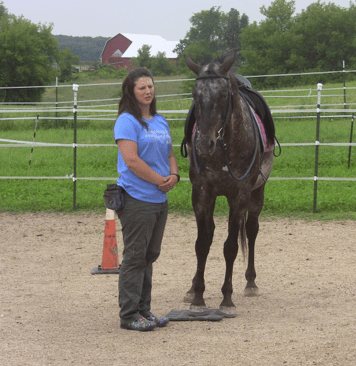
“The grown-ups are talking, please don’t interrupt” is the name I’ve given to one of the clicker training foundation lessons. At it’s most basic you are reinforcing the horse for looking straight ahead so his nose stays well away from your treat pouch. It begins with this very stylized base position for the handler in which the hands are held folded together at waist height. This creates a new routine for the handler. Instead of correcting her horse for the unwanted behavior of crowding into her, her new routine cues the horse to present her with this very polite, desirable behavior. The handler’s reward is twofold. She gets the result she wanted – her horse’s head is out of her space AND she feels good about the process.


Do You Believe?
The old knee-jerk reaction of correcting your horse for misbehavior is being replaced by this new clicker-friendly response.  But Duhigg asserts there’s one more ingredient that’s needed to make the new habit stick, and that’s belief.  This additional element is needed to get rid of the “yeah buts” that creep in when things are getting tough.

In other words, you’ll trust your new clicker skills in the security of your home paddock, but out in the real world – at a show or on a trail – when others are watching and distractions are high, you find yourself reverting back to old habits.  You can’t quite believe that all this click and treat stuff will actually work.

What Duhigg asserts is that “replacement habits only become durable new behaviors when they are accompanied by belief.”

This statement grew out of an examination of Alcoholics Anonymous.  There the belief was in a higher power, but what has emerged is it is belief itself that makes a difference.   In other words you have to be able to believe that things will get better.

The Power of Community
We are a social species.  What that means for our ability to change habits is this:

“There’s something very powerful about groups and shared experiences.  People might be skeptical about their ability to change if they’re by themselves, but a group will convince them to suspend disbelief.”

Communities, even if it is a community made up of just one other person, “make change believable.”  For habits to change permanently people must believe that change is possible.  “Belief is easier when it occurs within a community.”

Every time someone shares a clicker success story they are helping someone else cross that bridge into belief.  The success story says change is possible.  It’s important to hear someone else say: “My horse may have started out with all these horrific behaviors, but I can handle him now.  In fact, more than that, I have a great relationship.  He’s so good! I just love him.”

Sharing that story is sharing a belief in the process.  It is helping someone else change a habit pattern of violence or learned helplessness into one of empowerment and support.

“The evidence is clear: If you want to change a habit, you must find an alternative routine, and your odds of success go up dramatically when you commit to changing as part of a group.  Belief is essential, and it grows out of a communal experience, even if that community is only as large as two people.” Charles Duhigg

I have always said it would take a community to bring clicker training into the horse world.  It turns out I was more right than I knew.

Coming Next:

Keystone Habits
If our lives are made up of a series of habits, which ones do we work on to create widespread change?  In other words, is there a habit that you can create or change that would spark a chain reaction generating even more changes?  That’s the question I’ll be exploring in the next section.

Remember, if you are new to the JOY Full Horse blog, click on the JOY Full Horses tab at the top of this page to find the full table of contents and links to each of the articles I have published so far.

I hope you will want to share these articles by sending links to this blog to your friends.  But please remember this is copyrighted material.  All rights are reserved. Please do not copy any of the “Joyful Horses” articles without first getting written permission from Alexandra  Kurland, via theclickercenter.com

Also note: these articles are not intended as an instruction guide for introducing your horse to clicker training.  If you are new to clicker training and you are looking for how-to instructions, you will find what you need at my web sites:

theclickercenter.com                    theclickercentercourse.com

JOY Full Horses: Part 2: Ten Things You Should Know About Cues

This is a continuation of Part 2 of my new book, “JOY Full Horses”.  If you are new to this series, go to the contents for links to the previous articles.

In the preceding section I introduced you to the habit loop:

single habit loop
I left it to you to appreciate your habits, good and bad.  In this section we’ll look at how habits are formed.

Forming Habits – Good or Bad
Cues and rewards are not enough to form a habit.  You also need what Charles Duhigg in  “The Power of Cues” calls a craving.  That’s what powers the habit loop.

Duhigg cited a study done with monkeys in the 1990’s by Wolfram Schultz at Cambridge University.  Schultz studied the brains of macaque monkeys as they learned to touch a lever whenever coloured shapes appeared on a computer screen.

Correct responses were rewarded with a few drops of blackberry juice.  Initially the monkeys weren’t interested in the computer screen.  They spent most of their time trying to squirm out of the restraints that held them in place in front of the screen. But once they received that first reward, they became much more focused on the screen.  As soon as they understood the connection between the three steps: a shape appearing on the screen, pressing the lever, and receiving the reward of blackberry juice, they became intensely focused.

The probe that was embedded in the monkey’s brains revealed a consistent pattern. Each time a monkey received his reward, his brain activity would spike in a way that “suggested he was experiencing happiness.”

Whenever the monkey received his reward, the probe recorded a corresponding spike.  A habit was forming.  As that habit became stronger, the monkey’s brain began to anticipate the reward.  Instead of the spike occurring at the point where the monkey received the reward, now it was occurring the instant the shapes appeared on the screen – before the juice arrived.

The shapes on the monitor had become a cue for pulling the lever – the behavior the researcher could observe directly.  They were also a cue for the pleasure response in the brain which was recorded by the probe. A craving in the brain was emerging.

In studies that were done after this initial one, the monkeys were trained to anticipate juice whenever they saw a shape on a screen.  The researchers then tried to distract the monkeys.  They opened the lab’s door so the monkeys could go outside and play with other monkeys.

The monkeys who hadn’t yet developed a strong habit could be distracted.  If the juice triggered a spike at the point when the reward was delivered, they would leave the screen and go out to play with their friends.

However, once the spike occurred when the shapes appeared on the screen, the monkeys stayed put. The anticipation and sense of craving kept them glued to the screen.

Focus
Let’s translate this to our horses.  In the early stages of teaching a new behavior, you may have your horse’s attention – until he hears lunch being passed out in the barn, or his friends heading out to pasture.  He’s still easily distracted.

But as you build that behavior, what you may observe is his attention is now locked onto the task.  He’s hard to distract.

That’s the process we observe.  Now we can extrapolate from the macaques and say that a habit has been formed.  The spike of pleasure has shifted from the point where you click and deliver the reward to the presentation of your cue.

Cravings
The conclusion Duhigg brings us to with this research is that habits are strong because they create neurological cravings.  The monkey learned that pressing the lever when a shape appeared on a screen caused a drop of blackberry juice to be released.  He was learning how the system worked, but that’s not yet a habit.

A habit solidifies once the monkey begins to crave the juice when he sees the cue.  Once the craving develops, the monkey responds automatically.

Habits develop “by putting together a cue, a routine, and a reward, and then cultivating a craving that drives the loop.”  This last step is the important one to understand if you want to either build a new habit or disrupt an established one.

Duhigg used running as an example.  If you want to create the habit of running each morning, you need to establish a simple cue that will trigger the behavior.  It could be putting on your sneakers first thing in the morning.

You also need a reward.  This could be external – a mid-morning treat, or internal – the endorphin rush that you get from the jog.

What the studies show is that the cue and the reward are not enough to make the habit last.  Your brain needs to start craving the reward.  The cue must trigger not just the behavior, but also the craving for the reward.

Coming Next:

Changing Habits:
What happens if you don’t like the habit you’ve formed?  How do you change a habit?  That’s what I’ll be exploring in the next section.

Remember, if you are new to the JOY Full Horse blog, click on the JOY Full Horses tab at the top of this page to find the full table of contents and links to each of the articles I have published so far.

I hope you will want to share these articles by sending links to this blog to your friends.  But please remember this is copyrighted material.  All rights are reserved. Please do not copy any of the “Joyful Horses” articles without first getting written permission from Alexandra  Kurland, via theclickercenter.com

Also note: these articles are not intended as an instruction guide for introducing your horse to clicker training.  If you are new to clicker training and you are looking for how-to instructions, you will find what you need at my web sites:

theclickercenter.com                    theclickercentercourse.com

JOY Full Horses: Part 2: Ten Things You Should Know About Cues

This is a continuation of Part 2 of my new book, JOY Full Horses.  If you are new to this series, go to the contents for links to the previous articles.

In the preceding section I introduced you to Charles Duhigg’s book, “The Power of Habits“.  I ended by talking about traveling outside your habits.  I wrote:

“When I travel, I step outside of all of these classically conditioned triggers.  I get to experience “me”, not the “me” of my daily habits.  I think this is why people enjoy traveling on their vacations.  They could stay home and spend time in their own backyards, but that doesn’t give them a break from their habits.  Traveling may not be more restful, but it certainly creates more of a change when you can step outside not just of familiar landscapes but also of familiar habits.”

Microhabits
Until I started traveling on a regular basis, I was aware that I had routines to my day and general habit patterns, but I wasn’t as keenly aware of all the little microhabits that formed the overall pattern to my day.  They dictated not just what I was doing, but how I was feeling.

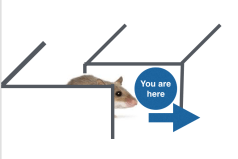
It turns out this has a very useful function.  Habits let us go on auto pilot.  In his book, “The Power of Habits”, Charles Duhigg shared some interesting research on habits.  He cited a study done with rats where their brain activity was monitored as they learned to navigate through a simple maze.  Each rat was kept behind a partition.  When the partition opened with a click, the rats would began to explore the passageway they were in. They sniffed the air and ran their whiskers up and down the walls.  The passageway ended in a T.  To the left was a piece of chocolate.  To the right just a dead end.  The rats first explored to the right before turning and getting the chocolate.

Duhigg recounts that outwardly the rats’ meanderings had no discernible pattern.

“It seemed as if each rat was taking a leisurely, unthinking stroll.

The probe in the rats’ heads, however told a different story.  While each animal wandered through the maze, its brain – and in particular, its basal ganglia – worked furiously.  Each time a rat sniffed the air or scratched a wall, its brain exploded with activity, as if analyzing each new scent, sight, and sound.  The rat was processing information the entire time it meandered.”

The scientists ran each rat through the maze several hundred times, and they repeated the experiment with multiple rats.  With each animal they saw the same series of shifts.  Over time the rats stopped sniffing the walls or making wrong turns.  Instead they ran through the maze at speed to the chocolate reward.  That was expected.  What was not expected was what the probes were recording.

“As each rat learned how to navigate the maze, its mental activity decreased. As the route became more and more automatic, each rat started thinking less and less.

It was as if the first few times a rat explored the maze, its brain had to work at full power to make sense of all the new information. Once the maze was learned, the rat didn’t need to scratch the walls or smell the air any more, and so the brain activity associated with scratching and smelling ceased.  It didn’t need to choose which direction to turn, and so decision making centers of the brain went quiet.  All it had to do was recall the quickest path to the chocolate.  Within a week, even the brain structures related to memory had quieted.  The rat had internalized how to sprint through the maze to such a degree that it hardly needed to think at all.

mouse in maze

This process – in which the brain converts a sequence of actions into an automatic routine – is known as “chunking”, and it’s at the root of how habits form.  There are dozens – if not hundreds – of behavioral chunks that we rely on every day. . .”

Why do we have these habit chunks?

“Habits, scientists say, emerge because the brain is constantly looking for ways to save effort.  Left to its own devices, the brain will try to make almost any routine into a habit, because habits allow our minds to ramp down more often.  This effort saving is a huge advantage.  An efficient brain requires less room. . .  An efficient brain also allows us to stop thinking about basic behaviors so we can devote more mental energy to other things.”

I don’t have to think about how to move my fingers over the keyboard as I type these words.  Finding the next letter is done by habit, which frees me up to think about what I am about to write not how I am going to record it.

Autopilot has huge advantages, but any of us who drive know the dangers of relying on it too much. That’s how you miss spotting the deer that’s about to jump out in front of your car.  (Or if you’re the deer, it’s how you miss seeing the car that’s about to hit you.)

Our clever brains have come up with a solution to depending too much on autopilot.  What the rat study showed was there was a spike of activity at the beginning of the maze just as the rat was hearing the click that signaled that the partition was about to go up.  There was a second spike at the end of the sequence when the rat found the chocolate.

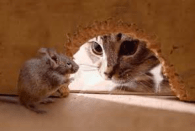
“These spikes are the brain’s way of determining when to cede control to a habit, and which habit cat outside mouse holeto use. From behind the partition it’s difficult for the rat to know if it’s inside a familiar maze or an unfamiliar cupboard with a cat lurking outside.  To deal with this uncertainty, the brain spends a lot of effort at the beginning of a habit looking for something  – a cue – that offers a hint as to which pattern to use.  . . . At the end of the activity, when the reward appears, the brain shakes itself awake and makes sure everything unfolded as expected.”

The Structure of Habits
Now we get to the part that should feel very familiar to clicker trainers:

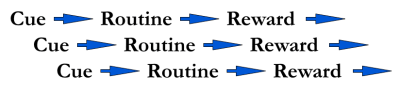
“This process within our brains is a three-step loop.  First, there is a cue, a trigger that tells your brain to go into automatic mode and which habit to use.

Then there is the routine, which can be physical, or mental, or emotional.

Finally, there is the reward, which helps your brain figure out if this particular loop is worth remembering for the future.

single habit loop

Over time, this loop – cue, routine, reward; cue, routine, reward – becomes more and more automatic.   The cue and reward become intertwined until a powerful sense of anticipation and craving emerges.  Eventually . . . a habit is born.”

habit loop

Changing Habits
Habits may be set in neurological pathways, but those pathways are not set in stone.  The good news for both ourselves and the animals we work with, is habits can be ignored, changed, or replaced.  Understanding the habit loop gives us insights into both the function of habits and how to go about altering them.

Habits mean that the brain doesn’t have to work so hard on certain tasks, and it can divert attention to other things.  Unless you deliberately resist a habit, the pattern that’s been routined in will unfold automatically.

But once you understand the components of habit loops, you can alter a habit by changing one of the components.  For example, in the rat study the scientists changed the location of the reward.  That appeared to extinguish the original habit.  Think about how simple that kind of change is to make the next time you want to alter a habit.  There is this caveat, though.  When they put the reward back in it’s original location, the habit reemerged without needing to be refreshed.

Once formed, we don’t have to keep relearning how to do things.  Which means, even if I take a long break from this computer, when I return to it, I’ll still know how to type.  Given the right triggers and rewards, the habit loop of typing will be there when I need it.

Bad Habits
Bad habits can certainly get in the way and make our lives miserable.  Think of the people who can’t sit down to watch a bit of television in the evening without also reaching for the snack bowl.  They feel guilty (probably also a habit by now), but they still fall into the habit of couch-potato snacking instead of going out for a walk.

Instead of grumbling at our unwanted habits, we need to appreciate habits in general.  Without our habit loops we would not be able to function.  People with damage to their basal ganglia have trouble coping with even the most mundane tasks.  They become paralyzed by all the tiny behind-the-scenes decisions we don’t have to make because our habit loops take care of them.  Most of the time we aren’t even aware that’s what’s happening.

I’ll stop at this point to give you time to appreciate your habits, good and bad.  In the next installment I’ll look at what it takes to form a habit.

Coming next: Forming Habits – Good or Bad

Remember, if you are new to the JOY Full Horse blog, click on the JOY Full Horses tab at the top of this page to find the full table of contents and links to each of the articles I have published so far.

I hope you will want to share these articles by sending links to this blog to your friends.  But please remember this is copyrighted material.  All rights are reserved. Please do not copy any of the “Joyful Horses” articles without first getting written permission from Alexandra  Kurland, via theclickercenter.com

Also note: these articles are not intended as an instruction guide for introducing your horse to clicker training.  If you are new to clicker training and you are looking for how-to instructions, you will find what you need at my web sites:

theclickercenter.com                    theclickercentercourse.com


JOY Full Horses: Part 2: Ten Things You Should Know About Cues

This is a continuation of Part 2 of my new book, JOY Full Horses.  If you are new to this series, go to the contents for links to the previous articles.

In the preceding section I talked about why it is so important to be in a PLAY Full mindset when you go out to the barn.  I ended with this:

You want to build a conditioned response for yourself.  No matter what sort of a day you’ve had, as soon as you head out to the barn – your mood shifts.  The good news is you really can build triggers for yourself that turn this into a habit.  In this section I’ll be explaining how.

Number 2: Non-Verbal Cues, continued

Chapter 2: Turning being PLAY FULL into a Habit

Power of habit book cover

The Power of Habits
It’s all well and good to say we want to be PLAY FULL.  Your intentions may be good, but what is the reality?  What are your emotional patterns?  Is it your habit to be cheerful, or do you let the stresses of the day get the better of you?  How do you develop the habit of being PLAY FULL so that’s always how you are when you’re with your horse?

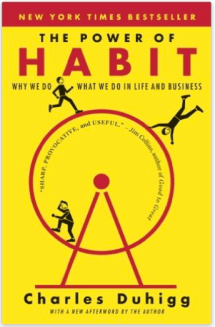
In his excellent book, “The Power of Habit”, Charles Duhigg talks about how to alter existing habits and how to build new, desirable ones.

Without knowing it he was describing a process we use in clicker training to build clean sequences of behavior.  Clean means the sequences are made up only of the behaviors you want.  There are no unwanted behaviors messing up the progression from one behavior to the next or attaching themselves tight as a tick onto existing behaviors.

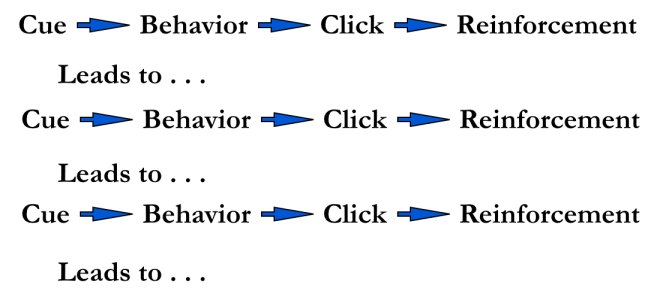
I refer to this teaching process as Loopy Training. You begin with a tight, small loop.  We often write this as:

click to reward

Reward is the short hand that’s often used, but it’s not the best word to choose.  Rewards certainly imply something good has been presented, but they aren’t necessarily directly linked to the behavior you’re trying to say “yes” to.  Getting a Christmas bonus may make you look forward even more to the Holidays, but it’s a clumsy way to reinforce you for a job well done in September. If the reward was linked to the task, it would serve as a much better reinforcer.

To remind us that we want to maintain the “ABC” tight connection between the behavior and it’s consequences, it is better to write this phrase out as:

click to reinforcement

Reinforce means to strengthen.  You reinforce a bridge or concrete.  You reinforce relationships.  If our actions reinforce a behavior, we should see more of that behavior.

When we write out this single phrase, it’s easy for our brains to end the sequence there and not see this as an on-going process.  We really should be writing this as:

loopy training diagram
As Duhigg describes them, habits are very much like that training loop.  They begin with a cue that triggers them, then the response, followed by the reward (or to use the language of animal trainers – followed by reinforcement.)

We all know we have habits – good and bad.  We are in the habit of always closing pasture gates once we’ve gone through them, of latching stall doors, turning off the barn lights when we go out.  Those are good habits to be in, but you might also have bad habits such as saying “you know” too often when you talk, or stopping at Starbucks on your way home for that extra sweet cup of coffee and sugar.

What the research makes us aware of is just how much of our lives are run by habits.  Going to the barn is one of my habits.  (And a very good one.)  Before the horses moved to the new barn, I would see them in the evening.  My schedule was dictated by the evening chores.  At the boarding barn stalls were cleaned only once a day in the morning.  If I wanted my horses to go overnight on a clean bed, I had to be there in the evening to do it.  And if I wanted to leave them with a warm mash and a late night snack of hay, again I had to be there to pass it out.  The last feed done by the barn staff was at 4 pm, and that’s too long a stretch to go until morning for a horse’s digestive system.

So my days revolved around the need to be at the barn to do evening chores.  Often I’d get to the barn feeling completely wiped out from a long day. At the start of the evening I’d be thinking this really is not going to be a riding night, but by the time I was cleaning the last of our stalls, I’d be itching to get my saddle out.  What had changed?

I was in a behavior chain.  I did the stalls in a consistent pattern.  Completing one stall became the cue to move on to the next.  I was moving from one conditioned response to the next.  By the time I got to the last stall, the triggers for riding were cued.  It happened every night.

cue:trigger loop
The Effect of Cues
The reinforcement in this case was the cue for the next link in the chain.  Confused?  Here’s an easy way to think of this.  Suppose you’re teaching a puppy to sit.  You say “sit”, and as he does, you click and give him a bit of hot dog.  The word “sit” will fast become a predictor of hot dogs.  Your puppy loves hot dogs, and he loves all the social attention sitting brings him, so he’ll be eager to hear you give the cue.  In fact he’ll be on the lookout for ways to get you to say “sit”.

If he jumps up on you and you say “sit”, and then you give him a bit of hot dog for listening so well to you, what have you in fact just reinforced?  What behavior are you going to see more of?

Jumping up.

Why?

Because jumping up led to the cue “sit” which reliably produces hot dogs.

This may not be what you intended, but this is the habit pattern you are inadvertently creating.

In my case I was reinforcing good habits.  Each little habit led me predictably through my evening.  The last step in this long sequence brought me to the last ride of the night which was always reserved for Peregrine.  I always saved his session for the end.  Why? Why do we save desert for the end of the meal? Because we want to leave our favorite, best reward for the end.

Unexpected Habits
When we moved the horses to the new barn, my day flipped upside down.  Instead of going out to the barn in the evening, I was now going first thing in the morning.  I had been looking forward to being able to ride whenever I wanted.  In a boarding barn you are always working around other people’s schedules.  Here in my own barn I could ride at any time.  At least, that was the theory.  The reality was my habits got in the way.

Mornings were for working on the computer.  I would finish the last of the stalls, and then head into the tack room but not to get my saddle.  The tack room also served as a temporary office.  That’s where my computer was.  Riding the horses in the morning felt decadent.  The pull to the computer trumped playing with the horses.  That was the stronger morning habit.

Most of what we do through the course of our day is really the result of one habit piled on top of another.  I’m not talking here about the big, noticeable habits that we are probably aware of, but lots of tiny microhabits that go into forming the routine of our day.

Emotional Habits
It’s not just what we do that are determined by these habits.  It’s also how we feel about what we do.  I became very aware of this because of all the traveling that I do.  At home my day follows routines.  Not every day is the same, but it is made up of familiar segments.  Some days include a trip to the post office. That forms a distinct loop inside the larger flow of my day.  Once I enter that habit loop, it unfolds in familiar sequences with emotions attached to it that are the product of classical conditioning.

There’s the feeling of annoyance while I stand waiting in line.  I don’t mind lines in and of themselves.  I stand in lots of other lines, even other post office lines, without this feeling of grumpiness descending upon me.  It’s the inefficiency of the way this particular post office branch is run that triggered the original grump.  Now whenever I walk up the steps towards the front doors, I can feel my mood shift.  There might not be any line at all, or maybe one of the more efficient clerks is at the window.  It doesn’t matter.  I was in a good mood as I drove to the post office, but now as I walk up the steps, I can feel my mood shifting as I am drawn into the “post office habit loop”.

Traveling Outside Your Habits
When I travel, I step outside of all of these classically conditioned triggers.  I get to experience “me”, not the “me” of my daily habits.  I think this is why people enjoy traveling on their vacations.  They could stay home and spend time in their own backyards, but that doesn’t give them a break from their habits.  Traveling may not be more restful, but it certainly creates more of a change when you can step outside not just of familiar landscapes but also of familiar habits.

I’ll let you mull this over as you think about your own traveling experiences, and I’ll pick up next time with a continued discussion of micro-habits.

Coming next: Chapter 2 continued: Micro-habits

I hope you will want to share these articles by sending links to this blog to your friends.  But please remember this is copyrighted material.  All rights are reserved. Please do not copy any of the “Joyful Horses” articles without first getting written permission from Alexandra  Kurland, via theclickercenter.com

Also note: these articles are not intended as an instruction guide for introducing your horse to clicker training.  If you are new to clicker training and you are looking for how-to instructions, you will find what you need at my web sites:

theclickercenter.com                    theclickercentercourse.com

JOY Full Horses: Pt 2: Part 2: Playing with Cues: Ten Things You Should Know About Cues

Number 2: Non-Verbal Cues

Mary pointing to chair

Chapter 1: Shh.  Don’t Talk.  I’m Listening To Your Body.

Clever Hans
There are many things in addition to verbal cues which can act as “green lights”

We’re such a verbal species many beginners forget that there are many things that can act as cues.  They feel as though a behavior isn’t really “on cue” until they have a verbal cue attached to it.  Until they can say “sit” to their dog or “trot” to their horse and have them respond, they don’t really believe they have the behavior on cue.

They are forgetting that with horses they are working with the species that is represented by Clever Hans, that master of reading human body language.

Clever Hans gained fame in the early 1900s.  His owner, Wilhelm von Osten, showed him off across Germany.  Clever Hans was said to be able to do complex mathematics.  He dumbfounded the nay sayers.  Even when his owner was out of sight, Clever Hans could still get the right answer.  How was this done? The answer was what you would expect from a clever horse.  He was a master at reading very subtle body language.

He was not alone.  So are most horses.  Hand gestures, where you’re looking, a raised eyebrow, a slight shift in balance: these will all be noticed by a horse, and they can easily become cues.  In fact these subtle signals are often acting as cues long before the human handlers realize what’s going on.

So part of playing with cues is noticing how good your horse is at spotting little changes.  You can easily turn this into a game and certainly a source of laughter.

Unintended Cues
So once again, we are back to play and yet another reason we want to turn being PLAY FULL into a habit.  Here’s another: with so many potential triggers for a behavior you may not be able to detect or deliberately control all the signals your horse is responding to.

Not long ago I was listening to a series of lectures given by Stanford University professor, Robert Sapolsky.  Sapolsky is a primatologist and a specialist in the physiology of stress.  He’s written a widely read book on the subject: “Why Zebras Don’t Get Ulcers”.

In his lecture Sapolsky described a study in which people were exposed to two different samples of sweat. Brain scans recorded their reactions.  The first sample was collected from people who were afraid, and the second sample came from people who were simply exerting themselves.  People in this later group were exercising on a treadmill.   People in the first group were about to jump out of an airplane.  They were having their very first sky diving lesson.  Sweat samples were collected from their arm pits moments before they jumped.

Later when people were asked to smell the two samples, they said they smelled the same.  But their brain scans told a different story.  Even though they didn’t report a difference, different parts of their brains were lighting up. This suggests that they were having very different emotional reactions to the two samples.

If humans can detect such differences, just imagine what our horses and our dogs must be detecting.  So consider this scenario:

It’s a beautiful Sunday afternoon.  The weather is perfect.  It’s a bright, sunny day, and you’ve gone out to the barn to work with your horse.  You have one of those glorious sessions where your horse almost seems to read your mind.  It’s the kind of session that gives you a euphoric high for the rest of the day.  You can hardly wait for your next visit to the barn.

The next day is Monday, and it’s one of “those” days.  There are people out sick at work.  The computers are down.  Your whole day is spent going from one crisis to another.  The traffic driving home is terrible.  It’s just a high stress day from start to finish.  Thank goodness for your horse.  At least your ride will be relaxing.  But when you ask your horse to follow you over to the mounting block, he plants his feet and looks at you as if you’re from Mars, and he hasn’t got a clue what you want him to do.

It’s tempting to throw a fit.  After all, it’s been that kind of a day.  He knows what you want.  He lined himself up perfectly yesterday.

But yesterday you were relaxed.  Now you’re stressed and the signals you’re giving off aren’t the same.  You aren’t moving in the same relaxed way, and you don’t smell the same.  You’re giving off stress pheromones that weren’t there yesterday.  When your horse detects these, they tell him to stay put.  You aren’t someone he feels comfortable allowing on his back.

This is why it is so important to be Playful – remember that means full of Play.

You want to build a conditioned response for yourself.  No matter what sort of a day you’ve had, as soon as you head out to the barn – your mood shifts.

The good news is you really can deliberately build triggers for yourself that turn this into a habit.  In the next section I’ll be explaining how.

Coming next: Chapter 2: Turning being PLAY FULL into a Habit

I hope you will want to share these articles by sending links to this blog to your friends.  But please remember this is copyrighted material.  All rights are reserved. Please do not copy any of the “Joyful Horses” articles without first getting written permission from Alexandra  Kurland, via theclickercenter.com

Also note: these articles are not intended as an instruction guide for introducing your horse to clicker training.  If you are new to clicker training and you are looking for how-to instructions, you will find what you need at my web sites:

theclickercenter.com                    theclickercentercourse.com