The Goat Diaries Day 10: You Can Never Do One Thing

The July Goat Diaries

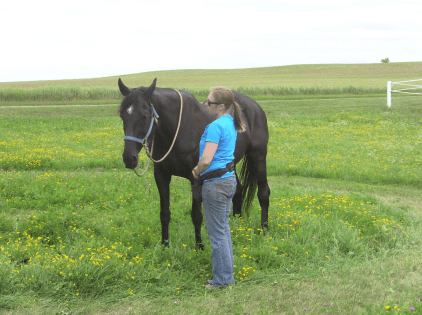
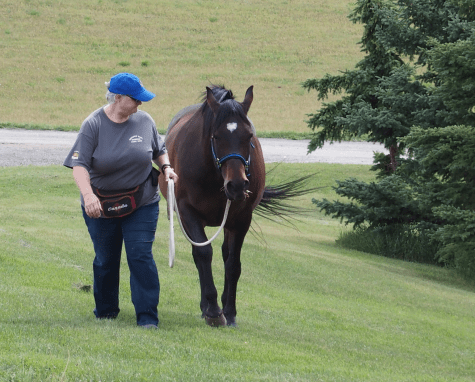
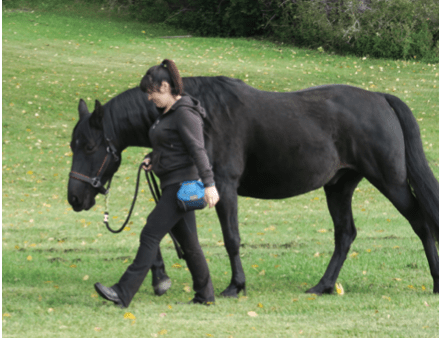
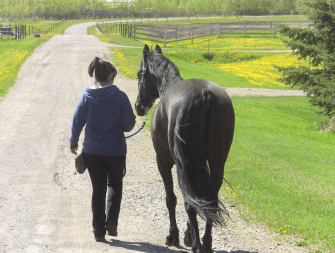
I don’t know which label to give this session:

The longer you stay with an exercise the more good things you see that it gives you.

You can never do one thing.

These both work.

E was very cautious around people.  He had shown me that many times over.  When Panda first arrived at eight months of age, she was more than cautious.  She was afraid to the point of charging anyone who leaned over her.  She hadn’t shown this behavior when we first met her in July, but it’s what she arrived with in September.  Panda was a Florida girl.  That’s where she was born.  We had to wait the extra two months for it to be cool enough to transport her North.  She arrived sporting the most gorgeous show clip.  Because she is little, I suspect the clipping was imposed not trained.  She was probably the victim of the “three men and a boy” school of horse handling, meaning she was wrestled into submission and made to stand still while someone towered over her with a pair of clippers.

So the horse we received in September pinned her ears and snaked her neck out whenever someone came near.  If I had seen any sign of this behavior when we looked at her, I would have passed on her as a potential guide.  But here she was.  Florida was a long way away, so this was the horse I was going to train.  I had enormous confidence that clicker training would get this sorted – and of course it did.  Not only did Panda become a super guide, these lessons led to her favorite game – Panda catch.

So now with E I had a goat who was afraid of people.  I found myself using many of the lessons that had worked so well with Panda.  Who knows how many good things these simple lessons would bring us.

E’s 7 pm session
I brought E out on a lead into the arena.  He was very good.  He showed me that he was understanding the morning lesson.  When I clicked, he was moving away from my treat pocket to get the treat.

Ann joined us in the arena.  I led him up to her.  He reached out cautiously to sniff her.  Click, treat.  I repeated this a couple of times, then he decided he wasn’t interested in going towards her again.

If his caution had been only that, discovering that approaching Ann produced treats might have been enough to break the ice.  But his caution was a reflection of real fear.  I have to be careful under these conditions.  If I am afraid of cats, but I really need the fifty dollars you are offering me if I touch the hissing kitten, I might do it.  I’m still afraid of all things feline.  Take away the fifty dollars, and I won’t go anywhere near the kitten.  That’s always a question when you are using positive reinforcement to get an individual “over” their fear.  Are you really changing the underlying concern, or are you just masking that worry?  And is it really fair to ask someone to make that choice?

It is possible that when I touch the kitten, it turns into a soft ball of purring contentment.  Instead of being afraid, now I’m enchanted.  Being clicked and reinforced for approaching the kitten has shown me that I have nothing to be afraid of.

Being clicked and reinforced for approaching Ann, was not enough to convince E that she was harmless.  I changed the game.

I clicked E as he walked beside me keeping slack in the lead, but instead of giving him the treat directly, I walked over to Ann and put the treat into her outstretched hand.  She was now the “food bowl.”  The first time I had to hold my hand over hers to get him to approach and take a treat.  After that he was willing to eat directly from her hand.

I wanted E to discover that people can be the source of good things.  I did a lot of this with Panda.  It began just as I was doing here.  Gradually, as Panda became more comfortable approaching people, we added in more people and changed the game to a targeting lesson.  At clinics I would have people form a large circle.  Each person would have a target, but only one person at a time would hold out the target.  When Panda approached and oriented to the target, click, that person gave her a treat.  Then that target disappeared, and someone else would hold out a target.

This game gradually morphed into its current form.  Panda gallops from one person to the next.  As she approaches, she runs around behind the chosen person and comes to a halt neatly at their side.  Very fun!  They click, give her a treat, and then off she goes – galloping to the next person.  If you asked her, she would say she invented the game, and in many ways she would be right.

I was borrowing from the beginnings of Panda catch to help E make several important discoveries.  I was hoping this lesson would help him to become more comfortable approaching people other than myself.  I also thought it might direct him away from my treat pocket.  When I clicked, I immediately headed over to Ann.  This took the focus off my pocket.  It wasn’t click and then zero in on my hand reaching towards my pocket.  Now it was click and follow me to the “food bucket”.

After he got his treat, he had to decide what to do next.  Should he stay where he just got fed, or he should follow me?  Decisions, decisions.  The choice he made was to follow me.  Excellent!

So now we had a new game.  I used the lead to direct E away from Ann.  I was careful not to drag him.  If he didn’t follow right away, I waited.  The contact from the lead told him I wanted something.  It was up to him to figure out what – and to be willing to do it.  As soon as he moved towards me and away from Ann, click, I walked the treat back to her outstretched hand.

Once he had his treats, I used the lead to ask him to move away from her hand and to come to me.  I know many dog trainers use versions of this game.  They’ll toss the treats so the dog has to move away from them to get them.  Or they’ll have the treats stashed in a bowl.  When they click, they’ll take the dog with them to get the treat.  These are all good strategies for keeping our animal learners from becoming locked onto our pockets.

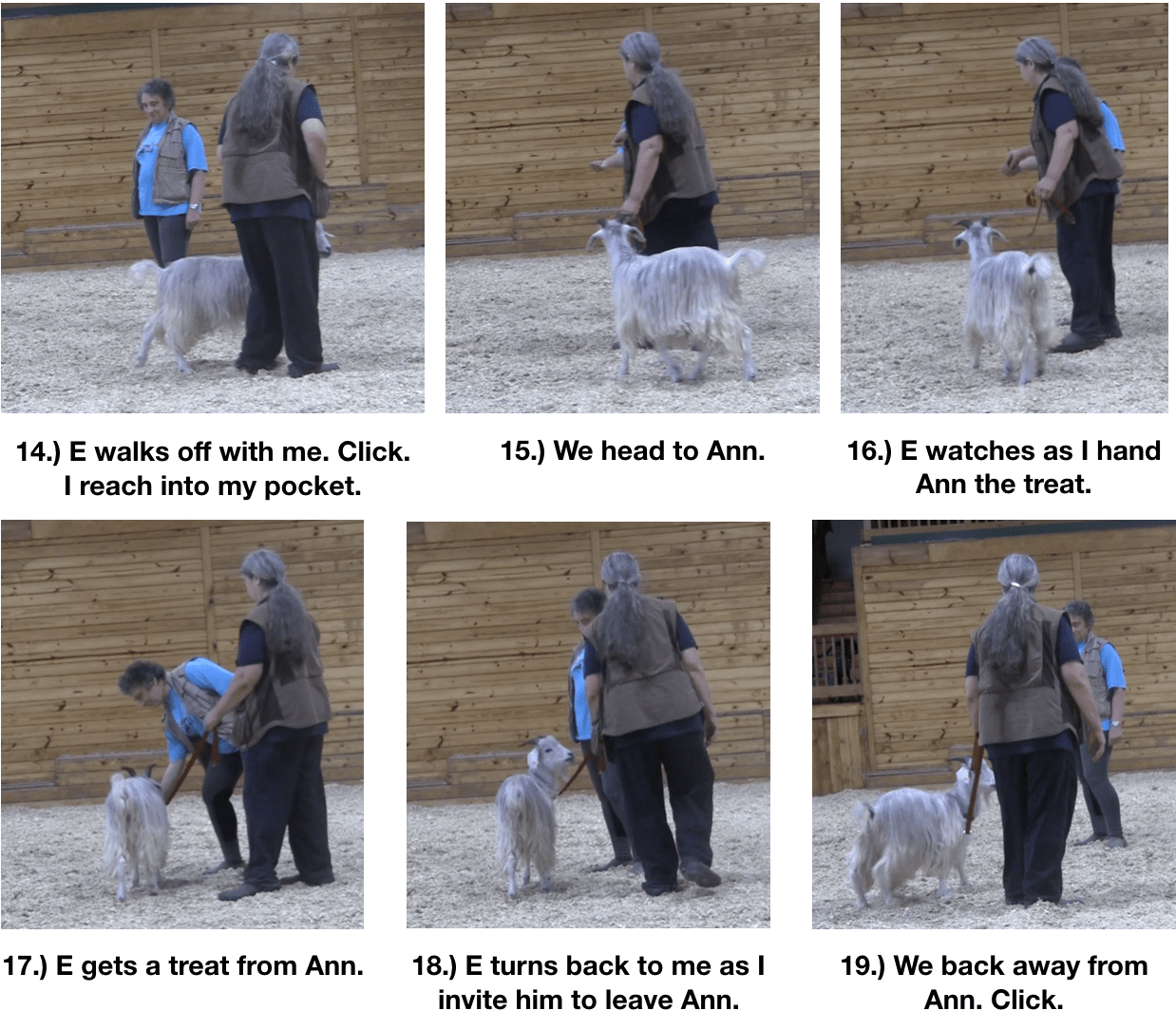
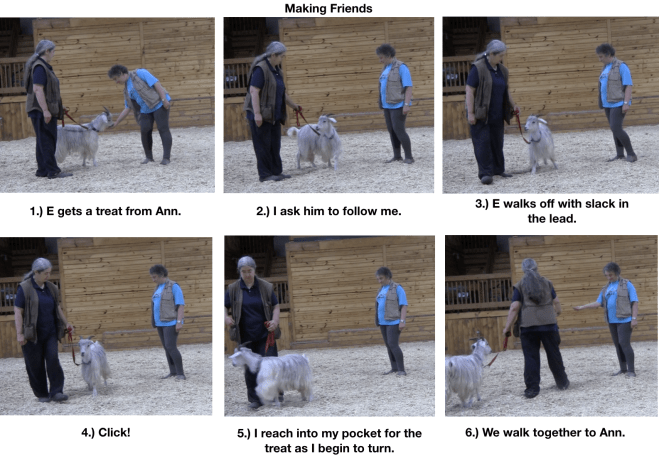
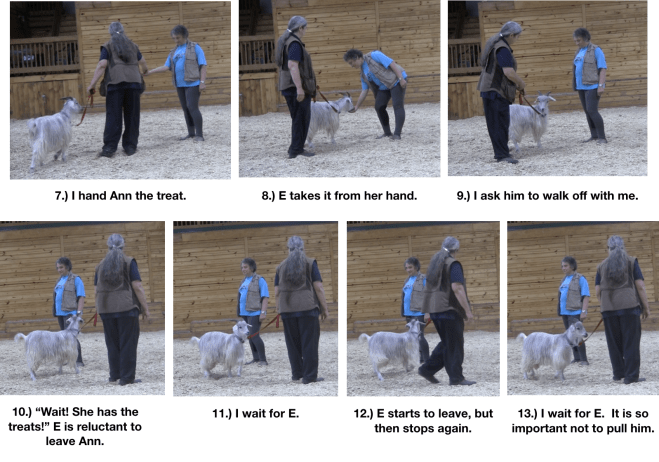
The photos below show a wonderful progression. E gets a treat from Ann and then walks off with me.  Click!  (Fig. 1 – 4)  We return to Ann.  (Fig. 5-8)  But now when I ask E to leave, he’s conflicted.  Ann has the treats!  Here again the rope handling becomes important.  It would be so easy to pull him into motion.  The learning for him in that case would be follow or be dragged.  That’s not what I want him to learn.

Instead I wait for him to make his own choice. (Fig. 9-13)  E walks off with me. Click. (Fig. 14)  E watches me hand the treat to Ann and walks with me so he can get to her. (Fig. 15-17)  This time when I ask E to follow me, he backs with me away from Ann.  (Fig. 18-19)  We walk back to Ann.

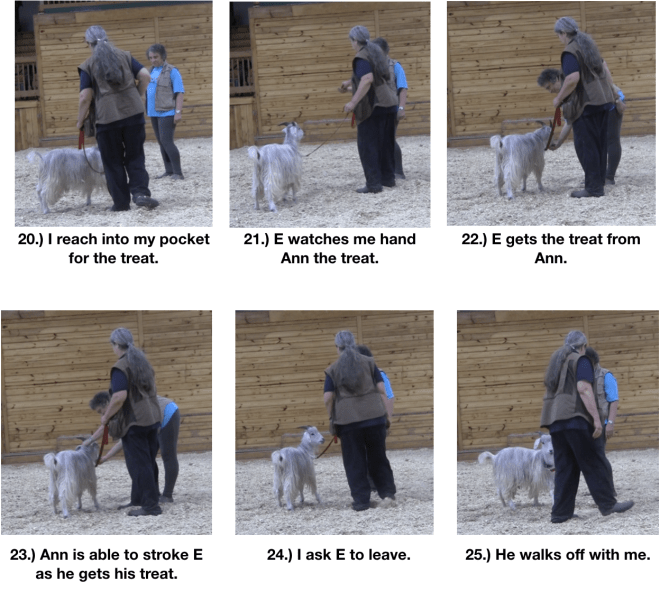
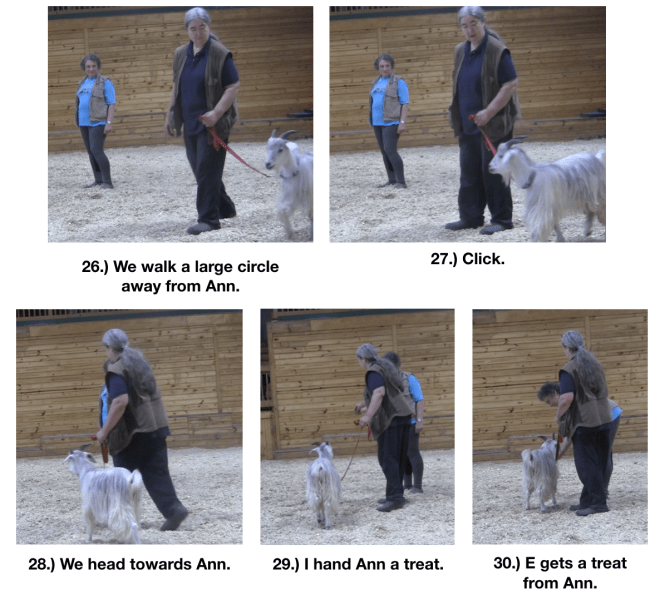
Walking back to Ann gives E more practice walking with me.  That’s one of the great benefits of this process. (Fig. 20-22).  E is becoming comfortable enough with Ann for her to be able to stroke him.  (Fig. 23) This time when I ask him to walk off with me, he leaves readily and we walk a large circle past Ann.  Click!  (Fig. 24-27)  We return to Ann for a treat. (Fig. 28-30)  That’s a lot of progress from sequence to sequence

Goat diaries day 10 making friends panel 1.png

Goat diaries day 10 making friends panel 2.png

Goat diaries day 10 making friends panel 3.png

Goat diaries day 10 making friends panel 4.png

Goat diaries day 10 making friends panel 5.png

When we left the arena, E was in a hurry to get back to the stall. I did a lot of stopping and asking him to come back to me.  As he came off the pressure of the lead, click, I gave him a treat and we continued on.  We hadn’t gone half way down the aisle before he was walking beside me keeping slack in the lead.  These goats are such fast learners.  He was becoming a pleasure to lead.  Gone was the sled dog impersonation we had started with.

The Goat Palace – Current Training

In my previous post I shared a story about Thanzi and Trixie dating back to the end of December. https://theclickercenterblog.com/2018/02/14/   January was a brutally cold month here in the Northeast.  The temperatures stayed in the single digits often dipping well below zero (Fahrenheit).  Training sessions shrunk down to the bare minimum.  It’s so easy to think that you aren’t getting anything done during these long stretches when the weather is against you, but the reality is good things emerge out of little steps.

So I described in the previous post how I reinforced Thanzi and Trixie for staying on their platforms and waiting patiently for their treats.  Every time I fed them, I would open their gate and let them out into the hallway.  While I was filling their hay feeders, they were waiting for me on their platforms.  It was bitter cold, but how could I resist?  So I would spend a couple of minutes clicking and reinforcing first one, then the other.  I wanted them to learn to take turns.

We are now in February, and it is shedding season.  This is very relevant because these are cashmere goats.  Their fleece has to be combed out of their coat and collected.  I was not looking forward to this, especially for Trixie who has been so body shy.

Sister Mary Elizabeth came out last week to check on their coats.  They weren’t yet starting to shed, so we sat and visited with them instead.  As she told me about Trixie’s background, she remembered that she had been one of three goats who were attacked by a dog last summer.  She wondered if this contributed to the fear Trixie often showed.  It is certainly possible.

A couple of days later Trixie started to let go of her coat.  She and Thanzi were on their platforms.  I started to comb across her back.  She stayed on her platform!

Thanzi has just started to shed as well.  Yesterday both goats took turns.  I would comb Thanzi while Trixie waited on her platform.  Then I would comb Trixie while Thanzi waited.

This was a huge step for both of these goats – to let me comb them without any restraint was an enormous gift.  To have it completely volunteered turned what could have been a horrible struggle into something all three of us can look forward to.  Instead of destroying the good work I had been doing with them, the combing was building trust.

This is what I love about positive reinforcement training.  You ALWAYS get more good things than just the one thing you are focused on.

These two photos tell the story.  I love how patiently each goat waits while the other is groomed.  And I am delighted that I can lean over them to comb out their fleece.  All that patient prep was paying off!

And by the way, not only do I not want to stress them.  I don’t want to stress their babies.  Both goats are due in March.  It won’t be long now before we have baby goats in the barn!

Coming Next: The Goat Diaries: Day 11 – A Walk in the Park

Please Note: if you are new to the Goat Diaries, these are a series of articles that are best read in order.  The first installment was posted on Oct. 2nd.  I suggest you begin there: https://theclickercenterblog.com/2017/10/02/   Two of the goats I write about originally came for a twelve day stay in July.  The July Goat Diaries track their training during this period.  In November these two goats, plus three others returned.  They will be with me through the winter.  The “Goat Palace” reports track their current training.  I wish to thank Sister Mary Elizabeth from the Community of St. Mary in upstate NY for the generous loan of her beautiful cashmere goats.


Goat Diaries Day 10: Distractions!

Distractions

I’ve been distracted by several projects this week so I am a bit behind getting these Goat Diary reports posted.  That seems very appropriate somehow because today’s post is about distractions!

In one of his Clicker Expo presentations Ken Ramirez talks about the importance of introducing distractions into the environment.  When he was the Director of Training at the Shedd Aquarium, he instructed his trainers to make changes every day to the training environment.  He wanted the dolphins and belugas that were used in the public demos to be so comfortable with change that if a tornado ripped the roof off the Aquarium, they would just think – “Oh look what our trainers have done for us today”.

I have always loved that image.  It creates a high standard of creativity and  consistent good training that is worth aspiring to.  With the goats at this point in their training it was easy to introduce change – essentially everything I did with them was new.  I wasn’t yet thinking about adding distractions as an active strategy.  I was starting with fearful animals so I knew I had a long way to go before they would be comfortable in a changing environment.  In their evening session I was about to discover just how easily something that I didn’t consider a distraction at all could completely derail their eagerness for training.

Lions and Tigers and Bears, Oh My! – And People, Too!  The July Goat Diaries: 7/14/17 7 pm session

In a previous post I shared with you what a happy goat looks like (https://theclickercenterblog.com/2018/01/26/).  I had taken E and P into the arena and watched with delight as they turned the mounting block into a playground.  I wanted to share the fun with Ann.  She can’t see their antics, but she can certainly hear the laughter in their feet as they run across the mounting block.

Ann came in the evening to visit with Fengur.  While she was playing with him, I sat with the goats.  When the arena was free, I set up the camera and brought them in.  Ann stationed herself beside the camera well away from them.  After my big build up about how much fun they had running over the mounting block, they were total fuddy-duddies.  There was no energy, no joy, no laughter, no interest in the mounting block at all – just a cautious inspection from a distance of Ann.  What was she doing out in the middle of the arena?  Having a new person in the arena was clearly a concern.

After a few minutes of non-performance, I decided to put them back.  They followed me into the barn aisle and went eagerly into their stall, knowing that I would be dropping treats on the floor.  It turns out that I neglected to turn on my camera, so none of their non-interest was recorded.

I let the goats settle back into the comfortable familiarity of their stall, then I took them out again individually for another leading session.  The main focus of the session was on treat delivery and their behavior around food.  I was continuing with the work I described in the previous two goat diary posts. (https://theclickercenterblog.com/2018/01/29/  and https://theclickercenterblog.com/2018/02/02/

A Panda Story

This focus on treat delivery and the time it takes to establish good manners was reminding me of Panda’s early training.  Cold winter days are a good time for stories, so I’m going to indulge in a couple, beginning with a favorite Panda story.  Panda is the miniature horse I trained to be Ann’s guide.  I remember when I first started working with Panda, she was as eager as the goats were to get into my pockets.

A week into her training – at about the stage I was now with the goats – I took Panda with me to a clinic I was giving at a barn that was about an hour away.  Ann rode in the front seat with her new guide dog curled between her feet.  Another of my clients was driving.  I was in the backseat with Panda essentially in my lap.  I was definitely a captive audience.  Doing a short session and then putting her back in her stall to process was an impossibility.  I had an hour’s drive with a horse in my lap!  What’s more I had a horse who knew I had treats in my pocket.

For the duration of the drive I clicked and treated anytime Panda’s nose moved even fractionally away from my pocket.  The idea was to keep her on such a high rate of reinforcement that she didn’t have a chance to mug me.  Over and over again, through the food placement I was saying to her – this is where the treats are delivered.  Going to my pocket gains you nothing.  Out here away from me, this is where you will find treats.  You might as well keep your nose here and not waste your energy going to my pockets.

Ann was in the front seat listening to the constant barrage of clicks.  I know they were making her anxious.  She had only recently taken on a new guide dog.  Everything about this dog was a struggle.  He should never have been placed.  The school was hoping that because Ann was such an experienced guide dog user, she would be able to make him work.

“Make the dog work” was truly the philosophy behind this dog’s training.  The result was a dog who showed extreme avoidance behavior.  Ann had one problem animal.  She didn’t want another.  How could she have a guide who needed to be clicked and treated every couple of seconds?  Ann knows how training works.  She knows that we would be building duration, but in that stage where the mugging is still such a strong reaction, the future good manners can seem impossibly far away.

Good manners emerge over time.  They are the result of consistent handling and a growing confidence in the learner.  By the time I handed Panda over to Ann, the guide dog had gone back to the school to be re-trained for a different job.  He went into search and rescue work, a job that suited his temperament much better.  And Panda became Ann’s full time guide much sooner than we had originally planned.

We celebrated the transfer by going out to dinner.  Panda kept her nose to herself and stayed quietly by Ann’s side throughout the evening.  Even when the salad course arrived, all she did was have a curious sniff before ducking her head back under the table to continue her nap. That’s great duration in a behavior that had begun with barely seconds between clicks.

Good manners emerged for Panda, and I was confident that they would also become the norm for the goats.  Time and consistency would create the behavior I wanted.
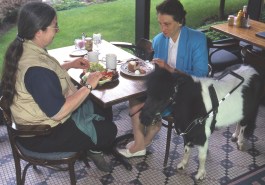
p46_PandaInRestaurantWithTrainerAlexandraKurlandOwnerAnnEdieNeilSoderstrom 343

Dining out with Panda

(If you want to learn more about Panda and her training, read the Panda Reports on my web site: theclickercenter.com.  Some of her early training is also featured in my DVDs: An Introduction to Clicker Training and Lesson 4: Stimulus Control.

Treats: Whatever Is Logical Do The Opposite

At some point in the distant future, it might be fun to travel with the goats in my car.  But at this point the thought of spending an hour trapped in the backseat of a car with an eager, greedy goat sounded exhausting.  We had a long way to go before they would be as settled about treats as Panda.

You meet your learner where he is not where you want him to be.  When I took P back into the arena, the session was very much focused around food delivery.  The children in the 4-H program may have giggled and let him snatch pretzels from their mouths.  With me P was learning that we played a very different game.

I brought P back out on a lead.  He continued to show good progress. He backed away from my closed hand.  He did a bit of head flinging which means he was feeling frustrated by having to back up.  I’m sure it did conflict with how he thought things should be done.  He wanted to push forward to get to the treats.  That’s what he had always done, but now he had to remember to back up instead.

Whatever is logical, do the opposite.  I could sympathize with his frustration.  From his point of view it made no sense that backing should work.  Going forward was how you get children to spill treats all over the ground.  Why should backing work?!!  We have all been given directions that make no sense.  Why should turning left instead of right get us to our destination?

And how many of us turn right because we’re convinced that should be the correct answer.  Even when we do turn left, it feels wrong.  Surely we’re heading in the wrong direction.  This can’t be right.  We’ll never get there.  Oh look, there’s our destination just ahead. How did that happen!?

It can take a while to relax and trust the directions.  That’s the stage I was in with P.  With a little more reinforcement history behind us, he would relax into the confidence that treats were coming.  There was no need to rush to get them.

The Goat Palace written Dec. 27 – Our Animals Always Tell Us

Meeting your learner where he is, not where you want him to be makes me want to share this story.  It was prompted by the goat’s current training.  If E and P’s treat taking manners were reminding me of Panda, a session I did with Trixie and Thanzi at the end of December made me think of Robin.  There are several of training mantras that apply to this session:

Our animals will always tell us what they need to work on next.

You get what you reinforce. 

My favorite, though, is this one:

If you don’t notice a little resistance, don’t worry about it.  It will get bigger.  And eventually, it will get big enough that you will do something about it.

Before I describe the goat’s training, here is Robin’s story:

Over the winter when Robin was still very new to clicker training, he started to snatch his treat from my hand.  I’d click, he’d grab, and then he’d eagerly be offering me the next clickable behavior.  I ignored the snatching.  He was eager.  It was cold.  He was offering lots of great work.

The snatching increased.  You get what you reinforce.  I didn’t like the snatching, but if it was getting worse, something in our interactions was reinforcing it.

I ignored it.  Robin was eager.  It was cold.  We were having fun – until I wasn’t.  The snatching was becoming more than annoying.  I was starting to count fingers after I gave him a treat.  It was time to do something about the way he took treats.

If you don’t notice a little resistance, don’t worry about it.  It will get bigger.  And eventually, it will get big enough that you will do something about it.

I’ve told the story many times about the way I solved this particular problem.  It’s detailed in both my Riding book and The Step-By-Step Guide in Pictures.  I went back to basics.  I put Robin in his stall with a stall guard across the door.  I stood across the aisle from him and held out the biggest carrot from a bag of big carrots.  Robin stretched his neck out to try and reach it.

I immediately turned my back, removing the carrot from sight and counted to three.  Then I turned back and held the carrot out again.  Robin stretched out his nose.  I turned my back and counted to three.

I again offered the carrot.  This time Robin hesitated ever so slightly.  I clicked, reached into my pocket and handed him a piece of carrot. I was using negative punishment.  I was taking away something Robin wanted – the carrot – to decrease a behavior I didn’t like – the reaching out towards me to get a treat.

(When an activity decreases – it is being punished, either by adding something unpleasant or by taking away something the individual enjoys (positive punishment and negative punishment – it’s just math adding or subtracting).  When an activity increases, it is being reinforced, either by adding something the individual wants or taking away something he doesn’t like. So again there is positive and negative reinforcement.  When the behavior increases it is being strengthened, i.e. reinforced.  When it decreases, it is being punished.  In both – the positive and negative refer to adding or subtracting, not value judgements.)

I offered the carrot again.  Robin hesitated.  Click, I handed him a piece of carrot from my pocket.  Robin is a super fast learner.  He had the dots connected.  If he drew back away from my hand, he got treats.  I could hold the carrot directly under his nose and instead of snatching it off my hand, he arched his neck and drew up away from it.  Click and treat.

I was enchanted.  He looked like a beautiful dressage horse.  Robin being Robin, he quickly made the connection.  If he arched his neck, click, I would give him a treat.  He wasn’t snatching anymore.  Instead he scooped the carrot slice gently off my hand with his enormous soft lips.

He started to offer what I have since called “the pose”.  When I walked by his stall, Robin would draw himself up and arch his neck.  Click.  I’d pause in my barn chores and give him a piece of carrot.  Through the winter I reinforced him a lot for this behavior.  I might have begun with negative punishment as I tried to stop an unwanted behavior – snatching treats off my hand.  Now I was actively reinforcing him for something I wanted – “the pose”.

I should add that this is not the way I teach the pose today.  It popped out when I was working on something else.  Now that I know this behavior is worth going after, I shape it more directly, most often with the aid of targeting.  And in general, when I find myself reaching towards a negative punishment strategy to solve a problem, I go have a cup of tea instead. I think about what I want and look for reinforcement-based teaching strategies instead.

The “pose” is not the best name that I could have come up with for this behavior.  For many people, a pose is a fixed, rigid, stilted posture.  It’s that awful grimace so many of us have when we’re forced to have our picture taken.

Instead, for me, the pose is a very dynamic behavior.  For Robin it has become a default behavior.  I was the cue.  In the absence of any active cue from me, if Robin posed, I would click and reinforce him.  It meant that if he wanted attention from me, he could get me to engage with him using a behavior I actively liked.

Horses are always doing something.  A horse in a stall has a long laundry list of behaviors to choose from.  Some are behaviors that I like, some are behaviors that I can ignore, and some are behaviors that I never want to see.  The laundry list includes taking a nap, eating hay, having a drink, watching the activities in the barn aisle – all perfectly acceptable and easy to ignore.

A horse could also be fighting with his neighbor, kicking the stall door to get attention, cribbing, raking his teeth up and down the wall, pacing, weaving.  These are behaviors I definitely do not want.  But if I fuss at a horse when I see him engaging in them, I could easily be reinforcing them through my attention.  Think of the small child who bangs the kitchen pots and pans while mother is on the phone.   Even negative attention is attention, and that can be better than no attention at all.

Robin doesn’t have to kick the wall to get me to notice him.  All he has to do is pose.  Click and treat.  I love having behaviors which my horses can use to ask for my attention. They know I will always acknowledge their request for connection.

Think of all the ways people interact with one another:  “Good morning.”  “How are you?” “Never better.”  These quick exchanges connect us.  Think how chilling and unpleasant an environment becomes when these social pleasantries are absent.  We need them to tell us things are okay between us.

Robin says good morning by posing.  I respond with a click and a treat.  All is well between us.  Our social bond is strong and getting stronger with each click and treat.

I reinforced Robin for the pose because he looked pretty.  I wasn’t heading for anything in particular beyond that.  This is what makes training so much fun.  Sometimes the next unexpected piece just pops out.

Here’s what happened to the pose.  One evening I had Robin in the arena.  I was asking him to trot around me on a circle.  He was giving me a nothing of a trot.  He looked like an old plow horse.  There was no energy, no pizzazz, nothing I wanted to reinforce.

Robin was expecting me to click.  He went once around the circle.  Nothing.  The way I tell the story was you could all but see the cartoon bubble appearing above his head.  “I’m not being reinforced.”

He went around again.

“What can I do to get reinforced?”

On the third time around he had the answer: “I know! I’ll try the pose!”

The way Dr. Jesus Rosales-Ruiz tells this story is this: by withholding the click I was putting Robin into an extinction process.  He began to regress back through behaviors that had been successful in the past.  The pose had been highly reinforced, so it was the first thing that he tried.

Whichever version of the story you prefer, Robin had to add energy to the trot in order to get into the pose.  Suddenly, his trot looked as though it belonged on a magazine cover.  He was gorgeous!  I clicked and gave him a treat, all the while gushing over how pretty he was.  I sent him back out around me.  It took him a few strides to find his balance, but he once again added the pose to the trot.  It was just one stride that I was clicking – but wow! What a gorgeous stride it was!  The rest is history.  Robin led the way.  He showed us that we could shape the beautiful, suspended balance of a classical dressage horse just through well timed clicks and treats.

Why am I telling this story? Because this morning’s session with Thanzi and Trixie made me think of Robin and the pose.  It reminded me of the expression:

If you don’t notice a little resistance, don’t worry about it.  It will get bigger.  And eventually, it will get big enough that you will do something about it.

In December I had been trying to work them individually.  We had snow Christmas eve and then the temperatures dropped and the wind rose.  Trixie was nervous about being out in the hallway by herself, so I let Thanzi join her.  Suddenly with two goats I had lots of crowding.  Hmm.  You get what you reinforce.  I knew at night when I was tucking them in, I was in a hurry.  It was cold.  It was late.  I just wanted to get done with the final chores and get back inside where it’s warm.  Had I been letting them crowd me and hurry the treat deliver?  Apparently the answer was yes.

I needed to sort out the crowding so in this session I set two mats out face too face.  Trixie hopped on one, Thanzi on the other.  I stood in the middle with both goats crowding into me begging for treats.  I waited.

“Oh right.  Crowding doesn’t get treats.”  They took their noses away from me.  Click. I reached into my pockets.

They were right back, pushing against my hands.  I got the treats out of my pockets and then drew my hands together.  I stood as though in calm meditation, waiting.  First one then the other took her nose away.  I waited until they were both good, then held out the treats to them.

They got their treats, and then they were right back crowding me, pushing against me with their muzzles.  I waited.  They took their noses away.  Click.  Get the treat.  Wait again with hands held together in quiet meditation.  They both drew away from me.  I held out my hands and let them take the treat.

It only took a couple of repetitions. They were both working so hard to stay away from my pockets.  Click, pause, feed.  They were both so good.

I left them in the hallway while I filled their hay feeders.  I was just finishing up when I looked out into the aisle.  They were standing each on her own platform waiting for me.  How can you resist?  I went out and did another round of paying attention to their good manners.

Your animals always tell you what they need to work on.  I don’t know where this will lead me, but I know it is what they need.  If it makes me think of Robin’s pose, I must be on the right track.

Staying Consistent

It’s easy to be focused and consistent through one training session.  It’s much harder to maintain that consistency over time.  When we transferred Panda full time to Ann, it was actually a relief to hand her over.  I missed her constant presence by my side, but maintaining the level of consistency that is needed for a guide was demanding.  When you can see, you don’t need a guide to tell you that you’ve come to a curb. If I started cutting corners in Panda’s training because I didn’t need all the things I had taught her to do, it would undermine her performance as a guide.  Ann would never be able to enjoy the luxury of seeing the curb that’s in front of her.  She would be relying on Panda to point this out to her.  A horse doesn’t know when it doesn’t count so it always has to count.  I followed that mantra throughout Panda’s training.

The same thing applies to the goats.  The same thing applies to the goats.  If sometimes I let them push into me to get treats, I will never get to the consistent good behavior that I want.  But it’s been cold!  It is so easy to get in a hurry and let standards drop.  So their training has been a bit like a yo yo.  I let things slip in my hurry to get chores done and my gloves back on.  They begin to crowd me, but now I am catching it sooner.  The manners pendulum keeps swinging back and forth.  Over time the cumulative effect shows me that the balance is tipping towards good manners.

Just for Fun!

I told you the story of Robin’s pose.  Here’s one of my favorite videos of Robin.  He was only three when this was filmed.  He had not yet been started under saddle.  So he’d never had a rider on his back, and I had never lunged him in side reins or any other type of mechanical device.  This beautiful balance and cadence had been shaped entirely with the clicker.  You’ll see I am holding two dressage whips.  You can call them anything you want, but they are functioning as targets.  They give him points of reference to balance between.  I know the lighting is not good in this video, but this was a long time ago, and this was the best the video camera could do.  Enjoy!


Coming Next: The Goat Diaries Day 10: You Can Never Do One Thing

Please Note: if you are new to the Goat Diaries, these are a series of articles that are best read in order.  The first installment was posted on Oct. 2nd.  I suggest you begin there: https://theclickercenterblog.com/2017/10/02/   Two of the goats I write about originally came for a twelve day stay in July.  The July Goat Diaries track their training during this period.  In November these two goats, plus three others returned.  They will be with me through the winter.  The “Goat Palace” reports track their current training.  I wish to thank Sister Mary Elizabeth from the Community of St. Mary in upstate NY for the generous loan of her beautiful cashmere goats.



Thank YOU!

I’m taking a brief detour from the Goat Diaries.  2018 is the 20th Anniversary of the publication of my book, “Clicker Training for your Horse”.  To celebrate every month this year I will be writing an article about one of the many people who have helped me bring positive reinforcement training into the horse world.

Last month I told you about Bob Viviano and Crackers.  Bob was there literally at the beginning of my exploration of clicker training.  Ann Edie joined us a short time later when she started taking lessons from me at the barn where I boarded my horses.  This month I want to turn the spotlight in her direction to thank her for the enormous contribution she has made to the development of clicker training and for 25 years of friendship.

Most of you know Ann through her guide horse, Panda.  Ann has big horses as well.  We seem to share our equine family – at least that’s how it feels.  Ann’s first horse, Magnat, is our one in ten thousand horse.  That’s how I think of him.  He was originally my school horse, but he was such a great match for Ann, in 1996 I gave him to her.  In 1999 he was joined by our two Icelandics, Sindri and Fengur.  Panda joined the “herd” in 2001.

I’ve written so much about Panda, I’m going to shine the spotlight instead on Magnat.  He played such an important role in the early development of clicker training it is right that he should get the attention as I celebrate twenty years of “Clicker Training for your Horse“.   There is so much I could write.  I’ll just share a couple of favorite Magnat stories.

Remembering Magnat

Magnat is an Arabian.  He came to me through clients of mine who wanted a weekend trail horse for their guests.  Several months and several disastrous rides after they got him, they discovered that he had a severe heart murmur.  My clients were in a dilemma.  They didn’t want to keep him as a pasture ornament, but they couldn’t ethically sell a horse with such a severe heart condition.  Who would want such a horse?  The answer was I would.

So Magnat became mine.  One of my favorite training mantras is:

The walk is the mother of all gaits.

I didn’t need to ride fast to enjoy a horse.  Magnat and I were a perfect fit.  I would love to have reserved him just for myself, but he was such a great school horse.  I began to use him to give lessons at the barn where I boarded.  I could not have asked for a better co-teacher.  This was in 1994.  I had just begun the year before to explore clicker training with Peregrine.  I was having such good success with it, I had started to share it with all my clients.

Pretty soon the only horse who wasn’t clicker trained was my own school horse.  I was reluctant to introduce it to him.  I had all the questions that everybody else has when you first start introducing food into your training.  What if he got mouthy?  He was so polite now.  I didn’t want to risk messing up my one and only school horse by teaching him clicker training!

When someone is hesitant to give clicker training a try, I get it.  I had the same questions and concerns that most people have when they first encounter this work.  But I really couldn’t go on encouraging all my clients to give it a try and not follow my own advice with Magnat.

I needn’t have worried.  For Magnat it barely caused a blip on the landscape.  He was polite before I introduced food, and he remained so even when my pockets were bulging with treats.  He was never muggy.

There are lots of horses who go through a very rocky transition stage.  The food does get them excited.  They frustrate easily and often older behaviors that have been suppressed through punishment resurface to create problems.  Magnat showed none of this.  That isn’t to say there weren’t changes.  My solid, reliable lesson horse truly began to shine.  If he had been good before, now he was outstanding.

Throughout that first winter he helped me teach people the basics of single-rein riding.  There’s a great expression:

The longer you stay with an exercise, the more good things you’ll see that it gives you.

One of the good things the basics of single-rein riding produced for Magnat was collection.  The beginnings of two favorite behaviors popped out: piaffe and canter in-hand.  This later is a gorgeous behavior to have in repertoire.  Magnat became so balanced and collected, he could canter while I walked beside him.

It was around this time that Ann came to the barn wanting to take lessons.  Ann was not a beginner.  She had ridden as a teenager, but then like so many others she gave up riding when she went off to college and never got back to it once she started raising a family.  The challenge for me was Ann is blind.  I had never worked with a blind rider before.  This was a new frontier for me.  But I assumed my job was teaching her to ride.  Ann would take care of the rest.  If I taught her the way I taught everyone else, we’d come out okay.  It turned out I was right.

I started Ann the way I start all riders who come to me.   It doesn’t matter how many years you have ridden or how experienced a trainer you are, if you are going to ride one of my horses, you start with a pony ride.  I guide the horse from the ground.  All you have to do is sit and enjoy.

As the rider becomes familiar with the horse’s communication system, and understands how to cue the horse, I gradually turn over more and more of the control.  So at first I have the reins, and I’m working the horse in-hand with a rider up.  Then I hand the reins over to the rider, but I stay close so my body language continues to support the rider’s cues.  Then I gradually fade out and the rider takes over completely from me.

This worked perfectly for Ann.  Having Magnat as my co-teacher made all the difference, especially since he could canter in-hand.  For teaching that made him worth his weight in gold.  I wish I had learned how to ride on a horse like Magnat.  Ann has such a relaxed canter seat because she learned the rhythm of the canter from him.  Starting out she never rode a bad canter.  All she had to do was relax and enjoy.  There was no struggle trying to get him into the canter, no trotting faster, faster, faster like a plane taking off.  There was no leaning sideways through unbalanced turns.

Magnat canter

Instead there was just the relaxed rhythm of a collected, glorious canter.  And then there was the piaffe and the passage.  It was Ann who was riding the first time Magnat succeeded in mobilizing into piaffe.  I was working him from the ground while she helped manage his weight shifts.

We were figuring out how to teach riding with the clicker.  I gave Ann the lesson, and she taught Magnat.  They were such a good match, I decided after their first winter together to give him to her.  It gave me so much more pleasure watching them develop as a team than I ever would have had riding him for myself.  And I had Peregrine.  He and Magnat became riding partners.  For the next sixteen years while we kept the horses at the boarding barn, Ann and I shared our evening rides together.

They were an unlikely pair, my thoroughbred, her Arab.  But it turned out that each horse gave their best to the other.  Magnat gave Peregrine the confidence to move forward again after a long, hard recovery from the aftershocks of Potomac horse fever.  And Peregrine taught Magnat about collection.

Magnat lived in a small paddock with two other horses.  I’m sure you can picture what he looked like during mud season.  Every night Ann would spend an hour or so grooming him and by the time he was ready to go into the arena, he was snowy white.  I don’t know how she did it!  When I brush my horses, the dirt moves from one spot to another.  When Ann grooms, the dirt leaves!  And a horse isn’t clean until her fingers tell her he’s clean.

Early on we taught Magnat to retrieve.  There’s a picture of him with a wooden dumbbell in his mouth on the cover of the first edition of “Clicker Training for your Horse”.  When Ann brought him into the arena, he would ask to be turned loose.  She’d let go of his reins, and he’d go out in the arena and bring back to her all the things the previous riders had dropped.

We boarded in a barn where there was a very active after school lesson program so there were always dropped riding crops, gloves, hats, kleenex.  Ann never knew what she was going to be handed.  Magnat was very diligent in making sure that he had found anything and everything that might get in their way.  In so many ways he was Ann’s first guide horse.

When the arena was clean, he would walk with her to the mounting block and line himself up.  Now the real glory of Magnat shone through.

Ann understood that clicker training means so much more than just using a marker signal and treats.  Clicker training for us is synonymous with good balance.  It was a joy to explore with her what that meant for our horses.

When Ann first started riding Magnat, she couldn’t manage his trot at all.  He bounced her out of the saddle.  It was the most jarring, bone rattling, uncomfortable trot imaginable.  That was because for her Magnat wasn’t yet balanced.  She didn’t yet understand how to use lateral flexions.  When she asked for the trot, she got the hollow-back, high-headed, stiff-legged trot that is all too often associated with Arabs.

As she learned how to use lateral flexions, Magnat relaxed and lifted himself up into a magic carpet ride.  The transformation was so black and white.  Ride him without asking for the lift that comes through the lateral work, and he would jar you right out of the saddle.  Ask for collection, and you were in heaven.

I taught Magnat lateral flexions before I began to explore clicker training.  He understood what I wanted and was a willing student.  Often people seek out clicker training because they are struggling with a horse.  That wasn’t the case with Magnat.  He could have gone through his whole life without ever needing to be clicker trained.

Before clicker training he was a good, solid-citizen riding horse, but that’s all he was.  Without clicker training he would have remained a nice, but ordinary horse.  With clicker training he shone.  I used to say he was a one in a million horse, but as the years went by and he just became more and more wonderful, not just to ride but to be around, I changed this to a one in ten million horse.

But I really shouldn’t be the one to describe what it was like to ride Magnat.  He was Ann’s horse.  Here is how Ann described him in a piece she wrote for my riding book:

“It’s always a dilemma to describe the experience of riding a truly extraordinary horse who has had the benefit of several years of clicker training.  Although many technical components go into the production of a really memorable ride, the irrepressible smile, the feeling of wonder, and expression of “WOW!!” that arises so regularly these days when I ride Magnat simply cannot be described in anything but poetic terms.

Yes, athletic talent and neuromuscular conditioning are part of what makes the ride so special; and yes, many hours of repetition over many months have gone into it; and yes, there is extraordinary lightness and balance.  But this is still far from the sum total of the experience.

Musicians have described a great melody as “ a journey which has many familiar passages, and which also contains some wonderful surprises which cause you to look at the world in a completely fresh way and gives new meaning to life.”  This is the best description I can find of what it is like to ride Magnat.

Magnat comes out into the arena every night feeling relaxed and eager to work.  He knows he will be appreciated and reinforced for his performance.  He knows that he is a respected dance partner and member of the team, not a mere subject of training.  This awareness and active participation on the part of the horse is one of the benefits bestowed by clicker training.

Our rides begin with warm-up exercises.  In the course of executing figures or doing simple softening and balancing work, I will pick up on the reins and suddenly feel the most indescribable lightness!!!

We may be in a super-buoyant, floating trot, a deliberate, balanced, ballet-like piaffe, or a heavenly rocking-horse canter.  Whatever it is, it will feel as though I am floating on a magic carpet.  He is so responsive in these moments.  It’s as if there are clear filaments of two-way communication from my finger tips to each of Magnat’s feet.  The slightest breath of a touch on one of those lines will be answered by an immediate floating response.

The musicians described music as a journey which “contains some wonderful surprises.”  That’s how I feel about riding Magnat.  Each ride contains surprises and special pleasures we have not experienced before.  It is like coming around a bend in the road and seeing a spectacular sunset, or a grove of awe-inspiring redwood trees, or the grandeur of an ancient castle, or the peace and cool of a Buddhist temple.  It truly takes the breath away!  It creates the deepest joy and aliveness in my heart!

These moments have totally changed the way I think about riding.  I feel such awe for Magnat and for what we create together.  In this moment I know, without the slightest doubt, exactly what I ride for – it is just this amazing feeling of total balance, effortlessness, lightness, and energy.  Magnat seems to feel the same excitement and joy, for he literally beams with pride, and recently he has begun uttering deep chortles in his throat at these moments.

I let the magic moment go on for as long as I dare, wanting it to continue forever, but knowing I must capture it with a click, before it disappears like a soap bubble or a delicious dream.

The click creates a pause in the music.  Magnat comes to a halt; I throw my arms around his neck in a huge hug, shower him with lavish praise, and empty my pockets of the most desirable treats!

The “WOW” feeling is definitely addictive.  The glow of the experience lingers and stays with me long after the ride.  Our whole horse-human relationship is one of appreciation, respect, and awe.

This is, for me, the great gift of clicker training.  When taken to the high-performance level, it creates transcendent moments of great joy”

Ann Edie – written in 2005 for “The Click That Teaches: Riding with the Clicker

Ann’s words express so perfectly why we have both worked to bring clicker training into the horse world.  If clicker training had just been about teaching tricks, and finding kinder way to get horses onto trailers or to stand for grooming, I would have moved on years ago.  Instead clicker training takes us on a journey to Joy.  It connects us deeply to our horses.

This is what Ann and I wanted to share when we wrote about our horses.  It is what I am celebrating in this twentieth year of “Clicker Training for your Horse”.  It is what we hope others will find as they explore clicker training: the great love and wisdom of horses.

Sadly we lost Magnat in 2011 not long after we moved to our new barn.  He had reached the grand age of 33, but it wasn’t enough.  We were both hoping he would be one of those Arabs who live to be forty.  Sadly he had cancer, and we had to say good-bye.

Ann has shared so generously her horses.  Magnat and the Icelandics have served as my school horses.  I’ve written about them, and they have appeared in the books and DVDs.  Sindri, our Icelandic stallion, was my riding horses.  Thank you Ann for that great pleasure and honor.

And then of course there is Panda, Ann’s guide horse.  Ann is a very private person, but she has shared Panda literally with the world.  We’ve had journalists from as far away as Japan and Australia come and do stories on her.  Ann has always been a good sport, and so has Panda!

What many people don’t know is Ann is one of the partners in The Clicker Center Barn. Without her help, the barn would never have been built.  Thank you Ann for this.  And thank you also for teaching me how to play scrabble and for occasionally letting me win.

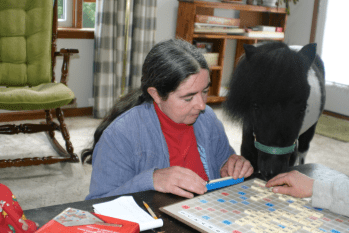
Alex Panda scrabble 0038

Goat Diaries Day 10: Expectations

What is the Click?

What does the click mean?

I’ve told you many times throughout these diaries that I clicked and reinforced a particular action.  Those are good words, but we have to question – is that what really happened?

Absolutely, I did click.  But what, if any, effect did it have on the goats’ behavior?  Did they even notice it?

In July I could make a good case for the click being just meaningless noise for the goats.  At this stage in their training were they stopping and orienting back to me because they heard the click? Or were they stopping because I stopped?

There was one very consistent cue that they were responding to.  When I reached into my pocket, they surged forward for the treat.  It’s this behavior that I wanted to change.  There are many strategies for doing this.  The one I chose for these sessions was to turn the movement of my hand into a cue for backing.

Once they had this part of the sequence down, I expected that they would notice more what came before the movement of my hand – the click.  Hear that sound, and you know treats are coming – get ready.  I know some people drop the click out and let the movement of their hand become the marker signal.  I prefer to keep the click in the sequence.

We all have biases in what we use for our marker signals.  My strong preference is for tongue clicks so I don’t have to carry a clicker around with me.  That leaves my hands free for other things.

We also have biases in how we use marker signals.  Do we keep them in?  Do we change them over time to verbal signals?  Do we sometimes feed without using a marker signal?  Do we click but not feed?  (When you want your click to function as a cue, that’s a peculiar one.  What are you cueing?  It becomes like an unfinished sentence.  Think how annoying and not very useful that is when people make a habit of never finishing their . . . .

There are lots of variations on the theme.  I developed my approach to using the marker signal through working with horses.  I decided early on I wanted the click to be a gate keeper.  That means about the only time I give my horses treats is after I have clicked.  I want the message to be: “If you didn’t hear a click, don’t bother looking for food.”  The exceptions involve rituals I have created around greeting and leaving.  I give treats as I enter the barn and say hello to my horses, and again as I am saying good-bye, but the context is consistent and creates its own control of expectations.

At all other times, if I am giving a treat, it is for something I have clicked.  This creates very consistent rules around the food.  In the absence of the click, I can reach into my pocket to get my gloves or a tissue.  My horses won’t be expecting food because I didn’t click.

If you sometimes feed a “just because” treat, you can create a lot of frustration.  Your horse is left wondering what he just did that got you to reach into your pocket.  “Just because” treats usually aren’t very consistent.  That lack of consistency can throw a learner into an extinction process complete with all the “shaking of the vending machine” that goes along with it.

You’re wanting to be kind, and instead the carrots you’re feeding are just turning your horse into a scary monster.  The click helps to manage this.  Now he knows there’s no food unless and until he hears the click.

If you are new to clicker training, this may sound very restricting.  You want to feed treats.  Don’t worry.  Once you start clicker training, you will have lots of opportunities to click and give your horse a treat.

Initially, the click is barely noticed by the horse.  He sees you reaching into your pocket.  That’s what he focuses on.  You can get the same kind of mugging behavior that the goats were showing.  The only difference is all that eagerness for the treats comes in a much larger package.

Over time you will see your horse respond to the click.  It has begun to function as a reliable cue.  When he hears that sound, he will stop to get his treat.

How do I know this?  I do a lot of liberty work.  Often the horse is at a considerable distance from me.  In fact, I may be completely out of his sight.  When I click, he stops.  He heard that sound, and he knows what he needs to do to get his treat.  Usually that means waiting quietly while I walk (not run) to him with the treat.

When cues are linked with positive reinforcement, they become predictors of good things to come.  The sound of the click leads to good things, so my learner will want to figure out what he can do to get me to click again.

Pushing forward into my space, nudging my hands, pawing at me, if none of these things lead to a click, but backing up does, I’ll begin to see my learner actively backing away from me and these other less useful behaviors (from his perspective) will drop away.  My learner will be using the backing behavior to cue me to make that funny sound that predictably, reliably leads to treats.

Over time he will learn that there are many behaviors that can get me to click.  So now the noticing of cues moves back another step.  He begins to pay attention to the thing that comes before the thing that comes before the thing that . . . .  In other words he begins to notice the cues I am giving that signal to him what is the hot behavior that will most reliably lead to a click and a treat.

In all of this click serves as a gatekeeper.  On one side are the behaviors that I want.  On the other are the treats that my learner wants.  It’s a win-win situation for both of us.

That understanding of the click’s function isn’t there at the beginning.  Horses can be just as eager for their treats as the goats.  They can crowd every bit as much into your space.  But at liberty, I can show you that the click is a cue an educated horse is definitely responding to.

Why do I want this?  I know many dog trainers have a much looser system with the click.  They will often toss treats without first marking a specific behavior.  Instead I want to give my horses so much practice responding to the click that it becomes automatic.  They don’t even think about it.  They hear the click, and instantly they are stopping.

Again, why do I want this?  Simple answer – because I ride.  Under saddle when I click, my horses all stop.  I don’t have to actively stop them in order to get a treat to them.  They stop on their own, and they wait patiently while I fish around in my pocket to get their treat.  There’s no fussing or fidgeting.  They have learned how to be patient.  That’s a wonderful safety net to have when you are sitting on the back of your learner.

These goats were a long way from that standard.  Riding was obviously not where we were heading. Instead they were going to be around small children.  When someone clicks, backing up away from the treat pocket is a great response for a goat to have.  That’s what I was working on in this session.

E’s leading session

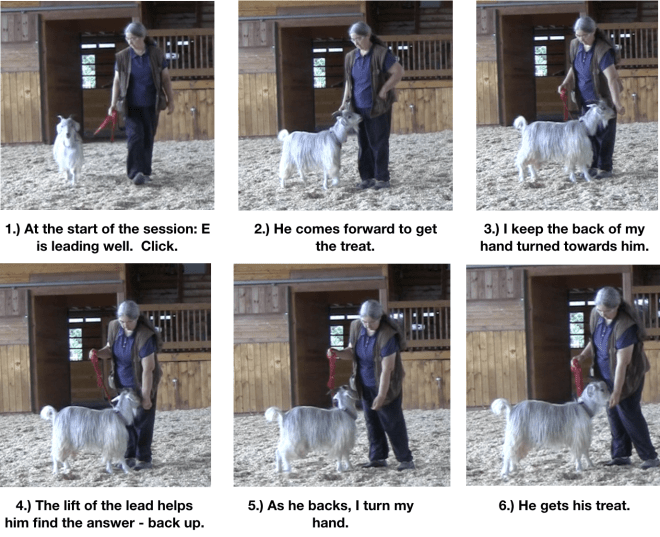
In the previous post I described P’s leading session and my focus on the treat delivery. Now it was E’s turn.  I brought him out into the arena on a lead.  He was also excellent.  He’s so very gentle.  He’s much easier to lead than P.  That actually made this lesson a little harder for him.  Because P can be very pushy, he’s had a lot more experience moving back from the treat.  It was easier for him to make the connection and to understand that backing up is what got me to hand him a goody.

E was slower to catch on.  When I clicked, I extended my closed hand out towards him.  Instead of finding my open palm with the treats there for the taking, I had the back of my hand turned towards him.  At first, he was confused.  What was he supposed to do?  I didn’t want this to turn into teasing, so I helped a little by lifting the lead up so it exerted a slight backwards pressure.  It was a suggestion only.  I was careful not to pull him back. The lead was there only to remind him about backing, to bring it further up in the “files” so he would give it a try.

In previous sessions I had introduced him to this collar cue.  He had learned that backing led to a release of the pressure AND a click and a treat.  I’d given the lift of the lead meaning.  Now it was time to put it to use.  The lead was acting as a prompt.  He got it right away.  I only had to use it three times, and then he was moving away from my closed hand on his own.

Goat diaries Day 10 food manners 1.png

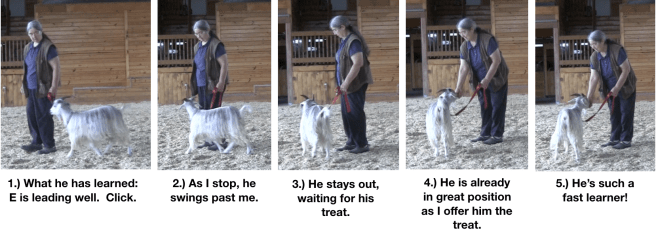
So now it was click, and he backed up to get his treat.  When I extended my hand out where the perfect goat would be, he was exactly where he should be to get a treat.

Goat diaries Day 10 food manners 2.png

You’ll need a password to watch this video.  It’s:  GoatDiariiesDay10E

I started to take E back, and then decided to let him have another go at the mounting block.  E was a little uncertain at first but then he went across the mounting block all the way to the end.  I had some foam mats at the far end.  E jumped up on them.  Contact points!  Then he leapt high into the air for a twisting dismount.  What fun!

We went back to the beginning, and he ran across the mounting block again.  I loved the rat a tat tat sound of his hooves on the wood.  At the far end he did another wild leap off the mounting block.

The two runs seemed to satisfy him.  He followed me into the aisle and back to his stall.  Getting him to go back in was easy.  Dropping treats seems to be the incentive they need to turn going into the stall into a good thing.  They could so easily become sticky at going back.  They like to go exploring.  And they definitely like the treats, the social attention, and the game.  Planning ahead so returning to the stall is a good thing was paying off.

As always, I balanced the excitement of our training sessions with the quiet of cuddle time.  P was particularly eager for attention.  They are showing more and more enjoyment.  Now when I scratch, they lean into my fingers.  I can see their lips wiggling.  None of this was there at the beginning.  Now when I scratch them, I get a whole body response.  Talk about reinforcing me!

The Goat Palace – Catching Up With Current Training

All this good prep has created more opportunities to give the goats adventures.  Because they will now lead reliably, we can take the three youngsters into the indoor arena for playtime.  I can lead Pellias and Elyan together without being dragged in opposite directions or pulled off my feet.  On the rare days when the temperature is reasonable I’ve also been taking them out individually for walks.

Last summer Pellias was the bold one, but this winter oddly enough it is Elyan who has been up for longer adventures.  We started out just walking a large circle immediately outside the lean-to.  I would ask Elyan to go just a couple of steps – click and treat.  When I walked off, I was always mindful of his response.

If he hesitated or stopped to look at his surroundings, I would wait for him.  The slack was out of the lead, but I didn’t add any pull.  When he oriented back to me, click, I gave him a treat.

If he rushed ahead of me, I would say “Wait” and stop my feet.  As soon as he glanced back towards me, click, I gave him a treat.  “Wait” became a reliable cue within one session.

I discovered this the next day when we took the three youngsters into the arena for a playtime.  We turned then loose and let them do aerials off the mounting block.  After a bit I headed towards the far end of the arena.  Elyan was staying close to me.  Pellias was a little further off.  When they spotted a set of platforms, they started to run towards them.   I said “Wait”, and Elyan immediately turned back to me.  Click and treat.  What fast learners these goats are!  I hadn’t yet given Pellias the “Wait” lesson, but when he heard the click, he immediately turned away from the platform and came running back to me.

Walking out with them individually has confirmed even more for me that the click has taken on meaning.  Pellias and Elyan have both become very good at staying by my side and keeping slack in the line.  As we walk along, I’ll click, and they will immediately orient to me.  This is happening now before I stop my feet or reach into my pocket.  What began as just noise in the background has become a reliable and very clear signal – come get your treat!

I should mention that Thanzi has also gained walking out privileges.  The first time I put a lead on her, she dragged me the length of the hallway to get back to the security of her pen.  Now she stays glued to my side, and we can venture out for walks.  That’s enormous progress.  She was chosen to come here because she was such a strong puller.  She’s so powerful, and now she is also so wonderfully light on a lead.

Trixie is another matter.  The lead for her is definitely a cue – just not a positive one.  If I am holding a lead in my hand, she shuts down completely.  Never mind trying to put it on her.  Just holding it creates this response.  She is a work in slow progress.  But I have written enough for today without going into the unwinding of her poisoned cues.  That will have to wait for another day.

Coming Next: Day 10 Continued: Distractions!

Please Note: if you are new to the Goat Diaries, these are a series of articles that are best read in order.  The first installment was posted on Oct. 2nd.  I suggest you begin there: https://theclickercenterblog.com/2017/10/02/   Two of the goats I write about originally came for a twelve day stay in July.  The July Goat Diaries track their training during this period.  In November these two goats, plus three others returned.  They will be with me through the winter.  The “Goat Palace” reports track their current training.  I wish to thank Sister Mary Elizabeth from the Community of St. Mary in upstate NY for the generous loan of her beautiful cashmere goats.
 

Happy Birthday Panda!

I’m going to take a quick break from the Goat Diaries to wish Panda a Happy Birthday.  Yesterday was her birthday.  Unbelievably she is 17 this year.  How does that happen!

Normally, I keep “family” birthdays private.  I don’t expect people to celebrate with us as we mark another year with our horses.  But so many people helped us out when Panda got sick in 2016 that I thought this was a good time for an update.  Panda is 17 this year!  She came so very close to not making it that is a real cause for celebrating.

She is doing so much better.  The diarrhea is under control – finally.  She is back in normal work as Ann’s guide.  Hooray!  Though in this brutally cold weather neither one of them has wanted to venture out.

Yesterday the temperatures had climbed to what felt like a tropical thirty degrees.  Ann took Panda out for a long and much enjoyed birthday walk.  When I visited with them afterwards, I asked Ann how Panda did.  She had been cooped up for so many days would she be a wild thing bouncy around on the end of her lead?  No, she was her usual focused, careful, eager self, making good decisions about avoiding the melting puddles that concealed ice underneath.

Back in her house I watched her retrieving her lead, one of her many favorite games.  Ann drops the lead on the floor and Panda picks it up and hands it back to her.  I had to laugh.  She is as full of play as she was when I had her in training as a weanling.  As I write that, I realize that’s not really true.  She is, if anything, even more full of play than she was when she was little.  Isn’t that a great thing to be able to write about somebody – horse or human.

Ann made a similar observation.  She said Panda becomes more like herself all the time.  I asked what she meant by that?  What does being Panda mean?

Ann should really be the one writing this, but it means she is so very confident.  She’s bold and she’s eager, and she’s comfortable in what she knows.  Ann always smiles when she talks about Panda.  I know a little about what she means.  I got a hint of it all those years ago when I had her in training.  I remember so clearly during one of our walks around the neighborhood thinking how nuanced the communication between us was becoming.  I remember thinking that when Ann has been working with Panda for a few years they will be like one of those couples who complete each other’s thoughts.  That’s definitely part of what being Panda means.  It means being the other half of a partnership that brings you great joy.

Happy Birthday Panda!

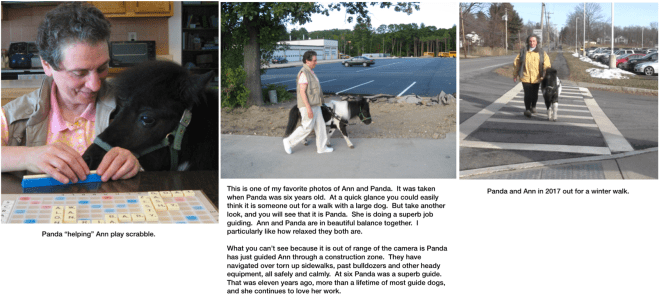
I didn’t take any birthday photos yesterday.  I should have.  But here are three favorites:

Ann Panda 3 photos scrabble, great walk, winter walk

Happy New Year!

Happy New Year Everyone!  I know you’re expecting the next installment of the Goat Diaries.  I’ll get back to those in my next post, but first I am going to do something a little different.

2018 is the 20th anniversary of the publication of “Clicker Training for Your Horse.”  Before 1998 clicker training was not part of the general horse world.  I’ve always said that first book was like my space beacon: “I’m here!  Is anyone else out there?”  The answer is yes.  Here you are, reading this post.  We are people who love the animals in our care and who want the training methods we use to support the relationship we want.

I’m one of those people who ignores most anniversaries, but twenty years is something to pay attention to.  It represents a huge commitment of time, energy, and love for our horses.  I’m not talking just about my contribution.  I’m thinking about all the many thousands of people who have helped pioneer clicker training and whose efforts have helped to spread it around the planet.

I would love to thank each and every one of you by name – but I don’t know all of you personally.  Even if I did, I would be bound to leave someone out.  I don’t want anyone to feel like the fairy in the children’s stories who wasn’t invited to the party, so instead I’m going to single out just a few people.  Every month this year I’ll be publishing an article commemorating the contribution of one of the many people who helped me bring clicker training into the horse world.

The first article features my long time client and friend, Bob Viviano.  For many years we boarded our horses in the same barn.  Bob’s appaloosa, Crackers, lived in the stall opposite Peregrine.  Soon after I moved Peregrine to the barn, Bob asked me to help him with a jumping problem he was having.  That was in 1993. Little did he know what he was getting himself in for!

When I watched Crackers go under saddle, it was clear the jumping problem was balance related.  That meant peeling back some layers and introducing them both to lateral work.  One of Bob’s hobbies was country line dancing.  Line dancing used a lot of the steps we were teaching Crackers.  Why not teach him an actual dance?  Forward – back – side – side: Bob taught Crackers the Electric Slide.

It didn’t matter what you called it – dressage or line dancing – the changes of bend and the weight shifts forward and back were exactly what Crackers needed.  Once Crackers had the dance figured out, Bob got others to join in.  The kids from the local 4-H group formed a line dance with Crackers in the middle.  That was just the beginning.  Eventually Bob and Crackers joined a group that was trying out for a Guinness Record of most people ever to perform in a line dance.  They got close with over a thousand people.  They certainly should have gotten the record for most people plus one horse!

In those early pioneer days we had no idea what you could do with clicker training.  We were just having fun.  We started out teaching our horses to touch targets.  That was step one in introducing a horse to clicker training.  Our horses all caught on fast to the targeting, and then we were confronted with the question everyone faces: now what?  What do you do with targeting?

Well, one answer is you teach your horse to retrieve.  My young horse, Robin was our first retriever.  Once he showed the way, the rest followed.  We very quickly had a barn full of eager retrievers.  And then what?  If a horse can retrieve, could he open a mail box?  Bob built Crackers his own mailbox so we could find out.  The answer, of course, was yes.  And not only can he open the mail box, he can also reach in, get the mail and hand it out to you.

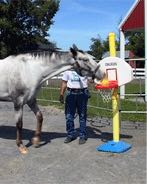
He can also retrieve a basketball and dunk it through a hoop, kick a football, swing a hula hoop over his head, answer the telephone, play a piano and paint you a picture, to name just a few of the many tricks Bob taught Crackers.

page2getstarted1crackers.jpg

Lots of people teach their horses tricks.  What set Bob apart was the way in which he shared them.  He started taking Crackers to outdoor fairs and festivals.  Bob loved seeing people’s faces light up as they watched Crackers perform.  “He’s so smart!” they’d exclaim as Crackers opened his mailbox and handed people the presents Bob had stashed inside.

I visited them at one festival where Crackers’ pen was right beside an area where people were flying enormous kites.  It didn’t matter that brightly colored dragons were swooping over his head, Crackers went right on performing for the people who had come to see him.

At Christmas Bob would take Crackers to local shopping malls to raise money for the Salvation Army.  I remember watching them outside a busy supermarket one snowy December evening.  People gave so generously because it was Crackers ringing the bell.  Bob took him to nursing homes and to the Hole in the Wall camp for children with cancer.  One of the many stories Bob shared was of a little girl who decorated her hospital room with pictures of Crackers.

It was always Bob and Crackers.  They were a team.  If you knew Bob, you knew Crackers.  And Crackers was always up for anything.  From tricks to line dancing, he would perform for hours.  As long as there were people who wanted to see him, Crackers was always willing.  At the barn whenever someone came to visit, they were always treated to a show.  Crackers loved it.  Bring out his mailbox, and he was always eager to perform.  Bob not only made Crackers’ life better through clicker training, together they enriched the lives of the thousands of people they met.

Bob and Crackers helped us discover what you could do with clicker training.  It wasn’t just that Crackers could open a mail box or ring a bell.  It was that he could perform wherever Bob took him whether it was at a crowded festival or in a snowy parking lot.  Clicker training had given Crackers a confidence Bob could rely on.

Bob played another very important role in the development of clicker training, one that not as many people know about.  He was my horse sitter.  There aren’t many people I would entrust my horses to.  I always knew I could rely on Bob.

In those early days, there were just occasional trips away.  Most of my teaching was done locally, but word of mouth was beginning to bring requests for clinics.  The people who signed up for my clinics didn’t yet know I was experimenting with clicker training.  They were coming because they had heard I was good at solving training problems.  During our time together, I would introduce them to clicker training, but it wasn’t yet the primary focus of the clinics.

In 1996 I launched my web site: theclickercenter.com.  That was also the year Karen Pryor asked me to write a book for her new company, Sunshine Books.  At clinics I still kept clicker training “under my hat”.  I waited until my book was published in 1998 to announce that I was giving clinics that were specifically about clicker training.  That’s when my travel schedule exploded.  For many years after that I was away teaching almost more than I was home.

Whenever I was out of town, it was Bob who came every day to look after my horses.  Without him I would never have been able to give those clinics.  And without the clinics I would never have been able to connect to all the other clicker pioneers who helped me spread clicker training around the planet.  So I owe Bob and Crackers a huge debt of thanks for joining me in this amazing adventure we call clicker training.

Crackers sadly is no longer with us.  He died in 2012 at the grand age of 30.  He is buried, as he should be, at the Clicker Center Barn where he will always be remembered with much love.  At 80 Bob is still going strong.  He may not have Crackers at his side, but he’s still sharing clicker training.  He continues to pass on Crackers’ legacy by volunteering at a local horse rescue.  So the ripples we started over twenty years ago are still going out into the horse world.  Thank you, Bob and Crackers!  It has been a great pleasure and honor to share clicker training with you.

Crackers and Bob are featured in all three of my books: “Clicker Training for your Horse”, “The Click That Teaches: A Step-By-Step Guide in Pictures”, and “The Click That Teaches: Riding with the Clicker”.  They also appears in The Click That Teaches DVD Lesson series.

Visit theclickercenter.com to learn more. (Crackers is the first horse featured on the page celebrating some of our clicker-trained horses. https://www.theclickercenter.com/clicker-horses-1)

Next month I’ll be celebrating this 20th Anniversary year with another story featuring one of our clicker-training pioneers.

Happy 2018 Everyone!

Coming next: The Goat Diaries returns.


Summer Pleasures – Watermelon Parties and The Two Sides of Freedom

Watermelon Parties

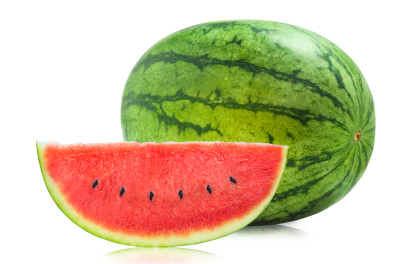
watermelon

Summer means watermelon parties for the horses.  They are always a surprise.  As I walk through the barn, bowl in hand, I’ll announce: “It’s party time!”

Watermelon parties are held outside. That was quick learning on my part. It’s astounding the amount of happy drool even a few pieces of watermelon can produce.

Robin and Fengur follow me outside.  While I pass out chunks of watermelon, they stand waiting, one on either side of me.  There’s no pushing, no trying to jump the queue, no grumbling at the other horse. We have a happy time together. The horses get to enjoy one of their favorite treats, and I get to enjoy their obvious pleasure.

Summer also means sharing an afternoon nap with Robin. I’ve just come in from mowing the lower pasture. It’s time for a cool down. I’m sitting in a chair in the barn aisle, cold drink by my side, computer on my lap, and Robin dozing beside me. Fengur has wandered off to the hay box to snack. He’ll join us in a little while.

Robin asleep lip drooping

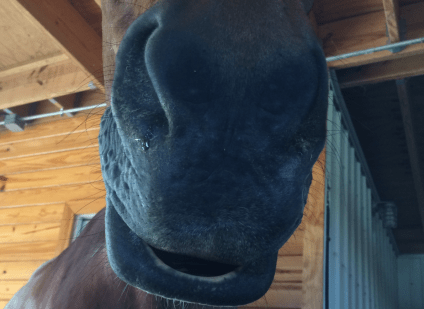
The view from my chair – Robin’s lower lip droops while he naps beside me.

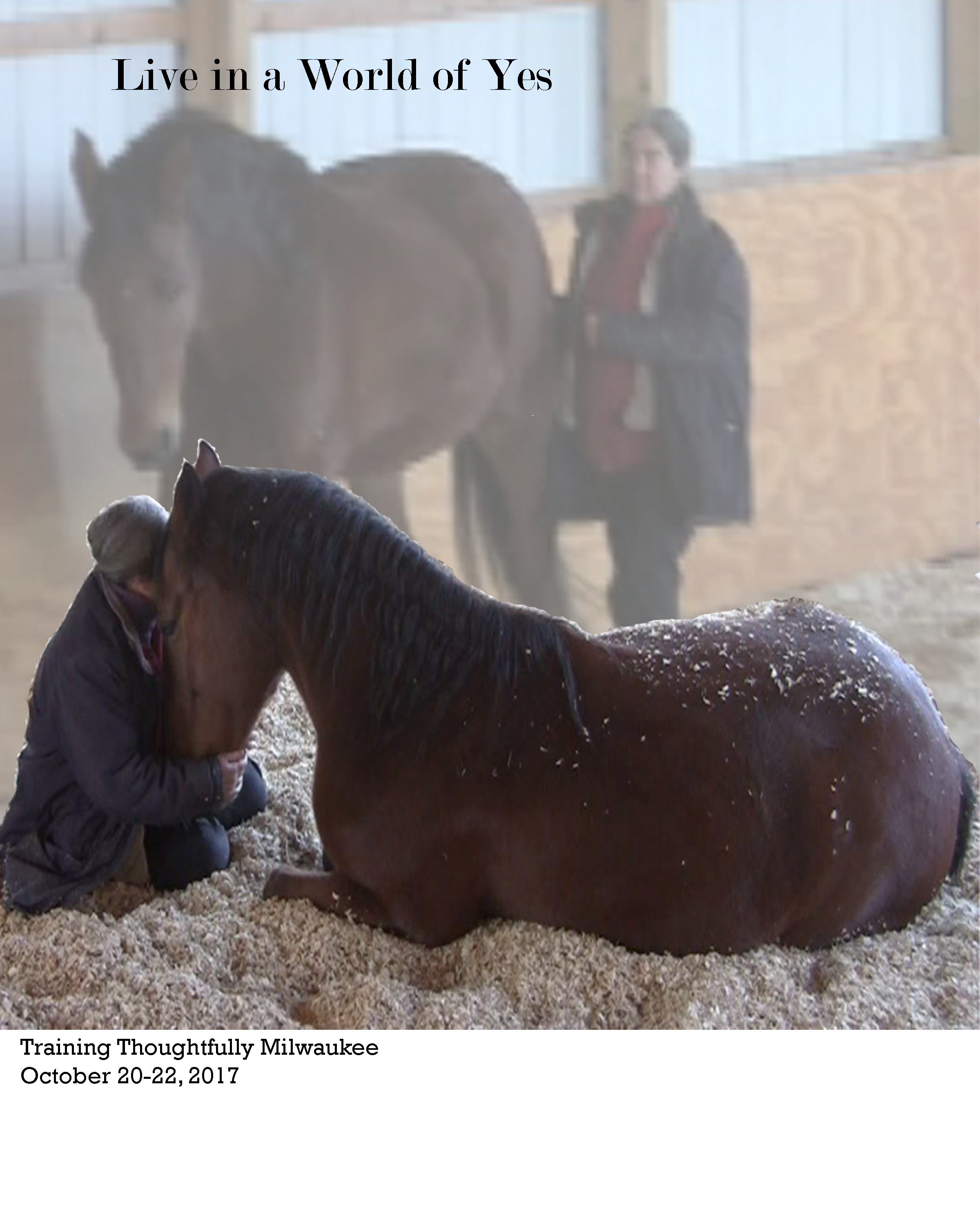
Why am I writing about these simple summer pleasures? My horses live in a world of yes. I’ve been thinking a lot lately about what this means. Living in a world of yes gives me the freedom to enjoy these simple pleasures. But the freedom isn’t one-sided. Living in a world of yes gives my horses just as much freedom.

We often think of training in terms of what we need from our animals. When I walk down the barn aisle, I need you, horse, to move out of my space. When the door bell rings, I need you, dog, to go sit on your mat. I’ll teach these things using clicks and treats, but the behaviors are for my benefit more than my animal companions. The freedom to ask is all on my side.

That’s not how things are in my barn. It’s set up to maximize choice for the horses. Doors are left open so they are free to go where they want. Right now what Robin wants is to nap in the barn aisle. I couldn’t give Robin this luxury of choice if I hadn’t also given him behaviors that let us share space amiably.

When I walk down the barn aisle, Robin will often pose. It’s a simple gesture, a slight arch of the neck is all that’s needed. If he thinks I’m not paying attention, he’ll give a low rumble of a nicker. I’ll click, and give him a treat. Often I’ll get a hug in return.  That’s good reinforcement for me.

The pose is a guaranteed way to get attention from me. If Robin wants to interact, he knows how to cue me. And I am under excellent stimulus control! That’s how cues should work. They create a give and take, a back and forth dialog. They erase hierarchy and create instead the three C’s of clicker training. Those three C’s lead in turn to the freedom my horses and I enjoy sharing the barn together.

Before I can tell you what the three C’s are, we have to go back a few steps to commands.  It’s not just in horse training that commands rule. They control most of our interactions from early childhood on.  Commands have a “do it or else” threat backing them up. Parents tell children what to do.  In school it is obey your teachers or face the penalties. In our communities it’s stop at red lights or get a ticket. Pay your taxes or go to jail. We all know the underlying threat is there. Stay within the rules and stay safe. Stray too far over the line and you risk punishment.

This is how we govern ourselves, so it is little wonder that it is also how we interact with our animals. With both horses and dogs – commands have been the norm. We tell our dogs to “sit”. When it is a true command, it is expected that the dog will obey – or else! The command is hierarchical which means it is also unidirectional. A sergeant gives a command to a private. The private does what he’s told.  He doesn’t turn things around give a command back to the sergeant.

We give commands to our horses, to our dogs – never the reverse. We expect our commands to be obeyed. We say “sit”, and the dog sits. I tell. You obey. Because they are hierarchical, commands exclude dialog. The conversation is all one-sided. Commands put us in a frame that keeps us from seeing deep into the intelligence and personality of the individual we’re directing.

Cues are different. Cues are taught with positive reinforcement. At first, this sounds like a huge difference, but for many handlers it represents a change in procedure, but not yet of mind set. The handler may be using treats as reinforcement, but the cues are still taught with an element of coercion.  How can this be? It’s not until you scratch below the surface, that you’ll begin to understand the ever widening gulf that the use of cues versus commands creates.

dog touching a targetTo help you see the coercive element, let’s look at how twenty plus years ago we were originally instructed how to teach cues.  You used your shaping skills to get a behavior to happen. It might be something as simple as touching a target. Cues evolve out of the shaping process. The appearance of the target quickly becomes the cue to orient to it.  But this cue is often not fully recognized by a novice handler.  We’re such a verbal species, this handler wants her animal to wait until she says “touch”.  As she understand it, that’s the cue.  So what does she do? She begins by saying “touch” and clicking and reinforcing her learner for orienting to the target.
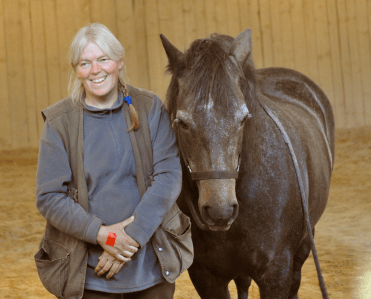

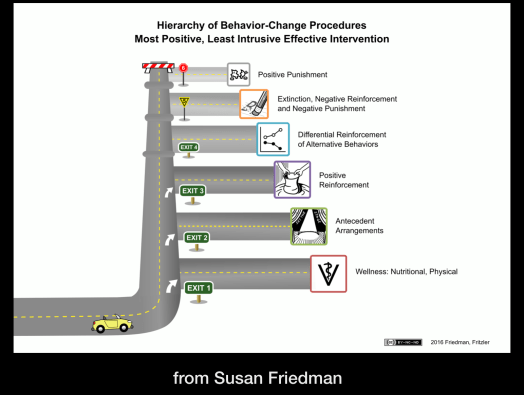
This part is easy. Whether she had said anything or not, her learner was going to touch the target. She’s ready to make a discrimination. Now she presents the target, but she says nothing. What does her learner do? He orients to the target, just as he’s been doing in all the previous trials. He expects to hear the click and be given a treat, but nothing happens. His person just changed the rules which has plunged him into a frustrating puzzle.

He’s in an extinction process. He’s no longer being reinforced for a behavior that has worked for him in the past. He’ll go through the normal trajectory of an extinction process. That means he’ll try harder. He’ll try behaviors that worked in the past, and he’ll become frustrated, anxious, even angry, before he’ll give up for a moment. In that moment of giving up, his person will say “touch” and present the target again.

She wants him to learn the distinction. In the presence of the cue perform the behavior – click and treat. In the absence do nothing.

The problem with this approach is she never taught her learner what “do nothing” looks like. She stepped from the world of commands into what she thinks of as a kinder world of cues, but she didn’t entirely shed the mantle of “do it or else”. With cues the threat of punishment may not be there, but extinction is still an unpleasant and frustrating experience. Why isn’t this key on my computer which was just working now locked up and frozen?!! Until you can find your way out of the puzzle, you can feel very trapped and helpless. A good trainer doesn’t leave her learner there very long. She’s looking for any hesitation that let’s her explain to her learner the on-off nature of cues.

There’s another way to teach this that doesn’t put the learner into this extinction bind.  This other way recognizes that cues create a dialog, a back and forth conversation.  I want my learner to wait for a specific signal before moving towards the target.  Let’s begin by creating a base behavior, a starting point.  For my horses this is the behavior I refer to as: “the grown-ups are talking please don’t interrupt”.  I will reinforce my horse for standing beside me with his head looking forward.  He’ll earn lots of clicks and treats for this behavior.  And he’ll begin to associate a very specific stance that I’m in with this behavior.  When I am standing with my hands folded in front of me, it’s a good bet to try looking straight ahead – click and treat.

Ruth Scilla grown ups.png

“Grown-ups”

In separate sessions he’ll also be reinforced for orienting to a target.  When both behaviors are well established, I’ll combine them.  Now I’ll look for grown-ups.  I’ll fold my hands in front of me, knowing I’ll get the response I’m looking for.  Only now, instead of clicking and reinforcing him, I’ll hold out the target to touch.  Click the quick response and treat.

The message is so much more interesting than the one created by using an extinction procedure to introduce cues.  Cues have just become reinforcers which means they have become part of a conversation.  If you want to interact with the target, here’s an easy way to get me to produce it – just shift into grown-ups.  That will cue me to lift the target up.  A conversation has begun.  We’re at the very elementary stage of “See spot run”.  I’m teaching my horses the behaviors they can use to communicate with me, and I am showing them how the process works.  You can be heard.  You WILL be heard.  Let’s talk!

The conversation that emerges over time comes from looking more deeply at what cues really are. We can think of them as a softer form of commands, but that doesn’t oblige us to step out of our hierarchical mindset. It is still I give a signal. You – my animal companion – respond. Click and treat. Diagram this out. The arrows all point in one direction.

Signal from human leads to response from animal

Peel another layer of understanding about how cues work and you come to this:

It isn’t just that cues are taught with positive reinforcement. Cues can be given by anyone or anything. A curtain going up cues an actor to begin speaking his lines. We would never say the curtain commanded the actor.

If cues can be given by anyone or anything, that means they are not hierarchical. We cue our animals, and they cue us. Cues create a back and forth exchange. They lead to conversation – to a real listening to our animals. We adjust our behavior based on their response. Cues lead to the three C’s of clicker training which I can now say are: communication, choice, and connection. And in my barn that in turn creates opportunities for more freedom. It means doors can be left open. It means I can have watermelon parties and sit with my horses while we both enjoy the afternoon breeze through the barn aisle.

Let’s parse this some more.

The mindset that commands create is very much centered around stopping behavior. Other training options won’t make sense. They won’t work.

Cue-based training makes it easier for you to see your horse’s behavior as communication, as a bid for attention. That makes it easier for you to look for solutions that satisfy his needs.

Let’s see how these differences play out in a typical boarding barn scenario. Your horse is hungry. His initial whicker has been ignored. In frustration he’s escalated into banging on his stall door. His human caretakers see this as “demanding” hay. In a command-based frame demanding hay equal rebellious behavior which can’t be tolerated. The behavior must be stopped.

Within this frame the only training options you can think of are those centered around stopping the unwanted behavior. Other options don’t make sense and won’t work. The command-based frame narrows your field of view. It’s as though you have a tight beam focused on the problem behavior. Everything within that beam is crystal clear, but everything outside the beam might as well not exist. You can’t even begin to think about other solutions. You are targeted on the unwanted behavior.  Banging on the stall door must be addressed and addressed directly.

Now let’s look at the contrast that a cue-based frame creates. Your horse is hungry. His initial whicker to you is noticed and responded to. You appreciate his alerting you to the lack of hay. You have read how important gut fill is in preventing ulcers. You attend to your horse’s needs. Within this frame many options become available including hanging a slow feeder in his stall so he doesn’t have to become anxious about his hay.

Which training options make sense will depend upon which frame you are in. If you are a teacher and you want your instructions to be effective, you need to help your students open a frame that matches what you are trying to teach.

In her presentations Dr. Susan Friedman uses a graphic showing a hierarchy of behavior change procedures beginning with the most positive, least intrusive procedures.

Dr. Susan Friedman's Hierarchy of interventions

You begin by looking at health and nutritional considerations and then move to antecedent arrangements. Hanging a hay net for our hungry horse would fit in here. Her graphic pictures a car moving along a highway. As you begin to approach more invasive procedures, there are speed bumps blocking the way. They are there to slow you down, to make you think about other approaches before you bring in the heavy guns of positive punishment. The hierarchy doesn’t exclude positive punishment as a possible solution, but it does say you would use this only when everything else has first been tried.

This hierarchy makes sense when you are looking at behavior from a cue-based perspective. From a command-based frame, the car enters not at the bottom of the roadway, but at the top.

My Changes To Procedural Changes slide

The first intervention is positive punishment. The barriers are still there, but now they act to keep you from seeing other options. It is only when punishment fails, that you are dragged, kicking and screaming, to consider other ways of changing behavior.  I’ve heard these stories so many times from people who are attending their first clicker training clinic. They’ve been brought there by “that horse” – the one who challenges everything they thought they knew about training. Nothing else worked, but then they tried, as a last resort, a bit of clicker training and everything changed! So here they are, ready to learn more.

They don’t yet know what an exciting world they are entering. Everything they have thought about training is about to be turned truly upside down and inside out. That’s all right. They have the fun of watermelon parties ahead of them.

Live in a World of Yes.png

If you want to learn more about living in a world of yes and the freedom that creates for both you and your animal companions, come join us in Milwaukee for the Training Thoughtfully conference.  https://www.trainingthoughtfullymilwaukee.com/

Deer Fencing – A Great Example of Everything is Connected


IMG_8839.JPG

The view in winter out my window

I recently took the deer fencing down.  That may not sound like a horse training topic, but it turned out to be a perfect example of one of my favorite training mantras: everything is connected to everything else.

The deer fencing protects a sprawling, low-growing evergreen.  I let the deer eat most of my garden, but this tree I protect.  Every fall the fencing goes up.  And in the spring it comes down.  That means taking down the plastic fencing I use and then pulling the metal fence stakes out of the ground.  After I had rolled up and put away the fencing, I tackled the fence posts.  I took a firm hold of the first stake, expecting it to come easily out of the soft spring ground.  It didn’t move.  I changed my grip, and it slipped out of the ground.  The image of a warm knife cutting through butter came to mind.  What was the difference?  Simple answer – bone rotations.

As I pulled up the rest of the stakes, it occurred to me that this would be a great way to let people practice the rope handling technique that you use to get a horse to lift his head up from grass. ‘Tis the season when the grass is calling with a Siren’s song to our horses.  In traditional training we are taught to fight the grass.  The horse MUST NOT drag us to grass. This sometimes keeps clicker trainers from seeing grass for what it is  – a wonderfully convenient source of reinforcement.  Instead we struggle to keep our horses from plunging their heads down to graze.

No one enjoys being dragged to grass. So how do you change this picture? One answer is to change how you view the grass. Your horse wants it. Great! That means you can use it to reinforce behavior YOU want. Instead of trying to stop him from diving for the grass, you’ll be looking for opportunities to let him graze.

This lesson is connected to something else I’ve been thinking about a lot recently and that’s frames.  Here I’m not talking about picture frames, though that’s a good metaphor for them.  I’m referring to the mental constructs that George Lakoff describes in his books, “Your Brain’s Politics” and “Don’t Think of an Elephant”.

Frames contain things

Whether frames are the kind we hang on a wall or the kind we form around ideas, frames contain things.  According to Lakoff, we organize facts within a frame of reference.  Facts that fit within a given frame are easily processed.  Others bounce off these frames as though they don’t even exist.  Either that or we push back against them because they don’t fit comfortably within the frame.  There’s no structure, no way to relate to them so the new idea might just as well not exist.

Frames both include and exclude facts

If you’ve always resisted letting your horse have grass during training, the following lesson is a great opportunity to practice expanding your frame to let some new ideas in. The first step is to decide that you’re going to give this approach a try.  That’s a lot more inviting than facing another summer-long battle with your horse over access to grass.

You can’t just suddenly declare that the grass is a reinforcer and expect smooth sailing.  You need to go through a teaching process for your horse to understand how to behave on grass.  I’m going to assume a general understanding of clicker training.  If you haven’t yet introduced your horse to the basics of clicker training, you’ll want to do that first.  I’ll refer you to my web sites for details (theclickercenter.com and theclickercentercourse.com)

Many of us have to hand-graze our horses to acclimate them to spring grass.  This is the perfect opportunity for this lesson. (If you need an easier starting point, you can begin in a paddock and use small piles of hay.) The idea is that you are going to teach your horse to leave food in order to get food.

For this lesson on transforming grass into a useful reinforcer here are the steps:

Begin by taking your horse out to graze. Don’t try to keep him from the grass. (If you are using hay piles scattered around your training space, let him take you to the hay. Don’t resist.) Let him eat for a couple of minutes. As he begins to settle and relax, you can start the lesson.

1.) Use your lead to ask your horse to lift his head up. He may ignore you at first, but do the best you can. This is where the image of pulling fence posts out of the ground becomes handy.  If you pull straight up on the lead, you’ll feel as though you are playing tug of war against a team of football players.  Your horse’s head won’t budge. Remember when I tried to pull the fence post up with a simple grip, it stayed planted in the ground.  But when I coiled my arm around the post like a vine coiling itself around a stake, it came out easily.

So before you head out with your horse, go practice pulling some metal fence posts out of the ground. Test the effect.  Take a simple grip and see what happens.  If the stake is buried deep into the ground, you won’t be able to pull it out.

Simple versus coiled grip.png

Now coil your arm around the stake.  You’ll feel it lift out with very little effort.  This is the technique you’re going to use on the lead.  You’re going to stand directly over the snap so the lead is perpendicular to the ground.  As you slide your hand down the lead, let your arm coil around it.  You’re now in a position that matches the way you coiled your arm around the metal stake.  Think about how you pulled the stake out of the ground.  You’ll use the same action with your horse.

In the past you may have had to yank, tug, and plead to get your horse to “come up for air”. Now suddenly his head is popping up.  It can’t be this easy!

Even if your horse feels as though he’s one of those stakes that is well and truly cemented into the ground, you’ll still be able to pry his head up with considerably less effort than you would have had to use in the past.  As his head begins to lift, be ready for the next step in this lesson.

Screen Shot 2017-05-18 at 10.51.08 PM

2.) As soon as he starts to lift his head, click and offer him a treat.

3.) Keeping the lead fairly short, fold your hands together at your waist. This base position is part of a lesson I call  “the grown-ups are talking, please don’t interrupt”.  With both hands folded together, if your horse tries to pull down to get to the grass, you’ll be able to anchor the lead to your body.   It’s surprising how solid you can be in this position.  From your horse’s point of view, it’s as though he’s tied to a well anchored post.

This only works if you have a fairly short lead so he can’t get too far down to the grass.  If your lead is too long, you’ll lose your leverage advantage.

Your horse is going to try and drop his head back down to the grass. With your hands anchoring the lead, you are essentially holding him as if he was tied to a post. As soon as he stops trying to pull down (even for an instant), click. Offer him a treat, and then anchor your hands again to your waist.

Panda in grown-ups not grazing.png

Panda would love to keep eating.  The short lead tells her to go into “grown-ups” instead.

Repeat this several times and then, click, give him his treat and let him drop his head down to eat grass.

Let him graze a little, then again, standing directly over the snap, coil your arm around the lead.  When you’re in position, rotate your arm so the “stake pops out of the ground”. As your horse lifts his head up, click and treat, then anchor your lead by standing in “grown-ups”.  Remember that means you’ll have both hands held together at your waist, and the lead will be short.

As soon as he stops pulling down, again you’ll click and treat.  Repeat this part of the pattern several times.  Release him to the grass when you see a noticeable improvement in his behavior. The behavior you’re heading towards is his side of the “grown-ups” picture.  That means he’s standing beside you with slack in the lead.  His head is about level with his chest and he’s looking straight ahead.  In other words he looks like a settled, well-mannered horse standing politely beside you.  If a friend were with you, the “grown-ups” could talk, and your horse would be waiting patiently beside you.

Screen Shot 2017-02-18 at 11.43.45 AM

A lovely result: this horse can stand on her own over grass without needing any reminders from the lead. She’ll get a click and a treat for this desirable behavior.

Instead of fighting the grass, you are now using it to reinforce the behavior you want. When you ask him to lift his head, your horse will begin to come up faster.  Instead of trying to dive back down to eat grass, he’ll shift on his own into “grown-ups”.  He knows he’s going to get reinforced for standing beside you with his head up.  And he also knows you’re going to let him eat more grass.  Instead of being anxious about getting to the grass, now he can relax and stand beside you keeping slack in the lead.

Paddy leading on grass 2

Lots of temptation under foot, but note how relaxed this horse is leading over the grass.

Once he’s coming up readily, you can ask him to walk a few steps to get to another patch of grass. At first, just go a couple of steps, then stop. People tend to want to keep going once they have a horse in motion, but this can undo the good work you’ve been establishing.  Go too far and the Siren’s call of the grass may overwhelm your horse.  So go just a couple of steps, stop and ask for grown-ups. As soon as he settles, which means he’s able to keep slack in the line because he’s not trying to go down for the grass, click, and let him graze.

On the search for good grass

On the search for good grass. Note the slack in the lead. This horse isn’t anxious about getting to the grass because he knows he’ll be given the opportunity to graze.

You can turn this into a game in which you are helping him find the best grass. From his point of view, you’ll probably be an incompetent grass hunter.  We humans seem to be drawn to the grass that our horses don’t want to eat.  We pick the long, extra green grass.  They want the stubby weeds.  But even if we take them to less than ideal spots, they do seem to understand that we’re on their side.  We’re trying to find them good grass.  It’s a great way to build a deep connection with your equine partner.

As you expand this basic lesson, you’ll be able train on grass without it becoming a distraction. In fact, when your horse does something you especially like, you’ll be able to thank him by letting him graze. What was once a major distraction will be instead a handy reinforcer. Leaving the grass will no longer be a problem.  Your horse knows he’s going to be able to graze again.  When you’re ready to move on, he’ll come away from the grass without a fuss. Your horse will be relaxed and ready for more work, and you’ll have a great new way to say  you for a job well done!

You’ve learned how to do this because everything is connected to everything else. Pulling up garden stakes has taught you the skill needed for asking a horse to come away from grass.  You’ve also learned that you can change long-held habits of thought. Instead of pushing against the grass and fighting your horse over every mouthful he snatches, you’ve found a way to transform it into a reinforcer.  That’s a great way to begin transforming other habits of thought that get in the way of creating a positive connection with your horse.

Happy grazing everyone!

Whisper walking away

What Did You Mean – Not What Did You Say?

Be The Teacher Your Learner Needs 2 THM.pngThe Kentucky Derby was run this past Saturday.  Years and years ago I used to pay attention to the Triple Crown races.  How could anyone who loves horses not be captivated by Secretariat?  But the glamour wore off as I came to know many ex-race horses, including some of Secretariat’s offspring. Now, if it didn’t pop up on the national news coverage, I could easily forget that the first Saturday in May is Derby Day.  What brought it to mind today is a photo I use in my conference presentations.  I was skimming through the talks I gave this past winter. That’s when I spotted the photo.  It was in a talk connecting George Lakoff’s work with horse training.
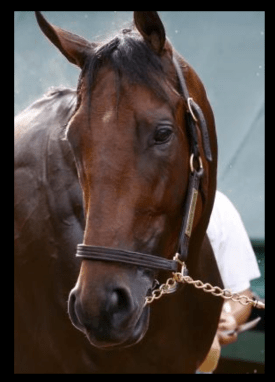
American pharoah lip chainIt’s a photo that appeared in my local newspaper, as well as on the internet.  It shows our most recent Triple Crown winner, American Pharaoh, being cooled down after a workout.  It could have been a photo of any race horse, or really of any hard-working performance horse.  There was nothing particularly distinctive about this picture.  You can see the sweat and the steam rising off his coat.  And you also see the chain that runs through the halter ring and into his mouth.  You can’t really tell from the picture, but the chain is probably over his top gums, an area that is even more sensitive to pain than his tongue.  That’s how young, very fit thoroughbreds are controlled on the track.
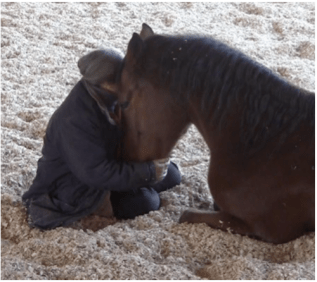
Why was this photo of a thoroughbred race horse in a talk about George Lakoff’s work?  What’s the connection? Lakoff is a cognitive linguist who has studied the power of metaphors in shaping how we think.  He is particularly interested these days in American politics.  One of his central ideas is that the current divide in our politics can best be viewed through the metaphor of family.  Long before any of us were aware of national governments or political parties, we were aware of the authority of our parents.  They set the rules and modeled the behavior that became the template for how each of us thinks society as a whole should be structured.

Lakoff has proposed that there are two primary family models:  the strict father family and the nurturant parent family.

In the strict father model, the father is the head of the family.  As the moral authority of the family, it is the father’s job to teach his children right from wrong.  He communicates this to the children in a hierarchical way.

Lakoff’s description of a Strict Father patriarch sounds eerily like force-based training.  You have only to substitute a few words – trainer for father, horse for child – and you have this:

“The trainer is the legitimate authority, and his authority is not to be challenged. . . Obedience to the trainer is required. It is upheld through punishment. Bad behavior from the horse is always punished.

The trainer teaches the horse right from wrong, and he communicates this to the horse in a hierarchical way.

Punishment is seen as absolutely crucial. It is the trainer’s moral duty to punish bad behavior in the horse.”

The nurturant parent model provides the contrast.  In this family structure it is moral to show empathy, to nurture, and to take on individual as well as social responsibility.  Cooperation with others is seen as more important than competition.

Instead of hierarchical communication, the Nurturant Parent model focuses on open communication. There is mutual respect between children and parents. This is different from other parenting models where children are expected to show respect for their parents, but not vice versa.

People often say words matter, but words are defined by our core values.

The chain in American Pharaoh’s mouth becomes a  symbol of command-based training.   In this very conventional view of training, horses are considered to be stupid animals.  If we look at that through the lens of Lakoff’s metaphors, we see more clearly what these words mean.  It implies a hierarchy – people above horses.  It means people can do whatever they want with horses.

Here’s the rest. Because horses are stupid animals, you have to use force to control them.  You have to show them “who’s boss”.  Here’s the corollary to that:  “But don’t worry.  They don’t feel pain the way we do.”  The frame these metaphors create very much influences what we are able to see.

In this view of the world, when a horse shows resistance, he’s being disobedient. He’s challenging the trainer’s authority and must be punished.  This training frame makes it hard to see other reasons a horse might fail to obey.  Only secondarily will the trainer break the lesson down into smaller steps, or look for physical causes.

Here’s the contrast:

Robin hug

This photo represents my core belief system.  It says something very different.  It is much more in line with Lakoff’s description of the nurturing parent model.  I believe that horses are intelligent animals, and that they should be treated with great kindness and fairness.  There is no hierarchy.  There is no separation between their needs and mine.  We are partners together.

What matters more than the words we use are the core values we hold.  Words only have the meaning that those values give them.  Respect is a perfect example.

Suppose you are new to the horse world.  You’re looking around for an instructor who can help you train your first horse.  You’ve been told that you should go watch a few lessons before taking your horse to anyone, so that’s what you’ve done.  You’re watching this trainer interact with his horses.  They are behaving exactly how you would like your youngster to be.  They move out of his space – no questions asked.  They stand politely to be groomed and saddled.  They seem safe to ride.   You like how he talks about his horses.  He talks about partnership.  He says it’s important that your horse respects you.

Respect is an important word for you, as well.  You like what this trainer is saying.  You like how calm and safe his horses are.  You leave feeling very confident that you have found what you’re looking for.

But have you?  What kind of respect do each of you mean?  In the strict father model respect is maintained through the use of punishment. So, yes, horses can appear to be very respectful, meaning they are afraid of the trainer.  They have learned what to do to escape punishment.

In the “nurturing parent model” respect means something very different.  It is something that is earned.  It is not something that is demanded.

Both parenting models can produce horses that show what you would call polite, safe manners, but the teaching process the horses experienced will have been very different.  If you send your horse to this trainer, you may find it’s a perfect match.  You were both talking about the same kind of respect. Or you could find yourself second guessing your decision.  You like him.  You can see that he’s skilled.  He certainly gets results, but the lessons make you squirm.

When you find that for you there’s a disconnect between someone’s  words and their actions, it’s time to look at core values.

What do the words really mean?  When we train thoughtfully, we learn to look beyond the outer shell of the familiar words we use. Are we letting someone else’s meaning take over?  Do our words reflect the kind of relationship we want to have?  Do the training methods match our core values?

Do you want an example?  Kay Laurence has just produced a promo video for our October Training Thoughtfully conference.  It’s a beautiful video.  Words and images are aligned.  They tell you so much. When I watch this video, I know it was produced by someone whose core values match my own.  If they match yours, as well, I hope you’ll join us for some Thoughtful Training this October.

Training Thoughtfully Milwaukee, Oct 20-22, 2017: Visit: https://www.trainingthoughtfullymilwaukee.com/

Training Thoughtfully Milwaukee Oct 20-22 2017.pngWatch the video: https://vimeo.com/216184198

If you want to learn more about George Lakoff’s work, read my January 8, 2017 post. (https://theclickercenterblog.com/2017/01/08/)

Enjoy!

Bridge Builders

Author’s note: I’ve been publishing my new book, JOYFull Horses in this blog.  This post is different.  July was packed with great training adventures.  I wanted to share, so this is a slight divergence from the JOYFull Horses posts.  Enjoy!   Alexandra Kurland

balsa wood bridge 1

Bridges
When I was in eighth grade, my science teacher set up a competition in the class.  Given the same components (balsa wood and toothpicks) each student was to build a bridge which would then be tested with progressively heavier and heavier weights to see which bridge was the strongest.  It was a great assignment.  Or it would have been except the competition was open only to the boys in the class.  What did the girls do instead?  Our assignment was to create a stain booklet showing how best to remove different types of stains from soiled clothing.

This sounds like the dark ages, but it was really not that long ago.  I’ve been thinking about that science teacher this week because of the Democratic National Convention.  I was traveling last week so I missed most of the Republican convention, or I would have been writing about that, as well.  I’m one of those people who actually enjoys listening to political speeches (at least the well-crafted ones).  I like talking about politics, even  – and especially – with people who have views that differ from my own.  I try not to mix too much politics into what I write about horse training, but every now and then it is important to pause for a moment and step outside the barn door.

One of the clips the news feeds played from Tuesday night’s roll call vote was that of a delegate who was 102 years old.  She was born before women had the right to vote.  That stopped me in my tracks.  I know the 19th Amendment granting women the right to vote was ratified in 1920, but that’s just an abstract date.  Hearing her speak made me realize that there are many women alive today who were born into a world in which their mothers were not allowed to vote.  It brought home to me how recent these changes really are, and how important it is that finally, finally we have a woman nominated to run for president of the United States.

Whatever you may think of Hilary Clinton, however you are planning on voting in the fall, this is a milestone that is worth celebrating.

In eighth grade the boys in my class took shop.  They learned how to work with power tools.  The girls took home economics.  We learned how to cook what was at the time considered a healthy meal: chicken ala king – essentially a can of cream of chicken soup poured over chow mein noodles. Curious the things we remember.   We were to fix it for lunch and serve it to the boys in the class.  As a vegetarian, I refused to participate.  I was allowed to skip the preparation of the main dish and was relegated instead to making a salad – iceberg lettuce and tomatoes.    We then had to serve what we had made to the boys in the class.

The message was clear.  The world may have been changing.  Many of our mothers had advanced degrees from universities. They were working outside the home in professional jobs that only a few years before would have been closed to women, but we were still expected to be homemakers not world changers.

The school gave one message.  My family gave me a stronger one.  We can create our own realities.  I wasn’t allowed to build a bridge in that class, but that didn’t keep me from building them later.  You can walk over my bridges without any fear of falling because they are bridges that link what we knew then about how to handle horses with what we know now.

Bridge Builders
This month I had the very great privilege to meet some other bridge builders.  One of the most surprising was a lion trainer I met in Germany.  I’ll bet you weren’t expecting that one!

Anja Beran book coverI’m just back from attending Anja Beran’s annual workshop on classical dressage.  Anja has a long standing relationship with the Krone Circus.  She trains their dressage horses.  The horses stay with her for roughly eight years, and then they are sent to the circus where they continue to perform well into their twenties.  When we walked through the barns at the circus, we saw horses who were 25, 28, even 30 years olds.  They all looked great.  They were a good weight, with healthy backs, clean legs, shiny coats, and brights eyes – and they were all still performing.
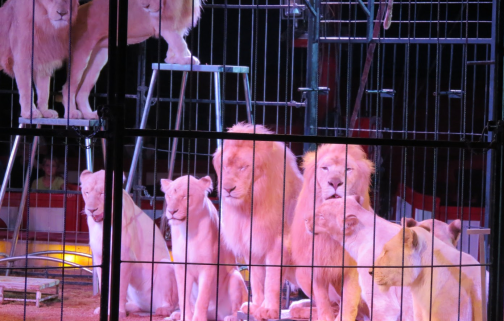
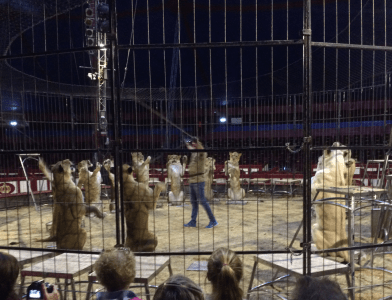
That was one of the main messages from both the circus and Anja Beran’s workshop.  When you build a strong foundation for a horse, you will have a horse who can stay sound and in work for many years to come.  This has always been at the core of my work.  My horses are family.  It matters to me that the work I do with them isn’t just for my entertainment.  It has to benefit them, as well.  One thing Anja Beran and I share is a deep understanding that good training helps horses stay sound.  Horses thrive when training is done well.

We hear so many sad stories of competition horses breaking down because they are rushed through their training.  At the circus we met horse trainers who value a good foundation because they love their horses.  Yes, they value performance – but not at the expense of the horses.

We also met Martin Lacey, a trainer who loves lions. In the morning before the circus opened to the public Anja had arranged for us to watch him work with his lions.  I don’t think many of us were truly looking forward to this part of the program.  Yes, it was lions, but we all had images of the old-style circus training with its cracking whips and sad-eyed lions.

Martin Lacey built a bridge for us into another world.  He loves his lions.  That was clear.  He grew up in a family that owned several zoos in the UK. For him lions were part of his family.  That’s how he talked about them.  He had 26 lions and tigers with the circus, and all of them were animals he had known since they were cubs.

lion group grooming at 4.30.28 AM


He showed us how he began their training, teaching them a very natural behavior for cats of any size.  He had the lions follow a moving target stick. Correct responses were reinforced with meat held out to them on the end of the stick.

Everything Martin Lacey showed us was so very familiar.  He used mats in very much the same way I use them for the horses.  He arranged the environment so his lions were successful.  He wanted to show people the power and graceful movement of the lions so he taught them to jump from one platform up onto the metal panels of their enclosure and then down to another platform.  In the show it was very dramatic watching lion after lion leaping up onto the side of the enclosure.  They would hang for a moment high over the heads of the audience before jumping down onto the next platform.

Lacey showed us how he taught this behavior.  He begins by having his lions follow a target stick from platform to platform.  When they are confident, eager jumpers, he has them leap from one platform onto a higher one that is hung from the enclosure wall.  As the lions become confident with this jump, he slants the platform down slightly so now they are landing on a sloping surface.  He lets them build their coordination and confidence at this level of difficulty, then he slants the platform down a bit more.  Gradually over time the platform hangs straight down, but now the lions have the strength and the skill to leap directly up onto the vertical wall of the enclosure.  It is just shaping through small approximations, something every good trainer understands.

Some of the behaviors Lacey teaches are based on very traditional circus tricks.  He has his lions sit up on their haunches and swat at the air to show off their enormous claws.  The behavior may be old-style, but how it is taught is not.  When Lacey first teaches his lions to sit up, he provides them with an elevated T bar for them to rest their paws on.  The T bar gives his younger lions the support they need to keep their backs straight while they are developing the strength and coordination to perform this behavior correctly.

lions sitting up 4

The lion to the right of Martin Lacey is using her T bar for support as she sits up on her haunches.  All the lions are orienting to his target stick.

He uses targeting to get them to reach up to the T bar in the first place.  Once they can balance resting their forepaws on the bar, he teaches them to swat one paw at a time at a moving target.  His skill at delivering timely food reinforcers was impressive, but shrink down the size of the feline, and you would see that any of us could teach our family cats this same behavior – in the same way.

In the show some of his lions still had the T bar set up in front of their station for support. With the youngest lions the T was very long giving them plenty of room on which to rest their paws.  The ones who were further along had shorter horizontal bars.  The T bar was gradually being faded out.  In the show many of his lions could balance without needing any support.

To teach his lions to advance towards him as though they were charging, he used multiple mats.  The lions moved from mat to mat to mat.  I had to smile.  I use multiple mats all the time with horses.  When I teach horses to run towards me, to keep things safe as they add speed, multiple mats are a great tool. Predators, prey, it makes no difference. Good training is good training regardless of the species you are working with. One of the hallmarks of good trainers is they are masters at setting up the environment for success.

That was the bridge Martin Lacey was helping us to see.  The planks of his bridge were made from the elements good trainers share.  I know there are many who oppose the idea of keeping any animals  in captivity, especially animals like lions.  That’s a different conversation, one I’ll leave for another time.

For now, given that animals are already under our care, the question becomes: how do we manage them?

If Martin Lacey had come out cracking whips and using intimidation to control his lions, I would be the first to say, absolutely not.  This shouldn’t be.  But that’s not the relationship Lacey has with his lions, and because of that he is an important bridge builder.  He is saying to all of us – look at the connection you can have with these animals, a top predator. It isn’t built out of fear.

If Lacey can create this with these lions, what excuse do we have for using violence to control our horses, our dogs, our children?

I think the jury is still out around the question of should wild animals be kept in zoos and circuses.  Is it fair to them?  What is the benefit to them, to us, to the planet?  Where does the greater good fall?  There are so many ethical questions involved, but one thing that was clear is Martin Lacey’s message is one we all need to hear.  Whatever the species of animal you are working with, the core principles of good training apply.  If he can stand in the center of an enclosure surrounded by lions, with a pouch filled with raw meat at his belt, and control them not through fear, but through understanding, that’s a bridge that is worth standing on.  If he can do it with lions, we surely can do it with each other.

Classical Bridges


Anja beran second book coverAnja Beran is another bridge builder.  Her bridge stretches back centuries to bring classical riding into the modern world.  Her bridge reaches forward into the future as she shows us how the gymnastic exercises developed by the great riding masters can be used for the benefit of horses.  So many of the horses in her barn came to her severely lamed by training.  Draw reins, heavy hands, rushed training – had compromised the soundness of so many of the horses that she presented during the workshop.  With each horse, she showed us how slow lateral work can be used to restore soundness and create performance excellence.
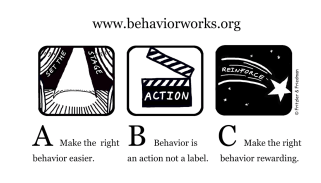
I know there are many people who would say that we should not ride horses at all.  But Anja was showing us something that I also know – good riding heals horses.  Physically, emotionally, good riding is good for horses. I may add the clicker and all that it represents into my training, but at it’s core what we each teach is not that far apart.

The Science Bridge
abc's graphicEarlier in July I also had the honor of spending time with yet another bridge builder, Dr. Susan Friedman.  Dr. Friedman is a professor of Applied Behavior Analysis at Utah State University.  Many of us know her through her presentations at the Clicker Expo, her web site – behaviorworks.org, and her on-line course, Living and Learning with Animals, a course for professional animal trainers and veterinarians.  Earlier in the month Susan joined me at the Cavalia Retirement farm where we co-taught a workshop.

If Anja’s bridge links us to classical dressage, Susan’s links us to science.  When I watch a trainer like Martin Lacey working with his lions, I am smiling not because he is using feel-good words.  Lots of clinician-showmen know how to hide their actions behind soft words.  I am smiling because I see good training being applied.

What is the measure of good training?  Susan helps us answer that question through her understanding of scientific inquiry.  She reminds us that science is always self-correcting.  What we understood about animal behavior fifty years ago, ten years ago is changing because of the research that is being done. Science connects what I do with my horses to what Martin Lacey does with his lions.  When one of my horses makes a mistake, I don’t punish him with a whip.  I change the environment to make the lesson easier for him to understand.  Martin Lacey does the same thing with his lions.  Why have we both chosen to avoid punishment and maximize positive reinforcement in our training?  Susan’s bridge takes us to that answer.

It’s easy to nod your head and say, yes, yes, of course we should use positive reinforcement, but so often what we have had modeled for us is punishment.  You might be reading this thinking that it’s horrific to have animals in captivity.  What do you do?  What actions do you take?  Do you respond to this post by attacking me?  If so, you are acting like an old-time lion tamer cracking his whip and using punishment to suppress behavior.

Susan built for us a very different bridge.  Throughout the weekend, in so many different ways, through her stories, her teaching, her thoughtful modeling, she showed us how to be completely congruent with the ethics of positive living.  It is all too easy to let a thoughtless word here, a careless action there erode a relationship.  Susan modeled for us so brilliantly how to live a life that leaves people shining.  She takes care to give every individual the positively-oriented support, attention, and modeling they need.  That’s not just a bridge, it’s a gift.

My eighth grade science teacher didn’t build bridges.  Instead he broke them down – literally.  When the boys brought their balsa wood bridges into class, he kept adding weight to them until, one by one, they all broke.

He broke other kinds of bridges.  For many in that class he broke the bridge into the sciences.  And most importantly he broke the bridge into kindness.  The behavior he modeled was that of a bully.  He used ridicule and punishment to control his class, and he ended up being universally disliked by his students.  He was a dictator not a bridge builder.

In this world we need people who build bridges, not the ones who tear them down.  When you find someone who is a good bridge builder, that is someone you want to get to know better.

Thank you Susan, Anja, and Martin.  I hope life brings me many opportunities to get to know each of you better.

Alexandra Kurland
theclickercenter.com