Modern Horse Training: Connections

Everything is Connected to Everything ElseIncluding Dolphins and Horses

I stumbled across clicker training in 1993. A friend who bred and trained Irish Wolf hounds told me about Karen Pryor’s book, “Don’t Shoot the Dog”. I read it, loved it and wanted to learn more. What was this clicker training that she was talking about? How did it work?

I read her second training book, “Lads Before the Wind: Diary of a Dolphin Trainer” which described how she and her husband, Tap Pryor, developed Sea Life Park in Hawaii. Karen was given the task of figuring out how to train dolphins. It wasn’t anything she set out to do. The task fell to her because the people they had hired to train the dolphins weren’t getting anywhere. These trainers were trying without success to use old-style circus training methods. That didn’t work with an animal that could just swim away from them.

Karen was intrigued by the work that was coming out of B.F. Skinner’s labs. So armed with the lab notes from some of his graduate students, she set to work. She figured out how to use marker signals and positive reinforcement to train dolphins.

Her books were great. I loved both of them. I enjoyed “Lads” even more than “Don’t Shoot the Dog” because Karen shared the puzzle-solving aspect of training. But those books weren’t training manuals. They didn’t teach you HOW to train. They just teased you with the possibility that you could remove the threat of punishment that sits behind most horse training methods.

I was intrigued, but in 1993 other than Karen’s books, there weren’t any readily available resources for learning more about clicker training. Through a bit of luck, I did manage to find a VHS recording of a seminar that Karen produced. It included two short video clips showing animals being clicker trained. One was of an African bull elephant at the San Diego zoo being trained with protective contact to present his feet for trimming. The other was a 12 week old mastiff puppy who learned to sit and lie down in minutes without ever being touched.

The elephant was the most interesting. He had attacked his keepers on several occasions so the decision was made to that no one was allowed to go directly into his pen with him. That meant that for ten years he had not had any foot care. Clicker training was being used to see if they could teach him to orient to targets and present his feet through a small opening in the gate of his enclosure. During the video, you could hear Gary Priest, the director of training at that time, saying “I cannot impress upon you enough how aggressive this animal was, but he’s standing there cooperating for just the social attention and a bucket of food treats.” I watched that and thought – we in the horse world have a lot to learn. I was thinking of the twitches, the lip chains, the hobbles, etc. that I had seen people use to force horses to comply.

The other video showed the use of a treat held up above a puppy’s nose to get the puppy to sit. Within just a few clicks, the puppy was sitting, then lying down and staying down while the trainer walked around her. There was no pushing, no shoving, no use of force. It was simple, elegant training.

Those two videos were all I needed to be up and running. They gave me what I needed to go out to the barn to ask Peregrine what he thought about clicker training. He got the proverbial ball rolling, so it is fitting that the new book, Modern Horse Training, is coming out on the anniversary of his birthday, April 26.

A Perfect Fit

I could say that clicker training was a perfect fit for me. Or I could turn it around and say that I was a perfect fit for clicker training. There were no horse books out there to guide me, or even any other trainers I could visit to see how it was being used. I was on my own. But I was primed. To use the language of constructional training, I had the components that were needed to turn the idea of clicker training into a fully formed, detailed, soup to nuts training program.

So what were those components? What were the skills, the mindset, the repertoire that prepared me so well to embrace the idea of clicker training? I will say that I have met many others who shared similar components. For so many all that is missing is the understanding of marker signals. Give them that, and, like me, they are off and running. But for many others clicker training represents a huge shift in thinking. Can you really use food in training? Isn’t it a distraction? Won’t it teach your horse to bite? What do you do when your horse says: “No”? The old style of thinking dictates that you must punish unwanted behavior or your horse will become dangerous. “Fear of and fear for” becomes an underlying motivator even if it is not spoken of in that way.

We can begin with that same underlying motivator and end up with a very different result. That’s what I wrote about in yesterday’s post. You can also use treats in training and still stay wedded to the belief that unwanted behavior needs to be corrected.

Using positive reinforcement describes a procedure. What I’m addressing now is the question of what motivates your training decisions? Even kind people can end up choosing punishment because they are motivated by “fear for” risks. You’re afraid that your dog might rush out the front door and be hit by a car, so you use punishment to teach him to stay back when you open the door. That’s one example of how this plays out.

You don’t have to use punishment to solve this problem. There are other options. You begin by acknowledging that you are concerned for your dog’s safety, and then you search out solutions that are a match with your core ethics and the type of relationship you want with your dog.

The same applies to horses. Wanting to keep bad things from happening is a powerful motivator that can take us to some wonderful learner-friendly procedures.

Sometimes it’s okay to start out by running away from something. Clicker training teaches us how to reframe that so you begin to run TOWARDS the good things that you want. You stop focusing on the unpleasant outcomes that you don’t want and you teach instead all the good things you do want.

You don’t want your horse crowding into you, stepping on your toes, mugging your pockets, biting at your hands. You can certainly suppress these behaviors through the use of punishment. Or you can look at what you do want. When your horse is standing next to you, what does that look like? Can you describe what the “perfect version” of your horse would be doing? He’d be standing four on the floor, in his own space, with his head between his shoulders so his nose is well away from your pockets. The more detailed your description is, the easier it is to train what you want. Each element you describe becomes a lesson you can teach. What are his ears doing? Where is his head – level with his chest, down on the ground? You can shape all of this using a marker signal that is linked to positive reinforcement.

Those are nice sounding words, but again how do you make this work? What were some of the component skills that helped me transform clicker training from an interesting concept into a workable training program?

That’s tomorrow’s post. I’m splitting what was originally a much longer single post into two installments so it’s not too much to read in one sitting.

“Modern Horse Training: A Constructional Guide to Becoming Your Horse’s Best Friend” will be available April 26. It will be available as a hardcover, a paperback, and as an ebook. You’ll be able to oder it through my web site and also through Amazon and other booksellers.

Modern Horse Training: Contrast Teaches

In Search of Excellence

In March we celebrated the twentieth anniversary of the Clicker Expo. The theme for the Expo was centered around excellence. The Expo organizers wanted the presenters to talk about what made their work consistently stand out – what accounted for our success in training and teaching. This was originally supposed to be the theme of the 2020 Clicker Expo, but then the pandemic got in the way, so we had a lot of time to think about this topic.

Yesterday I wrote about Peregrine’s mother. She had neurological damage which meant, especially early on, she would frequently lose her balance and fall. I was told by my vet that there was no treatment for her, and in all likelihood her condition would worsen and I would be forced to put her down. The risk of her falling on someone would mean she would simply become unsafe to handle.

I saw her fall. I knew the risks and I chose to work with her anyway. How could I not? I loved her.

When I was around her, I was always careful. And I was always afraid in a way that I had not been before when I was around horses. My fear shaped my training choices.

So when I thought about this question for my Expo presentation: in general what are the procedures, the techniques, the principles that help people to excel in their training, I came up with what might seem to many to be an unexpected answer.

But before I give you my answer, I first want to ask what is excellence anyway? What does it mean to you?

The dictionary defines it as: “the quality of being outstanding or extremely good.”

That’s a nice feeling to think that we are outstanding in something. And we are. Every one of us is an expert. We are an expert in our own life experience. Nobody knows more about your life than you do.

So when I was thinking about this question of excellence, I was thinking about what for me is the difference that has made a difference?

Here’s my answer: what helped me to be a better trainer comes down to one word and that’s fear.

This is an interesting answer because, of course, I am a positive-reinforcement trainer. I want my learners to be moving towards activities that they enjoy, not away from aversives. I work hard to set up positive-reinforcement scenarios for both the horses and the people I work with. But scratch below the surface of my training and what motivates my search for training excellence is fear.

There are two kinds of fear. There’s the fear of something. Horses are big. That’s such an obvious statement it almost seems silly to point it out. But I think this is one of the reasons that horses make us look more deeply below the surface of our training choices than working with dogs typically does.

Dogs can certainly be dangerous. They are predators, after all, but for the most part they are harmless family pets. They jump up on people and lick their faces. They run around their feet and bump into them. They pull on leashes and for the most part people manage to stay upright. The same behavior in a horse could land you in the hospital. Horses are bigger than we are. They are stronger than we are. They are faster than we are. When they are excited or afraid, they can very definitely hurt us. Plus we get on their backs! We compound the risks by riding them, so fear of being hurt represents a rational response to being around a large, potentially volatile animal.

Then there’s the fear for something. Dog owners know this kind of fear. It very definitely can effect their training choices. Think about this situation: You don’t want your dog running out the front door because he could end up in the road and be hit by a car.

That fear motivates many people to adopt punishment-based solutions. They aren’t cruel, mean owners. They love their dogs. They don’t want to lose them. That’s the motivation that sits behind choosing training methods that cause fear or pain. They want to stop the behavior of running out the front door to prevent something much more horrible from happening. Interesting. Give them a kinder solution and they’ll switch – provided it’s effective. If we want to move owners away from punishment-based solutions, education matters.

Size Matters

Horses are big. And as strong as they are, they are also very fragile, so horses confront us with both kinds of fear, and often at the same time. Training minis revealed to me how much size effects our training choices. Panda, the mini I trained to be a working guide for her blind owner, came to me when she was nine months old. The first day she was with me I brought her into my house. It was such a novelty. There’s a horse in my house! She was so small I wasn’t worried at all. She was the size of a large dog. She weighed only a hundred pounds. In horse terms she was 7.5 hands tall (28 inches at the withers). If she had gotten under a table or trapped somehow in a tight space, I could easily have helped her out. But when a full sized horse gets cast in a stall or trapped under a fence, you may need four or five strong people to get the horse untangled. Size makes a difference. If you have only trained big horses, I very much recommend that you find a mini-sized mini to work with. Panda revealed how much size makes a difference. For me I know it certainly colors the risks I am willing to take and the training decisions I make.

Size matters in others ways. When I took Panda for walks in those early days, she used to stand up on her hind legs like a goat. She was amazingly well balanced. When she reared up, I just laughed. She was so tiny. She was only 28 inches at the withers. So when she reared up, it was cute. If she had been a nine month old warmblood, I probably wouldn’t have been laughing. Size matters. Training minis is a useful exercise. It really does reveal how much our training is colored by the size of the animal we work with.

My horses have free run of the barn, that includes the barn aisle and other spaces that horses don’t typically have free access to. I am very comfortable with them. I couldn’t give them this life style if I wasn’t very confident that they are safe to be around, even in tight spaces. But even so I respect their size. I am mindful of how I move around them so we all remain safe. Fear isn’t on the surface. I know my horses are mindful of me, as well. They have shown me that they will actively avoid bumping into me, but mistakes can happen. So fear sits in the background and influences how I evaluate the safety moment to moment of every horse-human interaction.

In the horse world fear is everywhere. It’s easy to spot. All you have to do is look for tension. You’ll see it in the horses. And you’ll see it in the riders, even riders at very high levels. Look for the tension in their arms, the tightness in their bodies, the hold on the reins. Only we don’t call this fear. We call it being tough, being assertive. Being afraid in the horse world isn’t acceptable. Riders who are afraid are shamed. Horses who are afraid are punished.

Another place you can see how afraid riders are of their horses is at tack stores. Look at all the leverage devices that are used to control horses. Why do we need to control them? Because we are afraid of them. Only that fear is hushed up, glossed over, called something else.

The Legacy of “Get Back On Your Horse” Training Attitudes

In the horse world when you take a tumble, it is get back on your horse. You aren’t allowed to be afraid. Unless you are so hurt you are being airlifted off to a hospital, it is get back on. Conquer your fear and conquer that horse. We have inherited this attitude from the age in which horses were used for transportation. The phrase “get back on your horse” has become part of normal speech. If you have a disaster at work, you are instructed to get right back out there. People who have never been near a horse in their entire life are told: “You have to get back on your horse.”

In a previous post I wrote about my experience at a hunter jumper barn. There I saw attitudes that are all too common in the horse world. In lessons people were told to get over their fear.

They were told to push past it, “to get back on their horse”. If a horse refused a fence, he was just being lazy. He was testing you. He was stubborn.

The solution that was offered was to get after him and make him do it. Get tough. Go straight at the brick wall and go over it. Being afraid wasn’t an option.

The horse world has no patience for those who can’t. You have to be brave and make the horse do it.

So I went to the dictionary again to find out what brave means. The horse world agrees with the dictionary definition: brave – adjective: ready to face and endure danger or pain; showing courage.

Next I went to the thesaurus. That was interesting. The synonyms the thesaurus gave me made me feel as though I was in the swashbuckling era of the early Hollywood movies. They evoked images of the three musketeers or old John Wayne movies.

Brave is synonymous with: courageous, plucky, fearless, valiant, valorous, intrepid, heroic, lionhearted, manful, macho, bold, daring, daredevil, adventurous, audacious, death-or-glory; undaunted, unflinching, unshrinking, unafraid, dauntless, indomitable, doughty, mettlesome, venturesome, stouthearted, stout, spirited, gallant, stalwart.

Interesting. These were certainly words that were valued in “brick-wall” training. But my horse was showing me these weren’t qualities that helped her. And they certainly didn’t describe me.

Finding Alternatives

So what is the alternative to being brave? I was just beginning to learn about training. Compared to the people around me I had very limited skills. But I had two things going for me that they either ignored or steam rolled over because they could.

I was patient.

And I was persistent.

Plus I loved my horse. I wanted to put off for as long as possible the day her neurological impairments would force the decision to have her put down.

So you can definitely say that FEAR sits at the center of what drove me to become a better trainer.

Instead of pushing FEAR aside, instead of trying to pretend it wasn’t there, or feeling as though I wasn’t good enough because I felt afraid, I turned things around and learned to listen to that fear.

I was afraid of my horse and for my horse, both at the same time. Instead of running from fear, I listened to it. I used it. It shaped my training in a good way. I found solutions that were horse friendly, that sidestepped fighting with horses and instead helped me to become what the subtitle of my new book celebrates – my horse’s best friend. The new book, “Modern Horse Training: A Constructional Guide To Becoming Your Horse’s Best Friend” is very much a product of the forty year journey my horses have sent me on.

I know from teaching thousands of people that I am not alone in feeling afraid of my horses and for my horses. And I also know that many of these individuals have encountered the same message that I observed in that hunter jumper barn: Get over your fear. Get tougher. Get back on your horse and show him who is the boss.

I have taught people who now struggle to ride because they listened to someone else instead of to their own fear. When they got back on, their horse sent them flying. Broken bones were the result. The brick wall that is their fear now looms so high it can’t be ignored. There are still ways around the wall, but it’s a longer journey than it needed to be.

This isn’t universal. You may have been lucky enough to start out in a barn that taught through compassionate, learner-centric methods such as Sally Swift’s Centered Riding or some other equally kind form of instruction. But the old attitude sadly is still there in far too many barns. It is so embedded in the training world, you may not even be aware of it. It is just the norm, the way things are done. If you’re an instructor, of course you find yourself telling a student to get back on after a fall. It’s what you were told. It’s what you did.

But it’s not what our horses are asking for, and it’s certainly not a match with the kind of relationship that many of us are looking for when we get a horse. We want to ride, and, yes, absolutely we want adventures. But we want them want them with our best friend, not a sparing partner.

The title of the new book, “Modern Horse Training”, refers to this shift in thinking. The older forms of thinking used punishment to suppress fear. There is an alternative.

Modern Horse Training” offers another way forward. I’ll show you what emerges when instead of trying to suppress the fear, you acknowledge it, you listen to it – both in yourself and in your horses. It lets you develop teaching strategies that build confident, eager, resilient, enthusiastic learners. There’s no pushing through brick walls. Instead there is good instruction built around the much kinder path of constructional training and positive-reinforcement procedures.

The new book will be published on April 26, 2023. You will be able to order it through my web site: theclickercenter.com and also through Amazon and other booksellers. It will be available in hardcover, paperback and as an ebook.

In the coming posts I’ll share with you some of the many good things that have evolved in my training because I learned to listen to that little voice inside me that was telling me to be careful. Coming next: Everything is Connected to Everything Else

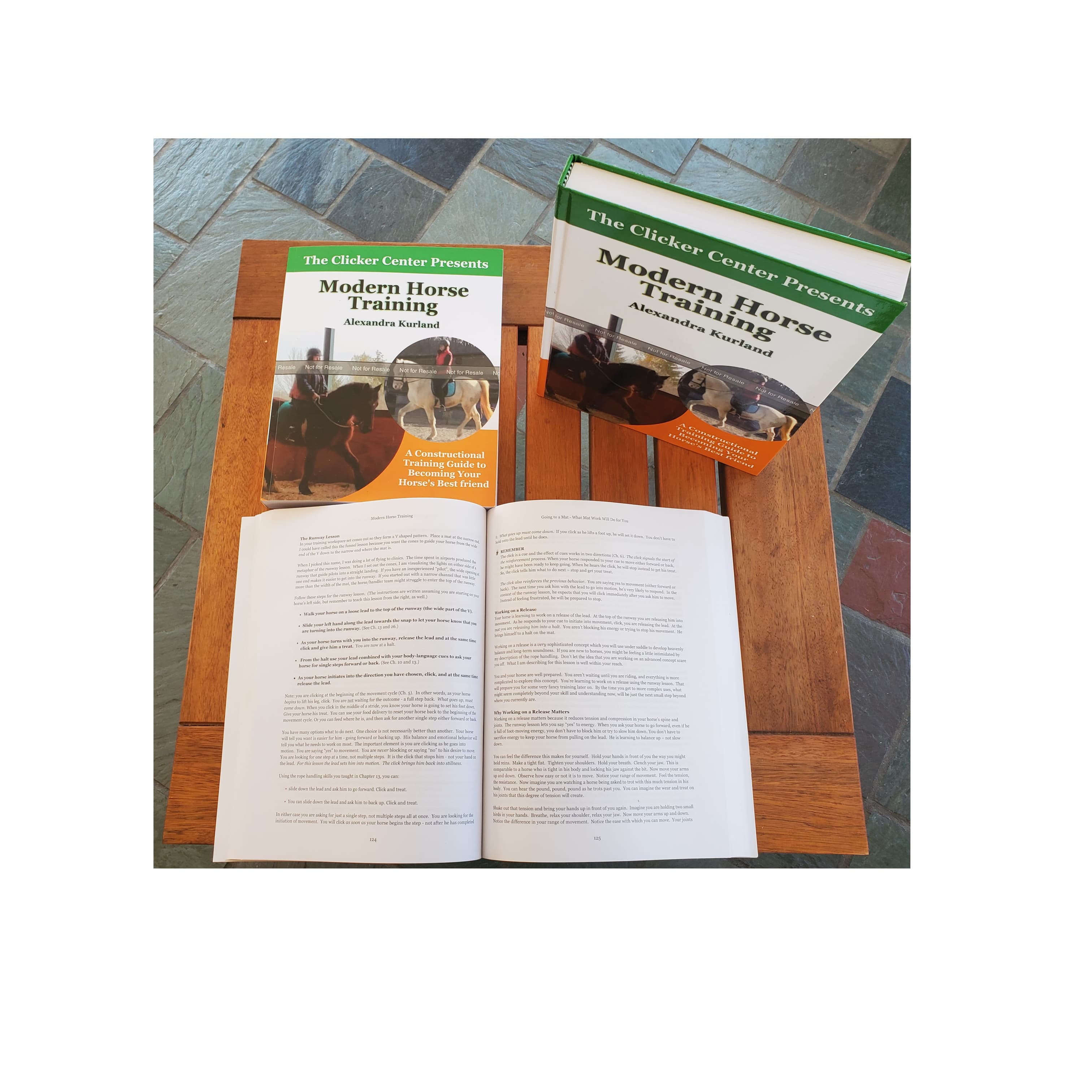
The book is coming! The arrival of the book proofs was very exciting!

Constructional Training – What That Term Means to Me.

I have a new book coming out on April 26: Modern Horse Training

The subtitle of the book is: A Constructional Guide to Becoming Your Horse’s Best Friend.

In the clicker training community we’ve been talking a lot recently about constructional training. Dr Jesús Rosales Ruiz has brought to our attention the work of Israel Goldiamond. Dr Goldiamond was a clinical psychologist. Instead of trying to “fix” problem behavior, he constructed new repertoires. The analogy would be instead of trying to fix a falling down, hundred year old barn with a leaky roof, cracked foundations and ceilings that are too low for horses, you build a new barn that’s purpose-built for what you need. It has none of the problems of the falling-down barn. The old barn may still be on your property, but you don’t have to use it for your horses. The old, unwanted behavior may still exist. Nothing is ever erased or unlearned, but there is a clean, new behavior in repertoire that you can call on instead.

The term constructional training appeals to me. I like building things. The idea that we can teach complex behaviors by first breaking them down into smaller component parts is not new to me. My horses showed me this decades ago.

Nor is this a new idea in the horse world. It is how good trainers train. But that doesn’t make it the norm. Far from it. What we see around us are people who confront problems head on. The horse world is full of instructors who tell their students to send their frightened horses forward, to make them obey, to show them who is boss. Sometimes this works and sometimes it puts the rider in the hospital and the horse on a trailer to the auction yards.

My Path to a Constructional Mindset
I have always been horse crazy. Like so many others I grew up in a family that just didn’t share my obsession over horses. My parents did at least provide me with the opportunity to ride. Over time I developed a decent seat. I could ride, maybe not that well, but riding out over rough terrain, riding at speed, riding bareback were all well within my capabilities. As a teenager, I thought I knew how to ride. As a young adult, I decided I was wrong. Yes, I could ride, but I didn’t really know how to ride. There’s a difference. And I certainly didn’t know how to train. I wanted to learn, so I started to take lessons at a local hunter jumper stable. To choose the stable I opened the phone book – yes, this was a time before computers when there were actual phone books with yellow pages directories. When I chose the stable that was closest to my house, I had no idea what I was getting myself into.

The owner had been around horses all of his life. He had grown up poor with very little formal schooling. I’m pretty sure he would not have been able to read the words I’m writing here, but my goodness he could read horses. He was a superb horse person. Talk about horse whisperers – he was definitely one of them.

He was running a hunter jumper barn because that’s where the money was in the northeast, but that wasn’t where he started out. At one point he had been top ten in the country – in bull riding.

That’s certainly not a typical background for a trainer at a jumper barn, at least not in this region. It made for “exciting” lessons. He had no physical fear. And he didn’t understand fear in others, not in people and certainly not in horses. His approach to fences was to go straight at them, the higher the better.

In New York where I live the thoroughbred racing industry is strong. That means if you are looking for a riding horse, you will encounter a lot of thoroughbreds. The horses in the school line were all thoroughbreds with only one exception, and they were all literally off the track. On Sunday the horses would be racing. On Monday they would be on a dealer’s van heading for the riding stable. The dealers knew Pick was looking for cheap horses, horses that weren’t fast enough, or sound enough for the trainers to hang onto, but who might do as riding horses.

These were horses who had never jumped a fence in their lives – at least not with a rider on board. Pick would set up a line of fences. He’d have one of the teenage boys who rode for him get on and they’d send the horse over the jumps. If a horse balked, they would build a chute. Two men would stand on either side of the chute with lunge whips while the rider drove the horse forward with a crop.

When the horse cleared the fence, the rails went up. They wanted to see what the horse could do.

The horses that took the fences down, or that came up lame afterwards were put back on the trailer and were sent back to the dealer’s yard. The others stayed and were put into the school line. I rode some amazingly athletic horses. I also rode some very frightened, unbalanced, and untrained horses. And I learned a lot about brick-wall training.

Brick-wall Training
Brick-wall training refers to an approach to problem solving where you go head-on into the problem. It was the reality I saw at this stable, and it’s a metaphor for much of what we encounter in the rest of society. If there’s a brick wall in front of you, you head over it, no matter how tall or how wide it is. You either make it over, or you crash. Oh well.

Brick-wall problem solving is fine if you are athletic enough, strong enough, sound enough, brave enough to make it over the fence. Many of those thoroughbreds were. But many of the riders weren’t. Pick lost a lot of potentially good riders to broken bones and just plain old fear.

I very quickly decided to opt out of the group lessons. I watched as many as I could, but I chose to take private lessons instead. I wanted to control what I was being taught. I wasn’t interested so much in going over the fences. That was a fun outcome, but only if the fence was jumped well. I wanted to know how to ride a correct corner that would bring me into a balanced approach to the fence. In other words, I was looking for the components that made for a successful ride. Because I had ridden before, I knew what I wanted to learn.

I baffled Pick. He thought riders just wanted to jump. In my lessons I would stop and ask questions. It turned out he knew a lot about balance. If you asked the right questions you could learn a lot from him. I asked a lot of questions, and I did indeed learn a lot about good riding. By watching the group lessons I also learned what I didn’t want.

I couldn’t go straight at brick walls, not with my horse. This was Peregrine’s mother. I bought her from Pick just before she turned a year old. He had bred her to be a racehorse, but he was just as glad to sell her early. She passed a pre-purchase vet check. Now that I’ve seen more pre-purchase exams, I know the vet was pretty superficial with this one. He wasn’t expecting to see any problems in such a young horse so he didn’t look for any. Not long after that exam, I began to see the first small signs that there was something terribly wrong.

At first, I saw her dragging her hind feet. When I asked Pick about it, he said she was just being lazy. How many times since then have I heard people say that about a horse?

When I saw her fall for the first time, I called the vet back in. This time he looked more closely, and he diagnosed her as a wobbler. She had spinal cord damage. When I started asking questions and doing some digging it was clear that the cause was a handling incident that had gone wrong. She was tied tight to a post while a teenager pulled her mane for the first time. She protested. He persisted. She fought back. She was against the four foot kick board of the arena. Her only escape was over the rail so she jumped it with her head tied tight. I’ll leave it to you to imagine the rest of that scene.

The incident occurred shortly before I bought her. I wouldn’t have known anything about it except one of the visible signs of the event was a swollen hind leg. If I hadn’t seen the swelling during one of my visits to the barn, no one would have said anything about it.

The swelling went away, but the damage to her spinal cord remained. The injury left her with limited awareness of her hindquarters. Wobbler syndrome is descriptive even if it doesn’t tell you very much about what has happened internally. It can be caused by injury, and there is also equine protozoal myeloencephalitis (EPM) which at that time was just beginning to be understood. In either case, even the vets at Cornell had no treatment to offer me. My local vet told me I would never be able to ride her, and he advised me to put her down.

I couldn’t do that. I couldn’t end her life simply because I wouldn’t be able to ride her. That wasn’t right. Nor could I afford to retire her to a pasture somewhere while I got a second horse to ride.

The vet told me that her condition would deteriorate over time, and I would eventually be forced to put her down for safety reasons. That was the future I had in front of us, but in the meantime I needed to deal with what she was struggling with on a day by day basis.

For starters she had trouble going in and out of her stall because there was a sill over the threshold that was intended to keep the bedding from spilling out into aisle. I thought if I taught her to go over ground poles, she would have more confidence stepping over the sill. So I set out a round jump pole. That terrified her. She refused to go anywhere near it. I could have forced her over it. That’s the “show them who’s boss” approach to training I had seen modeled all around me at the riding stable. I didn’t want to fight with her, so I took a different approach.

A ground pole was too hard. That was too big a “jump”. I swapped it out for a flat board that wouldn’t roll if she stepped on it. She was still afraid. She couldn’t manage it.

I tried a lead rope. That was still too hard. So then I drew a line in the sand. That she could walk over. From the line in the sand, I reintroduced the lead rope, then the flat board, and the round ground pole. She was eventually able to jump a small cross rail.

I didn’t approach the problem head on. She taught me how to break complex tasks down into smaller and smaller steps until I found something she could do.

Over time she learned to compensate for the nerve damage. My vet warned me never to ride her. He told me it was just too risky. She might lose her balance and fall on top of me. I listened to him. I had seen her fall often enough to know he was right, but when she was ready, I rode her. She was the horse who introduced me to classical dressage. She was the first horse I taught to piaffe. It was because of her that I became balanced obsessed. That’s what kept her from falling. That’s what kept us both safe, and that’s what formed the core of everything I teach today.

Here is the simplicity of what she showed me:

Break complex tasks down into smaller, simpler components.

Find something – no matter how small, no matter how far away from your goal behavior it may seem to be – where you can get a “yes answer” response and begin there.

Build in small steps.

Build in repeating patterns.

At that time I didn’t know anything about clicker training. I didn’t have the clarity of the marker signal. I wasn’t talking about movement cycles or loopy training. I didn’t call any of what I was doing constructional training, but the elements were all there. I was primed to be a clicker trainer. And I was primed to be drawn to the language of constructional training that Goldiamond has given us.

The new book, “Modern Horse Training“, has grown out of those powerful lessons learned over forty years ago. What we have now are the words to describe what the horses have been showing us. Horses are truly our best teachers. We just need to listen to them and they will open their hearts and their wisdom to us.

The publication date for “Modern Horse Training” is April 26, 2023. I’ll share more about where it can be ordered as we get closer to the date.

Coming next: Contrast Teaches

Modern Horse Training – The Proofs for the New Book Have Come!

I have a new book coming out on April 26: “Modern Horse Training”

Modern Horse Training: book proofs: hardcover and paperback editions plus a peek inside.

Just two weeks to go!

The proofs came Monday evening! So exciting. The book looks great. I’m so pleased. The pages are inviting, so readable. That matters a lot to me. You can have the best information in the world, but if the page isn’t inviting, no one is going to read it. And I know that sometimes what looks fine on the computer screen just doesn’t translate to the printed copy. So it’s always a worry.

So Monday evening there was the package, waiting to be opened. The new book was inside. But there was some avoidance behavior that kicked in. I need to take the deer fencing down before it gets dark. I need to go through my mail pile. Tomorrow won’t do. But now I have procrastinated long enough. It’s time to rip open the package and see the new book for the first time.

And it looks great! I love it!

So the proofs have been okayed. The book is ready, but I’m still going to make you wait until April 26. That’s the official publication date. I wanted to give myself a little leeway in case there were glitches that needed to be fixed. And besides it seems so perfect to bring the book out on the anniversary of Peregrine’s birthday. I want to stick to that date so we all have to wait. Two weeks! Very exciting!

While we’re waiting, I’ll share some background stories related to the book.

Coming Next: Constructional Training: What That Term Means To Me

Modern Horse Training: Why Another Book?

A new book is coming: Modern Horse Training: A Constructional Guide to Becoming Your Horse’s Best Friend

I’ll be telling you soon how you can pre-order it. This isn’t a marketing ploy. I am still getting the book set up so you can order it on line. As soon as that’s done, I’ll let you know. The publication date is April 26, the anniversary of Peregrine’s Birthday.

The book is coming out on Peregrine’s birthday, but it is really celebrating Robin. I think of this as his book. So let me show you why I want to share this work with you.

I’ve said over and over that balance matters. I fuss handling details in the food delivery. In clinics we focus in on the minutia of balance and here’s why.

Look at the changes in the way these horses are standing. In the before images we see the higgledy-piggledy stance of horses that are tense in their backs and unaware of their balance. They can’t stand square and be comfortable. And then we see the changes that occur, often within just a couple of sessions. We aren’t compelling these horses to stand square. They are finding this balance on their own. We teach them the underlying components and what emerges is a horse who can stand in beautiful balance.

You may be thinking: “Okay. That’s nice. It’s pretty. But so what?”

Why does this matter? Why should you care about these changes? Why should you join me in my obsession about balance?

Here’s why:

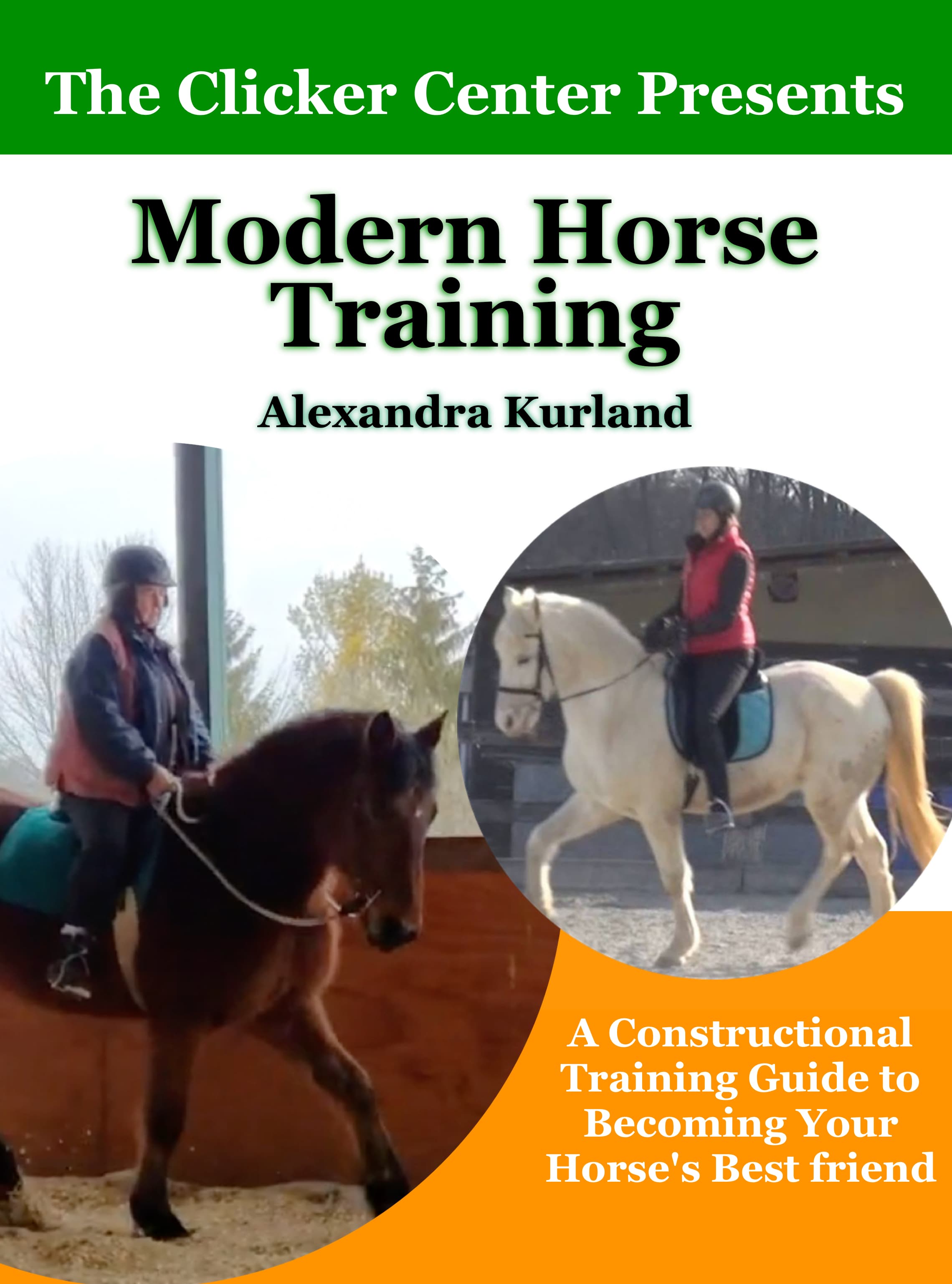
This is one of the images I have chosen for the cover of “Modern Horse Training”. This is Robin. The photo was taken last year. For years when people have asked me how old Robin is I have always said he’s four going on five. In the last year or two I finally decided it was time to update his age. In this photo you are looking at a 27 year old horse – (who still thinks he’s four going on five!)

Balance matters.

Here’s what I write about this image towards the end of the book:

“Robin joined my family as a yearling. He is not only my training partner, he is my much loved best friend. I treasure every every ride, every day we have together.

Good balance is woven into every lesson I have shared with you. My goal throughout this book has been to help you build your own great equine partnership with the horses in your life. Here’s to many great rides on your beautiful horses!”

If there’s an elevator speech way to describe the new book, that’s is it. Balance matters. For all of us who love our horses, these horses show us why.

Coming next: Constructional Training: What that means to me.

Modern Horse Training: The Story Behind the New Book

I have a new book coming. It will be published April 26, on the anniversary of Peregrine’s birthday. You’ll be able to pre-order it soon. I’m still getting all of that set up. I’ll have more details about how you can order the book coming soon.

For now let me tell you a little more about it.

In 2020 I was asked by an editor working for a popular line of self-help books if I would consider writing a horse training book for them. The request was interesting. It did no harm to say I would consider the idea. For a couple of months I heard nothing more from him. Then I got another email. This one took the idea a little further. They were definitely interested.

The email exchanges continued. The editor asked me to write a sample chapter. I did. In the fall of 2021 I was offered a contract to write a horse training book for them. The contract was very one-sided, but their marketing would bring clicker training to a much broader part of the horse community than I am able to reach on my own. So, even though it felt more than a little bit like I was selling my soul, I signed the contract.

I was still working on my on-line clinics so it was nose to grindstone all winter to get that project finished. I launched the clinics March 11, 2022. The following day I started on the new book.

It turned out the clinics were the perfect prep for writing a book. I was well primed. The words literally flew onto the page. The contract stipulated a July deadline for submitting the final chapters. I beat that deadline by two months. By mid-May I was sending in the final chapters. The editing had already begun on the sections I had already submitted. I had a meeting with the editor the end of May, and then I heard nothing.

Weeks went by in email silence. I started emailing others in the team who would be involved in the book’s production. Nothing. Finally, at the end of June I got an email from the production manager. The editor no longer worked for the company, and they would not be going ahead with the book. End of story.

I told you the contract was very one-sided.

So I was left with a book, but no publisher.

I put the book aside for a while. I had other projects that needed my attention, and I wanted some time to consider my options. I could look for another publisher. I could publish it myself. Self-publishing seemed like the best option. I like the editorial control that gives me over the content.

So there you have it. I wasn’t intending to write another book. That wasn’t on my radar. The book is very much the product of the pandemic. At the start of 2020 I had a full schedule of clinics planned for the year ahead. When we went into lockdown, one by one those clinics were canceled. My initial thought was I couldn’t possibly transfer my teaching to an on-line format. I needed to see the horses, to work with them directly to know what to advise. But in-person clinics were out, so I started to experiment. Rebekka Schulze, the organizer of the North Carolina clinic that was scheduled for the spring of 2020, invited me to test out a zoom clinic option. I discovered I loved the format. Using video we could focus in on the training details make such a difference to horses. People didn’t have the expense or the stress of travel. We could watch the horses in their home environments. There were so many advantages.

I put together more on-line clinics. I built each clinic around a major topic. I think my favorite was the rope handling clinic. Who knew that you could teach something as tactile as rope handling via an on-line platform!

Those clinics created the structure for the new book. When I heard back from my contact at the publishers that they weren’t going ahead with the project, I was actually relieved. They had done me a huge favor. I would not have written the book without the prompt from them. But in the end I am glad to have the book back in my own court. Their contract placed too many restrictions on how I could use my own work.

I set the book aside over the summer and came back to it in the fall of 2022. When I read it with a fresh perspective, I loved it. It’s a very good book. It needed to be published, so the editing and formatting process began.

The gestation period for a horse is roughly eleven months. It has taken me just a little bit longer than that to write and prepare my new book for publication. Every day I get a step closer to having it ready. April 26 is my target for publication – Peregrine’s birthday.

Coming next: I’ll answer the question – why another book? And very soon I’ll have information about how you can pre-order your copy. This isn’t a marketing tease. So much has changed in the publishing world, I’m on a steep learning curve putting all the pieces in place for a smooth book launch April 26.

Modern Horse Training

I have a new book! And I have a publication date. Very exciting.

The new book is “Modern Horse Training: A Constructional Guide to Becoming Your Horse’s Best Friend.”

The publication date is April 26 -27, 2023.

That may seem like an odd way to write the date. I chose the dates in honor of Peregrine. He truly was my beloved best friend. He’s the horse who introduced me to clicker training so how perfect that the newest book will be published on the anniversary of his birthday/first day.

He was born shortly before midnight on April 26, 1985. I have always celebrated both his birthday and his first day. For his 30th birthday I wrote a series of blog posts through the month of April. You can read them here:

https://theclickercenterblog.com/2015/04/12/

So a new book! What’s in it? What’s it about? How is it different from the other books? I’m sure you have lots of questions. I’ve been so busy writing the book and getting it ready for publication I haven’t really come up with the “elevator speech”. I don’t yet have the quick two or three sentences that grabs your attention and makes you want to know more.

I have three weeks to the book’s publication so I’m going to use this blog to help me develop my elevator speech. Why did I write this book? There’s a story behind that. But before I share that story, let me begin with the title.

“Modern Horse Training”

Why that title? All my other books have referenced clicker training, so why the change?

What does “Modern Horse Training” really mean?

To answer that kind of question I like to begin with the dictionary.

“Modern:

adjective
relating to the present or recent times as opposed to the remote past

characterized by or using the most up-to-date techniques, ideas, or equipment•
denoting a current or recent style or trend in art, architecture, or other cultural activity marked by a significant departure from traditional styles and values

noun (usually moderns)
a person who advocates or practices a departure from traditional styles or values.”

I often think about what life was like for horses (and people) in times past. I’ll say a hundred years ago ___, using that phrase as a benchmark against which to measure changes that have occurred. It occurred to me recently that while I use this phrase a lot, I haven’t kept it updated. So when I say a hundred years ago, I don’t really mean 1923. I mean a hundred years ago from the time when I was a child and I was forming my ideas about the world I lived in. What was the historical context in which I lived? I was growing up with a television in the house. My parents had listened to the radio.

I got my first horse in 1968. So a hundred ago at that time meant 1868. Think about what the world was like in 1868. That was the world Anna Sewell wrote about in “Black Beauty”.

I remember reading a monograph from England that was written in the 1840s. It described the care of the horses that were used to pull what were essentially city buses. The horses came mostly from Ireland, strong Irish draft horses. They used mostly mares which I thought was interesting. The horses were put to work when they were four or five and they were dead by age seven or eight.

Think about what a hundred years ago means to you. If you’re ten years old, that’s 1913, a year before the First World War. Think of the horses who lost their lives in that terrible war. It wasn’t machines that pulled the canons up to the front lines. It was horses. That included the strong Cleveland Bays that my Robin is descended from.

Wherever your hundred year benchmark begins, the world has undergone some incredible changes. We’ve seen tractors replace horses in the fields, cars replace them on the roads. I can watch a movie on the same device that I use to type this blog. Just incredible.

And that doesn’t even begin to address the many cultural changes that have occurred. Horse training and child rearing used to share the same motto: spare the rod, spoil the child. At least with children, that has changed. Yes, I know children are still beaten, but now it is called what it is – abuse and family services can step in. All too often with horses, it is still called training. Much has changed and in in some ways nothing has changed.

I want to celebrate the much that has changed.

This is the perspective that I was thinking of when I decided to call my new book “Modern Horse Training”. Horse training is not what it was a hundred years ago. It now includes clicker training and all that that means.

So before I tell you more about my new book, let me leave you for today to think about what a hundred years ago means to you. What was the world like a hundred years ago? And what are the changes that you have seen, that your parents and grandparents have seen. We are living in a different world from anything the people living a hundred years ago would have imagined. “Modern Horse Training” belongs to this new world. In the coming days I’ll tell you more about it. I may not end up with an elevator speech, but hopefully you’ll have a good sense what the new book is about.

Anniversaries

I’m beginning this post on October 27.  Who knows when I will actually get it done and published, but the beginning date is important.  All year I have been writing thank yous to the many people who have helped bring clicker training into the horse community.

Obviously I can’t thank each and every person.  There are too many of you, and I would be bound to forget someone.  I would hate to create a long list and then hurt someone’s feelings through an omission of error.  So I will send out a general, and most heartfelt thank you to everyone who has given clicker training a try, found it to your liking, and made it part of your life.

I have chosen October 27 to begin this post because it marks two special events.  On October 27, 1968 I became a horse owner for the very first time.  Since that day I have never been without a horse in my life.  And on October 27, 1998 I received a package in the mail.  It was an advance copy of my book, “Clicker Training for your Horse”, sent to me by my publisher, Sunshine Books, Karen Pryor’s company.

So I’m going to say thank you to my first horse because in so many ways he transformed me from a rider into a trainer.  I didn’t know at the time all the good things he would be bringing me.  When we first started out together, it was anything but good.  He was a totally unsuitable horse for a child, but I never said anything to my parents.  I was afraid if they knew how dangerous he was, they might send him back to his previous owner, and that would be the end of having my own horse.

I met his previous owner only once, on the day I tried the horse he was selling.  He was a large, overweight man.  He probably weighed over two hundred pounds.  He rode in a western bit with a long shank so when he pulled back he could exert a tremendous amount of force.  He liked to go trail riding – at speed.  He was one of those riders who got on and took off at a gallop and didn’t stop until he was back home.

So it was no wonder that the first time I rode my new horse out of a ring he took off at a gallop.  I’d only had him two days.  I had been riding in a small ring just outside the barn.  For some reason that made sense to her, the owner of the boarding barn told me to take him out of the ring.  Since he was there for a week’s trial, maybe she thought I should be doing more with him.

“You need to ride him out in the field” she declared.  I listened.  I took him out into a hay field that had an oval track cut into the grass.  At the far end of the track he took off at a gallop.

I was no match for him.  There was no way I could pull back with the force of his previous owner.  I tried to stop him but my feeble attempts made no dent in his determination to get back to the barn.  I’d been told when you want to stop a horse you pull back.  That’s what I was doing, but it had no effect.  As we galloped across the hay field, I remember shouting at him – “You’re supposed to have stopped by now!”  I really did!  It made no difference.

He didn’t stop until he was back inside the barn standing in his stall – which thankfully was on a straight line in from the barn door.  It was feeding time, so of course he wanted to get back, and I couldn’t stop him.

I lost track of the number of times he bolted with me after that.  His favorite and most terrifying “trick” was to run straight at a tree and only at the last second to duck to the side.  Sometimes I managed to stay on.  Often I fell off, but I always got back on and kept trying to stop him.  We eventually worked out a truce, and we were able to ride together at a pace that was more to my liking.  He was wonderfully sure footed so trail riding was fun.  He was one of those horses that you pointed in the general direction of where you wanted to go and then let him find the best way.  He was fearless riding out.  I don’t remember him ever spooking at anything.  It was just the bolting for home that was unnerving.

I can’t tell you how many times I got so frustrated with him that I almost gave up.  Almost, but never totally.  I don’t really know what finally made the difference.  I think it was simply that we gradually built a relationship.  He never showed much affection, and he was a hard horse to love.  I don’t think he expected people to be kind so he kept his true self very much hidden.  Now that I have seen how expressive horses can be, the contrast seems all the greater.

In the spring of my last year of high school he became lame.  It was one of those subtle, on-again-off-again lamenesses.  The vet diagnosed him with navicular disease.  Today we would say he had heel pain, and we would change the way he was trimmed.  But at that time changes in the navicular bone meant a diagnosis of permanent lameness.  I was delighted.  It meant that I wouldn’t have to sell my horse when I went away to school.  You couldn’t ethically sell a lame horse, so all through my years at Cornell I supported my horse.

I couldn’t take him to school with me, nor could he stay at the boarding barn without anyone to look after him, so he went to live with a family who had room for another horse.  I was lucky to find him such a good home.  He lived in retirement with them for seventeen years.  He finally passed away at the grand old age of 33.

I’ve never followed norms.  It’s the norm in the horse world to discard horses that are too lame or too old to ride.  This has always bothered me.  We have a responsibility to see to our horses’ lifelong care.  I feel as though I have earned the right to stand on the soap box that says people need to take care of their older horses.  As a student at Cornell, my budget was already tight.  Stretching it to cover my horse’s expenses made it tighter still.  I’m sure there would have been many people who would have sent him off to an auction and been done with him, but every month I wrote out a check to cover his expenses.  And every time I was home, I went up to visit him.

He was becoming so much more affectionate.  It was as though I had been a bridge between his old life and this new one.  We had struggled together.  When he bolted off with me, the adults at the boarding barn told me I needed to get after him, to punish him.

He had scared me.  When he came to a stop after one of his flat-out gallops, hitting him with the ends of my western reins was easy.  It changed nothing.  He kept bolting, but in the moment it did feel good.  Oh that slippery slope called punishment – it can be so reinforcing to the punisher.  Somehow I recognized that and managed to stop.  Punishing him wasn’t the answer.  Persistence was.  And now that he was in a quiet place being cared for by kind people, he was becoming trusting enough to show affection.

But I thought I was done with horses.  I know – that’s a surprise considering how completely they have been in my life.  He had not been an easy or fun horse to own.  I was heading off in a different direction, one that didn’t include horses.  But shortly after graduation, I got a call from the person who was caring for him.  He was showing signs of heaves, and she wanted to let me know.  I’d heard of heaves.  I knew vaguely what that meant, but I needed to know more.  So I got a book from the library on horses.  I read the short section that described heaves and then kept on reading.  That was my undoing.

When I started reading the chapter on raising foals, I thought I could do that.  By the time I had turned the final page I had switched from I could do that to I want to do that.  The overwhelming addiction to horses was reawakened.  I could think of nothing else. But I didn’t jump in right away.  I read everything I could get my hands on about horses, and I began taking lessons – English lessons from a very skilled horseman.  And I began to search for my foal.  I was going to have a horse I raised myself.  Only I wasn’t going to use all those harsh techniques that surrounded me in the horse world.

I was taking lessons at a hunter/jumper barn.  The instructor bought cheap thoroughbreds off the track and put them into his lesson string.  He was one of those riders who could get on an agitated horse and in minutes have it settled.  He couldn’t teach what he he did, but it was impressive to watch.  He had no physical fear on a horse, and he didn’t understand that anyone else might.  He thought that he needed to get people jumping as quickly as possible or they would get bored and go away.  Mostly that meant people got injured and went away.

I wasn’t yet balance obsessed, but I knew enough to know that I wasn’t ready to jump.  I took charge of my lessons.  I insisted on working primarily on the flat.  I thought it was more important to learn how to get to a jump in good balance than it was to go over it.  I jumped in the weekly group lessons, but in the private lessons I added in I took charge of what we worked on.  It helped that I had ridden before and had my own horse.  I asked endless questions.  He wasn’t used to this kind of riding student, but it meant I was learning what I needed.  I had to be ready for the foal I was going to raise.  Of course, he tried to talk me out of starting with a baby.  I heard all about green on green, but I was determined.  The hunt was on!

I was still supporting my first horse.  Adding a second horse was going to stretch my budget even tighter.  When I found her, my beautiful thoroughbred yearling, I wasn’t sure if I could really afford her.  I kept going over the numbers.  If I gave up this, if I cut back on that, could I stretch things enough to get her?   No matter how many times I tried to balance my budget, the numbers kept coming up short.  But I had to get her.  When I finally said yes, it was a real leap of faith that things would work out.  And somehow they did.

I get often get emails from people saying they are on a tight budget.  I totally understand.  I remember when videos first came out being really excited.  Here was a way to expand my knowledge even more.  The very first video I ever bought cost $89.  That was a huge stretch of the budget for me.  The video was a disappointment.  It was a simplistic overview that had no depth to it.  It was something you watched once and never needed to see again.  What a waste of precious dollars.

That’s why I have always been determined to pack as much as I can into all the books and videos I have produced.  They contain layer upon layer of information.  You can return to them many times and always find new things in them.  I want to give good value for money.  If you are on a tight budget, I still want you to be able to access good information.  And I want you to have an alternative to the force-based training that is so prevalent in the horse world.

In those early days the books I was reading didn’t help me to know how to train.  If anything, they taught me more about what NOT to do.  They were filled with advice on how to be a better punisher.  That wasn’t what I was looking for.

I had already had my first great teacher – my first horse.  I began by learning from him what I didn’t want.  In the years to come I was going to have many more lessons in patience and persistence.  I moved from knowing what I didn’t want to breaking lessons down into very small steps.  I learned about consistency and focus.  I learned to choose kindness over force.  My horses prepared me well so that when I finally stumbled across clicker training, it made perfect sense to me.  It was a good fit.  I was ready for Peregrine to teach me about this new way of training.

In this year of celebration I have thanked many people, but on this day I am thanking my horses.  It truly is my horses, my teachers.  I am so very grateful to them.   They have carried me across many stepping stones to what I have today – a deep and loving connection with my horses.  And I am delighted to be able to share what they have been teaching me with all of you.  We don’t have to listen to the people who are telling us to get tougher.  Our horses are showing us a different way, a way they understand and want us to know about.

Have fun!


Do It Differently

It was bound to happen.  At the start of this year I said every month this year I was going to use this blog to write a thank you to some of the many people who helped bring clicker training into the horse community.  This is my way of marking the twentieth anniversary of the publication of “Clicker Training for Your Horse”.  Sometimes it was just by a whisker, but I managed to get this done every month – except August.  I will blame the extreme heat that slowed me down to a snail’s pace.

I can’t blame my travel schedule because I travel every month.  August was no exception.  I was out in Washington State at Ken Ramirez’s Ranch for his “Animal Training for Professionals” course.  For twenty years he taught this as a semester long course at the University of Illinois.  He also taught a concentrated week-long version of the course at the Shedd Aquarium.  Most of the time is spent in the classroom but twice a day students get to have some animal time.  For the week-long course at the Shedd attendees got to watch the trainers working with animals.  At the Ranch attendees get hands-on experience working with goats, miniature donkeys and alpacas.

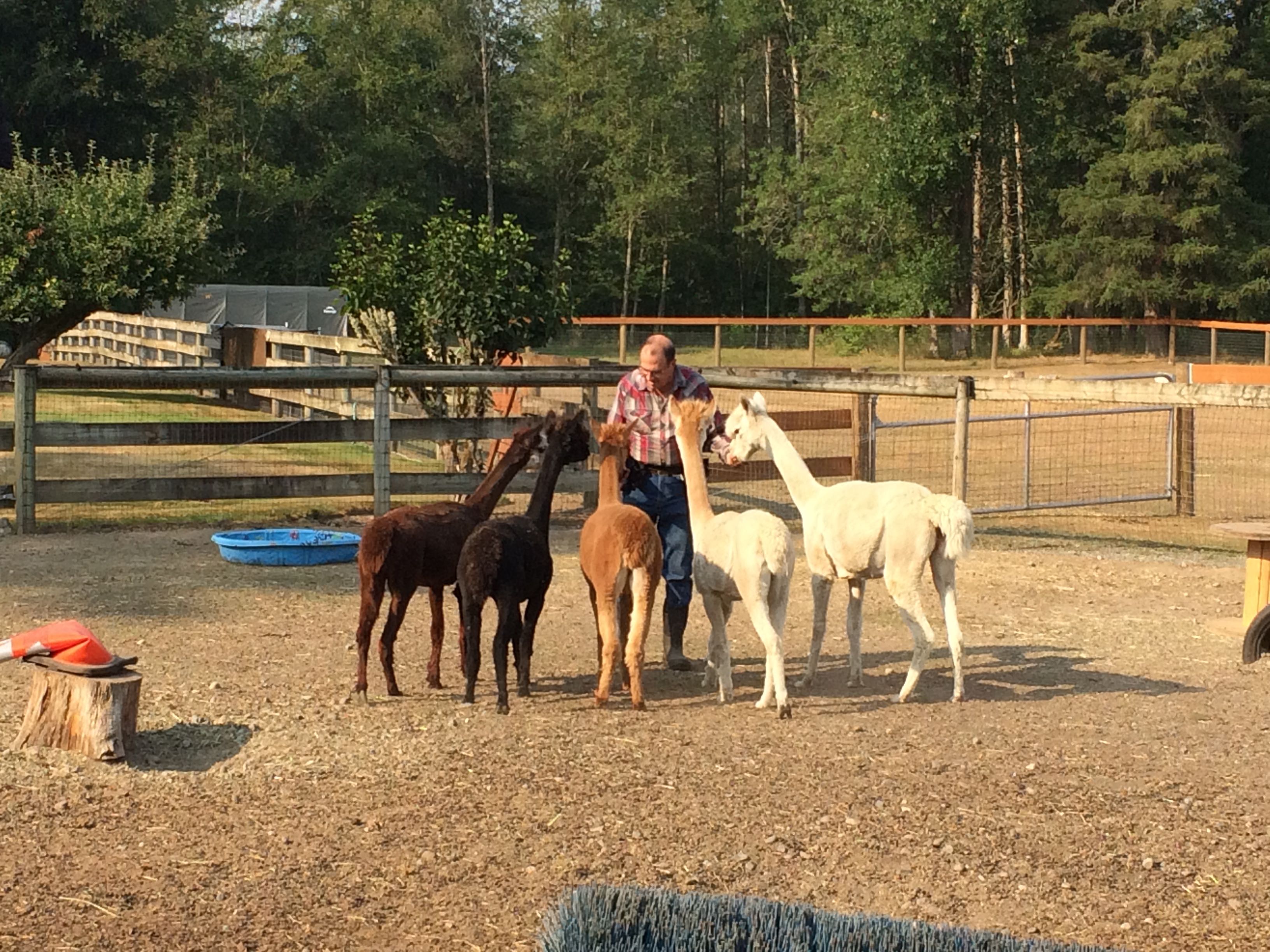
IMG_5425 Ken Ramirez with alpacas

Ken Ramirez with his alpacas

For this course I got to be Ken’s assistant which was a great fun, especially since most of the training sessions involved his herd of dairy goats.  I enjoyed very much seeing what Ken was teaching his herd of clicker-trained goats – what was a match up with what I was teaching my goats and what were some good ideas to take back to them?  It was also very interesting to see how Ken structured the course.  What did he put in his foundation?  What stair steps did he use to take people into the more advanced aspects of training?

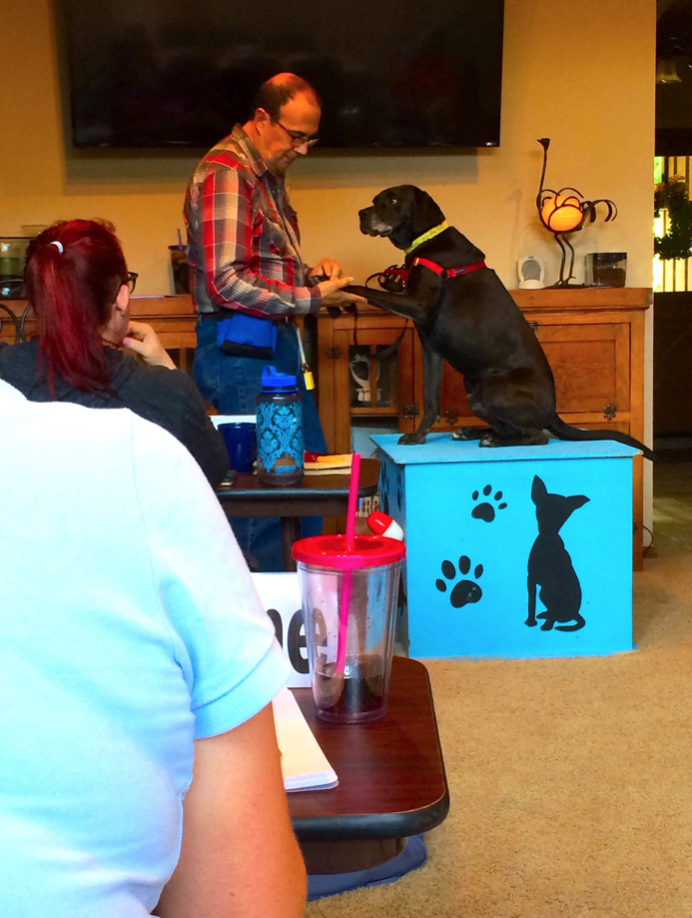
Ken Ramirez teaching husbandry behaviorsOn the third day Ken focused on husbandry, especially as it relates to medical care.  He is uniquely qualified to speak on this subject.  Both at the Shedd and through his consulting work, he has overseen the teaching of cooperative husbandry procedures not just to more animals than most of us will ever handle in a lifetime, but to more species as well.

Ken’s basic strategy can be summed up in a very simple phrase: do it differently.  Every day in your training you should be practicing some form of husbandry skills, but the key to success is don’t try to mimic a procedure someone else is going to be doing.  Your touch is going to be different, so even if you try to make everything the same as the real thing – you won’t succeed.  And besides, you don’t know what you are preparing your animal for.  Is it to stand quietly while you doctor a wire cut on your horse’s leg, or to put eye drops into an infected eye?  We don’t have crystal balls that can tell us what medical procedures our horses will need to tolerate.  X-rays might be standard, and certainly shots, but beyond that what are you preparing your animal for?

So Ken says do it differently.  Get your animal accustomed not just to being touched all over his body, but to being touched in different ways.

Do it differently also applies to getting an animal comfortable with changes in the environment.  Every day introduce some change, something different.  You aren’t trying to scare your horse.  You just want him to get used to the idea that change happens and it’s nothing to worry about.

Do it differently is a great life metaphor.  Sometimes we need to follow the rules, to do things the way “they have always been done” because the way they have always been done works.  The motto here would be “if it ain’t broke, don’t fix it.”

But even if it “ain’t broke”, can it be better?  Are we stuck in a rut just mindlessly copying what has been done before?  Horses have been trained for thousands of years.  On the surface the training that I learned from experienced horse trainers didn’t appear to be broken.  They could get on and ride their horses.  They could make them jump and cross scary streams.  They could make them go where they wanted.

“Make” was the operant word.  The end result could be very appealing, but if you scratched too far below the surface, you discovered a very broken system.  It was littered with discarded horses and far too many frightened would-be riders.  Something needed to change.

I was very lucky to be learning about horse training at a time when two very important change makers were shaking up the horse world.  One was Sally Swift who brought the Alexander technique into the horse world and changed the way riding was taught in the United States. Sally came regularly into my area so I was very fortunate to have been able to attend many of her workshops.

The other change maker was Linda Tellington-Jones, the founder of T.E.A.M. training (Tellington-Jones Equine Awareness Method).  Through Linda the horse world was introduced to the Feldenkrais work.  Early on I encountered T.E.A.M. training through a magazine article.  In it Linda described the body work she had developed, including the T.E.A.M. circles.

Peregrine’s mother was a wobbler.  She had a spinal cord injury that impaired her balance and made her very body defensive.  When she was a yearling, if I tried to touch her anywhere, I was met with gnashing teeth and pinned ears.  Her whole body couldn’t hurt, but I couldn’t figure out what was wrong because she wouldn’t let me in to ask questions.

I was reading everything and anything related to horses, and I was eager to learn.  These funny T.E.A.M. circles Linda was describing sounded intriguing.  I tried them on my mare and her world changed.  In minutes her eyes had grown soft.  Her head was drooping.  She was letting me in all over her body – except in one area around her right shoulder.  That was where the pain was.  For the first time she could relax enough to let me know what was wrong.

Within a few weeks I was on an airplane headed to the mid-west to attend a workshop Linda was giving.  I had to learn more!

That was the first of my many travels for horses.  At first I was traveling to learn, and then I was traveling to teach (which really means to learn even more!)

At one of the T.E.A.M. workshops Linda was letting us experience for ourselves the T.E.A.M. body work.  She let me feel one version of the T.E.A.M. circles, and then she did it another way.  She had her hand on my back so I couldn’t see what she was doing, but, oh my goodness!  It felt so very different!

I turned to face her.  “What did you do!?”

Her answer meant nothing to me.  “I breathed up through my feet.”

Now I’ve been trained in the biological sciences.  I’ve studied anatomy and physiology.  I’ve done dissections.  I know we breathe through our lungs, not our feet.  And beside, I had hay fever when I was little.  I was constantly congested.  Even breathing through my lungs felt like a foreign notion.  My breath got clogged somewhere at the top of my chest.

But I knew that breathing up from her feet meant something to Linda, so I went in search of the translation to that phrase.  One of the teachers I found lived in my area. She had a horse with a hard-to-diagnose lameness.  She contacted me to see if I could help her with him.  It turns out that the lateral work I was learning helped enormously.  When he carried himself in good balance, there was no sign of the lameness.

His owner, Marge Cartwright, was an Alexander practitioner, and she had also studied the Feldenkrais work.  So we ended up doing trades.  I worked with her horse to help him to be sounder, and she worked with me. Overtime I learned not only what it means to breath up through my feet, but to breathe up from the ground.  Learning that changed how horses relate to me.  It isn’t magic.  It isn’t some mystical gift of a horse whisperer.  It is simply the systematic unblocking of tension.  One metaphor that I love is the shining of a light on the dark places.  These are the places where movement become stuck, and we hide from ourselves the reasons for the stiffness.  This image comes via Anita Schnee, a Feldenkrais practitioner and regular attendee at the clinics I give at Cindy Martin’s farm near Fayetteville Arkansas.

The work Marge shared with me stands as one of the central pillars of what I teach today.  It is woven into every lesson both the ones that I give directly to horses and the lessons that I teach to their handlers.  Unless you live in my area and had the good fortune to learn from Marge, you won’t know her name.  But I owe her a huge thank you for enriching my life beyond measure.  Her work is woven into what I mean by equine clicker training.  If you have participated in a body awareness lesson at one of my clinics, you have been the direct beneficiary of her work. If you have thought about your own balance as you feed your horse a treat, that’s Marge’s influence again.  If you are learning about school figures – circles, lateral work, diagonals, etc. – by walking them without your horse, Marge has a hand in that, as well.

An awareness of balance, no much more than that – an appreciation for balance, an understanding that balance and soundness go hand-in-hand is something that I explored with Marge.

Clicker training for horses might have been little more than the teaching of tricks if it weren’t for this fascination and appreciation for balance.  Instead clicker training is a complex, wonderfully rich and diverse training system that can meet all needs. It includes the fun of tricks, but it doesn’t stop there.  The central core, the pillar that supports everything else is balance.

So thank you Marge for sharing your work so generously.  When you suggested we trade services, I’m sure you had no idea the ripple you were about to set into motion.  You helped make clicker training so much more than simply the pairing of a marker signal with treats.  What we teach and how we teach have become woven together to create a magnificent whole new way of doing things.  We dared to to it differently and look what grew out of it!

Thank you!

Giving The Ball A Push

2018 marks the twentieth anniversary of the publication of “Clicker Training for your Horse”.  I am celebrating by writing thank yous each month to people who helped bring clicker training into the horse world.

Are you trying to guess who it’s going to be this month?  Anyone who has followed my work knows the stories.  You’ve met the horses through my books and DVDs. Who will I single out this time?

I could turn it into a guessing game.  This person has appeared in the game show: “What’s my line?”.  Does that help?  Maybe not.  But if I tell you that the panelists correctly guessed that she was a dolphin trainer, now some of you will know who I’m talking about.  July’s tribute belongs to Karen Pryor.

So many of us were first introduced to clicker training through Karen’s book, “Don’t Shoot the Dog”.  I discovered her book through a friend who bred and trained Irish wolf hounds.  We were having lunch together (with one of her wolf hounds literally looking over my shoulder).  Needless to say, we were talking about training.  I’ve forgotten the exact subject, but I do remember my friend saying, “But of course, you’ve read “Don’t Shoot the Dog”.

Don't Shoot the Dog

She said it in a tone that implied that of course I had.  How could I not?  But in 1993 I had never even heard of “Don’t Shoot the Dog”.  Perhaps if Karen’s publishers had called it “Don’t Shoot the Horse”, the horse world would have been exploring clicker training ahead of the dog world.  We’ll never know.  But in any event, I tracked down a copy of “Don’t Shoot the Dog” and read it with great interest.

Those of you are familiar with Karen’s book know that it is not a training book per se.  Karen was writing about learning theory, a subject which can sound very dry and off-putting.  “Don’t Shoot the Dog” is anything but.  You read it, nodding your head in agreement.  “That’s why that horse, that dog, that person responded in that way.  It all makes so much sense!  How could they do anything else.”

When I read the chapter on punishment, I remember thinking, “The horse world needs to know about this.”  The horse world needs to understand that when you use punishment, there is ALWAYS fallout.  You always get other unintended, unwanted consequences.  Punishment doesn’t work with laser-fine precision.  You may shut down the behavior you’re after, but the effect spreads out and creates negative consequences and a general dampening down of behavior.

Use it often, and you will get what in the horse world is often called a “well behaved” horse, meaning a shut down horse.  Punishment stops behavior.  That’s the definition of punishment (versus reinforcement).  When you use reinforcement (plus or minus), the behavior you’re focusing on increases.

When you use punishment, the behavior decreases.  So you may punish biting.  Strike hard enough, fast enough, the biting may indeed stop – for the moment.  But punishment isn’t a teaching tool.  It doesn’t tell the horse what TO DO to avoid the unwanted consequence.  However, it is reinforcing for the punisher.  That’s what makes it such a slippery slope.  It may not get the results that you’re after, but in the moment, oh it can feel so good.

When skilled positive reinforcement trainers talk about the four quadrants meaning positive and negative reinforcement, and positive and negative punishment, they don’t take the use of punishment completely off the table.  They recognize that under the right conditions punishment – applied well – may be a necessary and correct choice.

In many of her presentations Dr. Susan Friedman talks about the hierarchy of behavior-change procedures.
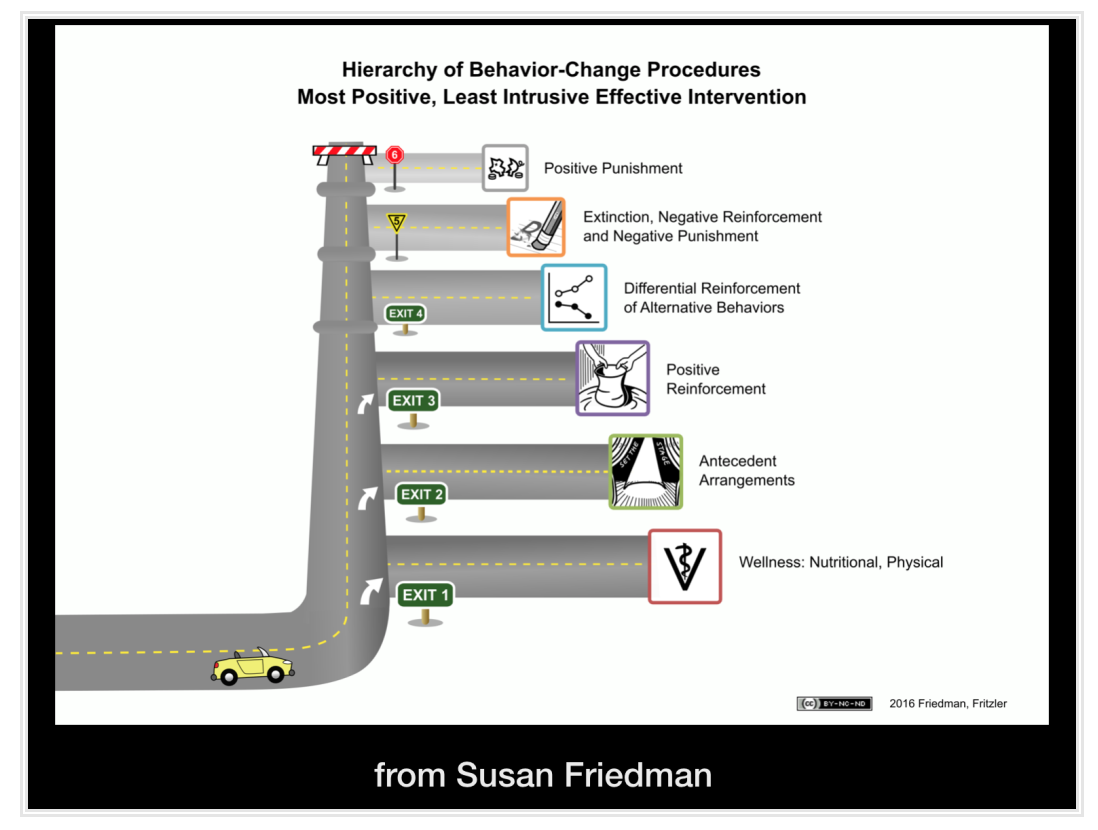
 

Susan Friedman's hierarchy

You begin with the least intrusive interventions.  You begin by exploring medical reasons for the behavior, then you move to changing the environment, and positive reinforcement procedures.  Only after many steps and pausing always to consider if there might be other alternatives, would you consider the more intrusive methods and sitting last as a possibility would be punishment.  And before people puff themselves up and say – I would never use punishment, remember Dr Friedman spent much of her career working with children with major behavioral problems that included self-injurious behavior.  So what would you do with a child who is trying to gouge her eyes out?  Is punishment of that behavior always off the table?

Punishment is certainly not where you begin, but there may be extreme situations where it is where you end up.  If a fire were fast approaching, and you needed to load a reluctant horse on a trailer NOW or leave him behind, would you resort to punishment?  Until you’re faced with that situation, it’s an open question.

Ken Ramirez, another trainer I greatly admire, doesn’t take punishment off the table either.  However, when he was overseeing the training program at the Shedd Aquarium, the novice trainers were only allowed to use positive reinforcement.  They could reinforce behaviors that they liked, but they had to be non-reactive to behaviors they didn’t like.  Only when they were more skilled could they begin to use more advanced techniques.  In his talks on this subject Ken explains why he puts these limits on his young trainers.  At some point early in their career they will come to him, asking for permission to move up the hierarchy.

“Ken,” they will say, “I could so easily solve this problem we’re having with this animal if only you would let me use this procedure that I’ve read about.”  Ken won’t let them.  He wants them to become very experienced with the basics.  If you let them begin to add in other techniques too soon, they really never learn how to be skilled and creative with the basic tools.  They jump the queue too fast and head for more intrusive techniques.

As they become more skilled, he lets them expand into the rest of the hierarchy.  His senior trainers can use any technique, including punishment, that they deem to be appropriate.  But he knows that these trainers have the experience and the skill to apply punishment well, meaning with good timing and at the right intensity to create the desired effect and minimize the fallout.  He also knows that they are so skilled and experienced that they don’t need to use punishment.  They will find other alternatives.

The odd thing in the horse world is we flip things upside down.  We reach first for punishment.  The horse bites – we strike.  It’s the horse’s fault.  And if he bites again, we’ll hit him harder.  We don’t look first for medical conditions.  Maybe that horse is full of ulcers.  Treat the ulcers and his reason for biting will go away.  We don’t rearrange the environment.  Use protective contact – put a barrier between you and the horse so he can’t bite you, and then use positive reinforcement to teach him alternatives to biting.

Instead we give six year old children riding crops (often pink riding crops with pretty sparkles), and we tell her to hit her pony harder.  We give punishment to the least experienced, most novice riders.  That’s completely upside down.  No wonder what we get back are so many sad stories, so many bad endings for both people and horses.

When I said the horse world needs to understand what Karen was saying about punishment in “Don’t Shoot The Dog”, I’ve always though some genie of the universe heard that.  “Got one! She’ll do.”  I was sent the clicker training bug.  More than that, that genie sat on my shoulder and kept urging me to write about what I was experiencing with my horses.  Lots of people, including Karen Pryor, had used clicker training with their horses before I ever went out to the barn with clicker in hand.  I was by no means the first person who ever used it with a horse.  But they didn’t disappear into their computers to write about it.  That good genie on my shoulder made sure that I did.

“Don’t Shoot the Dog” sparked my interest.  I wanted to know more about clicker training.  I read “Lads Before The Wind”,  Karen’s chronicle of the founding of Sea Life Park and the development of the first dolphin shows.  She shared with us the many training puzzles that had to be solved in order to figure out how to train dolphins.  Old-style circus training wasn’t the answer.  She turned to science and the work that was coming out of B.F. Skinner’s lab.

“Lads Before The Wind” took me a step closer.  I wanted to know more about training with a marker signal.

My friend brought me a copy of a magazine article she thought I’d find interesting.  I have no idea what the article was about.  I’m not even sure that I read it, but down in the left hand corner, in very small print, was a tiny ad for two of Karen Pryor’s early VHS videos.  I sent away for both.

The first one was recorded at a seminar that Karen gave with Gary Wilkes to a group of dog trainers.  Gary was the canine trainer who approached Karen with the question: “Do you think clicker training would work with dogs?”

In a conversation I had years ago with Karen, she said she had always had dogs, but they weren’t really trained, not like she had trained the dolphins.  They were just around.  But when Gary wondered if clicker training would work with them, Karen thought, of course!  Why not!  So she and Gary teamed up to give a series of seminars to dog trainers, and we all know what grew out of that for the dog world.

The clip from that seminar that intrigued me and sent me out to the barn to try clicker training my horse showed Gary training a twelve week old mastiff puppy to sit and then to lie down – all without touching the puppy.  These days that’s become so the norm, it wouldn’t get a second look, but in 1993 the dog training I had seen involved leash pops and pushing on the puppy to make it sit.  I was intrigued by the ease with which Gary got this puppy to lie down and stay down.

I was even more intrigued by a clip that was on the second video.  It featured Gary Priest, the Director of Training at the San Diego Zoo.  Gary talking about an African bull elephant named Chico.  Chico had tried to attack his keepers on several occasions so the decision had been made that no one could go into his enclosure with him.  So for ten years Chico had gone without foot care.  At that time the farrier literally got underneath the elephant to trim the front feet.  Gary showed a video of a farrier standing under the elephants belly to trim a foot.  “One wrong move from the elephant,” Gary says in the background – point taken.

So they had to come up with a different approach for Chico.  Gary decided to try clicker training.  They built several small openings in the gate to Chico’s enclosure.  Then they used targeting to bring him up to the enclosure gate.  It took many months, but they finally taught him to put his foot through the opening and to rest it on a metal stirrup bar for cleaning.

The video showed the keepers using targeting to guide Chico to turn around so his hindquarters were to the gate.  Then following a smaller target, Chico lifted his hind foot through the opening for his first trim in ten years.

Gary says in the voice over:  “I can’t impress upon you enough how aggressive this elephant was, but he’s standing here quietly all for the social attention and the bucket of food treats.”

I know how all too many horses even today get handled when they refuse to pick up their feet.  With some trainers, sadly, out come the lip chains, the hobbles, and three men and a boy to hold the horse down, all to force compliance.  We in the horse world do indeed have a lot to learn.

Those two videos gave me what I needed to get started.  I’ve told this part of the story many times.  My thoroughbred, Peregrine, was laid up with hoof abscesses in both front feet.  I wanted to keep him mentally engaged during what was likely to be a long recovery.  What a perfect time to give clicker training a try.  I went out to the barn with treats and a clicker.

In “Lads Before the Wind” Karen had talked about charging the clicker.  With the dolphins you blew a whistle then tossed a fish, blew a whistle then tossed a fish – until you saw the dolphins begin to look for the fish when they heard the whistle.   Now you could begin to make the blowing of the whistle contingent on a specific behavior.  For example, now the dolphin has to swim in the direction of a hoop suspended in the water.  Swim towards the hoop, and wonders of wonders, you can make the humans blow the whistle and throw you a fish.  That’s a powerful discovery.  Suddenly the animal feels in control.

I tried charging the clicker.  I clicked and treated, clicked and treated.  Peregrine showed no signs that he was connecting the click to the treat.  I remember thinking: “If this is going to take a long time, I’m not interested.”

I decided to try targeting.  There was an old dressage whip propped against the corner of the barn.  That would do.  I held it out. Peregrine sniffed it.  Click, treat.  I held it out again, same thing.  The ball was rolling.

I couldn’t do much more than ask him to target.  His feet hurt too much to take more than a step or two, but as he began to recover, I could ask for more.  I started to reshape all the things I had taught him over the years, everything from basic husbandry skills to the classical work in-hand I was learning.  When I started riding him seven weeks later, he was further along in his training than he had been before he was laid up.

Hmm.  Long lay-ups aren’t supposed to work that way, especially not with a thoroughbred.  Normally, as they recover, you go through a rough patch where they’re feeling very cooped up and your job is to convince them to walk not rear during hand walking.  With Peregrine there was no rough patch.  And he was understanding what I was asking of him so much better that he did before the lay-up.

The good genie that sat on my shoulder had picked well.  It was no accident that clicker training gained such a strong toe hold with me.  I’ve known so many people who gave clicker training a try, loved their horse’s response to the initial targeting, and then got stuck.  What do you do with it?  For them ground work meant lunging – and often lunging badly.  Ugh.  We just want to ride!

I wanted to ride as well, but I also loved ground work.  I had raised all my horses, so ground work to me meant so much more than lunging.   It meant teaching a young horse all the skills it would need to get along with people.  It meant learning how to stand quietly for haltering, grooming, foot care, medical procedures, saddling, etc..  It meant learning to lead and from that core foundation, learning about balance through the classical work in-hand and all the performance doors that opened up.  It meant expanding their world by introducing distractions and new environments.   The list went on and on.  And finally it meant connecting the ground work into riding.  Riding truly is just ground work where you get to sit down.

So as Peregrine began to recover from his abscesses, I had a lot to play with.  My training was already structured around systematic small steps.  It was easy to add in the click and a treat.  At first, you could say that all I was doing was just sugar coating same-old same old.  I would ask in the way I knew and then click and treat correct responses.  But even just that first step into clicker training was producing great results.  And when I explored targeting and free shaping – WOW! – was that ever fun!

I was liking this clicker training!  So I began to share it with my clients.  Together we figured out how to apply it to horses.  So fast forward three years to July of 1996.  I had written a series of articles that I wanted to put up on the internet.  I had built a web site, but I wasn’t sure if I could use the term clicker training.  Gary Wilkes had trademarked “Click and Treat” and the llama trainer, Jim Logan, had trademarked “Click and Reward”.  It was frustrating.  If people kept trademarking all these phrases, pretty soon there would be no way to refer to the training.

So I emailed Karen.  I introduced myself and sent her the articles I wanted to publish on my web site.  I needed to know if she had trademarked clicker training.  Could I use the term in my articles?

Twenty-four hours later I received an email back from Karen.  She had read my articles.  Would I like to write a book about clicker training horses for her publishing company?

You know the answer.  Karen gave the “ball” a huge push down the hill.  So thank you Karen.  Thank you for that initial support.  For me personally it was a great pleasure working with you on the editing of that book.  And over the past twenty years I have treasured our continued friendship.

At one of the early Clicker Expos when you were introducing the faculty, when you got to me, you began by talking about conventional horse training.  You described it as what it is – organized horse abuse.  Wow.  To be brave enough, bold enough to say it out loud.  It was shocking to hear, but so true.  You understood the horse world.  You knew about the wide-spread use of punishment.  You knew the importance of bringing positive reinforcement into this community.

You couldn’t be everywhere, doing everything yourself, but when you asked if I wanted to write a book, you gave the clicker training ball a huge push.  Twenty years later, the book we created together is still helping horse people to find alternatives.  And the horse world is changing!

Thank you Karen.