My Horse Is So Smart!!!

CTFYHbookcover

The cover of the first edition of “Clicker Training for your Horse” – published 20 years ago this year.

This post is another in the series I have been writing to commemorate the 20th anniversary of “Clicker Training for your Horse”.  Each month I have been giving special recognition to individuals who helped bring clicker training into the horse world.

Today clicker training is firmly rooted in the horse world.  There are people all around the planet who know two things about it: 1.) clicker training is fun and 2.) it’s good for horses.

But twenty years ago any time I mentioned clicker training very few people knew what I was talking about.  I always had to add a lengthy description of what it was, followed by detailed instructions for how to introduce it to your horse.  When I sent these posts out to the very limited number of horse groups that existed twenty years ago, here’s the response I would get back:

My Horse is so SMART!!!!!

That’s how the replies would begin.  They always made me smile.  Someone else was discovering clicker training.  More than that, that individual was seeing her horse in a completely new light.

The 1990s don’t seem that long ago to me, but they were truly pioneer days on the internet.  The entire community of clicker trainers was so small there was only one list – the Click-L list.  That’s where everyone posted.   And I mean everyone – dog trainers, parrot specialists, horse owners, exotic animal trainers, we were all on the same list.  I loved that.  You didn’t have to monitor dozens of separate forums to know what was going on. Everyone was in the same forum talking to one another.  You could read a post from Karen Pryor followed by one from Bob Bailey.  You could read about different species, dogs, parrots, and yes, even horses.

Any time I sent a post to the Click-L list I was reaching the entire clicker training community.  But I wanted to reach out into the broader horse community as well, so I also posted on one of the early horsemanship lists.  I was always careful how I used that list.  I didn’t want to intrude where I wasn’t wanted.  The list was a general one, but even so, clicker training didn’t always fit in to the discussions.

I chose carefully both which posts I responded to and what I said.  I knew if I came in like a steam roller telling people that my way was the best and everything they were doing was wrong, I’d get nothing but resentment and push back – and rightfully so.  If you push against what somebody else is doing, of course they are going to push back even harder against you.  That wasn’t the way to get people to try clicker training.

Instead I would wait until someone asked a question in a way that indicated that they might be open to the use of treats.

I’d respond with a lengthy description of clicker training and a detailed lesson plan that would help them with their specific training issue.  I don’t think I ever failed to get back an enthusiastic response.  It was always filled with caps and exclamation marks.  And it almost always began with:

“My Horse Is So SMART!!!”

Why was this such a surprise?  Traditional command-based training is built on a belief that horses are stupid animals.  This is not subtly implied.  It is stated as fact.  The corollary of this is: because horses are stupid animals, we need to use force to train them. But don’t worry dear, (and it was always said in this patronizing tone), they don’t feel pain the way we do.

Clicker training puts the lie to that core belief.  We can see how smart our horses are. When you remove the threat of punishment and instead train with positive reinforcement, horse or human, you see a blossoming of personality and enthusiasm.  It isn’t just our horses who suddenly seem so much smarter.  It is every individual who is training in this way.

Not everyone responded with such enthusiasm to those early posts.  Clicker training was both wonderfully well received and strongly pushed against.

There was one individual in particular, an Australian, who felt it was his moral duty to stamp out clicker training before it could spread.   He wrote angry posts declaring how wrong all this hand feeding was!!  His posts were also filled with caps and exclamation marks.  The difference was there was no joy in his posts.  There was no laughter – just angry sputtering.

I never responded to his posts – at least not directly.  Clicker training was truly the new kid on the block.  I knew if I pushed against what others were doing, they would push back even harder against me.  That’s only human nature.  There was a lot of horrible training going on at that time, but I was careful not to say anything negative.  I wrote about what I was doing and why.  I worked hard to avoid saying why I thought some other method was wrong.

I also knew that if someone posted something I didn’t like on the internet the best way to guarantee that that post would stay alive and gain traction was to comment on it.  As fast as things move on the internet, if you don’t respond to something, it disappears in an instant to be replaced by the next puff of an idea.  But as soon as you respond to a post, you give it legs.  You can think you’re helping out by offering a rebuttal to someone’s huffing and puffing, but all that does is guarantee that their comments will gain more traction.

I am always mindful of the oft repeated line in Lewis Carol’s “The Hunting of the Snark”: “What I tell you three times is true.”

We’ve seen the power of that in American politics, but I don’t want to disappear down that rabbit hole!  Instead I’ll just say I want to be careful how I post so that I don’t give added life to ideas that need to go away.

So I would never respond to this man’s nasty remarks.  It must have frustrated him no end that I never took the bait.  You could see the extinction burst he was in as he tried harder and harder to draw me into his rants.  Instead I would make note of his comments, and in my next long post I would address each of his concerns, but never directly.  If he stated that hand feeding treats would teach horses to bite, I would give detailed instructions for the teaching polite manners around food.  If he said clicker trained horses would become pushy and always be demanding treats, I would describe in detail the teaching of the foundation lessons and show how they create horses that move readily out of your space.

Whatever arguments he had, I countered them with detailed descriptions of the training – never pushing against him, never even mentioning him.  I just addressed point by point each blustering statement by providing people with good instruction for introducing their horses to the clicker.  The contrast in tone was startling.  I’m sure many of the people who were brave enough and curious enough to go out to the barn to it a try were in part attracted to clicker training because of the contrast in tone.

What people wrote back were posts filled with excitement.  The delight in their horses was crystal clear.  You could see it in every exclamation mark and underlined phrase.  We weren’t using emojis back then, but they found other ways to express their excitement.

Their enthusiastic posts encouraged others to give it a try and the snowball effect began. The angry, blustering posts sent by this one detractor had the opposite effect from the one he intended.  If he meant to stamp out clicker training before it could spread like wild fire from horse barn to horse barn, he was too late.  Clicker training spread even faster than a wild fire.  It’s an infectious idea.  It brings with it great joy and that’s certainly something we all want to share.

In 1998 when I published my book, “Clicker Training for your Horse”, I gave the “snowball” a big push.  I was quickly joined by many other people who got the ball rolling ever faster into the horse community.

Each month I’ve been writing thank you posts to the many people who helped bring clicker training into the horse world.  I’ve been singling out individuals to thank by highlighting their training.  This month is different.  I want to thank all those early adapters and their exclamation marks.  Your horses are indeed smart!!

I want to thank all those brave people who were curious enough to take treats and a clicker out to their barns and to ask their horses: “What do you think?”.  Your exclamations of delight helped spread clicker training around the planet!

exclamation points 3

Celebrate!

Years ago at a clinic I gave in Florida one of the attendees brought a horse she had only recently bought.  She was a novice, first-time owner.  She had done many things right.  She bought a horse she had been riding at a local lesson barn.  She was still boarding the horse with her instructor, but this was about to change.  She was going to be taking her mare home and caring for her herself.  That’s where the worry began.  Her mare was one of those horses who makes really ugly faces whenever anyone approaches her in a stall.  Her new owner was afraid to go into a stall with her.  That had been okay as long as she was boarding her and there were people around to help her, but once she took her home, she would be on her own.

So that weekend we focused on “happy faces”.  That’s all we worked on with her mare. Whenever anyone went past her stall, if even one ear perked forward, click, she would get a treat.  It was very opportunistic training.

We covered a lot of training topics that weekend – as we always do, but for that horse the focus remained squarely on “happy faces”.

The following year I gave another clinic in that area, and this team were back.  This time they were the clicker superstars.  She was our demo horse for exploring lateral work and introducing people to single-rein riding.  That was a huge jump from our first clinic together.

At the end of the three days we did a wrap up.  Each person talked about a highlight of the weekend.  When it was her turn, she started out by saying that at the end of the previous clinic she had been so mad at me because all I had let her do was reinforce her mare for putting her ears forward.  But when she took her horse home she began to understand why I had made that the central focus.  She continued to reinforce her mare for putting her ears forward.  It wasn’t all she worked on, but it continued to be an important element in every training session.  We could all see the results.

There’s a lovely training principle – The longer you stay with an exercise, the more good things that you see that it gives you.  When you focus in on what can seem like a very small and seemingly insignificant detail, it begins to collect other good things around it.

So this was her comment after this second clinic.  She said: she had always known her horse was beautiful, but now everyone could see it.

As more and more people are clicker training their horses, that statement takes on even more meaning.   We always knew our horses are beautiful.  Now we also know they are very smart, and because of clicker training more and more people can see it.

Thank you to all my exclamation mark posters!  Twenty years on you are still bringing good things into the horse world.

Keep it positive!!!!

Share the JOY!!!
Seeing Steps

We’re Mid-way through May.  Time to send another thank you out into the world to all the people who have helped bring clicker training into the horse world.  2018 marks the twentieth anniversary of the publication of “Clicker Training for your Horse“.

1998 was very much pioneer days.  There was no trail ahead.  We were blazing it.  Everyone who went out to the barn with a pocket full of treats and a clicker in hand was truly a pioneer.  We were stepping out into unknown territory.  The first people who went on that journey with me were my clients.  These were people I saw on a regular basis, some of them I had been working with for years.  They were familiar with how I operated.  I’d read a book, I’d go to a clinic, I see some interesting training, and then I’d try it out.  My horses were always the first guinea pigs.  If they liked what I was testing, I’d share it with a few of my clients, and, if they liked it, I’d share it with everyone.

That’s how clicker training got started, first with Peregrine and then with a few of my client’s horses.  That’s all it took to get the snowball rolling down the hill.  The first few steps into clicker training were easy.  You taught basic targeting.  You cleaned up the horse’s manners around food, and then what?  That’s was what my clients were helping me to figure out.

So this month belongs to them, to all those willing pioneers who joined me in that first approximation in.  As usual, I am going to single one person out, but in doing that what I am really doing is saying a huge thank you to all of my many clients who followed me into this exploration of clicker training.  So this month I am going to introduce you to Sharon and her Arab Missfire.  They were the inspiration behind Chapter 5 in “Clicker Training for your Horse”.

The title of Chapter 5 is: All Aboard! Mounting Blocks and So Much More: The Power of Goal Setting. You could say Chapter 5 is about teaching your horse to stand still at a mounting block, or you could say that it is about breaking training down into small steps.  Both would be right.

Sharon was a first-time horse owner who kept her mare at home.  She had what was a very common situation.  She had a couple of small fenced-in fields with access to a run-in shed, but no separate designated training area.  All the work was done out in Missfire’s paddock.  Missfire didn’t come with too many warning labels attached.  She was comfortable being groomed, okay to lead, she was afraid out on trails and would rush for home, but in her home paddock she was safe to ride.  The problem was she frustrated Sharon.  It was all the little things that Missfire didn’t do well.  Yes, you could groom her, but she fidgeted.  Yes, you could put a saddle on, but she fussed.  Yes, you could get her to the mounting block, but getting her to stand still long enough to get on was a challenge.

Sharon was a special ed teacher.  She taught math to teenagers who had been removed from regular classrooms because of their disruptive behavior.  When I first introduced Sharon to clicker training, I thought – she’s going to love this!  This will be right down her alley.

I was right.  She did love clicker training, the parts of it she understood, but oh how she struggled to make it work.  She just couldn’t see the steps.  She understood the overall concept, but she needed me to guide her through each lesson.  In between my weekly visits she was still struggling with her horse and feeling frustrated.

Clicker training has brought me many great things.  I’ve been able to travel and meet people I would never have connected with if not for the adventure called clicker training.  One of the connections I very much treasure is that with canine trainer, Kay Laurence. Kay feels about dogs the way I feel about horses.  The species we are passionate about may be different, but our regard for the animals we love is the same.  It was Kay who highlighted for all of us in the clicker training community the difference between guided and self-directed learning.

There’s a time and a place for both.  Knowing which to use when is the skill.

In the horse world many traditional riding lessons are designed to create dependent students.  There is a very clear hierarchy.  The trainer is the expert.  The learning is very much directed.  In group lessons you’re told when to trot, when to canter.  You’re not taught to become an independent thinker.  When you buy your first horse, you are still very much dependent upon the trainer.  You need him/her to fix things when the training goes wrong.

Clicker training changes that.  The role I play is that of guide not guru.  My favorite definition of a teacher is “someone who started before you”.  When someone asks me to help them with a horse, that’s all that I am.  Someone who started before that individual.  My job is not to make that person dependent upon me.  It’s to help her realize that she can be a teacher for her horse.  She can be an active, effective problem solver.

Even someone who has limited handling skills can be a good teacher.  The first requirement is understanding how to apply basic principles.  It’s: safety always comes first.  It’s: train where you can – not where you can’t.  If you don’t have the riding skills yet to handle rough terrain, sudden surprises, and an excited horse who wants to bolt for home, then ride where you can be safe.  Ride in your home paddock.  Or ride from the ground first.  Remember – ground work is just riding where you get to stand up.

Here’s another core principle: find a step in the training where you can get a consistent yes answer.  If you are just learning how to handle a horse, what CAN you ask for?  It might be as simple as having a horse touch his nose to a target.  That may not seem like much, but it’s a beginning step.  Each step opens the door to learning new skills which you and your horse are learning together.

The stumbling block that many people encounter when they are first experimenting with training is they become very outcome oriented.  Instead of focusing on the process, they want to jump to the end result.  That means they tend to lump criteria, and they miss seeing all the places where the horses are asking for more information.  That’s where Sharon was.  When she brought Missfire up to a mounting block, she expected to be able to just get on.  She was missing all the small steps that could be inserted into this process.  She just didn’t see them.

This was over twenty years ago – long before any of us knew about Hogwarts and Harry Potter.  But thinking back on it, that’s the image that comes to mind.  When I stood on the mounting block next to Missfire, I could see all the steps, but it was as if there was an invisibility spell cast over her when Sharon stood in the same place.  She just couldn’t see all the little questions she could be asking Missfire.

Can I put my hands on the saddle?  Yes.  Click and treat.

Can I wiggle the saddle?  Yes.  Click and treat.

Can I touch the stirrup leather?  Yes.  Click and treat.

That’s great.  That was a nice unit.  Now I’m going to step off the mounting block, and we’ll walk off together in a big circle so we can go back to the mounting block and ask those same questions – and maybe one or two more – all over again.

Slowly the invisibility spell lifted.  Sharon saw the steps.  She got it.  She was able to take Missfire to the mounting block and ask these small questions.  She was understanding how these small asks accumulated into a solid owning of the behavior – for both of them.

The following week when I arrived Sharon showed me how she had taught Missfire to “self bridle”.  And the week after that she showed me another new skill they had worked on together.  She was owning the process!  She was becoming what clicker training allows us to be – our horse’s teacher.  She wasn’t dependent upon me.  We still enjoyed our visits together.  There were lots of new skills that I could help her to learn, but she didn’t need me.

In “Clicker Training for your Horse” I used specific lessons such as foot care or the mounting block lesson to teach broader principles.  Sharon’s struggle with the mounting block became the inspiration for a chapter in “Clicker Training for your Horse“.  The week after her lesson I wrote Chapter 5: All Aboard! Mounting Blocks and So Much More: The Power of Goal Setting.

Here is the opening section from that chapter:

“Some of you who are more experienced may glance at this and think: a whole chapter just on getting your horse to stand next to a mounting block!  You’ve got to be kidding.  When is she going to talk about some real training?

This book is intended for people of all experience levels.  In my own teaching I work with many highly trained riders and instructors, but I also work with beginners and first-time horse owners.  If you haven’t spent much time around horses, no exercise is ever too basic to be taught.  I’ve given lessons in how to lead a horse into a barn, turn it around, and close the door behind you.  Sound simple?  If you’ve been around horses for years, of course it does, but to a timid, first-time owner with a pushy horse it can seem like an impossible task.

You may know how to teach your horse how to stand quietly while you get on.  It’s no problem for you, but for someone who has never dealt with this issue, it can be extremely frustrating.  You may take bridling for granted.  Then you buy that green, three year old you’ve been dreaming of for years, and he throws his head up into the rafters whenever you come near him with a bridle.

I don’t know what issues you’re struggling with, or what you already know, and what you don’t.  I don’t want to skip over anyone, so I’ve chosen to talk about some very basic training issues here.  That way everyone can participate.  Embedded in the discussion are the principles and concepts that will help you with every step of your training.  If you’re an experienced rider, you’ll be able to generalize easily from these examples and apply the principles to your own training situation  .  .  .  .  Foundation is everything in horse training.  So even if you’re working with upper level horses, I think you’ll find a great deal in this chapter that will interest you.

Training is easy once you know where to begin.  Getting started is the hard part.  You want to ride.  You’ve got a picture of your dream horse in your head.  You can see yourself clearing every fence on the course; galloping along a winding trail; or executing the perfect canter pirouette.  That’s your dream, but right now you and your horse are just starting out together.  What are you going to work on today to get to all those wonderful tomorrows?  What are your immediate training goals that address the issues you are working on today?

Goal setting is an important part of training.  When I’m working with someone on a regular basis, I’ll ask them what they want to focus on today, in this lesson.  Very often they’ll say they don’t know.  They have an overall dream of what they want to do with their horse, but they don’t have a specific goal in mind for that day’s training.  That’s fine.  The horse will always tell us what he needs to learn.

We’ll take him out to the ring and he’ll refuse to walk up to the mounting block.  Great.  He’s just given us the lesson for the day.  Yes, we could get on somehow, but we’d be missing a wonderful opportunity to train.

We might have been planning to work on canter departs, but that’s not what the day’s lesson is going to be about.  We’re going to teach him to stand next to the mounting block.  In the process we’ll be working on leading; on ground tying; on lateral work; on loading into a trailer; and, oh yes, on canter departs, and even on flying lead changes.  How is that possible when all you’re doing is getting on?  The answer is, you can never teach just one thing.  You’ll see what I mean as we go through this lesson.”

It’s great fun reading this chapter so many years after it was written.  I feel as though I could be writing it today in response to someone’s email query.  The words wouldn’t be that different.  I may know a lot more ways to teach the lessons I was writing about, but the core, underlying principles are the same.  What Sharon showed me was the power of those principles.  When you learn how to use them, they set you free.

So this is my thank you to Sharon and to all my other clients who showed me how to transform these principles from words on a page into actual practice.  Those pioneering days were great fun!  I am glad we took the journey together.  Many of you have split off and gone off on your own.  That’s as it should be.  The best part of clicker training is it teaches you how to forge your own path.  We will be friends always, and I am sending you a thank you for the time we journeyed together and the discoveries we made.  Thank you for helping to bring clicker training into the horse community.

Have fun!


Remembering

Each month this year I’ve been writing a post in celebration of the twentieth anniversary of the publication of “Clicker Training for your Horse”.  These posts are thank yous to all the many people who have helped bring clicker training into the horse world.  In January I began with a tribute to Bob Viviano and his horse Crackers.  February belonged to Ann Edie and Panda.  Last month I turned the spotlight on all the clinic organizers.  To represent them all I singled out Kate Graham and her horse Lucky.

This month is different.  April can belong to no one else but my beloved Peregrine.  April 26, 1985 was his birthday.  For thirty years I celebrated that event with him.  Now I remember the day without him.  Today I am getting ready to fly out to California to teach a clinic.  Peregrine put me on the path to all these great adventures.  I learned about clicker training for him, through him.  When I went out to the barn all those many years ago with treats in my pocket and a clicker in my hand, I had no idea of the journey he was sending me on.

When I lost Peregrine’s mother, I promised her I would write her a love story.  I didn’t know at the time what form that would take, just that I would do it.  My book, “Clicker Training For Your Horse”, was that love story.  It was written for her and for Peregrine.  Clicker training was not a story to keep to myself.  I have been sharing it with all of you because of them.

When Peregrine turned thirty, I wrote a series of posts in celebration.  They are a tribute to him and a history of equine clicker training.  You can read them beginning with https://theclickercenterblog.com/2015/04/13/todays-peregrine-story-early-lessons/ 

For most of his life Peregrine lived at boarding barns.  It was only in his final years that I was able to move him to a home of his own.  The barn is still so full of his memories.  We moved July 4th 2011.  It was truly Independence Day for all our horses.

Peregrine shaped how the barn is used.  He taught me to open all the doors.  Throughout his life he was always opening doors.  The most important one was the door to clicker training.

He is greatly loved, and he will always be greatly missed.

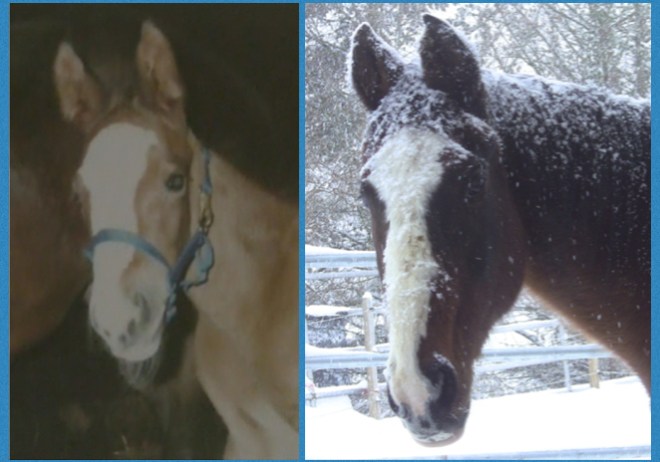
Peregrine Foal and in winter

Peregrine April 26, 1985 the day he was born, and Peregrine when he was 29

“I Need Goats!”

Preparation – it’s a wonderful thing.  All winter long “I need goats!” has been my call to bring the goats back into their pens.  “I need goats!” means food awaits.  Come fast!

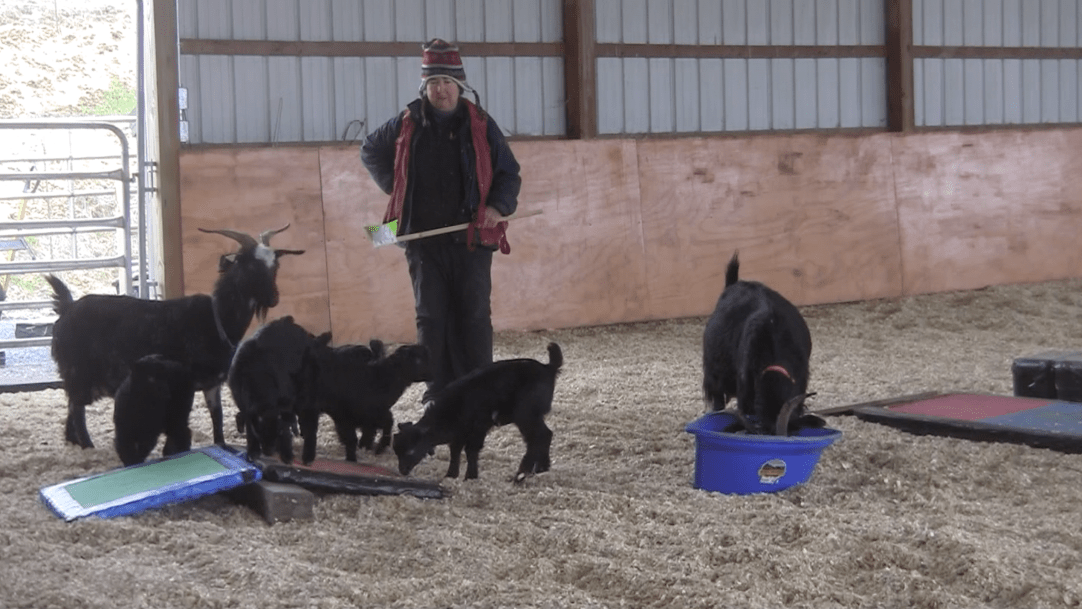
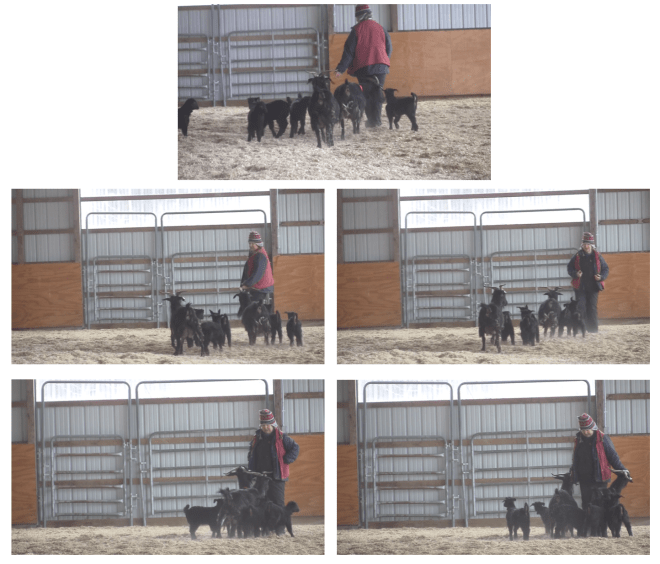
Yesterday “I need goats!” was put to a new test.  We took our little herd of seven goats – Trixie and her triplets and Thanzi and her twins – into the indoor.  I put Thanzi on a lead and had her follow a food-in-a-cup target stick.  She boldly – or perhaps I should say greedily – led the way.  Trixie held back but couldn’t resist when all the babies started surging through the outer gate of the Goat Palace.  We had the side door of the arena open so it was a short walk into the arena.

I had put a bucket down with some grain in it.  Thanzi made a bee line for it which helped draw all the others in.

Goats Thanzi eating in bucket.png

Everyone in

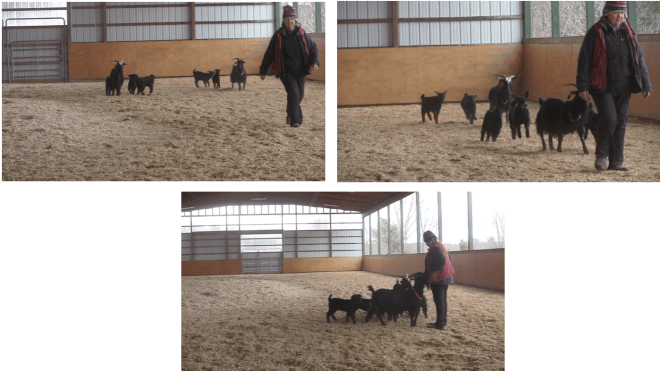
We got everyone inside, closed the gate, turned Thanzi loose and stood back to watch the fun.  At first they packed closely together.  Thanzi led them on a survey of the arena.  We’d set out some mats for the youngsters to climb over, but Thanzi and Trixie needed to check out the arena.

Goats - checking out arena.png

Checking out the arena

I left them alone for a bit.  When they had made the full circuit of the arena and they were back by the gate, I wandered out into the center of the arena.

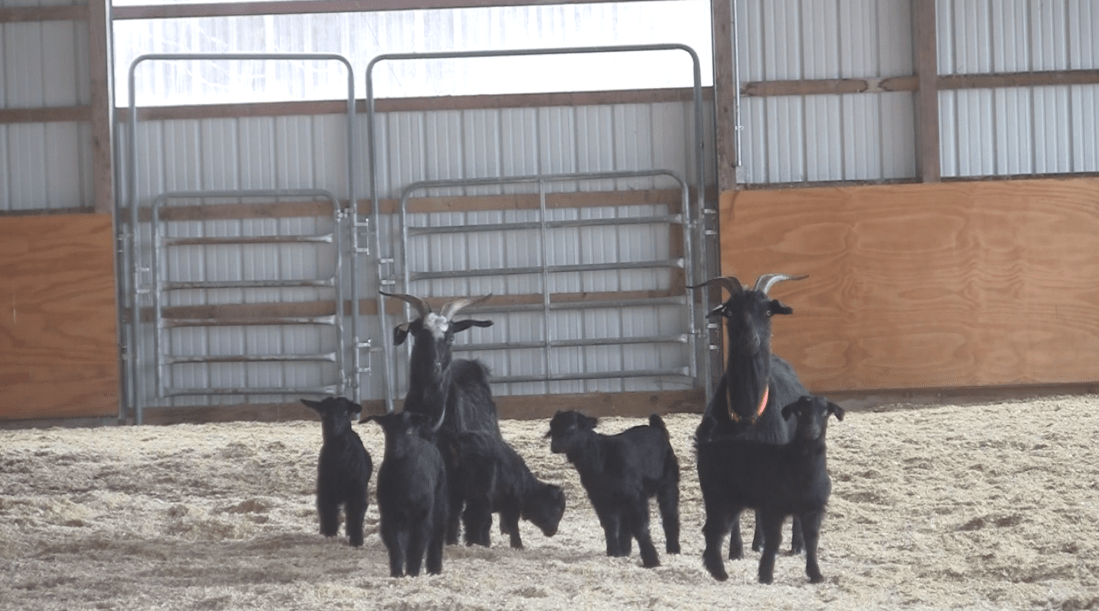
“I need goats!”  It was Thanzi who picked up her head first.  She turned and trotted straight towards me bringing a stream of goats with her.

Goats coming first time 5 panels.png

“I need goats!”

At first Trixie was too worried to come all the way to me.  I clicked and treated Thanzi then turned and walked away from the group.

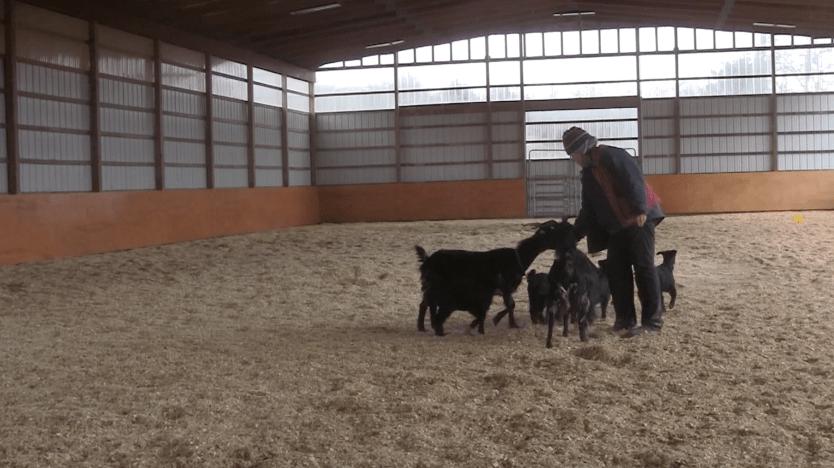
“I need goats!” They streamed towards me again.  Trixie was becoming braver.  Thanzi was always the first one to reach me, but now Trixie was coming up to get her treat.  When I turned to leave them, they followed behind me.  And when I called, they all came running and clustered around me while the two does got their treats.

Goats clustering around.png

Getting braver!

When I’m trying to teach a horse to be okay riding out by himself, there are times when I wish we hadn’t domesticated such a social animal, but watching as these goats came running towards me all as a group, I could definitely see the benefits of a herd species.

I could also see the benefits of a little preparation.  Without the connection that had been well established, Thanzi and Trixie might have spent their time in the arena keeping their babies as far away from me as possible.  Training – it’s a wonderful thing!

Goats going to far end of arena

goats coming 3 panels

Preparation let me become the Pied Piper of my little goat herd.

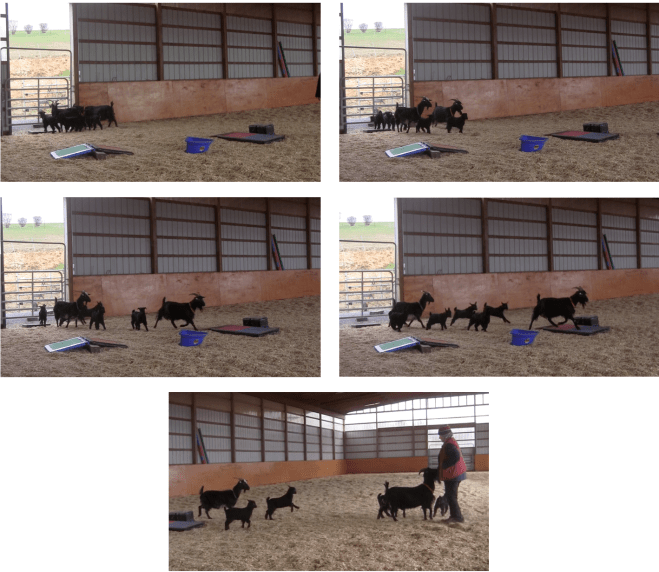
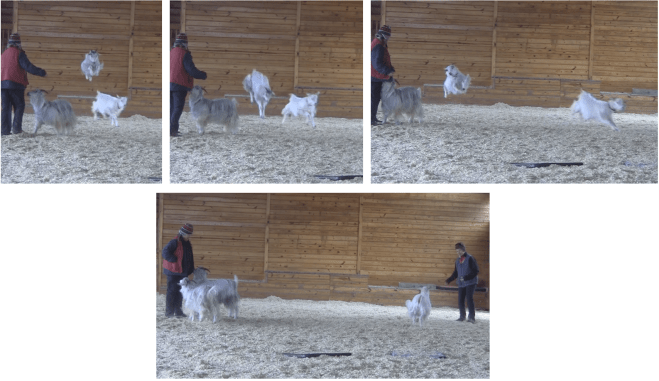
We saw another benefit of training when we brought the boys into the arena.  We set the mats out in a line at a distance from the mounting block.  The three of them would run to the mounting block, turn and race back to their mats.  When we first brought the three goats into the arena together, there was a lot of sparring.  Pellias and Elyan would drive Galahad away.  He was interfering with their play.  He was on the wrong mat – theirs, which ever one that was.  And he might just get one of their treats.

Now there was no head butting.  Not between Elyan and Pellias and not between the two of them and Galahad.  Even when they crossed paths, they just kept going without needing to spar.

Training it’s a wonderful thing!

Goats Pellias the acrobat.png

Play Time!

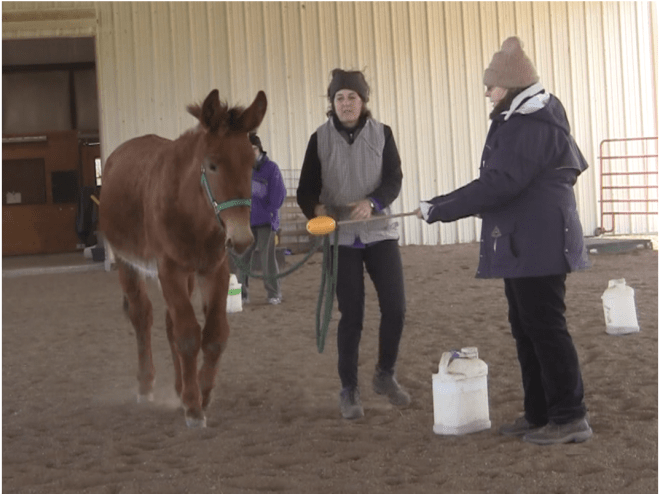
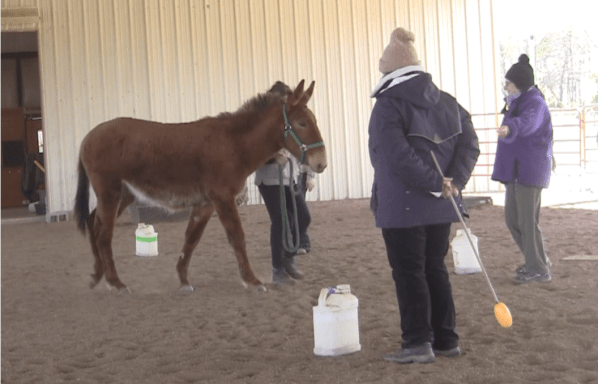
This past weekend I gave a clinic at Cindy Martin’s farm.  We worked with her yearling mule.  Rosie’s mom is a draft cross and her dad is a mammoth donkey, so Rosie is definitely not petite.  What she is is wonderfully endearing.  She is so very sweet.  And so wonderfully well mannered.  We played an early version of Panda catch with her.  All the participants stood in a circle around her.  Each person had a target.  One by one they held the target up and invited Rosie to approach.

Rosie targeting

Darling Rosie approaches a target. 

To keep things safe with so many people around her Rosie was on a lead.  Cindy handled her at first.  As the target was offered, Rosie walked confidently up to each person, ears forward, totally relaxed.  This was a completely new set up for her, but she had no worries about approaching people she didn’t know.  After getting her treat, Cindy asked her to back up.  At first, she was sticky.  Why leave?  As she caught onto the pattern, it was easier to ask her to back up.  Backing led to another opportunity to go to a target.

It’s a great lesson for teaching emotional balance.  Yes, you want to go to the target and the treats, but backing also produces lots of goodies, so leaving the person is okay.

The next day when we repeated the lesson, Rosie was eager to play.  Cindy started her, but I couldn’t resist having a play.  Rosie didn’t know me, but she was very accepting of a new handler.  She very quickly became super light.  A touch on the lead was all that was needed to initiate backing.  We’d back to the center of the circle, then Rosie would put those wonderful mule ears forward and off we’d go to the next target.

I directed people to shift their position on the circle.  Through a series of small weight shifts I asked Rosie to yield her hips.  That lined her up with the next person on the circle.  Each one of those weight shifts was clicked and treated so for Rosie a serious lesson remained a playful game.  Softening her neck and stepping under behind will let her handler interrupt her should she want to head off in a direction other than the one indicated.  It also lays the ground work for lateral work.

She was such a delight to work with.  Preparation!  It’s a wonderful thing.

That’s what Rosie and the goats were showing us.  Training usually feels as though you aren’t doing much of anything.  You’re teaching your young mule foal to follow a target. You’re calling your goats in from a play session.  Little things add up.  It isn’t just that you now have an animal that stays with you and responds to your cues.  What really stood out for me with all three of these groups – the does and their babies, Pellias, Elyan and Galahad, and now Rosie – was how solid they were emotionally.  Because of the training, they were able to handle changes in their environment.  The does became much more confident in the arena.  Their babies switched from being worried to being playful.  The boys could play without fighting, and Rosie could be a superstar learner.

Training.  It’s a wonderful thing.  Don’t leave home without it!

Rosie walking to a target

Good training.  It’s a wonderful thing!

Learning Fast!

Learning!  That’s what we’re born ready to do.  That’s what the baby goats are showing me.

Thanzi’s twins were born on Wednesday, March 21.  On Friday, March 23 I was on a plane heading to the Art and Science of Animal Training conference so I barely got to say more than hello to them.

At the conference I presented a new program on a very familiar topic – balance.  I had some great before and after photos showing how much a horse’s balance can be transformed just using the foundation lessons.  I also had some new videos showing how those changes were made.  You don’t need advanced skills and complex lessons.  You just need to direct your attention to your horse’s balance to make a huge difference for him.

By the time I got home, Thanzi’s twins had met Trixie’s triplets.  The two family groups were living and playing together in the front pen.  And it was still cold.  In fact it has continued to be cold even into April.  This morning when I looked out there was fresh snow on the ground!  Not much, but still it snowed overnight – and it’s April.  The cold limits how adventurous I want to be getting them out.  But it doesn’t limit their need for enrichment.  So every morning I have been building a new play ground for them to explore.

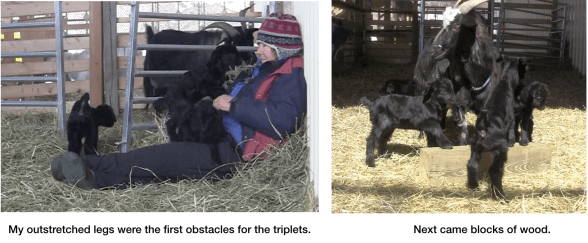
For Trixie’s triplets, their very first obstacles had been my outstretched legs as I sat with them in the hay.  They were determined to master climbing up and over.  And they delighted in trying to climb up onto my shoulder.  Patience, in particular, was determined to get to the top of the “mountain”, even if it meant stepping on Felicity who preferred to curl up in my lap.

Goats First Obstacles

Their next obstacles were blocks of wood, and then plastic jump blocks. Every day I gave them something new to explore, so for them novelty is something you play with, not run from.

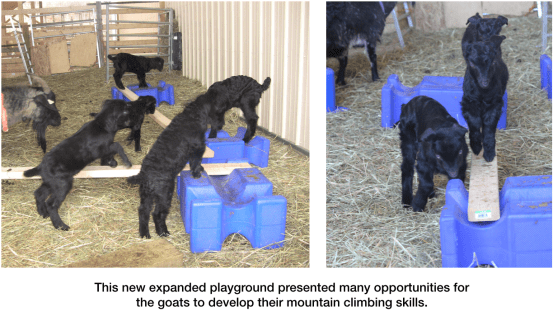
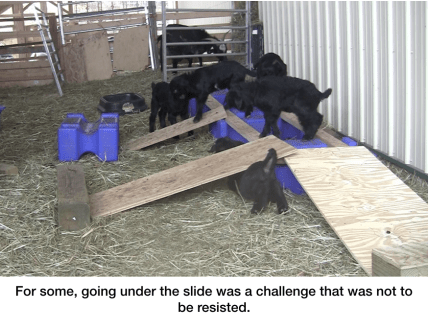
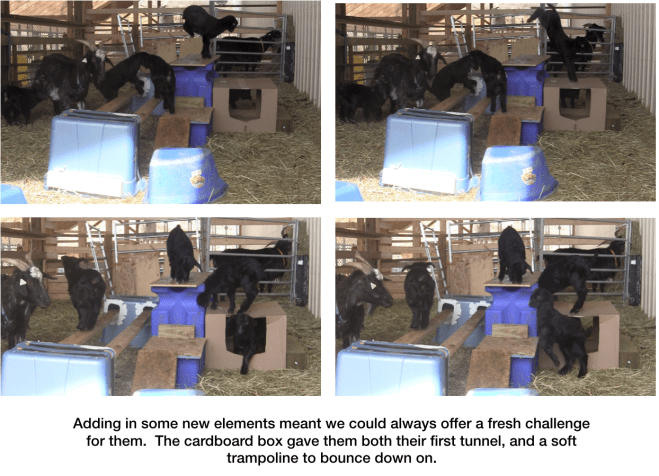
When I got back from the Art and Science conference, both sets of babies were clearly ready for even greater challenges so their playground expanded.  My raw materials were a couple of two by fours, six plastic jump blocks, some odds and ends of wood, and three pieces of plywood.  It is amazing how many different ways you can set up these elements to create a fresh challenge every day.

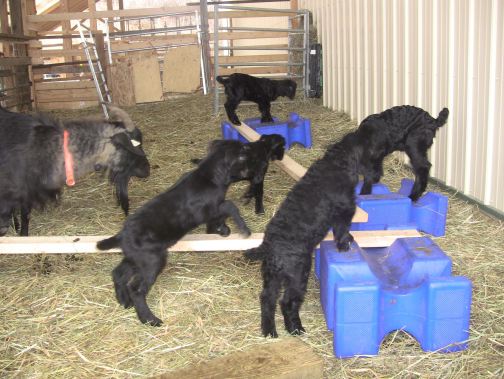
I began with the two by fours elevated just a little way off the ground.  The goats were immediately testing out their balance.  They wobbled a couple steps along the boards, fell off, got back on again, got bumped off by another goat, fell off, got back on again.  A day later they weren’t wobbling any more.  They could very nimbly walk the plank.

Goats learning to walk the plank

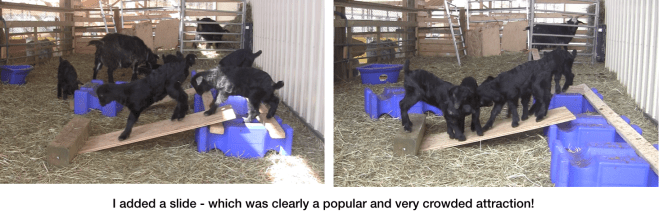
The next morning I added the plywood, but I set it so it sloped from the two by fours to the ground.  The goats slipped and slid down the plywood.  The two by fours were yesterday’s game.  This new challenge had them crowding onto the plywood.  One would be trying to go up the down escalator.  Her feet would be scrambling as she slid inexorably back down the plywood.  Another would be sliding towards her.  They’d collide mid-way, fall off and be right back for another turn.  What resilient, eager learners!

Goats Adding a slide to the playground

Goats every day something newAs their skills increased, I raised the two by fours, and added a couple more props.  One day I made a loop so they could run along the two by fours, slide down to a lower level, bounce from there across a plywood plank to another jump block and from there scramble up another slide back to the two by fours.  They made lap after lap, always with the obstacle of another goat wanting to go in the opposite direction.  Head butting on the slide was the best.  The mornings routinely begin with laughter as we watch the goats play.
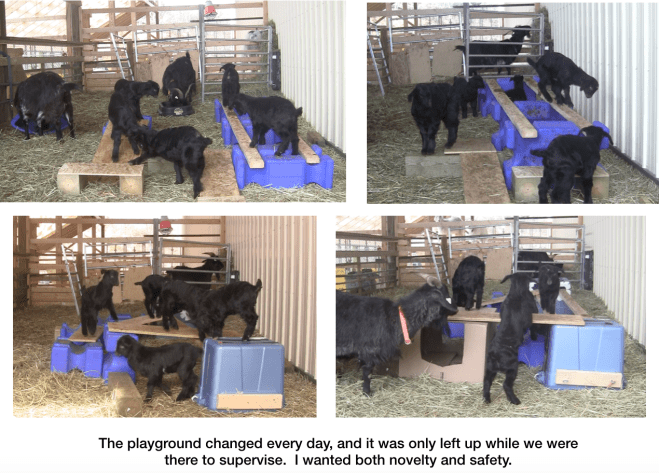
Goats the playground changes every day

Goats carboard boxes make great playgroundsLast weekend I shared the laughter with Caeli Collins, the organizer of the up-coming clinic in Half Moon Bay, California.  What a treat it was having Caeli visiting.  She attended the Art and Science conference then flew out last Wednesday to spend a few days enjoying goats and horses.
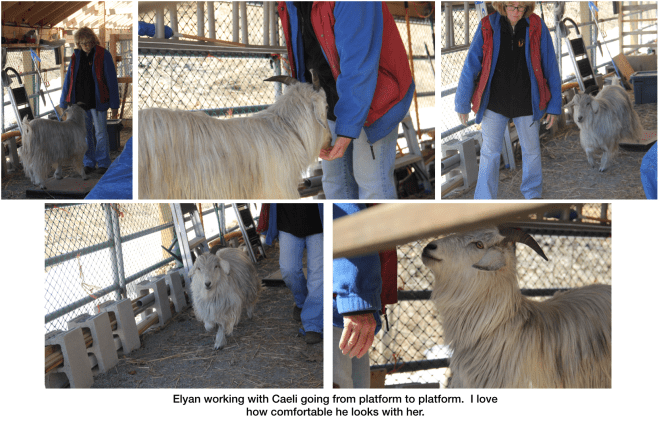
Caeli is an experienced clicker trainer.  When you are meeting a new group of animals, it is never clear what you’re going to work on.  Will they settle right in and show you the leading edge of what they know, or will they ask for some other lesson?  With the baby goats the goal was laughter.  That was easily provided.

With the older Clicker Center residents there were other important lessons to be explored.  Caeli was learning how to transfer her clicker training skills to animals (and species) she didn’t know.  And I was learning how to introduce the goats to someone new.

On the first day I opened the back gate into the boy’s section to let them out into the hallway while I fed.  They all poured out and raced to their stations.  That was before they realized there was someone new in the hallway.  I filled the hay feeders and then gave Caeli some hay stretcher pellets.  Pellias was willing to take a treat from Caeli, but not Elyan.  When I called the goats back into their enclosure, he scooted past her as fast as he could.  That was our baseline.

Day one was spent quietly letting the goats get to know Caeli.  She interacted with Elyan through the fence.  “Hmm.  This person knows how to play the clicker game.  Maybe she isn’t quite so scary after all!”

On day two they could both engage with her a little, and by day three I could step outside their pen and let Caeli train the goats on her own.  She worked with each one on targeting and platform training.  Pellias surprised her by deciding that after he got his treat from her, he should back up to the platform that was behind him.  And Elyan wanted to offer her his foot, something I had been working on a lot with both goats.

Goats Elyan working with Caeli

In addition to training time in the hallway, we took them into the arena so they could run around and play on the mounting block. And we went out for walks with them. We took advantage of one sunny, almost warm day to venture out on their longest walk yet, out into the back field.

And then there were the babies.  Every morning we set up a new playground for them.  As soon as we started moving pieces into place, they would be climbing all over them.  There was no worry, no concern over some new element we’d introduced.  These are confident, eager puzzle solvers, exactly what I want.  So our mornings started always with laughter.  Mixed into that was amazement over how fast they were learning.

Caeli also got to play with horses.  Robin and Fengur thought she was an entertaining guest, but mostly Caeli worked with the newest equine resident in the barn.  His name is Tonnerre.  He’s an eighteen year old, very pretty paint.  In his previous life he worked hard, and he has the stiffnesses and on-again-off-again lameness to show for it.

Through the winter the lameness has been more off than on, so I am hopeful that the microshaping gymnastics will help keep him comfortable.  That’s my main interest in having him at the barn.  I want to document the change in his body over time as he works more consistently with these lessons.

Last fall when he arrived, he really struggled to settle in.  For the first month or more the sessions were all about helping him not to panic when Marla took her mare into the arena.  For the first couple of weeks Marla had to spend most of her training time keeping Maggie in the barn aisle or just going into the arena briefly and then coming right back out again.  Thank goodness Marla was willing to play this game and had the skill to know how far and how fast to take Maggie out of sight.  Both horses were latching on to each other.  If we hadn’t spent the time to build their confidence that the other could go out of sight, we would today have two horses joined at the hip instead of two independent workers.

During those sessions Tonnerre was always loose.  He had his stall, outside run and part of the barnyard to move around in.  I had just pulled his shoes, and I didn’t want him doing a lot of frantic running back and forth.  So I stayed with him whenever Maggie was out and offered him the opportunity to target, to drop his head, and to back up, three very familiar behaviors.  He was able to stay with me, playing the clicker training game and only occasionally would he feel the need to break away and check on where she was.

Gradually, I was able to move away, engage with him less, and Marla was able to work her horse more normally.  It was very time intensive in the beginning, but definitely worth it to have both horses comfortable being out of sight of the other and able to work independently in the arena.

Tonnerre is proving to be an excellent student.  He’s always eager for his training sessions, but he’s not so sure about the goats.  He hasn’t quite come to terms with the strange sounds that come from that side of the arena.  When they are playing, goats make a lot of noise!

The first time he was in the arena with Caeli, they were just making the occasional banging sounds, but the wind was blowing hard. And of all things a squirrel decided to jump into the arena and run up a post into the rafters.

Tonnerre didn’t know Caeli, but he did know this was a scary day.  He wanted back into the barn away from all these strange noises and alarming creatures.  He was at liberty.  The door back to the barn aisle was open, so that’s where he went.  We had our baseline.  Relationship matters.

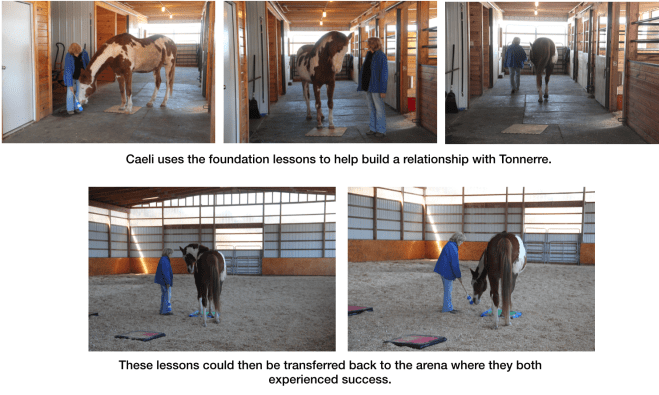
So we back tracked through his training, letting Caeli and Tonnerre get to know one another through the structure of the foundation lessons and in an environment where he was more comfortable.  It is always: “Train where you can, not where you can’t.”

And it is: “Go to a place in the training where you can get a consistent yes answer and proceed from there.”

Caeli could get a consistent yes answer in the barn aisle which then became a consistent and much more relaxed yes answer when she returned to the arena. Often the most important lessons come not from the fancy “stuff” a horse can show you, but from the simple things applied well.

Caeli and Tonnerre

At the Art and Science conference I talked about balance.  The baby goats are learning fast about physical balance.  When I turned the older goats and Tonnerre over to Caeli, the focus was very much on emotional balance.   Both are part of a complete picture.

I’d like Tonnerre and the goats to be good teachers even for novice clicker trainers.  Caeli was helping them make that leap to being comfortable with people they don’t know.  Her visit showed me that they will all be great co-teachers for anyone who wants to sharpen their clicker training skills – and enjoy some laughter along with it.

I made a short video of our daily play ground for the youngsters.  Enjoy!


Caeli wrote a wonderful post about her visit which I am including here.  It is fun to read about the same event from two different perspectives.  And Caeli added in her visit to Ann and Panda – always a treat.

A visit to Alex’s (long) – written by Caeli Collins and posted in The Click That Teaches facebook group April 7, 2018.

I spent four wonderful days with Alexandra Kurland at her barn in Albany just about a week ago. The goat babies were better than a movie, providing endless entertainment as they bounced around. Alex and Marla Foreman built new puzzles for them on a daily basis and they just kept bouncing to the challenge – walking a 2×4, turning a slanted board into a sliding contest, and chewing any clothing we didn’t quickly redirect. We decided a YouTube channel streaming baby goat antics would be a huge stress buster. Trixie and Thanzi are good moms and have amazing patience with them.

That was the several-times-a-day funfest. I also got to meet Ann and Panda, and go for a walk with them. Ann and Panda walk out! They walk faster than Sebastian and I doing in-hand trot work. But what I was really, really blown away by was Panda’s decision-making abilities. She watches for unevenness in the road, driveways, changes in slope, finds the crosswalk buttons, moves over for cars and more. It’s one thing to read about it, it’s another thing to see it in person. They are an amazing pair.

All of this was wonderful, but I was really there to expand my training knowledge and practice, which was so much fun. The boy goats (Pellias, Galahad and Elyan) and a horse named Tonnerre contributed to my education. Tonnerre is new to Alex’s barn since the fall, and is in long-term training with her to be a clicker training school horse (he’s the very good looking paint in the pictures). Alex has been working with him for some time.

My breadth of training is not wide – I work with my horse, Sebastian, and my dogs, but I’ve been a practicing and committed clicker trainer for about seven or eight years. I’m not a novice, but I’m also not a professional. For those of you who don’t know me, I organize and host Alex’s clinic in Half Moon Bay, CA, which is coming in three short weeks.

I learned so much. More than I ever hoped for. For me, it wasn’t about how do I teach shoulder-in or half-pass, it was how can I take what I know and use it with other animals as well as do better with my own. How do I make good decisions about what to work on with a different horse, or a different species. And with the help of Alex and the kindly animals at the barn, I have started on the building blocks to do this.

Here are some of the things I learned:

• Training begins with a relationship. If you are working with an animal you don’t know, you have to get to know each other. It’s that first date feeling, where everything feels a little (or a lot) awkward. And the less experience you have with the species the longer that might take
• Species appropriate foundation lessons are so important. The ones we use with the horses help them establish self-control and give them a measure of control over their learning. All animals deserve that
• Goats are really, really fast. Their heads can go in circles, and it’s very distracting. If I focused on what I was working on, and ignored the bits that don’t contribute I could get past this, but it was sooooo easy to get drawn in. I can see where this is true for my dog and my horse as well.
• Unexpected things happen. Really, they do! Can I be flexible enough to make the learner right? Pellias hit me with one – we were doing a bit of off leash practice and I was feeding where I wanted him to be (by my side) and he turned that into backing to the mat! It was funny and clickable and oh so not what I was thinking, but worth every bit of the click. And that became our routine in that spot, and I learned to take what was offered
• Food delivery is so, so important. The poor goats. Until I got consistent at putting the food where the perfect goat would be, the heads were twisting sideways to get it. But very much like the horses, the right food delivery moved them out of my space and set up the next cue, and calmed some of the frenetic activity down. The food delivery was predictable. It was very cool, and helped establish rhythm and stability

Tonnerre really helped me understand the importance of relationships. He was part of all that I learned, but deserves a few words of his own. Tonnerre can be safely handled, but he was pretty indifferent to anyone but Alex when we started. Alex suggested just grooming him while we got to know each other. There was no ear pinning or any overt aggression but he did grind his teeth. That became my cue that whatever we were currently doing was too much for him. So move to something else, or stop. Mats in the aisle, targets, the pose, walking from mat to mat, targeting while working in protective contact, mats and cones in the arena were all available. Working in the arena was too much, too early, and between a squirrel and noise from the goats he left – back to his stall. But the good news is that he had the choice to leave. Isn’t that cool? How often are our learners given the ability to say “sessions over, I’m done?”

Tonnerre reminds me of Sebastian, only kinder. He responded to short sessions of things he knew and we could expand on those. Alex could coach me on how to work with him, and we both could learn to work with someone new. Since Sebastian started out similar to Tonnere in his opinion of people, only more overt in expressing it, it wasn’t unfamiliar territory to either of us. And now I have better skills to deal with it (however did Sebastian and I survive those early days of clicker training?) and I had Alex there every day to help. And nothing but admiration for how Alex deals with the strange horses she’s presented with at every clinic.

And there you have it. Sorry for the length but it was an amazing, wonderful experience. This write-up was very worthwhile for me – it helped imprint the four days. And there is one other great thing – sitting there with Alex dissecting things over tea, while we took a break.

If you are interested in exploring this for yourself, Alex is doing private/small group sessions at the barn, so please contact her directly. It is amazing, and I highly, highly recommend it. And I can’t thank Alex enough for the opportunity. If I can figure out a way, I will be back.

Caeli Collins

March Discoveries

March is slipping away fast and I have not yet written this month’s celebration of the twentieth anniversary of the publication of “Clicker Training for your Horse”.  It’s been a jammed packed month.  The Clicker Expo and the Art and Science of Animal Training conferences were back to back this year.  Both conferences become endurance tests because I can’t resist the late night conversations with the other faculty members.  We typically don’t stop until one or two in the morning, and then only because we know we have presentations to give the next day.

For most of the month I had the added endurance test of night checks on the goats while I waited for Trixie and Thanzi to give birth.

Prepping for the conferences would have been enough to fill this month, but I also added the launching of the new Equiosity podcast with Dominique Day.

Episode 3 just went live yesterday.  The conferences are done, the goats are all doing great, so finally I can write my thank you to the people who helped open the doors to these great adventures.

It’s always a challenge to pick one person out of the many hundreds who have played principle roles in bringing clicker training so actively into the horse community.   This is the last day in March.  Spring is coming which means the clinic season is about start up again.  So it seemed like a good choice to celebrate the clinics and the many organizers and attendees.  I couldn’t possibly list all the names.  I’d be bound to leave someone out, so instead I am going to thank just one person, Kate Graham who, along with Lin Sweeney, for years hosted the Groton New York clinics.

I’m choosing Kate for two reasons.  One, the Groton clinics were one of my first clicker training clinics, and the first that turned into a recurring event.  Two or three times a year we would gather in Lin’s living room for the start of a great weekend.  Many people who became very instrumental in helping to expand clicker training were regulars at these clinics.

My main memory of the first Groton clinic was not of horses but of snow.  Saturday night we went out to dinner as a group.  We drove through near white out conditions to get to the restaurant.  In spite of the cold weather that weekend people were hooked.  We’d just scratched the surface of what is possible.  None of the horses in that first clinic had any clicker training experience so most of the training involved basic targeting.  But even so people were excited by the changes they were seeing in their horses.

I will always be grateful to Kate and Lin for saying – “Let’s do this again!”  If I had spent all my travel time just giving start-up clinics, I would never have been able to take clicker training past the basics of simple targeting.  My own horses would have known the joys of beautiful balance and all the other great gifts that clicker training brings us, but I wouldn’t have been able to share it with others through the clinics.  Instead clinic by clinic we moved the work forward.

We had a core group of regular attendees which meant I got to see horses advance through the stair steps of the training.  Katie Bartlett was among this group.  I got to see her senior horse, Willy, turn into a clicker super star, and then I watched her young Dutch warmblood, Rosie, develop from gawky youngster into a beautiful riding horse.

One of Lin Sweeney’s horses, a standardbred named Button, became a school horse for clinic attendees. Button became a super teacher for anyone who wanted to learn about lateral flexions. And then there was Lucky, Kate’s horse.

Lucky is the second reason for saying thank you to Kate.  Watching the two of them together always made me smile.  Lucky was a Connemara cross (or so Kate was told.)  He started with that all too usual story.  The first time Kate rode him after she bought him, Lucky spun and bolted as she was getting on him.  Kate fell off and broke her ankle.

To get him to the point where he could be ridden safely Kate looked at John Lyons’ work.  She found one of his instructors living within driving distance in Canada.  She helped her enormously.  When I first met Lucky, Kate could ride him, but he was incredibly wiggly.  Straight lines were not in his riding vocabulary.

I knew about that stage from my own exploration of single-rein riding.  Teaching a horse to be soft is done through lots of bending into lateral flexions.  Your horse now feels wonderfully light.  He is safe to ride.  You don’t have to worry about the spooking or the bolting off.  Those terrors are now a thing of the past, but your rides seem to be mostly about going in small circles.  Lyons knew how to sort out all this bending for his own horses, but he was just beginning to figure out how to teach it to others.  So Lucky was stuck in the stage where going in circles and wiggly lines was the norm.

I had also studied Lyons work and was familiar with the single-rein riding, so I understood what Kate was working on with Lucky.  Peregrine had taught me how to insert clicker training into the process which dramatically changed the conversation.

With Lucky we began on the ground, first with the basics of targeting and the other foundation lessons.  In 1998 I was focused on three foundation lessons, targeting, backing and head lowering.  It was through the clinic process that I expanded the list to six.  The other three behaviors had always been something I taught, but I hadn’t yet understood how universally important they were.

What did the clinics add to the list?  Standing on a mat, “happy faces”, and the grown-ups are talking, please don’t interrupt.  Grown-ups gives us a base position, a calm settled launching point to balance out all the more active behaviors we ask for.  It simply means that your horse is standing beside you in his own space with his head oriented evenly between his shoulders so he’s looking straight ahead.  He’s not doing all the “I don’t want my horse to . . . ” behaviors, such as mugging your pockets or crowding into your space.  Grown-ups begins the process of focusing on what you want your horse TO DO, instead of the unwanted behavior.  So it is as much for the handler as it is for the horse.

I gave it that long, somewhat cumbersome name because I wanted to make it clear to people who were peeking in at clicker training that we may be using food, but we are not permissive trainers.  Our horses have good manners.

Getting a horse to stand still beside you can be a challenging behavior to teach well.  It’s easy for force-based trainers.  You simply say to your horse – move and I’ll hurt you.  Say it with conviction, back it up with action, and your horse will stand still until you tell him to move.

In clicker training we are taking away the threat of enforcement.  Instead we reinforce behaving.  Horses get reinforced for offering behavior.  Standing still is very much a behavior.  Getting to a point where your horse will stand still long enough for the grown-ups to truly have a conversation takes time to build.  You have to convince your horse that all those other charming behaviors that you’ve been teaching him – lifting his feet, walking off into lateral work, picking up your grooming brushes, backing up, rushing off to find a mat, etc. none of these things are what you want right now.  Standing quietly beside you is what will get you to click and hand him a treat.

So grown-ups lets you discover how to build duration.  It introduces cues and stimulus control.  It shows you how to balance one behavior with another, and how to expand a simple stand-beside-me behavior in many different directions – from neutral balance into the pilates pose, and from simple duration into solid ground tying.  Through the process it also shows you how the behaviors you are teaching become transformed into conditioned reinforcers which can then be used to help support other newer behaviors.

The clinic horses were helping me to see connections.  I was discovering things about these foundation behaviors that working with my own horses had not yet revealed.  They were showing me details that are now embedded into the core teaching.  They helped make clicker training better, more universally applicable, and so much more fun!

Lucky loved clicker training.  And even more he loved Kate.  Watching the two of them together was always a highlight of the Groton clinics.  It wasn’t just that Lucky was beautiful – which he was.  With each clinic he became more and more suspended, and more and more stunning to watch.  He was a head turner for sure.  But what made Lucky stand out was his sense of humor.  He and Kate laughed their way through every training session.  They never worked on anything I shared with them.  For them it was always play.

That’s the joy they shared and that I have been lucky enough to share with others.  Thank you Kate!  And thank you to all the other clinic organizers.  You played an important role in planting the seed of clicker training.  Look how it is growing now!

Lucky-canter-for-web

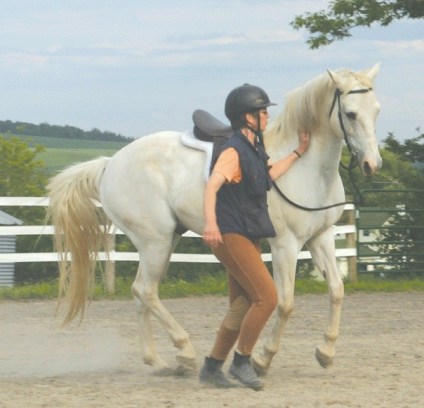
This is one of my favorite photos.  Lucky is cantering beside Kate.  I love the canter in hand.  Kate is walking.  She’s not running to try to keep up with a cantering horse.  Instead Lucky is staying beautifully connected to her so she can walk beside him with her hand on his neck.  Talk about an addicting sensation!   You can feel all the power of your horse, and all the control.  It is magnificence itself, an experience like no other, especially when you know that your horse is offering you this connection, not because he has to but because he joyously seeks it out.

Every time I look at this picture I smile.  It represents so many of the good things clicker training can give us: laughter, fun, a great connection with our horses, an opportunity to explore – and succeed in training advanced performance skills, beautiful balance, and most important of all – a happy horse.

Thank you Kate and Lucky, and thank you to all the other clinic organizers.  Your desire to bring clicker training solidly into your own area has helped to build a world-wide clicker training community.


Ending Well

Episode #3 of our new Equiosity podcast is now available.  Last August Dominique and I sat down at her dining room table and turned on our microphones so all of you could listen in to what turned into a very long conversation.  Mid way through we took a break to take her dogs for a walk.  Of course the conversation just kept going.  Dominique shared with me several training stories that I thought were worth adding to our recording so when we came back in, the conversation shifted to the topic of how to end a training session – something she’d had to work on, not just with her horses, but with her dogs.

It’s an important question.  We may need to stop to go to work, or to fix dinner, or just to get out of the cold, but our horses want us to keep going and going.  Ending well is the title of this episode, and that’s what we discuss.

I hope you enjoy it.

Visit Equiosity.com to listen to the podcast, or find it on itunes.

Now for a goat update.

I was away over the weekend at the Art and Science of Animal Training conference.  It was a tremendous event.  I suspect it will provide much material for future Equiosity podcasts.  This week Caeli Collins, the host and organizer of the clinic I’ll be giving the end of April in Half Moon Bay California, is visiting.  We started the day yesterday with the triplets climbing all over her lap.  Thanzi’s babies weren’t as bold about approaching us, but three little goats kept her busy enough.

Watching them all play together the challenge became telling everyone apart.  Thank goodness Prudence has a spot of white on her rump and Verity has a pretty white fringe on her forehead otherwise we’d be lost.  Felicity is easy to tell from the others.  She’s the one who wants to be curled up in your lap!  What a charmer.

IMG_2216 baby goats on planks

The girls enjoying the day’s enrichment.

Launch Day for Equiosity!

We’re ready!  Today Dominique Day and I are celebrating the start of a great new adventure.  We are launching our podcast, Equiosity – the podcast about all things equine.

Equiosity banner for blog

To listen to the podcast visit: Equiosity.com

If you find yourself tripping over the spelling, take Equus and combine that with curiosity.  You get both our name Equiosity and a great description of the podcast.  Whenever the two of us get together, it’s always a non-stop conversation about horses and training.

Last August I visited with Dominique at her farm and we recorded our first four podcasts.  I was in the midst of writing the Goat Diaries so what did we talk about in this podcast that is about all things equine?  Goats, of course.  So if you are missing the Goat Diary journals, this first podcast will take you back to the start of that great training adventure.

All roads lead to horses and that, of course, is where the goats take us.  In these Equiosity podcasts we intend to dig deep into the layers of training, to tease apart nuances and details that make a difference to our horses.  But first you need to meet us.  These introductions are not done in a stiff, formal way.  Instead you will meet us through a conversation that begins with goats and then takes us straight into what matters most to both of us, the well-being of our horses.  That’s the underlying theme of our first four podcasts.

Good things often take a long time in the oven.  There’s no rushing them.  We’ve been preparing for this launch day for a long time.  And now finally it is here!  I hope you enjoy our first podcast.

You can listen to it at Equiosity.com, and you’ll also find it on itunes.

Equiosity tile
Enjoy!
Alexandra Kurland
theclickercenter.com
theclickercenterblog.com
theclickercentercourse.com
and now also Equiosity.com

Goat Diaries Day 12 Last Day

I started sharing the July Goat Diaries on October 2, 2017.  I knew in the two weeks that the goats were with me they had generated enough material to fill a book, but I really didn’t think they had also generated enough posts to fill five months!  But here finally I am at the last day of the July Goat Diaries.  I certainly learned a lot.  One of the main things I learned was how entertaining goats are!

When I started this project, my goal was a simple one.  I wanted to get to know goats a little better, to see if they would make a good addition to the barn.  My training goals for the goats were also simple.  I wanted to introduce them to clicker training and to get the basics stabilized enough that they would not frustrate or be frustrated by novice clicker trainers.

I had started with two timid goats who wanted nothing to do with me.  They spent their first evening in the barn trying to stay as far away from me as possible.  I had observed them, and they had observed me.  The following morning the peanuts arrived and greed took over.  They forgot about being afraid and tried instead to raid my pockets.  The clicker training was under way!

Mid-way through their stay I was wishing I had more time.  They were delightful.  They were charming.  They were enthusiastic learners.  But they were oh so very were greedy for treats.  Stable, polite manners seemed like a very distant goal.

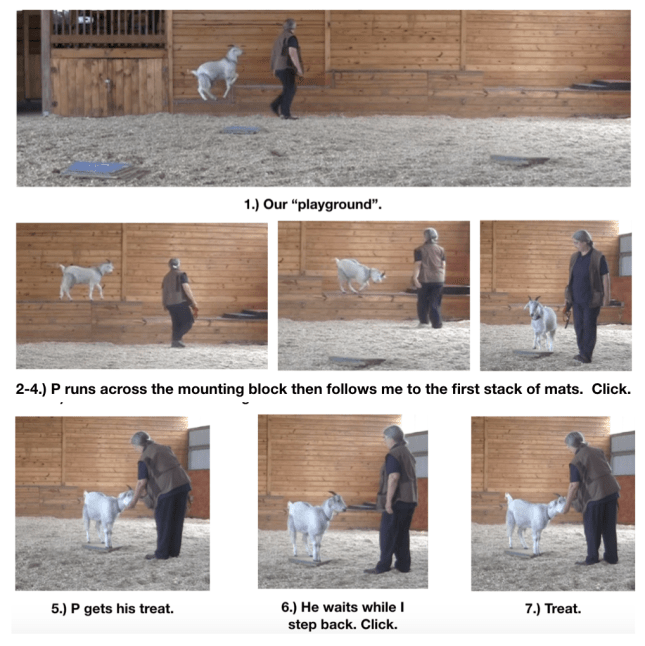
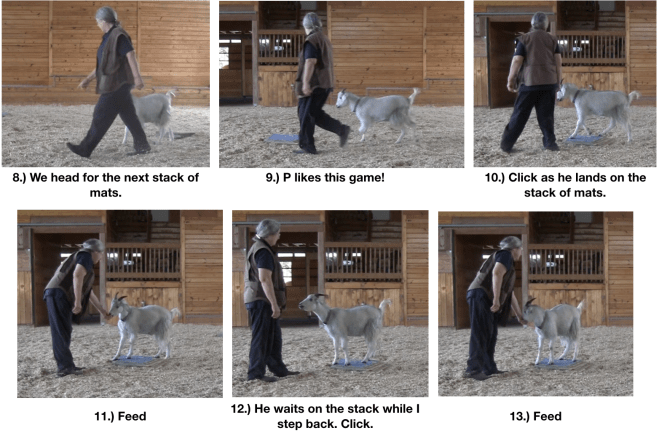
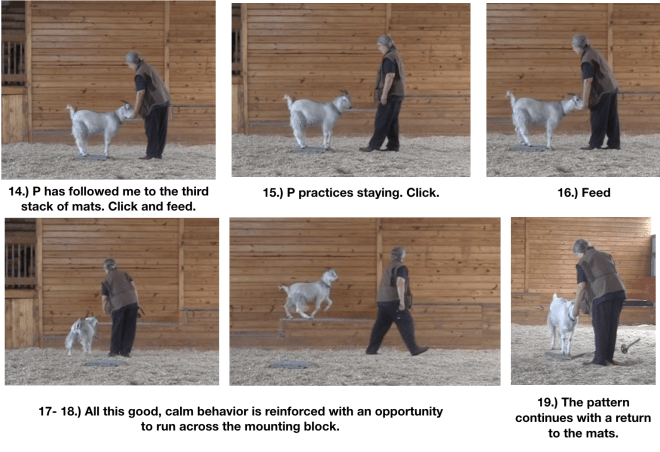
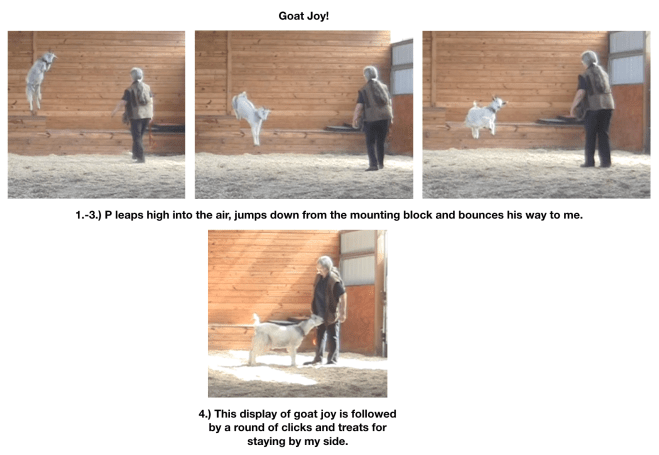
I was feeling greedy myself – for more training time.  On this their last day with me I wanted to squeeze in a couple of extra sessions before they were collected in the afternoon.  I decided for these sessions to experiment with putting platforms out in the arena.  I began with P.  As we entered, he veered off towards the mounting block.  I unclipped his lead and walked beside him as he ran across the mounting block.  At the far end he jumped down.  I backed up a few feet.  As he followed me, I clicked and reinforced him.  Then I directed him towards one of the platforms.

We went from platform to platform then back to the mounting block.  It was fun to engage with him in some goat play.  As he jumped off the mounting block, I turned, and he trotted with me all the way to the first platform.  There are all kinds of fun ways we could build on this.

Goats day 12 our playground fig 1-7

Goat Diaries Joy of being a goat 2.png

Goat Diaries Joy of being a goat 3.png

Things changed dramatically when I put P on a lead.  Everything would have been fine if I had simply gone with him as he forged ahead to the next platform.  But I didn’t.

With horses mats let us work on two sides of the same coin.  At first, the horse is reluctant to step on an unfamiliar surface.  He’s right to be cautious.  Avoiding holes is how you keep from breaking a leg.

So the first half of the mat lesson is developing the horse’s confidence and comfort level around mats.  Stepping on mats is a good thing.  It produces lots of goodies.

The other side of that lesson is dealing with the mat once it has become a tractor beam.  Horses become eager to go to mats.  That’s where you get lots of goodies.  So instead of hanging back and avoiding the mat, now your horse is dragging you to them.  You’re dealing with the same kind of I-want-to-go-somewhere emotions, the same pull that you encounter when you take him out to his paddock or you turn for home out on the trail.  He doesn’t want to wait for you.  He’s in a hurry!

Except heading for the pasture gate or for home after a long ride generates even more excitement than a mat.  So the mats provide a way of having this conversation but at an emotional level you can both handle.  With P I was now having that conversation.  “What do you mean I can’t just run to the mat!?”

The first time I redirected him from the mat, he handled it okay, but in the middle of the lesson things disintegrated.  He reared up and spun around, bumping into me in the process.  I felt as though the mats had turned into Borg ships from Star Trek – Resistance is Futile.

In my neighborhood I can watch lots of excited dogs behaving just like this.  It’s one thing to manage this when the animal is the size of a dog.  I was thinking what this behavior would look like in a horse.  Standing up your hind legs is not a behavior I want to encourage, no matter the size.

I used the lead to redirect him and just rode out the wave of energy.  “I know you want to go to the mat, but that’s not what we’re doing right now.”

The Sister had described to me how they introduce the lead to the goats.  They put the lead on the young goats and let them work out the restriction of the lead.  There’s no step by step progression of lessons, so this twirling, leaping, rearing behavior that I was getting was very much in P’s repertoire.

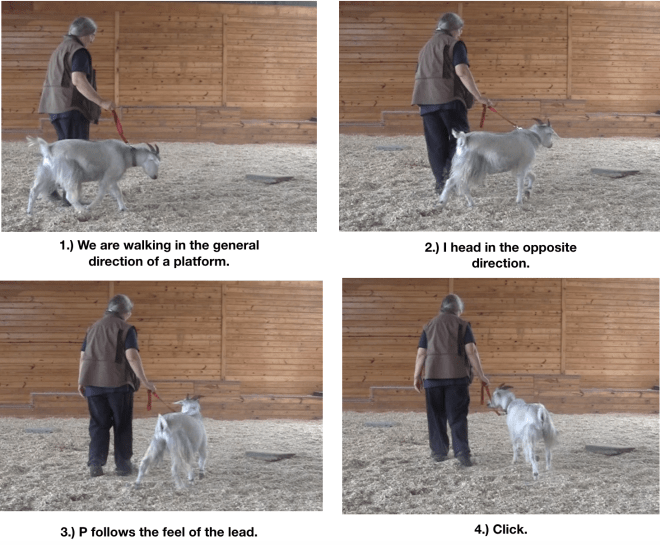
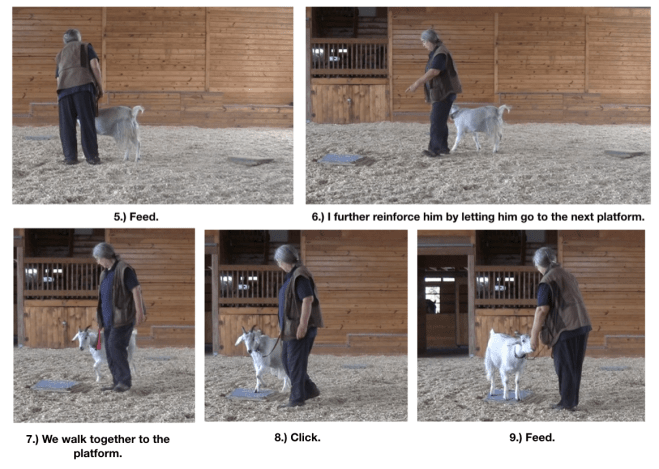
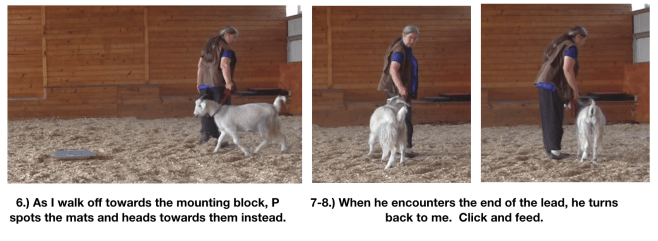
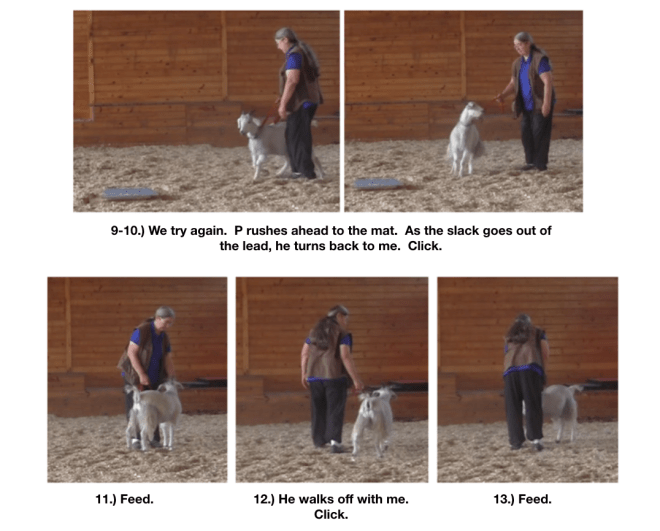
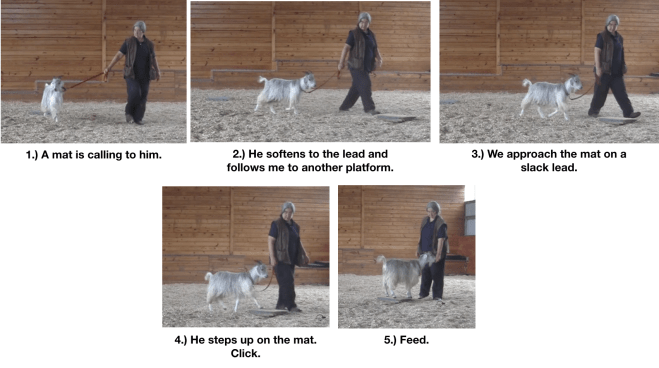
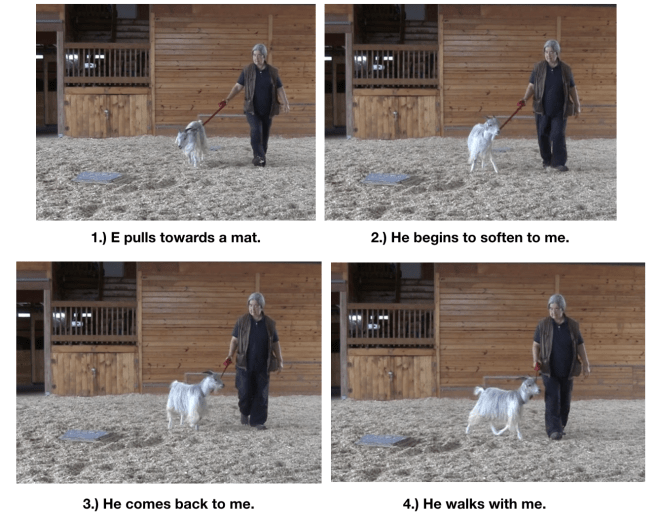
Once all four feet were back on the ground, I used the mat to help me teach him how to stay with me instead of pulling ahead.  We walked in the general direction of a mat, but I asked him to keep going past it.  When he turned in my direction and put slack back in the lead, click, I reinforced him.  I then added another layer of “yes! – aren’t you clever!” by letting him go to the next mat.  Click and treat.

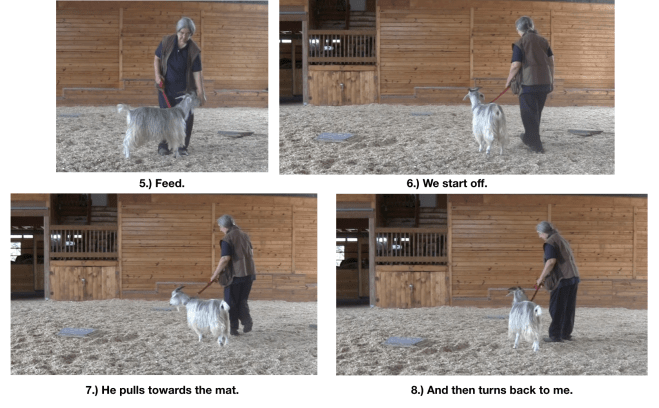
Note in Figures 2-3 in the series of photos below it might look as though I am dragging him away from the mat.  If that’s what your used to seeing, that’s how your eye will translate this.  But actually, as soon as the slack goes out of the lead, I am waiting for P.  I don’t keep walking.  Instead I wait for him to turn back to me. Click and treat.

Goat diaries day 12 tractor beams 2.png

Goats day 12 Pellias 5-9

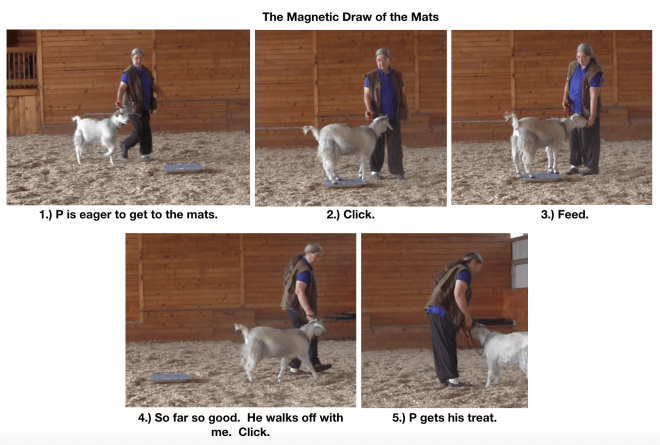
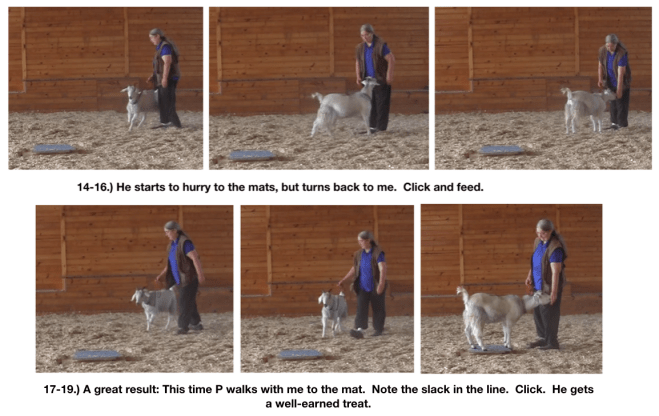
The value of mats is they begin to have this magnetic draw.  I want P to be eager to go to them.  But that draw can mean the sight of a mat overrides all other cues.  I wanted to teach P how to stay with me so we could walk together to the mats.

Goat diaries day 12 magnetic draw of mats 1.png


Goat diaries day 12 magnetic draw of mats 2.png

Goats day 12 P panels 9-13

Goats Day 12 Fig 14-19 with Pellias

P began to figure it out.  Now we could walk past a mat without it dragging him into it’s magnetic orbit.  When I released him to a mat, we could go to it together with slack in the lead.  I ended the session at that point.  The last day of training didn’t really feel like the time to be opening a whole new chapter.

E’s Session with the mats

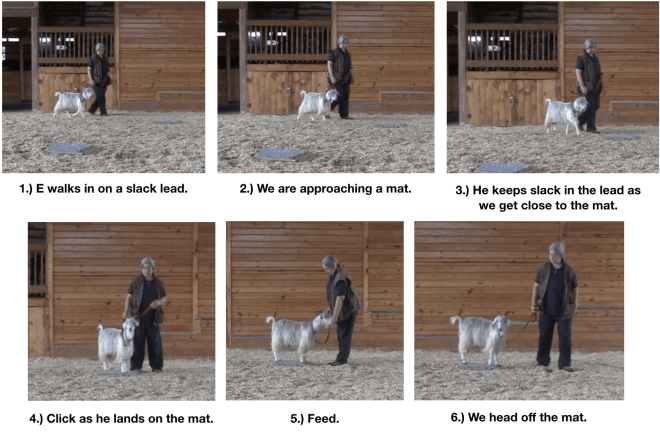
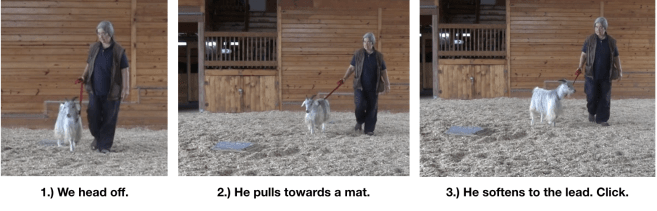
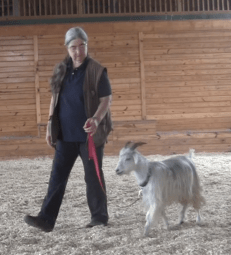
Now it was E’s turn.  As usual, he was completely different from his brother.  There were times when he spotted a mat and started to head there without me.  Instead of going with him, I changed course.  The lead would go tight.  I’d pause, waiting for E’s next move. He’d redirect back to me.  There was no leaping about as there had been with his brother.

To picture what he was like with the mats think eager dog who wants to greet another dog or say hello to a person.  He was all happy wiggle.  When he turned back to me, click he got a treat.

All the work we had done with the backing was paying off.  If he started to surge past me to get to a mat, I would stop.  The answer was sitting right there, fully primed, ready to open at the top of his rolodex.  All he had to do was back up and we were right back together.

Goat diaries Day 12 e encounters mats 1.png

More good leading:

Goat diaries Day 12 e encounters mats 2.png

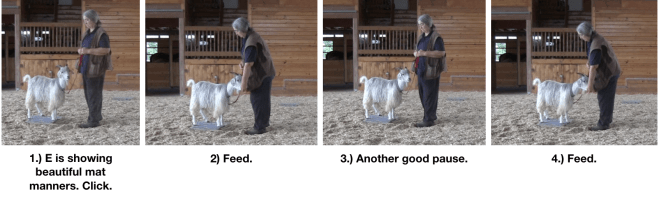
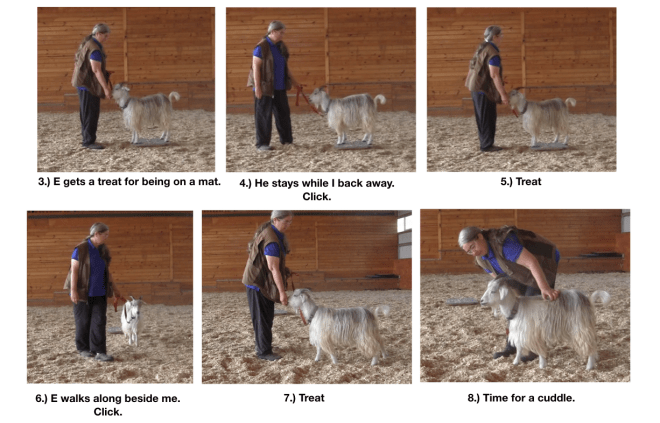
Once E was “parked” on a mat, I focused on grown-ups.  When we left the mat, he let me redirect him with the lead.  I was thinking what a pleasure it would be to walk him round my neighborhood at home.  I’m not sure what the dogs would think, but I would certainly have the most elegant of companions on the end of my lead!

Goat diaries Day 12 e encounters mats 3.png

The importance of Shaping on a Point of Contact:

Goat diaries Day 12 e encounters mats 4.png

E makes choices:

Goat diaries Day 12 e encounters mats 5.png

Goat diaries Day 12 e encounters mats 6.png

Because it was their last day at the barn, I wanted to get in as much training time as possible.  So I brought P back in after E’s session.  Just a half hour earlier he had struggled to go past a mat.  Their magnetic attraction was very evident.  We had to weather the storm of an extinction burst as he tried to get to the mats.  He had been like a fish on the end of a line, rearing, spinning, trying everything he could think of to get to a mat.  None of it had worked.  Landing back on the ground, moving away from the mat, that had earned a click and a treat.

This is where it is so important to stay on a point of contact and not add pressure.  If I add make-it-happen into the mix, I run a very high risk of poisoning the process.  Yes, absolutely, I could have dragged him away.  He’s a small goat, and I’m used to handling much larger animals.  I could have punished the rearing.  I could have forced him to follow me.  He would have learned his lesson, and I would also have broken everything I was trying to create with these goats.

Instead I stayed on the point of contact, moving with him, not against him.  This is very much like holding onto a squirming cat.  You don’t try to confine the cat, you simply keep moving with it, redirecting it as it tries to wiggle out of your arms.

There is always a chance that this lesson was too much.  Remember the training mantra: you never know what you have taught.  You only know what you have presented.

When I brought P back out for this second session, he showed me what he was learning by walking with me past the mats.  If a mat started to draw him in, I could easily redirect him.  He was learning that there are many ways to get treats.  Going to mats was a bonus, but going away from mats was also good.  Hurray!

P’s late morning session

I did another round of training in the late morning.  I thought I would make things easier if I put just one tempting mat out.

This lesson is all about the now/not now nature of cues.  It is learning that the lead has priority over other cues.  This is what I want him to learn: The mat may be sitting out in the middle of the arena, but until I release you to it, I want you to just ignore it.

When P started to surge towards the mat, I would say “wait” as the slack went out of the lead.  That’s a useful verbal cue for an animal to understand.  The meaning evolves with usage.  P very promptly changed direction and came back to me.  Click and treat.

I began to tack back and forth past the mat.  He got reinforced for ignoring it.  With the horses I can use the draw of the mat as a preliminary step towards teaching them to leave something they want, such as yummy spring grass.  It is much better to begin this lesson in the safety of a familiar paddock than out in a complex environment that’s full of distractions.

Dragging me to grass, to other horses, back to the barn, these all have similar emotional roots, just different levels of intensity.  I would much rather begin with the mats.  The draw they have is one I’ve created, and it is nothing like the draw another horse or a field of fresh grass can have.

I begin the discussion with mats.  My horse can learn to manage his emotions as I show him that there are alternatives that work just as well.  Going to the mat earns treats, but so does walking past the mat.

When they arrived, the goats had sled-dogged their way into the barn. I knew they could pull!  Now P was learning to lead even past something he very much wanted to get to. Click and treat.

E’s session:

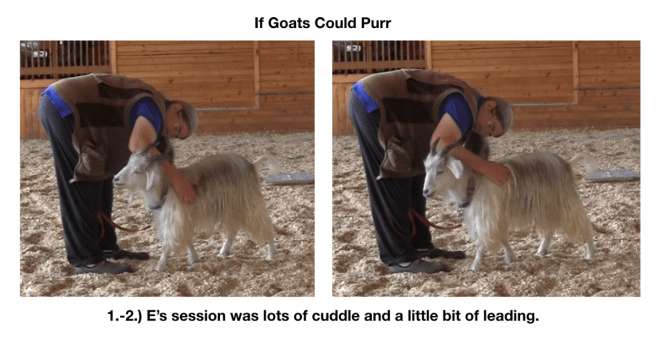
Goat Diaries Day 12 – If Goats could purr . . .

E’s last session in the arena was a lot of cuddling, and a little bit of leading.  If goat’s could purr, that’s what he would have been doing.

Goats day 12 if goats could purr fig 1-2

Goats day 12 if goats could purr fig 3 -8

I took E back to his stall, finished my barn chores and then went in to sit with them for for another round of goat “purrs”.

Their ride would be collecting them in a few minutes.  I decided on one last adventure.  I put the leads on both goats and took them outside for the first time since their arrival.  I wasn’t sure if I was going to be trying to manage two sled dogs going in opposite directions, but they were perfect.  All that work on basic training was paying off.  I’m sure to many all this caution where I spent so much time first in their stall and then in the barn aisle must have seemed silly.  These are goats!  Just get on with it.

But I’ve seen what “just getting on with it” means for both horses, and dogs.  I’ve watched enough dogs pulling against their leads to know that just getting on with it isn’t my idea of a fun walk.  When the goats arrived, they showed me they could pull as hard as any dog.  Now they were keeping a soft feel in the line.  Because I had taken my time in the beginning, we could all three enjoy a walk together now.

Trailer Loading – Goat Style
Sister Mary Elizabeth arrived in her pickup truck.  When the goats first came, my question had been how do you get them out of the back of a pick up? Now I had the reverse question.  How do you get them in?  E was small enough to lift up, so that was easy.  I tossed some treats on the floor of the pick up and showed P a target.  He jumped right up onto the tailgate.  Easy!  I wish all horses were as easy to load.

And then they were off.  My two weeks of goat training were drawing to a close.  There was just one more piece to describe and that’s graduation day.

Graduation Day!
That’s how I think of the following three days.  I drove up to the convent to give a clicker training workshop to the 4-H group that the Sister runs.

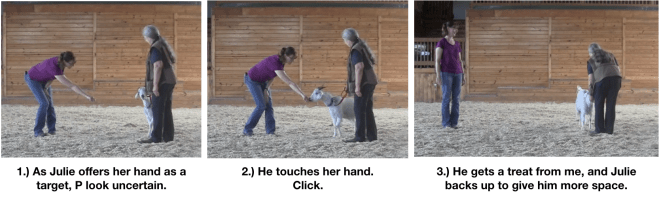
We had a great set up for introducing goats and children to clicker training.  The goats were in pens made from metal livestock panels.  We could begin with protective contact, introducing the goats to targeting with the children staying on the outside of the panels.

Most of the children had brought their own goats, so they already had relationships well established.  Even so, the panels were a great help.  We started all of the goats out with protective contact.  The barrier helped explain the “rules” of the game to both the goats and the children.  Touch the target and click – treats appear.  The panels stream-lined the process.

E and P showed what they had been learning.  P came in first and was a super star.  I set out two wooden platforms and showed the children how he would follow the target from one platform to the next.  Some of the children were sitting up on top of the panels.  P never even so much as glanced at them.  His focus was entirely with me, inside the pen.

With E I used a different approach.  I put him on a lead and had five of the children come into the pen with us.  Each child had a target stick.  One by one they held their target out for E to orient to.  He was very cautious at first.  From his perspective the children must have looked very predatory leaning towards him with their outstretched sticks.  But he did reach his nose out to touch the target, click, treat, on to the next child.  He caught on and began to move with much more confidence from target to target.

We did the same game with P.  He was much more confident.  It was good for him to move from target to target.  It’s a great way to generalize targeting to many different objects.

Both goats were great.  They led beautifully, took their treats politely, oriented to the target, worked for other people.  It was truly graduation day for them.

My own special treat was leading them down from the upper barn where most of the herd was housed.  It was cooler up there.  There was more of a breeze and the goats could shelter in the barn from the sun.  We’d tried the day before keeping all the goats down below where we were working, but it was just too hot for them.   On the second day only the goats we were going to be using were brought down to our work area.  I went up with the Sister to bring E and P down.  We got them through the gates of the upper pasture and into a fenced lane way.  The goats followed me one on each side, just as they had at the barn.  When an animal chooses to be with you that is indeed a great honor.

The goats were fun visitors. I enjoyed having them in the barn.  The training I did with them was just the beginning steps.  It was nothing unusual or fancy.  It was just clicker training basics, the same basics I would be using with a new horse. But basics are never boring or ordinary.

Always it is a study of one. And in that study of one, you discover the individual.

What do you do?
On forms that ask for your occupation I am never sure what to say.  I’m a writer, a teacher, a business owner.  For convenience I often say I’m a horse trainer, but really that is the least accurate description of them all.  I never really think of myself as a horse trainer.  To me that title refers to people who train other people’s horses for a living.

Very early on I tried having people send me their horses to train.  I hated it.  I felt as though I was running an assembly line.  It was get this horse worked and then move on to the next so I could get everyone done.  I barely had time left in the day for my own horses, and it began to feel as though they were also part of the assembly line.  The horses I had in training left my care knowing a lot more than when they came, but I didn’t enjoy it.

Training for me is about love.  I open my heart to each animal I work with.  When I sat with the goats, it wasn’t about training them to perform a particular task.  It was about making a connection with them.

Perhaps this is why far too often professional training can be so hard on horses.  The trainers certainly love horses.  They love the talent a particular horse shows.  But, do they love the individual?  Do they have time for that?  After so many horses have passed in and out of their barns, do they have the heart space for it?  Do they thank them, appreciate them, love them, each time they see some little breakthrough of understanding?

That’s what a marker signal lets us do.  Each time I click, I am celebrating the success of my learner.  I am building a relationship – a history of reinforcement.  That matters to me.  It is why I do not have a barn filled to the rafters with animals.  It is why I am a teacher not a trainer.  I want to have the time with each individual to make it a study of one.  That is what I share not by training horses, but by teaching the people who love them.  Together we are on a voyage of discovery.

It would have been fun to have had the goats stay a little longer.  Their two weeks of intensive training laid the ground work for so many grand adventures yet to come.  The goats were clearly eager learners.  Their leading skills meant we could have gone for walks around the property together.  I could have set up obstacle courses for them and taught them about agility.  As clever as they were, I could have taught them match to sample, color discrimination, counting and other forms of concept training. Mostly, I would just have enjoyed their company.  Because at the end of the day, that is what training lets us do – enjoy one another.

Instead they were going back to the children who love them.  They will be taking back with them the gift of clicker training.  Hopefully, it is a gift the children will be able to open.

The Goat Palace – Update

As you know the goats left in July, but came back to spend the winter.  So while this marks the end of the July Goat Diaries, it does not mark the end of my goat experiences.  In fact Trixie is due to give birth in just a few days so I suspect there will be many more goat reports once we have baby goats in the barn.

I have some other exciting news to share, but this has been a long report so I will wait for another day to tell you about my next great adventure.


Please Note: if you are new to the Goat Diaries, these are a series of articles that are best read in order.  The first installment was posted on Oct. 2nd.  I suggest you begin there: https://theclickercenterblog.com/2017/10/02/   Two of the goats I write about originally came for a twelve day stay in July.  The July Goat Diaries track their training during this period.  In November these two goats, plus three others returned.  They will be with me through the winter.  The “Goat Palace” reports track their current training.  I wish to thank Sister Mary Elizabeth from the Community of St. Mary in upstate NY for the generous loan of her beautiful cashmere goats.


Goat Diaries – Day 11: A Walk In The Park

Our brains love habits.  Predictable routines let our brains go on auto-pilot.  We don’t have to make decisions about every little thing.  Think how exhausted you’d feel before you even got as far as deciding what to have for breakfast if you didn’t have these micro-habits helping you get through the day.

I was establishing routines with the goats that were definitely helping with the smooth running of the day.  The morning of this their eleventh day of training began with a long cuddle/groom session.  E was particularly interested in being scratched.  I had the grooming mitt with me.  He stood perfectly while I used it all over his back and sides.  He seemed to be enjoying the feel.  P was not interested.

These goats need to be combed to get their beautiful cashmere fiber.  Combing was on the priority list, but they were both very clear that they weren’t ready for that step.  The grooming mitt was enough of a stretch for now.

Cuddle time was followed by leading sessions for each of them.  I was pleased by how good they both were.  I worked on grown-ups and took care that they stayed back during food delivery.  They were becoming very good at maintaining space between us.  I was also feeling that they were definitely responding to the click and not just my body language.  Their “wheels” were turning.

Little things were now evolving.  They knew the routine.  They knew they came out one at a time.  They knew they got treats on the floor when they went back to the stall so returning was not an issue.  They had become eager backers.  That meant I had to be careful to keep backing in balance with all the other things I was teaching them.  Backing is good, but in all things – moderation.

Our learners always tell us what we need to work on next.  Their eagerness to throw backing into everything suggested that I might want to put some mats out in the arena so they would have stations to go to.  That would help build solid standing still so I didn’t get hung up in some unintended chains.

E’s Session: “A Walk in the Park”

E was a delight.  He’s a charmer.  The way his long coat ripples as he walks, I can’t help but think I’m leading an overgrown Yorkshire terrier.  He’s a very elegant walking partner.  His good manners were beginning to match his good looks!

Goat Diaries Day 11 walk in park 1.png

E has become a very elegant walking partner.

P’s Session

P came out full of energy.  I thought he might need a bit of a run across the mounting block, so I let him loose.  He stayed with me.  We did a little bit at liberty and then I put him back on the lead.  He fussed a bit as I clipped the lead to his collar.  If he had been staying with me through the summer, cleaning that up would have been high on my to-do list.

He had much more go in him than E.  When I walked off, he trotted by my side.  He didn’t pull.  There was no feeling of the original sled-dogging.  He was staying with me.  He just had a lot of joyful energy that needed to be expressed.  I clicked, fed and went into grown-ups.

He was reminding me of an Icelandic stallion I had met at one of the spring clinics.  The stallion was in a new environment.  What an adventure!  He was a jumble of emotions.  He was excited – new horses, new sights and smells, so much to explore!  He was worried – new horses, new sights and smells, so much to take in.

He could have been a handful, but he came with a superb foundation in grown-ups.  Any time he started to get excited and to rush forward, his person stopped his feet and folded his arms together.  That was his cue for grown-ups.  That’s all he had to do.  His stallion instantly stopped his own feet and stood quietly.  It was a master class in the value of these foundation lessons.

P was on the first rung of the ladder that leads to grown-ups having that kind of stabilizing effect.  It doesn’t matter that he’s a fraction of the size of this horse.  Having these good manners in place will make him a much more enjoyable companion.  He made me think of the many dogs I have watched with their owners.  Some are over-controlled.  In an effort to manage them in human environments all their dogginess has been suppressed.  Don’t jump, don’t bark, don’t chew the furniture.  Don’t be a dog.

The other side of the pendulum looks at all that control in horror and lets the dogs do whatever they want.  Somewhere in the middle is a place where our animals can live comfortably and safely in our environments and still be themselves.

P is so very smart, and so full of joyful energy, that’s something I value and very much want to preserve.  I want to encourage his energy, not suppress it.  A very wise training mantra is: never get mad at energy.  You need it to train.

P’s energy can be channeled into so many fun activities.  I want to celebrate his quick learning.  His eagerness is a plus, something I want us both to enjoy.  He was learning to stay with me, to stand by my side, to move away from my treat pockets – not by being punished, but by being told over and over again how right he was.

Goat Diaries Day 11 Visitors

In the afternoon a friend I hadn’t see in quite a while came for a visit.  Ann joined us, as well.  We started by taking three chairs into the stall.  The goats visited a bit with Julie even though they hadn’t met her before.  That’s progress!  We talked for a while, then I took both goats in to play on the mounting block – except they didn’t want to!  After telling them how much fun it was watching the goats racing up and down the mounting block, they were total fuddy-duddies.  Oh well.  Perhaps Mount Everest loses it’s appeal after you’ve scaled it a few times.

Instead they stayed with me as I walked around the arena.  They were working together beautifully as a pair.  When I clicked, they both stayed well back away from my pockets.  All that was a plus.  What they didn’t do was put on an acrobatic show.  Oh well.

I took them back to their stall and then brought P out by himself on a lead.  I had Julie introduce herself via targeting.  She offered a target, in this case her hand.  When we clicked, I gave P his treat.

This is such a very safe way for him to meet new people.  I’ve used it many times with horses.  In clinics I’ll station people around the perimeter of a large circle.  For safety I’ll keep the horse on a lead.  One person will hold out a target, and I’ll walk with the horse as he moves towards the target.  Click.  I usually begin by handling the food.  The treats initially come from me.

After he gets his treat, we’ll back up to a mat that’s in the center of the circle.  Click, he gets reinforced for landing on the mat.  We do a couple of rounds of grown-ups and then the next person offers a target.  We use the mat in the middle so the horse’s hind end is never turned towards a person he doesn’t know.  I don’t want him to be frightened and suddenly kick out at someone.  Instead we back up away from the ring of people.

Remember, this lesson is most often used with horses who are worried by people. If something else in the environment suddenly startles him, I may be stacking one worry on top of another, creating a bigger spook than he would have to either one by itself.  So I structure this lesson with lots of layers of added caution, including backing up away from the people, but towards a mat.

All these little steps mean that this is not a beginning lesson.  I must first build all these components to make sure the lesson stays safe.  Look at all the skills this horse needs to understand and do well: targeting, taking food politely, backing, going to a mat, and even harder backing up with enough directional control that he lands on the mat, and finally grown-ups.

It’s a great pattern.  Every element gets stronger the more you play with it.  The horse gets more comfortable approaching people he doesn’t know.  His targeting skills become more generalized.  Backing becomes better.  The mat becomes an even stronger conditioned reinforcer.  Duration in grown-ups expands.  Treat manners get better.  Cues get stronger.  The behaviors overall become more solid.  Each element serves as a reinforcer for whatever preceded it.  You get all these benefits, and the animal thinks he’s just playing a game.

With P I wasn’t concerned about him kicking out so I didn’t worry about moving him away from Julie.  We just ping pinged back and forth between going to her to touch her offered target, and coming back to me for a treat.

I had just one more day with the goats and then they would be going back to their home farm.  Giving them this lesson would make it easier to transition new people into the games they had been learning with me.

Goat diaries day 11 meeting new friends.png

Goat Joy

Before we left the arena, I took P back over the mounting block.  The first time I kept the lead on and had him follow me up.  On the top step, I unhooked him, and he delighted us all with a wild leap into the air.  Such fun!

There’s more to this than just letting P entertain us with his acrobatic prowess.  P gets to practice getting excited, and then I ask for grown-ups and he practices calming down.  That’s a useful life skill no matter the species.

On the next run I unhooked him on the first step of the mounting block and let him go the rest of the way on his own.  He rewarded us all with another joyful leap off the mounting block.  I loved how he always came running straight to me.  Without really trying, I was building a great recall.

Goat diaries Day 11 Goat Joy.png

Who knows.  I may be triggering some form of goat to goat aggressive display.  All the goat experts reading this may be shaking their heads, thinking oh the trouble she is going to get into encouraging this kind of behavior.  Perhaps they are right.  Or perhaps, balancing his antics with grown-ups will mean I can allow this behavior without it tripping over the edge into emotional states I don’t want.

E’s Turn

E is much more people shy than his brother.  Again, I took advantage of the opportunity to have two experienced clicker trainers in the barn to help build his confidence.

We began by having him target to Julie’s outstretched hand.  He approached her very directly.  Click, he had to leave her to come to me for the food.  I do like this process.  It begins to build some duration between the click and the actual arrival of the treat.

With the horses there can eventually be a considerable time lag between these two events.  When I click, there are times when the horse I’m working with may be eighty feet or more away from me.  He’ll stop and wait patiently while I bring him his treat.

All the behavior that he is presenting between the moment he hears the click and the moment I get to him and stretch my hand out to deliver the treat are things that I like.  This kind of duration didn’t happen over night.  It is built in small increments through a long series of lessons.  The horses wait patiently because they know the treat is coming.  All that good, quiet waiting is reinforced over and over again through the ritual of the food delivery.

We moved from Julie to Ann.  I had Ann hold out a cloth frisbee.  E touched it, got a treat from me, but then was reluctant to go to Ann again.  I wanted him to be successful, so I had Julie step forward and offer her hand as a target.  He went to her directly, click, the treat came again from me.

We went back to Ann.  This time I had her hold her hand out.  Again, E was reluctant to approach her.  After a couple of failed attempts, I offered him the frisbee.  He touched it directly.  I handed Ann the treats.  E took them from her without hesitation.

So we used this pattern a couple of times.  Flexibility was the name of the game.  Training is not like baking a cake where you need to stick to the recipe or you end up with a mess.  In fact sticking rigidly to a recipe is a good way to guarantee a mess.   Always it is a study of one.  And always you are adjusting to the needs of your learner.  That was the major takeaway from this lesson.  We were asking E what level of interaction he was comfortable with and then making changes as needed to help him succeed.

Goals – Short or Long Term

When we were all done playing, I was really pleased with the return to the stall.  Both goats tend to rush ahead on the way back to the stall.  I could have simply released them.  The immediate goal was to get them back to the stall.  That’s where they were heading.  Letting them go on their own would have avoided any pulling they were doing on the lead.

It would also have missed an opportunity to teach them to stay with me in distracting environments.  There were going to be times when letting them off the lead wouldn’t be an option.  The walk back to the stall created an opportunity for me to show them that staying with me was worth the added effort.  I was taking them back to the stall.  But on the way there were lots more opportunities for treats.  Walking beside me had value.

E was figuring this out.  He was walking with me down the aisle.  There was less rushing ahead, less pulling to get back.  Out in the arena he had been listening to P calling.  He had clearly been wanting to get back to his brother.  I had kept the session short because I didn’t want him feeling too anxious.  So I was especially pleased that he walked back with me to his stall.

8 pm

At the end of the evening I had another cuddle session.  E in particular wanted to be close to me and to be scratched.  He’s so very sweet.  I’ve discovered he really likes having his chest and belly rubbed.  In fact, I haven’t found anywhere that doesn’t turn into a “please scratch” spot.  I can think of few better ways to end an evening than with goat bliss.  This was their last evening in the barn.  I was going to miss what had quickly become part of the day’s routine.

Goat Diaries Day 11 Goat bliss.png

Coming next: The July Goat Diaries: Day 12 – E and P’s Last Day at the Barn

Please Note: if you are new to the Goat Diaries, these are a series of articles that are best read in order.  The first installment was posted on Oct. 2nd.  I suggest you begin there: https://theclickercenterblog.com/2017/10/02/   Two of the goats I write about originally came for a twelve day stay in July.  The July Goat Diaries track their training during this period.  In November these two goats, plus three others returned.  They will be with me through the winter.  The “Goat Palace” reports track their current training.  I wish to thank Sister Mary Elizabeth from the Community of St. Mary in upstate NY for the generous loan of her beautiful cashmere goats.