Modern Horse Training: Contrast Teaches

In Search of Excellence

In March we celebrated the twentieth anniversary of the Clicker Expo. The theme for the Expo was centered around excellence. The Expo organizers wanted the presenters to talk about what made their work consistently stand out – what accounted for our success in training and teaching. This was originally supposed to be the theme of the 2020 Clicker Expo, but then the pandemic got in the way, so we had a lot of time to think about this topic.

Yesterday I wrote about Peregrine’s mother. She had neurological damage which meant, especially early on, she would frequently lose her balance and fall. I was told by my vet that there was no treatment for her, and in all likelihood her condition would worsen and I would be forced to put her down. The risk of her falling on someone would mean she would simply become unsafe to handle.

I saw her fall. I knew the risks and I chose to work with her anyway. How could I not? I loved her.

When I was around her, I was always careful. And I was always afraid in a way that I had not been before when I was around horses. My fear shaped my training choices.

So when I thought about this question for my Expo presentation: in general what are the procedures, the techniques, the principles that help people to excel in their training, I came up with what might seem to many to be an unexpected answer.

But before I give you my answer, I first want to ask what is excellence anyway? What does it mean to you?

The dictionary defines it as: “the quality of being outstanding or extremely good.”

That’s a nice feeling to think that we are outstanding in something. And we are. Every one of us is an expert. We are an expert in our own life experience. Nobody knows more about your life than you do.

So when I was thinking about this question of excellence, I was thinking about what for me is the difference that has made a difference?

Here’s my answer: what helped me to be a better trainer comes down to one word and that’s fear.

This is an interesting answer because, of course, I am a positive-reinforcement trainer. I want my learners to be moving towards activities that they enjoy, not away from aversives. I work hard to set up positive-reinforcement scenarios for both the horses and the people I work with. But scratch below the surface of my training and what motivates my search for training excellence is fear.

There are two kinds of fear. There’s the fear of something. Horses are big. That’s such an obvious statement it almost seems silly to point it out. But I think this is one of the reasons that horses make us look more deeply below the surface of our training choices than working with dogs typically does.

Dogs can certainly be dangerous. They are predators, after all, but for the most part they are harmless family pets. They jump up on people and lick their faces. They run around their feet and bump into them. They pull on leashes and for the most part people manage to stay upright. The same behavior in a horse could land you in the hospital. Horses are bigger than we are. They are stronger than we are. They are faster than we are. When they are excited or afraid, they can very definitely hurt us. Plus we get on their backs! We compound the risks by riding them, so fear of being hurt represents a rational response to being around a large, potentially volatile animal.

Then there’s the fear for something. Dog owners know this kind of fear. It very definitely can effect their training choices. Think about this situation: You don’t want your dog running out the front door because he could end up in the road and be hit by a car.

That fear motivates many people to adopt punishment-based solutions. They aren’t cruel, mean owners. They love their dogs. They don’t want to lose them. That’s the motivation that sits behind choosing training methods that cause fear or pain. They want to stop the behavior of running out the front door to prevent something much more horrible from happening. Interesting. Give them a kinder solution and they’ll switch – provided it’s effective. If we want to move owners away from punishment-based solutions, education matters.

Size Matters

Horses are big. And as strong as they are, they are also very fragile, so horses confront us with both kinds of fear, and often at the same time. Training minis revealed to me how much size effects our training choices. Panda, the mini I trained to be a working guide for her blind owner, came to me when she was nine months old. The first day she was with me I brought her into my house. It was such a novelty. There’s a horse in my house! She was so small I wasn’t worried at all. She was the size of a large dog. She weighed only a hundred pounds. In horse terms she was 7.5 hands tall (28 inches at the withers). If she had gotten under a table or trapped somehow in a tight space, I could easily have helped her out. But when a full sized horse gets cast in a stall or trapped under a fence, you may need four or five strong people to get the horse untangled. Size makes a difference. If you have only trained big horses, I very much recommend that you find a mini-sized mini to work with. Panda revealed how much size makes a difference. For me I know it certainly colors the risks I am willing to take and the training decisions I make.

Size matters in others ways. When I took Panda for walks in those early days, she used to stand up on her hind legs like a goat. She was amazingly well balanced. When she reared up, I just laughed. She was so tiny. She was only 28 inches at the withers. So when she reared up, it was cute. If she had been a nine month old warmblood, I probably wouldn’t have been laughing. Size matters. Training minis is a useful exercise. It really does reveal how much our training is colored by the size of the animal we work with.

My horses have free run of the barn, that includes the barn aisle and other spaces that horses don’t typically have free access to. I am very comfortable with them. I couldn’t give them this life style if I wasn’t very confident that they are safe to be around, even in tight spaces. But even so I respect their size. I am mindful of how I move around them so we all remain safe. Fear isn’t on the surface. I know my horses are mindful of me, as well. They have shown me that they will actively avoid bumping into me, but mistakes can happen. So fear sits in the background and influences how I evaluate the safety moment to moment of every horse-human interaction.

In the horse world fear is everywhere. It’s easy to spot. All you have to do is look for tension. You’ll see it in the horses. And you’ll see it in the riders, even riders at very high levels. Look for the tension in their arms, the tightness in their bodies, the hold on the reins. Only we don’t call this fear. We call it being tough, being assertive. Being afraid in the horse world isn’t acceptable. Riders who are afraid are shamed. Horses who are afraid are punished.

Another place you can see how afraid riders are of their horses is at tack stores. Look at all the leverage devices that are used to control horses. Why do we need to control them? Because we are afraid of them. Only that fear is hushed up, glossed over, called something else.

The Legacy of “Get Back On Your Horse” Training Attitudes

In the horse world when you take a tumble, it is get back on your horse. You aren’t allowed to be afraid. Unless you are so hurt you are being airlifted off to a hospital, it is get back on. Conquer your fear and conquer that horse. We have inherited this attitude from the age in which horses were used for transportation. The phrase “get back on your horse” has become part of normal speech. If you have a disaster at work, you are instructed to get right back out there. People who have never been near a horse in their entire life are told: “You have to get back on your horse.”

In a previous post I wrote about my experience at a hunter jumper barn. There I saw attitudes that are all too common in the horse world. In lessons people were told to get over their fear.

They were told to push past it, “to get back on their horse”. If a horse refused a fence, he was just being lazy. He was testing you. He was stubborn.

The solution that was offered was to get after him and make him do it. Get tough. Go straight at the brick wall and go over it. Being afraid wasn’t an option.

The horse world has no patience for those who can’t. You have to be brave and make the horse do it.

So I went to the dictionary again to find out what brave means. The horse world agrees with the dictionary definition: brave – adjective: ready to face and endure danger or pain; showing courage.

Next I went to the thesaurus. That was interesting. The synonyms the thesaurus gave me made me feel as though I was in the swashbuckling era of the early Hollywood movies. They evoked images of the three musketeers or old John Wayne movies.

Brave is synonymous with: courageous, plucky, fearless, valiant, valorous, intrepid, heroic, lionhearted, manful, macho, bold, daring, daredevil, adventurous, audacious, death-or-glory; undaunted, unflinching, unshrinking, unafraid, dauntless, indomitable, doughty, mettlesome, venturesome, stouthearted, stout, spirited, gallant, stalwart.

Interesting. These were certainly words that were valued in “brick-wall” training. But my horse was showing me these weren’t qualities that helped her. And they certainly didn’t describe me.

Finding Alternatives

So what is the alternative to being brave? I was just beginning to learn about training. Compared to the people around me I had very limited skills. But I had two things going for me that they either ignored or steam rolled over because they could.

I was patient.

And I was persistent.

Plus I loved my horse. I wanted to put off for as long as possible the day her neurological impairments would force the decision to have her put down.

So you can definitely say that FEAR sits at the center of what drove me to become a better trainer.

Instead of pushing FEAR aside, instead of trying to pretend it wasn’t there, or feeling as though I wasn’t good enough because I felt afraid, I turned things around and learned to listen to that fear.

I was afraid of my horse and for my horse, both at the same time. Instead of running from fear, I listened to it. I used it. It shaped my training in a good way. I found solutions that were horse friendly, that sidestepped fighting with horses and instead helped me to become what the subtitle of my new book celebrates – my horse’s best friend. The new book, “Modern Horse Training: A Constructional Guide To Becoming Your Horse’s Best Friend” is very much a product of the forty year journey my horses have sent me on.

I know from teaching thousands of people that I am not alone in feeling afraid of my horses and for my horses. And I also know that many of these individuals have encountered the same message that I observed in that hunter jumper barn: Get over your fear. Get tougher. Get back on your horse and show him who is the boss.

I have taught people who now struggle to ride because they listened to someone else instead of to their own fear. When they got back on, their horse sent them flying. Broken bones were the result. The brick wall that is their fear now looms so high it can’t be ignored. There are still ways around the wall, but it’s a longer journey than it needed to be.

This isn’t universal. You may have been lucky enough to start out in a barn that taught through compassionate, learner-centric methods such as Sally Swift’s Centered Riding or some other equally kind form of instruction. But the old attitude sadly is still there in far too many barns. It is so embedded in the training world, you may not even be aware of it. It is just the norm, the way things are done. If you’re an instructor, of course you find yourself telling a student to get back on after a fall. It’s what you were told. It’s what you did.

But it’s not what our horses are asking for, and it’s certainly not a match with the kind of relationship that many of us are looking for when we get a horse. We want to ride, and, yes, absolutely we want adventures. But we want them want them with our best friend, not a sparing partner.

The title of the new book, “Modern Horse Training”, refers to this shift in thinking. The older forms of thinking used punishment to suppress fear. There is an alternative.

Modern Horse Training” offers another way forward. I’ll show you what emerges when instead of trying to suppress the fear, you acknowledge it, you listen to it – both in yourself and in your horses. It lets you develop teaching strategies that build confident, eager, resilient, enthusiastic learners. There’s no pushing through brick walls. Instead there is good instruction built around the much kinder path of constructional training and positive-reinforcement procedures.

The new book will be published on April 26, 2023. You will be able to order it through my web site: theclickercenter.com and also through Amazon and other booksellers. It will be available in hardcover, paperback and as an ebook.

In the coming posts I’ll share with you some of the many good things that have evolved in my training because I learned to listen to that little voice inside me that was telling me to be careful. Coming next: Everything is Connected to Everything Else
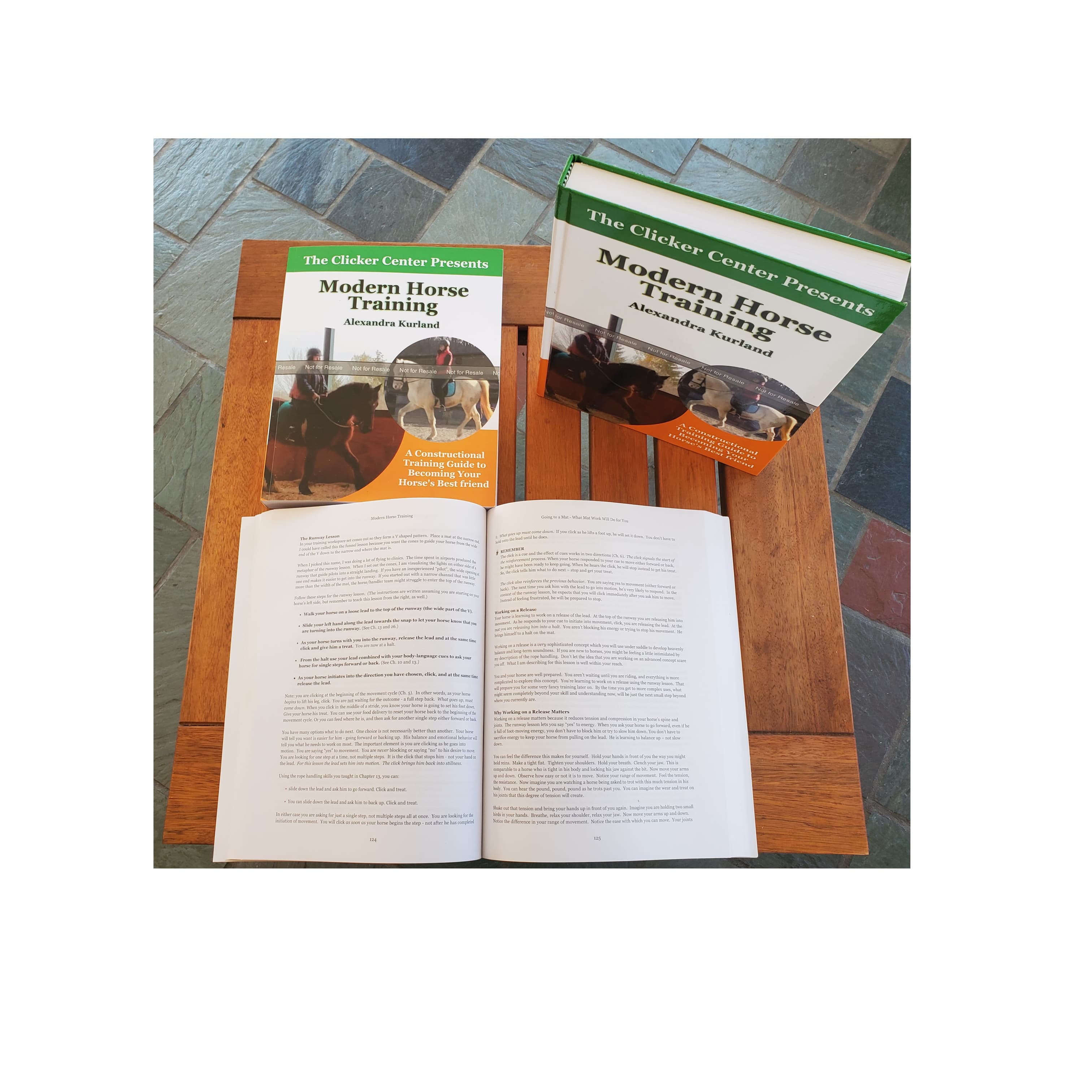
The book is coming! The arrival of the book proofs was very exciting!

Constructional Training – What That Term Means to Me.

I have a new book coming out on April 26: Modern Horse Training

The subtitle of the book is: A Constructional Guide to Becoming Your Horse’s Best Friend.

In the clicker training community we’ve been talking a lot recently about constructional training. Dr Jesús Rosales Ruiz has brought to our attention the work of Israel Goldiamond. Dr Goldiamond was a clinical psychologist. Instead of trying to “fix” problem behavior, he constructed new repertoires. The analogy would be instead of trying to fix a falling down, hundred year old barn with a leaky roof, cracked foundations and ceilings that are too low for horses, you build a new barn that’s purpose-built for what you need. It has none of the problems of the falling-down barn. The old barn may still be on your property, but you don’t have to use it for your horses. The old, unwanted behavior may still exist. Nothing is ever erased or unlearned, but there is a clean, new behavior in repertoire that you can call on instead.

The term constructional training appeals to me. I like building things. The idea that we can teach complex behaviors by first breaking them down into smaller component parts is not new to me. My horses showed me this decades ago.

Nor is this a new idea in the horse world. It is how good trainers train. But that doesn’t make it the norm. Far from it. What we see around us are people who confront problems head on. The horse world is full of instructors who tell their students to send their frightened horses forward, to make them obey, to show them who is boss. Sometimes this works and sometimes it puts the rider in the hospital and the horse on a trailer to the auction yards.

My Path to a Constructional Mindset
I have always been horse crazy. Like so many others I grew up in a family that just didn’t share my obsession over horses. My parents did at least provide me with the opportunity to ride. Over time I developed a decent seat. I could ride, maybe not that well, but riding out over rough terrain, riding at speed, riding bareback were all well within my capabilities. As a teenager, I thought I knew how to ride. As a young adult, I decided I was wrong. Yes, I could ride, but I didn’t really know how to ride. There’s a difference. And I certainly didn’t know how to train. I wanted to learn, so I started to take lessons at a local hunter jumper stable. To choose the stable I opened the phone book – yes, this was a time before computers when there were actual phone books with yellow pages directories. When I chose the stable that was closest to my house, I had no idea what I was getting myself into.

The owner had been around horses all of his life. He had grown up poor with very little formal schooling. I’m pretty sure he would not have been able to read the words I’m writing here, but my goodness he could read horses. He was a superb horse person. Talk about horse whisperers – he was definitely one of them.

He was running a hunter jumper barn because that’s where the money was in the northeast, but that wasn’t where he started out. At one point he had been top ten in the country – in bull riding.

That’s certainly not a typical background for a trainer at a jumper barn, at least not in this region. It made for “exciting” lessons. He had no physical fear. And he didn’t understand fear in others, not in people and certainly not in horses. His approach to fences was to go straight at them, the higher the better.

In New York where I live the thoroughbred racing industry is strong. That means if you are looking for a riding horse, you will encounter a lot of thoroughbreds. The horses in the school line were all thoroughbreds with only one exception, and they were all literally off the track. On Sunday the horses would be racing. On Monday they would be on a dealer’s van heading for the riding stable. The dealers knew Pick was looking for cheap horses, horses that weren’t fast enough, or sound enough for the trainers to hang onto, but who might do as riding horses.

These were horses who had never jumped a fence in their lives – at least not with a rider on board. Pick would set up a line of fences. He’d have one of the teenage boys who rode for him get on and they’d send the horse over the jumps. If a horse balked, they would build a chute. Two men would stand on either side of the chute with lunge whips while the rider drove the horse forward with a crop.

When the horse cleared the fence, the rails went up. They wanted to see what the horse could do.

The horses that took the fences down, or that came up lame afterwards were put back on the trailer and were sent back to the dealer’s yard. The others stayed and were put into the school line. I rode some amazingly athletic horses. I also rode some very frightened, unbalanced, and untrained horses. And I learned a lot about brick-wall training.

Brick-wall Training
Brick-wall training refers to an approach to problem solving where you go head-on into the problem. It was the reality I saw at this stable, and it’s a metaphor for much of what we encounter in the rest of society. If there’s a brick wall in front of you, you head over it, no matter how tall or how wide it is. You either make it over, or you crash. Oh well.

Brick-wall problem solving is fine if you are athletic enough, strong enough, sound enough, brave enough to make it over the fence. Many of those thoroughbreds were. But many of the riders weren’t. Pick lost a lot of potentially good riders to broken bones and just plain old fear.

I very quickly decided to opt out of the group lessons. I watched as many as I could, but I chose to take private lessons instead. I wanted to control what I was being taught. I wasn’t interested so much in going over the fences. That was a fun outcome, but only if the fence was jumped well. I wanted to know how to ride a correct corner that would bring me into a balanced approach to the fence. In other words, I was looking for the components that made for a successful ride. Because I had ridden before, I knew what I wanted to learn.

I baffled Pick. He thought riders just wanted to jump. In my lessons I would stop and ask questions. It turned out he knew a lot about balance. If you asked the right questions you could learn a lot from him. I asked a lot of questions, and I did indeed learn a lot about good riding. By watching the group lessons I also learned what I didn’t want.

I couldn’t go straight at brick walls, not with my horse. This was Peregrine’s mother. I bought her from Pick just before she turned a year old. He had bred her to be a racehorse, but he was just as glad to sell her early. She passed a pre-purchase vet check. Now that I’ve seen more pre-purchase exams, I know the vet was pretty superficial with this one. He wasn’t expecting to see any problems in such a young horse so he didn’t look for any. Not long after that exam, I began to see the first small signs that there was something terribly wrong.

At first, I saw her dragging her hind feet. When I asked Pick about it, he said she was just being lazy. How many times since then have I heard people say that about a horse?

When I saw her fall for the first time, I called the vet back in. This time he looked more closely, and he diagnosed her as a wobbler. She had spinal cord damage. When I started asking questions and doing some digging it was clear that the cause was a handling incident that had gone wrong. She was tied tight to a post while a teenager pulled her mane for the first time. She protested. He persisted. She fought back. She was against the four foot kick board of the arena. Her only escape was over the rail so she jumped it with her head tied tight. I’ll leave it to you to imagine the rest of that scene.

The incident occurred shortly before I bought her. I wouldn’t have known anything about it except one of the visible signs of the event was a swollen hind leg. If I hadn’t seen the swelling during one of my visits to the barn, no one would have said anything about it.

The swelling went away, but the damage to her spinal cord remained. The injury left her with limited awareness of her hindquarters. Wobbler syndrome is descriptive even if it doesn’t tell you very much about what has happened internally. It can be caused by injury, and there is also equine protozoal myeloencephalitis (EPM) which at that time was just beginning to be understood. In either case, even the vets at Cornell had no treatment to offer me. My local vet told me I would never be able to ride her, and he advised me to put her down.

I couldn’t do that. I couldn’t end her life simply because I wouldn’t be able to ride her. That wasn’t right. Nor could I afford to retire her to a pasture somewhere while I got a second horse to ride.

The vet told me that her condition would deteriorate over time, and I would eventually be forced to put her down for safety reasons. That was the future I had in front of us, but in the meantime I needed to deal with what she was struggling with on a day by day basis.

For starters she had trouble going in and out of her stall because there was a sill over the threshold that was intended to keep the bedding from spilling out into aisle. I thought if I taught her to go over ground poles, she would have more confidence stepping over the sill. So I set out a round jump pole. That terrified her. She refused to go anywhere near it. I could have forced her over it. That’s the “show them who’s boss” approach to training I had seen modeled all around me at the riding stable. I didn’t want to fight with her, so I took a different approach.

A ground pole was too hard. That was too big a “jump”. I swapped it out for a flat board that wouldn’t roll if she stepped on it. She was still afraid. She couldn’t manage it.

I tried a lead rope. That was still too hard. So then I drew a line in the sand. That she could walk over. From the line in the sand, I reintroduced the lead rope, then the flat board, and the round ground pole. She was eventually able to jump a small cross rail.

I didn’t approach the problem head on. She taught me how to break complex tasks down into smaller and smaller steps until I found something she could do.

Over time she learned to compensate for the nerve damage. My vet warned me never to ride her. He told me it was just too risky. She might lose her balance and fall on top of me. I listened to him. I had seen her fall often enough to know he was right, but when she was ready, I rode her. She was the horse who introduced me to classical dressage. She was the first horse I taught to piaffe. It was because of her that I became balanced obsessed. That’s what kept her from falling. That’s what kept us both safe, and that’s what formed the core of everything I teach today.

Here is the simplicity of what she showed me:

Break complex tasks down into smaller, simpler components.

Find something – no matter how small, no matter how far away from your goal behavior it may seem to be – where you can get a “yes answer” response and begin there.

Build in small steps.

Build in repeating patterns.

At that time I didn’t know anything about clicker training. I didn’t have the clarity of the marker signal. I wasn’t talking about movement cycles or loopy training. I didn’t call any of what I was doing constructional training, but the elements were all there. I was primed to be a clicker trainer. And I was primed to be drawn to the language of constructional training that Goldiamond has given us.

The new book, “Modern Horse Training“, has grown out of those powerful lessons learned over forty years ago. What we have now are the words to describe what the horses have been showing us. Horses are truly our best teachers. We just need to listen to them and they will open their hearts and their wisdom to us.

The publication date for “Modern Horse Training” is April 26, 2023. I’ll share more about where it can be ordered as we get closer to the date.

Coming next: Contrast Teaches

Modern Horse Training – The Proofs for the New Book Have Come!

I have a new book coming out on April 26: “Modern Horse Training”

Modern Horse Training: book proofs: hardcover and paperback editions plus a peek inside.

Just two weeks to go!

The proofs came Monday evening! So exciting. The book looks great. I’m so pleased. The pages are inviting, so readable. That matters a lot to me. You can have the best information in the world, but if the page isn’t inviting, no one is going to read it. And I know that sometimes what looks fine on the computer screen just doesn’t translate to the printed copy. So it’s always a worry.

So Monday evening there was the package, waiting to be opened. The new book was inside. But there was some avoidance behavior that kicked in. I need to take the deer fencing down before it gets dark. I need to go through my mail pile. Tomorrow won’t do. But now I have procrastinated long enough. It’s time to rip open the package and see the new book for the first time.

And it looks great! I love it!

So the proofs have been okayed. The book is ready, but I’m still going to make you wait until April 26. That’s the official publication date. I wanted to give myself a little leeway in case there were glitches that needed to be fixed. And besides it seems so perfect to bring the book out on the anniversary of Peregrine’s birthday. I want to stick to that date so we all have to wait. Two weeks! Very exciting!

While we’re waiting, I’ll share some background stories related to the book.

Coming Next: Constructional Training: What That Term Means To Me

Modern Horse Training: Why Another Book?

A new book is coming: Modern Horse Training: A Constructional Guide to Becoming Your Horse’s Best Friend

I’ll be telling you soon how you can pre-order it. This isn’t a marketing ploy. I am still getting the book set up so you can order it on line. As soon as that’s done, I’ll let you know. The publication date is April 26, the anniversary of Peregrine’s Birthday.

The book is coming out on Peregrine’s birthday, but it is really celebrating Robin. I think of this as his book. So let me show you why I want to share this work with you.

I’ve said over and over that balance matters. I fuss handling details in the food delivery. In clinics we focus in on the minutia of balance and here’s why.

Look at the changes in the way these horses are standing. In the before images we see the higgledy-piggledy stance of horses that are tense in their backs and unaware of their balance. They can’t stand square and be comfortable. And then we see the changes that occur, often within just a couple of sessions. We aren’t compelling these horses to stand square. They are finding this balance on their own. We teach them the underlying components and what emerges is a horse who can stand in beautiful balance.

You may be thinking: “Okay. That’s nice. It’s pretty. But so what?”

Why does this matter? Why should you care about these changes? Why should you join me in my obsession about balance?

Here’s why:

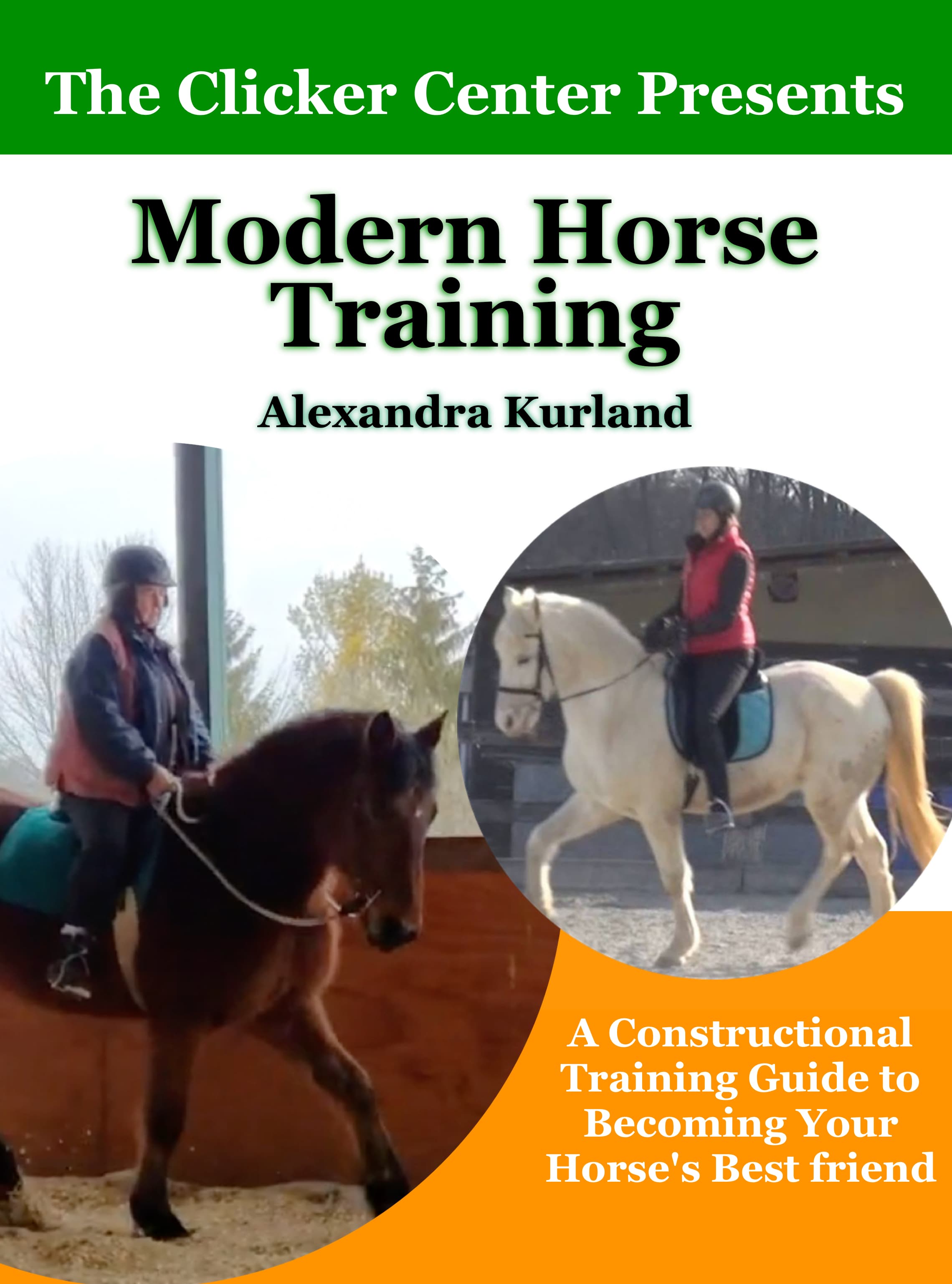
This is one of the images I have chosen for the cover of “Modern Horse Training”. This is Robin. The photo was taken last year. For years when people have asked me how old Robin is I have always said he’s four going on five. In the last year or two I finally decided it was time to update his age. In this photo you are looking at a 27 year old horse – (who still thinks he’s four going on five!)

Balance matters.

Here’s what I write about this image towards the end of the book:

“Robin joined my family as a yearling. He is not only my training partner, he is my much loved best friend. I treasure every every ride, every day we have together.

Good balance is woven into every lesson I have shared with you. My goal throughout this book has been to help you build your own great equine partnership with the horses in your life. Here’s to many great rides on your beautiful horses!”

If there’s an elevator speech way to describe the new book, that’s is it. Balance matters. For all of us who love our horses, these horses show us why.

Coming next: Constructional Training: What that means to me.

Modern Horse Training: The Story Behind the New Book

I have a new book coming. It will be published April 26, on the anniversary of Peregrine’s birthday. You’ll be able to pre-order it soon. I’m still getting all of that set up. I’ll have more details about how you can order the book coming soon.

For now let me tell you a little more about it.

In 2020 I was asked by an editor working for a popular line of self-help books if I would consider writing a horse training book for them. The request was interesting. It did no harm to say I would consider the idea. For a couple of months I heard nothing more from him. Then I got another email. This one took the idea a little further. They were definitely interested.

The email exchanges continued. The editor asked me to write a sample chapter. I did. In the fall of 2021 I was offered a contract to write a horse training book for them. The contract was very one-sided, but their marketing would bring clicker training to a much broader part of the horse community than I am able to reach on my own. So, even though it felt more than a little bit like I was selling my soul, I signed the contract.

I was still working on my on-line clinics so it was nose to grindstone all winter to get that project finished. I launched the clinics March 11, 2022. The following day I started on the new book.

It turned out the clinics were the perfect prep for writing a book. I was well primed. The words literally flew onto the page. The contract stipulated a July deadline for submitting the final chapters. I beat that deadline by two months. By mid-May I was sending in the final chapters. The editing had already begun on the sections I had already submitted. I had a meeting with the editor the end of May, and then I heard nothing.

Weeks went by in email silence. I started emailing others in the team who would be involved in the book’s production. Nothing. Finally, at the end of June I got an email from the production manager. The editor no longer worked for the company, and they would not be going ahead with the book. End of story.

I told you the contract was very one-sided.

So I was left with a book, but no publisher.

I put the book aside for a while. I had other projects that needed my attention, and I wanted some time to consider my options. I could look for another publisher. I could publish it myself. Self-publishing seemed like the best option. I like the editorial control that gives me over the content.

So there you have it. I wasn’t intending to write another book. That wasn’t on my radar. The book is very much the product of the pandemic. At the start of 2020 I had a full schedule of clinics planned for the year ahead. When we went into lockdown, one by one those clinics were canceled. My initial thought was I couldn’t possibly transfer my teaching to an on-line format. I needed to see the horses, to work with them directly to know what to advise. But in-person clinics were out, so I started to experiment. Rebekka Schulze, the organizer of the North Carolina clinic that was scheduled for the spring of 2020, invited me to test out a zoom clinic option. I discovered I loved the format. Using video we could focus in on the training details make such a difference to horses. People didn’t have the expense or the stress of travel. We could watch the horses in their home environments. There were so many advantages.

I put together more on-line clinics. I built each clinic around a major topic. I think my favorite was the rope handling clinic. Who knew that you could teach something as tactile as rope handling via an on-line platform!

Those clinics created the structure for the new book. When I heard back from my contact at the publishers that they weren’t going ahead with the project, I was actually relieved. They had done me a huge favor. I would not have written the book without the prompt from them. But in the end I am glad to have the book back in my own court. Their contract placed too many restrictions on how I could use my own work.

I set the book aside over the summer and came back to it in the fall of 2022. When I read it with a fresh perspective, I loved it. It’s a very good book. It needed to be published, so the editing and formatting process began.

The gestation period for a horse is roughly eleven months. It has taken me just a little bit longer than that to write and prepare my new book for publication. Every day I get a step closer to having it ready. April 26 is my target for publication – Peregrine’s birthday.

Coming next: I’ll answer the question – why another book? And very soon I’ll have information about how you can pre-order your copy. This isn’t a marketing tease. So much has changed in the publishing world, I’m on a steep learning curve putting all the pieces in place for a smooth book launch April 26.

Modern Horse Training

I have a new book! And I have a publication date. Very exciting.

The new book is “Modern Horse Training: A Constructional Guide to Becoming Your Horse’s Best Friend.”

The publication date is April 26 -27, 2023.

That may seem like an odd way to write the date. I chose the dates in honor of Peregrine. He truly was my beloved best friend. He’s the horse who introduced me to clicker training so how perfect that the newest book will be published on the anniversary of his birthday/first day.

He was born shortly before midnight on April 26, 1985. I have always celebrated both his birthday and his first day. For his 30th birthday I wrote a series of blog posts through the month of April. You can read them here:

https://theclickercenterblog.com/2015/04/12/

So a new book! What’s in it? What’s it about? How is it different from the other books? I’m sure you have lots of questions. I’ve been so busy writing the book and getting it ready for publication I haven’t really come up with the “elevator speech”. I don’t yet have the quick two or three sentences that grabs your attention and makes you want to know more.

I have three weeks to the book’s publication so I’m going to use this blog to help me develop my elevator speech. Why did I write this book? There’s a story behind that. But before I share that story, let me begin with the title.

“Modern Horse Training”

Why that title? All my other books have referenced clicker training, so why the change?

What does “Modern Horse Training” really mean?

To answer that kind of question I like to begin with the dictionary.

“Modern:

adjective
relating to the present or recent times as opposed to the remote past

characterized by or using the most up-to-date techniques, ideas, or equipment•
denoting a current or recent style or trend in art, architecture, or other cultural activity marked by a significant departure from traditional styles and values

noun (usually moderns)
a person who advocates or practices a departure from traditional styles or values.”

I often think about what life was like for horses (and people) in times past. I’ll say a hundred years ago ___, using that phrase as a benchmark against which to measure changes that have occurred. It occurred to me recently that while I use this phrase a lot, I haven’t kept it updated. So when I say a hundred years ago, I don’t really mean 1923. I mean a hundred years ago from the time when I was a child and I was forming my ideas about the world I lived in. What was the historical context in which I lived? I was growing up with a television in the house. My parents had listened to the radio.

I got my first horse in 1968. So a hundred ago at that time meant 1868. Think about what the world was like in 1868. That was the world Anna Sewell wrote about in “Black Beauty”.

I remember reading a monograph from England that was written in the 1840s. It described the care of the horses that were used to pull what were essentially city buses. The horses came mostly from Ireland, strong Irish draft horses. They used mostly mares which I thought was interesting. The horses were put to work when they were four or five and they were dead by age seven or eight.

Think about what a hundred years ago means to you. If you’re ten years old, that’s 1913, a year before the First World War. Think of the horses who lost their lives in that terrible war. It wasn’t machines that pulled the canons up to the front lines. It was horses. That included the strong Cleveland Bays that my Robin is descended from.

Wherever your hundred year benchmark begins, the world has undergone some incredible changes. We’ve seen tractors replace horses in the fields, cars replace them on the roads. I can watch a movie on the same device that I use to type this blog. Just incredible.

And that doesn’t even begin to address the many cultural changes that have occurred. Horse training and child rearing used to share the same motto: spare the rod, spoil the child. At least with children, that has changed. Yes, I know children are still beaten, but now it is called what it is – abuse and family services can step in. All too often with horses, it is still called training. Much has changed and in in some ways nothing has changed.

I want to celebrate the much that has changed.

This is the perspective that I was thinking of when I decided to call my new book “Modern Horse Training”. Horse training is not what it was a hundred years ago. It now includes clicker training and all that that means.

So before I tell you more about my new book, let me leave you for today to think about what a hundred years ago means to you. What was the world like a hundred years ago? And what are the changes that you have seen, that your parents and grandparents have seen. We are living in a different world from anything the people living a hundred years ago would have imagined. “Modern Horse Training” belongs to this new world. In the coming days I’ll tell you more about it. I may not end up with an elevator speech, but hopefully you’ll have a good sense what the new book is about.