Constructional Training – What That Term Means to Me.

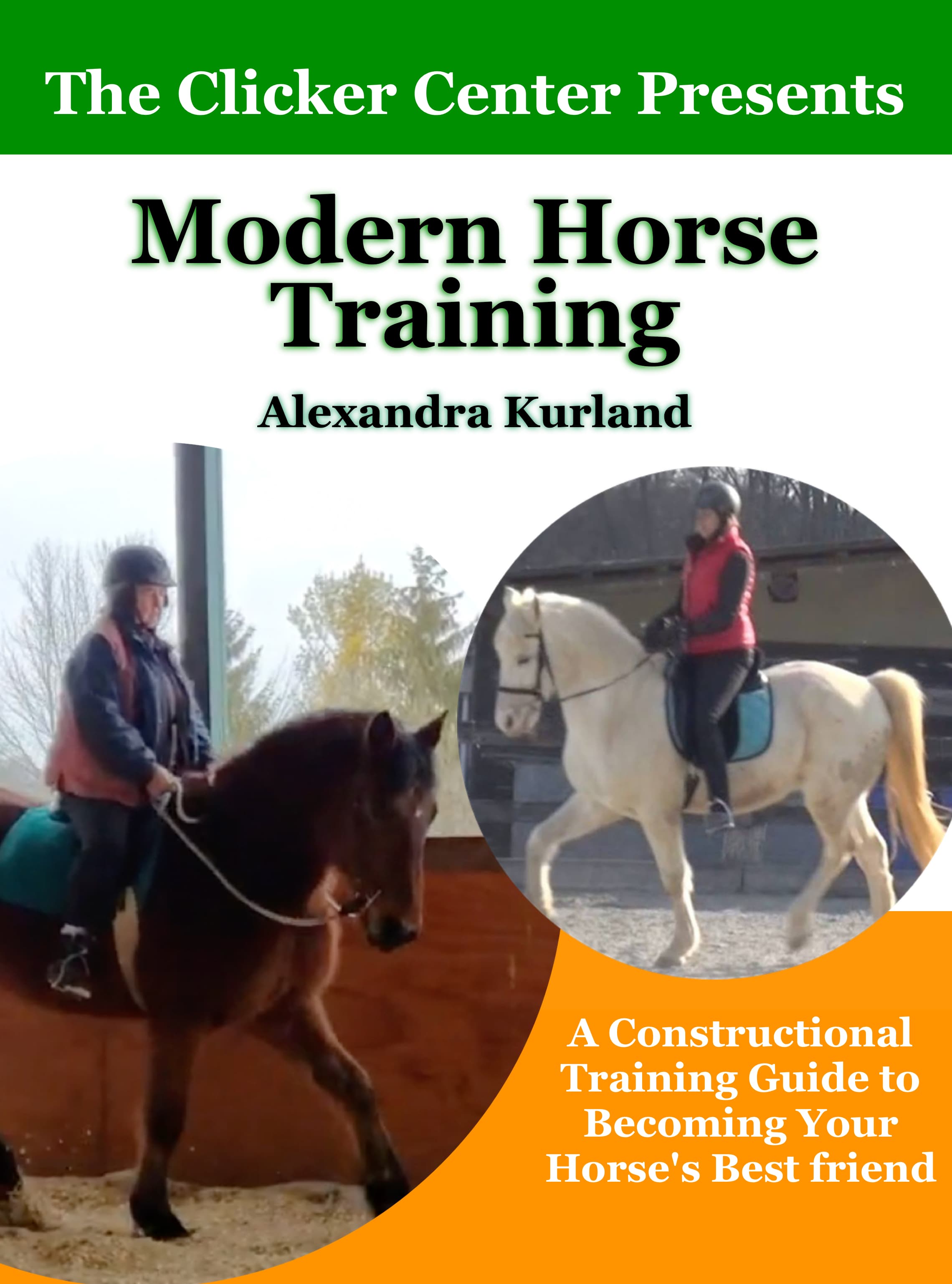
I have a new book coming out on April 26: Modern Horse Training

The subtitle of the book is: A Constructional Guide to Becoming Your Horse’s Best Friend.
In the clicker training community we’ve been talking a lot recently about constructional training. Dr Jesús Rosales Ruiz has brought to our attention the work of Israel Goldiamond. Dr Goldiamond was a clinical psychologist. Instead of trying to “fix” problem behavior, he constructed new repertoires. The analogy would be instead of trying to fix a falling down, hundred year old barn with a leaky roof, cracked foundations and ceilings that are too low for horses, you build a new barn that’s purpose-built for what you need. It has none of the problems of the falling-down barn. The old barn may still be on your property, but you don’t have to use it for your horses. The old, unwanted behavior may still exist. Nothing is ever erased or unlearned, but there is a clean, new behavior in repertoire that you can call on instead.

The term constructional training appeals to me. I like building things. The idea that we can teach complex behaviors by first breaking them down into smaller component parts is not new to me. My horses showed me this decades ago.

Nor is this a new idea in the horse world. It is how good trainers train. But that doesn’t make it the norm. Far from it. What we see around us are people who confront problems head on. The horse world is full of instructors who tell their students to send their frightened horses forward, to make them obey, to show them who is boss. Sometimes this works and sometimes it puts the rider in the hospital and the horse on a trailer to the auction yards.

My Path to a Constructional Mindset
I have always been horse crazy. Like so many others I grew up in a family that just didn’t share my obsession over horses. My parents did at least provide me with the opportunity to ride. Over time I developed a decent seat. I could ride, maybe not that well, but riding out over rough terrain, riding at speed, riding bareback were all well within my capabilities. As a teenager, I thought I knew how to ride. As a young adult, I decided I was wrong. Yes, I could ride, but I didn’t really know how to ride. There’s a difference. And I certainly didn’t know how to train. I wanted to learn, so I started to take lessons at a local hunter jumper stable. To choose the stable I opened the phone book – yes, this was a time before computers when there were actual phone books with yellow pages directories. When I chose the stable that was closest to my house, I had no idea what I was getting myself into.

The owner had been around horses all of his life. He had grown up poor with very little formal schooling. I’m pretty sure he would not have been able to read the words I’m writing here, but my goodness he could read horses. He was a superb horse person. Talk about horse whisperers – he was definitely one of them.

He was running a hunter jumper barn because that’s where the money was in the northeast, but that wasn’t where he started out. At one point he had been top ten in the country – in bull riding.

That’s certainly not a typical background for a trainer at a jumper barn, at least not in this region. It made for “exciting” lessons. He had no physical fear. And he didn’t understand fear in others, not in people and certainly not in horses. His approach to fences was to go straight at them, the higher the better.

In New York where I live the thoroughbred racing industry is strong. That means if you are looking for a riding horse, you will encounter a lot of thoroughbreds. The horses in the school line were all thoroughbreds with only one exception, and they were all literally off the track. On Sunday the horses would be racing. On Monday they would be on a dealer’s van heading for the riding stable. The dealers knew Pick was looking for cheap horses, horses that weren’t fast enough, or sound enough for the trainers to hang onto, but who might do as riding horses.

These were horses who had never jumped a fence in their lives – at least not with a rider on board. Pick would set up a line of fences. He’d have one of the teenage boys who rode for him get on and they’d send the horse over the jumps. If a horse balked, they would build a chute. Two men would stand on either side of the chute with lunge whips while the rider drove the horse forward with a crop.

When the horse cleared the fence, the rails went up. They wanted to see what the horse could do.

The horses that took the fences down, or that came up lame afterwards were put back on the trailer and were sent back to the dealer’s yard. The others stayed and were put into the school line. I rode some amazingly athletic horses. I also rode some very frightened, unbalanced, and untrained horses. And I learned a lot about brick-wall training.

Brick-wall Training
Brick-wall training refers to an approach to problem solving where you go head-on into the problem. It was the reality I saw at this stable, and it’s a metaphor for much of what we encounter in the rest of society. If there’s a brick wall in front of you, you head over it, no matter how tall or how wide it is. You either make it over, or you crash. Oh well.

Brick-wall problem solving is fine if you are athletic enough, strong enough, sound enough, brave enough to make it over the fence. Many of those thoroughbreds were. But many of the riders weren’t. Pick lost a lot of potentially good riders to broken bones and just plain old fear.

I very quickly decided to opt out of the group lessons. I watched as many as I could, but I chose to take private lessons instead. I wanted to control what I was being taught. I wasn’t interested so much in going over the fences. That was a fun outcome, but only if the fence was jumped well. I wanted to know how to ride a correct corner that would bring me into a balanced approach to the fence. In other words, I was looking for the components that made for a successful ride. Because I had ridden before, I knew what I wanted to learn.

I baffled Pick. He thought riders just wanted to jump. In my lessons I would stop and ask questions. It turned out he knew a lot about balance. If you asked the right questions you could learn a lot from him. I asked a lot of questions, and I did indeed learn a lot about good riding. By watching the group lessons I also learned what I didn’t want.

I couldn’t go straight at brick walls, not with my horse. This was Peregrine’s mother. I bought her from Pick just before she turned a year old. He had bred her to be a racehorse, but he was just as glad to sell her early. She passed a pre-purchase vet check. Now that I’ve seen more pre-purchase exams, I know the vet was pretty superficial with this one. He wasn’t expecting to see any problems in such a young horse so he didn’t look for any. Not long after that exam, I began to see the first small signs that there was something terribly wrong.

At first, I saw her dragging her hind feet. When I asked Pick about it, he said she was just being lazy. How many times since then have I heard people say that about a horse?

When I saw her fall for the first time, I called the vet back in. This time he looked more closely, and he diagnosed her as a wobbler. She had spinal cord damage. When I started asking questions and doing some digging it was clear that the cause was a handling incident that had gone wrong. She was tied tight to a post while a teenager pulled her mane for the first time. She protested. He persisted. She fought back. She was against the four foot kick board of the arena. Her only escape was over the rail so she jumped it with her head tied tight. I’ll leave it to you to imagine the rest of that scene.

The incident occurred shortly before I bought her. I wouldn’t have known anything about it except one of the visible signs of the event was a swollen hind leg. If I hadn’t seen the swelling during one of my visits to the barn, no one would have said anything about it.

The swelling went away, but the damage to her spinal cord remained. The injury left her with limited awareness of her hindquarters. Wobbler syndrome is descriptive even if it doesn’t tell you very much about what has happened internally. It can be caused by injury, and there is also equine protozoal myeloencephalitis (EPM) which at that time was just beginning to be understood. In either case, even the vets at Cornell had no treatment to offer me. My local vet told me I would never be able to ride her, and he advised me to put her down.

I couldn’t do that. I couldn’t end her life simply because I wouldn’t be able to ride her. That wasn’t right. Nor could I afford to retire her to a pasture somewhere while I got a second horse to ride.

The vet told me that her condition would deteriorate over time, and I would eventually be forced to put her down for safety reasons. That was the future I had in front of us, but in the meantime I needed to deal with what she was struggling with on a day by day basis.

For starters she had trouble going in and out of her stall because there was a sill over the threshold that was intended to keep the bedding from spilling out into aisle. I thought if I taught her to go over ground poles, she would have more confidence stepping over the sill. So I set out a round jump pole. That terrified her. She refused to go anywhere near it. I could have forced her over it. That’s the “show them who’s boss” approach to training I had seen modeled all around me at the riding stable. I didn’t want to fight with her, so I took a different approach.

A ground pole was too hard. That was too big a “jump”. I swapped it out for a flat board that wouldn’t roll if she stepped on it. She was still afraid. She couldn’t manage it.

I tried a lead rope. That was still too hard. So then I drew a line in the sand. That she could walk over. From the line in the sand, I reintroduced the lead rope, then the flat board, and the round ground pole. She was eventually able to jump a small cross rail.

I didn’t approach the problem head on. She taught me how to break complex tasks down into smaller and smaller steps until I found something she could do.

Over time she learned to compensate for the nerve damage. My vet warned me never to ride her. He told me it was just too risky. She might lose her balance and fall on top of me. I listened to him. I had seen her fall often enough to know he was right, but when she was ready, I rode her. She was the horse who introduced me to classical dressage. She was the first horse I taught to piaffe. It was because of her that I became balanced obsessed. That’s what kept her from falling. That’s what kept us both safe, and that’s what formed the core of everything I teach today.

Here is the simplicity of what she showed me:

Break complex tasks down into smaller, simpler components.

Find something – no matter how small, no matter how far away from your goal behavior it may seem to be – where you can get a “yes answer” response and begin there.

Build in small steps.

Build in repeating patterns.

At that time I didn’t know anything about clicker training. I didn’t have the clarity of the marker signal. I wasn’t talking about movement cycles or loopy training. I didn’t call any of what I was doing constructional training, but the elements were all there. I was primed to be a clicker trainer. And I was primed to be drawn to the language of constructional training that Goldiamond has given us.

The new book, “Modern Horse Training“, has grown out of those powerful lessons learned over forty years ago. What we have now are the words to describe what the horses have been showing us. Horses are truly our best teachers. We just need to listen to them and they will open their hearts and their wisdom to us.

The publication date for “Modern Horse Training” is April 26, 2023. I’ll share more about where it can be ordered as we get closer to the date.

Coming next: Contrast Teaches
Do It Differently

It was bound to happen.  At the start of this year I said every month this year I was going to use this blog to write a thank you to some of the many people who helped bring clicker training into the horse community.  This is my way of marking the twentieth anniversary of the publication of “Clicker Training for Your Horse”.  Sometimes it was just by a whisker, but I managed to get this done every month – except August.  I will blame the extreme heat that slowed me down to a snail’s pace.

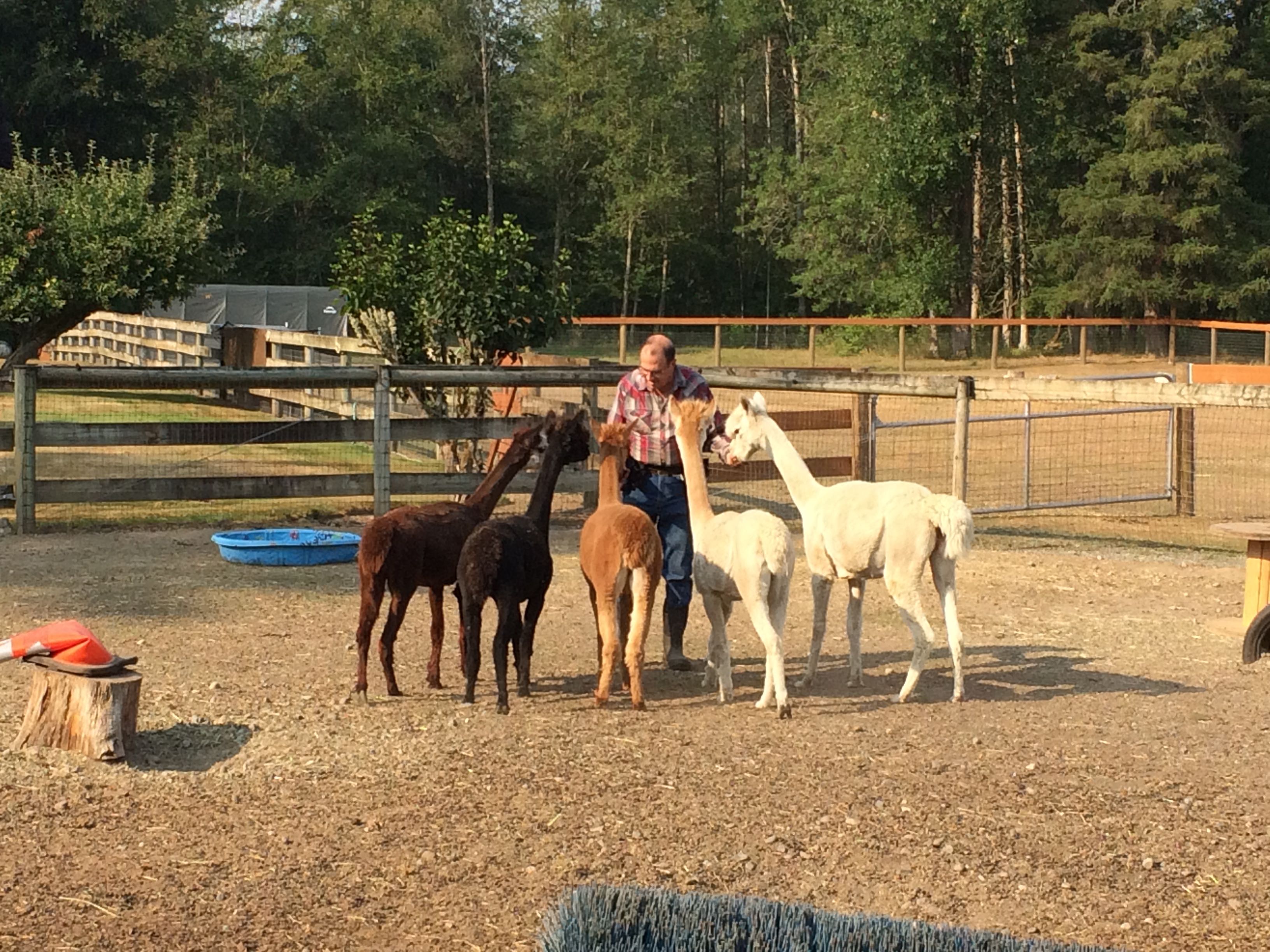
I can’t blame my travel schedule because I travel every month.  August was no exception.  I was out in Washington State at Ken Ramirez’s Ranch for his “Animal Training for Professionals” course.  For twenty years he taught this as a semester long course at the University of Illinois.  He also taught a concentrated week-long version of the course at the Shedd Aquarium.  Most of the time is spent in the classroom but twice a day students get to have some animal time.  For the week-long course at the Shedd attendees got to watch the trainers working with animals.  At the Ranch attendees get hands-on experience working with goats, miniature donkeys and alpacas.

IMG_5425 Ken Ramirez with alpacas

Ken Ramirez with his alpacas

For this course I got to be Ken’s assistant which was a great fun, especially since most of the training sessions involved his herd of dairy goats.  I enjoyed very much seeing what Ken was teaching his herd of clicker-trained goats – what was a match up with what I was teaching my goats and what were some good ideas to take back to them?  It was also very interesting to see how Ken structured the course.  What did he put in his foundation?  What stair steps did he use to take people into the more advanced aspects of training?

Ken Ramirez teaching husbandry behaviorsOn the third day Ken focused on husbandry, especially as it relates to medical care.  He is uniquely qualified to speak on this subject.  Both at the Shedd and through his consulting work, he has overseen the teaching of cooperative husbandry procedures not just to more animals than most of us will ever handle in a lifetime, but to more species as well.

Ken’s basic strategy can be summed up in a very simple phrase: do it differently.  Every day in your training you should be practicing some form of husbandry skills, but the key to success is don’t try to mimic a procedure someone else is going to be doing.  Your touch is going to be different, so even if you try to make everything the same as the real thing – you won’t succeed.  And besides, you don’t know what you are preparing your animal for.  Is it to stand quietly while you doctor a wire cut on your horse’s leg, or to put eye drops into an infected eye?  We don’t have crystal balls that can tell us what medical procedures our horses will need to tolerate.  X-rays might be standard, and certainly shots, but beyond that what are you preparing your animal for?

So Ken says do it differently.  Get your animal accustomed not just to being touched all over his body, but to being touched in different ways.

Do it differently also applies to getting an animal comfortable with changes in the environment.  Every day introduce some change, something different.  You aren’t trying to scare your horse.  You just want him to get used to the idea that change happens and it’s nothing to worry about.

Do it differently is a great life metaphor.  Sometimes we need to follow the rules, to do things the way “they have always been done” because the way they have always been done works.  The motto here would be “if it ain’t broke, don’t fix it.”

But even if it “ain’t broke”, can it be better?  Are we stuck in a rut just mindlessly copying what has been done before?  Horses have been trained for thousands of years.  On the surface the training that I learned from experienced horse trainers didn’t appear to be broken.  They could get on and ride their horses.  They could make them jump and cross scary streams.  They could make them go where they wanted.

“Make” was the operant word.  The end result could be very appealing, but if you scratched too far below the surface, you discovered a very broken system.  It was littered with discarded horses and far too many frightened would-be riders.  Something needed to change.

I was very lucky to be learning about horse training at a time when two very important change makers were shaking up the horse world.  One was Sally Swift who brought the Alexander technique into the horse world and changed the way riding was taught in the United States. Sally came regularly into my area so I was very fortunate to have been able to attend many of her workshops.

The other change maker was Linda Tellington-Jones, the founder of T.E.A.M. training (Tellington-Jones Equine Awareness Method).  Through Linda the horse world was introduced to the Feldenkrais work.  Early on I encountered T.E.A.M. training through a magazine article.  In it Linda described the body work she had developed, including the T.E.A.M. circles.

Peregrine’s mother was a wobbler.  She had a spinal cord injury that impaired her balance and made her very body defensive.  When she was a yearling, if I tried to touch her anywhere, I was met with gnashing teeth and pinned ears.  Her whole body couldn’t hurt, but I couldn’t figure out what was wrong because she wouldn’t let me in to ask questions.

I was reading everything and anything related to horses, and I was eager to learn.  These funny T.E.A.M. circles Linda was describing sounded intriguing.  I tried them on my mare and her world changed.  In minutes her eyes had grown soft.  Her head was drooping.  She was letting me in all over her body – except in one area around her right shoulder.  That was where the pain was.  For the first time she could relax enough to let me know what was wrong.

Within a few weeks I was on an airplane headed to the mid-west to attend a workshop Linda was giving.  I had to learn more!

That was the first of my many travels for horses.  At first I was traveling to learn, and then I was traveling to teach (which really means to learn even more!)

At one of the T.E.A.M. workshops Linda was letting us experience for ourselves the T.E.A.M. body work.  She let me feel one version of the T.E.A.M. circles, and then she did it another way.  She had her hand on my back so I couldn’t see what she was doing, but, oh my goodness!  It felt so very different!

I turned to face her.  “What did you do!?”

Her answer meant nothing to me.  “I breathed up through my feet.”

Now I’ve been trained in the biological sciences.  I’ve studied anatomy and physiology.  I’ve done dissections.  I know we breathe through our lungs, not our feet.  And beside, I had hay fever when I was little.  I was constantly congested.  Even breathing through my lungs felt like a foreign notion.  My breath got clogged somewhere at the top of my chest.

But I knew that breathing up from her feet meant something to Linda, so I went in search of the translation to that phrase.  One of the teachers I found lived in my area. She had a horse with a hard-to-diagnose lameness.  She contacted me to see if I could help her with him.  It turns out that the lateral work I was learning helped enormously.  When he carried himself in good balance, there was no sign of the lameness.

His owner, Marge Cartwright, was an Alexander practitioner, and she had also studied the Feldenkrais work.  So we ended up doing trades.  I worked with her horse to help him to be sounder, and she worked with me. Overtime I learned not only what it means to breath up through my feet, but to breathe up from the ground.  Learning that changed how horses relate to me.  It isn’t magic.  It isn’t some mystical gift of a horse whisperer.  It is simply the systematic unblocking of tension.  One metaphor that I love is the shining of a light on the dark places.  These are the places where movement become stuck, and we hide from ourselves the reasons for the stiffness.  This image comes via Anita Schnee, a Feldenkrais practitioner and regular attendee at the clinics I give at Cindy Martin’s farm near Fayetteville Arkansas.

The work Marge shared with me stands as one of the central pillars of what I teach today.  It is woven into every lesson both the ones that I give directly to horses and the lessons that I teach to their handlers.  Unless you live in my area and had the good fortune to learn from Marge, you won’t know her name.  But I owe her a huge thank you for enriching my life beyond measure.  Her work is woven into what I mean by equine clicker training.  If you have participated in a body awareness lesson at one of my clinics, you have been the direct beneficiary of her work. If you have thought about your own balance as you feed your horse a treat, that’s Marge’s influence again.  If you are learning about school figures – circles, lateral work, diagonals, etc. – by walking them without your horse, Marge has a hand in that, as well.

An awareness of balance, no much more than that – an appreciation for balance, an understanding that balance and soundness go hand-in-hand is something that I explored with Marge.

Clicker training for horses might have been little more than the teaching of tricks if it weren’t for this fascination and appreciation for balance.  Instead clicker training is a complex, wonderfully rich and diverse training system that can meet all needs. It includes the fun of tricks, but it doesn’t stop there.  The central core, the pillar that supports everything else is balance.

So thank you Marge for sharing your work so generously.  When you suggested we trade services, I’m sure you had no idea the ripple you were about to set into motion.  You helped make clicker training so much more than simply the pairing of a marker signal with treats.  What we teach and how we teach have become woven together to create a magnificent whole new way of doing things.  We dared to to it differently and look what grew out of it!

Thank you!

The Teachers We Get Are The Teachers We Need

JOY FULL Horses: Ten Things You Should Know About Cues: Number 9.) You Can’t Not Cue: Part 9 of 12

Stories
“She’s just being lazy.”  That was what I was told when I first asked about the way Peregrine’s mother dragged her hind toes.  She was not even a year old, and she had been mine for just a few short weeks.

The vet hadn’t said anything during the prepurchase exam about the way she used her hind end, but then he hadn’t really looked.  This was the first prepurchase exam I had ever seen so I didn’t know what to expect.  I’ve watched many more since, and I can say that this was the sloppiest and most superficial.

She was a weanling.  What could be wrong?  Thank goodness he was so casual with the exam!  If he had looked more closely, he might have noticed the way she was moving behind.  I’m not sure what I would have chosen to do.  I didn’t want a “problem” horse.  I wanted a horse I could ride; a horse who could teach me about great horsemanship.  The Universe was clearly listening because that’s what I got.

While my friends were taking their adult horses off to shows, I was raising my dream horse.  Only there was something wrong.  Dragging her hind feet was the first sign.

“She’s just being lazy.  You need to get after her more and make her move.”

That didn’t seem right.  There was something else going on.  A month or so after I started questioning her movement, I saw her fall for the first time.  I’m glad I didn’t listen to all those well-meaning horse people who had been telling me to get after her.  I had known she wasn’t being lazy.  I knew there had to be a different answer.  I just didn’t know yet what it was.

One of the best definitions of a teacher that I have ever heard is this: a teacher is someone who started before you.  Nowadays, as a teacher, I say to people we need to tell stories about our horses that work in their best interest.  The owner of the barn told the “lazy” story about my filly.  That story leads to the “get after her” answer.

I told a different story.  I didn’t know what was going on, but I was sure there was something wrong.  I had a new vet in the practice come out and give her a more thorough exam.  This one included neurological tests – all of which she failed.

We need to tell stories that help us find good training solutions.  If I say that there is something wrong, I’ll become a good detective.  I’ll take care of my horse’s physical needs.  I’ll make sure my horse’s feet are well balanced, that his tack fits comfortably, that his nutritional needs are met.

I’ll check for lameness issues, for ulcers, and for other health issues that might interfere with my horse’s willingness to work with me.  I’ll break my training down into small, manageable steps.  If my horse doesn’t want to go forward, I’ll explain what I want more clearly.  I’ll find lots of different ways to say “go forward” until they all begin to make sense.

Suppose after all this due diligence, I discover that actually, yes, the reason my horse didn’t want to go forward was he’s lazy.  In that case what is the worst that can happen? He’ll be healthier because I reexamined his overall management.  He’ll be better trained because I explained what I wanted.  And in all likelihood, he’ll be eager to work with me, and I won’t be thinking he’s lazy.  I’ll just be appreciating his level-headedness.

But suppose I bought into that original story – “He’s just being lazy. You should get after him.”  What’s the worst that can happen?

In my filly’s case I would have destroyed all the good will I had built up in our relationship.  She wasn’t dragging her toes because she was lazy.  She was dragging them because she couldn’t feel where they were.  The neurological damage meant she couldn’t feel her hind feet as they landed.

The news was devastating.  But even more was the prognosis.  At that time the vets had nothing to offer.  They told me she would in all likelihood continue to deteriorate until she was no longer able to stand up.  She would become a danger both to herself and to anyone who was near her.  I would never be able to ride her.  The best thing I could do would be to put her down.

I couldn’t do it.

I felt trapped.  I wanted a riding horse, not a pasture ornament.  I couldn’t afford a second horse.  But I couldn’t put her down just because she couldn’t do for me what I wanted.  Her life had value to her.  When she got to the point where she couldn’t stand up and life was hard for her, then I would face the decision to put her down.  That was the future we were looking at.  In the meantime I had to deal with the problems each day presented.

One Day At A Time
While my friends were learning how to jump, I was teaching my filly how to walk – literally.  When most of us talk about teaching our horse to walk we simply mean when we are asking them to walk with a certain energy level and overall balance.  We don’t mean how to put one foot in front of the other without falling.

When you are caught in a situation like this, you try many different things.  It is truly everything and the kitchen sink.  At the universities scientists run controlled studies so they can say this technique works, and this other is just an old wife’s tale.  I wasn’t interested in controlled studies.  I tried lots of different things.  Her condition began to stabilize.  She wasn’t getting worse.  The neurological deficit was still there.  It would always be there, but she was learning how to compensate for the lack of proprioception.

Her balance was better, but not her mood.  She was a terrible grump.  She didn’t want to be groomed.  If you walked past her shoulder, you would get pinned ears and her head snaking out at you to warn you off.  I always had to be careful when others walked past her to make sure she didn’t bite at them.  The barn owner had no use for her.  He made his money by taking clients to horse shows and giving them lessons.  From his point of view she was useless, and on top of that she was bad tempered.

I didn’t see her this way.  She was my beautiful, best beloved.  Together we were figuring out how to manage her condition.  But the grumpiness was a concern.  She clearly hurt somewhere, but she couldn’t tell me where.  As soon as I approached her, she was warning me off.

TTEAM
In one of the many horse magazines I was reading at that time, I came across an article about Linda Tellington-Jones’ TTEAM training.  The article described in detail the TEAM body work.

I was up for trying anything.  That evening at the barn I experimented with the TTEAM circles. You were to cup your hand lightly on the horse.  Then you imagined a clock face.  Beginning at 6 o’clock, you moved your finger tips once around the clock back to 6 and a little beyond, pressing softly into the horse’s coat.  You were to make one circle, and then move on to a different spot, letting your fingers guide you.

I tried it.  My filly melted.  Her head dropped.  Her eyes got soft.  She let me in.

Her whole body didn’t hurt.  Finally, she could show me where the problem was.  I could do TTEAM circles everywhere but one spot on her shoulder.  That was off limits.

Now I could help her.

I didn’t have a lot of money.  Taking on a horse was stretching my budget to it’s limits, but I knew I had to learn more about TTEAM.  I knew I needed to study with Linda directly.

So I did some research, booked a spot on a clinic she was teaching out in the mid-west and got on an airplane.  That was the first of many long journeys my horses have sent me on.

Innovations Come From the Outside In
Whether you are talking about the sciences, sports, economics: whatever the field of study is, new innovations evolve by bringing in ideas from the outside.  We don’t evolve from the inside expanding out.  We evolve by bringing in fresh ideas and combining them with what we already know.  That’s how we come up with completely novel combinations.

That’s what Sally Swift did through her Centered Riding.  She introduced the horse world to the Alexander technique and transformed how riding is taught.

Linda Tellington-Jones did something comparable for how horses are handled.  She combined Moshe Feldenkrais’ work with her knowledge of horse training to produce something brand new and revolutionary – TTEAM.

Linda describes how she stumbled across Feldenkrais.  She and her husband, Wentworth Tellington, had been running a school for instructors in California.  They had 65 horses, plus staff and students, and all the responsibility and work that goes along with the running of a successful program.  Linda burned out.  She divorced her husband, sold off all the horses and went traveling.

As she described it, she put her antennae up and followed them wherever they took her.  I love that image, and I have used it myself many times.  I follow my antennae, and they have taken me on many wonderful adventures.

Following Antennae
Following my antennae took me to TTEAM.  I became a TTEAM Practitioner and in the mid-1980s I began teaching.  That hadn’t been my intent when I headed off on this journey, but people were seeing what I was doing with Peregrine’s mother, and they were curious.  How could she be doing so much more than their own horses when she was so very handicapped?

Because I was willing to travel, I had access to people they didn’t.  I was bringing in new ideas from the outside.  I was still greener than green in so many ways.  Some of my clients could most definitely ride circles around me in terms of their skills on horseback, but I had access to resources they didn’t.  And I was beginning to understand balance in a way that could help every horse I encountered.

The Joy of Discovery
There is a lot to be said for riding lots of horses.  That’s the typical horse background of most professionals.  They’ve grown up on the backs of horses, riding everything and anything that came their way.

I was having a very different and very unique experience.  While others were off riding at shows, I was piecing together yet another tiny layer of the balance puzzle.   What fascinated me was process.  My clients understood that I didn’t have set answers for them.  What I was sharing was a love of exploration.  I wasn’t giving them recipes: this and only this is the way you train.  I was sharing with them the joy of discovering yet another layer in the training puzzle.

People would contact me because they were struggling with some handling issue.  Usually within a session or two we would be well on the way to solving their original problem, but now they were hooked on learning more.  The adventure of discovery was what I was sharing.  Very quickly they didn’t need me any more for the original problem.  That was well behind us, but they wanted to keep going, to join me on the journey that eventually led to clicker training and all that it represents.

Ready To Teach
Many of my clients became long-term friends.  As their skills expanded, they also became interested in teaching, but often they weren’t sure if they were really qualified to help others.  When someone voices concerns about being ready to teach, I always refer back to my own early experiences.  We are all experts in our own experience.  That is the one thing we can safely say.  I may not be an expert in jumping or team penning, but I am an expert in my own life experience.  That is something I know well and can share.

A teacher is someone who started before you.

I have always loved that definition.  I don’t know where I first heard it or who gets the credit for it.  Whoever it was said a very wise thing.

You don’t have to wait until you are The Expert in your field to have something useful to contribute.  You can teach and share out of your own experience.  As long as people understand that you are teaching process, an on-going, never-ending exploration, you are fine.  You aren’t teaching something that is set in stone and where you have all THE answers.  You are teaching a process of exploration.  You are inviting others to join you on the journey.

Change Makers
These days if you watch me train, most of the time you won’t see anything that jumps out at you that says: she must know TTEAM.

TTEAM was a stepping stone, and a very important one at that.  Linda followed her antennae to Moshe Feldenkrais.  He told her to keep exploring and to create.  She became a Feldenkrais practitioner, but instead of using the work just on people, Linda carried it back to what she knew – horses.  Out of that combination she developed something new.

I remember helping Linda at a clinic she was giving for a university audience in Madison Wisconsin.  It was a large group that included many vets and vet students.  One of the horses she worked that day was a big, raw-boned chestnut thoroughbred named Perfect.

Linda began by exploring his body using what she called tiger touches.  Tiger touches are not meant to be therapeutic.  They are used to collect data.  Instead of the soft circles that I had first tried, in the tiger touches you curve your fingers more like the claws of a cat – hence the name – and you go deep into the muscles.  You begin the exploration up at the horse’s poll and then work your way down his spine, shoulders and hindquarters.

At every point that Linda tested, Perfect reacted.  When she got to his back, he all but dropped to his knees, he was in so much pain.

I listened to a gasp go up in the audience.  Linda was helping people see what had been in front of them all this time.

What they had been taught had kept them from seeing how much pain horses could be in.  We had all been told horses are stupid animals.  Over and over again we heard this.  That was the underlying belief system that dominated horse training.  “Horses are stupid animals and because they are stupid, you have to use force to train them.”  But then this was added: “Don’t worry, they don’t feel pain the way we do.”

A month or so after I watched Linda working with Perfect, I was reading an article in one of the major horse magazines.  It was written by a vet.  In the article he stated that horses do not experience back pain.

That was 1984.  We have truly come a long way, and Linda, I believe, was a major catalyst for that change.

In 1984 we didn’t pay attention to saddle fit.  You found a saddle that fit YOU, and then you used it on every horse that you rode.   I remember being taught to put saddles up on top of the horse’s withers.  When the saddle slid back on our high withered thoroughbreds, we put breast collars on to hold them in place.

It was Tony Gonzales, a farrier from Hawaii, who started to look at saddle placement.  He had people watch how their horses moved when the saddles were placed up on the withers.  Then he slid the saddles back behind the “locking in” point of the shoulder and had them watch again.  The change was often dramatic.  Now that the saddle was no longer pinching their shoulders, the horses could move.

Tony pointed out how uneven our horses often are.  I remember being at a clinic of his that Sally Swift was also attending.  Tony lifted Sally up so she could see down the spine of a tall thoroughbred.  He pointed out how uneven this horse’s shoulders were.

This is general knowledge today, but it took a farrier from Hawaii bringing in fresh information to help us see what had always been right in front of us.

Change Our Beliefs, Change the World
When Peregrine’s mother was first diagnosed, there weren’t any chiropractors, or body workers around to help.  They didn’t exist for horses.  If they don’t experience pain, why would you need a body worker?

But now there are physical therapists, chiropractors, acupuncturists, energy workers.  They are there in large part because Linda did tiger touches on a chestnut thoroughbred named Perfect. Together they helped people see what had always been there – horses do experience pain.  It is just as real to them as it is to us.  They are just better at hiding it.

Detective Work
I have always said I was so lucky in my horses, first with the neurological issues, and then later with Peregrine and his stifles.  That may not sound lucky, but at least I knew what I was dealing with.  There was no hiding these issues.  I’ve dealt with so many horses who are puzzles.  You know something isn’t right, but the horse masks the symptoms.  It’s tempting to dismiss the reluctant attitude and reach instead for “just make him do it” solutions.

Again, we need to remember that horses are prey animals that rely on the safety of the herd for protection.  Any animal that looks lame or infirm will attract the notice of predators.  To stay safe horses have to hide their pain.  That doesn’t mean they don’t feel the sharp twinge every time they take a step.  I’ve had lots of injuries that I kept to myself.

If you don’t see the injury, you don’t need to know about it.  That’s how horses operate.  If they look vulnerable, they could be driven out of the herd.  Alone and infirm, they will certainly attract the attention of any predators that are around.

We need to remember this when we go looking for the root cause of our horse’s reluctant attitude.  The big things horses will show.  It’s hard to disguise an abscess or a torn tendon.  But other things they will be reluctant to let you see.

“He’s not right” will be a nagging feeling.  Vets, trainers, other horse people will tell you nothing is wrong, but you’ll still have that gut feeling.  Listen to it.  Be a good detective and tell a story that works in the best interest of your horse.

Coming Next: Stepping Stones
I promised you I would be returning to the ear-shy horse, and now finally in this next post, that’s what I’ll be doing.

Remember, if you are new to the JOY Full Horse blog, click on the JOY Full Horses tab at the top of this page to find the full table of contents and links to each of the articles I have published so far.

I hope you will want to share these articles by sending links to this blog to your friends.  But please remember this is copyrighted material.  All rights are reserved. Please do not copy any of the “JOY Full Horses” articles without first getting written permission from Alexandra  Kurland, via theclickercenter.com

Also note: these articles are not intended as an instruction guide for introducing your horse to clicker training.  If you are new to clicker training and you are looking for how-to instructions, you will find what you need at my web sites:

theclickercenter.com                    theclickercentercourse.com