Modern Horse Training – Today’s Post: Peregrine, My Master Teacher

Hi Everyone,

One more day to go before my new book, “Modern Horse Training, A Constructional Guide to Becoming Your Horse’s Best Friend”, becomes available to order.

Yesterday I shared with you a little behind the scenes information about how books are printed in the modern world. Modern printing for “Modern Horse Training”!

Sharing Clicker Training
You are reading this post because you are a follower of my work. You’ve been reading my blog. I suspect you also listen to my Equiosity podcast, so you know that I love horses. That’s something we very much have in common. When I started to explore clicker training, it was something I wanted to share. I’m not alone in that. Clicker training has spread around the planet because lots of people have been talking about it. We’ve been sharing our clicker success stories and other horse people have been paying attention. They’ve gotten curious enough to take a look. That’s a good thing for the horses they love.

This year marks an important anniversary for me. It was thirty years ago in September of 1993 that I first went out to the barn with a clicker in my hand and treats in my pocket.

Peregrine was eight years old. He was living at the home of one my long-time clients where he was turned out twenty-four/seven with her two horses. It was a heavenly set up for him except for one thing. The property was next to a wet lands, and he got Potomac Horse fever. He was one of the first horses in my area to contract the disease. Thankfully he was vaccinated, and also thankfully my vet recognized what it was. Peregrine got the treatment he needed, but not in time to completely avoid all of the long-term side effects. He developed laminitis which led to hoof abscesses in both of his front feet. Instead of being able to go out with his friends he was laid up in the barn. He was in so much pain for the first few days he was unable to walk even a step or two.

It looked as though he might be laid up for a while. I wanted to keep him entertained during his layup, so I decided this was the perfect time to experiment with clicker training, to see what it was about.

In her book, “Lads Before the Wind” Karen Pryor described the process of charging the clicker. She would blow a whistle, throw a fish in the water, blow a whistle, throw a fish in the water until, when she blew a whistle, she saw the dolphins interrupt what they were doing to look for the fish. At that point she knew they were making a connection between the whistle and the fish. So then she could choose the moment she blew the whistle to begin shaping the behavior she wanted to teach.

I went out to the barn to charge my clicker. I clicked and handed Peregrine a treat. He took the treat from me. Hand feeding was nothing new. I clicked and handed him another treat. He took the treat but showed no sign that we was noticing the click. I repeated this several more times.

People think I am patient. They are wrong.

Peregrine wasn’t responding to the click. I thought if this is going to take a long time, I’m not interested. So I looked around the barn for something to use as a target. There was an old dressage whip propped up in a corner gathering dust. I used that. I held it out towards Peregrine. He was curious. He sniffed it. I clicked and handed him a treat.

I held the target up again. He sniffed it again. Click and treat.

He was clearly interested. There was such a different look in his eyes than there had been when I was just handing him treats. He was getting it! Orient to the dressage whip, and you can get your person to reach into her pocket and give you a treat. What a fun discovery!

Over the next few days I expanded the game. I had Peregrine track the target left and right, up and down. As the abscesses healed, he could walk forward a step or two to follow it. Our clicker training sessions became the highlight of his day.

Peregrine was on stall rest for seven weeks. He was a young, fit thoroughbred who was used to a lot of turnout and exercise. I had dealt with other thoroughbreds who were coming off of lay-ups. The challenge was always to keep them from bouncing around and setting back their recovery. Peregrine stayed settled throughout his lay up. Returning to routine work was a non-event. When I started hand walking him, I included a review of basic ground work, only this time I was explaining what I wanted via a click and a treat . When I started riding him again after seven weeks of lay up, he was further along in his training than he had been when he was laid up. That’s not how things normally work!

So I was really curious. I started sharing clicker training with my clients, and the rest, as they say, is history. “Modern Horse Training” is a product of all of that sharing.

Learning More
I’ll share one more Peregrine story. I’ve written about his stifles. Peregrine grew up in a body that didn’t work. His stifles would lock to the point where he could not bend his hind legs. They created all kinds of training issues. He was an incredibly sweet horse who became a nightmare to handle. My vet told me that horses often outgrew locking stifles, but if not, there was a surgical option. He could cut one of the tendons that ran over Peregrine’s patella. It was effective, but there was an increased risk that Peregrine might fracture his patella.

When Peregrine was at his worst, when he was blasting out of my hand to unlock his stifles, I was sorely tempted by the surgery. But then I would figure out another piece of the training puzzle, and Peregrine would become a little easier to handle. I would put the surgical option on the back burner for a little longer. It was a risk I just wasn’t ready to take.

I was slowly learning how to manage Peregrine’s stifles – at least when I was working with him. When he was on his own, his stifles would lock up on him again. It was a problem that just wouldn’t go away.

After I started exploring clicker training, I reviewed everything I had ever taught him. The list was a long one. When I had first taught Peregrine to lunge, his stifles would lock up, and he would explode forward to release them. I would be left holding the lunge line, but there would be no horse at the other end. The force with which he blasted forward was enough to shear the metal snap of the lunge line.

I had heard John Lyons say that the strongest lead rope is the one in the horse’s mind. I needed that lead rope so I taught Peregrine to work at liberty. He was a superb liberty horse.

I was also learning classical dressage from Bettina Drummond, Nuno Olivier’s principle student. In addition to riding, I was learning classical work in-hand. That extended beyond the basics of lateral work to piaffe. Before I started him under saddle, I taught Peregrine to piaffe. Mobilizing his hind end helped to keep his stifles from locking, at least when he was working.

I had begun teaching Peregrine Spanish walk shortly before he got sick. I continued to work on that along with everything else. That’s when I started to notice a difference. Peregrine’s stifles weren’t locking up anymore. They had been locking up for eight years, and now they just weren’t.

Karen Pryor called one of her books “Reaching the Animal Mind”. What a perfect title!

That’s what I was doing. Peregrine wasn’t simply doing what he was told. He was internalizing what I was teaching him in a way that he had not done before. He changed how he was using his body. I talk a lot about the Feldenkrais Awareness Through Movement training for people and the profound effects that it can have. I saw something similar happening with Peregrine. The clarity of the marker signal was doing what eight years of training had not. Peregrine stopped locking in his stifles.

This is why I am so passionate about this work. Yes, it is wonderful that we have a kinder way to teach horses to load onto trailers or to stand well for a farrier. But clicker training goes deeper than that. If clicker training were simply about adding some new teaching strategies to our training choices, I suspect I would have long ago moved on to other things. I certainly would not have spent the thousands of hours away from my horses that it has taken to write the books, create the DVDs, produce the podcast, travel to clinics, and respond to all the queries I get about clicker training.

There is much more to this work. I know many of you reading this know what I mean. You have experienced something similar in your own horses. You have seen your relationship deepen in a way that goes beyond words. You have found yourself solving training puzzles, laughing during training sessions, loving your horses.

I have chosen to publish my new book, “Modern Horse Training” on April 26, the anniversary of Peregrine’s birthday, to honor the part he played in introducing me to clicker training. I lost him in September of 2015. He was thirty years old. He is deeply loved and in my heart always.

If he hadn’t been such a master teacher, I might have dabbled in clicker training and then moved on. That’s what others did with it. But he pushed me to see what it was really about. So I have a favor to ask of all of you reading this. For the horses in your life, please send a thank you to Peregrine by buying the new book. It will be hugely appreciated.

Each copy sold makes it easier for the next person to find clicker training. Help me turn the book into a best seller. Together we can make a difference and change the way horses are trained.

The book will be available to order tomorrow, April 26. You can order it from my web site, or through Amazon and other booksellers.
Modern Horse Training: Connections

Everything is Connected to Everything ElseIncluding Dolphins and Horses

I stumbled across clicker training in 1993. A friend who bred and trained Irish Wolf hounds told me about Karen Pryor’s book, “Don’t Shoot the Dog”. I read it, loved it and wanted to learn more. What was this clicker training that she was talking about? How did it work?

I read her second training book, “Lads Before the Wind: Diary of a Dolphin Trainer” which described how she and her husband, Tap Pryor, developed Sea Life Park in Hawaii. Karen was given the task of figuring out how to train dolphins. It wasn’t anything she set out to do. The task fell to her because the people they had hired to train the dolphins weren’t getting anywhere. These trainers were trying without success to use old-style circus training methods. That didn’t work with an animal that could just swim away from them.

Karen was intrigued by the work that was coming out of B.F. Skinner’s labs. So armed with the lab notes from some of his graduate students, she set to work. She figured out how to use marker signals and positive reinforcement to train dolphins.

Her books were great. I loved both of them. I enjoyed “Lads” even more than “Don’t Shoot the Dog” because Karen shared the puzzle-solving aspect of training. But those books weren’t training manuals. They didn’t teach you HOW to train. They just teased you with the possibility that you could remove the threat of punishment that sits behind most horse training methods.

I was intrigued, but in 1993 other than Karen’s books, there weren’t any readily available resources for learning more about clicker training. Through a bit of luck, I did manage to find a VHS recording of a seminar that Karen produced. It included two short video clips showing animals being clicker trained. One was of an African bull elephant at the San Diego zoo being trained with protective contact to present his feet for trimming. The other was a 12 week old mastiff puppy who learned to sit and lie down in minutes without ever being touched.

The elephant was the most interesting. He had attacked his keepers on several occasions so the decision was made to that no one was allowed to go directly into his pen with him. That meant that for ten years he had not had any foot care. Clicker training was being used to see if they could teach him to orient to targets and present his feet through a small opening in the gate of his enclosure. During the video, you could hear Gary Priest, the director of training at that time, saying “I cannot impress upon you enough how aggressive this animal was, but he’s standing there cooperating for just the social attention and a bucket of food treats.” I watched that and thought – we in the horse world have a lot to learn. I was thinking of the twitches, the lip chains, the hobbles, etc. that I had seen people use to force horses to comply.

The other video showed the use of a treat held up above a puppy’s nose to get the puppy to sit. Within just a few clicks, the puppy was sitting, then lying down and staying down while the trainer walked around her. There was no pushing, no shoving, no use of force. It was simple, elegant training.

Those two videos were all I needed to be up and running. They gave me what I needed to go out to the barn to ask Peregrine what he thought about clicker training. He got the proverbial ball rolling, so it is fitting that the new book, Modern Horse Training, is coming out on the anniversary of his birthday, April 26.

A Perfect Fit

I could say that clicker training was a perfect fit for me. Or I could turn it around and say that I was a perfect fit for clicker training. There were no horse books out there to guide me, or even any other trainers I could visit to see how it was being used. I was on my own. But I was primed. To use the language of constructional training, I had the components that were needed to turn the idea of clicker training into a fully formed, detailed, soup to nuts training program.

So what were those components? What were the skills, the mindset, the repertoire that prepared me so well to embrace the idea of clicker training? I will say that I have met many others who shared similar components. For so many all that is missing is the understanding of marker signals. Give them that, and, like me, they are off and running. But for many others clicker training represents a huge shift in thinking. Can you really use food in training? Isn’t it a distraction? Won’t it teach your horse to bite? What do you do when your horse says: “No”? The old style of thinking dictates that you must punish unwanted behavior or your horse will become dangerous. “Fear of and fear for” becomes an underlying motivator even if it is not spoken of in that way.

We can begin with that same underlying motivator and end up with a very different result. That’s what I wrote about in yesterday’s post. You can also use treats in training and still stay wedded to the belief that unwanted behavior needs to be corrected.

Using positive reinforcement describes a procedure. What I’m addressing now is the question of what motivates your training decisions? Even kind people can end up choosing punishment because they are motivated by “fear for” risks. You’re afraid that your dog might rush out the front door and be hit by a car, so you use punishment to teach him to stay back when you open the door. That’s one example of how this plays out.

You don’t have to use punishment to solve this problem. There are other options. You begin by acknowledging that you are concerned for your dog’s safety, and then you search out solutions that are a match with your core ethics and the type of relationship you want with your dog.

The same applies to horses. Wanting to keep bad things from happening is a powerful motivator that can take us to some wonderful learner-friendly procedures.

Sometimes it’s okay to start out by running away from something. Clicker training teaches us how to reframe that so you begin to run TOWARDS the good things that you want. You stop focusing on the unpleasant outcomes that you don’t want and you teach instead all the good things you do want.

You don’t want your horse crowding into you, stepping on your toes, mugging your pockets, biting at your hands. You can certainly suppress these behaviors through the use of punishment. Or you can look at what you do want. When your horse is standing next to you, what does that look like? Can you describe what the “perfect version” of your horse would be doing? He’d be standing four on the floor, in his own space, with his head between his shoulders so his nose is well away from your pockets. The more detailed your description is, the easier it is to train what you want. Each element you describe becomes a lesson you can teach. What are his ears doing? Where is his head – level with his chest, down on the ground? You can shape all of this using a marker signal that is linked to positive reinforcement.

Those are nice sounding words, but again how do you make this work? What were some of the component skills that helped me transform clicker training from an interesting concept into a workable training program?

That’s tomorrow’s post. I’m splitting what was originally a much longer single post into two installments so it’s not too much to read in one sitting.

“Modern Horse Training: A Constructional Guide to Becoming Your Horse’s Best Friend” will be available April 26. It will be available as a hardcover, a paperback, and as an ebook. You’ll be able to oder it through my web site and also through Amazon and other booksellers.

Goat Diaries: Clicker Training Day 4

The Goat Palace: Training is Accumulating Fast!

The goats are doing great.  My journal notes are filled with superlatives.  The basics are becoming much stronger and more reliable.  Each session opens the door to a new possibility, something I can now ask for that would have been hard to get just a few days before.  They are so much fun!  I love quick, eager learners!

But before I get swept away with their current training, it is worth going back to the July Goat Diaries to see what the first steps of the learning were, not just for them, but for me, as well.

Just before Thanksgiving I had finished posting about Day Three of their training.  (https://theclickercenterblog.com/2017/11/20/)  Three days doesn’t sound like much, but that was fourteen training sessions.  I had introduced Elyan and Pellias (E and P as I referred to them in July) to the bare bones of targeting.  They had been on platforms.  On day four I was planning to add in a second platform.  So let me jump back to July.  Hopefully, this won’t confuse you too much.  I wish I had begun posting these Goat Diaries sooner so there wasn’t this overlap, but that wasn’t how my summer unfolded.  And perhaps it is better this way.  You can see both how these first steps can be built, and at the same time how much fun you can have using these foundation skills.

Remember in July I had not yet expanded the roof of the lean-to to create the goat palace.  Instead E and P were living in the barn in one of the horse stalls.  I was using the stall, plus the outside run as my training areas. So back to July . . . .

The July Goat Diaries: How We Get Behavior

My main training goals with Elyan and Pellias were: to stabilize their behavior around food so they were safe to feed treats to; and to work on basic leading.  I was going to have these goats for less than two weeks.  At the end of that time they would be going back into the 4-H program that Sister Mary Elizabeth ran for the children in her area.  At the end of the summer the goats would be going to the county fair and to several fiber festivals.  To be shown in the ring, they had to lead.  So anything I could do to help them with their leading manners was a plus.

It may not seem that teaching them to target and to stand on platforms had anything to do with leading, but they are all connected.  I was creating the building blocks that would make adding in a lead much easier.  To help you connect the dots between these foundation skills and leading remember in clicker training there are many strategies you can use to get behavior to happen.  You can lure behavior with food.  I was certainly using that with the goats when I had them follow a bucket of hay back into their stall.

Food luring can be a very effective and humane management technique, especially under conditions when other skills have not yet been taught.  It is much less stressful for a herd animal like these goats to follow a bucket of hay into an enclosure, than it is to be driven from behind.  Getting the goats into the habit of following me and my bucket of treats was a first step towards having them stay with me on a lead.

Targeting is another way to get behavior.  The goats were in the early stages of understanding targeting.  I had used it to begin their introduction to clicker training.

Goats day 2 target practice E - 1.png

Elyan learning about targeting.

That was step number one.  The more you explore targeting, the more you discover what an incredible teaching tool it is.  Targeting is very much part of leading.  We usually think of targets as a visual aid.  Certainly the handler becomes a visual target.  But I also want the feel of the snap under a horse’s halter to become a target.  In this case it becomes a tactile target – follow this feel.

Tactile targets take us to rope handling which takes us to a discussion of pressure and release of pressure.  Often the mere mention of pressure makes some people cringe. That’s what they want to get away from when they clicker train.  But we do put halters and leads on our animals.  So the question is not do we use pressure, but how has the response to pressure been taught?  Is it information or a threat?

Escalating pressure has a do-it-or-else threat embedded in it.  This is what we want to get away from in clicker training.  But pressure doesn’t have to become painful or frightening to have an effect.  It can simply close one “door” while leaving other doors open.  When you’re trying to figure out how to use pressure in a learner-friendly way, that can be a helpful metaphor.

Used well a lead provides clues that help an animal get to his reinforcement faster.  Suppose I want my learner to back up.  I could simply wait until I see a shift of balance back.  If I’m lucky, the animal will shift back quickly, but he’s just as likely to try other directions first.  That introduces more “noise” into the process.

Think about situations in your own life where having some boundaries was helpful. Computers offer us so many good examples.  You want something to change on your screen, but nothing is happening, so you start hitting buttons.  Is it this combination or this one?  When you finally do get the response that you wanted, do you remember what you did?  Can you repeat it without first trying all the errors?  Probably not.  How do you feel?  Frustrated.

But now think about those times when the computer gave you a “not this way signal”.  When you tried something that wasn’t going to work, you heard an error message.  It sometimes takes me a couple of repetitions to realize that that ping I’m hearing is the computer telling me what I’m doing isn’t going to work, try something else.  Oh, right.  That door is closed.

At least the computer is communicating something.  I must be hitting the wrong keys.  Yes, I was pressing down the cap lock key instead of the shift key.  That’s why I was getting that error message. 

The error message doesn’t change.  Siri doesn’t come on and start yelling at me.  The computer doesn’t tell me if I don’t change my behavior and do what it wants, it will start destroying files.  The computer remains non-reactive to my emotional displays of frustration.  When I finally notice that I’ve been hitting the wrong key, it responds immediately by producing the result I want.

When I was trying to push through the wrong “door”, it gave me a clear message – try something else – but nothing else escalated.  Good rope handling is very similar.  When my animal partner learns to pay attention to the information the lead is providing, it doesn’t just close doors, it shows him which ones are open.  What is the fastest path to the click and treat?  Leads provide boundaries.  Used well, they also provide very welcome information.

The lead provides simple messages.  Slide down the lead and you are saying: “I want something.”  Staying on the lead closes doors.  Now you’re saying: “Not this way, but keep trying.  There is an open door, and I know you can find it.”  Releasing the lead says: “Great! You just found the answer!”

All of this has to be taught.  I can’t expect my learner to understand the cues a lead can provide first time out of the box.  If he’s had confusing, inconsistent, or punitive experiences with the lead, then the teaching process becomes even more involved.  I’m not working with a clean slate.  I have to show him through my actions that I’m not intentionally going to use the lead to hurt or scare him.

An animal that has not been carefully introduced to leads may not understand this.  His learning history may tell him to try to push on the “door”.  Bang on it hard enough and it will open!  Goats certainly know about pushing through things!  And so do many horses.

I want to build my training steps systematically so my learner can safely, comfortably discover that pushing on the door isn’t needed.  When he encounters a closed door, that’s a hint.  It means try a different direction.  The faster you stop banging on that door, the faster you’ll find the one that is open – click and treat.

Elyan and Pellias both wore collars, but so far I had avoided putting leads on them.  I wanted to give them some other skills first which would help them understand how leads worked.  We were heading to leading, but not directly.  The training principle is: Never start with your goal.  The more steps you put between where you are and where you want to be, the smoother and more successful the learning experience will be.

More steps in part means learning to use more than one teaching strategy.  So here is another training principle:  There is ALWAYS more than one way to teach any behavior.  The more ways I come up with to teach the same thing, the stronger that base behavior will be.

So another teaching strategy I use is referred to as free shaping.  Here you are not using any prompts such as a target to trigger the behavior.  Instead you are simply observing the individual and marking those moments that take you in the direction of your shaping goals.

When people talk about the magic of clicker training, they are referring to freeshaping.  Yes, it is good science, but it does look quite magical when an animal begins to consistently offer a complex behavior and the handler has “done nothing” but click and reinforce tiny stair steps towards the desired behavior.  There have been no targets and certainly no whips.  You haven’t applied pressure by moving into the animal’s space. You’ve just sat in your chair, and now suddenly your animal – goat, horse, dog – is backing up twenty feet.  Very neat.

I have always considered free shaping to be an advanced skill for both the handler and the animal learner.  A handler who is just learning how to change behavior through incremental steps will miss clickable moments.  The criteria will be unclear.  The timing will be off.  The result: a learner who is becoming increasingly frustrated and confused.  A confused learner leads to a confused handler.  Put those two things together and you get a mess.  That’s no way to begin with clicker training.

Freeshaping may be an advanced skills, but you need to practice free shaping in order to build your skills.  Here’s the mantra: for every complex behavior you teach, there will be some element that is free shaped.

I may use my rope handling skills to get a horse to step onto a mat.  Once he’s standing there, I’ll free shape his head orientation.

I was going to use this concept with the goats.  I got them to the platforms with the target. Once they were on the platform I wanted to free shape head orientation.  My starting point was a goat who was indeed standing with all four feet solidly on the mat, but his head was reaching up towards my pockets.  I knew what I didn’t want.  I didn’t want him straining up towards me, or the opposite – curling his neck down so he looked as though he was about to ram something.  I wanted him standing all four feet on the platform, with his head up, and looking straight ahead.

The problem was the goats never really presented me with what I wanted.  They looked off to the side, or up at my pockets, but rarely were they looking straight ahead.  If I insisted on perfection, my rates of reinforcement would drop.  I’d get a frustrated goat, and I’d already seen what frustrated goats do.  Jumping up on me was not an answer I wanted them to be practicing.

To help prime the pump I had been using the food delivery to approximate the behavior I wanted.  My concern was I might be getting too much of a curl of the neck.  I didn’t want to trigger head butting.  So that was my question as I began the morning session.  What had these goats learned from the previous day’s training?  Good things I wanted?  Or would  I be left with “Oh dear, let me go have another cup of tea and rethink where we are.”  I was about to find out.

Session 1: 8 am with P.

I wanted to make the target more meaningful to P. He clearly liked being up on his platform.  So perhaps if I set out two platforms and used the target to move him from one to the other, he would begin to have a better understanding of targets.  Targets are things you orient to get to other good things.

I set out two platforms, the original foam platform and a new one made out of two heavy blocks of wood.  P went directly to the foam platform, click and treat. I worked on his head orientation.  Mostly he was stretching his nose out towards me.  I tried to catch moments when his head was down, but I needed to be careful with that.  I didn’t want to teach him to lower his head into head butting position.

I used the target to move him to the second platform.  He definitely got the idea of moving from one platform to another, and he was staying on the platform well.  It seemed as though this was going to be a useful approach for him.

I did not film this session because there was a light rain so I have no pictures to share.

E’s Session

E’s session – I worked E in his stall.  That seemed easier than switching the goats.  I already had the makings of two platforms.  I dismantled their corner platform and used two of the blue blocks as bases for single platforms.  E was concerned with them at first so I put the plywood on them, and he was fine about getting up on the blocks.  I again added in the scratching after feeding so he got very soft-eyed and dreamy.  I liked this association.  Clicks are followed by treats (exciting!) which are followed by head scratching (dreamy).

The whole peanuts took too long to eat, so I had been breaking them up.  He wasn’t particularly interested in the hulls, but he did like the peanuts.   I had also added sunflower seeds to the mix in my pocket, and those he really liked!  We had a lovely session going from platform to platform.  He was getting treats and attention.  And I was getting more good data to record in my journal.  Win-win for both of us.

When we were finished, I opened their stall door so he could go out into the pen with P.  Instead of staying out, P came into the stall and got up on a platform.  So E came back in as well.

They started sparing over who got the platform.  I managed to get each one on his own platform and reinforced them for staying put.  Once I have taught them individually about platforms, this will definitely be a usable approach for teaching them to work as a pair.

When I was all done, I spent a few minutes scratching them both, then I left them with some treats scattered over the floor.

The Goat Palace: Working in Pairs

So now I’m going to jump forward to the present.  I just described the very bare bones beginning of using multiple platforms to work the goats together.  I’ve been building on these skills both with Elyan and Pellias, and Thanzi and Trixie.  It is key to being able to reduce the competition over food.

I was so impressed with Trixie and Thanzi yesterday.  I’ve been working them in their pen.  Each goat can now stay at her own station (a stack of plywood mats).  I can move to Trixie, offer her a target to touch, click and drop treats in her bucket while Thanzi stays on her platform.  Then I can go to Thanzi, and Trixie stays put.  That is such a change from the dashing from bucket to bucket that we started with.

Yesterday I took them into the hallway.  The narrow platforms were set out side by side.  They got themselves sorted, one on each platform.  I was pleased with the progress Trixie, in particular is making.  Thanzi, I know will leap eagerly onto a platform.  Trixie has been slower at figuring out that going to platforms is a great way to get clicked.  But there they both were each on her own platform.

I stood in front of them and waited for both of them to take their noses away from my pockets.  They could do it!  Click, treat.  And when I fed them, they stayed each in her own space to get the treat.  They didn’t try to crowd in and snatch treats from one another.  That’s huge progress, but wait it gets better!

Remember these goats were side by side.  The treat bowls were right in front of their platforms.  I could click one, drop treats in her bucket, and the other goat would stay put!  Of course, she got clicked and reinforced for staying on her platform.  Win-win for everyone.

Pellias and Elyan are becoming increasingly solid working as a pair.  I can now consistently use their stationing behavior as a management tool.  When I want them to go back into their pen, I call them and they both come running.  They dash onto their platforms: Elyan on the balance beam of a thick piece of wood, and Pellias on a stack of plywood mats.  Click – treat both several times.  Then click, drop treats and leave.

They stay at their stations hunting for the dropped treats in the hay instead of swooping in trying to get what the other one has.  That gives me time to call Galahad in and give him treats at the other end of the pen.  This core foundation skill is creating much more peaceful living conditions for everyone.

Before I can move on to teaching the “fancy” stuff, first there are these basics – the universals of day to day handling.  Done well, the basics become “fancy”.  They are certainly fun to teach.  Every day I feel like a small child who has been given another bag of leggo blocks to play with.  I can build so much more with the behaviors the goats are learning!  What’s next?  The goats will always tell me.

Coming Next:  Goat Diaries – Day 4 Learning About Goats


Goat Diaries Day 3 Platform Training For E

The Goat Palace –  Journal Report for Nov. 18, 2017

What felt like chaos on the first day is slowly emerging into a more orderly process.  That’s in large part because the goats are now understanding that there is a game underway that they want to be part of.

The last few days we started with training and then shifted to construction, but yesterday we reversed the order so we could fix one of the hay feeders.  By the time we were done with our various chores the goats had all shifted into the front section.  When I went in to close the middle gate, Elyan scooted out to join me in the back section.  He won the training lottery and had the first training session of the day.

I want to introduce the goats to stationary targets.  I had collected several objects that I thought would work well.  One was a large lid off a supplement container, another was a kneeling pad for gardening.  I started with the supplement lid.  Elyan ignored it.  So I swapped to the kneeling pad.  Again, nothing.  Hmm.  I tried one of the dog toys I had used yesterday with Trixie and Thanzi.  He oriented directly to it.  Click and treat.  Clearly, I would need to do a lot more generalizing of targets before he was going to recognize larger objects such as the supplement lid as something that belonged to this game.

I learned to swap around targets years ago working with horses.  Very early on in my clicker training experience I was giving a clinic to a group, showing them how to introduce their horses to clicker training.  I had had good luck using whips as targets. Everybody had a crop or dressage whip of some kind lying about that we could use. (That says a lot about the horse world.) The horses I had worked with up to this point all oriented well to them.  But, not this one horse.  She showed zero interest in the whip.  I don’t remember what made me try this, but there was a hard hat hanging nearby.  I snatched that up and held it out to this horse.  She oriented to it right away and kept on consistently targeting to it.

I looked at the whip later.  Someone had put white tape along the shaft.  When I held it out, it made the tip very hard to see.  I wondered if that was why the horse had ignored it.  She couldn’t see it, either, but she could very much see the hard hat.  So the lesson learned from this story is you sometimes have to try different objects to find the one that your learner will consistently orient to.

Once I had found a good target for Elyan, I set up a pattern of having him orient to the target, click, then I tossed the treat into a food bucket.  To get back to the target he had to walk several steps.  Going to a food bucket instead of to me for his treat opens up some fun possibilities for distance work.  It also means he’s not always looking to me for goodies.  I may be reaching into my pocket for the treat, but he gets it in the food bowl.

When I opened the gate to do a swap, all the goats rushed into the back section.  Galahad was last.  I managed to close the gate before he could get through.  He was now by himself in the front section which meant it was his turn next.  Marla did another session from outside the pen.  He was doing a great job orienting to the target.  She could hold it well out in the pen, and he would go directly to it, click, then back to his food bowl.  He was doing so well I dashed off to find my even longer target stick.  I came back with two new choices, the longer version of what Marla was already using, and the telescoping handle of a floor mop.  Marla tried the floor mop.  It was the perfect target stick, light weight, adjustable in length, and for Galahad, at least, easy to orient to.  He was a targeting star.

In the next swap somehow I got Trixie by herself in the front pen.  I was going to work from outside the pen, but she was starting to shake.  Being by herself was causing considerable distress.  I went in with her thinking perhaps the familiarity of the game might settle her.  She could orient to my hand and take food from me, but she clearly needed to be with the other goats, so once again, I opened the gate.  Thanzi came dashing in.  I did some simple targeting with her.  I had her orient to a target, then I dropped treats in a food bowl for her.  Trixie began to come over.  While Thanzi was getting her treats, I had enough time to have Trixie target my hand and get a treat.

When I opened the gate again, Elyan and Pellias rushed through, leaving Galahad by himself again, this time in the larger, back section.  Marla went in directly in with him for this session.  The work over the fence paid off.  She could offer him the same pattern – orient to the target, click, get your treat from the food bowl.  He had started out with the most intense mugging behavior of the three youngsters, but there was no evidence of it in this session.  He knew the pattern, and it didn’t include checking out pockets for treats.

In our next swap, Thanzi went through the gate into the back area leaving Trixie and the two boys behind.  I worked with Trixie again.  With the two youngsters still in the pen with her, she was less stressed.  And Thanzi stayed nearby, in part to make it clear to Galahad that he was to stay away.

Instead of my hand, I used the baton as a target.  Trixie did a great job orienting to it.  The boys initially kept their distance, but then I began to feel bold little Elyan trying to touch the target. I was holding it out of sight behind my back as I gave Trixie her treat.  It was out of sight for Trixie, but not for Elyan.

Our next swap left Galahad by himself again.  I had left three feed tubs out in this area.  As before, Marla had Galahad orient to the target.  But now she expanded the pattern by including the second feed tub.  Galahad did a great job moving to whichever tub she dropped the treats into and then heading directly back to the target.

We left them after this last session.  Pellias hadn’t had a turn, but it didn’t look as though it was going to be easy to get him swapped out by himself.  Trixie kept straddling the gate. I didn’t want to move her away, so I decided that skipping Pellias for one day would be okay.

Everyone was now down in the near end.  We had some work still to do in the back section, so we switched from training to construction.  At the end of the afternoon, I spent a few minutes scratching Elyan and Pellias.  They were on the top platform of the jungle gym.  They truly are cat like.  I would say I had to leave, that was enough scratching.  I’d start to withdraw my hands, and somehow, like magic, I’d be drawn right back in.  That’s cats.  You say you’re going to get up.  You’ve provided a warm lap to sleep on for long enough. You have other things to do, but do you get up?  Of course not!  I’ve always said one should be a well-trained human.

On to the July Goat Diaries and platform training.  You’ll see at the end of this session the beginning of this process of transforming goats into cats.

The July Goat Diaries: Day Three – Platform Training for E

Weeds and Behaviors

In gardening there’s an expression: A weed is a flower growing in the wrong place. How true that is. I’ve visited garden centers in England where they were selling pots of goldenrod. Goldenrod! Yes, it’s very beautiful, but if I don’t mow my pastures multiple times through the summer, it takes over.

So if a weed is a flower growing in the wrong place, a “bad” behavior is just a behavior occurring in the wrong context. Which means there really is no such thing as a behavior we never want to see. Pawing is a great example. When a horse paws on a tie, people get annoyed and want to stop the behavior even if that means using punishment. But pawing is forward movement. When a reluctant loader paws the bottom of a trailer ramp, it’s cause for a celebration. It means that horse is thinking about going forward onto the trailer.

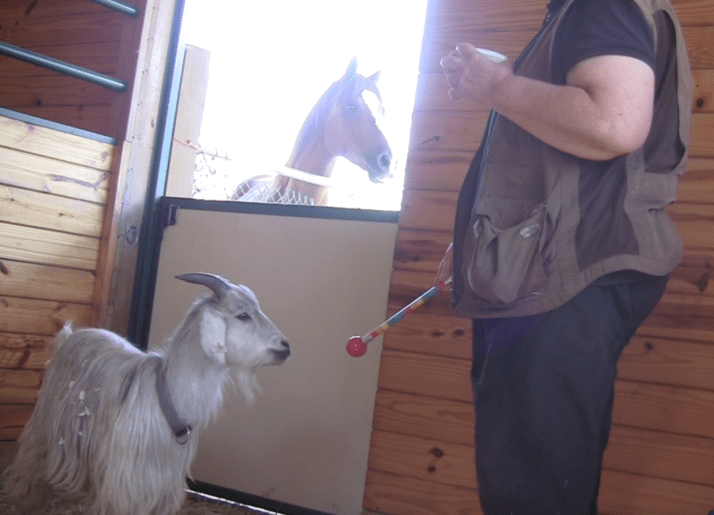
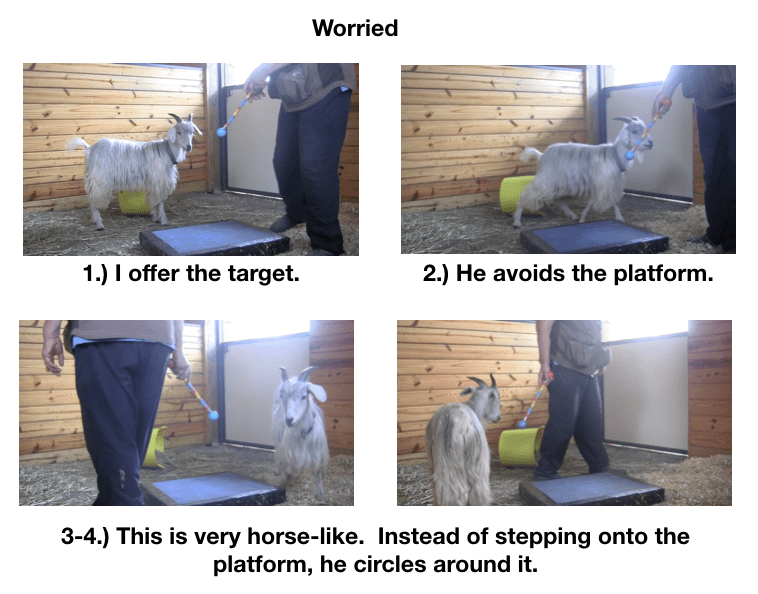
What has this got to do with the goats?  Unlike P who went right onto the platform as soon as it was available, E was more hesitant.  He was much more horse like in his initial caution. Instead of following the target directly onto the platform, he circled around it. Interesting.

Goat Diaries Day 3 E's First Platform Session - Worried -first panel 4 photos.png

Sometimes you get lucky.  As I was handing E his treat, I dropped a peanut onto the platform.  He took his treat from me, and then glanced down at the platform.  Click and treat.

Goat Diaries Day 3 E's First Platform Session - Worried -looking at platform 2 photos.pngNow the platform was of more interest.  He raised his leg to paw, click.  What goes up must come down. His foot landed on the platform. I gave him his treat.

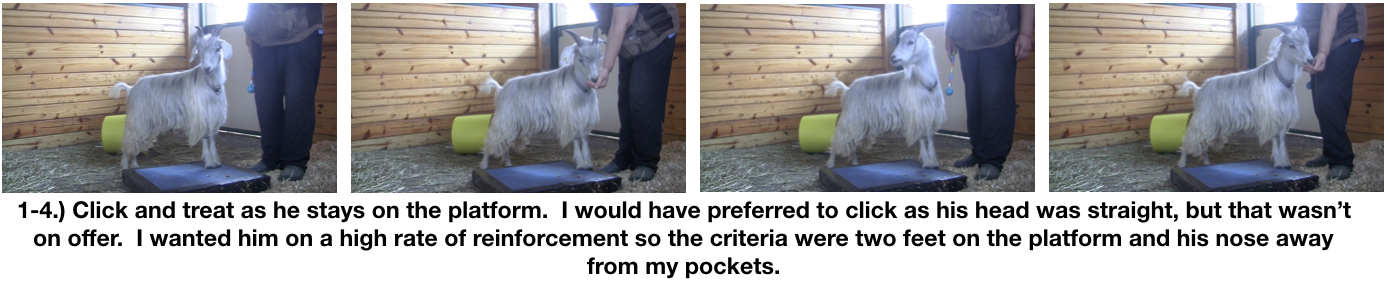
Goat Diaries Day 3 E's First Platform Session - Worried -pawing 2 photos.pngWhen E pawed me the day before to get a treat, I sidestepped the behavior. I didn’t want to see it in that context. But when he pawed the platform, click, I reinforced him. And here’s where his goat heritage took over. As soon as he had one foot on the platform, the rest followed. Worry over.

Goat Diaries Day 3 E's First Platform Session - Worried -pawing 2 photos 1.png

Goat Diaries Day 3 E's First Platform Session - Worried - pawing 2 photos 2.png


Goat Diaries Day 3 E's First Platform Session - Worried -staying 4 photos.png

Goat Diaries Day 3 E's First Platform Session - Worried -worry over.png

He was now solidly on the platform. As I stepped to the side, he pivoted with me. Hmm. Quick calculation. Did I want this, or should I use the food delivery to keep his feet still. Both were useful. I decided to take this offering and reinforce the pivot.

Goat diaries Day 3 - pivoting 5 photos.png

He was still showing some impatience with the food. He tried again jumping up. I stepped back out of his way so his front end fell abruptly to he ground.

goat diaries day 3 jumping up 4 photos.pngThen I stepped to the side and gave him another opportunity to pivot with me. I wanted to be as non-reactive as possible to the unwanted behavior. The break in the rhythm of the training was enough to make my point. E was discovering which behavior served him better – jumping up or staying on the platform.  It was his choice to make.

His confidence was growing and with it the accumulated history of getting treats for behaviors I liked. Time would tell if getting treats led to these behaviors becoming stronger.  I can say I reinforced the behavior by giving him peanuts, but that’s only true if the behavior becomes more frequent. Otherwise, I am just feeding peanuts.

Goat Diaries Day 3 E Pivoting with me.png

After this session I let Pellias back into the stall and gave them fresh hay.  They were eating together out of a hay bucket.  I stood next to them stroking their backs. E let me scratch him around his ears. He liked that. P joined us, and I scratched his forehead and ears. We stood together for several minutes while I scratched their heads. When I stopped, they asked for more. That felt like huge progress!

Coming Next: The Goat Diaries – Day 3: Arrange the Environment for Success

Please Note: if you are new to the Goat Diaries, these are a series of articles that are best read in order.  The first installment was posted on Oct. 2nd.  I suggest you begin there: https://theclickercenterblog.com/2017/10/02/ 


JOY Full Horses: Tagteaching – The Focus Funnel

This is a continuation of Part 2 of my new book, “JOY Full Horses”.  If you are new to this series, go to the contents for links to the previous articles.

In the previous post I introduced you to TagTeaching which stands for teaching with acoustical guidance.  Tagteaching takes the excess words out of coaching and shifts the focus from what a student is doing wrong and needs to correct to what is wanted.  Instruction can be pared down to the four WOOF criteria:

What we want
One thing at a time
Observable
Five words or less.

I described what each of those meant in the previous installment.  Now in this section, I’ll introduce you to another tagteaching tool: the focus funnel.

The Focus Funnel
The founder of Tagteaching,  Theresa Mckeon, developed the concept of the focus funnel for TAG instruction.

A funnel is wide at the top and narrows down at the bottom.

So at the top of the focus funnel is a broad description of the lesson.  This is the part most of us find easy.  We like our words!

Next the coach reduces this general description of the task down to clear instructions about what is wanted.  Lastly she reduces this even further down to a point of focus which can be described in five words or less.

The Focus Funnel Applied to Horse Training
Suppose you are introducing a friend to clicker training.  You’re going to show her how to ask her horse to touch a target.  You’ve probably already given her a general overview of targeting and explained why it’s important, why it makes a great introduction to clicker training.

You’ve gone through the basic prep.  You’ve practiced the lesson letting her rehearse with you how she’s going to hold the clicker and the target, how she’s going to feed her horse.

You’ve found a good area to work with her horse.  He’s loose in a small paddock so he’s free to move about and interact with her, but there is a fence separating her from him just in case he gets pushy or overly excited about the food.  The barrier means she can step back out of his reach instead of correcting him.  That keeps the lesson focused on the behavior she wants – touching the target.

So now she’s ready for the lesson description.

“You’re going to ask your horse to touch the target.  When he does, click and treat.  Repeat this several times, then drop some treats in his food bucket and step away from his paddock.

Your tag point is: Click as nose touches target.”

Constructive Feedback
Tagteaching, like its cousin clicker training, keeps us focused on the positive.  How do we say things so they are clear, to the point and non critical?

One of the tripping up points in coaching is what happens after the handler completes this first round of training.  As you watch her work, suppose you noticed that she was reaching into her treat pouch a second or two before she clicked.

Horses miss nothing. Her horse is going to see that movement, and he’s very quickly going to connect the dots.  Whatever he was doing just as her hand started to move is what he’s going to repeat.  If that was touching the target, that’s the behavior she’ll get more of.  The click will be extraneous information that gets filtered out.  She’ll be clicking the clicker, but it will have less and less meaning as her horse begins to rely on the movement of her hand.  For him that’s the true marker signal.

Now you could say – what’s wrong with that?   Isn’t that easier than all this clicking nonsense?

You could absolutely decide that the movement of your hand is going to be your marker.  There is nothing in clicker training that says you have to use a clicker, or even an auditory marker.  If you were working with a deaf horse, you’d have to come up with some other way to mark behavior.

The problem isn’t that a different marker is being used.  It’s that the handler isn’t aware that’s what is going on.  She isn’t being deliberate in her use of that signal so it will become inconsistent.  If she watched a video of herself, she might notice her hand movement and decide to make that her marker signal, but it’s one I would advise against.  There are so many times in horse training where your hands are going to be busy doing other things.  If your hand is your marker signal, you’re going to run into major timing problems.

You’re seeing these potential pitfalls ahead for your friend so you decide to say something about it.  Here’s how this normally plays out:

“That was good.  You timed the click well, but I noticed that your hand was creeping into your treat pouch.”

Oops.  You’ve just fallen through the trap door that catches so many of us out.  You’ve mixed reinforcement with instruction, and the result is that “but” just negated all the good things you said about her performance.  She isn’t going to hear that she did a good job.  What will stick is she got something wrong.

So what do you do instead?  You put a pause between the assessment and the next set of instruction.

“That was great. You timed the click perfectly each time he touched the target.”

Pause

Lesson description: “Now in the next round of targeting we’re going to focus on a different element.  It’s important that you wait until after the click to reach into your treat pocket.  This keeps the meaning of the click really clear.”

Directions:  “You’re going to repeat the targeting.  Your feeding hand will stay at your side until you click.”

Tag Point: “What would be a good tag point for you?  “Food delivery after the click.” Or perhaps “Hand on hip” might work better.  You tell me which one works best for you.”

Having the learner identify her own tag point makes it even stronger.  This is something that means something to her, that she can relate to.  So involve your learner in creating her own tag points.  It’s a great way to check that she really does understand what you want her to do, and because she helped create the tag point, she is more likely to remember it.

Try It Out
One of the reasons for publishing this book in small installments is it gives you time to think about each section and to try things out for yourself.  How many times during the coming day will you find yourself commenting on someone’s performance?

Your answer may be: “but I’m not a teacher.”

Hah!  We’re all teaching – all the time.  It may be with your children, or a co-worker – or yourself, but we all offer instruction and give feedback.  Do you fall into the trap of mixing feedback with instruction?  Are you letting: “that was great, but . . .” slip in and disrupt  what you intended as praise?

For today take the time to notice what you are currently doing.  What is your existing habit pattern?  Once you’ve observed what you do, you can take action to change any patterns you aren’t liking.  Use what you’ve been learning about habits from the previous chapters to help you create a plan for developing the good habit of separating feedback from instruction.  What new habit loop are you going to create for yourself?

Keeping track of the changes you see is a good way to build new habits that last.  That’s what we’ll be exploring in the next installment.

(P.S. If you are new to clicker training horses and would like to see what these first targeting lessons that I referred to in this post look like, in November of 2015 I posted a four part series on introducing a horse to clicker training.) https://theclickercenterblog.com/2015/11/20/2015-clinic-season-an-introduction-to-clicker-training-day-1/

Coming soon: Tagteaching and Keystone Habits

Remember, if you are new to the JOY Full Horse blog, click on the JOY Full Horses tab at the top of this page to find the full table of contents and links to each of the articles I have published so far.

I hope you will want to share these articles by sending links to this blog to your friends.  But please remember this is copyrighted material.  All rights are reserved. Please do not copy any of the “Joyful Horses” articles without first getting written permission from Alexandra  Kurland, via theclickercenter.com

Also note: these articles are not intended as an instruction guide for introducing your horse to clicker training.  If you are new to clicker training and you are looking for how-to instructions, you will find what you need at my web sites:

theclickercenter.com                    theclickercentercourse.com