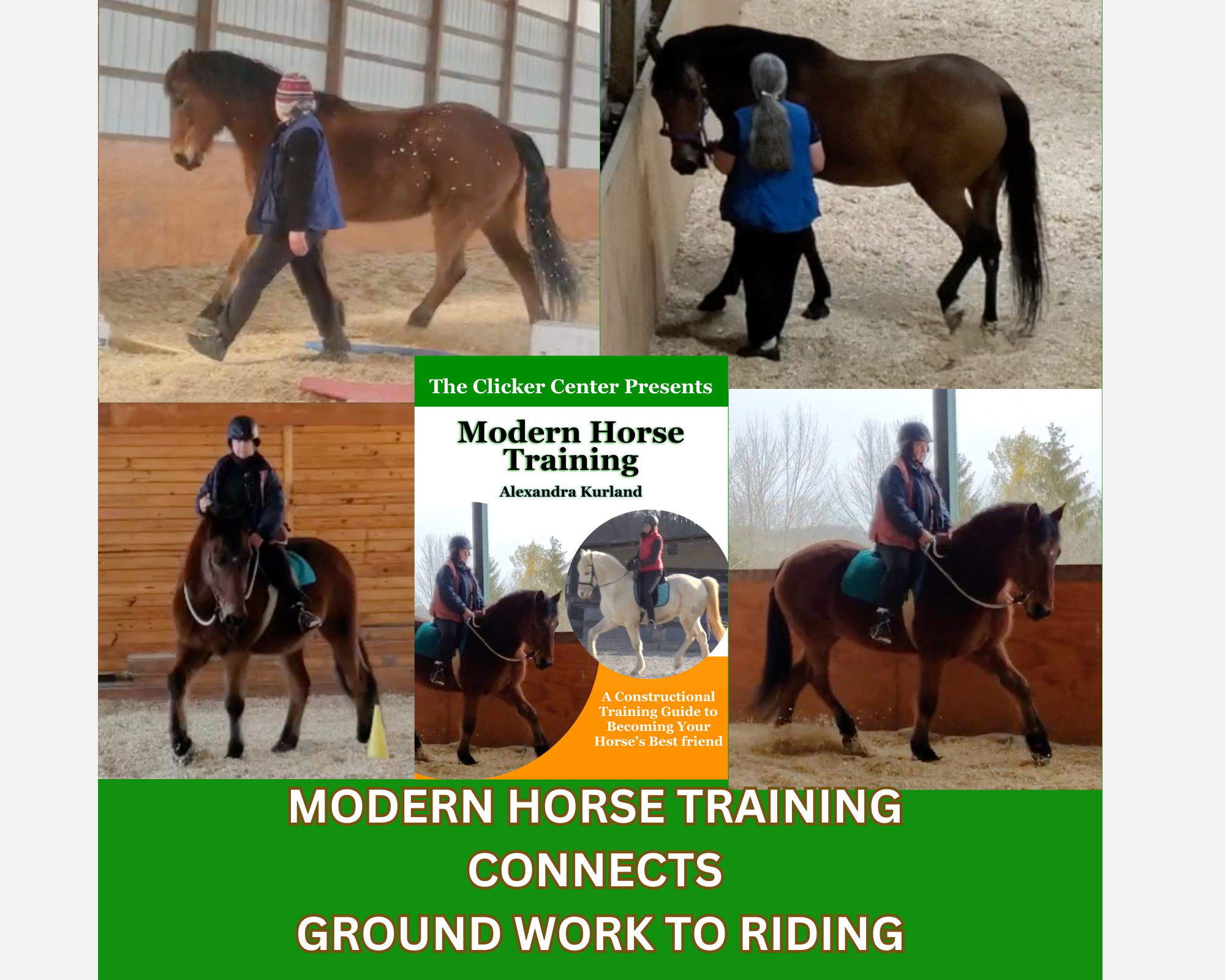
Modern Horse Training Connects Ground Work to Riding

One of my favorite expressions is: “Ground work is riding where you get to stand up and riding is ground work where you get to sit down.”

Everything is connected. The beautiful balance that Robin shows as he trots beside me at liberty is the same balance that I want to ride. The cues that I use on the ground carry over and become cues he understands when I ride.

The use of the lead as a communication tool works in the same way as the reins. When I teach Robin how to respond to tactile cues beginning on the ground, that understanding carries over to riding. Leads and reins work in the same way. Body language cues taught first on the ground carry over into riding.

This means the training is wonderfully efficient. I don’t have to teach one set of cues and behaviors for ground work and an entirely new set for riding. The components that I use to work with Robin at liberty are the same components that I’ll use for work in-hand and for riding. Modern Horse Training makes a deliberate, thoughtful connection between everything you teach. Lessons are not separate and random. The more your horse knows, the faster he will learn because many of the components you’ll need for a new lesson will already be in place.

Modern Horse Training Focuses on Balance
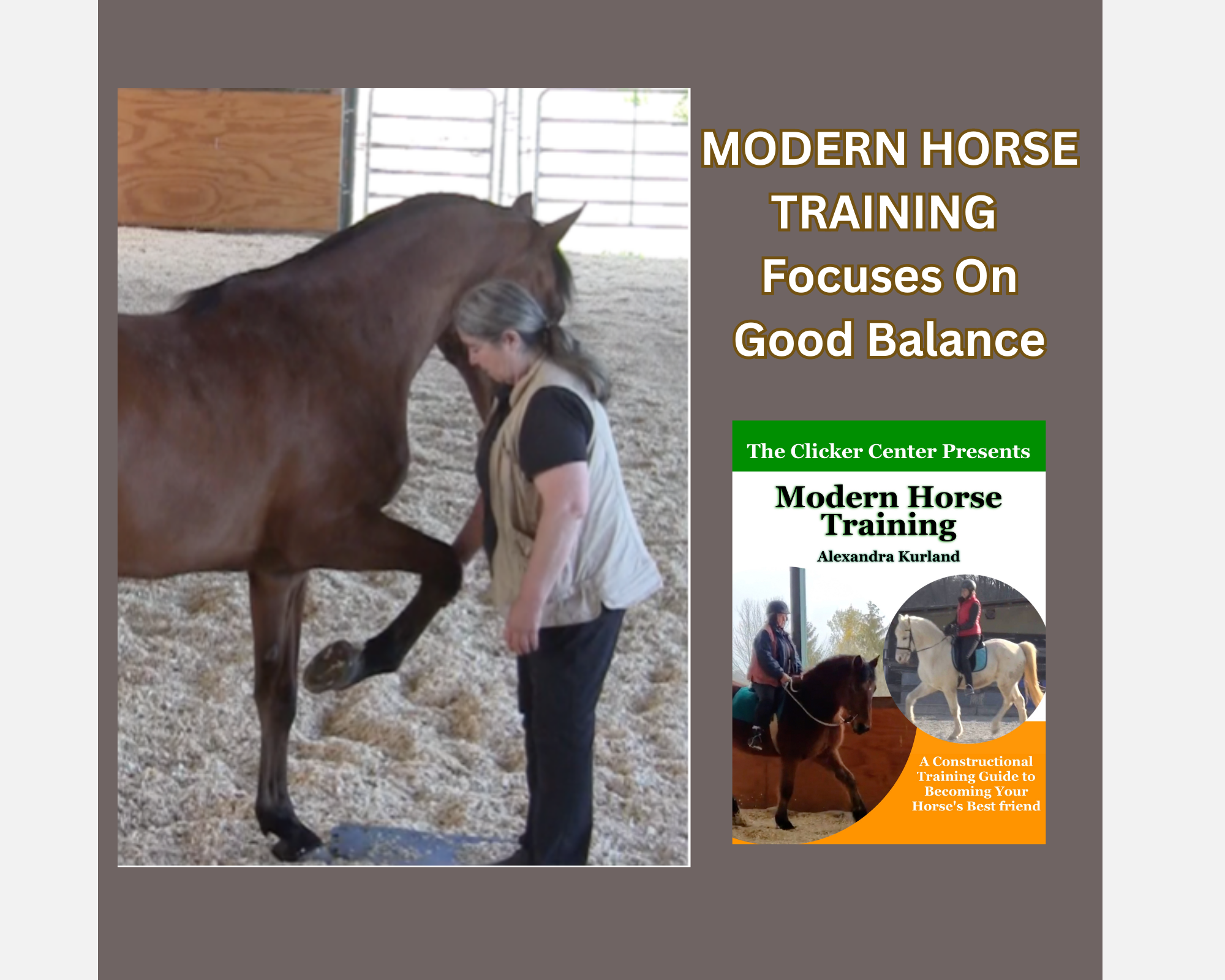
This has long been a favorite photo. I am asking Robin to lift his knee into my waiting hand. I love the quiet elegance that is expressed in this gesture. Note the solid support we see in his left front as he lifts his right leg.

I could easily turn this into foot cleaning, or I could expand the gesture so he extends his leg forward in preparation for Spanish Walk.

Or I could use it, as I am here, as a gymnastic exercise that prepares Robin for the day’s ride.

Once again we see the foundation lessons in action. Robin is standing on a mat. The mat provides a context for the leg lifts and helps to keep them from becoming a nuisance behavior. His beautiful balance has evolved out of the foundation lessons.

Modern Horse Training reminds us that everything is connected.

To learn more visit my web site: theclickercenter.com
Instagram: alexandra.kurland.5
Podcast: equiosity.com
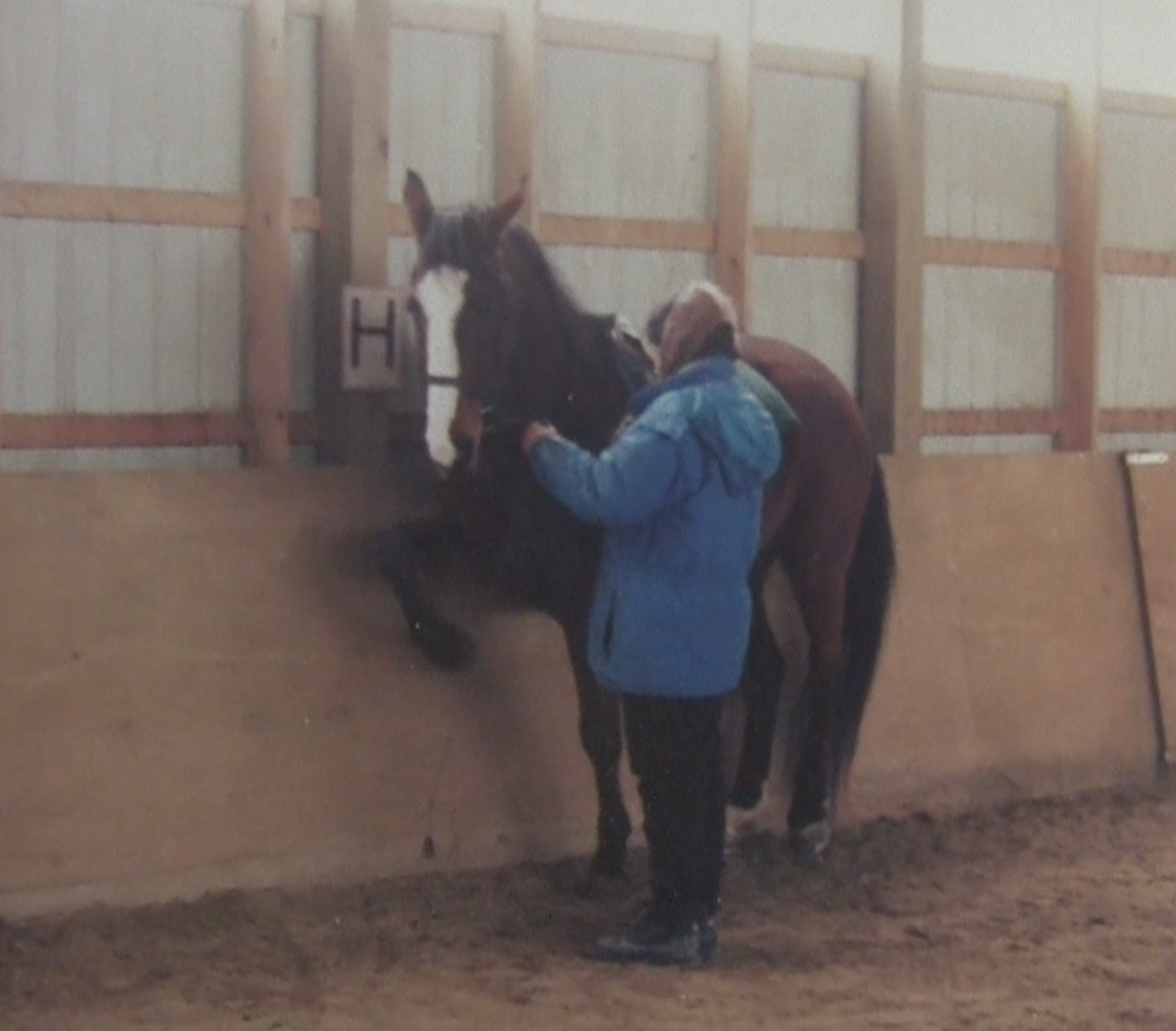
Today’s Peregrine Story: #12 Unexpected Changes

When I started Peregrine under saddle, my trainer said to me that he didn’t have the back strength to perform all the movements of upper level dressage, but he could still carry himself in the equilibrium of a high school horse.  She didn’t mean in a few years.  She meant now, as a young horse, we could expect him to lift up and carry himself in an engaged equilibrium.

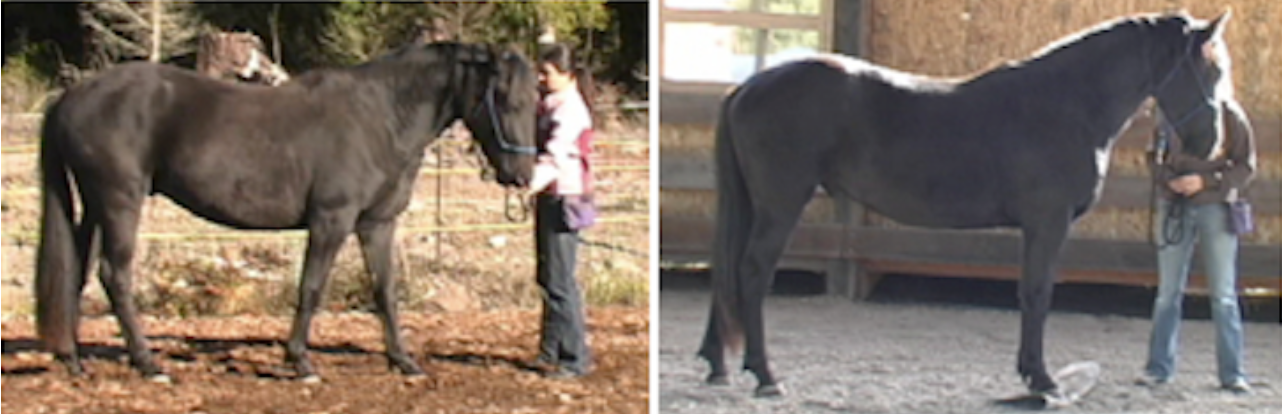
Oliver contrast side by side

This obviously isn’t Peregrine, but these two photos show clearly what is meant when I say he learned to lift and carry his own balance. The photo on the left shows Oliver, a percheron/quarter horse cross, as an almost two year old on day one of his first clinic with me. The photo on the right is also of Oliver. Look at how much more up and lifted he is throughout his body. He looks much older, but this picture was taken just twenty-four hours later. This beautiful balance comes from the lessons Peregrine has been teaching me.

That became the training criterion.  When Peregrine was engaged, his stifles didn’t lock.  I was learning to manage him so our rides no longer felt quite so on a knife’s edge of control.   When I first started riding him, his stifles would lock up without warning.  He would release them by catapulting me forward in a hard, rolling buck.  As long as he was engaged, I could keep him from locking up, and he was a lot of fun to ride.  But as soon as I got off and left him to manage his own balance, his stifles would be locking again.

He was eight years old.  Clearly he was not going to outgrow this condition.  And then he got Potomac horse fever.  And then he was laid up for seven weeks with foot abscesses.  And then we started exploring clicker training.

There had certainly been lots of people before me who used clicker training with their horses.  So why did it stick with me?  Why was I the one who buried herself in a computer for two years writing that first book on clicker training horses?  And why have I continued to be so fascinated by it?  The answer lies with Peregrine.

He was an interesting mix.  He was a well trained horse, but he was also a horse with a lot of issues – all stemming from his locking stifles.  I also had a huge repertoire to work with, both on the ground and under saddle.

Peregrine 1993 Spanish walk

1993 Peregrine in-hand – working on the lift needed for Spanish walk.

Ground work for me meant a lot more than lunging.  It also meant classical work in-hand and a huge liberty repertoire.  As Peregrine recovered from his hoof abscesses, I began to add the clicker into all of this other work.  Before his lay up we’d been working on Spanish walk.  I reshaped the leg lifts using the clicker.  He was so elegant, and he clearly enjoyed the new way this lesson was being taught.

Spanish walk required a huge shift in his balance.  In order to lift up into the front leg extensions, he had to engage his hind end to free up his shoulders.  This was taught in conjunction with all of his other in-hand work.  It was not presented as a separate “trick” behavior.  I was asking Peregrine to carry himself forward in engagement – something the guidance of the marker signal helped him to figure out.

I was a month or two into this work when it occurred to me that I hadn’t seen Peregrine lock in his stifles in quite a while.  I started paying more attention.  I was right.  His stifles weren’t locking – not under saddle and, even more telling, not on the ground, either.

For eight years we had been battling his stifles.  After just a few months of clicker training, they had stopped locking.  That’s when I knew that clicker training wasn’t simply another way to teach behavior.  Yes, it’s great that we have a kinder way to teach horses to pick up their feet for cleaning, or to load into a trailer.  That’s important, but clicker training goes deeper than that.  It awakens our horses’ intelligence.  I say it in this way because so much of training teaches horses only to follow, not to take any initiative.  Clicker training lets them to be full partners in the learning process.  They truly own what we are teaching them.  The lessons aren’t simply things you do when someone directs you.  Peregrine was learning how to manage his own body to keep himself more comfortable – all of the time – not just when I was around.

If clicker training had simply been another way to teach standard behavior, it would have been an interesting stepping stone, but it would not have held my attention in the way that it has for over twenty years.  Peregrine showed me that it is so much more.

Happy 30th Birthday Peregrine.  What a wise horse you are.  Thank you for being my teacher.