Modern Horse Training – Today’s Post: Peregrine, My Master Teacher

Hi Everyone,

One more day to go before my new book, “Modern Horse Training, A Constructional Guide to Becoming Your Horse’s Best Friend”, becomes available to order.

Yesterday I shared with you a little behind the scenes information about how books are printed in the modern world. Modern printing for “Modern Horse Training”!

Sharing Clicker Training
You are reading this post because you are a follower of my work. You’ve been reading my blog. I suspect you also listen to my Equiosity podcast, so you know that I love horses. That’s something we very much have in common. When I started to explore clicker training, it was something I wanted to share. I’m not alone in that. Clicker training has spread around the planet because lots of people have been talking about it. We’ve been sharing our clicker success stories and other horse people have been paying attention. They’ve gotten curious enough to take a look. That’s a good thing for the horses they love.

This year marks an important anniversary for me. It was thirty years ago in September of 1993 that I first went out to the barn with a clicker in my hand and treats in my pocket.

Peregrine was eight years old. He was living at the home of one my long-time clients where he was turned out twenty-four/seven with her two horses. It was a heavenly set up for him except for one thing. The property was next to a wet lands, and he got Potomac Horse fever. He was one of the first horses in my area to contract the disease. Thankfully he was vaccinated, and also thankfully my vet recognized what it was. Peregrine got the treatment he needed, but not in time to completely avoid all of the long-term side effects. He developed laminitis which led to hoof abscesses in both of his front feet. Instead of being able to go out with his friends he was laid up in the barn. He was in so much pain for the first few days he was unable to walk even a step or two.

It looked as though he might be laid up for a while. I wanted to keep him entertained during his layup, so I decided this was the perfect time to experiment with clicker training, to see what it was about.

In her book, “Lads Before the Wind” Karen Pryor described the process of charging the clicker. She would blow a whistle, throw a fish in the water, blow a whistle, throw a fish in the water until, when she blew a whistle, she saw the dolphins interrupt what they were doing to look for the fish. At that point she knew they were making a connection between the whistle and the fish. So then she could choose the moment she blew the whistle to begin shaping the behavior she wanted to teach.

I went out to the barn to charge my clicker. I clicked and handed Peregrine a treat. He took the treat from me. Hand feeding was nothing new. I clicked and handed him another treat. He took the treat but showed no sign that we was noticing the click. I repeated this several more times.

People think I am patient. They are wrong.

Peregrine wasn’t responding to the click. I thought if this is going to take a long time, I’m not interested. So I looked around the barn for something to use as a target. There was an old dressage whip propped up in a corner gathering dust. I used that. I held it out towards Peregrine. He was curious. He sniffed it. I clicked and handed him a treat.

I held the target up again. He sniffed it again. Click and treat.

He was clearly interested. There was such a different look in his eyes than there had been when I was just handing him treats. He was getting it! Orient to the dressage whip, and you can get your person to reach into her pocket and give you a treat. What a fun discovery!

Over the next few days I expanded the game. I had Peregrine track the target left and right, up and down. As the abscesses healed, he could walk forward a step or two to follow it. Our clicker training sessions became the highlight of his day.

Peregrine was on stall rest for seven weeks. He was a young, fit thoroughbred who was used to a lot of turnout and exercise. I had dealt with other thoroughbreds who were coming off of lay-ups. The challenge was always to keep them from bouncing around and setting back their recovery. Peregrine stayed settled throughout his lay up. Returning to routine work was a non-event. When I started hand walking him, I included a review of basic ground work, only this time I was explaining what I wanted via a click and a treat . When I started riding him again after seven weeks of lay up, he was further along in his training than he had been when he was laid up. That’s not how things normally work!

So I was really curious. I started sharing clicker training with my clients, and the rest, as they say, is history. “Modern Horse Training” is a product of all of that sharing.

Learning More
I’ll share one more Peregrine story. I’ve written about his stifles. Peregrine grew up in a body that didn’t work. His stifles would lock to the point where he could not bend his hind legs. They created all kinds of training issues. He was an incredibly sweet horse who became a nightmare to handle. My vet told me that horses often outgrew locking stifles, but if not, there was a surgical option. He could cut one of the tendons that ran over Peregrine’s patella. It was effective, but there was an increased risk that Peregrine might fracture his patella.

When Peregrine was at his worst, when he was blasting out of my hand to unlock his stifles, I was sorely tempted by the surgery. But then I would figure out another piece of the training puzzle, and Peregrine would become a little easier to handle. I would put the surgical option on the back burner for a little longer. It was a risk I just wasn’t ready to take.

I was slowly learning how to manage Peregrine’s stifles – at least when I was working with him. When he was on his own, his stifles would lock up on him again. It was a problem that just wouldn’t go away.

After I started exploring clicker training, I reviewed everything I had ever taught him. The list was a long one. When I had first taught Peregrine to lunge, his stifles would lock up, and he would explode forward to release them. I would be left holding the lunge line, but there would be no horse at the other end. The force with which he blasted forward was enough to shear the metal snap of the lunge line.

I had heard John Lyons say that the strongest lead rope is the one in the horse’s mind. I needed that lead rope so I taught Peregrine to work at liberty. He was a superb liberty horse.

I was also learning classical dressage from Bettina Drummond, Nuno Olivier’s principle student. In addition to riding, I was learning classical work in-hand. That extended beyond the basics of lateral work to piaffe. Before I started him under saddle, I taught Peregrine to piaffe. Mobilizing his hind end helped to keep his stifles from locking, at least when he was working.

I had begun teaching Peregrine Spanish walk shortly before he got sick. I continued to work on that along with everything else. That’s when I started to notice a difference. Peregrine’s stifles weren’t locking up anymore. They had been locking up for eight years, and now they just weren’t.

Karen Pryor called one of her books “Reaching the Animal Mind”. What a perfect title!

That’s what I was doing. Peregrine wasn’t simply doing what he was told. He was internalizing what I was teaching him in a way that he had not done before. He changed how he was using his body. I talk a lot about the Feldenkrais Awareness Through Movement training for people and the profound effects that it can have. I saw something similar happening with Peregrine. The clarity of the marker signal was doing what eight years of training had not. Peregrine stopped locking in his stifles.

This is why I am so passionate about this work. Yes, it is wonderful that we have a kinder way to teach horses to load onto trailers or to stand well for a farrier. But clicker training goes deeper than that. If clicker training were simply about adding some new teaching strategies to our training choices, I suspect I would have long ago moved on to other things. I certainly would not have spent the thousands of hours away from my horses that it has taken to write the books, create the DVDs, produce the podcast, travel to clinics, and respond to all the queries I get about clicker training.

There is much more to this work. I know many of you reading this know what I mean. You have experienced something similar in your own horses. You have seen your relationship deepen in a way that goes beyond words. You have found yourself solving training puzzles, laughing during training sessions, loving your horses.

I have chosen to publish my new book, “Modern Horse Training” on April 26, the anniversary of Peregrine’s birthday, to honor the part he played in introducing me to clicker training. I lost him in September of 2015. He was thirty years old. He is deeply loved and in my heart always.

If he hadn’t been such a master teacher, I might have dabbled in clicker training and then moved on. That’s what others did with it. But he pushed me to see what it was really about. So I have a favor to ask of all of you reading this. For the horses in your life, please send a thank you to Peregrine by buying the new book. It will be hugely appreciated.

Each copy sold makes it easier for the next person to find clicker training. Help me turn the book into a best seller. Together we can make a difference and change the way horses are trained.

The book will be available to order tomorrow, April 26. You can order it from my web site, or through Amazon and other booksellers.

The Clicker Super Glue

JOY FULL Horses: Ten Things You Should Know About Cues: Number 9.) You Can’t Not Cue: Part 6 of 12

What Keeps People Interested in Clicker Training?
I ended yesterday’s post with the question: what is the “glue” that gets somebody to stick to clicker training?  What makes someone take more than that first look?  What creates the shift from being simply curious about clicker training, to giving it a try, to becoming an active user, and eventually a clicker trainer?  I think there are four main elements that go into the creation of clicker super glue.

Science
The first component of clicker super glue is a love of science.  I’ve already talked about this, but let me expand on it here.  When I talk about a love of science I don’t mean someone who has read the chapter on learning theory in the psychology text book and memorized the four quadrants.  Lots of people can give you the definitions of negative and positive punishment.  That’s simply someone who has done a bit of reading.

A love of science is something more.  It’s that curiosity that has you always asking the “why” questions.  It’s wanting to know how things work.  It’s never being satisfied with the “because that’s the way it’s done” answers.

Someone who is passionate about science is also passionate about history.  You want to know what others before you have said in answer to those “why” questions.  Where did our current ideas come from?  Why do we use marker signals?  Why do we call them bridging signals? Where did that term come from?  What was meant by it, and is it still applicable?

“Just because” isn’t good enough.  How do we test our ideas?   How do we peel back the layers of confusion our words often create and look at what is really going on when we say antecedents set the occasion for behaviors which are controlled by consequences?   Do you nod your head and passively write that down in your notes?  Or do you want to dig down into those words to find out what those relationships really mean for your animals?

People who are passionate about science understand that what is understood today is not fixed in stone.  As we learn more, our understandings change.  In the sciences, as you test ideas and develop techniques that allow for more fine-tuned levels of exploration, ideas shift.  Science is the perfect companion to training.

science is the perfect companionIn both you will hear people saying: I used to follow this line of thought, but then the data showed me that this other was a better explanation/approach.  It offered a more functional interpretation or way of handling the behavior I was seeing.
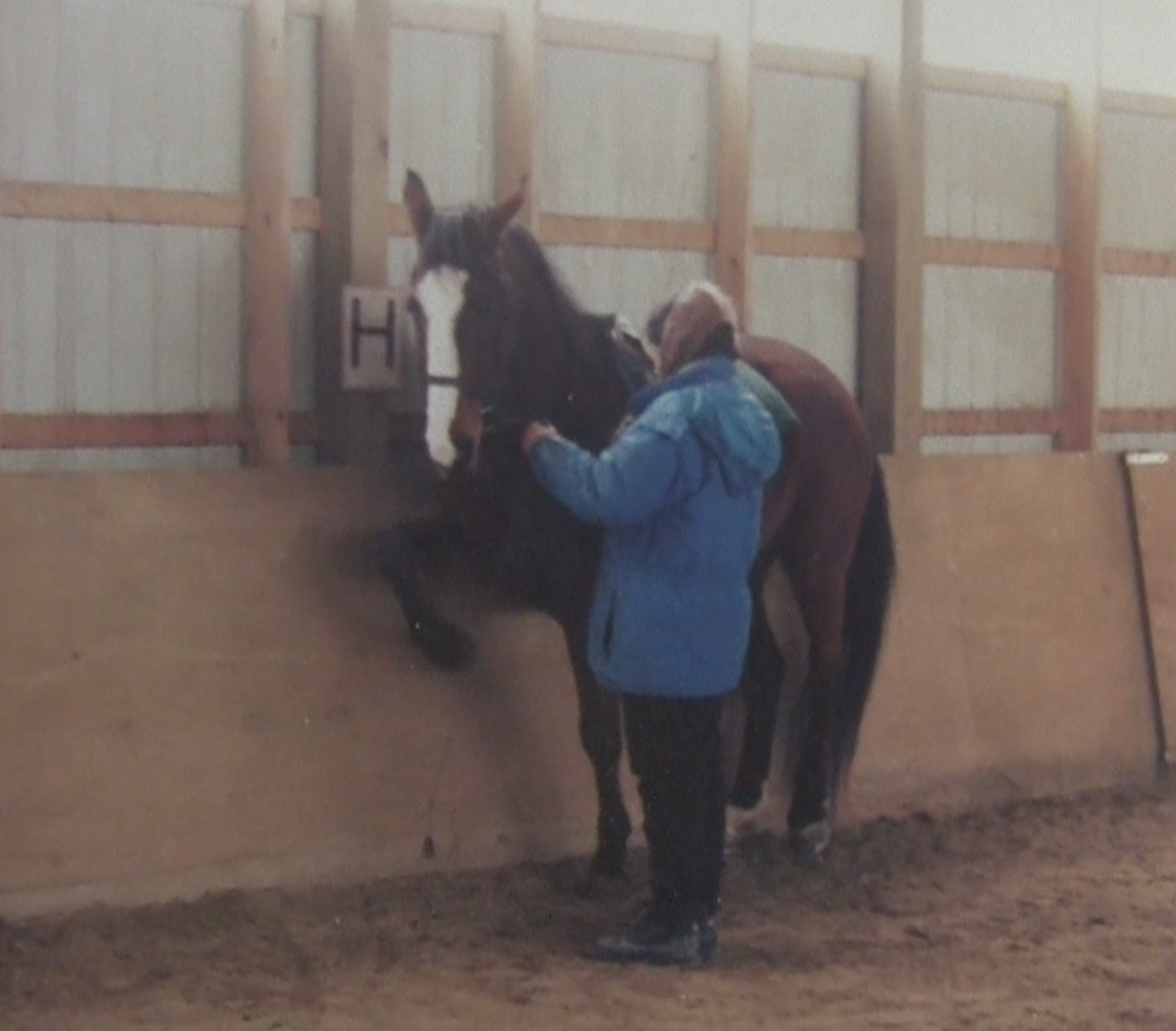
Nothing becomes entrenched because we are always asking those why questions.

Science alone is not enough.  Think of it like the super glues that come in two separate tubes.  Each tube by itself won’t hold anything together, but combine them, and you have a super glue that will last for years.  By itself science creates an interest in training, but it doesn’t guarantee that someone will turn into what I mean by a clicker trainer.

Relationship
One of the other super glue “tubes” is relationship.  When I first went out to the barn with a clicker in my hand and treats in my pocket, I was curious.  The scientist in me wanted to explore what sounded like an intriguing approach to training.  There weren’t any other equine clicker trainers around to act as role models.  I didn’t go out to the barn because I had been watching youtube videos showing me the amazing relationships people were developing with their horses.  It was the science behind the training that made me take the first look.  I kept going because that early exploration into clicker training so enriched the relationship I had with Peregrine.

I started sharing my early forays into clicker training with my clients.  I remember asking one of them what she thought about clicker training.  She said out of all the things I had shown her, it was her favorite.  When I asked why, she said it was because of the relationship it created with her horse.

Repertoire
Two tubes aren’t enough to create clicker super glue.  There is another element that I think is critical and that’s repertoire.

I’ve known many people who were excited to try clicker training.  They introduced their horses to the target, and then they got stuck.  What do you do with it?  That was the question.

When I started with the clicker, Peregrine already knew a lot, but there were glitches and speed bumps throughout his training.  Always the physical issues he had with his stifles got in the way.  As a youngster, he was plagued by locking stifles.  The stifle joint is equivalent to our knee.  When Peregrine wanted to take a step forward, the tendons that ran over his knee cap wouldn’t always release.  He’d try to move, and one or both of his hind legs just wouldn’t bend.  He’s be stuck in place until they let go.  On the ground backing usually unlocked his joints.  Under saddle the solution he was more likely to find was a hard buck forward.

So you could say he was both very well trained, and at the same time very much a problem horse.  On a good day he was a dream to ride, but when his stifles were locking up, he was a nightmare.  His stifles had forced me to learn so much more about training, especially about ground work, just to be able to manage him safely on those bad days.  On the good days, that same training produced some simply beautiful work.

Twenty plus years ago when Peregrine and I were first exploring clicker training, ground work for most people meant lunging.  That was all they knew.  You lunged your horse to get the “bucks out” so your horse was safe to ride.

Lunging was often crudely done.  The horse ran around you on a circle, often out of balance, often pulling on your lunge line.  It wasn’t fun for either of you, so if someone said: “we’re going to use the clicker to do ground work”, of course people ran for the hills!  What was fun about ground work?

I’ve raised all my horses.  Peregrine was a horse I bred.  I raised his mother, and Robin came to me as a yearling, so ground work to me has always meant so much more than lunging.  Ground work is the teaching of connection.  Ground work means showing your horse how to get along with people.  It includes basic manners and leading skills, but it’s so much more than that.  For a young horse ground work includes long walks out to learn about the world.  It includes walking through mud puddles and over wooden bridges, meeting the cows that live in the next field over, encountering joggers and bicycle riders.  It means liberty training and in-hand work.  It means learning about your body and gaining control over your balance so you can go up and down hills safely and one day carry a rider in comfort.

All this meant that after Peregrine was routinely touching a target, I wasn’t stuck.  I had a rich and varied repertoire to work with.  I began by reshaping everything I had ever taught him with the clicker.  In so many places I could almost hear him say: “Oh THAT’S what you wanted!  Why didn’t you say so before?”

Everything I had already taught him – the clicker made better. I began by using it as a piggy back tool, meaning I simply added it in to familiar lessons.  I would ask Peregrine to rotate up into shoulder-in much as I had always asked him, and I would click and treat as he complied.  It made him more willing, so it took less explaining on my part to get the desired response.

Reworking our existing repertoire got us a solid foot in the clicker door.  It gave us lots to explore to get us started.  When I’m introducing people to clicker training, I want to help them see all the many possibilities that exist in ground work.  If you equate clicker training just with targeting, you may well get stuck.  Your horse is touching a target.  That was fun, but now what?

The “now what” is finding creative ways to use that targeting behavior.  And it’s recognizing that there are many other shaping methods you can use.

It’s remembering that at one point your horse didn’t know how to pick up his feet for cleaning or to stand quietly while you put on his halter.  Can you use the clicker to make those things better?  Of course you can!  While you are learning how clicker training works, you can turn the ordinary into the extraordinary.

I like beginning with the “universals”, things we all do with our horses regardless of the type of riding we do.  We all need to clean our horse’s feet, groom them, halter them, and, if we ride, bridle and saddle them.  Below is a fun video from Monty Gwynne showing how a clicker-trained horse takes a bridle.  It’s a great example of turning the ordinary – something we all do on a regular basis – into something with real clicker flare.

https://www.youtube.com/watch?v=tfxuSytL6qo

Persistence
Science, relationship, repertoire are all important.  There’s one more component to our super glue and that’s persistence.

Training is not easy.  It is not straight forward.  It is certainly not a linear path where one success builds on another, and you never have another frustrating day ever again with your horse.

Training is about running up against a reaction you don’t understand and going off to have a proverbial cup of tea while you figure out a different way to approach the problem.  You have to have persistence to weather these little storms of confusion.  You have to have persistence to learn the handling skills that can make the difference between smooth-sailing success and a stormy ride.

You can understand the science inside and out, but your horse may still be turning his back and walking off the minute he sees you coming.  Persistence keeps you in the game, scratching your head trying to figure out what to do next. What do you change?  What do you add?

Persistence is what gets you to clinics and fills your bookshelves with training book after training book.  It is what gets you to tie a lead rope to your fence rail so you can practice, practice, practice your rope handling skills before you ever go near your horse.  And it is what takes you back out to the barn to see what your horse thinks of all the homework you’re doing on his behalf.

Put these four things together and you will have someone who shifts from simply giving clicker training a quick look to someone who is actively using clicker training on a routine basis.  But that still doesn’t mean someone is a clicker trainer.

Coming Next: Using Clicker Training Versus Being A Clicker Trainer

Remember, if you are new to the JOY Full Horse blog, click on the JOY Full Horses tab at the top of this page to find the full table of contents and links to each of the articles I have published so far.

I hope you will want to share these articles by sending links to this blog to your friends.  But please remember this is copyrighted material.  All rights are reserved. Please do not copy any of the “JOY Full Horses” articles without first getting written permission from Alexandra  Kurland, via theclickercenter.com

Also note: these articles are not intended as an instruction guide for introducing your horse to clicker training.  If you are new to clicker training and you are looking for how-to instructions, you will find what you need at my web sites:

theclickercenter.com                    theclickercentercourse.com

Today’s Peregrine Story: #12 Unexpected Changes

When I started Peregrine under saddle, my trainer said to me that he didn’t have the back strength to perform all the movements of upper level dressage, but he could still carry himself in the equilibrium of a high school horse.  She didn’t mean in a few years.  She meant now, as a young horse, we could expect him to lift up and carry himself in an engaged equilibrium.

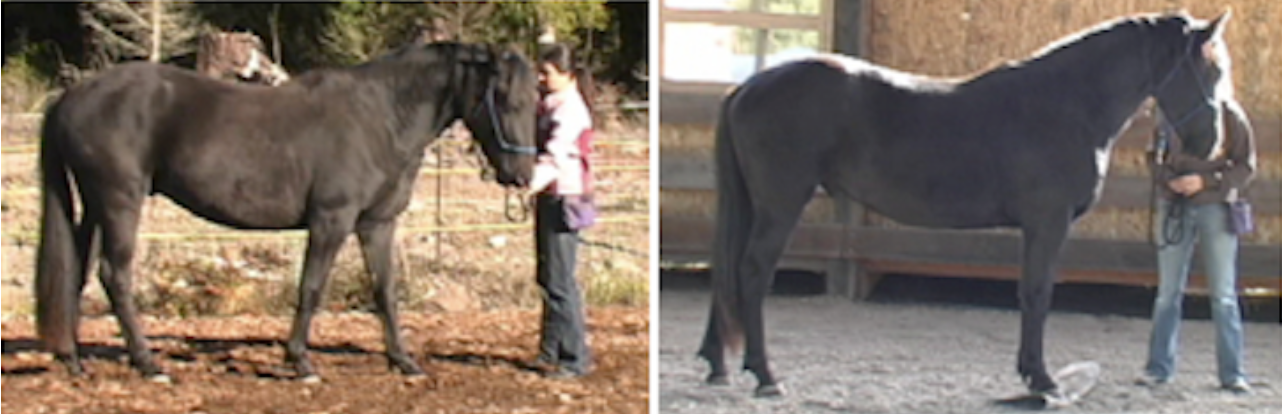
Oliver contrast side by side

This obviously isn’t Peregrine, but these two photos show clearly what is meant when I say he learned to lift and carry his own balance. The photo on the left shows Oliver, a percheron/quarter horse cross, as an almost two year old on day one of his first clinic with me. The photo on the right is also of Oliver. Look at how much more up and lifted he is throughout his body. He looks much older, but this picture was taken just twenty-four hours later. This beautiful balance comes from the lessons Peregrine has been teaching me.

That became the training criterion.  When Peregrine was engaged, his stifles didn’t lock.  I was learning to manage him so our rides no longer felt quite so on a knife’s edge of control.   When I first started riding him, his stifles would lock up without warning.  He would release them by catapulting me forward in a hard, rolling buck.  As long as he was engaged, I could keep him from locking up, and he was a lot of fun to ride.  But as soon as I got off and left him to manage his own balance, his stifles would be locking again.

He was eight years old.  Clearly he was not going to outgrow this condition.  And then he got Potomac horse fever.  And then he was laid up for seven weeks with foot abscesses.  And then we started exploring clicker training.

There had certainly been lots of people before me who used clicker training with their horses.  So why did it stick with me?  Why was I the one who buried herself in a computer for two years writing that first book on clicker training horses?  And why have I continued to be so fascinated by it?  The answer lies with Peregrine.

He was an interesting mix.  He was a well trained horse, but he was also a horse with a lot of issues – all stemming from his locking stifles.  I also had a huge repertoire to work with, both on the ground and under saddle.

Peregrine 1993 Spanish walk

1993 Peregrine in-hand – working on the lift needed for Spanish walk.

Ground work for me meant a lot more than lunging.  It also meant classical work in-hand and a huge liberty repertoire.  As Peregrine recovered from his hoof abscesses, I began to add the clicker into all of this other work.  Before his lay up we’d been working on Spanish walk.  I reshaped the leg lifts using the clicker.  He was so elegant, and he clearly enjoyed the new way this lesson was being taught.

Spanish walk required a huge shift in his balance.  In order to lift up into the front leg extensions, he had to engage his hind end to free up his shoulders.  This was taught in conjunction with all of his other in-hand work.  It was not presented as a separate “trick” behavior.  I was asking Peregrine to carry himself forward in engagement – something the guidance of the marker signal helped him to figure out.

I was a month or two into this work when it occurred to me that I hadn’t seen Peregrine lock in his stifles in quite a while.  I started paying more attention.  I was right.  His stifles weren’t locking – not under saddle and, even more telling, not on the ground, either.

For eight years we had been battling his stifles.  After just a few months of clicker training, they had stopped locking.  That’s when I knew that clicker training wasn’t simply another way to teach behavior.  Yes, it’s great that we have a kinder way to teach horses to pick up their feet for cleaning, or to load into a trailer.  That’s important, but clicker training goes deeper than that.  It awakens our horses’ intelligence.  I say it in this way because so much of training teaches horses only to follow, not to take any initiative.  Clicker training lets them to be full partners in the learning process.  They truly own what we are teaching them.  The lessons aren’t simply things you do when someone directs you.  Peregrine was learning how to manage his own body to keep himself more comfortable – all of the time – not just when I was around.

If clicker training had simply been another way to teach standard behavior, it would have been an interesting stepping stone, but it would not have held my attention in the way that it has for over twenty years.  Peregrine showed me that it is so much more.

Happy 30th Birthday Peregrine.  What a wise horse you are.  Thank you for being my teacher.