Joyful Horses: Table of Contents

In my previous post I explained how my book, JOY Full Horses, came to be written.  Then I left you hanging while I went off for a week to a conference.  So here, finally, is the first installment of the book.  I’m beginning, as books do, with the Table of Contents.

As you scroll down through the Table of Contents, I hope the chapter titles excite your interest.  I don’t want you to feel overwhelmed by a sudden flood of articles into this blog, so my plan is to publish a block of material once or twice a week.

Before I begin, let me share with you what this book overall is about, and what it is not.  In clicker training we learn not to focus on the unwanted behavior.  We want to focus on what we want the learner TO DO.  So it seems odd to be saying what this book is not.  It is not a “how-to” guide to clicker training.  I’ve written those books, produced those DVDs, written that on-line course.  If you are new to clicker training and need the nuts and bolts of how to get started, I will direct you to those resources.  You can find them all via my web site: theclickercenter.com.

So what is this book?  And who is it for?  The second question is easy to answer.  It is for you – especially if you have animals in your life, and you’re interested in training.  Over the past twenty plus years I’ve been pushing the boundaries of what can be done with clicker training.  How do we use it?  How do we think about it?  What is our current understanding of cues, chains, reinforcement schedules, etc., and how has that changed over the years? In these articles we’ll be going well beyond the basics of clicker training.  I want to share with you the differences that make a difference – that transform you from a follower of recipes into a creative, inventive trainer.  Play is the transformer.  In the articles that I have collected together to form this book, you’ll discover what I mean by that.

Alexandra Kurland   January 12, 2016

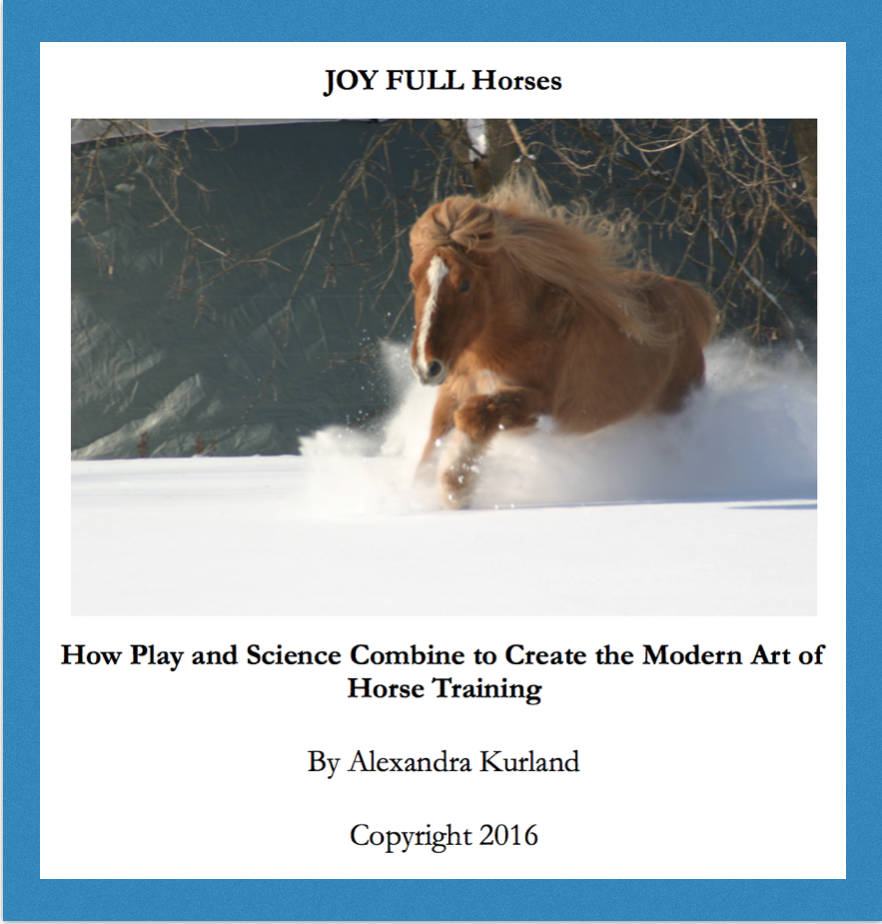
Joy Full Horses title page cover

Here’s a look at what’s coming:

Contents:

PART ONE: WHY PLAY?

Chapter 1: Mammals Play
Airplane Reading
Why Do Animals Play?

Chapter 2  Animal Emotions
Is Your Training Fun?
Animal Wise
Outdated Belief Systems
Affective Neuroscience
The Seven Affective Emotional Systems
The SEEKER System
A Courageous Mouse
The Cat Dilemma
RAGE
FEAR
LUST, CARE, and PANIC

Chapter 3: What Neuroscience Teaches Us About Play
The Archeological Dig Through The Brain
Clicker Training and the Seven Affective Systems

Chapter 4:  Inside the Trainer’s Brain
The Neuroscience of Training
Recognizing Play?

Chapter 5: What is Play?
Defining Play

Chapter 6: Being PLAY FULL
Play Full
Playing with Horses
Playing with Behavior
Playing with Play

Chapter 7:  Training Playfully Mixed with a Little Science
The ABC’s of Training
Reinforcement Variety
Antecedents

Chapter 8: Cues and Their Connection to Play
What are Cues?
Explaining Cues to a Beginner – Your List
Explaining Cues to a Beginner – My List

PART 2: PLAYING WITH CUES:
Ten Things You Should Know About Cues

Number 1: Cues are not Commands
Chapter 1: Asking Versus Telling
Commands
Cues
Paradigm Shifts
Playing with Cues

Number 2: Non Verbal Cues
Chapter 1:  Shh. Don’t Talk.  I’m Listening To Your Body
Clever Hans
Unintended Cues

Chapter 2: Turning being PLAY FULL into a Habit
The Power of Habits
The Effect of Cues
Unexpected Habits
Emotional Habits
Traveling Outside Your Habits
Microhabits
The Structure of Habits
Changing Habits
Bad Habits
Forming Habits – Good or Bad
Focus
Cravings
Changing Your Habits
Do You Believe?
The Power of Community
Keystone Habits
Small Wins or Big Fights – You Choose
Brick Walls
Dismantling The Brick Walls
Patience and Persistence
“They Don’t Feel Pain the Way We Do”
The Evolution of Belief
Balance – The Core of Everything
My “Salt Box”
Learned Helplessness
Standing Up For Our Horses
Force-Based Training
What Good Trainers Have In Common
Speaking Out For Our Horses

Chapter 3: TagTeaching – You Can’t Train My Child Like a Dog!
TagTeaching
Tag Points
WOOF Criteria
The Focus Funnel
The Focus Funnel Applied to Horse Training
Constructive Feedback
Tag Teaching and Keystone Habits
Journals
Forming The Record Keeping Habit
Forming a Journaling Community
KeyStone Habits for Life

Number 3: The Environment is a Cue

Chapter 1:  Emotions and Environmental Triggers
Environmental Cues
Guide Horses
Goose Neck Trailers
A Trainer’s Play Ground
The Herd Horse Advantage
My Cue Trumps Your Cue
Intelligent Disobedience
Horses as Guides
Evidence in Support of Intelligent Disobedience
Trusting Intelligent Disobedience
Teaching Traffic Checks
Testing the Training – How Strong are your Habits?
Guide Work: Yes She Can!
But, But, You MUST Need to Correct Her

Chapter 2: Using Environmental Cues
Every Day Environmental Cues

Chapter 3: The Time Has Come the Walrus Said to Talk of Many Things: Premack, Asking Questions, Mats, Airplane Runways and Creativity
The Time Has Come
Behaviors as Reinforcers
Turning Mats Into Tractor Beams
Feldenkrais Work
Asking Questions
The Translation to Horses
The Lead Tells A Story
The Runway
Give Them What They Want
Stopping on Mats
Constructional Training
Mat Manners
101 Things
The Opposite of Flooding
Playing with Language
Transforming Horse Training Into Play
Using Props
Playing with Images
Creativity

Number 4: Cue Communication

Chapter 1: Dr. DooLittle Knew How To Listen
Everything You Need to Know About Cues
Cue Communication
Everyday Conversations
Animal Trainers – The Ones to Really Learn From!
A Well-Trained Human
Behaviors Become Cues
Mounting Blocks as Cue Communication
Trust Your Horse, Trust the Process
Capture the Saddle
The Why Would You Leave Me? Game
Expectations
Walking Off Casually and the Why Would You Leave Me? Game
Capture the Saddle – A Target Game
Pre-Ride Safety Check List
“Grand Prix” Mounting Block Behavior
Listen To Your Horse
Detective Work
“Just Tell Me How You Feel”

Chapter 2: Finding “Yes”
Saying “No”
The Horse As Teacher
The Conversation
Fixing the “Fixers”

Number 5: Cues Evolve

Chapter 1: Cues Evolve Out Of The Shaping Process
Review
Head Lowering
Keeping Things in Balance
There’s Always More Than One Way To Teach A Behavior
Not A Forward-Moving Exercise
Moving the Hips
Backing in a Square
“Walking and Chewing Gum”
Dynamic Food Delivery
Mapping Out The Dance
Reading Your Dance Partner
Cues Evolve – Adding the Lead
Cues Evolve: How Light Can Light Be?
Who’s Not Showing Respect?
Starter Button and Constant On Cues
The Horse’s Perspective
Soap Box Time
Backing with Starter Button Cues
A Change in the Game
More “Being the Horse”
Heating Up a Behavior
Priming The Head Lowering Pump
Head Lowering from Backing in a Square
Calm Down NOW!
Heading Toward Lighter Than Light Cues
Playing with Cues
“How’d you do that?”

Number 6: Getting What You Want When You Want It: Stimulus Control

Chapter 1: Getting What You Want
More About Cues
Cues and Our Eager Clicker Horses
Stimulus Control Version 1.0
The Four Criteria of Stimulus Control
Speed Bump: Teaching with Extinction
Through “the Wardrobe”

Number 7: Stimulus Control and Play

Chapter 1: Even Play Has Rules
Reminders
Balancing Cues
Building a Repertoire of Behaviors
Base Behaviors
An Equine Ostrich
Clicker “Drill Sergeants”
Laughing with our Horses
Playing Safe
Remember To Laugh

Number 8: Cues Can Change and Be Changed

Chapter 1: Cues Evolve
Change Happens
What Comes Before What Comes Before
How Light is Too Light?
Wait

Chapter 2: The Cue Transfer Process
Changing Cues
Basic Manners
Tap Root Behaviors
Saying Please and Thank You
Good Manners are a Good Habit
The Grown-ups Really Are Talking
Great Service
Consistency
Over-eager Students

Chapter 3: New Cue – Old Cue
Creating New Cues
Sleight of Hand Magic Tricks
Understanding Pressure
Play and the Transferred Cue
The Transfer Continues
Sleight of Hand Magic – The Trick Revealed

Number 9: You Can’t Not Cue

Chapter 1: Using The Cues Your Horse Discovers
Collecting Gems
Clever Hans
Working WITH Your Own Clever Hans
Canine Teachers
Selecting from the Menu
Use Your Cues
An Accident Waiting To Happen
All Work and No Play . . .

Chapter 2: What is Clicker Training?
Labels
What Clicker Training Means To Me
Defining Clicker Training
Creating Stepping Stones

Chapter 3: Are You A Clicker Trainer or a User of Clicker Training?
Are You a Clicker Trainer?
Why Clicker Train? The Science Foundation
Three Blind Men and the Elephant
Modern Animal Training
Relationship
Using Clicker Training
The Clicker Super Glue
Science
Relationship
Repertoire
Persistence
Using Clicker Training
The Clicker Umbrella
Just Because You Can . . .
More Questions
Levels of Analysis
Adding a Question Mark – Feldenkrais Work
Asking Not Telling
The Questions

Chapter 4: What is the lesson? – Playing with Cues
The Teachers We Get Are The Teachers We Need
Stories
One Day At A Time
TTEAM
Innovations Come From the Outside In
Following Antennae
The Joy of Discovery
Ready To Teach
Change Makers
Change Our Beliefs, Change the World
Detective Work

Chapter 5: Stepping Stones
More To Learn
Remembering Play
Getting “Yes” Answers
Training Choices
Building Clean Loops
Scritching
Sequence Matters
You Never Know What You’ve Taught.  You Only Know What You’ve Presented
Using Your Head
Breath
Celebration!
Moving On
What Could You Find? What Could You Release?
Posing the Questions
Adding the Click
Tactile Communication
Cues Evolve
Cue Communication
Adding in Lateral Flexions
Do Not Enter Signs
Microrhythms

Number 10: Playing with Chains

Chapter 1: Cues Evolve into Chains
The List of Ten
Creating Change Through Chains
The Story for Poco
Poco’s Learning Loop
What We Say
The Meaning of Words
Negative Reinforcement
Procedure versus The Emotional Effect
History Matters
The Emotional Spectrum
It’s Not Your Fault
Changing Expectations
Hidden Motivators
What Triggers Change?
The Fluid Nature of Language
How Words Are Used
The Power of Play

PART 3: GOING MICRO

Chapter 1: The Many Forms of Micro
Why Micro
MicroShaping
Outcome Versus Reaction Pattern
Base Behaviors
Tossing Treats
Precision
Dynamic Food Delivery
Precision and Play Go Together
Patterns
What Does the Click Do

Chapter 2: How Clicker Trainers Play
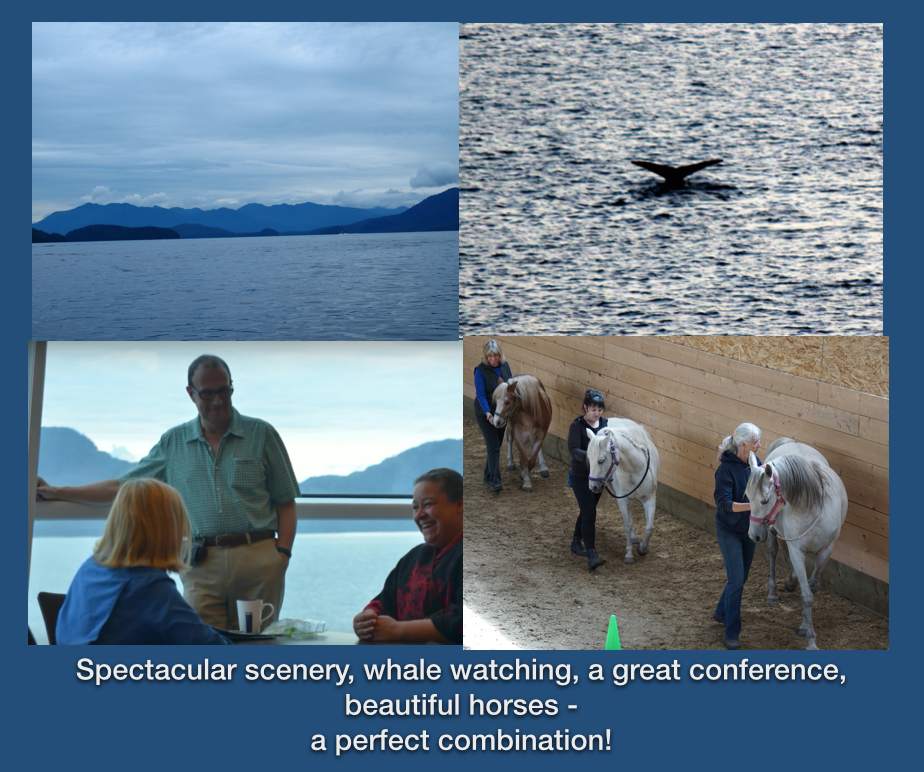
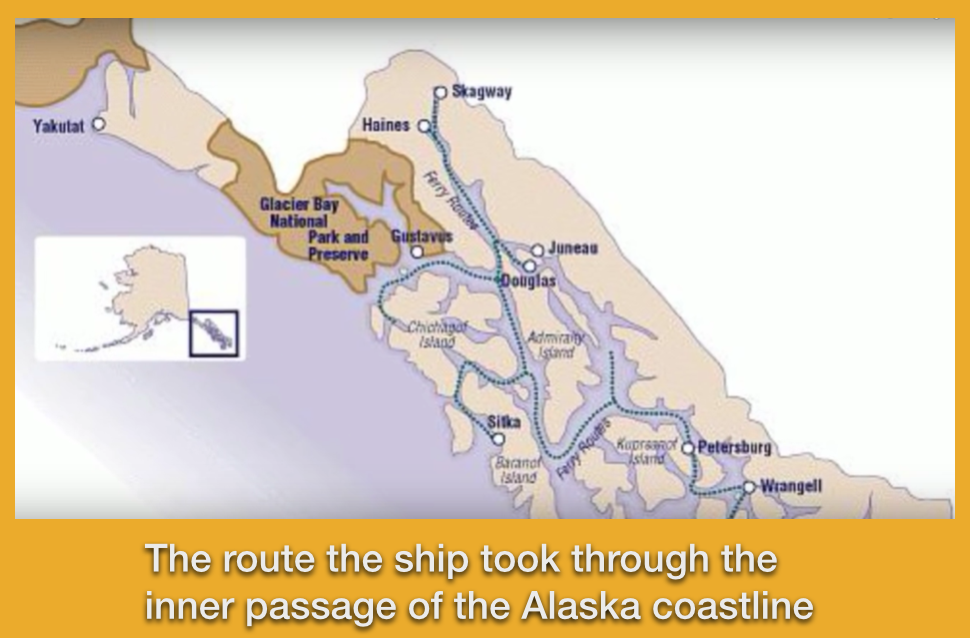
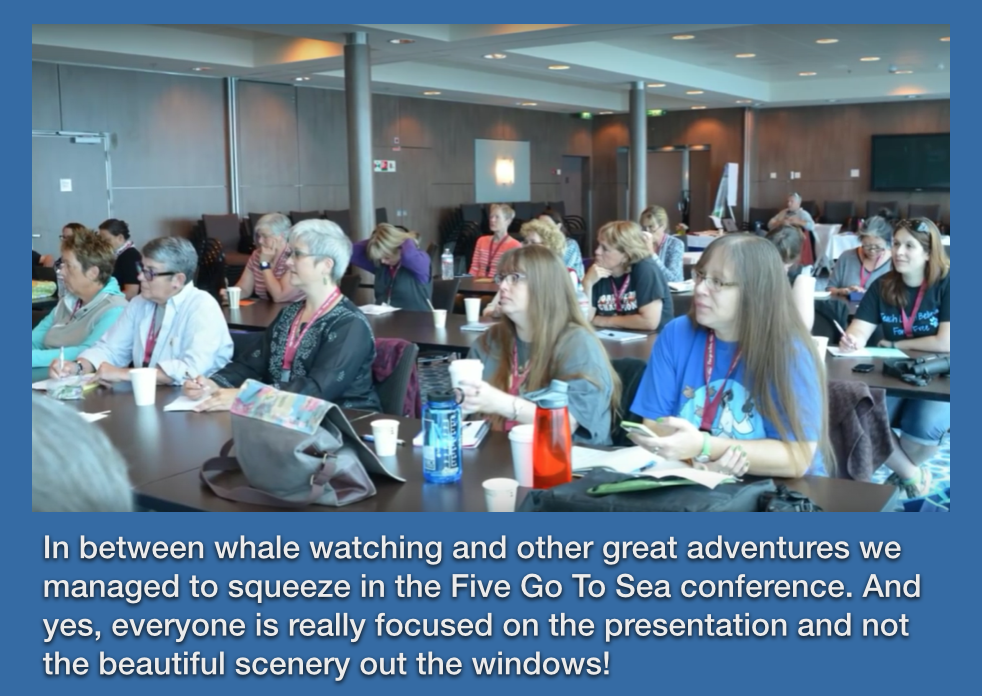
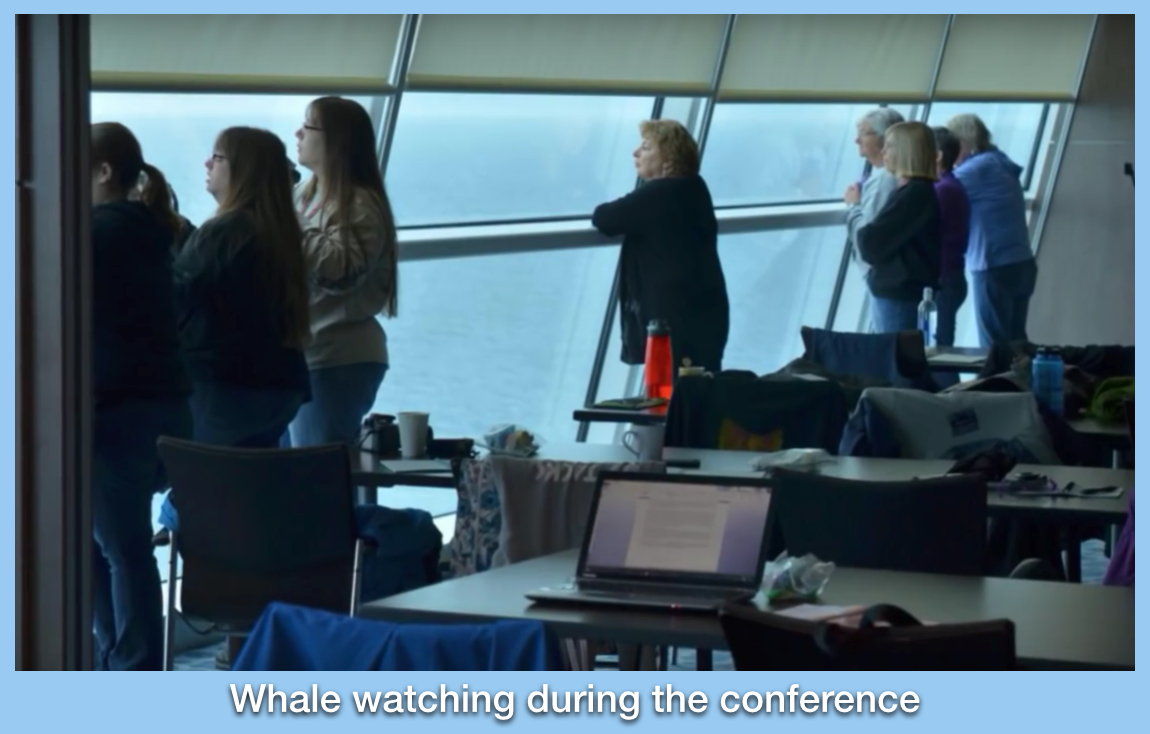
Five Go To Sea
“Riding” the Ocean
The Conference
Reaction Patterns
Extinction

Chapter 2: Regression
Reverting to Past Behaviors
Extinction Reveals Your Horse’s Past
Well Behaved or Shut Down?
Leaving History Behind
Data Collecting
Tuning Up the Handler’s Skills
Building Your Repertoire
The Animal Emotions
The Emotions of Extinction
Extinctions Emotional Pattern
Grief

Chapter 3: To Love a Horse
Extinction and Shaping
Regression and Resurgence
Extinction History
The Catalyst, Not the Cause
Extinction Reveals the Past
The Equine Version
Accidental Extinction
Mini versus Maxi Extinctions
Training Game Mishaps
Micro Extinctions
The Measure of Success
Using “Hot” Behaviors
Click For What You Already Have
Cues and Extinction
Teaching “Chill”
The Training Game
Genabacab
PORTL
PORTL Games
Mastering Extinction
Experiment One: Resurgence
Experiment Two: Regression
Mind Games
Using resurgence – Insight
What is Creativity?
Persistence
Degrees of Freedom
Expanding Repertoires
Being Emotional Is Being Alive
Building Unlikely Behaviors with Resurgence
Resurgence and Dog “Yoga”
Generalization and Creativity
The “Pose”
Seeing Familiar Landscapes with Fresh Eyes
The Creative Process
Mastering Micro
Micro Masters

AFTERWORD
I Can’t Do What You Want
Finding Joy

JOY Full Horses

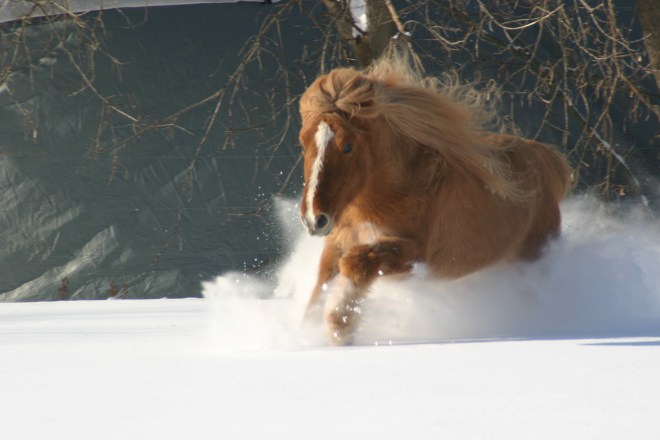
IMG_0218 Fengur snow great

In 2014 I surprised myself by writing a book.  This is by no means the first book I have written, so perhaps some of you will be surprised that I was surprised, but I had just finished the monster-sized project of writing and launching my new on-line course.  I wasn’t expecting to take on another big project quite so soon on the heels of that endeavor.

But books are funny things.  You don’t so much write them as they write themselves. When a book wants to pop out, if I am anywhere near a computer or a pad of paper with a pen in my hand, that’s what is going to happen.

Once the book was written, there remained the question of what to do with it. The normal answer is you publish it as a hold-in-your-hand actual book, but somehow that didn’t seem the right answer for this particular project. I sat with it for a year while I considered what I wanted to do.  In the end I have decided that what I wanted was to share it here.

I’m going to publish my book in this blog, section by section.  I hope you enjoy it.  It was written first and foremost for my horses, perhaps you could even say by my horses.  It is a gift from them to you.

Happy New Year 2016

Alexandra Kurland
Robin in box purple JOY FULL


Before I begin the book, let me share with you why it was written.

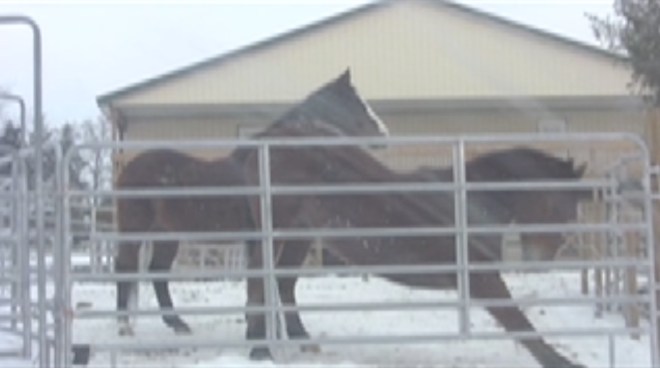
2014 was a dreadful year for me.  It’s astounding how fast your world can be turned upside down and inside out.  I arrived at the barn on Feb 10, 2014, as usual.  Robin and Peregrine greeted me at the paddock gate, as usual.  Robin bowed, stretching both front feet out in front of him and crossing one leg over the other – again as usual.
robin stretch bow copy

The bow is part of a favorite morning game. It’s his cue to me to open my car door.  I always feel like a jack-in-the-box popping out of my car on his signal.   I opened my car door, as usual, and gave both Peregrine and Robin good-morning-greeting treats from my pocket.

I got my backpack out of the car and headed up to the barn. Fengur and Sindri, our two Icelandics, were there to greet me as I reached their section of the barnyard.  Robin and Peregrine were already inside the barn, waiting for me in the aisle.

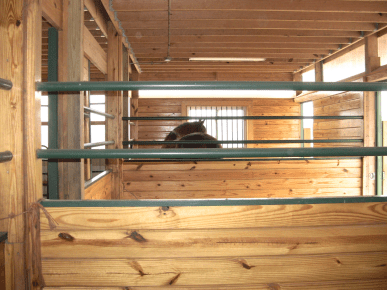
I went through my morning routine.  I fixed Peregrine’s mash, passed out hay for everyone, put Robin into his stall, closed the back gate to his “sun room” so he couldn’t help himself to Peregrine’s breakfast, gave Peregrine his mash and had just started on Sindri’s stall when I heard Robin banging against his stall wall.  I love the open design of the stalls in the new barn.  I could look down the line of stalls and see all the horses.  Robin looked as though he was trying to stretch out in a bow but there wasn’t quite enough room.
Robin in stall long view

“That’s interesting,” I thought.  “He’s transferring the bow up to the barn.”  I wanted to capture the moment, but I was too far away.  I continued on with Sindri’s stall, but I was listening now, on the alert for a repeat performance.  Sure enough Robin bowed again.  This time I was prepared.  I rushed over, but not in time to capture the bow.  Robin had gone outside into the small run directly outside his stall.  A quick glance told me something was wrong.

It took no more than an instant to switch from the playfulness of clicker training to the dread of a colic alert.  This wasn’t his normal bow inviting me to come play.  The stretch that I was seeing was something entirely different.  In the space of no time at all Robin’s gut had seized up into full colic pain.

Thank goodness for cell phones.  I never thought I would hear myself say that, but it meant I didn’t have to leave Robin to call the vet.  I got him out of the stall and into the arena.  Less than an hour later the vet was there, not my usual vet, but one of the younger members of the practice.

Robin blew through all the pain meds she gave him.  Suddenly we were talking about surgery.  “If you think it’s an option, you should ship him now.”

I couldn’t believe I was hearing those words, not for Robin.  He was my healthy horse.  He was never sick.  He’d never even had a lameness exam.  He’d certainly never coliced, and he had none of the common risk factors for colic.  He wasn’t confined to a stall.  Yes, the pastures were closed for the winter, but he and Peregrine had free run through the barn, the indoor arena, and their outside paddock area.  He drank a lot.  His weight was good.  He had none of the signs of metabolic disease that has become so common in older horses.  Given all the horses I know, Robin would be the last one I would expect to colic – and yet here we were talking about surgery.

I knew from clients who had gone through this experience that colic surgery was survivable, but you needed to ship early.  The longer you waited, the lower the chances were for a good outcome.

But surgery.  For Robin.

He was my healthy horse.  I didn’t want him to become an invalid.  That wasn’t the kind of life he would enjoy.

And then there was his shadow, Peregrine.  Peregrine is my elderly thoroughbred.  In the last couple of years he had become completely dependent upon Robin for security.  I’m not sure Robin appreciated having a constant shadow, but Peregrine didn’t really give him any choice.  In 2011 when I moved the horses to their new home, Peregrine coped with the change by attaching himself completely to Robin.  Fierce Robin, who had never really buddied up with anyone,  slowly discovered that he liked having someone to hang out with and take naps with.  They had become a pair, sharing everything including training time with me.

But now Robin was in the arena, filled with drugs that didn’t even dull his distress.  Peregrine was hovering nearby.  He clearly knew something was terribly wrong.    What was I to do?  If I kept Robin here, I was going to lose him.  And then what would Peregrine do?  The unthinkable was happening.  It was never supposed to be this way.  Robin was so much younger than Peregrine and he had ALWAYS been so healthy.  How could he be colicing?

If you’re going to ship them, ship them sooner rather than later.

I knew this truth.  I knew I had to make a decision, but how was I going to trailer Robin anywhere?  This was February.  The only available trailer on the property was snowed in.  And how could I leave Peregrine?  I wouldn’t be able to go with Robin.

I started making phone calls.  It took another hour to get everything organized, to get a driver for the trailer, to get the trailer dug out, the truck hitched up.

If you’re going to ship them, ship them sooner rather than later.  The day had begun so normally.  And now just a few hours later, I was leading Robin out to the trailer and shipping him off without me.

Bob Viviano, one of my long term clients and good friends, drove Robin for me.  We are lucky in this area to have an excellent hospital within an hour’s drive.  We gave Peregrine a sedative which bought me the time I needed to get Robin on the trailer.  He loaded without hesitation and I sent Bob off.  It was then a little after noon.

Half way to the hospital the snow started. Bob drove through white out conditions from a storm that was moving in from the coast.  If I had known there was snow to our south, I would never have risked his safety to drive Robin. Instead of an hour’s drive, it took him closer to two to reach the hospital.

I was waiting in the barn for news. At two thirty I heard that Robin had arrived safely and was being examined by the vets. Bob was heading back.

Peregrine had woken up by this time and had begun to pace.  I closed the outer stall doors to try to keep things a little warmer for him.  There was nothing I could do to ease his distress except to give him back Robin.  I had to hope that was going to be possible.

The news from the clinic didn’t sound good.  They were recommending surgery.  Was that an option?

I talked to the surgeon about what I wanted for Robin.  If it meant he would be left in chronic pain with a disabled life, then no, I didn’t want to operate.

She thought there was still a good chance for him.  How can you say no?  I said yes to the surgery.

I waited.  The hours passed.  There was another horse in surgery ahead of Robin. As soon as that horse was in recovery, Robin’s operation would begin.

At six I got another call.  Robin was being prepped for surgery.

Peregrine continued to pace.  He walked through the night, unable to settle.  I stayed with him, but it was Robin he needed.

At midnight I got the call, the call we all dread.  I had another decision to make.  They had found a twist. A full twist with dead small intestine.

I had learned from my clients that if you are going to ship them, ship them sooner rather than later.  I had also learned that cutting out intestine was the deal breaker.  That’s where you stopped.

So he’s a dead horse.  That’s what I thought as I heard the news.

But the surgeon thought there was still a chance.  The twist put him into the category of worst case scenario, but given that, he was in better shape than many horses who had twists.  He still had a good chance.  My world had flipped and flipped again.  What was she saying?  What decision should I make?  How could I say no? How could I stop now?

I told her again what I wanted for Robin.  I wanted him to live, but not if it meant he would be left in a state of chronic pain.  I told her it was okay to continue, and it was also okay to stop.

I wish I could have been there.  I don’t know what decision I would have made if I had seen the pain Robin was in.  But in the barn with Peregrine continuing to pace, I gave permission to continue.

At 2:30 in the morning the call came.  Robin was in recovery.

Peregrine continued to pace.  At dawn I opened up the outside stall door and let him out into the barnyard.  Peregrine liked to sunbath.  I hoped the warmth from the early morning sun would help him to settle.  He went out into the snow and rolled.  All very normal, and then he got cast.

I never knew it was possible for a horse to get cast in snow, but the conditions were just right for this calamity.  The weight of his body packed the snow into ice.  It formed a perfect cast along his backside.  The ridge line of ice kept him from rolling back onto his side.  He was trapped on his back, his feet waving helplessly in the air.  After a night of constant walking, he didn’t have the strength left to get up.  I could see in his eyes that he was giving up.

I couldn’t get him up by myself.  I made frantic phone calls.  I put in a call to the vets.  They were only ten minutes away.  Someone would be there at this hour who could get here fast.

While I waited, I dug away at the frozen snow.  I cleared enough to tip Peregrine more onto his side.  He struggled, found a bit of purchase, and was on his feet just as the vet arrived.

Disaster averted, but I couldn’t help but think how close I had come to losing both my horses in the space of twenty-four hours.

I stayed with Peregrine throughout the day.  I wanted to see Robin, but I knew he was getting the full care he needed.  Peregrine needed me more.

By evening he was settled enough that I could leave him in the care of others.   I drove down to see Robin.

Robin greeted me with a nicker.  I don’t know what I had expected, but not this.  He looked so healthy, so very bright.  He posed for me.  “Oh don’t do that, Robin, you’ll hurt your stitches.”

The surgeon and intern stopped by and stayed for a long time answering questions and just visiting.

I stayed with Robin.  His surgery was rapidly emptying my bank balance and putting me deep in debt, but that evening, when he rested his head against me, I knew I had made the right decisions.

I finally had to leave.  I slipped out of his stall, but before I could leave, Robin posed – his sure cue to me for attention.  The pose was a behavior he had learned when he was two. It had been the cornerstone of his training – helping him to develop the most glorious gaits and also giving him a sure-fire way of engaging me in clicker games.

So soon after surgery he wasn’t allowed anything to eat.  I couldn’t give him any treats, but that’s not what he wanted.  He wanted me to stay with him.  I opened his stall door and went back inside to hug his face – another favorite behavior.

I tried to leave again, again he posed.  I laughed.  He was turning my leaving into a game.  I went in and out a few more times for him, and then I slipped away.

The following afternoon I went down again.  The brightness was gone.  Robin was crashing.  He was in terrible pain.  The vets did an ultrasound looking for gut motility, looking for signs of more damage, or worse, more dead intestine or another twist.  What they could see encouraged them.  There were no obvious signs of further damage.
Robin in hospital

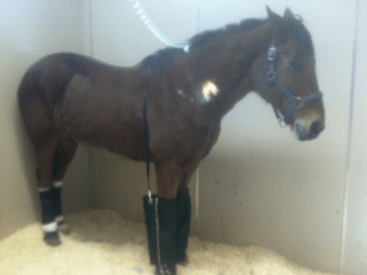
Over the next couple of days Robin’s temperature shot up.  What little manure he passed came out as liquid diarrhea.  He was put into an isolation stall.  When I visited him, I had to don protective gear – gown, gloves and boots before going into his stall.

My days took on a pattern.  I slept at the barn, so I could keep an eye on Peregrine.  I made a bed for myself in the tack room by stacking bags of shavings together.  In the morning I would wake up early and do the morning chores.  Then I would wait for the call that would tell me if Robin had made it through the night.

While I waited, I wrote.  I worked on a book.  It was originally supposed to be a series of articles for my on-line course, but day by day as I waited for news of Robin, it grew into a book.

Robin continued to fail.  To protect his feet from laminitis they kept him wrapped up round the clock in ice boots. He hated the boots.  He was in constant colic pain in spite of the pain killers he was on.  Every afternoon, all afternoon I stayed with him in his stall.  Some days all I could do was lean against the wall and watch as his muscles quivered in spasms with the pain and the fever. Other days he would lie down and sleep with his head resting in my lap.  I sat in the deep shavings and kept a vigil, monitoring every little change.
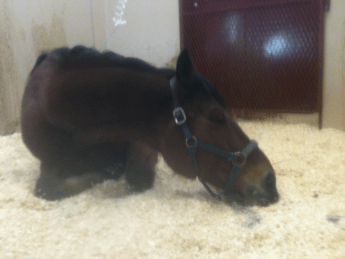
Robin 2 sleeping in hospital

The days passed.  The money poured out.  While I worried how I was going to afford all of this, I wrote a book about Play.  Odd how things evolve.

I knew always Robin might not come home.  He was so very sick.  The vets suggested that we give him platelets, but they wanted to check with me first.  The platelets were $500 a bag.  Ah well, I thought, so much for getting the new computer I so very much needed.

A week went by, then another.  I watched some horses go home.  Others came in, most for colic surgery, most were thoroughbred mares with newborn foals at their side.

I watched the staff give all the horses superb care.  Never was there any concern about leaving Robin with them.  There was no rough handling, no yelling, no treating any of the horses like livestock.  It was careful, caring, gentle handling.

During the second week Robin began to show more interest in eating.  At first, he was offered only small handfuls of hay several hours apart.  Then he was given a bowl of hay and finally a hay net.  At first all this did was make the diarrhea and the pain worse, but then on his second Saturday in hospital he started to look brighter.  His temperature finally dropped, and he began to eat more normally.  When I arrived in the afternoon, I was greeted by the welcome sight of a full hay net hanging in his stall.  The following day he continued to do well, so on the Monday, two weeks to the day of his arrival, he was cleared to go home.

I continued to live in the barn through the winter, huddled near a space heater in the tack room so I could keep an eye on Robin.  He was confined to his stall for a couple of weeks, then he was allowed out into his small outside run.

Peregrine helped me watch over him at night.  I always knew when Robin was lying down.  Peregrine would begin to pace.  The tack room is directly opposite Robin’s stall so Peregrine’s pacing would wake me in the middle of the night.  I’d slip out to check on Robin.  Always he looked comfortable, just resting, but I often had to get him up or Peregrine would continue to fret.  After about two weeks, Peregrine relaxed and let Robin – and me – sleep as needed.

Two months on from the surgery, Robin was allowed the freedom of the barn plus the arena, and then another month on from that he was allowed normal turnout.

As he got better, my writing time disappeared, and the book project went on hold.  Now that spring was here, there were more pressing outside jobs to do, plus my travel schedule was back in full swing.

In June the nightmare repeated itself – this time with Sindri, Ann Edie’s Icelandic stallion. He went off his feed, and he had a low grade temperature.  We had the vet out right away.  The diagnosis – anaplasmosis, one of the tick-borne fevers.  Apparently, this was hitting our area hard this year, and they were being run ragged getting to all the horses who were showing similar symptoms.

Sindri had had Potomac Horse fever eight years previously.  He’d had a bad reaction to the tetracycline, the antibiotic that is used to treat it.  His kidneys shut down, and we came very close to losing him.  Tetracycline is the drug of choice for anaplasmosis, but given his previous reaction, the vet chose an antibiotic from a different family of drugs.

This was on Saturday.  Sindri’s temperature dropped back to normal, and by Sunday he was back to eating and drinking normally.

Monday morning as I was turning him out, I saw a slight misstep as he came out of his stall.  Alarm bells started ringing.  The vet was out doing a recheck on Robin.

As we were finishing up with Robin, I mentioned that Sindri hadn’t looked right that morning.  He’d been a little off, and I was worried about laminitis.  We walked out to look at him.  Sindri walked up to us.  He looked fine.  There was no obvious lameness, no heat or pulses in his feet.

The vet left.  I busied myself about the barn where I could keep an eye on the horses.  When I checked Sindri again a short time later, he could no longer walk. The tinge that I had seen had grown into full blown laminitis.

I called the vet out again.  This time there was no mistaking what was happening.  The anaplasmosis had tipped him into laminitis.  My vet wanted us to keep his feet wrapped in ice boots and to stand him on sand to try to support his feet.  There was no way could get a load of sand delivered on such short notice, so Ann’s husband went off instead to Lowes to bring back bags of builders sand.

He brought us bags of ice and fifteen bags of sand.  That didn’t even begin to give us the coverage we needed.  Three trips later we had enough sand to get Sindri through the night.

The following day, Sindri looked so much better.  I thought with relief that we had dodged that bullet.  He was going to be all right. But the following day he crashed again.  Laminitis is like that.  You think you’re making head way, and then cruelly it flares up again with crippling pain.  The only good news was the x-rays showed no rotation of the coffin bone.

Sindri was on painkillers and other medications to try to control the inflammation.  He seemed to stabilize, but he was still sore.  And we had to keep his feet in ice boots round the clock.  Every two hours I repacked his boots with ice.  I could feel my brain turning to mush as the sleep deprivation set in.

Sindri seemed to stabilize.  He was allowed five minutes in the arena.  Turning he was very sore, but on a straight away he walked out in big reaching strides.  I turned him loose in the arena so he could choose what he wanted to do.  What he wanted was to trot up to me as I cleaned manure piles out of the arena.  That was an encouraging sign.  We were still hopeful he might recover with only minimal long-term damage to his feet.

Two weeks in we stopped icing his feet.  Hurray!  I still had to get up a couple of times during the night to give him his next round of meds, but at least I didn’t have to wrestle with the repacking of the ice boots.  We tried to reduce the level of painkillers.  The result: he could barely walk.  We changed meds and got him stabilized back to where he had been, but he continued to be a mystery.  The x-rays simply weren’t that bad.  Why was he continuing to show this degree of pain?

After two months he was no better, but he was also no worse.  I was scheduled to be out of the country for a week. I left on a Wednesday.  Friday I got an email from Ann.  She had tried to reach me by phone, but the contact number wasn’t working.  Sindri was colicing.

More nightmare.

I borrowed a cell phone and made the overseas call.  It was the middle of the night for Ann, but I knew she would be up.  She told me they weren’t sure what was going on, and she didn’t know what to do.

I heard myself saying if you think surgery is an option, ship him sooner rather than later.  Already, by waiting it might be too late.

I also heard myself telling her in more detail about Robin, about the cost of the surgery and the aftercare, about the risk to the feet in any horse, and the increased risk in a horse who already had laminitis.

I heard myself saying she should call Bob and get the trailer hooked up.  I knew it was the middle of the night, but he wouldn’t mind.  If she thought she wanted to go forward with treatment, the sooner they got to a hospital the better.  She should ship him while he was still able to go.

We talked for a few more minutes.  We both wanted the same thing for Sindri.  We wanted to give him a chance, but not if it meant condemning him to a lifetime of chronic pain.

I hung up, and pretended that everything was normal while I taught the morning sessions.  When it was eight o’clock back home, I called again.  The vets had recommended that Ann send him to our local clinic.  It looked as though the colic would resolve medically, but they wanted to be able to support him with fluids and monitor him more closely.  They had trailered Sindri over mid-morning to the clinic.  I kept checking my emails waiting for word of what was going on.

Sometime overnight things changed dramatically.  He began to reflux, a sign that there was a blockage somewhere.  Then the reflux slowed, but he became very painful, bucking and spinning in his stall.

His condition had shifted from a medical colic to an emergency surgery, but he was still an hour from the hospital.  Ann and I talked on the phone.  We both decided to send him for surgery.  It was so hard being so far away.  I knew the risks far better than Ann.  I had seen foundered horses.  What were we doing?  But we had to give him a chance.

Sindri made it to the hospital, but like Robin, he had to wait for another horse to come out of surgery.  He seemed to stabilize, and it was looking as though he might resolve medically, but then the reflux started again, and the decision had to be made.  Ann got the call and gave her permission to go ahead.

On the other side of the ocean I waited for news.

Sindri’s surgery was shorter than Robin’s and had a better outcome.  His intestine was inflamed.  They found signs of what might have been constrictions, but if there had been a blockage, it had resolved.

I flew home on Monday.  I was anxious to get in and get down to see Sindri.  I was hoping he would still be alive, that I wasn’t flying home to a dead horse.  United Airlines let me down.  The last leg of my trip was cancelled, and I had to spend the night in Newark.  I didn’t get home until mid-day on Tuesday.

Sindri waited for me.

He was in the same stall that Robin had started out in.  I almost didn’t recognize him as I walked up to his stall.  Unlike Robin, he looked like the very sick horse that he was.  His thick mane and forelock were braided to keep them out of the way of the catheter and fluid lines.  It was like looking at someone who you’ve only known with a beard.  Oh, that’s what you look like!
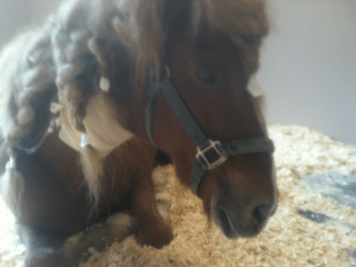
Sindri head shot in hospital

All four feet were in ice boots.  He was clearly in a lot of pain, both from the surgery and his feet.  The surgeon stopped by to update me on what they had found.  He sounded hopeful that Sindri would recover well from the surgery.  I looked at the way he was standing and wondered.

Over the next few days Sindri took us on a downward spiral.  He wasn’t eating.  Fresh x-rays showed us that we were now dealing with a rotation of his coffin bone, and his blood work was pointing us in the direction of liver damage.
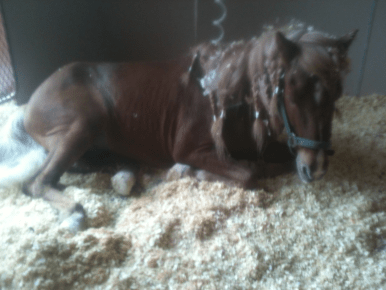
Sindri lying down in hospital

I had stopped working on my book when Robin had gotten better.  Now I brought it out again.  Every morning I worked on it, and every afternoon Ann and I drove down to visit with Sindri.  The vets started him on IV nutrition to try to reverse the liver damage.  Slowly he began to eat a little on his own.  Now instead of rejecting the handfuls of hay that he was offered, he was asking for more.

Mid-week a mini donkey moved in to the stall directly across from Sindri.  While Sindri’s condition slowly improved, the donkey’s declined.  He was clearly much loved.  His family came often to see him.  His liver was failing, but he wasn’t as lucky as Sindri.  The vets weren’t able to stop the progression of his disease.  I heard the vets discussing  the possibilities with his owners.  Epm had been ruled out, along with West Nile.  They weren’t sure what they were dealing with, or what more they could do.

It was hard to celebrate Sindri’s growing appetite knowing that across the hall there were only tears.

The vets began to talk about Sindri going home.  If he meets this milestone, maybe by Wednesday.  Then it was Thursday, then Friday.  Finally the call came early Saturday morning.  Sindri had been cleared, we could take him home.

When we arrived the mini donkey was on his side resting on a thick mat.  He was having a seizure.

Across the hall Sindri was looking bright and very much ready to go home.  We were using a borrowed stock trailer that didn’t have a ramp.  I was concerned that Sindri might be reluctant to step up into the trailer.  I needn’t have worried.  Sindri was ready to go home.  One of the interns took him out before I realized he was even out of his stall.  He was already on the trailer by the time I got outside.  Good Sindri!

He got off just as easily and walked surprisingly well up to the barn.  But over the next couple of days that changed.  Walking was reduced to a slow hobble.

I’ve been trimming my horses feet for the last couple of years.  That means when something like this happens, you don’t have a farrier available to help you.  My vet called in a favor and arranged for one of the best farriers in the area to come help us.  Together they decided that the best option for Sindri were wooden clogs.  The clogs are built up of layers of wood laminated together.  They let the horse’s foot roll over in any direction that is comfortable, and apparently they can provide almost instant relief to some laminitic horses.

The farrier and my vet came out together to put the clogs on. They took x-rays first.  The x-rays showed clearly why Sindri’s feet had become so much more painful.  The last set of x-rays taken at the hospital had indicated that he still had good depth of sole.  On the new x-rays the coffin bone on both front feet had rotated even more and was now pressing down on the sole.  We had run out of foot.

I’m glad it was an experienced farrier who trimmed Sindri’s  foot that day and not me.  The sole was separating at the toe leaving a long line of exposed soft tissue.  There was no possibility of putting the clogs on.  The farrier made some temporary pads to protect his feet.  Sindri was so good to stand for the trimming and for all the fussing with his feet.

We had been keeping him on a sand stall, but with his feet so open, the sand had to go.  We put Sindri temporarily in one of the other stalls, while I dug out load after load of sand.  Sand is amazing how it gets into all the cracks and crevasses and refuses to come out.  I swept until sweeping was doing no good.  Then I got out my vacuum – yes the barn has a vacuum.  I bought it originally for my house, but somehow it ended up at the barn instead.  When the vacuum wasn’t getting anything more, I washed the mats.  I had just spent two weeks in a vet hospital.  They had set the bar high for cleaning a stall!

Finally it was ready for shavings – four bags to create a wonderfully deep, soft bed.  Sindri was going into a luxury apartment!  Once he had hobbled from Fengur’s stall to his own, he lay flat out on this new thick mattress and fell into an exhausted sleep.

We ordered boots for Sindri.  They came by overnight express the following day, and we transferred him from the styrofoam pads he had been in to the protective and much more supportive boot.  Every day Ann helped me change his wraps and reapply a sugar and betadine mix to the soles of his feet.

A week later Sindri’s feet were less painful.  The soles were beginning to grow in and cover up the exposed soft tissue, but I knew we still had a long road ahead of us.  The goal was to make him comfortable.  He was still bright eyed, and engaged with us.  He was telling us it was okay to keep going.  As long as his eyes were bright, we would keep going on.  Ann couldn’t say no to the surgery, anymore than I could say no to Robin’s.  So here we were in a place we never wanted to be with any of our beloved horses.

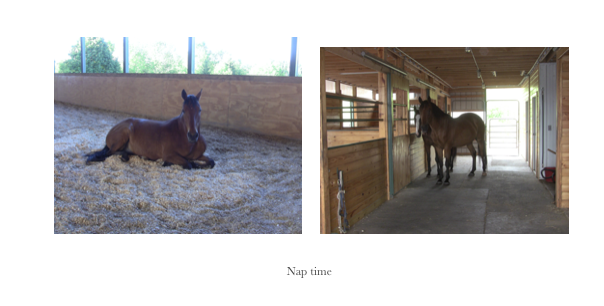
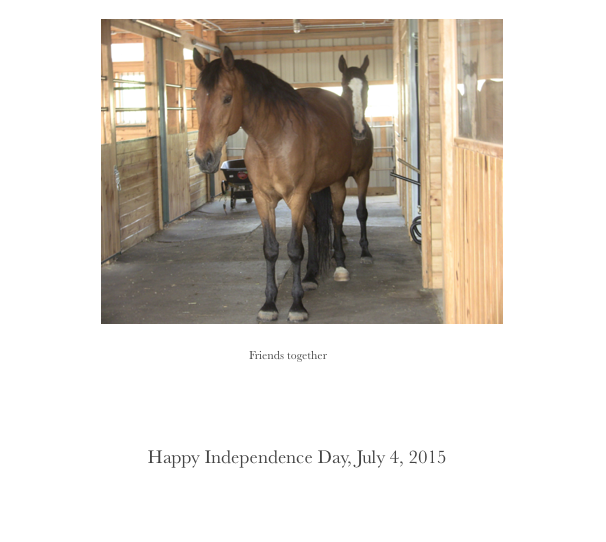
I always wanted to live in a barn with my horses.  I never expected I would be doing so under such circumstances.  Once again, I turned the tack room into my full time office and living quarters.  While I worked on the computer, I could keep an eye on Sindri.  Each afternoon Peregrine and Robin would have a nap standing side by side in the aisle next to Sindri’s stall.  Fengur, our other Icelandic, was generally outside having a sunbath in the barn yard.  And I was in my “stall”, keeping watch.

Sindri’s coffin bones stabilized.  With good care, a good farrier, and a lot of luck, his feet began to heal.  I kept writing throughout all of this.

Some people take up drinking when times are rough.  Other people go shopping or remodel their homes.  I, apparently, write books.  The first draft of the book was begun during Robin’s stay in hospital.  And it was finished during Sindri’s.

The book has been finished for a long time, but I have been undecided what I want to do with it.  Robin is still doing well, but we lost Sindri the day after Christmas 2014.  He coliced again, and this time it was clear it was the end.  When I led him for the last time out of the barn, he walked sound.  We had beaten the founder, but we couldn’t beat the colics. Perhaps six months of pain killers and other medications had just been too much for him.

I set the book aside. It’s been sitting in my computer, waiting.  I wasn’t sure for what.  I really haven’t wanted to publish it as a book, but if not that, what?  The book I have written was given to me by my horses.  It has grown out of lessons Peregrine and the others have been teaching me.   I wanted to share it, but I wasn’t sure how.

My decision has been to do something very old fashioned with it, but with a modern twist.  I’m borrowing an idea from the nineteenth century.  Charles Dickens published his books in serial form. Before they were turned into books that could be read cover to cover, they came out in weekly installments in inexpensive periodicals.  That meant his stories could be more widely read, but imagine having to wait a whole week to find out what twist the next chapter would bring.

I’m going to do something similar, but instead of using a printed magazine, I’m going to publish my book here on this blog, section by section.  I know we all live busy lives so I’ll space the publishing of these articles out so they don’t become overwhelming.

So what is this book about?  The simplest answer is play.

I have always played with training.  I have always told people to go “play” with an exercise.  I send them home to “play with ideas”, not to “work on a lesson.”  Play has been central to my life, but work can overcome that.  It has taken a lot of work to bring clicker training into the horse community.  My horses were always there reminding me that play is more powerful.

So it was right that a book about play would emerge at a time when I was most focused on my horses. It was written first and foremost for my horses, perhaps you could even say by my horses.  It is a gift from them to you.  I hope you enjoy it.

Alexandra Kurland
January 2 2016

Before I begin, I want to extend my great thanks to Dr. Naile and all the vets and staff at Oakencroft Veterinary clinic, and to the surgeons and staff at Rhinebeck Equine Hospital for the good care they gave to Robin and Sindri.

Also, a very great thanks to Mary Arena, who helped us enormously in caring for the horses, especially when I was away.  I would not have been able to travel if Mary had not been willing to step in and help.  Her contribution has always been greatly appreciated and always will be.  You never say thank you enough to people, but, Mary, I get to say thank you here.

Note:  What this book is, and what it is not.  In clicker training we learn to shift our focus from the unwanted behavior.  We want to focus on what we want the learner TO DO.  So it seems odd to be saying what this book is not.  It is not a “how-to” guide to clicker training.  I’ve written those books, produced those DVDS, written that on-line course.  If you are new to clicker training and need the nuts and bolts of how to get started, I will direct you to those resources.  You can find them all via my web site: theclickercenter.com.

So what is this book?  And who is it for?  The second question is easy to answer.  It’s for you – especially if you have animals in your life, and you’re interested in training.

Over the past twenty plus years I’ve been pushing the boundaries of what can be done with clicker training.  How do we use it?  How do we think about it?  What is our current understanding of cues, chains, reinforcement schedules, etc., and how has that changed over the years?

This book explores some of the areas that exploration has taken me.  We’ll be going well beyond the basics of clicker training.  I want to share with you the differences that make a difference – that transform you from a follower of recipes into a creative, inventive trainer.  Play is the transformer.  In the articles that follow you’ll discover what I mean by that.

I won’t be posting every day.  That would be overwhelming to you and to me.  Tomorrow is a travel day, so I’m not sure when I’ll be posting the next blog.  It will depend in part upon my internet access.  I will be putting you instead on an intermittent reinforcement schedule.  If you want to be notified when new posts are published, please sign up to follow this blog.

Coming soon: Part 1: Why Play?

Copyright  2016 All Rights Reserved.  I know on the internet how easy it is to pass posts around.  I certainly wrote this to share, and I hope you will share the link to these posts with others, but please respect the copyright restrictions on these articles.  If you wish to reprint them, please contact me for permission. (kurlanda@crisny.org)


An Introduction to Clicker Training: Day 2


This is Part 3 in this series.  The horse I am featuring was one of the horses at the November 2015 Arkansas clinic.  He had no clicker training experience prior to the clinic.  We tracked his progress via video over a three day period. 

Part 1 covered the morning training sessions of Day 1

Part 2 covered the afternoon training sessions of Day 1

If you have not already read Parts 1 and 2, I suggest you begin there.  This article covers the training sessions in Day 2.

Day 2

Day two began with another round of targeting and “the grown-up are talking”.  Again, I was choosing to work over the stall guard and to keep the session short.

Video: Introduction to Clicker Training: Day 2 Session 1

We followed the same pattern of the previous day.  After working with Nick, I asked people what they saw.  They all agreed that he was doing much better.  He was coming forward to touch the target, but the targeting loop was not yet clean.  He was first looking down the barn aisle.  Since this was not his home barn, it wasn’t surprising that he wanted to look around.  However, being easily distracted was one of the issues his owner reported having with him.

One of the participants commented that she was seeing a trend. Yes, he was looking at these competing distractions, but he was re-engaging with the targeting faster.  We also liked how far he was backing to get his treat, and how promptly he came forward again once the target was up.  He was still cautious about touching the target so we discussed whether we wanted the actual bump of the target, or was it enough for him to orient towards it.

Part of the answer to this depends upon how you are going to use the behavior in the future.  This is something to consider as you build your horse’s targeting skills.  For example, when horses trail ride in company, horses target on the tail of the horse in front of them.  We don’t normally think of this as targeting, but it is.  So here’s the question: do you want your horse to catch up to that target?  Or would you rather have him learn to maintain a set distance from the horse in front of him?  Following at a set distance the kind of target stick we were using with Nick is a good first step towards teaching this skill.

Once I start moving a target, generally I want the horse to keep a set distance from it.  There are other targets that I want the horse to catch up to.  If I am teaching a horse to retrieve, I not only want the horse to catch up to the target.  I want him to put his mouth around it, pick it up and bring it to me.

The beauty of this system is you don’t have to choose.  You can teach your horse that one type of target is something you orient to and follow.  Another is something you retrieve.  And still another type of target is something you station next to.

So what are some examples of different ways you might use targets?  You can teach your horse to “self bridle” by first having your horse touch his mouth to a bit that you’re holding out. Through small shifts in the criteria, you can then teach him to put his mouth around it in preparation for bridling.

Here’s an example of what this looks like when it’s a finished behavior:

Here are some other uses for the targeting skills Nick is learning.  You can hold a hula hoop out and have your horse put his nose through the center.  Change to a smaller hula hoop, and then change again to the nose band of a halter that you’re holding out for him.  He’ll be targeting by putting his nose into a halter.

You can hang a stationary target such as an empty orange juice jug in your barn aisle or stall.  While you are grooming your horse or doing a medical procedure, he’s staying next to his target.

I can even use the same object for two different target uses.  Small cones are a great example.  Cones make perfect retrieve toys.  They also make great markers.  I will often put cones out in a circle for my horses to go around.  These are targets that I want the horse to orient to, but not interact with in other ways – until I direct him to.  At the end of the lesson I’m going to ask him to pick up all the cones and hand them to me so we leave a tidy arena behind us.  How does an experienced clicker horse know the difference?  Cues.

Cues and the context in which they are given help a horse understand what to do when.  You might have a horse that understands the verbal cue “trot”.  When he’s on a lunge line, he picks up a trot promptly when asked.  But if you said “trot” to him while he was in a stall, he probably wouldn’t respond.  He’s not responding to the word “trot” in isolation.  It is “trot” plus all the context cues.   “Trot” plus the environment tells him what to do when. So the target alone doesn’t tell the horse what to do with it.  As his understanding of clicker training expands, it’s the target plus the associated context cues that he’ll be learning

Generally when I move a target, I want the horse to follow it, but not catch up to it.  The timing of my click teaches my horse what I want.  If I want my horse to follow a moving target, I’ll click as he orients to the target.  I won’t wait until he has caught up to it. So, suppose I’ve been teaching my eager clicker horse to bump a target, and now he’s really hitting it hard with his muzzle.  I may be wondering: did I really teach that!?  If I want a softer touch, or I want to have him just approach but not make contact with the target, I’ll click as he approaches the target.

Here’s a discussion of this process:

Video: An Introduction to Clicker Training: Day 2: The Flexibility of Targeting

Based on this discussion in the next round of targeting, I used a flat cone instead of the target stick.

Video: An Introduction to Clicker Training: Day 2 – Session 2: Targeting with a Cone

Video: An Introduction to Clicker Training: Day 2 – Session 2 continued: Work in the Stall

Going into the stall with Nick revealed the core issues his owner has been puzzling over.  The way Nick struggles to turn in the stall makes the space look small and cramped, but he’s in a stall that was built for draft horses.  It’s roughly 14 by 16 feet, more than big enough for a small horse like Nick, and yet he struggled to turn.  Again, I am still in the data collecting phase of the training.  I make note of the difficulty even while I continue to ask Nick questions.

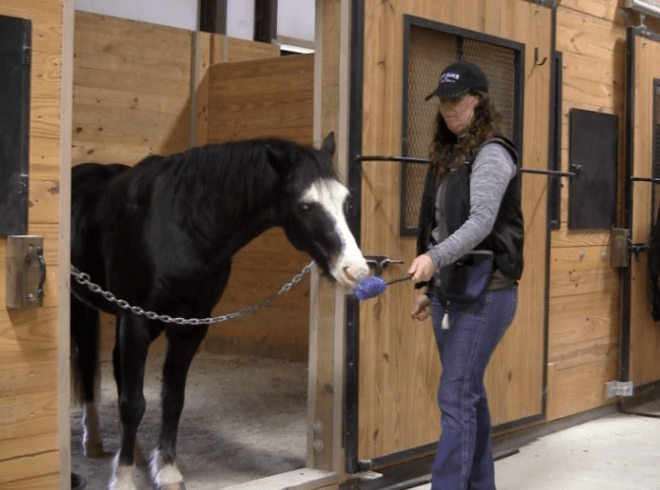
One question I wanted to ask related to the halter.  Was it contributing to Nick’s inability to maneuver in the stall?  Was there something in his previous experience with being worked on a lead that caused him to stiffen?  The way to answer that question was to slip the halter off and shift to targeting.

In this next clip you’ll see how I begin to ask for backing not via the food delivery, but as a direct request.  I’ll ask for backing by placing my hand on his neck.  I think of my hand there as a starter button cue.  It is very much like the key that turns on your car.  Once your car has started, you don’t keep turning the key.  In the same way, once Nick is backing, I release my hand.  But you’ll see that I walk into him as he backs.  So my hand on his neck is a starter button cue.  Walking into him is a “keep going” cue.  “As long as I am walking towards you, keep backing up.”  I want the horse to continue to back until either I click, or I ask for something else.

My hand on his neck is a pressure-and-release-of-pressure cue.  I am teaching it in a context that hopefully makes it easy for him to understand what is wanted.  In the clip you’ll see I ask at one point where he is close to the back corner of the stall.  He doesn’t think he has room to back up, so he stalls out.

When I fail to get a response, I don’t escalate.  I don’t push into him harder or become louder in my body language.  There’s no “do it or else!” embedded in my request.  Instead I make some small adjustments to ensure that my request is clear, and then I wait for him to solve the puzzle.  When he steps back, my hand goes away, and, click, he gets a treat.

Choice is what this lesson is all about.  When he stops at the door to look at the people, again, I wait him out.  I am letting him decide to bring his head inside the stall to touch the target.  You see revealed in the small confines of the stall the two issues his owner reports that she has with him.  When she goes out to get him, he will approach part way, but he is reluctant to come all the way up to her.  And out on the trail he is easily distracted.  She has trouble getting him to focus back on her.

I don’t have to turn Nick out or take him out on a trail to see these issues revealed.   He’s showing them to us here in the stall.  That’s good news.  Out on the trail energy levels can shoot up.  Small problems can suddenly turn into major safety issues.  Here in the stall, if he gets distracted, it’s easy to handle.  I  can teach Nick some skills that will help him stay with me as the environment becomes more complex.

Video: An Introduction to Clicker Training: Day 2 – Session 2 continued: More Stall Work

And here is the discussion that followed that session, including what it means to have a Grand Prix clicker horse.

 
Video: An Introduction to Clicker Training: Day 2 – Final Discussion

Once again, the clinic participants had to wait overnight to see how Nick processed this day’s lessons.  I will make you do the same.  I’ll share Day 3 in the next installment of this report.

Alexandra Kurland
theclickercenter.com
theclickercentercourse.com

This is Part 3 of a 4 Part series on introducing a horse to the clicker. 

My thanks to Cindy Martin for organizing and hosting the November clinic, and to all the clinic participants, especially Wendy Stephens and her beautiful Nick.

Please note: This article gives you wonderful details to get you started with the clicker, but it is not intended as complete instruction.  If you are new to clicker training and you are looking for how-to instructions, you will find what you need at my web sites:

theclickercenter.com                    theclickercentercourse.com

An Introduction to Clicker Training: Day 1: Afternoon Session

This is Part 2 in this series.  The horse I am featuring was one of the horses at the November 2015 Arkansas clinic.  He had no clicker training experience prior to the clinic.  We tracked his progress via video over a three day period. 

If you have not already read Part 1, I suggest you begin there.  Part 1 covers the morning sessions of Day 1.  This article covers the afternoon sessions of Day 1.

Afternoon Targeting Sessions

Just when you think you have that rare thing, a complete video record of a horse’s introduction to clicker training, you discover that several sessions are missing.  For the first two rounds of Nick’s afternoon session the record button wasn’t on.

In both sets he was at the door waiting for me and began with three very definite target touches.  He came forward promptly, touched the target and backed up easily for the treat delivery.  He came out further over the stall guard than he had been in the morning.  His interest in the game was growing.  That was encouraging progress, but it was also that’s something needed to be monitored.  I wanted to make sure that this new found confidence remained in balance with his general good manners.

In both rounds he showed the same cycle.  He began by touching the target promptly with none of the hesitation that he had shown in the morning.  He gave three solid touches, and then his response rate dipped down.  That was also something to monitor.

As usual we discussed what to do with the next round of treats.  Everything about his behavior suggested that he would be fine if I went into the stall with him.  He was backing easily out of my space.  He was taking the treats politely without any excessive mugging behavior.

Because he was now showing me that he would back away from me, I felt comfortable going into the stall with him.  But that didn’t mean I had to go in.  I could stay outside the stall and continue with the targeting.  Or I could introduce one of the other foundation lessons.  The consensus from the group was to continue with the targeting to get the come-forward-to-the-target-back-up-to-get-the-treat loop cleaner.

Again there is no right or wrong to this.  We could have made some other choice.  Nick’s behavior would tell us if the choices we made were heading us in a good direction.

Video: An Introduction To Clicker Training: Day 1 – Afternoon Training: 3rd Session

Data Collected. Now It’s Assessment Time

People felt this was his best round yet.  I kept this session very short.  I got three good touches and then ended the session.  This avoided the dip in behavior that we had seen earlier.  Nick was clearly still very cautious in his responses.  This is a process that has to unfold in it’s own time.

Several of the clinic participants wondered if we should change targets or change treats.  It’s always a possibility.  One of the huge advantages of clicker training is there is always more than one way to train every behavior.  There isn’t one and only one right way that you have to follow.  That’s what makes these discussions so valuable.  We could certainly try a different target, or introduce a different foundation lesson, but it was also okay to stay with what we were doing.

With Nick, I was still working with simple targeting, but in each round there had been significant changes.  I began by offering him the food approximately where the target had been.  Now I could move him back to get his treat which meant he then had to step forward to touch the target.  The shaping of more complex behavior was occurring almost without his noticing.  In the morning he started out much more on the forehand.  I made a point of feeding him in a way that shifted his balance back slightly which brought him off his front end.  That then allowed me to feed him so he moved back even more.  You are now seeing in the video clip how he is moving back well out of my way to get the treat.

Because I can feed him so he steps back, the dynamic of touching the target changes.  I will often see people moving the target around through big changes.  They’ll hold it high, then low, then out to the side.  Most horses can follow these changes and continue to touch the target.  Essentially the handler is being reinforced for changing criterion in big stair steps.  We call that lumping.  It works for a simple behavior like targeting, but I would rather see the handler learn to build behaviors more smoothly, so a response is already happening consistently before it becomes the criterion that earns the click.

Questions

Training must always take into consideration any health concerns.  One of the questions I had concerned Nick’s teeth.  I wondered how long ago they had been checked.  Nick not only took a long time to eat the hay stretcher pellets, I never heard him take them up onto his back molars to chew.  So I wondered if he might have some sharp points or some other issues that were contributing to his overall caution.  His owner said he had very recently been done by a good dentist.  That’s good to hear, but it doesn’t completely eliminate my question.

It’s so hard to judge how well an equine dentist is doing.  We can look at our horse’s feet to see if a farrier is leaving flare and other obvious signs that perhaps we need to question the job he’s doing.  But with teeth it’s much harder to evaluate the job a dentist has done.  Reaching in to check for points isn’t something we’re trained to do.

Even if you’ve had the teeth checked recently, it’s always possible that something has happened since to cause a problem.  Nick’s owner reported that he is very tight in his jaw and his poll.  That’s consistent with the way he was eating his treats.  This is all part of this early data collecting phase of the training.  Many of the concerns and questions that these early sessions raise may well simply disappear as Nick figures out the game.  What remains needs to be looked at with the possibility that there is a physical issue interfering with his ability to respond well.  For now we were very much still in an exploratory stage, so I continued on with another targeting session, the fourth of the afternoon:

Video  An Introduction To Clicker Training: Day 1 – Afternoon Training: 4th Session

The Grown-up Are Talking, Please Don’t Interrupt

In the discussion that followed this set, we decided that it would be interesting to shift gears and introduce Nick to an exercise which I refer to as: the grown-ups are talking, please don’t interrupt.  At it’s most basic this exercise is asking if the horse can keep his nose away from my treat pocket when I’m standing in close to him. Initially I free shape this lesson, meaning I am not prompting or triggering the correct response through my behavior.  I am simply observing Nick and reinforcing him for approximations that move him closer to my overall goal.

If he comes into my space or nudges at my arm, I’ll let him explore.  It’s important that he feels safe experimenting.  If I correct him for nuzzling my pockets, I can’t expect him to feel safe offering behavior in other ways.  If I don’t feel comfortable letting him nuzzle my pockets, I can always step back out of range.

When he moves his nose away from my body, click, I’ll give him a treat.  I’ll feed him out away from my body where the perfect horse would be.  That means he’ll have his head between his shoulders and at a height that puts him into good balance.

In this first round of grown-ups you will see that he spends over a minute investigating my pockets.  I let him explore.  This is such an important part of the process.  He isn’t being punished for coming into my space or nuzzling at my vest.  It isn’t dangerous for him to check out this option, but it also doesn’t get him any treats.

If you’ve been taught that you should never let a horse into your space like this, it can be really hard to watch him nuzzling at my pockets.  During this process his owner told us that he often mugs for treats.  It’s a behavior his previous owners allowed, which may account for his persistence.  But watch how quickly he catches on to this new game.  Moving his nose away from me is the way to get treats!

Video: An Introduction to Clicker Training: Day 1 – Afternoon Training: 5th Session – the First Asking for  Grown-Ups

In the discussion that followed this session I again emphasized how systematic the unfolding of clicker training is.  The behaviors I work on are very connected one to another.  Even though I haven’t perfected targeting, I can still move on and introduce other behaviors.  In the targeting he was learning that moving his head away from me to touch the blue end of the target stick produced goodies.  In grown-ups he was discovering that moving his head into that same position, even when a target wasn’t present, also produced treats.

I think it’s important early on for horses to discover that there is more than one way for them to earn a click and a treat.  If you work too long on targeting or some other behavior, a horse can get too narrow in his understanding of how the process works.  He will think that there is one and only one behavior that produces treats.  He can become very locked in.  When you try and do something else, he’ll get very frustrated because he feels as though he is being blocked from the one thing that he knows works.  So it’s good to experiment and introduce other behaviors early on in the process.

Remember there is no one and only one right answer.  If we had stayed with another round of targeting, would that have been wrong?  No.  If we had moved from targeting sooner, would we have been wrong?  No.  If we had switched to a different target or to different treats, would we have been wrong?  No.

Nick is definitely cautious in his approach to the target, but at this stage that isn’t a bad thing.  We’re at the beginning of a huge paradigm shift.  I’m letting him come into my space and sniff at my hands and explore my pockets.  He has to do that in order to discover that that’s not what works.  What works is taking his nose away from me.  I’m not going to correct him for nuzzling at me.  I don’t want to punish him for it.  I want him to make that choice on his own with minimal prompting from me.

If I thought he was dangerous, if I thought he was going to bite me, I would step away.  I might even have a different kind of barrier.  Or I might wait to work on this particular lesson.  In other words, I would set it up so I felt safe.  He’s exploring.  He’s experimenting.  While he’s doing so, it’s important that we both feel safe.

If I said to you: I want you to experiment, but recognize that there are sharks in the water.  And now go dip your toe in the water, you’d say to me: “I’d rather not.”

If I’m correcting him for nuzzling, then experimenting in general is a bad idea.   Trying things has become unsafe.  He’d be right to say the same thing to me. “I’m not going to reach out and touch that target, because I might get smacked.  You may be giving me treats this time, but next time you just might hit me instead.”

This is why I set up the training in this very structured way, and why I begin with protective contact.  I want him to learn that he can experiment safely.

In this next round you’ll see how well this strategy is paying off.  Nick spent most of the previous round mugging my pockets.  Now in this set you’ll see him very deliberately moving his head away from me.

Progress.

Video:  Introduction to Clicker Training: Day 1 – Afternoon Training: 6th Session – 2nd Grown-ups.


Nick is showing us why clicker training is so much fun.  With every round we’ve seen a shift, a change in his understanding.  Grown-ups produced for him a real “lightbulb” moment.  Shifting from targeting to grown-ups has helped him “connect the dots”.

It also shows again the value of using these short rounds of training.  You may be thinking: that’s easy to do in a clinic.  You have to stop to talk to the participants and explain what you’re doing.  How am I supposed to do this the the real world of my barn?

It’s really easy to do these short rounds of training in your home environment.  You might do a quick round of targeting and then fill a couple water buckets.  You’d do another short round of targeting and then throw down some hay, or turn out a horse.  You’d do another round, and then sweep the barn aisle.  In other words, in between doing your normal barn chores, you can get in a lot of short sets of training.

After you’ve got your chores done, you might want to have a more “normal” visit with your horse. You want to do more with him than just targeting in a stall.  All your previous training says you need to “work” with your horse.

You can begin to expand your clicker training into all the everyday tasks he already knows.  If he’s a horse like Nick who is safe to handle, by all means bring him out and groom him.  In that grooming session, you’ll be looking for opportunities to click and reinforce him.  If he normally fusses and moves about while you groom him, but right now he’s standing still, click and reinforce him.  When you ask him to move his hips over so you can get by, as he responds, click and reinforce him.

You will now be paying attention to all those little requests that we often take for granted when we groom.  You’ll be finding excuses to click and reinforce him, and in the process you’ll be discovering how much better he can be.  You will still have your “formal” clicker sessions where you focus specifically on targeting and the other foundation lessons.  But you can also begin to incorporate the clicker into the “real world” of everyday tasks and expectations.

Business can continue as usual, but now you have this added communication tool that says: “thank you for a job well done.” 

You’ll be doing this, and you’ll also be continuing with the formal process of introducing him to the six foundation lessons of clicker training.  As your horse masters those lessons, you can use them to make daily husbandry and the rest of your training even better.

Now, if your horse were showing you dangerous behaviors, I wouldn’t be encouraging you to bring him out to groom him.  While he learns how to learn, I would be recommending that you stay with protective contact.  He can be dirty for a while.  If you’re dodging his teeth, there’s nothing that says you have to groom him every day.  If you are seeing behaviors that raise safety concerns, I would teach him the learning-how-to-learn emotional-control aspect of his training with a barrier between you.

After this discussion I decided to finish up with one more round that would include both targeting and the grown-ups are talking lesson.

Video:  An Introduction to Clicker Training: Day 1 – Afternoon Training:  7th Session- Targeting & Grown-ups

This was the final round of the day.  In the afternoon we spent approximately fifty minutes focused on Nick.  About 17 minutes of that time was spent working directly with him.  The rest was spent in discussion.  That’s a good ratio, especially at this stage of the training.

One of the things we were discussing were all the changes we were seeing.  You have a huge advantage because you can go back and review the earlier video clips.  Think about all the changes you’ve seen in these clips.  We began in the morning with his first tentative exploration of the target, and now in the afternoon he will step forward to touch a target, and I can move him back with the food delivery.  I can stand next to him with my pockets filled with treats, and he will deliberately take his head away from me.  I can combine targeting and grown-ups in one work session.  That means  I am beginning to introduce him to two important concepts: cues and chaining.  Chaining refers to linking behaviors together via cues to create long sequences of behaviors.

At the beginning of the afternoon session, Nick was starting out with three strong responses and then his rate of response would drop off.  In this final set of the afternoon he was maintaining a high response rate through a long training set.

Throughout each of these training sets I was making choices.  In that very first round, I was deciding what does “orient to the target” look like?  Can he just sniff the target to get clicked, or does he actually have to touch it. These are all choices that have to be made.  Remember there are no rights or wrongs.   With every click I am assessing the horse’s progress.  Have I made a good choice, or do I need to adjust my criterion slightly?

When you are training, it is good to remember this wonderful quote: “It is always go to people for opinions and horses for answers.”  Through his behavior your horse will tell you if you are making good choices.  He will also be telling you if your basic handling skills are clean.  If you are fumbling around in your pocket trying to get out a treat, you’re giving him extra time to mug you.  You don’t want to be collecting unwanted behavior even as you’re reinforcing other things that you want.  The steady progress Nick made through the day told us that on balance the choices were good ones, and the game was making sense to him.  It was time to let him process what he was learning.

One of the expressions I use often in clinics is you never know what you have taught.  You only know what you have presented.  We would be finding out what he was learning by returning the next morning with another round of training.

More Training

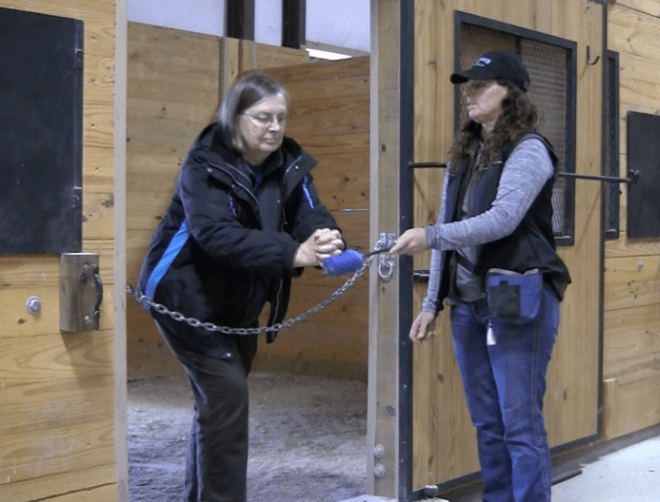
That last video marked the end of day 1 of Nick’s introduction to clicker training.  But this wasn’t the end of the day’s training for Nick’s owner.  We spent another fifty minutes working with her on her clicker training skills.  Just as we did with Nick, we began in a stall with “protective contact”.  She was on one side practicing her handling skills while another clinic participant played the part of her horse.

Human targeting game

I like beginning with these rehearsals.  If you are new to clicker training this is a must-do step.   What you just watched can look so easy.  You are probably thinking: “What can be so hard about holding up a target?”  Until you try it, you won’t know, but better that you find out all the little places where you’re fumbling around trying to get coordinated BEFORE you go to your horse.  If you can’t find a friend to help you, you can always pretend you have a partner.   Video tape yourself or practicing in front of a mirror to give yourself visual feedback.

I know many people fuss at having to go through these steps. They want to go directly to their horses.  They have told themselves that they are hands-on learners.  They need to be doing in order to learn.  These rehearsals give them the “hands-on” learning experience they are looking for.

I am very protective of horses.  If you are learning something new by going straight to your horse, your horse is going to have to withstand your learning curve of making mistakes, fumbling with the clicker, not getting the target up, etc. etc..  That can be hard on a new learner.  When someone runs into trouble in the first stages of the clicker training, its often because they didn’t do enough dress rehearsals.  This show up in inconsistent handling, timing that’s off, unclear criteria, and other issues that result in a horse being equally inconsistent.  The result is a lot of unwanted behavior as the horse expresses his frustration.

Watching someone else training with clean, consistent handling doesn’t guarantee that you’ll be able to do it yourself.  The dress rehearsal is the step you put in between.  The handler will be going through all the training steps first with a “human horse”.  Her partner will hold her hands together to represent a horse’s muzzle.  When she reaches out and bumps the target with her hands, her “trainer” will click and give her a treat.  The “human horse” will adjust her behavior to meet the needs of her learner.  If someone simply needs to practice clicking and getting the food out of her pocket, the “horse” will cooperate by touching the target directly.  She won’t present any behavioral challenges until her “handler” is ready to work on that step.

One of the huge advantages of this process is the “horse”can give her “handler” verbal feedback.   By the time you’re ready to go to your horse, you can focus on what he’s doing instead of focusing on your own skills.

Once your “human horse” gives you the “all clear”, you’re ready to ask your horse how you’re doing.  In this case we had a barnful of clicker-wise horses, so Nick’s owner was able to practice her new clicker skills with an experienced horse.  This was a real luxury that prepared her even more for her first clicker lessons with Nick.
Puffin targeting in stall
This is Puffin checking on Wendy’s “homework”.  Puffin was a rescue pony who is becoming a clicker star under the guidance of his person, Karen Quirk.

The clinic participants had to wait overnight to see how Nick processed his first day’s lessons.  I will make you do the same.  I’ll share Day 2 in the next installment of this report.

Alexandra Kurland
theclickercenter.com
theclickercentercourse.com

This is Part 2 of a 4 Part series on introducing a horse to the clicker. 

My thanks to Cindy Martin for organizing and hosting the November clinic, and to all the clinic participants, especially Wendy Stephens and her beautiful Nick.

Please note: This article gives you wonderful details to get you started with the clicker, but it is not intended as complete instruction.  If you are new to clicker training and you are looking for how-to instructions, you will find what you need at my web sites:

theclickercenter.com                    theclickercentercourse.com

An Introduction to Clicker Training: Day 1

This is Part 1 of a 4 part article.

The last time I posted I had just returned from the Five Go To Sea conference cruise.  It’s now November and I have just finished the 2015 clinic season.  Thank you to everyone who was able to join me this year.   Sharing clicker training is such a joy.  I am looking forward to seeing you again in 2016.

I’ll have my full  2016 clinic schedule posted on my web site soon.  In 2016 I’ll be back at the Cavalia retirement farm for another series of clinics.  And I’ll be returning to several of my long time clinic locations for more Clicker Intensives.

My conference schedule is already posted.  2016 is going to be a great year for learning!

The last clinic of the 2015 season was at Cindy Martin’s farm in Arkansas. One of the participants brought a horse who was completely new to clicker training. Usually when I have a start-up horse we are in narrow barn aisles with poor lighting and limited site lines.  Cindy’s barn is a perfect film studio. It had an extra wide aisle, tall ceilings and great lighting.  So we were we able to video this horse’s progress over three days.

What follows is a detailed account of the start-up process.  Whether you are brand new to clicker training or an experienced trainer, I think you will find this of interest.  This report takes you very systematically through the process that I recommend for introducing a horse to clicker training.  I have included video as well as the discussions that followed each training session.

Enjoy!

Step One: Introductions

Nick grown ups look away

My clinics always begin with a Friday night gathering.  When you talk to experienced clicker trainers, they always emphasize the importance of building a relationship with the animal you are training.  Relationship can be one of those fuzzy, feel-good words.  You can have all different kinds of relationships, some good, some quite toxic.  When science-based trainers define relationship, they are referring to a history of reinforcement.

In clicker training we put the emphasis on creating a history of positive reinforcement.  One of the metaphors that’s often used is that of building up a bank account by making many deposits via positive reinforcement.  As the bank account grows, if something happens and you do have to use a correction, your “bank account” can withstand a small withdrawal.

So training begins by building up that history of reinforcement with the animals you’re working with.  I’ve always felt that it was important to treat the people I work with with the same consideration that I give to their horses.  While I’m clicking and treating the horse, I don’t want to be barking commands at the person and criticizing every little mishap.  I also don’t want to spend three days working with a group of people who are essentially strangers.

I know I’ll be seeing many of the participants again at future events, so I like to get to know them as individuals, not a sea of anonymous faces.  So we spend the Friday night gathering in introductions.  I want to know what brought people to a clicker clinic.  What is their horse background? What is it they are hoping to get from the weekend?  I tell them that this is their first shaping exercise of the weekend.   Their introductions, what they are specifically looking for, help shape the clinic experience they are going to have.

Wendy, the owner of our first-time clicker horse, told us his story.  She was given Nick after friends of hers had given up on him.  They had hoped he would be a reining horse champion.  They had bred their mare to a top stallion.  At eighteen months he was sent off to a top trainer who thought the world of him.  He considered him his best futurity prospect of that year.  By the time Nick was two, the trainer was less excited by him, and by three he was saying Nick would not make it as a reiner.  It’s a familiar story.  His disappointed owners took him out of training, and then found that they no longer wanted him, so they gave him to Wendy.

Wendy’s training concerns centered around a desire to feel more connected to Nick.  He was very aloof.  He wasn’t hard to catch out in the pasture, but he never came directly up to her.  He would always stop ten to twenty feet away from her.  Out on trails she described him as safe to ride, but easily distracted.  It was hard to get him to focus on the rider.

People often come to clicker training as a last ditch effort to “fix” a problem horse.  Nick didn’t need “repairing”.  He was not a “broken” horse.  As I explained to the group Saturday morning, we weren’t trying to fix anything.  We were simply introducing a nice horse to clicker training.

What to Feed

We began with a discussion of the treats, both what to use and how to handle them in these early training sessions.  I rejected some flavored commercial horse treats that Wendy had brought in favor of some plain timothy alfalfa pellets Cindy had for an insulin-resistant older horse.

In these early start-up lessons you are asking for simple behaviors.  All the horse has to do is touch a target or move his nose away from your treat pocket.  You want to keep the rate of reinforcement high so the horse stays engaged in the game.   That means you are going through a lot of treats fast.  When I don’t recognize the commercial horse treat, I don’t know what I am feeding.  Is this something that is designed to be truly that – a treat, something you feed in quantities of one or two at a time, or is it something we can safely use in larger quantities during a training session?

If I’m not sure of ingredients, and especially of the sugar content, I prefer to use something like the timothy alfalfa pellets.  They are bland enough that a horse isn’t going to have a “sugar high” during the training, but still enough of a treat that he’ll want to figure out how to get me to give him more.

Protective Contact and the Importance of Choice

In addition to a discussion of what to feed, I also talked about protective contact.  What this means is the handler is separated from the horse by a barrier.  There are a number of reasons for using protective contact to introduce a horse to clicker training, even with a horse you know well.

When a horse is loose in a small paddock or a stall, he is free to interact with you – or not.  He has choice.  That’s key to clicker training.  If you go in with a horse, even if he is at liberty, his previous learning may interfere with his ability to figure out this new clicker game.  He’ll be so busy responding to previously learned cues, he won’t even be aware that there’s a puzzle to solve.  In fact, the more well-trained a horse is, the more important this reason for using protective contact becomes.

And if a horse isn’t so well trained, all the safety reasons for using protective contact come into play.  Without the barrier, if a horse crowds you trying to get to the treats in your pocket, you’ll need to do something to push him away.  If you’re having to correct him for this unwanted behavior, you’re creating a bind for yourself.  On the one hand you want your horse to feel safe experimenting and offering behavior.  And on the other hand you’re still saying no, don’t do that.  You’re essentially poisoning your first clicker encounter.

The barrier removes the safety concerns and gives your horse choice.  Choice is very important.  Current research is confirming that choice is reinforcing.  When we put a horse into protective contact, we are giving him the choice to interact with us or not.  We are also keeping things safe.  I don’t know the horses I am introducing to the clicker.  I don’t know which one is going to get super excited about the food and push into my space.  I don’t know which horse is going to show a huge regression into unwanted behaviors when the constraints of punishment are removed. (See my blog post:  Resurgence and Regression: Five Go To Sea Conference Presentation.  This is a twelve part article.  Part 1 was posted on May 21, 2015.)  Until the horse shows me that it is safe to go in with him with my pockets filled with treats, I stay with protective contact.
This is one of those soap box issues for me.  I know that there are many people in the horse community who will NEVER try clicker training.  Feed horses!  Give horses choice!  Horrors!

That’s fine.  Clicker training doesn’t have to be everyone’s cup of tea.  But, clicker training doesn’t just introduce the use of marker signals coupled with reinforcers.  It also brings into the horse world this idea of training with protective contact.  If we can introduce the concept of protective contact into mainstream horse training, we will be doing a very good thing indeed.  People go in with horses much too soon, and as a result, they end up reaching for punishment solutions first.

I remember watching a clinic years ago where a very well known clinician made everyone climb in and out of the round pen – even though there was a perfectly good gate.  The reason was this:  if a horse every charged you, you’d know how to climb the fence so you’d be able to get out of that pen fast!

There’s something wrong with this reasoning.  I don’t want to be in the pen with a horse until he tells me he’s comfortable having me there.  If he feels threatened, I don’t want him thinking he needs to attack me to remove the danger.

I want the horse to show me that he understands enough of “my language” to be able to figure out the puzzles I’m presenting.  Horses are punished for so many reasons, including not responding fast enough to commands.

When you’re afraid, it’s hard to think straight and follow instructions.  We know that from our own experience.  So imagine what it must be like for a horse.  He’s struggling to figure out what is wanted.  If he hesitates, he’ll be punished. If he reacts fast, but guesses wrong, he’ll be punished.

When a horse isn’t not sure what is wanted, is it any wonder he feels threatened and frustrates easily?  Aggression comes from a place of fear.  If I am working with a horse that is quick to lash out to protect himself, I want a barrier between us.  That way I won’t be adding fuel to the emotional fire by correcting him to keep myself safe.  I can just step back out of the way while he goes through the “learning how to learn” process.

Throughout the horse industry, if we treated horses more like zoo animals and used more protective contact, we would see an overall shift towards kinder training.  “Aggression comes from a place of fear” doesn’t just apply to horses.  Think about that the next time you are watching someone cracking a whip or swinging a lead rope at a horse.

Enough of the soap box.  Nick was stabled overnight in a large 14 by 16 box stall with a door that opened out onto a small outside covered run.  A stall guard was already set up in the stall door so creating protective contact was easy.

Keep your First Sessions Short: The Twenty Treat Strategy

The first lesson I teach is generally targeting.  For this first lesson I count out twenty treats.  I want to limit how long the session can last by limiting the number of treats I start out with.  When I run out of treats, I am obliged to take a break from active training.  These breaks do a number of good things.

First, they show the horse that this interesting game begins, ends, and then comes back again.  For many horses during this first introduction into clicker training is a true “Helen Keller” moment.  (If you don’t understand this reference, watch the old movie “The Miracle Worker”.)

When the horse figures out that he can control your behavior,  you often see what are referred to as “light bulb moments”.  For some horses this a huge sea change.  The horse needs to understand that this amazing experience is something that will continue on past the first introduction.  That’s part of what helps him to settle into the experience.

By giving breaks your horse is learning that the game stops, but it comes back again.  For many horses clicker training is a world changer.  Their human makes sense!  They can actually train their human!  Their world opens up.  You’re offering the target, and clicking and treating.

And then you close the door and walk away – and for the horse it’s back to business as usual.  All that clear communication vanishes.  For some horses this can be really hard on them.  Get back here and train me!  It’s bang, bang on the stall door.  If you’re in a boarding barn, that’s going to make you very unpopular with the owner!  By giving breaks, the horse learns that the game has pauses and then starts up again.

So I like to do a short session and then go away for a few minutes.  Then I come back to do another round.  The game ends, and then it begins again.  That’s hugely reassuring to the horse.

The other thing that the breaks create is an opportunity for the handler to think about the training.  Clicker training is fun.  You see your horse touching a target with more confidence.  He’s making progress.  It’s like the old potato chip commercial – “bet you can’t eat just one.”  You’ll be thinking: “I’ll just have him target one more time.  How about one more time after that?” 

If you fill your pockets at the start, you could end up training and training.  Caught up in the momentum of the moment, you might not notice some unwanted behavior that’s crept into the game.  Yes, your horse is eagerly touching the target, but he’s also pinning his ears flat to tell his neighbor in the adjoining stall to stay away!  That’s not the kind of behavior you want him to be weaving into his first clicker training experience.

If you take a short break to think about each session, you’re more likely to pick up on these unwanted behaviors, and you can make adjustments to your training environment as needed.  You want to catch any “speed bumps” in your training early on so you can make the necessary changes that ensure that the behavior you want is the behavior you get.

The breaks also give you time to think about what to do with the next round of twenty treats.  And they let you appreciate the steady, good progress you see your horse making.

Choosing Your Target

I generally introduce horses to the clicker via basic targeting.  Most horses are curious.  If you are holding something in your hand that doesn’t look too much like a goblin, they will come up to see what you’ve got.  Click!  They have just earned a treat.

Lots of things make good targets.  They need to be easy to handle, horse safe, and nothing that looks too scary.  Small plastic cones work great, as do empty water bottles and the lids off of supplement containers. In other words, you don’t have to spend a lot of money on targets.  Look around your barn.  You are bound to find something that will work.  From the collection Cindy had in her barn, I chose a great target stick.  It was made from an old riding crop.  She had stuck  a bit of foam from a pool noodle over one end and wrapped it in duct tape.  Perfect.

Planning Your Exit Strategy

Before I could introduce Nick to targets, I first had to think about my exit strategy.  If I’m going to take breaks, I need a way to end a session that’s okay for the horse.  I’ll be taking the treats, the attention, the game away with me.  I don’t want the horse left thinking that whatever he just did it made me leave.  He promises never to do that again!  If I’m clicking and treating for desired behavior, that’s the opposite of what I want, so I need to think out in advance how I’m going to end a training session.

The horses I work with regularly are all familiar with treats being tossed on the ground.  When I need to break away from a conversation we’re having, I toss a few treats on the ground or into a feed bucket for them.  While they are searching around for the goodies, I can slip away.  However, I can’t assume that other horses will know where to look when I toss a treat into a feed bucket.  So  Step One for Nick begins with this very easy lesson.  I simply opened his stall door, dropped a feed tub onto the floor and began dropping treats one or two at a time into the bucket.  Is it any wonder horses love clicker training!

This first video clip shows Nick learning that the sound of treats being tossed into his bucket means goodies are to be found there.  You will see that Wendy’s description of Nick was very accurate.  While he is willing to come to the front of the stall to take treats, he is very cautious.  This was a good first step both to help build his confidence, and to begin to let me learn more about him.

Video: An Introduction to Clicker Training: Session 1: Creating an Exit Strategy

https://vimeo.com/manage/videos/425974453/e9afdb9fcf

https://vimeo.com/manage/videos/425974453/e9afdb9fcf

Data Collecting: The First Targeting Session
Next came Nick’s first targeting session.  I view this first round of targeting very much as data collecting.  I am not thinking of it as the “teaching” part of the training.  This is exploratory training.  Nick’s response to the target will tell me where I can begin.  If he’s reluctant to even come up close to the target, I know that I’m going to have to break this lesson down into much smaller steps, beginning with more time spent just clicking him for acknowledging my presence.

On the other hand if he eagerly touches the target and then grabs for the treat and remains fixated on my pockets, I know I have a very different starting point for the training.  It’s all data collecting.  Until I ask Nick a few questions, I won’t know where to begin.  As you watch this next video, you can join us in the data collecting.  It shows Nick’s first targeting session.

Video: An Introduction to Clicker Training: Day 1 – The First Targeting Session

As you can see these sessions are short.  Putting only twenty treats in my pocket forces me to stop after just a couple of rounds of targeting.  While I am getting more treats, I can think about what I learned about Nick.  What did I like about this round?  What unwanted behaviors, if any, do I need to be aware of?  What do I want to do next?

Data Assessing: What Did We Learn?

The two main questions are: is there anything about this horse’s behavior that would suggest that it would be unsafe to go in the stall with him with my pockets filled with treats?  If the answer comes back yes, or even, I’m not sure, I stay with the protective contact.

The other question I ask is what should I do with the next round of twenty treats?  Should I continue with the targeting, or does his behavior suggest that I should shift to one of the other foundation lessons?  I have six to choose from: targeting, backing, head lowering, the grown-ups are talking – please don’t interrupt (meaning take your nose away from my treat pockets), ears forward (which I refer to as Happy Faces) and standing on a mat.  Taken together these six behaviors work beautifully to introduce horse and handler to clicker training.  They are great behaviors to choose because the end result of these lessons is a horse who has beautiful ground manners and lots of emotional self-control.

Often when I ask a group: “what did we just learn about this horse?”, they are stumped for words.  They don’t know what they are supposed to say.  We are so used to criticizing what we see.  That’s how we’ve been trained in school, at work, even in our own families.  “What’s wrong with this picture” is what we know, and yet, that doesn’t quite seem to be what I’m asking for.

There may indeed be things the horse presents that are a concern, but I really am looking at this through a different lens, one that is often very unfamiliar to first-time clicker trainers.  They haven’t spent a lot of time practicing finding things they like, so this is a great opportunity to develop that skill.  Let’s listen in to this first assessment process:

Video: Introduction to Clicker Training- Group Discussion After the 1st Target Session

Especially if you are new to clicker training, I recommend that you videotape your first clicker sessions.  They really can be fascinating.  The change in your horse’s understanding can happen so fast.  You can use the pauses between training sessions to review your video.  Often you’ll see little things in your handling that you’ll want to change.  If you are reaching into your treat pocket ahead of the click, or you’re feeding too far forward so your horse gets pulled onto his forehand, you’ll catch these handling glitches and be able to change them for the better in the next round.

Details That Make A Difference

To help with this type of data collecting I’ll point out a few handling details that you can watch for in this next video clip:

Note how I handle the target.  I position it so it is easier for Nick to touch it than it is for him to get to me.  If he starts exploring past the end of the target stick, I very quietly ease myself out of his reach while still keeping the target stick easily available.

After I click, the target stick drops down into a neutral position.  I give him his treat, and then immediately bring the target back up so it is available to him to touch.  The movement of the target stick as I bring it back up helps to attract his attention.  Taking it down after I click means that each round is a discreet trial.

Note also how deliberate I am in how I present the treat.  After I click, and NOT before, I begin to reach into my pocket to get the treat.  I am prompt in beginning the reinforcement delivery but that doesn’t mean I move fast.  Note the rhythm of the overall lesson. I maintain a steady pace which allows me to set the tone of the lesson.

Some common things to watch for in your own handling would be:

* Are you reaching into your treat pouch ahead of the click?  The movement of your hand will overshadow the click.  It will become your marker signal which isn’t what we want.

A good marker signal has the following characteristics:  It is quick.  It is unique, meaning it stands out from other stimuli in the background. It is non-emotional.  The click of the clicker meets all these criteria.  It gives you so much precision when you begin to work on details in performance.  And it means your horse does not need to be watching you to respond to a marker signal.  That’s a huge advantage for riding.  So take care now to make the click of the clicker a clean marker signal. (Note, very quickly you will shift from the actual clicker to a tongue click.  You’ll see me do this with Nick in the clips that follow.)

* Are you feeding out away from your body where the perfect horse would be?  If you feed in close, you’ll be reinforcing your horse for coming into your space.  I want to feed Nick so his head is away from me.  More than that, I want to take full advantage of the fact that I’m using food in my training, so I’m going to feed him to encourage good balance.  In this first lesson that means his head will be even between his shoulders and at a good height so he isn’t pulled onto his forehand to get the treat.

* Are you remembering to take the target down in-between trials.

* Are you bringing the target up promptly so it is approximately in the same orientation that it was in the previous trials?  Often people move the target around from one spot to another in this first round.  First the target is high, then it is low  That means that every time the horse touches the target it’s a very different behavior.  Even if the horse is managing to touch the target, he may be struggling to understand the underlying concept behind the click and treat.

* Are you maintaining a steady pace throughout the cycle?  Sometimes people rush to get the food out.  They are forgetting that the click buys them time.  It marks the moment you like.  You can think of it like a place holder.  You want your horse to understand that the behavior that was occurring at the exact moment that you clicked is worth trying again.  As long as you begin to reach into your pocket promptly, you don’t have to be fast in the delivery.  This isn’t “click and shove” training.  Your horse can see that you are getting a treat.  He knows it’s coming.  The whole process is part of the reinforcement.  It’s like Christmas.  It isn’t just ripping open a present that’s reinforcing.  It’s all of the anticipation leading up to the event that makes the presents so exciting.  With a beginner horse you can’t mess around and take too much time getting your treat to him.  That can be frustrating, but nor do you need to feel as though you have to rush.

Look for these details as you watch Nick’s second targeting session.

Training Sessions #2: More Targeting

Video An Introduction to Clicker Training: Day 1 – 2nd Target session

https://vimeo.com/manage/videos/630437050/bac7735f99

In this next round of targeting Nick is interested.  He’s waiting for me at the front of his stall, but he’s still unsure what this is all about.  Nick is slow to touch the target.  Waiting for him to touch the target can feel a bit like watching paint dry.   I have to decide: do I wait for an actual touch, or do I click any orientation towards the target?  With Nick I decided to wait for him to touch the target.  It wouldn’t have been wrong to click for approximations. That’s one of the great advantages of clicker training.  There is no one only one right moment to click.

Someone else might make different decisions.  Nick’s behavior will tell us if we are on the right track.  That’s one of the reasons to begin with these short sessions.  They give you time to consider the choices you’ve made so you can make adjustments.

In the discussion that followed this section, I again reminded people to count out their twenty treats so these early sessions remain short.  As long as I am still working with protective contact, I continue to count out twenty treats.  Once I decide that it’s time to go into the stall with the horse,  I then add more treats to my pockets.

As a group we agreed that Nick was remaining very calm and polite, but he didn’t yet get what this game was all about.  As one of the participants said: “That’s what is so exciting about watching this. That moment when a horse understands that he just made you click and hand him a treat, it changes the whole world for that horse.”

Often times in more traditional forms of training horses are corrected for offering behavior that hasn’t been asked for.  When you hold a target up, these horses wait to be told what to do.  Taking the initiative is not something that feels safe to them.  You’ll see them remain hesitant about touching the target.  Both Nick’s background and his behavior matches this scenario.

You don’t want to rush through these simple targeting lessons.  Again it is about choice.  I want Nick to discover that he has control of this lesson.  That’s what will build his confidence.  He needs me to give him whatever time it takes to make this discovery.  That’s what will turn him into a bright-eyed clicker star.

This is another good reason to use protective contact.  The stall guard limits my ability to step in a get “things done”.  This lesson isn’t about getting a horse to touch a target.  If I were goal oriented, that’s all I would see.  How fast did I get this horse to touch the target?

That’s just a behavior.  It’s a tool I’m using to teach Nick much more fundamental lessons.  I want him to understand the core values of clicker training.  I want him to understand that he does have choice, that his feelings matter.  I want him to understand that what is evolving is a conversation, and that his voice counts.

In the third round of targeting, you’ll see more changes.  Again we decided to continue with the targeting.

Video: Introduction to Clicker Training: Day 1 – 3rd Targeting Session


As I finished this round, I decided that I would do just one more round of training that morning – in part because I was looking at how much of the original bowl of treats I had gone through.

Measuring out the treats into a bowl was a good reminder to everyone that you need to keep track of how much you are feeding.  In these initial training sessions you are working with very simple behaviors.  You can go through a lot of treats fast. It’s one touch of a target, click, treat.  One quick moment of grown-ups, click treat.

Later you’ll be asking the horse for so much more.  You’ll be building complex sequences of behavior and asking for much longer duration.  You’ll be getting much more behavior for every single click.  When you reach the stage of filling your pockets at the start of a training session,  this early discipline of counting out your twenty treats will help you keep track of how much you are feeding.

Video:  Introduction to Clicker Training: Day 1 – 4th session

This fourth round of targeting shows the evolution of the food delivery.  Remember in the first round I fed Nick approximately where the target had been.  Now I can move into his space to feed him.  Initially it’s easy to think in terms of single behaviors.  You are having a horse touch a target.  But really what you have is a cycle of behaviors.  I refer to this as loopy training.

As a shorthand way of describing clicker training, we will often say that behavior leads to a click which leads to a treat.

You can write this as:

Behavior leads to  Click leads to Treat
or the short hand of:
Behavior => Click => Treat

It’s an easy way to think of clicker training. If you like it, click and reinforce it.  Reinforce is the key.  When you write out that single phrase, it’s easy to think of this event as an isolated unit, but reinforce means to strengthen.  If a behavior has been reinforced, you should see it occurring more and more frequently. So really what we have is a loop of behavior which we can write out as:

Behavior => Click => Treat =>
More of the Behavior => Click => Treat =>
More of the Behavior => Click => Treat => etc.

The food delivery is a dynamic part of this process.  I could simply click and continue to feed pretty much as I did in the first round of training, but that would be giving up so so much of the value that I get from my treats.  People who don’t use food in their training are at such a huge disadvantage. I know that’s not how they think about food, They see it as a nuisance, a distraction, a bribe.  All these negative labels can keep someone from seeing the enormous advantages using food as a reinforcer gives me.  It isn’t simply that getting something he wants want makes the horse more eager to do it again.  I get so many more good things from this part of the cycle:

* I can help a horse find good balance through my food placement.  You can see that in this fourth round of the training.  I place the food so Nick not only straightens out his head, but I am also placing it at a height that encourages him to lift up in his shoulders and come off his forehand.

* I can also set up the next phase of the training.  At some point I will want to ask Nick to back up.  By getting the backing first from the food delivery, I can map out the behavior before asking for it directly.  I can see how easily – or not – Nick backs.  If his feet get stuck and he struggles to back up to get to his treat, I know I will need to be careful how I introduce backing when I ask for it directly.  I may be dealing with a horse with arthritic hocks so backing is painful.  Or backing may have been taught so punitively that the horse resists and resents any attempt to make him back – even if it is to get to a treat.  Or the horse may simply never have been asked to back, and he can’t figure out how to move his feet.  Whatever previous experience Nick has with being asked to back, introducing it via food delivery gives him a huge jump-start on solving the clicker backing puzzle.

What this boils down to is I use food delivery dynamically.  These simple targeting lessons introduce this concept early on in the process.  The horse becomes accustomed to moving his feet to get treat, plus he becomes familiar with the feel of good balance.  The horse is learning to follow the handler’s body language creating the foundation for both leading and liberty work.

Nick’s owner was thrilled.  These four short training sessions showed her the structure she had been looking for.  She appreciated how systematic and organized the process was.  She saw how valuable the breaks were.  As she said, when you are new to clicker training, you need to step back to take stock of where you are.  Is this behavior going the direction you want, or is it going off the rails somehow?  Video really helps you keep track.  Most of us have cell phones or cameras that can take short video clips.  If you don’t have a tripod, you can always prop your phone up on a hay bale or a fence rail.

During the breaks you can review your video.  You’ll see your hand creeping towards your treat pouch ahead of the click.  No wonder your horse was more interested in mugging you than touching the target!  Details like this really do matter.  It’s so much better to catch them early on so your handling isn’t creating confusion and unwanted behavior.

The total training time for Nick that morning was twelve and a half minutes spread out over a forty-nine minute session.  If you were working on your own, you might spend a few minutes introducing your horse to a target, take a break to review your video, do a couple of barn chores, then return for another round of targeting.  Breaking up the individual targeting sessions by putting barn chores in between spreads the sessions out nicely.  After you’ve reviewed your video, it also gives you time to think about what you want to do next.

When you are brand new to clicker training, it’s perfectly understandable that you may not be completely sold on this style of training.  All you’re doing with these first few sessions is testing the waters.  Is this something you’re going to enjoy and find useful?

The structure I’ve shown in these video clips gives you a safe way to become familiar with the overall process.  If you need to take a pause from clicker training, you’ll be able to do so.  Context cues matter.  If you don’t have a target, your horse won’t be expecting the game, so you can handle him business as usual when you put away your treat pouch.

Having said that, when I introduce a horse to clicker training, I feel as though I am making a commitment to that horse.  I don’t want to show the horse that we can communicate clearly and then snatch that experience away.  Once I open up the communication channels, I want to keep them open, active, and ever-enlarging.

For Nick I may have decided that this fourth session would be the last for the morning, but it was definitely not the last of the weekend.  We continued on in the afternoon with another round of targeting.

Just as the clinic participants had to wait to see how Nick processed his morning lessons, you will have to wait to see the afternoon sessions.  I’ll post those in Part 2 of this series.

This is Part 1 of a 4 Part series on introducing a horse to the clicker.

Alexandra Kurland
theclickercenter.com
theclickercentercourse.com

My thanks to Cindy Martin for organizing and hosting the November clinic, and to all the clinic participants, especially Wendy Stephens and her beautiful Nick.

Please note: This article gives you wonderful details to get you started with the clicker, but it is not intended as complete instruction.  If you are new to clicker training and you are looking for how-to instructions, you will find what you need at my web sites:

theclickercenter.com                    theclickercentercourse.com

A Summer of Adventures!

scenery whales conference horses

Labor Day weekend seems like a good time to post this report on the Five Go To Sea conference and the August clinics. It’s taken me a while to put it together.  The problem with heading off on a summer of adventures is at some point you come bumping back into reality.  That happened to me when I returned from three weeks of travel.  I got home to find the hot water heater in my house was leaking and the tank was sizzling ominously.  I turned off everything I could find that was even remotely connected to the hot water tank and headed off to spend the night at the barn.  Thursday got the hot water tank replaced.  Friday a repair man came to fix the snowblower that wouldn’t start last winter.  I know the first snowfall is still a fair way off, but waiting until November to get it fixed is a bad idea.  Just to round things out, I also took my aged truck in for servicing.  I was learning that these machines have one thing in common with our brains.  They all operate under a use it or lose it principle.

Our brains thrive on novelty and that was certainly provided by the Five Go To Sea conference cruise.  The first cruise took us to the Caribbean. This year we sailed up the Alaska coastline.  The route the ship took was through what is referred to as the inner passage.map with caption
It travels between islands and through spectacular fjords so it doesn’t matter where you are on the ship, there is always something breathtaking to look at.  Our conference room had floor to ceiling windows so we didn’t miss out by being in a conference.   By the end of the first day, I think we were all in agreement that every conference from now on should provide a similar spectacular backdrop.  It certainly gave us some memorable conference moments.conference attendees 3

One such moment occurred during a presentation Kay was giving on PORTL, a training table game.  Kay was in the middle of a demonstration.  She was working with one of the conference attendees showing everyone how to get the game started.  Her learner made an unexpected move that Kay had not planned for.  Kay began to talk about these “oh, oops” moments.  Do you have a strategy in place to deal with this kind of situation?  How do you move on without confusing or frustrating your learner?  She had barely posed the question when one of our keen spotters cried “whale!” and everyone, Kay included, rushed to the windows.  Apparently, that’s what you do.  By the time we returned to the game the sticky moment was completely forgotten!

whale watching during conferenceIt helps to bring along your own naturalist on these cruises.  Ken Ramirez isn’t just a first class trainer.  Not surprisingly, he’s also an expert whale spotter, and he could tell us what we were looking at based on the size and shape of a quickly glanced spout.  My first whale sightings were just that.  A fleeting glimpse of a very distant spout.  But in Juneau I joined four of the conference participants for a whale watching tour.  In addition to seeing some spectacular scenery, we had close up views of hump back whales.

whale watching collageOther trip highlights included a hike through the coastal rainforest.  I’m not sure what I was expecting, but it wasn’t this.  Moss covered trees created a magical landscape.  I spotted a large hole disappearing under the roots of one massive tree.  “What would live in there?” I asked our guide.  She gave me a general answer, running down the list of small mammals that inhabit these forests.  What she left off her list were elves, brownies and fairies.  In a woods like this they were just as likely to be the inhabitants of this hidden cavity as any martin or rabbit.

giant tree with caption

nurse tree with caption2

At Skagway I boarded a train that followed the route the “Stampeders” took in the late 1800s on their journey to the Yukon in search of gold.  You have to wonder at the mass insanity that overtakes people.  Riding in the comfort of an old-fashioned train, I could marvel at the beauty of deep river gorges.  But if I had to carry a year’s worth of supplies up these same mountains, would I have thought they were beautiful?  The train was built in 1898 to carry the Stampeders to the gold fields of the Yukon.  Today it brings gold in the form of tourist dollars into the area.

railroad 4 photos tain picturestrain follows same routeminers narrow trail 2ghost bridge 2climing into the clouds 2The train passes through a section of trail called “Dead Horse Pass”.  It’s estimated that over three thousand horses and mules died along this stretch of trail.  Ignorance was the culprit.  The shop assistants and mill workers who were racing to the gold fields knew nothing about how to balance a pack.  They didn’t even really know where the Yukon was or what kind of conditions they were heading into.  Pictures taken of them in San Francisco before they headed north to the gold fields showed prospectors posing in front of painted mountain scenes with palm trees in the foreground!  But it wasn’t palm trees that they encountered as they drove their over packed horses up the White Pass Summit.

I thought of these horses as the train passed through this section of the trail.  I think of them now as I write this in my barn where my very pampered horses get to live a life of great comfort.  Perhaps it balances the scale just a little.  Throughout our history with horses we have a lot to answer for.

We met a very different kind of horse in the Butchart Garden in Victoria, British Columbia.  Along with a delightful giraffe, a camel, an ostrich, a reindeer, and a large cat with a salmon in its mouth, the horses pranced around an old-fashioned Carousel.  We wanted to ride them all, so we ended up taking several turns on the Carousel.  I rode a rabbit and, in honor of Kay, a large white dog.  One of us should have ridden the Orca, but we were running out of time.  The garden closed at nine, and we didn’t want to miss the bus that would take us back to the ship.carousel butchart 2

Did I mention that we also spent our days at sea in the conference room?  Ken treated us to an update on the training he’s been doing teaching dogs to count.  I had requested that for the day that I organized.  The results of his experiment are impressive, but what I particularly wanted him to include were the preliminary steps he goes through to design a good training set up.

So many of us simply jump straight into training.  We find out too late that we can’t really manage our props, that our set up is clumsy, and we haven’t given any thought to all the things that can – and now are going wrong. Ken showed how a bit of training practice without any dogs revealed some major issues in his original set up.  He also showed his clumsy first attempt when he was still evolving the best training procedure to use.  He refers to this as exploratory training.  What do you need to change before you begin the real task of training and data collection?

Ken is such a skilled and creative trainer, it was good to see things going wrong for him in this early phase of the training.  This isn’t to gloat but to understand that this planning phase is part of good training.

He also shared with us his recent foray into butterfly training.  He couldn’t show us any video, but his detailed description of the training process was a definite trip highlight.  I don’t know which surprised us more – that butterflies could be trained or that butterflies could be bullies.

Kay focused much of her time on the training game, PORTL.  She divided people up into groups of three: a learner, a teacher and a coach.  The first tasks were fairly simple.  The teacher was to introduce the learner to the game.  Kay instructed them to plan thoroughly before they brought in their learner.  What were they going to do if their learner did something unexpected, if there was a bad click, if they got stuck and needed to consult with the coach?Portl planning session 2With Ken’s emphasis the day before on planning the teachers and coaches took this training prep very seriously.  Normally people rush through this part of the process.  They jump right in with their learners and then don’t have any plan for dealing with the unexpected.  You see that kind of approach creating a lot of frustration on both sides of the table.kay coaching Portl planning sessionNot so with this group.  More than half an hour went by and none of the learners had been called in.  The teachers and coaches were still engaged in careful planning.  The poor learners weren’t sure what they were supposed to do.  No one had anticipated this contingency – that the prep would be so very comprehensive.  The advantage of being on a cruise ship is we could send them off to get a drink or to whale watch while the rest of their team planned out their training strategy.

break time at the conferenceWe learned from this experience.  On the last day of the conference we again played PORTL.  This time Kay set more challenging tasks which definitely required some planning time.  I took the “learners” through some body awareness/training exercises.  That produced some interesting results.  When the teachers came to get their learners, people didn’t want to leave to go play the game.  One “teacher” ran into a training puzzle and needed a moment to think.  She told her learner that they would only be a couple of minutes.  She could stay at the table while she consulted with her coach.  “Oh no”, her learner told her.  “Take your time.” She was going back to rejoin the body awareness session.

Ken coaching POrtl standingPortl plan first then playI must say having the backdrop of the open ocean created the perfect setting for body awareness exercises.  The gentle pitch and roll of the ship added to the proprioceptive experience.  Even the occasional “whale” cue which sent us all rushing to the windows contributed to the learning.  How quickly could you come back from a mammoth distraction into a state of calm balance for your animal?  And since I was among those who rushed to the window I couldn’t fuss when others did the same.

(I’ll write a separate post on some of the work I covered during the conference, including the body awareness exercises.)

The cruise ended all too soon.  When we docked back in Seattle early on Friday morning, I felt as though I could easily have set sail again.  Alaska is a landscape I could easily become lost in.  We are talking about where to go next.  What adventure should we have for our next cruise?  I could easily return to Alaska to sail up through the inner passage and see again those magnificent fjords.

For those who don’t want to go on a ship, Kay is talking about a land cruise next winter in the UK.  I’ll enjoy that as well, but I will also be looking forward to our next ocean adventure.

The cruise was over, but not my travels.  I headed next to a small clinic at Monty Gwynne’s, one of my Click That Teaches coaches.   Many of you have met Monty through her wonderful PRE Icaro.Monty and Icky 2 photos

Icky is only one of the many horses Monty has trained.  She also has a barn full of ponies who have all learned lateral work.  They made my job so easy.  They were the true teachers.  I simply stepped aside and let them teach people how to dance with horses.  On the third day we brought three of the horses into the arena for the start of a quadrille.  We had originally planned on having six horses working together for our drill team, but two of the participants had to leave early, and the third was busy attending to her own horse.  So we settled on just three horses which was enough for everyone’s first attempt at working in sync with one another.

Watching them coming down the long side together in shoulder-in was the highlight of my entire trip.  What a treat!  Monty has a treasure trove of wonderful horses.  If you want to explore what the combination of clicker training and an understanding of good balance can create, you should plan a trip to visit Monty.drill team Monty's ponies

I flew home on Tuesday, spent half a day catching up and then drove to the Cavalia Retirement Farm for a three day clinic.  It was another great event.  Several of the attendees were brand new to clicker training so the focus this time was on foundation work.  One of my Click That Teaches coaches, Sue Bennett, joined us.  Having Sue there to help meant we could split up into smaller groups to give people lots of one on one coaching.

Bilbo enjoying the clinicThe star of the clinic was Bilbo, an enormous Ardennes daft stallion.  When Bilbo enters the arena all eyes are on him, and it isn’t just because he’s so big.  Bilbo has charisma.  We generally save him for the end of the day.  We let him play his version of Panda catch.  He’s not as good at it yet as Panda.  She runs at full gallop from person to person.  I am glad to say Bilbo chooses a more sedate speed.  His reward for moving from one station to the next is not just a click and a treat.  He also gets a back scratch from everyone in the clinic.  He’s so big you can have the entire clinic group around him and everyone can find a spot to scratch.  Did I mention that Bilbo likes clinics and wouldn’t mind if they happened every weekend?favorite photos from 2015 clinics 2

I enjoy the clinics and all the other adventures, but it is good to be home for a bit.  I have pastures to mow, plumbing to fix, and horses to enjoy.

Alexandra Kurland
theclickercenter.com

Independence Day!

Peregrine in barn door 5:17:12

While others celebrate July 4th as a national holiday, for me it marks a much more personal anniversary.  July 4 is truly Independence Day for me.

July 4, 2011 is the day I moved my horses out of the boarding barn to their very own home.

I spent the better part of yesterday going through photos.  Things have changed so much for the horses.  The first nine months living in a construction site was hard, but now they have what I wanted for them, a good life.

Enjoy the photos.

Indy day 1

Indy 2 mud into level siteIndy 2a contractors framing

 Indy 4 roofing

Indy 5 June barn
Indy 6 Stone dust spreadIndy 7 redone move inIndy 4 deep trenches outside

Indy 7c barn mess


Indy 9 Fengus in arenaIndy 10 barn in Sept

Indy 11 hay loft

Indy 12 Pg looking

Indy 13 hay loft winter comingIndy 14 barn mess OctIndy 15 cement truckIndy cement pour

Indy 17 tack room viewIndy 18 walls going upIndy 19 tongue groove

Indy town water

Indy 21 composterIndy 22 barn interior Dec 18

Indy 25 stalls designIndy 26 upstairs loftIndy 27 winter workIndy 28 outside runs

Indy 29 Peregrine napping

Indy barn transformed

Indy 31 horses moved in

Indy 32 Horses in filed

Indy 33 Peregrine choiceIndy 34 Choice Pg by door

Indy 35 Iceys play

Indy 36 Flowers

Indy 37 Peregrine window

Indy 38 shavings bags

Indy 39 Pg content

Indy 40 home

Indy 41 land reclaimed

Indy 42 more home

Indy 43 playtimeIndy 45 naptime 2 images

Indy 46 friends tog

An Invitation

The series on Resurgence has generated a lot of interest, and I know from my in-box, also a lot of questions.  So I’ve invited Dr. Jesús Rosales-Ruiz and Kay Laurence to join me for an on-line question and answer session.  I hope you will join us, as well.

AK JRR Kay on cruiseWhen: June 21, 2015

What Time?  1 pm Eastern Time Zone (Check on line for time zone converters if you aren’t sure of the time difference.)

Cost: $35.00

Space is limited.  If you would like to attend, do sign up early.  The meeting is limited to a maximum of 25 people.

How do you sign up?  Email me at: kurlanda@crisny.org.  I will send you a paypal invoice for the meeting.

What do you need to participate?  For optimum audio quality, a headset is recommended.

What should I bring?  Lots of questions!

Alexandra Kurland
theclickercenter.com

5GoToSea: Part 15: Micro Masters

Resurgence and Regression: Understanding Extinction So You Can Master It

From a presentation given by Dr. Jesús Rosales-Ruiz during the 2014 Five Go To Sea Conference cruise.

Part 1: The Elevator Question
Part 2: The Translation to Horses: Is Personality Expressed or Suppressed?
Part 3: Unraveling the Regression Mess
Part 4: Extinction and Shaping
Part 5: Extinction Reveals The Past
Part 6: Accidental Extinction
Part 7: Emotions
Part 8: Training With High Rates Of Reinforcement
Part 9: Cues and Extinction
Part 10: PORTL
Part 11: Mastering Extinction
Part 12: Creativity Explored
Part 13: Degrees of Freedom
Part 14: The Positive Side of Resurgence
Part 15: Micro Masters

If you have not read the previous installments of this series, I suggest you begin with Part 1. Part 1 was published on May 21, 2015.

Part 15: Micro Masters

The “Pose”
Jesús closed his presentation with two horse examples.  The first was Robin’s “pose”. I’ve told the story of the “pose” many times.  I’ll keep it brief here.  Robin first learned a stationary “pose”.  It originally was a by-product of cleaning up his treat taking manners when he was two years old.  During the process he started “posing”, arching his neck and looking like a very pretty dressage horse.  I liked the look so I continued to reinforce it.  It became a default behavior.  In the absence of any other active cue from me, if Robin posed, I would click and reinforce him.  I became the cue for the behavior.

Offering “the pose” meant that if Robin wanted to interact with me and engage in the clicker game, he had a sure fire way of doing so.  Even if I was busy doing barn chores, if I saw him posing, I would click and reinforce him.  I never wanted him to feel like the proverbial toddler who is banging the kitchen pots and pans to get his mother’s attention. If Robin wanted attention from me, he had a behavior which he could use to satisfy his need for social interaction.

Because Robin wasn’t ignored, he didn’t go through an extinction process.  I didn’t see a regression into the unwanted behaviors that macro extinctions can cause. Instead I was able to reinforce a behavior I liked, one that was a useful warm up for our formal training sessions.  For his part Robin was confident that I would engage with him when he asked for attention.

Reinforcing him for the stationary pose went on through the winter.  I didn’t have any plans for developing the behavior.  It was simply something I liked.  It was Robin who was the creative one!

It must have been late March.  I was lunging him in the arena one evening.  He was giving me a ho hum trot.  There was nothing there I could reinforce.  Robin went once around the circle, twice, three times without reinforcement.  Normally I would have been clicking and reinforcing him at a much higher rate, but given the plow horse trot I was presented with, there was nothing there I wanted to say yes to.

At the time I would not have described it in these terms, but I was putting him into an extinction process.  I could see him searching, trying to decide what to do.  On the third time round he had the answer.  He would try his pose.  But in order to pose and still stay in the trot, he had to add energy.  Within one stride he transformed into magazine-cover magnificence.  I captured the moment with a click and the rest is history.  The “pose” has evolved into a major component of my work.  Robin showed us that we could indeed shape self carriage.  What began as a happy accident for Robin has become a deliberate and very systematically trained behavior in other horses.

Our Creative Horses
When I first told this story to Jesús, he commented that the pose came out because of resurgence.  At the time, I didn’t understand the significance of what he was saying, but I remembered what he said.  And Jesús remembered the story.  It got him thinking about the procedure and how we might use it to make deliberate use of resurgence.  The result: we now have a systematic way of creating unlikely behaviors. The end result can look like magic, but there is good science behind it.  Here are the steps:

First, you build a strong history of reinforcement for the component behaviors.

Next, you change the situation somewhat so extinction comes into play.

This generates a resurgence of previously reinforced behaviors.  The result: new combinations emerge.  That’s creativity.  The most fun for me is seeing what the horses invent.  They are often so much more creative than their human partners!

Seeing Familiar Landscapes with Fresh Eyes
Kay Laurence might say we are seeing familiar landscapes with fresh eyes.

Jesús would say you have to understand the process of extinction so you can master it. If you understand it, you won’t be frustrating your animals.  Instead, you’ll know how to use extinction to generate complex behaviors.

I would say that monitoring the level of extinction your learner is experiencing is a keys-to-the-kingdom part of good training.  I recently spent a couple of days working with a group of horses I have come to know well.  One of them is a retired performance horse.  Without going into a lot of details, I would describe him as an emotionally fragile horse.  He’s easily worried. If he thinks he has the right answer, he’s a superstar, but I always have to be careful how far I stretch him into new behaviors.  If he thinks he might get something wrong, he worries.  He’s come out of a training environment in which he had to perform correctly or his rider could get seriously hurt. I suspect he was corrected for mistakes which accounts for his worry.

Mastering Micro
This past weekend I was working among other things on this horse’s pose.  He’s very much got the idea that he gets reinforced for lifting up through his topline and releasing at the poll.  I was holding out for slightly better versions.  As I withheld my click, I saw him experimenting. Was it higher with his poll?  Was it more lift of his back? What did I want?

The shifts he was giving me represented micro changes.  The variations were all within a clickable range.  Clicking him for any of these variations would not have been wrong, but I was waiting fractionally to see what else would pop out.  I was using micro extinctions to create the next step.  And because I was thinking about this in terms of extinction, I was monitoring closely how this related to his emotional level. I did not want him to become macro worried.

We were always just a second or two away from a click so I could let him experiment within a micro extinction without risking the emotional fallout of a larger extinction process.

Micro is so very much the key.

Macro extinctions are painful.  Micro extinctions are part of good shaping.

Macro shaping can be frustrating.  Micro shaping is elegant.

Macro negative reinforcement is literally painful. Micro is again good shaping.

When you go micro, your learner is always just a second or two away from a reinforceable moment.  You can cue another behavior.  You can click and treat. Either way, you are saying: “Yes! Great idea!”  Micro mastery is what we should be striving for in our training.  When you say someone is a great trainer, you are saying he is a Micro Master.  In training that’s the “black belt” we should be aiming for.

(Note: this video was taken when Robin was three years old.  He was not yet started under saddle.  Also, he had never been in side reins or any of the other devices that are commonly used to lunge horses.  This beautiful self-carriage was shaped entirely through clicker training.  The dressage whips that I’m using serve as targets.  They give Robin orientation points that help him maintain his balance relative to me.)

This concludes the report on Dr. Jesús Rosales’ Ruis’ 2014 presentation on Resurgence and Regression given at the Five Go To Sea conference cruise.

For information on the 2015 Five Go To Sea Alaska cruise visit fivegotosea.com

Alexandra Kurland
theclickercenter.com
theclickercentercourse.com

Please note: If you are new to clicker training and you are looking for how-to instructions, you will find what you need at my web sites:

theclickercenter.com                    theclickercentercourse.com