Welcome to The Click That Teaches Mini Courses

First in the series is: Lesson 1: Getting Started with the Clicker. Before I tell you what is in this lesson let me tell you about the original lesson and this new updated version.


I began producing these videos in 1999. At the time video cameras were huge.  There was no high definition video. Video was produced on VHS tapes.  There was no youtube, or facebook.  The entire clicker training community gathered together in a single group forum.  Over the past twenty-five plus years the world has changed and changed and then changed some more.  


I produced the first four lessons in the series as VHS tapes. It took me a while to admit that the world had shifted to DVDs.  I finally switched to DVDs for Lesson 5, and there I have remained – until now.

Mostly, I also stayed with DVDs because I just didn’t have time to make the switch.  There were always more pressing projects that needed to get done.

 But now, finally, I have turned my attention to getting the DVDs up on the internet.


Lesson 1: Getting Started with the Clicker was originally produced in 1999.  That was the first of what would become an eighteen part lesson series. It took me over ten years to finish the series. Always I felt as though I was in a foot race.  No matter how fast I got the videos out, there was always such a need for more.

 The whole “soup to nuts” training program was in my head. I knew the progression of lessons that would take someone from the first introductory steps to a solid understanding of clicker training; through basic husbandry behaviors to problem solving scenarios; from simple basics to performance superstar.  

I wanted the lessons to be as close to my actually being in your barn with you as I could manage via video.  So throughout the series I was often using video that was filmed at clinics.  I wanted you to see people and horses learning together – solving the puzzles that horses present. This sometimes created a compromise with sound quality.  You can see real time training, but you have to listen to the background noise of birds in the rafters or the wind taking our voices away.


I could remake these videos.  Modern cameras are so much better, and we have learned so much over the twenty-five plus years since that first video was produced.  But always when I go back to them, I see things that I don’t want to throw away.  These videos show you the birth of equine clicker training.  Yes, we have become much more sophisticated in the way we talk about the training.  We have a much deeper understanding of behavior analysis.  The horses have helped us to add so many more details to the handling.  But everything on these lessons is still valid.  They are a good beginning.  They will show you how to introduce your horse to clicker training.  And they will show you why I kept adding more details to these basic lessons.


When I switched from VHS tape to DVD, I added an extra hour to the original Lesson One.  I felt an update was needed. That was in 2006.  Now all these many years later not only do I have more to say, I have a better way to deliver the material.  

I’ve taken all the material that was in the DVD and added new video, updates, and more background information so the original DVD has essentially been transformed into a mini course.

The course breaks the material up into bite-sized pieces.  Watch a little, try it out with your horse, then come back for more. 

Lesson One focuses on clicker training basics: Introducing your horse to the clicker and the key foundation lessons that create safe, polite horses. 

If you are a beginner, you’ll find that this is an easy format to use. And if you’ve been clicker training for a while, I think you’ll enjoy this look back at the early development of clicker training for horses.

Visit theclickercenter.com to learn more.

Enjoy

Writers Write

It’s the old question – if you were stranded on a desert island what three things would you want to take with you?


Here’s my answer:

  1. A horse, of course.
  2. A very thick notebook.
  3. A very reliable pen.

With those three things I could be very happy. I would never be bored. Writers write and I am a writer. I always have been. Until very recently, the books you knew me by were training books for horses. But long before I wrote my first training book, “Clicker Training for your Horse”, I was writing children’s books. Three of them, the first in the Kenyon Bear Series were published in the late 1980’s. Then my life took a turn when I started to explore clicker training. I became fully absorbed in developing clicker training for horses.

For me writing about horses began with my personal training journals. For years I recorded every training session, every visit. I have stacks of notebooks recording the daily lessons. Those lessons weren’t so much what I was teaching my horses, but what I was learning from them.

Out of that grew the books, DVDs, blog posts, on-line courses, podcasts, conference presentations, etc. that you know me by today. That’s been a journey that has stretched over decades. I put the publication of children’s books on hold. My time and energy had to go towards clicker training. Horses need an alternative to the force-based, command-based methods that is the norm in the horse world. But I never stopped writing children’s books.

There are two more books in the Kenyon Bear Series. The next one will be published this fall. And then there is a new series which I am so eager to share. I’ll save the details of that for another time.

Over those decades many things have changed. When I wrote the first of the horse books, “Clicker Training for your Horse”, I always thought of it as my “space beacon”. “I’m here. Is anybody else out there who thinks about horses the way I do?”

It turns out there are a lot of people out there. They have helped spread clicker training around the planet.

The need is still great, but with more voices speaking out for horses, I can indulge in doing what writers do. They write.

And thanks to changes in the way books are printed and distributed, I can share what I write with you.

So I have just published the third book in the Kenyon Bear Series: Sara’s Story – The Bear Nobody Wanted.

It is a book to be shared with the young readers in your life. It’s a chapter book with pictures. It is a great bed time story to read aloud to the little ones in your life. It is a book your young readers will treasure and read over and over again as they grow up.


It is filled with laughter, with fun, with scary times, with friends discovered, with adventures, with daring rescues and a happy, though bittersweet ending.


Sara’s Story is a perfect book for the summertime holidays. Keep your young readers reading with the Kenyon Bear Chapter Books.

To Learn More visit my web site: theclickercenter.com

You’ll find all three of the Kenyon Books there.

You can also order them through Amazon which saves on your shipping cost.
If you order through Amazon, do please leave a five star review. Your good reviews help others find the books.

Connecting The Dots Between Children’s Books and Horse Training

I just published this week’s Equiosity podcast.

This is Part 3 of a three part conversation.

In Part 1 we talked about resets – what they are and how they can be used to help horses rebalance so they are more in sync with their handlers.

In Part 2 this led to a discussion of shaping on a point of contact, the WWYLM lesson and visualizing your horse as a marching band.

In part 3 explore some useful metaphors that help in understanding lateral work. We begin with Merry-Go-Rounds and then move on to railroad tracks.

At the very end of the podcast I talk about the connection between the horse training and my children’s books. Everything is connected to everything else. I hope you listen all the way to the end to understand the connections. Clicker training really is Modern Horse Training. It represents a shift in attitude towards horses.

When I’m thinking about Modern Horse training I’m thinking about the contrast between today and that time when horses were beasts of burden.

Our relationship with horses is different today. The reason why we have horses has changed. Our horses are our companions and our friends. They aren’t pit ponies down in the coal mines forced to haul coal out of the mines. They aren’t the London cab horses that were written about in Black Beauty. Thankfully, those days are behind us. We have the luxury to really examine our training and to update it to make sure that it really does work in the best interest of our horses.

When I’m sharing clicker training, I want to touch more than the lead rope you hold in your hands. I want to touch your heart because that’s how we truly, deeply connect to one another and change forever how people train horses.

The children’s books for me are part of that. So thank you for indulging me as I continue to talk about the Kenyon Bear Books. I encourage you to order them to see what they are about. (https://www.theclickercenter.com/bear-hollow-press)
Everything is connected to everything else.

Train well and have fun with clicker training.

To listen to the podcast go to equiosity.com or subscribe to it via your podcast provider.

https://soundcloud.com/user-398403643/episode-271-resets-pt-3-merry-go-rounds-and-railway-tracks

Modern Horse Training: My Horse Really Likes Me

Earlier in the year it was vaccination day for all the horses. We did the big horses first, then I drove over to Ann’s house to hold Panda for the vet. I was first to arrive. Panda greeted me with a small hello. Her response to the vet was to pretend she wasn’t there.

We had arrived a few minutes before Ann was expecting us. We went ahead and Panda her shots. All was well. We left Panda in her stall and stepped outside her little barn. And that’s when Ann came out of her house onto her back deck.

Panda erupted in song. “You’re here! My person is coming!” She whinnied her greeting.

Ann wanted to pause and talk to us, but that kind of enthusiastic greeting was not to be ignored! She went first to say hello to Panda, and then she could ask her questions.

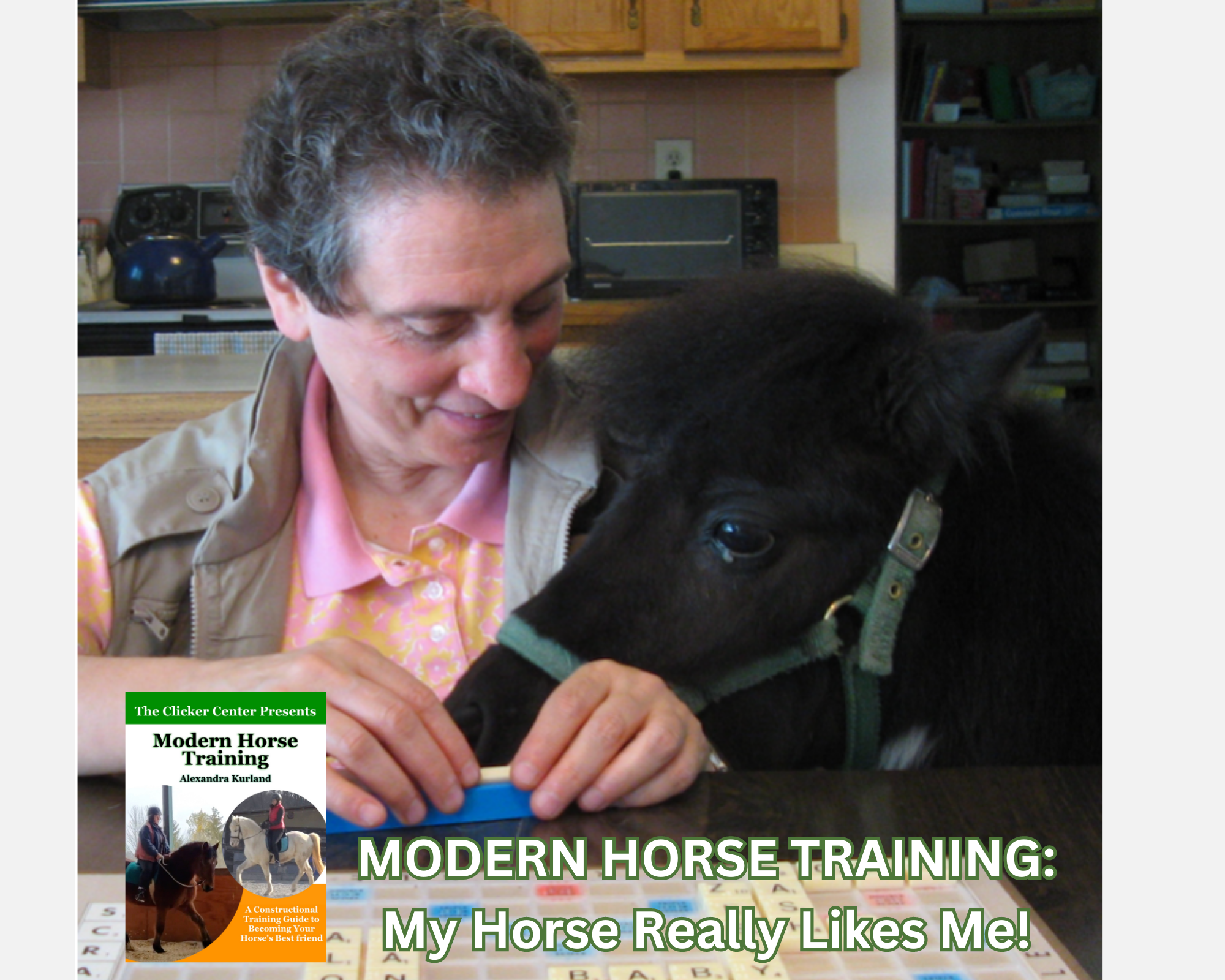
Our clicker trained horses show us in so many ways that they like us. In this photo Panda is “helping” Ann during a scrabble game. Guide work isn’t all work. It includes a lot of social, play time that Panda clearly enjoys. It’s no wonder they have a great relationship!

Modern Horse Training Is About Sharing With Friends

Modern Horse Training isn’t something you want to keep to yourself. It’s too much fun. Laughter and love are meant to be shared, and so is good training.

I love working with other clicker trainers and I am always honored when they let me have a play with their horses. This is Graya, one of Michaela Hempen’s horses (clickertrainingferde.com). We were having a rope handling discussion in which Graya was very much an active participant.

Good training needs to be shared!

You can help me share it by sharing these posts with your friends.

These posts are from my instagram posts. You can find me at: alexandra.kurland.5

Modern Horse Training: My horse is so SMART!!!!”

I always love seeing the posts that begin with this enthusiastic discovery. Someone has given clicker training a try and discovered how smart their horse really is.

I’ve heard the opposite said all too many times. “Horses are such stupid animals.” This is often followed by: “That’s why you need to use force to train them. But don’t worry. They don’t feel pain the way we do.” Go to any tack store in the country and you will see evidence of this very old-fashioned way in which people view horses.

One of the reasons I wanted to train Panda was to help people see horses in a different light. I’ve heard people talk about guide dogs in such glowing terms. “Isn’t that wonderful! That dog is so smart.”

When we started with Panda, many horse people believed a horse could never be trained to guide. They simply weren’t smart enough. And yet here Panda is, twenty years on, still guiding! Horses are indeed so very smart!

Modern Horse Training: My Horse Is So Brave!

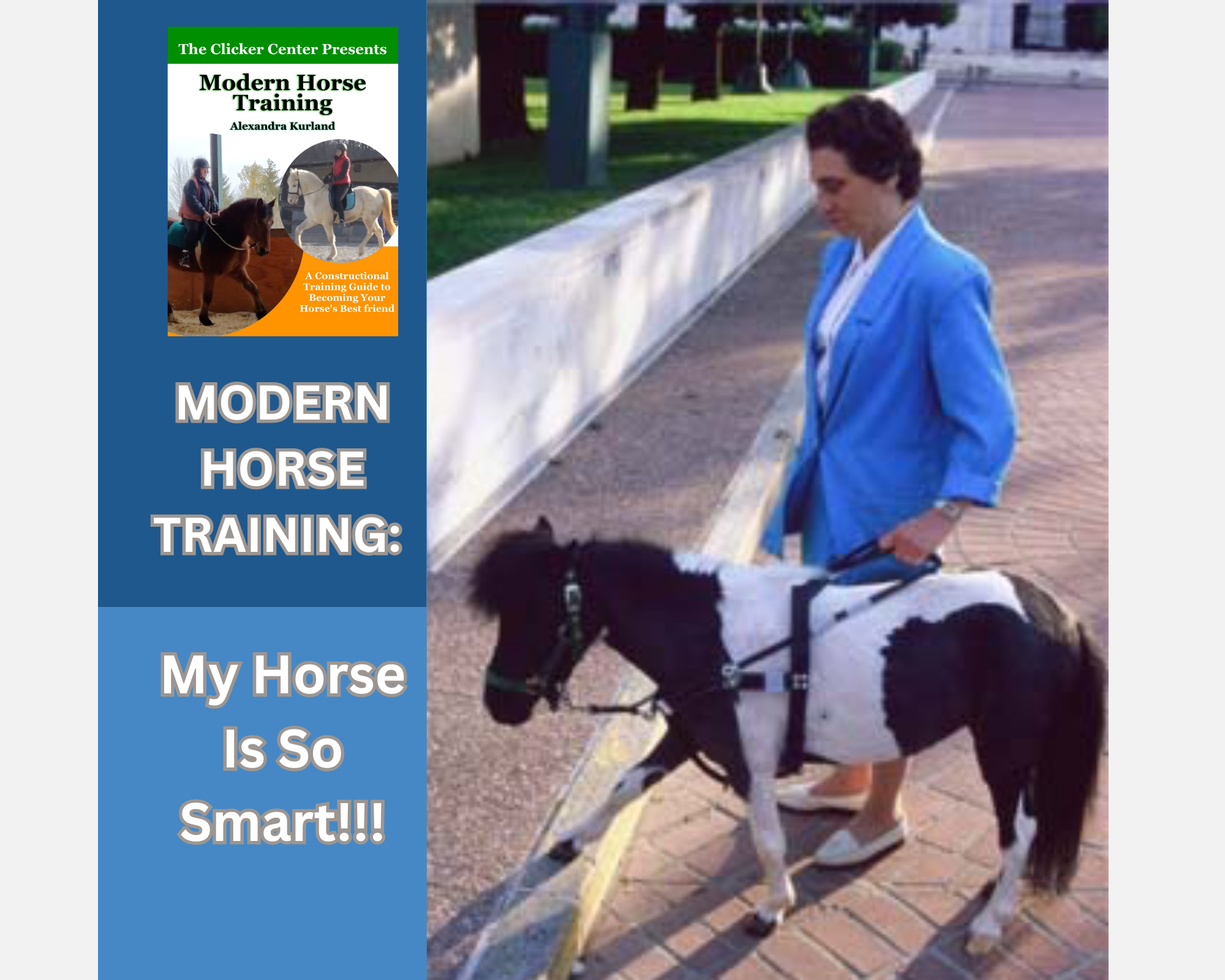
Panda is guiding her blind owner through a construction zone. This was their daily walk home from work. Every day there was a different puzzle to figure out. One day there would be a sidewalk that ended in construction fencing. The next day the entire sidewalk would be gone and Panda would have to find a path forward through the construction zone. She was always unflappable.

Panda’s good decisions were reinforced by her handler. Together they developed into a confident team. Twenty years on and they are still a great team. Modern Horse Training is for the long haul.

If you want to see a short video clip of Panda guiding, visit my instagram posts at #Alexandra.Kurland.5

Modern Horse Training Builds Great Relationships

I love giving clinics. I love sharing clicker training with others, and I am always honored when someone lets me have a play with their horse. Over time I have come to know many of the clinic horses well, and I consider them to be part of my extended equine family. I always get a chuckle when a horse I haven’t seen for months gets excited when I turn up at the barn. “You’re here! We’re going to play!”

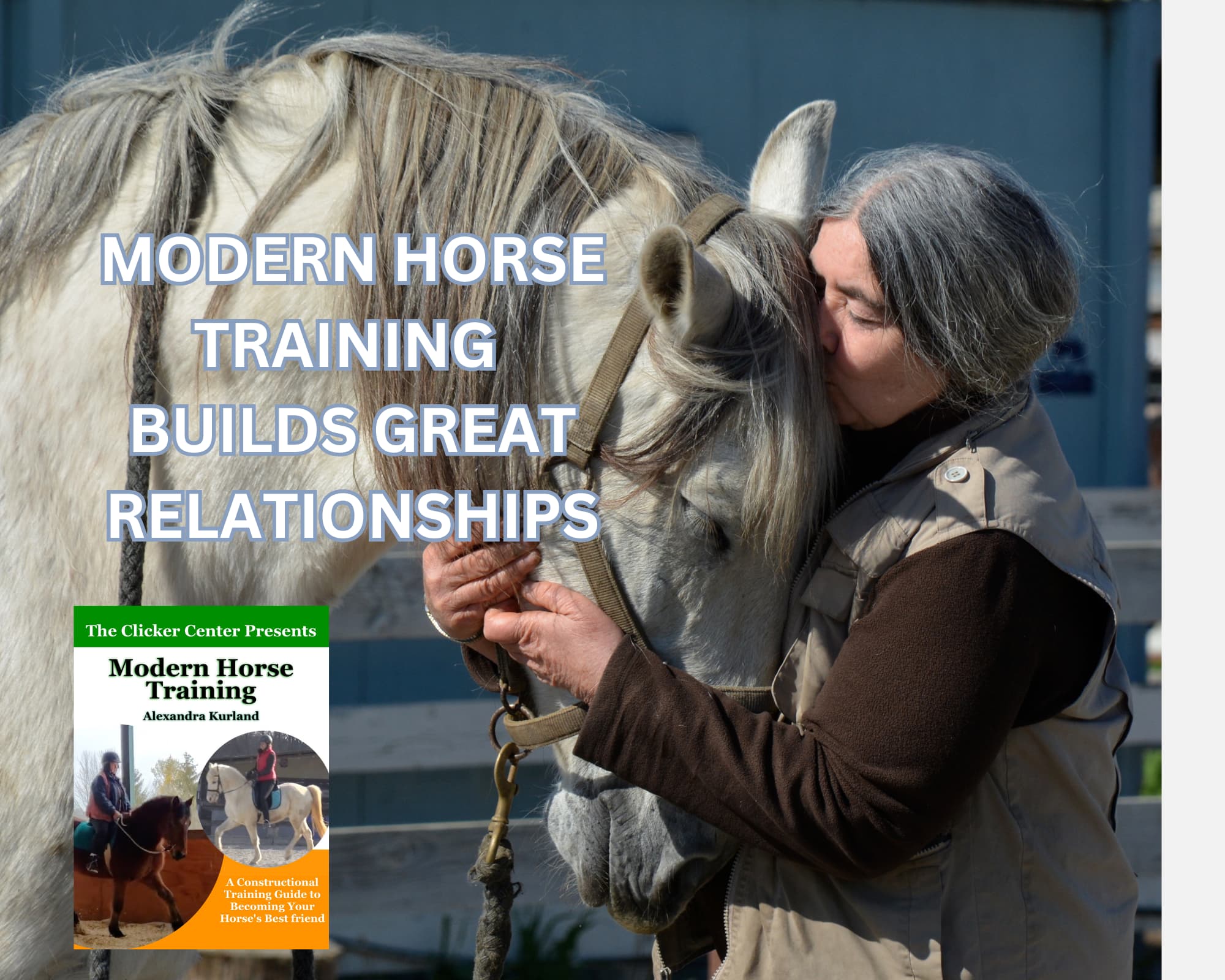
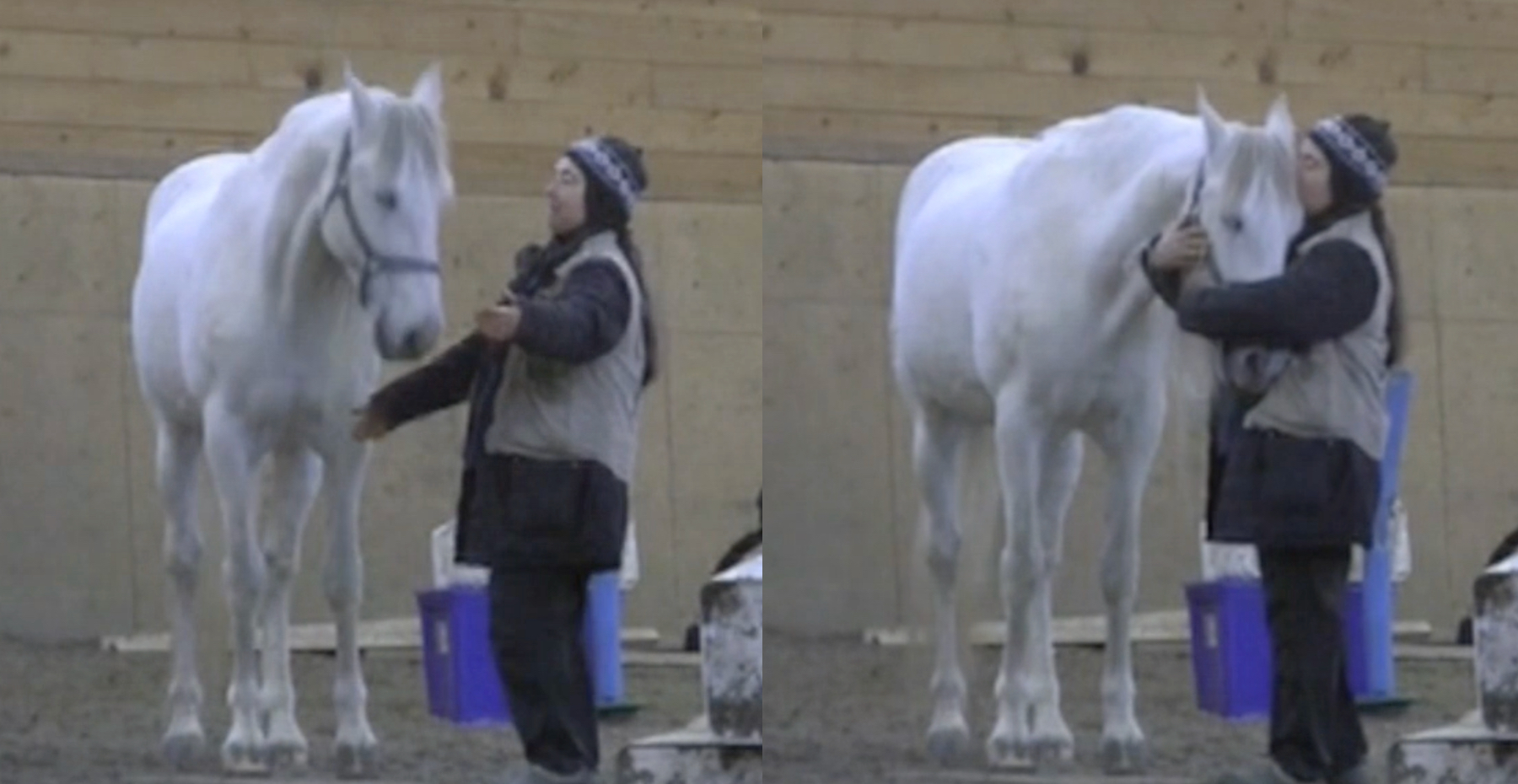
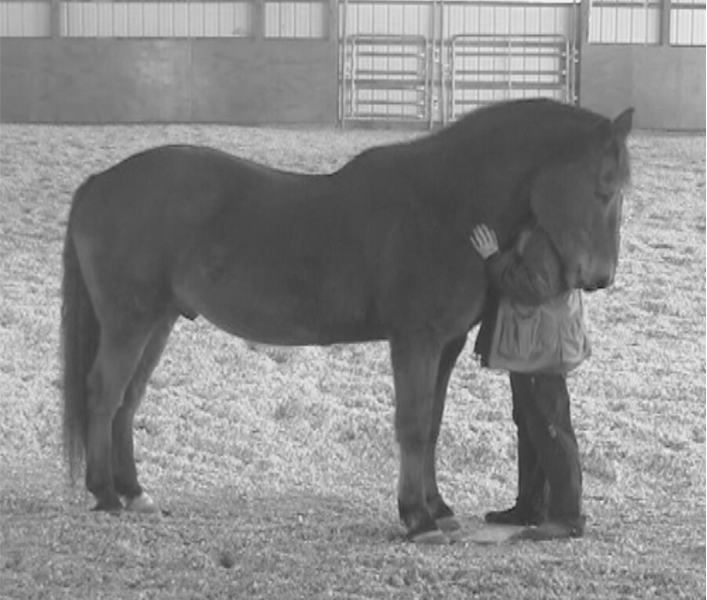
I love this photo because this horse began by actively warning me to stay out of his space. His body was covered with “No Trespassing” signs. Teaching him to give hugs changed all that.

The hug begins as simple body part targeting. The horse learns to bring his nose to your hand. With your palm over his nostril you can feel the horse breathing in, breathing out. Click as he exhales and pretty soon you are clicking as the horse relaxes and melts into your waiting hand.

Adding in your second hand gives him two target points to orient around. This can become an exercise in body awareness and balance. Or you can turn it into a social hug.

It’s hard to tell who enjoys the hug more – horse or human. I suspect the best answer is we both do.

This is very much a case of we both enjoy a good bear hug.


Modern Horse Training is wonderfully sneaky. Simple behaviors such as basic targeting transform into so much more.

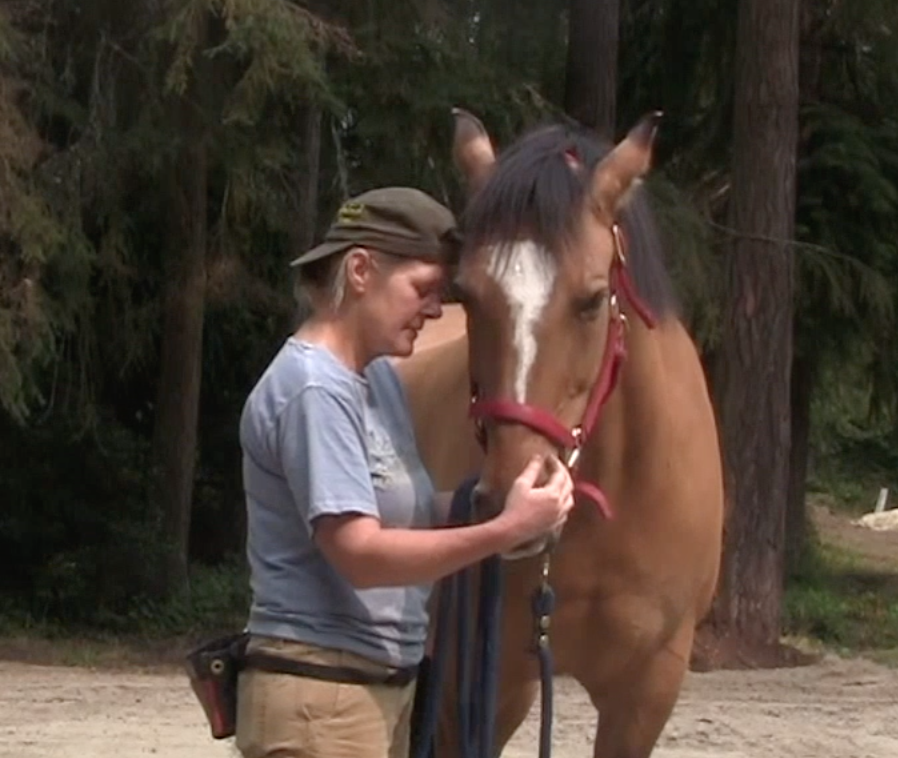
This image shows the beginning steps of teaching the Awareness Hug.

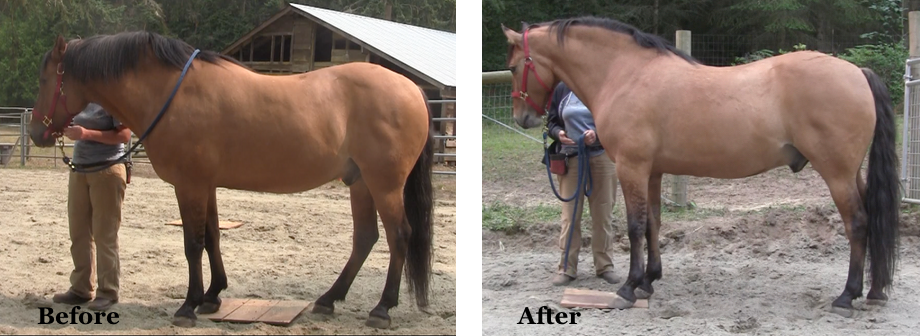
This is one of my favorite before and after comparisons. The changes in the way this horse is holding himself occurred after three sessions held over a day and a half. The Awareness Hug very much contributed to the changes you’re seeing.

“Before” he’s in a higgledy-piggledy stance with his balance pitching forward. He looks stuck. Under saddle you could imagine it might be a chore to get him to go forward with enthusiasm.

“After” he’s lifting up. He’s standing much more over the support columns of his legs. He looks so much more athletic, as though it would be easy to go forward.

The Awareness Hug is taught in detail through my on-line clinics. I’m tempted to say it is part of Clinic #6: Connecting the Dots since I have a unit that is specifically on The Hug in that clinic. But everything is connected to everything else. To truly understand the details that helped change this horse’s balance you need to connect the dots through all the clinics.

To learn more about my on-line clinics visit my web site: theclickercenter.com

Modern Horse Training – Todays’ Post: Names Matter

Titles are important. Names matter. I learned this a long time ago when I started referring to the “t’ai chi wall”. That’s an element in the rope handling that I teach. Suddenly, it became a something. It stood out from everything else that was associated with the rope handling.

Names matter. Farmers know this which is why they don’t name their animals. Names transform them into individuals.

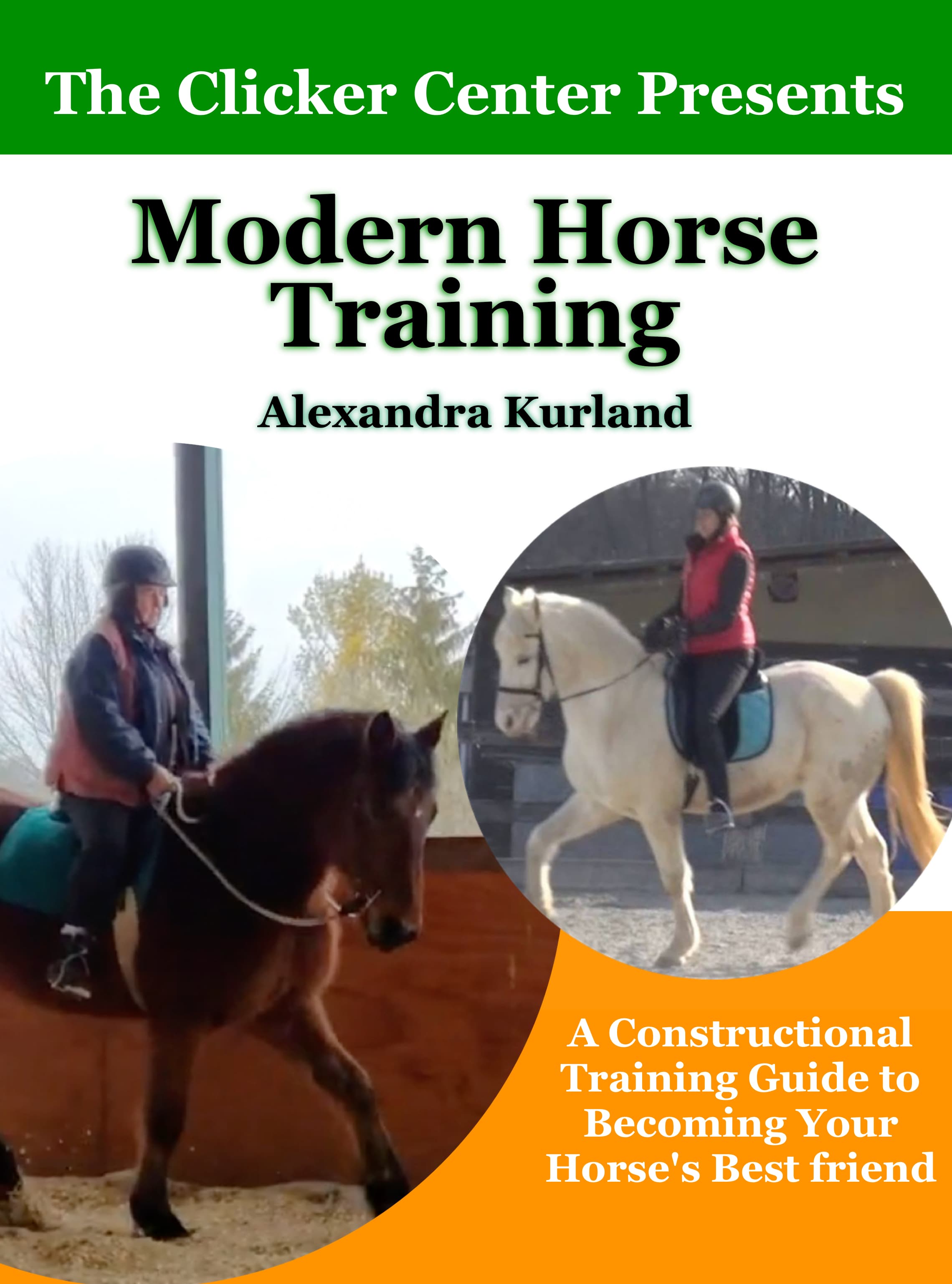
We name our horses because we are looking for that individual connection. That brings me to the rest of the title I have given my new book. I’m calling it, “Modern Horse Training: A Constructional Guide to Becoming Your Horse’s Best Friend”.

In previous posts I’ve talked about what Modern Horse Training means to me. I’ve described the example/non-example comparison that I am making by choosing that title. In yesterday’s post, I wrote in general terms what constructional training refers to.

Of course, I tried on many different titles, but I kept coming back to “Modern Horse Training”. And then there was the subtitle. I considered staying with just “A Constructional Guide to Horse Training“, but I kept adding on the rest: “A Constructional Guide to Becoming Your Horse’s Best Friend”.

I know there will be people who read that title and think the book isn’t for them. They are interested in performance not friendship. That title is too mushy.

I’m also interested in performance. The cover reminds us that we don’t have to give up on one to have the other. Training teaches performance skills. It also creates connection.

I should say good training does this. Force-based training turns communication into a one way street. When you use commands, meaning you are controlling your horse with a do-it-or-else threat backing up every request, you become like a drill sergeant barking out orders. The sergeant tells the private what to do. The private does what he’s told. He’s not on equal footing. He doesn’t respond by giving an order back to the sergeant. If he does, he’s being insubordinate, and he will be punished.

Punishment shuts down behavior. When we use command-based training we shut down the back and forth communication that makes being with our horses such a joy. We shut down the full expression of their personality. That funny, brave, inquisitive, smart, mischievous, bold, kind individual we love so much disappears and hides away from us. Good training brings our horse’s personality out of hiding – in a good way.

In a recent Equiosity podcast I brought together a group of people who are currently going through my on-line clinics. They were all regular attendees in the coaching sessions that are part of those clinics. The conversation turned into a three part series. I ended by asking each of them to describe what they thought of when they were pictured a clicker-trained horse. I thought they might describe some particularly fun bit of training they had taught to their horses. But no, to a person, they all talked about the relationship that was developing through clicker training. What they most valued was not that they could now pick up their horse’s feet with ease, or load him on a trailer, or ride him. What they valued most was the connection the training was creating.

That’s why we have horses. Think back to the horse books you read as a child. If you are one of the horse addicted, you probably had a whole shelf full of them. Yes, the stories were full of riders who soared over giant fences or raced across deserts. But always, what mattered most was the love between horse and handler.

Too often performance is put first and that connection is lost. We talk about “bomb-proof horses”. But what really does that mean? Yes, safety always comes first. I want a horse who is comfortable with me and the world around him. But if there is a bear nearby, I would like my horse to be able to tell me that going forward is really not a good idea. I want my training to give him a voice that counts, a voice that is listened to.

If he’s hurting, I want him to be able to let me know that he can’t do what I’m asking. I want him to be able to tell me this without having to shout. Horses shout by rearing up, kicking out, bolting off. Long before he has reached the boiling point, I want my training to give him a voice that is heard.

This is how we keep horses sound. It is how we remember why we fell in love with them in the first place. It is how we transform ourselves from drill sergeant into best friend. The title is the right one to chose. The new book is indeed a constructional guide to becoming our horse’s best friend.

Robin – my best friend and performance partner

The new book, “Modern Horse Training: A Constructional Guide to becoming Your Horse’s Best Friend” will be published April 26, 2023. It will be available through my web site: theclickercenter.com and through Amazon and other booksellers. Look for it in hardcover, paperback and as an ebook.

My Horse Is So Smart!!!

CTFYHbookcover

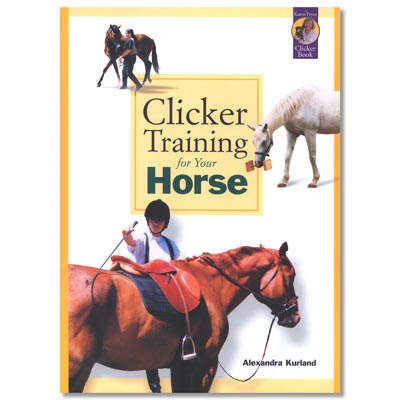
The cover of the first edition of “Clicker Training for your Horse” – published 20 years ago this year.

This post is another in the series I have been writing to commemorate the 20th anniversary of “Clicker Training for your Horse”.  Each month I have been giving special recognition to individuals who helped bring clicker training into the horse world.

Today clicker training is firmly rooted in the horse world.  There are people all around the planet who know two things about it: 1.) clicker training is fun and 2.) it’s good for horses.

But twenty years ago any time I mentioned clicker training very few people knew what I was talking about.  I always had to add a lengthy description of what it was, followed by detailed instructions for how to introduce it to your horse.  When I sent these posts out to the very limited number of horse groups that existed twenty years ago, here’s the response I would get back:

My Horse is so SMART!!!!!

That’s how the replies would begin.  They always made me smile.  Someone else was discovering clicker training.  More than that, that individual was seeing her horse in a completely new light.

The 1990s don’t seem that long ago to me, but they were truly pioneer days on the internet.  The entire community of clicker trainers was so small there was only one list – the Click-L list.  That’s where everyone posted.   And I mean everyone – dog trainers, parrot specialists, horse owners, exotic animal trainers, we were all on the same list.  I loved that.  You didn’t have to monitor dozens of separate forums to know what was going on. Everyone was in the same forum talking to one another.  You could read a post from Karen Pryor followed by one from Bob Bailey.  You could read about different species, dogs, parrots, and yes, even horses.

Any time I sent a post to the Click-L list I was reaching the entire clicker training community.  But I wanted to reach out into the broader horse community as well, so I also posted on one of the early horsemanship lists.  I was always careful how I used that list.  I didn’t want to intrude where I wasn’t wanted.  The list was a general one, but even so, clicker training didn’t always fit in to the discussions.

I chose carefully both which posts I responded to and what I said.  I knew if I came in like a steam roller telling people that my way was the best and everything they were doing was wrong, I’d get nothing but resentment and push back – and rightfully so.  If you push against what somebody else is doing, of course they are going to push back even harder against you.  That wasn’t the way to get people to try clicker training.

Instead I would wait until someone asked a question in a way that indicated that they might be open to the use of treats.

I’d respond with a lengthy description of clicker training and a detailed lesson plan that would help them with their specific training issue.  I don’t think I ever failed to get back an enthusiastic response.  It was always filled with caps and exclamation marks.  And it almost always began with:

“My Horse Is So SMART!!!”

Why was this such a surprise?  Traditional command-based training is built on a belief that horses are stupid animals.  This is not subtly implied.  It is stated as fact.  The corollary of this is: because horses are stupid animals, we need to use force to train them. But don’t worry dear, (and it was always said in this patronizing tone), they don’t feel pain the way we do.

Clicker training puts the lie to that core belief.  We can see how smart our horses are. When you remove the threat of punishment and instead train with positive reinforcement, horse or human, you see a blossoming of personality and enthusiasm.  It isn’t just our horses who suddenly seem so much smarter.  It is every individual who is training in this way.

Not everyone responded with such enthusiasm to those early posts.  Clicker training was both wonderfully well received and strongly pushed against.

There was one individual in particular, an Australian, who felt it was his moral duty to stamp out clicker training before it could spread.   He wrote angry posts declaring how wrong all this hand feeding was!!  His posts were also filled with caps and exclamation marks.  The difference was there was no joy in his posts.  There was no laughter – just angry sputtering.

I never responded to his posts – at least not directly.  Clicker training was truly the new kid on the block.  I knew if I pushed against what others were doing, they would push back even harder against me.  That’s only human nature.  There was a lot of horrible training going on at that time, but I was careful not to say anything negative.  I wrote about what I was doing and why.  I worked hard to avoid saying why I thought some other method was wrong.

I also knew that if someone posted something I didn’t like on the internet the best way to guarantee that that post would stay alive and gain traction was to comment on it.  As fast as things move on the internet, if you don’t respond to something, it disappears in an instant to be replaced by the next puff of an idea.  But as soon as you respond to a post, you give it legs.  You can think you’re helping out by offering a rebuttal to someone’s huffing and puffing, but all that does is guarantee that their comments will gain more traction.

I am always mindful of the oft repeated line in Lewis Carol’s “The Hunting of the Snark”: “What I tell you three times is true.”

We’ve seen the power of that in American politics, but I don’t want to disappear down that rabbit hole!  Instead I’ll just say I want to be careful how I post so that I don’t give added life to ideas that need to go away.

So I would never respond to this man’s nasty remarks.  It must have frustrated him no end that I never took the bait.  You could see the extinction burst he was in as he tried harder and harder to draw me into his rants.  Instead I would make note of his comments, and in my next long post I would address each of his concerns, but never directly.  If he stated that hand feeding treats would teach horses to bite, I would give detailed instructions for the teaching polite manners around food.  If he said clicker trained horses would become pushy and always be demanding treats, I would describe in detail the teaching of the foundation lessons and show how they create horses that move readily out of your space.

Whatever arguments he had, I countered them with detailed descriptions of the training – never pushing against him, never even mentioning him.  I just addressed point by point each blustering statement by providing people with good instruction for introducing their horses to the clicker.  The contrast in tone was startling.  I’m sure many of the people who were brave enough and curious enough to go out to the barn to it a try were in part attracted to clicker training because of the contrast in tone.

What people wrote back were posts filled with excitement.  The delight in their horses was crystal clear.  You could see it in every exclamation mark and underlined phrase.  We weren’t using emojis back then, but they found other ways to express their excitement.

Their enthusiastic posts encouraged others to give it a try and the snowball effect began. The angry, blustering posts sent by this one detractor had the opposite effect from the one he intended.  If he meant to stamp out clicker training before it could spread like wild fire from horse barn to horse barn, he was too late.  Clicker training spread even faster than a wild fire.  It’s an infectious idea.  It brings with it great joy and that’s certainly something we all want to share.

In 1998 when I published my book, “Clicker Training for your Horse”, I gave the “snowball” a big push.  I was quickly joined by many other people who got the ball rolling ever faster into the horse community.

Each month I’ve been writing thank you posts to the many people who helped bring clicker training into the horse world.  I’ve been singling out individuals to thank by highlighting their training.  This month is different.  I want to thank all those early adapters and their exclamation marks.  Your horses are indeed smart!!

I want to thank all those brave people who were curious enough to take treats and a clicker out to their barns and to ask their horses: “What do you think?”.  Your exclamations of delight helped spread clicker training around the planet!

exclamation points 3

Celebrate!

Years ago at a clinic I gave in Florida one of the attendees brought a horse she had only recently bought.  She was a novice, first-time owner.  She had done many things right.  She bought a horse she had been riding at a local lesson barn.  She was still boarding the horse with her instructor, but this was about to change.  She was going to be taking her mare home and caring for her herself.  That’s where the worry began.  Her mare was one of those horses who makes really ugly faces whenever anyone approaches her in a stall.  Her new owner was afraid to go into a stall with her.  That had been okay as long as she was boarding her and there were people around to help her, but once she took her home, she would be on her own.

So that weekend we focused on “happy faces”.  That’s all we worked on with her mare. Whenever anyone went past her stall, if even one ear perked forward, click, she would get a treat.  It was very opportunistic training.

We covered a lot of training topics that weekend – as we always do, but for that horse the focus remained squarely on “happy faces”.

The following year I gave another clinic in that area, and this team were back.  This time they were the clicker superstars.  She was our demo horse for exploring lateral work and introducing people to single-rein riding.  That was a huge jump from our first clinic together.

At the end of the three days we did a wrap up.  Each person talked about a highlight of the weekend.  When it was her turn, she started out by saying that at the end of the previous clinic she had been so mad at me because all I had let her do was reinforce her mare for putting her ears forward.  But when she took her horse home she began to understand why I had made that the central focus.  She continued to reinforce her mare for putting her ears forward.  It wasn’t all she worked on, but it continued to be an important element in every training session.  We could all see the results.

There’s a lovely training principle – The longer you stay with an exercise, the more good things that you see that it gives you.  When you focus in on what can seem like a very small and seemingly insignificant detail, it begins to collect other good things around it.

So this was her comment after this second clinic.  She said: she had always known her horse was beautiful, but now everyone could see it.

As more and more people are clicker training their horses, that statement takes on even more meaning.   We always knew our horses are beautiful.  Now we also know they are very smart, and because of clicker training more and more people can see it.

Thank you to all my exclamation mark posters!  Twenty years on you are still bringing good things into the horse world.

Keep it positive!!!!

Share the JOY!!!

Seeing Steps

We’re Mid-way through May.  Time to send another thank you out into the world to all the people who have helped bring clicker training into the horse world.  2018 marks the twentieth anniversary of the publication of “Clicker Training for your Horse“.

1998 was very much pioneer days.  There was no trail ahead.  We were blazing it.  Everyone who went out to the barn with a pocket full of treats and a clicker in hand was truly a pioneer.  We were stepping out into unknown territory.  The first people who went on that journey with me were my clients.  These were people I saw on a regular basis, some of them I had been working with for years.  They were familiar with how I operated.  I’d read a book, I’d go to a clinic, I see some interesting training, and then I’d try it out.  My horses were always the first guinea pigs.  If they liked what I was testing, I’d share it with a few of my clients, and, if they liked it, I’d share it with everyone.

That’s how clicker training got started, first with Peregrine and then with a few of my client’s horses.  That’s all it took to get the snowball rolling down the hill.  The first few steps into clicker training were easy.  You taught basic targeting.  You cleaned up the horse’s manners around food, and then what?  That’s was what my clients were helping me to figure out.

So this month belongs to them, to all those willing pioneers who joined me in that first approximation in.  As usual, I am going to single one person out, but in doing that what I am really doing is saying a huge thank you to all of my many clients who followed me into this exploration of clicker training.  So this month I am going to introduce you to Sharon and her Arab Missfire.  They were the inspiration behind Chapter 5 in “Clicker Training for your Horse”.

The title of Chapter 5 is: All Aboard! Mounting Blocks and So Much More: The Power of Goal Setting. You could say Chapter 5 is about teaching your horse to stand still at a mounting block, or you could say that it is about breaking training down into small steps.  Both would be right.

Sharon was a first-time horse owner who kept her mare at home.  She had what was a very common situation.  She had a couple of small fenced-in fields with access to a run-in shed, but no separate designated training area.  All the work was done out in Missfire’s paddock.  Missfire didn’t come with too many warning labels attached.  She was comfortable being groomed, okay to lead, she was afraid out on trails and would rush for home, but in her home paddock she was safe to ride.  The problem was she frustrated Sharon.  It was all the little things that Missfire didn’t do well.  Yes, you could groom her, but she fidgeted.  Yes, you could put a saddle on, but she fussed.  Yes, you could get her to the mounting block, but getting her to stand still long enough to get on was a challenge.

Sharon was a special ed teacher.  She taught math to teenagers who had been removed from regular classrooms because of their disruptive behavior.  When I first introduced Sharon to clicker training, I thought – she’s going to love this!  This will be right down her alley.

I was right.  She did love clicker training, the parts of it she understood, but oh how she struggled to make it work.  She just couldn’t see the steps.  She understood the overall concept, but she needed me to guide her through each lesson.  In between my weekly visits she was still struggling with her horse and feeling frustrated.

Clicker training has brought me many great things.  I’ve been able to travel and meet people I would never have connected with if not for the adventure called clicker training.  One of the connections I very much treasure is that with canine trainer, Kay Laurence. Kay feels about dogs the way I feel about horses.  The species we are passionate about may be different, but our regard for the animals we love is the same.  It was Kay who highlighted for all of us in the clicker training community the difference between guided and self-directed learning.

There’s a time and a place for both.  Knowing which to use when is the skill.

In the horse world many traditional riding lessons are designed to create dependent students.  There is a very clear hierarchy.  The trainer is the expert.  The learning is very much directed.  In group lessons you’re told when to trot, when to canter.  You’re not taught to become an independent thinker.  When you buy your first horse, you are still very much dependent upon the trainer.  You need him/her to fix things when the training goes wrong.

Clicker training changes that.  The role I play is that of guide not guru.  My favorite definition of a teacher is “someone who started before you”.  When someone asks me to help them with a horse, that’s all that I am.  Someone who started before that individual.  My job is not to make that person dependent upon me.  It’s to help her realize that she can be a teacher for her horse.  She can be an active, effective problem solver.

Even someone who has limited handling skills can be a good teacher.  The first requirement is understanding how to apply basic principles.  It’s: safety always comes first.  It’s: train where you can – not where you can’t.  If you don’t have the riding skills yet to handle rough terrain, sudden surprises, and an excited horse who wants to bolt for home, then ride where you can be safe.  Ride in your home paddock.  Or ride from the ground first.  Remember – ground work is just riding where you get to stand up.

Here’s another core principle: find a step in the training where you can get a consistent yes answer.  If you are just learning how to handle a horse, what CAN you ask for?  It might be as simple as having a horse touch his nose to a target.  That may not seem like much, but it’s a beginning step.  Each step opens the door to learning new skills which you and your horse are learning together.

The stumbling block that many people encounter when they are first experimenting with training is they become very outcome oriented.  Instead of focusing on the process, they want to jump to the end result.  That means they tend to lump criteria, and they miss seeing all the places where the horses are asking for more information.  That’s where Sharon was.  When she brought Missfire up to a mounting block, she expected to be able to just get on.  She was missing all the small steps that could be inserted into this process.  She just didn’t see them.

This was over twenty years ago – long before any of us knew about Hogwarts and Harry Potter.  But thinking back on it, that’s the image that comes to mind.  When I stood on the mounting block next to Missfire, I could see all the steps, but it was as if there was an invisibility spell cast over her when Sharon stood in the same place.  She just couldn’t see all the little questions she could be asking Missfire.

Can I put my hands on the saddle?  Yes.  Click and treat.

Can I wiggle the saddle?  Yes.  Click and treat.

Can I touch the stirrup leather?  Yes.  Click and treat.

That’s great.  That was a nice unit.  Now I’m going to step off the mounting block, and we’ll walk off together in a big circle so we can go back to the mounting block and ask those same questions – and maybe one or two more – all over again.

Slowly the invisibility spell lifted.  Sharon saw the steps.  She got it.  She was able to take Missfire to the mounting block and ask these small questions.  She was understanding how these small asks accumulated into a solid owning of the behavior – for both of them.

The following week when I arrived Sharon showed me how she had taught Missfire to “self bridle”.  And the week after that she showed me another new skill they had worked on together.  She was owning the process!  She was becoming what clicker training allows us to be – our horse’s teacher.  She wasn’t dependent upon me.  We still enjoyed our visits together.  There were lots of new skills that I could help her to learn, but she didn’t need me.

In “Clicker Training for your Horse” I used specific lessons such as foot care or the mounting block lesson to teach broader principles.  Sharon’s struggle with the mounting block became the inspiration for a chapter in “Clicker Training for your Horse“.  The week after her lesson I wrote Chapter 5: All Aboard! Mounting Blocks and So Much More: The Power of Goal Setting.

Here is the opening section from that chapter:

“Some of you who are more experienced may glance at this and think: a whole chapter just on getting your horse to stand next to a mounting block!  You’ve got to be kidding.  When is she going to talk about some real training?

This book is intended for people of all experience levels.  In my own teaching I work with many highly trained riders and instructors, but I also work with beginners and first-time horse owners.  If you haven’t spent much time around horses, no exercise is ever too basic to be taught.  I’ve given lessons in how to lead a horse into a barn, turn it around, and close the door behind you.  Sound simple?  If you’ve been around horses for years, of course it does, but to a timid, first-time owner with a pushy horse it can seem like an impossible task.

You may know how to teach your horse how to stand quietly while you get on.  It’s no problem for you, but for someone who has never dealt with this issue, it can be extremely frustrating.  You may take bridling for granted.  Then you buy that green, three year old you’ve been dreaming of for years, and he throws his head up into the rafters whenever you come near him with a bridle.

I don’t know what issues you’re struggling with, or what you already know, and what you don’t.  I don’t want to skip over anyone, so I’ve chosen to talk about some very basic training issues here.  That way everyone can participate.  Embedded in the discussion are the principles and concepts that will help you with every step of your training.  If you’re an experienced rider, you’ll be able to generalize easily from these examples and apply the principles to your own training situation  .  .  .  .  Foundation is everything in horse training.  So even if you’re working with upper level horses, I think you’ll find a great deal in this chapter that will interest you.

Training is easy once you know where to begin.  Getting started is the hard part.  You want to ride.  You’ve got a picture of your dream horse in your head.  You can see yourself clearing every fence on the course; galloping along a winding trail; or executing the perfect canter pirouette.  That’s your dream, but right now you and your horse are just starting out together.  What are you going to work on today to get to all those wonderful tomorrows?  What are your immediate training goals that address the issues you are working on today?

Goal setting is an important part of training.  When I’m working with someone on a regular basis, I’ll ask them what they want to focus on today, in this lesson.  Very often they’ll say they don’t know.  They have an overall dream of what they want to do with their horse, but they don’t have a specific goal in mind for that day’s training.  That’s fine.  The horse will always tell us what he needs to learn.

We’ll take him out to the ring and he’ll refuse to walk up to the mounting block.  Great.  He’s just given us the lesson for the day.  Yes, we could get on somehow, but we’d be missing a wonderful opportunity to train.

We might have been planning to work on canter departs, but that’s not what the day’s lesson is going to be about.  We’re going to teach him to stand next to the mounting block.  In the process we’ll be working on leading; on ground tying; on lateral work; on loading into a trailer; and, oh yes, on canter departs, and even on flying lead changes.  How is that possible when all you’re doing is getting on?  The answer is, you can never teach just one thing.  You’ll see what I mean as we go through this lesson.”

It’s great fun reading this chapter so many years after it was written.  I feel as though I could be writing it today in response to someone’s email query.  The words wouldn’t be that different.  I may know a lot more ways to teach the lessons I was writing about, but the core, underlying principles are the same.  What Sharon showed me was the power of those principles.  When you learn how to use them, they set you free.

So this is my thank you to Sharon and to all my other clients who showed me how to transform these principles from words on a page into actual practice.  Those pioneering days were great fun!  I am glad we took the journey together.  Many of you have split off and gone off on your own.  That’s as it should be.  The best part of clicker training is it teaches you how to forge your own path.  We will be friends always, and I am sending you a thank you for the time we journeyed together and the discoveries we made.  Thank you for helping to bring clicker training into the horse community.

Have fun!


Remembering

Each month this year I’ve been writing a post in celebration of the twentieth anniversary of the publication of “Clicker Training for your Horse”.  These posts are thank yous to all the many people who have helped bring clicker training into the horse world.  In January I began with a tribute to Bob Viviano and his horse Crackers.  February belonged to Ann Edie and Panda.  Last month I turned the spotlight on all the clinic organizers.  To represent them all I singled out Kate Graham and her horse Lucky.

This month is different.  April can belong to no one else but my beloved Peregrine.  April 26, 1985 was his birthday.  For thirty years I celebrated that event with him.  Now I remember the day without him.  Today I am getting ready to fly out to California to teach a clinic.  Peregrine put me on the path to all these great adventures.  I learned about clicker training for him, through him.  When I went out to the barn all those many years ago with treats in my pocket and a clicker in my hand, I had no idea of the journey he was sending me on.

When I lost Peregrine’s mother, I promised her I would write her a love story.  I didn’t know at the time what form that would take, just that I would do it.  My book, “Clicker Training For Your Horse”, was that love story.  It was written for her and for Peregrine.  Clicker training was not a story to keep to myself.  I have been sharing it with all of you because of them.

When Peregrine turned thirty, I wrote a series of posts in celebration.  They are a tribute to him and a history of equine clicker training.  You can read them beginning with https://theclickercenterblog.com/2015/04/13/todays-peregrine-story-early-lessons/ 

For most of his life Peregrine lived at boarding barns.  It was only in his final years that I was able to move him to a home of his own.  The barn is still so full of his memories.  We moved July 4th 2011.  It was truly Independence Day for all our horses.

Peregrine shaped how the barn is used.  He taught me to open all the doors.  Throughout his life he was always opening doors.  The most important one was the door to clicker training.

He is greatly loved, and he will always be greatly missed.

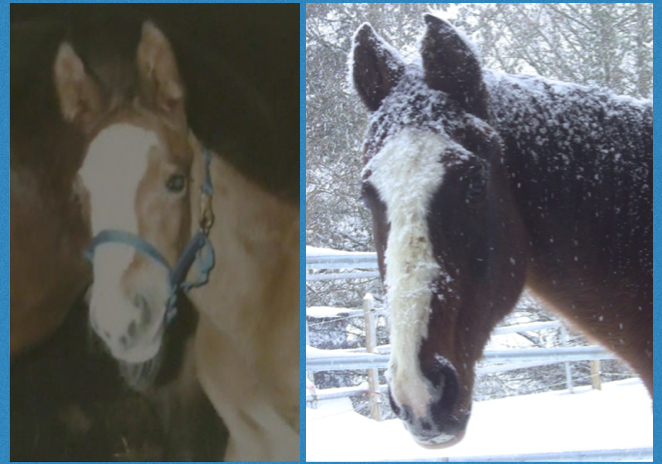
Peregrine Foal and in winter

Peregrine April 26, 1985 the day he was born, and Peregrine when he was 29