Goat Diaries: Keeping Things in Balance

The Goat Palace: Structure Matters – Nov. 14, 2017

When I first started teaching, I often traveled to people’s home barn to help them with their horses.  If you board your horse in a big barn, there’s usually plenty of help around,  but the people who keep their horses at home are often stuck.  They might have a trailer, but they have a horse who won’t load, so getting help can be a problem.  I was willing to travel, and I was also willing to make do with whatever training environment (or lack thereof) they had.

I learned fast that structure really does make a difference.  The right size space, good footing, good fencing, these really do make things so much easier.  I also learned to be creative with what I had.  In my first book, “Clicker Training for your Horse” I described a situation with a very aggressive thoroughbred mare.  There was no suitable outdoor space where we could work safely.  No matter.  Her stall was built into the structure of an old dairy barn, and it provided us with the perfect “theater in the round” where we could begin with protective contact. That horse really taught me how useful a starting point this can be.

Our first training day with the goats showed me that structure was going to matter with them, as well.  We began our day by closing off the gaps in the fence that separated the two areas.  That eliminated one problem.  We didn’t have to deal with little E squeezing through the boards to join in the game.  All the goats were together in the front section while we put up the boards.  That made it easy to open the gate and let the first goat through.  No surprise, Thanzi was first at the gate.

She started out by ignoring the target and checking out my pocket.  She’d looked like such a ringer the day before going so consistently to the target.  It was interesting to see what she had processed from that experience.  It was clearly, when there’s food involved, head straight to the pockets.

When she got too focused on my pockets, I would shift position so the target was more in view.  She would sniff at my pockets and then notice the target, touch it, get reinforced, then it was back to my pockets for another hopeful investigation.  This went on for a few minutes before she abruptly switched and went consistently straight to the target, click, treat, back to the target.

I used what the horses have taught me about food delivery.  As I got the treat from my pocket (winter squash rind), I moved into her space so she had to back up to get the treat.  She would take a step back without any fuss.  This is a very pushy, domineering goat.  Moving her away from the treats right from the start seemed to be nipping in the bud any tendency to crowd into me demanding treats. Yes, she was sniffing at my pockets, but it never escalated beyond that.

I know some goat enthusiasts have worried that moving goats back might trigger a head butting response, but so far, there has been no sign of this.  When I back her, I am stepping into her chest, just as I would a taller horse. And it is having the same good effect on reducing crowding that stepping into a horse’s space to deliver the treat does.

We let Trixie through the gate next.  My idea was that I would work with one goat and Marla could work with the other, but the goats didn’t cooperate.  Thanzi wanted whatever Trixie was getting so she hovered too close.  She wasn’t yet strong enough on the targeting to be drawn away.  We may have to work with her for a few days, and then catch Trixie up once Thanzi is able to stay solidly engaged with one person without being distracted by what other goats are doing.

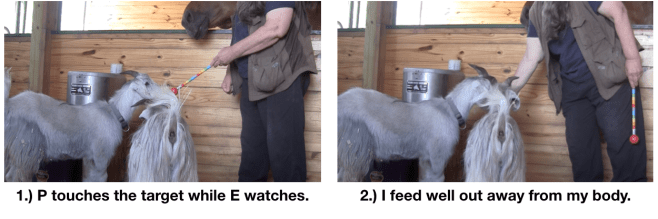
We left the two ladies in the large area and then tried the boys.  I engaged E and P down at one end.  I had two platforms set up. I was trying to reinforce them for staying each on his own station.  I glanced over to the other end of the pen.  Marla was working Galahad using the protective contact of the fenceline.  The only problem was she had Thanzi trying to be part of the session as well.  I didn’t want Thanzi practicing behaviors that would create problems down the road so I suggested that Marla move Galahad away from the fence.  But Marla said she needed the protective contact.  Galahad was so focused on the food he couldn’t think about anything else.

Fair enough.  That’s very much what you would expect at this early stage.  It was interesting to compare E and P with Galahad.  They had started out in exactly the same way.  Peanuts meant two things: mug your person for treats and butt at your brother to drive him away.  They could think of nothing else.  But now they could work together in close quarters.  Instead of mugging, I had the beginnings of taking turns.  I was sure Galahad would catch up fast, but again structure matters.

If he needed protective contact, rather than muddle through making do, we needed to create a space that would work for him.  So we withdrew to think about how best to construct what we needed.

I didn’t think we needed to build a permanent second fence in our training space.  What we needed were panels that we could put up on a temporary basis.  I had just the right solution.  I had some lightweight training panels that could be made goat proof with a few simple additions.  We pulled them out of storage and began to weave a spider’s web of baling twine through the gaps.  When we were finished, it looked as though several very drunk spiders had been at work!

We set the panels across the width of the front training area using the jungle gym on one side to help hold them in place.

Little E was first into our new training area.  Now that he and his brother have become long-term residents, it’s time to call them by their proper names, Elyan and Pellias (though I’ll still refer to them as E and P in the July Goat Diaries).  Elyan had a super session.  He followed a new target – a green target on the end of a long stick) as I moved it around on a circle.  I had fun taking him up onto part of the jungle gym, and the down again to continue our circle.

Periodically, I stopped and held the target straight down to the ground in a neutral position.  Elyan paused by my side, and even backed up a little away from me.  Click and treat, then click and treat again to reinforce the stillness.  The title of today’s Goat Diary report is: Keeping Things In Balance.  That’s what we were working on here.

Galahad was next.  Marla and I both moved outside the goat enclosure and worked with him through the outer fence.  There was a post in the way, so we ended up working as a team. I held the target out to him and Marla fed.  He was surprisingly fast at catching on to the game.  He went consistently to the target, click, and then moved back to Marla as she reached for the treat.  The barrier made a huge difference for him.  And separating the target from the person who was feeding probably also helped.

Pellias was next.  We were just getting started, when little Elyan squeezed his way through the one gap in our fence.  I had thought the jungle gym would be enough to block it off, but I was wrong.  So again, I did a double session with them.  I got away with it, but my preference for now is to work them individually to strengthen their stationing behavior on platforms before asking them to work as a pair.  We will need to fortify our panels for the next session in order to do that.

We spent the rest of the afternoon on construction.  We finished the outer gates and further goat proofed the outer fencing.  There’s still a lot to do before we can declare the Goat Palace finished.

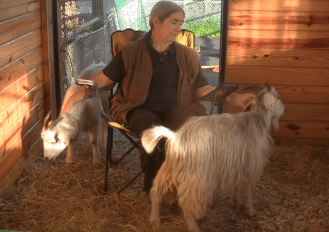
Again, in the evening after the horses were tucked in, I went out to sit with the goats.  This  time it was Elyan who stayed for a visit.  He was on the top platform of the jungle gym.  I set my chair beside him and reached up to scratch his chin.  He closed his eyes in blissful enjoyment.

Galahad came over a time or two but didn’t stay.  Pellias watched from the back area.  He would have had to run the gauntlet of the ladies to join us.  If they hadn’t been there, I don’t know if he would have come over or not.  It was nice to have a few minutes just with Elyan.  Every time I took my hand away, he leaned down to invite me to continue.  Back in July when I began this project, I had no idea how cat like goats are.  It’s one of their greatest charms.

So now it’s on to the double feature of today’s installment of the July Goat Diaries.  I hope this isn’t confusing you going back and forth between these two time lines. 

The Goat Diaries: Day Two Session 4: Keeping Things in Balance
 

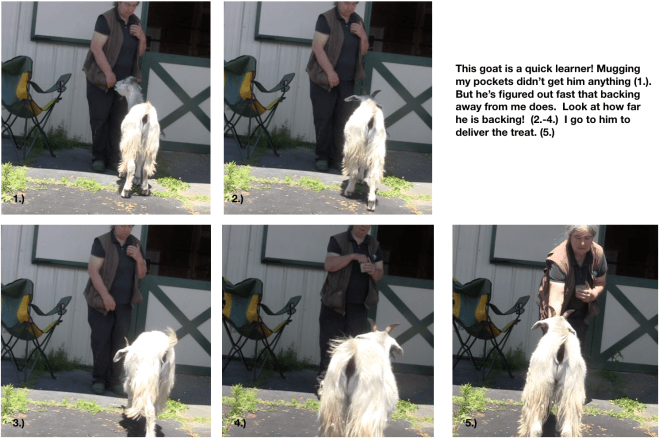
goats backing up to get treats.png

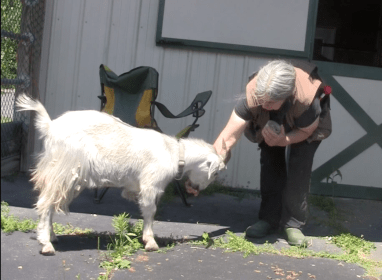
Moving back out of my space gets treats.

In an earlier Goat Diary blog I described how P had discovered that backing up got him treats. Surprise, surprise! This discovery was clearly messing with his head. Why did this work? This evening session was confirming for him that he was right. Backing did work! But why? That was clearly still perplexing him.

One of the core principles I follow in my training is this:

For every exercise you teach there is an opposite exercise you must teach to keep things in balance.

Backing away is great, especially when you are working with an animal that comes equipped with horns! But coming forward to me is also useful. I didn’t want to lose one behavior while I worked on the other. So I also offered him the target to touch.

This is such an important stage in an animal’s introduction to clicker training. It’s easy to be right when there is only one answer. Touch a target – get clicked. That’s easy. But if the only way to get reinforced is when there’s a target around, that’s really limiting. I want my learners to understand that there are many ways to get reinforced. Touching a target is only one option.  But adding in other behaviors complicates the game. Now you have to figure out what is going to work. Is it backing? Is it targeting?  What’s the right answer? If you are guessing, it is easy to become frustrated.

This is when clues begin to morph into cues and a whole new dimension is added to the game.

4th Session 5 pm

P’s Session: Backing Confirmed

You never know what you have taught. You only know what you have presented.

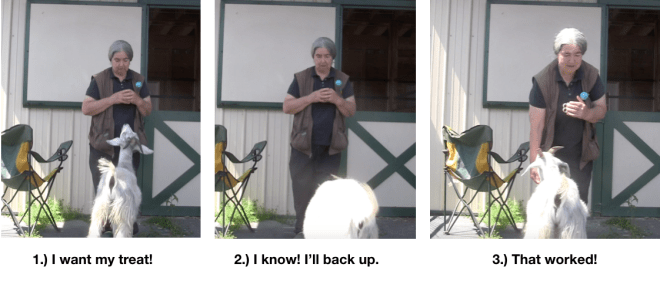
In this session I asked P what he was learning. What would he do when he came forward into my space? The answer: back up away from me. Wow! Was he ever a fast learner! What fun! Now my challenge was to stay a step or two ahead of him.
Goats Day 2 Backing Confirmed P 3 photos.png

Backing Confirmed

With E I continued with some target practice in his stall.  His session showed that he was still unclear what to do with the target. He hesitated between moving to the target and staying attached to my pockets.

It is never a race to see which goat learns the fastest. E was experimenting, learning what worked and what didn’t. This is such an important part of clicker training. One of the main things E was learning was that mistakes were not punished.  It was safe to be close to me, and it was safe to guess wrong.  It was safe to experiment.

With many horses their training history has taught them not to experiment.  In command-based training you wait to be told what to do.  Anything else can get you punished. The first steps into clicker training can feel very unsafe for these individuals.  Instead of enthusiasm, you get worry and caution.  It can be a slow process unraveling the fear that comes wrapped up in their training expectations.  I was glad with these goats we could go straight to enthusiasm.

Video: Goat Diaries Day 2 E following a target  Note:You will need a password to open this video.  Use: “GoatDiariesDay 2 E Learns”


Coming Next: Goat Diaries: Clicker Training Day 2
Goats are Like Horses Except That They’re Not – Platform Training Begins

Please Note: if you are new to the Goat Diaries, these are a series of articles that are best read in order.  The first installment was posted on Oct. 2nd.  I suggest you begin there: https://theclickercenterblog.com/2017/10/02/ 
The Goat Diaries: Clicker Training Day 2 – Different Learners

The Goat Palace

It seems very appropriate that today’s Goat Diary entry is titled different learners because that’s certainly what I have in the five goats.  Yesterday we began the formal introduction to clicker training for our new arrivals.  Thanzi, not surprisingly, was first because she pushed her way through the gate ahead of all the others.  They stayed in the smaller front area with the hay feeders, and Thanzi worked in the back section.

She was brilliant.  I held out my coloured baton as her target.  She touched it, I clicked and gave her a treat so she was well away from me.  I held the target out again.  She touched it.  Click – treat.  There was no mugging, just consistent target touches.  It was as though she already knew the game.  I’ve met horses who were like this.  Robin was one of them.  He caught on instantly to the connections, faster than any horse I had ever met.  Thanzi was Robin smart.

She did decide after a few consistent touches that my pockets needed investigating.  I stayed quiet while she sniffed for treats.  Nothing.  She touched the red ball, click, a treat appeared.  These puzzle moments are golden.  Our animals have to test, to experiment.  What works?  What doesn’t? This is why it is so important to create a good environment for learning.  I don’t want the other goats trying to push their way in distracting her and creating more “noise” in the system.  I want the simplicity of the process to be clear.  Mug my pockets, nothing happens.  Touch the target, click, you can get me to hand you treats.  Simple.

Thanzi reached over and touched the target.  Click, I gave her a piece of squash rind. She was standing still.  Click – treat, click – treat, click – treat in rapid succession for standing still.

I kept her session short, in part because these early sessions should be short, and in part because we still had four more goats to play with.  I opened gate.  Thanzi charged back in scattering the other goats.  I had no preference for order.  Whoever came next would be next.  I had thought P would be first out, but it was little E who rushed through the gate.  He was clearly eager for a turn.

I had set out stacks of plywood to serve as platforms, something I had introduced E and P to during their July visit.  E followed the target, but he was so excited he kept overshooting the platforms.  He clearly remembered the game.  I had no mugging, just lots of eager enthusiasm. I’ve known horses who were like this. After an absence from clicker training, they are so excited to be back in the game, it’s like watching a small child waiting for Christmas.

E is so very sweet.  I could have played with him all morning, but there were others waiting.  We opened the gate again and everyone swarmed into the back area.  Galahad was last.  I managed to close the gate before he could go through, so now it was Marla’s turn to play, this time in the front section.

I was getting the camera set up, when little E squirmed his way through the fence and joined us.  We had planned on putting a hay feeder in the section he got through and then changed the plan, but forgot to change the fence, so now we had two goats eager for attention.

Galahad was having his formal introduction to clicker training.  We knew already that he is very sweet.  We also had discovered that he is a terrible mugger.  So I suggested to Marla that she drop his treats into a feed bucket to make a clear separation between the treats and her pockets.  I wasn’t able to watch because I needed to keep E entertained.

This session was an interesting one for E.  There was a huge pull towards the feed bucket, especially when he heard Marla click.  But I was able to draw him away with the target. He was clearly remembering all the good things he had learned in July.

In the next swap we got everyone back into the front section.  Now I wanted P to have a turn, but first we had to move two hay feeders onto the dividing fence so little E couldn’t join us again.  The juggling of feeders and eager goats was not elegant.  In fact, I would say that described all the swaps.  Teaching each of the goats to go to a station is definitely going to be a high priority.  Today’s chaos was data collecting.  I don’t like the chaos at the gate, but I haven’t yet decided what to do about it.

We got P into the back section where I had all the platforms set out.  He was brilliant.  He followed the target to the indicated platform and stood rock solid on it while I stepped away.  It was as though no time at all had passed since his last clicker training session.  He picked up right where we had left off.  You’ve already seen in the Goat Diary reports that he is a quick learner.  His performance today just confirmed it.

The only problem with this session was little E wanted to join us. He tried several times to come over to the fence, but Thanzi drove him away.  Hmm.  I didn’t like this.  P was having a great time, but E was stressed.  I kept P’s session fairly short in large part for E’s sake.

So now it was Trixie’s turn.  We managed somehow to get everyone but her into the back area.  She’s so much more cautious.  I had a target for her, but she wasn’t ready for that.  Instead I held my left hand out to her.  She was able to come forward to sniff my fingers.  Click. I took my hand down and fed her with my right hand.  For her I was using sunflower seeds, a premium treat.

Thanzi was hovering by the gate.  I moved a feed tub to her side of the fence and offered her the target to touch.  She reached over and touched it.  I dropped some sunflower seeds down into the feed tub.  It took her a few moments to find all the seeds so I had time to return to Trixie.

I thought it might help her confidence to have Thanzi nearby. With the fence between them, Thanzi couldn’t drive her away.  Trixie could have the comfort of her presence without the worry. I also knew I didn’t need to worry about the three boys pushing their way into the game.  They knew better than to go anywhere near Thanzi and the feed tub.

So I offered my hand again to Trixie, and she was able very cautiously to touch it.  Click and treat.  I loved how gently she licked the sunflower seeds off my hand.  I could see her looking at my target stick, so I held it out for her, and she nosed the target. Click and treat.

Thanzi had finished her sunflower seeds, so I offered her the target again.  Click, I dropped more treats into her bucket.  I worked back and forth like this, easing Trixie gently into the game, and keeping Thanzi nearby with opportunities to touch the target.

Again, I kept this session short. We left to work on the construction.  We still had a very important outer gate to build in case a goat slipped past us while we were going in and out of their enclosure.  I do like “air locks” so even if someone gets out, they are still contained in a fenced area.

I’ve detailed these introductions to highlight how much you have to tailor the training to the individuals you are working with.  I like to begin with targeting.  It’s such an easy way for an animal to begin to make the connection between the behavior he’s offering and the treats I’m handing him.  Going directly to the treat pocket doesn’t work, but you can get me to hand you goodies just by touching this target.  From an animal’s perspective it must seem like magic.  And then there’s that funny clicking sound which begins to take on significance.  When you hear that, you know this person is about to hand you a treat.  Get ready.

It’s very black and white, both for the animal and for the handler.  And it’s also normally a very clean slate.  There’s no prior experience with targeting.  That’s especially important with horses.  They often have had such negative training experiences.  If I put a lead on, I’m often instantly into poisoned cue territory because the lead has been used to correct the horse.  Make a mistake and you’ll be punished.  That’s been the message.

So now I have a lead on, and maybe I want the horse to take his nose away from my pockets to earn a click and a treat.  He has no way of knowing what the “right” answer is.  But he knows if he guesses wrong, he’s in trouble.  I don’t want that kind of expectation weaving it’s way around these first clicker training sessions, so I try to begin with something that has no previous training history.  Normally that’s targeting.

A short targeting session can tell me a lot about the animal I’m working with.  That was certainly true with the goats.  The morning session showed me that I have five very different learners.  Normally I would say it was time to have the proverbial cup of tea while I thought about what to do with all the data I had collected.  In this case the “cup of tea” meant go work on the construction while I thought about what to adjust.

Marla and I built the outer gates and then I had to head off for the afternoon so there wasn’t time for another round of training.  In the evening after the horses were settled in, I went out to the goatery to check on everyone and to spend a few minutes just hanging out.  I left my vest outside so no treats were on offer.  Thanzi and Trixie came up to sniff my hands, but they weren’t ready to stay for a scratch.  E and P would have liked to come up to me, but Thanzi drove them into the back area.  Gallahad slipped past her and jumped up onto the top platform of the jungle gym.  I don’t know if he is just bolder than the other two, or she is more tolerant of him.  In either case, he was allowed to stay.

He loved the attention.  I scratched his face and his eyes became dreamy.  There was no more mugging, no more pushy behavior, just total bliss.  He has the softest teddy bear fur, so he wasn’t the only one enjoying the attention.  I did feel bad for E and P though who made several attempts to come forward, but each time Thanzi drove them away.  I have to think how best to deal with this.  It was certainly much easier when it was just the two of them.  And speaking of just the two of them, today I will include a Goat Diary report.  If I don’t, I’ll never get back to E and P’s introduction to clicker training.


The July Goat Diaries: Clicker Training Day 2: Two Different Learners

In the last Goat Diary report I shared with you how P was picking up the nuances of the clicker game at lighting speed. He reminded me of my horse, Robin.  Robin is so very good at seeing connections. He’s like the child in math class who gets to the correct answer without having to write out all the steps. When the teacher tells him to show his work, he gets annoyed. Why do I have to go back through all those little steps when I already have the answer?

With P I recognized the quick brain I was working with. The question was had I learned enough working with Robin and all the other smart horses I’ve met so I could stay at least a couple of steps ahead of this clever goat? And what new twists and turns (literal ones in the case of these very agile goats) would P throw into the mix?

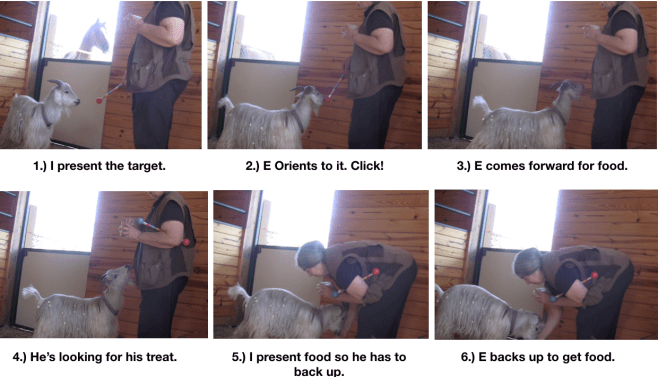
E was a very different learner. He was very sweet, much more timid around people and in new environments, and not nearly as quick at making connections. I started with some simple targeting. He was a much more gentle mugger than P, but he was a mugger nonetheless. So I asked him step back to get his treat, as well.

Target PracticeGoat Diaries Day 2 E learns about food delivery 6 panels

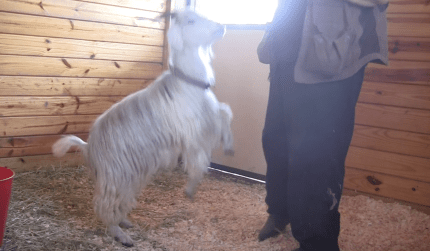
It was clear the connections were not yet being made. He knew that I had treats. He just didn’t know the best way to get them from me. In his frustration he tried pawing and jumping up, two behaviors that definitely were not going to get him what he wanted.

If you don’t know what else to do to get what you want, of course you’re going to try things that have worked in the past.  I had seen E use pawing to pull the hay bucket away from P.  Pawing was a behavior that worked to get him things he wanted.  Why shouldn’t he try it with me?  I needed to expand his behavioral repertoire to give him other possibilities.

Goats E What not To Do pawing

Goats E What not to do jumping

What not to do.

Instead of punishing the unwanted behavior, I used the food delivery to set up an opportunity to click and reinforce him while he was still in his own space.  I hoped he would figure out that staying away from my pockets got him more treats than crowding me.

E wasn’t making the connections. He came forward to check out my pockets. I tried waiting to see what he would do. One of the functions of training is to broaden an animal’s repertoire, to show him more alternatives. By waiting to see what he does you are in effect saying: In this situation where you are feeling frustrated, you could do what feels natural – jump up or paw at my leg – or you could back up away from the treats.

Instead of punishing E for jumping, I want to give him alternatives that work even better to get him what he wants – the treats. As I build a reinforcement history around these more desirable behaviors (from my perspective), I will make it increasingly unlikely that he will choose to jump up.

E hadn’t been doing the intense mugging that P had, so in previous sessions there had been less of a need to use the food delivery to move him out of my space.  After he got his treat, I wanted him to look away from my pockets.  He was struggling to come up with the answer.  I didn’t want to frustrate him so I gave him something he could do. I presented him with the target.

He stretched out his neck to touch it with his nose. Click treat, and then click again for standing still. He was showing me he could keep his nose away from my pockets.  Since the behavior was now occurring fairly frequently, it was fair game to make that the clickable criterion.  I began to wait for him to move his head away from my pockets.  In other words, I began to teach him “the grown-ups are talking, please don’t interrupt.”

Goats day 2 learning to wait E -12 photos
Learning To Wait
E was very sweet, very gentle to work with, but I wasn’t sure he was understanding what I wanted. I was getting the behavior I wanted, but I’m not sure he was really making the connection yet between his behavior and the click/treat. We’ll see what the next session brings.

You can watch a brief excerpt from E’s training session. You’ll need a password to watch the video.   Use: “GoatDiariesDay 2 E Learns”

(Just a quick word about why I have these videos password protected.  They are intended to accompany these diary accounts.  If they are public videos, they could be passed around the internet and taken out of this context.  I’m delighted if you share the links to these blogs with your friends.  In fact I hope that you do.  I wrote them to share, but please do not share the videos outside the context of these blogs.)

Video Goat Diaries Day 2 E Learning to wait

It’s interesting to look at the contrast between the two learners. P picked up really fast that backing away from me for some peculiar reason got me to hand him treats. E didn’t make this leap. He was very sweet, very gentle to work with, but he was not the quick thinker that his brother was proving to be.

He was, however, beginning to stay out of my space which meant I could reinforce him. for standing still. I didn’t want to build in a head turn with the standing. I wasn’t looking for perfection, but I was trying to pick and choose a good moment to click. The challenge was to get a click in before he moved, but not to click on head positions that would work against me in the long run.  I was not always successful.  I had to take his head turning away from me.  That’s what I could get.  I would have preferred to have him looking straight ahead but that wasn’t really there yet.  I would need to build the orientation I wanted  in other ways before I could make it a consistent criterion to go after.  Waiting would only intensify the mugging behavior.

It’s easy to feel frustrated at this stage.  I knew what I didn’t want – the nose stretched up to the treat pocket, or turned too far away to the side, but there didn’t seem to be much in between. What I didn’t want was to lose the standing back out of my space while I waited for something that wasn’t yet there. I was looking for the beginning kernel of a good loop. Find a loop that is tight and clean, and then let it expand. When the behavior you are looking for is already happening, you can make that the next clickable criterion. I was looking for that clean loop. From the beginning to the end of the session we were definitely making progress, just not at the lightning speed of his brother.

Total session time: 8 min.
Coming Next: Day 2 4th Session: Keeping Things in Balance
Please Note: if you are new to the Goat Diaries, these are a series of articles that are best read in order.  The first installment was posted on Oct. 2nd.  I suggest you begin there: https://theclickercenterblog.com/2017/10/02/ 

Goat Diaries: The Goat Palace

We’re off and running!  I can’t say we finished the goat palace yesterday.  There’s still a lot left to do, but it is enough done to receive the goats.  I’m sure the three yearlings were thinking “and about time, too!”  Spending the last couple of days locked in a stall with a very dominant older doe cannot have been fun.  She made it very clear that they could venture out of their corner to get hay only when she was completely satisfied that she had gotten all the best bits.  We were racing to get it done as much for their sake as for our own desire to see it finished.

IMG_3948 the goats in the stall

E, P and Galahad are together in the corner.  Trixie is in the middle of the stall, and Thanzi has her head down eating.  The blankets are to keep their coats clean, not to keep them warm.

We were ready just at dusk.  We took the two ladies out first.  Marla ended up with the “pleasure” of being sled-dogged down the barn aisle by both of them while I kept the boys from going through the stall door.  It was not elegant.

Thankfully they headed in exactly the direction we wanted them to go.  They zipped into their new home.  I had buckets scattered about the enclosure with treats in them: cut up pieces of winter squash.  Thanzi found the buckets right away and quickly forgot about being nervous in a new space.  Trixie was a different story.  She  stayed close to Thanzi, but she was too nervous to check out the feed tubs on her own or to approach us.  As Thanzi found all the treats in one bucket, I dropped others in the next which moved her from bucket to bucket.

When Trixie was close enough to me, I held out my hand as a target.  She was curious enough to reach out towards me. Click, I handed her a treat.  She was also nervous enough to keep her distance, so at this point mugging was not an issue.  That is mugging was not an issue until Thanzi noticed that we were handing out treats.

Trixie was over by Marla and Thanzi shoved her way into the game.  With two it became too confusing.  I suggested that we only try to have them target when only one goat was involved.  I didn’t want the competition, the mugging, or the confusion over what was being clicked.  Marla moved away, and that was enough to interrupt the game for the moment.  As the ladies settled into their new space, we dropped more treats and withdrew to get the boys.

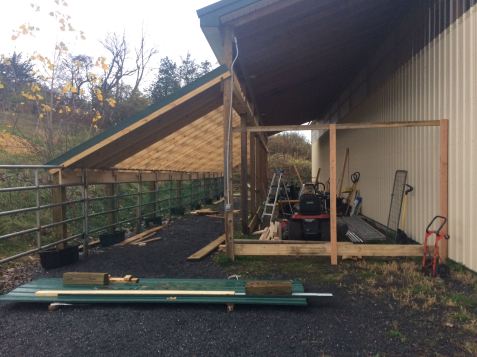
I should pause here to describe what we have built.  The original lean-to ran part way down the long side of the arena.  It was seventy feet long by twelve feet deep.  In the winter the snow sliding off the arena roof often blocked access to the entrance and in the summer it became too hot, so we used it for storage only.  Mainly what it stored were leftovers from the original construction.

For the goat palace we extended the roof out another nine feet to the edge of the gravel roadway that runs along that side of the barn.  So the entire enclosure is 70 feet by approximately 20 feet.  The goats palace is divided by an interior fence into two sections.  The back section is 40 feet by 20.  The front section is 30 feet by twelve.  We reserved the outer half of this section for equipment storage, a 9 by 30 foot space.  So the new entrance to the enclosure sits further out from the barn giving us better access in the winter.

IMG_3934 goat palace under construction

The Goat Palace a week ago.  A lot has changed in a week!

I learned from the July visit. We have built out goat enclosure very much with training in mind.  The entire enclosure is fenced and then covered with mesh both to keep goats in and predators out.  The fence line that runs along length of the equipment area has a narrow gap between two fence boards so we can fill hay feeders from the outside of the pen.  And we can also use this fence line for any protective contact training we want to do.  These two areas for the goats are divided off one from the other by an interior fence line so we separate the goats for training.

For now we had the two ladies locked in the back half so we could get the boys in without a struggle at the gate.  They were very eager to be out of the stall.  I led the way with E and P.  They definitely did not lead with the good manners they had left with!  They pulled all the way down the barn aisle.  Again, it was not elegant, but we got them out to their new home and turned them loose.

We had four home made hay feeders hanging along the rail of the front enclosure.  They found those quickly enough.  We let them explore and eat for a couple of minutes, then we opened the gate that separates the front and back half, and let the ladies join them.  Actually, it was the other way around.  The boys went to them.  They all ran around exploring, then they settled down at the hay feeders.

Marla and I were sitting on some elevated boards that are part of a jungle gym I built for them out of a couple of saw horses, and a big wooden box.

Trixie came over first and very tentatively held her nose out to Marla’s offered hand.  Click, Marla reached into her pocket and gave her a hay stretcher pellet.  I was holding a big bowl of cut up squash rind.  So after a couple of target touches with Marla, I offered my hand as a target.  Trixie very tentatively switched over to me.  Click and treat.  Then Marla offered her hand as a target.  Trixie went back to her.  We did a couple of these exchanges then Thanzi came over and Trixie retreated to the hay feeders.

Thanzi went first to Marla who was sitting closest to her.  Marla held out her hand and clicked as Thanzi reached out her nose towards her.  She fed so Thanzi had to turn her head to the side to get her treat.  I offered my hand as a target.  Thanzi came right over, click, but then she spotted the food bowl and went straight to helping herself.  Marla snatched it away and put it up out of reach on the top part of the jungle gym.

That seemed to sort the mugging, at least for the moment.  Marla held out her hand as target and fed so again Thanzi  had to turn her head to the side to get the treat.  Marla did this a couple of times.  It helps to have a spotter when you train.  I suggested that instead she feed so Thanzi would have to take a step or two back to get the treat.

This worked like a charm.  Thanzi stepped back beautifully, and after only two or three clicks, she was staying back.  I clicked for that.  Marla had to feed because she was in reach, but I did the clicking.  Thanzi is very bold.  Mugging is definitely a potential problem, so to see her so quickly step back and stay back was exciting.

She was staying back beautifully.  And then Galahad left the hay feeder and climbed up the back side of the jungle gym and discovered the treat bowl.  E and P quickly joined him.  Game over.  We were too busy laughing to train.  Now everyone was up on the jungle gym.  I do wonder what the poor horses are going to think of all this racket.

It was starting to get cold, so we left them to their play and went in to finish the barn chores.

I was going to include another post from the July Goat Diaries, but this is enough for today.  I’m eager to get the day started and to see how the goats are this morning.  I’ll get pictures of the finished goat palace soon.


Goat Diaries – Clicker Training Day 2: These Goats Are Smart!

The goat palace is almost finished.  We were hoping to get it done yesterday afternoon, but we didn’t quite make it.  The three yearlings are feeling very squashed in the stall by the oldest female, Thanzi.  She is making it very clear that they are TO STAY IN YOUR CORNER.  I am glad we decided in our construction to use the entire space the lean-to provided and didn’t just settle for making a small goat pen.  They will have plenty of room to spread out.

So for this morning it is back to July and the Goat Diaries.  I had gotten as far as mid-morning of E and P’s second day of clicker training.

Training Rhythms

Good training begins to have a rhythm to it, especially in these early stages where you are asking for simple behaviors, and you’re keeping the rates of reinforcement high. It’s get the behavior – click and feed, get the behavior – click and feed, – get the behavior, click and feed. It becomes a training loop. We’re looking for clean loops.

When a loop is clean you get to move on, and not only do you get to move on you should move on. That’s the mantra of loopy training. Often people change criteria too fast which ends up confusing the learners. Or they stay too long at one step so they build a glass ceiling into their training.  To the learner backing up means three steps and only three steps. If the handler asks for four, there’s frustration. The learner knows the behavior. It’s three steps and three steps only!

The mantra of loopy training helps you to know when to move on. It also helps you to know when you should pause for a moment to let your learner show you what he has learned. Canine trainer, Kay Laurence refers to these pauses as puzzle moments.

In these early sessions with these goats I was beginning to establish some training loops. P in particular was such a fast learner, it was time to give him some puzzle moments to see what dots he was connecting.  If you aren’t sure what a puzzle moment looks like, P is about to show you.

Session 3: 11 am
I started with P out in the pen. He was ready, eager to touch a target, but my attention was elsewhere.  I was busy setting up the camera. I was very aware that I might be missing a window of opportunity. We began with a little targeting. He oriented to it, I clicked, fed, and then clicked and fed again while he was still out of my space. The jumping up on me to try to get the food that he had been doing in the previous session was almost completely gone.  My active use of food delivery was paying off.

Click for targeting. Feed where the perfect goat would be. The perfect goat would have all four feet on the ground. He would be looking straight ahead, and he would be outside my personal space.

After I clicked, I fed P so he had to take a step or two back to get the food. My concern here was the food delivery caused him to curl his neck so his head was in the orientation it would be for butting with his horns. I didn’t want to trigger that behavior. But head butting is a forward moving behavior. Here he was moving back, so I hoped that his feet would keep his head from thinking he should be charging me.

Get them while they’re standing still.

I fed P so he had to back up a couple of steps to get to the treat in my hand. Before he could come forward again, click, I was giving him a treat – this time where he was standing. I wanted him to get the idea. Standing still, away from me, is a good thing. Click treat, click treat. I was tightening the training loop down to the tiny fraction of a second in which he was standing still looking straight ahead.

The neighbors were mowing the hill up above the barn. P kept turning his head to the side to check them out. His feet were still, but I didn’t want to make such a full head turn part of the behavior. I had to wait, hoping his feet would be still when he finally looked back in my direction. Click then treat.

When I clicked, I used my food delivery to move him back a couple of steps. I wanted to be able to click again while he was still standing back out of my space. I also wanted his head to be straight. If I clicked too many times when his head was turned, I was concerned that I would build that into the base behavior. So I had to wait to click until his feet were still AND he had his head straight. Asking for two criteria at once was pushing my luck. The first couple of times he was too quick for me. He straightened his head, but just as I began to click, he was shifting forward.

I moved him back again with the food delivery. He took his treat from my hand.  Before I could click again, he had come forward into my space.

I work hard to avoid putting my learners into a macro extinction process.  Here’s what that means: This behavior has been consistently working to get me to hand you treats. Only now suddenly, it’s not. You’re not going to be reinforced for this very successful behavior.

We all know how frustrating this can be. You put your money in the vending machine and nothing comes out. Time to shake the vending machine!

My training rhythm was broken and P didn’t yet have enough experience in the game to know what to do. His repertoire of behaviors was still too limited to offer me something I could reinforce. Instead he was trying to go directly to my pockets. I suspect by this point the small children he had grown up with would have dropped pretzels and peanuts all over the floor and everyone would be happy. The children would be giggling, and P would be gobbling up the goodies. Only this wasn’t how I played the game. How annoying!

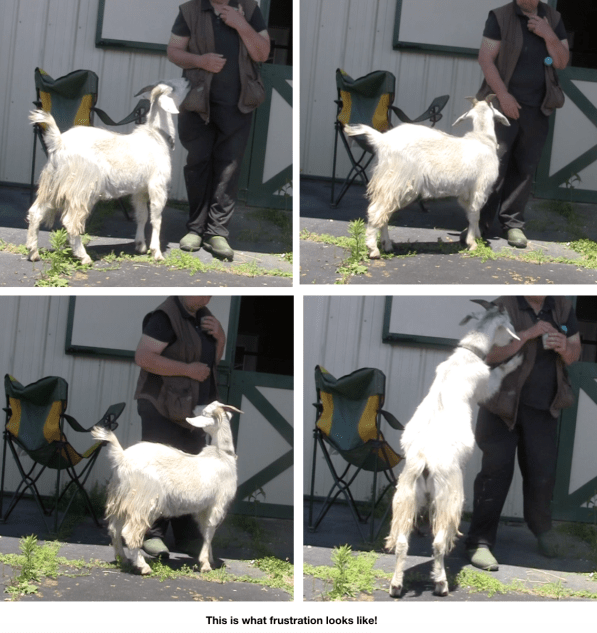
P gave a little chuff of a sneeze. I had llamas years ago, so I recognized this sound as a sign of frustration. He tried both my pockets. Nothing. He gave a head toss which I dodged, and then I got lucky. He dropped his head away from me enough so that I could reinforce him. The food delivery moved him out of my space, and we were back on track building good behavior.

Goats day 2 what frustration looks like 4 photos.png


Goats Day 2 back up to get clicked 3 photos.png

Training is not without moments of frustration. I was beginning to recognize what this looked like in a goat. A little tail wiggle, a snort, a head butting gesture – these all told me that P was struggling a bit to make sense of what was happening. Why wasn’t I just giving him treats! That’s what the children would have done. And if they didn’t give him treats, he’d just jump up on them, and that was sure to make them scatter their peanuts and pretzels on the ground!

But here this was different. He was clearly frustrated. Doing what had always worked in the past, namely crowding into me didn’t work. Looking away, taking a step back, produced treats!  It made no sense to him, so while it produced treats it also produced a puzzled goat.  And a puzzled goat can very quickly become a frustrated goat.  Noted.

I was monitoring carefully. Always I am asking myself is this working? Is this the best strategy? How much frustration is too much? What should I change? Should I stop?

Puzzle solving!

There is a time to be clicking, and a time to just wait it out and let your learner work out the puzzle. Through the food delivery, I had shown P the answer. Back away and you get treats. Would he put the pieces of the puzzle together? I waited. The skill here is to be quiet, to remain as non-reactive as you can be and let him figure out the answer. A puzzle you solve for yourself, is an answer you will own.

He could sniff at my pockets. I remained non-reactive. How frustrating! I was not playing the game fair. The children would have been flailing their arms about and pushing him away. Which meant they would also have been dropping treats. Push on the vending machine, and it scatters goodies over the ground, except not now.

His feet took him back a couple of steps. Click – treat. The next time the backing was even more definite.

He caught on fast and began to back away from me. When he came forward into my space, now I could wait. It was a puzzle moment. What would he do? I had shown him the answer through the food delivery. Would he find it now on his own?

The answer was yes! He backed up, not just a little, but multiple steps. And he backed with energy. Very neat!

Goats day 2 Quick study 5 photos.png

P was definitely a quick study. He was beginning to understand that he could get the food by doing other things besides jumping up or bumping my pockets. It was a really fun session watching him catch on so fast. Though I got the impression that he was still very confused. Backing was clearly working, but it didn’t make sense to him. How could backing up get treats to appear? He was a very puzzled goat.

I sympathized. We’ve all been given sets of instructions that make no sense. Whatever is logical – do the opposite. How maddening is that! Especially when it works!

I would find out in the next session if P could reconcile himself to this new inside-out world order.

(Note: we had moved on in the treats. I was now using a mix of peanuts, peanut hulls, sunflower seeds and hay stretcher pellets as treats.)

Training time for this session: 6 minutes.

Video: Video: Goat Diaries Day 2: A Quick Study: Note you will need a password to watch this video: GoatDiariesDay 2 E Learns
“A puzzle solved is a behavior owned.” P showed me he was making the connections – fast!

Video: GOAT DIARIES/Day 2/Problem Solving: Note you will need a password to watch this video: GoatDiariesDay 2 E Learns


Coming next: Day 2 Continued – Two Different Learners

A Detour from the Goat Diaries

I Have a Goat Herd
The goats are here!  They arrived mid-day yesterday.  We were a long way from being done building their “Goat Palace”.  We still had four panels to put up on the roof, the interior fencing to finish and three gates to build.  So the goats went into a stall.  I was originally thinking we would put them into the arena, but the consensus was they might be too hard to catch in such a large space.
They traveled in the back of her covered pick-up truck.  It was a very different arrival from the one I described in the Goat Diaries.  When E and P arrived back in July, they were huddled together against the back of the cab.  The Sister had to climb into the truck to bring them out.  Not today.  When she opened up the back of the pick-up, the goats crowded forward to greet us.

There were five goats in all.  That was a surprise for Marla.  Sister Mary Elizabeth had asked me if I could manage a third yearling.  I thought Marla would enjoy having a training project of her own.  As a thank you for all the help she’s given me building the goat palace, I said yes, by all means bring him along as well.  We have plenty of room for them all in the goat palace.  (I’m not sure about time!  I’m glad I got a jump start on the clicker introductions with E and P.)

The little one Marla will be working with is Sir Galahad.  He’s snowy white with the softest, most luxurious fur and such a very sweet face.  He is leased by a child who loves him, so he will be going back in the spring to be part of the summer 4-H program.  He is very friendly.  That puts us way ahead in the training.  He stayed right by the tail gate, enjoying a head scratch from both of us.  It is so interesting always the differences between individuals.  Initially, E and P froze when I pet them.  They stayed under my hand, but it was a long time before they showed any outward signs of enjoyment.  Galahad was clearly well versed in the pleasures of having your head scratched.  His response was very reinforcing and very cat like.  All the places cats most like to be rubbed and scratched seem to be what goats like best as well.

The two ladies are black goats.  They have blankets on to keep their fur clean so I haven’t seen them “undressed” to see how much brown they have in their coats.  Both ladies came right up to the tailgate.  They were very interested in the hay stretcher pellets I offered them.  Again, there’s a difference.  E and P wouldn’t take anything from me until the pretzels and peanuts arrived.  These ladies weren’t at all fussy about what I was offering them.

Thanzi (I hope I have the spelling right) was introduced first.  She’s a grand champion which means she produces top class cashmere.  I am looking forward to feeling her coat!  She was also described as an alpha in the herd.  She is very bold.  She’s not worried at all by the world at large.  But she does pull like a freight train so she can be difficult to handle.  She weighs about 120 pounds so when she wants to drag you on the end of a lead, she can.

Trixie (her barn name – I don’t yet have the spelling of her formal name) is a spotted goat.  Apparently, spotted goats are not favored by the cashmere producers.  It makes it harder to sort their fiber, but the Sister feels that it is important to maintain the spotted genetics in her herd, so she is very much looking forward to seeing the babies Trixie produces.  She’ll be easy to tell apart from Thanzi because she has a large white spot on her forehead.  I like having goats that are so easy to tell apart.  Trixie is a very different personality from Thanzi.  She’s much more nervous.  While we were talking, she started to shake. The shaking gradually stopped, but she was still clearly feeling very nervous.

And then there were the two boys, E and P, back again.  They were stuck behind the two ladies.  If they had been by themselves, I don’t know if they would have come forward, or not. Thanzi had very strategically placed herself so they would have had to be very brave indeed to push past her.

I got a stall ready for them. I love the versatility of the barn.  Normally, Fengur and Robin use two stalls as pass-throughs, but I could close off one, move the hay bag into the barn aisle and create a space for the goats without imposing at all on the horses.

So we were ready.  Since Galahad and the ladies were up by the tail gate, it was easy to put leads on them.  We opened the tail gate.  Galahad was the first down, lured easily by the offer of hay stretcher pellets.  The ladies jumped down following the same invitation for treats.  We left E and P in the pick up and pointed the goats in the direction of the barn.  They do indeed pull!

We got them safely into their stall, then went back for E and P.  They were more wary.  I held out my hand, and clicked when they looked at me.  They came forward to get a treat, and I was able to attach leads to their collars.  They jumped down, as well, following my hand held out as a target.  They did a fair bit of pulling down the barn aisle, so they will need a refresher course in leading.  In training you never erase old learnings.  They will always know how to pull.  Hopefully, they will also remember how to walk beside me with slack in the lead.

We gave the goats more hay, watched them for a few minutes and then went back to our construction project.  We finished the roof!  Hurray!  And just in time, too, because it rained last night, and today we have high wind warnings.  Our roof will get it’s first test.

We made progress on the interior fencing.  We have a couple more gates to build, and some other details to finish, but the end is in sight.  What pleases me the most is how we have been able to use up so much of the left overs from the original barn construction.  It is very satisfying to be able to put to good use all these miscellaneous things that have been so very much in the way.  It gives the goat palace a very “home made” look, but hopefully people will just think that it adds to it’s charm.

At the end of the evening, after all the barn chores were done, I sat with the goats.  I set my chair just inside the door.  The two ladies stayed away.  P watched from a distance as well.  But Galahad came right over and tried to raid my pockets.  He knew I had treats in them, and he was determined to get to them!  While he was busy trying to figure out how to get to my well protected pockets, E stood in front of me and enjoyed a head scratch.  There was zero mugging from him.  I distracted Galahad as best I could by scratching his head.  He finally gave up trying to get to my pockets and enjoyed the attention instead.

I left to pass out the mashes to the horses.  When I looked in on them a few minutes later, the three boys were all in a huddle in one corner of the stall and the ladies were standing apart from one another eating hay.  I checked them again just before lights out.  E and P were curled up together all in a heap.  Galahad was already asleep off by himself, and the ladies were lying down apart from one another.  When I looked in on them just after 5 this morning, they were all in the same spots.

It’s now getting light enough to do barn chores so time to post this and get on with the construction.

The Goats Are Coming Back!

I’m interrupting the Goat Diaries to bring you an exciting message.  The Goats are coming back!  E and P were with me for just twelve days in July.  During that time, they generated enough material to fill a book.  As you know, I’ve turned that into the Goat Diary posts.  The goats brought good learning and lots of laughter.  I’ve missed having them in the barn, so I asked to have them back.

E and P are coming.  They are going to be joined by two pregnant nanny goats so next March I will have the pleasure of intorducing their babies to the world via clicker training.  What fun!

One of my coaches, Marla Foreman has been staying with me this past year.  Her mare, Maggie, is now one of the residents in the barn.  The two of us have been putting in long days building the “goat palace”.  There’s a seventy foot overhang down one side of the barn.  It’s been a fairly useless space.  Originally, I intended to use it for guest horses, but in the summer it gets too hot.  And in the winter, the snow coming off the roof blocks access to it.  We store the lawn mower and the snow blower out there, plus the left overs from the original construction, but beyond that it isn’t used.  So there were two main goals for the building project.  The first was to use up all of the construction left overs, and the other was to create living quarters for the goats.

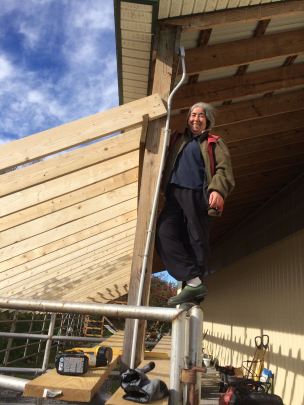
We’ve turned the lean-to into a glorious space by extending the roof out another nine feet.  It’s been a fun project.  I never imagined that I would be up on scaffolding building rafters, or as we were yesterday, putting on metal roofing panels.

IMG_3871 AK on scaffolding of goat palaceSince it is one of my projects, there are many creative twists to the construction.  If you can put aside “the book” whether its for training or building, to look for alternative solutions, you can be pretty certain that’s what I’ll do.  We have lots of very expensive and very necessary drainage running under what is now the goatery.  I didn’t want to risk damaging the the drainage by digging post holes.  That’s always been the stumbling block to finishing this section of the barn.  How could I extend the roof without digging holes for the supporting posts?  With the goats acting as an incentive, I finally came up with a solution.  This is what I love best about building things. Whether it is a construction project or a training program, the problem solving is the most fun.

Marla and I did a lot of creative problem solving as we figured out how to build a roof. We had the existing lean-to to follow as a guide, but then there were the Kurland creative twists to figure out.  The goats are coming tomorrow, and we’ve still got a lot of work to do.  There are several more puzzles to solve before we’ll be ready to welcome them, and then there will be all the puzzles they present.  It’s going to be a fun winter!

Goat Diaries: Clicker Training Day 2 – Quick Learners!

Please Note: If you are new to the Goat Diaries, these are a series of articles that are best read in order.  The first installment was posted on Oct. 2nd.  I suggest you begin there: https://theclickercenterblog.com/2017/10/02/
Protective Contact
I talk a lot about protective contact. I like to begin with a barrier between the animal learner and the handler.  The more I worked with the goats, the more I appreciated just how important beginning in this way can be.  Now I am sure there are many who will read this with eyes rolling. These are baby goats! Are you so afraid of them that you need a barrier?

There are times with certain individuals where the answer would be: “Yes, absolutely I’m afraid of this animal – and so should you be.  Whether it’s a tiny terrier, or a giant horse, this individual has demonstrated that he will defend himself.   While we’re working out our relationship, I’ll keep myself safe by working behind a barrier.

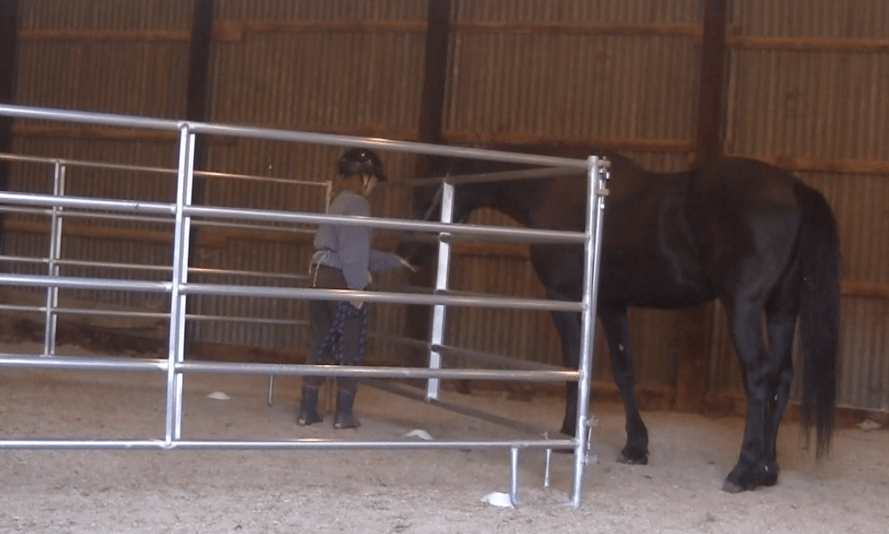
aries protective contact.png

In this case it’s the human who is on the inside of the round pen panels. The horse is free to leave.  What he’s chosen is to stay and interact.  What he can’t do is charge his person which was the behavior he was showing earlier.

Safety can also work the other way.  It’s the animal who is afraid of us. The barrier means the handler can’t get any closer. The animal can choose when he feels comfortable enough to approach, and he can also retreat any time he needs to. That freedom of choice builds confidence. The barrier may feel restricting to the handler. We want to be in with our animals, actively doing things with them, but in the long run beginning with a barrier can help build the truly connected relationship we are looking for.

Barriers aren’t just about safety. They also limit options which means that your learner isn’t practicing behaviors you don’t want. If I don’t want mugging behavior to become woven into the matrix of these early lessons, the barrier can help. I can just step back out of range so my horse can’t reach my pockets, or my dog (or goat) can’t jump up on me.

When these unwanted behaviors aren’t present, it’s so much easier to find and reinforce behavior that works well for both of us. I’m not punishing the behaviors I don’t like. I am simply arranging the training environment so it’s easier for my animal learners to offer behaviors I like.

With the goats I didn’t have a set up that let me begin with protective contact. So instead I borrowed again from the horses and used the treat delivery to help create some spatial separation.

8 am 2nd session

At 8 am I  gave the goats hay in their stall. P left to come to me, so I had him follow the target into the outside pen. E wanted to come, but I managed to close the door before he could join us. P was very eager. I was holding a cup of grain and peanuts in my hand. I wanted to keep their treats separate from the horses’ so the cup seemed the best option.

The first session or two of clicker training can seem so easy, especially with a nervous learner. He’s just beginning to figure out that treats are involved, but he’s still a little worried about approaching too close so mugging behavior is manageable. But give him time to think, and this is what he may come up with: Why bother with the target. Why not just go straight for the treats?

This was clearly what P had concluded. He kept jumping up on me. I could deflect him easily, but hmm. This was decidedly not what I wanted. If my set up had allowed, I would have gone to protective contact to keep him from practicing this behavior. Instead I borrowed another technique from the horses. I followed the mantra: “Click for behavior. Feed where the perfect horse (or goat) would be.” The perfect goat would most definitely not be jumping up to get his treat. When I clicked, I fed him so he had to take a step or two back.

Goat diaries Day 2 P jumping up.png

This is obviously NOT behavior I want.

Goat diaries Day 2 P being fed so he backs up.png

To help create some space between us, I fed him so he had to take a step or two back to get to his treat. Note: I am NOT pushing him back.  I simply imagine that there is a bucket sitting where I want to deliver the treat.  He moves with me and shifts out of my way just as he would if there actually were a bucket I needed to get to.  If you don’t yet have the feel of this kind of treat delivery, begin with an actual bucket.  When you can smoothly deliver treats to the bucket and your animal moves out of your way to let you get to it, you’re ready to shift to imaginary buckets.  Teaching your animal learner that he may have to move his feet to get to his treat opens up many more possibilities for shaping behavior.  The food delivery becomes a much more active part of the training.

You never know what you have taught. You only know what you have presented.

That is something I say often in clinics. As I deflected the jumping, I was thinking about that.  I was looking for something I wanted to reinforce. I didn’t want him practicing this behavior, and I most certainly did not want to chain it into something else that I did want. P was too fast a learner for that. I could see him figuring out the following sequence: jump up, then look at the target and voila – this human feeds you peanuts! Not good.

When I did click, I fed P so he had to back up away from the cup of treats. Definitely it was going to be interesting to see what he did in the next session. What learning was taking place in that clever head?

When I stopped with him, I dropped some treats on the ground. It was a bit of a struggle to get him to find them. He was orienting to my fingers, not moving to the treats. I finally just stood up, and that’s when he started eating the dropped treats.  That bought me the time I needed to slip back into the stall so I could work with E.

Little E was a perfect gentleman, especially compared with P. He followed the target pretty well, and backed up gently for his treat. It was overall a very pleasant session. On the previous day when I worked them together, I was seeing a lot of head butting between them.  Frustration and resource guarding was creating a problem.

Before P jumped over the dutch door and showed me that they could be separated, my plan had been to teach them to stand on platforms. With each goat on his own platform, I would be able to bring some order to our training.  Now that I could separate them, I could put that strategy on the back burner.

Goat diaries day 2 E getting his treat.png

E moves back to get his treat.  He was a perfect gentleman in this session.

Coming Next:  Day 2 – These Goats Are Smart!

Please Note: If you are new to the Goat Diaries, these are a series of articles that are best read in order.  The first installment was posted on Oct. 2nd.  I suggest you begin there: https://theclickercenterblog.com/2017/10/02/


Goat Diaries: Day 1 Continued – Lessons From Panda

Please Note: If you are new to the Goat Diaries, these are a series of articles that are best read in order.  The first installment was posted on Oct. 2nd.  I suggest you begin there: https://theclickercenterblog.com/2017/10/02/

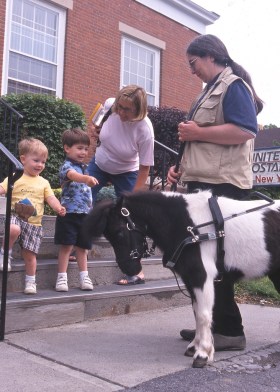
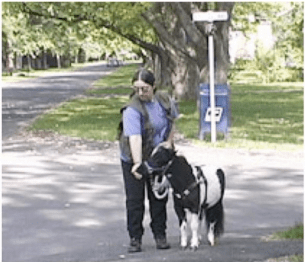
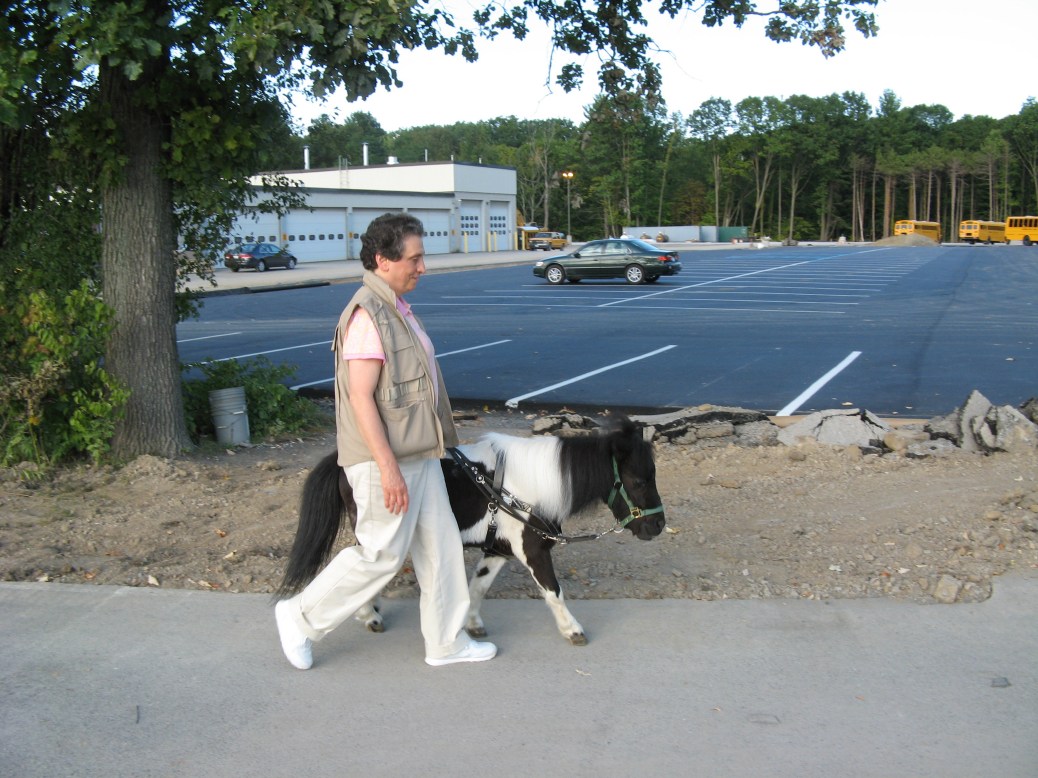
p5_TrainerAlexandraKurlandPandaWithLittleBoys AtPostOfficeDelmarNYNeilSoderstrom.jpgThese goats were not the first dog-sized herbivore I have worked with. Panda, the miniature horse I trained to be a guide for the blind, has that honor. I was quickly discovering that the principles and lessons I had used in her training were going to apply very much to these goats. They may be very different species, but their training needs were similar. The rules I set myself for Panda very much applied to the goats.

One of the primary rules was a core training principle:

You can’t ask for and expect to get something on a consistent basis unless you have gone through a teaching process to teach it to your horse.

That meant I couldn’t ask Panda for anything that I had not taught her. If I wanted her to stand still while I talked to my neighbors, I had to first teach her what I wanted her TO DO. I couldn’t expect her to just know how to be patient. And she had to learn to be very patient because people were bubbling with curiosity when they saw me walking a miniature horse around my suburban neighborhood.

Panda at curb in neighborhood.png

Panda at 10 months out for a walk around the neighborhood – fall 2001.  I am reinforcing her for stopping at the curb after crossing the street.

I also had to be consistent. I kept in mind a phrase I had learned from John Lyons many years ago: “The horse doesn’t know when it doesn’t count, so it always has to count.” Panda’s blind owner would never be able to see a curb crossing, or a root sticking up through a sidewalk. If I wanted Panda to be consistent in her guide work, I needed to be 100% consistent in her training.

These two training rules served me well when I took them to the goats.

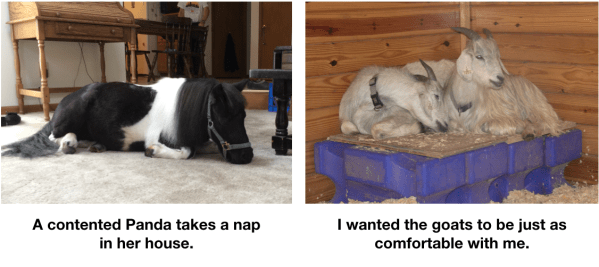
Panda napping goats nappingSession 7: 4 pm
I took the chair back in and set it in the middle of the stall. Both goats were eager for food, so eager in fact they were practically in my lap. I decided to work on “grown-ups” to get a feel for how that would work with them.  Grown-ups is short for a lesson I refer to as “the grown-ups are talking, please don’t interrupt.”  Grown-ups means the goat (or horse) stands beside me in his own space. Ideally he is looking straight ahead so his nose is well away from my treat pockets.

Sitting as I was in a chair, I was thinking about Panda. One of the early behaviors I worked on with her was this one of having her position herself beside my chair.  In fact, my second book, “The Click That Teaches: A Step-By-Step Guide in Pictures” was written while I was teaching Panda to stand next to me while I worked on the computer.  It was the start of teaching her a base position out of which so much of her guide work evolved.

Panda guiding - great walk.JPG

Panda as a working guide

Panda is tiny. At nine months of age when her training started, she weighed about 120 pounds. I could easily have pushed her into any position I wanted, but that would have broken one of the rules I had set for her training. It’s worth repeating that my primary rule was I could not ask her for anything that I had not first introduced to her through a teaching process. If I hadn’t taught her how to stand next to my chair, I couldn’t ask her to do so and expect her to be successful.

Connected to this rule, I could not physically move her around. It was always up to Panda to move her own body in response to my request. If she was standing with her hind end swung too far out away from my chair, I could not push her back into position.

With small animals that’s so easy to do. We can push, pull, and drag them around. We can even pick them up and carry them.  Who needs training when you can do that!

With ponies that is so often why they get such awful reputations for being stubborn and for “misbehaving”.  They may not get picked up like a baby goat, but they certainly get pushed and shoved around.  They aren’t really being taught what is wanted.  While they are still too small to put up much of a fuss, they are just pushed around. It’s easy. It’s quick. It gets the job done, but it leaves behind negative fallout.

With Panda if I wanted her to move her hip over, I could put my hand on her hind end. I could indicate a direction I’d like her to move, but I had to stop at that point of contact and wait. Another wonderful phrase for the point of contact is point of attention. I would wait there for Panda to notice my hand and then make a response.

When she shifted her weight even the tiniest bit, I would take my hand away as I clicked. The click was always followed by a treat. Pushing her over would have been faster in the moment. Waiting took more focus, but the results were well worth the wait.

Panda has been working as a guide for over fourteen years.  Following these rules in the foundation of her work helped build this long-term durability in her work.

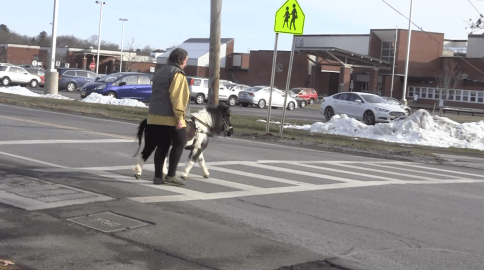
Panda walk 1.1.17  cross delaware.png

Winter 2017

I was following the same rules with the goats. They were so much smaller than Panda. E probably weighed only about thirty or forty pounds. I could easily have picked him up, moved him around any way I wanted. That would get him from point A to point B. It would be easy – this time. But the more I followed that path, the less he would want to have anything to do with me. He might approach me because I had peanuts, but the minute my pockets were empty, he’d be off. That wasn’t enough. That wasn’t the relationship I wanted to build.

P was the first one to come over to visit. He came around the right side of my chair and got lots of clicks and treats for staying by my side. E was still eating hay which made it easier to focus just on P.  When E joined us, it was harder to separate out who was getting clicked for what. We were very much where you would expect to be at this stage – eager chaos with some order beginning to appear.

I kept this session short. Better to do a little and then leave to think about what to do next next than to stay and let their eagerness turn into unwanted behaviors.

(Note: each of these sessions were only about five or six minutes total.)

Session 8: 8 pm
For their final session for the day I went in without treats and set my chair down near their hay pile. They were comfortable enough with me to continue eating. I reached out and stroked their backs. They didn’t run away but they stopped eating. Curious.

I haven’t worked with goats enough to know what – if any – stroking, scratching, rubbing they enjoy. Are they like llamas who really don’t want the contact? Or are they more like horses who enjoy a good social grooming? I scratched the base of E’s ears. He stopped eating, but he stayed.

His body was tight. He showed no outward signs of enjoyment. His lips weren’t wiggling the way a horse’s would. His eyes weren’t getting dreamy. But he was staying. I scratched some more around his ears and the back of his neck. P crowded in so I switched to him. As soon as my hand left him, E went back to eating.  As I scratched P, he also froze.   When I stopped scratching, he put his head down and began eating hay. Scratch – the eating stopped. Interesting.

I sat with them for about half and hour and then left them for the night.

Goat Diaries Day 2 Cuddle Time

Evening “cuddle” time.

Coming Next: Day 2: Quick Learners

Please Note: If you are new to the Goat Diaries, these are a series of articles that are best read in order.  The first installment was posted on Oct. 2nd.  I suggest you begin there: https://theclickercenterblog.com/2017/10/02/
And to learn more about clicker training visit my web site: theclickercenter.com

Goat Diaries – Day 1 Continued: Cups of Tea

Please Note: if you are new to the Goat Diaries, these are a series of articles that are best read in order.  The first installment was posted on Oct. 2nd.  I suggest you begin there: https://theclickercenterblog.com/2017/10/02/
Collecting Data

tea cupI frequently tell people that it’s time to put their horse away and go have a cup of tea.  Yes, we want to spend time with our animals, but in these initial forays into clicker training less is often better.

When I’m coaching horse owners, I have them count out twenty treats.  When they begin their sessions, that’s all they have in their pockets. That forces them to step away from their horses to refill their pockets.  They can go right back to their horses after they have replenished their twenty treats, but that brief break in the training gives them time to think and adjust.  I was doing a lot of adjusting as I introduced myself and clicker training to these goats.

In all I did eight sessions on this first day.  That may sound like a lot, but they were each just a few minutes long, and they were spread out throughout the day.

Session 5: 1 pm

I tried working from the outside of the stall. The goats were interested in the target, but it was too hard to deliver the treat, so I kept this session short.  My stalls are perfect for starting horses with the clicker.  I designed them with that in mind.  I wasn’t thinking about goats.

Targeting over the stall wall was worth the experiment if only to show me that wasn’t going to work.  I would have preferred separating them and working them one at a time, but I thought that might really stress them.  The compromise was a less than ideal set up.

So many of the people who have their horses at home are in the same boat. They have a paddock with a run-in shed that’s shared by three horses. Chaos! At least the goats were little so we could all three tolerate a bit of chaos.

In this respect they were more like dogs than horses. Size does make a difference.  People are much more casual getting dogs started with clicker training than I am with horses.  Just imagine trying to work with goats that weighed in at a thousand pounds each! It’s challenging enough at times with horses, but remember goats have horns, and they can jump and wiggle in ways a horse simply can’t.

Just because you can doesn’t mean you should.

Just because I could manage two goats at once didn’t make it ideal.

I wanted to step away from the goats and think some more about how best to work with them. These short sessions let me test the waters. I was giving things a try, seeing what worked and what didn’t, and then I was stepping away to think about how to do it better.  Goat or horse, this would be the pattern.  Always it is the animals who show you what they need to work on and what you need to change to make things better for each individual.

Session 6: 3 pm:

In my previous sessions I had sat in a chair and let the goats come to me.  This gave them a sense of safety.  As long as I was sitting in the chair, it was clear I wasn’t going to try to corner them in the stall and grab them.  But now that they were eagerly coming up to me to get peanuts, it was time to make a change.  I wanted to be able to move around more, so this time I went in without the chair.  My plan was to see if they would begin to follow the target.

When I went in, they were both eating hay out of the bucket. I was struggling to remember their names  – Sir Elyan and Sir Peleus, so I simply referred to them as E (the little one with the long hair) and P.

E and P are easy to tell apart. P is the larger goat with short guard hairs (on the left).  E is much smaller, and he has long hair (on the right). I was quickly discovering that they were as different in their personalities as they were in their physical appearance.

goats in stall Day 1

“P” is on the left.  “E” on the right.

As soon as I stepped through the door, P left the hay and began to follow the target. He stayed in the game. E joined us when he realized P was getting treats. P seemed to be making connections fast. It was clear he was beginning to understand the game. Little E was too busy butting in (literally) to get his brother’s treats to notice what was going on.

I began testing the waters a bit more in this session. They were definitely eager for treats. If they had been horses, I most certainly would have wanted some kind of barrier between us. That much eagerness in a thousand pound body can quickly become overwhelming.

I didn’t want to punish them for being eager, but I did need them to understand that while treats might come from my pockets, I was not an open salad bar.  You have to wait for your “dinner plate” to be brought to you.  With horses I would begin delivering the treat so the horse had to take a step or two back to get to it.  The best set up for teaching this is to have the horse in a stall with a stall guard across the door.

Robin targeting in stall

A great set up for introducing a horse to clicker training.

The horse reaches forward to touch a target, and then the treat is delivered so he has to take a step back. It’s such an easy way to introduce a horse to the idea of backing out of your space. The mantra is feed where the perfect horse would be. In this case the perfect horse takes a step back to get his treat.

Robin backing for food delivery

Backing to get the treat

Backing is one of six foundation lessons that I teach in the initial set up of clicker training.  These foundation behaviors become the ones a horse will offer if he’s feeling unsure. If something frightens him, much better that he backs up out of your space than that he runs over the top of you.

I was pretty sure there would be times when I’d want the perfect goat to be moving out of my space. I certainly didn’t want them crowding into me, so after I clicked, I extended my arm well out away from my body.  This kept them from crowding into me for their treats.

Day 1 targeting 3 pm panel 1

E and P were wary of movement. When I shifted towards them, they backed right up. I didn’t want them backing because they were afraid, but at least I knew that feeding them out away from me was going to be easy to get. Data collected.

I also checked out what P’s response was to my holding him by his collar. The answer: head shaking and resistance.

I asked E the same question.  When he felt me take his collar, he dragged forward against the pressure.  I kept a soft but steady feel.  When he softened in response, click, I released his collar and gave him a treat.

Goat diaries Day 1 targeting 3 pm collar panel 1a.pngI knew from the way the goats had sled-dogged their way into the barn the day they arrived that leading was a high priority, but it was also going to need a lot of work. This just confirmed it. The goats were used to being grabbed, but they didn’t know how to release to pressure.  The data I collected told me this was a lesson that would have to wait.

Before we could work directly on leading, I needed to teach them the underlying skills that would make this a fair and successful lesson. Approaching the leading directly would result in a train wreck. A better way is to come at a training goal indirectly and with lots of small steps.

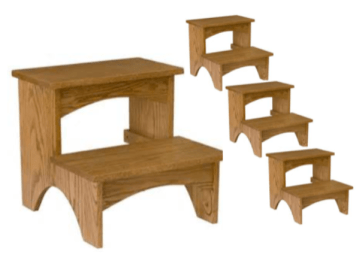
Big step stool, little step stools.png

Good training breaks new tasks down into many small steps.

Coming Next: The Goat Diaries: Clicker Training Begins – Day 1 – Session #7: Lessons From Panda

Please Note: if you are new to the Goat Diaries, these are a series of articles that are best read in order.  The first installment was posted on Oct. 2nd.  I suggest you begin there: https://theclickercenterblog.com/2017/10/02/
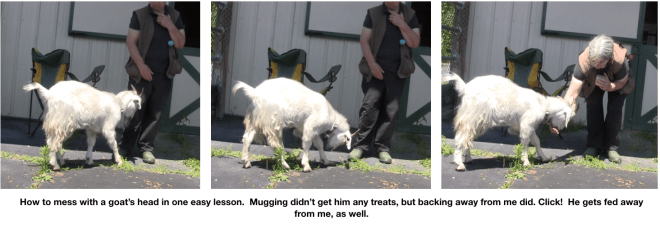


Goat Diaries: Day 1 Continued – Dress Rehearsals and Trial Runs

Testing The Waters

In my previous session I had tested the waters by sitting down in a chair and trying to introduce targeting to a pair of young, very food motivated goats. Data collection is an important part of training. What was the data I had collected so far?

I discovered that I needed to change my treat delivery.  I was so used to my horses who wait patiently while I get their treats that I hadn’t factored in the quickness of these young goats. Getting treats out of my pocket while sitting in a chair was too slow.  I normally start horses in a stall or a small paddock so there’s a barrier between us.  I’m standing so I can move as needed which means getting a treat out promptly isn’t a factor.  Sitting down changed everything.

With horses I recommend to people that they do a practice run first without their animal learner. Go through the handling skills you’re going to be using BEFORE you’re with your horse. Can you manage the target and the treats? What can you do to streamline the process?

Remember: Clean handling in helps to get clean training results out.

The more you are bumbling and fumbling your way through the process, the more mistakes you’ll accumulate. Your animal learner may even get so frustrated by the inconsistencies that he simply quits and gives up trying. That’s when people start to say their animal got bored. He didn’t get bored. He got confused.

The way to avoid this is to run through a pretend session, something I had failed to do. But I was learning fast.

Already I had learned that whether it’s a goat or a horse, the starting point is the same. Go spend some time just quietly getting to know the individual you are going to train. Then find something your learner wants. That was easy with these goats. They wanted peanuts! The ice had been broken, and they were ready to train.

Our first targeting session at 8 am showed me the things I needed to change. In the next session I made some adjustments in my food delivery. With two goats vying for peanuts, I couldn’t afford a long time lag between the click and the delivery of the treats – not if I wanted them to connect the training dots.  I wanted the click to mean something to them and not to be so overshadowed by everything else that was going on that it became just background noise.

Session 4: 11 am
This session was very similar to the 9:30 session, except this time when I sat down in my chair the goats came right over. I had learned I needed to pre-load my hand. Reaching into my pocket took longer than I had. I was using whole peanuts still in their shell. That helped keep this session from disintegrating into chaos. It took a moment for the goats to chew the peanut hulls. While one was still chewing, I had time to offer the other the target.

Goat Diaries Day 1 targeting panel 1aThe placement of the target helped make it clear which goat I was focusing on.  The yellow bucket also helped to keep them separated and out of my lap.

Goat Diaries Day 1 targeting panel 1b

Photos taken from video: Goat Diaries: Day 1 Targeting.mov

The total time on this session was 6.2 minutes.

Coming Next: Day 1 Continued: Cups of Tea