Some Things Just Take Time

I know the current trend is for shorter, shorter, shorter posts. I get it. There are so many posts, so many videos, we need short and sweet. But some things just need more time. Teaching your horse to lower his head is one of those topics.

There is a quick, easy way to get a horse to lower his head. Have him follow a target to the ground. There. I’ve done it. Short and sweet. Done in 80 words. Not bad. Except . . .

Except one of the training principles is: there is always more than one way to teach every lesson.

Having a horse follow a target to the ground is a great starting point. But we need more. We need backing in a square into head down. To explain why this lesson is so important, what it does for your horse, and how to implement it, I need about two hours of your time.

That’s how long it takes at clinics to explain the lesson. It’s also how long the original head lowering DVD is. That DVD is now an on-line mini course. I won’t take two hours of your time right now to explain this lesson. Instead I’ll just say:

Head lowering is not a forward-moving exercise.

Eight words, but my goodness there’s a lot packed into those eight words.

Look at the images of “Day 1 before” and “Day 3 after” for this horse.
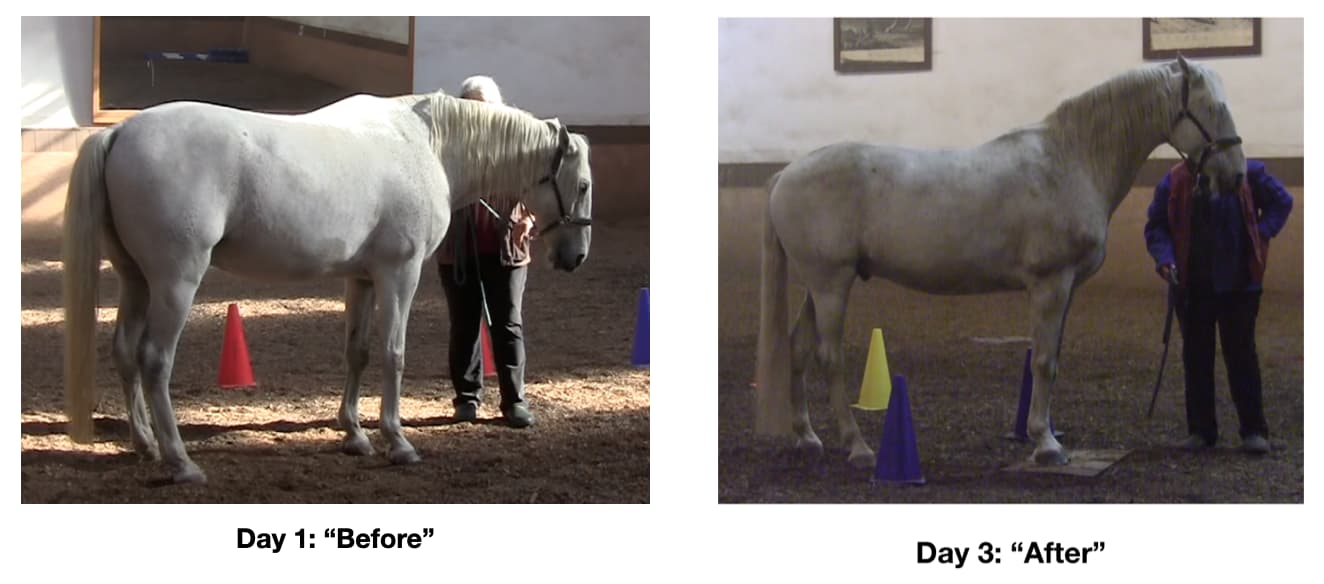
In the “Before” image he looks like his back hurts. Look at the way he’s standing, sort of crouched under behind. And he looks so grumpy. Something you can’t see in the picture is he was so tight the muscles in his shoulders and girth area were in spasms.

On day three he looks like the sport horse that he is. His back has relaxed, and he’s lifting up from the base of his neck. Head lowering played a major role in the changes you see.
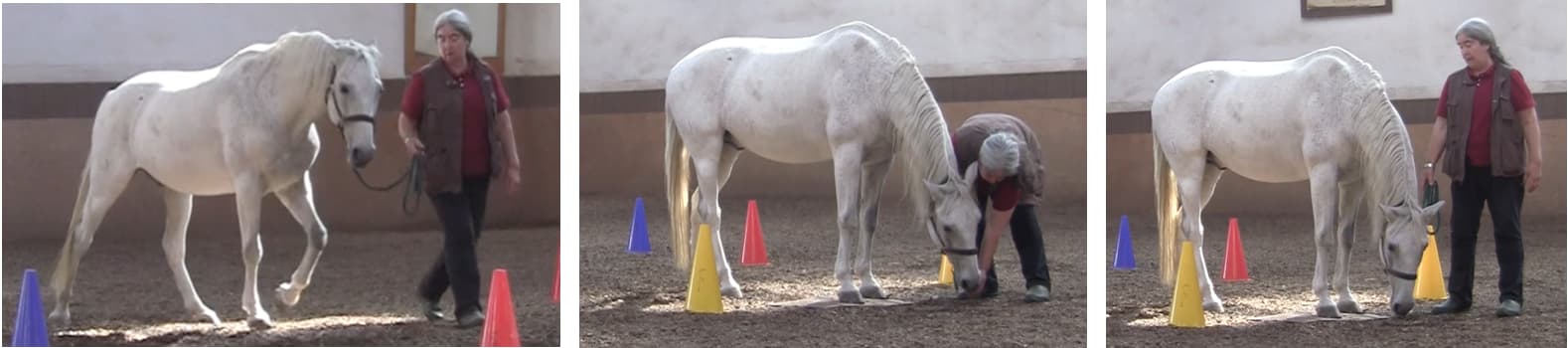
In this sequence he starts out very grumpy. Once he’s standing on a mat, I ask him to lower his head, first using simple food delivery. Once that’s working, I can ask from the lead.

As he leaves his head down, look at the head-to-tail stretch that gives him. This sounds so simple, and really it is. Food delivery is such as easy way to get a horse to lower his head. But where you place the food to get this full body stretch is something you learn from the backing-in-a-square-into-head-down lesson.

Backing in a square into head down can create other types of changes.

This four year old warmblood knew he was big. He knew he could ignore handlers and barge over the top of them. He threw a lot of energy into pushing people around.
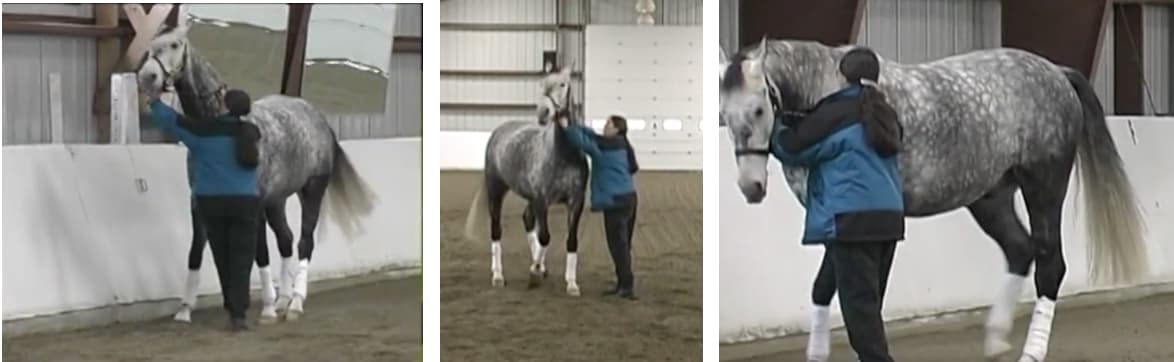
He’s trying really hard to use his height and his size to push forward over the top of me.
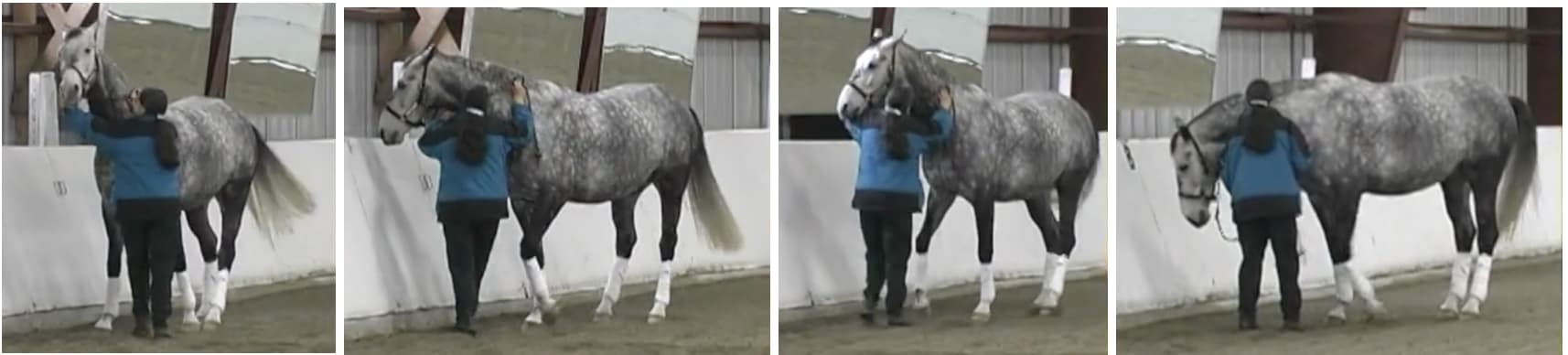
I’ve turned the lead into a “t’ai chi wall”. It’s like throwing a ball against a wall. His energy is the ball. When he runs into the lead, he bounces back off it. As I feel him starting to drop his head, I release the lead. Click and treat.

All that barging-over-the-top-of-you energy is redirected by the “t’ai chi wall” of the lead. I don’t have to get tougher with him. I don’t have to scare him to “show him who is the boss”. I just need to know how to slide up the lead into the “t’ai chi wall”, so I can redirect his energy out of my space.

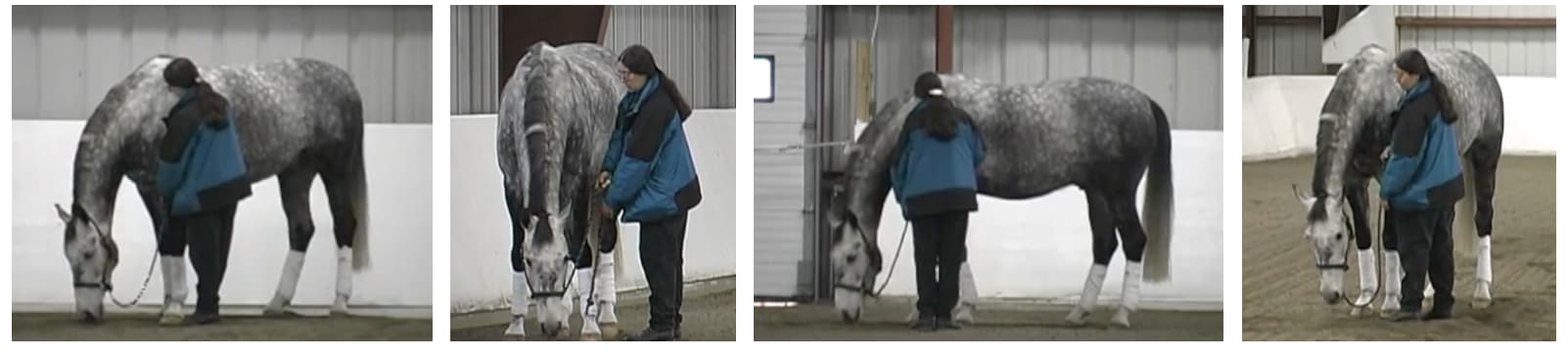
He backs up. I direct his hips through a turn, and his head begins to drop. Pretty soon I can release this once bargey horse into the same full body stretch that so helped the other horse let go of years of body tension. Head lowering can help this young horse start his working life without that kind of crippling resistance.
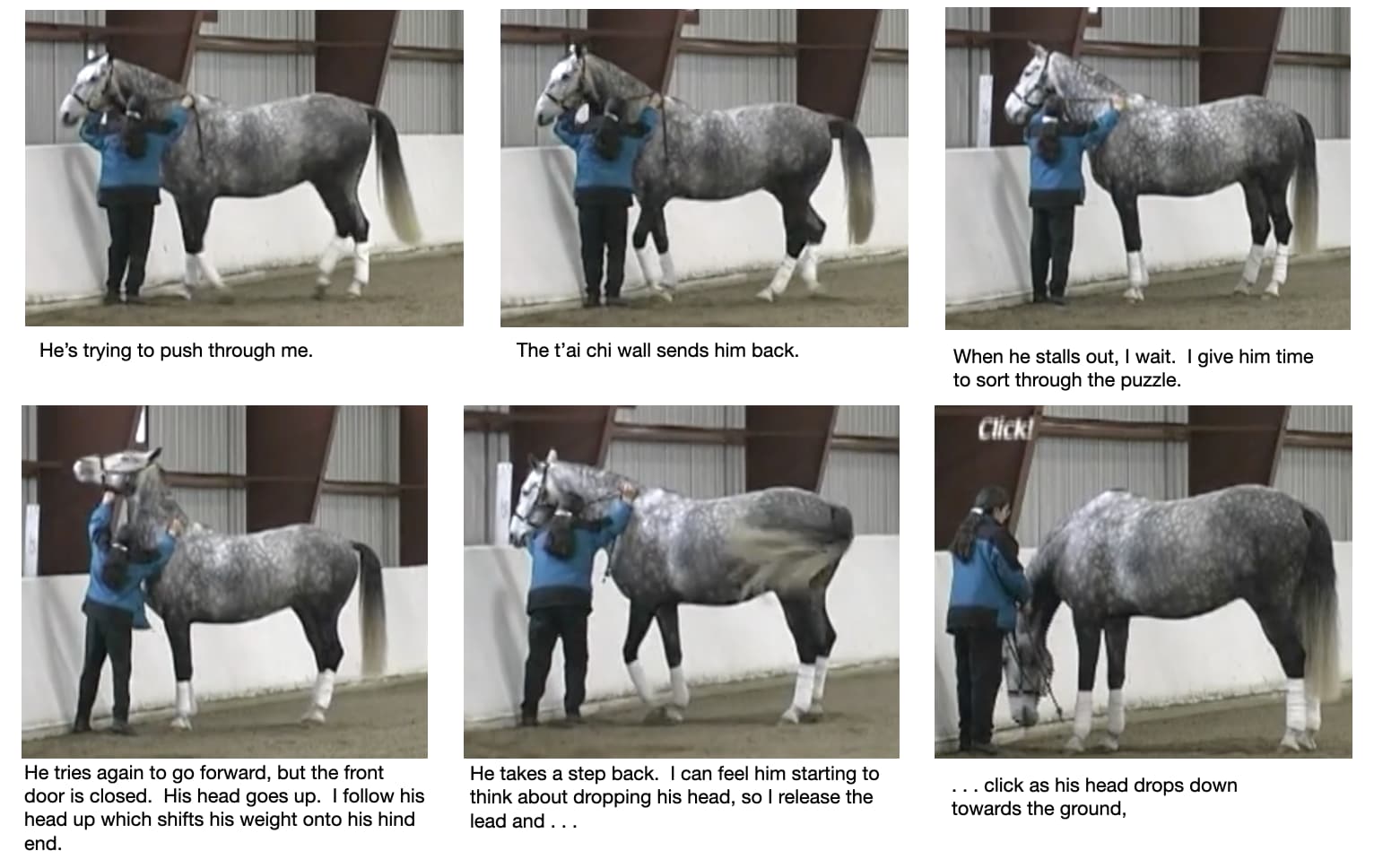
Backing-in-a-square-into-head-lowering transforms pushy and potentially dangerous behavior into polite head lowering. This lesson shows us that there’s so much more to head lowering than simply getting a horse to lower his head.
Curious?

Check out the Lesson Three: Head Lowering Mini Course.

I’ve broken the original two hour DVD down into twenty-seven chapters. Instead of sitting down to a full length movie, you can watch the lesson in shorter segments.

The course includes the original DVD Lesson, plus new teaching material. I take you step by step through the head lowering lesson. You’ll learn how to set your horse up for success by teaching the precursor behaviors first. I’ll show you why head lowering is not a forward moving lesson. I’ll explain what that means and how to put those words into action.

Head lowering is a power tool that can enhance your horse’s physical and emotional well-being. This mini course explains the changes it creates. The detailed instructions and demos show you how to put the lesson to work in your own training.

Visit theclickercenter.com to learn more.
Procedure versus The Emotional Effect

JOY Full Horses: Ten Things You Should Know About Cues: Number 10: Playing with Chains – Part 3 of 5

Procedure versus The Emotional Effect
Yesterday’s post began a discussion of negative reinforcement.  Especially when you have a horse who is new to clicker training it is important to separate procedure from emotional effect.  I can perform what appears to be the same procedure with two individuals and end up with completely different emotional outcomes.

That’s true whether I am using what appears on the surface to be a positive reinforcement or a negative reinforcement procedure.  Think of all the people who run in the opposite direction if you suggest playing a training game.  I view these experiences as fun opportunities to improve my skills.  Others see them as a torturous experiences, even when you are passing out reinforcers they want. Their childhood experiences have set them up to see training games as anything but fun.  Same procedure – different emotional response – different behavioral outcome.  So for one person the training game is a positive experience.  It will get them in the room, engaged in the process.  For another it has the opposite effect.  It will get them looking for the nearest exit!

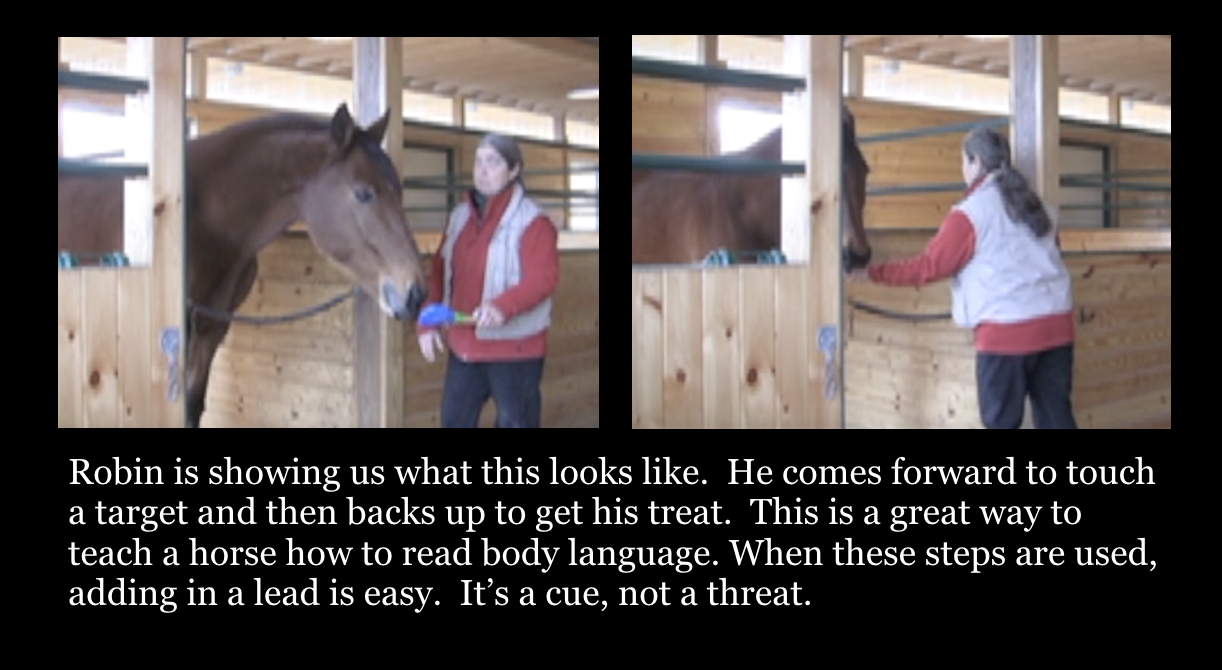
If I’m working with a horse that has been handled well all of it’s life, sliding down the lead will convert easily into a cue, and there may never really be any aversive elements in the process. That’s especially true if I have set up the use of the lead through the first couple of foundation lessons.  If I begin with basic targeting and use my food delivery to move a horse back a step or two to get his treat, he will quickly respond to my body language.  When I turn into him, he’ll easily back up.  Now I can add in the activation of the lead as I turn towards him, and he’ll back up just as readily.

robin-touch-target-back-up-with-caption

I’m really using more of a transferred cue process than negative reinforcement.

History Matters
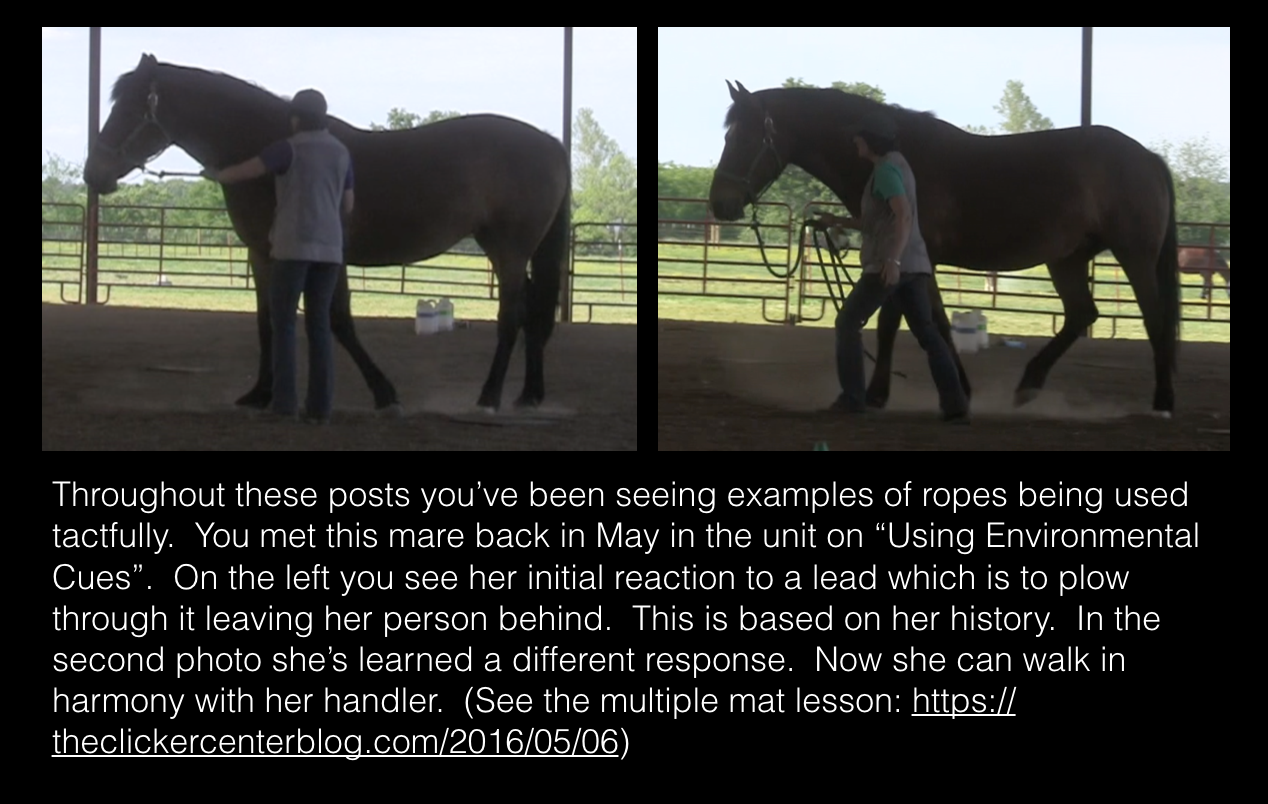
An individual who has been hurt by leads will be deeply suspicious of them, even if I have gone through the same foundation lessons that prepared that first horse so well.  I can be super soft, but any interaction with a lead will be regarded with suspicion.  Same action, different emotions.

For the first horse the pressure acts as a cue from the very beginning. But what about the second?  When I slide down the rope, that horse is going to read it as a threat. That’s his history. If he guesses wrong, he’s expecting to be hurt.  If he comes crashing into my space with a lot of energy attempting to escape the inevitable, the wall I create with the lead is going to have to be pretty solid.  I’m ricocheting his own energy.  I’m not adding any pressure beyond that, but his previous experience will control how he feels about what I’m doing.

The Emotional Spectrum
When I slide up the lead to richochet this horse’s energy out of my space, I am operating in a zone that sits between true, easy-to-define negative reinforcement and positively taught tactile cues.  With some of the horses that I work with, it is very clear to me that I am starting out with negative reinforcement.  No question.  Slide down the rope and you meet with the guarded response of a horse who knows the pressure will escalate if he guesses wrong.  My job is to show him that that’s not going to happen.  No matter what he does, I am not going to retaliate.  His history may be creating some major flare ups of aggression, but I am not going to be drawn into a counter attack.

It’s Not Your Fault
At times like these I remember a line from Ismael Beahl’s autobiography “A Long Way Gone”.  Beahl was a child soldier in Sierra Leone’s civil war.  He and the other boys he fought with were given drugs that contributed to the horrific acts of cruelty which they committed.  He describes his actions with great honesty in his book.

When he was pulled out of the army and sent to a hospital for rehabilitation, he lashed out at the people who were trying to help him.  He had done such terrible things.  How could he live with himself?  He wanted to hurt everyone who came near him.

“It’s not your fault,” his caregivers would say, refusing to be drawn into the drama of his conflict.  Again and again they would repeat this:

“It’s not your fault.  It’s not your fault.”

At first this enraged him even more, but gradually he could hear the words and accept their meaning.

Changing Expectations
When horses are flaring up with aggression, I say the same thing to them: “It’s not your fault.”  I’ve seen how horses are handled.  In far too many places harsh handling is the norm.  It’s how we’re taught you have to be around horses.  It’s not the handler’s fault either.  It is our heritage, but it doesn’t have to be our future.  We can pass on a different legacy to the next generation of horse owners.

When I’m using a lead, my task is to direct the horse away from this expectation of retaliation.  Eventually, he will truly believe that the lead will always and only be a positive communication tool. That’s when he’ll let you in past his guard, and the relationship becomes magical.

The response to the lead shows us it’s hidden history. I cannot make a blanket statement that the slide down the lead is experienced as something pleasant and acceptable, something neutral, or something aversive.  The horse’s history creates an expectation that effects his initial emotional reaction to the rope.  In some cases the emotional reaction is one I hope to change.  By changing the way I use the lead, the lead itself may no longer trigger an unwanted emotional response.

scout-on-lead-two-photos

Coming Next: Part 4: Hidden Motivators

Remember, if you are new to the JOY Full Horse blog, click on the JOY Full Horses tab at the top of this page to find the full table of contents and links to each of the articles I have published so far.

I hope you will want to share these articles by sending links to this blog to your friends.  But please remember this is copyrighted material.  All rights are reserved. Please do not copy any of the “JOY Full Horses” articles without first getting written permission from Alexandra  Kurland, via theclickercenter.com

Also note: these articles are not intended as an instruction guide for introducing your horse to clicker training.  If you are new to clicker training and you are looking for how-to instructions, you will find what you need at my web sites:

theclickercenter.com                    theclickercentercourse.com