Modern Horse Training: Core Principles of Good Training

I have a new book coming out on April 26, 2023: “Modern Horse Training: A Constructional Guide to Becoming Your Horse’s Best Friend”
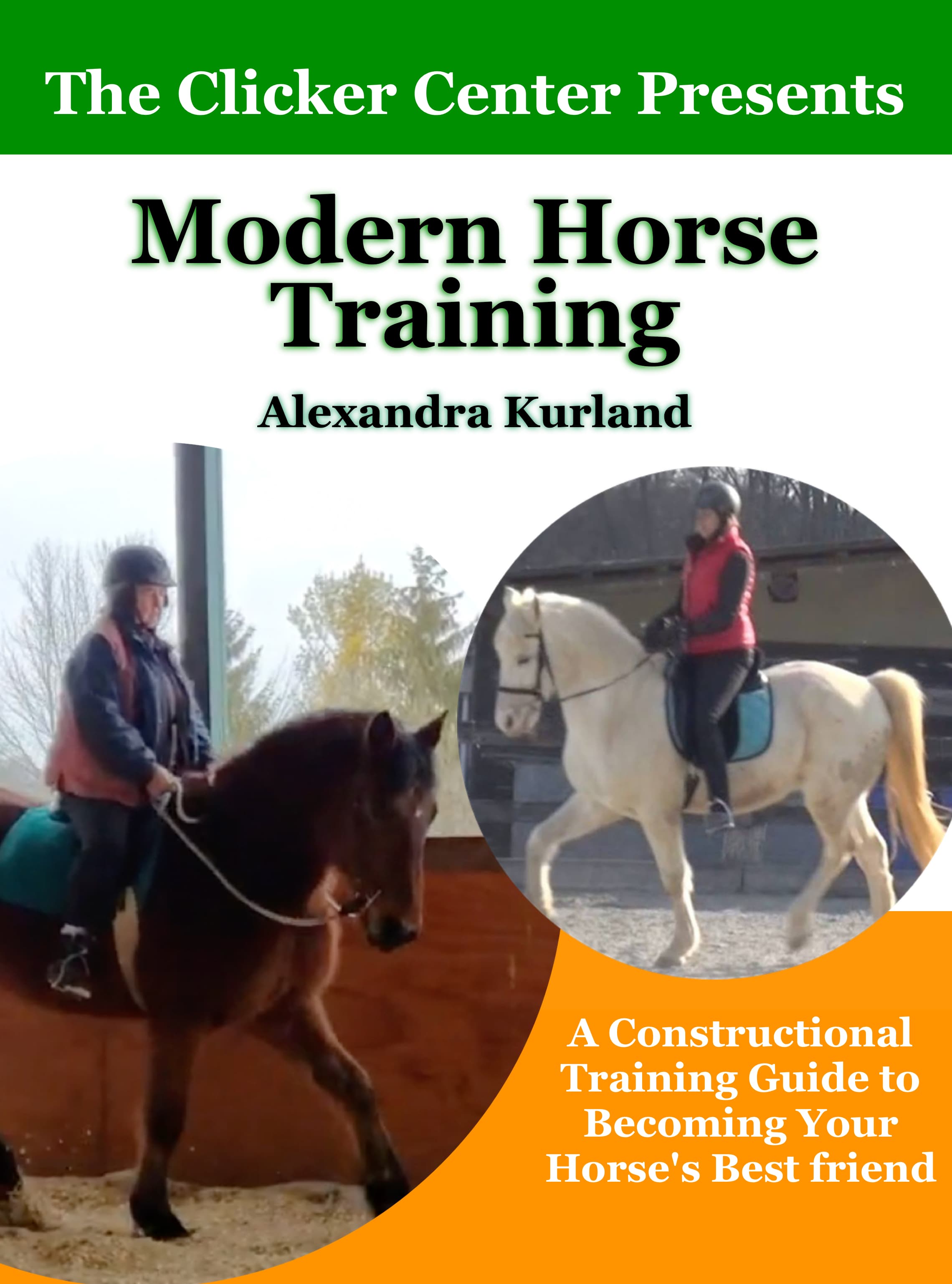
The new book – coming April 26, 2023

I am no good at writing quick elevator pitches to let you know what the book is about. Instead while we are waiting for the publication date, I have been sharing a series of short posts that describe the overall development of my training.

I ended yesterday’s post by asking what were some of the component skills that helped me transform clicker training from an interesting concept into a workable training program for horses?

For starters my horses had helped me to formulate some guiding principles. These pre-dated my exploration of clicker training. I learned these principles directly from my horses. I also saw trainers I admired using them. So these principles are not specific to clicker training. I would say they are part of good training in general. These concepts take you to horse-friendly, learner-centric training choices regardless of the actual procedures used.

So what are they?

They begin with:

Safety always comes first – for both you and your horse.

That sounds as though it should be a given, but it’s not. I’ve watched far too many horse people ignore this basic principle. Trailer loading is a prime example. Look at all the fights you see around trailers. A given trainer may have gotten away with forcing frightened horses onto trailers. But load enough horses, and you’ll will meet that one individual who fights back with more power, more speed, more fear than you can handle. Someone will get hurt and those are odds I’m just not willing to take on.

Here’s a way safety always comes first plays out for me. Peregrine’s mother taught me the value of ground work. Her neurological condition gave me this one simple rule. I never asked her for something under saddle which she had not shown me she could do on her own. If she couldn’t walk beside me around my work space without spooking at the goblins, she wasn’t ready to be ridden. If she couldn’t trot in balance without a rider, I wasn’t going to get on and expect her to know how to trot.

This rule kept us safe. It’s a good rule that I have extended to all the horses I work with. It means that ground work is an essential part of good riding. That’s also not a given. In 1993 when I first started exploring clicker training, ground work for most people meant lunging. That was pretty much it. You lunged your horse before you rode him to “get the bucks out”. Often that meant sending an unbalanced horse at speed around you on a circle. It wasn’t much fun for either the horse or the handler.

For me ground work meant so much more than this. I got Peregrine’s mother as a yearling and later I bred her to get Peregrine. Because I raised both my horses, ground work meant all the handling of young horses – teaching them to accept grooming, haltering, basic leading, foot care, blanketing, basic medical care, etc. When you have only been around older riding horses, it’s easy to take these universals for granted. You forget that horses have to learn how to accept all these different intrusions into their personal space. When an older horse is hard to groom or doesn’t stand well for the farrier, he’s labelled as a “problem horse”. Clicker training helps us to reframe how we see these horses.

Ground work also meant teaching my horses the basic skills that let me go for walks with them. It meant the T.E.A.M. ground work skills that began to move me away from the conventional handling that I saw around me in the local riding stables. It also meant the classical work in-hand that I was learning from Bettina Drummond, Nuno Oliviero’s principle student. And it meant round pen training that I first figured out based on a magazine article and later expanded upon after watching John Lyons. So I brought to clicker training an extensive and varied repertoire of ground work.

I also understood the connection between ground work and riding. The first time I watched John Lyons at one of his symposiums, he said “I solve ground problems on the ground and riding problems under saddle.” I could see that wasn’t what he was doing, but he really believed what he was saying. Yes, he was using his version of round pen training to prepare a young horse for riding. That connection was there. But after that in his mind there was a separation.

A couple of years later he stopped making that distinction. His stallion Zip had shown him how connected ground work and riding really were. I never heard him talk about this directly, but you could see the difference. The first time I saw Zip, I loved his topline. He was round, he was soft, he was well balanced – all things I enjoyed looking at. But Zip had short, little pony gaits.

Lyons had not yet resolved this major training puzzle: horses will naturally change leg speed before they soften at the poll. In the new book I describe in detail what this means so I won’t go into it here. When you don’t solve this puzzle, the gaits are effected. Horses no longer have the big, beautiful, clean gaits that you would have seen in them as youngsters. Their gaits become compromised. It is so normal, we often don’t even see anymore how unbalanced and lame horses are becoming because of the way in which they are being ridden.

In his symposiums Lyons would use Zip to demonstrate a ground exercise Lyons referred to as the east, west, north, south lesson. It is a form of hazing. The horse wants to dodge to the left to escape from you, you drive him to the right. He ducks out to the right, you drive him back to the left. He tries to back up, you send him forward. He barges over the top of you, you drive him straight back. No matter which way the horse tries to duck out the escape route is blocked. After a while, the horse stands still in front of you. And when you tell him to move to the left or right, forward or back, he does.

This can be a brutal lesson if you take the brick-wall approach to it. (See https://theclickercenterblog.com/2023/04/13/) It can be an elegant lesson if you break it down into small steps and teach it with positive reinforcement.

I watched Lyons over a number of years, and I saw a lot of changes both in his horses and in the way he talked about his training. With Zip he demonstrated another core training principle: the longer you stay with an exercise the more good things you see that it gives you.

Every week Lyons would use Zip to demo the east, west, north, south lesson and every week Zip would get better at it. Lyons kept seeing more of what staying with a lesson gives you. In Zip’s case it resolved the leg speed puzzle. Zip gave at the poll before he changed leg speed. Solving the puzzle transformed his gaits. He became a beautiful mover. His gaits matched the promise of his topline. When he was in his twenties and completely blind, he moved better than he had in his early teens.

My horses had also shown me the clear connection between ground work and riding. So one of my favorite expressions is:

Ground work is just riding where you get to stand up and riding is ground work where you get to sit down.

Everything is connected to everything else.
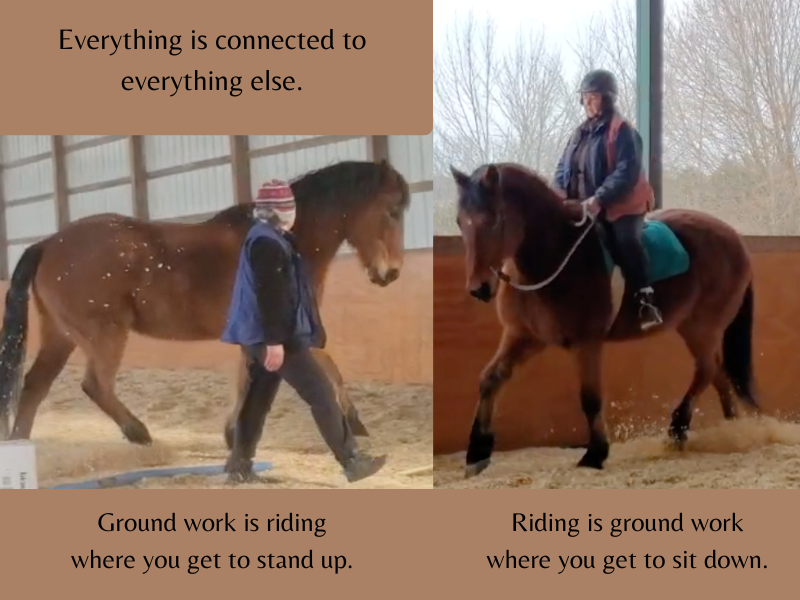
This connection between lessons and especially between ground work and riding is key to the approach I have taken in “Modern Horse Training: A Constructional Guide to Becoming Your Horse’s Best Friend”. The fun of this way of structuring your training is it is very sneaky. You are never working on just one thing. Every lesson truly is connected to all other lessons. And because I am breaking complex lessons down into small components and I am using positive reinforcement procedures, safety always does come first – and fun is the result.

The new book, “Modern Horse Training” will be published April 26, 2023. It will be available as a hardcover, a paperback, and as an ebook. You’ll be able to order it through my web site, theclickercenter.com and also through Amazon and other booksellers.

Coming next- What is Constructional Training?

Seeing Steps

We’re Mid-way through May.  Time to send another thank you out into the world to all the people who have helped bring clicker training into the horse world.  2018 marks the twentieth anniversary of the publication of “Clicker Training for your Horse“.

1998 was very much pioneer days.  There was no trail ahead.  We were blazing it.  Everyone who went out to the barn with a pocket full of treats and a clicker in hand was truly a pioneer.  We were stepping out into unknown territory.  The first people who went on that journey with me were my clients.  These were people I saw on a regular basis, some of them I had been working with for years.  They were familiar with how I operated.  I’d read a book, I’d go to a clinic, I see some interesting training, and then I’d try it out.  My horses were always the first guinea pigs.  If they liked what I was testing, I’d share it with a few of my clients, and, if they liked it, I’d share it with everyone.

That’s how clicker training got started, first with Peregrine and then with a few of my client’s horses.  That’s all it took to get the snowball rolling down the hill.  The first few steps into clicker training were easy.  You taught basic targeting.  You cleaned up the horse’s manners around food, and then what?  That’s was what my clients were helping me to figure out.

So this month belongs to them, to all those willing pioneers who joined me in that first approximation in.  As usual, I am going to single one person out, but in doing that what I am really doing is saying a huge thank you to all of my many clients who followed me into this exploration of clicker training.  So this month I am going to introduce you to Sharon and her Arab Missfire.  They were the inspiration behind Chapter 5 in “Clicker Training for your Horse”.

The title of Chapter 5 is: All Aboard! Mounting Blocks and So Much More: The Power of Goal Setting. You could say Chapter 5 is about teaching your horse to stand still at a mounting block, or you could say that it is about breaking training down into small steps.  Both would be right.

Sharon was a first-time horse owner who kept her mare at home.  She had what was a very common situation.  She had a couple of small fenced-in fields with access to a run-in shed, but no separate designated training area.  All the work was done out in Missfire’s paddock.  Missfire didn’t come with too many warning labels attached.  She was comfortable being groomed, okay to lead, she was afraid out on trails and would rush for home, but in her home paddock she was safe to ride.  The problem was she frustrated Sharon.  It was all the little things that Missfire didn’t do well.  Yes, you could groom her, but she fidgeted.  Yes, you could put a saddle on, but she fussed.  Yes, you could get her to the mounting block, but getting her to stand still long enough to get on was a challenge.

Sharon was a special ed teacher.  She taught math to teenagers who had been removed from regular classrooms because of their disruptive behavior.  When I first introduced Sharon to clicker training, I thought – she’s going to love this!  This will be right down her alley.

I was right.  She did love clicker training, the parts of it she understood, but oh how she struggled to make it work.  She just couldn’t see the steps.  She understood the overall concept, but she needed me to guide her through each lesson.  In between my weekly visits she was still struggling with her horse and feeling frustrated.

Clicker training has brought me many great things.  I’ve been able to travel and meet people I would never have connected with if not for the adventure called clicker training.  One of the connections I very much treasure is that with canine trainer, Kay Laurence. Kay feels about dogs the way I feel about horses.  The species we are passionate about may be different, but our regard for the animals we love is the same.  It was Kay who highlighted for all of us in the clicker training community the difference between guided and self-directed learning.

There’s a time and a place for both.  Knowing which to use when is the skill.

In the horse world many traditional riding lessons are designed to create dependent students.  There is a very clear hierarchy.  The trainer is the expert.  The learning is very much directed.  In group lessons you’re told when to trot, when to canter.  You’re not taught to become an independent thinker.  When you buy your first horse, you are still very much dependent upon the trainer.  You need him/her to fix things when the training goes wrong.

Clicker training changes that.  The role I play is that of guide not guru.  My favorite definition of a teacher is “someone who started before you”.  When someone asks me to help them with a horse, that’s all that I am.  Someone who started before that individual.  My job is not to make that person dependent upon me.  It’s to help her realize that she can be a teacher for her horse.  She can be an active, effective problem solver.

Even someone who has limited handling skills can be a good teacher.  The first requirement is understanding how to apply basic principles.  It’s: safety always comes first.  It’s: train where you can – not where you can’t.  If you don’t have the riding skills yet to handle rough terrain, sudden surprises, and an excited horse who wants to bolt for home, then ride where you can be safe.  Ride in your home paddock.  Or ride from the ground first.  Remember – ground work is just riding where you get to stand up.

Here’s another core principle: find a step in the training where you can get a consistent yes answer.  If you are just learning how to handle a horse, what CAN you ask for?  It might be as simple as having a horse touch his nose to a target.  That may not seem like much, but it’s a beginning step.  Each step opens the door to learning new skills which you and your horse are learning together.

The stumbling block that many people encounter when they are first experimenting with training is they become very outcome oriented.  Instead of focusing on the process, they want to jump to the end result.  That means they tend to lump criteria, and they miss seeing all the places where the horses are asking for more information.  That’s where Sharon was.  When she brought Missfire up to a mounting block, she expected to be able to just get on.  She was missing all the small steps that could be inserted into this process.  She just didn’t see them.

This was over twenty years ago – long before any of us knew about Hogwarts and Harry Potter.  But thinking back on it, that’s the image that comes to mind.  When I stood on the mounting block next to Missfire, I could see all the steps, but it was as if there was an invisibility spell cast over her when Sharon stood in the same place.  She just couldn’t see all the little questions she could be asking Missfire.

Can I put my hands on the saddle?  Yes.  Click and treat.

Can I wiggle the saddle?  Yes.  Click and treat.

Can I touch the stirrup leather?  Yes.  Click and treat.

That’s great.  That was a nice unit.  Now I’m going to step off the mounting block, and we’ll walk off together in a big circle so we can go back to the mounting block and ask those same questions – and maybe one or two more – all over again.

Slowly the invisibility spell lifted.  Sharon saw the steps.  She got it.  She was able to take Missfire to the mounting block and ask these small questions.  She was understanding how these small asks accumulated into a solid owning of the behavior – for both of them.

The following week when I arrived Sharon showed me how she had taught Missfire to “self bridle”.  And the week after that she showed me another new skill they had worked on together.  She was owning the process!  She was becoming what clicker training allows us to be – our horse’s teacher.  She wasn’t dependent upon me.  We still enjoyed our visits together.  There were lots of new skills that I could help her to learn, but she didn’t need me.

In “Clicker Training for your Horse” I used specific lessons such as foot care or the mounting block lesson to teach broader principles.  Sharon’s struggle with the mounting block became the inspiration for a chapter in “Clicker Training for your Horse“.  The week after her lesson I wrote Chapter 5: All Aboard! Mounting Blocks and So Much More: The Power of Goal Setting.

Here is the opening section from that chapter:

“Some of you who are more experienced may glance at this and think: a whole chapter just on getting your horse to stand next to a mounting block!  You’ve got to be kidding.  When is she going to talk about some real training?

This book is intended for people of all experience levels.  In my own teaching I work with many highly trained riders and instructors, but I also work with beginners and first-time horse owners.  If you haven’t spent much time around horses, no exercise is ever too basic to be taught.  I’ve given lessons in how to lead a horse into a barn, turn it around, and close the door behind you.  Sound simple?  If you’ve been around horses for years, of course it does, but to a timid, first-time owner with a pushy horse it can seem like an impossible task.

You may know how to teach your horse how to stand quietly while you get on.  It’s no problem for you, but for someone who has never dealt with this issue, it can be extremely frustrating.  You may take bridling for granted.  Then you buy that green, three year old you’ve been dreaming of for years, and he throws his head up into the rafters whenever you come near him with a bridle.

I don’t know what issues you’re struggling with, or what you already know, and what you don’t.  I don’t want to skip over anyone, so I’ve chosen to talk about some very basic training issues here.  That way everyone can participate.  Embedded in the discussion are the principles and concepts that will help you with every step of your training.  If you’re an experienced rider, you’ll be able to generalize easily from these examples and apply the principles to your own training situation  .  .  .  .  Foundation is everything in horse training.  So even if you’re working with upper level horses, I think you’ll find a great deal in this chapter that will interest you.

Training is easy once you know where to begin.  Getting started is the hard part.  You want to ride.  You’ve got a picture of your dream horse in your head.  You can see yourself clearing every fence on the course; galloping along a winding trail; or executing the perfect canter pirouette.  That’s your dream, but right now you and your horse are just starting out together.  What are you going to work on today to get to all those wonderful tomorrows?  What are your immediate training goals that address the issues you are working on today?

Goal setting is an important part of training.  When I’m working with someone on a regular basis, I’ll ask them what they want to focus on today, in this lesson.  Very often they’ll say they don’t know.  They have an overall dream of what they want to do with their horse, but they don’t have a specific goal in mind for that day’s training.  That’s fine.  The horse will always tell us what he needs to learn.

We’ll take him out to the ring and he’ll refuse to walk up to the mounting block.  Great.  He’s just given us the lesson for the day.  Yes, we could get on somehow, but we’d be missing a wonderful opportunity to train.

We might have been planning to work on canter departs, but that’s not what the day’s lesson is going to be about.  We’re going to teach him to stand next to the mounting block.  In the process we’ll be working on leading; on ground tying; on lateral work; on loading into a trailer; and, oh yes, on canter departs, and even on flying lead changes.  How is that possible when all you’re doing is getting on?  The answer is, you can never teach just one thing.  You’ll see what I mean as we go through this lesson.”

It’s great fun reading this chapter so many years after it was written.  I feel as though I could be writing it today in response to someone’s email query.  The words wouldn’t be that different.  I may know a lot more ways to teach the lessons I was writing about, but the core, underlying principles are the same.  What Sharon showed me was the power of those principles.  When you learn how to use them, they set you free.

So this is my thank you to Sharon and to all my other clients who showed me how to transform these principles from words on a page into actual practice.  Those pioneering days were great fun!  I am glad we took the journey together.  Many of you have split off and gone off on your own.  That’s as it should be.  The best part of clicker training is it teaches you how to forge your own path.  We will be friends always, and I am sending you a thank you for the time we journeyed together and the discoveries we made.  Thank you for helping to bring clicker training into the horse community.

Have fun!