positive reinforcement
In Search of Excellence: Effective Practice – Part 9
Part 9: Practice Excellence
This is the ninth and last installment in a nine part series. If you have not yet read Parts 1 through 8, you should begin with those. Part 1 was published on Nov. 16, 2014.
Part 1: “The Talent Code”:
Introduces Daniel Coyle’s book, “The Talent Code”.
Part 2: The Myelin Factor:
This section presents a short course in neuroscience centered around myelin and the role it plays in building new skills.
Part 3: Equine Simulators:
Part 3 looks at creative ways to build your handling skills BEFORE you work directly with your horse.
Part 4: What Does Soccer have to do with Horse training?:
There are two types of skills you need to build: the first are technical skills you need to be able to handle a horse, these include rope handling and other physical skills. The second involves the split second decisions you must make.
Part 5: Skill Depends Upon Myelin:
Myelin builds high speed neural pathways. How does this translate to the building of skills for horses and their handlers?
Part 6: The Positive Role of Mistakes:
Highlight – Adjust – Click! – Reinforce – Repeat. That’s clicker training. It’s also good myelin building. You’re building good habits that create excellence. Myelin wraps. It doesn’t unwrap so you want to build good habits right from the start.
Part 7: The Role of Patterns in Deep Practice:
In clicker training we break lessons down into thin slices. It turns out in talent hotspots, they do the same thing.
Part 8: The Deep Practice “Layer Cake”
This section looks at the three tiers of deep practice Coyle identifies in “The Talent Code”
Part 9: Practice Excellence:
The series concludes by looking at the difference between mindless drilling and practicing for excellence.
Part 9: Practice Excellence
How We Practice
Coyle cited an interesting study done by Barry Zimmerman of New York University. Zimmerman asked a simple question: can you judge ability solely by the way people describe how they practice. In other words, without seeing someone perform, can you accurately predict their level of expertise if all you know about them is how they practice?
Zimmerman and his colleague, Anastasia Kitsantas, chose volleyball serves as the skill they would evaluate. They interviewed expert players, club players, and novices. They had twelve measures for evaluating serving practice. Based on the answers they predicted how each person would perform when their serve was evaluated. They then had the players execute their serve and their actual performance was compared to the predictions. Ninety percent of the variation in skill could be accounted for by the players’ answers. The conclusion: experts weren’t better because they were more gifted. They were better because they practiced differently.
Practice brings with it images of endless, boring drilling. I remember at school sitting in French class repeating over and over again the same phrases. It was the opposite of deep practice. We may have been saying the words slowly but it was mind numbing – not mindful. I could pass every test with flying colors, but I learned nothing, except perhaps to hate French class. Thankfully I did not learn to hate repetition. Other experiences have taught me to value mindful, thoughtful repetition. “Nothing you can do — talking, thinking, reading, imagining — is more effective in building skill than executing the action, firing the impulse down the nerve fiber, fixing the errors, honing the circuit.”
Maintaining Myelin
Coyle posed this question: What would be the surest method of ensuring that LeBron James started missing jump shots or that Yo-Yo Ma missed chord changes? The answer: don’t let them practice for a month. That’s all it takes.
Myelin like all living structures needs maintenance. Daily practice doesn’t just grow new insulation, it also keeps the existing myelin in a state of good repair. That is particularly true as you get older. Myelin production slows down as you age past fifty. You can still add insulation, but the process is slower.
Coyle quoted the pianist, Vladimir Horowitz, who continued to play into his eighties: “If I skip practice for one day, I notice. If I skip practice for two days, my wife notices. If I skip practice for three days, the world notices.”
More is not Better. Better is Better.
If you were the victim of mindless drilling, here’s some good news: more is not always better. Doing six more push ups won’t help if you are no longer paying attention to your technique. Mindless drilling is just that – less.
Deep practice doesn’t require that you spend hours on end walking around your arena in the t’ai chi walk. What it does require is that you spend your practice time in what is referred to as the sweet spot, that point at the “edge of your capabilities where you attentively build and hone circuits. . . . When you depart the deep practice zone, you might as well quit.”
At the music camp one of the instructors teaches a course in how to practice. She urges her students to “find a balance point where you can sense the errors when they come. To avoid the mistakes, first you have to feel them immediately. If you hear a string out of tune, it should bother you.”
Patterns
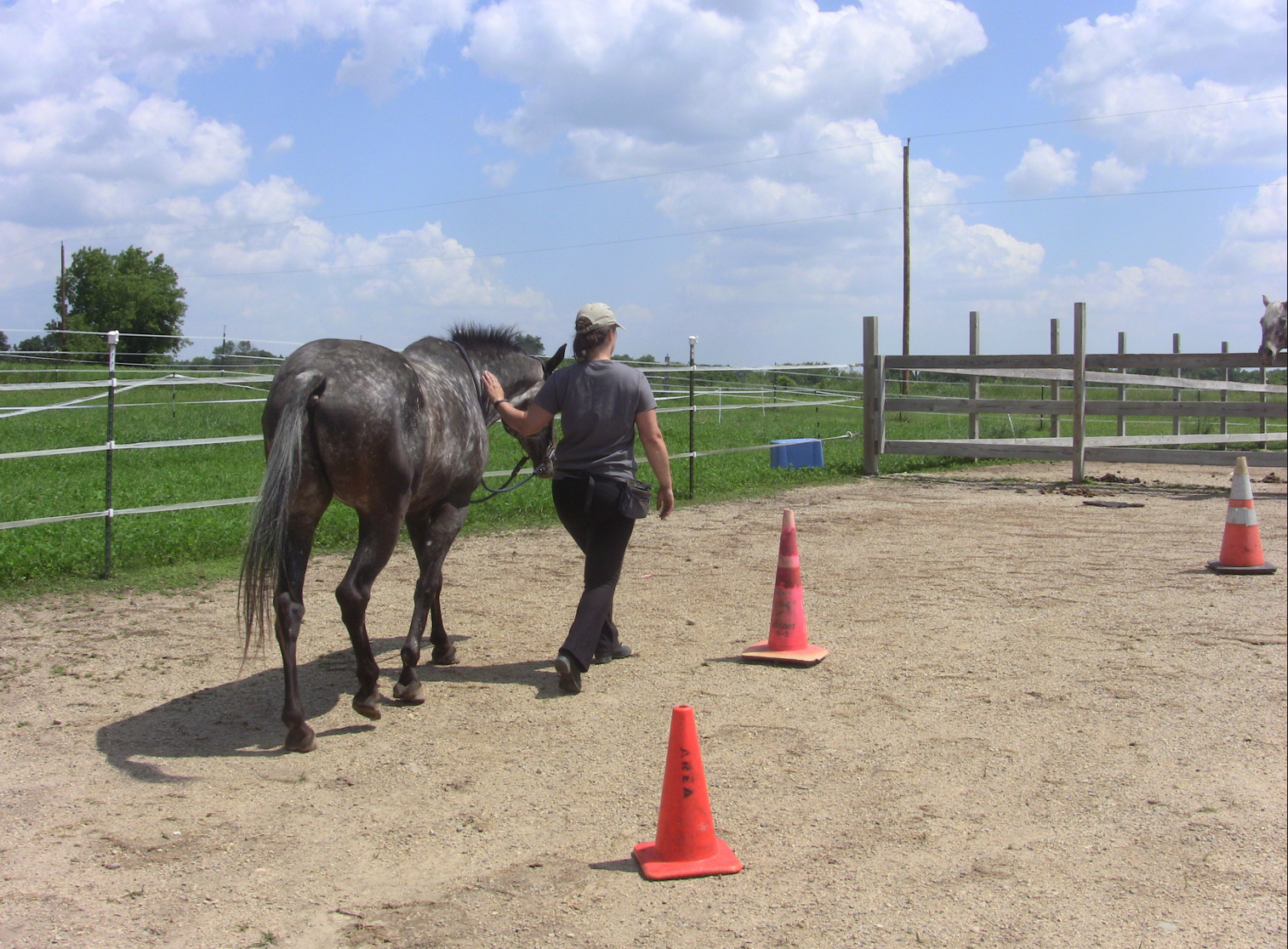
This resonated so strongly with me. This is why I have people work their horses through patterned exercises. I take the time to pace out circles and mark the circumference with cones. I have paced out hundreds of circles. I could get lazy and just put the cones out in a rough approximation, but I don’t. I pace out the circle so people can develop a feel for what it means to be in balance. When their horses drift slightly off the circle, I want that loss of balance to bother them – a lot.
Over the years I’ve become hyper-tuned to balance. When I work with horses and feel them lose their balance, I can’t help but wonder how can people not feel this? It’s like finger nails on a blackboard. That tuning is always with me. When horses fall out of balance, when they drift over their outside shoulder, or lean in to the inside, I notice just as surely as a musician notices when an instrument is out of tune. The horse isn’t literally going to fall down – not at the pace that we’re going, but add energy, add speed, and what might seem at first like a trivial loss of balance becomes the reason the horse can’t hold the canter through a turn, or find his stride going over a jump, or keep you safe negotiating steep terrain.
Big problems have their roots in little things.
Turning Inward to Find The “Sweet Spot”
One of the challenges for beginner trainers is knowing how fast to progress. If you go too fast, you’ll encounter resistance. On the other hand, if you stay too easy, you won’t progress.
The people in the talent hot spots were looking for the sweet spot: “that productive, uncomfortable terrain located just beyond our current abilities, where reach exceeds our grasp. Deep practice is not simply about struggling; it’s about seeking out a particular struggle which involves a cycle of distinct actions:
1.) Pick a target [behavior].
2.) Reach for it.
3.) Evaluate the gap between the target behavior and the reach.
4.) Return to step one.”
With the horses we have to be careful that we pick target behaviors that contain steps that they can reach and succeed at. We need to be able to keep the rates of reinforcement high. After all it is our goal not their’s that we are reaching for. We want the pretty canter depart, the perfect shoulder-in. They have no notion of these things. But they do understand our enthusiasm, and they do come to love the game of figuring out what earns clicks and treats.
“One of the useful features of myelin is that it permits any circuit to be insulated, even those of experiences we might not enjoy at first.”
Coyle wrote this in relation to practice. You might not enjoy it at first, but as you repeat the process and myelinate the circuits, you build a habit. Practice may have been something you wanted to avoid at first, but now you find yourself craving your practice sessions.
At a talent hotspot music school the new students at first struggle to understand the deep practice process. Slowing music down to the point where it becomes unrecognizable is hard work. Revealing all the errors in your technique is also hard. But most of the students come to enjoy the process very quickly and their learning accelerates accordingly.
Owen Carman, the director of the school referred to it as: “a turn inward; they stop looking outside for solutions and they reach within.”
Finding Joy: Where the “Sweet Spot” Takes Us
For our horses this looking inward is critical to success. Yes, you can have instructors who can give you broad brush coaching, but good riding is internal. It is about breath control. It is about letting go of force and make-it-happen energy. It is about subtle balance shifts that the horse can feel but an observer cannot see. It is about thinking and having the horse respond. It is about lightness, grace, and love. These things must be found within. Deep practice gives you a route in to find them.
Alexandra Kurland
theclickercenter.com
theclickercenterblog.com
theclickercentercourse.com
In Search of Excellence: Effective Practice – Part 8
Part 8: The Deep Practice “Layer Cake”
This is the eighth installment in a nine part series. If you have not yet read Parts 1 through 7, you should begin with those. Part 1 was posted on Nov. 16, 2014.
Part 1: “The Talent Code”:
Part 1 introduces Daniel Coyle’s book, “The Talent Code”.
Part 2: The Myelin Factor:
This section presents a short course in neuroscience centered around myelin and the role it plays in building new skills.
Part 3: Equine Simulators:
Part 3 looks at creative ways to build your handling skills BEFORE you work directly with your horse.
Part 4: What Does Soccer have to do with Horse training?:
There are two types of skills you need to build: the first are technical skills you need to be able to handle a horse, these include rope handling and other physical skills. The second involves the split second decisions you must make.
Part 5: Skill Depends Upon Myelin:
Myelin builds high speed neural pathways. How does this translate to the building of skills for horses and their handlers?
Part 6: The Positive Role of Mistakes:
Highlight – Adjust – Click! – Reinforce – Repeat. That’s clicker training. It’s also good myelin building. You’re building good habits that create excellence. Myelin wraps. It doesn’t unwrap so you want to build good habits right from the start.
Part 7: The Role of Patterns in Deep Practice:
In clicker training we break lessons down into thin slices. It turns out in talent hotspots, they do the same thing.
Part 8: The Deep Practice “Layer Cake”:
This section looks at the three tiers of deep practice Coyle identifies in “The Talent Code”
Part 8: The Deep Practice “Layer Cake”
Deep Practice – The Three Tiers
In the talent hotbeds Coyle visited he observed that deep practice was three tiered. First, the learners looked at the task as a whole – what was the mega-circuit they were attempting to learn? Second, they chunked things down. Third they played with time.
The First Deep Practice Tier: Find A Look That Pleases Your Eye
You have to have some sense of what you are building before you can begin. This can be a challenge in the horse world. So often what we see around us is not what we want. You can watch world class competition and walk away shaking your head, saying: why would anyone want to spend so much time, effort and money to achieve that? You see the wringing tails, the tight jaws, the unhappy horses. If that’s the whole, why would I want to study the parts?
I was lucky in that I did find a visual image that made my heart sing, and I was even luckier that I was able to spend many hundreds of hours watching good training, absorbing the images of beautiful movement. But I know that’s not the only way to achieve this. A single photo pinned to a bathroom mirror where it is seen every day can inspire and help train the eye.
Whether it’s a photo, a video, someone you saw riding who inspired you, find a look that pleases your eye. You don’t have to know why it pleases you. It doesn’t even have to be performance oriented. Perhaps it is a picture of someone sharing a quiet moment with their horse, sitting beside them while the horse takes a nap, or walking together down a country lane. Collect these images. Make them your screen saver, pin them up on your kitchen cupboards, stick them to your refrigerator, put them on your desk at work. Let these images accumulate and inspire. Over time they will fill in the picture of the mega circuits that you are trying to create.
We are prewired to imitate. Filling your life with these images will allow this process to occur almost without your being aware of it. But because we are pre-wired to imitate be care full of the images you watch. Normally this is written careful, but I want to emphasize this point. Be full of care. Especially today with such easy access to all kinds of images via youtube, in your search for your own state of excellence, be care full what you watch. If you find within a few seconds of watching a dressage ride, that you aren’t liking what you see, turn it off. You don’t need to watch it through to the end. When you focus on what you don’t like, you’re still absorbing those images and myelinating those circuits.
When you find images you like, that’s the time to linger, to let them permeate through you and become part of you. When you practice, you will find yourself mirroring those images even if at first you aren’t aware that you are.
Mirror Neurons
When I first began teaching, I taught private lessons. I loved those lessons – until I started teaching clinics and then I liked them even more. There are many advantages to private training, but there is one huge disadvantage – people aren’t engaged in deep practice observation. During the clinics people get to watch each other. There is a huge gain in learning efficiency when you have seen several other people working through a particular lesson before you attempt it yourself. I’ve know many horse people who tell me they can’t learn by watching. They have to be doing to learn. I always think what a hard belief system they are creating for their horse.
We are wired to imitate – all of us. That’s been another interesting discovery – mirror neurons. They fire as we watch someone else perform. When I watch great figure skaters, I feel different afterwards. It is as if I had been out on the ice jumping with them. I don’t know how to skate, but I don’t just see the triple axel, I feel it. We are wired to imitate. Part of the training process in clinics is learning to become a better visual learner. How do you watch so that you see the small details that are important? How do you watch so that you also feel the movement?
The Second Deep Practice Tier: Chunking Things Down
Second, they chunked this circuit down into the smallest possible units. In clicker training I would say for every step that you find, no matter how small it may seem, there is ALWAYS a smaller step that you can break something down into. We want to keep thin slicing and thin slicing until we find a step where we can get a consistent, clean loop of behavior. If we find bobbles, mistakes, resistance, “no” answers, the slice we’re looking at is still too large. Looking at training from the perspective of myelin makes clean loops all the more important. You want to be insulating pathways that fire off patterns you want to build. If you allow in little bobbles, little bits of almost-good-enough-but-not-quite, those errors will become insulated along with everything else. They will become stronger, easier to access, harder to avoid. Remember, myelin wraps. It doesn’t unwrap. A habit formed is a habit kept.
The Third Deep Practice Tier: Playing With Time
The third element Coyle identified was “playing with time” – “slowing the action down, then speeding it up, to learn the inner architecture.” In clinics we put the horses away and practice our handling skills, slowing down, speeding up our movements to learn the secrets of good balance. At a Russian tennis school that has produced numerous top players there is one court only. Players learn not by playing, or even hitting balls, but by swinging imaginary rackets.
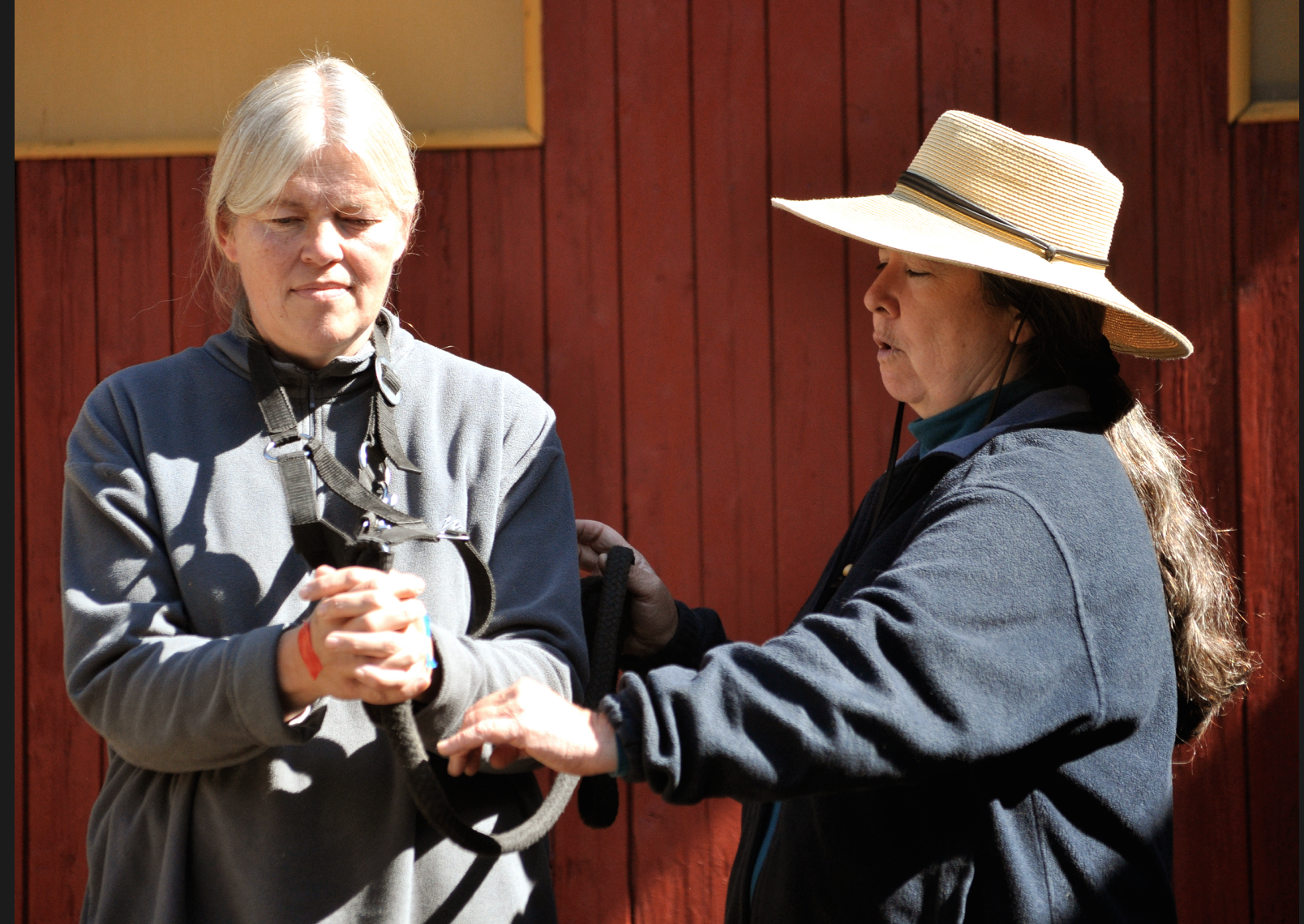
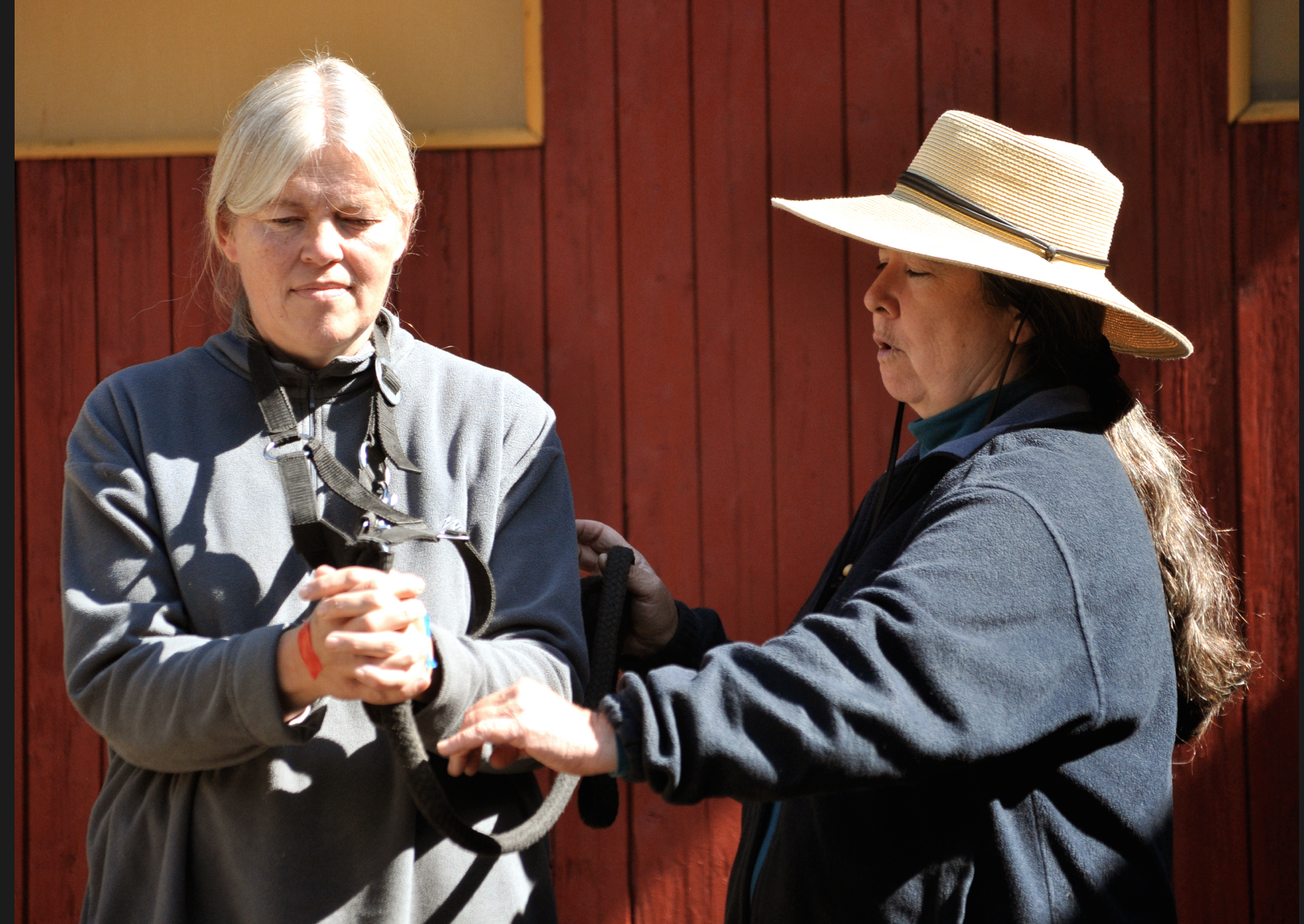
At clinics we put the horses away and we practice our handling skills, miming the actions with only imaginary ropes in our hands.
At the Russian tennis school students practice without rackets “rallying in slow motion with an imaginary ball. All players do it, from the five-year-olds to the pros. . . There are no private lessons. Students practice in a line. . . It looked like a ballet class; a choreography of slow, simple, precise motions with an emphasis on technique.”
None of the students are permitted to play in a tournament for the first three years of their study. “Technique is everything.”
At clinics technique is everything because that is what the horses have told us. They notice everything, so details matter. How you hold a lead matters. How you stand, how you breathe – horses notice so we need to as well.
At a music camp that has produced such great musicians as Yo Yo Ma and Isaak Perlman the instructors cut up sheet music into strips. The strips are then thrown into a hat and the students pull out at random the line they will be working on. They don’t just learn to play it as we will eventually hear it. They slow it down to glacial speed, slower than many of the students would ever have thought possible. The music becomes unrecognizable – more like whale songs with long drawn out notes than anything you would hear in a concert hall.
Playing this slowly reveals mistakes in technique that playing faster would hide, but accumulate enough of those mistakes and even someone as non-musical as I am will begin to notice. Eliminate them through these deep practice techniques and what myelin begins to insulate is the perfection of world class performance.
I have learned horse handling by slowing myself down and attending to details. In the “t’ai chi walk” which we practice at clinics I am sure there are many who don’t see the point. “How can you work horses like this?” People who are new to this process feel awkward stepping out so deliberately, so slowly. They bobble from side to side as they try to follow my lead. It feels awkward and unfamiliar. “How much longer do we have to do this?” I know, I know, but the ones who stay the course see their horses change. Now we have a good explanation for why this happens and it is based in neuroscience. Or should I say myelin science.
When you work slowly, “you attend more closely to errors, creating a higher degree of precision with each firing. . . When it comes to growing myelin, precision is everything. . . It’s not how fast you can do something. It’s how slow you can do it correctly.”
Going slow also helps the learner develop a “working perception of the skill’s internal blueprints — the shape and rhythm of the interlocking skill circuits.” Here’s what that means. When you work slowly you are observing, judging, adjusting your own performance. You are becoming your own coach.
I can teach you the overall technique, but I can’t possibly tell you every little adjustment YOU need to make in order to handle a horse well. I couldn’t write out instructions that are detailed enough and specific enough to your situation – and even if I could, you wouldn’t be able to remember and follow them. So I give you a process. I show you how to step away from your horse and enter the world of deliberate, deep practice. I show you how to use the t’ai chi walk, to slow everything down so you can observe how YOU move. I show you how to become your own best coach, and in doing so I liberate both you and your horse from a dependency on constant external coaching. Now you can learn together, teaching each other what it means to flow together.
Deliberate deep practice takes you to excellence.
Coming Soon: Part 9: Practice Excellence
In Search of Excellence: Effective Practice – Part 7
Part 7: The Role of Patterns in Deep Practice
This is the seventh installment in a nine part series. If you have not yet read Parts 1 through 6, you should begin with those. Part 1 was posted on Nov. 16, 2014.
Part 1: “The Talent Code”:
Part 1 introduces Daniel Coyle’s book, “The Talent Code”.
Part 2: The Myelin Factor:
This section presents a short course in neuroscience centered around myelin and the role it plays in building new skills.
Part 3: Equine Simulators:
Part 3 looks at creative ways to build your handling skills BEFORE you work directly with your horse.
Part 4: What Does Soccer have to do with Horse training?:
There are two types of skills you need to build: the first are technical skills you need to be able to handle a horse, these include rope handling and other physical skills. The second involves the split second decisions you must make.
Part 5: Skill Depends Upon Myelin:
Myelin builds high speed neural pathways. How does this translate to the building of skills for horses and their handlers?
Part 6: The Positive Role of Mistakes:
Highlight – Adjust – Click! – Reinforce – Repeat. That’s clicker training. It’s also good myelin building. You’re building good habits that create excellence. Myelin wraps. It doesn’t unwrap so you want to build good habits right from the start.
Part 7: The Role of Patterns in Deep Practice:
In clicker training we break lessons down into thin slices. It turns out in talent hotspots, they do the same thing.
Part 7: The Role of Patterns in Deep Practice
Chunking Things Down – Pattern Recognition
I have always used the term chunking down. “You want to chunk down that lesson into many small steps.” I know some prefer to think of thin slicing. For them a chunk is a big unit. You have a big chunk of cement. But a chunk, even when it is made of cement is still only a part of the whole. You are holding a block of cement in your arms – not the whole wall. I’m not alone in using the term “chunking”. Coyle used it when referring to the process of breaking training down that he saw in all the talent hotspots. To understand how important it is to break skill acquisition down into smaller units he used as his example learning how to read.
“We rode our horses out on a trail.”
If I asked you to remember this sentence, it would be easy. It has three main conceptual chunks: “We rode”, “our horses”, “out on a trail” are each chunks.
But if you are just learning how to read, these chunks are too big to be processed. These chunks are made up of smaller chunks: the letters are smaller chunks that you combine to create phonetic combinations that form words.
The pattern of four opposing diagonal lines forms a smaller chunk yet that you learn to recognize as the letter W.
Coyle had a great image for this: “each chunk nests neatly inside another group like so many sets of Russian dolls. Your skill at reading is the skill of packing and unpacking the chunks – or to put it in myelin terms of firing patterns of circuits – at lightening speed. . . Skills are the nested accumulation of small discrete circuits.”
A gymnast learns a floor routine by assembling it “via a series of chunks, which in turn are made up of other chunks. He’s grouped a series of muscle movements together in exactly the same way that you grouped a series of letters together to form words. Fluency happens when the gymnast repeats the movements often enough that he knows how to process those chunks as one big chunk. . . When he fires his circuits to do a backflip, the gymnast doesn’t have to think, Okay, I’m going to push off with my legs, arch my back, tuck my head into my shoulders, and bring my hips around. . . He simply fires the backflip circuit that he’s built and honed through deep practice. . . . When chunking has been done effectively, it creates a mirage. . . Top performers look incomprehensibly superior, yet they aren’t so different from ordinary performers as they seem. What separates these two levels is not innate superpower but a slowly accrued act of construction and organization: the building of a scaffolding, bolt by bolt, circuit by circuit, or to put it in terms of myelin – wrap by wrap.”
Talent
I learned a long time ago at clinics never to predict who was going to become a clicker superstar. I might have four complete newbies to the clicker process, each one struggling over the simplest of skills. I might want to say that the person with the well put together sport horse who was starting out with some decent horse handling skills would go further that the complete beginner who was tripping over her own feet, terrified of her own shadow never mind her horse. But you never know. That first person could be at a huge disadvantage. She might have just enough skills and enough of a comfort level with horses that she skips over the deep practice part of learning new skills. She becomes competent, but not great and her interest in clicker training wanes. The payback isn’t enough to hold her interest.
The novice handler has to work for everything. She has to engage in deep practice just to learn to put on a halter or to hold a lead. As a result she finds herself leap frogging past her more skilled counterpart. She not only stays with clicker training, the next time she attends a clinic, it’s to show off her superstar clicker horse.
Beginners
Most of us have forgotten what it was like to be a beginner rider struggling to find our balance on the back of a moving horse. We’ve forgotten how awkward it felt to use the reins, to try to turn or stop the horse. We may still be taking lessons, we may still be learning new skills, but that initial total beginner stage of awkwardness is well behind us and thankfully forgotten. But you can easily bring it back. If you only get on and off from the left side of your horse, next time you ride try getting off on the right. You’ll suddenly feel a blank canvas of nerve connections. It isn’t automatic at all. How do you even begin? How do you tell your left leg to swing over the saddle? Try to perform any skill other than the way you have programmed it in, and you will feel that blank-slate effect. That’s what it’s like to be a beginner with unformed, unmyelinated neural pathways.
For years I boarded my horses at a lesson barn for beginners. I had around me constant reminders of what it was like to learn how to ride. I saw the uncertainty, the awkwardness, the accumulating errors and regrettable habits. There was no deep-practice training in this program. The riders gained a level of competence but no one ever rose to the level of expert rider. You might say that’s because no one wanted to achieve that level of performance excellence – but how do we know? Why shouldn’t everyone have the same opportunity to gain excellence in whatever area their passion takes them? Those young riders were putting in the time. They came week after week for their lessons. But they never really got to feel what it is like to flow in total harmony with their horses. They never discovered the joy of feeling as though you are moving as one fluid being. Feeling the strength, the power, the athleticism, the spirit of horses was beyond the experience of their weekly lessons. If asked, they might say this isn’t why they came every week, but that is only because they didn’t know that this deeper level of experience was possible.
The gift of the gifted few is not their genes. It is the chance encounters that lead them to deep practice and the opportunity for excellence that grows out of it.
Coming Soon: Part 8: The Deep Practice “Layer Cake”
In Search of Excellence: Effective Practice
Part 6: The Positive Role of Mistakes
This is the sixth installment in a nine part series. If you have not yet read Parts 1 through 5, you should begin with those. Part 1 was published on Nov. 16, 2014.
Part 1: “The Talent Code”:
Part 1 introduces Daniel Coyle’s book, “The Talent Code”.
Part 2: The Myelin Factor:
This section presents a short course in neuroscience centered around myelin and the role it plays in building new skills.
Part 3: Equine Simulators:
Part 3 looks at creative ways to build your handling skills BEFORE you work directly with your horse.
Part 4: What Does Soccer have to to with Horse training?:
There are two types of skills you need to build: the first are technical skills you need to be able to handle a horse, these include rope handling and other physical skills. The second involves the split second decisions you must make.
Part 5: Skill Depends Upon Myelin:
Myelin builds high speed neural pathways. How does this translate to the building of skills for horses and their handlers?
Part 6: The Positive Role of Mistakes:
Highlight – Adjust – Click! – Reinforce – Repeat. That’s clicker training. It’s also good myelin building. You’re building good habits that create excellence. Myelin wraps. It doesn’t unwrap so you want to build good habits right from the start.
Part 6: The Positive Role of Mistakes
Next I’ll look at the same steps from the handler’s perspective. What do I need to build to be a good “dance partner” for my horse? Perhaps it is my rope handling. I’ll practice sliding down the lead, again teasing apart each small segment and rehearsing it in slow motion. I’ll notice that feeling of awkwardness when I switch sides and work on the right. Again I am attending to mistakes. That is different from focusing on what I don’t want. I notice that bit of awkwardness. Perhaps I’ll switch back to the left side and look at what my hands do that feels so smooth. This is the practiced side where the myelin wraps are thicker. I can feel the effect of all that good practice. When I switch over to the right, I get to experience the awkwardness that is the result of thinner insulation. The rope-handling pathway is not as well formed. What a wonderful opportunity to take the time to build a good circuit!
I know how easy it is for people to jump into clicker training without fussing over all these details. They click and hand their horse a goody without attending to any of these nuances. It’s sloppy – but who cares. It’s easy, it’s fun – that is, until it’s not. Every time someone gives their horse a treat so that his head comes around to them, they are reinforcing him for falling onto his inside shoulder and coming into their space. Click and treat, over and over, they are insulating circuits that they are not going to want.
Myelin wraps nerve fibers. It insulates them well to build strong, high speed habits. Myelin wraps. It doesn’t unwrap. So you want to build good habits sooner rather than later.
Deep Practice for Horses
The deep practice doesn’t end there. Once the handler has worked on her own skills, we return to the horses. The brilliance of clicker training is how easily it creates thoughtful, deliberate deep practice for the horses. We studied our own balance. Now we can do the same for them.
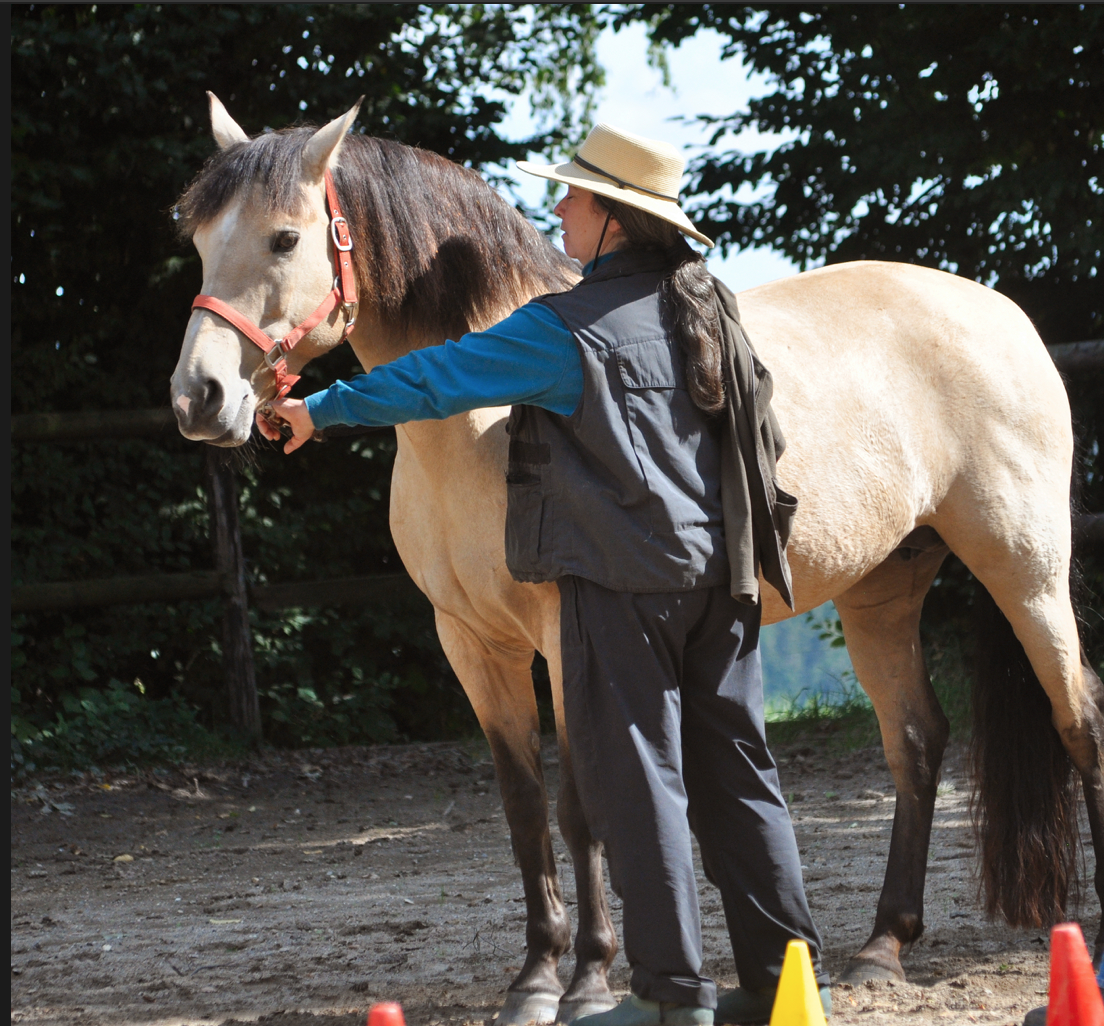
Every time you click the clicker and your horse stops to get his treat, you are creating a deep practice step. Ask him to take a step forward. How does he initiate that movement? Ah, he begins by letting his weight drop into his inside shoulder so he comes slightly into your space. Your practiced hand will catch that loss of balance, and gently redirect him back to the beginning of the movement cycle so he can begin again. Now as he comes forward in balance, click, he gets a treat.
Highlight – Adjust – Click! – Reinforce – Repeat. That’s clicker training.
As you highlight those adjustments, he will become aware of the changes. Good balance will become something he owns for himself.
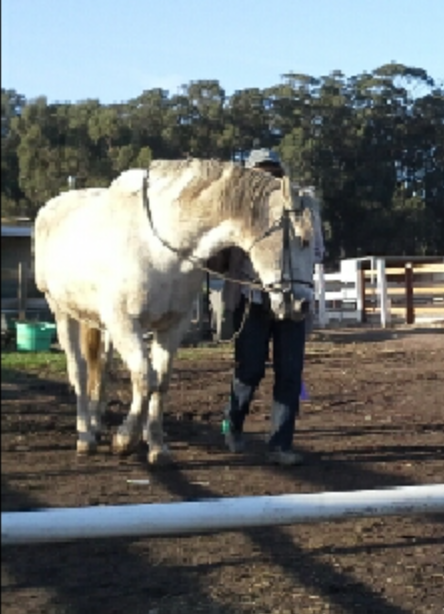
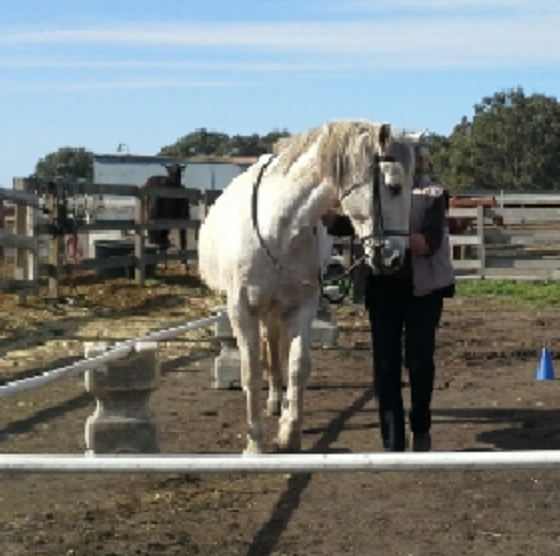
Here’s an interesting before and after. The photo to the left was taken at the beginning of a session. Note how much this horse tends to lean in and down onto his inside shoulder. The photo to the right shows the change in his balance after some deep practice work together.
Coding for Excellence
There aren’t specific genes that code for chess geniuses, tennis superstars, or rocket scientists. How could there be? But there is this very adaptive mechanism that allows someone who focuses on chess, or tennis, or rocket science to become a superstar in their chosen field. The system lets “our needs and our actions determine the skills we grow. It is flexible, responsive, and economical because it gives all human beings the innate potential to earn skill where needed.”
In Search of Excellence: Effective Practice – Part 5
Part 5: Skill Depends Upon Myelin
This is the fifth installment in a nine part series. If you have not yet read Parts 1 through 4, you should begin with those. Part 1 was published on Nov. 16, 2014.
Part 1: “The Talent Code”:
Part 1 introduces Daniel Coyle’s book, “The Talent Code”.
Part 2: The Myelin Factor:
This section presents a short course in neuroscience centered around myelin and the role it plays in building new skills.
Part 3: Equine Simulators:
Part 3 looks at creative ways to build your handling skills BEFORE you work directly with your horse.
Part 4: What Does Soccer have to to with Horse training?:
There are two types of skills you need to build: the first are technical skills you need to be able to handle a horse, these include rope handling and other physical skills. The second involves the split second decisions you must make.
Part 5: Skill Depends Upon Myelin:
Myelin builds high speed neural pathways. How does this translate to the building of skills for horses and their handlers?
Part 5: Skill Depends Upon Myelin
Coyle summarizes skill acquisition with the following:
1.) Every movement, thought or feeling is a precisely timed electrical signal traveling through a chain of neurons.
2.) Myelin insulates the nerve fibers and increases signal strength, speed, and accuracy.
3.) The more a particular circuit is fired, the more myelin optimizes that circuit, and the stronger, faster, and more fluent our movements and thoughts become.
I have just gotten a new computer. I’m not altogether convinced that all of its features are advantages, but the one thing I do like is the speed. My old computer had slowed down to the equivalent of an elderly person using a walker to get around. The wait times for even the simplest of operations were horrendous. This new computer is lightening fast. There are no wait times. I’m not spending half my morning watching the little wheel circle round that tells me the computer is working. Like the little engine that could, my old computer would eventually manage to bring up the file I needed. This computer has it up on the screen instantly. That I like.
That’s the metaphor for the effect deep practice has on the speed of transmission of the electrical impulse traveling along that network of nerve fibers. It transforms it from the dinosaur days of dial up modems and slow computers to the blazing speeds of this new computer. The efficiency that creates for me is enormous. There’s no more stop and go interruptions as the computer tries to run the programs I’m working on.
Again, as Coyle defines it: “Skill is built from myelin insulation that wraps neural circuits.”
In the talent hotbeds Coyle visited he saw very deliberate, mistake-focused practice. The current understanding of myelin and the role it plays in nerve-fiber conductivity seemed to explain why this type of training is so effective.
To build high speed circuits you need to activate the circuit, address any mistakes, and then activate the circuit again – over and over.
I have always valued persistence and that other key ingredient – passion – or as the writer Joseph Campbell put it – “following your bliss”. Why is this important? Wrapping one or two layers of myelin around a nerve fiber is a good start, but it takes a lot more than that to develop a high speed, super efficient circuit. It takes time and it takes energy. You need a passion for your chosen interest in order to sustain the level of commitment it takes to build a super star circuit.
The translation to Horses
So how does this relate to clicker training? We’re used to hearing that we need to focus on what we WANT the horse to do, not the unwanted behavior. We don’t generally talk about mistakes – that’s focusing the spotlight on what we don’t want. Or is it? I think there is a difference between looking at where you currently are with all the unwanted behavior your horse is throwing at you and attending to mistakes in a deliberate, focused, chunked down process.
Suppose a horse is crowding into me, leaning into his inside shoulder, and swinging his head in to swipe at my arm. Focusing on this behavior will suck me into the drama of a confrontation, and it may blind me to the solutions that will shift this horse out of my space. In this scenario what myelin circuits will I be firing? What myelin circuits will I be strengthening? That’s an interesting and important question to ask yourself. Remember it isn’t just the circuits for physical actions that are strengthened. Myelin also effects the pathways that regulate emotional responses. So every time I get frustrated or angry with that horse when he crowds in on me, I’m strengthening that response. I’m making it easier and easier to become angry. I’m creating the very thing I most want to avoid – a hair trigger for anger.
So I want to make a sharp U turn and shift my focus to what I want. In a broad brush description of what I want, I would say that I want my horse to keep his head straight, and to walk forward with his weight evenly balanced between his shoulders. The result will be that he’ll stay out of my space.
So now I apply deliberate deep practice techniques to building those skills. I begin by putting my horse away and working out the details of what I want by miming both my actions and the horse’s. I’ll slow everything down so I can really understand what is needed. I’ll pretend that I am my horse. What happens to my balance when I lean in on top of my handler? How does this effect my ability to walk forward? How does it make me feel? What do I need to do to change out of this balance into a more desirable balance? How does that make me feel? Always I pay attention to these emotional shifts. It shouldn’t be a surprise that they track very accurately the changes in my balance. Physical balance helps to create emotional well-being.
I’ll imagine again that I am a horse standing in reasonable balance. My handler will be asking me to walk off maintaining this good balance. How does my weight need to shift to create that first balanced step? Remember I am miming all of this, moving in slow motion so I can notice all the tiny details, all the changes in balance that will become more automatic as I speed things up.
Building a skill follows a curious trajectory. I’ll begin with this very chunked down, slow-motion process where everything is noticed and nothing is automatic. How do I shift my balance to begin to lift my foot so I can take a step? Where does the movement begin? What allows it? What blocks it? Everything is noticed. But this isn’t where I am going to end up. Thank goodness! I’d never be able to walk if that were the case. And that’s the point.
Automaticity
As a skill develops, you become less and less aware of what you are doing. The skill becomes automatic. There’s a name for this: automaticity. We need skills to become automatic so we can attend to other things. If I had to think about every tiny detail of how I walk every time I took a step, I would never be able to work with my horse. So I analyze this process away from my horse. I build the circuit I want, strengthening it with repetitions until it begins to feel automatic. That’s when I am ready to explore the next step in the process. When I have strung enough of these chunks together so the entire flow feels smooth and automatic, I’ll ask my horse what he thinks about all this deep practice. Has it made me a better dance partner? His feedback will tell me what I need to work on next.
Coyle made the comment that the process of building brain circuits accompanied by automaticity yields a curious result: as we build these enormous and highly detailed circuits, we’re simultaneously forgetting that we have built them. Perhaps this is the reason people are often reluctant to begin the deep practice routines of miming in slow motion the skills they want to build. They have forgotten what it is like to be a complete beginner and the work that’s involved in learning a new skill. None of us like the feeling of being clumsy and awkward. It’s an uncomfortable place to be in. We want to move out of that zone as quickly as possible.
There are two ways to do this – the first is to avoid exploring any new activity where you might experience being a beginner without well-insulated myelin circuits to guide you through. The other way is to build good circuits through an efficient, effective process. The deep practice techniques give you the fast track out of this zone, and they do it oddly enough by slowing everything down. That’s the paradox.
So in my deep practice approach to developing good training skills I’ll continue to explore balance from the horse’s perspective. I’ll begin by shifting my weight so I can step off with my outside foot. Oh no, there’s a slight bobble as I begin the shift. Left unattended that will snowball into my falling over my inside shoulder. As I pretend to be a horse, I’ll feel crowded by my handler who will be trying to push me back. We’ll both be heading down a well-myelinated track of annoyance that was built up via our previous training encounters. So I’m going to notice all those tiny losses of balance, attend to them, and now that small part of the circuit can fire without the error. I won’t be triggering that older habit pattern that leads to annoyance. Instead I am building a better “expressway”.
Highlight – Adjust – Click! – Reinforce – Repeat. That’s clicker training.
I’ll repeat this segment, attending to the nuances of the balance shifts until I have a clean circuit. The myelin pathway that I am strengthening is building towards excellence.
Coming soon: Part 6: The Positive Role of Mistakes
Shopping for a New Car: Lessons Learned From Clicker Training
Part 1: The Demise of the Panda Mobile
A sad day has arrived. I have finally declared my reliable, old Mazda unsafe to drive. This was the first car Panda learned to travel in. I bought it in February of 2001. Panda arrived in September of that same year. When I went shopping for a compact car, I never imagined it was going to turn into a horse transport.
Panda arrived in an enormous horse trailer. It pulled up outside my suburban home. That got enough heads turning as cars drove past. But then the back doors of the trailer opened and out stepped tiny Panda!
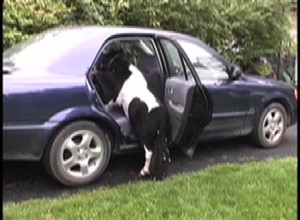
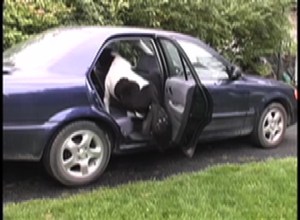
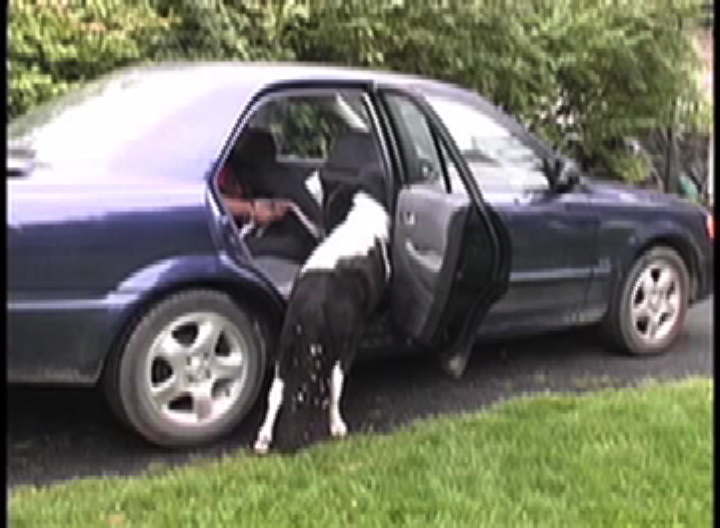
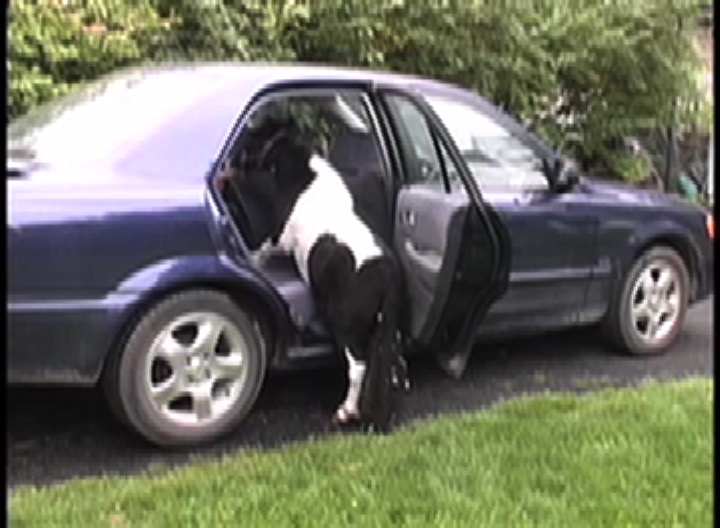
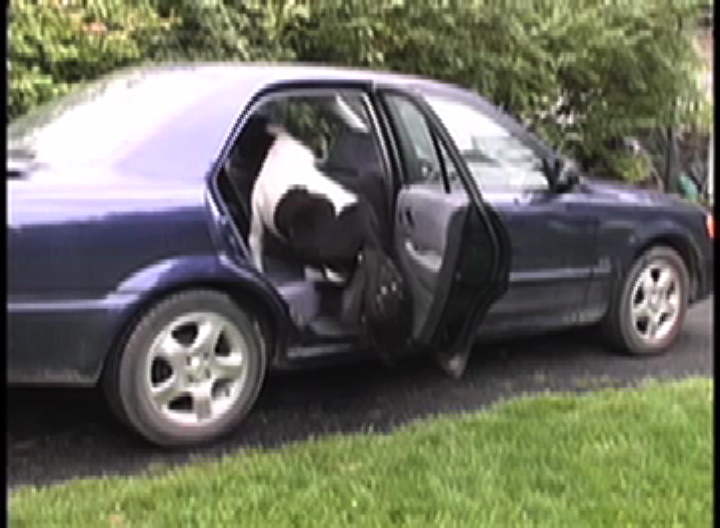
Her first lesson in car travel began the following day. I have a wonderful video clip of her trying to figure out how to get in the car. She was willing. She just couldn’t figure out where all her feet were supposed to go!
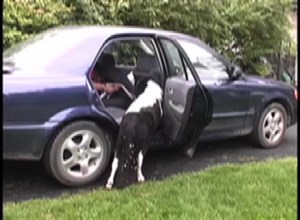
When she finally did jump in, my emotions jumped from “Wow! I have a horse in my car.” to “Oh no! I have a horse in my car! Now what!”
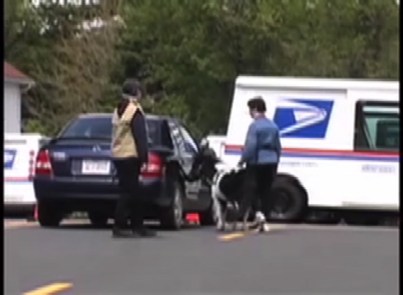
Because Panda was in training to be a guide, she needed to be able to travel with me wherever I went. Mostly that meant running local errands and going to the barn. On our first car trip through town, she didn’t yet have her “sea legs”. I remember driving like a proverbial little old lady. I was terrified a squirrel or another car was going to pull out in front of us and make me hit the brakes.
Balancing on the back seat was clearly not a good option, so we took the seat out and built a platform for her to stand on. I just reinstalled the back seat. For a thirteen year old car that’s gotten a lot of heavy use, it’s got to be the cleanest back seat ever!
Panda has changed the way I shop for a car. I wonder if any of the salesmen noticed the unusual order in which I examined each car. I suspect most drivers open the driver’s door first. I opened the right side passenger door because that’s the door Panda uses to get in. I didn’t tell any of them that I was checking the height of the seat and the swing of the door to see if a horse could jump in. That would have taken more explaining than it was worth.
In case you’re wondering, in the cars I have checked out so far, Kia’s back seat failed the Panda test. Mazda’s gave excellent access. The Toyota Prius would be really hard for her. The batteries are under the back seat so she would have a big jump up (or more to the point down) out of the car. Fords were useless. The Suburus were great. I have other cars on my list, but I haven’t yet had a chance to look at them.
Panda has also converted me from a manual shift to an automatic transmission. I have driven manuals all of my adult life. That was always my driving preference, but Panda has changed that. She’s such a decadent little thing. She loves resting her chin on my shoulder while I drive and taking a nap. In the winter the vents blast hot air directly at her, and in the summer she gets the full effect of the air conditioning. But, oh dear, every time I need to shift I have to wake her up. I decided years ago that my next car would have to be an automatic.
Panda’s regular “Panda mobile” is Ann’s family van, but I do still occasionally provide transportation. I want to keep Panda happy so my car selection is being very much influenced by her.
So what did I buy?
When I bought my Mazda thirteen years ago, I knew I wanted a small car. I was replacing a Nissan Sentra that had over 250,000 miles. It had been a reliable car to own, but dull as ditch water to drive. I knew I wanted something different so I test drove every small passenger car on the market, foreign and domestic. I also consulted Consumer Reports and several other sources of car reviews.
I had fun test driving all those different cars even though it created a great deal of head-spinning confusion. Almost every car had something going for it. I wasn’t sure exactly what I was looking for, but one by one I was able to cross the different makes and models off the list. It finally came down to a choice between the Mazda and a Suburu. The Suburu almost won because of the all wheel drive and, I have to say it, the heated seats. I live in snow country so the Suburu’s reputation for being good in snow was definitely tempting. And when you’re out in cold barns all day, heated seats also have a draw. But in the end I chose the Mazda because, quite frankly, it was fun to drive.
I don’t mean this to turn into a car review, but my Mazda has been the best car I have ever owned. It doesn’t have as many miles on it as my other cars. With the clinics scattered as they are all across the country, I am traveling more by air these days than by car. So it may not be quite a fair comparison, but the Mazda has lasted longer and had fewer repairs than any other car I have driven. What finally did it in was rust. It was a victim of too many days spent parked at the airport or sitting out at the barn instead of sheltered in my garage.
The real hammer blow fell in 2012 when Hurricane Sandy went through my area. I was teaching that weekend at a clinic in Groton New York about four hours from home. Over the weekend we kept an anxious watch on the weather channel. The hurricane was forecast to hit the northeast sometime late in the day on Monday. I wasn’t the only one who lived in the path they were predicting it would take, so we finished up early in the day to get everyone home before it hit.
Once home, I decided to spend the night camped out at the barn with the horses. Quite apart from wanting to be with the horses should anything happen, I decided I was safer weathering a hurricane in my strong, new barn, rather than in my house with three tall pine trees looming over the back garden.
I wasn’t sure where it would be safest to park my car. In the end I brought it into the barnyard and parked it under the composter.
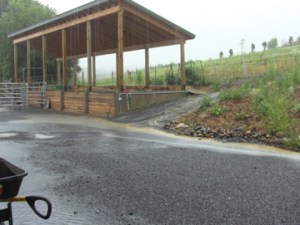
Hurricane Sandy went up the east coast causing major damage, especially to the New Jersey coastline and to New York City. It caused enormous flooding in the hill town communities in Vermont and parts of New York, but in my area we had high winds but no real damage – except in my barnyard. I don’t know what happened to my poor car, but in the morning it looked as though someone had taken a car key to the paint.
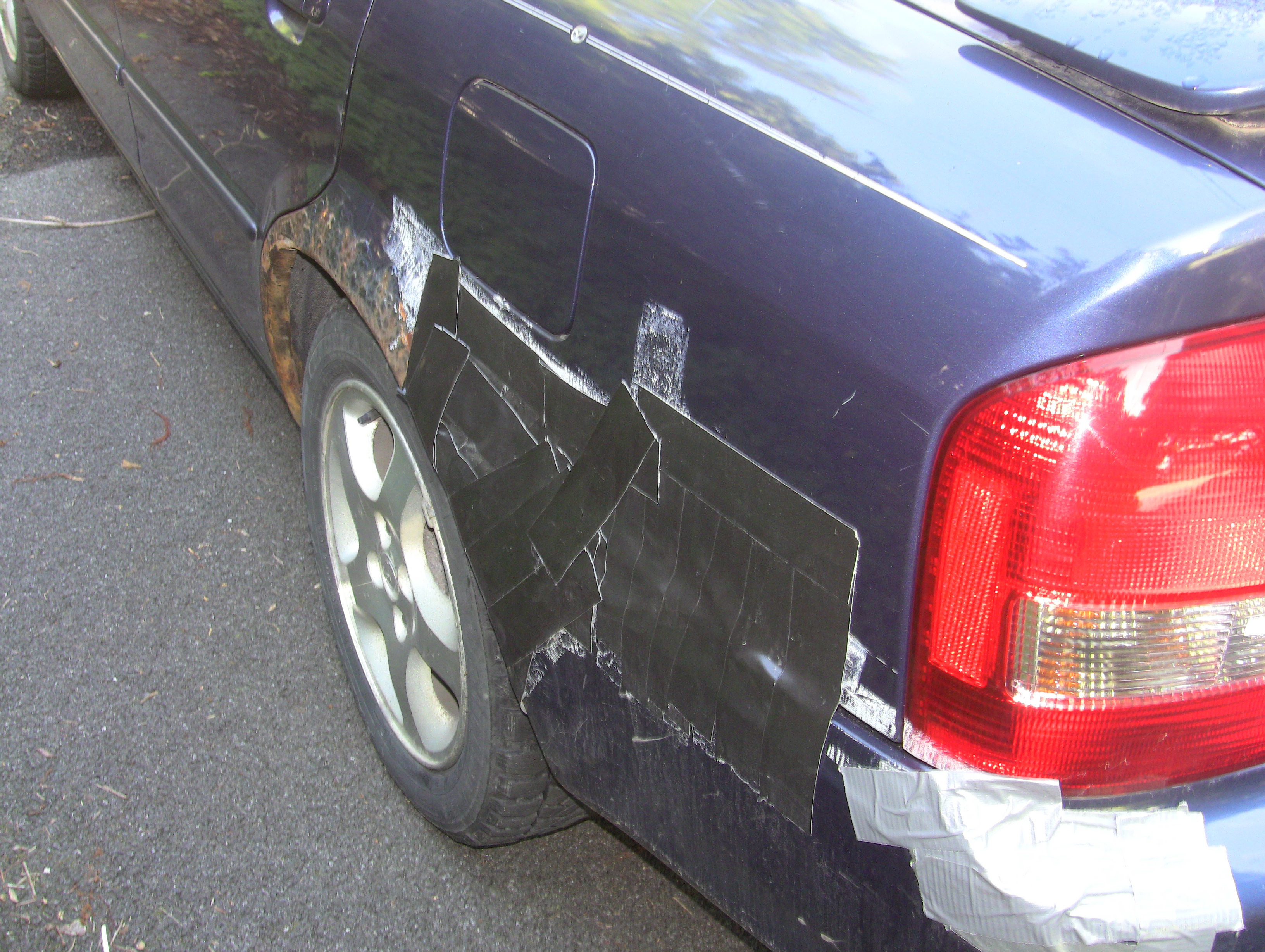
And then there was the back bumper. That can’t be blamed on the hurricane. I don’t know what happened. I suspect someone backed into it in a parking lot and left without owning up to the damage. In any event the bumper had a huge crack in it. I was busy at the time between traveling, the horses, and creating my new on-line course. I never repaired the bumper. Big mistake. The wobble put extra wear and tear on the bolts holding everything together. They eventually gave way and left the side bumper hanging at a precarious angle.
But I’m a horse person. There’s always duct tape and baling twine. I strapped the bumper up with duct tape and kept on driving.
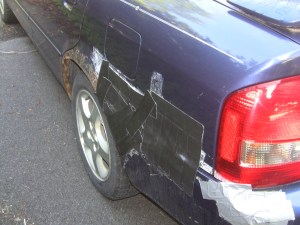
I’ve had to go from regular duct tape to the black gorilla tape to keep everything in place. This past weekend I was driving back from a long road trip through a bumpy stretch of highway construction. I bounced along over huge potholes. My car decided it had had enough. After jarring over a particularly bad stretch of road I heard a horrible banging coming from the back. It reminded me of a horse I knew years ago who had shattered his jaw. When he chewed, he sounded as though he was rolling cracked marbles around in his mouth. The car sounded like a supersized version of that. I thought for sure the bumper had finally fallen off, but when I pulled over, the duct tape was still holding everything in place. I looked at the underside of the car, added more duct tape to the bumper, and drove off. The rattling continued. I pulled over again, added even more duct tape and tried again. It was no good. Every time I hit a bump, the whole back end sounded as though it was bouncing off the chassis. And given the amount of rust on the car, that could well have been the case. But I was two hundred miles from home. I didn’t fancy being stranded in the middle of nowhere, so I kept going. Once I got on better roads, the car quieted down and drove just fine.
It got me home safely, but I knew I was probably looking at the end of the road. When I took it in the following day to have it checked over, my local mechanic confirmed what I already knew. It was time to call it quits. I will miss my old Panda mobile.
Part Two: Shopping for a New Car: Hasn’t Anyone heard of Positive Reinforcement?
So now the search was on for my next car. I’ve known this day was coming so I’ve been doing my homework, reading reviews and paying attention to the cars I see on the road. It made sense to begin with the Mazda/Ford dealership since I had enjoyed my current car so much. It was also the closest dealership to my house.
I drove my pickup truck to the dealership, so my first challenge was finding a place to park. My truck is designed for hauling horse trailers, not squeezing through narrow gaps in an overstuffed parking lot. I headed into a blind alley and spent the next few minutes inching my way back out. This might have been a Ford dealership, one that sells and services pickups, but there was no room to maneuver. By the time I got inside whatever good mood I’d been in had evaporated.
I was greeted by a salesman. “Hi, my name is Jim, but everyone calls me Doc. You can call me Doc.”
Okay, not my style.
As we were walking out to the lot, he asked the inevitable question: “So what do you do?”
I never know how to answer this question. I wear so many hats. I’m a writer, a publisher. I’m an experimenter, an inventor, a teacher, a coach. In the end I say what I always say, I train horses.
It turns out that was the wrong answer. “Doc” had had horses. Years ago he’d owned a couple of standardbred race horses. He went on to tell me how much money he’d lost on them. “Those horses cost me a bundle. The only people who got rich were the vets and the trainers. The horses were always breaking down” Okay, same species, different world.
We went out to the parking lot. All the cars were locked. We wandered around looking at the exterior of cars. This wasn’t helping. I’ve seen them on the road. I know what the cars look like on the outside. I needed to see their insides. Whatever happened to show rooms where the current models are on display? This was beginning to take more time than it should, and I was liking these cars less with each passing moment.
Doc finally went back to get keys and I wandered around reading price stickers. At long last we got a couple of cars open. We looked at the Fords first. They were quickly crossed off the list. I didn’t like the interiors. For me the seats weren’t comfortable, and Panda would never have gotten in. We went back to the other side of the lot to the Mazdas.
We looked at the Mazda 3. Good access for Panda, check. Comfortable seats, check. Reasonable instrument panel, check. Attractive interior, check. The only problem was I hated the overall look of the car. Why do all these modern cars have front grills that look like cartoon character fish? Did all the designers grow up on “Finding Nemo”? Whatever car I get I plan to keep for ten years or more. I’m going to be looking at it for a long time. I don’t fancy walking out to my driveway every morning and being confronted by a cartoon imitation of a fishy grin. (My apologies to all the Mazda owners who have never seen their cars in this way and now will forevermore. )
I hoped the drive would make up for the appearance. I was not disappointed. It drove like a Mazda which meant it handled well. This car and mine might be thirteen years apart, but the feel was familiar. I was glad that Mazda had not messed with that, but still there was the look of the car. Doc was not helping. He had to refer to the brochure to tell me anything about the car. I can read brochures for myself. In passing he told me had been on the job for only seven weeks. Clearly the dealership provided very little training for their new employees. He was trying hard, so I tried to cut him some slack, but seven weeks is time enough to learn the basic facts about each of the main cars that you’re selling. He also didn’t know how to run a test drive.
Like most dealerships this one was on a busy commercial strip. You can’t really get a feel for what a car can do in stop and go traffic. But I know from my previous experience that once you turn up the side streets you can quickly get onto roads that let you really test a car. Doc hadn’t found those routes yet.
Oh well. The car was fine, but I left the dealership in a grump. I had wanted to like the car, but I couldn’t get past my dislike of the exterior.
Next stop was the Kia dealership just down the road. I didn’t even try to find a spot for my truck. I parked directly in front of the entrance. I cornered the first person I saw and asked if my truck was okay where it was. It turned out I was speaking to the owner of the dealership. He was in his early thirties, very cordial, very welcoming. He asked what I was looking for, grabbed a salesman, and told him the cars he should show me.
I had to repeat everything that had just been said – twice – not because the salesman didn’t hear me the first time, but because he didn’t remember a word I had said. He was too busy drooling over my truck.
My truck is even older than my car. It’s a 1997 F350 which I bought second hand. I’ve driven small cars all my life. Good cars, but not cars anyone ever pays attention to. No one ever commented on my Mazda or any of its predecessors. But when I bought my truck, things changed. Delivery men would stand in the middle of my driveway staring at my truck.
“Nice truck,” they’d exclaim, drawing out the vowels. They would stand transfixed, filled with obvious truck envy.
The first time I drove the truck to the local lumber yard I experienced the same thing. For years the lumber yard had been a place I tried to avoid. If you were female and wanted service, you had to come with a man – or I now discovered a “nice truck”. For the first time ever I got wonderful service – once they could take their eyes off my truck.
Not all trucks produce this response. Years ago I was helping a friend move house. We stopped at a warehouse to pick up some large packing boxes. She had her newer, shinier Chevy. I had my Ford. The Chevy was ignored. It might as well have not been there. “Nice truck,” drawled the warehouse worker, stopping just as all the others had to admire my Ford’s square, old-fashioned lines.
My truck is older now. It has spent the summer under the overhang at the barn so it is coated with dust and pollen. It was not looking it’s best when I pulled into the Kia dealership, but the salesman still had that “look”. “Nice truck,” he exclaimed, drawing out the vowels in the same way all the others had.
(Here’s a tip to Ford motors. You are missing the boat completely with your new trucks. What were you thinking changing your design? I do not see men stopping in parking lots obviously struck by truck envy the way that they do when they see my truck. If you want to sell trucks, reintroduce your old design.)
I had come to the dealership to buy a car. I did not need a salesman who was distracted by my 17 year old truck. And anyway it was blocking a delivery van so I moved it, inching my way through the narrow lanes of the lot around to a corner spot where it was less in the way.
Again we walked directly out to the lot instead of starting in the showroom. And again the cars were all locked. He showed me the exterior of one car after the other. I wanted to see the interior. We marched up and down the parking lot before we finally found a car that was open. I sat in the driver’s seat and was immediately struck by how stale the car smelled. “Is this a used car?” I asked. I hadn’t yet looked at the sales sticker. He confirmed that it was.
“Well, it was owned by a smoker,” I declared.
“Oh don’t worry about that. We’ll have it cleaned before you buy it.”
That’s not a smell you get out with a little cleaning – or even a lot of cleaning. I got out of the car and announced that I wasn’t buying any car that had been owned by a smoker.
He was clearly annoyed. He’d found a car that was unlocked. Now he was going to have to go back inside and get some keys.
The car that responded to the panic button on the keys he brought back was a Kia Soul. What a funny looking car – again my apologies to anyone who owns one. I would struggle with the boxiness of the design. And for all it’s extra height, the interior was not that roomy. But I was curious to see how it handled, so we took it for a drive. I thought it was odd that he did not check my driver’s license first. Nor did he put dealer plates on the car.
As we were leaving, a Hummer pulled up to the front of the dealership. The salesman stared. Apparently Hummers also produce truck envy. He was trying to sell me a little car, but all he could say was a Hummer was what he’d buy.
We weren’t even out of the parking lot before I knew the Kia Soul was not my car. What a horrible drive.
Test driving cars is very much like riding. There, I knew I would get around to horses! It is so much a matter of feel. This car was wobbly. The brakes were abrupt. The steering wheel didn’t give that tight feeling of being connected to the road that I enjoy. This was not my car.
Next we looked at the Rio. The way the side door opened would make it hard for Panda to jump in, but I didn’t share with the salesman my criterion for judging a car. I did want to drive it though, so again he reluctantly went back into the dealership to get keys.
The car he picked was partially blocked by another car parked in front of it. I didn’t fancy trying to maneuver out of such a tight spot in a car I didn’t know. I asked the salesman to drive it forward for me. As he climbed into the driver’s seat, I heard him mutter, “for someone who drives a big truck you must get stuck a lot.” Points off for you. There’s no need to be rude. His job was to get this new car safely off the lot and onto roads suitable for a test drive. In my previous car-shopping experience the salesmen always drove the car first. They showed me what the car could do, and then they turned it over to me. I never drove any of the cars directly off the lot. Given the congested, bumper-threatening traffic of the commercial strips dealerships always seem to be on, I didn’t mind turning this part of the drive over to them. Let them be responsible for keeping the car out of harm’s way.
In this case the salesman pulled the car forward out of the parking space, then we traded places. I headed out of the parking lot, but again I didn’t even make it out onto the street before I knew this was not my car. I see a lot of Kias on the road. I will look at them differently now. And especially in the winter when the roads are slick, I will make sure there is a bit more room between us. I did not like the handling of that car – at all. Again my apologies to all Kia owners.
We took the short way back to the dealership. But as short as the drive was, the salesman was clearly bored with it. He might as well have been a small child in the back seat whining “are we there yet?”
So the Kias were crossed off my list. That made it easy, but there were lots of used cars on the lot in makes and models that were on my list. I asked about a Nissan that was directly in front of us. He said the obvious. It was a four door sedan. I was now getting tired of his lazy attitude. I had made it clear that I was replacing my Mazda. I wasn’t window shopping. I was here to test drive cars and to make a decision about buying one.
I asked about another car. Again he said something general about the exterior. Finally I snapped. I told him I knew what these cars looked like. I saw them all the time on the roads. I needed to see the interiors.
“That means I’d have to get the keys for each one,” he said in a tone that clearly indicated I was being a bother.
“Yes,” I snapped back. I looked at my watch. It was close to four-thirty. He had eaten up over an hour and a half of my time, and I’d only driven two cars around the block. I’d had enough. “It’s getting late,” I said. “This has taken too much time, and now I have to leave.”
So the first salesman was well meaning but inexperienced. This one was rude and lazy.
The horses would be waiting for their supper, so I headed out. I was hoping to return later that evening to continue the search, but a quick check on the internet revealed that the dealerships all closed at 6 on Fridays. That was a surprise. I would have thought they would stay open to get a jump start on the weekend shoppers. What it meant for me was I could spend the evening researching the remaining cars on my list.
Saturday afternoon the first stop was the Toyota dealership. This was centered around one of those oversized, glass fronted buildings that declared “we are a modern, up-to-date dealership selling the best cars in the business.” There’s nothing like a little window dressing for setting the stage. Inside the cavernous show room was buzzing with activity. I stopped at the reception desk and was immediately introduced to one of the sales staff – a woman this time. She was all smiles, welcoming me cordially to the dealership.
We went through the usual questions: what was I looking for? She asked if I ever drove a manual. “Yes, that’s what I had always driven.” “Oh, then I might have just the car for you!”
We walked out to the far side of the lot to look at a Scion. This was a car that was not on my radar. It looked less like a fish than the Mazdas and the Kias, so that was a plus. It had good side door access. The interior was roomy and pleasant enough, but how would it drive?
As I sat in the driver’s seat checking out the dashboard, she asked what I thought of the car. I responded that I liked it, but I would have to do some research. I would want to check out the reviews in Consumer Reports and other sources. The words weren’t even out of my mouth before she began disparaging reviews in general and Consumer Reports in particular. Hmm. Not a good move. I just let her talk. Salesmen tend to criticize reviews only when the reviewers don’t like the car, so what was I going to be reading about the Scion?
Reviews weren’t the only thing she didn’t like. We hadn’t made it out of the parking lot before she was criticizing how I drove a manual. I felt like saying I had been driving manuals all my adult life and every one of them had outlasted most of the cars on the road.
We were not off to a good start, and it went downhill from there. She had been all smiles in the showroom. Now she was clearly bored and wanting the drive to be over as soon as possible. The gas gauge was on empty so she was going to get her wish. By necessity this was going to be a short test drive. We turned off the main road onto a side street, made one turn, went a few blocks, turned again, and ended up back on the main road and the dealership. So much for getting to know what the car could do!
I had been pleasantly surprised by the Scion. The price was good. The drive was acceptable. The interior provided plenty of room and good access for Panda. It was something to consider. But I had come to this dealership to test drive a Prius.
You would think I had to apply in triplicate for the privilege. We wandered around the lot looking at a selection of Prius cars, but she showed no sign that she was going to get any keys. As we walked along the lines of cars, she asked what I thought of the Scion. I told her I had liked it, but I would have to do some reading about it.
“How long do you think that reading is going to take?” She asked in an annoyed tone. “How soon do you think it will be before you make a decision?”
What an odd question. Had I not told her that my car was no longer road safe? Didn’t that mean that I was a serious shopper? I was not window shopping. I was going to buy a car. She was annoyed that I wanted to test drive the Prius. She was also annoyed that I hadn’t driven my old Mazda to the lot. “How do you expect us to look at it, if you don’t have it here.” Did I not say that it was no longer road safe? And besides we are a long way from that step.
She asked again how soon it was going to be before I made a decision. Was it going to be a day? How long was all this reading going to take?
“Soon,” I told her in a cold voice. I might not know how long my car shopping was going to take, but one thing was becoming very clear. Whatever car I decided on, I wasn’t going to be buying it through her.
I was ready to leave, but I was determined to at least look at the interior of a Prius. She did eventually get some keys. The Prius she selected was a pleasant surprise. There was plenty of room in the back and the interior was very attractive. But the batteries are under the back seat so it would have been a big jump up for Panda.
We took the car for a test drive. She started telling me an improbable tale of how much you can pack into a Prius. She’d been visiting her mother who sent her home with a full dining room set, table and four chairs, several floor lamps, big, overstuffed sofa cushions. The list kept growing.
“In how many trips,” I asked as I turned a corner.
“One.”
“Oh, then you left your children at your mother’s.”
“Oh no, we fit everyone in.”
We were on a straightaway, a good place to test the steering, but somehow I didn’t want to. The Prius drove well. It was certainly a car I could enjoy, but it was not a feel that I loved.
We went around the block and returned to the dealership. I put the Prius on the possible list.
We went back inside the dealership. She disappeared for a few minutes. When she came back, it was to tell me that her next appointment had arrived. “Good,” I though. “That’s an easy excuse to leave.” She had wasted too much of my time already. I might be interested in both the Scion and the Prius, but I would not be working with her again.
Three dealerships. Three strikes.
People complain about the state of the economy. They blame everyone but themselves. Sadly, my experience at these dealerships is typical of far too many encounters in our service economy. It stands in stark contrast to the experience you would get within the clicker training world. Perhaps that is why these sales associates were so jarring for me. I know the message I would want to send to all the dealerships. If you want to increase sales, yes you have to have a good product, but there’s more to it than than. You have to teach your sales staff how to talk to people, how to listen to their needs, how to be supportive and positive – in other words, you need to teach them clicker skills. Just think of the staff training our clicker horses could provide!
I left the Toyota dealership feeling fed up with the search and headed down the road to the Suburu dealership. I almost didn’t stop, but I was going right past it, I might as well turn in. The dealership was under construction. In the background you could see the steel frame for yet another huge glass-fronted showcase. But for now the sales department was crowded into a large construction trailer. That meant the front parking lot was even more crowded than the other dealerships had been. But construction requires large construction vehicles. If they could fit, then my pickup certainly could. I drove past the construction area and found a spot way in the back of the parking lot. As I was getting out, I was greeted by a salesman who was collecting empty plastic water bottles from his own truck. The dealership paid 8 cents per bottle and gave the money to the local humane society. Extra points for both of them.
We went through the preliminary questions, and then he took me over to a line of Imprezas. They all had leather interiors.
I said I actively would not buy a car with leather seats.
“Got it,” he responded and we moved on. No questions asked. More points earned.
The cars he wanted to show me were of course locked, but he went off right away in a golf cart to get the keys. The Impreza he showed me passed the initial inspection. It’s front grill did not resemble a fish. The side doors would give Panda room to get in. The seats were comfortable, the instrument panel uncluttered. He checked my license, put a dealer’s plate on the car, and we headed out of the lot.
So far so good. Unlike the other salesmen, he had clearly been selling cars for years, and what’s more, he enjoyed it. He also knew how to conduct a test drive. He picked a route that showed off what this car could do. We didn’t just go around the block, he directed me down a winding side road that gave me a good feel for the car’s handling. We diverted into a large, empty parking lot where I could try out the car’s turning radius. It spun on a dime. What fun! Maybe it was because I was driving my tank of a truck which has no maneuverability, who knows, but I was loving this. I spun the car again. Now I was smiling. This was the first car that had made me smile.
I’ve grown so super cautious in recent years driving on snow. The Mazda always got me home, but it was only because in slippery conditions I crawled along at a snail’s pace. This was a car that handled well and was made to drive on snow.
We left the parking lot and headed on to a stretch of highway where I could run the speed up. I continued to like the drive. We returned to the dealership and I found myself inside buying a car! Just like that! So in answer to the Toyota saleswoman’s question: soon apparently meant today.
So I have bought a car. My first in thirteen years. I am looking forward to getting it home and taking it for another spin around an empty parking lot! I am also looking forward to driving it in it’s first snow storm and feeling the extra security the all wheel drive gives me. There were still cars left on my list that I had intended to test drive, but this salesman can thank his competitors for this quick sale. He knew what he was doing. He knew how to present a car well. He didn’t dither around and waste my time. He seemed to enjoy the experience of showing off a good car. He made it a pleasant, positive experience which stood in stark contrast to the others.
Perhaps it is simply experience that teaches this. Who knows how many other salesmen have come and gone from this same dealership, failing in just the same way that the others did. Or perhaps this dealership really does train its staff. I don’t know, but I believe in reinforcement. He had a good car. He presented it well. He treated me well, and for that he earned the reinforcement of a sale completed. There are lessons there for all of us.
Alexandra Kurland