Modern Horse Training – Today’s Post: Peregrine, My Master Teacher

Hi Everyone,

One more day to go before my new book, “Modern Horse Training, A Constructional Guide to Becoming Your Horse’s Best Friend”, becomes available to order.

Yesterday I shared with you a little behind the scenes information about how books are printed in the modern world. Modern printing for “Modern Horse Training”!

Sharing Clicker Training
You are reading this post because you are a follower of my work. You’ve been reading my blog. I suspect you also listen to my Equiosity podcast, so you know that I love horses. That’s something we very much have in common. When I started to explore clicker training, it was something I wanted to share. I’m not alone in that. Clicker training has spread around the planet because lots of people have been talking about it. We’ve been sharing our clicker success stories and other horse people have been paying attention. They’ve gotten curious enough to take a look. That’s a good thing for the horses they love.

This year marks an important anniversary for me. It was thirty years ago in September of 1993 that I first went out to the barn with a clicker in my hand and treats in my pocket.

Peregrine was eight years old. He was living at the home of one my long-time clients where he was turned out twenty-four/seven with her two horses. It was a heavenly set up for him except for one thing. The property was next to a wet lands, and he got Potomac Horse fever. He was one of the first horses in my area to contract the disease. Thankfully he was vaccinated, and also thankfully my vet recognized what it was. Peregrine got the treatment he needed, but not in time to completely avoid all of the long-term side effects. He developed laminitis which led to hoof abscesses in both of his front feet. Instead of being able to go out with his friends he was laid up in the barn. He was in so much pain for the first few days he was unable to walk even a step or two.

It looked as though he might be laid up for a while. I wanted to keep him entertained during his layup, so I decided this was the perfect time to experiment with clicker training, to see what it was about.

In her book, “Lads Before the Wind” Karen Pryor described the process of charging the clicker. She would blow a whistle, throw a fish in the water, blow a whistle, throw a fish in the water until, when she blew a whistle, she saw the dolphins interrupt what they were doing to look for the fish. At that point she knew they were making a connection between the whistle and the fish. So then she could choose the moment she blew the whistle to begin shaping the behavior she wanted to teach.

I went out to the barn to charge my clicker. I clicked and handed Peregrine a treat. He took the treat from me. Hand feeding was nothing new. I clicked and handed him another treat. He took the treat but showed no sign that we was noticing the click. I repeated this several more times.

People think I am patient. They are wrong.

Peregrine wasn’t responding to the click. I thought if this is going to take a long time, I’m not interested. So I looked around the barn for something to use as a target. There was an old dressage whip propped up in a corner gathering dust. I used that. I held it out towards Peregrine. He was curious. He sniffed it. I clicked and handed him a treat.

I held the target up again. He sniffed it again. Click and treat.

He was clearly interested. There was such a different look in his eyes than there had been when I was just handing him treats. He was getting it! Orient to the dressage whip, and you can get your person to reach into her pocket and give you a treat. What a fun discovery!

Over the next few days I expanded the game. I had Peregrine track the target left and right, up and down. As the abscesses healed, he could walk forward a step or two to follow it. Our clicker training sessions became the highlight of his day.

Peregrine was on stall rest for seven weeks. He was a young, fit thoroughbred who was used to a lot of turnout and exercise. I had dealt with other thoroughbreds who were coming off of lay-ups. The challenge was always to keep them from bouncing around and setting back their recovery. Peregrine stayed settled throughout his lay up. Returning to routine work was a non-event. When I started hand walking him, I included a review of basic ground work, only this time I was explaining what I wanted via a click and a treat . When I started riding him again after seven weeks of lay up, he was further along in his training than he had been when he was laid up. That’s not how things normally work!

So I was really curious. I started sharing clicker training with my clients, and the rest, as they say, is history. “Modern Horse Training” is a product of all of that sharing.

Learning More
I’ll share one more Peregrine story. I’ve written about his stifles. Peregrine grew up in a body that didn’t work. His stifles would lock to the point where he could not bend his hind legs. They created all kinds of training issues. He was an incredibly sweet horse who became a nightmare to handle. My vet told me that horses often outgrew locking stifles, but if not, there was a surgical option. He could cut one of the tendons that ran over Peregrine’s patella. It was effective, but there was an increased risk that Peregrine might fracture his patella.

When Peregrine was at his worst, when he was blasting out of my hand to unlock his stifles, I was sorely tempted by the surgery. But then I would figure out another piece of the training puzzle, and Peregrine would become a little easier to handle. I would put the surgical option on the back burner for a little longer. It was a risk I just wasn’t ready to take.

I was slowly learning how to manage Peregrine’s stifles – at least when I was working with him. When he was on his own, his stifles would lock up on him again. It was a problem that just wouldn’t go away.

After I started exploring clicker training, I reviewed everything I had ever taught him. The list was a long one. When I had first taught Peregrine to lunge, his stifles would lock up, and he would explode forward to release them. I would be left holding the lunge line, but there would be no horse at the other end. The force with which he blasted forward was enough to shear the metal snap of the lunge line.

I had heard John Lyons say that the strongest lead rope is the one in the horse’s mind. I needed that lead rope so I taught Peregrine to work at liberty. He was a superb liberty horse.

I was also learning classical dressage from Bettina Drummond, Nuno Olivier’s principle student. In addition to riding, I was learning classical work in-hand. That extended beyond the basics of lateral work to piaffe. Before I started him under saddle, I taught Peregrine to piaffe. Mobilizing his hind end helped to keep his stifles from locking, at least when he was working.

I had begun teaching Peregrine Spanish walk shortly before he got sick. I continued to work on that along with everything else. That’s when I started to notice a difference. Peregrine’s stifles weren’t locking up anymore. They had been locking up for eight years, and now they just weren’t.

Karen Pryor called one of her books “Reaching the Animal Mind”. What a perfect title!

That’s what I was doing. Peregrine wasn’t simply doing what he was told. He was internalizing what I was teaching him in a way that he had not done before. He changed how he was using his body. I talk a lot about the Feldenkrais Awareness Through Movement training for people and the profound effects that it can have. I saw something similar happening with Peregrine. The clarity of the marker signal was doing what eight years of training had not. Peregrine stopped locking in his stifles.

This is why I am so passionate about this work. Yes, it is wonderful that we have a kinder way to teach horses to load onto trailers or to stand well for a farrier. But clicker training goes deeper than that. If clicker training were simply about adding some new teaching strategies to our training choices, I suspect I would have long ago moved on to other things. I certainly would not have spent the thousands of hours away from my horses that it has taken to write the books, create the DVDs, produce the podcast, travel to clinics, and respond to all the queries I get about clicker training.

There is much more to this work. I know many of you reading this know what I mean. You have experienced something similar in your own horses. You have seen your relationship deepen in a way that goes beyond words. You have found yourself solving training puzzles, laughing during training sessions, loving your horses.

I have chosen to publish my new book, “Modern Horse Training” on April 26, the anniversary of Peregrine’s birthday, to honor the part he played in introducing me to clicker training. I lost him in September of 2015. He was thirty years old. He is deeply loved and in my heart always.

If he hadn’t been such a master teacher, I might have dabbled in clicker training and then moved on. That’s what others did with it. But he pushed me to see what it was really about. So I have a favor to ask of all of you reading this. For the horses in your life, please send a thank you to Peregrine by buying the new book. It will be hugely appreciated.

Each copy sold makes it easier for the next person to find clicker training. Help me turn the book into a best seller. Together we can make a difference and change the way horses are trained.

The book will be available to order tomorrow, April 26. You can order it from my web site, or through Amazon and other booksellers.

Modern Horse Training: Connections

Everything is Connected to Everything ElseIncluding Dolphins and Horses

I stumbled across clicker training in 1993. A friend who bred and trained Irish Wolf hounds told me about Karen Pryor’s book, “Don’t Shoot the Dog”. I read it, loved it and wanted to learn more. What was this clicker training that she was talking about? How did it work?

I read her second training book, “Lads Before the Wind: Diary of a Dolphin Trainer” which described how she and her husband, Tap Pryor, developed Sea Life Park in Hawaii. Karen was given the task of figuring out how to train dolphins. It wasn’t anything she set out to do. The task fell to her because the people they had hired to train the dolphins weren’t getting anywhere. These trainers were trying without success to use old-style circus training methods. That didn’t work with an animal that could just swim away from them.

Karen was intrigued by the work that was coming out of B.F. Skinner’s labs. So armed with the lab notes from some of his graduate students, she set to work. She figured out how to use marker signals and positive reinforcement to train dolphins.

Her books were great. I loved both of them. I enjoyed “Lads” even more than “Don’t Shoot the Dog” because Karen shared the puzzle-solving aspect of training. But those books weren’t training manuals. They didn’t teach you HOW to train. They just teased you with the possibility that you could remove the threat of punishment that sits behind most horse training methods.

I was intrigued, but in 1993 other than Karen’s books, there weren’t any readily available resources for learning more about clicker training. Through a bit of luck, I did manage to find a VHS recording of a seminar that Karen produced. It included two short video clips showing animals being clicker trained. One was of an African bull elephant at the San Diego zoo being trained with protective contact to present his feet for trimming. The other was a 12 week old mastiff puppy who learned to sit and lie down in minutes without ever being touched.

The elephant was the most interesting. He had attacked his keepers on several occasions so the decision was made to that no one was allowed to go directly into his pen with him. That meant that for ten years he had not had any foot care. Clicker training was being used to see if they could teach him to orient to targets and present his feet through a small opening in the gate of his enclosure. During the video, you could hear Gary Priest, the director of training at that time, saying “I cannot impress upon you enough how aggressive this animal was, but he’s standing there cooperating for just the social attention and a bucket of food treats.” I watched that and thought – we in the horse world have a lot to learn. I was thinking of the twitches, the lip chains, the hobbles, etc. that I had seen people use to force horses to comply.

The other video showed the use of a treat held up above a puppy’s nose to get the puppy to sit. Within just a few clicks, the puppy was sitting, then lying down and staying down while the trainer walked around her. There was no pushing, no shoving, no use of force. It was simple, elegant training.

Those two videos were all I needed to be up and running. They gave me what I needed to go out to the barn to ask Peregrine what he thought about clicker training. He got the proverbial ball rolling, so it is fitting that the new book, Modern Horse Training, is coming out on the anniversary of his birthday, April 26.

A Perfect Fit

I could say that clicker training was a perfect fit for me. Or I could turn it around and say that I was a perfect fit for clicker training. There were no horse books out there to guide me, or even any other trainers I could visit to see how it was being used. I was on my own. But I was primed. To use the language of constructional training, I had the components that were needed to turn the idea of clicker training into a fully formed, detailed, soup to nuts training program.

So what were those components? What were the skills, the mindset, the repertoire that prepared me so well to embrace the idea of clicker training? I will say that I have met many others who shared similar components. For so many all that is missing is the understanding of marker signals. Give them that, and, like me, they are off and running. But for many others clicker training represents a huge shift in thinking. Can you really use food in training? Isn’t it a distraction? Won’t it teach your horse to bite? What do you do when your horse says: “No”? The old style of thinking dictates that you must punish unwanted behavior or your horse will become dangerous. “Fear of and fear for” becomes an underlying motivator even if it is not spoken of in that way.

We can begin with that same underlying motivator and end up with a very different result. That’s what I wrote about in yesterday’s post. You can also use treats in training and still stay wedded to the belief that unwanted behavior needs to be corrected.

Using positive reinforcement describes a procedure. What I’m addressing now is the question of what motivates your training decisions? Even kind people can end up choosing punishment because they are motivated by “fear for” risks. You’re afraid that your dog might rush out the front door and be hit by a car, so you use punishment to teach him to stay back when you open the door. That’s one example of how this plays out.

You don’t have to use punishment to solve this problem. There are other options. You begin by acknowledging that you are concerned for your dog’s safety, and then you search out solutions that are a match with your core ethics and the type of relationship you want with your dog.

The same applies to horses. Wanting to keep bad things from happening is a powerful motivator that can take us to some wonderful learner-friendly procedures.

Sometimes it’s okay to start out by running away from something. Clicker training teaches us how to reframe that so you begin to run TOWARDS the good things that you want. You stop focusing on the unpleasant outcomes that you don’t want and you teach instead all the good things you do want.

You don’t want your horse crowding into you, stepping on your toes, mugging your pockets, biting at your hands. You can certainly suppress these behaviors through the use of punishment. Or you can look at what you do want. When your horse is standing next to you, what does that look like? Can you describe what the “perfect version” of your horse would be doing? He’d be standing four on the floor, in his own space, with his head between his shoulders so his nose is well away from your pockets. The more detailed your description is, the easier it is to train what you want. Each element you describe becomes a lesson you can teach. What are his ears doing? Where is his head – level with his chest, down on the ground? You can shape all of this using a marker signal that is linked to positive reinforcement.

Those are nice sounding words, but again how do you make this work? What were some of the component skills that helped me transform clicker training from an interesting concept into a workable training program?

That’s tomorrow’s post. I’m splitting what was originally a much longer single post into two installments so it’s not too much to read in one sitting.

“Modern Horse Training: A Constructional Guide to Becoming Your Horse’s Best Friend” will be available April 26. It will be available as a hardcover, a paperback, and as an ebook. You’ll be able to oder it through my web site and also through Amazon and other booksellers.

Giving The Ball A Push

2018 marks the twentieth anniversary of the publication of “Clicker Training for your Horse”.  I am celebrating by writing thank yous each month to people who helped bring clicker training into the horse world.

Are you trying to guess who it’s going to be this month?  Anyone who has followed my work knows the stories.  You’ve met the horses through my books and DVDs. Who will I single out this time?

I could turn it into a guessing game.  This person has appeared in the game show: “What’s my line?”.  Does that help?  Maybe not.  But if I tell you that the panelists correctly guessed that she was a dolphin trainer, now some of you will know who I’m talking about.  July’s tribute belongs to Karen Pryor.

So many of us were first introduced to clicker training through Karen’s book, “Don’t Shoot the Dog”.  I discovered her book through a friend who bred and trained Irish wolf hounds.  We were having lunch together (with one of her wolf hounds literally looking over my shoulder).  Needless to say, we were talking about training.  I’ve forgotten the exact subject, but I do remember my friend saying, “But of course, you’ve read “Don’t Shoot the Dog”.

Don't Shoot the Dog

She said it in a tone that implied that of course I had.  How could I not?  But in 1993 I had never even heard of “Don’t Shoot the Dog”.  Perhaps if Karen’s publishers had called it “Don’t Shoot the Horse”, the horse world would have been exploring clicker training ahead of the dog world.  We’ll never know.  But in any event, I tracked down a copy of “Don’t Shoot the Dog” and read it with great interest.

Those of you are familiar with Karen’s book know that it is not a training book per se.  Karen was writing about learning theory, a subject which can sound very dry and off-putting.  “Don’t Shoot the Dog” is anything but.  You read it, nodding your head in agreement.  “That’s why that horse, that dog, that person responded in that way.  It all makes so much sense!  How could they do anything else.”

When I read the chapter on punishment, I remember thinking, “The horse world needs to know about this.”  The horse world needs to understand that when you use punishment, there is ALWAYS fallout.  You always get other unintended, unwanted consequences.  Punishment doesn’t work with laser-fine precision.  You may shut down the behavior you’re after, but the effect spreads out and creates negative consequences and a general dampening down of behavior.

Use it often, and you will get what in the horse world is often called a “well behaved” horse, meaning a shut down horse.  Punishment stops behavior.  That’s the definition of punishment (versus reinforcement).  When you use reinforcement (plus or minus), the behavior you’re focusing on increases.

When you use punishment, the behavior decreases.  So you may punish biting.  Strike hard enough, fast enough, the biting may indeed stop – for the moment.  But punishment isn’t a teaching tool.  It doesn’t tell the horse what TO DO to avoid the unwanted consequence.  However, it is reinforcing for the punisher.  That’s what makes it such a slippery slope.  It may not get the results that you’re after, but in the moment, oh it can feel so good.

When skilled positive reinforcement trainers talk about the four quadrants meaning positive and negative reinforcement, and positive and negative punishment, they don’t take the use of punishment completely off the table.  They recognize that under the right conditions punishment – applied well – may be a necessary and correct choice.

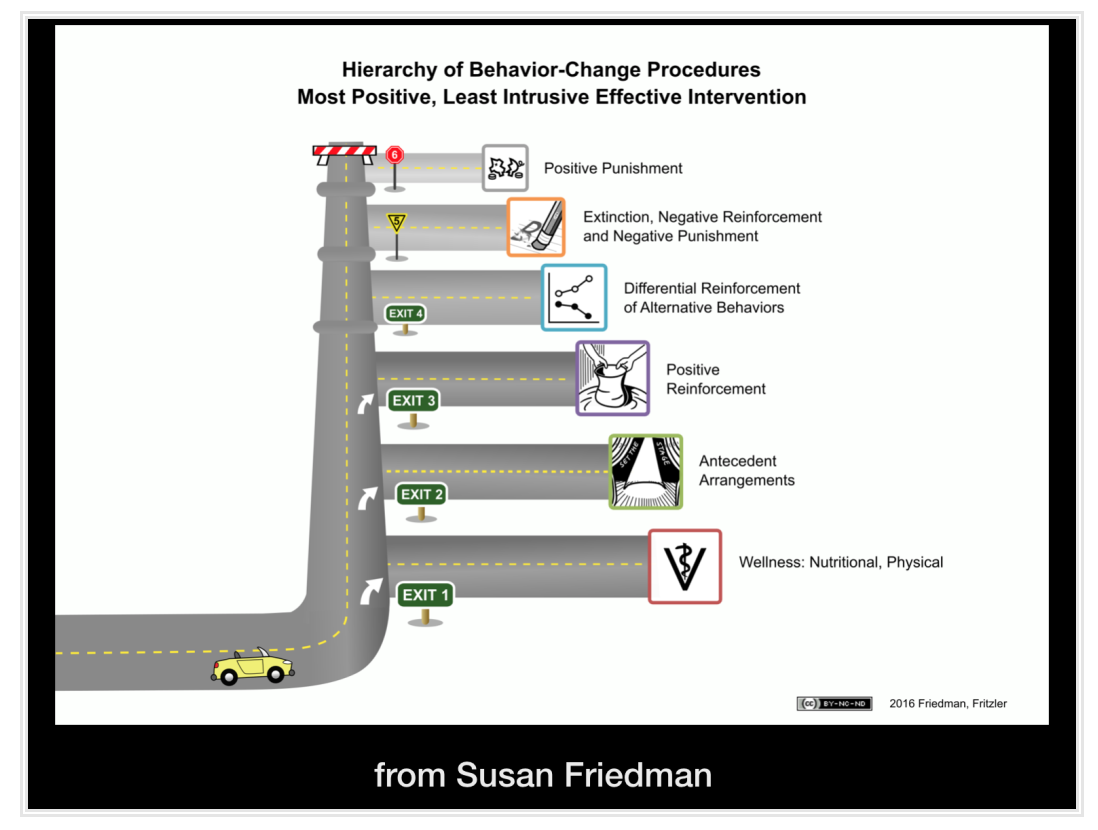
In many of her presentations Dr. Susan Friedman talks about the hierarchy of behavior-change procedures.


Susan Friedman's hierarchy

You begin with the least intrusive interventions.  You begin by exploring medical reasons for the behavior, then you move to changing the environment, and positive reinforcement procedures.  Only after many steps and pausing always to consider if there might be other alternatives, would you consider the more intrusive methods and sitting last as a possibility would be punishment.  And before people puff themselves up and say – I would never use punishment, remember Dr Friedman spent much of her career working with children with major behavioral problems that included self-injurious behavior.  So what would you do with a child who is trying to gouge her eyes out?  Is punishment of that behavior always off the table?

Punishment is certainly not where you begin, but there may be extreme situations where it is where you end up.  If a fire were fast approaching, and you needed to load a reluctant horse on a trailer NOW or leave him behind, would you resort to punishment?  Until you’re faced with that situation, it’s an open question.

Ken Ramirez, another trainer I greatly admire, doesn’t take punishment off the table either.  However, when he was overseeing the training program at the Shedd Aquarium, the novice trainers were only allowed to use positive reinforcement.  They could reinforce behaviors that they liked, but they had to be non-reactive to behaviors they didn’t like.  Only when they were more skilled could they begin to use more advanced techniques.  In his talks on this subject Ken explains why he puts these limits on his young trainers.  At some point early in their career they will come to him, asking for permission to move up the hierarchy.

“Ken,” they will say, “I could so easily solve this problem we’re having with this animal if only you would let me use this procedure that I’ve read about.”  Ken won’t let them.  He wants them to become very experienced with the basics.  If you let them begin to add in other techniques too soon, they really never learn how to be skilled and creative with the basic tools.  They jump the queue too fast and head for more intrusive techniques.

As they become more skilled, he lets them expand into the rest of the hierarchy.  His senior trainers can use any technique, including punishment, that they deem to be appropriate.  But he knows that these trainers have the experience and the skill to apply punishment well, meaning with good timing and at the right intensity to create the desired effect and minimize the fallout.  He also knows that they are so skilled and experienced that they don’t need to use punishment.  They will find other alternatives.

The odd thing in the horse world is we flip things upside down.  We reach first for punishment.  The horse bites – we strike.  It’s the horse’s fault.  And if he bites again, we’ll hit him harder.  We don’t look first for medical conditions.  Maybe that horse is full of ulcers.  Treat the ulcers and his reason for biting will go away.  We don’t rearrange the environment.  Use protective contact – put a barrier between you and the horse so he can’t bite you, and then use positive reinforcement to teach him alternatives to biting.

Instead we give six year old children riding crops (often pink riding crops with pretty sparkles), and we tell her to hit her pony harder.  We give punishment to the least experienced, most novice riders.  That’s completely upside down.  No wonder what we get back are so many sad stories, so many bad endings for both people and horses.

When I said the horse world needs to understand what Karen was saying about punishment in “Don’t Shoot The Dog”, I’ve always though some genie of the universe heard that.  “Got one! She’ll do.”  I was sent the clicker training bug.  More than that, that genie sat on my shoulder and kept urging me to write about what I was experiencing with my horses.  Lots of people, including Karen Pryor, had used clicker training with their horses before I ever went out to the barn with clicker in hand.  I was by no means the first person who ever used it with a horse.  But they didn’t disappear into their computers to write about it.  That good genie on my shoulder made sure that I did.

“Don’t Shoot the Dog” sparked my interest.  I wanted to know more about clicker training.  I read “Lads Before The Wind”,  Karen’s chronicle of the founding of Sea Life Park and the development of the first dolphin shows.  She shared with us the many training puzzles that had to be solved in order to figure out how to train dolphins.  Old-style circus training wasn’t the answer.  She turned to science and the work that was coming out of B.F. Skinner’s lab.

“Lads Before The Wind” took me a step closer.  I wanted to know more about training with a marker signal.

My friend brought me a copy of a magazine article she thought I’d find interesting.  I have no idea what the article was about.  I’m not even sure that I read it, but down in the left hand corner, in very small print, was a tiny ad for two of Karen Pryor’s early VHS videos.  I sent away for both.

The first one was recorded at a seminar that Karen gave with Gary Wilkes to a group of dog trainers.  Gary was the canine trainer who approached Karen with the question: “Do you think clicker training would work with dogs?”

In a conversation I had years ago with Karen, she said she had always had dogs, but they weren’t really trained, not like she had trained the dolphins.  They were just around.  But when Gary wondered if clicker training would work with them, Karen thought, of course!  Why not!  So she and Gary teamed up to give a series of seminars to dog trainers, and we all know what grew out of that for the dog world.

The clip from that seminar that intrigued me and sent me out to the barn to try clicker training my horse showed Gary training a twelve week old mastiff puppy to sit and then to lie down – all without touching the puppy.  These days that’s become so the norm, it wouldn’t get a second look, but in 1993 the dog training I had seen involved leash pops and pushing on the puppy to make it sit.  I was intrigued by the ease with which Gary got this puppy to lie down and stay down.

I was even more intrigued by a clip that was on the second video.  It featured Gary Priest, the Director of Training at the San Diego Zoo.  Gary talking about an African bull elephant named Chico.  Chico had tried to attack his keepers on several occasions so the decision had been made that no one could go into his enclosure with him.  So for ten years Chico had gone without foot care.  At that time the farrier literally got underneath the elephant to trim the front feet.  Gary showed a video of a farrier standing under the elephants belly to trim a foot.  “One wrong move from the elephant,” Gary says in the background – point taken.

So they had to come up with a different approach for Chico.  Gary decided to try clicker training.  They built several small openings in the gate to Chico’s enclosure.  Then they used targeting to bring him up to the enclosure gate.  It took many months, but they finally taught him to put his foot through the opening and to rest it on a metal stirrup bar for cleaning.

The video showed the keepers using targeting to guide Chico to turn around so his hindquarters were to the gate.  Then following a smaller target, Chico lifted his hind foot through the opening for his first trim in ten years.

Gary says in the voice over:  “I can’t impress upon you enough how aggressive this elephant was, but he’s standing here quietly all for the social attention and the bucket of food treats.”

I know how all too many horses even today get handled when they refuse to pick up their feet.  With some trainers, sadly, out come the lip chains, the hobbles, and three men and a boy to hold the horse down, all to force compliance.  We in the horse world do indeed have a lot to learn.

Those two videos gave me what I needed to get started.  I’ve told this part of the story many times.  My thoroughbred, Peregrine, was laid up with hoof abscesses in both front feet.  I wanted to keep him mentally engaged during what was likely to be a long recovery.  What a perfect time to give clicker training a try.  I went out to the barn with treats and a clicker.

In “Lads Before the Wind” Karen had talked about charging the clicker.  With the dolphins you blew a whistle then tossed a fish, blew a whistle then tossed a fish – until you saw the dolphins begin to look for the fish when they heard the whistle.   Now you could begin to make the blowing of the whistle contingent on a specific behavior.  For example, now the dolphin has to swim in the direction of a hoop suspended in the water.  Swim towards the hoop, and wonders of wonders, you can make the humans blow the whistle and throw you a fish.  That’s a powerful discovery.  Suddenly the animal feels in control.

I tried charging the clicker.  I clicked and treated, clicked and treated.  Peregrine showed no signs that he was connecting the click to the treat.  I remember thinking: “If this is going to take a long time, I’m not interested.”

I decided to try targeting.  There was an old dressage whip propped against the corner of the barn.  That would do.  I held it out. Peregrine sniffed it.  Click, treat.  I held it out again, same thing.  The ball was rolling.

I couldn’t do much more than ask him to target.  His feet hurt too much to take more than a step or two, but as he began to recover, I could ask for more.  I started to reshape all the things I had taught him over the years, everything from basic husbandry skills to the classical work in-hand I was learning.  When I started riding him seven weeks later, he was further along in his training than he had been before he was laid up.

Hmm.  Long lay-ups aren’t supposed to work that way, especially not with a thoroughbred.  Normally, as they recover, you go through a rough patch where they’re feeling very cooped up and your job is to convince them to walk not rear during hand walking.  With Peregrine there was no rough patch.  And he was understanding what I was asking of him so much better that he did before the lay-up.

The good genie that sat on my shoulder had picked well.  It was no accident that clicker training gained such a strong toe hold with me.  I’ve known so many people who gave clicker training a try, loved their horse’s response to the initial targeting, and then got stuck.  What do you do with it?  For them ground work meant lunging – and often lunging badly.  Ugh.  We just want to ride!

I wanted to ride as well, but I also loved ground work.  I had raised all my horses, so ground work to me meant so much more than lunging.   It meant teaching a young horse all the skills it would need to get along with people.  It meant learning how to stand quietly for haltering, grooming, foot care, medical procedures, saddling, etc..  It meant learning to lead and from that core foundation, learning about balance through the classical work in-hand and all the performance doors that opened up.  It meant expanding their world by introducing distractions and new environments.   The list went on and on.  And finally it meant connecting the ground work into riding.  Riding truly is just ground work where you get to sit down.

So as Peregrine began to recover from his abscesses, I had a lot to play with.  My training was already structured around systematic small steps.  It was easy to add in the click and a treat.  At first, you could say that all I was doing was just sugar coating same-old same old.  I would ask in the way I knew and then click and treat correct responses.  But even just that first step into clicker training was producing great results.  And when I explored targeting and free shaping – WOW! – was that ever fun!

I was liking this clicker training!  So I began to share it with my clients.  Together we figured out how to apply it to horses.  So fast forward three years to July of 1996.  I had written a series of articles that I wanted to put up on the internet.  I had built a web site, but I wasn’t sure if I could use the term clicker training.  Gary Wilkes had trademarked “Click and Treat” and the llama trainer, Jim Logan, had trademarked “Click and Reward”.  It was frustrating.  If people kept trademarking all these phrases, pretty soon there would be no way to refer to the training.

So I emailed Karen.  I introduced myself and sent her the articles I wanted to publish on my web site.  I needed to know if she had trademarked clicker training.  Could I use the term in my articles?

Twenty-four hours later I received an email back from Karen.  She had read my articles.  Would I like to write a book about clicker training horses for her publishing company?

You know the answer.  Karen gave the “ball” a huge push down the hill.  So thank you Karen.  Thank you for that initial support.  For me personally it was a great pleasure working with you on the editing of that book.  And over the past twenty years I have treasured our continued friendship.

At one of the early Clicker Expos when you were introducing the faculty, when you got to me, you began by talking about conventional horse training.  You described it as what it is – organized horse abuse.  Wow.  To be brave enough, bold enough to say it out loud.  It was shocking to hear, but so true.  You understood the horse world.  You knew about the wide-spread use of punishment.  You knew the importance of bringing positive reinforcement into this community.

You couldn’t be everywhere, doing everything yourself, but when you asked if I wanted to write a book, you gave the clicker training ball a huge push.  Twenty years later, the book we created together is still helping horse people to find alternatives.  And the horse world is changing!

Thank you Karen.