Modern Horse Training: Connections

Everything is Connected to Everything ElseIncluding Dolphins and Horses

I stumbled across clicker training in 1993. A friend who bred and trained Irish Wolf hounds told me about Karen Pryor’s book, “Don’t Shoot the Dog”. I read it, loved it and wanted to learn more. What was this clicker training that she was talking about? How did it work?

I read her second training book, “Lads Before the Wind: Diary of a Dolphin Trainer” which described how she and her husband, Tap Pryor, developed Sea Life Park in Hawaii. Karen was given the task of figuring out how to train dolphins. It wasn’t anything she set out to do. The task fell to her because the people they had hired to train the dolphins weren’t getting anywhere. These trainers were trying without success to use old-style circus training methods. That didn’t work with an animal that could just swim away from them.

Karen was intrigued by the work that was coming out of B.F. Skinner’s labs. So armed with the lab notes from some of his graduate students, she set to work. She figured out how to use marker signals and positive reinforcement to train dolphins.

Her books were great. I loved both of them. I enjoyed “Lads” even more than “Don’t Shoot the Dog” because Karen shared the puzzle-solving aspect of training. But those books weren’t training manuals. They didn’t teach you HOW to train. They just teased you with the possibility that you could remove the threat of punishment that sits behind most horse training methods.

I was intrigued, but in 1993 other than Karen’s books, there weren’t any readily available resources for learning more about clicker training. Through a bit of luck, I did manage to find a VHS recording of a seminar that Karen produced. It included two short video clips showing animals being clicker trained. One was of an African bull elephant at the San Diego zoo being trained with protective contact to present his feet for trimming. The other was a 12 week old mastiff puppy who learned to sit and lie down in minutes without ever being touched.

The elephant was the most interesting. He had attacked his keepers on several occasions so the decision was made to that no one was allowed to go directly into his pen with him. That meant that for ten years he had not had any foot care. Clicker training was being used to see if they could teach him to orient to targets and present his feet through a small opening in the gate of his enclosure. During the video, you could hear Gary Priest, the director of training at that time, saying “I cannot impress upon you enough how aggressive this animal was, but he’s standing there cooperating for just the social attention and a bucket of food treats.” I watched that and thought – we in the horse world have a lot to learn. I was thinking of the twitches, the lip chains, the hobbles, etc. that I had seen people use to force horses to comply.

The other video showed the use of a treat held up above a puppy’s nose to get the puppy to sit. Within just a few clicks, the puppy was sitting, then lying down and staying down while the trainer walked around her. There was no pushing, no shoving, no use of force. It was simple, elegant training.

Those two videos were all I needed to be up and running. They gave me what I needed to go out to the barn to ask Peregrine what he thought about clicker training. He got the proverbial ball rolling, so it is fitting that the new book, Modern Horse Training, is coming out on the anniversary of his birthday, April 26.

A Perfect Fit

I could say that clicker training was a perfect fit for me. Or I could turn it around and say that I was a perfect fit for clicker training. There were no horse books out there to guide me, or even any other trainers I could visit to see how it was being used. I was on my own. But I was primed. To use the language of constructional training, I had the components that were needed to turn the idea of clicker training into a fully formed, detailed, soup to nuts training program.

So what were those components? What were the skills, the mindset, the repertoire that prepared me so well to embrace the idea of clicker training? I will say that I have met many others who shared similar components. For so many all that is missing is the understanding of marker signals. Give them that, and, like me, they are off and running. But for many others clicker training represents a huge shift in thinking. Can you really use food in training? Isn’t it a distraction? Won’t it teach your horse to bite? What do you do when your horse says: “No”? The old style of thinking dictates that you must punish unwanted behavior or your horse will become dangerous. “Fear of and fear for” becomes an underlying motivator even if it is not spoken of in that way.

We can begin with that same underlying motivator and end up with a very different result. That’s what I wrote about in yesterday’s post. You can also use treats in training and still stay wedded to the belief that unwanted behavior needs to be corrected.

Using positive reinforcement describes a procedure. What I’m addressing now is the question of what motivates your training decisions? Even kind people can end up choosing punishment because they are motivated by “fear for” risks. You’re afraid that your dog might rush out the front door and be hit by a car, so you use punishment to teach him to stay back when you open the door. That’s one example of how this plays out.

You don’t have to use punishment to solve this problem. There are other options. You begin by acknowledging that you are concerned for your dog’s safety, and then you search out solutions that are a match with your core ethics and the type of relationship you want with your dog.

The same applies to horses. Wanting to keep bad things from happening is a powerful motivator that can take us to some wonderful learner-friendly procedures.

Sometimes it’s okay to start out by running away from something. Clicker training teaches us how to reframe that so you begin to run TOWARDS the good things that you want. You stop focusing on the unpleasant outcomes that you don’t want and you teach instead all the good things you do want.

You don’t want your horse crowding into you, stepping on your toes, mugging your pockets, biting at your hands. You can certainly suppress these behaviors through the use of punishment. Or you can look at what you do want. When your horse is standing next to you, what does that look like? Can you describe what the “perfect version” of your horse would be doing? He’d be standing four on the floor, in his own space, with his head between his shoulders so his nose is well away from your pockets. The more detailed your description is, the easier it is to train what you want. Each element you describe becomes a lesson you can teach. What are his ears doing? Where is his head – level with his chest, down on the ground? You can shape all of this using a marker signal that is linked to positive reinforcement.

Those are nice sounding words, but again how do you make this work? What were some of the component skills that helped me transform clicker training from an interesting concept into a workable training program?

That’s tomorrow’s post. I’m splitting what was originally a much longer single post into two installments so it’s not too much to read in one sitting.

“Modern Horse Training: A Constructional Guide to Becoming Your Horse’s Best Friend” will be available April 26. It will be available as a hardcover, a paperback, and as an ebook. You’ll be able to oder it through my web site and also through Amazon and other booksellers.
Goat Diaries: Day 5 – Excitement!

Excitement

I love the enthusiasm and excitement a new learner brings to clicker training.  There’s food!  There’s attention.  There are puzzles to be solved.  It’s very exciting.  The goats were reminding me of some of the clicker-trained dogs I’ve seen.  Everything is go, go, go.  Throw behaviors at your human, wolf down the treat then throw something else at them.  And above all watch the treats.  Don’t let those goodies get out of your sight!

My challenge was to build calm confidence while keeping the enthusiasm.  With the horses that comes from a deep understanding of the clicker game.  If you absolutely know the treats are not going to be taken away from you, you can afford to take your eyes off of them.  You’ll get them whether you are watching them or not.  This is in part what it means for the learner to trust the process.

Settling into enthusiastic calmness doesn’t happen overnight, but it does happen.  Accumulate enough consistent reinforcement around what you want, and it becomes the norm.  I was still a long way from that with Elyan and Pellias in July, but that was the direction I hoped we were heading.  Time would tell.

Before I jump into today’s installment of the Goat Diaries, I want to share an email that got my day off to a great start this morning.

“Hi Alexandra,

I’m loving the Goat Diary installments. I’m finding them a whole refresher course in themselves, especially with the annotated photo sequences. I have 2 friends firmly hooked on them as well.

One of these friends, Anne-Marie and I, about 6 months ago, rehomed a Palouse pony, now named Nugget, who had become “unmanageable” for several previous owners who used either the “traditional” or increasing pressure approach with him. We introduced him to Life with a Clicker and he’s great. The goat diaries have been very timely, as Nugget is athletic, smart, eager with a high play drive and greedy for treats!

 We had Anne-Marie’s vet come and do his teeth a couple of weeks ago. When we told the vet Nugget’s previous name, he went a shade of grey and asked if we seriously expected him to do the horse’s teeth. This vet had met the horse about 2 years ago, because the owners suspected he was a rig (because of his behaviour) and they wanted his blood tested to see if this was the case (it wasn’t). We found out quite a bit from the vet that we hadn’t known when we agreed to rehome him.

 I asked the vet if he would just handle Nugget a bit, before giving him a sedative in case (by some miracle) he, the vet, didn’t think that would be necessary. Nugget was a model child!!!!  He stood quietly and straight (while playing GrownUps with me at his side) while the vet stroked his head and neck, asked him if it was OK to look at his teeth and proceeded to lift Nugget’s lips around and run his fingers along the teeth. Then he did some “trial” rasping before putting the gag on and saying that he certainly didn’t need a sedative!

The vet was super impressed with the change in him, and told us to “keep doing whatever you are doing with him  because it’s working”! Anne-Marie explained a bit about positive reinforcement and the clicker. We have since heard that the vet has been telling almost anyone who will listen about Nugget and his Clicker Training ( I will have to ask him to refer those who do listen to him to your website).

Your post yesterday on “Eager” was perfect to remind us to balance forward moving games with stillness.”

Talk about a great way to begin my day!  Thank you, Amanda Goodman, for your lovely email and for your permission to share it with others.  This is exactly why I am writing the Goat Diaries.  I hope my experiences with the goats will provide good reminders for all of us working with horses.  So now on to the goats and more excitement from Pellias!

The July Goat Diaries: 9:30 am First morning session

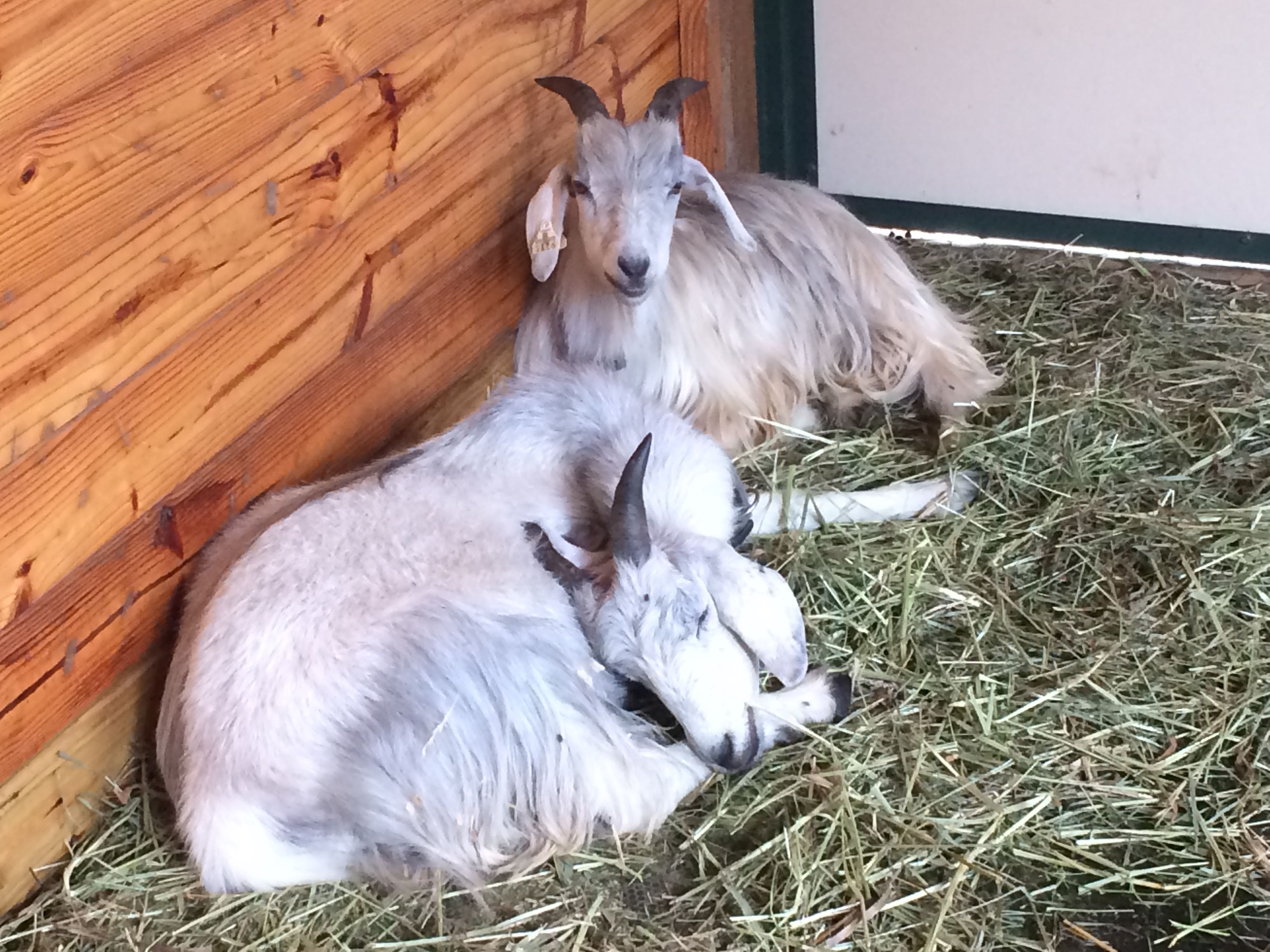
I made certain to feed the goats first before working with them and to give them plenty of time for their breakfast. When I went in to play with them, they were both napping in the hay.

IMG_2816 Goats E and P napping.jpg

Pellias has his head curled around and Elyan is looking at me with sleepy eyes.

P’s Session:

I set up two platforms as usual. I had decided to use a different approach with the pole.  If P didn’t want to go over it, that was fine.  I set two poles on the ground with a wide gap between them.  He didn’t need to jump them.  He could easily go through the gap to get to the next platform.

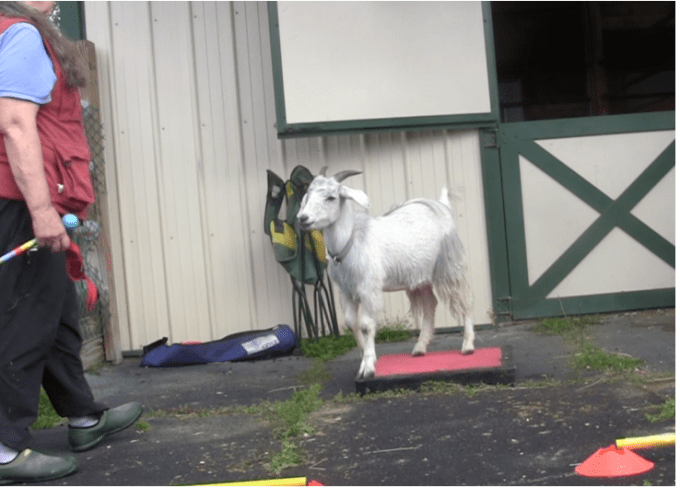
P was much more settled.  He went right to the first platform and waited for me.  I was able to take a couple of steps back from him, click and treat.  He was standing solidly on the platform, not stretching out trying to get to me.  It seemed as though he was beginning to  understand that I would bring the food to him.

Goat diaries Day 5 P on platform.png

He moved well at first from one platform to the next.  But as the session progressed, he stepped off the platform prematurely.  Conflict!  What was he to do?  He had a difficult choice to make.  His desire for treats and his enthusiasm for platforms collided and sent him rearing up onto his hind legs.  He could have charged, but instead a dramatic leap landed him back on the platform!

goat diaries day 5 panels 1-6 P excitement.png

Goat diaries Day 5 P on platform - panel 2.png

Goat diaries Day 5 P on platform - panel 3.png

Goat diaries Day 5 P on platform - panel 4.png

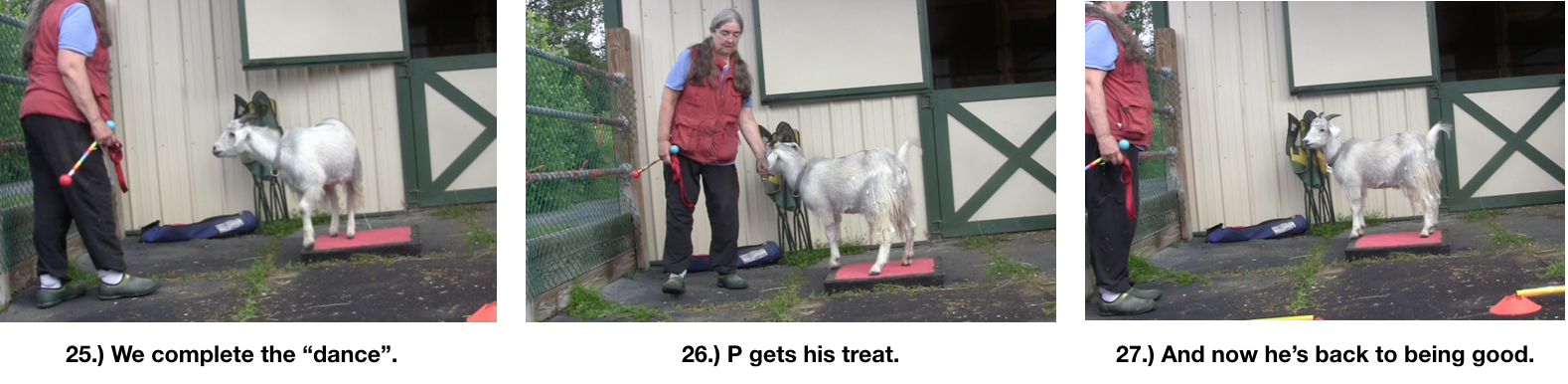
goat diaries day 5 panels 25-27 P excitement.png

This seemed to sort out his choices because after that he settled into good work.  He was back to being a calm, patient learner.

goat diaries day 5 all is well.png

I’ll wait to describe E’s session because it involves another important step in their training – the re-introduction of the lead.

The Goat Palace Dec 18 2017

I said at the start of this post that the goats were reminding me of dogs.  The similarities were becoming more and more apparent.  Horses can certainly buck and twist and kick out their heels, but they do not have anything like the range of movement that goats have.  Goats can twist and squirm and turn themselves inside out in ways that are much more similar to dogs.

My focus with all the goats has been very much to build a stable base.  For that I was drawing on the foundation lessons that I teach the horses I work with.  The goats had learned basic targeting skills.  I had used the food delivery to introduce backing.  Platforms had given their feet a place to be so we could work on grown-ups.  They were understanding that, yes, I would give them treats, but first they had to figure out the puzzle.  The dots were connecting

We had some basic skills.  We had enthusiasm.  We had agile, quick learners.  It was time to shift in my thinking from horse to dog training.  So recently I’ve split my training along two separate lines of thought.  I had been using the platforms with Elyan and Pellias to teach them to position themselves relative to me and each other.  I’ve been expanding that recently to bring in some of Michele Pouliot’s work with platforms.  I’ll expand on that later.  It’s time to catch you up with Thanzi and Trixie.

I’m experimenting with a different technique with them.  I’ve been thinking about how best to prepare them for leading.  I have no doubt that if I put a lead on them right now, they would both pull like freight trains.  Thanzi in particular is a very powerful goat.  They both know how to put their heads down and just muscle their way into what ever they want.  They are also both super enthusiastic about the training.  They understand platforms and targets.  So why not have some fun and experiment with bird’s nests?

Now what in the world does that mean!?  It’s a technique Kay Laurence has developed to introduce dogs to leading and heel work.  The idea is that dogs are very good at watching bird’s nests because you never know when something yummy might fall out of them.  So one technique is to walk along with treats in your hand and randomly, occasionally let a few treats fall through your fingers.  The dogs very quickly learn to follow you and watch your hand.

This then evolves into putting a small cup onto the end of a target stick.  You put a treat into the cup and walk along with the stick held out above the dog’s head.  The dog looks up at the cup and walks along beside you.  Click – a flick of the wrist sends the treat flying out of the cup.  The dog chases it down – what fun! – and then immediately returns to the cup.  The dogs are learning to move with balance, to stay oriented to Kay, to stop, back up, come forward, to walk at her side, or to move out around her on a circle.  (If you want to learn more directly from Kay, bookmark her web site: learningaboutdogs.com  It is going through a massive redesign at the moment so it is currently off line.  When Kay unveils her new site after Christmas, it will be full of good things to explore.)

I have been thinking about this technique for quite a while, especially for Thanzi.  She’s such a powerful goat.  Before I ever attach a lead to her collar, I want her to understand how to stay with me.  So I built a “bird’s nest” target stick for the goats.  I duct taped a small plastic container to one end of a wooden stick and a clicker to the other.  The cup was just big enough for a goat to eat out of. That turned out to be an important criterion.

The first time I used the target cup, the goats were confused by the food delivery.  I had to teach them to look for the food falling out of the cup.  That part was okay.  They could do that, but then they didn’t want to eat the pumpkin pieces once they had fallen into the gravel.

So we’re back to horse training constraints with the food delivery.  We don’t want our horses eating off of the footings we typically work them in.  The goats were saying they didn’t consider the gravel walkway to be a suitable dinner plate.  Fair enough.  So I switched from dropping the treat out of the cup, to lowering it so the goat could eat the treat from the cup.  (If you’re reading this, Kay, don’t shudder at the corruption of your method.  I had to adapt your technique to my learners’ persnickety eating habits.)

I’ve only been experimenting with this approach for a couple of days, but so far I really like it, especially for Thanzi.  She is so smart and so much fun to work with.  She has caught on with lightening speed to the game.  She positions herself by my side and walks in very measured steps, head up, nose pointing to the cup.  I pause.  She pauses.  Click, lower the cup.  She takes the treat.  I reload, and off we go for a few more steps of very controlled, measured walk.  Pause. Wait. She backs up.  Click.  Lower the cup.  Reload.  I hold a handful of treats in my free hand.  When they are gone, we walk together over to the gate.  High up on a post out of reach for goats I have more treats stashed.  I get a resupply and we’re off.  I think this is going to be a really fun way to teach Thanzi both great leading skills and also some fun liberty work.  Thank you, Kay.

It’s also been good for Trixie.  She very deliberately chooses to be the first one through the gate when it’s time to train.  I let her through into the hallway and throw some treats to Thanzi so she’s not feeling too left out.  Trixie has definitely got the idea of stationing on platforms.  Following the target cup is an easy way to move her from platform to platform and to build her confidence.  I could use a regular target and hand feed her.  This is an experiment.  I want to see what I get when I deliver the food in this way.

This is the fun of clicker training.  There is always, always more than one way to train every behavior.  Part of the reason for working with the goats is they get me out of the “rut” of doing things the way I know how to do things.  That’s always good for training.  So far, I’ve treated them like horses.  Now I’m having the fun of borrowing ideas from dog trainers.  There’s always another way to solve every puzzle.  And there’s always more to learn.  That’s as true for me as it is for Thanzi and Trixie.

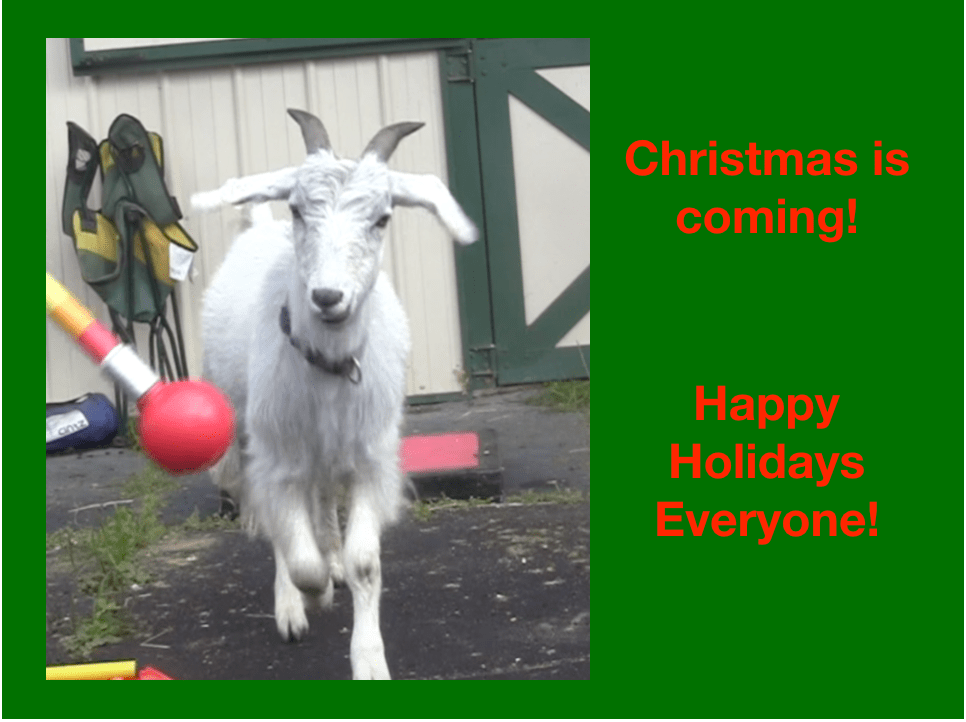
Happy Holidays Everyone!  I wish you the joy of your own mad scientist experiments!


Pellias Christmas card.png

We’re in the midst of the Holiday Season. If need a thank you gift for your horse sitter, a stocking stuffer for your riding partners, a grab bag present for your animal loving friends, here’s a thought. Share the links to the Goat Diaries: theclickercenterblog.com


Please Note: if you are new to the Goat Diaries, these are a series of articles that are best read in order.  The first installment was posted on Oct. 2nd.  I suggest you begin there: https://theclickercenterblog.com/2017/10/02/   Two of the goats I write about originally came for a twelve day stay in July.  The July Goat Diaries track their training during this period.  In November these two goats, plus three others returned.  They will be with me through the winter.  The “Goat Palace” reports track their training.  I wish to thank Sister Mary Elizabeth from the Community of St. Mary in upstate NY for the generous loan of her beautiful cashmere goats.