Today’s Peregrine Story: #8 They Don’t Feel Pain The Way We Do

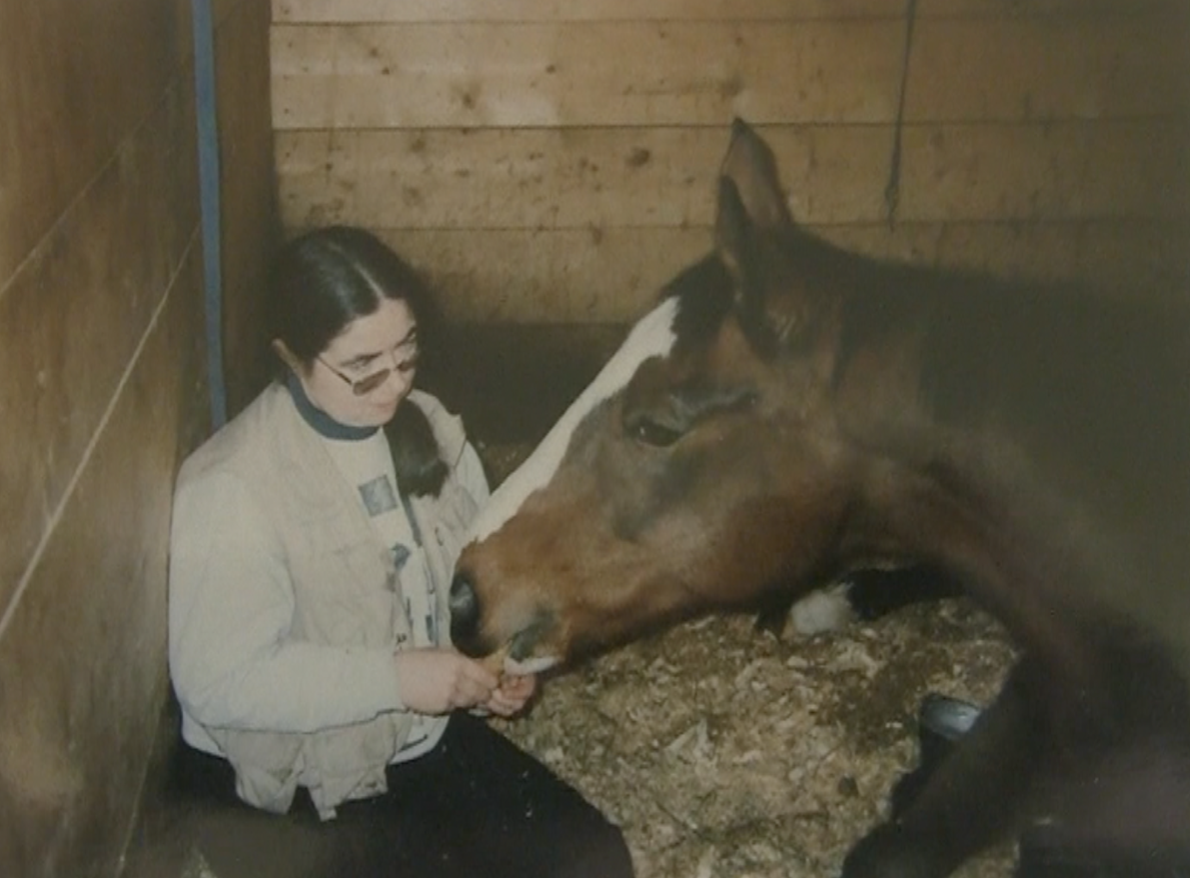
Shortly before she became mine, Peregrine’s mother was injured in a handling incident. One of the teenagers at the barn had been given the assignment of pulling her mane. In case you aren’t familiar with this technique, it is literally what the name implies. The mane is shortened and tidied up by pulling out the longer strands.

The horses I grew up with never had their manes pulled. The first time I watched this being done it was to a young racehorse, a two year old who was literally climbing the walls trying to get away. The trainer stood outside the stall door watching as a young handler struggled to get the job done.

I couldn’t help asking what they were doing. It looked to me like some horrific form of torture. The trainer dismissed my concerns. “They don’t feel pain the way we do,” he said. In his view, the mare was climbing the walls not because of pain, but because she was being disobedient. That’s a great example of the stories we tell ourselves – and come to believe – to make things okay.

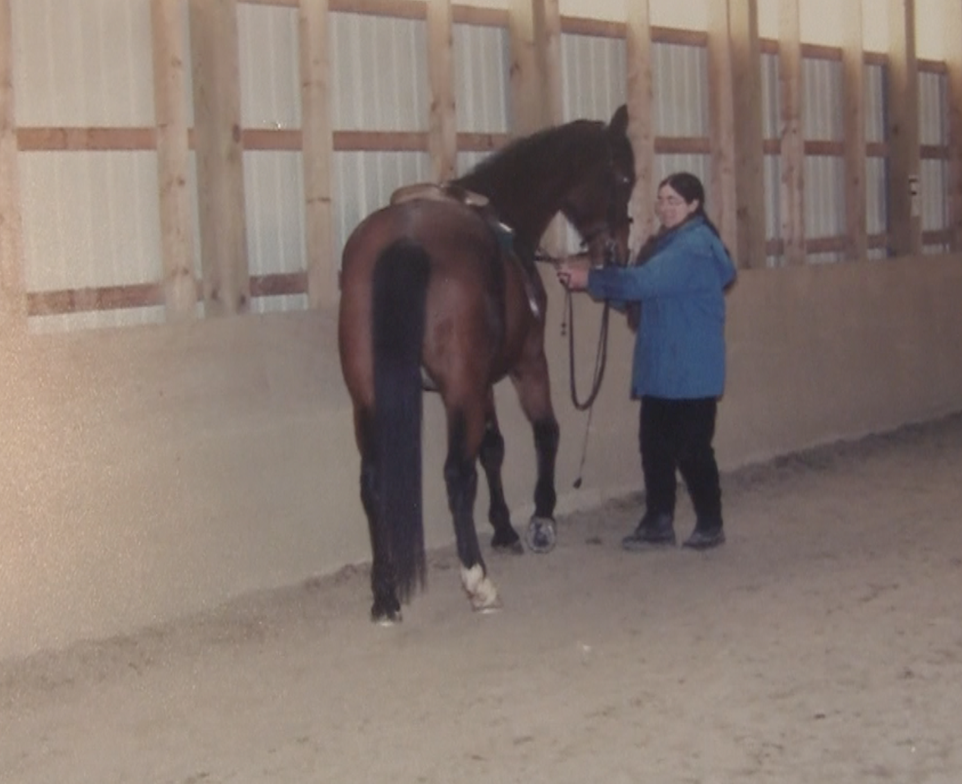
Peregrine’s mother wasn’t in a stall the first time someone tried to pull her mane. Shortly before she officially became my horse, it was decided she should have her mane tidied up. For her introduction to this procedure she was tied tight to a post supporting a four foot high fence. To get away from the pain she presumably didn’t feel, she jumped the fence. You could say it showed how athletic she was that she was able to jump the fence with her head snubbed up tight to the post. Really, it just says how desperately she needed to get away.

I only learned about it because I saw scrapes on her legs and asked about them. It wasn’t until much later that I discovered the full scope of the injuries she sustained. Her spine was damaged in what was a very avoidable accident. My beautiful, athletic, perfect horse became a wobbler. That is exactly what the name suggests. She sustained neurological damage as a result of that incident. She couldn’t tell where her hind legs were so she wobbled about trying to stay on her feet.

I learned over time just how profoundly compromised she was. Eventually it became hard for her even to walk without falling. All the dreams I had had for her as a riding horse were set aside as I tried to help her learn the most basic of motor skills. It was my early training experiences with her that taught me about small steps, and about finding ways around the many “brick walls” that were thrown up in her path. Long before I ever heard about clickers and positive reinforcement, she taught me how to break things down into the smallest of small steps. The power of those lessons formed the core of what clicker training means to me.

She taught me to believe in the power of change. You cannot NOT change. How’s that for a sentence! But it’s true. We are constantly changing. The question is: are you changing towards something or are you simply always reverting back to familiar patterns?

If you don’t believe that change is possible, you will always be reverting back to the same reality that you currently find yourself mired down in. I didn’t know what change, if any, was possible for her. The vets at the time painted a very bleak future for us. I just knew that I had to deal with the challenges each day presented.

Stepping over the sill of her stall door was hard for her. But it was something she needed to be able to do, so we worked on stepping over ground poles. Those were terrifying for her, so I put a rope on the ground instead. Even that was too hard, so I drew a line in the dirt. That she could manage so that’s where we began.

She was showing me that no matter how small a step may seem, there is always, ALWAYS a smaller step you can find.

That is truly at the heart of all good training. It is certainly at the heart of how I think about clicker training.

Eventually she was able to walk over those ground poles, and the sill of her stall was no longer a problem. She could even manage a small cross rail. We didn’t know what was possible. We just kept working on the little things that challenged her. Eventually the little things grew into wonderful things. She became my riding partner and introduced me to the world of classical dressage.

She is why at the core of everything I teach there is balance. For me balance is everything. It gave her life. When some people talk about dressage, they see competition rings and rosettes. I see balance. That’s what dressage means to me. The end result may indeed take you to the show ring, but first it takes you to a feel that is heaven itself. Balance is everything. It is life-giving, life sustaining. It is beauty, grace, power. It is love.

Peregrine continues to teach me those lessons his mother began.
Happy 30th Birthday Peregrine
Today’s Peregrine Story: #7 Pulling Down The Brick Walls

Imagine you are riding your horse towards an enormous brick wall. There will be a few horses who are athletic enough and riders who are skilled enough to go directly over the wall. If they’re successful, that will tempt them to take the next horse straight over, and the next. And it will also tempt them to make the wall ever higher. Eventually they will either make the wall so high no horse can jump it, or they will try and force a horse over the wall who truly can’t make it. Either way, eventually they will crash.

If you lower that fence, more horses and more riders will be able to jump it successfully, but there will still be some who can’t. They either lack the physical ability, the skills or the confidence to jump it.

Lower it a bit more and some who couldn’t jump it before will now be successful. Turn it into a cross rail and more will manage it, but you will still have some individuals who can’t manage even a small jump. You may have to turn it into a ground pole, or draw a line in the dirt – or you may need to find a way to go around the jump altogether rather than over it.
When I’m confronted by a “brick wall” of a behavioral problem, I prefer either to find a way around it, or to dismantle it so I only have to ask my horse to go over a few small bricks. If you pull enough layers off the brick wall, you will eventually get to the point where every horse and every handler can be successful.

Peregrine’s mother taught me this. She was bred to be a racehorse. The trainer who had her kept a small string of racehorses and broodmares in addition to his jumpers.  If I hadn’t stepped into her life, she would have ended up at the track – at least that was the goal. Given the injuries she sustained in the name of training, she never would have made it that far.
Racehorses take baths, so as a weanling it was expected that she would take baths. The assignment of teaching her about hoses was turned over to a teenager who took her straight out and tried to give her a bath. The result was predictable. She reared up and struck out at his head.

He never managed to give her a bath, but he did make everyone believe she was a “witch”, a nasty horse you didn’t want to get close to. Interesting how it is the horse who takes the blame for our bad training.

He also created in her a lasting fear of hoses. When I started working with her a few months later, I could not take her directly down the barn aisle and out into the arena because it meant walking over the hose that was used to fill water buckets. When I wanted to go into the arena, I had to take her out through the back which meant climbing over the shavings pile so we could get in by the back gate.

I’m sure the trainer would have had a different solution. He would have “made” her comply. There would have been a fight, and in the end she would have walked over the hose. She would still have been afraid of it, but she would have learned that she had no choice.
I was a very green handler. I knew I didn’t have the skills to get into this kind of a fight, so I used a different approach. I have always said I did some of my best training when I knew the very least. All I had was patience and persistence, and I put those to good use.

Every night I would take her out of her stall and tie her to the aisle rail so I could groom her. Tying was something she had already learned how to do so it was safe to use. I began about twenty feet away from the hose. When we were done, I would turn her away from the hose and walk the long way around into the arena. Each night I tied her a little closer to the hose, but always we turned and walked away from it. I never confronted her with it.

We finally got to the point where she could be tied right beside the hose, and she would stand quietly throughout her grooming session without seeming to worry about it. One night instead of turning away, I asked her to follow me over it. She did so without hesitation. And after that, she always followed me wherever I asked her to go.

I didn’t try to plow over the brick wall. I found a way to dismantle it brick by brick until she was ready to cross over it.

She discovered she could walk over hoses without fear. More than that, she now understood that she could trust me to take care of her.

I wasn’t expecting this larger result. I simply wanted to find a non-confrontational way to help her understand that hoses were harmless. In the process I showed her how I could be trusted to behave. I could be counted on to be consistent and to be on her side. I wasn’t going to be petting her one moment and beating her the next.

One of the many things that you learn from horse training is the longer you stay with an exercise, the more good things you’ll find that it gives you. Focus on some little achievable piece of the training, something you and your horse can accomplish together, and all kinds of other good and often unexpected results will emerge out of it.

This small step over a garden hose was one of the many steps that led me to clicker training.  When we clicker train we dismantle the brick walls, and we find ways for all of our horses to succeed.  This is one of the many gifts Peregrine and his mother gave me.

Happy 30th Birthday Peregrine.  You helped teach me the gift of small steps.  That was a great gift indeed.

Today’s Peregrine Story: #6 Ground Work Redefined

Peregrine in hand cropped

1993: Peregrine setting up for haunches-in.

They say a journey of a thousand miles begins with a single step.  In 1993 when I went out to the barn with my pockets full of treats, I had no idea the journey that first step was going to take me on.  I wasn’t thinking about writing books, making videos, traveling to clinics and conferences, sharing clicker training on the internet with people from around the planet.  I just wanted a way to keep Peregrine entertained while he was laid up with foot abscesses.

As he began to recover, I used the clicker to reshape some of the many things I had taught him over the years.  Clicker training had landed in a good place.  I had a lot in my tool box to play with.  In 1993 if you said ground work to most people, that meant one and only one thing – lunging.  It’s no wonder when I started to write about using clicker training to improve ground work so many people ran in the opposite direction.  It wasn’t just the treats that they didn’t like, it was lunging.  Rarely did you see it done well, with a real understanding of a horse’s balance.  It was used to “get the bucks out”.  In my area the norm for lunging was horses racing around, out of balance, being jerked on, often in side reins.  It was at best mindless.  At it’s worse, it was a physically exhausting battle between horse and handler, repeated daily before the rider dared to get on.

I was learning something very different.  For starters I had raised both Peregrine and his mother.  Ground work for me meant so much more than lunging.  It meant all the early handling and socialization.  It meant teaching horses to pick up their feet for cleaning, to stand well for grooming and saddling and all the other basic handling you take for granted when you’ve only had older horses.  It meant going for walks together to learn about the world.  Peregrine’s mother had spinal cord damage – the result of a handling accident that occurred shortly before she became mine.  So for her ground work meant even more.  It meant literally reteaching her how to walk without falling.

Early on in my horse training experience I was able to spend time with some very skilled horsemen. They didn’t mess around with the kind of small steps I teach today through clicker training. They went straight to the big stuff. Most of the time they were successful because they had the skills to get into a fight with a horse and win. But occasionally things would turn into a train wreck.

I remember one such occasion where a trainer was trying to “sort out” a mustang. This was a powerfully built draft type horse. He’d already come to grief with several other trainers, and now this man was trying out his skills. The mustang came within a hair’s breath of kicking his head in.

I was watching this as a very young and very inexperienced horse owner. My takeaway message was I didn’t want to get into a fight with a horse. Apart from the fact that it was just too dangerous, even then I knew it didn’t create the kind of relationship that I wanted.
I also knew that I didn’t have the skills or the strength to guarantee that I would win. If you can’t guarantee a victory in the big battle – don’t start it in the first place.

I concentrated instead on the little victories. I was boarding at the time in a hunter jumper barn. I saw horses who had never been jumped before being sent over enormous fences. Most of the time they were athletic enough to make it over, but sometimes they would simply crash through the fence or refuse to jump altogether. The horses that stopped or tried to run out past the jump were all treated in the same way. They were punished. They learned fast that no matter how scared they were about jumping, the only safe route for them was straight over the fence.

I was finding a different way.  My own, beloved horse – Peregrine’s mother – had neurological damage. Never mind jumping.  Stepping over the raised sill of her stall was a daily challenge. She couldn’t go over a ground pole without panicking, but she could step over a line drawn in the dirt.  So that’s where we began.  Stepping over that line was a first step on a journey that has carried me many places.

It has brought me here to this morning where I am thinking back over the thirty years I have had with the foal that she gave me.

Happy 30th Birthday Peregrine. You are much beloved.

Today’s Peregrine Story: #5 Intelligence

Peregrine lying in stall with Ak croppedIf you’ve read my first book, “Clicker Training for your Horse”, you might have noticed that there are very few pictures of Peregrine in it.  That’s because throughout the period that I was working on it, Peregrine was on stall rest.  I was writing a book that he had helped in large part to create, but on the eve of having it published it was not at all clear that he would ever be sound again.

The culprit was Potomac horse fever.  It had left him with damage to his feet.  It was a frustrating situation to be in.  Peregrine’s big, gorgeous trot had dwindled down to a shuffle.  I would say to my vets, he’s lame, but they couldn’t see it.  That was just how the horses that they saw horses moved.  He wasn’t asymmetrically lame.  What was wrong?

What was wrong was this wasn’t the way MY horse moved.  Finally one of the young associates in the practice decided that maybe there was something wrong – with Peregrine’s hocks.  Sigh.  I knew where the problem was, in his front feet.  I could feel it.

Just to humor me the vet did nerve blocks on Peregrine’s front feet.  His comment as I trotted Peregrine out for him: “I’ve never seen a horse get so sound so fast in his hocks from a nerve block to his front feet.”

For the few minutes that his feet were numbed and he felt no pain, we could all see the beautiful big trot that was Peregrine’s.  And then the pain returned and with it the shuffling reluctance to move.

We tried various strategies.  He’d be okay for a little bit and then lame again.  Finally his feet deteriorated to the point where we were forced to do hoof wall resections on all four feet.  Peregrine was put on total stall rest.  The only time he was allowed out of his stall was to walk the few steps down the barn aisle to the wash stall where everyday I had to treat and rewrap his feet.  This went on for nine months.  By the end I never again wanted to see another roll of duct tape!

Now I am sure there will be people reading this who will be horrified.  Nine months of stall rest!  Just remember this was over twenty years ago.  We might well have better options today that wouldn’t involve confining a horse to a stall, but all I can say is it worked.  The new hoof that grew in over those nine months grew in healthy.  In December we were ready to let him have some limited exercise.  That’s when I got the call from a producer from the BBC.  They were doing a series on animal intelligence.  Could they come film my horses?

You don’t say no to the BBC.  Of course they could come, but I wasn’t sure what I could show them.  The day they arrived was Peregrine’s fourth day off stall rest. So far we had walked around the arena for about ten minutes each day.

The first horse I brought out for them was our senior horse, Magnat.  He was always our consistent superstar.  You could rely on Magnat to show off, and he didn’t disappoint us.  He and his owner, Ann Edie, were just learning piaffe.  We filmed a short lesson, and then it was Peregrine’s turn.

He came into the arena eager to work.  For nine months there had been no clicker training, and suddenly, today everything was allowed.  He was tireless.  We worked mostly at liberty.  Peregrine could have quit at any time.  Instead he kept offering and offering.

It was a wonderful experience.  This was the first time that I had shared clicker training with reporters, and this producer set a high standard for everyone else who was to follow.  He was a superb interviewer.  He knew how to ask good questions which made it fun to share the horses with him.

We’d film a bit and then pause to discuss what I would be showing them  next.  There were six of us in a tight cluster discussing the details of the filming: the producer, his assistant, the camera man, the sound man with his enormous boom, myself and Peregrine.  He joined in every conversation, looking over our shoulders, clearly interested in everything that was being said.

He must have been listening because he pulled out all the stops, showing off his canter in hand and for the first time ever producing piaffe at liberty.  I had no idea this was in him.  We had only worked piaffe in hand or under saddle. This was very much the early days of clicker training.  Peregrine had picked the perfect time to show me what was possible.

The video the producer shot that morning was so good he ended up creating a twenty minute segment just on Peregrine. Unfortunately, as he was preparing the final edit, he learned that he had to cut down on the overall length of the series.  The easiest way to make the time was to cut out the section on clicker training, so Peregrine never did have his moment to shine on BBC television.  That’s all right.  He shone for me that day.  Somewhere buried in my stacks of old VHS tapes I have a copy of the original program before the producer had to cut out Peregrine’s section.  I’m biased, of course, but he should have left it in!

In the horse world one of the deep seated beliefs is that horses are stupid animals. That’s why we need to use force to train them.  “It’s all they can understand.”  But of course, there’s the corollary belief that horses don’t feel pain the way we do, so its okay.

When I first started sharing clicker training on the internet, people would post about their first clicker experience.  These were the early adopters.  They had no idea what they were stepping into.  Their posts always made me laugh.  “My horse is so SMART!!!” they would exclaim.  Their surprise and their delight was so evident in their words.  Their enthusiasm attracted others and encouraged them to give this strange new way of interacting with horses a try.  They quickly joined the chorus of: “My horse is so SMART!!!”

Clicker training helps us to see what I have always known.  Only its not just our horses that are so smart.  It’s all animals.  It was very appropriate that our first interview should be one for a program devoted to Animal Intelligence.

Happy 30th Birthday, Peregrine  When I first went out to the barn with clicker in hand, I had no idea all the adventures you would be taking me on me on.  Thank you for a wonderful journey!

Today’s Peregrine Story: #4 Determination

Peregrine taught me about determination. I was told that most horses outgrow locking stifles.  I just needed to wait.  Peregrine’s stifles got worse, not better. By the time he was two, they had infected our entire training relationship.  Everything was difficult.  Everything was dangerous.  I never knew when his stifles would lock up, and he would explode forward in an effort to release them.

I was told by my trainer that horses with bad stifles do one of two things to relieve the pressure on their joints.  They rear up, or they bolt forward through the hand.  Thankfully Peregrine never chose rearing, but blasting forward was definitely something we experienced often.

I taught him to lunge to try to strengthen his hind end.  Keeping to a circle was a nightmare for him.  His stifles would lock up, and he would explode forward to release them.  I didn’t let go of the lunge line. I didn’t need to.  Peregrine’s leap forward sheared the top off the metal snap of the lunge line.  I was left with a line in my hand, but no horse at the other end.

Talk about a horse being instantly reinforced.  And how do you stop that!

I was incredibly frustrated. Peregrine as a two year old was a tough horse to love.  His stifles always meant he got the “last word in.”  I’d ask him to back up out of my space.  He’d comply, but when he stopped, his stifles would lock up, sending his weight forward again into my space.  The result: he was always pushing into me.  That’s not a good thing for a young horse.  You don’t want them thinking they can push you around.  He began to feel threatening.  His stifles were most definitely creating an attitude I didn’t like.

I was told there was a surgical option.  They could cut the medial ligament that held the patella in place, but the surgery might increase the risk later of a fractured patella.  I teetered on the brink of choosing surgery many times, but always I held back.  I was determined to find a training solution.  And I was determined to get things right with Peregrine.  As much as he frustrated me, frightened me, angered me, he was “my kid”, and I would stick by him.

Slowly we worked things out.  I heard John Lyons say that the strongest lead rope is the one in a horse’s mind.  I needed that lead rope, so I taught Peregrine to be a super liberty horse.  This was long before I ever heard about clicker training.  By the time I went out to the barn that first time with a clicker and treats, we had become friends.  He was a good working partner both on the ground and under saddle.  I didn’t need clicker training to help me fall in love with my horse.  I had already done that.  What clicker training gave us was a true conversation.  The more I have put our old ways of working behind us, the richer and more interesting that conversation has become.

Clicker training has given Peregrine a voice that can be heard loud and clear.  He has a voice that I listen to.  And I have a way of talking to him that he can truly understand.  When I fill my pockets with treats, I am filling them with so much more.  I am filling them with information, with appreciation, with love.

Happy 30th Birthday Peregrine!

Today’s Peregrine Story: A Study of One

Peregrine 3 shots edit no caption

My how they grow! Peregrine at 1 hour, 1 month and 4 months.

When Peregrine was about four months old and beginning to fill out, he started fussing when I groomed him around his belly and hind legs.  This was a decided change in his behavior, and I was worried.

I called my vet out again.  When he got to the barn, Peregrine popped his head over the stall door to say hello.  The vet turned his back on him and walked away.  The other horses were due for worming.  This was still in the dark ages when tube worming was the routine way to control parasites.  I had a lot of questions to ask, so we left Peregrine and his mother to the end.  Big mistake.  The horse in the stall next to theirs was a big, broad chested thoroughbred.  He hated being wormed, and he fought hard against the vet.  I waited with Peregrine in the adjacent stall.  We listened with growing concern as the horse spun around the stall, crashing into the walls until the vet finally succeeded in trapping him in a corner long enough to get a twitch on him.  Worming was a necessary evil, so in those days you used whatever methods you had to to get the job done.

He was the last horse to be done before Peregrine, but now Peregrine was afraid.  Instead of going up to the front of the stall to greet the vet, he hid behind his mother.  The vet made no effort to greet Peregrine or to help him feel more at ease.  He went into the stall and walked straight up to his hind end.  He put his hand directly onto Peregrine’s stifle.  Startled, Peregrine cow kicked his hind leg up against his belly.

The vet pulled his hand away and announced that there was nothing wrong with this horse.  He was just bad mannered.  He was a spoiled, backyard foal.  I needed to stop coddling him and make him behave.

The words stung.   What a horrible, horrible thing to say.  If he had waited, if he had asked, he would have seen Peregrine coming up to me and letting me put his halter on without fuss.  He would have seen a foal who stood well for handling, who willingly and easily picked up all four feet, but who was now showing concern about being handled in one particular area.

A week after this incident I saw Peregrine’s stifles lock for the first time.  He tried to take a step and his leg wouldn’t bend.  There had been a reason for his behavior.  It had nothing to do with his manners, and everything to do with physical discomfort.  Because this vet was convinced that I was spoiling this foal by handling him, he couldn’t see past his own biases to the physical issue that was brewing.  That was the first of the many thousands of times I would see Peregrine’s stifles lock.  For the next eight years his stifles haunted our training, turning even the simplest of tasks into a struggle.

I said in my previous post that I learned many important lessons from that vet.  Actually, I should say I learned them from Peregrine.  I learned that Peregrine was always right.  Whenever he protested and resisted against a training request, I always discovered that there was an underlying physical cause.  It might not be obvious at first, but when I stopped trying to make him do something and instead listened to him, I would find that he had been right.  He really couldn’t do what I was asking.

That lesson has carried over to other horses.  In my teaching I’ve found that whenever someone has been struggling for a long time with a persistent behavior problem, once we scratch below the surface and do some detective work, almost without exception we find there is an underlying physical cause.

Peregrine and that vet taught me that every horse is a study of one.  We need to treat them as the individuals that they are instead of lumping them all into one category.  That vet saw horses as livestock.  He handled Peregrine in a way that was consistent with his world view.  Peregrine showed me the value of treating each horse as an individual.  And clicker training gave me a way to free up his voice so I could really hear what he needed to say.

Happy Thirtieth Birthday Peregrine.  Sometimes the gifts you have given me have been hard ones, but always they have been worth opening.

Today’s Peregrine Story: Then and Now

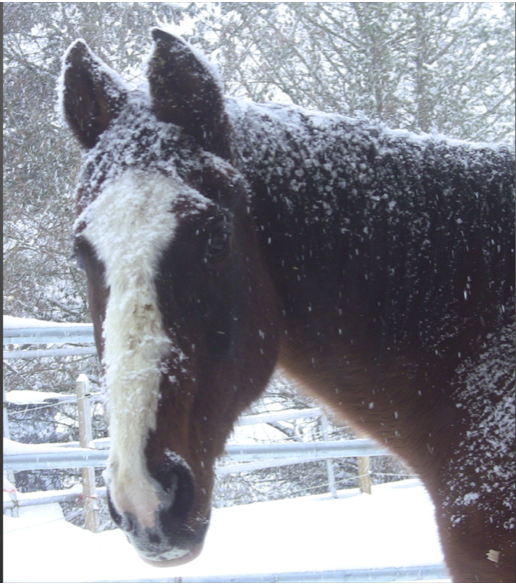
Peregrine in snow head shotPeregrine will be 30 in two weeks.  You can see his age in his face.  Just like an elderly person, his flesh has melted away from his bones.  But there’s something else I see his face.  I see the foal who greeted me thirty years ago.

I was there at his birth which was a very good thing or he might not have survived his first day.  His mother had neurological damage to her spine resulting in limited proprioception in her hind end.  She panicked during the foaling.  As Peregrine began to emerge, she fell down against the stall wall and couldn’t get up.  He was trapped in the corner of the stall with not enough Peregrine halter close editroom to get free of her pelvis.  If I had not been camped out just outside her stall and heard the first sounds of her struggle, I might have lost them both.

I was able to pull Peregrine out and then summon the help I needed to move her away from the wall.  While his mother rested, he struggled to his feet.

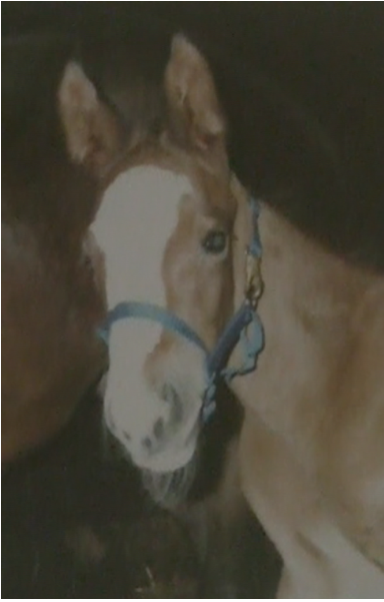
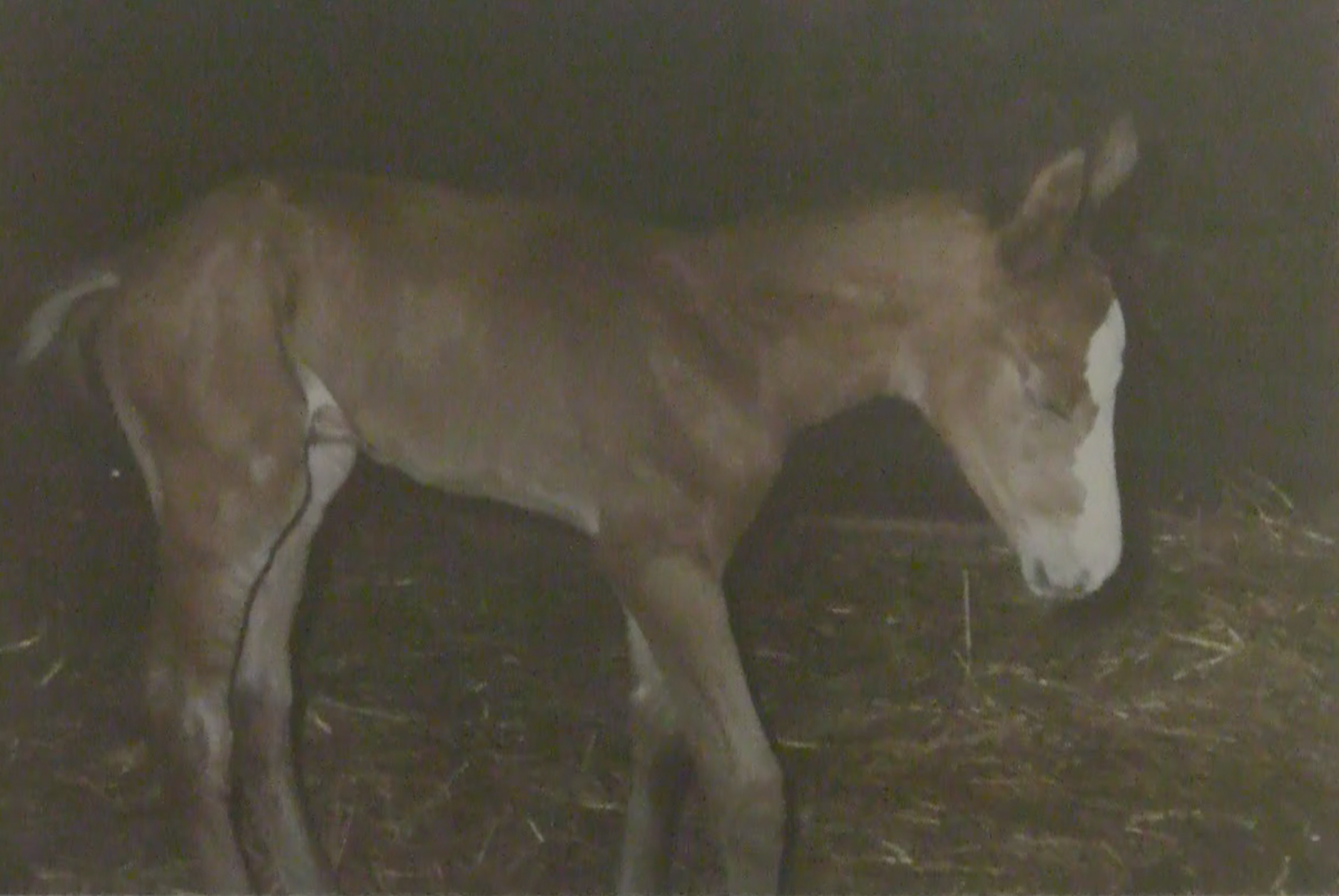
I’ve watched people trying to catch new born foals.  They have to corner them, trap them, grab them up in their arms and hold them tight.  Peregrine was never like that.  I’d been talking to him for months before his birth.  He was born knowing my voice, knowing me.   He was every bit as at ease with me as he was his own mother.  This foal picture was taken just eight hours after he was born.  The halter was a non-event.  I slipped it on, and he wore it as though it was the most natural thing in the world for a horse to do.  He fell asleep that first morning with his head in my lap, something he still does, thirty years later.

When I look at this picture, I see my beautiful Peregrine.   He’s curious, open, eager for the life that is ahead of him.  When I look at Peregrine now, I see the same horse.  He’s still beautiful and still eager for what the day will bring.  I wish we could say the same for all old horses.

Happy Birthday Peregrine.  Thank you for the gift of 30 years.

Help me celebrate his 30th birthday on April 26, 2015.  Details to be announced.

Peregrine just a few hours old.

Peregrine just a few hours old.

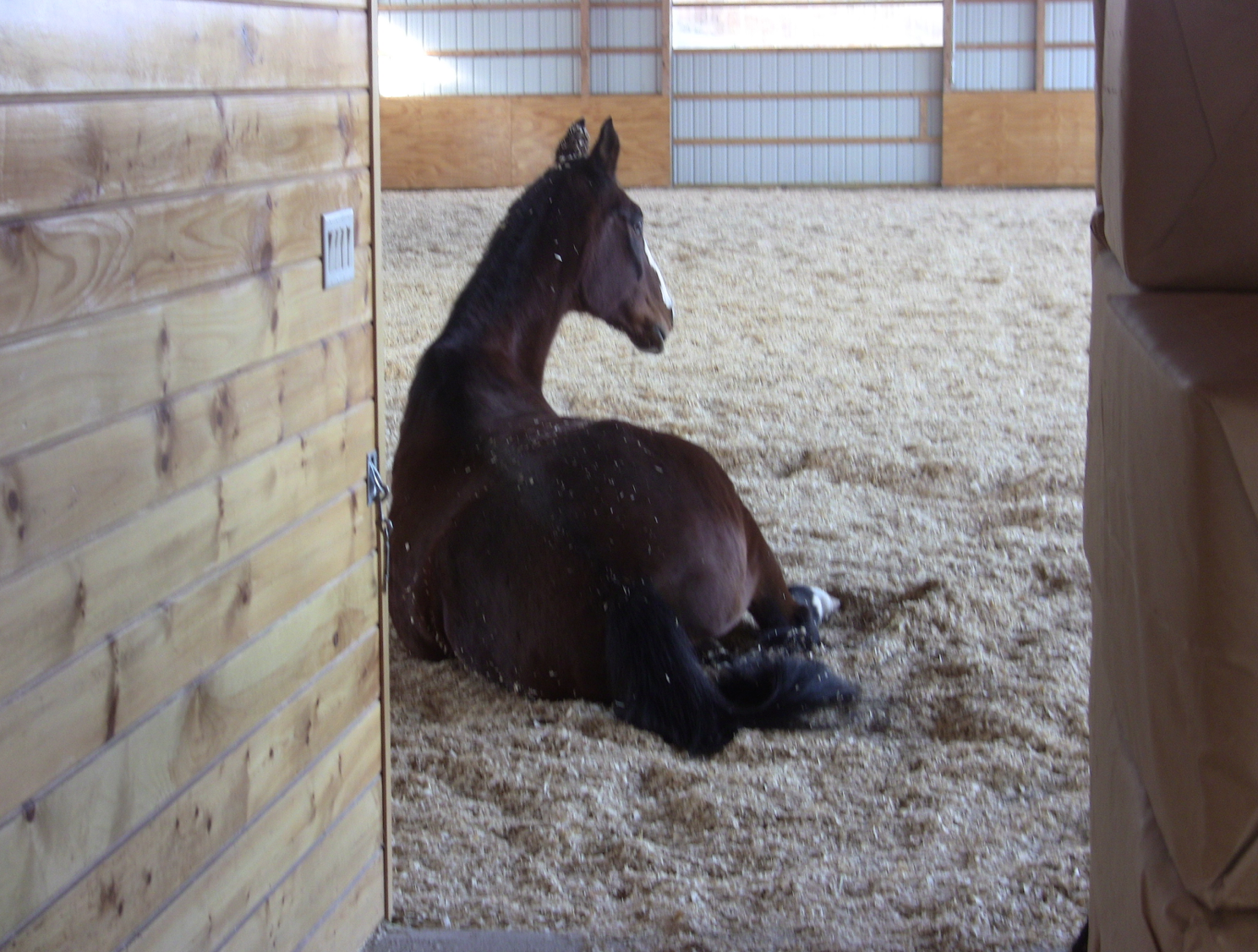
Peregrine enjoying an afternoon nap in the arena.

Peregrine enjoying an afternoon nap in the arena.

You’re invited!

In just a few short weeks I will be celebrating Peregrine’s 30th Birthday, and you are all invited to his party!
Where: Here on the internet.  Details to be announced.

Peregrine foal sleeping standing

When:  Peregrine was born at 11:35 p.m. 1985.  On Sunday April 26, 2015 I will celebrating his 30th Birthday.

And on Monday April 27 the festivities continue as I celebrate his First Day.

Throughout the day on April 26 and 27 Peregrine and I will be receiving internet “visitors”.

What to bring: Your stories!

Peregrine is our original clicker-trained horse.  He’s the one who got the whole ball rolling back in 1993.

I first learned about clicker training from a friend who trained Irish wolf hounds.  I was curious to see what Peregrine would think about it so I went out to the barn with clicker and treats.  He was laid up with abscesses in both front feet at the time – the after effects of Potomac horse fever.  There wasn’t much he could do.  He was too sore to walk, but he could touch a target.  I used a dressage whip which he was perfectly happy to bump with his nose, especially when he discovered that doing so got me to reach into my pocket and give him treats!

We both thought this clicker game was entertaining.  As he became more mobile, I added bits and pieces from the things he already knew.  The result: after seven weeks of stall rest, he was further ahead in his training than he had been when he was laid up.  I was hooked, and the rest, as they say, is history.  Peregrine was my original clicker pioneer and experimental “guinea pig”.  He helped spread this wonderful way of training around the planet.

I’d like to celebrate his 30th Birthday – a major milestone for us – by hearing about your clicker horses.  Share your pictures, and your stories.  Celebrate with me the love we have for our horses.

How:  Share your stories and your pictures here and on facebook.   I’ll be celebrating 30 years with Peregrine.  What special relationships do you cherish and celebrate every day?

Alexandra Kurland
theclickercenter.com
theclickercenterblog.com
theclickercentercourse.com

Words Matter

What Are You Really Saying?
We’ve been having an interesting discussion in my on-line course about the labels people use to describe their horses.
airplane seats multiple rows
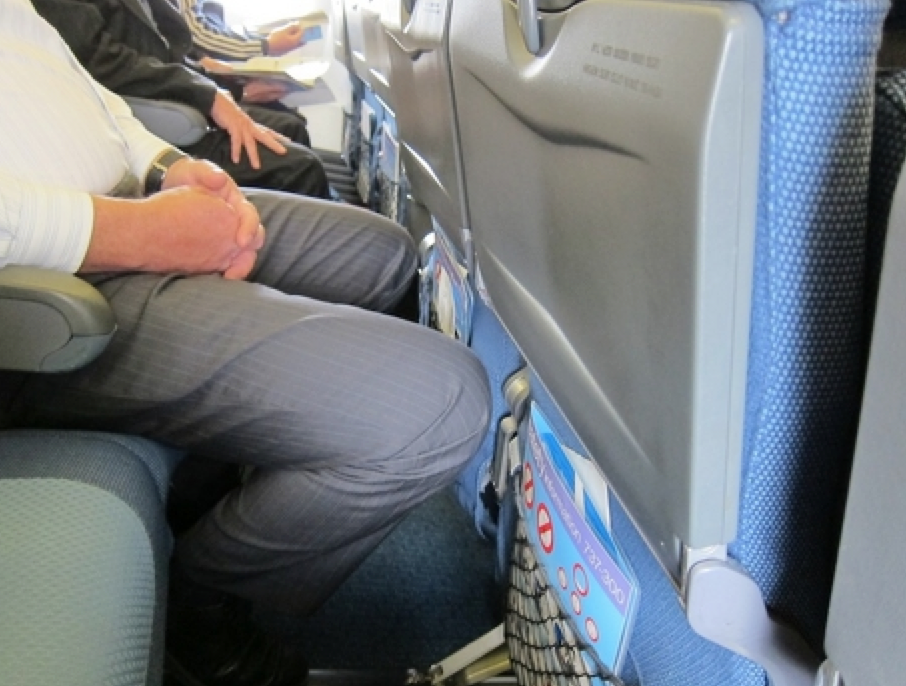
Words are so interesting.  Recently I flew on a Delta airlines plane.  Most of the airlines have rows at the front of the economy section that give you a couple more inches of leg room.  United calls this section economy plus.  Delta calls it comfort seating.

Oh dear.

As I walked past the last row of this section to my seat in the middle of the plane, I couldn’t help thinking: “abandon hope all ye who enter here.”  If I have just passed the comfort seating zone, what was left – the comfortless seating rows.  Exactly right!

cramped airline seat

Words Matter
Words matter.  Labels matter.  We use language so we are constantly creating labels and attaching them to everything.  We name our family members, our friends, our pets, the objects around us, the thoughts and emotions we’re feeling.

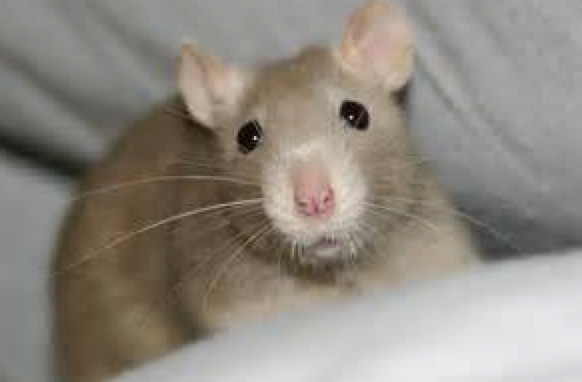
When we talk about our horses, we often find ourselves saying they are dominant, stubborn, aggressive, playful, friendly, submissive.  We stick these labels on the animal, and they become self-fulfilling prophecies. The power of expectations is huge.  Dr. Robert Rosenthal demonstrated this in a clever study done with rats.  Twelve lab techs were each given five rats.  Their job was to train their rats to run through a maze.  Six of the lab techs were told their rats came from a strain that was bred for good performance.  The other six lab techs were told their rats came from a strain that had been bred for poor performance.

rat 2They were given five days to work with their rats, and from day one on there was a significant difference in how the rats performed.  The “smart” rats learned the maze much faster.  Of course, you’ve already guessed the set up.  The rats were all from the same strain.  There should have been no significant difference in performance, but the expectation of the handlers impacted how they handled the rats.  The “smart” rats were handled more gently which resulted in them performing almost twice as well as the “stupid” rats.  The expectations of the experimenters had created a self-fulfilling prophecy.

Rosenthal went on to conduct similar tests of expectations in schools.  In one study all the students in a class were given an IQ test at the beginning of the school year.  The teachers were then told that five of the students had scored exceptionally well on the test and could be expected to excel throughout the year.  At the end of the year, these five students had indeed surpassed all the other students in the class.  And again, you’ve probably guessed the set up of the experiment.  The five children were picked at random.  Their scores were no higher than the rest of their classmates at the start of the school year, but the extra attention the teachers gave them again created a self-fulfilling prophecy.

Rosenthal dubbed the influence that expectation can have on results as the “Pygmalion Effect”.  His work clearly shows us that labels and the expectations they create do indeed matter.

What Are You Attaching The Label To?
Dr. Susan Friedman and other behaviorists remind us that the emotionally charged labels we use don’t describe the whole animal, they describe the behavior we’re seeing.  That shift in focus is important.  If I think of a horse as aggressive, we can both become trapped in this label just as surely as a fly is trapped in amber.

Labels can become dead ends.  An aggressive horse becomes just that.  Even if I modify his behavior, that label remains attached like a permanent brand tattooed around his neck.  He might not be showing aggression now, but watch out, that label warns.  This is an aggressive horse.

When you unlock the horse from these labels and describe instead the behavior you are observing along with its antecedents and its reinforcers, you also unlock training solutions that create the potential for lasting change.

Labels
Labels can certainly be a convenient short hand.  We all use them, but we need to be mindful when we do of the effect that these labels have on the ways in which we interact with our horses and the training choices that we make.  We need to keep in mind the Pygmalion effect, but that doesn’t mean we mustn’t use labels.  After all, labels – meaning nouns and the adjectives that modify them – are what give meaning and richness to our language.  Without them we would be creating a very drab world indeed.  (Note all the labels that were used just in the last two sentences.  They help give colour to the world we live in.)

So instead of stripping our language down to the bare bones because we are afraid to use any descriptive labels at all, let’s learn instead how to put the Pygmalion effect to work for us.  If our expectations contribute to the outcome we get, then let’s use labels that take us in the direction we want to go.

listen to labels beigeWhen you attach labels, think about what you want to modify.  Are you describing the whole horse or just the behavior you are seeing in this moment?  If you do label the horse, select ones that take you to the horse you want to have.  I believe that horses are intelligent animals, and I love being around smart horses.  The labels that I attach to the horses I’m with reflect this belief system and direction I want to be heading with them.  Listen to the labels that people  use to describe their horses.  They will reveal their underlying belief systems.

Self-Fulfilling Prophecies
We attract evidence to support our belief systems.  If I believe that horses are intelligent animals, I will be most aware of experiences that support that view.  Someone else might think of horses as stupid animals.  Guess what they will notice?

We can see the same behavior, and our underlying belief system will cause us to see it in completely different ways.  We’ll each end up attaching labels that support our belief system.  So when you use someone else’s labels, you want to consider their underlying belief system.  Is it a match with where you want to be heading with your horse?

If you try on someone else’s label, examine carefully what expectations that creates for you.  When I say my horse is “smart”, there’s delight and admiration attached to that label.  You might use that label and find that it creates problems.  What happens if your “smart” horse doesn’t understand a lesson?  Do you get frustrated with him because he’s not trying hard enoughHe should be able to get this.  If a label leads you down a relationship path that creates disappointment or conflict, don’t use that label.

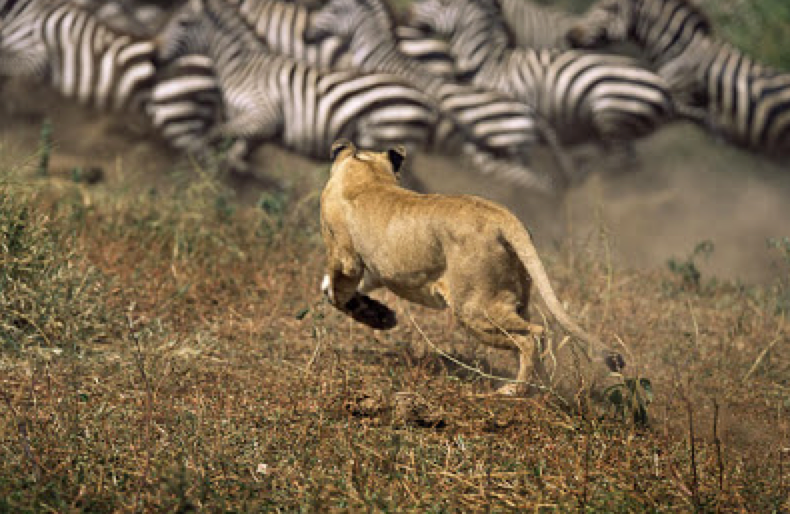
Labels are often based on an incomplete analysis of the behavior we’re seeing.  We hear so often horses are prey animals, and they are flight reaction animals.  Lets take those descriptions a step further than these statements usually carry us.  Horses are herd animals. They form social groups to provide safety from predators.  When a predator attacks what do horses do?  Run, of course.  But not apart.  They don’t scatter in all directions.  They bunch together.  Why? Because that tighter bunch makes it harder for a predator to get in close to take one of them down.

So when a horse is startled and crowds in on top of you, is he being pushy, or is he trying to keep you both safe?  When you drive him out of your space because you’ve been taught that this behavior is a sign of disrespect, what must he be thinking?  That you’re literally throwing him to the lions.zebras lion

For obvious reasons we can’t have our horses jumping on top of us, but if I see this reaction as a desire for safety, I’ll find training solutions that support this need.  Our underlying belief systems and our understanding of horses will very much influence how we see this event.  It will impact what labels we attach to the horse and what training solutions we choose.

Through clicker training we are learning to look beyond the easy out of incomplete or outdated labels to the behavior we are seeing. Horses do indeed have very definite personalities.  One of the great pleasures of clicker training is the horse’s personality can be expressed and remain intact.  That makes it very much a study of one – your horse with his unique personality and life history.  When you describe him, use words that lead you to towards the kind of relationship you want to have.

https://www.youtube.com/watch?v=JO4hFS9ZQ4E

I believe horses are intelligent and my expectations create that reality in my horses.

Alexandra Kurland

Please note: If you are new to clicker training and you are looking for how-to instructions, you will find what you need at my web sites:

theclickercenter.com                    theclickercentercourse.com

P.S. If you want to learn more about expectations, listen to the January 22, 2015 podcast of NPR’s Invisibilia: How to Become Batman.  You’ll hear Robert Rosenthal describe the study he did with the rats, and you’ll also hear from Stanford psychologist, Carol Dweck.  I’ve referenced her work in previous articles.

http://www.npr.org/podcasts/510307/invisibilia

Yes And . . . Learning to Grab a Whale By The Tail: More Metaphors from a Systems Biologist

Getting Out Of The Cloud
Systems biologist, Uri Alon has given us the image of the cloud.  As a young graduate student studying physics, he found himself in despair over his research.  Assumption after assumption had failed.  What he thought was a reasonable hypothesis led him nowhere.  The cloud became his metaphor for the state of confusion that sits at the boundary between the known and the unknown. When you are in the cloud, you know you are getting closer to discovering something truly new.

When one of his graduate students tells him that he is in the cloud, Alon understands that this is a normal part of the research process.  Knowing about the process doesn’t take away the negative feelings, but it does tell him how to help that student.

Alon: “Just knowing that the cloud is normal, that it’s essential, and in fact beautiful, means we can join the Cloud Appreciation Society.  It detoxifies the feeling that something is deeply wrong with me.”

Instead of being defeated by the cloud, Alon and his graduate students use it to find creative solutions. How did Alon find this creative solution for his teaching when other researchers did not?  Innovations rarely come from within a field.  They come from bringing in fresh ideas from other sources.

So what was the fresh idea Alon brought to his research?

At the same time that he was working on his Ph.D, he was also studying improvisational theatre.  As an actor, he was actively taught how to deal with failure.  One technique for going into the unknown was saying “Yes, and . . .”  to what other people offered.

Alon: “Yes and . . .”  means agreeing with and building on another person’s offer.  If an actor says: “Here’s a pool of water.”  and the second actor says: “No, that’s just the stage.” you have nowhere to go.  The second actor has created a dead end for your idea.   The improvisation is over, and everyone on stage feels frustrated.  That’s called blocking: saying no to the other person’s idea.

If instead you say:

There’s a pool of water.

Yes, let’s jump in.

Look, there’s a whale.

Let’s grab it by the tail.

It’s taking us to the moon.

That way you unlock hidden creativity building on each other’s ideas.

In science there’s a lot of blocking and no mindfulness for this form of communicating.”

Silencing the Inner Critic
We have an inner critic that keeps us from grabbing the whale by the tail because we don’t want people to think we are ignorant, stupid, or foolish.  Saying “yes, and . . .”  by-passes that inner critic.

Saying “yes, and . . .”  does more than that.  It transforms horse training.  I love phrases like this.  Psychologist Carol Dweck gave us The Power of Yet. (See: “Choosing Your Words, Your Mindset, Your Training Strategies”; published January 13, 2015.)

Saying: “My horse can’t pick up his right canter lead” is limiting and creates dead ends.

Saying: “My horse can’t pick up his right canter lead – yet” opens the door to possibilities.

Now we have another powerful phrase borrowed from the sciences.  Uri Alon has given us: “Yes and. . .”

“Yes And . . .”  instead of “No, Not That”
The horse world is full of: “No, not that.”  We are the ones on stage saying: “no that’s not a pool of water.  Don’t go there.”  We are actively taught to block.

We slide down the lead asking for movement and our horse takes a step – just not in the direction we want him to go.

We say: “No, not that.  That’s not the way to go.”

He tries again.  “No, not that.”  We keep shutting him down and shutting him down.  Is it any wonder we see so many horses who have lost all the sparkle in their eyes.  What we love most about horses, their spirit, we rob from them with all of our “No, not that” blocks.

How much better to say: “Yes, and. . .”  That’s how we should be shaping behavior.  This is what the best shapers know how to do.

They set up the training environment so they can ask for tiny slices of behavior.  Each slice is greeted with a “yes, and . . .”  Yes, you shifted your weight.  That’s great.  Now what else can you do?

Recently I was working with a group of horses who I have come to know well.  When I first met them, they were saying: “No, not that” to me every time I slid down a lead.  I could tell from their responses that they had encountered a lot of blocking in their past.  The lead didn’t invite movement.   It stalled them out.

We’ve had a great many roundabout conversations about lead ropes and the cues they can give.  On this last visit the pieces of the puzzle began to come together.  We had our first true “yes and” conversations via a lead.  Each time I slid my hand down the lead, I was inviting movement.  I was answered with a positive response.  I might want more of a step to the side, but instead of blocking what they gave me, I accepted the offering and built on it.

I had a whale by the tail, and it was taking me to the moon.  What a delicious feeling!  As I was working with these horses I was thinking – how on earth do you teach this!  Blocking is easy.  How do you teach someone how to accept and flow with each changing step?  And then I listened to Alon talk about “yes, and . . .”  That is the metaphor that describes the dance.  My partner is never wrong.  “Yes, that’s right” is so much more supportive than “No not that.”  These horses initially expected the “No.”  Now they understand “Yes.”

Clicker training gives us the freedom to say “Yes, and . . .”  The horse training I originally learned was all about saying the opposite: “No, not that . . .”  I think this is a huge dividing line between what clicker training offers and what traditional training encourages.  We look at what we want our animals To Do, and we say “yes” to their offerings.

While I was working on this article, I took a break from the computer and went out to give the horses their lunch.  While Peregrine ate his mid-day mash, I cleaned stalls, checked the water,  refilled the hay boxes.  By that time Peregrine was done.  I opened his stall door, and Robin went in to make sure that Peregrine hadn’t left anything that needed cleaning up.  I fixed a cup of tea and was heading back into the tack room when I heard Robin calling to me from the arena.

I looked in and both horses were waiting for me.  The tea could wait.  I went in to the arena.  Peregrine started offering his octogenarian version of Spanish walk.  Robin circled around us in his beautiful collected trot and ended by positioning himself in perfect heel position by my side.  I found myself laughing as I thought “Yes, and . . .”

Next time you are with your horses say “yes and . . .” to them.  Grab the whale by the tail and see where they take you.  To the moon and back is a wonderful place to go when it is in the company of a horse.

Alexandra Kurland

Please note: If you are new to clicker training and you are looking for how-to instructions, you will find what you need at my web sites:

theclickercenter.com                    theclickercentercourse.com

References:
If you want to listen to Alon describe for himself the cloud and the concept of “Yes, and . . .”, go to:

He’s an excellent presenter, and even though these are essentially the same talk, you will find new things in each one.