Goat Diaries: Clicker Training Day 2 – Quick Learners!

Please Note: If you are new to the Goat Diaries, these are a series of articles that are best read in order.  The first installment was posted on Oct. 2nd.  I suggest you begin there: https://theclickercenterblog.com/2017/10/02/

Protective Contact
I talk a lot about protective contact. I like to begin with a barrier between the animal learner and the handler.  The more I worked with the goats, the more I appreciated just how important beginning in this way can be.  Now I am sure there are many who will read this with eyes rolling. These are baby goats! Are you so afraid of them that you need a barrier?

There are times with certain individuals where the answer would be: “Yes, absolutely I’m afraid of this animal – and so should you be.  Whether it’s a tiny terrier, or a giant horse, this individual has demonstrated that he will defend himself.   While we’re working out our relationship, I’ll keep myself safe by working behind a barrier.
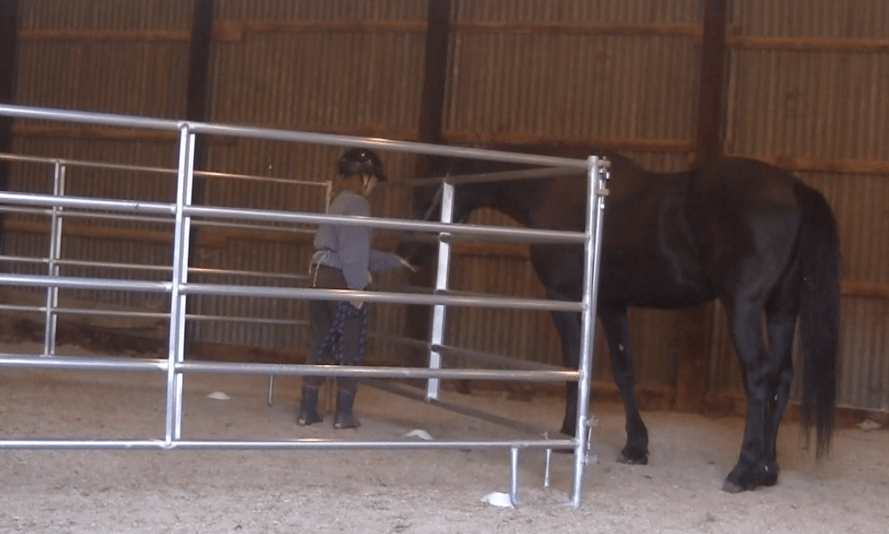
aries protective contact.png

In this case it’s the human who is on the inside of the round pen panels. The horse is free to leave.  What he’s chosen is to stay and interact.  What he can’t do is charge his person which was the behavior he was showing earlier.

Safety can also work the other way.  It’s the animal who is afraid of us. The barrier means the handler can’t get any closer. The animal can choose when he feels comfortable enough to approach, and he can also retreat any time he needs to. That freedom of choice builds confidence. The barrier may feel restricting to the handler. We want to be in with our animals, actively doing things with them, but in the long run beginning with a barrier can help build the truly connected relationship we are looking for.

Barriers aren’t just about safety. They also limit options which means that your learner isn’t practicing behaviors you don’t want. If I don’t want mugging behavior to become woven into the matrix of these early lessons, the barrier can help. I can just step back out of range so my horse can’t reach my pockets, or my dog (or goat) can’t jump up on me.

When these unwanted behaviors aren’t present, it’s so much easier to find and reinforce behavior that works well for both of us. I’m not punishing the behaviors I don’t like. I am simply arranging the training environment so it’s easier for my animal learners to offer behaviors I like.

With the goats I didn’t have a set up that let me begin with protective contact. So instead I borrowed again from the horses and used the treat delivery to help create some spatial separation.

8 am 2nd session

At 8 am I  gave the goats hay in their stall. P left to come to me, so I had him follow the target into the outside pen. E wanted to come, but I managed to close the door before he could join us. P was very eager. I was holding a cup of grain and peanuts in my hand. I wanted to keep their treats separate from the horses’ so the cup seemed the best option.

The first session or two of clicker training can seem so easy, especially with a nervous learner. He’s just beginning to figure out that treats are involved, but he’s still a little worried about approaching too close so mugging behavior is manageable. But give him time to think, and this is what he may come up with: Why bother with the target. Why not just go straight for the treats?

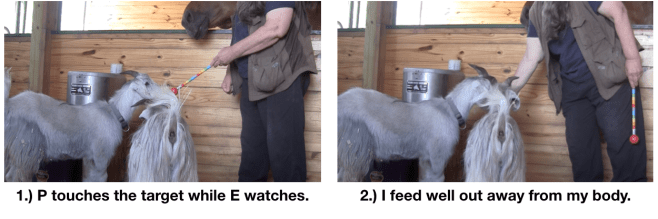
This was clearly what P had concluded. He kept jumping up on me. I could deflect him easily, but hmm. This was decidedly not what I wanted. If my set up had allowed, I would have gone to protective contact to keep him from practicing this behavior. Instead I borrowed another technique from the horses. I followed the mantra: “Click for behavior. Feed where the perfect horse (or goat) would be.” The perfect goat would most definitely not be jumping up to get his treat. When I clicked, I fed him so he had to take a step or two back.

Goat diaries Day 2 P jumping up.png

This is obviously NOT behavior I want.

Goat diaries Day 2 P being fed so he backs up.png

To help create some space between us, I fed him so he had to take a step or two back to get to his treat. Note: I am NOT pushing him back.  I simply imagine that there is a bucket sitting where I want to deliver the treat.  He moves with me and shifts out of my way just as he would if there actually were a bucket I needed to get to.  If you don’t yet have the feel of this kind of treat delivery, begin with an actual bucket.  When you can smoothly deliver treats to the bucket and your animal moves out of your way to let you get to it, you’re ready to shift to imaginary buckets.  Teaching your animal learner that he may have to move his feet to get to his treat opens up many more possibilities for shaping behavior.  The food delivery becomes a much more active part of the training.

You never know what you have taught. You only know what you have presented.

That is something I say often in clinics. As I deflected the jumping, I was thinking about that.  I was looking for something I wanted to reinforce. I didn’t want him practicing this behavior, and I most certainly did not want to chain it into something else that I did want. P was too fast a learner for that. I could see him figuring out the following sequence: jump up, then look at the target and voila – this human feeds you peanuts! Not good.

When I did click, I fed P so he had to back up away from the cup of treats. Definitely it was going to be interesting to see what he did in the next session. What learning was taking place in that clever head?

When I stopped with him, I dropped some treats on the ground. It was a bit of a struggle to get him to find them. He was orienting to my fingers, not moving to the treats. I finally just stood up, and that’s when he started eating the dropped treats.  That bought me the time I needed to slip back into the stall so I could work with E.

Little E was a perfect gentleman, especially compared with P. He followed the target pretty well, and backed up gently for his treat. It was overall a very pleasant session. On the previous day when I worked them together, I was seeing a lot of head butting between them.  Frustration and resource guarding was creating a problem.

Before P jumped over the dutch door and showed me that they could be separated, my plan had been to teach them to stand on platforms. With each goat on his own platform, I would be able to bring some order to our training.  Now that I could separate them, I could put that strategy on the back burner.

Goat diaries day 2 E getting his treat.png

E moves back to get his treat.  He was a perfect gentleman in this session.

Coming Next:  Day 2 – These Goats Are Smart!

Please Note: If you are new to the Goat Diaries, these are a series of articles that are best read in order.  The first installment was posted on Oct. 2nd.  I suggest you begin there: https://theclickercenterblog.com/2017/10/02/


Goat Diaries: Day 1 Continued – Lessons From Panda

Please Note: If you are new to the Goat Diaries, these are a series of articles that are best read in order.  The first installment was posted on Oct. 2nd.  I suggest you begin there: https://theclickercenterblog.com/2017/10/02/

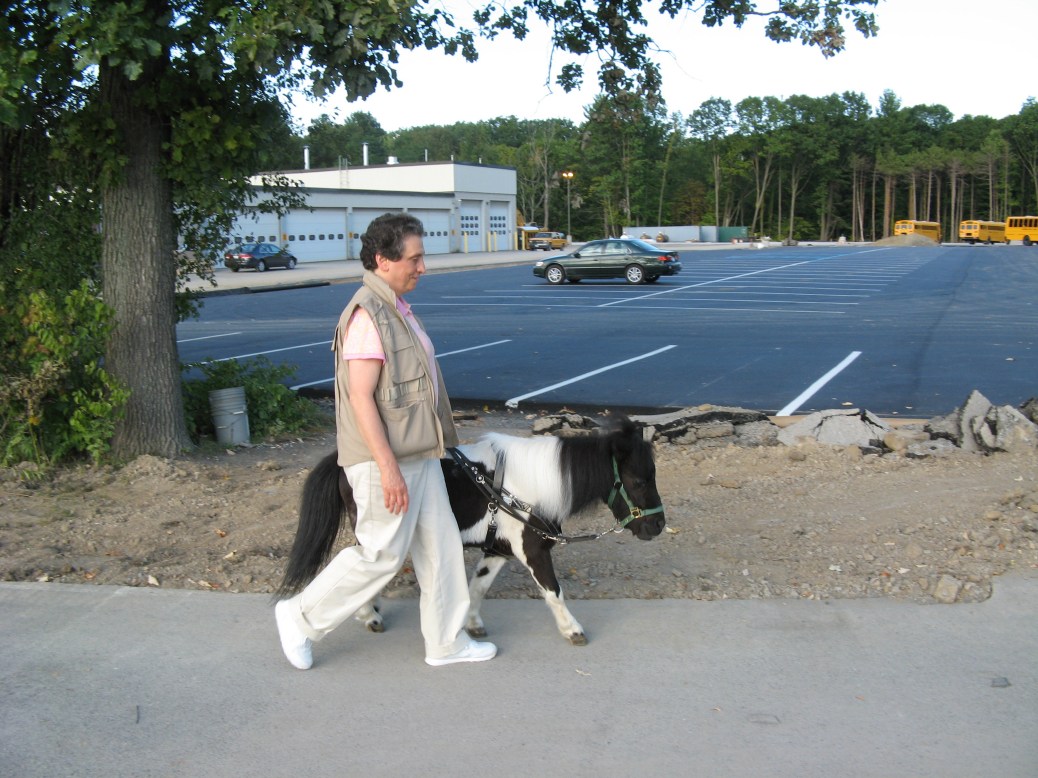
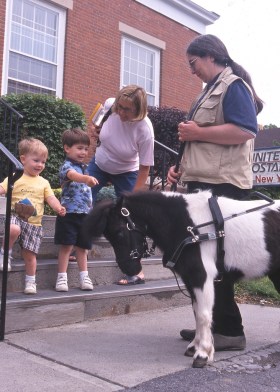
p5_TrainerAlexandraKurlandPandaWithLittleBoys AtPostOfficeDelmarNYNeilSoderstrom.jpgThese goats were not the first dog-sized herbivore I have worked with. Panda, the miniature horse I trained to be a guide for the blind, has that honor. I was quickly discovering that the principles and lessons I had used in her training were going to apply very much to these goats. They may be very different species, but their training needs were similar. The rules I set myself for Panda very much applied to the goats.
One of the primary rules was a core training principle:

You can’t ask for and expect to get something on a consistent basis unless you have gone through a teaching process to teach it to your horse.

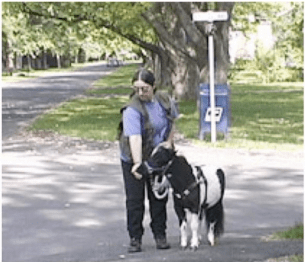
That meant I couldn’t ask Panda for anything that I had not taught her. If I wanted her to stand still while I talked to my neighbors, I had to first teach her what I wanted her TO DO. I couldn’t expect her to just know how to be patient. And she had to learn to be very patient because people were bubbling with curiosity when they saw me walking a miniature horse around my suburban neighborhood.

Panda at curb in neighborhood.png

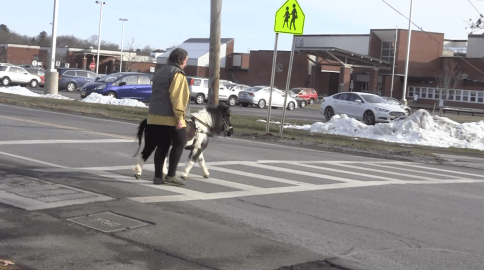
Panda at 10 months out for a walk around the neighborhood – fall 2001.  I am reinforcing her for stopping at the curb after crossing the street.

I also had to be consistent. I kept in mind a phrase I had learned from John Lyons many years ago: “The horse doesn’t know when it doesn’t count, so it always has to count.” Panda’s blind owner would never be able to see a curb crossing, or a root sticking up through a sidewalk. If I wanted Panda to be consistent in her guide work, I needed to be 100% consistent in her training.

These two training rules served me well when I took them to the goats.

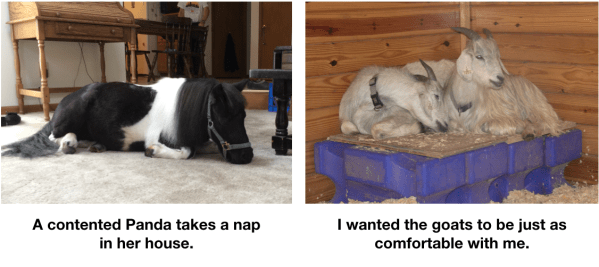
Panda napping goats nappingSession 7: 4 pm
I took the chair back in and set it in the middle of the stall. Both goats were eager for food, so eager in fact they were practically in my lap. I decided to work on “grown-ups” to get a feel for how that would work with them.  Grown-ups is short for a lesson I refer to as “the grown-ups are talking, please don’t interrupt.”  Grown-ups means the goat (or horse) stands beside me in his own space. Ideally he is looking straight ahead so his nose is well away from my treat pockets.

Sitting as I was in a chair, I was thinking about Panda. One of the early behaviors I worked on with her was this one of having her position herself beside my chair.  In fact, my second book, “The Click That Teaches: A Step-By-Step Guide in Pictures” was written while I was teaching Panda to stand next to me while I worked on the computer.  It was the start of teaching her a base position out of which so much of her guide work evolved.

Panda guiding - great walk.JPG

Panda as a working guide

Panda is tiny. At nine months of age when her training started, she weighed about 120 pounds. I could easily have pushed her into any position I wanted, but that would have broken one of the rules I had set for her training. It’s worth repeating that my primary rule was I could not ask her for anything that I had not first introduced to her through a teaching process. If I hadn’t taught her how to stand next to my chair, I couldn’t ask her to do so and expect her to be successful.

Connected to this rule, I could not physically move her around. It was always up to Panda to move her own body in response to my request. If she was standing with her hind end swung too far out away from my chair, I could not push her back into position.

With small animals that’s so easy to do. We can push, pull, and drag them around. We can even pick them up and carry them.  Who needs training when you can do that!

With ponies that is so often why they get such awful reputations for being stubborn and for “misbehaving”.  They may not get picked up like a baby goat, but they certainly get pushed and shoved around.  They aren’t really being taught what is wanted.  While they are still too small to put up much of a fuss, they are just pushed around. It’s easy. It’s quick. It gets the job done, but it leaves behind negative fallout.

With Panda if I wanted her to move her hip over, I could put my hand on her hind end. I could indicate a direction I’d like her to move, but I had to stop at that point of contact and wait. Another wonderful phrase for the point of contact is point of attention. I would wait there for Panda to notice my hand and then make a response.

When she shifted her weight even the tiniest bit, I would take my hand away as I clicked. The click was always followed by a treat. Pushing her over would have been faster in the moment. Waiting took more focus, but the results were well worth the wait.

Panda has been working as a guide for over fourteen years.  Following these rules in the foundation of her work helped build this long-term durability in her work.

Panda walk 1.1.17  cross delaware.png

Winter 2017

I was following the same rules with the goats. They were so much smaller than Panda. E probably weighed only about thirty or forty pounds. I could easily have picked him up, moved him around any way I wanted. That would get him from point A to point B. It would be easy – this time. But the more I followed that path, the less he would want to have anything to do with me. He might approach me because I had peanuts, but the minute my pockets were empty, he’d be off. That wasn’t enough. That wasn’t the relationship I wanted to build.

P was the first one to come over to visit. He came around the right side of my chair and got lots of clicks and treats for staying by my side. E was still eating hay which made it easier to focus just on P.  When E joined us, it was harder to separate out who was getting clicked for what. We were very much where you would expect to be at this stage – eager chaos with some order beginning to appear.

I kept this session short. Better to do a little and then leave to think about what to do next next than to stay and let their eagerness turn into unwanted behaviors.

(Note: each of these sessions were only about five or six minutes total.)

Session 8: 8 pm
For their final session for the day I went in without treats and set my chair down near their hay pile. They were comfortable enough with me to continue eating. I reached out and stroked their backs. They didn’t run away but they stopped eating. Curious.

I haven’t worked with goats enough to know what – if any – stroking, scratching, rubbing they enjoy. Are they like llamas who really don’t want the contact? Or are they more like horses who enjoy a good social grooming? I scratched the base of E’s ears. He stopped eating, but he stayed.

His body was tight. He showed no outward signs of enjoyment. His lips weren’t wiggling the way a horse’s would. His eyes weren’t getting dreamy. But he was staying. I scratched some more around his ears and the back of his neck. P crowded in so I switched to him. As soon as my hand left him, E went back to eating.  As I scratched P, he also froze.   When I stopped scratching, he put his head down and began eating hay. Scratch – the eating stopped. Interesting.

I sat with them for about half and hour and then left them for the night.

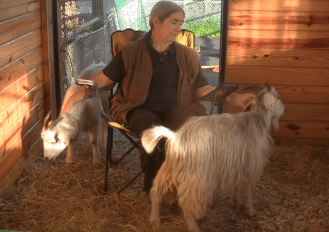
Goat Diaries Day 2 Cuddle Time

Evening “cuddle” time.

Coming Next: Day 2: Quick Learners

Please Note: If you are new to the Goat Diaries, these are a series of articles that are best read in order.  The first installment was posted on Oct. 2nd.  I suggest you begin there: https://theclickercenterblog.com/2017/10/02/

And to learn more about clicker training visit my web site: theclickercenter.com

Goat Diaries – Day 1 Continued: Cups of Tea

Please Note: if you are new to the Goat Diaries, these are a series of articles that are best read in order.  The first installment was posted on Oct. 2nd.  I suggest you begin there: https://theclickercenterblog.com/2017/10/02/

Collecting Data

tea cupI frequently tell people that it’s time to put their horse away and go have a cup of tea.  Yes, we want to spend time with our animals, but in these initial forays into clicker training less is often better.
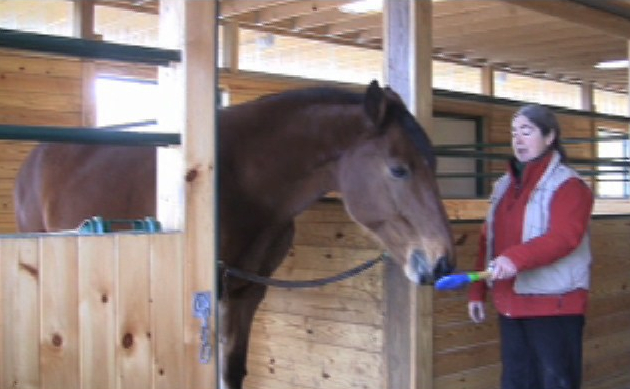
When I’m coaching horse owners, I have them count out twenty treats.  When they begin their sessions, that’s all they have in their pockets. That forces them to step away from their horses to refill their pockets.  They can go right back to their horses after they have replenished their twenty treats, but that brief break in the training gives them time to think and adjust.  I was doing a lot of adjusting as I introduced myself and clicker training to these goats.

In all I did eight sessions on this first day.  That may sound like a lot, but they were each just a few minutes long, and they were spread out throughout the day.

Session 5: 1 pm

I tried working from the outside of the stall. The goats were interested in the target, but it was too hard to deliver the treat, so I kept this session short.  My stalls are perfect for starting horses with the clicker.  I designed them with that in mind.  I wasn’t thinking about goats.

Targeting over the stall wall was worth the experiment if only to show me that wasn’t going to work.  I would have preferred separating them and working them one at a time, but I thought that might really stress them.  The compromise was a less than ideal set up.

So many of the people who have their horses at home are in the same boat. They have a paddock with a run-in shed that’s shared by three horses. Chaos! At least the goats were little so we could all three tolerate a bit of chaos.

In this respect they were more like dogs than horses. Size does make a difference.  People are much more casual getting dogs started with clicker training than I am with horses.  Just imagine trying to work with goats that weighed in at a thousand pounds each! It’s challenging enough at times with horses, but remember goats have horns, and they can jump and wiggle in ways a horse simply can’t.

Just because you can doesn’t mean you should.

Just because I could manage two goats at once didn’t make it ideal.

I wanted to step away from the goats and think some more about how best to work with them. These short sessions let me test the waters. I was giving things a try, seeing what worked and what didn’t, and then I was stepping away to think about how to do it better.  Goat or horse, this would be the pattern.  Always it is the animals who show you what they need to work on and what you need to change to make things better for each individual.

Session 6: 3 pm:

In my previous sessions I had sat in a chair and let the goats come to me.  This gave them a sense of safety.  As long as I was sitting in the chair, it was clear I wasn’t going to try to corner them in the stall and grab them.  But now that they were eagerly coming up to me to get peanuts, it was time to make a change.  I wanted to be able to move around more, so this time I went in without the chair.  My plan was to see if they would begin to follow the target.

When I went in, they were both eating hay out of the bucket. I was struggling to remember their names  – Sir Elyan and Sir Peleus, so I simply referred to them as E (the little one with the long hair) and P.

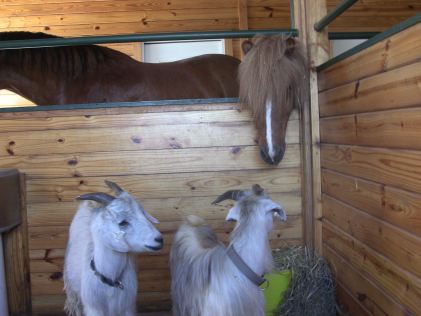
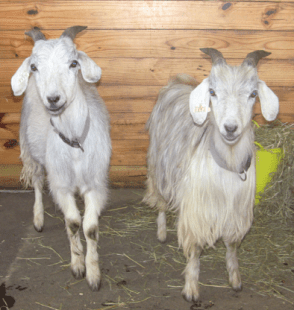
E and P are easy to tell apart. P is the larger goat with short guard hairs (on the left).  E is much smaller, and he has long hair (on the right). I was quickly discovering that they were as different in their personalities as they were in their physical appearance.

goats in stall Day 1

“P” is on the left.  “E” on the right.

As soon as I stepped through the door, P left the hay and began to follow the target. He stayed in the game. E joined us when he realized P was getting treats. P seemed to be making connections fast. It was clear he was beginning to understand the game. Little E was too busy butting in (literally) to get his brother’s treats to notice what was going on.

I began testing the waters a bit more in this session. They were definitely eager for treats. If they had been horses, I most certainly would have wanted some kind of barrier between us. That much eagerness in a thousand pound body can quickly become overwhelming.

I didn’t want to punish them for being eager, but I did need them to understand that while treats might come from my pockets, I was not an open salad bar.  You have to wait for your “dinner plate” to be brought to you.  With horses I would begin delivering the treat so the horse had to take a step or two back to get to it.  The best set up for teaching this is to have the horse in a stall with a stall guard across the door.

Robin targeting in stall

A great set up for introducing a horse to clicker training.

The horse reaches forward to touch a target, and then the treat is delivered so he has to take a step back. It’s such an easy way to introduce a horse to the idea of backing out of your space. The mantra is feed where the perfect horse would be. In this case the perfect horse takes a step back to get his treat.

Robin backing for food delivery

Backing to get the treat

Backing is one of six foundation lessons that I teach in the initial set up of clicker training.  These foundation behaviors become the ones a horse will offer if he’s feeling unsure. If something frightens him, much better that he backs up out of your space than that he runs over the top of you.

I was pretty sure there would be times when I’d want the perfect goat to be moving out of my space. I certainly didn’t want them crowding into me, so after I clicked, I extended my arm well out away from my body.  This kept them from crowding into me for their treats.

Day 1 targeting 3 pm panel 1

E and P were wary of movement. When I shifted towards them, they backed right up. I didn’t want them backing because they were afraid, but at least I knew that feeding them out away from me was going to be easy to get. Data collected.

I also checked out what P’s response was to my holding him by his collar. The answer: head shaking and resistance.

I asked E the same question.  When he felt me take his collar, he dragged forward against the pressure.  I kept a soft but steady feel.  When he softened in response, click, I released his collar and gave him a treat.

Goat diaries Day 1 targeting 3 pm collar panel 1a.pngI knew from the way the goats had sled-dogged their way into the barn the day they arrived that leading was a high priority, but it was also going to need a lot of work. This just confirmed it. The goats were used to being grabbed, but they didn’t know how to release to pressure.  The data I collected told me this was a lesson that would have to wait.
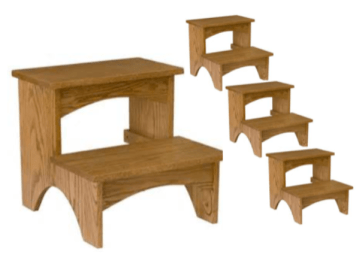
Before we could work directly on leading, I needed to teach them the underlying skills that would make this a fair and successful lesson. Approaching the leading directly would result in a train wreck. A better way is to come at a training goal indirectly and with lots of small steps.

Big step stool, little step stools.png

Good training breaks new tasks down into many small steps.

Coming Next: The Goat Diaries: Clicker Training Begins – Day 1 – Session #7: Lessons From Panda

Please Note: if you are new to the Goat Diaries, these are a series of articles that are best read in order.  The first installment was posted on Oct. 2nd.  I suggest you begin there: https://theclickercenterblog.com/2017/10/02/


Goat Diaries: Day 1 Continued – Dress Rehearsals and Trial Runs

Testing The Waters

In my previous session I had tested the waters by sitting down in a chair and trying to introduce targeting to a pair of young, very food motivated goats. Data collection is an important part of training. What was the data I had collected so far?

I discovered that I needed to change my treat delivery.  I was so used to my horses who wait patiently while I get their treats that I hadn’t factored in the quickness of these young goats. Getting treats out of my pocket while sitting in a chair was too slow.  I normally start horses in a stall or a small paddock so there’s a barrier between us.  I’m standing so I can move as needed which means getting a treat out promptly isn’t a factor.  Sitting down changed everything.

With horses I recommend to people that they do a practice run first without their animal learner. Go through the handling skills you’re going to be using BEFORE you’re with your horse. Can you manage the target and the treats? What can you do to streamline the process?

Remember: Clean handling in helps to get clean training results out.

The more you are bumbling and fumbling your way through the process, the more mistakes you’ll accumulate. Your animal learner may even get so frustrated by the inconsistencies that he simply quits and gives up trying. That’s when people start to say their animal got bored. He didn’t get bored. He got confused.

The way to avoid this is to run through a pretend session, something I had failed to do. But I was learning fast.

Already I had learned that whether it’s a goat or a horse, the starting point is the same. Go spend some time just quietly getting to know the individual you are going to train. Then find something your learner wants. That was easy with these goats. They wanted peanuts! The ice had been broken, and they were ready to train.

Our first targeting session at 8 am showed me the things I needed to change. In the next session I made some adjustments in my food delivery. With two goats vying for peanuts, I couldn’t afford a long time lag between the click and the delivery of the treats – not if I wanted them to connect the training dots.  I wanted the click to mean something to them and not to be so overshadowed by everything else that was going on that it became just background noise.

Session 4: 11 am
This session was very similar to the 9:30 session, except this time when I sat down in my chair the goats came right over. I had learned I needed to pre-load my hand. Reaching into my pocket took longer than I had. I was using whole peanuts still in their shell. That helped keep this session from disintegrating into chaos. It took a moment for the goats to chew the peanut hulls. While one was still chewing, I had time to offer the other the target.

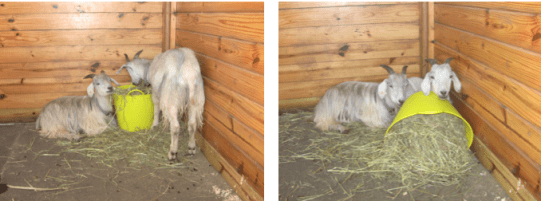
Goat Diaries Day 1 targeting panel 1aThe placement of the target helped make it clear which goat I was focusing on.  The yellow bucket also helped to keep them separated and out of my lap.

Goat Diaries Day 1 targeting panel 1b

Photos taken from video: Goat Diaries: Day 1 Targeting.mov

The total time on this session was 6.2 minutes.

Coming Next: Day 1 Continued: Cups of Tea


Goat Diaries: Day 1 – Begin By Breaking the Rules

Goats Not Horses
I’m a horse trainer.  That’s what I know, but here I was with two young goats trying to stay as far away from me as was possible in the space of a stall.   The goats belonged to St Mary’s Convent.  They were raised both for their beautiful cashmere fiber and to be part of a 4-H program.   They had grown up being held in the laps of young children.

The rest of their experience with people was very conventional farm handling. When you needed to move a particular goat into another pen, you grabbed the collar around his neck and propelled him forward as best you could. No wonder they were suspicious of me! They clearly expected to be grabbed and held. The Sister who had raised them very much loved her goats and was wonderfully kind to them. But the handling was done within the constraints of traditional farm management.

These goats had also grown up being fed peanuts and pretzels by children.  No safety rules attached. The herd had gained the nickname of Piranha Goats. That tells it all. Apparently, the children loved having the baby goats jump up and take pretzels out of their mouths. Cute maybe, but these weren’t babies anymore.

I had just discovered that the goats were willing to set aside their suspicion of me for the prize of peanuts.  Gone was their shyness around me.  Suddenly, I had two goats all but in my lap eagerly taking the peanuts from me.  Okay.  That was one hurdle crossed.  Now what?

With horses I would normally begin with targeting. Now that the goats knew food was involved it seemed a reasonable starting point for them, as well. I would also normally begin with protective contact. I would be on one side of a barrier with the horse on the other. And I would be working with only one horse at a time.

Nick target in stall 2.png

I often get emails from people asking for help getting started.  They’ve gone out into the only work space they have – their paddock – and tried to clicker train several horses at once.  That’s a recipe for disaster.  We’ve all seen one horse run another off a hay pile. Now the handler has essentially become the “hay pile” – a hay pile with a particularly tempting stash of carrots hidden in it’s pockets.

If the handler doesn’t get kicked or run over, she runs a high risk of getting one of her horses kicked.  And even if the herd gets along beautifully and doesn’t quarrel over a scarce resource, there’s the problem of sorting out what to do after you click.

Do you feed everybody, even the horse who was doing completely the opposite of what you wanted?  Or do you just feed the horses who were good?  What kind of confusion and frustration are you weaving into your first clicker lessons?

It’s so much better to work one horse at a time.  There are lots of ways to do this.  You may not be able to afford metal round pen panels, but you can make inexpensive wooden panels to create a safe work space for your horse.  You can set these panels up in your paddock, so all the other horses can watch.  A horse who worries about being away from the herd will still have his family nearby.

Maggie in round pen panels.png

These wooden panels are both inexpensive and easy to make.  They provide a good safety barrier for you and your horse.  Note the horse is on the outside.  This gives her more power of choice.  She’s free to leave at any time.  The handler has to become more creative to keep her horse engaged with her.  If her horse does leave, the panels keep her from chasing after her to get her back.

I didn’t do this with the goats.  I began by breaking my own rules.  My work space was their stall.  I had no barrier and two goats – with horns – who were jostling one another to get to the treats. That’s a recipe for chaos, but I didn’t want to stress the goats by separating them.

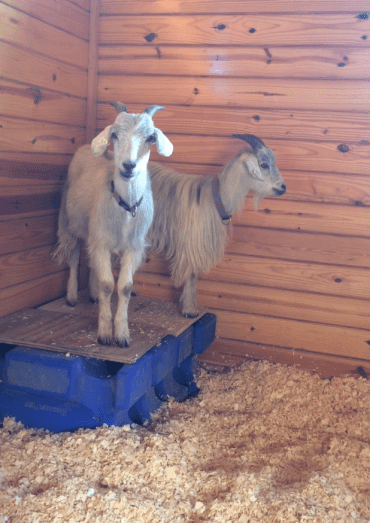
Instead I took my chair into the stall, set a bucket of hay down in front of it and began. The chair served one of the functions of protective contact. While it didn’t provide me with any protection from them, it did give the goats a sense of safety. They could stay on their platform as far from me as they could get, or they could come see what I had to offer.  I was planted in my chair.  They could see that I wasn’t going to to chase them into a corner or make a sudden move to grab them.

Goat diaries day 1 goats on platform.png

While I watched the goats, they were watching me.


Session 3: 9:30 am


peanuts1.png

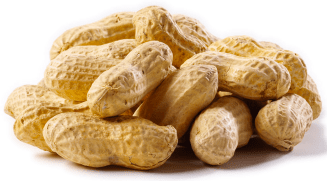
Peanuts!

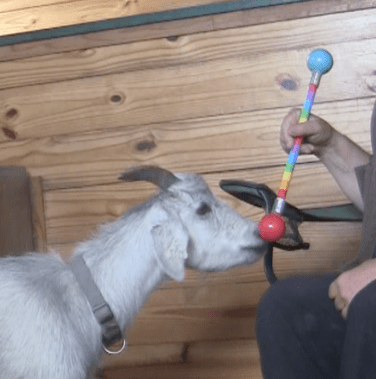
I sat in my chair shelling peanuts (and eating some, as well.) It took almost five minutes for the goats to decide it was safe to check me out. In the end their curiosity coupled with lure of the peanuts proved too much for them. They came over to see what I was doing. Once they realized treats were involved, they were eager to play. And just as it does with horses, their curiosity helped me out. When I held my target (a colored baton that rattled when I shook it) out to them, they reached out to sniff it.

goat diaries day 1 baton2.png

My Target Stick

I was sitting in a chair so I could be at their level. That made it hard for me to get at my pocket after I clicked. Too slow. I didn’t like the lack of a smooth connection between the click and the treats. I’m so used to working with horses I hadn’t factored in the challenge of getting to my pocket.

I was accumulating too many errors – not good, so I ended the session after just a few rounds of targeting. I wanted us all to have a chance to think.

goat diaries day 1 targeting intro Taking Turns.png

Taking Turns: The photos make it seem as though this was a very orderly session, but it felt like chaos to me.  I’m used to introducing one animal at a time to the basics of clicker training.  I was reluctant to separate the goats, so I started with a less than ideal situation.  I quickly realized I needed to change my set up or I was going to accumulate a lot of unwanted behavior along with the target touches.  It was time to stop and rethink what I was doing.  Testing the waters is fine, as long as you don’t stay too long once you realize a change is needed.

Coming Next: Testing the Waters: Dress Rehearsals and Trial Runs

Goat Diaries: Clicker Training Begins

Day 1: Goats are Not Horses

IMG_1569 Fengur looking at the goats

I train horses. That’s the species that has captured my heart and my training focus. Hand me a horse, and I know how to start. I may not know right away how to unravel a particular training puzzle, but at least I know how to begin sorting out the pieces. Or to borrow another metaphor – with horses I have a road map. I don’t always know where I’m going to end up, but at least I know how to get started.

With goats I had no road map. I knew they were sort of like horses – only not really.

The “not really” parts were what I was most looking forward to discovering. One way to stretch yourself as a trainer is to step outside the comfort zone of the species you are most familiar with. What were these goats going to teach me about horse training? And what were they going to teach me about goats? I was finding out fast.

Clicker Training Day 1: 6 am – Session 1

IMG_2793 Goats on platform

Now What? I had a pair of goats living in the end stall – goats who wanted nothing to do with me. At 6:00 I cleaned their stall, gave them fresh hay and then went in to sit with them. While I worked on my computer, the goats stood opposite me on their platform. Hmm. First contact might take a while.


Session 2: 8:30

At 8:30 the peanuts and pretzels arrived. Party time! They weren’t at all shy about coming to me for peanuts. Suddenly, I had two goats eagerly pushing into my lap trying to get to the peanuts stashed in my pocket.

At this point it was just feed, feed, feed. I wasn’t trying to link getting a peanut to a specific behavior. The connection I needed was being made: I am a provider of things you like. They were clearly eager – really too eager for the treats. It was time to think about how best to proceed. This is when I tell people to go have a cup of tea. It was too hot for tea, but it was definitely time to withdraw and consider the next step.

tea cup.png

Coming Next: Begin By Breaking the Rules

Goat Diaries: Arrival Day

Arrivals

They are small like dogs, eat hay like horses and behave like goats – which is exactly what they are.

goats in stall Day 1

But these weren’t just any goats. They were Cashmere goats, producers of that most luxurious of fibers. They belonged to St. Mary’s Convent. Long story short the Sister in charge of the herd had offered to let me have the pair for a couple of weeks. How could I say no? It was going to be fun to train something other than horses.

So here they were in the back of a covered pickup truck, two yearlings huddled together in a bed of hay, trying to stay as far away from us as they could get. The Sister crawled into the back of the truck and pulled out the smaller of the two.  She sat on the tailgate holding him in her lap.  These goats were used in a 4H program. They had been cradled in children’s laps since the time they were born.

This goat, Sir Elyan, was incredibly cute. The first cashmere goat I saw was a beautiful silver doe with long, flowing guard hairs. This little one was going to have a coat like hers. How perfect!

He was tiny for his age. He weighed only about thirty pounds. The Sister could easily lift him down from the back of the van. The other goat was his full brother, but they looked nothing alike. He was much bigger and had short guard hairs instead of the long coat of his brother. Good, I thought. I won’t have any trouble telling the two of them apart.

The Sister handed me Elyan’s lead and climbed back into the van for his brother. He was too big to easily lift out. The Sister managed to pull him to the back of the truck. He stood on the tailgate of the van surveying his new surroundings.

“Now what do we do?  How do you get a goat down?” I wondered, but I didn’t say anything out loud.

Not to worry. He took care of that for us. He jumped nimbly down from the truck and joined his brother. We pointed them in the direction of the barn, and off they went!

“Great!” I thought, “they pull like sled dogs!” Leading was definitely going to be high on my training priority list.

sled dog 4.png

We got them headed into the stall I had prepared for them and turned them loose to explore. I had lots of questions to ask. What could they eat? What mustn’t they eat? Apparently they were picky eaters, but they did like peanuts and pretzels. That’s what the children had taught them. I had neither at the barn. Oh well. Surely they would like hay stretcher pellets.

No, the goats told me after giving these treats the briefest of sniffs. That is not something goats eat. Nor will we take the grass you are offering us, or the hay. We will eat the hay, but only if you go away.

I brought a chair into the stall and sat down. I was not unfamiliar with goats. I’ve had clients who had goats, and there were goats at the barn where I boarded my horses. I’ve been around goats enough to know that they are perfect candidates for clicker training. They are agile, greedy, and very smart.

These goats were also very afraid. They did NOT want to be touched. They may have curled up in the laps of the small children they knew, but they were making it very clear that they wanted nothing to do with me.

I was still enchanted. Talk about cute! I spent the evening sitting with them, observing their behavior and letting them observe me. In my on-line course this is how I have people begin with their horses. Before you start introducing the clicker and making it contingent on behavior, spend time just getting to know the animal you’ll be training.

(It is worth noting that I am writing this sitting in a chair next to Robin.  I enjoy spending time with the animals I train.  He is having a snooze. His chin is resting on the top of my head. It is perhaps the most charming way in which to work. The only thing that would make it better would be the absence of flies.)

Spending time with our animals is a luxury. That’s especially true of our horses. We groom them, we ride them, but do we spend time just being with them, sharing quiet moments like this together?  For many of us the answer is no.  There are too many pulls on our time, and often barns are not set up for quiet visiting.  Certainly many of the boarding barns I visit aren’t.  You groom, you ride, you go away.  That’s the expectation.  If you want to spend time just hanging out with your horse, that’s something you have to create on your own.

I knew with the goats food would get me a long way forward, but fear could also pull me back even further. I wanted them to want to be with me, just as Robin wants to stand here by my side. We are all social animals. Once you remove the fear, the pull to be together is a strong one.

So I sat and watched, enchanted. Sometimes good training is as simple as sitting in a chair.  At least that’s how it begins.

The goats settle in:

IMG_1563 goats who are you.jpg

Do I know you?

goats with hay bucket

Happiness is a bucket filled with hay.

IMG_1582 goats rabbit in stall.jpg

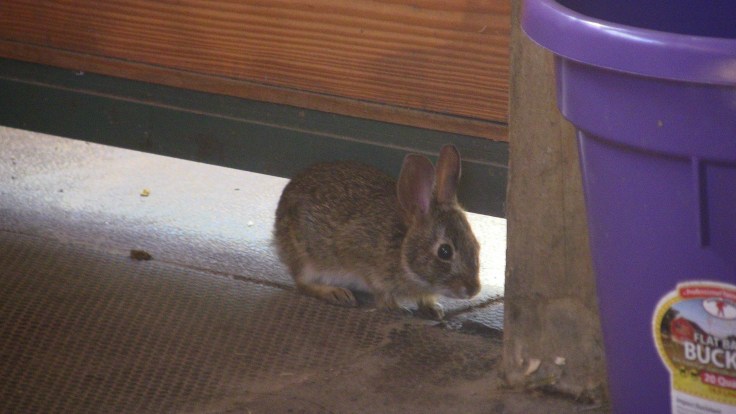
All the neighbors came to check out the new arrivals.

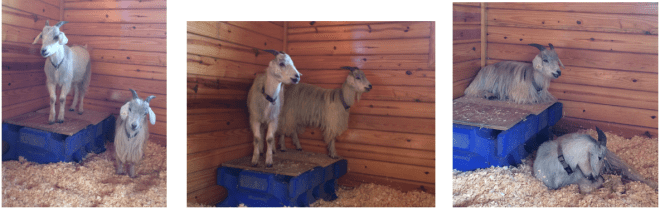
goats on platform 3 photos

Inspecting the “hotel room”.  It looks as though they found everything to their liking.

Coming Next: Goat Diaries – Training Day 1

What Has Knitting Got To Do With Training?

knitting

I like to knit. I’m not a good knitter. I don’t know how to do any fancy patterns. What I knit are blankets, warm, soft blankets. You may be wondering what this has to do with training. Well, for starters I knit these blankets while I am editing video. All the videos I have produced for the DVDs and my on-line course have required hundreds of hours of editing time. I can only sit for so long before I need something to do with my hands. That something is knitting.

I also knit because I can’t resist beautiful, hand spun yarn. I visit the local farmer’s markets not so much for the fresh produce, but to see what yarn the spinners have brought.  As I make my selection, I feel like a cat luxuriously kneading the wonderfully soft yarn.  The spinners have yarn made from alpaca wool, and my favorite, sheep’s wool blended with mohair. How can anyone resist?

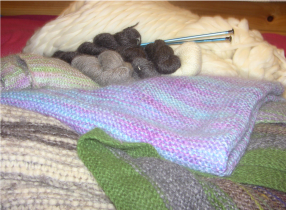
I don’t necessarily need to do anything with the wool I buy.  It’s beautiful just to look at, but I have mice in the house so a while ago all the yarn had to be put away in rodent proof containers.  Sad.  There’s no point in having beautiful yarn if you don’t put it to use, so last fall I made myself a promise. I would not buy any more yarn until I had used up everything that I had. So over the winter I went on a knitting spree. I knit a beautiful grey and white blanket that is made from alpaca roving a friend gave me years ago.  And I knit a second blanket that is made from a blend of Lancashire sheep wool and mohair.

Mohair comes from goats, and goats can be fun to train. And there you have the next connection to training. While I was knitting and editing video, I was thinking that it might be fun to get a pair of goats. But I wouldn’t want just any goats.  I’d want angoras. What fun to have goats that could produce the fiber I was so very much enjoying. So I got on the internet and began reading about Angora goats.

That was in late March. In early April I was listening to a program on the radio about upcoming art and entertainment events in the area.  The featured event was a fiber tour. Farmers in a neighboring county who raise sheep and other animals for their fiber had banded together to promote their farms. One of the representatives was a Sister from Saint Mary’s Convent who raises cashmere goats. Cashmere! I hadn’t even considered that most luxurious of fibers. I was on the internet immediately. What did cashmere goats look like?

I was in town the weekend of the fiber tour so off I went. I took a friend with me, and we drove around Washington County looking at sheep, goats, and even rabbits. The first stop was a farm that raised Angora goats. The farm was built on the side of a steep hill. The goats were at the bottom of the hill, at a distance, protected by their guard dog. We could sort of see them from the top of the hill, but that was as close as the farmer wanted us to go.

The next farm had Icelandic sheep. That was fun for me since I have Icelandic horses. Next we saw angora rabbits. They were more like tribbles than rabbits. Somewhere under all that fur we were assured there was indeed a rabbit.

We visited a factory that spun specialty yarns from the wool these growers provided.  I yielded to temptation. I had indeed used up my supply of yarn, and here was the perfect excuse to begin again.

The last stop of the day was to Saint Mary’s Convent, home of the cashmere goats.

Now at the outset I should say that one of the reasons I love horses is for their physical beauty.  “There is nothing so good for the inside of a man as the outside of a horse.”  This may be an over-used cliche, but it is very true. Horses are aesthetically pleasing. So one of my many hesitations over adding goats to our little clicker family is – how should I put this politely – many goats really aren’t very pretty. The goats I’m used to seeing have been bred for their milk and their (sad to say) meat. Pretty was not an important criterion. So imagine my delight when the first cashmere goat I met was a stunner. I won’t try to describe her. Instead here is her picture.

cashmere doe at fiber festival

Regal would be a good word for her.  What a classic goat face she had, and that wonderful long silver coat. Never mind angoras. Cashmeres were the goats for me!

I spent a delightful hour watching goats and talking to the Sister who managed them. In addition to breeding them for their fiber, she also ran a 4-H program. Her young goats were leased out to children in that program. They were all there that day, proudly showing off this year’s kids. They sat on benches outside the barn, cradling the goats in their arms. One thing was for sure, these were goats who were going to grow up being used to handling!

I left enchanted, but still very much on the fence about adding goats. It would mean new fencing. It would mean taking time away from Robin. But it would also mean I would have animals who would make great teachers for people coming to the barn. I straddled the metaphorical fence all the way home.

The following day I sent the Sister an email introducing myself. It was a step. I wasn’t yet committing myself to getting goats, but I was pushing the door open a bit.

The Sister responded. She was very excited about the clicker training. Her neighbor next farm over was an agility trainer. They’d been over to watch her dogs. She was intrigued. Could clicker training really be used with her goats? Would I be interested in doing a program in the summer for her 4-H group?

Well, that was a way to take one more exploratory step. I could get to know her goats a little bit better, so I said yes.

More emails passed between us. Sister Mary Elizabeth asked if I would be interested in having a couple of the goats for a week or so before the 4-H program.

My first reaction was to say no. I didn’t have fencing for goats. I wasn’t ready for them. But then I remembered my deer fencing. We have one open stall in the barn. At the moment we use it as a grooming stall for our Icelandic, Fengur.   He sheds literally bucket loads of hair practically year round. If Ann grooms him in the stall, it’s much easier to keep his hair from flying around everywhere. But it was summer. He was taking a brief hiatus from shedding. We could use the stall for the goats and line the outside run with the deer fencing. That ought to keep them contained.

So it was decided. Right after I got back from my trip to England at the end of June my adventure in goat training would begin.

Coming in October: The Goat Diaries

Impatient to read the Goat Diaries?  Great!  You can have a sneak preview of my adventures in goat training at the Training Thoughtfully Conference in Milwaukee WI Oct. 20-22, 2017.  I’ll be sharing a brand new program: “Lessons From A Goat” which will draw on the Goat Diaries posts.  I’ll begin posting the Goat Diaries after the conference.

Registration for the conference will remain open until Oct. 15 so there’s still time to reserve your spot.

This conference is the creation of Kay Laurence.  Those of you who follow my work know that Kay is a trainer whose work I greatly admire.  Any chance I get to collaborate with her, I jump at.  I know good things for the horses will always come from the time I spend with her.  You can learn more about the program at: TrainingThoughtfullyMilwaukee.com

P.P.S.: My original plan was to begin posting the Goat Diaries in August or September, but they have taken considerably more time to prepare than I had anticipated.  Now that my fall travel schedule has kicked into high gear, I find that it is better to wait until after the Training Thoughtfully conference to begin posting this new series.  Anticipation is part of the fun!  (I will share this statistic – my venture into goat training has produced over 80 new videos so I have lots to share and lots to say about how goats can help us to be better horse trainers.