Some Things Just Take Time

I know the current trend is for shorter, shorter, shorter posts. I get it. There are so many posts, so many videos, we need short and sweet. But some things just need more time. Teaching your horse to lower his head is one of those topics.

There is a quick, easy way to get a horse to lower his head. Have him follow a target to the ground. There. I’ve done it. Short and sweet. Done in 80 words. Not bad. Except . . .

Except one of the training principles is: there is always more than one way to teach every lesson.

Having a horse follow a target to the ground is a great starting point. But we need more. We need backing in a square into head down. To explain why this lesson is so important, what it does for your horse, and how to implement it, I need about two hours of your time.

That’s how long it takes at clinics to explain the lesson. It’s also how long the original head lowering DVD is. That DVD is now an on-line mini course. I won’t take two hours of your time right now to explain this lesson. Instead I’ll just say:

Head lowering is not a forward-moving exercise.

Eight words, but my goodness there’s a lot packed into those eight words.

Look at the images of “Day 1 before” and “Day 3 after” for this horse.
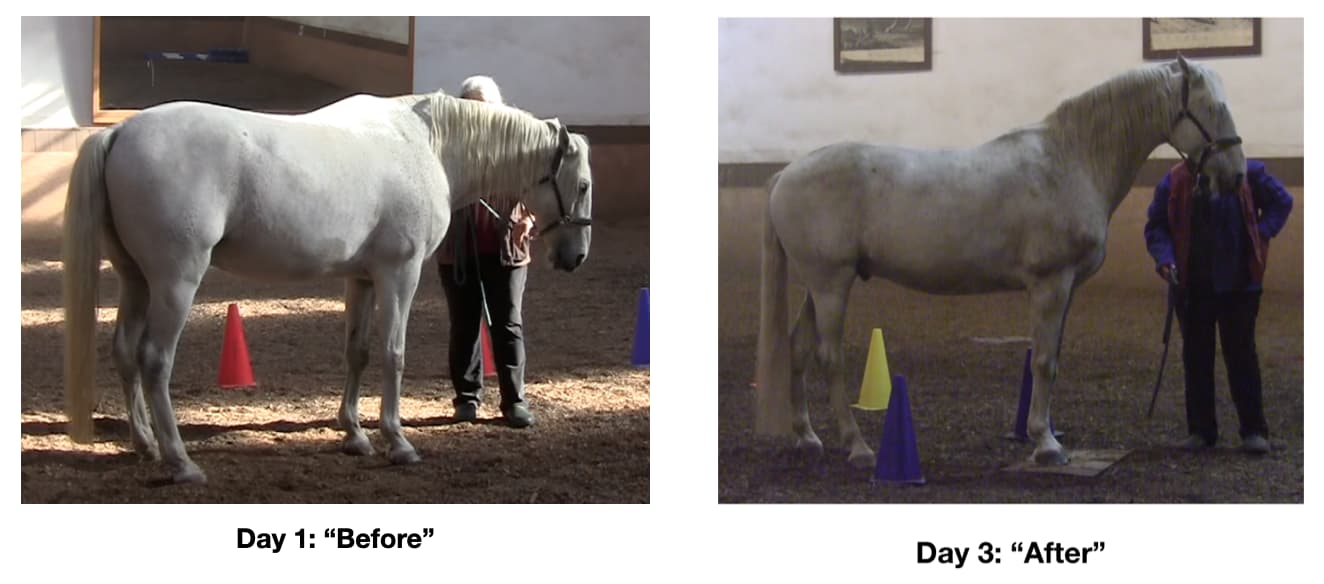
In the “Before” image he looks like his back hurts. Look at the way he’s standing, sort of crouched under behind. And he looks so grumpy. Something you can’t see in the picture is he was so tight the muscles in his shoulders and girth area were in spasms.

On day three he looks like the sport horse that he is. His back has relaxed, and he’s lifting up from the base of his neck. Head lowering played a major role in the changes you see.
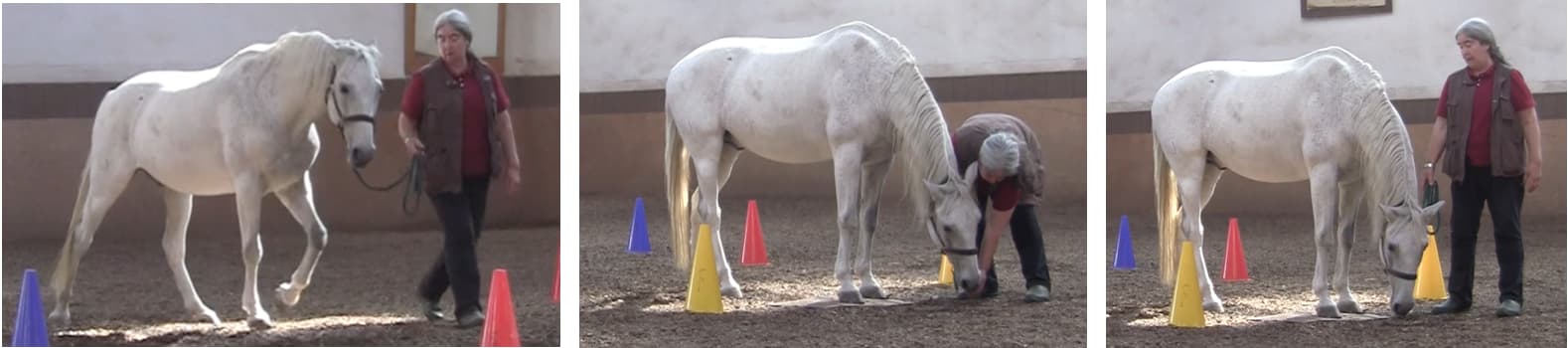
In this sequence he starts out very grumpy. Once he’s standing on a mat, I ask him to lower his head, first using simple food delivery. Once that’s working, I can ask from the lead.

As he leaves his head down, look at the head-to-tail stretch that gives him. This sounds so simple, and really it is. Food delivery is such as easy way to get a horse to lower his head. But where you place the food to get this full body stretch is something you learn from the backing-in-a-square-into-head-down lesson.

Backing in a square into head down can create other types of changes.

This four year old warmblood knew he was big. He knew he could ignore handlers and barge over the top of them. He threw a lot of energy into pushing people around.
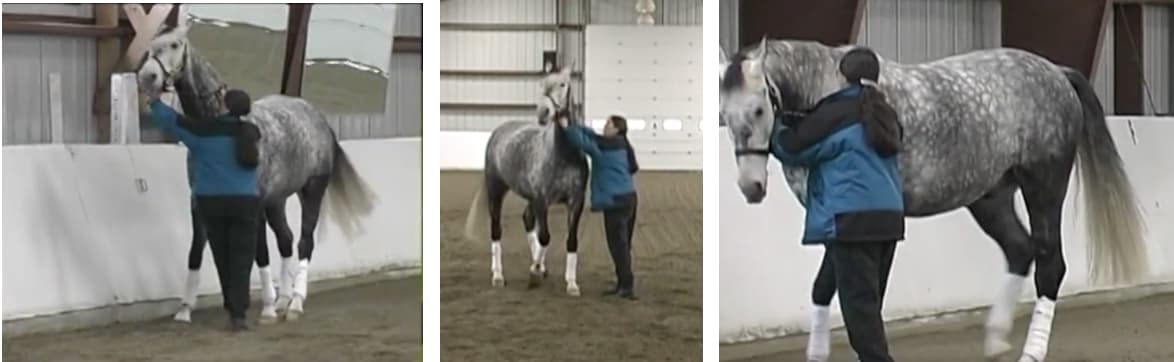
He’s trying really hard to use his height and his size to push forward over the top of me.
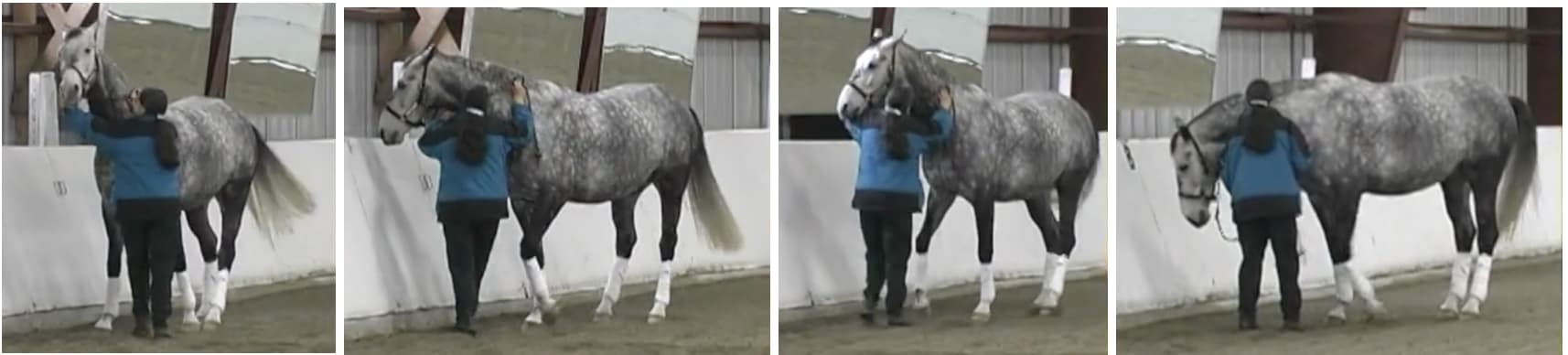
I’ve turned the lead into a “t’ai chi wall”. It’s like throwing a ball against a wall. His energy is the ball. When he runs into the lead, he bounces back off it. As I feel him starting to drop his head, I release the lead. Click and treat.

All that barging-over-the-top-of-you energy is redirected by the “t’ai chi wall” of the lead. I don’t have to get tougher with him. I don’t have to scare him to “show him who is the boss”. I just need to know how to slide up the lead into the “t’ai chi wall”, so I can redirect his energy out of my space.

He backs up. I direct his hips through a turn, and his head begins to drop. Pretty soon I can release this once bargey horse into the same full body stretch that so helped the other horse let go of years of body tension. Head lowering can help this young horse start his working life without that kind of crippling resistance.
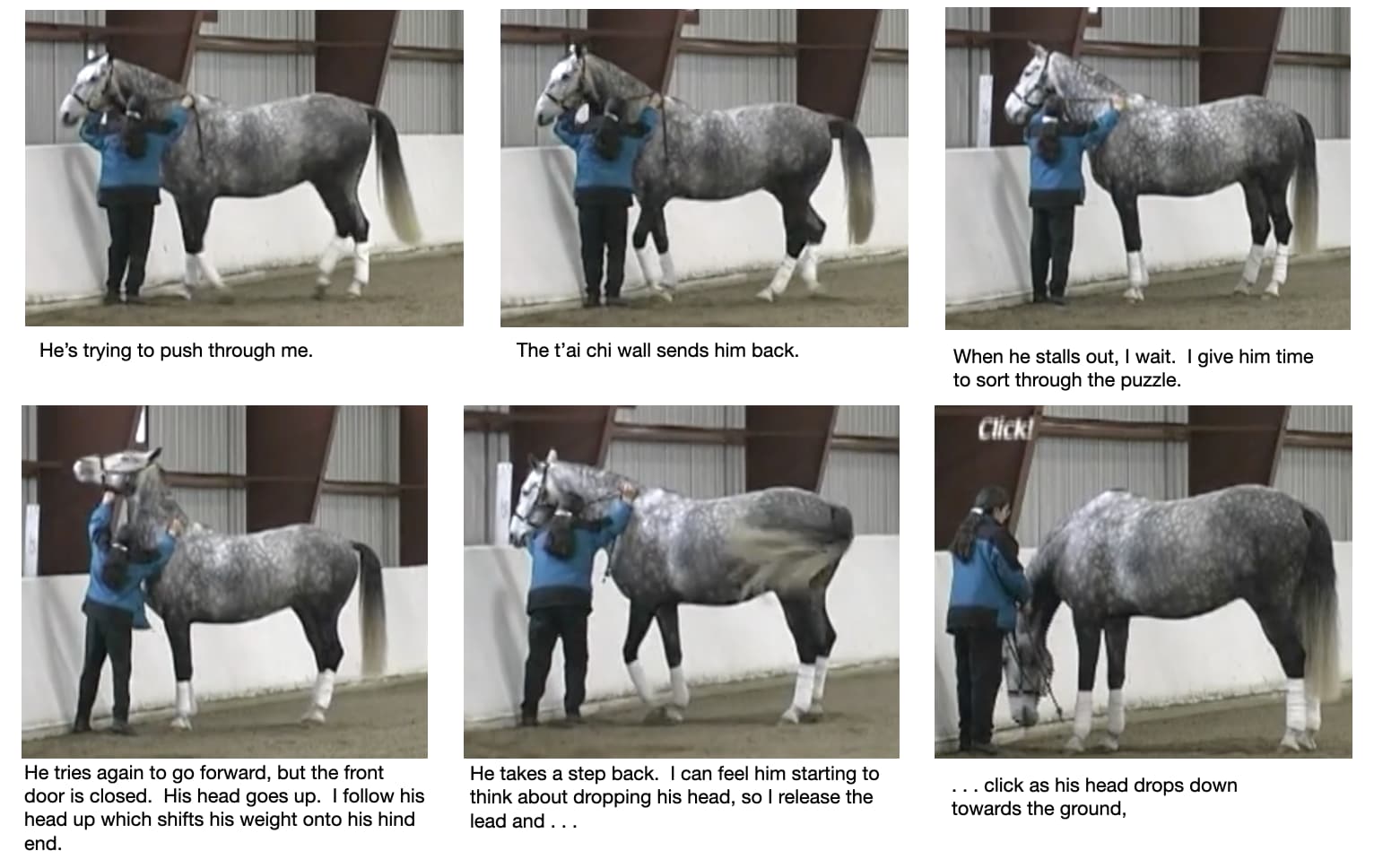
Backing-in-a-square-into-head-lowering transforms pushy and potentially dangerous behavior into polite head lowering. This lesson shows us that there’s so much more to head lowering than simply getting a horse to lower his head.
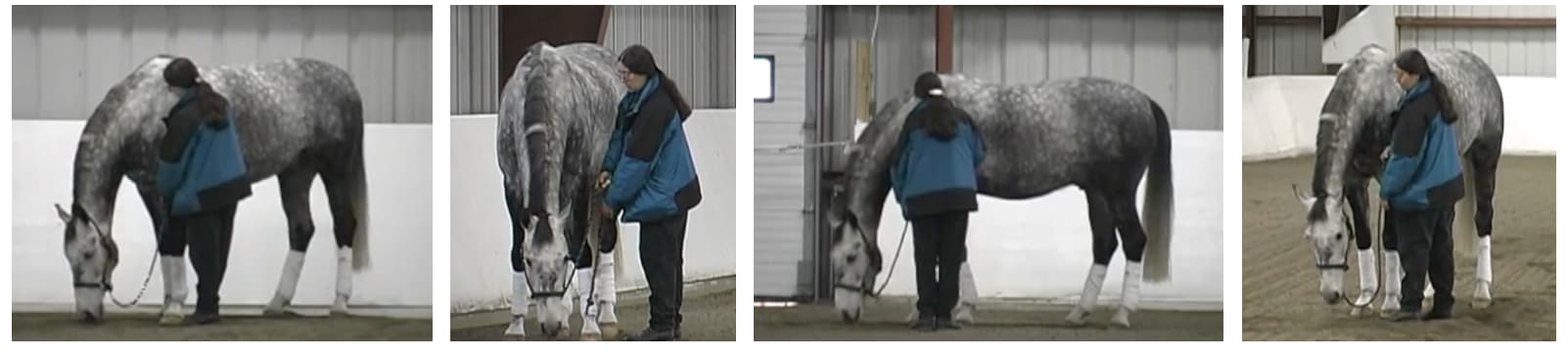
Curious?

Check out the Lesson Three: Head Lowering Mini Course.

I’ve broken the original two hour DVD down into twenty-seven chapters. Instead of sitting down to a full length movie, you can watch the lesson in shorter segments.

The course includes the original DVD Lesson, plus new teaching material. I take you step by step through the head lowering lesson. You’ll learn how to set your horse up for success by teaching the precursor behaviors first. I’ll show you why head lowering is not a forward moving lesson. I’ll explain what that means and how to put those words into action.

Head lowering is a power tool that can enhance your horse’s physical and emotional well-being. This mini course explains the changes it creates. The detailed instructions and demos show you how to put the lesson to work in your own training.

Visit theclickercenter.com to learn more.
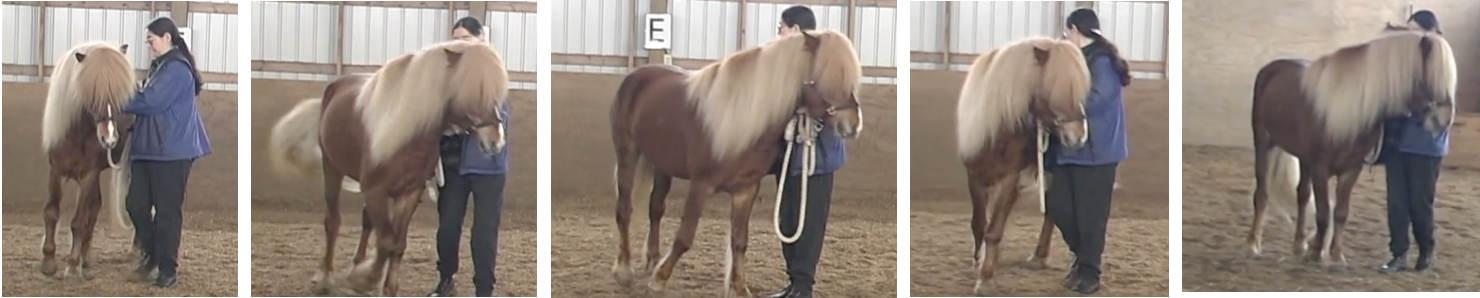
Time to Celebrate!

What am I celebrating? I have just finished transferring all of the original DVD lessons onto an on-line platform.

I recognize that DVDS are yesterday’s technology. They are going the way of the dinosaurs – which doesn’t mean that the information they contain is disappearing. It’s just transforming. Dinosaurs transformed into birds. And now yesterday’s DVDs have become today’s on-line mini courses.

It’s been a Herculean task, but I have just finished transferring all of the original DVD lessons to the platform that hosts my on-line clinics.

Visit my web site: theclickercenter.com to learn more.

These new lessons are even better than the original DVDs. I’ve added new material: new videos, more background information, and updates on the lessons.

But why bother? Why not just send you to my new on-line clinics and forget about this older material? After all, some of those lessons are well over twenty years old.

I certainly encourage everyone to make use of the new on-line clinics, but the original DVD lessons contain so many gems. I don’t want to see them go the way of the dinosaur.

I’ll be sharing some of those gems over the coming days.

I’ll start with this one from Lesson #2: Ground Manners.

This lesson was originally produced in 2000. It includes a great session with our Icelandic stallion Sindri. Sindri was a new immigrant. He had been in the country for just two weeks when this lesson was filmed. This was the first time I brought him into the arena. He very quickly showed me that he thought leading meant you wrapped yourself around your person and then herded her wherever you wanted to go!

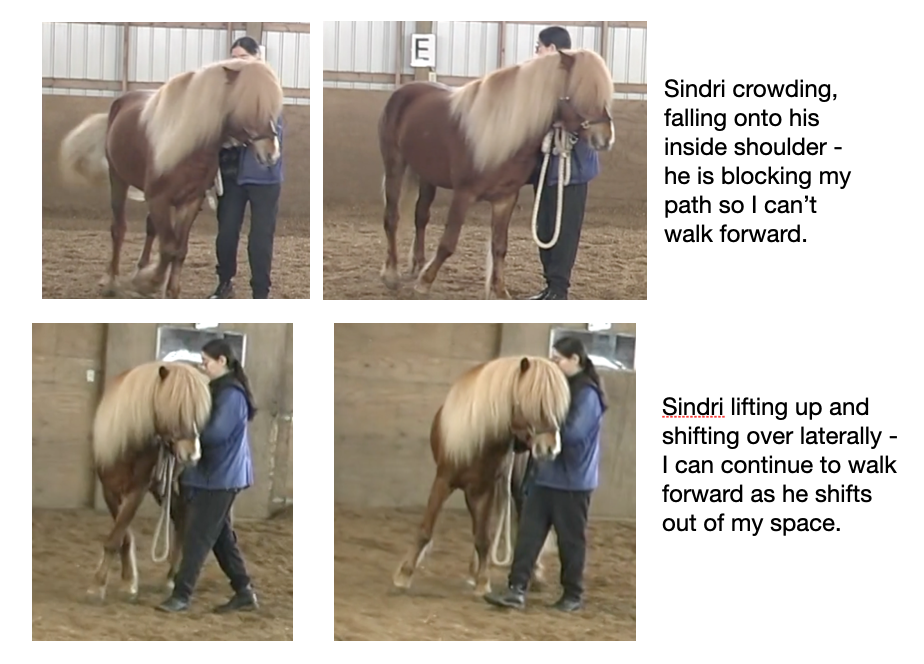
Walking a straight line was just about impossible. When I asked Sindri to go forward, he leaned onto his inside shoulder and crowded into me. He wasn’t a scary horse. I didn’t feel threatened. I just couldn’t go where I wanted.

That was the baseline. Half an hour later I had a horse who was understanding lateral work. When I walked into him, instead of crowding into me, he moved over out of my space.

Contrast is a great teacher. What I love about this session is you can so clearly see Sindri leaning down onto his inside shoulder and crowding into me. There was nothing subtle about what he was doing.

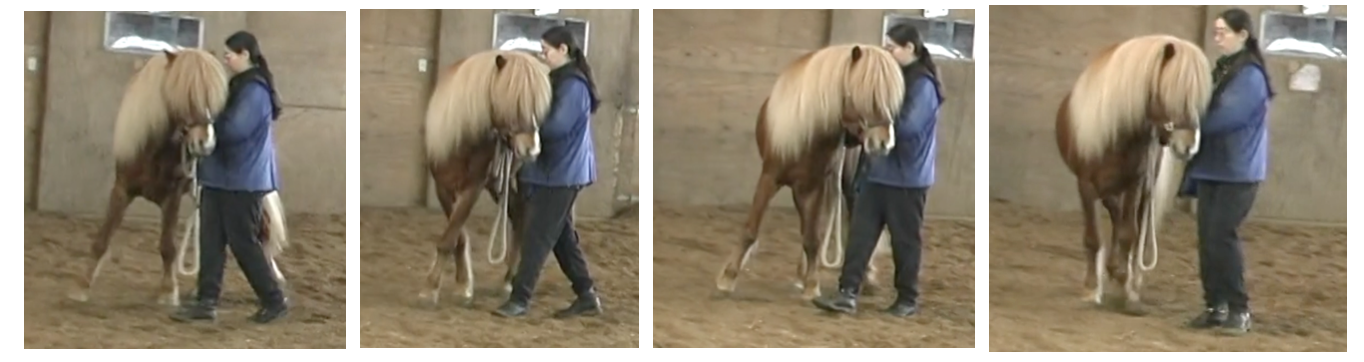
Look at each of these still shots. Sindri’s weight is coming down onto his left front leg as he crowds in on top of me. I can’t walk forward because there’s a horse blocking my path.

This is such a common pattern. I see so many horses who start out leaning onto their inside shoulders. This session was filmed in 2000. At that time, if I had stepped outside of my clicker training world, I would have been told that Sindri needed to learn respect. I needed to get tougher with him. For my own safety, anytime he came into my space, I needed to drive him away from me.

Thankfully for Sindri I stayed in my clicker training bubble. I taught him an alternative to falling in. I taught him to soften and bend around me so he could shift his balance and move up and over out of my space. We were on the road to shoulder-in, beautiful balance, and a very polite horse.

Sindri is a very quick learner. What makes this clip so very useful is you get to watch him making this switch in real time. The actual training time of the lesson was 33 minutes and you get to watch most of it with explanations provided along with some slow motion video that highlights the changes that are occurring.

You can see the beginning of the changes in these screenshots. Now as I walk forward, Sindri displaces up and over out of my way. He isn’t rushing past me, blocking my ability to go forward. Instead he is staying with me as he steps laterally out of my way.

Look at the difference a change in balance makes:

This was filmed in 20001, long before cell phone were everywhere videoing everything. I was using a big, clunky video camera that usually ran out of either battery or tape before the end of a lesson. But on this day the stars were aligned. I had a client visiting who was willing to video the lesson. She asked some really good questions because she was just starting to learn about lateral work. Her questions add to the value of this session.

We were actually able to get on film Sindri’s discovery that he could move sideways. Normally we either miss the actual learning process, or the battery runs out just as the horse is starting to figure out the lesson, or the horse needs multiple sessions to make this switch so it is harder for you to see the change in balance.

So many times I have missed great sessions because the video camera wasn’t running. I think of them like the “fish” that got away. But this gem of a session we got on film. It doesn’t matter that the lesson occurred over two decades ago. Horses are still leaning onto their shoulders today and lateral work is still the solution.

To help my client understand what she had just seen with Sindri, I walked through a demo of Sindri’s starting balance and the changes that occurred that produced the lateral steps.

Sindri’s lesson and the demo that followed it are just part of the Lesson #2 Mini Course. It also includes a discussion of pressure and release of pressure in the context of clicker training. What fits under the clicker training “umbrella”, and what doesn’t belong?

Also included is backing in a square – a key foundation skill; working with foals; and an appearance of a very young Robin. Robin is my co-teacher in presenting the duct tape lesson. The duct tape lesson teaches the prerequisite skills needed for the lesson Sindri shows us.

Note: these lessons were always intended to be used in conjunction with my books and clinics. They focus in on specific steps in the training to provide addition detailed instruction. They are a great addition to the on-line clinic series.

To learn more visit my web site: theclickercenter.com

Welcome to The Click That Teaches Mini Courses

First in the series is: Lesson 1: Getting Started with the Clicker. Before I tell you what is in this lesson let me tell you about the original lesson and this new updated version.


I began producing these videos in 1999. At the time video cameras were huge.  There was no high definition video. Video was produced on VHS tapes.  There was no youtube, or facebook.  The entire clicker training community gathered together in a single group forum.  Over the past twenty-five plus years the world has changed and changed and then changed some more.  


I produced the first four lessons in the series as VHS tapes. It took me a while to admit that the world had shifted to DVDs.  I finally switched to DVDs for Lesson 5, and there I have remained – until now.

Mostly, I also stayed with DVDs because I just didn’t have time to make the switch.  There were always more pressing projects that needed to get done.

 But now, finally, I have turned my attention to getting the DVDs up on the internet.


Lesson 1: Getting Started with the Clicker was originally produced in 1999.  That was the first of what would become an eighteen part lesson series. It took me over ten years to finish the series. Always I felt as though I was in a foot race.  No matter how fast I got the videos out, there was always such a need for more.

 The whole “soup to nuts” training program was in my head. I knew the progression of lessons that would take someone from the first introductory steps to a solid understanding of clicker training; through basic husbandry behaviors to problem solving scenarios; from simple basics to performance superstar.  

I wanted the lessons to be as close to my actually being in your barn with you as I could manage via video.  So throughout the series I was often using video that was filmed at clinics.  I wanted you to see people and horses learning together – solving the puzzles that horses present. This sometimes created a compromise with sound quality.  You can see real time training, but you have to listen to the background noise of birds in the rafters or the wind taking our voices away.


I could remake these videos.  Modern cameras are so much better, and we have learned so much over the twenty-five plus years since that first video was produced.  But always when I go back to them, I see things that I don’t want to throw away.  These videos show you the birth of equine clicker training.  Yes, we have become much more sophisticated in the way we talk about the training.  We have a much deeper understanding of behavior analysis.  The horses have helped us to add so many more details to the handling.  But everything on these lessons is still valid.  They are a good beginning.  They will show you how to introduce your horse to clicker training.  And they will show you why I kept adding more details to these basic lessons.


When I switched from VHS tape to DVD, I added an extra hour to the original Lesson One.  I felt an update was needed. That was in 2006.  Now all these many years later not only do I have more to say, I have a better way to deliver the material.  

I’ve taken all the material that was in the DVD and added new video, updates, and more background information so the original DVD has essentially been transformed into a mini course.

The course breaks the material up into bite-sized pieces.  Watch a little, try it out with your horse, then come back for more. 

Lesson One focuses on clicker training basics: Introducing your horse to the clicker and the key foundation lessons that create safe, polite horses. 

If you are a beginner, you’ll find that this is an easy format to use. And if you’ve been clicker training for a while, I think you’ll enjoy this look back at the early development of clicker training for horses.

Visit theclickercenter.com to learn more.
Enjoy

The Original DVD Lessons Are Now Mini Courses

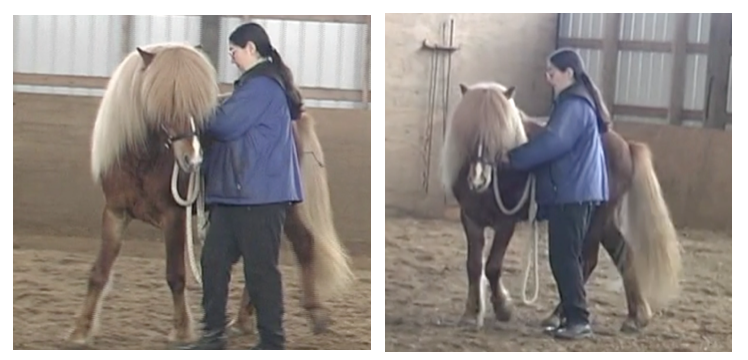
Some favorite images from the original lessons.

DVDs are a thing of the past. Netflix recognized that a while back when they stopped shipping out DVDS. I recognized it, as well, but I’ve been slower to do anything about it. It took me over ten years to complete all eighteen of the original DVD Lessons. The first four were made in the era of camcorders and VHS tapes. It took me a while to join the modern digital world and convert them to DVDs. And now technology has changed again, and I am still playing catch up.

But catching up is exactly what I am doing. I am converting the DVD Lessons to On-line Mini Courses. Lessons 1 through 5 are now available on-line. Go to my web site: theclickercenter.com to learn more. You’ll find the lessons in the DVD section, but now they are available as mini courses which you access on-line.
Why am I bothering to convert these DVDS? I could have let them go the way of the dinosaurs and become extinct. After all, I’ve continued to add new material. I’ve got the original on-line course, the on-line clinics, an updated version of my book, “The Click That Teaches: A step by Step Guide in Pictures“, and my newest book, “Modern Horse Training“. I can well understand someone thinking that enough is enough. “Why do we need these older lessons when there is all this new material?”

The answer sits in the training mantra: “It is always a study of one.”

Horses are complex. They are individuals. Every horse I work with teaches me something.

One lesson I haven’t learned is always have a camera running. You never know when a horse is going to show you something important that needs to be shared. Every time I fail to video an interesting session, I always think of the old fish stories about the “big one that got away”.

But every now and then I get lucky. I have the camera running. The battery doesn’t run out, and the horse teaches us something important. Those lessons don’t become outdated. They are as instructive now as they were when they first came out.

Does that mean nothing has changed over the twenty-five plus years since the first video lesson was made? Absolutely not. The horses have been showing me how to teach better. I’m not just transferring the original lessons onto a streaming platform. I’ve added new material. Each lesson includes updates to the handling and new video that helps you understand the concepts I’m discussing.

The streaming platform means I can break the original two hour DVD lessons into shorter, more digestible segments. Shorter clips fit into our busy lives, and they also make it easier to find segments you want to refer back to.

The streaming platform lets me combine video with text. When a clip needs some background information to make it clearer, I’ve added new material. I haven’t just converted the original lessons. These are fresh, updated mini courses.

Over the next couple of days I’ll share with you what each of the new mini courses covers. If you can’t wait, visit my web site: theclickercenter.com. You’ll find the new mini courses in the DVD section of the Shop.

Enjoy!

The first five DVD Lessons are now available on-line as mini courses.

Connecting The Dots Between Children’s Books and Horse Training

I just published this week’s Equiosity podcast.

This is Part 3 of a three part conversation.

In Part 1 we talked about resets – what they are and how they can be used to help horses rebalance so they are more in sync with their handlers.

In Part 2 this led to a discussion of shaping on a point of contact, the WWYLM lesson and visualizing your horse as a marching band.

In part 3 explore some useful metaphors that help in understanding lateral work. We begin with Merry-Go-Rounds and then move on to railroad tracks.

At the very end of the podcast I talk about the connection between the horse training and my children’s books. Everything is connected to everything else. I hope you listen all the way to the end to understand the connections. Clicker training really is Modern Horse Training. It represents a shift in attitude towards horses.

When I’m thinking about Modern Horse training I’m thinking about the contrast between today and that time when horses were beasts of burden.

Our relationship with horses is different today. The reason why we have horses has changed. Our horses are our companions and our friends. They aren’t pit ponies down in the coal mines forced to haul coal out of the mines. They aren’t the London cab horses that were written about in Black Beauty. Thankfully, those days are behind us. We have the luxury to really examine our training and to update it to make sure that it really does work in the best interest of our horses.

When I’m sharing clicker training, I want to touch more than the lead rope you hold in your hands. I want to touch your heart because that’s how we truly, deeply connect to one another and change forever how people train horses.

The children’s books for me are part of that. So thank you for indulging me as I continue to talk about the Kenyon Bear Books. I encourage you to order them to see what they are about. (https://www.theclickercenter.com/bear-hollow-press)
Everything is connected to everything else.

Train well and have fun with clicker training.

To listen to the podcast go to equiosity.com or subscribe to it via your podcast provider.

https://soundcloud.com/user-398403643/episode-271-resets-pt-3-merry-go-rounds-and-railway-tracks

Equiosity Podcast Episode #270

Now that Edgrr is published I can shift my focus back to horses. That means this week’s Equiosity podcast is now available.

Enjoy!

Equiosity Episode 270: Resets and Lateral Work Part 2: The Why Would You Leave Me? Lesson

This is Part 2 of a three part conversation that was sparked by the on-line coaching sessions that I host once a month for people in my on-line clinics. We were talking about balance, which is no surprise. We’re always talking about balance. Embedded in that conversation was a discussion of resets. In part 1 we defined resets, discussed their importance, described how they are taught and used.

In this episode we begin with the “Why Would You Leave Me?” Lesson. I describe what this lesson is, how it is taught and the relation to resets. We discuss how to help horses that tend to overflex and horses that are very crooked. I use the metaphor of a marching band to help visualize the process of teaching horses how to become better balanced.

Listen to the podcast at: Equiosity.com or subscribe to it via your podcast provider.

https://soundcloud.com/user-398403643/episode-270-resets-and-lateral-work-pt-2-the-why-would-you-leave-me-lesson

Modern Horse Training: People Say The Nicest Things!

People Say the Nicest Things!

Now that my children’s book, “Teddies to the Rescue” is launched, I can pause for a moment to check in with my other new book, “Modern Horse Training”. I haven’t been keeping track of it on Amazon which has meant I missed seeing some wonderful reviews.

People have been saying the nicest things about the book.

I want to share! But first, I want to say a very public thank your for your amazing comments. They are hugely appreciated!

Carmen left this wonderful review in July.

“I have all of Alexandra’s other books and they are dog-eared with use. This book refines and builds on what she has written before. This lady is one dedicated teacher and researcher. She’s knows horses and she knows people through her many years of learning, applying and teaching clicker training. I’m 73, and I’m loving learning this gentle, intriguing way of horse training. Congratulations Alexandra, you have produced a masterpiece!”I have all of Alexandra’s other books and they are dog-eared with use. This book refines and builds on what she has written before. This lady is one dedicated teacher and researcher. She’s knows horses and she knows people through her many years of learning, applying and teaching clicker training. I’m 73, and I’m loving learning this gentle, intriguing way of horse training. Congratulations Alexandra, you have produced a masterpiece!”

From Coralie

“A truly excellent training guide! I am an enormous fan of Alex’s work and am very thankful to her for sharing her wonderful expertise over the years. She is an excellent horse trainer – compassionate, thoughtful and extremely knowledgeable – and her training methods have transformed my partnership with my lovely horse. I received this from a kind friend and have enjoyed it so much I have since bought several copies for other horse friends to enjoy. A wonderful book.”

Fron an anonymous reviewer:

“The Title Says It All!
Amazingly thorough and thoughtful book. There really is no better approach to becoming your horses’s best friend! Whether you want to trail ride, do performance work, have an easier time with husbandry procedures, or simply find ways for you and your horse to stay mentally and physically engaged, this book is the best guide. Thank you Alexandra Kurland for this gem!”

From Susanna

“A Must Have For Every Modern Horse Trainer

This book is filled with detailed instructions on how to build your horse’s repertoire from basic behaviours to complex performance. The author’s deep love of horses, expert understanding of science behind learning and years of experience with horses and their trainers shine from every page.”

From Jo

“Not Just For Horse Trainers!

I have been listening and learning from Alexandra Kurland for many years. She is one of my favorite voices in the training world and I have devoured hundreds of hours of her wonderful podcasts and classes. So much of my approach and philosophy to training I owe to her (and her mentors).

I initially bought this book to give to a friend because I neither own, ride or train horses. I train dogs.

BUT ….. when it arrived I wanted to peep at it myself so I carefully tried to turn the pages without curling or crinkling them so I could keep it looking nice. I rapidly realized that was just not going to work! I immediately wanted to read the whole thing cover to cover, I wanted to bookmark pages and to highlight sections of text. There was only one thing for it, I had to buy another copy for myself 😂

No matter what species you share your life with there is training gold waiting in these pages. I cannot recommend it enough!”

From Wendy:

“Buy this book! You Won’t be disappointed!

If you are thinking about starting positive reinforcement training or are in the midst of it, this is an amazingly useful book! A step by step guide for building the foundation of training and communicating with your equine partner organized in an easy to use and refer to format. The author is a decades long leading expert in the field of equine positive reinforcement training who keeps abreast of the science of how we all learn, human and equine alike. The lay out of the book optimizes how you will learn.”

Thank you everyone for your wonderful reviews! Train well and have fun with your horses!

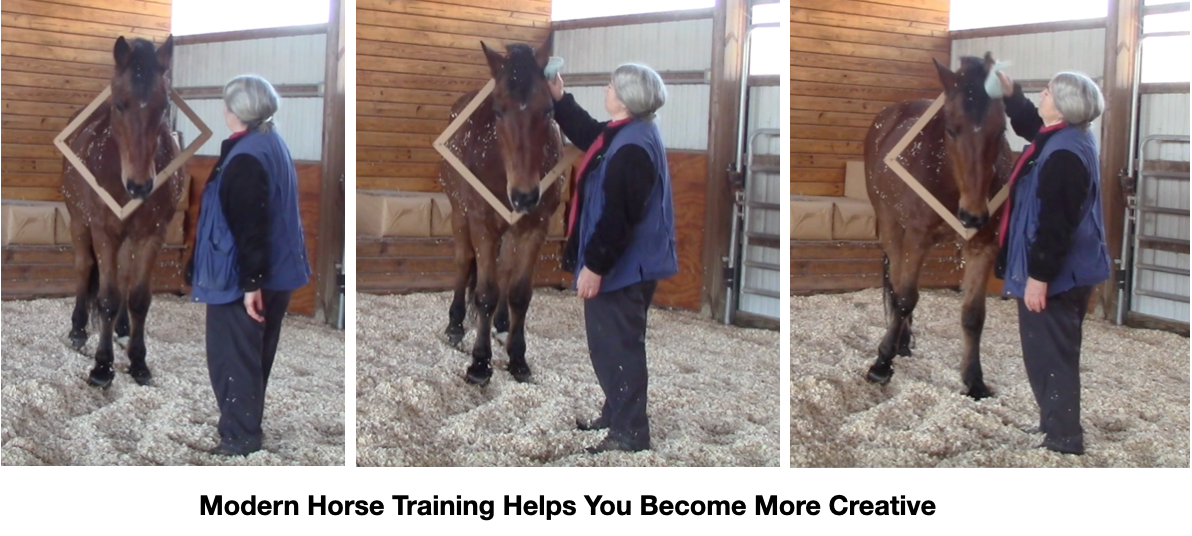
“Modern Horse Training” Helps You To Become More Creative

I know many people think they aren’t very creative, especially when it comes to training. I’d like to suggest that being creative isn’t an intrinsic characteristic. One person isn’t born more creative than another. Creativity is something that is learned. Creativity can be developed. Maybe in school you got the message that you just weren’t creative. You heard that so often, you started to believe it. So sad.

Horses can help you change that view of yourself. Here’s how:

Add lots of stuff to your training environment. The more stuff you have, the more possibilities you’ll see for some fun training games.

An empty arena is a huge blank slate. It can be hard to think of new things to do. Put out a circle of cones with a mat in the middle, and you will begin to see more options for the day’s lesson.

If all your cones are orange, decorate them with colored duct tape. Now you have blue and green and red cones. The colors will help you see even more patterns you can play with. You can ride across the circle leaving through a red gate and returning via a blue gate. You can ask your horse to stop at every green cone.

Add more mats. You’ll see more possibilities. Creativity comes from having more options to play with. When you feel stuck, add stuff.

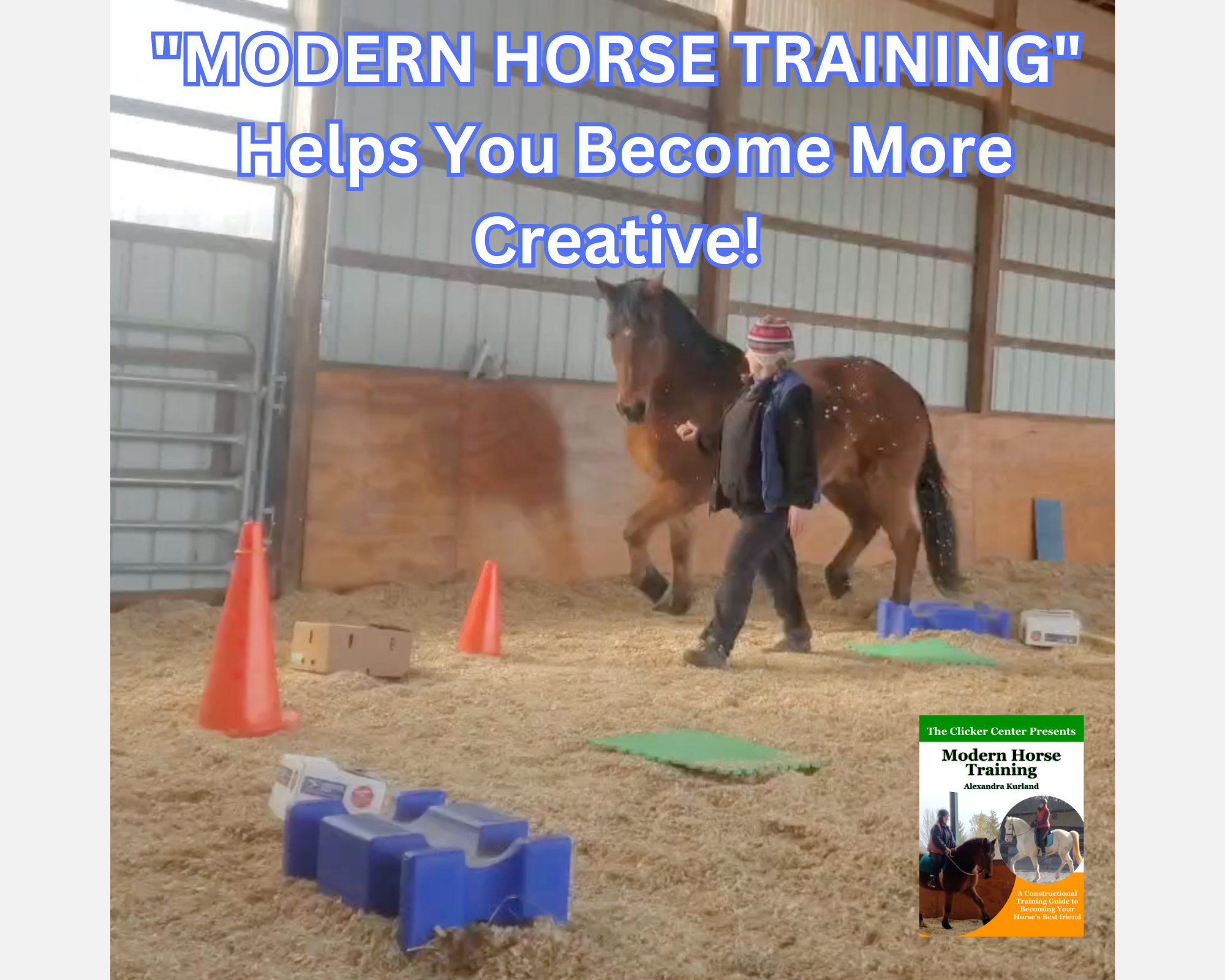
In the photo I’m using cones of different sizes, jump blocks, cardboard boxes and colored mats to create a colorful playground for Robin.

Modern Horse Training embraces the word “yet”

Yet is a wonderful word. Stanford psychologist, Carol Dweck, reminds us to add yet to dead end statements.

Here’s what that means. If you find yourself saying you aren’t creative, that’s a dead end statement. Say it often enough and you will start to believe it. Add “yet” to the end of that sentence and everything changes.

You aren’t very creative – yet. That opens up the possibility for change. Modern Horse Training helps transform that sentence into you are becoming a very creative, inventive trainer.

Here’s a great way to begin. Pick a simple object your horse is comfortable with. Maybe it’s a plastic dog toy. Think of all the ways a clicker trained horse could interact with this toy. He could orient to it with his nose. He could follow it to the ground to help teach head lowering. He can learn to retrieve it. You can hang it from a fence and teach him to stand next to a stationary target. That’s just the beginning.

Pick a different object. Maybe it’s a wash cloth. You can ask for many of the same things that you taught with the dog toy. You can add some new things, as well.

He can stand on it so now you have a portable mat you can carry in your pocket.

He can stand still on one wash cloth while you groom him all over with another wash cloth.

You can hang it on your fence and teach him to go out to it. Put a ground pole in his path and that’s the beginning of jumping at liberty.

You can teach him to orient to the wash cloth with his ear, his shoulder, his hip, etc. This will help you with many husbandry skills including prepping him for medical care.

Each new object expands the possibilities and contributes to your becoming more creative.

Have fun!

You can order my new book, “Modern Horse Training” through my web site: theclickercenter.com or get it from Amazon and other booksellers. When you order through Amazon, do please leave a five star review. Your good reviews help others to find this work.

Modern Horse Training Leads To Creative Training Solutions

(This series of posts were originally posted on instagram in June 2023. Find me at: #alexandra.kurland.5)

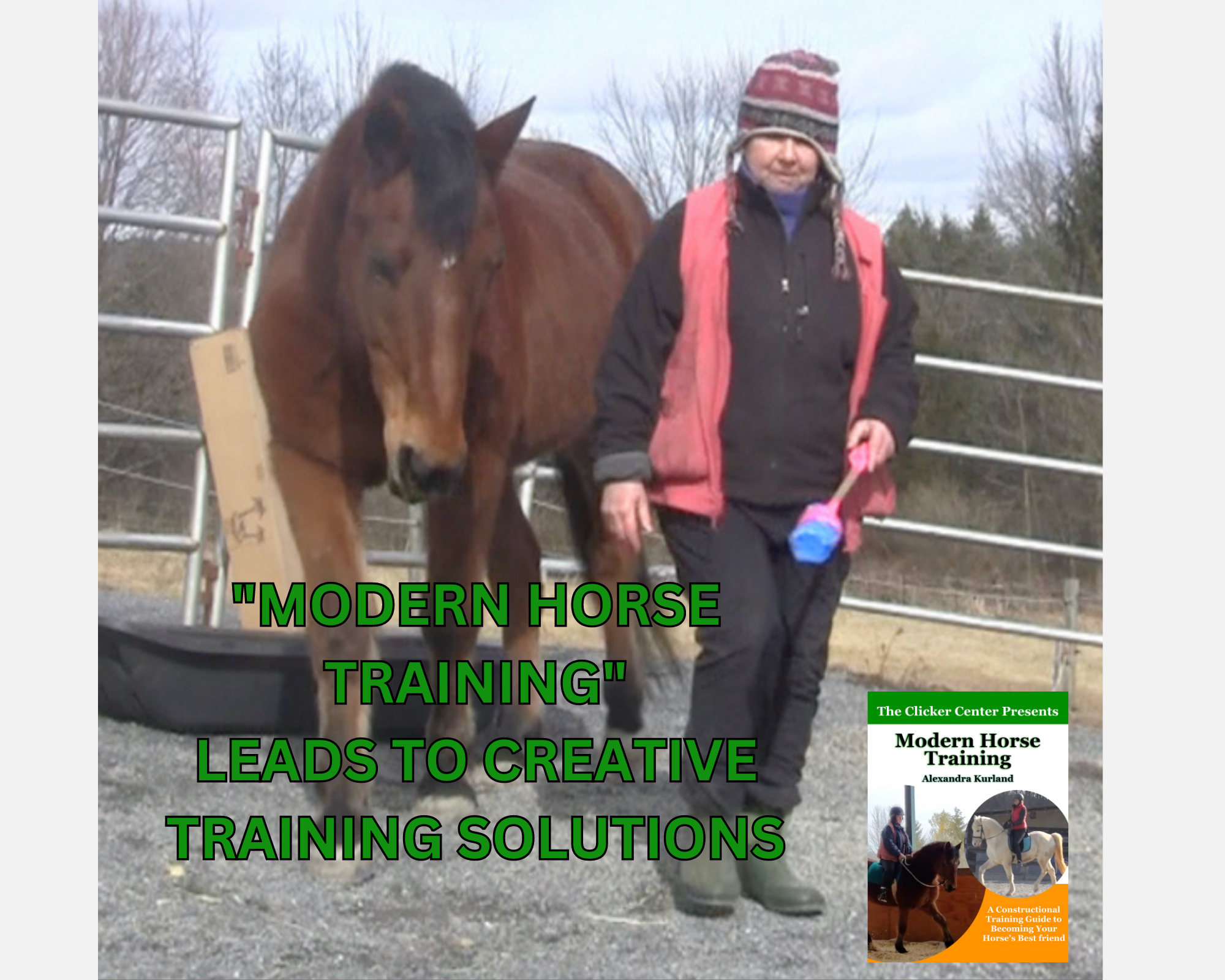
Robin is helping me demo the “touch the goblin” game. This is a targeting lesson that helps horses gain a lot of confidence interacting with novel objects.

As always, I am using a constructional approach, meaning this lesson uses skills that I have taught previously. I wouldn’t begin by asking an anxious horse to follow a target up to something that worries him.

That would be like having you touch a tarantula in exchange for a hundred dollars. You might do it. A hundred dollars can buy a lot of hay for your horse. You’ll touch the tarantula – really fast and maybe you’ll be flinching while you do it. You’re still afraid of the tarantula, but you touched the goblin and got your hundred dollars.

That’s not what we want for our horses, so the game begins by having them orient first to lots of objects that they are already familiar with and don’t worry them. You’ll also begin in environments where your horse feels comfortable.

I’ve added a toboggan and some cardboard boxes to the barnyard. Robin is reminding us that turning your back on a goblin and walking calmly away is just as important as approaching a goblin. I remember years ago watching a very bold rider force her nervous horse to stand facing a scary mailbox. As soon as the horse had his back turned to it, he shot off like a rocket. She was lucky she didn’t fall off. Horses show us how important it is to listen to them and to adjust our training to meet their needs.

Things I like about this photo: Robin is working at liberty which means he has the option to leave at any time. Choice is an important part of Modern Horse Training.

I love how relaxed he looks as he walks away from the goblins. He’s following both the target and my body orientation. He may be at liberty, but this is also very much a lesson on leading.

Everything is connected to everything else.

Modern Horse Training – Be Creative!

Good training doesn’t mean you need to spend a lot of money on training equipment.

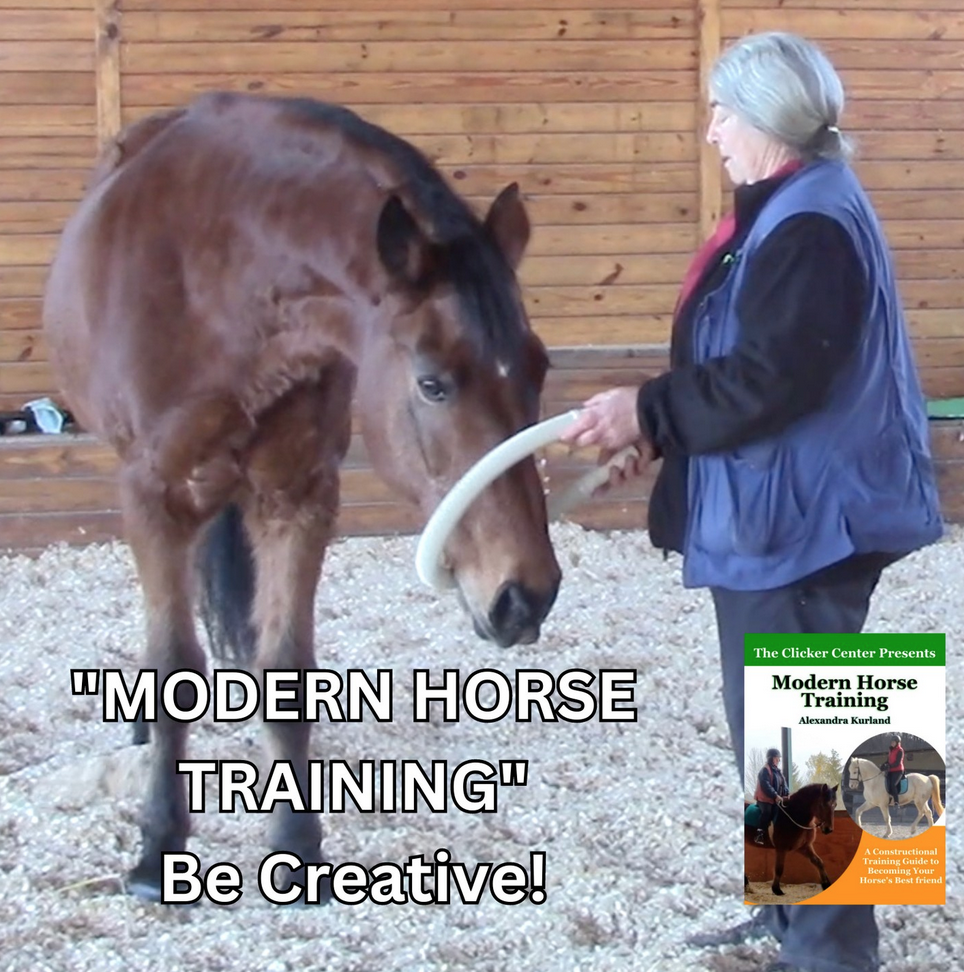
I’m teaching Robin to put his nose into a loop formed from a vacuum cleaner hose. The hose can be swapped out for cardboard boxes of different sizes and depths, pool noodles held in a loop, and many other objects.

How does this help you? Think about all the “clothes” we ask our horses to wear. This turns into haltering, bridling, putting on an over-the-head blanket, accepting a grazing muzzle, etc.

The fun of constructional training is you are teaching component skills that can then be used for many different behaviors. It’s a very fun and efficient way to teach.

Modern Horse Training: Be Creative!

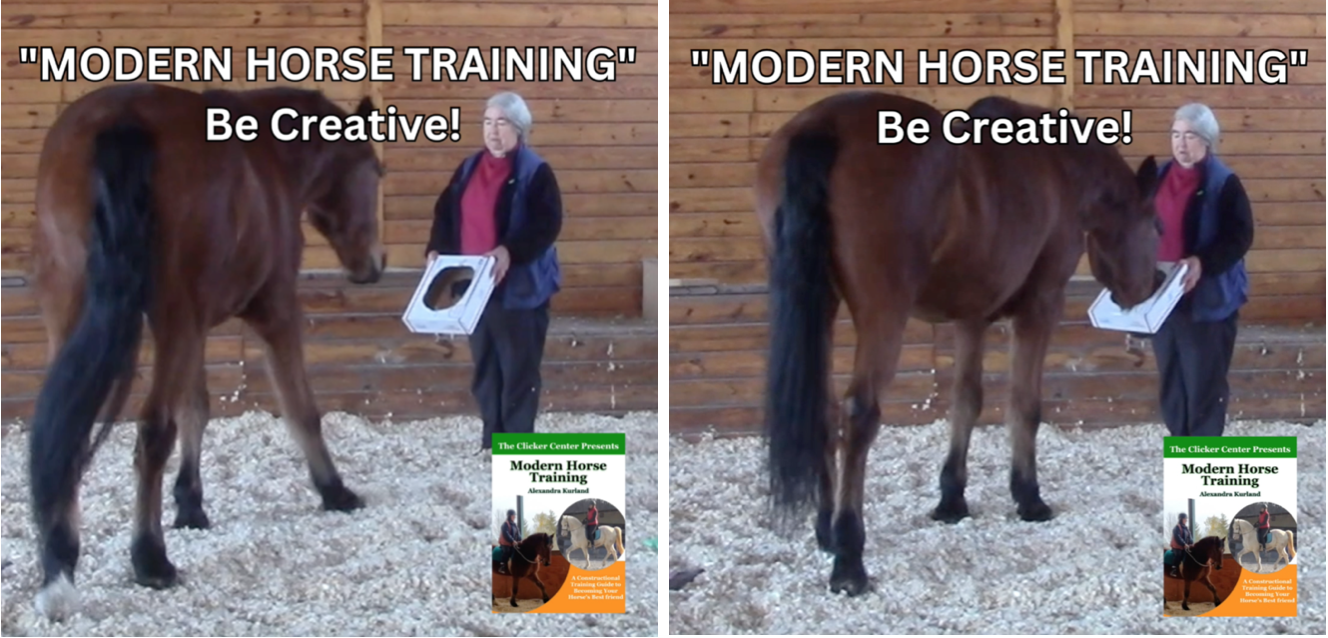
Robin has learned to put his nose down into many different objects, including cardboard boxes.

Now I’m using backchaining to teach him to come to me from a distance to put his nose into a cardboard box. Backchaining means I begin by standing very close to him so it is easy for him to put his nose into the box. Then I gradually move further away from him so he has to take several steps to get to the box.

Right now this is a cardboard box. Later it could be a halter I hold out to him. Think about how you can use this lesson to help a horse who is anxious about being haltered. You’re using objects that don’t have the previous associations that a halter has for that horse to teach him the basic skills that will help him to be comfortable with halters.

The cardboard box will be swapped out for other objects such as pool noodles held in a loop until eventually the horse is ready for halters. You’ll now have a horse who sees you holding a halter in your hand. Instead of turning away, he will come from a distance to put his nose into the halter.

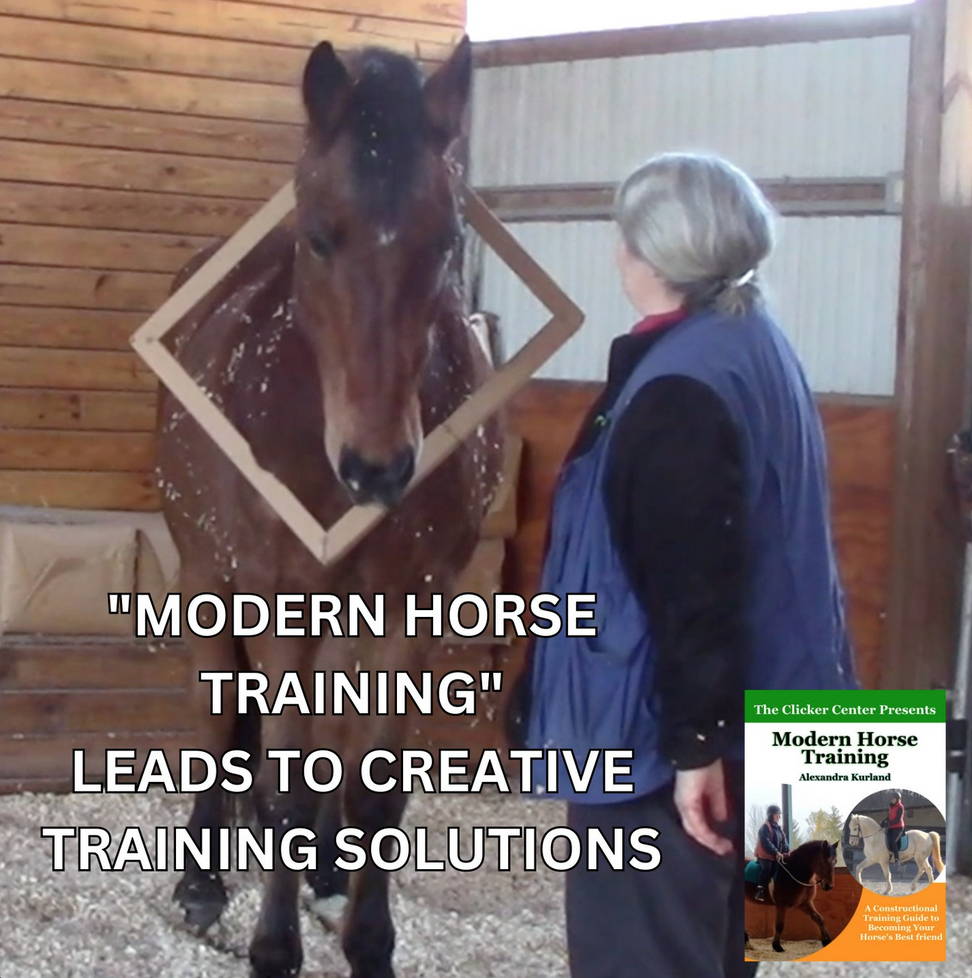
You’ve been framed!”

Modern Horse Training leads to creative solutions and lots of fun games!

Robin is putting his whole head and neck into this cardboard frame.

Think about all the ways this simple game can be transformed into useful skills. It’s a great prep for putting a blanket over your horse’s head. Is your horse worried about a halter or bridle going up over his ears? Games like this are a great prep. Maybe you’d like to ride in a neck ring. Again this is great prep.

Games like this are fun for both the horse and the handler. And they smooth the way for many other handling requests we make of our horses.

Want to learn more? My new book, Modern Horse Training, is available through my web site: theclickercenter.com and from Amazon and other booksellers.

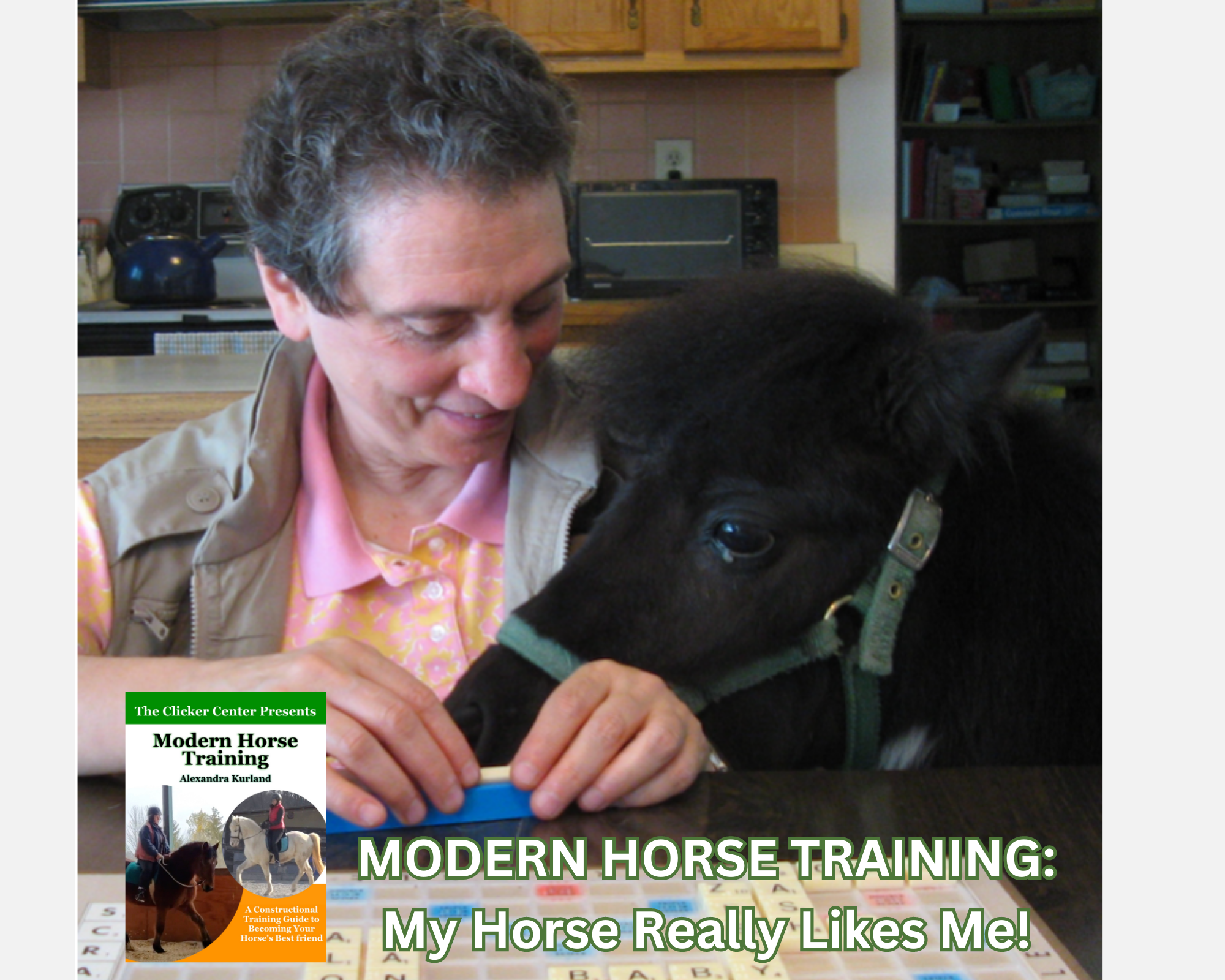
Modern Horse Training: My Horse Really Likes Me

Earlier in the year it was vaccination day for all the horses. We did the big horses first, then I drove over to Ann’s house to hold Panda for the vet. I was first to arrive. Panda greeted me with a small hello. Her response to the vet was to pretend she wasn’t there.

We had arrived a few minutes before Ann was expecting us. We went ahead and Panda her shots. All was well. We left Panda in her stall and stepped outside her little barn. And that’s when Ann came out of her house onto her back deck.

Panda erupted in song. “You’re here! My person is coming!” She whinnied her greeting.

Ann wanted to pause and talk to us, but that kind of enthusiastic greeting was not to be ignored! She went first to say hello to Panda, and then she could ask her questions.

Our clicker trained horses show us in so many ways that they like us. In this photo Panda is “helping” Ann during a scrabble game. Guide work isn’t all work. It includes a lot of social, play time that Panda clearly enjoys. It’s no wonder they have a great relationship!

Modern Horse Training Is About Sharing With Friends

Modern Horse Training isn’t something you want to keep to yourself. It’s too much fun. Laughter and love are meant to be shared, and so is good training.

I love working with other clicker trainers and I am always honored when they let me have a play with their horses. This is Graya, one of Michaela Hempen’s horses (clickertrainingferde.com). We were having a rope handling discussion in which Graya was very much an active participant.

Good training needs to be shared!

You can help me share it by sharing these posts with your friends.

These posts are from my instagram posts. You can find me at: alexandra.kurland.5