Some Things Just Take Time

I know the current trend is for shorter, shorter, shorter posts. I get it. There are so many posts, so many videos, we need short and sweet. But some things just need more time. Teaching your horse to lower his head is one of those topics.

There is a quick, easy way to get a horse to lower his head. Have him follow a target to the ground. There. I’ve done it. Short and sweet. Done in 80 words. Not bad. Except . . .

Except one of the training principles is: there is always more than one way to teach every lesson.

Having a horse follow a target to the ground is a great starting point. But we need more. We need backing in a square into head down. To explain why this lesson is so important, what it does for your horse, and how to implement it, I need about two hours of your time.

That’s how long it takes at clinics to explain the lesson. It’s also how long the original head lowering DVD is. That DVD is now an on-line mini course. I won’t take two hours of your time right now to explain this lesson. Instead I’ll just say:

Head lowering is not a forward-moving exercise.

Eight words, but my goodness there’s a lot packed into those eight words.

Look at the images of “Day 1 before” and “Day 3 after” for this horse.
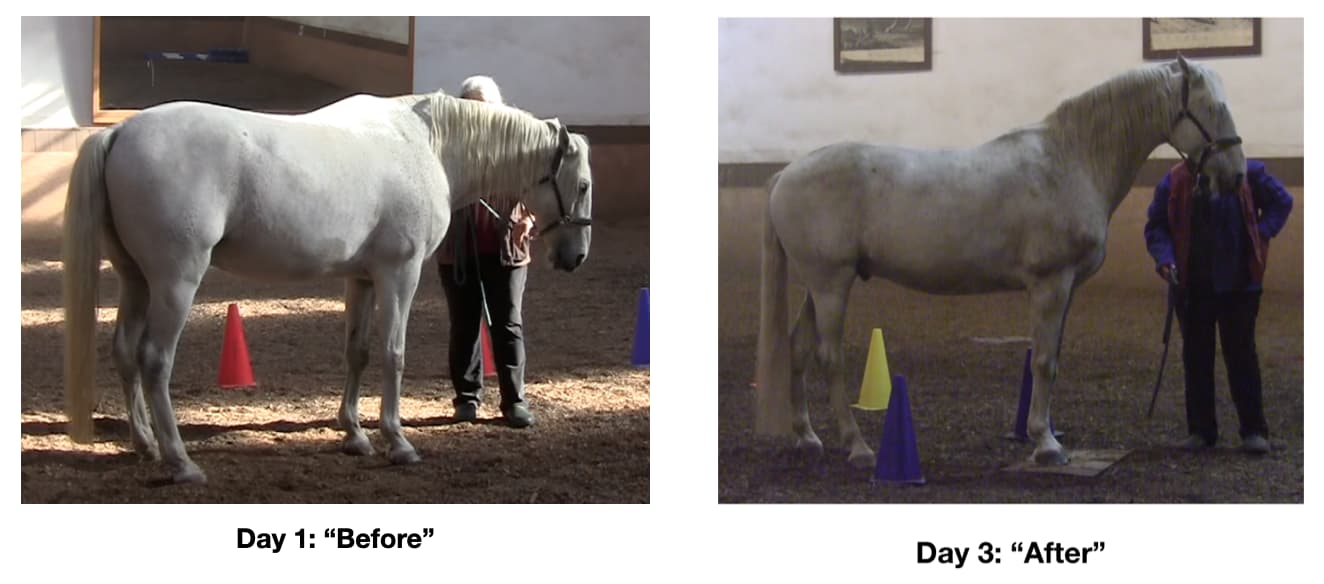
In the “Before” image he looks like his back hurts. Look at the way he’s standing, sort of crouched under behind. And he looks so grumpy. Something you can’t see in the picture is he was so tight the muscles in his shoulders and girth area were in spasms.

On day three he looks like the sport horse that he is. His back has relaxed, and he’s lifting up from the base of his neck. Head lowering played a major role in the changes you see.
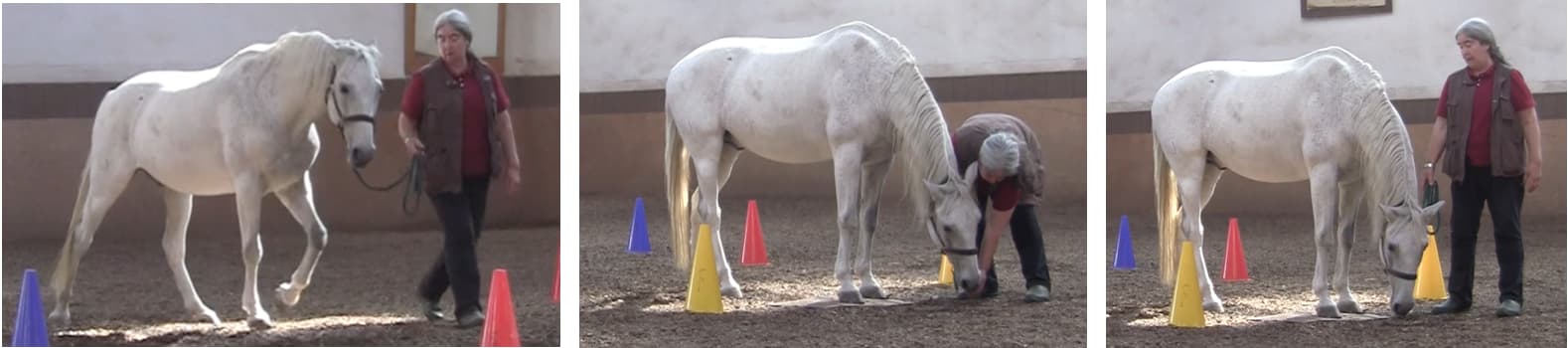
In this sequence he starts out very grumpy. Once he’s standing on a mat, I ask him to lower his head, first using simple food delivery. Once that’s working, I can ask from the lead.

As he leaves his head down, look at the head-to-tail stretch that gives him. This sounds so simple, and really it is. Food delivery is such as easy way to get a horse to lower his head. But where you place the food to get this full body stretch is something you learn from the backing-in-a-square-into-head-down lesson.

Backing in a square into head down can create other types of changes.

This four year old warmblood knew he was big. He knew he could ignore handlers and barge over the top of them. He threw a lot of energy into pushing people around.
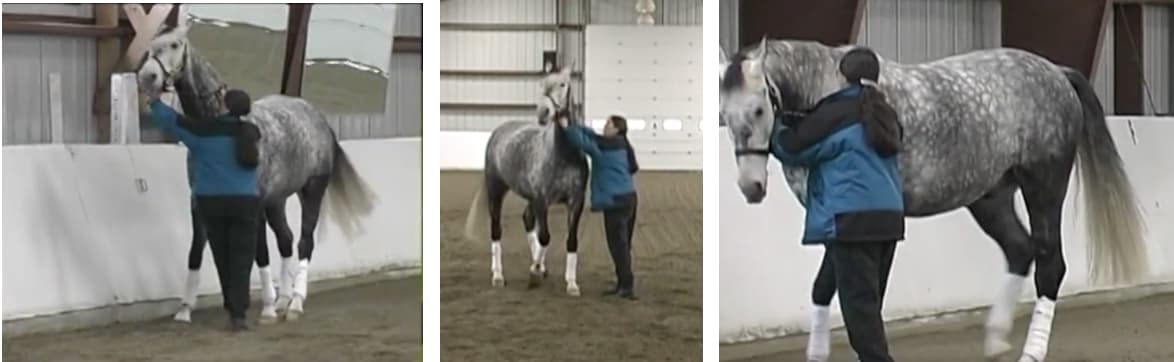
He’s trying really hard to use his height and his size to push forward over the top of me.
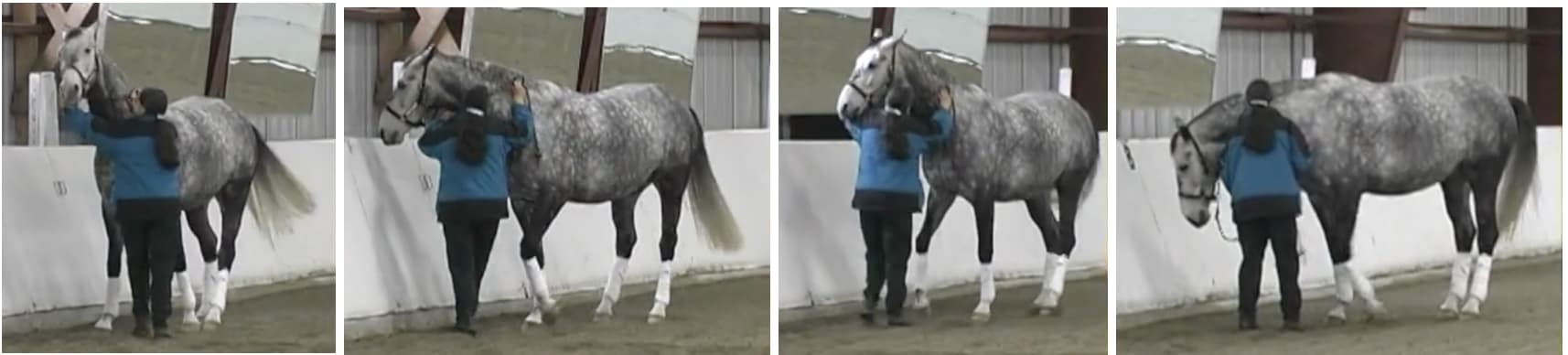
I’ve turned the lead into a “t’ai chi wall”. It’s like throwing a ball against a wall. His energy is the ball. When he runs into the lead, he bounces back off it. As I feel him starting to drop his head, I release the lead. Click and treat.

All that barging-over-the-top-of-you energy is redirected by the “t’ai chi wall” of the lead. I don’t have to get tougher with him. I don’t have to scare him to “show him who is the boss”. I just need to know how to slide up the lead into the “t’ai chi wall”, so I can redirect his energy out of my space.

He backs up. I direct his hips through a turn, and his head begins to drop. Pretty soon I can release this once bargey horse into the same full body stretch that so helped the other horse let go of years of body tension. Head lowering can help this young horse start his working life without that kind of crippling resistance.
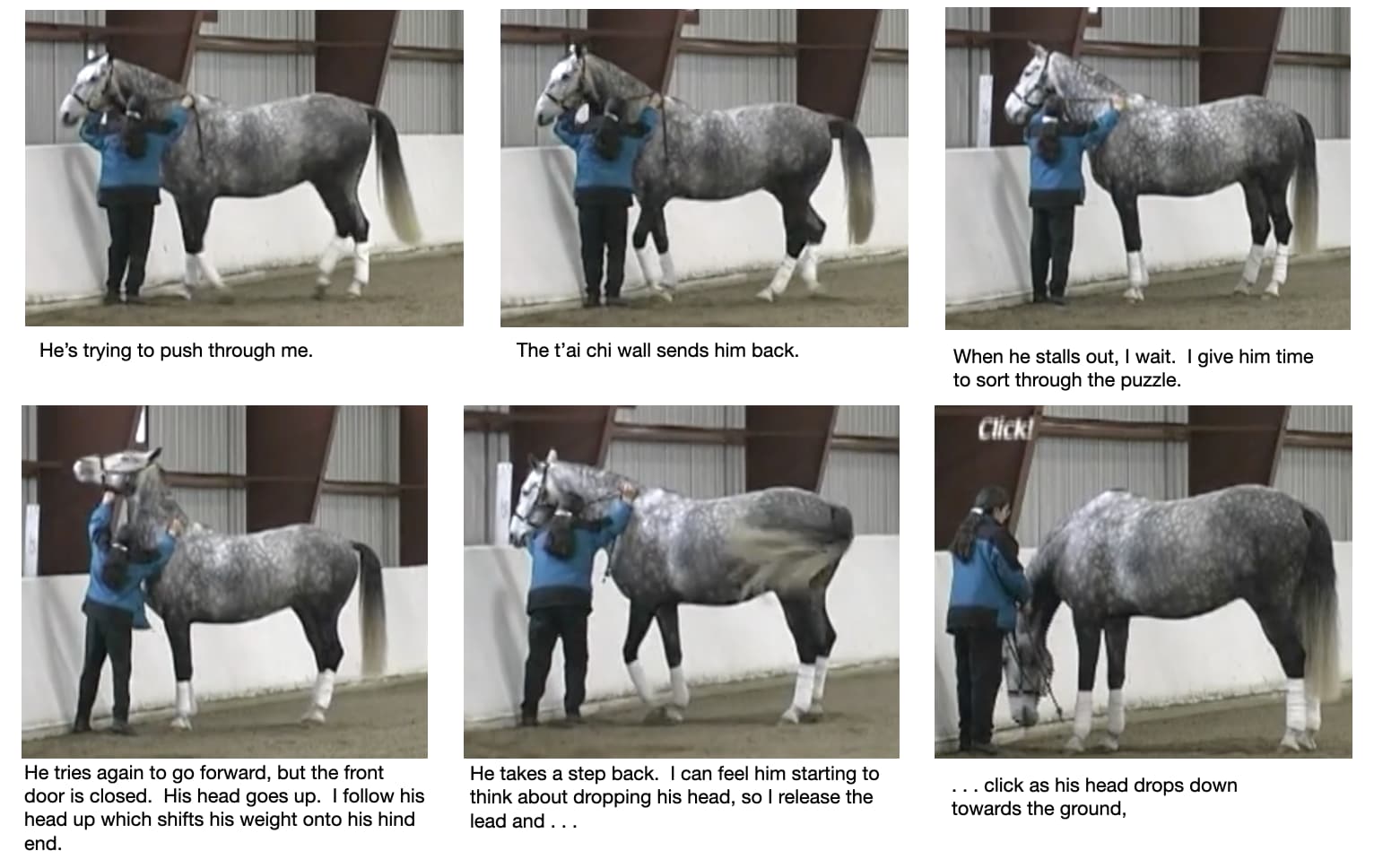
Backing-in-a-square-into-head-lowering transforms pushy and potentially dangerous behavior into polite head lowering. This lesson shows us that there’s so much more to head lowering than simply getting a horse to lower his head.
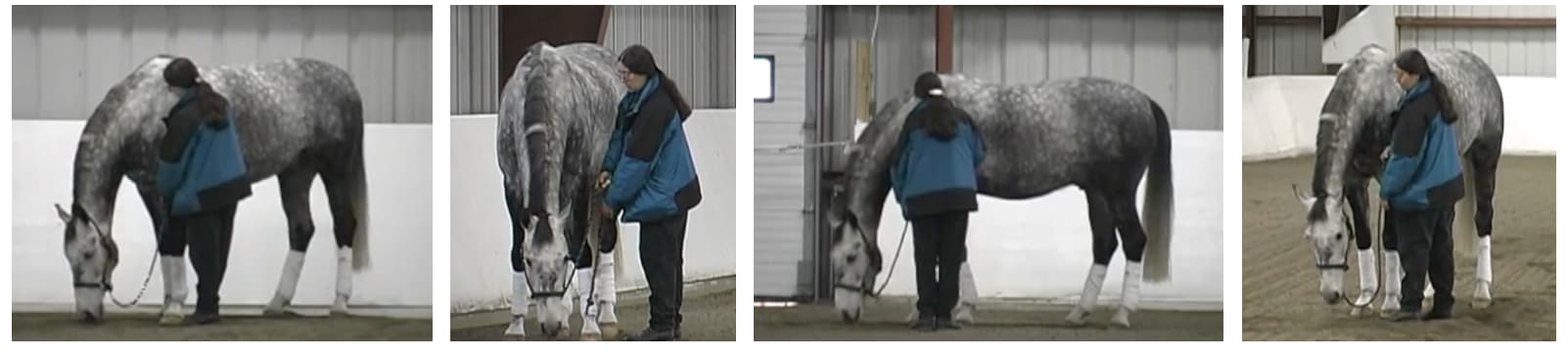
Curious?

Check out the Lesson Three: Head Lowering Mini Course.

I’ve broken the original two hour DVD down into twenty-seven chapters. Instead of sitting down to a full length movie, you can watch the lesson in shorter segments.

The course includes the original DVD Lesson, plus new teaching material. I take you step by step through the head lowering lesson. You’ll learn how to set your horse up for success by teaching the precursor behaviors first. I’ll show you why head lowering is not a forward moving lesson. I’ll explain what that means and how to put those words into action.

Head lowering is a power tool that can enhance your horse’s physical and emotional well-being. This mini course explains the changes it creates. The detailed instructions and demos show you how to put the lesson to work in your own training.

Visit theclickercenter.com to learn more.
Time to Celebrate!

What am I celebrating? I have just finished transferring all of the original DVD lessons onto an on-line platform.

I recognize that DVDS are yesterday’s technology. They are going the way of the dinosaurs – which doesn’t mean that the information they contain is disappearing. It’s just transforming. Dinosaurs transformed into birds. And now yesterday’s DVDs have become today’s on-line mini courses.

It’s been a Herculean task, but I have just finished transferring all of the original DVD lessons to the platform that hosts my on-line clinics.

Visit my web site: theclickercenter.com to learn more.
These new lessons are even better than the original DVDs. I’ve added new material: new videos, more background information, and updates on the lessons.

But why bother? Why not just send you to my new on-line clinics and forget about this older material? After all, some of those lessons are well over twenty years old.

I certainly encourage everyone to make use of the new on-line clinics, but the original DVD lessons contain so many gems. I don’t want to see them go the way of the dinosaur.

I’ll be sharing some of those gems over the coming days.

I’ll start with this one from Lesson #2: Ground Manners.

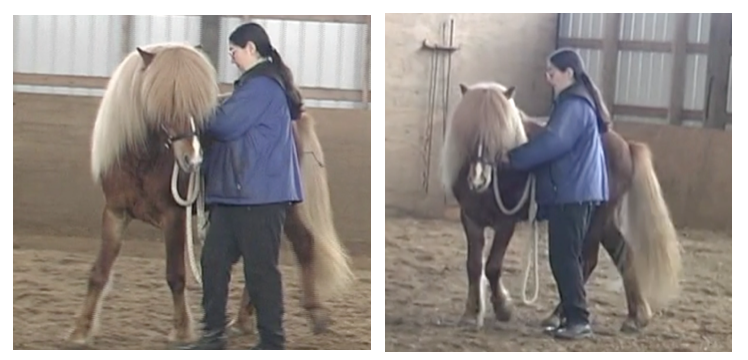
This lesson was originally produced in 2000. It includes a great session with our Icelandic stallion Sindri. Sindri was a new immigrant. He had been in the country for just two weeks when this lesson was filmed. This was the first time I brought him into the arena. He very quickly showed me that he thought leading meant you wrapped yourself around your person and then herded her wherever you wanted to go!

Walking a straight line was just about impossible. When I asked Sindri to go forward, he leaned onto his inside shoulder and crowded into me. He wasn’t a scary horse. I didn’t feel threatened. I just couldn’t go where I wanted.

That was the baseline. Half an hour later I had a horse who was understanding lateral work. When I walked into him, instead of crowding into me, he moved over out of my space.

Contrast is a great teacher. What I love about this session is you can so clearly see Sindri leaning down onto his inside shoulder and crowding into me. There was nothing subtle about what he was doing.

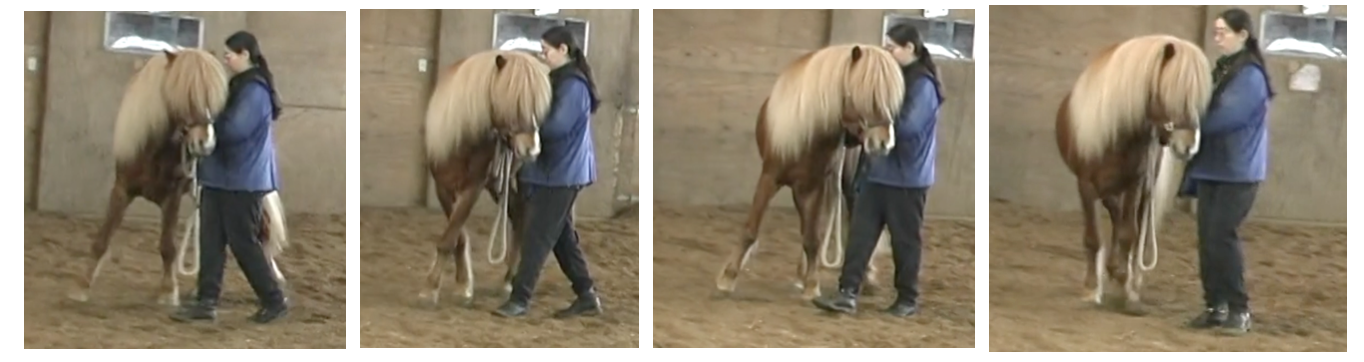
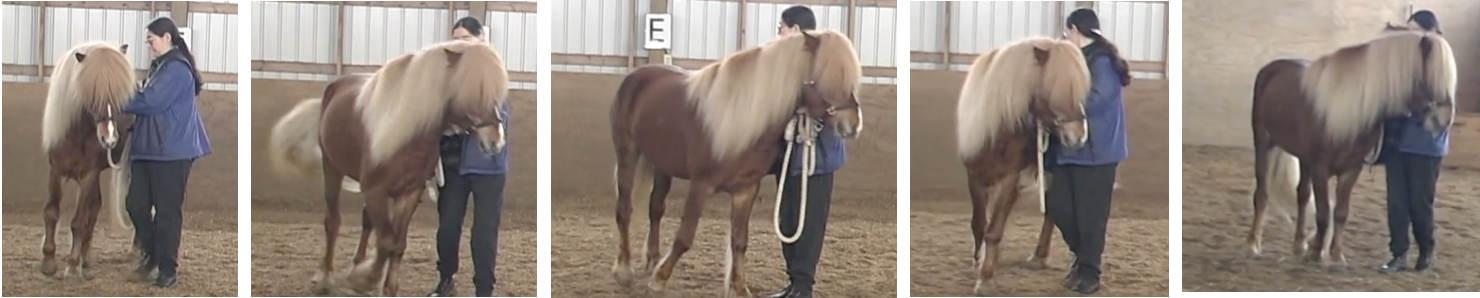
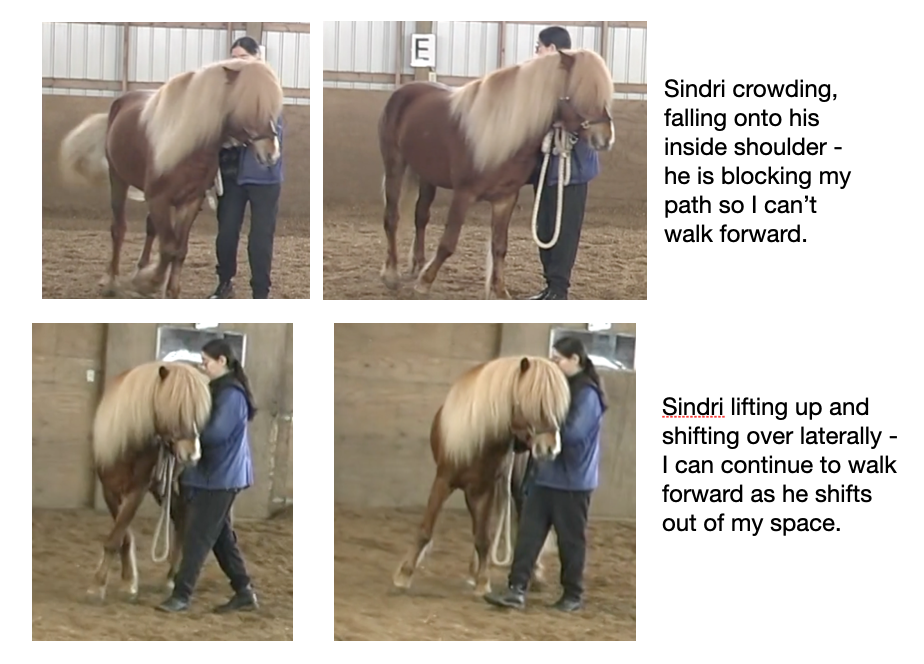
Look at each of these still shots. Sindri’s weight is coming down onto his left front leg as he crowds in on top of me. I can’t walk forward because there’s a horse blocking my path.

This is such a common pattern. I see so many horses who start out leaning onto their inside shoulders. This session was filmed in 2000. At that time, if I had stepped outside of my clicker training world, I would have been told that Sindri needed to learn respect. I needed to get tougher with him. For my own safety, anytime he came into my space, I needed to drive him away from me.

Thankfully for Sindri I stayed in my clicker training bubble. I taught him an alternative to falling in. I taught him to soften and bend around me so he could shift his balance and move up and over out of my space. We were on the road to shoulder-in, beautiful balance, and a very polite horse.

Sindri is a very quick learner. What makes this clip so very useful is you get to watch him making this switch in real time. The actual training time of the lesson was 33 minutes and you get to watch most of it with explanations provided along with some slow motion video that highlights the changes that are occurring.

You can see the beginning of the changes in these screenshots. Now as I walk forward, Sindri displaces up and over out of my way. He isn’t rushing past me, blocking my ability to go forward. Instead he is staying with me as he steps laterally out of my way.

Look at the difference a change in balance makes:

This was filmed in 20001, long before cell phone were everywhere videoing everything. I was using a big, clunky video camera that usually ran out of either battery or tape before the end of a lesson. But on this day the stars were aligned. I had a client visiting who was willing to video the lesson. She asked some really good questions because she was just starting to learn about lateral work. Her questions add to the value of this session.

We were actually able to get on film Sindri’s discovery that he could move sideways. Normally we either miss the actual learning process, or the battery runs out just as the horse is starting to figure out the lesson, or the horse needs multiple sessions to make this switch so it is harder for you to see the change in balance.

So many times I have missed great sessions because the video camera wasn’t running. I think of them like the “fish” that got away. But this gem of a session we got on film. It doesn’t matter that the lesson occurred over two decades ago. Horses are still leaning onto their shoulders today and lateral work is still the solution.

To help my client understand what she had just seen with Sindri, I walked through a demo of Sindri’s starting balance and the changes that occurred that produced the lateral steps.

Sindri’s lesson and the demo that followed it are just part of the Lesson #2 Mini Course. It also includes a discussion of pressure and release of pressure in the context of clicker training. What fits under the clicker training “umbrella”, and what doesn’t belong?

Also included is backing in a square – a key foundation skill; working with foals; and an appearance of a very young Robin. Robin is my co-teacher in presenting the duct tape lesson. The duct tape lesson teaches the prerequisite skills needed for the lesson Sindri shows us.

Note: these lessons were always intended to be used in conjunction with my books and clinics. They focus in on specific steps in the training to provide addition detailed instruction. They are a great addition to the on-line clinic series.

To learn more visit my web site: theclickercenter.com