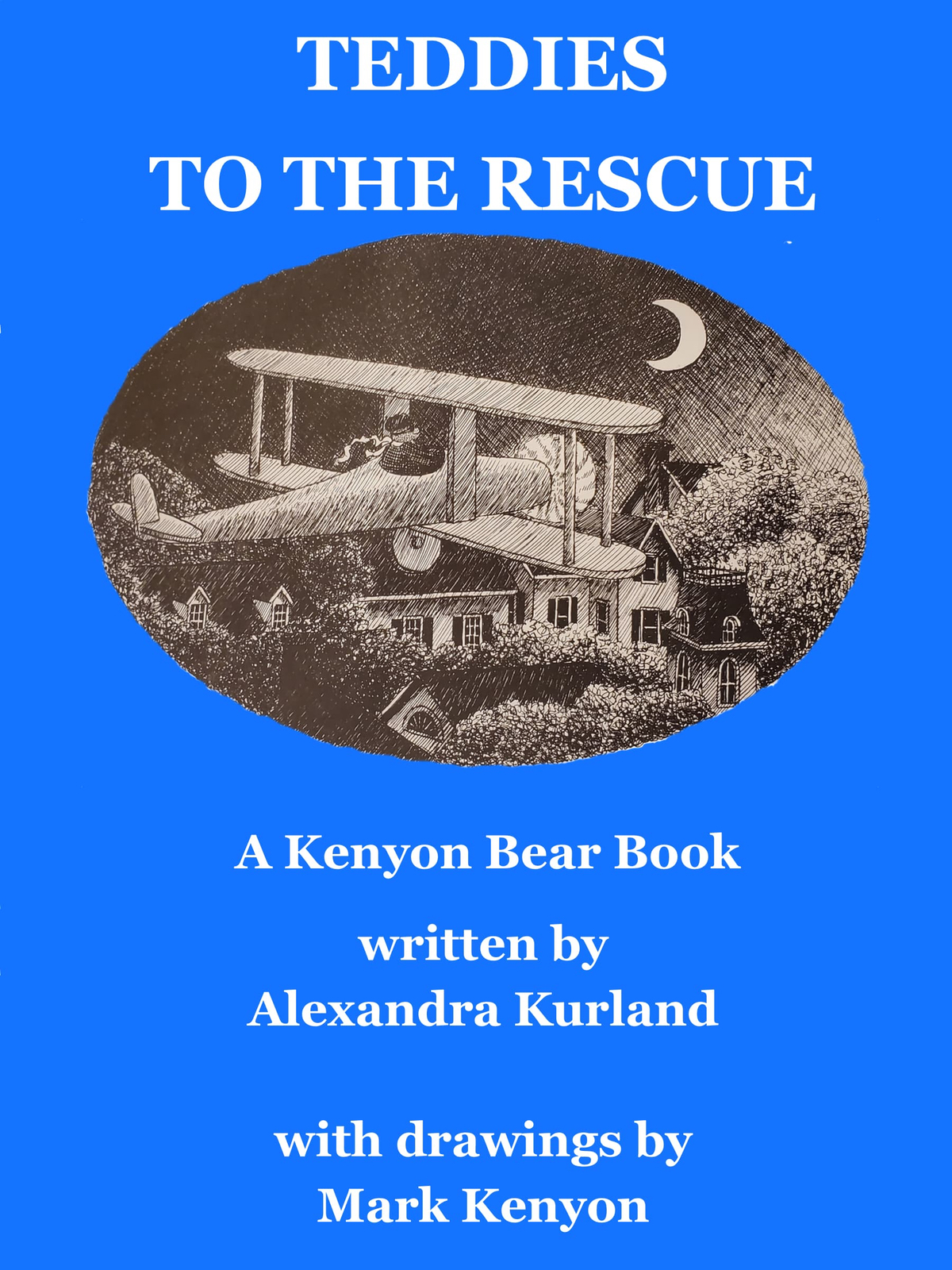
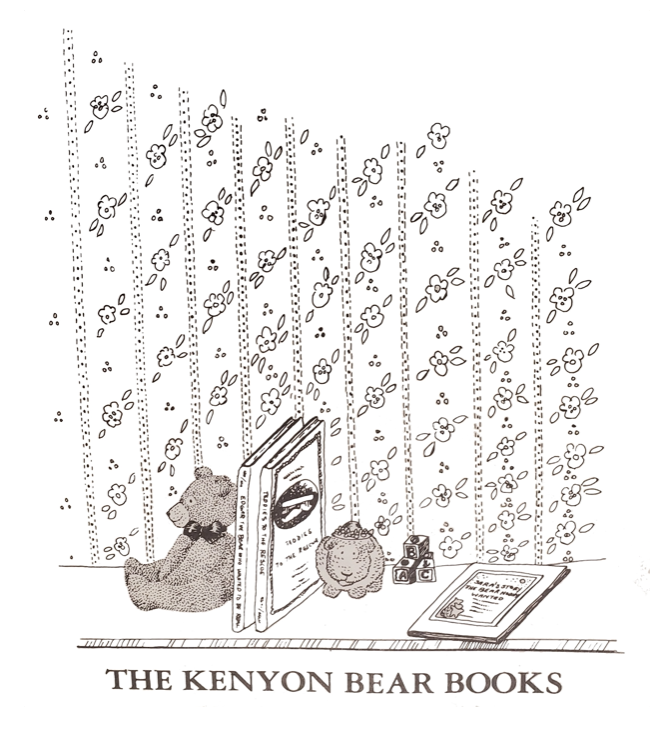
“Teddies To The Rescue” is the first book in the Kenyon Bear Series.
Kenyon is sent a letter that contains a plea for help and the adventure begins.
“Teddies to the Rescue” makes a great read-aloud bedtime story. The chapter format invites young readers into the story.
When I was little, I would read the same story over and over again. That’s what happened with “Teddies“. I heard back from so many of the parents of our young readers. “Teddies” was a great favorite.
Here are some of the comments people shared when the books were first available:
“My eight year old son keeps your book by his bed along with two or three other toy treasure. He looks again and again at it with his younger brother. We’ve read it a million times. And he always knows if it’s been moved for dusting his table. I believe it’s that book we all had as children and that we’ll always remember.” New York
“My family loves “Teddies To The Rescue”. A big favorite with Louis who is four and has learned to love the word Chapter since spending time with Teddies. He is now only interested in books that have chapters.” Virginia
This next one refers to the second book in the Kenyon Bear Series. It could have been written for any of the Kenyon Bear books.
“Emma (Age 6) and I snuggled down one evening with “Edgrr The Bear Who Wanted To Be Real”, and read it straight through. When we finished, we felt wonderful and thought it was a very special and important thing that Edgrr learned. . . Thank you for sharing.” New York
“My Son is eighteen and has a reading difficulty, though he does well in other areas. He liked “Teddies to the Rescue” so much, I bought him the second book. He ordinarily does not like books, but these are the first ones that he liked and in fact discussed with me. He wants to know when there will be another one.” California
The world has changed a lot since the Kenyon Bear books were written. We live in the digital age. But young children still have teddy bears, and they still love being read to. I hope there is still a place in this modern world for some bear magic.
“Teddies To The Rescue” is available as a hardcover and a paperback.
I designed an ebook version, but then decided not to use it. Ebooks have many advantages, but they lack the charm of a printed book. Children’s books are about more than the stories they contain. Holding a book in your hands, turning the pages and discovering new worlds, new friends, seeing your favorite books stacked up on your bedside table, these are all part of falling in love with reading.
I may issue “Teddies” as an ebook at some point, but for now enjoy it in the hardcover and paperback versions. It is a perfect bedtime read-aloud, as well as a great book to give to your young readers.
You’ll see that the hardcover and the paperback are two different sizes. The paperback version is larger and may be better if you are reading the book aloud. The larger page size makes it easier to share the illustrations. The hardcover is a great size for young, independent readers to enjoy on their own.
You can also get it from Amazon. If you are ordering the book from outside of the US, that is the easiest way to get it. When you do a search for “Teddies to the Rescue” in Amazon, make sure you are looking at the new edition. The original edition is still listed even though it is out of print.
When you order the book through Amazon, do please add a five star review. Your reviews help others to find the book.
“Teddies to the Rescue” is available now through my web site: theclickercenter.com and through Amazon and other booksellers. To learn more about the real story behind “Teddies to the Rescue” read on:
“Teddies to the Rescue” is the first book in the Kenyon Bear series. It was originally a Christmas present for my mother.
I listen to so many interviews in which people talk about their terrible childhoods and their alcoholic, abusive parents. I’m almost embarrassed to say that I had lovely parents. I “chose” them well.
One of the great lessons I learned from both of my parents was you create your own reality. When I was twelve, my mother decided it was time to stop being a stay-at-home mom. College tuitions were looming in the future, and it was time to augment the family budget. Instead of looking around for a “normal” job, my mother created her own job. She decided to make use of her lifelong passion for collecting.
Collectors collect. If my mother were stranded on a desert island, she would have collected shells and interesting pebbles. Since she had more scope than a desert island provides, her collections were much more wide-ranging. There were times when the house resembled a museum more than a place people actually lived.
My mother liked to collect. It was the hunt that appealed to her. She wasn’t a hoarder. She didn’t need to keep everything she found. She was perfectly happy creating a collection, enjoying it for a time, and then selling it on. So the “job” she decided on was opening a herb shop. The shop gave her the perfect excuse to go hunting and the herb shop gave her the perfect setting.
A herb shop is its own self. It is whatever you want it to be. My mother brought all of her interests together to create a shop that was a unique and enchanting experience. It was part antique shop, part specialized garden center, part art gallery, part food boutique, part book store, and most importantly part toy shop. If you wanted something special, something you weren’t going to find in other stores or gift catalogs, you went to The Shuttle Hill Herb Shop.
One Saturday when I was in the shop, an older lady came in and asked us if we would be interested in carrying pears. Pears? That seemed very odd. We weren’t sure what she meant. It was a busy morning. We didn’t really have time to talk to her. My mother excused herself to go help another customer and this lady left the shop. She returned a short time later with a box filled with handmade teddy bears. Not pears. Bears.
They were enchanting. They were beautifully made. Yes. We would be delighted to sell her bears in the shop.
That was the beginning of a wonderful relationship with Jane Kenyon, the maker of the shop’s bears. We put them up in the front window where everyone going past could see them. It wasn’t long before the bears started to have adventures.
Mrs Kenyon made an extra large bear for the shop. Of course, he was called Kenyon in her honor. In “Teddies to the Rescue” I write:
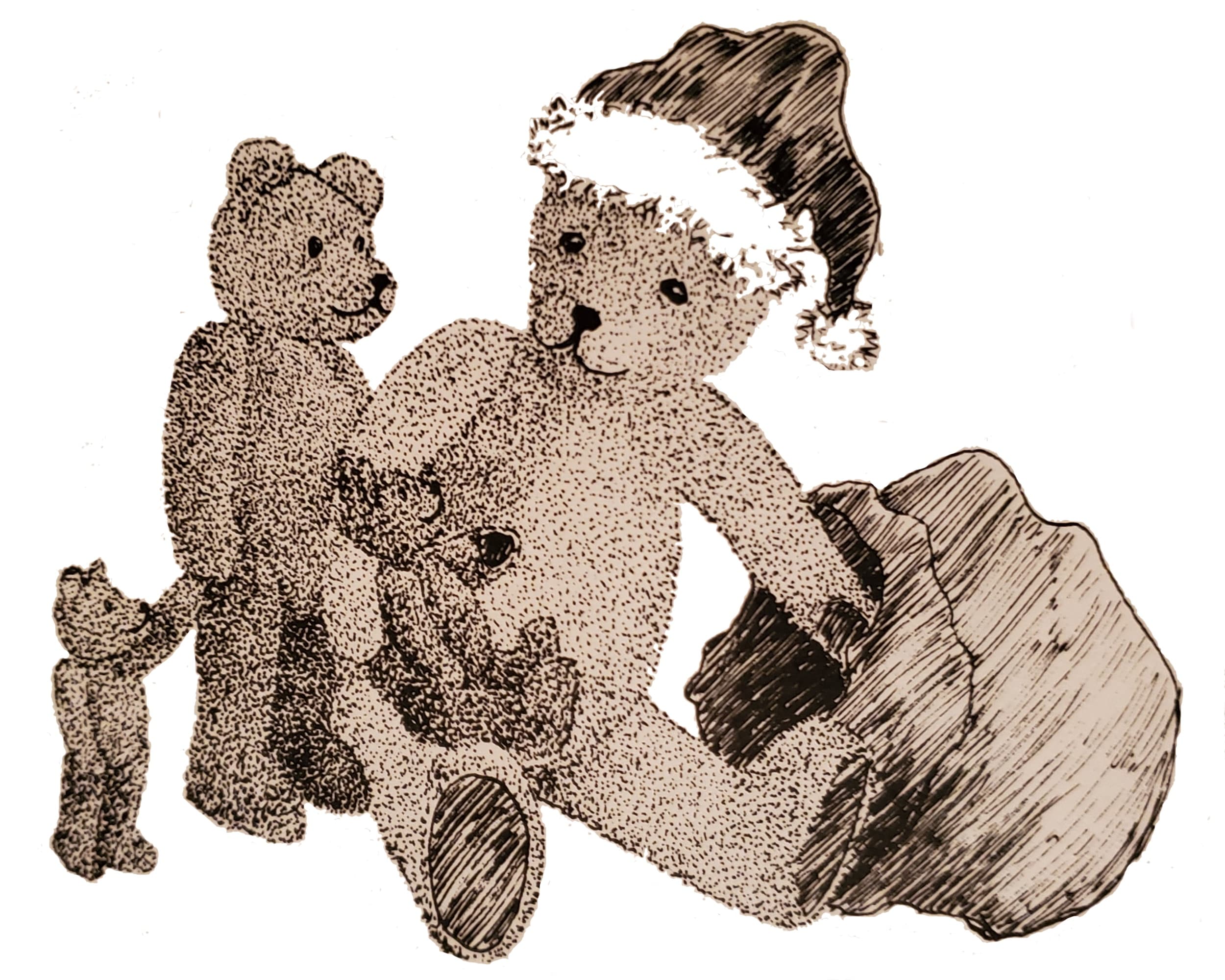
“Kenyon is the shop’s bear. He lives in the window all year round. At Christmas he dresses up as Santa Bear and hands out gifts to all the other bears.”
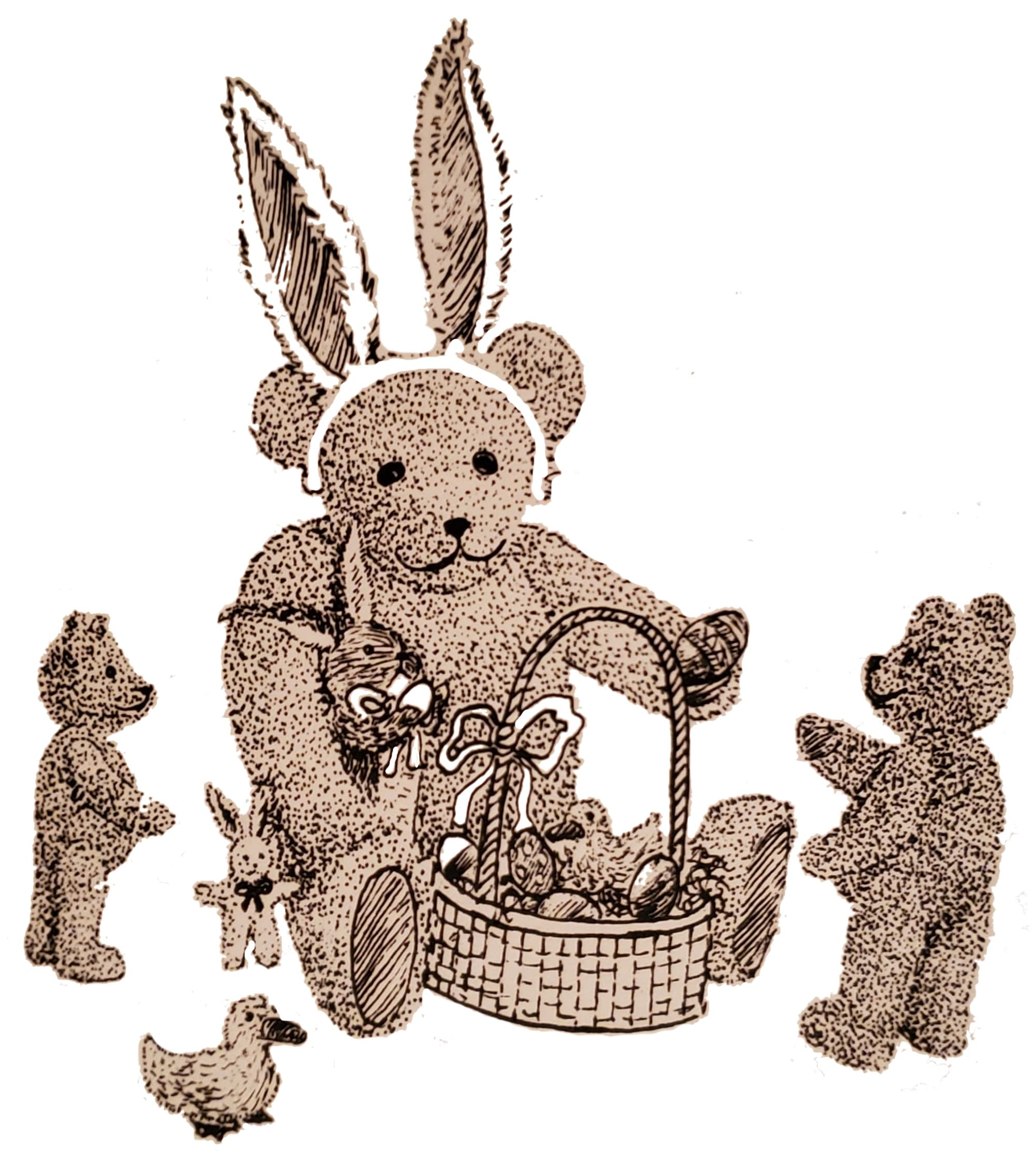
“At Easter he puts on long rabbit ears and pretends he’s the Easter Bunny.”
“In between times he dresses to suit the season, and the other bears join him. They’re so funny. In the summer they go swimming with inner tubes and flippers.
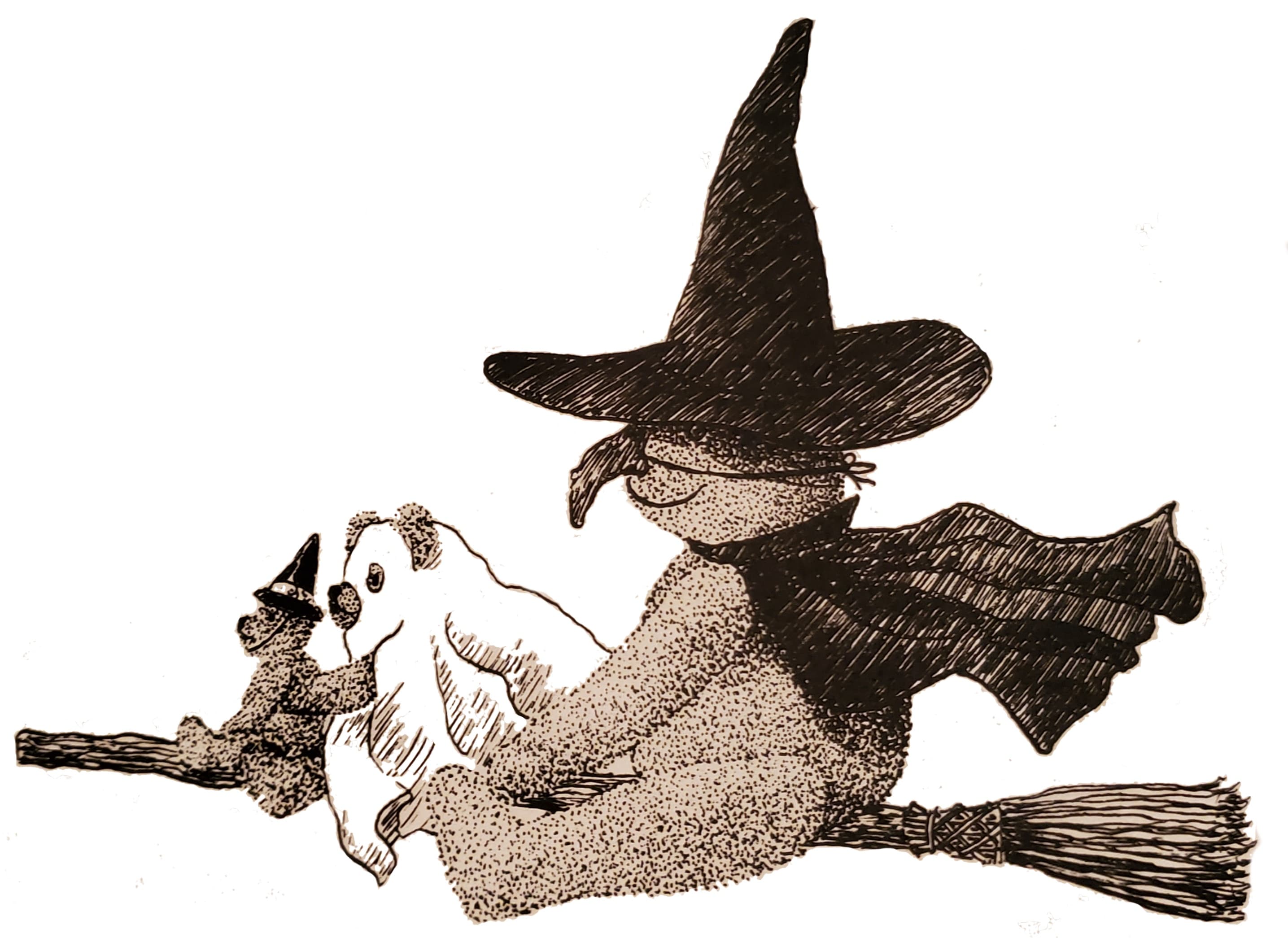
At Halloween they dress up in scary ghost costumes and go Trick or Treating.”
All of that was true.
The bears had many adventures in the window. One of our customers lent us some of his antique toys for the bears. He brought us a metal horse and a big green car. In the winter I let Kenyon have my snow shoes and the bears went camping. In the summer they relaxed in hammocks and beach chairs.
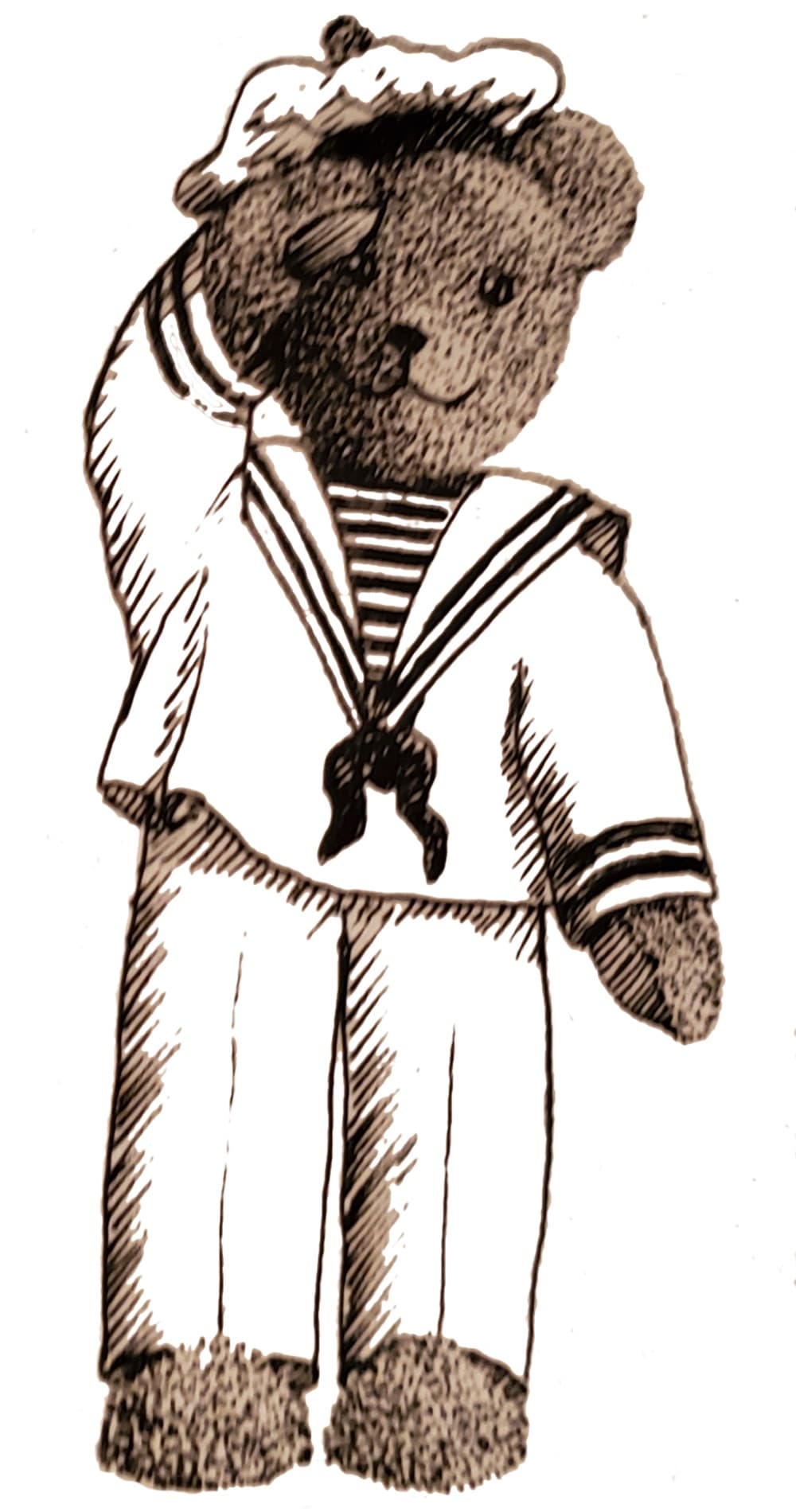
From left to right: The characters in “Teddies to the Rescue”: Pippin and Christopher in the car, Amber in his sailor’s suit, Kenyon the shop’s bear, Bertram with his aeroplane, Chester and Hector the horse.
People stopped in just to see the bears. Every Saturday Mrs Kenyon would bring us another box filled with the most beautiful, enchanting, and magical bears. The bears found loving homes, all except for one amber colored bear who was returned to us in the most horrible condition.
He was missing an ear and his stuffing was falling out of large holes in what had once been his beautiful mohair fur.
We sent him back to Mrs Kenyon for repairs. She patched him up as best she could. She made him a sailor suit to cover up the worst of the repairs.
That bear’s name is Amber and he still lives in my house. It is his story that I share in “Teddies to the Rescue”.
Jane Kenyon’s son was a talented artist. In the fall of 1985 I suggested to him that we create a children’s book together to give as a Christmas present to our mothers. I would write the story, and he could illustrate it.
Mark and I pulled out our favorite children’s books to compare what we liked for illustrations. We went against the trend of the day which was strongly influenced by Disney movies. We chose instead black and white, pen and ink illustrations.
The result was “Teddies to the Rescue” which we gave to both our mothers that Christmas.
Of course, they loved the book. That goes without saying. Mothers are biased. They would have loved it no matter what it was like. You can’t go by their opinion. I was biased as well, but that’s okay. I loved what we had created. Mark’s illustrations captured the magic of all my favorite children’s books.
We decided to take the next step and publish the book. I had heard about the difficulties of getting books published, especially books that didn’t fit the accepted norms. We had created a chapter book for young readers. (This was long before the Harry Potter books made it okay again for children’s books to have chapters.) And we had pen and ink drawings instead of the Disney-influenced illustrations that were the norm.
We made the decision to publish the book ourselves. Now remember this was 1986. We are essentially talking the pre-digital age. We were able to use the typesetting equipment at the State University, but the typesetting was done blind. On my very primitive version of a home computer, I would guess at the formatting I wanted, send it the computer at the State University and several days later, I would get back a scroll of typesetting paper.
As I unrolled it, I always felt as though I was back in the days of the ancient Romans.
The text on the scroll had to be cut and pasted onto story boards. A story board is exactly what it sounds like, a stiff piece of cardboard on which a pair of facing pages are laid out.
The scroll of paper was cut up and the appropriate text along with any illustrations were glued to the story board. On quite a few of the pages we wanted the text to wrap around the illustrations. If the indents weren’t quite right, I would guess at the corrections. I could see the coding on the computer screen, but not how the page would actually look.
I would send in the corrections, and a few days later I would get another scroll of typesetting. It was a laborious process because almost right wasn’t good enough. We went through approximation after approximation until both Mark and I were satisfied with the result.
The stack of story boards for “Teddies to the Rescue” plus the blues, scrolls of the typesetting, and an original copy of the book.
A stack of story boards was finally sent off to the printer. A few weeks later the blues arrived. That’s a photocopy printed from the final plates. The blues are your last chance to spot any typos and make any needed corrections before the book goes to press. Changes are expensive at this point so you have to hope you haven’t made any major errors.
With that last hurdle cleared, the books were printed. We were ambitious. We ordered a print run of 5,000 books. That would have been a respectable printing even for the major presses. It was very ambitious for an unknown author with a self published book.
The books arrived in time for Christmas 1986.
By that time Mark and I were already at work on a second book: “Edgrr The Bear Who Wanted to be Real”. We published that story the following Christmas and the following year we published the third book in the Kenyon Bear series, “Sara’s Story – The Bear Nobody Wanted”. Mark had to bow out of illustrating this third story. His non-artist work life was taking too much of his time to work on a third book, so Sara’s Story was illustrated by another good friend, Jane Isabella. Jane was a professional artist who worked for us from time to time in the shop. Jane brought her own style and sense of whimsy to the pen and ink drawings.
Sara was published just in time for Christmas 1988. By that time we had sold out of Teddies to the Rescue and we were running low on Edgrr. But we didn’t do another print run of either book because my mother had finally decided that after almost 20 years of running the shop she was ready to retire. 1989 was the last full year in the shop. When we closed in January 1990, we had sold out of all three books. That was quite an achievement.
Kenyon, Edgrr, Sara and all the other bears who had been featured in the books went home to live with me. I still have them all. They live in a room very much like that described in the book, an upstairs bedroom that is overseen by the very elderly, and much loved teddy bear my mother had as a child.
The bear my mother had as a child.
I wrote two more Kenyon Bear stories, but I was busy with horses. I never had those stories illustrated, and for many years they lay forgotten in a pile of other papers.
When the tree fell on my house in 2020, the story of the Upstairs Armadillo wasn’t the only manuscript that I found. I unearthed the unpublished Kenyon Bear books plus several other stories I had written.
Covid had shut down all travel. I had time to read. Time to dream. Time to write.
“No book is really worth reading at the age of 10 which is not equally – and often far more – worth reading at the age of fifty and beyond.” C.S. Lewis
“Modern Horse Training” was the priority. That book evolved out of the on-line clinics that I developed to take the place of the in-person clinics that the virus shut down. Now that it is successfully launched, I can turn my attention back to the children’s books.
So finally, after all these days of teasing you with information about my newest publishing venture, let me tell you how you can get “Teddies to the Rescue”:
You can order “the new book”Teddies To The Rescue” through my web site: theclickercenter.com and through Amazon.
Please note: At the moment (meaning August 25, 2023), both the paperback and hard cover editions are available through my web site. Only the hardcover is currently listed on Amazon. The paperback edition should be available on Amazon within the next day or two. The original edition is still listed on Amazon even though it has been out of print for years. You will want to order the new edition.
If you are ordering from outside the United States, I recommend using Amazon to avoid the international shipping charges.
And do please leave a five star review on Amazon. That will help others find the book.
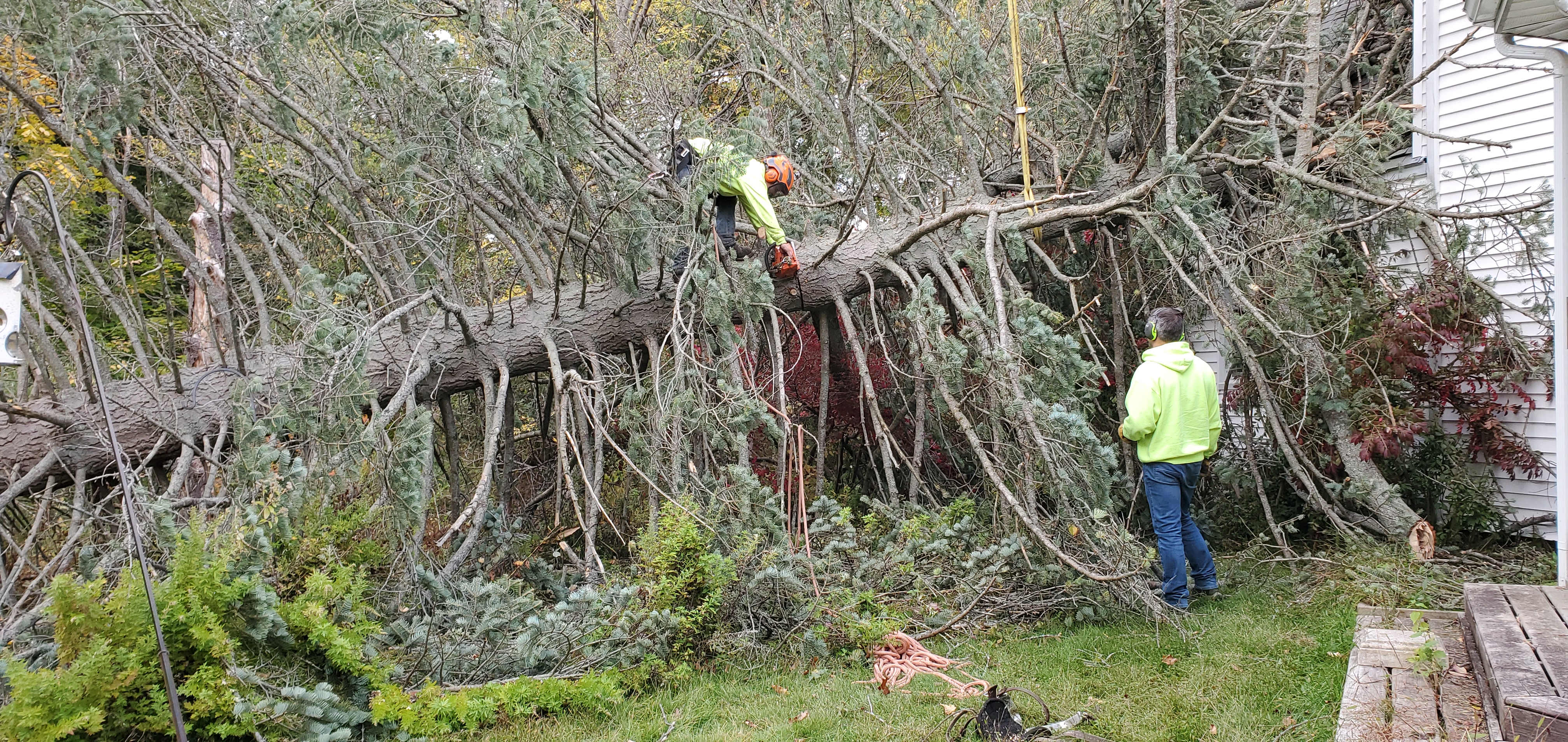
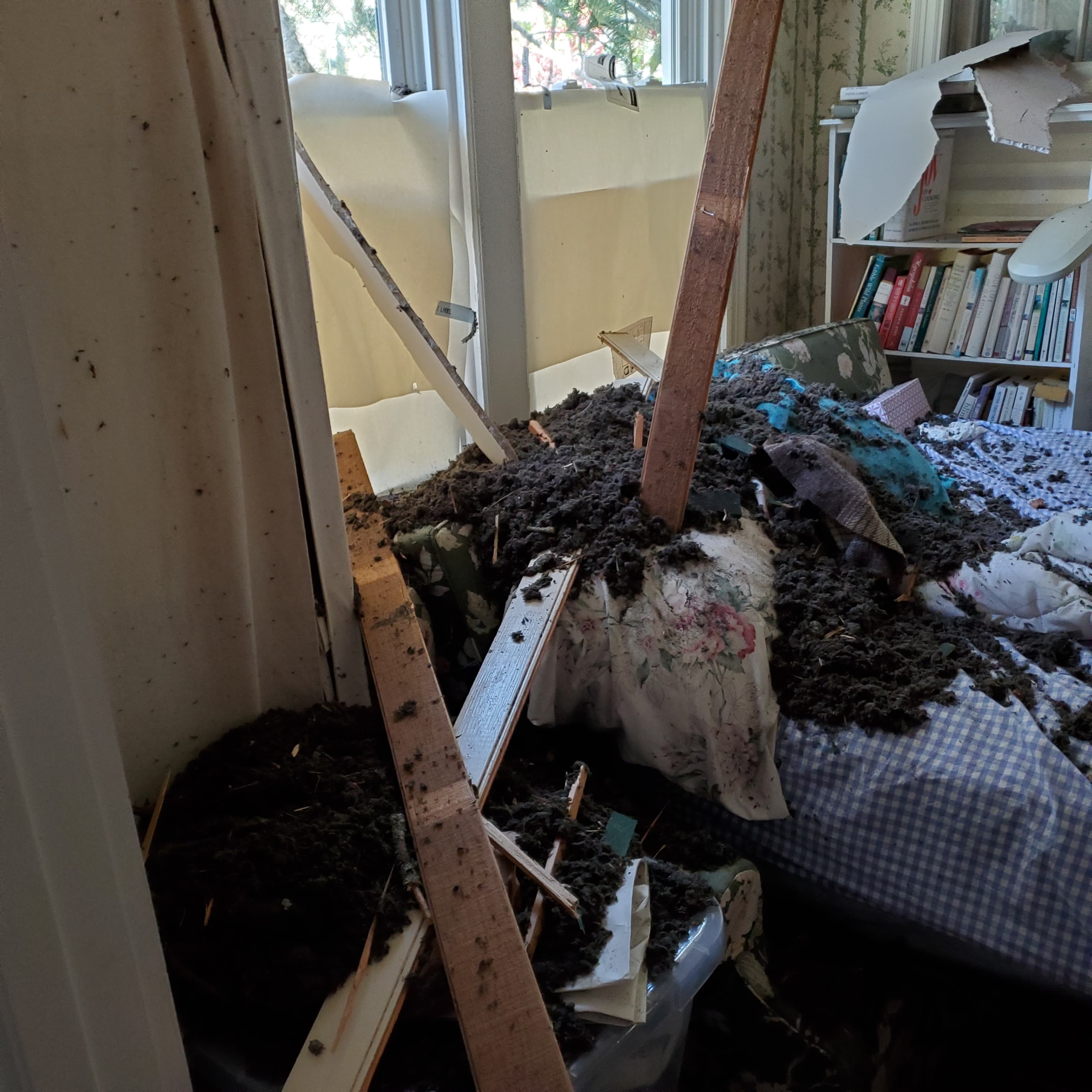
Why now? Why have I finally decided to share “my hobby” with you? Let me answer that by telling you a story. In the fall of 2020 we had a severe windstorm in my area and a tree fell on my house.
There’s a longer version to the tree story, but I’ll leave that for another time. The tree crashed through the roof and created considerable damage to the rooms underneath.
During the clean up, while I was sorting through papers, I came across a story my mother had written. It had probably been ten or fifteen years since I had looked at it. She wrote it when she was in her twenties. It was the start of children’s book about Charles Alexander and an upstairs armadillo. I have always known about Charles Alexander. He was something of a good-natured poltergeist (if such a thing exists) who was part of my mother’s childhood.
The story was only a couple of pages, just long enough to introduce the upstairs armadillo. It was started but never finished. The upstairs armadillo was waiting for me to tell his story.
I have learned that when a horse or a character wants you to tell their story, you stop what you are doing and write it down. So that’s what I did. Over the winter of 2021, I wrote “The Upstairs Armadillo”. The book wrote itself very fast. I so enjoyed the process, that I wrote a second Upstairs Armadillo book, and I was starting on a third when the weather warmed up. The horses and spring chores were back to demanding more of my time, so book three of the Upstairs Armadillo series was set aside.
I was expecting to get back to it over the winter of 2022, but I was asked by a mass market publisher to write a clicker training book for them. That took precedence. I signed a contract and in March of 2022 I began writing that book. I submitted the manuscript at the end of May, and then I heard nothing. The editor I was working with stopped responding to my emails. Finally, in July I was informed that the editor was no longer with the company, and they would not be publishing my book after all. I have no idea what happened, but I was actually relieved. It had felt a bit like selling my soul to work with this company, and now I was free to manage the book myself.
That book is “Modern Horse Training, A Constructional Guide to Becoming Your Horse’s Best Friend”. I published it on April 26, 2023.
During the year that I worked on it, I never forgot about the Upstairs Armadillo or the other children’s books I have written over the years. I pulled them out of the various drawers in which they were stashed and began reading. And that’s when I decided it was time to share them.
You’re going to have to wait for the Upstairs Armadillo. I’m going to begin with the Kenyon Bear Books.
I published these books in the late 1980s and then horses took over and for many years the children’s books sat very much on the back burner.
Tomorrow I’ll share the story about how the Kenyon Bear books came to be written.
I hope you are excited by my news and you’re eager to order the new book, but I am going to make you wait just a little bit longer to find out how you can get your copy.
Everyone should have a hobby. If you are thinking mine has something to do with horses, you would be partially right. I do spend most of my time working with horses, writing about horses, talking about horses, thinking about horses, living with horses. But I do have a hobby that only partially revolves around horses. I write children’s book.
C.S. Lewis wrote: “When I was young, I read children’s books in secret. When I was an adult, I read them openly and with pleasure.”
C.S. Lewis is of course the author of the Narnia books, so I am in good company. If you are not familiar with his children’s books, you have a treat in store for you.
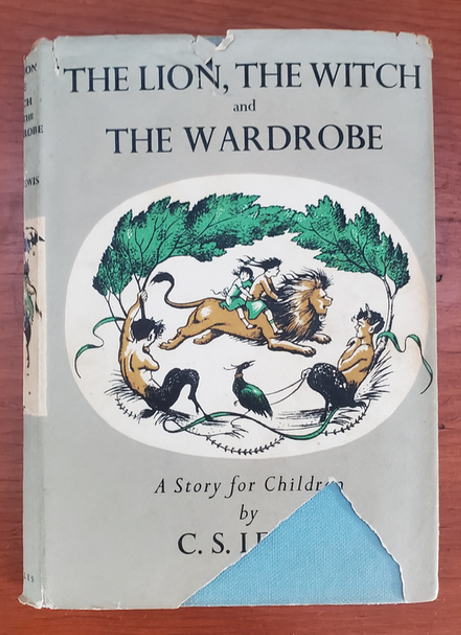
When I was three years old, my parents read “The Lion, The Witch, and the Wardrobe” to me for the first time. JRR Tolkein’s “The Hobbit” was read to me when I was four.
My much read, much loved copy
These books had a powerful influence on my life. Just the fact that I remember listening to these stories when I was so very young shows you the impact that they had.
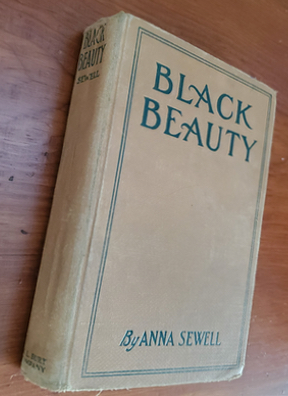
When I talk about horse training, I say that all training methods are made up of three layers. There is the underlying belief system, the guiding principles and the methods we chose. When I describe the core ethical belief system that guides my training, I say to people: “I read ‘Black Beauty‘ when I was little, and I cried when Ginger died.” When it comes to horses, I am unashamedly sentimental.
I would have been six or seven when I encountered ‘Black Beauty’ for the first time. So before there was Ginger, there was Narnia.
Nowadays everyone knows about Middle Earth, but when I encountered C.S. Lewis and JRR Tolkien, that was years before they were widely known in the US. Every fall my parents would get the children’s catalog from Blackwells Bookstore in Oxford England.
In October we would spend days pouring over the catalog and choose the books we wanted for Christmas. In December a carton would arrive from Blackwells containing the books we had selected.
Ordering from Blackwells meant we had many books years before they were widely known in the US. It’s hard to imagine it now, but growing up, I was the only person in my class who knew about hobbits.
My favorite books were filled with magic. I wanted books that would take me to Narnia and Middle Earth. Of course, I loved the Paddington books and was charmed by Winnie the Pooh. There was also ‘Green Smoke‘, and ‘The Children of Green Knowe‘, to name just a few of my favorites.
There were never enough of these books to satisfy so I starting writing my own. I write the kind of stories I would have enjoyed reading as a child. The magic is real, the animals have voices, and fauns and dragons do exist.
Why am I writing about this? You know me as a horse trainer, and the author of the clicker training books. That’s been my focus for thirty plus years. I want horse-friendly, kind, caring, compassionate training to become the norm in the horse world.
The path that put me on an interception course with clicker training began when I was three years old and I found my way to Narnia for the first time. The children’s books that I most loved have very much shaped the person I am today. They taught me important values. I read ‘Black Beauty‘ when I was little and I cried when Ginger died.
The path that children books put me on led to the writing of “Clicker Training for your Horse” and my other books on clicker training.
These training books have had a major impact in the horse world. They provide an alternative to the force-based, “show them you’re the boss” training that is so prevalent throughout the horse world. People all around the planet are now using clicker training. They are recognizing that you don’t have to “hit harder” to get horses to listen to you. In fact, when you stop hitting them, they listen to you so much more.
I’ve been listening to my horses, and they are telling me it is time to share the children’s books I have written. They are filled with love and loyalty. Those are important lessons to learn to carry forward into a life filled with horses.
I hope you are curious and you want to know more. I am going to make you wait until tomorrow to unwrap my new book!
I have an announcement to make, a fun surprise. I am about to publish another book!
I’m guessing some of you are thinking: “So soon! I haven’t finished reading “Modern Horse Training” and you’ve already got another book coming! I’m not ready.”
Don’t worry. This book is very different from my other books. Over the next few days I’ll be sharing with you the details of the book. Until then, I’ll leave you wondering what it is about.
I know many people think they aren’t very creative, especially when it comes to training. I’d like to suggest that being creative isn’t an intrinsic characteristic. One person isn’t born more creative than another. Creativity is something that is learned. Creativity can be developed. Maybe in school you got the message that you just weren’t creative. You heard that so often, you started to believe it. So sad.
Horses can help you change that view of yourself. Here’s how:
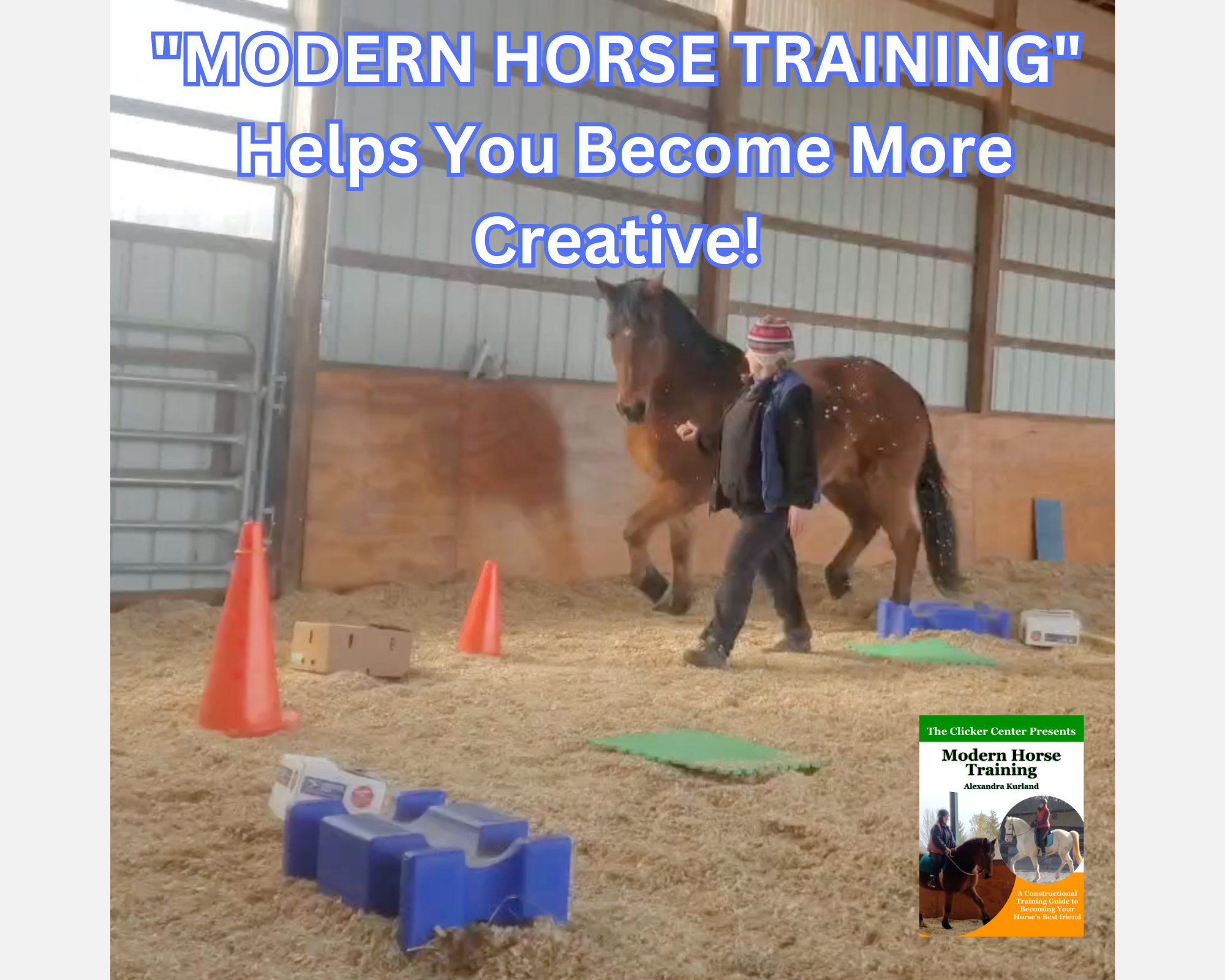
Add lots of stuff to your training environment. The more stuff you have, the more possibilities you’ll see for some fun training games.
An empty arena is a huge blank slate. It can be hard to think of new things to do. Put out a circle of cones with a mat in the middle, and you will begin to see more options for the day’s lesson.
If all your cones are orange, decorate them with colored duct tape. Now you have blue and green and red cones. The colors will help you see even more patterns you can play with. You can ride across the circle leaving through a red gate and returning via a blue gate. You can ask your horse to stop at every green cone.
Add more mats. You’ll see more possibilities. Creativity comes from having more options to play with. When you feel stuck, add stuff.
In the photo I’m using cones of different sizes, jump blocks, cardboard boxes and colored mats to create a colorful playground for Robin.
Modern Horse Training embraces the word “yet”
Yet is a wonderful word. Stanford psychologist, Carol Dweck, reminds us to add yet to dead end statements.
Here’s what that means. If you find yourself saying you aren’t creative, that’s a dead end statement. Say it often enough and you will start to believe it. Add “yet” to the end of that sentence and everything changes.
You aren’t very creative – yet. That opens up the possibility for change. Modern Horse Training helps transform that sentence into you are becoming a very creative, inventive trainer.
Here’s a great way to begin. Pick a simple object your horse is comfortable with. Maybe it’s a plastic dog toy. Think of all the ways a clicker trained horse could interact with this toy. He could orient to it with his nose. He could follow it to the ground to help teach head lowering. He can learn to retrieve it. You can hang it from a fence and teach him to stand next to a stationary target. That’s just the beginning.
Pick a different object. Maybe it’s a wash cloth. You can ask for many of the same things that you taught with the dog toy. You can add some new things, as well.
He can stand on it so now you have a portable mat you can carry in your pocket.
He can stand still on one wash cloth while you groom him all over with another wash cloth.
You can hang it on your fence and teach him to go out to it. Put a ground pole in his path and that’s the beginning of jumping at liberty.
You can teach him to orient to the wash cloth with his ear, his shoulder, his hip, etc. This will help you with many husbandry skills including prepping him for medical care.
Each new object expands the possibilities and contributes to your becoming more creative.
Have fun!
You can order my new book, “Modern Horse Training” through my web site: theclickercenter.com or get it from Amazon and other booksellers. When you order through Amazon, do please leave a five star review. Your good reviews help others to find this work.
(This series of posts were originally posted on instagram in June 2023. Find me at: #alexandra.kurland.5)
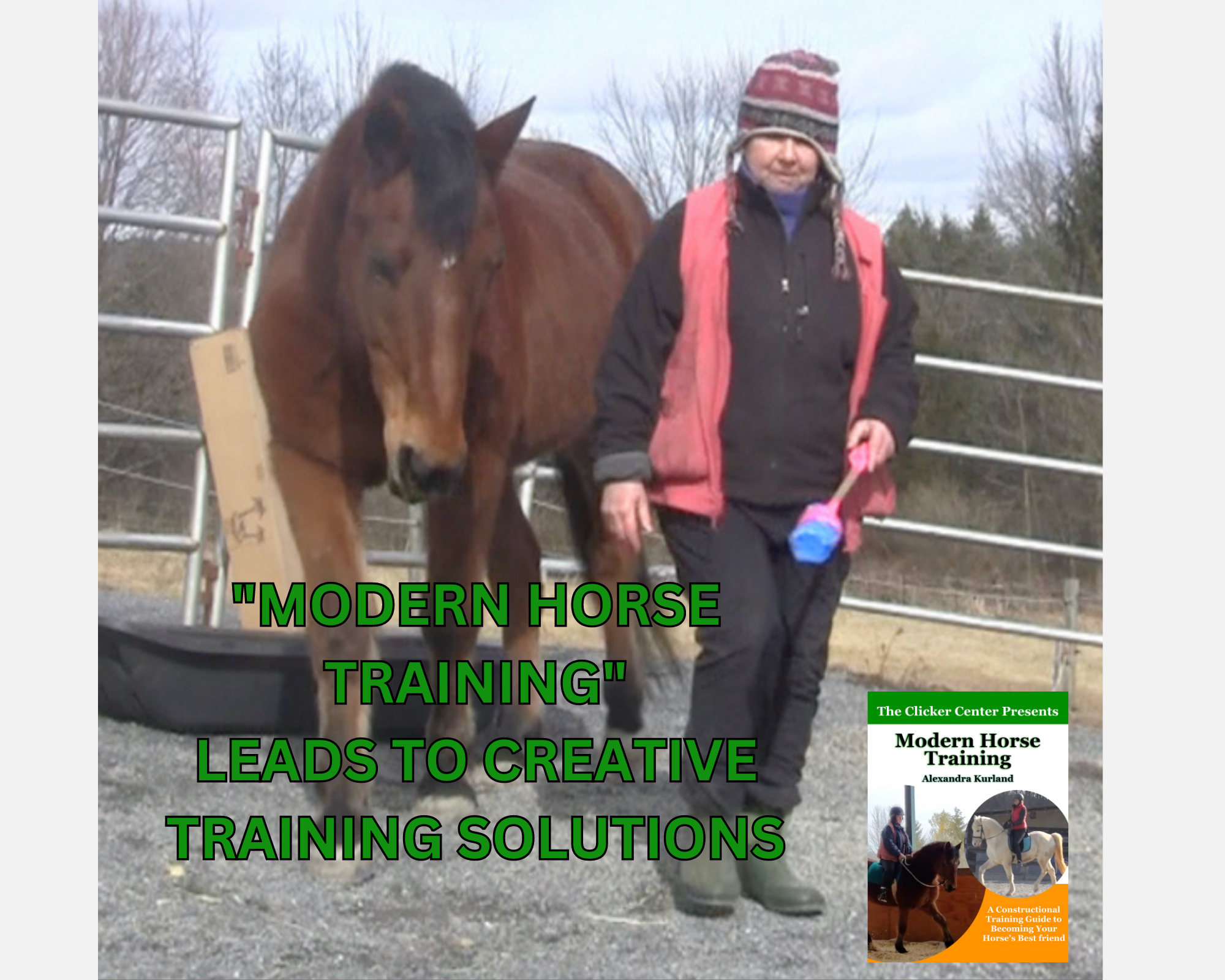
Robin is helping me demo the “touch the goblin” game. This is a targeting lesson that helps horses gain a lot of confidence interacting with novel objects.
As always, I am using a constructional approach, meaning this lesson uses skills that I have taught previously. I wouldn’t begin by asking an anxious horse to follow a target up to something that worries him.
That would be like having you touch a tarantula in exchange for a hundred dollars. You might do it. A hundred dollars can buy a lot of hay for your horse. You’ll touch the tarantula – really fast and maybe you’ll be flinching while you do it. You’re still afraid of the tarantula, but you touched the goblin and got your hundred dollars.
That’s not what we want for our horses, so the game begins by having them orient first to lots of objects that they are already familiar with and don’t worry them. You’ll also begin in environments where your horse feels comfortable.
I’ve added a toboggan and some cardboard boxes to the barnyard. Robin is reminding us that turning your back on a goblin and walking calmly away is just as important as approaching a goblin. I remember years ago watching a very bold rider force her nervous horse to stand facing a scary mailbox. As soon as the horse had his back turned to it, he shot off like a rocket. She was lucky she didn’t fall off. Horses show us how important it is to listen to them and to adjust our training to meet their needs.
Things I like about this photo: Robin is working at liberty which means he has the option to leave at any time. Choice is an important part of Modern Horse Training.
I love how relaxed he looks as he walks away from the goblins. He’s following both the target and my body orientation. He may be at liberty, but this is also very much a lesson on leading.
Everything is connected to everything else.
Modern Horse Training – Be Creative!
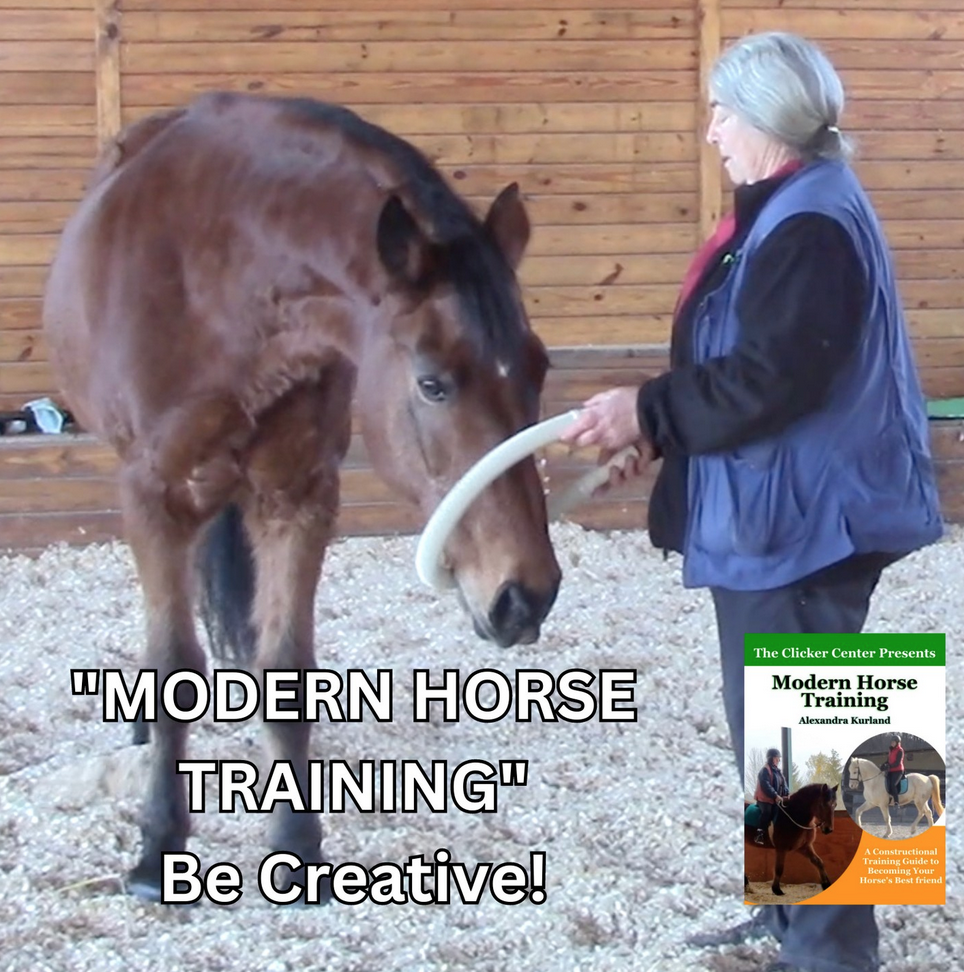
Good training doesn’t mean you need to spend a lot of money on training equipment.
I’m teaching Robin to put his nose into a loop formed from a vacuum cleaner hose. The hose can be swapped out for cardboard boxes of different sizes and depths, pool noodles held in a loop, and many other objects.
How does this help you? Think about all the “clothes” we ask our horses to wear. This turns into haltering, bridling, putting on an over-the-head blanket, accepting a grazing muzzle, etc.
The fun of constructional training is you are teaching component skills that can then be used for many different behaviors. It’s a very fun and efficient way to teach.
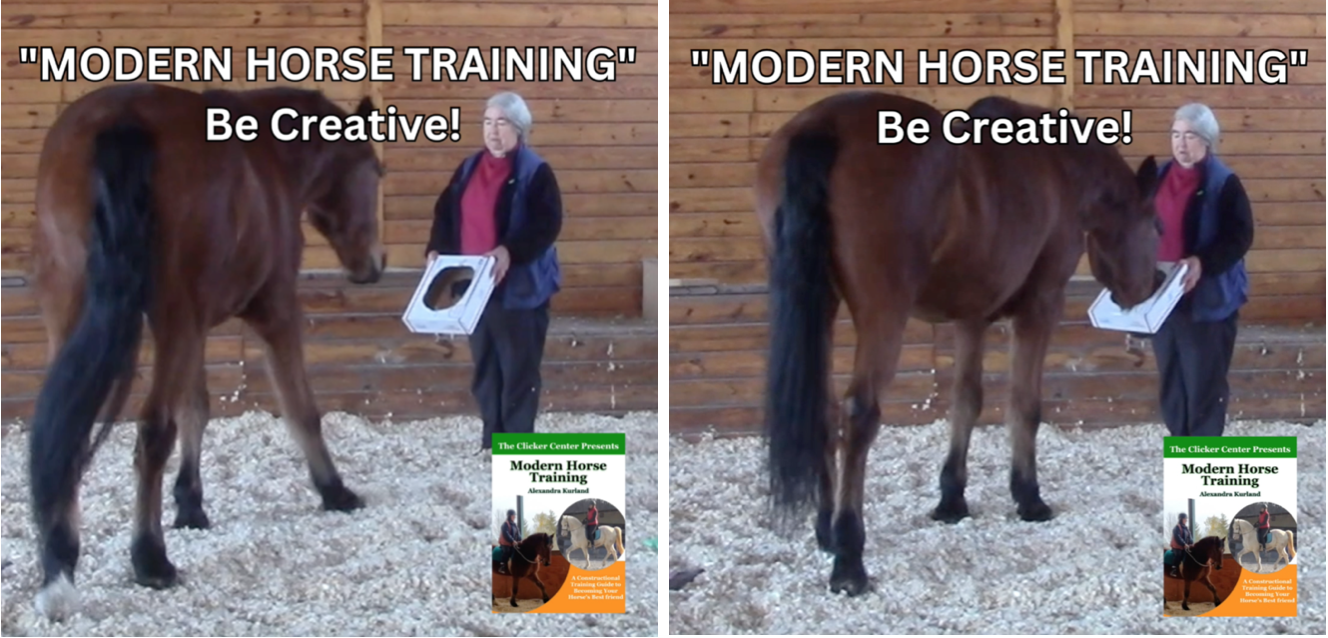
Modern Horse Training:Be Creative!
Robin has learned to put his nose down into many different objects, including cardboard boxes.
Now I’m using backchaining to teach him to come to me from a distance to put his nose into a cardboard box. Backchaining means I begin by standing very close to him so it is easy for him to put his nose into the box. Then I gradually move further away from him so he has to take several steps to get to the box.
Right now this is a cardboard box. Later it could be a halter I hold out to him. Think about how you can use this lesson to help a horse who is anxious about being haltered. You’re using objects that don’t have the previous associations that a halter has for that horse to teach him the basic skills that will help him to be comfortable with halters.
The cardboard box will be swapped out for other objects such as pool noodles held in a loop until eventually the horse is ready for halters. You’ll now have a horse who sees you holding a halter in your hand. Instead of turning away, he will come from a distance to put his nose into the halter.
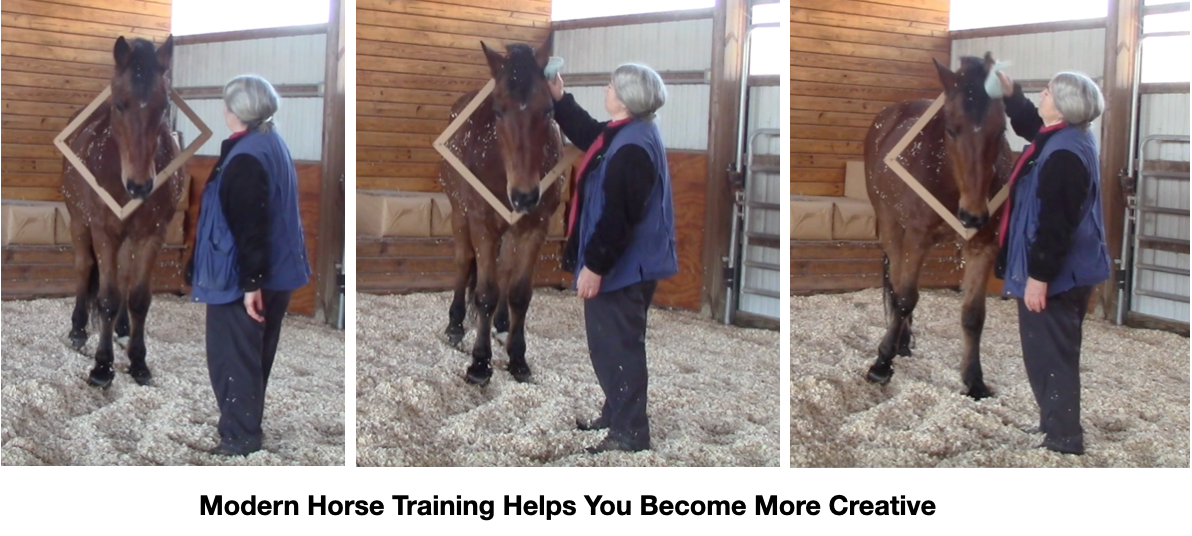
You’ve been framed!”
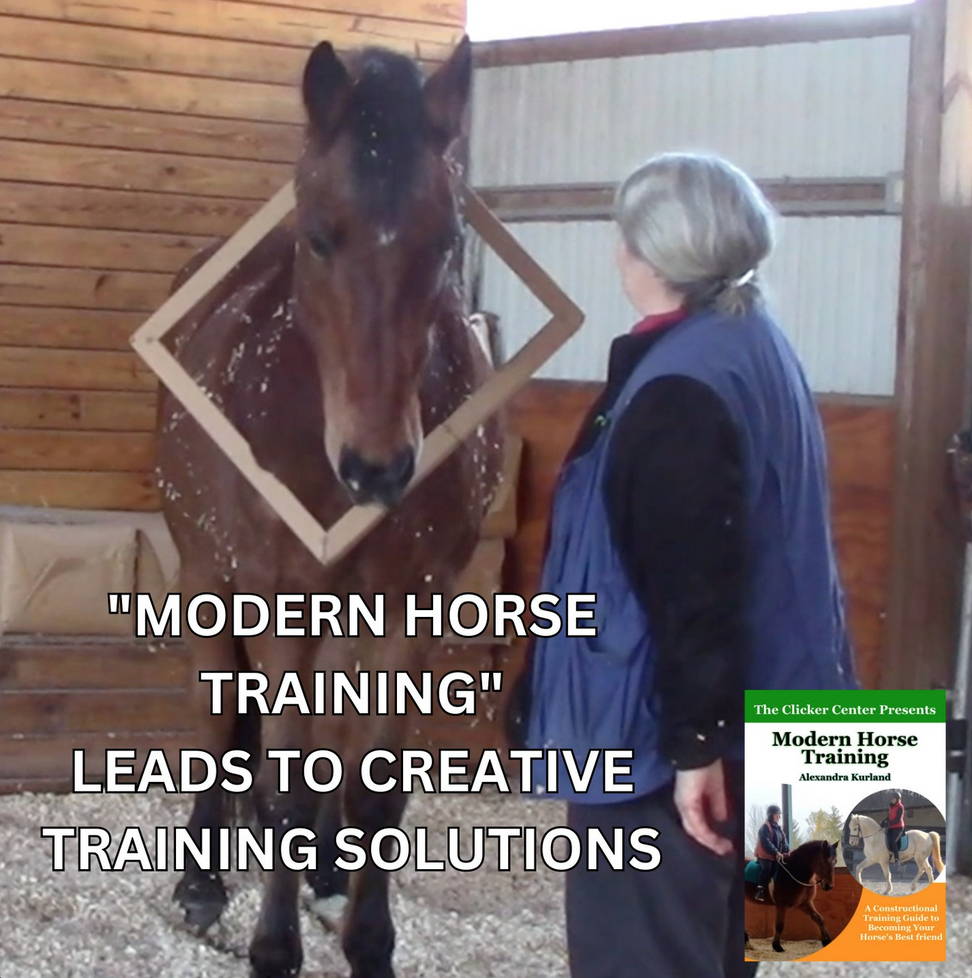
Modern Horse Training leads to creative solutions and lots of fun games!
Robin is putting his whole head and neck into this cardboard frame.
Think about all the ways this simple game can be transformed into useful skills. It’s a great prep for putting a blanket over your horse’s head. Is your horse worried about a halter or bridle going up over his ears? Games like this are a great prep. Maybe you’d like to ride in a neck ring. Again this is great prep.
Games like this are fun for both the horse and the handler. And they smooth the way for many other handling requests we make of our horses.
Want to learn more? My new book, Modern Horse Training, is available through my web site: theclickercenter.com and from Amazon and other booksellers.
Earlier in the year it was vaccination day for all the horses. We did the big horses first, then I drove over to Ann’s house to hold Panda for the vet. I was first to arrive. Panda greeted me with a small hello. Her response to the vet was to pretend she wasn’t there.
We had arrived a few minutes before Ann was expecting us. We went ahead and Panda her shots. All was well. We left Panda in her stall and stepped outside her little barn. And that’s when Ann came out of her house onto her back deck.
Panda erupted in song. “You’re here! My person is coming!” She whinnied her greeting.
Ann wanted to pause and talk to us, but that kind of enthusiastic greeting was not to be ignored! She went first to say hello to Panda, and then she could ask her questions.
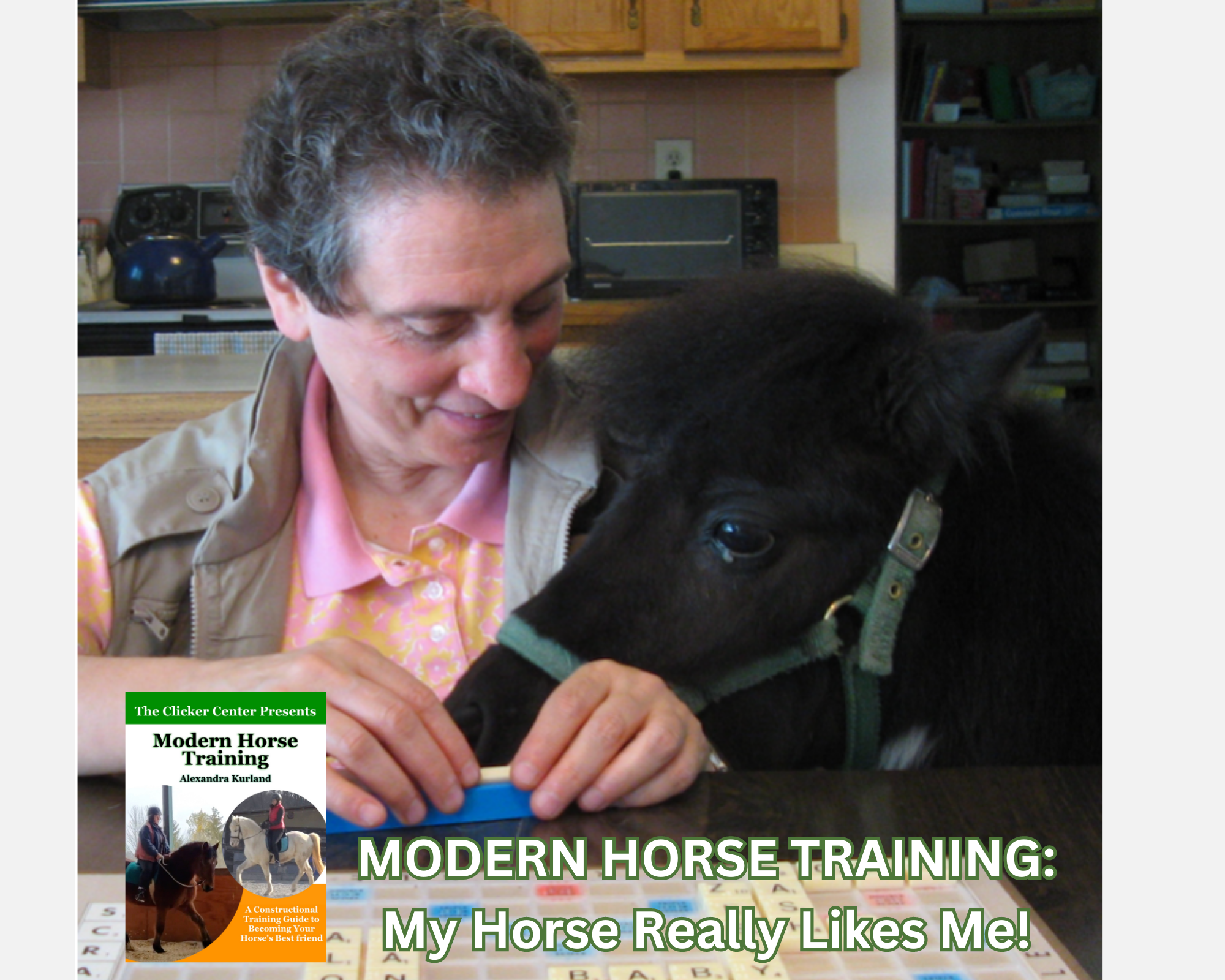
Our clicker trained horses show us in so many ways that they like us. In this photo Panda is “helping” Ann during a scrabble game. Guide work isn’t all work. It includes a lot of social, play time that Panda clearly enjoys. It’s no wonder they have a great relationship!
Modern Horse Training Is About Sharing With Friends
Modern Horse Training isn’t something you want to keep to yourself. It’s too much fun. Laughter and love are meant to be shared, and so is good training.
I love working with other clicker trainers and I am always honored when they let me have a play with their horses. This is Graya, one of Michaela Hempen’s horses (clickertrainingferde.com). We were having a rope handling discussion in which Graya was very much an active participant.
Good training needs to be shared!
You can help me share it by sharing these posts with your friends.
These posts are from my instagram posts. You can find me at: alexandra.kurland.5








 The Clicker Center Blog