
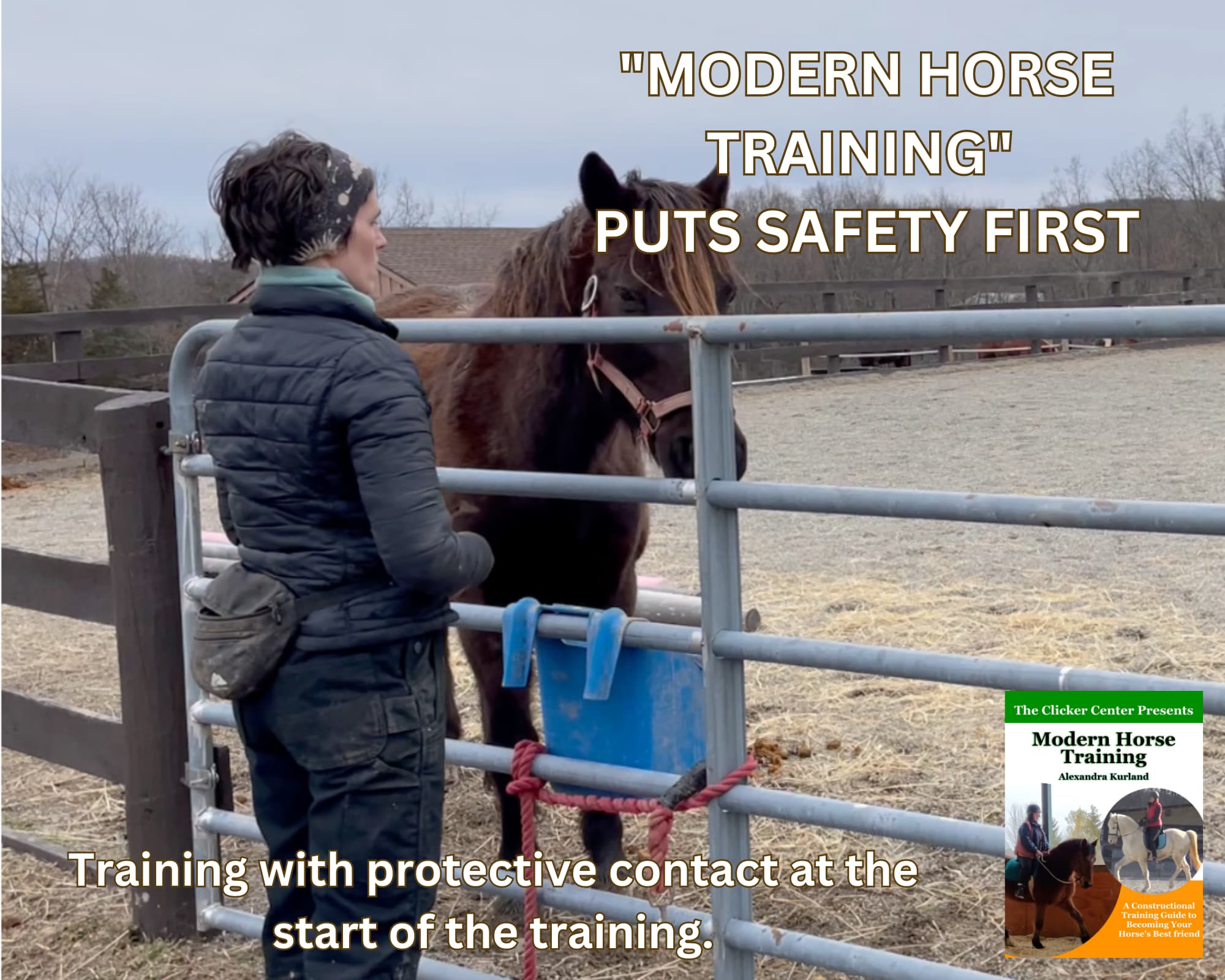
This is one of the photos I included in the book. This is Taylor Culbert working with her horse Theo. She adopted Theo from a horse rescue. In this lesson she’s using protective contact. That means there’s a barrier between them. Theo always has the option of leaving.
I love this image because it illustrates a great set up for protective contact. Theo could easily walk away from the gate, but he’s choosing to stay. He’s not crowding into the gate, reaching through the bars or stretching over the top rail. Instead he is standing politely in his own space presenting what Taylor is looking for – an ears forward, relaxed “happy face”.
When people introduce their horses to clicker training, I always recommend that they begin with protective contact. Protective contact means clicker training begins by placing safety first. If a horse becomes pushy because you have treats in your pockets, you can just step back out of the way. You don’t have to correct the unwanted behavior. You can stay focused on what you want your horse TO DO.
I recommend beginning with protective contact even when you know your horse well and you have no any safety concerns.
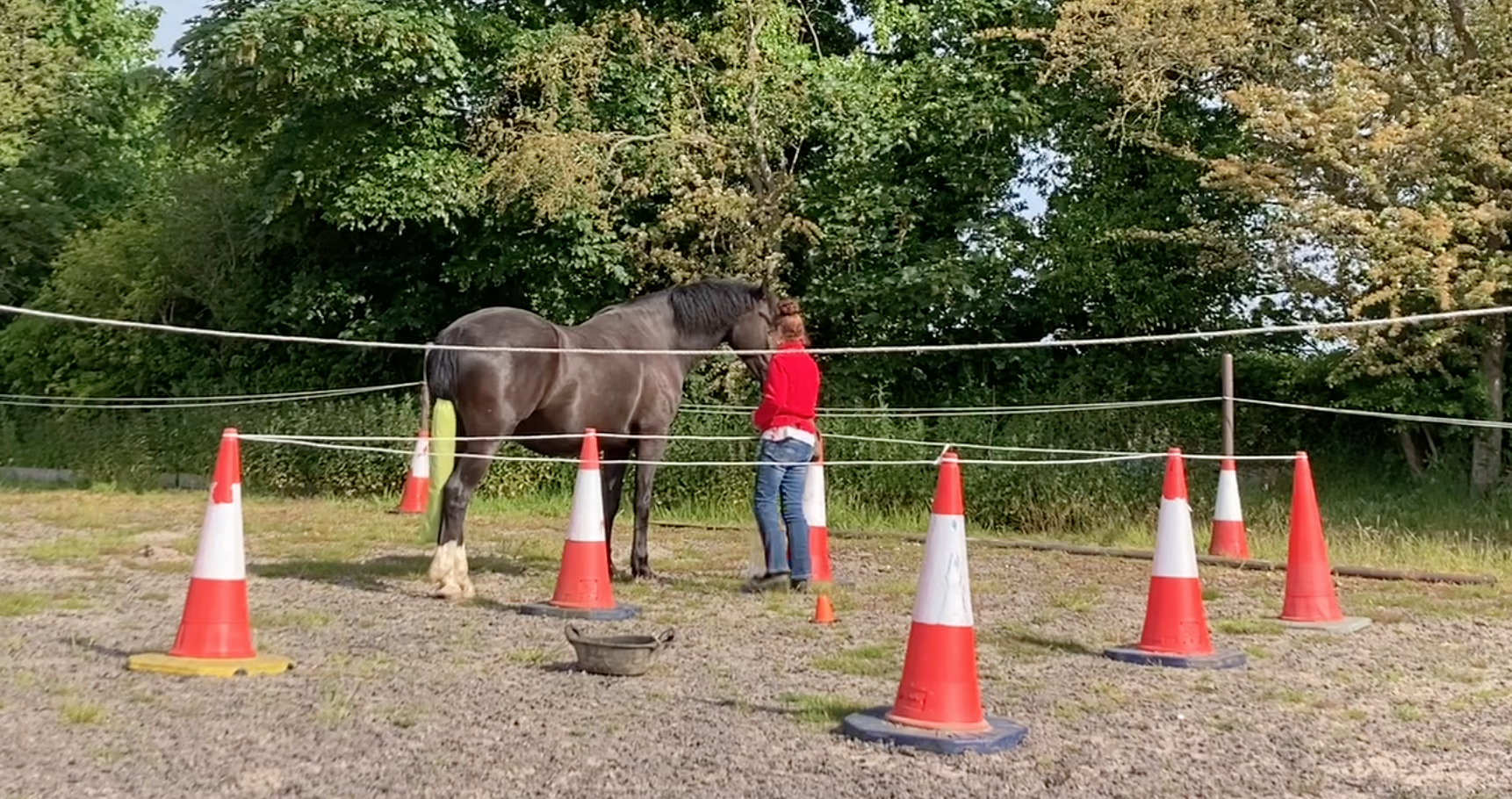
Part of good training is learning to use the environment well so you can set your horse up for success. Clicker training is going to introduce many new concepts, including one that may feel very foreign to both horses and handlers. Horses have choice. It is okay for horses to say “no”.
“No” is just information. It isn’t a rebellion or a sign of failure. It is just information. When your horse says “no” to something you have asked him to do, it means the lesson has become too hard or too confusing. He doesn’t understand what you want him to do. Getting to a “yes” answer means you need to make some adjustments. That may mean going back a few steps in your training to ask for a simpler step, or teaching a missing component skill, or changing the environment so it is less distracting. These changes will get you to a “yes, I understand that, I can do that” answer.
Horses that have been trained with commands have learned that they have few choices. “Well behaved” has come to mean they do what they are told. Safe, reliable horses are very much the goal of Modern Horse Training, but we want more than this. We want horses who participate because they want to, not because they have to.
When you begin with protective contact, you are saying to your horse: “This training is different. You have choice. I will listen to you, and I will adjust the training to meet your learning needs.”
If your horse walks away, the barrier means you can’t force him back into the game. He truly does have the choice just to walk away.
It is our job to make the lessons clear enough, interesting enough, reinforcing enough that our horses want to stay. Modern Horse Training means our horses truly do have a voice that is listened to.
Find me on Instagram at @alexandra.kurland.5
You can buy the new book, “Modern Horse Training”, through my web site: theclickercenter.com and from Amazon and other booksellers.
 The Clicker Center Blog